EP2196138A2 - Système et procédé destinés à la formation au stress d'un utilisateur - Google Patents
Système et procédé destinés à la formation au stress d'un utilisateur Download PDFInfo
- Publication number
- EP2196138A2 EP2196138A2 EP09014974A EP09014974A EP2196138A2 EP 2196138 A2 EP2196138 A2 EP 2196138A2 EP 09014974 A EP09014974 A EP 09014974A EP 09014974 A EP09014974 A EP 09014974A EP 2196138 A2 EP2196138 A2 EP 2196138A2
- Authority
- EP
- European Patent Office
- Prior art keywords
- user
- activation
- sensor
- data
- parameters
- Prior art date
- Legal status (The legal status is an assumption and is not a legal conclusion. Google has not performed a legal analysis and makes no representation as to the accuracy of the status listed.)
- Withdrawn
Links
Images


Classifications
-
- A—HUMAN NECESSITIES
- A61—MEDICAL OR VETERINARY SCIENCE; HYGIENE
- A61B—DIAGNOSIS; SURGERY; IDENTIFICATION
- A61B5/00—Measuring for diagnostic purposes; Identification of persons
- A61B5/48—Other medical applications
- A61B5/4884—Other medical applications inducing physiological or psychological stress, e.g. applications for stress testing
-
- A—HUMAN NECESSITIES
- A61—MEDICAL OR VETERINARY SCIENCE; HYGIENE
- A61B—DIAGNOSIS; SURGERY; IDENTIFICATION
- A61B5/00—Measuring for diagnostic purposes; Identification of persons
- A61B5/24—Detecting, measuring or recording bioelectric or biomagnetic signals of the body or parts thereof
- A61B5/316—Modalities, i.e. specific diagnostic methods
- A61B5/318—Heart-related electrical modalities, e.g. electrocardiography [ECG]
-
- A—HUMAN NECESSITIES
- A61—MEDICAL OR VETERINARY SCIENCE; HYGIENE
- A61B—DIAGNOSIS; SURGERY; IDENTIFICATION
- A61B5/00—Measuring for diagnostic purposes; Identification of persons
- A61B5/02—Detecting, measuring or recording for evaluating the cardiovascular system, e.g. pulse, heart rate, blood pressure or blood flow
- A61B5/0205—Simultaneously evaluating both cardiovascular conditions and different types of body conditions, e.g. heart and respiratory condition
-
- A—HUMAN NECESSITIES
- A61—MEDICAL OR VETERINARY SCIENCE; HYGIENE
- A61B—DIAGNOSIS; SURGERY; IDENTIFICATION
- A61B5/00—Measuring for diagnostic purposes; Identification of persons
- A61B5/02—Detecting, measuring or recording for evaluating the cardiovascular system, e.g. pulse, heart rate, blood pressure or blood flow
- A61B5/024—Measuring pulse rate or heart rate
- A61B5/02405—Determining heart rate variability
-
- A—HUMAN NECESSITIES
- A61—MEDICAL OR VETERINARY SCIENCE; HYGIENE
- A61B—DIAGNOSIS; SURGERY; IDENTIFICATION
- A61B5/00—Measuring for diagnostic purposes; Identification of persons
- A61B5/16—Devices for psychotechnics; Testing reaction times ; Devices for evaluating the psychological state
- A61B5/165—Evaluating the state of mind, e.g. depression, anxiety
-
- A—HUMAN NECESSITIES
- A61—MEDICAL OR VETERINARY SCIENCE; HYGIENE
- A61B—DIAGNOSIS; SURGERY; IDENTIFICATION
- A61B5/00—Measuring for diagnostic purposes; Identification of persons
- A61B5/48—Other medical applications
- A61B5/486—Biofeedback
-
- A—HUMAN NECESSITIES
- A61—MEDICAL OR VETERINARY SCIENCE; HYGIENE
- A61B—DIAGNOSIS; SURGERY; IDENTIFICATION
- A61B5/00—Measuring for diagnostic purposes; Identification of persons
- A61B5/68—Arrangements of detecting, measuring or recording means, e.g. sensors, in relation to patient
- A61B5/6801—Arrangements of detecting, measuring or recording means, e.g. sensors, in relation to patient specially adapted to be attached to or worn on the body surface
- A61B5/6802—Sensor mounted on worn items
- A61B5/6804—Garments; Clothes
- A61B5/6805—Vests, e.g. shirts or gowns
-
- A—HUMAN NECESSITIES
- A61—MEDICAL OR VETERINARY SCIENCE; HYGIENE
- A61B—DIAGNOSIS; SURGERY; IDENTIFICATION
- A61B5/00—Measuring for diagnostic purposes; Identification of persons
- A61B5/68—Arrangements of detecting, measuring or recording means, e.g. sensors, in relation to patient
- A61B5/6801—Arrangements of detecting, measuring or recording means, e.g. sensors, in relation to patient specially adapted to be attached to or worn on the body surface
- A61B5/6802—Sensor mounted on worn items
- A61B5/681—Wristwatch-type devices
-
- A—HUMAN NECESSITIES
- A61—MEDICAL OR VETERINARY SCIENCE; HYGIENE
- A61B—DIAGNOSIS; SURGERY; IDENTIFICATION
- A61B5/00—Measuring for diagnostic purposes; Identification of persons
- A61B5/68—Arrangements of detecting, measuring or recording means, e.g. sensors, in relation to patient
- A61B5/6801—Arrangements of detecting, measuring or recording means, e.g. sensors, in relation to patient specially adapted to be attached to or worn on the body surface
- A61B5/683—Means for maintaining contact with the body
- A61B5/6831—Straps, bands or harnesses
-
- A—HUMAN NECESSITIES
- A61—MEDICAL OR VETERINARY SCIENCE; HYGIENE
- A61B—DIAGNOSIS; SURGERY; IDENTIFICATION
- A61B2562/00—Details of sensors; Constructional details of sensor housings or probes; Accessories for sensors
- A61B2562/02—Details of sensors specially adapted for in-vivo measurements
- A61B2562/0219—Inertial sensors, e.g. accelerometers, gyroscopes, tilt switches
-
- A—HUMAN NECESSITIES
- A61—MEDICAL OR VETERINARY SCIENCE; HYGIENE
- A61B—DIAGNOSIS; SURGERY; IDENTIFICATION
- A61B5/00—Measuring for diagnostic purposes; Identification of persons
- A61B5/08—Measuring devices for evaluating the respiratory organs
Definitions
- the invention relates to a system for stress training a user with a sensor device, a signal processing device and at least one signaling unit and a corresponding method.
- variable stress is understood in two ways: on the one hand as a distress of the stimuli that an individual perceives as negative, overburdening, threatening, etc., and as eustress in the form of stimuli that are interpreted as positive or experienced.
- the psychophysiological activation of an individual can be in different areas, in addition to an optimal, possibly also situation-dependent optimal state, hyperactivation is possible.
- a hyperdeactivation is to be distinguished, which includes a relaxation, sleep and exhaustion and can be considered optimal in rest periods, but not in times when active activity is required and is considered negative in these.
- the invention aims to determine the psychophysiological activation by measuring physiological parameters
- these include effects that are due to a subjective assessment.
- the WO 2006/113900 A2 shows a hand-portable biofeedback device by means of which RSA waves (waves of respiratory sinus arrhythmia) are detected.
- RSA waves waves of respiratory sinus arrhythmia
- the high point of the heart rate during inhalation, the so-called RSA pressure point is returned to the user, so that he can adjust his breathing accordingly.
- the disadvantage is that for carrying out the method, the attention of the user is required. The stress as such is not measured and detected, so that the user can not be given any indication of the interruption of stress situations.
- a further disadvantage is that the device, in that it must be carried in the hand, affects the user.
- the WO 2006/082565 A1 relates to the arrangement of sensors for detecting physiological parameters incorporated in textiles. With this device the stress level of a person can be determined and a corresponding feedback can be returned. A statement about the signal processing and the determination of the stress level itself is not disclosed.
- the DE 2002 2905 U1 describes a miniaturized sensor device for monitoring the disstress Eustress relaxation function (well-being) of a person who works on the principle of biofeedback and continuously measures vital parameters by means of sensors.
- the sensor device may preferably be incorporated in skin-contacting articles, such as a wristwatch, and informs the user of its state of stress. No statement is made about the signal processing.
- the invention has for its object to provide a system and a method for stress training of a user, by means of which a user can achieve a psychophysiological degree of activation in an optimal range.
- the object is achieved with a system of the type mentioned above, which is characterized in that the signal processing device is designed to determine a value for the user's stress from at least one parameter correlated with the psychophysiological activation of the user and that the signaling unit for Task of a response to the user is formed when exceeding or falling below defined thresholds of activation.
- a method according to the invention for achieving the stated object provides that the signal processing device is designed to determine a value for the user's stress from at least one parameter correlated with the psychophysiological activation of the user and that the signaling unit is responsible for giving feedback to the user Above or below defined thresholds of activation is formed.
- Preferred developments of the method according to the invention provide that feature parameters are extracted from measured sensor data, from which parameter data are generated are determined on the basis of which at least one output parameter, in particular the extraction of the feature parameters, the calculation of the parameter data, the calculation of the output parameters is multi-level.
- At least two sensor data, at least two feature parameters in the determination of parameter data and / or at least two parameter data in the determination of output parameters are included in the determination of a feature parameter as sensor data, e.g. ECG, respiration and / or acceleration of the user are measured and that from the sensor data as feature parameters, e.g. Heart rate, respiratory rate, energy expenditure, activity level, RR intervals (time intervals of the R-waves in the ECG), activity classes, muscle tone and phasic and tonic values of the electrodermal activity (EDA) are extracted.
- ECG electrodermal activity
- At least one parameter correlating with the psychophysiological activation of heart rate variability (HRV), respiratory sinus arrhythmia (RSA) and / or additional heart rate (AHR) is determined as parameter data.
- a preferred embodiment of the system according to the invention provides that the sensor device in a conventional manner on the body is portable, and in particular as a chest belt, belt, top or can be designed as a wristwatch.
- the sensor device can be switched on and off automatically depending on the context, in particular by Applying or removing in the form of closing the chest belt, by body heat, in presence or absence of vital signs, by monitoring the potential difference of two electrodes, by turning on movement and shutdown in complete rest.
- the sensor device may have different sensors within the system, it may be provided in particular that the sensors of the sensor device in at least two as ECG (electrocardiogram), EMG (electromyogram), EDA, respiratory, pulse -, activity, movement, position, temperature and / or humidity sensor are formed.
- the sensor device is wirelessly connected to the signal processing device, wherein in particular the signal processing means are designed as a smartphone, PC and / or clock and further at least one of the signal processing means at least temporarily wireless or wired via the Internet with a web application is connected, so that the sensor device itself is at least temporarily directly connectable via a wireless signal connection to the Internet and thus context information from external data sources are available.
- the signal processing means are designed as a smartphone, PC and / or clock and further at least one of the signal processing means at least temporarily wireless or wired via the Internet with a web application is connected, so that the sensor device itself is at least temporarily directly connectable via a wireless signal connection to the Internet and thus context information from external data sources are available.
- the signaling unit may also be designed differently in the context of the system, thus as an optically indicating signaling unit, but preferred embodiments provide that the signaling unit, which gives a feedback to the user, tactile is designed as a vibration alarm and / or as an acoustic signaling unit.
- the sensor device has an input device (eg push button) by means of which measurement data markings for events can be assigned and in that the input device permits inputs by means of an acceleration sensor by tapping the system.
- an input device eg push button
- the sensor system is furthermore designed such that the sensor device is designed to determine at least one value for chronic stress and the balance of different activation ranges of a user (balance between overactivation and underactivation with respect to duration and intensity) in particular an internal data memory of the sensor device for storing detected sensor data and / or further parameters calculated therefrom and the sensor system using a signal connection the stored data, as well current sensor data, feature parameters, parameter data and / or output parameters in real time, certain time intervals and / or availability of the Signal connection to the signal processing device transmits.
- the invention provides in a further embodiment that the sensor device is configurable, in particular personal data, a time profile of the desired periods for activation or situation interruption of a stress situation and personal activation values or trigger delays are adjustable.
- the options activation and situation interruption of a stress situation can be activated or deactivated manually, wherein in particular the sensor device can be calibrated individually, in particular by determining calibration values on the basis of properties of the user from a database, on the other hand during a certain period of wear Behavior of the user is analyzed, ie explicitly sleep or sleep phases detected and calculated from the comparison to active phases of the user a baseline for individual feature parameters and parameter data.
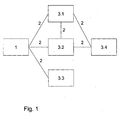
- the Fig. 1 shows a schematic representation of the components of the device according to the invention.
- a sensor device 1 is connected to at least one signal processing device 3 by means of signal connections 2, which may be wireless or wire connections.
- the sensor device 1 is formed in the preferred embodiment as a chest belt. It serves as a direct measuring instrument of certain vital parameters of user 4 ( Fig. 2 ), such as the heartbeat or breathing.
- the measured data are stored internally in the sensor device 1 and with the aid of the method according to the invention of the multi-stage algorithm, which is described below Fig. 3 is explained in more detail, evaluated.
- an active feedback is triggered to the user 4.
- the output parameters and other functionalities of the sensor system 1 can be visualized, stored and further processed.
- the user 4 can not only read the sensor system 1 by means of the signal processing device 3, but also remotely controlled operate to set or change personal data, active feedback time delay, additional sensor system 1 information, a psychophysiological activation time profile, and the psychophysiological activation upper and lower thresholds, respectively.
- the clock 3.3 has compared to the smartphone 3.1 or the PC 3.2 reduced functionality by the clock 3.3 only simple controls are formed.
- the sensor system 1 Connected, the sensor system 1 with one of the signal processing means 3 via a signal connection 2.
- a signal connection 2 such as Bluetooth, realized.
- the signal connection 2 of the sensor device 1 to the PC 3.2 can, in addition to Bluetooth and / or WLAN optionally also via a wire-connected signal connection, e.g. USB, be trained.
- Signal connections between the signal processing device 3 and a web application 3.4 on the Internet allow data exchange to electronic diaries, other users, a database and / or give access to context information from the Internet, such. current weather data that can be transmitted directly to the sensor device 1 via one of the signal processing devices 3.
- the sensor device 1 can also be used to set up a direct, wireless signal connection 2 to a web application 3.4.
- FIG. 2 are the components of the sensor system 1 with respect to the user 4, in FIG Fig. 2 drawn as a stick figure, shown in a schematic diagram.
- the components of the sensor device are next to at least one Sensor 1.1, a signaling unit 1.2, a signal processing 1.3, which is followed by a memory 1.4 via a telemetry 1.5 connected to the signal processing device 3.
- the sensor 1.1 receives data of the user 4 by measuring the vital parameters, eg respiration, acceleration or the ECG of the user 4, whereby at least one sensor 1.1 is provided for each vital parameter, and transfers the data further to the signal processor 1.3, which is the multi-stage invention Contains algorithm, which is further down in Fig. 4 is explained in more detail.
- a signaling unit 1.2 serves as a signal generator for the user 4 and, depending on the calculated output values from the signal processing 1.3, an active feedback to the user 4.
- the preferred embodiment is a tactile situation interruption in the form of a vibration generator, which informs the user 4 by vibration ,
- a user himself also has the option to operate the sensor device 1 directly by simple contact, single or multiple tapping of the device or with the aid of a signal processing device 3 and in this course to set so-called "markers".
- These address specific stress situations or certain controls of the sensor device, e.g. an activation of a certain delay time or the tactile situation interruption.
- the calculated output values from the signal processing 1.3 are stored internally in the sensor system 1 in a memory 1.4.
- the telemetry 1.5 continues to be a data transmission over the signal connections 2 to at least one of the signal processing device 3 to the other Evaluation made in Fig. 2 for better distinction and for identification that this is not directly integrated in the embodiment of the sensor system 1, is shown in dashed lines.
- the telemetry 1.5 also allows the reverse variant that data from the signal processing device 3 are transmitted to the signal processing 1.3 to provide the signal processing 1.3 special context information or changed presets available.
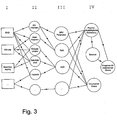
- Fig. 3 an embodiment of the multi-stage method according to the invention of the signal processing 1.3 is shown.
- first of all certain feature data II are extracted, from which defined parameter data III are calculated, which are decisive for the output parameters IV.
- both the extraction of the feature data II, the calculation of the parameter data III, as well as the calculation of the output values IV can be designed multi-level, in which case at least two calculation stages find their application.
- various vital parameters of the user 4 are measured in the form of sensor data I using the sensors 1.1 of the sensor system 1, which in the exemplary embodiment include the parameters respiration, body acceleration and a measurement of an electrocardiogram (ECG).
- ECG electrocardiogram
- the preferred feature data II is extracted from the sensor data I and stored.
- This first calculation stage is used in the embodiment in particular from the measurement of the ECG, the RR intervals, the respiratory rate, the energy conversion, the activity level and the heart rate from the previously measured
- the same feature parameters II can be extracted from various sensor data I, eg the energy expenditure is extracted from the sensor data I of the ECG, the breathing and the acceleration; this makes it clear that a very accurate determination of the feature parameter II is possible.
- parameter data III such as heart rate variability (HRV), respiratory sinus arrhythmia (RSA) and additional heart rate (AHR)
- HRV heart rate variability
- RSA respiratory sinus arrhythmia
- AHR additional heart rate
- the parameter data III are then further used in a third calculation stage to calculate the actual output parameters IV in the form of the psychophysiological activation and the balance of the different activation areas of the user 4 by means of a final calculation for the time being.
- the values of the psychophysiological activation and the chronic stress of the user 4 are then calculated directly from the parameter data III, and the balance of the different activation ranges, ie the balance between overactivation and underactivation, is determined from the psychophysiological activation.
- a prognosis for the expected chronic stress in the future is estimated.
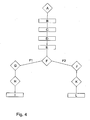
- step A an inquiry takes place as to whether the sensor device 1, in the preferred embodiment with the chest belt, has been applied by the user 4. If the query is answered in the affirmative, the sensor system 1 switches on and starts the acquisition of the sensor data I in step B, whereby besides the already mentioned human vitality characteristics, such as cardiac activity, respiration and acceleration, further data, such as body temperature, position of the user 4, etc., can be detected by corresponding sensors 1.1.
- human vitality characteristics such as cardiac activity, respiration and acceleration
- further data such as body temperature, position of the user 4, etc.
- Step C describes the extraction and storage of the feature data II from the sensor data I, whereby a variety of features can be calculated from some sensor data in the combination, such as the energy conversion from the extracted sensor data of acceleration, respiration and ECG composed (see Fig. 3 ).
- the second calculation stage of the multi-stage algorithm according to the invention begins by calculating from the feature data the parameter data III which provide the essential data for the calculation of the psychophysiological activation and also storing it. From this, the corresponding output parameters IV for the psychophysiological activation are calculated, stored and output in step E in the third calculation stage.
- step F a query is made as to whether the predetermined threshold value of the upper limit for the psychophysiological activation (F1) has been exceeded or whether the predetermined threshold value of the lower limit for the psychophysiological activation has been undershot (F2). If query possibility F1, ie the exceeding of the upper limit of the psychophysiological activation threshold, a query is made by step G if an interruption mode has been activated by the user 4 and follows in positive feedback step H, in which again a query occurs, which is checked, whether a preset delay time has been adhered to which, if affirmative by means of step I, results in an active interruption of the stress situation by a vibration signal.
- step I the lower limit for the psychophysiological activation is undershot (F2)
- step J the sequence of further events of steps J, K and L follows.
- Inquiry J is inquired whether the activation mode for activation of the user 4 is activated , If the previous step J is affirmative, it is again checked in the following step K whether the delay time has been maintained and, if the result is adequate, the active feedback in step L is given to the user 4 by activation of the user 4 by a vibration signal.
- FIG. 5 the calibration of the device according to the invention and of the method according to the invention is shown in a schematically sketched flowchart, beginning with the installation of the required software via the creation of a user profile for the calibration of the Signal processing 1.3 for the multi-stage algorithm according to the invention.
- a first step M designates the necessary installation of the operating software by the user 4 in a signal processing device 3, which in a preferred embodiment is a PC 3.2.
- the user 4 sets up a user profile containing the most important personal data such as height, age, weight, sex, training state and normal resting pulse of the user 4.
- step O the sensor system 1 is applied as a chest strap in the preferred embodiment and worn for a certain period of time, eg a week, to record in this period the most important parameters needed as basic values for the signal processing 1.3, the actual calibration of the Signal processing 1.3 is divided into the following steps 01 - 03.
- step O1 various functionalities are set, which can also be changed during operation of the device according to the invention.
- the threshold values of the upper and lower limits of the psychophysiological activation can be adjusted as desired, time profiles for active or resting phases can be set and the tactile feedback can be switched on or off.
- the rest or sleep phases are determined within the calibration period, wherein the determination of the load limits, for example, by performing a normalized stress test.
- average values within such a rest phase are determined for the corresponding parameter data, which then serve as a so-called baseline for the respective parameter data or characteristic data.
- the values of the calibration are then available in a database in a signal processing device 3 and internally stored in the sensor system 1 of the signal processing 1.3.
- the calibration of the sensor system 1 proceeds in a partially or fully automatic manner, so that the operation of the sensor device 1 is as simple as possible.
- the inventive method of the multi-stage algorithm within the device of the sensor system according to the invention in the preferred embodiment as a chest belt with integrated sensor and Auswertystem for calculating and storing the psychophysiological activation, the balance different activation areas and the determination of chronic stress and active feedback by means of a tactile situation interruption of the user.
Landscapes
- Health & Medical Sciences (AREA)
- Life Sciences & Earth Sciences (AREA)
- Engineering & Computer Science (AREA)
- Animal Behavior & Ethology (AREA)
- Public Health (AREA)
- Pathology (AREA)
- Physics & Mathematics (AREA)
- Biomedical Technology (AREA)
- Heart & Thoracic Surgery (AREA)
- Medical Informatics (AREA)
- Molecular Biology (AREA)
- Surgery (AREA)
- Veterinary Medicine (AREA)
- General Health & Medical Sciences (AREA)
- Biophysics (AREA)
- Cardiology (AREA)
- Physiology (AREA)
- Psychiatry (AREA)
- Child & Adolescent Psychology (AREA)
- Developmental Disabilities (AREA)
- Hospice & Palliative Care (AREA)
- Psychology (AREA)
- Social Psychology (AREA)
- Pulmonology (AREA)
- Educational Technology (AREA)
- Biodiversity & Conservation Biology (AREA)
- Measurement Of The Respiration, Hearing Ability, Form, And Blood Characteristics Of Living Organisms (AREA)
Applications Claiming Priority (1)
| Application Number | Priority Date | Filing Date | Title |
|---|---|---|---|
| DE102008061997A DE102008061997A1 (de) | 2008-12-12 | 2008-12-12 | System und Verfahren zum Stresstraining eines Benutzers |
Publications (2)
| Publication Number | Publication Date |
|---|---|
| EP2196138A2 true EP2196138A2 (fr) | 2010-06-16 |
| EP2196138A3 EP2196138A3 (fr) | 2010-07-07 |
Family
ID=42126497
Family Applications (1)
| Application Number | Title | Priority Date | Filing Date |
|---|---|---|---|
| EP09014974A Withdrawn EP2196138A3 (fr) | 2008-12-12 | 2009-12-03 | Système et procédé destinés à la formation au stress d'un utilisateur |
Country Status (2)
| Country | Link |
|---|---|
| EP (1) | EP2196138A3 (fr) |
| DE (1) | DE102008061997A1 (fr) |
Cited By (8)
| Publication number | Priority date | Publication date | Assignee | Title |
|---|---|---|---|---|
| EP2698112A1 (fr) * | 2012-08-13 | 2014-02-19 | Tata Consultancy Services Limited | Détermination de contraintes en temps réel d'un individu |
| WO2014105999A1 (fr) * | 2012-12-31 | 2014-07-03 | Microsoft Corporation | Dispositif actionné par l'humeur |
| US20140288401A1 (en) * | 2011-11-22 | 2014-09-25 | Koninklijke Philips N.V. | Mental balance or imbalance estimation system and method |
| CN104224124A (zh) * | 2014-09-15 | 2014-12-24 | 北京智谷技术服务有限公司 | 肢体内外侧识别方法和设备 |
| US9104231B2 (en) | 2012-09-27 | 2015-08-11 | Microsoft Technology Licensing, Llc | Mood-actuated device |
| WO2016124742A1 (fr) * | 2015-02-07 | 2016-08-11 | Pauseable Aps | Procédé et système de relaxation et d'entretien de l'attention |
| CN109846499A (zh) * | 2019-04-10 | 2019-06-07 | 麻师宇 | 基于智能穿戴设备的生物反馈方法及系统 |
| CN116129704A (zh) * | 2022-12-24 | 2023-05-16 | 北京千种幻影科技有限公司 | 驾驶模拟训练方法、电子设备及存储介质 |
Families Citing this family (1)
| Publication number | Priority date | Publication date | Assignee | Title |
|---|---|---|---|---|
| DE102012012206A1 (de) * | 2012-06-21 | 2013-12-24 | Ronald Weiss | Monitoringsystem und Verfahren zur Bestimmung von Aufmerksamkeits- und/oder Aktivitätsstörungen |
Citations (1)
| Publication number | Priority date | Publication date | Assignee | Title |
|---|---|---|---|---|
| US20080146890A1 (en) * | 2006-12-19 | 2008-06-19 | Valencell, Inc. | Telemetric apparatus for health and environmental monitoring |
Family Cites Families (13)
| Publication number | Priority date | Publication date | Assignee | Title |
|---|---|---|---|---|
| US4331154A (en) * | 1979-10-15 | 1982-05-25 | Tech Engineering & Design | Blood pressure and heart rate measuring watch |
| US20060122474A1 (en) * | 2000-06-16 | 2006-06-08 | Bodymedia, Inc. | Apparatus for monitoring health, wellness and fitness |
| DE20022905U1 (de) | 2000-11-10 | 2002-06-20 | Hecht, Karl, Prof.em. Prof. Dr.med., 12527 Berlin | Miniaturanordnung zur Integration in mit der Haut in Kontakt stehende Gebrauchsgegenstände und -vorrichtungen |
| KR100463018B1 (ko) * | 2002-05-17 | 2004-12-23 | 생체계측신기술연구센터 | 전자파센서 내장형 휴대용 에이치알브이 건강모니터링시스템 |
| FI20025039A0 (fi) * | 2002-08-16 | 2002-08-16 | Joni Kettunen | Menetelmä II fysiologisen signaalin analysoimiseksi |
| KR100519758B1 (ko) * | 2003-01-22 | 2005-10-07 | 삼성전자주식회사 | 용적맥파를 이용한 인체 안정도 평가방법 및 장치 |
| US20050154264A1 (en) * | 2004-01-08 | 2005-07-14 | International Business Machines Corporation | Personal stress level monitor and systems and methods for using same |
| CN101115438B (zh) | 2005-02-07 | 2010-06-16 | 皇家飞利浦电子股份有限公司 | 用于判定人的应力水平并基于所判定的应力水平提供反馈的装置 |
| CA2599148A1 (fr) * | 2005-02-22 | 2006-08-31 | Health-Smart Limited | Methodes et systemes de controle psychophysiologique et physiologique ainsi que leurs utilisations |
| US8002711B2 (en) * | 2005-03-18 | 2011-08-23 | Respironics, Inc. | Methods and devices for relieving stress |
| US7635337B2 (en) * | 2005-03-24 | 2009-12-22 | Ge Healthcare Finland Oy | Determination of clinical stress of a subject in pulse oximetry |
| CA2604741C (fr) | 2005-04-20 | 2014-11-25 | Helicor, Inc. | Procedes et dispositifs de soulagement du stress |
| JP2010518914A (ja) * | 2007-02-16 | 2010-06-03 | ヴィロ・ゲームス・リミテッド | バイオセンサ・デバイス及び方法 |
-
2008
- 2008-12-12 DE DE102008061997A patent/DE102008061997A1/de not_active Ceased
-
2009
- 2009-12-03 EP EP09014974A patent/EP2196138A3/fr not_active Withdrawn
Patent Citations (1)
| Publication number | Priority date | Publication date | Assignee | Title |
|---|---|---|---|---|
| US20080146890A1 (en) * | 2006-12-19 | 2008-06-19 | Valencell, Inc. | Telemetric apparatus for health and environmental monitoring |
Cited By (13)
| Publication number | Priority date | Publication date | Assignee | Title |
|---|---|---|---|---|
| US10085695B2 (en) * | 2011-11-22 | 2018-10-02 | Koninklijke Philips N.V. | Mental balance or imbalance estimation system and method |
| US20140288401A1 (en) * | 2011-11-22 | 2014-09-25 | Koninklijke Philips N.V. | Mental balance or imbalance estimation system and method |
| EP2698112A1 (fr) * | 2012-08-13 | 2014-02-19 | Tata Consultancy Services Limited | Détermination de contraintes en temps réel d'un individu |
| US9104231B2 (en) | 2012-09-27 | 2015-08-11 | Microsoft Technology Licensing, Llc | Mood-actuated device |
| CN105208919A (zh) * | 2012-12-31 | 2015-12-30 | 微软技术许可有限责任公司 | 情绪驱动的设备 |
| US9046884B2 (en) | 2012-12-31 | 2015-06-02 | Microsoft Technology Licensing, Llc | Mood-actuated device |
| WO2014105999A1 (fr) * | 2012-12-31 | 2014-07-03 | Microsoft Corporation | Dispositif actionné par l'humeur |
| CN104224124A (zh) * | 2014-09-15 | 2014-12-24 | 北京智谷技术服务有限公司 | 肢体内外侧识别方法和设备 |
| WO2016124742A1 (fr) * | 2015-02-07 | 2016-08-11 | Pauseable Aps | Procédé et système de relaxation et d'entretien de l'attention |
| CN107427225A (zh) * | 2015-02-07 | 2017-12-01 | 波斯埃布尔公司 | 用于放松和培养注意力的方法和系统 |
| US10799665B2 (en) | 2015-02-07 | 2020-10-13 | Pauseable Aps | System for tracking motion of a device |
| CN109846499A (zh) * | 2019-04-10 | 2019-06-07 | 麻师宇 | 基于智能穿戴设备的生物反馈方法及系统 |
| CN116129704A (zh) * | 2022-12-24 | 2023-05-16 | 北京千种幻影科技有限公司 | 驾驶模拟训练方法、电子设备及存储介质 |
Also Published As
| Publication number | Publication date |
|---|---|
| EP2196138A3 (fr) | 2010-07-07 |
| DE102008061997A1 (de) | 2010-06-17 |
Similar Documents
| Publication | Publication Date | Title |
|---|---|---|
| EP2196138A2 (fr) | Système et procédé destinés à la formation au stress d'un utilisateur | |
| DE69728031T2 (de) | Organismuszustandsmessgerät und entspannungszustandsangabegerät | |
| DE102018107633B4 (de) | Schlaganfallüberwachungssystem | |
| EP1230894B1 (fr) | Dispositif, méthode et programme d'ordinateur pour mesurer l'activité physique et physiologique d'un patient et pour l'évaluation de l'état psychosomatique de cette personne | |
| DE69831026T2 (de) | Nicht-Invasive Messvorrichtung mit verschiedenen Betriebsarten | |
| EP2164386B1 (fr) | Dispositif et procédé de prédiction d'une perte de contrôle sur un muscle | |
| EP0959956B1 (fr) | Systeme de surveillance de patient | |
| DE112018003005T5 (de) | Ermüdungserholungsunterstützungsvorrichtung | |
| EP2916724A1 (fr) | Procédé et dispositif de détermination de paramètres vitaux | |
| DE202013000110U1 (de) | Echtzeitübungs-Coachingsystem | |
| DE112014004760T5 (de) | Vitalsignal-Messapparat und Verfahren zum Schätzen einer Kontaktbedingung | |
| EP3518757A1 (fr) | Surveillance de signaux biologiques, en particulier d'électrocardiogrammes | |
| EP3116381A1 (fr) | Système permettant de déterminer les paramètres vitaux | |
| EP1768449A1 (fr) | Méthode pour ajustage d'un dispositif auditif basé sur des données biométriques | |
| WO2018202606A1 (fr) | Identification de troubles du rythme cardiaque | |
| DE102015122645B3 (de) | Risikoblutdruckmonitor zur adaptiven Überwachung des arteriellen Blutdrucks | |
| EP2393561B1 (fr) | Indicateur de cycle respiratoire portatif | |
| EP3562383B1 (fr) | Dispositif, système et procédé pour produire un biofeedback | |
| DE102005003678A1 (de) | Vorrichtung und Verfahren zur Messung und Beeinflussung des Blutdrucks und der Herzratenvariabilität | |
| DE10233149A1 (de) | Digitales, elektronisches Diagnose-Verfahren und Meßeinrichtung zu seiner Durchführung | |
| DE10243265A1 (de) | Bioelektrischer Herzdiagnostikhandschuh | |
| EP3446625B1 (fr) | Utilisation d'un dispositif de signal pour determiner une demande de cathétérisme | |
| EP4437971A1 (fr) | Procédé de détermination de maladie mentale, programme, appareil de détermination de maladie mentale et système de détermination de maladie mentale | |
| DE20022905U1 (de) | Miniaturanordnung zur Integration in mit der Haut in Kontakt stehende Gebrauchsgegenstände und -vorrichtungen | |
| DE202019000434U1 (de) | Biofeedbacksystem zur Verwendung in einem Verfahren zur Prävention, Diagnose und Therapie von Stress und kognitivem Leistungsabfall bedingt durch der Unterhaltung, Kommunikation und Datenverarbeitung dienenden elektronischen Bildschirmgeräten |
Legal Events
| Date | Code | Title | Description |
|---|---|---|---|
| PUAI | Public reference made under article 153(3) epc to a published international application that has entered the european phase |
Free format text: ORIGINAL CODE: 0009012 |
|
| PUAL | Search report despatched |
Free format text: ORIGINAL CODE: 0009013 |
|
| 17P | Request for examination filed |
Effective date: 20091221 |
|
| AK | Designated contracting states |
Kind code of ref document: A2 Designated state(s): AT BE BG CH CY CZ DE DK EE ES FI FR GB GR HR HU IE IS IT LI LT LU LV MC MK MT NL NO PL PT RO SE SI SK SM TR |
|
| AX | Request for extension of the european patent |
Extension state: AL BA RS |
|
| AK | Designated contracting states |
Kind code of ref document: A3 Designated state(s): AT BE BG CH CY CZ DE DK EE ES FI FR GB GR HR HU IE IS IT LI LT LU LV MC MK MT NL NO PL PT RO SE SI SK SM TR |
|
| AX | Request for extension of the european patent |
Extension state: AL BA RS |
|
| 17Q | First examination report despatched |
Effective date: 20160226 |
|
| STAA | Information on the status of an ep patent application or granted ep patent |
Free format text: STATUS: THE APPLICATION IS DEEMED TO BE WITHDRAWN |
|
| 18D | Application deemed to be withdrawn |
Effective date: 20160708 |