EP2196322B1 - Elément de sécurité - Google Patents
Elément de sécurité Download PDFInfo
- Publication number
- EP2196322B1 EP2196322B1 EP09015216.6A EP09015216A EP2196322B1 EP 2196322 B1 EP2196322 B1 EP 2196322B1 EP 09015216 A EP09015216 A EP 09015216A EP 2196322 B1 EP2196322 B1 EP 2196322B1
- Authority
- EP
- European Patent Office
- Prior art keywords
- layer
- liquid crystal
- lacquer
- security element
- security
- Prior art date
- Legal status (The legal status is an assumption and is not a legal conclusion. Google has not performed a legal analysis and makes no representation as to the accuracy of the status listed.)
- Revoked
Links
Images
Classifications
-
- B—PERFORMING OPERATIONS; TRANSPORTING
- B42—BOOKBINDING; ALBUMS; FILES; SPECIAL PRINTED MATTER
- B42D—BOOKS; BOOK COVERS; LOOSE LEAVES; PRINTED MATTER CHARACTERISED BY IDENTIFICATION OR SECURITY FEATURES; PRINTED MATTER OF SPECIAL FORMAT OR STYLE NOT OTHERWISE PROVIDED FOR; DEVICES FOR USE THEREWITH AND NOT OTHERWISE PROVIDED FOR; MOVABLE-STRIP WRITING OR READING APPARATUS
- B42D25/00—Information-bearing cards or sheet-like structures characterised by identification or security features; Manufacture thereof
- B42D25/30—Identification or security features, e.g. for preventing forgery
- B42D25/36—Identification or security features, e.g. for preventing forgery comprising special materials
- B42D25/364—Liquid crystals
-
- B—PERFORMING OPERATIONS; TRANSPORTING
- B42—BOOKBINDING; ALBUMS; FILES; SPECIAL PRINTED MATTER
- B42D—BOOKS; BOOK COVERS; LOOSE LEAVES; PRINTED MATTER CHARACTERISED BY IDENTIFICATION OR SECURITY FEATURES; PRINTED MATTER OF SPECIAL FORMAT OR STYLE NOT OTHERWISE PROVIDED FOR; DEVICES FOR USE THEREWITH AND NOT OTHERWISE PROVIDED FOR; MOVABLE-STRIP WRITING OR READING APPARATUS
- B42D25/00—Information-bearing cards or sheet-like structures characterised by identification or security features; Manufacture thereof
-
- B—PERFORMING OPERATIONS; TRANSPORTING
- B42—BOOKBINDING; ALBUMS; FILES; SPECIAL PRINTED MATTER
- B42D—BOOKS; BOOK COVERS; LOOSE LEAVES; PRINTED MATTER CHARACTERISED BY IDENTIFICATION OR SECURITY FEATURES; PRINTED MATTER OF SPECIAL FORMAT OR STYLE NOT OTHERWISE PROVIDED FOR; DEVICES FOR USE THEREWITH AND NOT OTHERWISE PROVIDED FOR; MOVABLE-STRIP WRITING OR READING APPARATUS
- B42D25/00—Information-bearing cards or sheet-like structures characterised by identification or security features; Manufacture thereof
- B42D25/20—Information-bearing cards or sheet-like structures characterised by identification or security features; Manufacture thereof characterised by a particular use or purpose
- B42D25/29—Securities; Bank notes
-
- B—PERFORMING OPERATIONS; TRANSPORTING
- B42—BOOKBINDING; ALBUMS; FILES; SPECIAL PRINTED MATTER
- B42D—BOOKS; BOOK COVERS; LOOSE LEAVES; PRINTED MATTER CHARACTERISED BY IDENTIFICATION OR SECURITY FEATURES; PRINTED MATTER OF SPECIAL FORMAT OR STYLE NOT OTHERWISE PROVIDED FOR; DEVICES FOR USE THEREWITH AND NOT OTHERWISE PROVIDED FOR; MOVABLE-STRIP WRITING OR READING APPARATUS
- B42D25/00—Information-bearing cards or sheet-like structures characterised by identification or security features; Manufacture thereof
- B42D25/30—Identification or security features, e.g. for preventing forgery
- B42D25/355—Security threads
-
- B—PERFORMING OPERATIONS; TRANSPORTING
- B42—BOOKBINDING; ALBUMS; FILES; SPECIAL PRINTED MATTER
- B42D—BOOKS; BOOK COVERS; LOOSE LEAVES; PRINTED MATTER CHARACTERISED BY IDENTIFICATION OR SECURITY FEATURES; PRINTED MATTER OF SPECIAL FORMAT OR STYLE NOT OTHERWISE PROVIDED FOR; DEVICES FOR USE THEREWITH AND NOT OTHERWISE PROVIDED FOR; MOVABLE-STRIP WRITING OR READING APPARATUS
- B42D25/00—Information-bearing cards or sheet-like structures characterised by identification or security features; Manufacture thereof
- B42D25/40—Manufacture
- B42D25/45—Associating two or more layers
-
- C—CHEMISTRY; METALLURGY
- C08—ORGANIC MACROMOLECULAR COMPOUNDS; THEIR PREPARATION OR CHEMICAL WORKING-UP; COMPOSITIONS BASED THEREON
- C08J—WORKING-UP; GENERAL PROCESSES OF COMPOUNDING; AFTER-TREATMENT NOT COVERED BY SUBCLASSES C08B, C08C, C08F, C08G or C08H
- C08J7/00—Chemical treatment or coating of shaped articles made of macromolecular substances
- C08J7/04—Coating
- C08J7/042—Coating with two or more layers, where at least one layer of a composition contains a polymer binder
-
- C—CHEMISTRY; METALLURGY
- C08—ORGANIC MACROMOLECULAR COMPOUNDS; THEIR PREPARATION OR CHEMICAL WORKING-UP; COMPOSITIONS BASED THEREON
- C08J—WORKING-UP; GENERAL PROCESSES OF COMPOUNDING; AFTER-TREATMENT NOT COVERED BY SUBCLASSES C08B, C08C, C08F, C08G or C08H
- C08J7/00—Chemical treatment or coating of shaped articles made of macromolecular substances
- C08J7/04—Coating
- C08J7/043—Improving the adhesiveness of the coatings per se, e.g. forming primers
-
- C—CHEMISTRY; METALLURGY
- C08—ORGANIC MACROMOLECULAR COMPOUNDS; THEIR PREPARATION OR CHEMICAL WORKING-UP; COMPOSITIONS BASED THEREON
- C08J—WORKING-UP; GENERAL PROCESSES OF COMPOUNDING; AFTER-TREATMENT NOT COVERED BY SUBCLASSES C08B, C08C, C08F, C08G or C08H
- C08J7/00—Chemical treatment or coating of shaped articles made of macromolecular substances
- C08J7/04—Coating
- C08J7/044—Forming conductive coatings; Forming coatings having anti-static properties
-
- B42D2033/26—
Definitions
- the invention relates to a security element for securing the authenticity of a valuable article, such as a security paper, a value document or a brand article, which has a layer structure with at least one layer on the basis of a liquid-crystalline material and at least one lacquer layer adjacent to this liquid crystal layer.
- the invention also relates to a method for producing the security element, a valuable item with the security element according to the invention, a transfer belt with a plurality of security elements according to the invention designed as transfer element and the use of the security element according to the invention for securing products of any kind.
- Valuables such as branded goods or documents of value
- security elements for the purpose of protection, which allow verification of the authenticity of the object of value and at the same time serve as protection against unauthorized reproduction.
- Valuables within the meaning of the present invention are in particular banknotes, shares, identity cards, credit cards, bonds, certificates, vouchers, checks, high-quality admission tickets, but also other papers that are subject to counterfeiting, such as passports and other identity documents, as well as product security elements such as labels, seals, packaging and the like
- object of value in the following includes all such objects, documents and product protection means.
- Suitable alignment layers are, for example, a layer of a linear photopolymer, a finely structured layer or a layer oriented by the application of shear forces. Suitable finely structured layers can be produced by embossing, etching, scoring or direct printing of the structures. Also, the photo-alignment of liquid crystal layers is known. In this case, alignment layers of linear photopolymers are used, which can be patterned by exposure to polarized light or at a defined angle.
- liquid crystal layers themselves are used for alignment, ie for alignment of further liquid crystal layers.
- a liquid crystal motif layer of preferably nematic liquid crystals with a liquid crystal alignment layer.
- the alignment layer consists either of cholesteric liquid crystals and has regions of different layer thickness, or of nematic liquid crystals in combination with a photoisomerizable Twister.
- EP 1894 736 It is disclosed to align a liquid crystal layer in regions differently by area-wise contact with an underlying liquid crystal layer. The different orientation is based on a dissolution and consequent mixing of the liquid crystal layers in the contact areas.
- the physical background to the effects observed with liquid crystal security features is that in dimensions that are large relative to the wavelength of visible light, a uniform alignment of the liquid crystals is dictated. Areas of uniform orientation also have uniform light polarization properties and exhibit uniform color shift effects.
- liquid crystal layers are usually part of a multi-layered structure with multiple functional layers, and the creation of a suitable substrate for a sufficient alignment of the liquid crystals is often not guaranteed. Strong variations in the quality of the substrate, however, also lead to strong fluctuations in the quality of the liquid crystal layer, which become visible to a viewer.
- the liquid crystal layer typically has to be coated with further layers, e.g. B. with additional liquid crystal layers, embossing lacquer layers, color layers, adhesive layers, etc.
- the liquid crystal layer may be influenced in a manner that disturbs the alignment of the liquid crystals in an observable manner.
- the quality of the security feature based on the liquid crystals is thereby impaired. This is especially true when the liquid crystals are not fully cured and when the other layer contains, for example, high-boiling solvents that can not completely leave the layer structure in the drying process and penetrate into the liquid crystal layer.
- a security element having the features of the preamble of claim 1 is also known from the document WO 2004/095090 A1 known. It is therefore an object of the present invention to provide a security element having a liquid crystal-based security feature which avoids the problems of the prior art.
- the object of the present invention is generally to provide greater design freedom with regard to the construction of security elements with liquid crystal-based security features.
- the object is achieved by the security element having the features of claim 1.
- a method for producing the security element, a valuable article and a transfer belt with security elements according to the invention and the use of the security elements for product security are the subject of the independent claims. Specific embodiments of the invention are the subject of the dependent claims.
- the security element according to the invention has a layer structure with at least one layer based on a liquid-crystalline material and at least one lacquer layer to which the liquid-crystal layer is applied, and is characterized in that the lacquer layer to which the liquid-crystal layer is applied is unstructured and consists of one Lacquer is free of liquid crystals and is inert to the liquid crystal layer.
- Unstructured in the sense of the present invention means that the lacquer layer has no structure which is suitable for specifically promoting a uniform orientation of a liquid-crystalline material applied thereon.
- “Inert” in the sense of the present invention means that the lacquer layer is without direct effect on the liquid crystal layer, i. H. For example, there is no mutual dissolution with the consequence of a mixing of the layers, at least not to the extent that causes an optical effect in the liquid crystal layer.
- liquid crystal-based security features do not necessarily have to be applied to a substrate, which results in an alignment of the liquid crystals, at least no alignment in macroscopic dimensions.
- the surface may be any desired lacquer which is inert to the liquid-crystal layer composition.
- the type of varnish therefore depends on the material with which it is to be coated. It must be avoided that a dissolution of the liquid crystal composition by the paint or vice versa, and thus may take place mixing between the paint and liquid crystal composition. Therefore, the paint is preferably solvent-free. Particular preference is given to paints which are produced by UV radiation or by electron radiation (ES radiation) are curable. In particular, free-radically or cationically curing UV lacquers, if appropriate with photoinitiators, are used. It is understood that the paint in turn is free of liquid crystals. Paint and adjacent liquid crystal layer or liquid crystal layers must therefore be coordinated.
- a lacquer which dissolves a liquid crystal layer of a certain composition and is therefore unsuitable for it may be inert to another liquid crystal composition and therefore suitable as a base or as a cover layer for a liquid crystal layer of this composition.
- Appropriate coordination of material properties is within the general knowledge of a person skilled in the art.
- the paint of the invention is unstructured, d. H. no measures are taken to design its surface in such a way that it is suitable for aligning liquid crystals. Any measures that could specifically promote alignment, such as stretching, embossing, etching, etc., are not performed.
- Liquid crystal-based security features exhibit the typical liquid crystal phenomena on such resist layers, in spite of the apparent lack of alignment, such as light polarizing effect, viewing angle dependent color impressions, color shift effects.
- a simple security element according to the invention with a security feature based on liquid crystal can be made, for example, of a carrier material, such as a plastic film, an unstructured inert lacquer applied thereto and a motif layer made of or coated thereon with liquid crystals, eg. As nematic liquid crystals exist.
- liquid crystals While in perfectly aligned nematic liquid crystals, when viewed through a linear polarizing filter against a background of substantially metallic reflection with proper position of the polarizing filter, the liquid crystals appear completely identical to the environment, in the above security element it is typically observed that when viewed through a linear polarizing filter Liquid crystals always slightly darker than the unaffected environment. On the one hand, this can result from a certain depolarization by the microdomains and, on the other hand, microdomains are present in every position of the polarization filter, which influence the polarized light such that the reflected light has a different polarization direction when it passes through the nemate layer again. The re-passage can also be done by differently oriented microdomains.
- cholesteric liquid crystals can also be used instead of the nematic liquid crystals.
- the cholesteric phase can also be formed from Nematen in combination with a Verdriller. Suitable materials are known.
- a security element not only has a functional layer based on liquid crystals, as in the simplest embodiment described above, but if the liquid crystal functional layer with further functional layers or auxiliary layers, in particular with one or more other liquid crystal functional layers is combined.
- Such a combination is typically present in conventional security elements.
- Security elements usually consist of a multi-layered composite, in which several security features are present in combination, and in which consequently also several functional layers are required, which are optionally connected and held together by auxiliary layers.
- Functional layers are, for example, liquid-crystal layers, thin-film elements, layers with magnetic particles, electrically conductive layers, layers with diffraction structures, ink layers, etc.
- Auxiliary layers are pressure-acceptance, protective and primer layers, layers of laminating adhesive, adhesion promoters, etc.
- the layers can influence one another in different ways, in particular, liquid crystal layers can be influenced by adjacent functional layers. and / or auxiliary layers are undesirably influenced, ie impaired in their effects. Such an impairment is prevented if the lacquer layer according to the invention is provided between the respective layers.
- the following are some non-limiting examples for cases in which the lacquer layer according to the invention can be advantageously used.
- a liquid crystal layer when a liquid crystal layer is coated on a layer or coated with a layer containing components such as solvents capable of dissolving the liquid crystal layer, these components in the liquid crystal layer may cause loss of alignment of the liquid crystals and even loss of the liquid crystal layer liquid crystalline phase lead.
- Such layers are in particular printing ink layers, adhesive layers, layers with metallic effect colors, layers with fluorescent pigments, etc. If such layers are not directly coated with the liquid crystal layer, but first coated with the inert, unstructured lacquer layer according to the invention and only then applied to the liquid crystal layer, then influencing the Liquid crystal layer reliably avoided and still achieved some alignment of the liquid crystals, so that the liquid crystal effects can be observed.
- a color-shifting motif layer having a plurality of juxtaposed different color-shift effects is produced by applying a liquid-crystal layer (second layer) to a first liquid-crystal layer which is incompletely crosslinked and in motif form. Through interactions between the layers In the second layer, sharply delineated local changes in color-tilting properties result.
- a shift in the color shift effect of the entire second layer by full-surface coating with laminating adhesive is in the document EP 1894 736 also disclosed. While in this case the controllability and variability of liquid crystal layers is desired and used to achieve certain effects, it is generally undesirable and can be prevented by the provision of the lacquer layer according to the invention.
- Cholesteric liquid crystals can be obtained from nematic liquid crystals by combining with a twisting agent. If a liquid-crystalline layer containing a twisting agent adjoins another liquid-crystalline layer, the twisting agent can pass from one layer into the adjacent layer and influence the color of this layer. A separation of the two layers by the lacquer layer according to the invention can remedy this situation.
- the lacquer layer of the invention can also be used to prevent liquid crystal motifs, which should be visible only when viewed through a polarizer, even when viewed without aids "can be anticipated". If a motive of liquid crystals on a carrier film with preferred direction, z. As a PET film, applied, the nematic liquid crystals align well on it. If the carrier film is subsequently coated over its entire surface with cholesteric liquid crystals, the cholesteric liquid crystals on the nematic liquid crystals align themselves perfectly, but not in the interstices.
- the cholesteric liquid crystal layer exhibits virtually no light scattering in the areas which are in the direction of a viewer over areas in which nematic liquid crystals are located, while The areas that are not perfectly aligned by nematic liquid crystals, due to a different alignment quality by the carrier film, a certain light scattering, especially at the area boundaries, is observed. As a result, the hidden motif is also dimly visible without polarizer. If, on the other hand, the motif is first coated with the lacquer layer according to the invention and only then with the cholesteric liquid crystal layer, the differences in the alignment of the cholesteric liquid crystals on the nematic liquid crystals on the one hand and the support film on the other hand are largely compensated.
- the cholesteric liquid crystal layer shows significantly more light scattering on the unstructured lacquer layer than without the lacquer layer, the light scattering is uniform, so that the motif lying underneath the cholesteric liquid crystal layer can not be detected without a polarizer.
- the inert, unstructured lacquer layer according to the invention thus offers itself as an intermediate layer between two liquid crystal layers, in order to prevent an undesired mutual influence of the liquid crystal layers; as a substrate prior to the application of a liquid crystal layer to a security element layer, which could undesirably affect the liquid crystal layer to prevent disturbances of the liquid crystal layer and to achieve some alignment in microdomains.
- this can be advantageously used as a cover layer on a liquid crystal layer prior to the application of another security element layer to prevent disturbing effects of this further layer on the liquid crystal effects.
- Suitable layer thicknesses for the lacquer layer according to the invention are in the range from about 0.5 ⁇ m to about 10 ⁇ m, preferably from about 1 ⁇ m to about 5 ⁇ m, particularly preferably from about 2 ⁇ m to about 3 ⁇ m.
- the unstructured, inert lacquer layer according to the invention can be applied over the entire area or over a partial area as required.
- Preferred lacquers are free-radically or cationically curable UV lacquers, if appropriate with suitable photoinitiators. Equally well suited are electron beam-curable coatings that do not require a photoinitiator.
- a suitable UV varnish contains, for example, 0% by weight to 99.5% by weight of prepolymers, 0% by weight to 99.5% by weight of reactive diluents and 0.5% by weight to 15% by weight. photoinitiator.
- An example of a suitable lacquer following composition may be mentioned: 40 wt .-% Ebecryl 5129 (Cytec), 15 wt .-% Ebecryl 81 (Cytec), 35 wt .-% T ri m p ropan ethylol t ri a methacrylate (TMPTA ), 7% by weight of Ebecryl P115 (Cytec) and 3% by weight of Irgacure 127 (Ciba).
- the layer to which the paint is applied should be at least tack-free, and also the paint itself should, if necessary, before additional layers are applied, be dried or cured so far that it is at least tack-free.
- “Tack-free” means coated film pieces of about 100 cm 2 , stacked, weighted at 10 kg and stored for 72 hours at 40 ° C, can then be easily separated without damaging the coatings.
- the properties of the inert, unstructured paint are independent of the application method.
- Methods for applying the paint are not particularly limited and conventional methods can be used, for example printing methods such as flexographic printing, gravure printing or roller application.
- printing methods such as flexographic printing, gravure printing or roller application.
- other materials and methods it is also possible to refer to what is known to those skilled in the art of producing security elements from their specialist knowledge.
- Suitable support materials are, for example, films or films made of plastic, paper or textile material, but also materials such as metal strips or glass platelets.
- Suitable plastics are z.
- polyesters such as polyethylene terephthalate (PET) or polyethylene naphthalate (PEN), polycarbonate (PC), triacetyl cellulose (TAC).
- PET polyethylene terephthalate
- PEN polyethylene naphthalate
- PC polycarbonate
- TAC triacetyl cellulose
- compositions used to prepare the liquid crystal layers are preferably polymerizable or curable inks consisting of nematic or cholesteric liquid crystals, or inks or lacquers containing nematic or cholesteric liquid crystals. Particular preference is given to paints and coatings which are radiation-curing, in particular UV-curing or EB-curing.
- the liquid crystal layers are preferably applied by means of a printing process, for example by flexographic printing, offset printing, gravure printing, inkjet printing, or by roller spraying or dipping. The materials or methods mentioned are not intended to be limiting.
- security elements usually contain not only a security feature based on liquid crystals, but also other security features. It is therefore necessary to apply in a security element either a plurality of layers directly to each other or to connect a plurality of sub-elements, for example by means of laminating layers.
- Some examples include coating with embossing lacquers followed by embossing (for example with a hologram) and optionally metallization; a coating with a background, such as metallizations and / or absorbent layers, and other features such as magnetic pigments or fluorescent pigments; a lamination to a suitable substrate, which may contain, for example, holograms, metallizations, black printing, magnetic or fluorescent or thermochromic substances, or microstructure arrangements; a direct heat-sealable equipment and application to a suitable substrate, etc.
- a security feature based on liquid crystal with the coating layer of the invention is largely arbitrarily combinable with other security features.
- an adhesion promoter can be used to improve the adhesion between the lacquer layer and the liquid crystal layer.
- Suitable adhesion promoters are silanes (Geniosil from Wacker), Dynasilane (Degussa), Silquest (GE Silicones), zirconates and titanates (Kenrich) and polyimines (Lupasol grades from BASF).
- the adhesion promoter must also be matched to the type of adjacent layers. Adhesion promoters which dissolve the adjacent layers only to a negligible extent and not or only to a negligible extent into the adjacent layers are suitable pass. Particularly preferred are adhesion promoters, which can be dosed very low.
- the security element according to the invention is preferably provided in the form of transfer belts with a multiplicity of security elements designed as transfer elements. Transfer elements and transfer element bands are known per se. Characteristic of transfer tapes is that the security elements are prepared on a carrier layer with a layer structure in reverse layer sequence, as it should be present later on the object to be protected. The carrier layer is either removed from the layer structure of the security element after the transfer or remains as a protective layer on the security element. For details, see the pamphlets EP 0 402 261 B1 and WO 2005/108108 directed.
- the security element according to the invention can have any desired shapes and also any desired sizes. In preferred embodiments, it has the form of a security band, a security strip, a label, a Folien internationaletches or other planar security element. The dimensions are significantly influenced by the object to be protected.
- the security element has a thickness of 1 .mu.m to 100 .mu.m, which is the thicknesses that are easy to handle for equipping security documents and security papers.
- the security elements according to the present invention are intended in particular for the authenticity assurance of valuables, such as value documents, ie banknotes, documents, checks, identity documents and the like, and security papers.
- value documents ie banknotes, documents, checks, identity documents and the like
- security papers become a precursor to a value document which can not yet be processed understood, which may have more authenticity features in addition to the security element.
- Security paper is usually in quasi-endless form and will be further processed at a later date.
- the security element according to the invention can be present in / on a paper substrate with / without synthetic fibers.
- the security element can also be provided in / on composite film banknotes, in particular in / on each layer of the composite film banknote (layer structure: plastic film / paper / plastic film, but also paper / plastic film / paper), and in / on polymer banknotes.
- the security elements according to the invention are also quite generally suitable for securing products of any kind, for example for the identification of data carriers, branded articles or packaging.
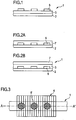
- Fig. 1 shows a security element 1 according to the invention in cross section.
- the security element 1 is produced by printing a UV varnish as a layer 3 on a carrier foil 2 of, for example, PET, followed by crosslinking of the UV varnish by UV irradiation. If the UV varnish is at least crosslinked so that it is tack-free, a liquid crystal layer 5 is printed, wherein in the in Fig. 1 In the embodiment shown, the liquid crystal layer is not full-surface, but is in the form of a motif.
- the liquid crystal layer may contain, for example, nematic or cholesteric liquid crystals.
- the film or UV varnish can be darkened, or it is printed before printing the UV varnish, a dark ink layer on the film or the film with a reflective layer, e.g. As a metallization provided.
- colorants which are soluble in the coating composition are preferably used to color the unstructured, inert lacquer layer with a desired color.
- a nematic liquid-crystalline material is used for the liquid-crystal layer 5 and viewed through a linear polarization filter, then a light-dark contrast is determined upon rotation of the polarization filter.
- this can only be explained by the fact that the liquid crystals on the lacquer layer are aligned to a certain extent, i. H. have formed in a random manner microdomains in which the liquid crystals have aligned each other reasonably uniform.
- Fig. 2A shows a cross section through a security element of the prior art.
- the security element has a carrier foil 2, which has a preferred direction for the alignment of liquid-crystalline material, for example a stretched PET foil.
- a layer 6 of nematic liquid-crystalline material is printed on the carrier film 2.
- the layer 6 here has the shape of a motif, in the embodiment of a honeycomb pattern.
- On the stretched PET film a very good alignment of the liquid-crystalline material of the layer 6 takes place.
- the liquid crystal layer 6 is overprinted with another layer 7 of liquid crystal material.
- the liquid-crystalline material of the layer 7 is cholesteric and may for example consist of Nematen in combination with a Verdriller. In view of the layer of cholesteric liquid-crystalline material, the nematic layer 6 should not be visible to a viewer.
- the motif of the layer 6 should be recognizable only when viewed through a polarizer 4, as in Fig. 3 shown.
- Fig. 3 shows a view of a security element, as in the FIGS. 2A and 2B in cross section along the line AA 'is shown.
- the security element is viewed in plan view of the cholesteric liquid crystal layer through a linear polarizer 4, the motif of the nematic liquid crystal layer 6 being visible as honeycomb 6 '.
- the honeycomb 6 ' are more or less clearly visible depending on the position of the polarizer.
- a certain recognizability of the honeycomb 6 ' is also given without the aid of the polarizer 4.
- An attentive viewer can recognize the honeycomb 6 'weak at least from certain angles.
- the reason for this is that the cholesteric liquid crystals of the layer 7 align themselves very well over the nematen of the layer 6, while they are at least somewhat inferior to the carrier film 2 to a certain extent. Accordingly, the light scattering in the areas without Nematen stronger than in the subject areas, whereby the honeycomb motif can be undesirably recognizable.
- the undesirable recognizability of a liquid crystal motif ie the recognizability of the motif without the aid of a polarizer, can be prevented by the security element is provided in accordance with the invention with a lacquer layer, as in Fig. 2B shown.
- Fig. 2B shows a similar security element as Fig. 2A
- the view in plan view by a linear polarizer 4 is the same as in the security element of FIG Fig. 2A (Fig. 3).
- Fig. 2B also shows a section through the security element along the line AA '( Fig. 3 ).
- the security element according to the invention, as in Fig. 2B is different from the prior art security element as shown in FIG Fig. 2A shown by the unstructured layer 3 of inert UV varnish between the liquid crystal layers 6 and 7.
- the security element 1 is produced by firstly, as in the case of the security element of the prior art, a motif layer 6 of nematic liquid crystals is formed on a support 2. Subsequently, however, a solvent-free UV varnish 3, which dissolves neither the material of the layer 6 nor the material of the layer 7 to be subsequently applied thereto, is applied over the entire surface. The lacquer is cured completely or at least until tack free by irradiation with UV light and then applied to the cured lacquer layer a layer 7 of cholesteric liquid crystals over the entire surface.
- an adhesion promoter may be applied to the layer 6 and / or an adhesion promoter may be applied to the layer 3 before the application of the layer 7.
- the primer of course, like the UV varnish, must be matched to the liquid crystal material of layers 6 and 7, i. H. it must not influence the optical effect of the liquid crystal layers.
- the honeycomb motif of layer 6 can no longer be anticipated without the aid of a polarizer under no viewing angle.
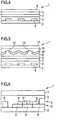
- Fig. 4 shows a security element according to the invention as in Fig. 2B but with an additional layer 8.
- security elements typically not just a single security feature, but a combination of security features. For this reason, they usually have a multi-layered structure, and it is necessary to connect the liquid crystal-based security feature to other layers.
- a security element sub-element which has the security feature based on liquid crystal, connected by means of an adhesive with another security element sub-element having another security feature. If such an adhesive is applied directly to a layer of liquid-crystalline material, there is the risk that the liquid-crystalline layer is changed by the adhesive in terms of its optical properties. Therefore, with advantage, as in Fig. 4 shown, applied to the layer 7 of liquid-crystalline material, first a layer 3 'of inert lacquer and cured. This layer 3 'then serves as a substrate for the adhesive layer.
- An alternative variant for producing multi-layered security elements is not to assemble the security elements from a plurality of sub-elements, but to apply one layer after the other on a carrier.
- the layer 7 of cholesteric liquid crystal material could be printed with a colored motif.
- the layer 8 in Fig. 4 would in this case represent an ink layer. Similar to adhesives, inks also tend to dissolve layers of liquid crystalline material and thereby alter their optical properties. It is therefore advantageous not to directly print on the layer 7 of liquid-crystalline material, but first of all to provide a layer 3 'of inert lacquer and then to use it as a substrate for printing with a printing motif.
- Fig. 5 illustrates one of a variety of ways in which a security element of the invention having a liquid crystal based security feature can be provided with further functional layers.
- the security element that is in Fig. 5 is shown in cross-section, it is the in Fig. 2B or 4 illustrated security element, which additionally has a metallized diffraction structure with negative writing.
- the security element is made by gluing two sub-elements.
- the first subelement corresponds to the one in FIG Fig. 2B shown security element and consists of the carrier film 2, the motif layer 6 of nematic liquid crystals and the layer 7 of cholesteric liquid crystals, the layers 6 and 7 are separated according to the invention by an unstructured layer 3 of inert lacquer.
- the second sub-element is produced by printing an embossing lacquer layer 11 onto a carrier film (not shown) and embossing a desired embossing structure in the embossing lacquer, onto which embossed layer 11 a metal layer 10 is vapor-deposited, and by partial demetallization of the metal layer 10 recesses 10 ', which form a negative font, are generated.
- the sub-element with embossed structure is now glued by means of an adhesive layer 8 with the sub-element with Farbkipp compacten. So that the adhesive can not undesirably change the optical properties of the layer 7 of cholesteric liquid crystal material, a layer 3 'of inert lacquer is preferably applied before bonding to the layer 7 and cured by UV radiation.
- the two sub-elements are glued together by means of the adhesive layer 8 and the carrier film to which the embossing lacquer has been applied is removed by a separation winding.
- an adhesive layer 12 is then applied to the layer composite.
- the carrier film 2 can be removed after the application of the security element to the target substrate, so that the entire layer composite is then present without carrier films. In this way, the polarization effect features are not affected by films and can be observed with high contrast.
- the security element 1 can also be bonded to further functional layers and / or auxiliary layers.
- Fig. 6 shows a cross section through a further embodiment of a security element according to the invention 1.
- the security element comprises a carrier film 2, a stretched PET film, a layer 6 of nematic liquid crystal material and a layer 7 of cholesteric liquid crystal material.
- the layers 6 and 7 are separated by an unstructured layer 3 of inert lacquer.
- the layer 6 of nematic liquid crystal material is formed only partly directly on the PET film.
Landscapes
- Chemical & Material Sciences (AREA)
- Organic Chemistry (AREA)
- Medicinal Chemistry (AREA)
- Polymers & Plastics (AREA)
- Health & Medical Sciences (AREA)
- Chemical Kinetics & Catalysis (AREA)
- Crystallography & Structural Chemistry (AREA)
- Engineering & Computer Science (AREA)
- Manufacturing & Machinery (AREA)
- Finance (AREA)
- Accounting & Taxation (AREA)
- Business, Economics & Management (AREA)
- Credit Cards Or The Like (AREA)
- Polarising Elements (AREA)
- Laminated Bodies (AREA)
- Liquid Crystal (AREA)
Claims (20)
- Élément de sécurité (1) destiné à garantir l'authenticité d'un objet de valeur tel que d'un papier de sécurité, d'un document de valeur ou d'un article de marque, comportant
une structure à couches ayant- au moins une couche (5; 7) sur la base d'un matériau cristallin liquide, et- au moins une couche de vernis (3) sur laquelle la couche cristalline liquide (5; 7) est appliquée,caractérisé en ce que la couche de vernis (3) est non structurée et consiste en un vernis exempt de cristaux liquides et inerte vis-à-vis de la couche cristalline liquide. - Élément de sécurité selon la revendication 1, caractérisé en ce que le vernis est exempt de solvants.
- Élément de sécurité selon la revendication 1 ou 2, caractérisé en ce que la couche de vernis a une épaisseur de couche située entre environ 0,5 µm et environ 10 µm, de préférence entre environ 1 µm et environ 5 µm, particulièrement de préférence entre environ 2 µm et environ 3 µm.
- Élément de sécurité selon au moins une des revendications de 1 à 3, caractérisé en ce que le vernis est durcissant par UV ou durcissant par faisceau d'électrons, de préférence durcissant par voie radicalaire ou durcissant par voie cationique.
- Élément de sécurité selon une des revendications de 1 à 4, caractérisé en ce qu'il comporte au moins une couche supplémentaire sur laquelle la couche de vernis est appliquée.
- Élément de sécurité selon la revendication 5, caractérisé en ce que la au moins une couche supplémentaire n'est pas inerte vis-à-vis de la couche cristalline liquide.
- Élément de sécurité selon la revendication 5 ou 6, caractérisé en ce que la au moins une couche supplémentaire est une couche fonctionnelle.
- Élément de sécurité selon la revendication 7, caractérisé en ce que la couche fonctionnelle est une couche cristalline liquide supplémentaire.
- Élément de sécurité selon au moins une des revendications de 1 à 8, caractérisé en ce que, entre la couche cristalline liquide et la couche de vernis, il comporte un agent adhésif.
- Élément de sécurité selon une des revendications de 1 à 9, caractérisé en ce qu'il comporte une structure à couches multicouche ayant au moins une couche fonctionnelle, éventuellement supplémentaire.
- Élément de sécurité selon la revendication 10, caractérisé en ce que la au moins une couche fonctionnelle supplémentaire est sélectionnée parmi le groupe qui consiste en une couche réfléchissante, en une couche à effet de diffraction optique, en une couche interférentielle, en une couche qui contient des substances caractéristiques lisibles par machine, en particulier des substances réfléchissantes, magnétiques, électriquement conductrices, luminescentes, en une couche d'encre d'impression.
- Élément de sécurité selon la revendication 10 ou 11, caractérisé en ce qu'il comporte une couche auxiliaire, en particulier une couche de colle.
- Élément de sécurité selon au moins une des revendications de 10 à 12, caractérisé en ce que, entre la couche cristalline liquide et la au moins une couche fonctionnelle supplémentaire et/ou éventuellement la couche auxiliaire, il comporte une couche de vernis qui consiste en un vernis inerte vis-à-vis de la couche cristalline liquide.
- Procédé de fabrication d'un élément de sécurité (1) qui est destiné à garantir l'authenticité d'un objet de valeur tel que d'un papier de sécurité, d'un document de valeur ou d'un article de marque, et qui comporte une structure à couches, comportant les étapes suivantes :- génération d'au moins une couche de vernis (3) sur une couche de la structure à couches,- application d'une couche cristalline liquide (5; 7) sur la couche de vernis (3),caractérisé en ce que la couche de vernis (3) est générée sous forme non structurée et que, pour la génération de la couche de vernis (3), c'est un vernis exempt de cristaux liquides et inerte vis-à-vis de la couche cristalline liquide qui est utilisé, cependant que la couche de vernis (3) est générée de telle façon que, avant l'application de la couche cristalline liquide (5; 7), elle est au moins exempte d'adhérence.
- Procédé selon la revendication 14, caractérisé en ce que la couche de la structure à couches sur laquelle la couche de vernis est générée est une couche fonctionnelle.
- Procédé selon la revendication 15, caractérisé en ce que la couche fonctionnelle est une couche cristalline liquide supplémentaire.
- Procédé selon une des revendications de 14 à 16, caractérisé en ce que, sur la couche cristalline liquide, avant la jonction à au moins une couche fonctionnelle éventuellement supplémentaire et/ou à une couche auxiliaire, une couche de vernis consistant en un vernis inerte vis-à-vis de la couche cristalline liquide.est appliqué.
- Ruban de transfert comportant une pluralité d'éléments de sécurité selon une des revendications de 1 à 13 à transférer sur un substrat tel qu'un papier de sécurité, un document de valeur ou un objet de valeur.
- Objet de valeur tel qu'un papier de sécurité destiné à la fabrication de documents de sécurité ou de valeur, ou document de valeur, caractérisé en ce qu'il est doté d'un élément de sécurité selon une des revendications de 1 à 13 ou d'un élément de transfert issu d'un ruban de transfert selon la revendication 18.
- Utilisation d'un élément de sécurité selon une des revendications de 1 à 13 ou d'un élément de transfert selon la revendication 18 ou d'un élément de sécurité fabriqué selon une des revendications de 14 ou 17, pour la protection de produits consistant en des marchandises de tous genres.
Applications Claiming Priority (1)
| Application Number | Priority Date | Filing Date | Title |
|---|---|---|---|
| DE102008061608A DE102008061608A1 (de) | 2008-12-11 | 2008-12-11 | Sicherheitselement |
Publications (3)
| Publication Number | Publication Date |
|---|---|
| EP2196322A2 EP2196322A2 (fr) | 2010-06-16 |
| EP2196322A3 EP2196322A3 (fr) | 2015-09-02 |
| EP2196322B1 true EP2196322B1 (fr) | 2017-10-25 |
Family
ID=41728570
Family Applications (1)
| Application Number | Title | Priority Date | Filing Date |
|---|---|---|---|
| EP09015216.6A Revoked EP2196322B1 (fr) | 2008-12-11 | 2009-12-08 | Elément de sécurité |
Country Status (2)
| Country | Link |
|---|---|
| EP (1) | EP2196322B1 (fr) |
| DE (1) | DE102008061608A1 (fr) |
Families Citing this family (7)
| Publication number | Priority date | Publication date | Assignee | Title |
|---|---|---|---|---|
| CN102985391A (zh) * | 2010-07-09 | 2013-03-20 | 帝斯曼知识产权资产管理有限公司 | 用于混凝土地板的可辐射固化涂料 |
| DE102010046839A1 (de) * | 2010-09-29 | 2012-03-29 | Giesecke & Devrient Gmbh | Zur Lagerung geeignetes Substrat und Sicherheitselement für die Herstellung von Wertdokumenten, Wertdokument sowie Verfahren zur Herstellung hiervon |
| DE102010050823A1 (de) | 2010-11-09 | 2012-05-10 | Giesecke & Devrient Gmbh | Sicherheitspapier, Verfahren zur Herstellung desselben und Sicherheitselement |
| DE102014018890A1 (de) | 2014-12-17 | 2016-06-23 | Giesecke & Devrient Gmbh | Sicherheitselement, Verfahren zum Herstellen desselben und mit dem Sicherheitselement ausgestatteter Datenträger |
| FR3105088B1 (fr) * | 2019-12-20 | 2021-12-24 | Oberthur Fiduciaire Sas | Structure optique à effet de relief |
| DE102024131191A1 (de) * | 2024-10-25 | 2026-04-30 | Giesecke+Devrient Currency Technology Gmbh | Sicherheitselement mit motivbildender Flüssigkristallschicht |
| DE102024131190A1 (de) * | 2024-10-25 | 2026-04-30 | Giesecke+Devrient Currency Technology Gmbh | Sicherheitselement mit motivbildender Flüssigkristallschicht |
Citations (9)
| Publication number | Priority date | Publication date | Assignee | Title |
|---|---|---|---|---|
| EP0435029A2 (fr) | 1989-12-22 | 1991-07-03 | GAO Gesellschaft für Automation und Organisation mbH | Support d'information avec élément de sécuritÀ© à cristaux liquides |
| EP0793693B1 (fr) | 1994-11-23 | 1999-04-07 | Basf Aktiengesellschaft | Procede permettant de revetir ou d'imprimer des substrats |
| EP1189079A1 (fr) | 1999-05-24 | 2002-03-20 | Toppan Printing Co., Ltd. | Corps composite stratifie, support d'enregistrement d'informations et element permettant d'attribuer une fonction de prevention des contrefa ons |
| WO2003061980A1 (fr) | 2002-01-25 | 2003-07-31 | De La Rue International Limited | Ameliorations de procedes de fabrication de substrats |
| WO2004095090A1 (fr) | 2003-04-17 | 2004-11-04 | Leonhard Kurz Gmbh & Co. Kg | Feuille et element de securite optique |
| WO2005105475A1 (fr) | 2004-04-30 | 2005-11-10 | Giesecke & Devrient Gmbh | Materiau en feuille et son procede de fabrication |
| WO2005108108A2 (fr) | 2004-04-30 | 2005-11-17 | Giesecke & Devrient Gmbh | Element de securite et son procede de production |
| EP1894736A2 (fr) | 2006-08-28 | 2008-03-05 | Giesecke & Devrient GmbH | Elément de sécurité à effet chatoyant et procédé de fabrication dudit élément |
| EP2006116A1 (fr) | 2007-06-21 | 2008-12-24 | Hueck Folien Ges.m.b.H. | Elément de sécurité à couleur variable selon l'orientation et signes de sécurité ne pouvant pas être reconnus visuellement |
Family Cites Families (5)
| Publication number | Priority date | Publication date | Assignee | Title |
|---|---|---|---|---|
| FR2648193B1 (fr) | 1989-06-07 | 1994-05-13 | Sab Nife | Procede pour reguler une pression dans un circuit de travail a partir d'une pression de reference, dispositif pour la mise en oeuvre de ce procede, systeme de freinage et systeme limiteur d'effort comportant ce dispositif |
| DE19940682A1 (de) * | 1999-08-27 | 2001-03-01 | Basf Ag | Cholesterisches Schichtmaterial mit verbessertem Farbeindruck und Verfahren zu dessen Herstellung |
| AT504463A1 (de) * | 2002-04-11 | 2008-05-15 | Hueck Folien Gmbh | Beschichtetes trägersubstrat, vorzugsweise mit beidseitig unterschiedlichen optischen und/oder fluoreszierenden merkmalen |
| DE102006015023A1 (de) * | 2006-03-31 | 2007-10-04 | Giesecke & Devrient Gmbh | Sicherheitselement und Verfahren zu seiner Herstellung |
| DE102006027236A1 (de) | 2006-06-09 | 2007-12-13 | Giesecke & Devrient Gmbh | Sicherheitselement |
-
2008
- 2008-12-11 DE DE102008061608A patent/DE102008061608A1/de not_active Withdrawn
-
2009
- 2009-12-08 EP EP09015216.6A patent/EP2196322B1/fr not_active Revoked
Patent Citations (9)
| Publication number | Priority date | Publication date | Assignee | Title |
|---|---|---|---|---|
| EP0435029A2 (fr) | 1989-12-22 | 1991-07-03 | GAO Gesellschaft für Automation und Organisation mbH | Support d'information avec élément de sécuritÀ© à cristaux liquides |
| EP0793693B1 (fr) | 1994-11-23 | 1999-04-07 | Basf Aktiengesellschaft | Procede permettant de revetir ou d'imprimer des substrats |
| EP1189079A1 (fr) | 1999-05-24 | 2002-03-20 | Toppan Printing Co., Ltd. | Corps composite stratifie, support d'enregistrement d'informations et element permettant d'attribuer une fonction de prevention des contrefa ons |
| WO2003061980A1 (fr) | 2002-01-25 | 2003-07-31 | De La Rue International Limited | Ameliorations de procedes de fabrication de substrats |
| WO2004095090A1 (fr) | 2003-04-17 | 2004-11-04 | Leonhard Kurz Gmbh & Co. Kg | Feuille et element de securite optique |
| WO2005105475A1 (fr) | 2004-04-30 | 2005-11-10 | Giesecke & Devrient Gmbh | Materiau en feuille et son procede de fabrication |
| WO2005108108A2 (fr) | 2004-04-30 | 2005-11-17 | Giesecke & Devrient Gmbh | Element de securite et son procede de production |
| EP1894736A2 (fr) | 2006-08-28 | 2008-03-05 | Giesecke & Devrient GmbH | Elément de sécurité à effet chatoyant et procédé de fabrication dudit élément |
| EP2006116A1 (fr) | 2007-06-21 | 2008-12-24 | Hueck Folien Ges.m.b.H. | Elément de sécurité à couleur variable selon l'orientation et signes de sécurité ne pouvant pas être reconnus visuellement |
Non-Patent Citations (1)
| Title |
|---|
| KOHKI TAKATOH ET AL.,: "Alignment Technologies and Applications of Liquid Crystal Devices", 2005, TAYLOR & FRANCIS, ISBN: 0-7484-0902-5, article KOHKI TAKATOH: "Chapter 1- Overview", pages: v-xvi, 1 - 5 |
Also Published As
| Publication number | Publication date |
|---|---|
| EP2196322A2 (fr) | 2010-06-16 |
| EP2196322A3 (fr) | 2015-09-02 |
| DE102008061608A1 (de) | 2010-06-17 |
Similar Documents
| Publication | Publication Date | Title |
|---|---|---|
| EP1744904B2 (fr) | Materiau en feuille et son procede de fabrication | |
| EP1744903B9 (fr) | Element de securite et procede pour sa production | |
| EP1744900B1 (fr) | Element de securite et son procede de production | |
| EP2344342B1 (fr) | Carte à élément de sécurité intégré | |
| EP1744902B1 (fr) | Element de securite et procede de fabrication | |
| EP2196322B1 (fr) | Elément de sécurité | |
| EP2461970A1 (fr) | Procédé pour fabriquer un élément de sécurité et élément de sécurité pouvant être obtenu selon le procédé | |
| EP2590822B2 (fr) | Document de valeur avec une couche d'absorption transparente et avec une couche d'absorption opaque | |
| EP2257841B1 (fr) | Élément de sécurité avec caractéristiques de polarisation | |
| EP4461555A1 (fr) | Élément de sécurité comprenant une couche de cristaux liquides formant un motif | |
| EP2261053B1 (fr) | Elément de sécurité comportant une couche de cristaux liquides formant un motif | |
| WO2017211450A1 (fr) | Élément de sécurité, substrat de document de valeur, document de valeur équipé de ce dernier et procédé de fabrication | |
| EP2498998B1 (fr) | Procédé pour fabriquer un élément de sécurité avec des métallisations adaptées et élément de sécurité obtenu avec ce procédé | |
| EP1714795A1 (fr) | Élément de sécurité avec un code magnétique spatialement séparé, la méthode et dispositif pour sa production et son application | |
| DE102024131191A1 (de) | Sicherheitselement mit motivbildender Flüssigkristallschicht | |
| WO2026087090A1 (fr) | Élément de sécurité comportant une couche de cristaux liquides formant un motif et procédé de fabrication correspondant | |
| DE102004053008A1 (de) | Folienmaterial und Verfahren zu seiner Herstellung |
Legal Events
| Date | Code | Title | Description |
|---|---|---|---|
| PUAI | Public reference made under article 153(3) epc to a published international application that has entered the european phase |
Free format text: ORIGINAL CODE: 0009012 |
|
| AK | Designated contracting states |
Kind code of ref document: A2 Designated state(s): AT BE BG CH CY CZ DE DK EE ES FI FR GB GR HR HU IE IS IT LI LT LU LV MC MK MT NL NO PL PT RO SE SI SK SM TR |
|
| AX | Request for extension of the european patent |
Extension state: AL BA RS |
|
| PUAL | Search report despatched |
Free format text: ORIGINAL CODE: 0009013 |
|
| AK | Designated contracting states |
Kind code of ref document: A3 Designated state(s): AT BE BG CH CY CZ DE DK EE ES FI FR GB GR HR HU IE IS IT LI LT LU LV MC MK MT NL NO PL PT RO SE SI SK SM TR |
|
| AX | Request for extension of the european patent |
Extension state: AL BA RS |
|
| 17P | Request for examination filed |
Effective date: 20160302 |
|
| RBV | Designated contracting states (corrected) |
Designated state(s): AT BE BG CH CY CZ DE DK EE ES FI FR GB GR HR HU IE IS IT LI LT LU LV MC MK MT NL NO PL PT RO SE SI SK SM TR |
|
| REG | Reference to a national code |
Ref country code: DE Ref legal event code: R079 Ref document number: 502009014466 Country of ref document: DE Free format text: PREVIOUS MAIN CLASS: B42D0015000000 Ipc: C08J0007040000 |
|
| GRAP | Despatch of communication of intention to grant a patent |
Free format text: ORIGINAL CODE: EPIDOSNIGR1 |
|
| STAA | Information on the status of an ep patent application or granted ep patent |
Free format text: STATUS: GRANT OF PATENT IS INTENDED |
|
| RIC1 | Information provided on ipc code assigned before grant |
Ipc: B42D 25/00 20140101ALI20170428BHEP Ipc: B42D 25/45 20140101ALI20170428BHEP Ipc: B42D 25/355 20140101ALI20170428BHEP Ipc: C08J 7/04 20060101AFI20170428BHEP Ipc: B42D 25/29 20140101ALI20170428BHEP Ipc: B42D 25/364 20140101ALI20170428BHEP |
|
| INTG | Intention to grant announced |
Effective date: 20170516 |
|
| RAP1 | Party data changed (applicant data changed or rights of an application transferred) |
Owner name: GIESECKE+DEVRIENT CURRENCY TECHNOLOGY GMBH |
|
| GRAS | Grant fee paid |
Free format text: ORIGINAL CODE: EPIDOSNIGR3 |
|
| GRAA | (expected) grant |
Free format text: ORIGINAL CODE: 0009210 |
|
| STAA | Information on the status of an ep patent application or granted ep patent |
Free format text: STATUS: THE PATENT HAS BEEN GRANTED |
|
| AK | Designated contracting states |
Kind code of ref document: B1 Designated state(s): AT BE BG CH CY CZ DE DK EE ES FI FR GB GR HR HU IE IS IT LI LT LU LV MC MK MT NL NO PL PT RO SE SI SK SM TR |
|
| REG | Reference to a national code |
Ref country code: GB Ref legal event code: FG4D Free format text: NOT ENGLISH |
|
| REG | Reference to a national code |
Ref country code: CH Ref legal event code: EP |
|
| REG | Reference to a national code |
Ref country code: AT Ref legal event code: REF Ref document number: 939882 Country of ref document: AT Kind code of ref document: T Effective date: 20171115 |
|
| REG | Reference to a national code |
Ref country code: IE Ref legal event code: FG4D Free format text: LANGUAGE OF EP DOCUMENT: GERMAN |
|
| REG | Reference to a national code |
Ref country code: DE Ref legal event code: R096 Ref document number: 502009014466 Country of ref document: DE |
|
| REG | Reference to a national code |
Ref country code: FR Ref legal event code: PLFP Year of fee payment: 9 |
|
| REG | Reference to a national code |
Ref country code: CH Ref legal event code: NV Representative=s name: PATENTANWAELTE SCHAAD, BALASS, MENZL AND PARTN, CH |
|
| REG | Reference to a national code |
Ref country code: NL Ref legal event code: MP Effective date: 20171025 |
|
| REG | Reference to a national code |
Ref country code: LT Ref legal event code: MG4D |
|
| PG25 | Lapsed in a contracting state [announced via postgrant information from national office to epo] |
Ref country code: NL Free format text: LAPSE BECAUSE OF FAILURE TO SUBMIT A TRANSLATION OF THE DESCRIPTION OR TO PAY THE FEE WITHIN THE PRESCRIBED TIME-LIMIT Effective date: 20171025 |
|
| PG25 | Lapsed in a contracting state [announced via postgrant information from national office to epo] |
Ref country code: SE Free format text: LAPSE BECAUSE OF FAILURE TO SUBMIT A TRANSLATION OF THE DESCRIPTION OR TO PAY THE FEE WITHIN THE PRESCRIBED TIME-LIMIT Effective date: 20171025 Ref country code: LT Free format text: LAPSE BECAUSE OF FAILURE TO SUBMIT A TRANSLATION OF THE DESCRIPTION OR TO PAY THE FEE WITHIN THE PRESCRIBED TIME-LIMIT Effective date: 20171025 Ref country code: NO Free format text: LAPSE BECAUSE OF FAILURE TO SUBMIT A TRANSLATION OF THE DESCRIPTION OR TO PAY THE FEE WITHIN THE PRESCRIBED TIME-LIMIT Effective date: 20180125 Ref country code: ES Free format text: LAPSE BECAUSE OF FAILURE TO SUBMIT A TRANSLATION OF THE DESCRIPTION OR TO PAY THE FEE WITHIN THE PRESCRIBED TIME-LIMIT Effective date: 20171025 Ref country code: FI Free format text: LAPSE BECAUSE OF FAILURE TO SUBMIT A TRANSLATION OF THE DESCRIPTION OR TO PAY THE FEE WITHIN THE PRESCRIBED TIME-LIMIT Effective date: 20171025 |
|
| PG25 | Lapsed in a contracting state [announced via postgrant information from national office to epo] |
Ref country code: BG Free format text: LAPSE BECAUSE OF FAILURE TO SUBMIT A TRANSLATION OF THE DESCRIPTION OR TO PAY THE FEE WITHIN THE PRESCRIBED TIME-LIMIT Effective date: 20180125 Ref country code: GR Free format text: LAPSE BECAUSE OF FAILURE TO SUBMIT A TRANSLATION OF THE DESCRIPTION OR TO PAY THE FEE WITHIN THE PRESCRIBED TIME-LIMIT Effective date: 20180126 Ref country code: LV Free format text: LAPSE BECAUSE OF FAILURE TO SUBMIT A TRANSLATION OF THE DESCRIPTION OR TO PAY THE FEE WITHIN THE PRESCRIBED TIME-LIMIT Effective date: 20171025 Ref country code: IS Free format text: LAPSE BECAUSE OF FAILURE TO SUBMIT A TRANSLATION OF THE DESCRIPTION OR TO PAY THE FEE WITHIN THE PRESCRIBED TIME-LIMIT Effective date: 20180225 Ref country code: HR Free format text: LAPSE BECAUSE OF FAILURE TO SUBMIT A TRANSLATION OF THE DESCRIPTION OR TO PAY THE FEE WITHIN THE PRESCRIBED TIME-LIMIT Effective date: 20171025 |
|
| REG | Reference to a national code |
Ref country code: DE Ref legal event code: R026 Ref document number: 502009014466 Country of ref document: DE |
|
| PLBI | Opposition filed |
Free format text: ORIGINAL CODE: 0009260 |
|
| PG25 | Lapsed in a contracting state [announced via postgrant information from national office to epo] |
Ref country code: SK Free format text: LAPSE BECAUSE OF FAILURE TO SUBMIT A TRANSLATION OF THE DESCRIPTION OR TO PAY THE FEE WITHIN THE PRESCRIBED TIME-LIMIT Effective date: 20171025 Ref country code: CZ Free format text: LAPSE BECAUSE OF FAILURE TO SUBMIT A TRANSLATION OF THE DESCRIPTION OR TO PAY THE FEE WITHIN THE PRESCRIBED TIME-LIMIT Effective date: 20171025 Ref country code: DK Free format text: LAPSE BECAUSE OF FAILURE TO SUBMIT A TRANSLATION OF THE DESCRIPTION OR TO PAY THE FEE WITHIN THE PRESCRIBED TIME-LIMIT Effective date: 20171025 Ref country code: CY Free format text: LAPSE BECAUSE OF FAILURE TO SUBMIT A TRANSLATION OF THE DESCRIPTION OR TO PAY THE FEE WITHIN THE PRESCRIBED TIME-LIMIT Effective date: 20171025 Ref country code: EE Free format text: LAPSE BECAUSE OF FAILURE TO SUBMIT A TRANSLATION OF THE DESCRIPTION OR TO PAY THE FEE WITHIN THE PRESCRIBED TIME-LIMIT Effective date: 20171025 |
|
| PLAX | Notice of opposition and request to file observation + time limit sent |
Free format text: ORIGINAL CODE: EPIDOSNOBS2 |
|
| 26 | Opposition filed |
Opponent name: BASF SE Effective date: 20180724 |
|
| PG25 | Lapsed in a contracting state [announced via postgrant information from national office to epo] |
Ref country code: RO Free format text: LAPSE BECAUSE OF FAILURE TO SUBMIT A TRANSLATION OF THE DESCRIPTION OR TO PAY THE FEE WITHIN THE PRESCRIBED TIME-LIMIT Effective date: 20171025 Ref country code: PL Free format text: LAPSE BECAUSE OF FAILURE TO SUBMIT A TRANSLATION OF THE DESCRIPTION OR TO PAY THE FEE WITHIN THE PRESCRIBED TIME-LIMIT Effective date: 20171025 Ref country code: SM Free format text: LAPSE BECAUSE OF FAILURE TO SUBMIT A TRANSLATION OF THE DESCRIPTION OR TO PAY THE FEE WITHIN THE PRESCRIBED TIME-LIMIT Effective date: 20171025 |
|
| REG | Reference to a national code |
Ref country code: IE Ref legal event code: MM4A |
|
| PG25 | Lapsed in a contracting state [announced via postgrant information from national office to epo] |
Ref country code: LU Free format text: LAPSE BECAUSE OF NON-PAYMENT OF DUE FEES Effective date: 20171208 Ref country code: MT Free format text: LAPSE BECAUSE OF FAILURE TO SUBMIT A TRANSLATION OF THE DESCRIPTION OR TO PAY THE FEE WITHIN THE PRESCRIBED TIME-LIMIT Effective date: 20171025 |
|
| REG | Reference to a national code |
Ref country code: BE Ref legal event code: MM Effective date: 20171231 |
|
| PG25 | Lapsed in a contracting state [announced via postgrant information from national office to epo] |
Ref country code: IE Free format text: LAPSE BECAUSE OF NON-PAYMENT OF DUE FEES Effective date: 20171208 |
|
| PG25 | Lapsed in a contracting state [announced via postgrant information from national office to epo] |
Ref country code: BE Free format text: LAPSE BECAUSE OF NON-PAYMENT OF DUE FEES Effective date: 20171231 Ref country code: SI Free format text: LAPSE BECAUSE OF FAILURE TO SUBMIT A TRANSLATION OF THE DESCRIPTION OR TO PAY THE FEE WITHIN THE PRESCRIBED TIME-LIMIT Effective date: 20171025 |
|
| PLBB | Reply of patent proprietor to notice(s) of opposition received |
Free format text: ORIGINAL CODE: EPIDOSNOBS3 |
|
| PG25 | Lapsed in a contracting state [announced via postgrant information from national office to epo] |
Ref country code: HU Free format text: LAPSE BECAUSE OF FAILURE TO SUBMIT A TRANSLATION OF THE DESCRIPTION OR TO PAY THE FEE WITHIN THE PRESCRIBED TIME-LIMIT; INVALID AB INITIO Effective date: 20091208 Ref country code: MC Free format text: LAPSE BECAUSE OF FAILURE TO SUBMIT A TRANSLATION OF THE DESCRIPTION OR TO PAY THE FEE WITHIN THE PRESCRIBED TIME-LIMIT Effective date: 20171025 |
|
| PG25 | Lapsed in a contracting state [announced via postgrant information from national office to epo] |
Ref country code: MK Free format text: LAPSE BECAUSE OF FAILURE TO SUBMIT A TRANSLATION OF THE DESCRIPTION OR TO PAY THE FEE WITHIN THE PRESCRIBED TIME-LIMIT Effective date: 20171025 |
|
| PLCK | Communication despatched that opposition was rejected |
Free format text: ORIGINAL CODE: EPIDOSNREJ1 |
|
| APBM | Appeal reference recorded |
Free format text: ORIGINAL CODE: EPIDOSNREFNO |
|
| APBP | Date of receipt of notice of appeal recorded |
Free format text: ORIGINAL CODE: EPIDOSNNOA2O |
|
| APAH | Appeal reference modified |
Free format text: ORIGINAL CODE: EPIDOSCREFNO |
|
| PG25 | Lapsed in a contracting state [announced via postgrant information from national office to epo] |
Ref country code: TR Free format text: LAPSE BECAUSE OF FAILURE TO SUBMIT A TRANSLATION OF THE DESCRIPTION OR TO PAY THE FEE WITHIN THE PRESCRIBED TIME-LIMIT Effective date: 20171025 |
|
| APBQ | Date of receipt of statement of grounds of appeal recorded |
Free format text: ORIGINAL CODE: EPIDOSNNOA3O |
|
| PG25 | Lapsed in a contracting state [announced via postgrant information from national office to epo] |
Ref country code: PT Free format text: LAPSE BECAUSE OF FAILURE TO SUBMIT A TRANSLATION OF THE DESCRIPTION OR TO PAY THE FEE WITHIN THE PRESCRIBED TIME-LIMIT Effective date: 20171025 |
|
| PGFP | Annual fee paid to national office [announced via postgrant information from national office to epo] |
Ref country code: FR Payment date: 20211220 Year of fee payment: 13 Ref country code: GB Payment date: 20211222 Year of fee payment: 13 Ref country code: AT Payment date: 20211216 Year of fee payment: 13 Ref country code: DE Payment date: 20211231 Year of fee payment: 13 |
|
| PGFP | Annual fee paid to national office [announced via postgrant information from national office to epo] |
Ref country code: CH Payment date: 20211222 Year of fee payment: 13 |
|
| REG | Reference to a national code |
Ref country code: DE Ref legal event code: R103 Ref document number: 502009014466 Country of ref document: DE Ref country code: DE Ref legal event code: R064 Ref document number: 502009014466 Country of ref document: DE |
|
| APBU | Appeal procedure closed |
Free format text: ORIGINAL CODE: EPIDOSNNOA9O |
|
| PGFP | Annual fee paid to national office [announced via postgrant information from national office to epo] |
Ref country code: IT Payment date: 20211230 Year of fee payment: 13 |
|
| RDAF | Communication despatched that patent is revoked |
Free format text: ORIGINAL CODE: EPIDOSNREV1 |
|
| STAA | Information on the status of an ep patent application or granted ep patent |
Free format text: STATUS: PATENT REVOKED |
|
| RDAG | Patent revoked |
Free format text: ORIGINAL CODE: 0009271 |
|
| REG | Reference to a national code |
Ref country code: CH Ref legal event code: PL |
|
| REG | Reference to a national code |
Ref country code: FI Ref legal event code: MGE |
|
| 27W | Patent revoked |
Effective date: 20220311 |
|
| GBPR | Gb: patent revoked under art. 102 of the ep convention designating the uk as contracting state |
Effective date: 20220311 |
|
| REG | Reference to a national code |
Ref country code: AT Ref legal event code: MA03 Ref document number: 939882 Country of ref document: AT Kind code of ref document: T Effective date: 20220311 |