EP2196539B1 - Process for the continuous biological production of lipids, hydrocarbons or mixtures thereof - Google Patents
Process for the continuous biological production of lipids, hydrocarbons or mixtures thereof Download PDFInfo
- Publication number
- EP2196539B1 EP2196539B1 EP08171701.9A EP08171701A EP2196539B1 EP 2196539 B1 EP2196539 B1 EP 2196539B1 EP 08171701 A EP08171701 A EP 08171701A EP 2196539 B1 EP2196539 B1 EP 2196539B1
- Authority
- EP
- European Patent Office
- Prior art keywords
- reactor
- product
- aqueous medium
- process according
- fermentation gas
- Prior art date
- Legal status (The legal status is an assumption and is not a legal conclusion. Google has not performed a legal analysis and makes no representation as to the accuracy of the status listed.)
- Active
Links
Images

Classifications
-
- C—CHEMISTRY; METALLURGY
- C12—BIOCHEMISTRY; BEER; SPIRITS; WINE; VINEGAR; MICROBIOLOGY; ENZYMOLOGY; MUTATION OR GENETIC ENGINEERING
- C12P—FERMENTATION OR ENZYME-USING PROCESSES TO SYNTHESISE A DESIRED CHEMICAL COMPOUND OR COMPOSITION OR TO SEPARATE OPTICAL ISOMERS FROM A RACEMIC MIXTURE
- C12P5/00—Preparation of hydrocarbons or halogenated hydrocarbons
- C12P5/02—Preparation of hydrocarbons or halogenated hydrocarbons acyclic
-
- C—CHEMISTRY; METALLURGY
- C12—BIOCHEMISTRY; BEER; SPIRITS; WINE; VINEGAR; MICROBIOLOGY; ENZYMOLOGY; MUTATION OR GENETIC ENGINEERING
- C12P—FERMENTATION OR ENZYME-USING PROCESSES TO SYNTHESISE A DESIRED CHEMICAL COMPOUND OR COMPOSITION OR TO SEPARATE OPTICAL ISOMERS FROM A RACEMIC MIXTURE
- C12P7/00—Preparation of oxygen-containing organic compounds
- C12P7/64—Fats; Fatty oils; Ester-type waxes; Higher fatty acids, i.e. having at least seven carbon atoms in an unbroken chain bound to a carboxyl group; Oxidised oils or fats
- C12P7/6436—Fatty acid esters
- C12P7/6445—Glycerides
- C12P7/6463—Glycerides obtained from glyceride producing microorganisms, e.g. single cell oil
-
- Y—GENERAL TAGGING OF NEW TECHNOLOGICAL DEVELOPMENTS; GENERAL TAGGING OF CROSS-SECTIONAL TECHNOLOGIES SPANNING OVER SEVERAL SECTIONS OF THE IPC; TECHNICAL SUBJECTS COVERED BY FORMER USPC CROSS-REFERENCE ART COLLECTIONS [XRACs] AND DIGESTS
- Y02—TECHNOLOGIES OR APPLICATIONS FOR MITIGATION OR ADAPTATION AGAINST CLIMATE CHANGE
- Y02E—REDUCTION OF GREENHOUSE GAS [GHG] EMISSIONS, RELATED TO ENERGY GENERATION, TRANSMISSION OR DISTRIBUTION
- Y02E50/00—Technologies for the production of fuel of non-fossil origin
- Y02E50/30—Fuel from waste, e.g. synthetic alcohol or diesel
Definitions
- the invention is directed to a process for the continuous biological production of a product selected from the group of lipids, hydrocarbons, organic acids, polyalknoates and mixtures thereof by conversion of a suitable substrate using micro-organisms, in which process the said substrate is continuously, anaerobically fermented to produce the product and fermentation gas, in the presence of, optionally supported, micro-organisms.
- Amyris further describes a production system for making bio-organic compounds, e.g. for a biofuel.
- the system may include a vessel, a first phase comprising an aqueous medium including host cells capable of producing a bio- organic compound, where the bio-organic compound comprises a second phase in contact with the aqueous medium.
- US 4,127,447 relates to a process for carrying out a biologically catalyzed reaction comprising the steps of: introducing an influent solution containing reactants into an upflow packed bed column packed with a support having attached thereto anaerobic microorganisms for catalyzing the reaction of said reactants; introducing with said influent a membrane disruptive detergent to lyse dead microorganisms from said support and to make available the essential nutrient of said dead microorganisms to the remaining live microorganisms.
- the process is in particular for use in the treatment of industrial organic wastes and domestic sewage.
- WO2003/050274 relates to a method for producing a crystalline and/or amorphous metabolite suspension from a fermentation broth comprising treating the fermentation broth with one or more coagulants and/or one or more flocculants; and separating the biomass of the fermentation broth from the coagulated and/or flocculated fermentation broth by use of a separation equipment, whereby a crystalline and/or amorphous metabolite suspension is obtained.
- WO2007/104551 relates to a process for the purification of waste water, in particular for the continuous purification of waste water in papermaking, where waste water to be purified is treated with anaerobic microorganisms in order to degrade contaminants present in the waste water.
- the process further comprises subjecting waste water to a pressure-release flotation step before being supplied to the anaerobic reactor or after being discharged from the anaerobic reactor, in order to delime the water to at least some extent.
- BHC may be present as small ( ⁇ 10 ⁇ m), medium (10-100 ⁇ m), large (>100 ⁇ m) droplets or a combination thereof.
- suitable feedstocks may be derived from glycerol, low cost biofuels (methanol, ethanol and the like), agro/forestry residuals, hydrolysates of agro/forestry residuals and gasified forms thereof (for example syngas).
- Fermentation gas is commonly composed of mostly carbon dioxide and some water vapour, but could contain substantial amounts of methane.
- the fermentation medium can also contain other, oxidized, products next to BHC such as organic acids and polymers thereof (for example polyalkanoates). Such a presence does not limit the invention.
- the present invention aims at providing a low cost, integrated bioreactor with several technology options for the direct production of a BHC-stream from renewables.
- solid-liquid-liquid separation techniques are used for promoting the coalescence of the product droplets in order to enhance separation, said SLL separation techniques including gravity settling, flotation or a combination thereof, wherein the separation of the product is done using a tilted plate separator or wherein the product is separated from the aqueous medium by flotation using fermentation gas dissolved in the aqueous medium, wherein fermentation gas dioxide is generated for flotation by a pressure decrease of the aqueous medium.
- the present invention is based on the combined and integrated use of a reactor, the specific properties of the main products (fermentation gas and BHC) and various downstream processing unit operations in an inventive way, for a specific process configuration.
- micro-organism An important aspect of the process is the anaerobic fermentation of the substrate, using suitable micro-organism, which may optionally be supported.
- suitable micro-organisms are known in the art, for example in WO 2008/113041 (LS9), Kalscheuer R, Stölting T and Steinbüchel A. 2006.
- Microdiesel Escherichia coli engineered for fuel production.
- the micro-organisms can be freely suspended, immobilized, forming granules, forming flocs and the like. In this way the cell concentration in the reactor can be optimized and less surplus cell mass is produced. Additionally, separation of the cell mass may be enhanced.
- the process is basically in up-flow with recirculation over the column reactor. This may either be an internal recirculation, for example using a draft tube, or an external recirculation.
- the fermentation gas In the process a large amount of fermentation gas is generated, which generates turbulent mixing and dispersion in the reactor and provides a useful gas lift function in the reactor.
- the fermentation gas also has a useful function in the separation of the BHC from the reaction broth.
- Liquid withdrawal can be done from the top or from the bottom of the reactor.
- liquid withdrawal from the bottom of the reactor is preferred since it enhances the subsequent separation steps by making use of the pressure head of the reactor.
- the reactor pressure can be further controlled by regulating the fermentation gas flow leaving the reactor.
- the separation of the various phases in the reaction mixture or broth namely gas (fermentation gas), two liquid phases (aqueous medium and the apolar lipids, hydrocarbon, organic acid, or polyalkanoate) and an optional solid phase (optionally supported micro-organisms).
- gas Fermentation gas
- two liquid phases aqueous medium and the apolar lipids, hydrocarbon, organic acid, or polyalkanoate
- an optional solid phase optional solid phase
- the droplets of the product that is produced in the process of the invention may have varying sizes, ranging from small ( ⁇ 10 ⁇ m), medium (10-100 ⁇ m) or large (>100 ⁇ m).
- the BHC is generally present in emulsified form, which may be stabilized by the presence of micro-organisms and other biological particles and molecules. This requires additional measures to make sure that the BHC coalesce and may be recovered as a separate liquid phase. In some instances, a (generally small) part of the product may be gaseous, which would then require a separate step to recover them form the carbon dioxide based gas phase.
- the SSL separation includes the use of an SSL separation technique selected from gravity settling, flotation, combinations thereof, wherein the separation of the product is done using a tilted plate separator or wherein the product is separated from the aqueous medium by flotation using fermentation gas dissolved in the aqueous medium.
- separation techniques may be used for separating the product and/or promoting the coalescence of the product (solid-liquid-liquid separation, in short SLL separation).
- the selection of the separation technique depends on the properties of the mixture and the coalescence properties of the product droplets.
- the said SLL separation techniques are used for separating the BHC and/or for promoting the coalescence of the BHC droplets in order to enhance separation.
- suitable SLL separation techniques include centrifugation, use of hydrocyclones, filtration, membrane filtration or a combination thereof.
- Preferred steps for this include the use of flotation of the BHC using dissolved carbon dioxide and other components in the fermentation gas in combination with a ventury type device (or other pressure reduction devices) or the use of hydrocyclones. These techniques can be used when small droplets of the product are present in the mixture. In specific embodiments these steps can also be combined with each other, or they may be combined with other separation systems, such as a tilted plate separator. A tilted plate separator can be used when large droplets of the product are present in the mixture. It is, for example, possible to separate at least part of the fermentation gas, the solids and the product from the aqueous phase in such a separator.
- the process requires a recirculation over the reactor. This may be done by an internal recirculation of part of the reaction broth, using an internal draft tube, possibly after separating carbon dioxide and part of the BHC produced. It is also possible to recirculate the solids, with part of the aqueous medium, but with relatively low amounts of BHC and carbon dioxide, through an external recirculation, after the separation of the major amount of the carbon dioxide and BHC from it.
- the process of the present invention overcomes this disadvantage by the possibility to use large amounts of cell mass and the direct separation of the product from the reaction broth.
- the process of the invention has the advantage of a limited number of unit operations and only those that do not have moving parts, instead of centrifuges.
- the nature of the materials involved allows the use of relatively cheap construction materials, compared to conventional fermentors, namely no need to use steel fermentors, but concrete or plastics suffice. Also there is little possibility of erosion, which also makes the use of lower cost materials possible.
- the process is based on the bioconversion of renewable substrates, mainly carbohydrates, but also other materials, as defined above. These substrates are generally introduced into the reactor as aqueous solution, either directly into the reactor or into the recycle flow, if present.
- the reactor may be operated at ambient pressure, but in case the fermentation gas flotation method, discussed above, is used, it is preferred that the reactor is operated at a slightly higher pressure, such as between 0.11 MPa and 2.0 MPa (abs) (1.1 and 20 bar (abs)), thereby enabling the flotation by a simple pressure reduction after the reactor. It is also possible to operate the reactor under ambient pressure and to withdraw the liquid from the bottom. Because of the pressure head of the reactor contents, up to 10 meters of water column or more, there is enough carbon dioxide dissolved in the liquid for the required flotation by carbon dioxide. In the alternative, it is also possible to use this pressure to drive the hydrocyclones. The reactor pressure can be further controlled by regulating the carbon dioxide flow leaving the reactor.
- the liquid effluent port is placed at the bottom of the reactor. Due to the static pressure at the bottom of the reactor, a substantial amount of fermentation gas is absorbed in the broth. Eventually, the amount of fermentation gas absorbed in the broth can be increased by increasing the pressure in the reactor, for example by controlling the flow of fermentation gas leaving the reactor.
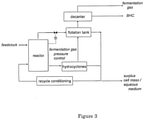
- the BHC-broth suspension leaves the reactor with a high fermentation gas pressure. Releasing the pressure in the flotation tank results in small bubbles that selectively accumulate small droplets of BHC. BHC is then recovered from the bubbles in a decanter, while the broth (and eventually remaining BHC) can be (partly) recycled to the reactor.
- the liquid effluent is placed at the bottom of the reactor.
- the hydrostatic pressure of the reactor may be sufficient to drive the hydrocyclones at no further operational (energy) costs.
- the pressure in the reactor can be increased by, for example, controlling the flow of fermentation gas leaving the reactor.
- the centrifugal field in the hydrocyclones may be sufficient to ensure the BHC separation with the overflow, while the broth (and eventually remaining BHC) can be (partly) recycled to the reactor.
- the centrifugal field in the hydrocyclones may concentrate small BHC droplets towards the center of the hydrocyclone and promote coalescence. Improved BHC recovery may thus be achieved by combining the use of hydrocyclones and flotation as shown in Figure 3 .
- This example illustrates typical flows over the reactor and their impact on the reactor size.
- the catabolic reaction for product formation is: 3 1 12 C 6 H 12 O 6 ⁇ 1 C 12 H 26 + 605 CO 2 + 5.5 H 2 O
- the required substrate feed can be calculated.
- F in 198 ton/hour.
- the reactor is designed for a superficial gas velocity of 70 m/hour, resulting in a cross-sectional area of 143 m 2 (or a diameter of 6.7 m) and a height of 23 m.
- these values are strongly dependant on the type of product, the required production rate, the micro-organism used and the growth rate of the micro-organism, among others.
- This example illustrates the effect of the product droplet size on the selection of the separation technique.
- the reactor is operated at atmospheric conditions. CO 2 is first separated, after which the product-broth mixture enters a tilted plate settler.
- the settler can be mounted on top of the reactor or external.
- the sigma factor ⁇ is commonly used and corresponds to the equivalent surface area of a settling tank with the same theoretical performance.
- Table 1 shows the droplet rise velocity u and the required sigma factor for different droplet sizes.
- Sigma factor as a function of droplet size. d ( ⁇ m) u (m/hr) ⁇ / m 2 0,1 0,0000006 280 833 333 1 0,00006 2 808 333 10 0,006 28 083 100 0,6 281 1000 60 3
- the sigma value of disc stack centrifuges is roughly limited to 100 000 m 2 and for tilted plate settlers to 1 000 m 2 . It is clear that this separation method can only be used when sufficiently large product droplets are present in the mixture.
- This example illustrates the range of droplet sizes that can be obtained and the coalescence behavior of the mixture.
- Mixture B In this mixture, no decane was added in order to evaluate the settling behavior of the cells in water without influence of the product. After 20 hours there was no clear water layer but 3 fractions were clearly differentiated: a top layer with low cell concentration, a middle layer with high cell concentration and a bottom layer (approx. 0.68 cm) with settled cells. Using Stokes equation a particle diameter of 2 ⁇ m was calculated, which is a typical diameter for bakers' yeast cells.
- Mixture C In this mixture, no yeast cells were added in order to evaluate the rising behavior of the decane droplets without influence of the micro-organism. The mixture was unstable as expected and about 84 mL of decane was clearly separated within 1 minute.
- Mixture D This mixture is similar to Mixture A. After 21 hours of settling most of the decane was present in the top layer. Two 40 mL samples were taken from this layer and centrifuged for 30 minutes at 4700 rpm. The fractions obtained are summarized in Table 4. Table 4. Fractions obtained after centrifugation of two samples from the top layer (after 21 hours settling) of Mixture D. Sample Total volume yeast cells clear water mixture clear decane 1 40 mL approx. 1 mL 7 mL 8 mL 24 mL 2 40 mL approx. 0.5 mL 3 mL 4 mL 32.5 mL
- This example illustrates the effect of the product droplet size on the selection of the separation technique.
- the bottom zone of the reactor described in Example 1 has a static pressure of 0.2 MPa (2 bars), where a substantial amount of CO 2 is absorbed in the broth.
- a configuration as shown in Figure 1 small product droplets can be separated from the mixture.
- the flotation efficiency strongly depends on the droplet-bubble diameter ratio, their velocities and abundance.
- Table 2. Sigma factor as a function of droplet size. d ( ⁇ m) u (m/hr) ⁇ / m 2 10 0,02 8425 100 2 84 1000 200 1
Landscapes
- Chemical & Material Sciences (AREA)
- Organic Chemistry (AREA)
- Life Sciences & Earth Sciences (AREA)
- Zoology (AREA)
- Wood Science & Technology (AREA)
- Engineering & Computer Science (AREA)
- Biotechnology (AREA)
- General Health & Medical Sciences (AREA)
- Microbiology (AREA)
- Chemical Kinetics & Catalysis (AREA)
- Genetics & Genomics (AREA)
- General Chemical & Material Sciences (AREA)
- Health & Medical Sciences (AREA)
- Biochemistry (AREA)
- Bioinformatics & Cheminformatics (AREA)
- General Engineering & Computer Science (AREA)
- Cell Biology (AREA)
- Oil, Petroleum & Natural Gas (AREA)
- Preparation Of Compounds By Using Micro-Organisms (AREA)
- Apparatus Associated With Microorganisms And Enzymes (AREA)
Priority Applications (4)
| Application Number | Priority Date | Filing Date | Title |
|---|---|---|---|
| DK08171701.9T DK2196539T3 (da) | 2008-12-15 | 2008-12-15 | Fremgangsmåde til kontinuerlig biologisk produktion af lipider, carbonhydrider eller blandinger deraf |
| SI200832191T SI2196539T1 (sl) | 2008-12-15 | 2008-12-15 | Postopek za kontinuirano biološko proizvodnjo lipidov, ogljikovodikov ali njihovih mešanic |
| EP08171701.9A EP2196539B1 (en) | 2008-12-15 | 2008-12-15 | Process for the continuous biological production of lipids, hydrocarbons or mixtures thereof |
| ES08171701T ES2908334T3 (es) | 2008-12-15 | 2008-12-15 | Procedimiento para la producción biológica continua de lípidos, hidrocarburos o mezclas de los mismos |
Applications Claiming Priority (1)
| Application Number | Priority Date | Filing Date | Title |
|---|---|---|---|
| EP08171701.9A EP2196539B1 (en) | 2008-12-15 | 2008-12-15 | Process for the continuous biological production of lipids, hydrocarbons or mixtures thereof |
Publications (2)
| Publication Number | Publication Date |
|---|---|
| EP2196539A1 EP2196539A1 (en) | 2010-06-16 |
| EP2196539B1 true EP2196539B1 (en) | 2022-02-09 |
Family
ID=40637796
Family Applications (1)
| Application Number | Title | Priority Date | Filing Date |
|---|---|---|---|
| EP08171701.9A Active EP2196539B1 (en) | 2008-12-15 | 2008-12-15 | Process for the continuous biological production of lipids, hydrocarbons or mixtures thereof |
Country Status (4)
| Country | Link |
|---|---|
| EP (1) | EP2196539B1 (da) |
| DK (1) | DK2196539T3 (da) |
| ES (1) | ES2908334T3 (da) |
| SI (1) | SI2196539T1 (da) |
Families Citing this family (3)
| Publication number | Priority date | Publication date | Assignee | Title |
|---|---|---|---|---|
| US9752165B2 (en) * | 2014-02-10 | 2017-09-05 | Cellulosic Ethanol Technologies, Llc | Processes and systems for recovering oil from fermentation products |
| EP3110930B1 (en) * | 2014-02-28 | 2020-04-15 | Delft Advanced Biofuels B.V. | Process for the recovery of lipids or hydrocarbons |
| EP3766982A1 (en) | 2019-07-18 | 2021-01-20 | Delft Advanced Biofuels B.V. | Integrated system for biocatalytically producing and recovering an organic substance |
Family Cites Families (5)
| Publication number | Priority date | Publication date | Assignee | Title |
|---|---|---|---|---|
| US4127447A (en) * | 1976-05-03 | 1978-11-28 | The United States Of America As Represented By The United States Department Of Energy | Biomass growth restriction in a packed bed reactor |
| EP1456361B1 (en) * | 2001-12-11 | 2012-02-29 | Novozymes A/S | Process for harvesting crystalline particles from fermentation broth |
| CA2644757A1 (en) * | 2006-03-15 | 2007-09-20 | Meri Entsorgungstechnik Fuer Die Papierindustrie Gmbh | Method and apparatus for the anaerobic treatment of waste water |
| CN105331518A (zh) * | 2006-05-26 | 2016-02-17 | 阿迈瑞斯公司 | 制造生物有机化合物的设备 |
| US8110093B2 (en) | 2007-03-14 | 2012-02-07 | Ls9, Inc. | Process for producing low molecular weight hydrocarbons from renewable resources |
-
2008
- 2008-12-15 DK DK08171701.9T patent/DK2196539T3/da active
- 2008-12-15 EP EP08171701.9A patent/EP2196539B1/en active Active
- 2008-12-15 ES ES08171701T patent/ES2908334T3/es active Active
- 2008-12-15 SI SI200832191T patent/SI2196539T1/sl unknown
Non-Patent Citations (2)
| Title |
|---|
| ARJAN S. HEERES ET AL: "Fermentation broth components influence droplet coalescence and hinder advanced biofuel recovery during fermentation", BIOTECHNOLOGY JOURNAL, vol. 10, no. 8, 1 August 2015 (2015-08-01), DE, pages 1206 - 1215, XP055501183, ISSN: 1860-6768, DOI: 10.1002/biot.201400570 * |
| HEERES ARJAN S ET AL: "Microbial advanced biofuels production: overcoming emulsification challenges for large-scale operation", TRENDS IN BIOTECHNOLOGY, vol. 32, no. 4, April 2014 (2014-04-01), pages 221 - 229, XP028837784, ISSN: 0167-7799, DOI: 10.1016/J.TIBTECH.2014.02.002 * |
Also Published As
| Publication number | Publication date |
|---|---|
| DK2196539T3 (da) | 2022-03-14 |
| ES2908334T3 (es) | 2022-04-28 |
| SI2196539T1 (sl) | 2022-06-30 |
| EP2196539A1 (en) | 2010-06-16 |
Similar Documents
| Publication | Publication Date | Title |
|---|---|---|
| Wainaina et al. | Biochemicals from food waste and recalcitrant biomass via syngas fermentation: a review | |
| EP2950914B1 (en) | System and method for improved gas dissolution | |
| Hajilary et al. | Biofuel types and membrane separation | |
| Singhania et al. | Biological upgrading of volatile fatty acids, key intermediates for the valorization of biowaste through dark anaerobic fermentation | |
| US9068202B2 (en) | Fermentation process | |
| KR100387301B1 (ko) | 폐가스로부터의 생성물의 생물학적 제조방법 | |
| Yesil et al. | Anaerobic fermentation of organic solid wastes: volatile fatty acid production and separation | |
| EP3411490B1 (en) | Low pressure separator having an internal divider and uses therefor | |
| US20150111273A1 (en) | Biohydrogen production method and reactor | |
| WO2003106353A1 (en) | Method of purifying fischer-tropsch derived water | |
| CA2823196A1 (en) | System and method for producing ethanol and biogas | |
| EP2196539B1 (en) | Process for the continuous biological production of lipids, hydrocarbons or mixtures thereof | |
| Bansod et al. | Review of membrane technology applications in wastewater treatment and biofuels | |
| CN103031338A (zh) | 一种气相底物发酵连续生产乙醇的方法 | |
| US10494653B2 (en) | Process for the recovery of lipids or hydrocarbons | |
| KR100365131B1 (ko) | 폐가스로부터의아세트산의생물학적제조방법 | |
| CN101109005B (zh) | 内循环微生物反应器及石油微生物脱硫系统 | |
| JPWO2019188727A1 (ja) | 有機物質の製造装置 | |
| Al-karawi | Development and intensification of a foam flotation system in harvesting microalgae for biofuel | |
| CN202272866U (zh) | 一种用于气相底物发酵生产有机酸或有机醇的系统 | |
| Tang et al. | Continuous Bio-Hydrogen Production Using Activated Carbon As Solid Carriers from Molasses Fermentation | |
| BR112018015918B1 (pt) | Processo e aparelho de conversão biológica |
Legal Events
| Date | Code | Title | Description |
|---|---|---|---|
| PUAI | Public reference made under article 153(3) epc to a published international application that has entered the european phase |
Free format text: ORIGINAL CODE: 0009012 |
|
| AK | Designated contracting states |
Kind code of ref document: A1 Designated state(s): AT BE BG CH CY CZ DE DK EE ES FI FR GB GR HR HU IE IS IT LI LT LU LV MC MT NL NO PL PT RO SE SI SK TR |
|
| AX | Request for extension of the european patent |
Extension state: AL BA MK RS |
|
| 17P | Request for examination filed |
Effective date: 20101129 |
|
| 17Q | First examination report despatched |
Effective date: 20101227 |
|
| AKX | Designation fees paid |
Designated state(s): AT BE BG CH CY CZ DE DK EE ES FI FR GB GR HR HU IE IS IT LI LT LU LV MC MT NL NO PL PT RO SE SI SK TR |
|
| STAA | Information on the status of an ep patent application or granted ep patent |
Free format text: STATUS: EXAMINATION IS IN PROGRESS |
|
| RAP1 | Party data changed (applicant data changed or rights of an application transferred) |
Owner name: DELFT ADVANCED BIOFUELS B.V. |
|
| RAP1 | Party data changed (applicant data changed or rights of an application transferred) |
Owner name: DELFT ADVANCED BIOFUELS B.V. |
|
| GRAP | Despatch of communication of intention to grant a patent |
Free format text: ORIGINAL CODE: EPIDOSNIGR1 |
|
| STAA | Information on the status of an ep patent application or granted ep patent |
Free format text: STATUS: GRANT OF PATENT IS INTENDED |
|
| INTG | Intention to grant announced |
Effective date: 20211001 |
|
| GRAS | Grant fee paid |
Free format text: ORIGINAL CODE: EPIDOSNIGR3 |
|
| GRAA | (expected) grant |
Free format text: ORIGINAL CODE: 0009210 |
|
| STAA | Information on the status of an ep patent application or granted ep patent |
Free format text: STATUS: THE PATENT HAS BEEN GRANTED |
|
| AK | Designated contracting states |
Kind code of ref document: B1 Designated state(s): AT BE BG CH CY CZ DE DK EE ES FI FR GB GR HR HU IE IS IT LI LT LU LV MC MT NL NO PL PT RO SE SI SK TR |
|
| REG | Reference to a national code |
Ref country code: GB Ref legal event code: FG4D |
|
| REG | Reference to a national code |
Ref country code: CH Ref legal event code: EP Ref country code: AT Ref legal event code: REF Ref document number: 1467533 Country of ref document: AT Kind code of ref document: T Effective date: 20220215 |
|
| REG | Reference to a national code |
Ref country code: IE Ref legal event code: FG4D |
|
| REG | Reference to a national code |
Ref country code: DE Ref legal event code: R096 Ref document number: 602008064389 Country of ref document: DE |
|
| REG | Reference to a national code |
Ref country code: DK Ref legal event code: T3 Effective date: 20220310 |
|
| REG | Reference to a national code |
Ref country code: NL Ref legal event code: FP |
|
| REG | Reference to a national code |
Ref country code: ES Ref legal event code: FG2A Ref document number: 2908334 Country of ref document: ES Kind code of ref document: T3 Effective date: 20220428 |
|
| REG | Reference to a national code |
Ref country code: LT Ref legal event code: MG9D |
|
| REG | Reference to a national code |
Ref country code: AT Ref legal event code: MK05 Ref document number: 1467533 Country of ref document: AT Kind code of ref document: T Effective date: 20220209 |
|
| PG25 | Lapsed in a contracting state [announced via postgrant information from national office to epo] |
Ref country code: SE Free format text: LAPSE BECAUSE OF FAILURE TO SUBMIT A TRANSLATION OF THE DESCRIPTION OR TO PAY THE FEE WITHIN THE PRESCRIBED TIME-LIMIT Effective date: 20220209 Ref country code: PT Free format text: LAPSE BECAUSE OF FAILURE TO SUBMIT A TRANSLATION OF THE DESCRIPTION OR TO PAY THE FEE WITHIN THE PRESCRIBED TIME-LIMIT Effective date: 20220609 Ref country code: NO Free format text: LAPSE BECAUSE OF FAILURE TO SUBMIT A TRANSLATION OF THE DESCRIPTION OR TO PAY THE FEE WITHIN THE PRESCRIBED TIME-LIMIT Effective date: 20220509 Ref country code: LT Free format text: LAPSE BECAUSE OF FAILURE TO SUBMIT A TRANSLATION OF THE DESCRIPTION OR TO PAY THE FEE WITHIN THE PRESCRIBED TIME-LIMIT Effective date: 20220209 Ref country code: HR Free format text: LAPSE BECAUSE OF FAILURE TO SUBMIT A TRANSLATION OF THE DESCRIPTION OR TO PAY THE FEE WITHIN THE PRESCRIBED TIME-LIMIT Effective date: 20220209 Ref country code: BG Free format text: LAPSE BECAUSE OF FAILURE TO SUBMIT A TRANSLATION OF THE DESCRIPTION OR TO PAY THE FEE WITHIN THE PRESCRIBED TIME-LIMIT Effective date: 20220509 |
|
| PG25 | Lapsed in a contracting state [announced via postgrant information from national office to epo] |
Ref country code: PL Free format text: LAPSE BECAUSE OF FAILURE TO SUBMIT A TRANSLATION OF THE DESCRIPTION OR TO PAY THE FEE WITHIN THE PRESCRIBED TIME-LIMIT Effective date: 20220209 Ref country code: LV Free format text: LAPSE BECAUSE OF FAILURE TO SUBMIT A TRANSLATION OF THE DESCRIPTION OR TO PAY THE FEE WITHIN THE PRESCRIBED TIME-LIMIT Effective date: 20220209 Ref country code: GR Free format text: LAPSE BECAUSE OF FAILURE TO SUBMIT A TRANSLATION OF THE DESCRIPTION OR TO PAY THE FEE WITHIN THE PRESCRIBED TIME-LIMIT Effective date: 20220510 Ref country code: FI Free format text: LAPSE BECAUSE OF FAILURE TO SUBMIT A TRANSLATION OF THE DESCRIPTION OR TO PAY THE FEE WITHIN THE PRESCRIBED TIME-LIMIT Effective date: 20220209 Ref country code: AT Free format text: LAPSE BECAUSE OF FAILURE TO SUBMIT A TRANSLATION OF THE DESCRIPTION OR TO PAY THE FEE WITHIN THE PRESCRIBED TIME-LIMIT Effective date: 20220209 |
|
| PG25 | Lapsed in a contracting state [announced via postgrant information from national office to epo] |
Ref country code: IS Free format text: LAPSE BECAUSE OF FAILURE TO SUBMIT A TRANSLATION OF THE DESCRIPTION OR TO PAY THE FEE WITHIN THE PRESCRIBED TIME-LIMIT Effective date: 20220609 |
|
| PG25 | Lapsed in a contracting state [announced via postgrant information from national office to epo] |
Ref country code: SK Free format text: LAPSE BECAUSE OF FAILURE TO SUBMIT A TRANSLATION OF THE DESCRIPTION OR TO PAY THE FEE WITHIN THE PRESCRIBED TIME-LIMIT Effective date: 20220209 Ref country code: RO Free format text: LAPSE BECAUSE OF FAILURE TO SUBMIT A TRANSLATION OF THE DESCRIPTION OR TO PAY THE FEE WITHIN THE PRESCRIBED TIME-LIMIT Effective date: 20220209 Ref country code: EE Free format text: LAPSE BECAUSE OF FAILURE TO SUBMIT A TRANSLATION OF THE DESCRIPTION OR TO PAY THE FEE WITHIN THE PRESCRIBED TIME-LIMIT Effective date: 20220209 Ref country code: CZ Free format text: LAPSE BECAUSE OF FAILURE TO SUBMIT A TRANSLATION OF THE DESCRIPTION OR TO PAY THE FEE WITHIN THE PRESCRIBED TIME-LIMIT Effective date: 20220209 |
|
| REG | Reference to a national code |
Ref country code: DE Ref legal event code: R097 Ref document number: 602008064389 Country of ref document: DE |
|
| PLBE | No opposition filed within time limit |
Free format text: ORIGINAL CODE: 0009261 |
|
| STAA | Information on the status of an ep patent application or granted ep patent |
Free format text: STATUS: NO OPPOSITION FILED WITHIN TIME LIMIT |
|
| 26N | No opposition filed |
Effective date: 20221110 |
|
| PG25 | Lapsed in a contracting state [announced via postgrant information from national office to epo] |
Ref country code: IT Free format text: LAPSE BECAUSE OF FAILURE TO SUBMIT A TRANSLATION OF THE DESCRIPTION OR TO PAY THE FEE WITHIN THE PRESCRIBED TIME-LIMIT Effective date: 20220209 |
|
| GBPC | Gb: european patent ceased through non-payment of renewal fee |
Effective date: 20221215 |
|
| PG25 | Lapsed in a contracting state [announced via postgrant information from national office to epo] |
Ref country code: LU Free format text: LAPSE BECAUSE OF NON-PAYMENT OF DUE FEES Effective date: 20221215 |
|
| PG25 | Lapsed in a contracting state [announced via postgrant information from national office to epo] |
Ref country code: IE Free format text: LAPSE BECAUSE OF NON-PAYMENT OF DUE FEES Effective date: 20221215 Ref country code: GB Free format text: LAPSE BECAUSE OF NON-PAYMENT OF DUE FEES Effective date: 20221215 |
|
| PG25 | Lapsed in a contracting state [announced via postgrant information from national office to epo] |
Ref country code: HU Free format text: LAPSE BECAUSE OF FAILURE TO SUBMIT A TRANSLATION OF THE DESCRIPTION OR TO PAY THE FEE WITHIN THE PRESCRIBED TIME-LIMIT; INVALID AB INITIO Effective date: 20081215 |
|
| PG25 | Lapsed in a contracting state [announced via postgrant information from national office to epo] |
Ref country code: CY Free format text: LAPSE BECAUSE OF FAILURE TO SUBMIT A TRANSLATION OF THE DESCRIPTION OR TO PAY THE FEE WITHIN THE PRESCRIBED TIME-LIMIT Effective date: 20220209 |
|
| PG25 | Lapsed in a contracting state [announced via postgrant information from national office to epo] |
Ref country code: MC Free format text: LAPSE BECAUSE OF FAILURE TO SUBMIT A TRANSLATION OF THE DESCRIPTION OR TO PAY THE FEE WITHIN THE PRESCRIBED TIME-LIMIT Effective date: 20220209 |
|
| PG25 | Lapsed in a contracting state [announced via postgrant information from national office to epo] |
Ref country code: MC Free format text: LAPSE BECAUSE OF FAILURE TO SUBMIT A TRANSLATION OF THE DESCRIPTION OR TO PAY THE FEE WITHIN THE PRESCRIBED TIME-LIMIT Effective date: 20220209 |
|
| PG25 | Lapsed in a contracting state [announced via postgrant information from national office to epo] |
Ref country code: MT Free format text: LAPSE BECAUSE OF FAILURE TO SUBMIT A TRANSLATION OF THE DESCRIPTION OR TO PAY THE FEE WITHIN THE PRESCRIBED TIME-LIMIT Effective date: 20220209 |
|
| PGFP | Annual fee paid to national office [announced via postgrant information from national office to epo] |
Ref country code: NL Payment date: 20241119 Year of fee payment: 17 |
|
| PGFP | Annual fee paid to national office [announced via postgrant information from national office to epo] |
Ref country code: DE Payment date: 20241210 Year of fee payment: 17 |
|
| PGFP | Annual fee paid to national office [announced via postgrant information from national office to epo] |
Ref country code: DK Payment date: 20241224 Year of fee payment: 17 |
|
| PGFP | Annual fee paid to national office [announced via postgrant information from national office to epo] |
Ref country code: BE Payment date: 20241219 Year of fee payment: 17 |
|
| PGFP | Annual fee paid to national office [announced via postgrant information from national office to epo] |
Ref country code: FR Payment date: 20241223 Year of fee payment: 17 |
|
| PGFP | Annual fee paid to national office [announced via postgrant information from national office to epo] |
Ref country code: ES Payment date: 20250131 Year of fee payment: 17 |
|
| PGFP | Annual fee paid to national office [announced via postgrant information from national office to epo] |
Ref country code: CH Payment date: 20250101 Year of fee payment: 17 |
|
| PG25 | Lapsed in a contracting state [announced via postgrant information from national office to epo] |
Ref country code: TR Free format text: LAPSE BECAUSE OF FAILURE TO SUBMIT A TRANSLATION OF THE DESCRIPTION OR TO PAY THE FEE WITHIN THE PRESCRIBED TIME-LIMIT Effective date: 20220209 |
|
| PGFP | Annual fee paid to national office [announced via postgrant information from national office to epo] |
Ref country code: SI Payment date: 20251204 Year of fee payment: 18 |