EP2197177A1 - Procédé et appareil permettant la paquetisation de la voix et de services de données en temps réel sur un réseau de communication sans fil - Google Patents
Procédé et appareil permettant la paquetisation de la voix et de services de données en temps réel sur un réseau de communication sans fil Download PDFInfo
- Publication number
- EP2197177A1 EP2197177A1 EP10003713A EP10003713A EP2197177A1 EP 2197177 A1 EP2197177 A1 EP 2197177A1 EP 10003713 A EP10003713 A EP 10003713A EP 10003713 A EP10003713 A EP 10003713A EP 2197177 A1 EP2197177 A1 EP 2197177A1
- Authority
- EP
- European Patent Office
- Prior art keywords
- packet
- wireless communication
- data
- payload data
- pdsn
- Prior art date
- Legal status (The legal status is an assumption and is not a legal conclusion. Google has not performed a legal analysis and makes no representation as to the accuracy of the status listed.)
- Withdrawn
Links
- 238000000034 method Methods 0.000 title claims abstract description 38
- 238000004891 communication Methods 0.000 title claims description 94
- 230000005540 biological transmission Effects 0.000 description 25
- 230000006835 compression Effects 0.000 description 11
- 238000007906 compression Methods 0.000 description 11
- 230000032258 transport Effects 0.000 description 8
- 238000011084 recovery Methods 0.000 description 7
- 238000001228 spectrum Methods 0.000 description 6
- 230000008569 process Effects 0.000 description 5
- 210000004027 cell Anatomy 0.000 description 4
- 230000001413 cellular effect Effects 0.000 description 4
- 230000006870 function Effects 0.000 description 4
- 238000012545 processing Methods 0.000 description 4
- 230000000153 supplemental effect Effects 0.000 description 4
- 238000012384 transportation and delivery Methods 0.000 description 4
- 230000001934 delay Effects 0.000 description 3
- 238000010586 diagram Methods 0.000 description 3
- 238000009432 framing Methods 0.000 description 3
- 230000003139 buffering effect Effects 0.000 description 2
- 230000007246 mechanism Effects 0.000 description 2
- 239000002245 particle Substances 0.000 description 2
- 230000003068 static effect Effects 0.000 description 2
- 238000012546 transfer Methods 0.000 description 2
- 101150012579 ADSL gene Proteins 0.000 description 1
- 102100020775 Adenylosuccinate lyase Human genes 0.000 description 1
- 108700040193 Adenylosuccinate lyases Proteins 0.000 description 1
- 230000004075 alteration Effects 0.000 description 1
- 210000004271 bone marrow stromal cell Anatomy 0.000 description 1
- 230000008859 change Effects 0.000 description 1
- 125000004122 cyclic group Chemical group 0.000 description 1
- 230000001419 dependent effect Effects 0.000 description 1
- 238000013461 design Methods 0.000 description 1
- 238000000605 extraction Methods 0.000 description 1
- 230000000977 initiatory effect Effects 0.000 description 1
- 238000007726 management method Methods 0.000 description 1
- 230000003287 optical effect Effects 0.000 description 1
- 238000005192 partition Methods 0.000 description 1
- 230000004224 protection Effects 0.000 description 1
- 238000013468 resource allocation Methods 0.000 description 1
- 238000006467 substitution reaction Methods 0.000 description 1
- 230000001360 synchronised effect Effects 0.000 description 1
Images


Classifications
-
- H—ELECTRICITY
- H04—ELECTRIC COMMUNICATION TECHNIQUE
- H04W—WIRELESS COMMUNICATION NETWORKS
- H04W92/00—Interfaces specially adapted for wireless communication networks
- H04W92/02—Inter-networking arrangements
-
- H—ELECTRICITY
- H04—ELECTRIC COMMUNICATION TECHNIQUE
- H04L—TRANSMISSION OF DIGITAL INFORMATION, e.g. TELEGRAPHIC COMMUNICATION
- H04L12/00—Data switching networks
- H04L12/66—Arrangements for connecting between networks having differing types of switching systems, e.g. gateways
-
- H—ELECTRICITY
- H04—ELECTRIC COMMUNICATION TECHNIQUE
- H04L—TRANSMISSION OF DIGITAL INFORMATION, e.g. TELEGRAPHIC COMMUNICATION
- H04L65/00—Network arrangements, protocols or services for supporting real-time applications in data packet communication
- H04L65/10—Architectures or entities
- H04L65/102—Gateways
- H04L65/1023—Media gateways
- H04L65/103—Media gateways in the network
-
- H—ELECTRICITY
- H04—ELECTRIC COMMUNICATION TECHNIQUE
- H04L—TRANSMISSION OF DIGITAL INFORMATION, e.g. TELEGRAPHIC COMMUNICATION
- H04L65/00—Network arrangements, protocols or services for supporting real-time applications in data packet communication
- H04L65/10—Architectures or entities
- H04L65/102—Gateways
- H04L65/1033—Signalling gateways
- H04L65/104—Signalling gateways in the network
-
- H—ELECTRICITY
- H04—ELECTRIC COMMUNICATION TECHNIQUE
- H04L—TRANSMISSION OF DIGITAL INFORMATION, e.g. TELEGRAPHIC COMMUNICATION
- H04L65/00—Network arrangements, protocols or services for supporting real-time applications in data packet communication
- H04L65/1066—Session management
- H04L65/1101—Session protocols
-
- H—ELECTRICITY
- H04—ELECTRIC COMMUNICATION TECHNIQUE
- H04L—TRANSMISSION OF DIGITAL INFORMATION, e.g. TELEGRAPHIC COMMUNICATION
- H04L65/00—Network arrangements, protocols or services for supporting real-time applications in data packet communication
- H04L65/60—Network streaming of media packets
- H04L65/65—Network streaming protocols, e.g. real-time transport protocol [RTP] or real-time control protocol [RTCP]
-
- H—ELECTRICITY
- H04—ELECTRIC COMMUNICATION TECHNIQUE
- H04L—TRANSMISSION OF DIGITAL INFORMATION, e.g. TELEGRAPHIC COMMUNICATION
- H04L69/00—Network arrangements, protocols or services independent of the application payload and not provided for in the other groups of this subclass
- H04L69/04—Protocols for data compression, e.g. ROHC
-
- H—ELECTRICITY
- H04—ELECTRIC COMMUNICATION TECHNIQUE
- H04L—TRANSMISSION OF DIGITAL INFORMATION, e.g. TELEGRAPHIC COMMUNICATION
- H04L69/00—Network arrangements, protocols or services independent of the application payload and not provided for in the other groups of this subclass
- H04L69/16—Implementation or adaptation of Internet protocol [IP], of transmission control protocol [TCP] or of user datagram protocol [UDP]
-
- H—ELECTRICITY
- H04—ELECTRIC COMMUNICATION TECHNIQUE
- H04L—TRANSMISSION OF DIGITAL INFORMATION, e.g. TELEGRAPHIC COMMUNICATION
- H04L69/00—Network arrangements, protocols or services independent of the application payload and not provided for in the other groups of this subclass
- H04L69/16—Implementation or adaptation of Internet protocol [IP], of transmission control protocol [TCP] or of user datagram protocol [UDP]
- H04L69/161—Implementation details of TCP/IP or UDP/IP stack architecture; Specification of modified or new header fields
-
- H—ELECTRICITY
- H04—ELECTRIC COMMUNICATION TECHNIQUE
- H04L—TRANSMISSION OF DIGITAL INFORMATION, e.g. TELEGRAPHIC COMMUNICATION
- H04L69/00—Network arrangements, protocols or services independent of the application payload and not provided for in the other groups of this subclass
- H04L69/16—Implementation or adaptation of Internet protocol [IP], of transmission control protocol [TCP] or of user datagram protocol [UDP]
- H04L69/164—Adaptation or special uses of UDP protocol
-
- H—ELECTRICITY
- H04—ELECTRIC COMMUNICATION TECHNIQUE
- H04L—TRANSMISSION OF DIGITAL INFORMATION, e.g. TELEGRAPHIC COMMUNICATION
- H04L69/00—Network arrangements, protocols or services independent of the application payload and not provided for in the other groups of this subclass
- H04L69/16—Implementation or adaptation of Internet protocol [IP], of transmission control protocol [TCP] or of user datagram protocol [UDP]
- H04L69/168—Implementation or adaptation of Internet protocol [IP], of transmission control protocol [TCP] or of user datagram protocol [UDP] specially adapted for link layer protocols, e.g. asynchronous transfer mode [ATM], synchronous optical network [SONET] or point-to-point protocol [PPP]
-
- H—ELECTRICITY
- H04—ELECTRIC COMMUNICATION TECHNIQUE
- H04L—TRANSMISSION OF DIGITAL INFORMATION, e.g. TELEGRAPHIC COMMUNICATION
- H04L69/00—Network arrangements, protocols or services independent of the application payload and not provided for in the other groups of this subclass
- H04L69/16—Implementation or adaptation of Internet protocol [IP], of transmission control protocol [TCP] or of user datagram protocol [UDP]
- H04L69/169—Special adaptations of TCP, UDP or IP for interworking of IP based networks with other networks
-
- H—ELECTRICITY
- H04—ELECTRIC COMMUNICATION TECHNIQUE
- H04L—TRANSMISSION OF DIGITAL INFORMATION, e.g. TELEGRAPHIC COMMUNICATION
- H04L69/00—Network arrangements, protocols or services independent of the application payload and not provided for in the other groups of this subclass
- H04L69/22—Parsing or analysis of headers
-
- H—ELECTRICITY
- H04—ELECTRIC COMMUNICATION TECHNIQUE
- H04L—TRANSMISSION OF DIGITAL INFORMATION, e.g. TELEGRAPHIC COMMUNICATION
- H04L69/00—Network arrangements, protocols or services independent of the application payload and not provided for in the other groups of this subclass
- H04L69/30—Definitions, standards or architectural aspects of layered protocol stacks
- H04L69/32—Architecture of open systems interconnection [OSI] 7-layer type protocol stacks, e.g. the interfaces between the data link level and the physical level
- H04L69/322—Intralayer communication protocols among peer entities or protocol data unit [PDU] definitions
- H04L69/324—Intralayer communication protocols among peer entities or protocol data unit [PDU] definitions in the data link layer [OSI layer 2], e.g. HDLC
-
- H—ELECTRICITY
- H04—ELECTRIC COMMUNICATION TECHNIQUE
- H04W—WIRELESS COMMUNICATION NETWORKS
- H04W80/00—Wireless network protocols or protocol adaptations to wireless operation
- H04W80/04—Network layer protocols, e.g. mobile IP [Internet Protocol]
Definitions
- the present invention relates to voice and data communication. More particularly, the present invention relates to a novel and improved method and apparatus for transmitting packetized voice traffic and data traffic over wireless communication networks.
- CDMA code division multiple access
- IS-95 Mobile Station-Base Station Compatibility Standard for Dual-Mode Wideband Spread Spectrum Cellular System
- TIA/EIA/IS-2000-2 Physical Layer Standard for cdma2000 Spread Spectrum Systems hereinafter referred to as the IS-2000 standard
- W-CDMA Wideband Code Division Multiple Access
- 3GPP 3 rd Generation Partnership Project
- a CDMA system allows for voice and data communications between users over a terrestrial link.
- the use of CDMA techniques in a multiple access communication system is disclosed in U.S. Patent No. 4,901,307 , entitled “SPREAD SPECTRUM MULTIPLE ACCESS COMMUNICATION SYSTEM USING SATELLITE OR TERRESTRIAL REPEATERS", and U.S. Patent No. 5,103,459 , entitled “SYSTEM AND METHOD FOR GENERATING WAVEFORMS IN A . CDMA CELLULAR TELEPHONE SYSTEM", both assigned to the assignee of the present invention and incorporated by reference herein.
- Other examples of communication systems are time division multiple access (TDMA) systems and frequency division multiple access (FDMA) systems.
- base station refers to the hardware with which the remote stations communicate.
- Cell refers to the hardware or the geographic coverage area, depending on the context in which the term is used.
- a sector is a partition of a cell. Because a sector of a CDMA system has the attributes of a cell, the teachings described in terms of cells are readily extended to sectors.
- a CDMA system communications between users are conducted through one or more base stations.
- a first user on one remote station communicates to a second user on a second remote station by transmitting data on the reverse link to a base station.
- the base station receives the data and can route the data to another base station.
- the data is transmitted on the forward link of the same base station, or a second base station, to the second remote station.
- the forward link refers to transmission from the base station to a remote station and the reverse link refers to transmission from the remote station to a base station.
- the forward link and the reverse link are allocated separate frequencies.
- a significant difference between voice traffic services and data traffic services is the fact that the former imposes stringent maximum delay requirements.
- the overall one-way delay of speech traffic frames must be less than 100 msec.
- the delay of data traffic frames can be permitted to vary in order to optimize the efficiency of the data communication system.
- more efficient error correcting coding techniques which require significantly larger delays than those that can be tolerated by voice traffic services, can be utilized.
- An exemplary efficient coding scheme for data is disclosed in U.S. Patent Application Serial No.
- GOS grade of service
- the GOS of a data traffic communication system is typically defined as the total delay incurred in the transfer of a predetermined amount of data.
- voice traffic services requires a reliable communication link which, in the exemplary CDMA communication system, is provided by soft handoff.
- Soft handoff results in redundant transmissions from two or more base stations to improve reliability.
- this additional reliability is not required for data traffic transmission because the data packets received in error can be retransmitted.
- the transmit power used to support soft handoff can be more efficiently used for transmitting additional data.
- IP internet protocol
- TCP transmission control protocol
- UDP User Datagram Protocol
- Real-time Transport Protocol (RTP), promulgated in RFC 1889 (published?), uses sequence information to determine the arrival order of packets and uses time-stamping information correct misalignments in the interarrival packet time, which is referred to as jitter. Jitter can be considered as the difference between the time when a packet is expected and the time when the packet actually arrives.
- RTP header is used in conjunction with UDP and IP headers to provide voice traffic services over packet switching networks.
- the combined IP/UDP/RTP header is 40 bytes long, which is a significant percentage of the actual IP packet. In a slow communication link, the overhead required for transmitting IP/UDP/RTP headers may be unacceptable for end users.
- IP internet protocol
- the method comprises the steps of: receiving an internet protocol (IP) packet from the packet-switched network at a designated point in the circuit-switched network; generating a payload data packet; aligning the payload data packet to a circuit-switched frame; transporting the circuit-switched frame over-the-air to a wireless communication device; extracting the payload data packet from the circuit-switched frame at the wireless communication device; and generating a new IP packet from the payload data packet.
- IP internet protocol
- null frames are generated to replace corrupted IP packets and thus maintain synchronicity in the sequence flow.
- the payload data packets are generated by stripping off all header information.
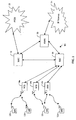
- a wireless communication network 10 generally includes a plurality of mobile stations (also called subscriber units or user equipment) 12a-12d, a plurality of base stations (also called base station transceivers (BTSs) or Node B). 14a-14c, a base station controller (BSC) (also called radio network controller or packet control function 16), a mobile station controller (MSC) or switch 24, a packet data serving node (PDSN) or internetworking function (IWF) 20, a public switched telephone network (PSTN) 22 (typically a telephone company), and an Internet Protocol (IP) network 18 (typically the Internet).
- BSC base station controller
- MSC mobile station controller
- IWF internetworking function
- PSTN public switched telephone network
- IP Internet Protocol
- the wireless communication network 10 is a packet data services network.
- the mobile stations 12a-12d may be any of a number of different types of wireless communication device such as a portable phone, a cellular telephone that is connected to a laptop computer running IP-based, Web-browser applications, a cellular telephone with associated hands-free car kits, a personal data assistant (PDA) running IP-based, Web-browser applications, a wireless communication module incorporated into a portable computer, or a fixed location communication module such as might be found in a wireless local loop or meter reading system.
- PDA personal data assistant
- mobile stations may be any type of wireless communication unit.
- the mobile stations 12a-12d may advantageously be configured to perform one or more wireless packet data protocols such as described in, for example, the EIA/TIA/IS-707 standard.
- the mobile stations 12a-12d generate IP packets destined for the IP network 24 and encapsulate the IP packets into frames using a point-to-point protocol (PPP).
- PPP point-to-point protocol
- the IP network 24 is coupled to the PDSN 20, the PDSN 20 is coupled to the MSC 18, the MSC is coupled to the BSC 16 and the PSTN 22, and the BSC 16 is coupled to the base stations 14a-14c via wirelines configured for transmission of voice and/or data packets in accordance with any of several known protocols including, e.g., E1, T1, Asynchronous Transfer Mode (ATM), IP, PPP, Frame Relay, HDSL, ADSL, or xDSL.
- E1, T1 Asynchronous Transfer Mode
- IP IP
- PPP Packet Transfer Mode
- HDSL High Speed Downlink
- ADSL Advanced Driver Assistance Services
- xDSL xDSL
- the mobile stations 12a-12d communicate with the base stations 14a-14c over an RF interface defined in the 3 rd Generation Partnership Project 2 "3GPP2" , "Physical Layer Standard for cdma2000 Spread Spectrum Systems," 3GPP2 Document No. C.P0002-A, TIA PN-4694, to be published as TIA/EIA/IS-2000-2-A, (Draft, edit version 30) (Nov. 19, 1999), which is fully incorporated herein by reference.
- the mobile stations 12a-12d communicate with the base stations 14a-14c over an RF interface defined in ⁇ NOTE TO MYSELF: insert TDMA, WCDMA, FDMA references>
- the base stations 14a-14c receive and demodulate sets of reverse link signals from various mobile stations 12a-12d engaged in telephone calls, Web browsing, or other data communications. Each reverse link signal received by a given base station 14a-14c is processed within that base station 14a-14c. Each base station 14a-14c may communicate with a plurality of mobile stations 12a-12d by modulating and transmitting sets of forward-link signals to the mobile stations 12a-12d. For example, as shown in FIG. 1 , the base station 14a communicates with first and second mobile stations 12a, 12b simultaneously, and the base station 14c communicates with third and fourth mobile stations 12c, 12d simultaneously.
- the resulting packets are forwarded to the BSC 16, which provides call resource allocation and mobility management functionality including the orchestration of soft handoffs of a call for a particular mobile station 12a-12d from one base station 14a-14c to another base station 14a-14c.
- a mobile station 12c is communicating with two base stations 14b, 14c simultaneously. Eventually, when the mobile station 12c moves far enough away from the origination base stations 14c, the call will be handed off to the destination base station 14b.
- the BSC 16 will route the received data to the MSC 18, which provides additional routing services for interface with the PSTN 22. If the transmission is a packet-based transmission such as a data call destined for the IP network 24, the MSC 18 will route the IP packets to the PDSN 20, which will send the IP packets to the IP network 24. Alternatively, the BSC 16 will route the packets directly to the PDSN 20, which sends the packets to the IP network 24.
- the forward link comprises at least one pilot channel and a plurality of traffic channels, wherein each channel is spread by an appropriate Walsh or quasi-orthogonal function. Each channel is then spread by a quadrature pair of pseudonoise (PN) sequences at a fixed chip rate of 1.2288 Mcps.
- PN pseudonoise
- the use of Walsh codes and PN sequences allows a base station to generate multiple forward link CDMA channels.
- the forward link channels can comprise multiple channels, including but not limited to, pilot channels, synchronization channels, paging channels, broadcast channels, assignment channels, common power control channels, common control channels, dedicated control channels, fundamental channels, supplemental channels, and supplemental code channels.
- the reverse traffic channels can also comprise multiple channels, including but not limited to access channels, common control channels, fundamental channels, supplemental channels, and supplemental code channels, as specified by radio configurations of each individual subscriber network implementing IS-2000.
- Each channel is physically constructed to achieve functionally different purposes.
- a pilot channel may be simply spread using Walsh code "W 0 " but a synchronization channel is an encoded, interleaved, spread, and modulated spread spectrum signal.
- the other forward and reverse link channels are also encoded, interleaved, spread, and modulated spread spectrum signals, but manipulated with various values to satisfy various requirements imposed by the appropriate telecommunication standard.
- a wireless communication device 200 communicates with a base station(BS)/packet data serving node (PDSN) 220 through an interface Um.
- BS base station
- PDSN packetet data serving node
- the wireless communication device 200 may be the origination or the destination of the IP packet, or alternatively, the wireless communication device 200 may be a transparent link to an electronic device 210. In either case, payload information is broken into packets wherein header information is added to each packet.
- the IP header 212 sits on top of the PPP layer 214, which sits on the RLP layer 216, which sits on top of the physical layer 218.
- the RLP layer 216 is the Radio Link Protocol layer, which is responsible for retransmitting packets when a transmission error occurs.
- the packets are transported over the air to a BS/PDSN 220, wherein the packet is sent over the IP network 230.
- Header compression is often used in wireless communication systems to improve the bandwidth and power efficiency of the link by increasing the percentage of the link used for the information payload.
- temporary interruptions in the delivery of information packets are not uncommon. The occurrence of any such interruption may cause significant delays due to the need to retransmit a resynchronization packet to resynchronize a header decompressor at a target device and a need to re-negotiate traffic parameters between the header compressor end and the header decompressor end.
- the need to increase the data throughput rate is always present in modem communication systems that support a variety of applications.
- packetized data traffic and packetized voice traffic are transported over a wireless communication network by selectively bypassing the reliability measures within the RLP layer.
- the packetized data traffic and packetized voice traffic are encapsulated in payload data packets that are the same size as the data frames designed for conventional circuit-switched voice services.
- IP packets the packetized data traffic and the packetized voice traffic will be referred to as IP packets.
- voice traffic is transmitted in vocoder-generated 20 ms data frames.
- voice traffic is transmitted in data frames of 5 ms, 20 ms, 40 ms, or 80 ms duration.
- the IP packets in the exemplary embodiment are carried in payload data packets that are aligned to the data frames of the wireless communication system. Alignment of the IP packets to the data frames of the wireless communication system is advantageous since the wireless communications system is already designed to implement capacity-efficient framing of speech.
- the IP/UDP/RTP headers of the IP packet frames are compressed.
- compression takes the form of stripping IP/UDP/RTP headers from the IP packets so that the vocoder frames carry payload data packets that are aligned with the vocoder frames.
- new headers are generated and appended to the payload by the wireless communication device.
- IP/UDP/RTP protocols The purpose of the IP/UDP/RTP protocols is to ensure a reliable delivery of packets between an origination point and a destination.
- the exemplary embodiment deliberately omits the reliability protections resulting from these protocols in order to implement an error recovery technique in a wireless communication system.
- IP packets are aligned within vocoder data frames and are transported over the air to a receiving end. If a packet is lost from the IP network, a null frame can be generated to replace the lost packet.
- a null frame is a specially coded frame that identifies to the wireless communication device that the original frame from the IP network was lost.
- Receipt of a null frame initiates error recovery techniques such as the repetition of previous non-null frames or the interpolation of data from adjacent frames.
- error recovery techniques reduces the time delay of sending requests for the retransmission of lost frames and the actual retransmission of the lost frames.
- null frames allows the decoder at a receiving end to maintain synchronicity with the encoder at the transmitting end because the null frames are sent with the RTP sequence numbers associated with the corrupted IP packets.
- FIG. 3 illustrates the protocol stack of the exemplary embodiment described above, which will hereinafter be referred to as the Real-Time Packet Data Service Option (RTPDSO).
- FIG. 3 shows an electronic device 310 linked to a wireless communication device 300 which is then linked to an IP network 330 via a BS/PDSN 320.
- the protocols shown in FIG. 3 such as IP' 312, UDP' 314, and RTP' 316, represent the function of removing and re-inserting the IP/UDP/RTP headers, i.e., the header compression. Since the destination and source IP addresses and port numbers do not change, the only dynamic information during normal operation is the RTP sequence numbers.
- the implementation of the exemplary embodiment selectively depends upon the nature of the wireless communication device. For example, if the wireless communication device serves as the target destination of the IP data packet, then the vocoder that encodes and decodes the IP packets is located on the wireless communication device and the wireless communication device need not reconstruct the IP/UDP/RTP headers locally.
- the wireless communication device can also serve as the transparent medium for the transport of IP packets to another electronic device, such as a laptop or a PDA.
- IP packets received by the wireless communication device from the electronic device must be stripped of IP/UDP/RTP headers before transmission over the wireless network, and payload packets received from the wireless network must be reconstructed with new IP/UDP/RTP headers before transmission to the electronic device.
- the RTPDSO and PDSO are implemented together so that initialization, negotiation, and compression update information are more reliably transmitted using the RLP layer.
- the payload data is not transported using the RLP layer.
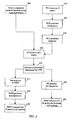
- FIG. 4 is a flowchart of an initialization and registration process for a wireless communication device entering the range of a PDSN that provides both service options, PDSO and RTPDSO.
- the wireless communication device enters the range of a base station that is connected to a PDSN.
- the wireless communication device requests the base station for RTPDSO and the PDSO support for packetized transmissions over the PDSN.
- the base station sets up two air interface links with the PDSN for these two service options. It should be noted that the number of air interface links implemented for this embodiment is dependent upon system conditions.
- the wireless communication device originates a call with the PDSO in order to perform mobile IP registration.
- Various mobile IP registration and session initiation protocols (SIP) exist that can be used with the embodiments described below, but will not be described herein.
- the air interface links can be dropped and the PDSO goes dormant.
- a set up process Upon the transmission of a IP packet in either the forward or reverse link, a set up process first takes place to establish protocols and exchange compression parameters. Compression parameters may include, but are not limited, to the RTP sequence number, IP addresses, and UDP port numbers. In one embodiment, the set up process takes place using the PDSO to ensure the reliability of the air interface link.
- the wireless communication device performs all protocol negotiation over the PDSO.
- the wireless communication device is the transparent medium for the transport of IP packets to a connected electronic device
- the electronic device performs protocol negotiation over the PDSO.
- the wireless communication device strips the header information from the IP packets destined for transport over the PDSN and reconstructs header information for the payload data packets destined for the electronic device.
- Information as to the compression negotiation originates at the wireless communication device and is carried over the PDSO.
- FIG. 5 is a flowchart of a forward link transmission of real-time packet data services.
- the PDSN re-activates the PDSO to start the initialization of the mobile-terminated real-time packet data call.
- a processing element may comprise a processor, a micro-controller, application specific integrated circuit, or other equivalent forms of hardware or software, as described further below.
- the PDSN activates the RTPDSO for transporting voice, video service or other multimedia packets to the wireless communication device.
- the wireless communication device can activate the RTPDSO for transporting voice or video service packets.
- the PDSN receives IP packets from the IP network.
- the PDSN aligns the packets to vocoder data frames through compression and transports the voice or video packets to the base station. It should be noted that not aligning the payload with the air interface frames will require extra overhead to delineate frames of the payload. Non-alignment of packets to frames can also introduce additional latency due to the wait for more data to fill air interface frames.
- the PDSN While receiving packets from the IP network and conveying the IP packets to the base station, the PDSN keeps track of RTP sequence numbers. To reduce jitter and account for transmission delays, the PDSN performs de-jitter buffering. If the processing element detects missing frames, then the processing element generates low-rate null frames.
- Null frames are specially coded frames that identify to the wireless communication device that the original frame from the IP network was lost. The use of null frames allows the decoder in the wireless communication device to remain synchronized with the encoder in the IP network.
- the PDSN relays the packets from the IP network directly to the base station without performing compression.
- the base station performs compression by stripping off header information from the IP packet to form a payload data packet that is sent over the air interface to the wireless communication device.
- the base station would perform the necessary de-jitter buffering and the transmission of null frames over the air interface when packets from the IP network are lost.
- the wireless communication device receives data frames over the air and decodes all data frames.
- the decoder of the wireless communication device processes the IP packets without adding header information to the payload data packets.
- the decoder For received null frames, the decoder performs error recovery techniques such as repeating the previous non-null frame or interpolating data from adjacent frames.
- the decoder can perform the same error recovery techniques used for null frames.
- the wireless communication device receives payload data packets over the air from the base station and performs error recovery on null frames or corrupted frames.
- the wireless communication device encapsulates the payload in new packets with necessary IP/UDP/RTP headers. The RTP sequence number is incremented for every frame received, any necessary UDP and IP checksums are recomputed, and any static header information are all included in the header.
- the new IP/UDP/RTP packets are transmitted to the targeted electronic device.
- FIG. 6 is a flowchart of a reverse link transmission of real-time packet data services.
- the encoder of the wireless communication device generates data packets that are immediately sent over the RTPDSO using the same framing as a circuit-switched call.
- the wireless communication device receives IP packets carrying header information from the electronic device.
- the wireless communication device compresses the IP packets. As discussed previously in the exemplary embodiment, compression takes the form of stripping all header information from the IP packets.
- the wireless communication device packages the compressed IP packets into payload data packets by framing the payload data packets in the same manner as the frames for circuit-switched voice services.
- the aligned payload data packets are transported over the air to a base station.
- the base station receives data frames carrying the aligned payload data packets from the air interface.
- the base station repackages the payload data packets into PPP packets for delivery to a PDSN. If the base station receives null frames or corrupted frames from the wireless communication device, the decoder located at the base station performs error recovery techniques, such as the substitution of a null frame with the last non-null frame or the reconstruction of data from interpolating adjacent data frames.
- the PDSN receives the repackaged frames from the base station and "decompresses" the payload by re-inserting the necessary IP/UDP/RTP headers. For each frame, RTP sequence numbers are incremented, UDP and IP checksums are computed, and all the static header information is re-inserted into the reconstructed header.
- the new IP/UDP/RTP packet is transmitted to the IP network.
- step 680 the base station performs the reinsertion of the necessary IP/UDP/RTP headers before delivering the frames to the PDSN.
- step 690 the PDSN relays the new IP/UDP/RTP packets to the IP network.
- DSP digital signal processor
- ASIC application specific integrated circuit
- FPGA field programmable gate array
- the processor may advantageously be a microprocessor, but in the alternative, the processor may be any conventional processor, controller, micro-controller, or state machine.
- the software module could reside in RAM memory, flash memory, ROM memory, EPROM memory, EEPROM memory, registers, hard disk, a removable disk, a CD-ROM, or any other form of storage medium known in the art.
- RAM memory random access memory
- ROM memory read-only memory
- EPROM memory erasable programmable read-only memory
- EEPROM memory electrically erasable programmable read-only memory
- registers hard disk, a removable disk, a CD-ROM, or any other form of storage medium known in the art.
Landscapes
- Engineering & Computer Science (AREA)
- Computer Networks & Wireless Communication (AREA)
- Signal Processing (AREA)
- Computer Security & Cryptography (AREA)
- Multimedia (AREA)
- Business, Economics & Management (AREA)
- General Business, Economics & Management (AREA)
- Mobile Radio Communication Systems (AREA)
- Data Exchanges In Wide-Area Networks (AREA)
- Transceivers (AREA)
Applications Claiming Priority (2)
| Application Number | Priority Date | Filing Date | Title |
|---|---|---|---|
| US09/643,363 US6879581B1 (en) | 2000-08-22 | 2000-08-22 | Method and apparatus for providing real-time packetized voice and data services over a wireless communication network |
| EP01964042A EP1312192B1 (fr) | 2000-08-22 | 2001-08-14 | Procede et appareil permettant la paquetisation de la voix et de services de donnees en temps reel sur un reseau de communication sans fil |
Related Parent Applications (1)
| Application Number | Title | Priority Date | Filing Date |
|---|---|---|---|
| EP01964042.4 Division | 2001-08-14 |
Publications (1)
| Publication Number | Publication Date |
|---|---|
| EP2197177A1 true EP2197177A1 (fr) | 2010-06-16 |
Family
ID=24580496
Family Applications (2)
| Application Number | Title | Priority Date | Filing Date |
|---|---|---|---|
| EP01964042A Expired - Lifetime EP1312192B1 (fr) | 2000-08-22 | 2001-08-14 | Procede et appareil permettant la paquetisation de la voix et de services de donnees en temps reel sur un reseau de communication sans fil |
| EP10003713A Withdrawn EP2197177A1 (fr) | 2000-08-22 | 2001-08-14 | Procédé et appareil permettant la paquetisation de la voix et de services de données en temps réel sur un réseau de communication sans fil |
Family Applications Before (1)
| Application Number | Title | Priority Date | Filing Date |
|---|---|---|---|
| EP01964042A Expired - Lifetime EP1312192B1 (fr) | 2000-08-22 | 2001-08-14 | Procede et appareil permettant la paquetisation de la voix et de services de donnees en temps reel sur un reseau de communication sans fil |
Country Status (12)
| Country | Link |
|---|---|
| US (1) | US6879581B1 (fr) |
| EP (2) | EP1312192B1 (fr) |
| JP (2) | JP2004507934A (fr) |
| KR (1) | KR100856384B1 (fr) |
| CN (1) | CN1593047B (fr) |
| AT (1) | ATE476820T1 (fr) |
| AU (1) | AU2001284940A1 (fr) |
| BR (1) | BR0113418A (fr) |
| DE (1) | DE60142741D1 (fr) |
| ES (1) | ES2347417T3 (fr) |
| TW (1) | TW536893B (fr) |
| WO (1) | WO2002017592A2 (fr) |
Families Citing this family (42)
| Publication number | Priority date | Publication date | Assignee | Title |
|---|---|---|---|---|
| US7158491B1 (en) * | 1999-11-05 | 2007-01-02 | Nokia Corporation | Terminal-based link adaptation scheme having a detector which monitors application signaling and a requestor which requests a special channel based on the detection |
| BR0114892A (pt) * | 2000-10-24 | 2004-07-06 | Nortel Networks Ltd | Sistemas e métodos arq de estrutura de canal compartilhado |
| GB2371954B (en) * | 2001-02-01 | 2003-02-19 | 3Com Corp | Interface system for wireless node and network node |
| US7061891B1 (en) | 2001-02-02 | 2006-06-13 | Science Applications International Corporation | Method and system for a remote downlink transmitter for increasing the capacity and downlink capability of a multiple access interference limited spread-spectrum wireless network |
| JP2002247001A (ja) * | 2001-02-21 | 2002-08-30 | Ando Electric Co Ltd | 擬似ランダムパターン送信装置 |
| US20020114316A1 (en) * | 2001-02-22 | 2002-08-22 | Buchanan Stanley P. | Method and system for alignment of streaming data between circuit and packet domains of a communication system |
| WO2002080382A1 (fr) | 2001-03-30 | 2002-10-10 | Science Applications International Corporation | Recepteur multi-etages de transmissions a acces multiple par repartition de code |
| US7006461B2 (en) * | 2001-09-17 | 2006-02-28 | Science Applications International Corporation | Method and system for a channel selective repeater with capacity enhancement in a spread-spectrum wireless network |
| US7836124B2 (en) * | 2001-11-16 | 2010-11-16 | Clearwire Legacy Llc | RTP, UDP, IP header compression on the circuit switched type airlink access |
| CN1586060A (zh) * | 2002-09-11 | 2005-02-23 | 西门子公司 | 用于在基于数据压缩的通信系统中修改连接的方法和装置 |
| US20040064657A1 (en) * | 2002-09-27 | 2004-04-01 | Muraleedhara Navada | Memory structure including information storage elements and associated validity storage elements |
| US7382749B2 (en) * | 2002-11-26 | 2008-06-03 | Sony Corporation | Systems, methods, and apparatus with a common wireless communications protocol |
| US7337384B2 (en) * | 2003-02-19 | 2008-02-26 | Nokia Corporation | Error detection scheme with partial checksum coverage |
| US8036122B2 (en) * | 2003-04-03 | 2011-10-11 | Alcatel Lucent | Initiation of network treatment for data packet associated with real-time application different from network treatment applicable to data packet non-associated with the real-time application |
| GB2402027A (en) * | 2003-05-21 | 2004-11-24 | Hutchison Whampoa Three G Ip | Network based RTP proxy for IP header elimination |
| KR100651566B1 (ko) * | 2003-08-26 | 2006-11-28 | 삼성전자주식회사 | 이동통신 단말기에서 출력 버퍼링을 이용한 멀티미디어재생 장치 및 그 제어 방법 |
| JP2005229395A (ja) * | 2004-02-13 | 2005-08-25 | Canon Inc | 再生装置 |
| SE528195C2 (sv) * | 2004-07-14 | 2006-09-19 | Teliasonera Ab | Metod och anordning i ett telekommunikationssystem |
| CN100372397C (zh) * | 2004-07-19 | 2008-02-27 | 华为技术有限公司 | 一种数字集群系统中媒体访问控制协议层的数据处理方法 |
| US7911945B2 (en) * | 2004-08-12 | 2011-03-22 | Nokia Corporation | Apparatus and method for efficiently supporting VoIP in a wireless communication system |
| DE602005012817D1 (de) | 2004-09-30 | 2009-04-02 | Huawei Tech Co Ltd | Verfahren system zur realisierung von kommunikation |
| CN1297124C (zh) * | 2004-09-30 | 2007-01-24 | 华为技术有限公司 | Ip多媒体子系统中利用电路交换承载业务的系统及方法 |
| EP1836864A4 (fr) * | 2004-12-20 | 2011-12-07 | Lg Electronics Inc | Systeme d'acces multidiffusion |
| US7525954B1 (en) * | 2005-01-27 | 2009-04-28 | Sprint Spectrum L.P. | System and method for asymmetric communications and control in a wireless wide area network |
| US7774505B2 (en) | 2005-03-05 | 2010-08-10 | Samsung Electronics Co., Ltd | Method for transmitting image data in real-time |
| US7688760B2 (en) * | 2005-05-16 | 2010-03-30 | Motorola, Inc | Method and apparatus for an exchange of packet data between a wireless access terminal and a packet switched communication system via a circuit switched communication system |
| US7684566B2 (en) | 2005-05-27 | 2010-03-23 | Microsoft Corporation | Encryption scheme for streamed multimedia content protected by rights management system |
| TWI332797B (en) | 2005-06-30 | 2010-11-01 | Realtek Semiconductor Corp | Cordless multimedia system and image display system |
| US8321690B2 (en) | 2005-08-11 | 2012-11-27 | Microsoft Corporation | Protecting digital media of various content types |
| RU2008117998A (ru) * | 2005-10-06 | 2009-11-20 | Нек Корпорейшн (Jp) | Система преобразования протоколов при передаче медийной информации между сетью с коммутацией пакетов и сетью с коммутацией каналов |
| US8908577B2 (en) * | 2005-12-02 | 2014-12-09 | Qualcomm Incorporated | Solving IP buffering delays in mobile multimedia applications with translayer optimization |
| US8953596B2 (en) * | 2006-01-06 | 2015-02-10 | Qualcomm Incorporated | Conserving network capacity by releasing QoS resources |
| JP4684131B2 (ja) * | 2006-02-27 | 2011-05-18 | 京セラ株式会社 | 基地局装置及びデータ中継方法 |
| US8792865B2 (en) * | 2006-06-29 | 2014-07-29 | Qualcomm Incorporated | Method and apparatus for adjusting packet data content by sending null packets based on transmitter signal condition or requirement |
| US7729380B2 (en) * | 2007-01-21 | 2010-06-01 | Motorola, Inc. | Method and device for selectively transmitting voice bursts and regenerated header bursts |
| US20100003928A1 (en) * | 2008-07-01 | 2010-01-07 | Motorola, Inc. | Method and apparatus for header compression for cdma evdo systems |
| CN101631284A (zh) * | 2008-07-18 | 2010-01-20 | 深圳富泰宏精密工业有限公司 | 利用图片识别心情的系统及方法 |
| CN102056235B (zh) * | 2009-11-09 | 2017-04-26 | 华为技术有限公司 | 一种数据传输方法、设备和系统 |
| US9730261B2 (en) * | 2010-01-18 | 2017-08-08 | Telefonaktiebolaget Lm Ericsson (Publ) | Hierarchical protocol classification |
| JP2012151878A (ja) * | 2012-03-12 | 2012-08-09 | Kyocera Corp | 無線通信システム、無線基地局、無線端末及び無線通信方法 |
| US10541933B2 (en) * | 2016-11-10 | 2020-01-21 | Disney Enterprises, Inc. | Systems and methods for aligning frames of a digital video content in IP domain |
| US12615327B2 (en) * | 2024-01-04 | 2026-04-28 | Boost SubscriberCo L.L.C. | Dynamic modification of communication operations exchanged between interconnected networks |
Citations (3)
| Publication number | Priority date | Publication date | Assignee | Title |
|---|---|---|---|---|
| WO1997016007A1 (fr) | 1995-10-25 | 1997-05-01 | Telecom Finland Oy | Passerelle entre reseaux utilisant differents protocoles |
| US5781547A (en) | 1996-02-29 | 1998-07-14 | Motorola, Inc. | Router and method for use in a communication system |
| WO1999062223A2 (fr) | 1998-05-26 | 1999-12-02 | Qualcomm Incorporated | Architecture et procede de transmission rapide de donnees a commutation de circuits |
Family Cites Families (18)
| Publication number | Priority date | Publication date | Assignee | Title |
|---|---|---|---|---|
| US4901307A (en) | 1986-10-17 | 1990-02-13 | Qualcomm, Inc. | Spread spectrum multiple access communication system using satellite or terrestrial repeaters |
| US5103459B1 (en) | 1990-06-25 | 1999-07-06 | Qualcomm Inc | System and method for generating signal waveforms in a cdma cellular telephone system |
| US5511073A (en) | 1990-06-25 | 1996-04-23 | Qualcomm Incorporated | Method and apparatus for the formatting of data for transmission |
| FI940093A0 (fi) * | 1994-01-10 | 1994-01-10 | Nokia Mobile Phones Ltd | Foerfarande foer oeverfoering av data och datagraenssnittenhet |
| US5535199A (en) * | 1994-09-06 | 1996-07-09 | Sun Microsystems, Inc. | TCP/IP header compression X.25 networks |
| FI98027C (fi) * | 1995-01-10 | 1997-03-25 | Nokia Telecommunications Oy | Pakettiradiojärjestelmä ja päätelaitteisto pakettiradiojärjestelmää varten |
| FI962381A7 (fi) * | 1996-06-07 | 1997-12-08 | Nokia Corp | Datan pakkaaminen tietoliikenneyhteydellä |
| US5933462A (en) | 1996-11-06 | 1999-08-03 | Qualcomm Incorporated | Soft decision output decoder for decoding convolutionally encoded codewords |
| JP4109735B2 (ja) * | 1997-09-05 | 2008-07-02 | 株式会社日立製作所 | パケット変換方法、伝送方法、mpegプロトコルとipの変換方法、catvシステム、プロトコル変換方法およびパケット送信方法 |
| FI106510B (fi) * | 1997-10-10 | 2001-02-15 | Nokia Networks Oy | Järjestelmä puheen siirtämiseksi matkapuhelinverkon ja kiinteän verkon päätelaitteen välillä |
| US6415329B1 (en) * | 1998-03-06 | 2002-07-02 | Massachusetts Institute Of Technology | Method and apparatus for improving efficiency of TCP/IP protocol over high delay-bandwidth network |
| US6230012B1 (en) * | 1998-08-07 | 2001-05-08 | Qualcomm Incorporated | IP mobility support using proxy mobile node registration |
| US6535918B1 (en) * | 1998-09-22 | 2003-03-18 | Qualcomm Incorporated | Interface between standard terminal equipment unit and high speed wireless link |
| JP2000115194A (ja) * | 1998-10-02 | 2000-04-21 | Matsushita Electric Ind Co Ltd | 無線通信装置 |
| US6160804A (en) * | 1998-11-13 | 2000-12-12 | Lucent Technologies Inc. | Mobility management for a multimedia mobile network |
| US6542490B1 (en) * | 1999-01-29 | 2003-04-01 | Nortel Networks Limited | Data link control proctocol for 3G wireless system |
| US6556556B1 (en) * | 1999-01-29 | 2003-04-29 | Nortel Networks Limited | Method and system for limiting data packet transmission within a digital mobile telephone communication network by discarding unsuccessfully transmitted radio link protocol frames |
| US6463074B1 (en) * | 2000-06-14 | 2002-10-08 | Tantivy Communications, Inc. | Receiver for time division multiplex system without explicit time slot assignment |
-
2000
- 2000-08-22 US US09/643,363 patent/US6879581B1/en not_active Expired - Fee Related
-
2001
- 2001-08-14 JP JP2002522159A patent/JP2004507934A/ja not_active Withdrawn
- 2001-08-14 AU AU2001284940A patent/AU2001284940A1/en not_active Abandoned
- 2001-08-14 KR KR1020037002552A patent/KR100856384B1/ko not_active Expired - Fee Related
- 2001-08-14 DE DE60142741T patent/DE60142741D1/de not_active Expired - Lifetime
- 2001-08-14 CN CN01814425.XA patent/CN1593047B/zh not_active Expired - Fee Related
- 2001-08-14 BR BR0113418-3A patent/BR0113418A/pt not_active Application Discontinuation
- 2001-08-14 WO PCT/US2001/025573 patent/WO2002017592A2/fr not_active Ceased
- 2001-08-14 EP EP01964042A patent/EP1312192B1/fr not_active Expired - Lifetime
- 2001-08-14 AT AT01964042T patent/ATE476820T1/de not_active IP Right Cessation
- 2001-08-14 EP EP10003713A patent/EP2197177A1/fr not_active Withdrawn
- 2001-08-14 ES ES01964042T patent/ES2347417T3/es not_active Expired - Lifetime
- 2001-08-22 TW TW090120624A patent/TW536893B/zh not_active IP Right Cessation
-
2011
- 2011-07-22 JP JP2011160979A patent/JP5139566B2/ja not_active Expired - Fee Related
Patent Citations (3)
| Publication number | Priority date | Publication date | Assignee | Title |
|---|---|---|---|---|
| WO1997016007A1 (fr) | 1995-10-25 | 1997-05-01 | Telecom Finland Oy | Passerelle entre reseaux utilisant differents protocoles |
| US5781547A (en) | 1996-02-29 | 1998-07-14 | Motorola, Inc. | Router and method for use in a communication system |
| WO1999062223A2 (fr) | 1998-05-26 | 1999-12-02 | Qualcomm Incorporated | Architecture et procede de transmission rapide de donnees a commutation de circuits |
Also Published As
| Publication number | Publication date |
|---|---|
| ES2347417T3 (es) | 2010-10-29 |
| EP1312192B1 (fr) | 2010-08-04 |
| KR100856384B1 (ko) | 2008-09-04 |
| US6879581B1 (en) | 2005-04-12 |
| AU2001284940A1 (en) | 2002-03-04 |
| DE60142741D1 (de) | 2010-09-16 |
| WO2002017592A3 (fr) | 2003-01-16 |
| TW536893B (en) | 2003-06-11 |
| JP2004507934A (ja) | 2004-03-11 |
| EP1312192A2 (fr) | 2003-05-21 |
| CN1593047A (zh) | 2005-03-09 |
| CN1593047B (zh) | 2014-03-12 |
| JP5139566B2 (ja) | 2013-02-06 |
| WO2002017592A2 (fr) | 2002-02-28 |
| JP2012010349A (ja) | 2012-01-12 |
| BR0113418A (pt) | 2004-01-13 |
| KR20030027961A (ko) | 2003-04-07 |
| ATE476820T1 (de) | 2010-08-15 |
Similar Documents
| Publication | Publication Date | Title |
|---|---|---|
| US6879581B1 (en) | Method and apparatus for providing real-time packetized voice and data services over a wireless communication network | |
| AU2002247311B2 (en) | Method and apparatus for providing multiple quality of service levels in a wireless packet data services connection | |
| US7355999B2 (en) | Method and apparatus for carrying packetized voice and data in wireless communication networks | |
| JP5084842B2 (ja) | 無線通信ネットワークにおける改良されたヘッダ圧縮 | |
| JP4629434B2 (ja) | データ送信のための改善されたフィードバック | |
| US20070058679A1 (en) | Dynamic robust header compression | |
| TW200412811A (en) | Improved feedback system using dynamic decoding | |
| AU2002247311A1 (en) | Method and apparatus for providing multiple quality of service levels in a wireless packet data services connection | |
| HK1073028A (en) | Method and apparatus for providing real-time packetized voice and data services over a wireless communication network | |
| HK1094629A (en) | Method and apparatus for carrying packetized voice and data in wireless communication networks |
Legal Events
| Date | Code | Title | Description |
|---|---|---|---|
| PUAI | Public reference made under article 153(3) epc to a published international application that has entered the european phase |
Free format text: ORIGINAL CODE: 0009012 |
|
| 17P | Request for examination filed |
Effective date: 20100406 |
|
| AC | Divisional application: reference to earlier application |
Ref document number: 1312192 Country of ref document: EP Kind code of ref document: P |
|
| AK | Designated contracting states |
Kind code of ref document: A1 Designated state(s): AT BE CH CY DE DK ES FI FR GB GR IE IT LI LU MC NL PT SE TR |
|
| GRAP | Despatch of communication of intention to grant a patent |
Free format text: ORIGINAL CODE: EPIDOSNIGR1 |
|
| INTG | Intention to grant announced |
Effective date: 20160217 |
|
| RIC1 | Information provided on ipc code assigned before grant |
Ipc: H04L 12/64 20060101ALI20160205BHEP Ipc: H04L 29/06 20060101AFI20160205BHEP |
|
| STAA | Information on the status of an ep patent application or granted ep patent |
Free format text: STATUS: THE APPLICATION IS DEEMED TO BE WITHDRAWN |
|
| 18D | Application deemed to be withdrawn |
Effective date: 20160628 |