EP2197211A2 - Procédé d'amélioration de la fonctionnalité de la représentation binaire de MPEG-7 et autres descriptions de contenu XML - Google Patents
Procédé d'amélioration de la fonctionnalité de la représentation binaire de MPEG-7 et autres descriptions de contenu XML Download PDFInfo
- Publication number
- EP2197211A2 EP2197211A2 EP10003086A EP10003086A EP2197211A2 EP 2197211 A2 EP2197211 A2 EP 2197211A2 EP 10003086 A EP10003086 A EP 10003086A EP 10003086 A EP10003086 A EP 10003086A EP 2197211 A2 EP2197211 A2 EP 2197211A2
- Authority
- EP
- European Patent Office
- Prior art keywords
- schema
- elements
- tree
- decoder
- codes
- Prior art date
- Legal status (The legal status is an assumption and is not a legal conclusion. Google has not performed a legal analysis and makes no representation as to the accuracy of the status listed.)
- Withdrawn
Links
- 238000000034 method Methods 0.000 title claims abstract description 23
- 230000005540 biological transmission Effects 0.000 claims description 3
- 230000002708 enhancing effect Effects 0.000 claims 1
- 229920006132 styrene block copolymer Polymers 0.000 description 10
- 238000001914 filtration Methods 0.000 description 5
- 230000008859 change Effects 0.000 description 4
- 230000006835 compression Effects 0.000 description 4
- 238000007906 compression Methods 0.000 description 4
- 230000006872 improvement Effects 0.000 description 4
- 239000012634 fragment Substances 0.000 description 3
- 238000010276 construction Methods 0.000 description 2
- 230000006870 function Effects 0.000 description 2
- 239000003550 marker Substances 0.000 description 2
- VBRBNWWNRIMAII-WYMLVPIESA-N 3-[(e)-5-(4-ethylphenoxy)-3-methylpent-3-enyl]-2,2-dimethyloxirane Chemical compound C1=CC(CC)=CC=C1OC\C=C(/C)CCC1C(C)(C)O1 VBRBNWWNRIMAII-WYMLVPIESA-N 0.000 description 1
- 230000003044 adaptive effect Effects 0.000 description 1
- 230000008901 benefit Effects 0.000 description 1
- 230000001419 dependent effect Effects 0.000 description 1
- 238000005516 engineering process Methods 0.000 description 1
- 230000002349 favourable effect Effects 0.000 description 1
- 238000013507 mapping Methods 0.000 description 1
- 230000007246 mechanism Effects 0.000 description 1
- 238000012011 method of payment Methods 0.000 description 1
- 238000005457 optimization Methods 0.000 description 1
- 230000008569 process Effects 0.000 description 1
Images





Classifications
-
- H—ELECTRICITY
- H04—ELECTRIC COMMUNICATION TECHNIQUE
- H04N—PICTORIAL COMMUNICATION, e.g. TELEVISION
- H04N21/00—Selective content distribution, e.g. interactive television or video on demand [VOD]
- H04N21/20—Servers specifically adapted for the distribution of content, e.g. VOD servers; Operations thereof
- H04N21/23—Processing of content or additional data; Elementary server operations; Server middleware
- H04N21/235—Processing of additional data, e.g. scrambling of additional data or processing content descriptors
- H04N21/2353—Processing of additional data, e.g. scrambling of additional data or processing content descriptors specifically adapted to content descriptors, e.g. coding, compressing or processing of metadata
-
- H—ELECTRICITY
- H04—ELECTRIC COMMUNICATION TECHNIQUE
- H04N—PICTORIAL COMMUNICATION, e.g. TELEVISION
- H04N19/00—Methods or arrangements for coding, decoding, compressing or decompressing digital video signals
- H04N19/20—Methods or arrangements for coding, decoding, compressing or decompressing digital video signals using video object coding
-
- H—ELECTRICITY
- H04—ELECTRIC COMMUNICATION TECHNIQUE
- H04N—PICTORIAL COMMUNICATION, e.g. TELEVISION
- H04N19/00—Methods or arrangements for coding, decoding, compressing or decompressing digital video signals
- H04N19/70—Methods or arrangements for coding, decoding, compressing or decompressing digital video signals characterised by syntax aspects related to video coding, e.g. related to compression standards
-
- H—ELECTRICITY
- H04—ELECTRIC COMMUNICATION TECHNIQUE
- H04N—PICTORIAL COMMUNICATION, e.g. TELEVISION
- H04N21/00—Selective content distribution, e.g. interactive television or video on demand [VOD]
- H04N21/20—Servers specifically adapted for the distribution of content, e.g. VOD servers; Operations thereof
- H04N21/23—Processing of content or additional data; Elementary server operations; Server middleware
- H04N21/235—Processing of additional data, e.g. scrambling of additional data or processing content descriptors
-
- H—ELECTRICITY
- H04—ELECTRIC COMMUNICATION TECHNIQUE
- H04N—PICTORIAL COMMUNICATION, e.g. TELEVISION
- H04N21/00—Selective content distribution, e.g. interactive television or video on demand [VOD]
- H04N21/40—Client devices specifically adapted for the reception of or interaction with content, e.g. set-top-box [STB]; Operations thereof
- H04N21/43—Processing of content or additional data, e.g. demultiplexing additional data from a digital video stream; Elementary client operations, e.g. monitoring of home network or synchronising decoder's clock; Client middleware
- H04N21/435—Processing of additional data, e.g. decrypting of additional data, reconstructing software from modules extracted from the transport stream
-
- Y—GENERAL TAGGING OF NEW TECHNOLOGICAL DEVELOPMENTS; GENERAL TAGGING OF CROSS-SECTIONAL TECHNOLOGIES SPANNING OVER SEVERAL SECTIONS OF THE IPC; TECHNICAL SUBJECTS COVERED BY FORMER USPC CROSS-REFERENCE ART COLLECTIONS [XRACs] AND DIGESTS
- Y10—TECHNICAL SUBJECTS COVERED BY FORMER USPC
- Y10S—TECHNICAL SUBJECTS COVERED BY FORMER USPC CROSS-REFERENCE ART COLLECTIONS [XRACs] AND DIGESTS
- Y10S707/00—Data processing: database and file management or data structures
- Y10S707/99931—Database or file accessing
- Y10S707/99933—Query processing, i.e. searching
- Y10S707/99936—Pattern matching access
-
- Y—GENERAL TAGGING OF NEW TECHNOLOGICAL DEVELOPMENTS; GENERAL TAGGING OF CROSS-SECTIONAL TECHNOLOGIES SPANNING OVER SEVERAL SECTIONS OF THE IPC; TECHNICAL SUBJECTS COVERED BY FORMER USPC CROSS-REFERENCE ART COLLECTIONS [XRACs] AND DIGESTS
- Y10—TECHNICAL SUBJECTS COVERED BY FORMER USPC
- Y10S—TECHNICAL SUBJECTS COVERED BY FORMER USPC CROSS-REFERENCE ART COLLECTIONS [XRACs] AND DIGESTS
- Y10S707/00—Data processing: database and file management or data structures
- Y10S707/99941—Database schema or data structure
- Y10S707/99942—Manipulating data structure, e.g. compression, compaction, compilation
Definitions
- the invention relates to the coding and decoding of XML-based structured documents, as provided for example in MPEG-7.
- the XML is a standard for the definition of document structures and is used to represent structured data in a text file and forms, for example, the basis for the language XHTML.
- These XML-based structured documents are based on a set of structured elements - hereafter referred to as "schemas" - such as those that can be specified using Document Type Definition (DTD), XML Schema, or Multimedia Description Schemes (DS).
- DTD Document Type Definition
- XML Schema XML Schema
- DS Multimedia Description Schemes
- the invention relates to the optimization of the coding of structured XML documents.
- the object underlying the invention is now to provide methods for improving the functionality of the binary representation of XML-based content descriptions, in particular of MPEG-7 documents, in which the amount of data to be transmitted is minimized, searches within the document as simple as possible and are not included in the schema template an instantiated document with the least possible effort.
- the structure of an XML document can be construed as a data tree, with each element of the description corresponding to a node in that tree.
- the structure of the nodes is determined by the definition in the schema underlying the document. In particular, the type and number of child elements are defined by this. The prototype of such a node is shown, for example, on page 19 of this draft.
- This tree node consists of the name of the element or complex type, a field with codewords TBC (Tree Branch Code) that are used to refer to the child elements, and the tree branches that represent the references to the corresponding child elements.
- TBC Transmission Branch Code
- the TBCs are divided into two components, namely a schema branch and a position information, where the schema information is derived from the elements that appear in the schema as child elements, while the position information contains the position information for those elements, which can occur multiple times.
- the possible types of child elements are elements of type Complex Type, which in turn can contain child elements, or elements of type Simple Type or attributes that can not contain child elements.
- the length of the #position field is determined by the maximum number ("maxOccurs") of the element specified in the schema. In the case where in this example the maximum number is greater than 7 or not limited, the field is adaptively extended until the position to be coded can be represented. This split has the property that the schema branch code or SBC #SchemaBranchCode always stays the same regardless of how many children are or can be present in the current instantiation.
- the TBCs that is the SchemaBranchCodes and optionally the PositionCodes
- the TBCs are strung together, resulting in a path in the document.
- the desired element is reached, the last code is inserted in the table. If the desired element can not have any more children, ie an attribute or a simple type, then this termination code is not necessary and will not be sent. In this case, the attribute or the simple type element is subsequently transmitted coded.
- the invention consists in using two different scheme branching codes, one of which is used much more frequently, thus causing compression, merging scheme branching codes and location codes, and transmitting the bit length for the scheme branching codes, thereby facilitating the search function in that the first part alone specifies the type of the referenced element and that on the basis of a schema version number to be transmitted and fixed expansion strategies also known to the decoder an enhancement of extensibility is achieved.
- FIG. 1 is a previous addressing of a simple type element or attribute and in FIG. 1b an addressing of a Complex Type element shown, as it corresponds to the known methods.
- FIG. 1c and 1d the corresponding addressing according to the inventive method are shown. From this it is clear that two different scheme branching codes SBC-A and SBC-B are used and not only the general scheme branching code SBC-B.
- such an address path consists of concatenated TBC codes, that is, if necessary, position codes #pos also exist between the scheme branch codes SBC-A, and only at the end is a scheme branch code SBC-A with a path termination code and no further position specification followed by a general scheme branching code SBC-B, which may also contain elements of the simple type or attributes that make up the leaves of the tree-like structure.
- the #schema branch codes of both tables are referred to below as SBC-A and SBC-B, respectively.
- the total path is again formed by the concatenation of TBCs, with all except the last TBC with SBC-A and possibly the corresponding # position codes are formed.
- the end of the first part of the path created using table A is signaled with a termination code, for example all bits 1.
- a termination code for example all bits 1.
- the termination code must be sent in the method according to the invention even if an attribute or a simple type element is addressed. Since the length of the #Schema Branch Codes depends on the number of possible elements, the codes in Table A, ie the codes SBC-A, are correspondingly shorter. On the compression also has a favorable effect that the codes SBC-A are used much more frequently than the codes SBC-B.
- FIG. 2 is an example of an XML schema text and is shown in the FIGS. 2a and 2b the associated node tables shown for SBC-A and SBC-B. From this it becomes clear that for the SBC-A the schema branch codes can be shortened, because here the Simple Type elements and attributes do not need to be referenced.
- a functionality required by the binary representation that is not fully usable with the method according to the ISO / IEC draft is the simplified search for specific elements in the document.
- this search should be done with a simple filtering mechanism by pattern matching a bitstream predetermined in the document that uniquely addresses the searched element in the document.
- a quick search for a particular element in the document tree will then parse the bitstream, and look more closely at only those elements that were addressed by the correct path fragment.
- filtering is not fully practicable since the length of the # position codes can not be determined in advance if the maximum number of at least one element in the schema is greater than 7 is or is not limited.
- the #Position codes are split into a fixed length part and a variable length part.
- the variable length parts are removed from the TBCs and moved to the end of the path.
- an indication of the total length L, typically in bits, of the path may be sent without the # position codes behind, so that a pointer Z for the # position codes may be carried and thus the correct positions parallel to the SBCs can be decoded.
- this also enables the search for specific positions (#positions) for the searched elements and also supports the search for the case of the extensibility explained below, in which a part of the path is not known to every decoder.
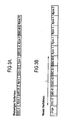
- FIG. 3a illustrates these relationships using the example of addressing a simple type element or attribute in the previous method.
- FIG. 3b Corresponding to the inventive method is shown.
- all scheme branching codes SBC-B1 ... SBC-B5 of a respective path are arranged consecutively and have a total length L which is transmitted first at the beginning.
- the position codes #pos 1 ... # pos5 are separated from the SBC and arranged consecutively.
- the bit pattern for the absolute addressing with the bit length L can be determined from the scheme definition, so that a filtering of the bit stream by pattern matching is possible.
- the coding scheme on which the ISO / IEC design algorithm is based is context-sensitive, that is, each element encodes only the other possibilities determined by the context.
- the decoder can only read and correctly interpret the bitstream if it knows the scheme definition. It must be known to the decoder which TBC code refers to which element and how long the bit code in each element is to read the correct number of bits for each path fragment.
- a defined schema is subsequently extended to take into account new constraints, for example new metadata categories.
- These extensions can be optional elements or attributes.
- XML-formatted documents created according to the old schema definition continue to be valid (forward compatibility) with respect to the new definition.
- these can also be inheritance-derived data types which, in the case of a restriction (derived by restriction), retain the TBCs or, on extension (derived by extension), receive an extended TBC table, as described below.
- the standardized versions can be assigned a unique version identifier, which can be found in FIG. 4a with M7_Version_ID.
- proprietary extensions can be marked with an extension identification, which can be found in FIG. 4a with Extension_ID.
- This can be specified if the bit lengths of the extended tree node TSN are also stored in the bit stream. This will, as in FIG. 4a shown indicated by a flag DS_Extension.
- the bit length information of the tree branch codes TBC from the extended tree nodes TSN is given in the FIG. 4a specified DS_Update_Info (), as in FIG. 4b shown, coded.
- DS_Update_Info DS_Update_Info
- the Expression Number_of_changed_nodes signals the number of changed tree nodes. The number can be coded with variable length, according to the position information proposed in the ISO / IEC draft.
- the information of the changed tree node can be addressed in the bit stream by a navigation command Navigation_Command and a navigation path Navigation_Path ().
- the subsequently transmitted change information then applies to all elements that are of the same type as the addressed node.
- the changed codeword length SBC_Length or the changed number of schema branch codes is inserted into the data stream.
- the codeword length or number is again coded according to the method used to code the number_of_changed_nodes.
- the changed tree nodes can be identified by directly addressing the complex types in the schema. This direct addressing can be achieved, for example, by counting the complex types defined in the schema.
- the decoder can also decode the contents of the newly added documents and, if necessary, save or process them further.
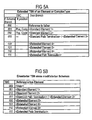
- FIGS. 5a and 5b The example shown shows the changes in a new version of a schema definition, where FIG. 5a an extended tree node of a complex type element and in FIG. 5b an expanded tree node of a modified schema is shown. Elements 3 to 6 are added in the new version.
- the length of the schema code extends from two to three. The previous addresses remain except for the extension by a zero as MSB, however.
- FIGS. 6a and 6b The following is an example of encoding schema-extended elements in the FIGS. 6a and 6b shown.
- the starting point is in connection with FIG. 2 example used.
- FIG. 2 example For the sake of simplicity, the above-described method of dividing node tables is dispensed with in this illustration.
- the original scheme "PurchaseOrderType" should be extended by a few elements.
- the extensions opposite FIG. 2 are in FIG. 6a highlighted in bold.
- Documents encoded according to the old schema definition are transferred to a decoder that is aware of the new scheme.
- the version number of the schema underlying the coded document must be sent to the decoder first.
- the decoder has a table in which, for each version number, the bit width or the number of schema branching codes SBC is stored for all elements.
- the decoder determines that PurchaseOrderType elements are not encoded with four bits but only three bits. With this information he can already decode the document correctly.
- Documents coded according to the new schema definition are transferred to a decoder that knows only the old schema.
- the decoder recognizes from the version number of the scheme that unknown elements can be transmitted and that known elements can be coded with a different bit width.
- the new bit width of the elements must be known to the decoder, otherwise it would lose synchronization with the encoder.
- URI specified address
- the encoder has four ways of encoding the document:
- the decoder recognizes from the schema branching code 0101 that an element is being addressed that is not included in the standard scheme. Accordingly, it interprets the next bits as the length L of the unknown element.
- This length specification could be according to the adaptive variable integer coding as given in the ISO / IEC draft. With the aid of this length specification, he skips the subordinate sub-tree "billTo" and resets it in # SchemaBranch code 0010. He can then decode the following element "Command" again.
- the tree nodes containing new elements as well as their position in the document tree are transmitted before the actual document.
- This method updates the schema known to the decoder.
- the transmission of the document thus takes place in accordance with the case where the schema is known.
- he can use the newly transferred schema to extend his internally known elements over the new ones, provided that a unique version number is assigned that identifies the new schema.
- a complete, new scheme is transferred.
- the decoder can handle the document as encoded according to a known scheme.
- he can use the newly transferred schema to extend his internally known elements to the new ones, provided a unique one The version number that identifies the new schema.
Landscapes
- Engineering & Computer Science (AREA)
- Multimedia (AREA)
- Signal Processing (AREA)
- Library & Information Science (AREA)
- Document Processing Apparatus (AREA)
- Information Retrieval, Db Structures And Fs Structures Therefor (AREA)
- Compression, Expansion, Code Conversion, And Decoders (AREA)
Applications Claiming Priority (3)
| Application Number | Priority Date | Filing Date | Title |
|---|---|---|---|
| DE10064663 | 2000-12-22 | ||
| DE10109547 | 2001-02-28 | ||
| EP01985799A EP1344403B1 (fr) | 2000-12-22 | 2001-12-20 | Procede pour ameliorer la fonctionnalite de la representation binaire de mpeg-7 et d'autres descriptions de contenu a base de xml |
Related Parent Applications (1)
| Application Number | Title | Priority Date | Filing Date |
|---|---|---|---|
| EP01985799.4 Division | 2001-12-20 |
Publications (2)
| Publication Number | Publication Date |
|---|---|
| EP2197211A2 true EP2197211A2 (fr) | 2010-06-16 |
| EP2197211A3 EP2197211A3 (fr) | 2010-08-25 |
Family
ID=26008063
Family Applications (5)
| Application Number | Title | Priority Date | Filing Date |
|---|---|---|---|
| EP10003087A Ceased EP2197212A3 (fr) | 2000-12-22 | 2001-12-20 | Procédé d'amélioration de la fonctionnalité de la représentation binaire de MPEG-7 et autres descriptions de contenu XML |
| EP10003088.1A Expired - Lifetime EP2197213B1 (fr) | 2000-12-22 | 2001-12-20 | Procédé d'amélioration de la fonctionnalité de la représentation binaire de MPEG-7 et autres descriptions de contenu XML |
| EP01985799A Expired - Lifetime EP1344403B1 (fr) | 2000-12-22 | 2001-12-20 | Procede pour ameliorer la fonctionnalite de la representation binaire de mpeg-7 et d'autres descriptions de contenu a base de xml |
| EP10003085A Withdrawn EP2197210A3 (fr) | 2000-12-22 | 2001-12-20 | Procédé d'amélioration de la fonctionnalité de la représentation binaire de MPEG-7 et autres descriptions de contenu XML |
| EP10003086A Withdrawn EP2197211A3 (fr) | 2000-12-22 | 2001-12-20 | Procédé d'amélioration de la fonctionnalité de la représentation binaire de MPEG-7 et autres descriptions de contenu XML |
Family Applications Before (4)
| Application Number | Title | Priority Date | Filing Date |
|---|---|---|---|
| EP10003087A Ceased EP2197212A3 (fr) | 2000-12-22 | 2001-12-20 | Procédé d'amélioration de la fonctionnalité de la représentation binaire de MPEG-7 et autres descriptions de contenu XML |
| EP10003088.1A Expired - Lifetime EP2197213B1 (fr) | 2000-12-22 | 2001-12-20 | Procédé d'amélioration de la fonctionnalité de la représentation binaire de MPEG-7 et autres descriptions de contenu XML |
| EP01985799A Expired - Lifetime EP1344403B1 (fr) | 2000-12-22 | 2001-12-20 | Procede pour ameliorer la fonctionnalite de la representation binaire de mpeg-7 et d'autres descriptions de contenu a base de xml |
| EP10003085A Withdrawn EP2197210A3 (fr) | 2000-12-22 | 2001-12-20 | Procédé d'amélioration de la fonctionnalité de la représentation binaire de MPEG-7 et autres descriptions de contenu XML |
Country Status (6)
| Country | Link |
|---|---|
| US (5) | US7233953B2 (fr) |
| EP (5) | EP2197212A3 (fr) |
| JP (5) | JP2004517410A (fr) |
| CN (1) | CN1227609C (fr) |
| DE (1) | DE50115539D1 (fr) |
| WO (1) | WO2002052857A2 (fr) |
Families Citing this family (26)
| Publication number | Priority date | Publication date | Assignee | Title |
|---|---|---|---|---|
| EP1122958A1 (fr) * | 2000-02-02 | 2001-08-08 | Siemens Aktiengesellschaft | Méthode pour la transmission d'un message et système de télécommunication |
| US7233953B2 (en) * | 2000-12-22 | 2007-06-19 | Siemens Aktiengesellschaft | Method for improving functionality of the binary representation of MPEG-7 and of other XML-based contents descriptions |
| EP1223759A1 (fr) * | 2001-01-08 | 2002-07-17 | Robert Bosch Gmbh | Méthode de génération d'un code d'extension pour description binaire de données multimédia |
| DE50213742D1 (de) * | 2001-02-01 | 2009-09-17 | Siemens Ag | Verfahren zur verbesserung der funktionalität der binären repräsentation von mpeg-7 und anderen xml-basierten inhaltsbeschreibungen |
| EP1388211A2 (fr) * | 2001-02-05 | 2004-02-11 | Expway | Procede et systeme de compression de descriptions structurees de documents |
| US7689901B2 (en) * | 2001-03-01 | 2010-03-30 | Sony Corporation | Multiple updates to content descriptions using a single command |
| CN1520563A (zh) | 2001-06-25 | 2004-08-11 | 在用二进制表示的结构化的文档中,快速查找数据元或属性的方法或快速筛选片段的方法 | |
| DE10231970B3 (de) * | 2002-07-15 | 2004-02-26 | Siemens Ag | Verfahren zur Codierung von Positionen von Datenelementen in einer Datenstruktur sowie Vorrichtungen zur entsprechenden Codierung und/oder Decodierung |
| DE10339971A1 (de) * | 2002-12-03 | 2004-07-01 | Siemens Ag | Verfahren zur Codierung eines XML-basierten Dokuments |
| EP1598941A4 (fr) * | 2003-02-03 | 2009-02-18 | Sharp Kk | Procede et dispositif de codage, procede et dispositif de decodage, programme et support d'enregistrement |
| SG160225A1 (en) * | 2003-02-14 | 2010-04-29 | Res In Motion Ltd Ca | System and method for compression of wireless applications expressed in a structured definition language |
| US7908248B2 (en) * | 2003-07-22 | 2011-03-15 | Sap Ag | Dynamic meta data |
| US7685137B2 (en) * | 2004-08-06 | 2010-03-23 | Oracle International Corporation | Technique of using XMLType tree as the type infrastructure for XML |
| US8954400B2 (en) | 2004-09-13 | 2015-02-10 | International Business Machines Corporation | Method, system and program product for managing structured data |
| CN1312933C (zh) * | 2004-10-28 | 2007-04-25 | 复旦大学 | 一种基于树状结构的视频图像压缩编码方法 |
| CN100354862C (zh) * | 2004-11-19 | 2007-12-12 | 北京九州软件有限公司 | 计算机文档的存储及解析方法 |
| US8667179B2 (en) * | 2005-04-29 | 2014-03-04 | Microsoft Corporation | Dynamic utilization of condensing metadata |
| US20070143664A1 (en) * | 2005-12-21 | 2007-06-21 | Motorola, Inc. | A compressed schema representation object and method for metadata processing |
| US7886223B2 (en) * | 2006-11-17 | 2011-02-08 | International Business Machines Corporation | Generating a statistical tree for encoding/decoding an XML document |
| DE102007007830A1 (de) | 2007-02-16 | 2008-08-21 | Fraunhofer-Gesellschaft zur Förderung der angewandten Forschung e.V. | Vorrichtung und Verfahren zum Erzeugen eines Datenstroms und Vorrichtung und Verfahren zum Lesen eines Datenstroms |
| US7747558B2 (en) * | 2007-06-07 | 2010-06-29 | Motorola, Inc. | Method and apparatus to bind media with metadata using standard metadata headers |
| US7925643B2 (en) * | 2008-06-08 | 2011-04-12 | International Business Machines Corporation | Encoding and decoding of XML document using statistical tree representing XSD defining XML document |
| EP2219117A1 (fr) * | 2009-02-13 | 2010-08-18 | Siemens Aktiengesellschaft | Module de traitement, dispositif et procédé de traitement de données XML |
| CN101944229B (zh) * | 2009-07-08 | 2012-11-28 | 方正国际软件(北京)有限公司 | 用于图像文件的附加信息方法 |
| EP2388701A1 (fr) * | 2010-05-17 | 2011-11-23 | Siemens Aktiengesellschaft | Procédé et appareil pour la fourniture d'une implémentation de service |
| US8375031B2 (en) * | 2011-02-10 | 2013-02-12 | Tektronix, Inc. | Lossless real-time line-rate filtering using PCAP style filters and hardware assisted patricia trees |
Family Cites Families (32)
| Publication number | Priority date | Publication date | Assignee | Title |
|---|---|---|---|---|
| US5675668A (en) * | 1992-04-08 | 1997-10-07 | Kawaski Steel Corporation | Coding method, semiconductor memory for implementing coding method, decoder for semiconductor memory and method for identification of hand-written characters |
| US5379355A (en) * | 1992-08-24 | 1995-01-03 | Ricoh Corporation | Data encoding using one or more adaptive decision trees |
| US5608903A (en) * | 1994-12-15 | 1997-03-04 | Novell, Inc. | Method and apparatus for moving subtrees in a distributed network directory |
| GB2300991B (en) * | 1995-05-15 | 1997-11-05 | Andrew Macgregor Ritchie | Serving signals to browsing clients |
| AU2585797A (en) * | 1996-03-15 | 1997-10-01 | University Of Massachusetts | Compact tree for storage and retrieval of structured hypermedia documents |
| US5846718A (en) * | 1996-05-31 | 1998-12-08 | The Johns Hopkins University | Identification of pyrazinamide-resistant mycobacteria and methods for treating mycobacterial infections |
| US6052686A (en) * | 1997-07-11 | 2000-04-18 | At&T Corporation | Database processing using schemas |
| US6345126B1 (en) * | 1998-01-29 | 2002-02-05 | Xerox Corporation | Method for transmitting data using an embedded bit stream produced in a hierarchical table-lookup vector quantizer |
| US6501491B1 (en) * | 1998-09-21 | 2002-12-31 | Microsoft Corporation | Extensible user interface for viewing objects over a network |
| US6507856B1 (en) * | 1999-01-05 | 2003-01-14 | International Business Machines Corporation | Dynamic business process automation system using XML documents |
| US6772180B1 (en) * | 1999-01-22 | 2004-08-03 | International Business Machines Corporation | Data representation schema translation through shared examples |
| US6292114B1 (en) * | 1999-06-10 | 2001-09-18 | Intel Corporation | Efficient memory mapping of a huffman coded list suitable for bit-serial decoding |
| US6978269B1 (en) * | 1999-07-13 | 2005-12-20 | International Business Machines Corporation | Apparatus and method for generating and displaying a schema diagram for a database |
| US6671853B1 (en) * | 1999-07-15 | 2003-12-30 | International Business Machines Corporation | Method and system for selectively streaming markup language documents |
| US6209124B1 (en) * | 1999-08-30 | 2001-03-27 | Touchnet Information Systems, Inc. | Method of markup language accessing of host systems and data using a constructed intermediary |
| EP1247165B1 (fr) * | 1999-10-01 | 2006-05-03 | Infoglide Corporation | Systeme et procede permettant la transformation d'une base de donnees relationnelle en une base de donnees hierarchique |
| JP3368883B2 (ja) | 2000-02-04 | 2003-01-20 | インターナショナル・ビジネス・マシーンズ・コーポレーション | データ圧縮装置、データベースシステム、データ通信システム、データ圧縮方法、記憶媒体及びプログラム伝送装置 |
| US6883137B1 (en) * | 2000-04-17 | 2005-04-19 | International Business Machines Corporation | System and method for schema-driven compression of extensible mark-up language (XML) documents |
| EP1158420A1 (fr) * | 2000-05-24 | 2001-11-28 | Robert Bosch Gmbh | Procédé de description d'un contenu de données audiovisuelles dans un environnement multimédial |
| DE10047338C2 (de) | 2000-09-25 | 2002-09-19 | Siemens Ag | Verfahren zur Datenkompression von strukturierten Dokumenten und Anordnung zur Durchführung des Verfahrens |
| CN1401188B (zh) * | 2000-10-17 | 2011-06-08 | 皇家菲利浦电子有限公司 | Mpeg-7样品的二进制格式 |
| US7398275B2 (en) * | 2000-10-20 | 2008-07-08 | Sony Corporation | Efficient binary coding scheme for multimedia content descriptions |
| US7934008B2 (en) * | 2000-10-20 | 2011-04-26 | Sony Corporation | Delivery of multimedia descriptions using access units |
| US6625615B2 (en) * | 2000-12-19 | 2003-09-23 | International Business Machines Corporation | Data processing system and method for multi-level directory searches |
| US7233953B2 (en) * | 2000-12-22 | 2007-06-19 | Siemens Aktiengesellschaft | Method for improving functionality of the binary representation of MPEG-7 and of other XML-based contents descriptions |
| EP1223759A1 (fr) * | 2001-01-08 | 2002-07-17 | Robert Bosch Gmbh | Méthode de génération d'un code d'extension pour description binaire de données multimédia |
| EP1388211A2 (fr) * | 2001-02-05 | 2004-02-11 | Expway | Procede et systeme de compression de descriptions structurees de documents |
| US6804677B2 (en) * | 2001-02-26 | 2004-10-12 | Ori Software Development Ltd. | Encoding semi-structured data for efficient search and browsing |
| US7734997B2 (en) * | 2001-05-29 | 2010-06-08 | Sony Corporation | Transport hint table for synchronizing delivery time between multimedia content and multimedia content descriptions |
| JP2003003115A (ja) * | 2001-06-22 | 2003-01-08 | Nippon Paint Co Ltd | 中塗り塗料組成物、複層塗膜形成方法および複層塗膜 |
| US20030009472A1 (en) * | 2001-07-09 | 2003-01-09 | Tomohiro Azami | Method related to structured metadata |
| US7362909B2 (en) * | 2003-04-10 | 2008-04-22 | Sharp Kabushiki Kaisha | Coding device and method and decoding device and method |
-
2001
- 2001-12-20 US US10/451,592 patent/US7233953B2/en not_active Expired - Lifetime
- 2001-12-20 EP EP10003087A patent/EP2197212A3/fr not_active Ceased
- 2001-12-20 CN CN01822811.9A patent/CN1227609C/zh not_active Expired - Fee Related
- 2001-12-20 EP EP10003088.1A patent/EP2197213B1/fr not_active Expired - Lifetime
- 2001-12-20 WO PCT/DE2001/004871 patent/WO2002052857A2/fr not_active Ceased
- 2001-12-20 EP EP01985799A patent/EP1344403B1/fr not_active Expired - Lifetime
- 2001-12-20 EP EP10003085A patent/EP2197210A3/fr not_active Withdrawn
- 2001-12-20 EP EP10003086A patent/EP2197211A3/fr not_active Withdrawn
- 2001-12-20 DE DE50115539T patent/DE50115539D1/de not_active Expired - Lifetime
- 2001-12-20 JP JP2002553831A patent/JP2004517410A/ja active Pending
-
2006
- 2006-12-29 US US11/617,924 patent/US7882428B2/en not_active Expired - Fee Related
- 2006-12-29 US US11/617,943 patent/US7844628B2/en not_active Expired - Fee Related
- 2006-12-29 US US11/617,909 patent/US7844895B2/en not_active Expired - Fee Related
-
2008
- 2008-08-12 JP JP2008207999A patent/JP4881353B2/ja not_active Expired - Fee Related
- 2008-12-24 JP JP2008327576A patent/JP5039018B2/ja not_active Expired - Fee Related
-
2010
- 2010-08-25 US US12/862,973 patent/US8037405B2/en not_active Expired - Fee Related
-
2011
- 2011-03-08 JP JP2011050558A patent/JP5366995B2/ja not_active Expired - Fee Related
-
2013
- 2013-03-22 JP JP2013060764A patent/JP2013140627A/ja active Pending
Non-Patent Citations (1)
| Title |
|---|
| None |
Also Published As
Similar Documents
| Publication | Publication Date | Title |
|---|---|---|
| EP2197213B1 (fr) | Procédé d'amélioration de la fonctionnalité de la représentation binaire de MPEG-7 et autres descriptions de contenu XML | |
| EP1522028B9 (fr) | Procede et dispositif pour coder/decoder des documents structures, notamment des documents xml | |
| WO2003091905A2 (fr) | Description generique d'un flux de donnees | |
| DE60225785T2 (de) | Verfahren zur codierung und decodierung eines pfades in der baumstruktur eines strukturierten dokuments | |
| EP1561281B1 (fr) | Procede de production d'un train de bits a partir d'un arbre d'indexation | |
| EP1407610B1 (fr) | Systeme permettant un codage/decodage ameliore de documents structures, se basant en particulier sur xml, et procedes et dispositifs permettant un codage/decodage ameliore de representations binaires de ces documents | |
| EP1645133B1 (fr) | Procede de codage de documents structures | |
| EP1766982B1 (fr) | Procede de codage d'un document xml, procede de decodage, procede de codage et decodage, dispositif de codage, dispositif de decodage et dispositif de codage et decodage | |
| EP1559031A2 (fr) | Evolution de schema compatible en amont et en aval | |
| EP1616274B1 (fr) | Procede de codage d'un document structure | |
| EP1400124B1 (fr) | Procede pour ameliorer la fonctionnalite de la representation binaire de descriptions de contenu mpeg-7 et basees sur d'autres langages xml | |
| DE10231970B3 (de) | Verfahren zur Codierung von Positionen von Datenelementen in einer Datenstruktur sowie Vorrichtungen zur entsprechenden Codierung und/oder Decodierung | |
| WO2006027323A1 (fr) | Procede de codage d'un document xml | |
| DE10339971A1 (de) | Verfahren zur Codierung eines XML-basierten Dokuments | |
| DE10248758B4 (de) | Verfahren und Vorrichtungen zum Encodieren/Decodieren von XML-Dokumenten | |
| EP1567942A2 (fr) | Procede pour coder un document base sur le langage xml | |
| DE10351896A1 (de) | Verfahren zur Indizierung von strukturierten Dokumenten | |
| DE102004044164A1 (de) | Verfahren und Vorrichtung zur Kodierung von XML-Dokumenten |
Legal Events
| Date | Code | Title | Description |
|---|---|---|---|
| PUAI | Public reference made under article 153(3) epc to a published international application that has entered the european phase |
Free format text: ORIGINAL CODE: 0009012 |
|
| AC | Divisional application: reference to earlier application |
Ref document number: 1344403 Country of ref document: EP Kind code of ref document: P |
|
| AK | Designated contracting states |
Kind code of ref document: A2 Designated state(s): DE FR GB |
|
| PUAL | Search report despatched |
Free format text: ORIGINAL CODE: 0009013 |
|
| AK | Designated contracting states |
Kind code of ref document: A3 Designated state(s): DE FR GB |
|
| STAA | Information on the status of an ep patent application or granted ep patent |
Free format text: STATUS: THE APPLICATION IS DEEMED TO BE WITHDRAWN |
|
| 18D | Application deemed to be withdrawn |
Effective date: 20110226 |