EP2197750B1 - Procédé pour contrôler une qualité de bananes et de bananes plantains par conditionnement - Google Patents
Procédé pour contrôler une qualité de bananes et de bananes plantains par conditionnement Download PDFInfo
- Publication number
- EP2197750B1 EP2197750B1 EP08829915.1A EP08829915A EP2197750B1 EP 2197750 B1 EP2197750 B1 EP 2197750B1 EP 08829915 A EP08829915 A EP 08829915A EP 2197750 B1 EP2197750 B1 EP 2197750B1
- Authority
- EP
- European Patent Office
- Prior art keywords
- bag
- bananas
- bags
- plantains
- banana
- Prior art date
- Legal status (The legal status is an assumption and is not a legal conclusion. Google has not performed a legal analysis and makes no representation as to the accuracy of the status listed.)
- Active
Links
Images


Classifications
-
- A—HUMAN NECESSITIES
- A23—FOODS OR FOODSTUFFS; TREATMENT THEREOF, NOT COVERED BY OTHER CLASSES
- A23B—PRESERVATION OF FOODS, FOODSTUFFS OR NON-ALCOHOLIC BEVERAGES; CHEMICAL RIPENING OF FRUIT OR VEGETABLES
- A23B7/00—Preservation of fruit or vegetables; Chemical ripening of fruit or vegetables
- A23B7/14—Preserving or ripening with chemicals not covered by group A23B7/08 or A23B7/10
- A23B7/144—Preserving or ripening with chemicals not covered by group A23B7/08 or A23B7/10 in the form of gases, e.g. fumigation; Compositions or apparatus therefor
- A23B7/152—Preserving or ripening with chemicals not covered by group A23B7/08 or A23B7/10 in the form of gases, e.g. fumigation; Compositions or apparatus therefor in a controlled atmosphere comprising other gases in addition to CO2, N2, O2 or H2O ; Elimination of such other gases
-
- A—HUMAN NECESSITIES
- A23—FOODS OR FOODSTUFFS; TREATMENT THEREOF, NOT COVERED BY OTHER CLASSES
- A23B—PRESERVATION OF FOODS, FOODSTUFFS OR NON-ALCOHOLIC BEVERAGES; CHEMICAL RIPENING OF FRUIT OR VEGETABLES
- A23B2/00—Preservation of foods or foodstuffs, in general
- A23B2/05—Preservation of foods or foodstuffs, in general by heating using irradiation or electric treatment
- A23B2/08—Preservation of foods or foodstuffs, in general by heating using irradiation or electric treatment using microwaves or dielectric heating
-
- A—HUMAN NECESSITIES
- A23—FOODS OR FOODSTUFFS; TREATMENT THEREOF, NOT COVERED BY OTHER CLASSES
- A23B—PRESERVATION OF FOODS, FOODSTUFFS OR NON-ALCOHOLIC BEVERAGES; CHEMICAL RIPENING OF FRUIT OR VEGETABLES
- A23B7/00—Preservation of fruit or vegetables; Chemical ripening of fruit or vegetables
- A23B7/14—Preserving or ripening with chemicals not covered by group A23B7/08 or A23B7/10
- A23B7/144—Preserving or ripening with chemicals not covered by group A23B7/08 or A23B7/10 in the form of gases, e.g. fumigation; Compositions or apparatus therefor
- A23B7/148—Preserving or ripening with chemicals not covered by group A23B7/08 or A23B7/10 in the form of gases, e.g. fumigation; Compositions or apparatus therefor in a controlled atmosphere, e.g. partial vacuum, comprising only CO2, N2, O2 or H2O
-
- B—PERFORMING OPERATIONS; TRANSPORTING
- B65—CONVEYING; PACKING; STORING; HANDLING THIN OR FILAMENTARY MATERIAL
- B65B—MACHINES, APPARATUS OR DEVICES FOR, OR METHODS OF, PACKAGING ARTICLES OR MATERIALS; UNPACKING
- B65B25/00—Packaging other articles presenting special problems
- B65B25/02—Packaging agricultural or horticultural products
- B65B25/04—Packaging fruit or vegetables
- B65B25/041—Packaging fruit or vegetables combined with their conservation
-
- B—PERFORMING OPERATIONS; TRANSPORTING
- B65—CONVEYING; PACKING; STORING; HANDLING THIN OR FILAMENTARY MATERIAL
- B65D—CONTAINERS FOR STORAGE OR TRANSPORT OF ARTICLES OR MATERIALS, e.g. BAGS, BARRELS, BOTTLES, BOXES, CANS, CARTONS, CRATES, DRUMS, JARS, TANKS, HOPPERS, FORWARDING CONTAINERS; ACCESSORIES, CLOSURES, OR FITTINGS THEREFOR; PACKAGING ELEMENTS; PACKAGES
- B65D81/00—Containers, packaging elements, or packages, for contents presenting particular transport or storage problems, or adapted to be used for non-packaging purposes after removal of contents
- B65D81/24—Adaptations for preventing deterioration or decay of contents; Applications to the container or packaging material of food preservatives, fungicides, pesticides or animal repellants
- B65D81/26—Adaptations for preventing deterioration or decay of contents; Applications to the container or packaging material of food preservatives, fungicides, pesticides or animal repellants with provision for draining away, or absorbing, or removing by ventilation, fluids, e.g. exuded by contents; Applications of corrosion inhibitors or desiccators
- B65D81/263—Adaptations for preventing deterioration or decay of contents; Applications to the container or packaging material of food preservatives, fungicides, pesticides or animal repellants with provision for draining away, or absorbing, or removing by ventilation, fluids, e.g. exuded by contents; Applications of corrosion inhibitors or desiccators for ventilating the contents
-
- B—PERFORMING OPERATIONS; TRANSPORTING
- B65—CONVEYING; PACKING; STORING; HANDLING THIN OR FILAMENTARY MATERIAL
- B65D—CONTAINERS FOR STORAGE OR TRANSPORT OF ARTICLES OR MATERIALS, e.g. BAGS, BARRELS, BOTTLES, BOXES, CANS, CARTONS, CRATES, DRUMS, JARS, TANKS, HOPPERS, FORWARDING CONTAINERS; ACCESSORIES, CLOSURES, OR FITTINGS THEREFOR; PACKAGING ELEMENTS; PACKAGES
- B65D2565/00—Wrappers or flexible covers; Packaging materials of special type or form
- B65D2565/38—Packaging materials of special type or form
- B65D2565/381—Details of packaging materials of special type or form
- B65D2565/388—Materials used for their gas-permeability
-
- B—PERFORMING OPERATIONS; TRANSPORTING
- B65—CONVEYING; PACKING; STORING; HANDLING THIN OR FILAMENTARY MATERIAL
- B65D—CONTAINERS FOR STORAGE OR TRANSPORT OF ARTICLES OR MATERIALS, e.g. BAGS, BARRELS, BOTTLES, BOXES, CANS, CARTONS, CRATES, DRUMS, JARS, TANKS, HOPPERS, FORWARDING CONTAINERS; ACCESSORIES, CLOSURES, OR FITTINGS THEREFOR; PACKAGING ELEMENTS; PACKAGES
- B65D85/00—Containers, packaging elements or packages, specially adapted for particular articles or materials
- B65D85/30—Containers, packaging elements or packages, specially adapted for particular articles or materials for articles particularly sensitive to damage by shock or pressure
- B65D85/34—Containers, packaging elements or packages, specially adapted for particular articles or materials for articles particularly sensitive to damage by shock or pressure for fruit, e.g. apples, oranges or tomatoes
Definitions
- the present invention generally relates to a method of packaging fresh fruits, especially bananas and plantains. More particularly the present invention relates to a method to control banana and plantain quality by packaging.
- MAP modified atmosphere packaging
- CAP controlled atmosphere packaging
- CAP of fresh produce is just a more controlled version of MAP. It involves a precise matching of packaging material gas transmission rates with the respiration rates of the produce.
- the goal in fresh produce packaging is to use MAP/CAP to preserve produce quality by reducing the aerobic respiration rate but avoiding anaerobic processes that lead to adverse changes in texture, flavor, and aroma, as well as an increased public health concern.
- O 2 and CO 2 level For each respiring produce item, there is an optimum O 2 and CO 2 level that will reduce its respiration rate and thereby, slow aging and degradation processes.
- Different fresh produce items have different respiration rates and different optimum atmospheres for extending quality and shelf life.
- MAP/CAP There is a complex system for distributing bananas which involves harvesting the fruit when it is green, packing the green fruit in cartons, shipping the fruit to distant markets via ocean liners, initiating ripening at the receiving port by gassing the green fruit with ethylene, and after sufficient time is allowed for ripening, the fruit is shipped to the wholesale or retail markets.
- Plantains are not as widely consumed fruit as bananas, but it has established steady markets especially in the United States. Most of the plantains exported to the United States are shipped in 50 lb boxes from South America.
- Banana or plantain green life and banana or plantain shelf life are two competing physiological conditions. By drastically decreasing the oxygen content green life is greatly increased. On the other hand ripening requires ethylene gas.
- the currently available technology to maintain the green life while shipping includes depriving oxygen from the bananas or plantains. This may take place, for example, by closing the bananas or plantains in plastic bags having low permeability to oxygen.
- Banavac bags are 0,00254-0,00381 cm (1,0-1,5 mil) polyethylene bags without holes and are used when green life extension is needed and on vessels that do not have controlled atmosphere. Banavac bags must be torn open before the ripening cycle (ethylene gas treatment) can be initiated, because the gas does not penetrate the bag. The need to rip open the bags before gassing results in added labor costs. Some Banavac bags have ripcords to make it easier to tear open the bags, but easy tear bags do not maintain adequate modified atmospheres because they leak.
- Polypack bags are 0.7 mil polyethylene (PE) bags with holes punched in the bags. This bag is used in European markets under most conditions. These bags can not be used to delay ripening of the fruit or to extend the shelf life of bananas because there is no control of the atmosphere inside this type of bag. Similarly, Tubopak bags have holes punched in the bag so that no atmosphere control can be obtained.
- PE polyethylene
- Patent application publications WO 01/92118 A2 , WO 03/043447 A1 , and EP 1 516 827 A1 describe banana packaging consisting of a polymer-coated microporous membrane applied over specifically sized holes in the container.
- the breathable membrane controls the oxygen, carbon dioxide, and ethylene contents inside the package to control ripening (without opening the bag) and to extend the shelf life of bananas after ripening.
- the breathable patch is generally produced by normal plastic extrusion and orientation processes. By way of example, a highly filled, molten plastic is extruded onto a chill roll and oriented in the machine direction using a series of rollers that decrease the thickness of the web. During orientation, micropores are created in the film at the site of the filler particles.
- the microporous film is converted into pressure sensitive adhesive patches or heat-seal coated patches using narrow web printing presses that apply a pattern of adhesive over the microporous web and die-cut the film into individual patches on a roll.
- narrow web printing presses that apply a pattern of adhesive over the microporous web and die-cut the film into individual patches on a roll.
- the banana or plantain packer has to apply the adhesive-coated breathable patch over a hole made in the primary packaging material (bag) during the packaging operation.
- the packer must purchase hole-punching and label application equipment to install on each packaging equipment line.
- Microporous material can be used only as patches on the packages basically due to two reasons: 1) high cost of the material and 2) the material is inherently opaque thereby allowing inspection of the packed material only when applied as patches.
- the microporous material has to be attached only to a limited area in order to be able to control the atmosphere inside the bag. If the bag would be made fully out of the microporous material the total OTR of the bag would be much too high, resulting in ambient air conditions (20.9% O 2 /0.03% CO 2 ) inside the bag. This would prevent the controlled ripening of the bananas or plantains and yellow life extension.
- microperforate packaging materials An alternative to microporous patches for MAP/CAP of bananas or plantains is to microperforate polymeric packaging materials.
- Various methods can be used to microperforate packaging materials: cold or hot needle mechanical punches, electric spark and lasers. Mechanical punches are slow and often produce numerous large perforations (1 mm or larger) throughout the surface area of the packaging material, making it unlikely that the atmosphere inside the package will be modified below ambient air conditions (20.9% O 2 , 0.03% CO 2 ).
- Equipment for spark perforation of packaging materials is not practical for most plastic converting operations, because the packaging material is typically submerged in either an oil bath or a water bath while the electrical pulses are generated to microperforate the material.
- OTR oxygen transmission rate
- MVTR moisture vapor transmission rate
- a 50-micron perforation has a very small surface area (1.96 x 10 -9 m 2 ) and a low O 2 Flux (about 80 cc/day-atm) compared to its very high OTR (>200,000 cc O 2 /m 2 -day-atm). Therefore, one 50-micron perforation would exceed the OTR limit of this invention. Furthermore, since the microperforations placed throughout the length and width of the packaging and are not registered in a well-defined area on the packaging, they can be easily occluded during pack out, shipment or display by produce, adjacent bags, or marketing labels applied on the package. The result is a wide variability in the gas transmission rates of the packaging materials.
- US 2005/0266129 discloses the controlling of the rate of ripeneing of perishable fruits such as bananas by microperforated packaging, to extend the shelf life of perishable food products.
- US patents 6,441,340 , 6,730,874 , and 7,083,837 disclose a microperforated packaging material, where the microperforations are specifically tailored in size, location and number for the specific produce to maintain pre-selected O 2 and CO 2 concentrations.
- the method to make registered microperforations according to these patents uses a CO 2 laser and a sensor mechanism.
- Microperforated packaging material can be used successfully to control the O 2 and CO 2 concentrations inside fresh produce packaging.
- the microperforations are through holes or drill holes through the material would suggest that the material is not at all functional for banana packaging. This is for two reasons: one would expect that the holes would provide an easy access for microorganisms into the package and secondly, one would expect that the material would not effectively prevent dehydration of the bananas. It also seems that the packing into bags according to this disclosure have a twofold effect on disease development: Infections that have occurred after cutting (in the field) and during the washing/packing operations are unable to develop further due to direct action of high CO 2 inhibiting fungal growth, and indirect effect of high H 2 O reduces the severity of symptoms.
- crown rot is a pathological disease caused by a fungal complex (species of Fusarium, Penicillium and Colletotrichum ) and, although infection occurs during harvesting and packing, symptoms may not be obviously until after ripening.
- the method of this invention provides laser microperforated banana and plantain bags having registered microperforation arrays to allow for transmission of oxygen, carbon dioxide, and ethylene gases into and out of the packaging for optimum quality preservation of the fruit.
- An object of the present invention is to provide a package and a method to pack fresh bananas or plantain to improve even ripening of the fruit.
- Another object of the invention is to provide means to evenly control green life and yellow life of bananas and plantains.
- Yet another object of the invention is to provide a package that controls dehydration of the bananas and plantains while transported or in storage.
- An even further object of the invention is to provide a package that reduces crown mold and pedicel withering of packaged bananas or plantains during transport and storage.
- Still another object of the invention is to provide a method to insert the bananas or plantains into the bags without breaking the package and thereby loosing the advantage of the specifically designed bags.
- banana and plantain packaging provides solutions that are either expensive (microporous membrane technology) or insufficient to meet the specific needs related to fruit ripening (Banavac bags or Tubopac bags). Therefore, this disclosure addresses these problems and the invention according to this disclosure provides a method to pack bananas and plantains, a method to extend the green life and the shelf live of bananas and plantains, and a method to improve the quality of the bananas and plantains.
- Green life is defined as the period of time from harvest until ripening is induced (naturally or artificially).
- Shelf life of bananas is defined as the time, after ethylene treatment, until the banana peel shows sugar spots (color stage 7).
- Banana and plantain color is described in stages by the industry. A color stage of 3.5 to 5 is preferred for bananas placed on sale at retail. At color stage 3, bananas and plantains are 50% yellow and 50% green. At a color stage of 5, bananas and plantains are 95% yellow with slight green color at stem and blossom end.
- Registered microperforation means laser perforations registered in a well-defined area(s) of the package.
- Each microperforation has a preferred average diameter between 110 and 400 microns, and more preferably for bananas between 150-235 microns.
- the units applied to the term used in reference to the O 2 transmission rates of a packaging material, i.e., "OTR is expressed as cc/m 2 -day-atmosphere (or cc/100 in 2 -day-atm) at 25° C, 75% RH".
- OTR transmission rates of a packaging material
- one atmosphere (atm) is 101,325 kg/ms 2 .
- Another unit describing the flow of a particular gas through a packaging material is "Flux", expressed as cc/day-atm.
- the Total O 2 Flux of a microperforated package is the sum of the O 2 Flux of the base material (e. g. polyethylene) and the O 2 Flux of the microperforations.
- the moisture vapor transmission rate (MVTR) of a material is expressed as g H 2 O/m 2 -day-atm or g/100 in 2 -day-atm.
- EXAMPLE 1 Registered microperforations provide a package that does not have to be ripped open to initiate the ripening cycle.
- the 0,00254 cm (1.0 mil) polyethylene (PE) bags were 102,9 cm wide and 123,2 cm long (40,5" wide and 48,5" long).
- the bag material can also be selected from polypropylene, polyester, nylon, polystyrene, polyvinyl chloride, polylactic acid in monolayers, coextrusions, and laminates.
- Microperforations 225 microns in diameter were drilled into the front and back panels of the bags and were registered at 29,2 cm (11,5") down from the open end and 49,5 cm (19,5") from either side.
- the total O 2 flux of the bag was 61,283 cc/day-atm.
- the objective was to monitor the gas composition inside the bags during simulated ship transport (3 weeks at 14 C) and after gassing with ethylene for 24 hrs.
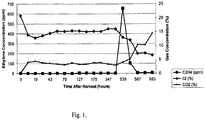
- Figure 1 shows the O 2 , CO 2 , and ethylene (C 2 H 4 ) contents inside these microperforated banana bags.
- the bananas consumed enough O 2 and produced enough CO 2 to create a modified atmosphere inside the bags, i.e, about 15% O 2 and 3% CO 2 .
- Levels of ethylene before gassing were low; ranging from 1-3 ppm.
- Within 24 hrs of gassing the fruit with 1000 ppm ethylene (C 2 H 4 ) ethylene content inside the bags rose to about 600 ppm.
- Front and back panels of the bags had the same number and placement of microperforations.
- Registered microperforated bags tested were one of two total O 2 fluxes: 47,844 cc/day-atm (referred to at RMP1) and 59,805 cc/day-atm (referred to as RMP2).
- the two different O 2 fluxes were made by varying the number and/or size of the microperforations drilled into the PE, with the average size of microperforations being 225 microns.
- Table 1 shows the green life (days) for bananas packed in Polypack, Banavac, and registered microperforated bags. Table 1. Green life of bananas packed in different bags. Bag Type Average Green Life (days) Green Life Range (days) Polypack 21 14-26 Banavac 47 32-59 Registered Microperforated Bags 33 27-38
- Banana green life and banana shelf life are two competing physiological conditions. By drastically decreasing the oxygen content in the bag, as the Banavac bag does, green life is greatly increased; 26 days over bananas held in ambient air (Polypack bags) (Table 1) . However, unless the Banavac bags are torn open, the bananas will not ripen. In contrast, bananas sealed in registered microperforated bags showed an increase in green life by 12 days (up to 57% increase) compared to Polypack bananas. Bananas in RMP1 and RMP2 bags gave similar green lives.
- Banavac bananas produced soft green bananas after 4 days.
- Polypack bananas reached a color stage of 7 after 4 days post-ripening, compared to bananas in registered microperforated bags which changed to a color stage of 5 after 5 days. Therefore, post-ripening studies show that registered microperforated bags delay ripening, increasing the shelf life of bananas compared to Polypack and Banavac bags.
- Example 1 and 2 Based on the results of the laboratory tests of Example 1 and 2 above, we designed a shipping test to compare the effects of packing bananas in registered microperforated bags (one microperforation location) versus packing them in Polypack bags.
- the PE bag composition, dimensions, microperforation number and registration location and the total O 2 flux of the bags were the same as given in Example 1 above.
- Table 2 shows the gas contents inside the various packages and the color range developed by bananas in those packages 8 days after gassing. There was a wide variability in the oxygen and carbon dioxide contents inside microperforated bags, suggesting that the microperforations were occluded in some bags during the pack-out procedures. Table 2. Headspace gas content and color development in 40-lb banana bags 8 days after gassing with ethylene.
- microperforated bags When the oxygen and carbon dioxide contents inside microperforated bags were 12.9 and 5.7%, respectively, the banana color range was 4.0-5.0 which is 1 to 1.5 units lower than the range for banana in control bags. The controls were at a color stage of 5.5 to 6.0. Such reduction in color stage development by the test bags is desirable if these values are consistent. However, microperforated bags with oxygen contents of 1% or less and carbon dioxide contents of 8% or more, produced bananas with color ranges of 2.0 to 2.5, and some bags with carbon dioxide values greater than 10% produced soft green fruit, an undesirable situation. Again, the data suggested that the microperforations were occluded during pack-out.
- bananas inside microperforated bags had a color of 2.5 to 3 after the ripening cycle compared to a color of about 4 for Polypack bags and opened Banavac bags. This demonstrated, once more, that the microperforations allowed ethylene gas to penetrate the bags and initiate ripening, although the ripening was delayed compared to controls. Furthermore, Table 3 shows that fruit in microperforated bags developed color more slowly during after-gassing storage studies at 18° C. Polypack and Banavac bananas (after the Banavac bags were ripped open so ripening could occur) changed from a color of 4 to 5 after 1 day to a color of 6 after 6 days at 18°C.
- Bananas in bags with one microperforation location at the top of the bag had a wide range of colors stages (3.5 to 5 after 6 days), while bananas in bags with two microperforation locations placed at the bottom of the bag near the carton vent holes showed more uniform color development, with colors of 3.5-4.0, than bananas in bags with one microperforation location. In all microperforated bags, shelf life was increased compared to bananas in Polypack and Banavac bags. Table 3. Color development in banana clusters 1, 4 and 6 days after gassing with ethylene.
- boxes where bananas are packed in bags according to this invention can be stored on pallet for up to two days, because the modified atmosphere in the bags slows the metabolic rate of the bananas and thus reduces generation of heat.
- boxes with bananas in Banavac bags must be depalletized and air-stacked because the heat released by the ripening fruit inside the Banavac bag causes the fruit to become soft.
- a heavy weight piece of paper (tunnel pad) is placed in the bottom of the box followed by the plastic bag.
- the tunnel pad is perforated in the area that is placed over the vent hole in the bottom of the box.
- Banana clusters (concave side down) are arranged in the box in four rows of approximately five clusters per row. The first row is set next to one of the long sides of the box, which allows room for the second row to be put on top of the first row but offset to the opposite long side of the box.
- the plastic bag is pulled up and over the tunnel pad and this triple layer of packing material is folded over the first two rows of fruit.
- This folding creates a pocket to hold the third row of fruit as well as creating a cushion that reduces bruising.
- the bag and tunnel pad are pulled over the second and third rows of fruit to create a pocket into which the fourth row of fruit is packed.
- the remaining bag material is gathered together and pushed through the vent hole in the box lid as the upper half of the box is slipped over the lower half. Air is extracted from the bag with a vacuum cleaner; the bag is twisted, folded over on itself and wrapped several times with a strong rubber band to seal it.
- EXAMPLE 5 Importance of leak-free (hermetic) seals in maintaining desired gas atmospheres inside banana bags.
- Hermetic bag seals can be attained by a number of other methods besides a rubber-band closure technique described here. For example, heat-sealing the bag will provide a hermetic seal.
- the objective of this study was to determine the effects of bag type (registered microperforated v. Tubopack) on the quality of 18,2 kg (40 lb) bananas, before gassing and after gassing.
- Tubopack bags have eighty four holes, each having a diameter of 1,27 cm (1/2 in).
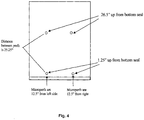
- Polyethylene bags 0,00381 cm. 97,8 cm wide x 128.3 cm long (1.5 mil, 38.5" wide x 50.5" long) were laser microperforated with 225-230 micron holes in specific areas on the bag as depicted in Fig. 3 .
- microperforated bags had 4 microperforation locations, 2 sets in the front of the bag and 2 sets in the back of the bag.
- the first set of microperforations was placed 66,0 cm (26") up from bottom seal and the second set was placed 5,1 cm (2") up from the bottom seal.
- the total O 2 flux of the bags averaged 82,294 cc/day-atm.
- the bags were sealed by first gathering all corners of the bag together, twisting them into a "neck”, folding over the neck, and securing with a rubber band.
- Headspace Analysis on Bananas before Gassing The bananas arrived at a California port and were discharged within 1 to 2 days. Headspace (O 2 /CO 2 ) readings were taken on registered microperforated bags approximately 9 days after the bananas' arrival to the port. The bananas were stored at 13.3°C before measuring the gas contents inside the bag headspace. Headspace analysis (O 2 and CO 2 contents) was done on boxes on two different pallets. Table 5.
- Headspace gas readings (at 13.3°C) in registered microperforated bag containing 18,2 kg (40-lb) bananas (before ethylene treatment)
- Table 5 shows the O 2 and CO 2 content of boxes packed with bananas in microperforated bags before gassing. The readings were very consistent with O 2 levels around 16% and CO 2 levels between 5% and 7% before gassing with ethylene.
- MVTRs of a 1 mil HDPE Banavac bag is less than 1 g H 2 O /100 in 2 -day while the MVTR of microperforated bags is in excess of 100 g H 2 O/100 in 2 -day, regardless of bag thickness.
- water vapor can ready pass through the microperforations to reduce the concentration of moisture inside the bag.
- the more microperforations the higher the MVTR.
- the key is to allow some moisture vapor escape to reduce the growth of mold, but at the same time maintain enough moisture inside the bag to prevent dehydration.
- Table 6 shows O 2 and CO 2 levels inside the 18,2 kg (40-lb) microperforated banana bags after gassing with ethylene.
- the levels of O 2 varied from ⁇ 1% to 17% with most readings between 3% and 5%.
- the few unusually high O 2 reading may be due to a poor seal, resulting in an increased flux of O 2 into the bag.
- Those readings with O 2 less than 1% may be due to microperforation occlusion.
- the levels of CO 2 varied from 4% to 24% with the majority of the reading between 20% and 23%. We would expect to see a reduction in O 2 levels and an increase in CO 2 levels after gassing, because ethylene increases the respiration rate of the bananas.
- bananas in registered microperforated bags were approximately 1.5 stages behind the control (Tubopack) bananas. Bananas packaged in registered microperforated bags were not as ripe as controls, averaging a color stage of 2.5 to 3. In addition, bananas in registered microperforated bags were more uniform in color than control bananas which averaged 3 to 5 color stage (Tables 7 and 8).
- bananas packaged in microperforated bags did not show dehydration, crown rot, yellow crown and withered pedicels during storage, indicating an improved shelf life for bananas stored in microperforated bags.
- EXAMPLE 8 The weight of bananas to be enclosed in the bag determines the number of microperforations in the bag and microperforation locations.
- a single banana (a finger) enclosed inside a small microperforated bag.
- the number of microperforations needed to control the quality of a single banana in a bag is far less than required by 18,2 kg (40-lbs) of bananas in a bag.
- Green plantain fruits were packed in microperforated bags designed for 22,7 kg (50 lb) of plantains.
- the bag material was 0.00381 cm (1.5 mil) thick PE Blend with an oxygen transmission rate of 350cc O 2 /645 cm 2 (350 cc O 2 /100 in2) day -atm.
- Bag dimensions were 96,5 cm wide and 88,9 cm long (38" wide and 35" long). Each bag had four positions of microperforations on each side of the bag.
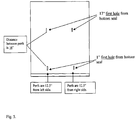
- Figure 5 shows the locations of the microperforations.
- microperforations Two set of microperforations were drilled into the front and back panels of the plantain bag at the following locations: 2,54 cm (1") up and 43,2 cm (17") up from the bottom seal of the bag and 31,8 cm (12,5") from each bag side ( Figure 5 ). Each microperforation had an average diameter of 225-230 microns.
- the total O 2 Flux of the bag was 82,294 cc/day-atm, which is the same O 2 Flux that was used for 18,2 kg (40 lbs) bananas.
- the differences in the fruit weight going into the bag 22,7 kg plantain v.18,2 kg bananas (50lbs plantain v. 40 lbs bananas), there is a difference in microperforation placement on the bag (cf. Figs 4 and 5 ).
Landscapes
- Engineering & Computer Science (AREA)
- Life Sciences & Earth Sciences (AREA)
- Chemical & Material Sciences (AREA)
- Food Science & Technology (AREA)
- Zoology (AREA)
- Wood Science & Technology (AREA)
- Polymers & Plastics (AREA)
- General Chemical & Material Sciences (AREA)
- Chemical Kinetics & Catalysis (AREA)
- Mechanical Engineering (AREA)
- Agronomy & Crop Science (AREA)
- Storage Of Fruits Or Vegetables (AREA)
- Packging For Living Organisms, Food Or Medicinal Products That Are Sensitive To Environmental Conditiond (AREA)
- Packages (AREA)
- Packaging Of Special Articles (AREA)
Claims (15)
- Procédé d'emballage de bananes ou de bananes plantains, ledit procédé comprenant les étapes consistant à:a) microperforer au laser des sacs en plastique dans au moins une zone cible spécifique du sac, ladite microperforation comprenant de prévoir sur le côté du sac un réseau de microperforation en haut et un en bas;b) fournir une boîte de taille préférée et insérer le sac microperforé dans la boîte;c) insérer des bananes vertes ou des plantains dans le sac;d) extraire l'air du sac;e) sceller hermétiquement le sac; etf) induire la maturation de la banane ou de la banane plantain à l'intérieur du sac hermétiquement scellé en traitant avec de l'éthylène gazeux dans une chambre de mûrissement pressurisée.
- Procédé selon la revendication 1, dans lequel le matériau de sac est choisi dans le groupe de matières plastiques consistant en polyéthylène, polypropylène, polyester, nylon, polystyrène, chlorure de polyvinyle, acide polylactique en monocouches, co-extrusions et stratifiés.
- Procédé selon la revendication 1, dans lequel on réalise un scellement hermétique en scellant le sac avec une bande de caoutchouc.
- Procédé selon la revendication 1, dans lequel les microperforations sont situées dans 2, 4 ou 6 zones du sac.
- Procédé selon la revendication 4, dans lequel les microperforations sont à deux emplacements sur le côté avant du sac et sur deux emplacements dans le côté arrière du sac.
- Procédé selon la revendication 5, dans lequel le sac est apte à emballer 18,2 kg (40 livre) de bananes et les microperforations sont situées à 5,1 cm (2 ") et 66,0 cm (26") du joint inférieur du la taille du sac et de la microperforation est comprise entre 110 et 400 microns.
- Procédé selon la revendication 1, dans lequel la quantité de bananes emballée dans un sac varie entre une banane unique et plus de 18,2 kg (40 livres) de bananes.
- Procédé selon la revendication 5, dans lequel le sac est apte à emballer 22,7 kg (50 lb) de plantains et les microperforations sont situées à 2,5 cm (1") et 43,2 cm (17") du fond sceau du sac et la taille de la microperforation est de 225-230 microns.
- Procédé selon la revendication 1, dans lequel la quantité de plantains emballés dans un sac varie entre un plantain unique et plus de 22,7 kg (50 livres) de plantains.
- Procédé selon les revendications 7 ou 9, dans lequel les microperforations permettent un flux total d'O2 pour des bananes ou plantains garnis dans une plage de 1000 cc/jour/atm 500 000 cc / jour / atm.
- Procédé selon la revendication 10, dans lequel le flux d'O2 désiré est obtenu en modifiant le nombre et / ou la taille des microperforations et le placement et le nombre de zones cibles des microperforations en fonction de la taille du sac et du poids des bananes emballé dans le sac.
- Procédé d'emballage de bananes, ledit procédé comprenant les étapes consistant à:a) des sacs de polyéthylène en microperforation au laser destinés à emballer des bananes de 18,2 kg (40 livre) à deux endroits à l'avant du sac et à deux endroits à l'arrière du sac à 5,1 cm (2") et 66,0 cm (26 ") du joint inférieur du dos, ladite microperforation laser fournissant des microperforations de taille 150-235 microns;b) fournir une boîte de taille préférée et insérer le sac microperforé dans la boîte;c) insérer des bananes vertes dans le sac;d) extraire l'air du sac;e) sceller hermétiquement le sac avec une bande de caoutchouc; etf) induire la maturation des bananes à l'intérieur du sac hermétiquement scellé en traitant avec de l'éthylène gazeux dans une chambre de maturation sous pression.
- Procédé pour emballer des plantains, ledit procédé comprenant les étapes consistant à:a) des sacs de polyéthylène en microperforation au laser convenant à l'emballage de plantains de 22,7 kg (50 livre) à deux endroits à l'avant du sac et à deux endroits à l'arrière du sac à 2,5 cm (1") et 43,2 cm (17 ") du joint inférieur du dos, ladite microperforation laser fournissant des microperforations de taille 225-230 microns;b) fournir une boîte de taille préférée et insérer le sac microperforé dans la boîte;c) l'insertion de plantains verts dans le sac;d) extraire l'air du sac;e) sceller hermétiquement le sac avec un élastique; etf) induire la maturation du plantain à l'intérieur du sac hermétiquement scellé en traitant avec de l'éthylène gazeux dans une chambre de maturation sous pression.
- Procédé pour augmenter la durée de conservation des bananes ou des plantains, le procédé comprenant les étapes consistant à:a) microperforer au laser des sacs en plastique dans au moins une zone cible spécifique du sac, ladite microperforation comprenant de prévoir sur le côté du sac un réseau de microperforation en haut et un en bas;b) fournir une boîte de taille préférée et insérer le sac microperforé dans la boîte;c) insérer des bananes vertes ou des plantains dans le sac;d) extraire l'air du sac;e) sceller hermétiquement le sac;f) avant l'étape de maturation de la banane, stocker les boîtes de banane ou de banane plantain à 14°C;g) déplacer les boîtes de banane ou de banane plantain dans la salle de maturation pressurisée eth) induire la maturation de la banane ou de la banane plantain à l'intérieur du sac hermétiquement scellé en traitant avec de l'éthylène gazeux.
- Procédé pour empêcher une contamination après récolte de bananes ou de plantains avec un moule de couronne, ledit procédé comprenant les étapes consistant à:a) microperforer au laser des sacs en plastique dans au moins une zone cible spécifique du sac, ladite microperforation comprenant de prévoir sur le côté du sac un réseau de microperforation en haut et un en bas;b) fournir une boîte de taille préférée et insérer le sac microperforé dans la boîte;c) insérer des bananes vertes ou des plantains dans le sac;d) extraire l'air du sac; etf) induire la maturation de la banane ou de la banane plantain à l'intérieur du sac hermétiquement scellé en traitant avec de l'éthylène gazeux dans une chambre de mûrissement pressurisée.
Applications Claiming Priority (2)
| Application Number | Priority Date | Filing Date | Title |
|---|---|---|---|
| PCT/US2007/019277 WO2009031992A1 (fr) | 2007-09-04 | 2007-09-04 | Procédé de contrôle de qualité de bananes par l'emballage |
| PCT/US2008/010209 WO2009032169A1 (fr) | 2007-09-04 | 2008-08-28 | Procédé pour contrôler une qualité de bananes et de bananes plantains par conditionnement |
Publications (3)
| Publication Number | Publication Date |
|---|---|
| EP2197750A1 EP2197750A1 (fr) | 2010-06-23 |
| EP2197750A4 EP2197750A4 (fr) | 2014-10-22 |
| EP2197750B1 true EP2197750B1 (fr) | 2017-11-29 |
Family
ID=40429146
Family Applications (1)
| Application Number | Title | Priority Date | Filing Date |
|---|---|---|---|
| EP08829915.1A Active EP2197750B1 (fr) | 2007-09-04 | 2008-08-28 | Procédé pour contrôler une qualité de bananes et de bananes plantains par conditionnement |
Country Status (5)
| Country | Link |
|---|---|
| US (2) | US10010089B2 (fr) |
| EP (1) | EP2197750B1 (fr) |
| CA (1) | CA2698005C (fr) |
| CL (2) | CL2008002614A1 (fr) |
| WO (2) | WO2009031992A1 (fr) |
Families Citing this family (10)
| Publication number | Priority date | Publication date | Assignee | Title |
|---|---|---|---|---|
| WO2011082059A1 (fr) * | 2009-12-28 | 2011-07-07 | Rohm And Haas Company | Procédé de manipulation de bananes |
| KR101416086B1 (ko) * | 2009-12-28 | 2014-07-09 | 다우 글로벌 테크놀로지스 엘엘씨 | 바나나 취급 방법 |
| ES2371195B1 (es) * | 2010-06-11 | 2012-09-13 | Arc Eurobanan, S.L. | Procedimiento para la maduracion de platanos en camara |
| US20130004634A1 (en) * | 2011-06-29 | 2013-01-03 | Rohm And Haas Company | Method of handling mangoes |
| US20130171324A1 (en) * | 2011-12-28 | 2013-07-04 | Chiquita Brands International Inc. | Process for making vacuum dried fruit product |
| PT2934156T (pt) * | 2012-12-18 | 2019-05-29 | Agrofresh Inc | Embalagem de atmosfera modificada para bananas |
| US20140348986A1 (en) * | 2013-05-23 | 2014-11-27 | The Iams Company | Avocado Processing |
| US20180327161A1 (en) * | 2017-05-11 | 2018-11-15 | Relish Labs, LLC | Meal-kit preparation and shipping system |
| FR3078321B1 (fr) * | 2018-02-27 | 2021-04-09 | Sphere | Sac pour fruits et legumes |
| US11871760B2 (en) | 2022-01-20 | 2024-01-16 | Alex J. Pollack | System and method of accelerated individual banana ripening |
Family Cites Families (29)
| Publication number | Priority date | Publication date | Assignee | Title |
|---|---|---|---|---|
| US2689678A (en) * | 1950-11-09 | 1954-09-21 | Bemis Bro Bag Co | Bag |
| US3450542A (en) * | 1965-02-23 | 1969-06-17 | United Fruit Co | Controlled atmosphere storage of green bananas |
| FR1567996A (fr) * | 1967-12-29 | 1969-05-23 | ||
| US3552637A (en) * | 1969-04-30 | 1971-01-05 | Standard Fruit And Steamship C | Banana bag |
| US3718059A (en) * | 1969-12-18 | 1973-02-27 | Mobil Oil Corp | Permeable thermoplastic film product and method |
| US3798333A (en) * | 1972-03-31 | 1974-03-19 | Borden Inc | Packaging bananas in carbon dioxide permeable film |
| NZ209507A (en) * | 1983-10-06 | 1986-07-11 | Canadian Ind | Thermoplastic valve bag:perforated outer wall with mesh inner liner |
| GB8610600D0 (en) * | 1986-04-30 | 1986-06-04 | Novo Industri As | Transformation of trichoderma |
| CA1301533C (fr) * | 1987-03-31 | 1992-05-26 | William Duncan Powrie | Preservation de morceaux de fruits frais coupes ou segmantes |
| CA2069147A1 (fr) * | 1991-05-22 | 1992-11-23 | Kazuaki Kitano | Adn et son utilisation |
| KR950701291A (ko) * | 1992-04-27 | 1995-03-23 | 리챠드 지. 워터맨 | 미세천공된 필름 및 이로부터 제조된 포장백 |
| DK52393D0 (fr) * | 1993-05-05 | 1993-05-05 | Novo Nordisk As | |
| US5698249A (en) * | 1994-08-03 | 1997-12-16 | Dai Nippon Printing Co., Ltd. | Package of fresh plant |
| US5525130A (en) * | 1995-02-08 | 1996-06-11 | Board Of Trustees Operating Michigan State University | Plant development affecting device and method |
| WO1997002753A1 (fr) * | 1995-07-12 | 1997-01-30 | Novo Nordisk A/S | Nettoyage en place a l'aide d'une solution contenant une protease et une lipase |
| US6008029A (en) * | 1995-08-25 | 1999-12-28 | Novo Nordisk Biotech Inc. | Purified coprinus laccases and nucleic acids encoding the same |
| US5617711A (en) * | 1995-09-27 | 1997-04-08 | Chiquita Brands, Inc. | Method of producing a container of bananas and method of transferring bananas |
| AR005601A1 (es) * | 1996-01-29 | 1999-06-23 | Novozymes As | Proceso para la remocion o blanqueo de suciedad o manchas presentes en telas celulosicas y proceso para el lavado de telas celulosicas manchadas o sucias y composicion detergente |
| US6190710B1 (en) * | 1996-02-20 | 2001-02-20 | Stepac L.A., The Sterilizing Packaging Company Of L.A., Ltd. | Plastic packaging material |
| US5899084A (en) * | 1997-01-10 | 1999-05-04 | Chiquita Brands, Inc. | Method and apparatus for ripening perishable products in a temperature-controlled room |
| DE29613599U1 (de) * | 1996-08-06 | 1996-09-26 | IFCO International Food Container Organisation GmbH, 82049 Pullach | Luftpolsterfoliensack für Obstverpackungen |
| WO1998056680A2 (fr) * | 1997-06-09 | 1998-12-17 | Chiquita Brands, Inc. | Systeme stable et modulaire de gerbage, et procede d'emballage, de stockage, de transport et de presentation de produits frais pour la vente au detail |
| US5919504A (en) * | 1998-04-13 | 1999-07-06 | Weyerhaeuser Company | Fresh produce package |
| US6441340B1 (en) * | 1999-05-04 | 2002-08-27 | Elizabeth Varriano-Marston | Registered microperforated films for modified/controlled atmosphere packaging |
| US7601374B2 (en) * | 2000-09-26 | 2009-10-13 | Landec Corporation | Packaging of respiring biological materials |
| AU2003295764A1 (en) * | 2002-11-19 | 2004-06-15 | Chiquita Brands, Inc. | Packaging system for produce or the like |
| US20050266129A1 (en) * | 2004-05-27 | 2005-12-01 | Nazir Mir | Packaging material and method for perishable food product |
| US20060121167A1 (en) * | 2004-12-02 | 2006-06-08 | Dole Food Company, Inc. | Controlling the ripening of bananas |
| US20110293802A1 (en) * | 2009-10-07 | 2011-12-01 | Chiquita Brands L.L.C. | Banana Storage and Shipping Bags |
-
2007
- 2007-09-04 WO PCT/US2007/019277 patent/WO2009031992A1/fr not_active Ceased
-
2008
- 2008-08-28 CA CA2698005A patent/CA2698005C/fr active Active
- 2008-08-28 EP EP08829915.1A patent/EP2197750B1/fr active Active
- 2008-08-28 US US12/733,470 patent/US10010089B2/en active Active
- 2008-08-28 WO PCT/US2008/010209 patent/WO2009032169A1/fr not_active Ceased
- 2008-09-03 CL CL2008002614A patent/CL2008002614A1/es unknown
- 2008-09-03 CL CL2008002615A patent/CL2008002615A1/es unknown
-
2018
- 2018-05-15 US US15/980,102 patent/US10687539B2/en active Active
Non-Patent Citations (1)
| Title |
|---|
| None * |
Also Published As
| Publication number | Publication date |
|---|---|
| US10687539B2 (en) | 2020-06-23 |
| US10010089B2 (en) | 2018-07-03 |
| CL2008002614A1 (es) | 2009-01-09 |
| CA2698005A1 (fr) | 2009-03-12 |
| US20180255796A1 (en) | 2018-09-13 |
| US20100233333A1 (en) | 2010-09-16 |
| EP2197750A4 (fr) | 2014-10-22 |
| CL2008002615A1 (es) | 2009-06-12 |
| WO2009032169A1 (fr) | 2009-03-12 |
| EP2197750A1 (fr) | 2010-06-23 |
| CA2698005C (fr) | 2016-01-05 |
| WO2009031992A1 (fr) | 2009-03-12 |
Similar Documents
| Publication | Publication Date | Title |
|---|---|---|
| US10687539B2 (en) | Modified atmosphere packaging for transportation and ripening of bananas and plantains with extended quality preservation | |
| Mangaraj et al. | Modified atmosphere packaging of fruits and vegetables for extending shelf-life-A review | |
| Mangaraj et al. | Applications of plastic films for modified atmosphere packaging of fruits and vegetables: a review | |
| Opara et al. | Modified atmosphere packaging for food preservation | |
| US20100221393A1 (en) | Resealable, Reusable Plastic Storage Container and Lid With Gas-Permeable Membranes for Modified Storage of Food and Perishables | |
| CN114007941B (zh) | 用于保存呼吸农产品的包装物和方法 | |
| Jain et al. | Modified atmosphere packaging | |
| EP4416076B1 (fr) | Emballage pour la conservation de produits respirants et procédé | |
| Matera et al. | An innovative smart device to control modified atmosphere packaging (MAP) of fruit and vegetables | |
| CN106005763B (zh) | 一种水蜜桃常温保鲜包装盒及其制备方法和应用 | |
| CN216333649U (zh) | 鲜切水果便利包装盒 | |
| Catalá et al. | Atmosphere Packaging | |
| Devon | Principles and Practice of Modified Atmosphere Packaging of Horticultural Commodities | |
| Ščetar | A Perspective on Fruit and Vegetable Packaging | |
| KR20090040193A (ko) | 변화된 환경에서도 식품 및 부패성 물질을 저장하기 위해서가스 투과성 막을 갖춘 재밀봉 및 재사용이 가능한플라스틱 저장용기 및 뚜껑 | |
| WO1996020870A1 (fr) | Pellicule de conditionnement de materiaux ayant besoin d'air | |
| Venkatesh | MODIFIED ATMOSPHERE PACKAGING (MAP) | |
| EP0744434A1 (fr) | Film d'emballage pour matériaux qui respirent | |
| WO2007034034A1 (fr) | Procédé permettant d’emballer des produits à base de légumes frais dans une atmosphère modifiée |
Legal Events
| Date | Code | Title | Description |
|---|---|---|---|
| PUAI | Public reference made under article 153(3) epc to a published international application that has entered the european phase |
Free format text: ORIGINAL CODE: 0009012 |
|
| 17P | Request for examination filed |
Effective date: 20100331 |
|
| AK | Designated contracting states |
Kind code of ref document: A1 Designated state(s): AT BE BG CH CY CZ DE DK EE ES FI FR GB GR HR HU IE IS IT LI LT LU LV MC MT NL NO PL PT RO SE SI SK TR |
|
| AX | Request for extension of the european patent |
Extension state: AL BA MK RS |
|
| DAX | Request for extension of the european patent (deleted) | ||
| A4 | Supplementary search report drawn up and despatched |
Effective date: 20140919 |
|
| RIC1 | Information provided on ipc code assigned before grant |
Ipc: B65D 85/34 20060101ALI20140915BHEP Ipc: B65B 55/00 20060101AFI20140915BHEP Ipc: A23B 7/148 20060101ALI20140915BHEP Ipc: B65D 81/26 20060101ALI20140915BHEP |
|
| GRAP | Despatch of communication of intention to grant a patent |
Free format text: ORIGINAL CODE: EPIDOSNIGR1 |
|
| INTG | Intention to grant announced |
Effective date: 20161103 |
|
| GRAJ | Information related to disapproval of communication of intention to grant by the applicant or resumption of examination proceedings by the epo deleted |
Free format text: ORIGINAL CODE: EPIDOSDIGR1 |
|
| INTC | Intention to grant announced (deleted) | ||
| GRAP | Despatch of communication of intention to grant a patent |
Free format text: ORIGINAL CODE: EPIDOSNIGR1 |
|
| INTG | Intention to grant announced |
Effective date: 20170606 |
|
| GRAS | Grant fee paid |
Free format text: ORIGINAL CODE: EPIDOSNIGR3 |
|
| GRAA | (expected) grant |
Free format text: ORIGINAL CODE: 0009210 |
|
| RAP1 | Party data changed (applicant data changed or rights of an application transferred) |
Owner name: WINDHAM PACKAGING, LLC |
|
| RIN1 | Information on inventor provided before grant (corrected) |
Inventor name: VARRIANO-MARSTON, ELIZABETH |
|
| AK | Designated contracting states |
Kind code of ref document: B1 Designated state(s): AT BE BG CH CY CZ DE DK EE ES FI FR GB GR HR HU IE IS IT LI LT LU LV MC MT NL NO PL PT RO SE SI SK TR |
|
| REG | Reference to a national code |
Ref country code: GB Ref legal event code: FG4D |
|
| REG | Reference to a national code |
Ref country code: CH Ref legal event code: EP |
|
| REG | Reference to a national code |
Ref country code: AT Ref legal event code: REF Ref document number: 950134 Country of ref document: AT Kind code of ref document: T Effective date: 20171215 |
|
| REG | Reference to a national code |
Ref country code: IE Ref legal event code: FG4D |
|
| REG | Reference to a national code |
Ref country code: DE Ref legal event code: R096 Ref document number: 602008053191 Country of ref document: DE |
|
| REG | Reference to a national code |
Ref country code: NL Ref legal event code: FP |
|
| REG | Reference to a national code |
Ref country code: LT Ref legal event code: MG4D |
|
| REG | Reference to a national code |
Ref country code: AT Ref legal event code: MK05 Ref document number: 950134 Country of ref document: AT Kind code of ref document: T Effective date: 20171129 |
|
| PG25 | Lapsed in a contracting state [announced via postgrant information from national office to epo] |
Ref country code: ES Free format text: LAPSE BECAUSE OF FAILURE TO SUBMIT A TRANSLATION OF THE DESCRIPTION OR TO PAY THE FEE WITHIN THE PRESCRIBED TIME-LIMIT Effective date: 20171129 Ref country code: NO Free format text: LAPSE BECAUSE OF FAILURE TO SUBMIT A TRANSLATION OF THE DESCRIPTION OR TO PAY THE FEE WITHIN THE PRESCRIBED TIME-LIMIT Effective date: 20180228 Ref country code: FI Free format text: LAPSE BECAUSE OF FAILURE TO SUBMIT A TRANSLATION OF THE DESCRIPTION OR TO PAY THE FEE WITHIN THE PRESCRIBED TIME-LIMIT Effective date: 20171129 Ref country code: SE Free format text: LAPSE BECAUSE OF FAILURE TO SUBMIT A TRANSLATION OF THE DESCRIPTION OR TO PAY THE FEE WITHIN THE PRESCRIBED TIME-LIMIT Effective date: 20171129 Ref country code: LT Free format text: LAPSE BECAUSE OF FAILURE TO SUBMIT A TRANSLATION OF THE DESCRIPTION OR TO PAY THE FEE WITHIN THE PRESCRIBED TIME-LIMIT Effective date: 20171129 |
|
| REG | Reference to a national code |
Ref country code: FR Ref legal event code: PLFP Year of fee payment: 11 |
|
| PG25 | Lapsed in a contracting state [announced via postgrant information from national office to epo] |
Ref country code: HR Free format text: LAPSE BECAUSE OF FAILURE TO SUBMIT A TRANSLATION OF THE DESCRIPTION OR TO PAY THE FEE WITHIN THE PRESCRIBED TIME-LIMIT Effective date: 20171129 Ref country code: LV Free format text: LAPSE BECAUSE OF FAILURE TO SUBMIT A TRANSLATION OF THE DESCRIPTION OR TO PAY THE FEE WITHIN THE PRESCRIBED TIME-LIMIT Effective date: 20171129 Ref country code: BG Free format text: LAPSE BECAUSE OF FAILURE TO SUBMIT A TRANSLATION OF THE DESCRIPTION OR TO PAY THE FEE WITHIN THE PRESCRIBED TIME-LIMIT Effective date: 20180228 Ref country code: AT Free format text: LAPSE BECAUSE OF FAILURE TO SUBMIT A TRANSLATION OF THE DESCRIPTION OR TO PAY THE FEE WITHIN THE PRESCRIBED TIME-LIMIT Effective date: 20171129 Ref country code: GR Free format text: LAPSE BECAUSE OF FAILURE TO SUBMIT A TRANSLATION OF THE DESCRIPTION OR TO PAY THE FEE WITHIN THE PRESCRIBED TIME-LIMIT Effective date: 20180301 |
|
| PG25 | Lapsed in a contracting state [announced via postgrant information from national office to epo] |
Ref country code: CY Free format text: LAPSE BECAUSE OF FAILURE TO SUBMIT A TRANSLATION OF THE DESCRIPTION OR TO PAY THE FEE WITHIN THE PRESCRIBED TIME-LIMIT Effective date: 20171129 Ref country code: EE Free format text: LAPSE BECAUSE OF FAILURE TO SUBMIT A TRANSLATION OF THE DESCRIPTION OR TO PAY THE FEE WITHIN THE PRESCRIBED TIME-LIMIT Effective date: 20171129 Ref country code: DK Free format text: LAPSE BECAUSE OF FAILURE TO SUBMIT A TRANSLATION OF THE DESCRIPTION OR TO PAY THE FEE WITHIN THE PRESCRIBED TIME-LIMIT Effective date: 20171129 Ref country code: CZ Free format text: LAPSE BECAUSE OF FAILURE TO SUBMIT A TRANSLATION OF THE DESCRIPTION OR TO PAY THE FEE WITHIN THE PRESCRIBED TIME-LIMIT Effective date: 20171129 Ref country code: SK Free format text: LAPSE BECAUSE OF FAILURE TO SUBMIT A TRANSLATION OF THE DESCRIPTION OR TO PAY THE FEE WITHIN THE PRESCRIBED TIME-LIMIT Effective date: 20171129 |
|
| REG | Reference to a national code |
Ref country code: DE Ref legal event code: R097 Ref document number: 602008053191 Country of ref document: DE |
|
| PG25 | Lapsed in a contracting state [announced via postgrant information from national office to epo] |
Ref country code: IT Free format text: LAPSE BECAUSE OF FAILURE TO SUBMIT A TRANSLATION OF THE DESCRIPTION OR TO PAY THE FEE WITHIN THE PRESCRIBED TIME-LIMIT Effective date: 20171129 Ref country code: RO Free format text: LAPSE BECAUSE OF FAILURE TO SUBMIT A TRANSLATION OF THE DESCRIPTION OR TO PAY THE FEE WITHIN THE PRESCRIBED TIME-LIMIT Effective date: 20171129 Ref country code: PL Free format text: LAPSE BECAUSE OF FAILURE TO SUBMIT A TRANSLATION OF THE DESCRIPTION OR TO PAY THE FEE WITHIN THE PRESCRIBED TIME-LIMIT Effective date: 20171129 |
|
| PLBE | No opposition filed within time limit |
Free format text: ORIGINAL CODE: 0009261 |
|
| STAA | Information on the status of an ep patent application or granted ep patent |
Free format text: STATUS: NO OPPOSITION FILED WITHIN TIME LIMIT |
|
| 26N | No opposition filed |
Effective date: 20180830 |
|
| PG25 | Lapsed in a contracting state [announced via postgrant information from national office to epo] |
Ref country code: SI Free format text: LAPSE BECAUSE OF FAILURE TO SUBMIT A TRANSLATION OF THE DESCRIPTION OR TO PAY THE FEE WITHIN THE PRESCRIBED TIME-LIMIT Effective date: 20171129 |
|
| PG25 | Lapsed in a contracting state [announced via postgrant information from national office to epo] |
Ref country code: MC Free format text: LAPSE BECAUSE OF FAILURE TO SUBMIT A TRANSLATION OF THE DESCRIPTION OR TO PAY THE FEE WITHIN THE PRESCRIBED TIME-LIMIT Effective date: 20171129 |
|
| REG | Reference to a national code |
Ref country code: CH Ref legal event code: PL |
|
| PG25 | Lapsed in a contracting state [announced via postgrant information from national office to epo] |
Ref country code: CH Free format text: LAPSE BECAUSE OF NON-PAYMENT OF DUE FEES Effective date: 20180831 Ref country code: LU Free format text: LAPSE BECAUSE OF NON-PAYMENT OF DUE FEES Effective date: 20180828 Ref country code: LI Free format text: LAPSE BECAUSE OF NON-PAYMENT OF DUE FEES Effective date: 20180831 |
|
| REG | Reference to a national code |
Ref country code: BE Ref legal event code: MM Effective date: 20180831 |
|
| PG25 | Lapsed in a contracting state [announced via postgrant information from national office to epo] |
Ref country code: BE Free format text: LAPSE BECAUSE OF NON-PAYMENT OF DUE FEES Effective date: 20180831 |
|
| PG25 | Lapsed in a contracting state [announced via postgrant information from national office to epo] |
Ref country code: MT Free format text: LAPSE BECAUSE OF NON-PAYMENT OF DUE FEES Effective date: 20180828 |
|
| PG25 | Lapsed in a contracting state [announced via postgrant information from national office to epo] |
Ref country code: TR Free format text: LAPSE BECAUSE OF FAILURE TO SUBMIT A TRANSLATION OF THE DESCRIPTION OR TO PAY THE FEE WITHIN THE PRESCRIBED TIME-LIMIT Effective date: 20171129 |
|
| PG25 | Lapsed in a contracting state [announced via postgrant information from national office to epo] |
Ref country code: HU Free format text: LAPSE BECAUSE OF FAILURE TO SUBMIT A TRANSLATION OF THE DESCRIPTION OR TO PAY THE FEE WITHIN THE PRESCRIBED TIME-LIMIT; INVALID AB INITIO Effective date: 20080828 Ref country code: PT Free format text: LAPSE BECAUSE OF FAILURE TO SUBMIT A TRANSLATION OF THE DESCRIPTION OR TO PAY THE FEE WITHIN THE PRESCRIBED TIME-LIMIT Effective date: 20171129 |
|
| PG25 | Lapsed in a contracting state [announced via postgrant information from national office to epo] |
Ref country code: IE Free format text: LAPSE BECAUSE OF NON-PAYMENT OF DUE FEES Effective date: 20180828 |
|
| PG25 | Lapsed in a contracting state [announced via postgrant information from national office to epo] |
Ref country code: IS Free format text: LAPSE BECAUSE OF FAILURE TO SUBMIT A TRANSLATION OF THE DESCRIPTION OR TO PAY THE FEE WITHIN THE PRESCRIBED TIME-LIMIT Effective date: 20180329 |
|
| P01 | Opt-out of the competence of the unified patent court (upc) registered |
Effective date: 20240123 |
|
| PGFP | Annual fee paid to national office [announced via postgrant information from national office to epo] |
Ref country code: DE Payment date: 20250829 Year of fee payment: 18 |
|
| PGFP | Annual fee paid to national office [announced via postgrant information from national office to epo] |
Ref country code: NL Payment date: 20250829 Year of fee payment: 18 |
|
| PGFP | Annual fee paid to national office [announced via postgrant information from national office to epo] |
Ref country code: GB Payment date: 20250829 Year of fee payment: 18 |
|
| PGFP | Annual fee paid to national office [announced via postgrant information from national office to epo] |
Ref country code: FR Payment date: 20250829 Year of fee payment: 18 |