EP2197796B1 - Verfahren zur herstellung von titandioxid - Google Patents
Verfahren zur herstellung von titandioxid Download PDFInfo
- Publication number
- EP2197796B1 EP2197796B1 EP08839099A EP08839099A EP2197796B1 EP 2197796 B1 EP2197796 B1 EP 2197796B1 EP 08839099 A EP08839099 A EP 08839099A EP 08839099 A EP08839099 A EP 08839099A EP 2197796 B1 EP2197796 B1 EP 2197796B1
- Authority
- EP
- European Patent Office
- Prior art keywords
- reactor
- ticl
- nozzles
- stages
- titanium tetrachloride
- Prior art date
- Legal status (The legal status is an assumption and is not a legal conclusion. Google has not performed a legal analysis and makes no representation as to the accuracy of the status listed.)
- Not-in-force
Links
- GWEVSGVZZGPLCZ-UHFFFAOYSA-N Titan oxide Chemical compound O=[Ti]=O GWEVSGVZZGPLCZ-UHFFFAOYSA-N 0.000 title claims abstract description 18
- 239000004408 titanium dioxide Substances 0.000 title claims abstract description 9
- 238000004519 manufacturing process Methods 0.000 title claims abstract description 8
- QVGXLLKOCUKJST-UHFFFAOYSA-N atomic oxygen Chemical compound [O] QVGXLLKOCUKJST-UHFFFAOYSA-N 0.000 claims abstract description 20
- 239000007788 liquid Substances 0.000 claims abstract description 20
- 239000001301 oxygen Substances 0.000 claims abstract description 20
- 229910052760 oxygen Inorganic materials 0.000 claims abstract description 20
- XJDNKRIXUMDJCW-UHFFFAOYSA-J titanium tetrachloride Chemical compound Cl[Ti](Cl)(Cl)Cl XJDNKRIXUMDJCW-UHFFFAOYSA-J 0.000 claims abstract description 16
- 238000000034 method Methods 0.000 claims description 31
- 239000002245 particle Substances 0.000 claims description 11
- 239000007789 gas Substances 0.000 claims description 9
- 239000012530 fluid Substances 0.000 claims description 8
- XKRFYHLGVUSROY-UHFFFAOYSA-N Argon Chemical compound [Ar] XKRFYHLGVUSROY-UHFFFAOYSA-N 0.000 claims description 4
- IJGRMHOSHXDMSA-UHFFFAOYSA-N Atomic nitrogen Chemical compound N#N IJGRMHOSHXDMSA-UHFFFAOYSA-N 0.000 claims description 4
- KZBUYRJDOAKODT-UHFFFAOYSA-N Chlorine Chemical compound ClCl KZBUYRJDOAKODT-UHFFFAOYSA-N 0.000 claims description 4
- 239000000203 mixture Substances 0.000 claims description 4
- 239000003380 propellant Substances 0.000 claims description 4
- 229910052786 argon Inorganic materials 0.000 claims description 2
- 229910052757 nitrogen Inorganic materials 0.000 claims description 2
- 241000854291 Dianthus carthusianorum Species 0.000 claims 1
- 230000001681 protective effect Effects 0.000 claims 1
- 238000006243 chemical reaction Methods 0.000 abstract description 20
- 238000007254 oxidation reaction Methods 0.000 abstract description 8
- 230000003647 oxidation Effects 0.000 abstract description 7
- 230000004913 activation Effects 0.000 abstract description 6
- 229910003074 TiCl4 Inorganic materials 0.000 abstract description 4
- 238000002485 combustion reaction Methods 0.000 abstract description 3
- 239000007791 liquid phase Substances 0.000 abstract description 2
- 238000011144 upstream manufacturing Methods 0.000 abstract description 2
- 239000012071 phase Substances 0.000 abstract 1
- 230000008569 process Effects 0.000 description 14
- 229910010413 TiO 2 Inorganic materials 0.000 description 6
- YXFVVABEGXRONW-UHFFFAOYSA-N Toluene Chemical compound CC1=CC=CC=C1 YXFVVABEGXRONW-UHFFFAOYSA-N 0.000 description 6
- 238000002156 mixing Methods 0.000 description 4
- VEXZGXHMUGYJMC-UHFFFAOYSA-M Chloride anion Chemical compound [Cl-] VEXZGXHMUGYJMC-UHFFFAOYSA-M 0.000 description 3
- 239000000460 chlorine Substances 0.000 description 3
- 239000000049 pigment Substances 0.000 description 3
- 239000007858 starting material Substances 0.000 description 3
- VEXZGXHMUGYJMC-UHFFFAOYSA-N Hydrochloric acid Chemical compound Cl VEXZGXHMUGYJMC-UHFFFAOYSA-N 0.000 description 2
- 239000000654 additive Substances 0.000 description 2
- 230000008901 benefit Effects 0.000 description 2
- 230000015572 biosynthetic process Effects 0.000 description 2
- 238000001816 cooling Methods 0.000 description 2
- 238000010438 heat treatment Methods 0.000 description 2
- 239000000047 product Substances 0.000 description 2
- 239000000376 reactant Substances 0.000 description 2
- 238000005507 spraying Methods 0.000 description 2
- ZAMOUSCENKQFHK-UHFFFAOYSA-N Chlorine atom Chemical compound [Cl] ZAMOUSCENKQFHK-UHFFFAOYSA-N 0.000 description 1
- 238000005054 agglomeration Methods 0.000 description 1
- 230000002776 aggregation Effects 0.000 description 1
- 229910052783 alkali metal Inorganic materials 0.000 description 1
- -1 alkali metal salts Chemical class 0.000 description 1
- 150000001447 alkali salts Chemical class 0.000 description 1
- 239000007795 chemical reaction product Substances 0.000 description 1
- 229910052801 chlorine Inorganic materials 0.000 description 1
- 238000004140 cleaning Methods 0.000 description 1
- 239000011362 coarse particle Substances 0.000 description 1
- 230000000052 comparative effect Effects 0.000 description 1
- 238000009833 condensation Methods 0.000 description 1
- 230000005494 condensation Effects 0.000 description 1
- 239000000498 cooling water Substances 0.000 description 1
- 230000006378 damage Effects 0.000 description 1
- 238000009826 distribution Methods 0.000 description 1
- 238000001704 evaporation Methods 0.000 description 1
- 230000008020 evaporation Effects 0.000 description 1
- 230000003116 impacting effect Effects 0.000 description 1
- 230000006872 improvement Effects 0.000 description 1
- 230000000977 initiatory effect Effects 0.000 description 1
- 239000002667 nucleating agent Substances 0.000 description 1
- 230000006911 nucleation Effects 0.000 description 1
- 238000010899 nucleation Methods 0.000 description 1
- 238000005457 optimization Methods 0.000 description 1
- 230000001590 oxidative effect Effects 0.000 description 1
- 238000004886 process control Methods 0.000 description 1
- 238000005201 scrubbing Methods 0.000 description 1
- 238000000926 separation method Methods 0.000 description 1
- 238000005245 sintering Methods 0.000 description 1
- 239000007787 solid Substances 0.000 description 1
- 210000002023 somite Anatomy 0.000 description 1
- 238000001179 sorption measurement Methods 0.000 description 1
- 238000001228 spectrum Methods 0.000 description 1
- 230000002269 spontaneous effect Effects 0.000 description 1
- 230000003685 thermal hair damage Effects 0.000 description 1
- XLYOFNOQVPJJNP-UHFFFAOYSA-N water Chemical compound O XLYOFNOQVPJJNP-UHFFFAOYSA-N 0.000 description 1
Images



Classifications
-
- C—CHEMISTRY; METALLURGY
- C01—INORGANIC CHEMISTRY
- C01G—COMPOUNDS CONTAINING METALS NOT COVERED BY SUBCLASSES C01D OR C01F
- C01G23/00—Compounds of titanium
- C01G23/04—Oxides; Hydroxides
- C01G23/047—Titanium dioxide
- C01G23/07—Producing by vapour phase processes, e.g. halide oxidation
Definitions
- the invention relates to the production of titanium dioxide by oxidation of titanium tetrachloride, wherein liquid titanium tetrachloride is used.
- titanium tetrachloride TiCl 4
- an oxidizing gas such as oxygen, air, etc.
- an oxidizing gas such as oxygen, air, etc.
- TiCl 4 + O 2 ⁇ TiO 2 + 2 Cl 2 TiCl 4 + O 2 ⁇ TiO 2 + 2 Cl 2
- Additve AlCl 3 are known as rutilizers and water vapor or alkali salts as nucleating agents.
- the starting materials Due to the high activation energy of the oxidation of TiCl 4 , the starting materials must be heated so strongly that an adiabatic mixing temperature of the starting materials before the onset of reaction of about 800 ° C is reached, so that the reaction proceeds completely.
- the oxidation reaction is highly exothermic, so that after complete, adiabatic conversion, the temperature of the product stream is higher by about 900 ° C than the reactants.
- this mixture Until separation of the TiO 2 particles from the gaseous reaction products by means of a filter, this mixture must be cooled considerably in a cooling section in order to avoid damage to the filter.
- Oxygen and TiCl 4 are preheated and then reacted in a tubular reactor. Since the total amounts of the educts are metered at one point in each case of the tubular reactor, is to speak of a one-step process.
- EP 0 427 878 B1 discloses a one-step process in which oxygen is heated to about 1500 ° C to 1650 ° C and mixed with about 450 ° C hot TiCl 4 -AlCl 3 vapor. The process control is energetically unsatisfactory in both cases, since based on 100% energy supply for heating the educts then about 160% thermal reaction energy is released. Thereafter, about 210% heat energy must be removed from the hot product stream in the cooling section. This will be the considerable Reaction enthalpy not used for the activation of the reaction, but transferred to the cooling water system.
- TiCl 4 are introduced coaxially and the hot oxygen-containing gas is introduced tangentially into the reactor.
- the TiCl 4 can be supplied in gaseous or in liquid form.
- TiCl 4 is passed into the hot oxygen stream at a first inlet point at a temperature of at least 450 ° C and mixed with AlCl 3 and at another inlet point at a temperature of 350 ° C to 400 ° C and without AlCl 3 .
- the method according to EP 0 852 568 B1 plans to dose in addition to TiCl 4 and the oxygen in two stages.
- the aim of this method is the effective control of the mean TiO 2 particle size and thus the color cast of the TiO 2 -Pigmentgrund stresses.
- about 400 ° C hot TiCl 4 vapor is first passed into an approximately 950 ° C stream of oxygen. In the subsequent reaction zone, the TiO 2 particles are formed and the particle growth takes place.
- a second inlet point less heated TiCl 4 vapor (about 180 ° C) is supplied.
- Oxygen is introduced at the second inlet point at a temperature between 25 and 1040 ° C, the temperature of the mixture being sufficient to initiate the reaction.
- the multi-stage method according to US 6,387,347 should also reduce agglomeration.
- the already heated TiCl 4 stream is divided into two partial streams before metering into the reactor.
- a partial stream is oxidized in the first stage of the reactor.
- the second partial stream is cooled by spraying liquid TiCl 4 (de-superheating) and then metered into the reactor.
- the de-superheating takes place outside the reactor, wherein the condensation temperature of the total current is not exceeded.
- the US 2007/0172414 A1 discloses a multi-stage process for the reaction of TiCl 4 and O 2 , in which in the first stage gaseous TiCl 4 and in the second stage liquid TiCl 4 is introduced into the reactor. This method allows energy savings and an improvement of the particle size spectrum.
- the object of the present invention was to provide a process for the production of titanium dioxide by oxidation of titanium tetrachloride, which enables further energy savings compared to the processes known from the prior art.
- the object is achieved in a process for the production of titanium dioxide particles by reaction of titanium tetrachloride with an oxygen-containing gas in a tubular reactor, characterized in that the titanium tetrachloride is introduced into the reactor in at least two stages and only in liquid form.
- the inventive method differs from the mentioned single-stage or Multi-stage chloride process for the production of titanium dioxide from the prior art, characterized in that the TiCl 4 is introduced into the oxidation reactor in at least two stages and exclusively in liquid form.
- the total liquid TiCl 4 used is quantitatively divided into several stages so that in the first stage only a small amount is metered to start the combustion despite the use of the liquid phase.
- the required activation energy is provided in the first stage alone via the preheated oxygen. In all further stages, the activation energy is provided by the preheated oxygen and the reaction enthalpy of TiCl 4 oxidation released in the upstream stages.
- the inventive method can with the pure liquid dosage of TiCl 4 not only with the use of preheated to about 1600 ° C oxygen are carried out, but also with the use of preheated oxygen at a temperature in the range of about 740 ° C to 1000 ° C. In the latter case eliminates the need for additional oxygen heating with an auxiliary flame, for example with toluene.
- Another advantage of the second variant is a lower chlorine consumption, which otherwise results from the formation of HCl in the course of the Toluolverbrennung.
- the process according to the invention can be carried out under the conditions of Examples 1 and 2 below, without this list being bound by any limitation of the invention.
- the comparative example involves the single-stage metering of gaseous TiCl 4 according to the prior art ( EP 0 427 878 B1 ): example 1
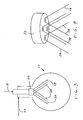
- FIGS. 1 to 6 show exemplary embodiments of the invention.
- FIG. 1 and FIG. 2 show a tubular reactor (10).
- the introduction of the liquid TiCl 4 (14) into the tube reactor (10) takes place, for example, through nozzles (12) which are arranged annularly on the circumference of the reactor (10).
- the liquid TiCl 4 (14) is atomised by means of the nozzle (12) into small droplets (16) which evaporate in the reactor (10) without impacting the wall of the reactor (10).
- FIG. 2 shows the direction (18) of the gas flow in the reactor (10).
- the nozzle (12) is preferably effectively enveloped by shielding gas (20) which is additionally introduced into the reactor (10) to prevent adsorption of solids and thermal damage to the nozzle (12).
- FIG. 1 shows the orientation of the nozzle (12) parallel to a plane which is perpendicular to the central axis of the reactor (10).
- FIG. 3 and FIG. 4 show an advantageous embodiment of the invention, in which a Hohlkegelbündeldüse (22) is used, which atomizes the introduced liquid TiCl 4 (14) compared to the single-fluid nozzle (12) into smaller drops (24).
- a Hohlkegelbündeldüse (22) is used, which atomizes the introduced liquid TiCl 4 (14) compared to the single-fluid nozzle (12) into smaller drops (24).
- a liquid such as TiCl 4 and a propellant (propellant) can be introduced into the reactor (10).
- a propellant for example, one or a mixture of the gases from the group of nitrogen, argon, chlorine gas and oxygen can be used as the propellant.
- FIG. 5 shows an embodiment of the invention, wherein the nozzles (12) are arranged radially on the circumference of the tubular reactor (10) and aligned parallel to a plane which is perpendicular to the central axis of the reactor (10).
- Liquid TiCl 4 (14) is introduced into the reactor (10) through the nozzles (12) and atomized (26).
- FIG. 6 shows a further embodiment of the invention, in which the nozzles (12) are arranged tangentially on the circumference of the tubular reactor (10) and aligned parallel to a plane which is perpendicular to the central axis of the reactor (10).
- Liquid TiCl 4 (14) is introduced into the reactor (10) through the nozzles (12) and atomized (28). Due to the tangential arrangement of the nozzles (12), the flow in the reactor (10) is set in rotation. As a result, the scrubbing particles introduced into the reactor (10) according to the prior art are better distributed in the reactor (10) for cleaning the inner walls.
- the process according to the invention optionally also comprises the dosing of additives for rutilization (eg AlCl 3 ) known to the person skilled in the art and nucleation (for example alkali metal salts) into the reaction zone.
- additives for rutilization eg AlCl 3
- nucleation for example alkali metal salts
- the inventive method also includes embodiments in which the oxygen is metered in multiple stages.
Landscapes
- Chemical & Material Sciences (AREA)
- Organic Chemistry (AREA)
- Life Sciences & Earth Sciences (AREA)
- Environmental & Geological Engineering (AREA)
- General Life Sciences & Earth Sciences (AREA)
- Geology (AREA)
- Inorganic Chemistry (AREA)
- Inorganic Compounds Of Heavy Metals (AREA)
- Catalysts (AREA)
Description
- Die Erfindung betrifft die Herstellung von Titandioxid durch Oxidation von Titantetrachlorid, wobei flüssiges Titantetrachlorid eingesetzt wird.
- In einem der kommerziell angewendeten Verfahren zur Herstellung von Titandioxid-Pigmentpartikeln, dem sogenannten Chloridverfahren, wird Titantetrachlorid (TiCl4) mit einem oxidierenden Gas wie Sauerstoff, Luft etc. sowie mit bestimmten Additiven in einem Rohrreaktor zu Titandioxid und Chlorgas umgesetzt:
TiCl4 + O2 → TiO2 + 2 Cl2
Die TiO2-Partikel werden anschließend von dem Chlorgas abgetrennt. Als Additve sind AlCl3 als Rutilisierer sowie Wasserdampf oder Alkalisalze als Keimbildner bekannt.
Aufgrund der hohen Aktivierungsenergie der Oxidation von TiCl4 müssen die Edukte so stark erhitzt werden, dass eine adiabate Mischtemperatur der Edukte vor einsetzender Reaktion von ca. 800 °C erreicht wird, damit die Reaktion vollständig abläuft. Die Oxidationsreaktion ist stark exotherm, so dass nach vollständigem, adiabaten Umsatz die Temperatur des Produktstroms um etwa 900°C höher als die der Edukte liegt. Bis zur Abtrennung der TiO2-Partikel von den gasförmigen Reaktionsprodukten mit Hilfe eines Filters muss dieses Gemisch in einer Kühlstrecke erheblich abgekühlt werden, um Schäden am Filter zu vermeiden. - Gemäß der
US 3,615,202 werden Sauerstoff und TiCl4 vorgeheizt und anschließend in einem Rohrreaktor zur Reaktion gebracht. Da die Gesamtmengen der Edukte an jeweils einer Stelle des Rohrreaktors dosiert werden, ist von einem einstufigen Verfahren zu sprechen. AuchEP 0 427 878 B1 offenbart ein einstufiges Verfahren, bei dem Sauerstoff auf etwa 1500 °C bis 1650 °C erhitzt und mit etwa 450 °C heißem TiCl4-AlCl3-Dampf vermischt wird. Die Prozessführung ist in beiden Fällen energetisch unbefriedigend, da bezogen auf 100% Energiezuführung zur Aufheizung der Edukte anschließend etwa 160% thermische Reaktionsenergie frei wird. Danach müssen aus dem heißen Produktstrom etwa 210 % Wärmeenergie in der Kühlstrecke abgeführt werden. Damit wird die beträchtliche Reaktionsenthalpie nicht für die Aktivierung der Reaktion genutzt, sondern an das Kühlwassersystem übergeben. - In dem einstufigen Verfahren gemäß
GB 969,618 - In der
EP 0 583 063 B1 wird zwecks energetischer Optimierung eine zweistufige Einleitung von TiCl4 in den Reaktor beschrieben. TiCl4 wird an einem ersten Einlasspunkt mit einer Temperatur von mindestens 450 °C und vermischt mit AlCl3 und an einem weiteren Einlasspunkt mit einer Temperatur von 350 °C bis 400 °C und ohne AlCl3 in den heißen Sauerstoffstrom geleitet. - Das Verfahren gemäß
EP 0 852 568 B1 sieht vor, neben TiCl4 auch den Sauerstoff zweistufig zu dosieren. Zielsetzung dieses Verfahrens ist jedoch die wirksame Kontrolle der mittleren TiO2-Partikelgröße und damit des Farbstichs des TiO2-Pigmentgrundkörpers. Hier wird in einen etwa 950 °C heißen Sauerstoffstrom zunächst etwa 400 °C heißer TiCl4-Dampf geleitet. In der nachfolgenden Reaktionszone bilden sich die TiO2-Partikel und findet das Partikelwachstum statt. An einem zweiten Einlasspunkt wird weniger stark erwärmter TiCl4-Dampf (ca. 180 °C) zugeführt. Sauerstoff wird an dem zweiten Einlasspunkt mit einer Temperatur zwischen 25 und 1040 °C eingeleitet, wobei die Temperatur der Mischung ausreichend ist, um die Reaktion einzuleiten. - Das mehrstufige Verfahren gemäß
US 6,387,347 soll zusätzlich die Agglomeratbildung reduzieren. Hierzu wird der bereits erhitzte TiCl4-Strom vor der Dosierung in den Reaktor in zwei Teilströme aufgeteilt. Ein Teilstrom wird in der ersten Stufe des Reaktors oxidiert. Der zweite Teilstrom wird durch Einsprühen von flüssigem TiCl4 abgekühlt (De-Superheating) und anschließend in den Reaktor dosiert. Das De-Superheating findet außerhalb des Reaktors statt, wobei die Kondensationstemperatur des Gesamtstroms nicht unterschritten wird. - Die
US 2007/0172414 A1 offenbart ein mehrstufiges Verfahren zur Reaktion von TiCl4 und O2, bei dem in der ersten Stufe gasförmiges TiCl4 und in der zweiten Stufe flüssiges TiCl4 in den Reaktor eingeleitet wird. Dieses Verfahren ermöglicht Energieeinsparungen und eine Verbesserung des Partikelgrößenspektrums. - Die Aufgabe der vorliegenden Erfindung bestand darin, ein Verfahren zur Herstellung von Titandioxid durch Oxidation von Titantetrachlorid zu schaffen, das gegenüber den aus dem Stand der Technik bekannten Verfahren weitere Energieeinsparungen ermöglicht.
- Die Lösung der Aufgabe besteht in einem Verfahren zur Herstellung von Titandioxid-Partikeln durch Reaktion von Titantetrachlorid mit einem sauerstoffhaltigen Gas in einem Rohrreaktor dadurch gekennzeichnet, dass das Titantetrachlorid in wenigstens zwei Stufen und ausschließlich in flüssiger Form in den Reaktor eingeleitet wird.
- Weitere vorteilhafte Ausformungen der Erfindung sind in den Unteransprüchen beschrieben.
- Die folgenden
Figuren 1 bis 6 dienen dem besseren Verständnis und vorteilhafter Ausformungen der Erfindung: -
Figur 1 : Schematische Darstellung eines Rohrreaktors mit einer Einstoffdüse, die parallel zu einer Ebene ausgerichtet ist, welche senkrecht zur Mittelachse des Reaktors steht. -
Figur 2 : Seitenansicht des Reaktors inFigur 1 . -
Figur 3 : Schematische Darstellung eines Rohrreaktors mit einer Hohlkegelbündeldüse. -
Figur 4 : Vergrößerte Ansicht der Düse inFigur 3 . -
Figur 5 : Schematische Darstellung eines Rohrreaktors mit drei Einstoffdüsen, die radial auf dem Umfang des Rohrreaktors und parallel zu einer Ebene ausgerichtet sind, welche senkrecht zur Mittelachse des Reaktors steht. -
Figur 6 : Schematische Darstellung eines Rohrreaktors mit drei Einstoffdüsen, die tangential auf dem Umfang des Rohrreaktors und parallel zu einer Ebene ausgerichtet sind, welche senkrecht zur Mittelachse des Reaktors steht. - Das erfindungsgemäße Verfahren unterscheidet sich von den genannten einstufigen oder mehrstufigen Chloridverfahren zur Herstellung von Titandioxid aus dem Stand der Technik dadurch, dass das TiCl4 in wenigstens zwei Stufen und ausschließlich in flüssiger Form in den Oxidationsreaktor eingeleitet wird.
- Das insgesamt eingesetzte flüssige TiCl4 wird dabei mengenmäßig so in mehrere Stufen aufgeteilt, dass in der ersten Stufe nur eine kleine Menge dosiert wird, um die Verbrennung trotz Verwendung der flüssigen Phase zu starten. Die benötigte Aktivierungsenergie wird in der ersten Stufe allein über den vorerhitzten Sauerstoff bereitgestellt. In allen weiteren Stufen wird die Aktivierungsenergie durch den vorerhitzten Sauerstoff und die in den vorgeschalteten Stufen freigesetzte Reaktionsenthalpie der Oxidation von TiCl4 bereitgestellt.
- Bei der Ausgestaltung des Verfahrens kommt es darauf an, die Reaktion nicht durch Einsprühung einer zu großen Menge flüssigen TiCl4 in eine der Stufen auszulöschen. Einen wirksamen Anhaltspunkt dafür, ob die Reaktion spontan abläuft oder verlöscht, liefert die berechnete adiabate Mischtemperatur aller Edukte in der jeweiligen Stufe vor Beginn der Reaktion. Die Erfahrung zeigt, dass die Reaktion ab einer adiabaten Mischtemperatur von ca. 740°C vollständig abläuft. Auf dieser Grundlage kann der Fachmann ohne Weiteres die Anzahl der erforderlichen Stufen und die Aufteilung des TiCl4 auf diese Stufen festlegen.
- Überraschenderweise kann das erfindungsgemäße Chloridverfahren mit der reinen Flüssigdosierung von TiCl4 nicht nur bei Einsatz von auf etwa 1600 °C vorerhitzten Sauerstoff durchgeführt werden, sondern auch bei Einsatz von vorerhitztem Sauerstoff einer Temperatur im Bereich von etwa 740 °C bis 1000 °C. In letzterem Fall entfällt die Notwendigkeit der zusätzlichen Sauerstofferhitzung mit einer Hilfsflamme, beispielsweise mit Toluol. Ein weiterer Vorteil der zweiten Variante ist ein geringerer Chlorverbrauch, der ansonsten durch Bildung von HCl im Zuge der Toluolverbrennung entsteht.
- Das erfindungsgemäße Verfahren kann unter den Bedingungen der nachfolgenden Beispiele 1 und 2 durchgeführt werden, ohne dass mit dieser Auflistung eine Einschränkung der Erfindung verbunden ist. Das Vergleichsbeispiel beinhaltet die einstufige Dosierung von gasförmigem TiCl4 gemäß Stand der Technik (
EP 0 427 878 B1 ):Beispiel 1 Beispiel 2 Vergleich Anzahl der Stufen 2 5 1 O2-Temperatur vor Reaktionszone (°C) 1650 920 1650 Toluol bedarf (kg/h) 110 0 110 Cl-Verbrauch wg. HCl-Bildung (kg/h) 340 0 340 TiCl4 (t/h) zur 1. Stufe 9,1 1,2 24,0 2. Stufe 14,9 2,9 - 3. Stufe - 4,3 - 4. Stufe - 6,5 - 5. Stufe - 9,1 - - Das erfindungsgemäße Verfahren bietet mehrere Vorteile gegenüber der Dosierung von gasförmigem TiCl4:
- Der energetische und apparative Aufwand zur Verdampfung des TiCl4 entfällt.
- Bei der flüssigen Dosierung kann das TiCl4 aufgrund des hohen Impulses der eingesprühten Flüssigkeitstropfen besser verteilt und es können somit homogenere Reaktionsbedingungen geschaffen werden.
- Bei der mehrstufigen Verfahrensweise wird durch die Vermischung mit relativ kaltem Edukt in der zweiten und den folgenden Verbrennungsstufen die adiabate Reaktionstemperatur abgesenkt, so dass der Sinterprozess, d.h. das Partikelwachstum rascher beendet wird. Hierdurch wird der Anteil grober Partikel im Pigment reduziert.
- Die
Figuren 1 bis 6 zeigen beispielhafte Ausführungen der Erfindung.Figur 1 und Figur 2 zeigen einen Rohrreaktor (10). Die Einleitung des flüssigen TiCl4 (14) in den Rohrreaktor (10) erfolgt beispielsweise durch Düsen (12), die ringförmig auf dem Umfang des Reaktors (10) angeordnet sind. Das flüssige TiCl4 (14) wird mit Hilfe der Düse (12) in kleine Tropfen zerstäubt (16), die im Reaktor (10) verdampfen, ohne auf die Wand des Reaktors (10) zu prallen.Figur 2 zeigt die Richtung (18) des Gasstroms im Reaktor (10). Die Düse (12) ist bevorzugt wirksam von Schutzgas (20) umhüllt, das zusätzlich in den Reaktor (10) eingeleitet wird, um eine Anlagerung von Feststoffen und eine thermische Beschädigung der Düse (12) zu verhindern.Figur 1 zeigt die Ausrichtung der Düse (12) parallel zu einer Ebene, welche senkrecht zu der Mittelachse des Reaktors (10) steht. -
Figur 3 und Figur 4 zeigen eine vorteilhafte Ausführung der Erfindung, bei der eine Hohlkegelbündeldüse (22) verwendet wird, die das eingeleitete flüssige TiCl4 (14) im Vergleich zu der Einstoffdüse (12) in kleinere Tropfen zerstäubt (24).
In einer anderen Ausformung der Erfindung werden anstelle von Einstoffdüsen wie (12) und (22) Zweistoffdüsen eingesetzt, bei denen gleichzeitig eine Flüssigkeit wie TiCl4 und ein Treibgas (Treibmedium) in den Reaktor (10) eingeleitet werden können. Als Treibmedium können beispielsweise eines oder ein Gemisch der Gase aus der Gruppe Stickstoff, Argon, Chlorgas und Sauerstoff verwendet werden.
Figur 5 zeigt eine Ausführung der Erfindung, bei der die Düsen (12) radial auf dem Umfang des Rohrreaktors (10) angeordnet und parallel zu einer Ebene ausgerichtet sind, welche senkrecht zur Mittelachse des Reaktors (10) steht. Flüssiges TiCl4 (14) wird durch die Düsen (12) in den Reaktor (10) eingeleitet und zerstäubt (26).
Figur 6 zeigt eine weitere Ausführung der Erfindung, bei der die Düsen (12) tangential auf dem Umfang des Rohrreaktors (10) angeordnet und parallel zu einer Ebene ausgerichtet sind, die senkrecht zur Mittelachse des Reaktors (10) steht. Flüssiges TiCl4 (14) wird durch die Düsen (12) in den Reaktor (10) eingeleitet und zerstäubt (28). Durch die tangentiale Anordnung der Düsen (12) wird die Strömung im Reaktor (10) in Rotation versetzt. Hierdurch werden die nach dem Stand der Technik in den Reaktor (10) eingebrachten Scheuerteilchen zur Abreinigung der Innenwände besser im Reaktor (10) verteilt. - Die beschriebenen Ausführungsformen stellen nur mögliche Ausformungen der Erfindung dar und sind nicht als Beschränkung der Erfindung zu verstehen. Beispielsweise umfasst das erfindungsgemäße Verfahren optional auch die dem Fachmann bekannte Dosierung von Additiven zur Rutilisierung (z.B. AlCl3) und zur Keimbildung (z.B. Alkalisalze) in die Reaktionszone. Des Weiteren umfasst das erfindungsgemäße Verfahren auch Ausführungsformen, bei denen der Sauerstoff mehrstufig dosiert wird.
Claims (8)
- Verfahren zur Herstellung von Titandioxid-Partikeln durch Reaktion von Titantetrachlorid mit einem sauerstoffhaltigen Gas in einem Rohrreaktor dadurch gekennzeichnet,
dass das Titantetrachlorid in wenigstens zwei Stufen und ausschließlich in flüssiger Form in den Reaktor eingeleitet wird. - Verfahren nach Anspruch 1 dadurch gekennzeichnet,
dass das Titantetrachlorid mit Einstoffdüsen insbesondere mit Hohlkegelbündeldüsen eingeleitet wird. - Verfahren nach Anspruch 1 dadurch gekennzeichnet,
dass das Titantetrachlorid mit Zweistoffdüsen eingeleitet wird. - Verfahren nach Anspruch 3 dadurch gekennzeichnet,
dass ein Treibmedium aus der Gruppe der Gase Stickstoff, Argon, Chlorgas oder Mischungen davon eingesetzt wird. - Verfahren nach einem Anspruch einem oder mehreren der Ansprüche 2 bis 4
dadurch gekennzeichnet,
dass die Düsen von einem Schutzgas umhüllt sind. - Verfahren nach einem oder mehreren der Ansprüche 2 bis 5 dadurch gekennzeichnet, dass die Düsen parallel zu einer Ebene, die senkrecht zur Mittelachse des Reaktors steht, ausgerichtet sind.
- Verfahren nach Anspruch 6 dadurch gekennzeichnet,
dass die Düsen tangential auf dem Umfang des Reaktors angeordnet sind. - Verfahren nach einem oder mehreren der Ansprüche 1 bis 7 dadurch gekennzeichnet,
dass der Sauerstoff auf eine Temperatur bis etwa 1600 °C, bevorzugt auf eine Temperatur im Bereich von etwa 740 °C bis 1000 °C vorerhitzt wird.
Applications Claiming Priority (2)
| Application Number | Priority Date | Filing Date | Title |
|---|---|---|---|
| DE102007049297A DE102007049297A1 (de) | 2007-10-12 | 2007-10-12 | Verfahren zur Herstellung von Titandioxid |
| PCT/EP2008/008431 WO2009049787A2 (de) | 2007-10-12 | 2008-10-07 | Verfahren zur herstellung von titandioxid |
Publications (2)
| Publication Number | Publication Date |
|---|---|
| EP2197796A2 EP2197796A2 (de) | 2010-06-23 |
| EP2197796B1 true EP2197796B1 (de) | 2011-01-26 |
Family
ID=40458695
Family Applications (1)
| Application Number | Title | Priority Date | Filing Date |
|---|---|---|---|
| EP08839099A Not-in-force EP2197796B1 (de) | 2007-10-12 | 2008-10-07 | Verfahren zur herstellung von titandioxid |
Country Status (15)
| Country | Link |
|---|---|
| US (2) | US8323613B2 (de) |
| EP (1) | EP2197796B1 (de) |
| JP (1) | JP5419880B2 (de) |
| CN (1) | CN101801852B (de) |
| AT (1) | ATE496872T1 (de) |
| AU (1) | AU2008314197B2 (de) |
| CA (1) | CA2696159A1 (de) |
| DE (2) | DE102007049297A1 (de) |
| ES (1) | ES2360397T3 (de) |
| MX (1) | MX2010003075A (de) |
| RU (1) | RU2487837C2 (de) |
| SA (1) | SA08290632B1 (de) |
| TW (1) | TWI499560B (de) |
| WO (1) | WO2009049787A2 (de) |
| ZA (1) | ZA201001301B (de) |
Families Citing this family (3)
| Publication number | Priority date | Publication date | Assignee | Title |
|---|---|---|---|---|
| DE102009009780A1 (de) * | 2009-02-20 | 2010-08-26 | Kronos International, Inc. | Mehrstufiges Verfahren zur Herstellung von Titandioxid |
| JP5554205B2 (ja) * | 2010-10-18 | 2014-07-23 | シャープ株式会社 | 無線送信装置、無線受信装置、無線通信システム、無線送信装置の制御プログラムおよび集積回路 |
| CN109319836A (zh) * | 2018-10-16 | 2019-02-12 | 东北大学秦皇岛分校 | 一种电场控制下TiO2纳米颗粒的热解合成方法 |
Family Cites Families (21)
| Publication number | Priority date | Publication date | Assignee | Title |
|---|---|---|---|---|
| GB913151A (en) * | 1958-03-06 | 1962-12-19 | British Titan Products | Vapour phase oxidation of titanium tetrachloride |
| NL256440A (de) * | 1959-10-02 | |||
| CH526333A (de) * | 1967-05-19 | 1972-08-15 | Bayer Ag | Verfahren und Vorrichtung zur Durchführung von Reaktionen zwischen Gasen |
| US3615202A (en) | 1969-11-28 | 1971-10-26 | David R Stern | Process for the manufacture of titanium dioxide |
| DE2225794A1 (de) * | 1972-05-26 | 1973-12-13 | Vnii Pi Titana | Verfahren zur herstellung von titandioxid |
| ES2035498T3 (es) | 1989-11-13 | 1993-04-16 | Kronos Titan-Gesellschaft Mbh | Procedimiento y dispositivo para la preparacion de dioxido de titanio. |
| GB9216933D0 (en) | 1992-08-10 | 1992-09-23 | Tioxide Group Services Ltd | Oxidation of titanium tetrachloride |
| RU2119454C1 (ru) * | 1994-10-28 | 1998-09-27 | Владимир Ильич Мазин | Способ получения высокодисперсных оксидов |
| CN1199385A (zh) | 1996-07-25 | 1998-11-18 | 科尔-麦克基化学有限责任公司 | 生产二氧化钛的方法和装置 |
| RU2160230C2 (ru) * | 1999-01-10 | 2000-12-10 | Волгоградское открытое акционерное общество "Химпром" | Способ получения диоксида титана |
| AU755976B2 (en) * | 1999-08-30 | 2003-01-02 | Showa Denko Kabushiki Kaisha | Titanium oxide particles and method for production thereof |
| US6387347B1 (en) * | 2000-02-14 | 2002-05-14 | Millennium Inorganic Chemicals, Inc. | Controlled vapor phase oxidation of titanium tetrachloride to manufacture titanium dioxide |
| US20020155059A1 (en) * | 2001-04-24 | 2002-10-24 | Tekna Plasma Systems Inc. | Plasma synthesis of titanium dioxide nanopowder and powder doping and surface modification process |
| DE10153640A1 (de) * | 2001-10-31 | 2003-05-15 | Inst Neue Mat Gemein Gmbh | Beschichtete Titandioxid-Teilchen |
| RU2264888C2 (ru) * | 2003-12-24 | 2005-11-27 | Государственное научное учреждение "Научно-исследовательский институт высоких напряжений при Томском политехническом университете" | Способ получения нанодисперсных порошков оксидов |
| JP2005314187A (ja) * | 2004-04-30 | 2005-11-10 | Dai Ichi Kogyo Seiyaku Co Ltd | チタン系酸化物およびその製造方法 |
| CN101098827B (zh) * | 2004-11-11 | 2011-06-15 | 巴塞尔聚烯烃意大利有限责任公司 | 由含有钛化合物的废液制备TiO2粉末的方法 |
| US7799124B2 (en) * | 2005-04-07 | 2010-09-21 | E.I. Du Pont De Nemours And Company | Process for treating inorganic particles via sintering of sinterable material |
| US7476378B2 (en) | 2005-10-27 | 2009-01-13 | E.I. Dupont Denemours & Company | Process for producing titanium dioxide |
| US20070248759A1 (en) * | 2006-04-20 | 2007-10-25 | Kostantinos Kourtakis | Processes for producing articles containing titanium dioxide possessing low sinterability |
| US20080075654A1 (en) | 2006-09-21 | 2008-03-27 | Jamison Matthew E | Titanium dioxide process |
-
2007
- 2007-10-12 DE DE102007049297A patent/DE102007049297A1/de not_active Ceased
-
2008
- 2008-09-26 US US12/238,716 patent/US8323613B2/en not_active Expired - Fee Related
- 2008-10-01 TW TW097137675A patent/TWI499560B/zh active
- 2008-10-07 CN CN2008801063142A patent/CN101801852B/zh not_active Expired - Fee Related
- 2008-10-07 JP JP2010528305A patent/JP5419880B2/ja not_active Expired - Fee Related
- 2008-10-07 CA CA2696159A patent/CA2696159A1/en not_active Abandoned
- 2008-10-07 AU AU2008314197A patent/AU2008314197B2/en not_active Ceased
- 2008-10-07 EP EP08839099A patent/EP2197796B1/de not_active Not-in-force
- 2008-10-07 ES ES08839099T patent/ES2360397T3/es active Active
- 2008-10-07 MX MX2010003075A patent/MX2010003075A/es active IP Right Grant
- 2008-10-07 RU RU2010118700/02A patent/RU2487837C2/ru not_active IP Right Cessation
- 2008-10-07 AT AT08839099T patent/ATE496872T1/de active
- 2008-10-07 WO PCT/EP2008/008431 patent/WO2009049787A2/de not_active Ceased
- 2008-10-07 DE DE502008002505T patent/DE502008002505D1/de active Active
- 2008-10-11 SA SA08290632A patent/SA08290632B1/ar unknown
-
2010
- 2010-02-23 ZA ZA2010/01301A patent/ZA201001301B/en unknown
-
2012
- 2012-10-22 US US13/656,897 patent/US8480999B2/en not_active Expired - Fee Related
Also Published As
| Publication number | Publication date |
|---|---|
| WO2009049787A3 (de) | 2009-06-04 |
| ES2360397T3 (es) | 2011-06-03 |
| US8323613B2 (en) | 2012-12-04 |
| JP5419880B2 (ja) | 2014-02-19 |
| TWI499560B (zh) | 2015-09-11 |
| EP2197796A2 (de) | 2010-06-23 |
| ATE496872T1 (de) | 2011-02-15 |
| CN101801852A (zh) | 2010-08-11 |
| DE502008002505D1 (de) | 2011-03-10 |
| ZA201001301B (en) | 2010-11-24 |
| JP2011500483A (ja) | 2011-01-06 |
| MX2010003075A (es) | 2010-04-01 |
| AU2008314197B2 (en) | 2013-04-04 |
| TW200918459A (en) | 2009-05-01 |
| WO2009049787A2 (de) | 2009-04-23 |
| RU2010118700A (ru) | 2011-11-20 |
| US8480999B2 (en) | 2013-07-09 |
| RU2487837C2 (ru) | 2013-07-20 |
| SA08290632B1 (ar) | 2012-01-24 |
| CA2696159A1 (en) | 2009-04-23 |
| AU2008314197A1 (en) | 2009-04-23 |
| DE102007049297A1 (de) | 2009-04-23 |
| US20130058860A1 (en) | 2013-03-07 |
| CN101801852B (zh) | 2012-07-18 |
| US20090098042A1 (en) | 2009-04-16 |
Similar Documents
| Publication | Publication Date | Title |
|---|---|---|
| DE3115002A1 (de) | Verfahren zur herstellung von feinteiligen und feinzerteilten metall- und metalloidoxiden sowie vorrichtung zur durchfuehrung des verfahrens | |
| EP1189835B1 (de) | Sprühpyrolyse- oder sprühtrocknungsverfahren sowie anlage zur durchführung | |
| EP1319151B1 (de) | Verfahren zur regenerierung von schwefelhaltigem reststoff und verwendung eines zerstäubungsbrenners zur durchführung des verfahrens | |
| EP2197796B1 (de) | Verfahren zur herstellung von titandioxid | |
| DE69218071T2 (de) | Verfahren zur Herstellung von Eisenoxidteilchen | |
| EP1327106A1 (de) | Zerstäubungsbrenner für die thermische spaltung von schwefelhaltigem reststoff | |
| DE1592529B2 (de) | Verfahren zur herstellung eines rutil pigmentes durch umsetzung von titantetrachlorid mit sauerstoff in einem heissen gasgemisch | |
| DE948415C (de) | Verfahren zur Herstellung feinverteilter Metalloxyde aus fluechtigen Metallhalogeniden | |
| DE1293728B (de) | Verfahren und Vorrichtung zur Herstellung pyrogener Metalloxyde | |
| EP2398738B1 (de) | Mehrstufiges verfahren zur herstellung von titandioxid | |
| EP2637775B1 (de) | Verfahren und vorrichtung zur herstellung von acetylen und synthesegas | |
| DE1194832B (de) | Verfahren und Vorrichtung zum Abkuehlen eines heissen, TiO-haltigen Gasgemisches | |
| DE974793C (de) | Verfahren zur Herstellung von feinverteilten Oxyden | |
| DE3719825A1 (de) | Verfahren zur herstellung von keramikpulvern und vorrichtung zur durchfuehrung desselben | |
| EP0093909B1 (de) | Verfahren zur Spaltung von verdünnter Schwefelsäure | |
| WO2015003871A1 (de) | Verfahren zur herstellung von metalloxiden | |
| EP2200942B1 (de) | Mehrstufiges verfahren zur herstellung von titandioxid | |
| EP4437273B1 (de) | Verfahren und vorrichtung zur behandlung und neutralisierung von umweltschädlichen und/oder toxischen abgasen | |
| DE2202965C3 (de) | Verfahren zur Herstellung wasserfreier teilchenförmiger Alkalimetallphosphate | |
| DE1592496B2 (de) | Herstellung eines Titandioxidpigments durch Dampfphasenoxidation | |
| DE1592529C (de) | Verfahren zur Herstellung eines Rutil Pigmentes durch Umsetzung von Titantetra chlond mit Sauerstoff in einem heißen Gas gemisch | |
| DE4111231A1 (de) | Verfahren und vorrichtung zur herstellung von dichten, kugelfoermigen pulvern (im partikelgroessenbereich von 0,05-5 um) mit hilfe eines modifizierten spruehverfahrens | |
| DE102007012849A1 (de) | Verfahren und Vorrichtung zur Herstellung von Metallchloriden | |
| DE1177114B (de) | Verfahren zur Herstellung eines Oxyds eines der Elemente Titan, Zirkonium, Eisen, Aluminium und Silicium | |
| DE1268123B (de) | Vorrichtung zum Oxydieren von Blei |
Legal Events
| Date | Code | Title | Description |
|---|---|---|---|
| PUAI | Public reference made under article 153(3) epc to a published international application that has entered the european phase |
Free format text: ORIGINAL CODE: 0009012 |
|
| 17P | Request for examination filed |
Effective date: 20100318 |
|
| AK | Designated contracting states |
Kind code of ref document: A2 Designated state(s): AT BE BG CH CY CZ DE DK EE ES FI FR GB GR HR HU IE IS IT LI LT LU LV MC MT NL NO PL PT RO SE SI SK TR |
|
| GRAP | Despatch of communication of intention to grant a patent |
Free format text: ORIGINAL CODE: EPIDOSNIGR1 |
|
| GRAS | Grant fee paid |
Free format text: ORIGINAL CODE: EPIDOSNIGR3 |
|
| GRAA | (expected) grant |
Free format text: ORIGINAL CODE: 0009210 |
|
| AK | Designated contracting states |
Kind code of ref document: B1 Designated state(s): AT BE BG CH CY CZ DE DK EE ES FI FR GB GR HR HU IE IS IT LI LT LU LV MC MT NL NO PL PT RO SE SI SK TR |
|
| REG | Reference to a national code |
Ref country code: GB Ref legal event code: FG4D Free format text: NOT ENGLISH |
|
| REG | Reference to a national code |
Ref country code: CH Ref legal event code: EP |
|
| REG | Reference to a national code |
Ref country code: IE Ref legal event code: FG4D Free format text: LANGUAGE OF EP DOCUMENT: GERMAN |
|
| REF | Corresponds to: |
Ref document number: 502008002505 Country of ref document: DE Date of ref document: 20110310 Kind code of ref document: P |
|
| REG | Reference to a national code |
Ref country code: DE Ref legal event code: R096 Ref document number: 502008002505 Country of ref document: DE Effective date: 20110310 |
|
| REG | Reference to a national code |
Ref country code: NL Ref legal event code: T3 |
|
| REG | Reference to a national code |
Ref country code: ES Ref legal event code: FG2A Ref document number: 2360397 Country of ref document: ES Kind code of ref document: T3 Effective date: 20110603 |
|
| LTIE | Lt: invalidation of european patent or patent extension |
Effective date: 20110126 |
|
| PG25 | Lapsed in a contracting state [announced via postgrant information from national office to epo] |
Ref country code: LT Free format text: LAPSE BECAUSE OF FAILURE TO SUBMIT A TRANSLATION OF THE DESCRIPTION OR TO PAY THE FEE WITHIN THE PRESCRIBED TIME-LIMIT Effective date: 20110126 Ref country code: HR Free format text: LAPSE BECAUSE OF FAILURE TO SUBMIT A TRANSLATION OF THE DESCRIPTION OR TO PAY THE FEE WITHIN THE PRESCRIBED TIME-LIMIT Effective date: 20110126 Ref country code: SE Free format text: LAPSE BECAUSE OF FAILURE TO SUBMIT A TRANSLATION OF THE DESCRIPTION OR TO PAY THE FEE WITHIN THE PRESCRIBED TIME-LIMIT Effective date: 20110126 Ref country code: LV Free format text: LAPSE BECAUSE OF FAILURE TO SUBMIT A TRANSLATION OF THE DESCRIPTION OR TO PAY THE FEE WITHIN THE PRESCRIBED TIME-LIMIT Effective date: 20110126 Ref country code: GR Free format text: LAPSE BECAUSE OF FAILURE TO SUBMIT A TRANSLATION OF THE DESCRIPTION OR TO PAY THE FEE WITHIN THE PRESCRIBED TIME-LIMIT Effective date: 20110427 Ref country code: PT Free format text: LAPSE BECAUSE OF FAILURE TO SUBMIT A TRANSLATION OF THE DESCRIPTION OR TO PAY THE FEE WITHIN THE PRESCRIBED TIME-LIMIT Effective date: 20110526 Ref country code: NO Free format text: LAPSE BECAUSE OF FAILURE TO SUBMIT A TRANSLATION OF THE DESCRIPTION OR TO PAY THE FEE WITHIN THE PRESCRIBED TIME-LIMIT Effective date: 20110426 |
|
| REG | Reference to a national code |
Ref country code: IE Ref legal event code: FD4D |
|
| PG25 | Lapsed in a contracting state [announced via postgrant information from national office to epo] |
Ref country code: FI Free format text: LAPSE BECAUSE OF FAILURE TO SUBMIT A TRANSLATION OF THE DESCRIPTION OR TO PAY THE FEE WITHIN THE PRESCRIBED TIME-LIMIT Effective date: 20110126 Ref country code: PL Free format text: LAPSE BECAUSE OF FAILURE TO SUBMIT A TRANSLATION OF THE DESCRIPTION OR TO PAY THE FEE WITHIN THE PRESCRIBED TIME-LIMIT Effective date: 20110126 Ref country code: BG Free format text: LAPSE BECAUSE OF FAILURE TO SUBMIT A TRANSLATION OF THE DESCRIPTION OR TO PAY THE FEE WITHIN THE PRESCRIBED TIME-LIMIT Effective date: 20110426 Ref country code: CY Free format text: LAPSE BECAUSE OF FAILURE TO SUBMIT A TRANSLATION OF THE DESCRIPTION OR TO PAY THE FEE WITHIN THE PRESCRIBED TIME-LIMIT Effective date: 20110126 Ref country code: SI Free format text: LAPSE BECAUSE OF FAILURE TO SUBMIT A TRANSLATION OF THE DESCRIPTION OR TO PAY THE FEE WITHIN THE PRESCRIBED TIME-LIMIT Effective date: 20110126 |
|
| PG25 | Lapsed in a contracting state [announced via postgrant information from national office to epo] |
Ref country code: EE Free format text: LAPSE BECAUSE OF FAILURE TO SUBMIT A TRANSLATION OF THE DESCRIPTION OR TO PAY THE FEE WITHIN THE PRESCRIBED TIME-LIMIT Effective date: 20110126 Ref country code: IE Free format text: LAPSE BECAUSE OF FAILURE TO SUBMIT A TRANSLATION OF THE DESCRIPTION OR TO PAY THE FEE WITHIN THE PRESCRIBED TIME-LIMIT Effective date: 20110126 Ref country code: DK Free format text: LAPSE BECAUSE OF FAILURE TO SUBMIT A TRANSLATION OF THE DESCRIPTION OR TO PAY THE FEE WITHIN THE PRESCRIBED TIME-LIMIT Effective date: 20110126 |
|
| PG25 | Lapsed in a contracting state [announced via postgrant information from national office to epo] |
Ref country code: RO Free format text: LAPSE BECAUSE OF FAILURE TO SUBMIT A TRANSLATION OF THE DESCRIPTION OR TO PAY THE FEE WITHIN THE PRESCRIBED TIME-LIMIT Effective date: 20110126 Ref country code: SK Free format text: LAPSE BECAUSE OF FAILURE TO SUBMIT A TRANSLATION OF THE DESCRIPTION OR TO PAY THE FEE WITHIN THE PRESCRIBED TIME-LIMIT Effective date: 20110126 Ref country code: CZ Free format text: LAPSE BECAUSE OF FAILURE TO SUBMIT A TRANSLATION OF THE DESCRIPTION OR TO PAY THE FEE WITHIN THE PRESCRIBED TIME-LIMIT Effective date: 20110126 |
|
| PLBE | No opposition filed within time limit |
Free format text: ORIGINAL CODE: 0009261 |
|
| STAA | Information on the status of an ep patent application or granted ep patent |
Free format text: STATUS: NO OPPOSITION FILED WITHIN TIME LIMIT |
|
| 26N | No opposition filed |
Effective date: 20111027 |
|
| REG | Reference to a national code |
Ref country code: DE Ref legal event code: R097 Ref document number: 502008002505 Country of ref document: DE Effective date: 20111027 |
|
| BERE | Be: lapsed |
Owner name: KRONOS INTERNATIONAL, INC. Effective date: 20111031 |
|
| PG25 | Lapsed in a contracting state [announced via postgrant information from national office to epo] |
Ref country code: IT Free format text: LAPSE BECAUSE OF FAILURE TO SUBMIT A TRANSLATION OF THE DESCRIPTION OR TO PAY THE FEE WITHIN THE PRESCRIBED TIME-LIMIT Effective date: 20110126 Ref country code: MC Free format text: LAPSE BECAUSE OF NON-PAYMENT OF DUE FEES Effective date: 20111031 |
|
| PG25 | Lapsed in a contracting state [announced via postgrant information from national office to epo] |
Ref country code: BE Free format text: LAPSE BECAUSE OF NON-PAYMENT OF DUE FEES Effective date: 20111031 |
|
| PGFP | Annual fee paid to national office [announced via postgrant information from national office to epo] |
Ref country code: DE Payment date: 20121010 Year of fee payment: 5 Ref country code: FR Payment date: 20121018 Year of fee payment: 5 |
|
| PG25 | Lapsed in a contracting state [announced via postgrant information from national office to epo] |
Ref country code: MT Free format text: LAPSE BECAUSE OF FAILURE TO SUBMIT A TRANSLATION OF THE DESCRIPTION OR TO PAY THE FEE WITHIN THE PRESCRIBED TIME-LIMIT Effective date: 20110126 |
|
| PGFP | Annual fee paid to national office [announced via postgrant information from national office to epo] |
Ref country code: ES Payment date: 20121031 Year of fee payment: 5 |
|
| PG25 | Lapsed in a contracting state [announced via postgrant information from national office to epo] |
Ref country code: LU Free format text: LAPSE BECAUSE OF NON-PAYMENT OF DUE FEES Effective date: 20111007 |
|
| REG | Reference to a national code |
Ref country code: CH Ref legal event code: PL |
|
| PG25 | Lapsed in a contracting state [announced via postgrant information from national office to epo] |
Ref country code: IS Free format text: LAPSE BECAUSE OF FAILURE TO SUBMIT A TRANSLATION OF THE DESCRIPTION OR TO PAY THE FEE WITHIN THE PRESCRIBED TIME-LIMIT Effective date: 20110126 Ref country code: LI Free format text: LAPSE BECAUSE OF NON-PAYMENT OF DUE FEES Effective date: 20121031 Ref country code: CH Free format text: LAPSE BECAUSE OF NON-PAYMENT OF DUE FEES Effective date: 20121031 |
|
| PG25 | Lapsed in a contracting state [announced via postgrant information from national office to epo] |
Ref country code: TR Free format text: LAPSE BECAUSE OF FAILURE TO SUBMIT A TRANSLATION OF THE DESCRIPTION OR TO PAY THE FEE WITHIN THE PRESCRIBED TIME-LIMIT Effective date: 20110126 |
|
| PG25 | Lapsed in a contracting state [announced via postgrant information from national office to epo] |
Ref country code: HU Free format text: LAPSE BECAUSE OF FAILURE TO SUBMIT A TRANSLATION OF THE DESCRIPTION OR TO PAY THE FEE WITHIN THE PRESCRIBED TIME-LIMIT Effective date: 20110126 |
|
| REG | Reference to a national code |
Ref country code: DE Ref legal event code: R119 Ref document number: 502008002505 Country of ref document: DE Effective date: 20140501 |
|
| REG | Reference to a national code |
Ref country code: FR Ref legal event code: ST Effective date: 20140630 |
|
| PG25 | Lapsed in a contracting state [announced via postgrant information from national office to epo] |
Ref country code: FR Free format text: LAPSE BECAUSE OF NON-PAYMENT OF DUE FEES Effective date: 20131031 Ref country code: DE Free format text: LAPSE BECAUSE OF NON-PAYMENT OF DUE FEES Effective date: 20140501 |
|
| REG | Reference to a national code |
Ref country code: ES Ref legal event code: FD2A Effective date: 20141107 |
|
| REG | Reference to a national code |
Ref country code: AT Ref legal event code: MM01 Ref document number: 496872 Country of ref document: AT Kind code of ref document: T Effective date: 20131007 |
|
| PG25 | Lapsed in a contracting state [announced via postgrant information from national office to epo] |
Ref country code: ES Free format text: LAPSE BECAUSE OF NON-PAYMENT OF DUE FEES Effective date: 20131008 |
|
| PG25 | Lapsed in a contracting state [announced via postgrant information from national office to epo] |
Ref country code: AT Free format text: LAPSE BECAUSE OF NON-PAYMENT OF DUE FEES Effective date: 20131007 |
|
| PGFP | Annual fee paid to national office [announced via postgrant information from national office to epo] |
Ref country code: NL Payment date: 20171016 Year of fee payment: 10 Ref country code: GB Payment date: 20171004 Year of fee payment: 10 |
|
| REG | Reference to a national code |
Ref country code: NL Ref legal event code: MM Effective date: 20181101 |
|
| GBPC | Gb: european patent ceased through non-payment of renewal fee |
Effective date: 20181007 |
|
| PG25 | Lapsed in a contracting state [announced via postgrant information from national office to epo] |
Ref country code: NL Free format text: LAPSE BECAUSE OF NON-PAYMENT OF DUE FEES Effective date: 20181101 |
|
| PG25 | Lapsed in a contracting state [announced via postgrant information from national office to epo] |
Ref country code: GB Free format text: LAPSE BECAUSE OF NON-PAYMENT OF DUE FEES Effective date: 20181007 |