EP2198501B1 - Antriebsvorrichtung mit drehmomentkompensation - Google Patents
Antriebsvorrichtung mit drehmomentkompensation Download PDFInfo
- Publication number
- EP2198501B1 EP2198501B1 EP08801102.8A EP08801102A EP2198501B1 EP 2198501 B1 EP2198501 B1 EP 2198501B1 EP 08801102 A EP08801102 A EP 08801102A EP 2198501 B1 EP2198501 B1 EP 2198501B1
- Authority
- EP
- European Patent Office
- Prior art keywords
- motors
- drive unit
- servomotors
- motor
- drive
- Prior art date
- Legal status (The legal status is an assumption and is not a legal conclusion. Google has not performed a legal analysis and makes no representation as to the accuracy of the status listed.)
- Not-in-force
Links
- 230000005540 biological transmission Effects 0.000 claims description 17
- 230000033001 locomotion Effects 0.000 claims description 14
- 239000000872 buffer Substances 0.000 claims description 6
- 230000001419 dependent effect Effects 0.000 description 2
- 238000009826 distribution Methods 0.000 description 2
- 238000000034 method Methods 0.000 description 2
- 238000003825 pressing Methods 0.000 description 2
- 238000010276 construction Methods 0.000 description 1
- 238000011161 development Methods 0.000 description 1
- 230000018109 developmental process Effects 0.000 description 1
- 238000004080 punching Methods 0.000 description 1
- 230000001105 regulatory effect Effects 0.000 description 1
- 238000003860 storage Methods 0.000 description 1
Images

Classifications
-
- B—PERFORMING OPERATIONS; TRANSPORTING
- B30—PRESSES
- B30B—PRESSES IN GENERAL
- B30B15/00—Details of, or accessories for, presses; Auxiliary measures in connection with pressing
- B30B15/14—Control arrangements for mechanically-driven presses
-
- H—ELECTRICITY
- H02—GENERATION; CONVERSION OR DISTRIBUTION OF ELECTRIC POWER
- H02K—DYNAMO-ELECTRIC MACHINES
- H02K16/00—Machines with more than one rotor or stator
-
- H—ELECTRICITY
- H02—GENERATION; CONVERSION OR DISTRIBUTION OF ELECTRIC POWER
- H02K—DYNAMO-ELECTRIC MACHINES
- H02K7/00—Arrangements for handling mechanical energy structurally associated with dynamo-electric machines, e.g. structural association with mechanical driving motors or auxiliary dynamo-electric machines
- H02K7/10—Structural association with clutches, brakes, gears, pulleys or mechanical starters
- H02K7/1004—Structural association with clutches, brakes, gears, pulleys or mechanical starters with pulleys
Definitions
- the invention relates to a drive device for applications in forming presses, consisting of several electric drives with common torque compensation according to the preamble of claim 1.
- presses such as multi-ram transfer presses, press lines, transfer presses, servo presses or punching presses
- drive tasks there are a variety of drive tasks. Particularly in the areas of press drives and workpiece transport systems, very high demands are placed on the drives with regard to power transmission and dynamics.
- Both the press drives and the transfer drives often use two servomotors for one drive unit.
- the main advantage is certainly the greater performance of the drive unit over the use of a single servo motor.
- the redundancy when using two servomotors is also to be mentioned as an advantage in terms of safety.
- both servomotors are operated at 100% of their maximum capacity, so that the use of two motors results in a doubling of the maximum power compared to the use of a motor. In practice, this uniform torque distribution is problematic. In order to achieve a high control quality of the overall system, both servomotors are operated in a position-controlled manner.
- the current consumption of the servomotors is dependent on the reaction torque which the servomotors experience during the transmission of power by the motion transmission means.
- the reaction moments experienced by the two servomotors may be different due to the surrounding construction.
- One reason for this may be, for example, different belt tensions of a common toothed belt.
- the consequence of this uneven distribution of torque is that a servomotor has its maximum possible power or its maximum permissible current consumption reached earlier than the other servomotor. When these limits are reached, an overload mechanism responds and the entire drive unit comes to a halt.
- a possible method to synchronize the torques of the two engaged servomotors is in the DE 10 2004 009 256 A1 described.
- the second servomotors are controlled by their own torque controllers, which are to ensure that both motors apply the same torque.
- GB-A-1220403 discloses a drive device according to the preamble of claim 1, a multiple drive, in particular the use of two or more synchronously running motors, for example, for use in large transmissions, known.
- the invention is based on the idea to mutually mechanically connect a plurality of generally two motors or motors connected to the motors so that the reaction moments compensate each other.
- a leverage which connects both motors, is intended to transmit torques from one motor to another in such a way that they are respectively introduced in opposite directions on the adjacent motor.
- the leverage for compensating the reaction moments of a first balance lever, which is fixedly connected to the first motor, a second balance lever, which is fixedly connected to the second motor and a tab, which in a fulcrum with the first balance lever and in a second pivot point is rotatably connected to the second balance lever.
- This compensation of the reaction moments is particularly important when the use of two drives doubling, or when using three drives tripling the power is sought.
- the drives are operated - position-controlled. In this control mode the advantages of the drive device according to the invention come fully to bear. By compensating the reaction torques, all drives can be operated evenly to their power limit or up to their maximum current consumption.
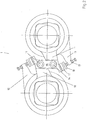
- FIG. 1 shows a simplified representation of the drive device according to the invention 1.
- the two servomotors 2, 3 are operatively connected to a respective transmission 4, 5.
- planetary gear are used, but also all other known types of transmissions are conceivable.
- pulleys 6,7 are operatively connected to the gears.
- Characteristic of the drive device 1 according to the invention is that both servomotors act on the same motion transmission means, in this case on a belt, not shown here, for example a toothed belt. All other, known in the art motion transmission means, such as flat belts or gears are used.
- the two drive trains shown are connected via mounting flanges 8.9 with the surrounding structure. Between the transmissions 4, 5 and the servomotors 2, 3, the leverage suitable for the invention can be seen for torque compensation.
- the balancing levers 10, 11 are fastened firmly to the servomotors 2, 3. These two balance levers 10,11 are hinged together via a tab 12.
- the joint arrangement consisting of the two balance levers 10,11 and the tab 12 is formed such that a reaction torque on the first servo motor 2 is transmitted to the second servo motor 3, that the moment acts in the opposite direction. Since this type of torque transmission also acts on the first servomotor 2 from the second servomotor 3, different reaction moments are compensated.
- FIG. 2 the articulation arrangement described above is clarified.
- the balance lever 10,11 and the attached thereto tab 12 with the hinge points 13,14 can be clearly seen.
- the stop levers 15, 16 are firmly connected to the gears 4,5. They have the task to limit the movements which the leverage consisting of the balance lever 10,11 and the tab 12 performs. For this purpose, defined gaps between the buffers 17, which are fixed to the balance lever 10,11, and the buffers 18 which are fixed to the stop levers 15,16 are preset. The adjustment of this column by means of screws 19.
- the balance lever 10,11 and the stop lever 15,16 are rotatably connected to each other by suitable bearings 20. The limitation by the stop lever 15,16 is not relevant for the compensation of the torques during operation. It serves only to safeguard an emergency situation, or an unforeseeable movement situation of the compensation device.
- three or more drives can be used instead of the described two servomotors.
- three or more drives can be used instead of the described two servomotors.
Landscapes
- Engineering & Computer Science (AREA)
- Power Engineering (AREA)
- Mechanical Engineering (AREA)
- Press Drives And Press Lines (AREA)
- Manipulator (AREA)
Description
- Die Erfindung betrifft eine Antriebsvorrichtung für Anwendungen in Umformpressen, bestehend aus mehreren elektrischen Antrieben mit gemeinsamer Drehmomentkompensation nach dem Oberbegriff des Anspruch 1.
- In Umformpressen, wie beispielsweise Mehrstößeltransferpressen, Pressenstraßen, Stufenpressen, Servopressen oder Stanzautomaten gibt es vielfältige Antriebsaufgaben. Insbesondere in den Bereichen Pressenantriebe und Werkstücktransportsysteme werden dabei bezüglich Kraftübertragung und Dynamik sehr hohe Anforderungen an die Antriebe gestellt.
- Wurden bei den Antrieben von mechanischen Pressen in der Vergangenheit fast ausnahmslos Schwungradantriebe eingesetzt, so ist in jüngster Zeit ein Trend zu direkt angetriebenen Pressen mit Servomotoren zu erkennen. Bei großen erforderlichen Presskräften stoßen Servomotoren zur Zeit noch an ihre Leistungsgrenzen. Um die Grenze der mit Servomotoren maximal möglichen Presskraft nach oben zu bringen, geht man häufig dazu über mehrere Servomotoren, welche auf das gleiche Bewegungsübertragungsmittel wirken, einzusetzen.
- In der
DE 10 2004 009 256 A1 ist eine so genannte Mehrservopresse der oben beschriebenen Ausführung dargestellt. Bei dieser technischen Lösung wird als Vorteil gesehen, mehrere Servomotoren ein gemeinsames Stirnrad antreiben zu lassen, das mit einem Exzenter verbunden ist. Ein solches Getriebe erweist sich als kostengünstig, robust und steif. Weil die Kraftübertragung auf das Stirnrad über mehrere, gleichzeitig mit dem Stirnrad kämmende Ritzel erfolgt ist es möglich, die gesamte zur Umformung erforderliche Maximalkraft über das so gebildete Getriebe zu leiten. - Bei den Werkstücktransportsystemen, auch Transfersysteme genannt, verwendet man seit längerem unterschiedliche elektrische Antriebe, welche die früher üblichen mechanischen, an den Pressenantrieben gekoppelten Antriebe nahezu vollständig abgelöst haben. In der
DE 198 01 731 A1 ist ein Transfersystem beschrieben, bei dem ebenfalls zwei Motoren auf das gleiche Bewegungsübertragungsmittel wirken. Dabei treiben zwei stationäre Antriebsmotoren über eine Zugmittelanordnung eine teleskopierbare Auslegeranordnung an. Durch eine entsprechende Regelung der Antriebsmotoren führt die als Teleskopfeeder bekannte Transportvorrichtung Horizontal- und Vertikalbewegungen aus. Der geforderte Transportweg besteht in der Regel aus sich überlagernden horizontalen und vertikalen Bewegungen. Beliebige Bewegungsprofile sind mit diesem System fahrbar. - Sowohl bei den Pressenantrieben, als auch bei den Transferantrieben werden häufig für eine Antriebseinheit zwei Servomotoren eingesetzt. Der Hauptvorteil liegt dabei sicherlich in der größeren Leistungsfähigkeit der Antriebseinheit gegenüber des Einsatzes eines einzelnen Servomotors. Die Redundanz beim Einsatz zweier Servomotoren ist unter Sicherheitsaspekten ebenfalls als Vorteil zu nennen.
- Nachteil beim Einsatz mehrerer Servomotoren in einer Antriebseinheit ergeben sich durch den aufwendigen Steuerungs- und Regelungsaufwand. Da die Servomotoren in der Regel an ihren Leistungsgrenzen betrieben werden wird angestrebt, dass die beiden Servomotoren exakt gleich viel Leistung an das gemeinsame Bewegungsübertragungsmittel, wie zum Beispiel Zahnrad oder Zahnriemen, abgeben. Im Idealfall werden beide Servomotoren mit 100 % ihres maximalen Leistungsvermögens betrieben, so dass sich durch den Einsatz zweier Motoren eine Verdoppelung der Maximalleistung im Vergleich zum Einsatz eines Motors ergibt. In der Praxis stellt sich diese gleichmäßige Drehmomentverteilung als problematisch dar. Um eine hohe Regelgüte des Gesamtsystems erzielen zu können werden beide Servomotoren lagegeregelt betrieben. In diesem Fall ist die Stromaufnahme der Servomotoren abhängig vom Reaktionsmoment, welches die Servomotoren bei der Kraftübertragung durch das Bewegungsübertragungsmittel erfahren. Die Reaktionsmomente, die die beiden Servomotoren erfahren, können aufgrund der Umgebungskonstruktion unterschiedlich sein. Ein Grund dafür können beispielsweise unterschiedliche Riemenspannungen eines gemeinsamen Zahnriemens sein. Die Folge dieser ungleichen Drehmomentenverteilung ist, dass ein Servomotor seine maximal mögliche Leistung bzw. seine maximal zulässige Stromaufnahne früher erreicht, als der andere Servomotor. Bei Erreichen dieser Grenzen spricht ein Überlastmechanismus an und die gesamte Antriebseinheit kommt zum Stehen. Somit ist eine Verdopplung der Leistung durch den Einsatz von zwei Servomotoren in der Praxis nicht ohne weiteres möglich. Eine mögliche Methode die Drehmomente der beiden in Eingriff stehenden Servomotoren zu synchronisieren wird in der
DE 10 2004 009 256 A1 beschrieben. Dabei werden die zweiten Servomotoren über eigene Drehmomentregler angesteuert, die sicherstellen sollen, dass beide Motoren das gleiche Drehmoment aufbringen. - Der Nachteil dieser Methode ist, wie auch in der
DE 10 2004 009 256 A1 eingeräumt, der hohe Regelaufwand. Darüber hinaus wird sicherlich auch die Störanfälligkeit des Gesamtsystems durch die zusätzlichen Regelkreise deutlich erhöht. - Schließlich ist aus der Druckschrift
GB-A-1220403 - Ausgehend von Stand der Technik ist es Aufgabe der Erfindung, eine Antriebsvorrichtung zu schaffen, bei der mehrere Motoren auf ein gemeinsames Bewegungsübertragungsmittel wirken, wobei beide Motoren das exakt gleiche Drehmoment aufbringen sollen. Diese Aufgabe wird ausgehend von einer Antriebsvorrichtung nach dem Oberbegriff des Anspruch 1, durch die kennzeichnenden Merkmale des Anspruch 1 gelöst. In den Unteransprüchen sind vorteilhafte und zweckmäßige Weiterbildungen der erfindungsgemäßen Antriebsvorrichtung angegeben.
- Der Erfindung liegt der Gedanke zugrunde, mehrere, in der Regel zwei, Motoren bzw. mit den Motoren verbundene Getriebe, gegenseitig mechanisch so zu verbinden, dass die Reaktionsmomente sich kompensieren.
Eine Hebelage, welche beide Motoren verbindet, soll dabei Drehmomente von einem Motor zum anderen derart übertragen, dass diese am benachbarten Motor jeweils gegensinnig eingeleitet werden. Erfindungsgemäß besteht die Hebelage zur Kompensation der Reaktionsmomente aus einem ersten Ausgleichshebel, welcher mit dem ersten Motor fest verbunden ist, aus einem zweiten Ausgleichshebel, welcher mit dem zweiten Motor fest verbunden ist sowie einer Lasche, welche in einem Drehpunkt mit dem ersten Ausgleichshebel und in einem zweiten Drehpunkt mit dem zweiten Ausgleichshebel drehbar verbunden ist. - Diese Kompensation der Reaktionsmomente ist besonders dann wichtig, wenn mit dem Einsatz von zwei Antrieben eine Verdoppelung, beziehungsweise beim Einsatz von drei Antrieben eine Verdreifachung der Leistung angestrebt wird. Die Antriebe werden dabei - lagegeregelt betrieben. Bei dieser Regelungsart kommen die Vorteile der erfindungsgemäßen Antriebsvorrichtung voll zum tragen. Durch die Kompensation der Reaktionsmomente können alle Antriebe gleichmäßig bis an Ihre Leistungsgrenze, beziehungsweise bis zu Ihrer maximalen Stromaufnahme betrieben werden.
- Weitere Einzelheiten und Vorteile der Erfindung ergeben sich aus dem, anhand der Zeichnungen dargestellten Ausführungsbeispiels.
- Es zeigen:
- Figur 1
- Antriebsvorrichtung in einer Draufsicht
- Figur 2
- Antriebsvorrichtung in einer Seitenansicht
-
Figur 1 zeigt eine vereinfachte Darstellung der erfindungsgemäßen Antriebsvorrichtung 1. Zu sehen sind zwei Servomotoren 2,3. Die beiden Servomotoren 2,3 sind mit jeweils einem Getriebe 4,5 wirkverbunden. In diesem Ausführungsbeispiel werden Planetengetriebe eingesetzt, aber auch alle anderen bekannten Getriebearten sind denkbar. Abtriebsseitig befinden sich Riemenscheiben 6,7, welche ihrerseits mit den Getrieben wirkverbunden sind. Kennzeichnend für die erfindungsgemäße Antriebsvorrichtung 1 ist, dass beide Servomotoren auf das gleiche Bewegungsübertragungsmittel wirken, in diesem Falle auf einen hier nicht dargestellten Riemen, beispielsweise einen Zahnriemen. Auch alle anderen, dem Stand der Technik bekannten Bewegungsübertragungsmittel, wie beispielsweise Flachriemen oder Zahnräder sind einsetzbar. - Die beiden dargestellten Antriebsstränge sind über Befestigungsflansche 8,9 mit der Umgebungskonstruktion verbunden. Zwischen den Getrieben 4,5 und den Servomotoren 2,3 ist die erfindungswesentliche Hebelage zur Drehmomentkompensation zu erkennen. Fest an den Servomotoren 2,3 sind dabei die Ausgleichshebel 10,11 befestigt. Diese beiden Ausgleichshebel 10,11 sind über eine Lasche 12 gelenkig miteinander verbunden. Die Gelenkanordnung bestehend aus den beiden Ausgleichshebel 10,11 und der Lasche 12 ist derart ausgebildet, dass ein Reaktionsmoment am ersten Servomotor 2 so auf den zweiten Servomotor 3 übertragen wird, dass das Moment in die entgegen gesetzte Richtung wirkt. Da diese Art der Drehmomentübertragung auch vom zweiten Servomotor 3 auf den ersten Servomotor 2 wirkt, werden unterschiedliche Reaktionsmomente kompensiert.
- In
Figur 2 wird die oben beschriebene Gelenkanordnung verdeutlicht. In dieser Ansicht sind die Ausgleichshebel 10,11 sowie die daran gelagerte Lasche 12 mit den Gelenkpunkten 13,14 deutlich zu sehen. - Die Anschlaghebel 15, 16 sind fest mit den Getrieben 4,5 verbunden. Sie haben die Aufgabe die Bewegungen, welche die Hebelage, bestehend aus den Ausgleichshebel 10,11 und der Lasche 12, ausführt zu begrenzen. Dazu werden definierte Spalte zwischen den Puffern 17, welche an den Ausgleichshebel 10,11 befestigt sind, und den Puffern 18, welche an den Anschlaghebeln 15,16 befestigt sind voreingestellt. Die Einstellung dieser Spalte erfolgt mittels Stellschrauben 19. Die Ausgleichshebel 10,11 und die Anschlaghebel 15,16 sind durch geeignete Lagerungen 20 drehbar miteinander verbunden. Die Begrenzung durch die Anschlaghebel 15,16 ist für die Kompensation der Drehmomente im laufenden Betrieb nicht relevant. Sie dient lediglich der Absicherung einer Notfallsituation, beziehungsweise einer nicht vorhersehbaren Bewegungssituation der Kompensationsvorrichtung.
- Die Erfindung ist nicht auf das dargestellte und beschriebene Ausführungsbeispiel beschränkt.
- Beispielsweise können statt der beschriebenen zwei Servomotoren auch drei oder mehr Antriebe eingesetzt werden. Insbesondere bei den beschriebenen Anwendungen im Bereich des Pressenhauptantriebes ist es durchaus denkbar mehr als zwei Antriebsmotoren einzusetzen, die auf ein gemeinsames Antriebsrad wirken.
- Ebenso ist es möglich auch andere elektrische Antriebe einzusetzen, als die im Ausführungsbeispiel beschriebenen Servomotoren. Alle anderen marktgängigen Antriebstypen sind dabei denkbar.
-
- 1
- Antriebsvorrichtung
- 2, 3
- Servomotoren
- 4, 5
- Getriebe
- 6, 7
- Riemenscheiben
- 8, 9
- Befestigungsflansche
- 10, 11
- Ausgleichshebel
- 12
- Lasche
- 13, 14
- Gelenkpunkt
- 15, 16
- Anschlaghebel
- 17
- Puffer an Ausgleichshebel
- 18
- Puffer an Anschlaghebel
- 19
- Stellschrauben
- 20
- Lagerung
Claims (5)
- Antriebsvorrichtung in einer Umformpresse, bestehend aus mindestens zwei Antriebsmotoren, wobei die Antriebsmotoren direkt oder über Getriebemittel mit einem gemeinsamen Bewegungsübertragungsmittel wirkverbunden sind, wobei Motoren (2,3) über eine Hebelage (10,11,12) mechanisch so miteinander verbunden sind, dass die Reaktionsmomente, welche die Motoren im Betrieb erfahren, gegenseitig kompensiert werden,
dadurch gekennzeichnet, dass die Motoren (2,3) lagegeregelt betrieben werden und
dass die Hebelage zur Kompensation der Reaktionsmomente aus einem ersten Ausgleichshebel (10), welcher mit dem ersten Motor (2) fest verbunden ist, aus einem zweiten Ausgleichshebel (11), welcher mit dem zweiten Motor (3) fest verbunden ist, sowie einer Lasche (12), welche in einem Drehpunkt (13) mit dem ersten Ausgleichshebel (10) und in einem zweiten Drehpunkt (14) mit dem zweiten Ausgleichshebel (11) drehbar verbunden ist, besteht. - Antriebsvorrichtung nach Anspruch 1,
dadurch gekennzeichnet, dass das Reaktionsmoment des Motors (2) gegensinnig auf den Motor (3) übertragen wird und umgekehrt. - Antriebsvorrichtung nach einem oder mehreren der Ansprüche 1 oder 2,
dadurch gekennzeichnet, dass die Motoren (2,3) Servomotoren sind - Antriebsvorrichtung nach einem oder mehreren der Ansprüche 1 bis 3,
dadurch gekennzeichnet, dass die Bewegung der Hebelage (10,11,12) durch Anschlaghebel (15, 16) begrenzt werden, welche mit Getrieben (4,5) fest verbunden sind. - Antriebsvorrichtung nach einem oder mehreren der Ansprüche 1 bis 4,
dadurch gekennzeichnet, dass an den möglichen Kontaktflächen zwischen den Ausgleichshebel (10,11) und den Anschlaghebel (15,16) Puffer (17,18) vorgesehen sind, wobei mittels einer Stellschraube (19) die Puffer (18), welche mit den Anschlaghebel (15,16) verbunden sind, so eingestellt werden können, dass ein definierter Spalt entsteht.
Applications Claiming Priority (2)
| Application Number | Priority Date | Filing Date | Title |
|---|---|---|---|
| DE200710043376 DE102007043376A1 (de) | 2007-09-12 | 2007-09-12 | Antriebsvorrichtung mit Drehmomentkompensation |
| PCT/DE2008/001264 WO2009033441A1 (de) | 2007-09-12 | 2008-07-31 | Antriebsvorrichtung mit drehmomentkompensation |
Publications (2)
| Publication Number | Publication Date |
|---|---|
| EP2198501A1 EP2198501A1 (de) | 2010-06-23 |
| EP2198501B1 true EP2198501B1 (de) | 2016-05-25 |
Family
ID=40220084
Family Applications (1)
| Application Number | Title | Priority Date | Filing Date |
|---|---|---|---|
| EP08801102.8A Not-in-force EP2198501B1 (de) | 2007-09-12 | 2008-07-31 | Antriebsvorrichtung mit drehmomentkompensation |
Country Status (6)
| Country | Link |
|---|---|
| EP (1) | EP2198501B1 (de) |
| JP (1) | JP5260655B2 (de) |
| CN (1) | CN101809850B (de) |
| DE (1) | DE102007043376A1 (de) |
| ES (1) | ES2588020T3 (de) |
| WO (1) | WO2009033441A1 (de) |
Families Citing this family (2)
| Publication number | Priority date | Publication date | Assignee | Title |
|---|---|---|---|---|
| DE102009035215A1 (de) * | 2009-07-29 | 2011-02-10 | Dieffenbacher Gmbh + Co. Kg | Presse mit einem direkt angetriebenen Kurbeltrieb |
| EP2829334B1 (de) * | 2013-07-25 | 2015-12-30 | TRUMPF Werkzeugmaschinen GmbH + Co. KG | Antriebsvorrichtung für eine Bewegungseinheit einer Werkzeugmaschine sowie Werkzeugmaschine mit einer derartigen Antriebsvorrichtung |
Family Cites Families (8)
| Publication number | Priority date | Publication date | Assignee | Title |
|---|---|---|---|---|
| FR1332959A (fr) * | 1962-08-31 | 1963-07-19 | Ensemble de moteurs électriques à vitesse variable | |
| US3418865A (en) | 1967-06-19 | 1968-12-31 | Dominion Eng Works Ltd | Multiple drive for large gears |
| DE19704504A1 (de) * | 1997-02-06 | 1998-08-13 | Krauss Maffei Ag | Motor |
| DE19801731A1 (de) | 1998-01-19 | 1999-07-22 | Mueller Weingarten Maschf | Transporteinrichtung |
| JP2004017089A (ja) * | 2002-06-17 | 2004-01-22 | Aida Eng Ltd | プレス機械のスライド駆動装置 |
| US20050145117A1 (en) * | 2003-09-03 | 2005-07-07 | Ruxu Du | Mechanical press with controllable mechanism |
| EP1683252A4 (de) * | 2003-10-21 | 2009-07-22 | Jean Fiset | Energietransfervorrichtung |
| DE102004009256B4 (de) * | 2004-02-26 | 2008-04-03 | Schuler Pressen Gmbh & Co. Kg | Mechanische Mehrservopresse |
-
2007
- 2007-09-12 DE DE200710043376 patent/DE102007043376A1/de not_active Withdrawn
-
2008
- 2008-07-31 JP JP2010524342A patent/JP5260655B2/ja not_active Expired - Fee Related
- 2008-07-31 ES ES08801102.8T patent/ES2588020T3/es active Active
- 2008-07-31 CN CN200880107105XA patent/CN101809850B/zh not_active Expired - Fee Related
- 2008-07-31 WO PCT/DE2008/001264 patent/WO2009033441A1/de not_active Ceased
- 2008-07-31 EP EP08801102.8A patent/EP2198501B1/de not_active Not-in-force
Non-Patent Citations (1)
| Title |
|---|
| None * |
Also Published As
| Publication number | Publication date |
|---|---|
| CN101809850B (zh) | 2012-11-14 |
| EP2198501A1 (de) | 2010-06-23 |
| DE102007043376A1 (de) | 2009-03-19 |
| ES2588020T3 (es) | 2016-10-28 |
| CN101809850A (zh) | 2010-08-18 |
| JP2010538834A (ja) | 2010-12-16 |
| JP5260655B2 (ja) | 2013-08-14 |
| WO2009033441A1 (de) | 2009-03-19 |
Similar Documents
| Publication | Publication Date | Title |
|---|---|---|
| EP2946846B1 (de) | Werkzeugwechselvorrichtung für eine Umformpresse | |
| EP2879799B1 (de) | Rollenmühle und verfahren zum zerkleinern von mahlgut mit einer rollenmühle | |
| EP1259455A2 (de) | Hebewerk | |
| EP2332756A2 (de) | Vorrichtung zur Höhenverstellung eines Fahrzeugaufbaus | |
| WO2014177691A1 (de) | Bremssystem mit elektrischer servobremse | |
| DE102016110634A1 (de) | Falttisch | |
| EP3966409B1 (de) | Vorrichtung zum abstellen von gegenständen mit horizontal orientiertem antrieb | |
| EP2198501A1 (de) | Antriebsvorrichtung mit drehmomentkompensation | |
| EP3554981B1 (de) | Parkbremse | |
| DE102011103383A1 (de) | Biegepresse | |
| DE102011000749A1 (de) | Walzenmühle | |
| WO1999018318A1 (de) | Torwellenantriebsaggregat für tore mit einer antriebs- und/oder torsionsfeder-welle | |
| EP0324384B1 (de) | Spannvorrichtung für Seilbahnmaschinen | |
| DE102005021460A1 (de) | Verstelleinrichtung für Kupplungen und Getriebebremsen, insbesondere von Kraftfahrzeugen zum Verstellen eines einen Auflage- und Drehpunkt eines gebogenen Hebels bildenden Auflagerelements | |
| EP0775525A1 (de) | Drehmomentabstützung | |
| DE10305888B4 (de) | Hubbalkenautomatik | |
| EP4136366B1 (de) | Getriebe, antriebsanordnung und spinnereimaschine | |
| DE102004023151A1 (de) | Umlaufgetriebe | |
| DE102004046649B4 (de) | Webblatt-Antrieb einer Webmaschine | |
| DE2515876A1 (de) | Drehmomentenverzweigendes getriebe, insbesondere fuer doppelschneckenextruder | |
| DE102011052633B3 (de) | Walzenbrecher mit Drehmomentstütze | |
| DE102023205192B3 (de) | Antriebssystem | |
| DE68918917T2 (de) | Stauchpresse mit horizontal gegenüberliegenden Stempeln. | |
| EP2556523A1 (de) | Antriebseinrichtung zur fernbetätigung eines schalters | |
| DE7810844U1 (de) | Spannvorrichtung fuer die kette oder ketten eines kettenfoerderers |
Legal Events
| Date | Code | Title | Description |
|---|---|---|---|
| PUAI | Public reference made under article 153(3) epc to a published international application that has entered the european phase |
Free format text: ORIGINAL CODE: 0009012 |
|
| 17P | Request for examination filed |
Effective date: 20100126 |
|
| AK | Designated contracting states |
Kind code of ref document: A1 Designated state(s): AT BE BG CH CY CZ DE DK EE ES FI FR GB GR HR HU IE IS IT LI LT LU LV MC MT NL NO PL PT RO SE SI SK TR |
|
| AX | Request for extension of the european patent |
Extension state: AL BA MK RS |
|
| DAX | Request for extension of the european patent (deleted) | ||
| 17Q | First examination report despatched |
Effective date: 20141118 |
|
| REG | Reference to a national code |
Ref country code: DE Ref legal event code: R079 Ref document number: 502008014248 Country of ref document: DE Free format text: PREVIOUS MAIN CLASS: H02K0016000000 Ipc: H02K0007100000 |
|
| RIC1 | Information provided on ipc code assigned before grant |
Ipc: H02K 7/10 20060101AFI20151202BHEP Ipc: H02K 16/00 20060101ALI20151202BHEP Ipc: B30B 15/14 20060101ALI20151202BHEP |
|
| GRAP | Despatch of communication of intention to grant a patent |
Free format text: ORIGINAL CODE: EPIDOSNIGR1 |
|
| INTG | Intention to grant announced |
Effective date: 20160217 |
|
| GRAS | Grant fee paid |
Free format text: ORIGINAL CODE: EPIDOSNIGR3 |
|
| RAP1 | Party data changed (applicant data changed or rights of an application transferred) |
Owner name: SCHULER PRESSEN GMBH |
|
| GRAA | (expected) grant |
Free format text: ORIGINAL CODE: 0009210 |
|
| AK | Designated contracting states |
Kind code of ref document: B1 Designated state(s): AT BE BG CH CY CZ DE DK EE ES FI FR GB GR HR HU IE IS IT LI LT LU LV MC MT NL NO PL PT RO SE SI SK TR |
|
| REG | Reference to a national code |
Ref country code: GB Ref legal event code: FG4D Free format text: NOT ENGLISH |
|
| REG | Reference to a national code |
Ref country code: CH Ref legal event code: EP |
|
| REG | Reference to a national code |
Ref country code: IE Ref legal event code: FG4D Free format text: LANGUAGE OF EP DOCUMENT: GERMAN Ref country code: AT Ref legal event code: REF Ref document number: 803050 Country of ref document: AT Kind code of ref document: T Effective date: 20160615 |
|
| REG | Reference to a national code |
Ref country code: DE Ref legal event code: R096 Ref document number: 502008014248 Country of ref document: DE |
|
| REG | Reference to a national code |
Ref country code: FR Ref legal event code: PLFP Year of fee payment: 9 |
|
| RAP2 | Party data changed (patent owner data changed or rights of a patent transferred) |
Owner name: SCHULER PRESSEN GMBH |
|
| REG | Reference to a national code |
Ref country code: LT Ref legal event code: MG4D |
|
| REG | Reference to a national code |
Ref country code: NL Ref legal event code: MP Effective date: 20160525 |
|
| REG | Reference to a national code |
Ref country code: ES Ref legal event code: FG2A Ref document number: 2588020 Country of ref document: ES Kind code of ref document: T3 Effective date: 20161028 |
|
| PG25 | Lapsed in a contracting state [announced via postgrant information from national office to epo] |
Ref country code: FI Free format text: LAPSE BECAUSE OF FAILURE TO SUBMIT A TRANSLATION OF THE DESCRIPTION OR TO PAY THE FEE WITHIN THE PRESCRIBED TIME-LIMIT Effective date: 20160525 Ref country code: NO Free format text: LAPSE BECAUSE OF FAILURE TO SUBMIT A TRANSLATION OF THE DESCRIPTION OR TO PAY THE FEE WITHIN THE PRESCRIBED TIME-LIMIT Effective date: 20160825 Ref country code: LT Free format text: LAPSE BECAUSE OF FAILURE TO SUBMIT A TRANSLATION OF THE DESCRIPTION OR TO PAY THE FEE WITHIN THE PRESCRIBED TIME-LIMIT Effective date: 20160525 Ref country code: NL Free format text: LAPSE BECAUSE OF FAILURE TO SUBMIT A TRANSLATION OF THE DESCRIPTION OR TO PAY THE FEE WITHIN THE PRESCRIBED TIME-LIMIT Effective date: 20160525 |
|
| PGFP | Annual fee paid to national office [announced via postgrant information from national office to epo] |
Ref country code: DE Payment date: 20160616 Year of fee payment: 9 Ref country code: IT Payment date: 20160913 Year of fee payment: 9 |
|
| PG25 | Lapsed in a contracting state [announced via postgrant information from national office to epo] |
Ref country code: SE Free format text: LAPSE BECAUSE OF FAILURE TO SUBMIT A TRANSLATION OF THE DESCRIPTION OR TO PAY THE FEE WITHIN THE PRESCRIBED TIME-LIMIT Effective date: 20160525 Ref country code: PT Free format text: LAPSE BECAUSE OF FAILURE TO SUBMIT A TRANSLATION OF THE DESCRIPTION OR TO PAY THE FEE WITHIN THE PRESCRIBED TIME-LIMIT Effective date: 20160926 Ref country code: GR Free format text: LAPSE BECAUSE OF FAILURE TO SUBMIT A TRANSLATION OF THE DESCRIPTION OR TO PAY THE FEE WITHIN THE PRESCRIBED TIME-LIMIT Effective date: 20160826 Ref country code: HR Free format text: LAPSE BECAUSE OF FAILURE TO SUBMIT A TRANSLATION OF THE DESCRIPTION OR TO PAY THE FEE WITHIN THE PRESCRIBED TIME-LIMIT Effective date: 20160525 Ref country code: LV Free format text: LAPSE BECAUSE OF FAILURE TO SUBMIT A TRANSLATION OF THE DESCRIPTION OR TO PAY THE FEE WITHIN THE PRESCRIBED TIME-LIMIT Effective date: 20160525 |
|
| PGFP | Annual fee paid to national office [announced via postgrant information from national office to epo] |
Ref country code: FR Payment date: 20160722 Year of fee payment: 9 |
|
| PG25 | Lapsed in a contracting state [announced via postgrant information from national office to epo] |
Ref country code: BE Free format text: LAPSE BECAUSE OF NON-PAYMENT OF DUE FEES Effective date: 20160731 |
|
| PGFP | Annual fee paid to national office [announced via postgrant information from national office to epo] |
Ref country code: ES Payment date: 20160722 Year of fee payment: 9 |
|
| PG25 | Lapsed in a contracting state [announced via postgrant information from national office to epo] |
Ref country code: DK Free format text: LAPSE BECAUSE OF FAILURE TO SUBMIT A TRANSLATION OF THE DESCRIPTION OR TO PAY THE FEE WITHIN THE PRESCRIBED TIME-LIMIT Effective date: 20160525 Ref country code: SK Free format text: LAPSE BECAUSE OF FAILURE TO SUBMIT A TRANSLATION OF THE DESCRIPTION OR TO PAY THE FEE WITHIN THE PRESCRIBED TIME-LIMIT Effective date: 20160525 Ref country code: EE Free format text: LAPSE BECAUSE OF FAILURE TO SUBMIT A TRANSLATION OF THE DESCRIPTION OR TO PAY THE FEE WITHIN THE PRESCRIBED TIME-LIMIT Effective date: 20160525 Ref country code: RO Free format text: LAPSE BECAUSE OF FAILURE TO SUBMIT A TRANSLATION OF THE DESCRIPTION OR TO PAY THE FEE WITHIN THE PRESCRIBED TIME-LIMIT Effective date: 20160525 Ref country code: CZ Free format text: LAPSE BECAUSE OF FAILURE TO SUBMIT A TRANSLATION OF THE DESCRIPTION OR TO PAY THE FEE WITHIN THE PRESCRIBED TIME-LIMIT Effective date: 20160525 |
|
| PG25 | Lapsed in a contracting state [announced via postgrant information from national office to epo] |
Ref country code: PL Free format text: LAPSE BECAUSE OF FAILURE TO SUBMIT A TRANSLATION OF THE DESCRIPTION OR TO PAY THE FEE WITHIN THE PRESCRIBED TIME-LIMIT Effective date: 20160525 |
|
| REG | Reference to a national code |
Ref country code: DE Ref legal event code: R097 Ref document number: 502008014248 Country of ref document: DE Ref country code: CH Ref legal event code: PL |
|
| PG25 | Lapsed in a contracting state [announced via postgrant information from national office to epo] |
Ref country code: MC Free format text: LAPSE BECAUSE OF FAILURE TO SUBMIT A TRANSLATION OF THE DESCRIPTION OR TO PAY THE FEE WITHIN THE PRESCRIBED TIME-LIMIT Effective date: 20160525 |
|
| PLBE | No opposition filed within time limit |
Free format text: ORIGINAL CODE: 0009261 |
|
| STAA | Information on the status of an ep patent application or granted ep patent |
Free format text: STATUS: NO OPPOSITION FILED WITHIN TIME LIMIT |
|
| GBPC | Gb: european patent ceased through non-payment of renewal fee |
Effective date: 20160825 |
|
| PG25 | Lapsed in a contracting state [announced via postgrant information from national office to epo] |
Ref country code: LI Free format text: LAPSE BECAUSE OF NON-PAYMENT OF DUE FEES Effective date: 20160731 Ref country code: CH Free format text: LAPSE BECAUSE OF NON-PAYMENT OF DUE FEES Effective date: 20160731 |
|
| 26N | No opposition filed |
Effective date: 20170228 |
|
| REG | Reference to a national code |
Ref country code: IE Ref legal event code: MM4A |
|
| PG25 | Lapsed in a contracting state [announced via postgrant information from national office to epo] |
Ref country code: SI Free format text: LAPSE BECAUSE OF FAILURE TO SUBMIT A TRANSLATION OF THE DESCRIPTION OR TO PAY THE FEE WITHIN THE PRESCRIBED TIME-LIMIT Effective date: 20160525 |
|
| PG25 | Lapsed in a contracting state [announced via postgrant information from national office to epo] |
Ref country code: GB Free format text: LAPSE BECAUSE OF NON-PAYMENT OF DUE FEES Effective date: 20160825 Ref country code: IE Free format text: LAPSE BECAUSE OF NON-PAYMENT OF DUE FEES Effective date: 20160731 |
|
| PG25 | Lapsed in a contracting state [announced via postgrant information from national office to epo] |
Ref country code: LU Free format text: LAPSE BECAUSE OF NON-PAYMENT OF DUE FEES Effective date: 20160731 |
|
| REG | Reference to a national code |
Ref country code: AT Ref legal event code: MM01 Ref document number: 803050 Country of ref document: AT Kind code of ref document: T Effective date: 20160731 |
|
| PG25 | Lapsed in a contracting state [announced via postgrant information from national office to epo] |
Ref country code: AT Free format text: LAPSE BECAUSE OF NON-PAYMENT OF DUE FEES Effective date: 20160731 |
|
| REG | Reference to a national code |
Ref country code: DE Ref legal event code: R119 Ref document number: 502008014248 Country of ref document: DE |
|
| REG | Reference to a national code |
Ref country code: FR Ref legal event code: ST Effective date: 20180330 |
|
| PG25 | Lapsed in a contracting state [announced via postgrant information from national office to epo] |
Ref country code: DE Free format text: LAPSE BECAUSE OF NON-PAYMENT OF DUE FEES Effective date: 20180201 |
|
| PG25 | Lapsed in a contracting state [announced via postgrant information from national office to epo] |
Ref country code: FR Free format text: LAPSE BECAUSE OF NON-PAYMENT OF DUE FEES Effective date: 20170731 Ref country code: CY Free format text: LAPSE BECAUSE OF FAILURE TO SUBMIT A TRANSLATION OF THE DESCRIPTION OR TO PAY THE FEE WITHIN THE PRESCRIBED TIME-LIMIT Effective date: 20160525 Ref country code: HU Free format text: LAPSE BECAUSE OF FAILURE TO SUBMIT A TRANSLATION OF THE DESCRIPTION OR TO PAY THE FEE WITHIN THE PRESCRIBED TIME-LIMIT; INVALID AB INITIO Effective date: 20080731 |
|
| PG25 | Lapsed in a contracting state [announced via postgrant information from national office to epo] |
Ref country code: TR Free format text: LAPSE BECAUSE OF FAILURE TO SUBMIT A TRANSLATION OF THE DESCRIPTION OR TO PAY THE FEE WITHIN THE PRESCRIBED TIME-LIMIT Effective date: 20160525 Ref country code: MT Free format text: LAPSE BECAUSE OF FAILURE TO SUBMIT A TRANSLATION OF THE DESCRIPTION OR TO PAY THE FEE WITHIN THE PRESCRIBED TIME-LIMIT Effective date: 20160525 Ref country code: IS Free format text: LAPSE BECAUSE OF FAILURE TO SUBMIT A TRANSLATION OF THE DESCRIPTION OR TO PAY THE FEE WITHIN THE PRESCRIBED TIME-LIMIT Effective date: 20160525 |
|
| PG25 | Lapsed in a contracting state [announced via postgrant information from national office to epo] |
Ref country code: BG Free format text: LAPSE BECAUSE OF FAILURE TO SUBMIT A TRANSLATION OF THE DESCRIPTION OR TO PAY THE FEE WITHIN THE PRESCRIBED TIME-LIMIT Effective date: 20160525 |
|
| PG25 | Lapsed in a contracting state [announced via postgrant information from national office to epo] |
Ref country code: IT Free format text: LAPSE BECAUSE OF NON-PAYMENT OF DUE FEES Effective date: 20170731 |
|
| REG | Reference to a national code |
Ref country code: ES Ref legal event code: FD2A Effective date: 20181030 |
|
| PG25 | Lapsed in a contracting state [announced via postgrant information from national office to epo] |
Ref country code: ES Free format text: LAPSE BECAUSE OF NON-PAYMENT OF DUE FEES Effective date: 20170801 |