EP2198661B1 - Verfahren zur datenkommunikation in einem kooperativen zellnetzwerk sowie entsprechendes gerät und computerprogramm dafür - Google Patents
Verfahren zur datenkommunikation in einem kooperativen zellnetzwerk sowie entsprechendes gerät und computerprogramm dafür Download PDFInfo
- Publication number
- EP2198661B1 EP2198661B1 EP08837230.5A EP08837230A EP2198661B1 EP 2198661 B1 EP2198661 B1 EP 2198661B1 EP 08837230 A EP08837230 A EP 08837230A EP 2198661 B1 EP2198661 B1 EP 2198661B1
- Authority
- EP
- European Patent Office
- Prior art keywords
- entity
- relay
- transmission channel
- source
- destination
- Prior art date
- Legal status (The legal status is an assumption and is not a legal conclusion. Google has not performed a legal analysis and makes no representation as to the accuracy of the status listed.)
- Active
Links
Images


Classifications
-
- H—ELECTRICITY
- H04—ELECTRIC COMMUNICATION TECHNIQUE
- H04W—WIRELESS COMMUNICATION NETWORKS
- H04W72/00—Local resource management
- H04W72/50—Allocation or scheduling criteria for wireless resources
- H04W72/54—Allocation or scheduling criteria for wireless resources based on quality criteria
- H04W72/542—Allocation or scheduling criteria for wireless resources based on quality criteria using measured or perceived quality
Definitions
- the present invention relates to the field of radio transmission systems using mobile entities. More specifically, the invention is placed in the context of cooperative cellular networks, allowing cooperation between entities present in cells of the network.
- an entity may be a fixed or mobile terminal, a relay node, or a base station.
- An entity that assists a source entity to route a message to a destination entity (or destination entity) is called a relay (or relay entity).
- a cooperation strategy at the level of such relay entities consists, for example, in amplifying a signal received from a source entity or by another relay entity and then retransmitting it to another relay entity or a destination entity.
- a selection of source entities authorized to transmit information is performed.
- This selection of the source entities authorized to transmit is ensured by a scheduler.
- the source entity or entities for which the respective transmission channel with the destination entity is selected is prioritized, and then these source entities are authorized to transmit information to the entity. destination. It can be for example the least disturbed channels. This gives a gain in flow in the cell. This gain is called multi-user diversity gain and is obtained by the application of a scheduling policy by the scheduler.
- the invention is placed in a context of optimization of the cooperation between the different entities of a system, for example when a transmission channel established between two entities of the system has poor radio conditions.
- Such a cooperative radio communication system is therefore in the form of a set of entities comprising at least one source entity, at the least one relay entity and at least one destination entity.
- the source entity transmits information to the destination entity or to the relay entity, which itself retransmits this information to the destination entity or to another relay entity.
- Cooperation is ensured by allowing a relay entity to relay information from a source entity to a destination entity.
- the cooperation between the various entities of the system notably makes it possible to increase the diversity of the transmission channel between the source entity and the destination entity, an increase in the capacity of the system, or a reduction in the power consumption of the transmission system. source.
- the source entities may wait for a long time before being allowed to transmit by the scheduler. Furthermore, when an opportunistic scheduling is used (scheduling that favors the sources with the best radio conditions), the source entities whose transmission channels established with the destination entity, the poorer radio conditions are rarely allowed to
- Some so-called real-time services impose a limiting waiting time for the source entity before it is allowed to transmit not to exceed. This aspect has been solved in the prior art by means of a maximum permissible probability that the average waiting time of a source entity exceeds a set threshold.
- Prior art cooperation techniques have attempted to propose selection criteria for relays allowing a source entity to be chosen by a scheduler in a more frequent manner than it is without these techniques, in a mobile radio system supporting the cooperation between its different entities (that is to say the different entities present in one of the cells of the cellular network).
- this technique requires a change in the scheduler.
- this technique does not guarantee a quality of transmission channel sufficient to be able to transmit.
- this priority assignment technique can significantly reduce the multi-user diversity gain when opportunistic scheduling is used.
- US2007 / 189260A1 provides a method for detecting a temporal variation of a channel between a source entity and a destination entity from a stream comprising a training sequence and a plurality of data sequences.
- the invention proposes a method of communication between a source entity and a destination entity, in a cooperative network comprising a plurality of entities, defined by claim 1.
- This technique consists in exploiting the temporal variation information of impulse responses of transmission channels established between two entities of a cell of a cellular network in order to determine a global transmission channel consisting of a set of these transmission channels.
- the method according to the invention therefore makes it possible, by selecting a global transmission channel to establish the source entity, the relay entity and the destination entity, to authorize the source entity to transmit more frequently despite the fact that the transmission channel established directly between the source entity and the destination entity is attenuated such that the transmission of real-time services can not be ensured
- the combination of the characteristics of the transmission channel established between the source entity and the relias entity and characteristics of the transmission channel established between the relay entity and the destination entity makes it possible to determine a transmission channel. global with less attenuation than the transmission channel established directly between the source entity and the destination entity. This involves reducing the timeout of the source entity before being allowed to transmit.
- the temporal variation information that is considered is not partial temporal variation information relating to a transmission channel established for example between a source entity and a relay entity or between the relay entity and a destination entity, but global variation information concerning a global transmission channel to be established between a source entity and a destination entity and passing through at least one relay entity.
- global variation information makes it possible to select from among several determined global transmission channels, the one that is going to be the most suitable, unlike a selection according to a temporal variation only partial that does not inform on the state of the temporal variation of the impulse response of the overall transmission channel to be established between the source entity and the destination entity and passing through at least one entity relay.
- the temporal variation of an impulse response of at least one transmission channel is determined from an average value of the impulse responses of said transmission channels and a movement speed of said transmission channel. given entity.
- a global transmission channel is selected when the temporal variation of the impulse response of said global transmission channel is greater than a predetermined threshold and when a temporal variation of an impulse response of a channel transmission rate established directly between the source entity and the relay entity is less than said predetermined threshold.
- a time variation threshold below which it is unnecessary to select this global transmission channel is determined in advance.
- This threshold can be statically configured or be variable in time or in space, for example depending on the structural conditions of the location of the antennas or the nature of the ground or is implanted the cell of the cellular network.
- the latter comprises a step of informing the relay entity M k through which the global channel selected transits to relay data exchanges between the source entity M i and the destination entity M j .
- the invention also relates to a device for managing a communication between at least one source entity and a destination entity, in a cooperative network comprising a plurality of entities, defined by claim 6.
- this also comprises means of information of the relay entity through which the global channel selected to relay data exchanges between the source entity and the destination entity.
- the invention also relates to a computer program product downloadable from a communication network and / or stored on a computer-readable medium and / or executable by a microprocessor, and comprising program code instructions for the computer. execution of the communication method as described above.
- the invention proposes a new technique of selecting global transmission channels established between a source entity and a destination entity and passing through one or more relay entities, for relaying data from the source entity to the destination entity, which Reduces the waiting time for a source entity to be allowed to transmit.
- Such a reduction in delay can for example be useful when the transmission channel established between a source entity and a destination entity is disturbed, resulting in a low frequency of selection of the source entity, especially when an opportunistic scheduling is implemented. .
- the reduction of this source entity selection delay is obtained by implementing the method of data communication between a source entity and a destination entity, via at least one relay entity, according to the invention.
- the relay entity is a mobile entity, that is to say moving in the cell, which can for example use a relay strategy based on the amplification and retransmission as described above.
- the invention therefore proposes to exploit the temporal variation properties of the impulse response of the transmission channels established between two entities of the cell to select a global transmission channel connecting the source entity to the destination entity and passing through at least a mobile relay entity, and thus reduce the selection time of the source entity.
- This new transmission channel corresponding to the transmission channel intended to be established between the source entity and the destination entity via one or more relay entities is called the global transmission channel.
- the communication method according to the invention therefore makes it possible to establish a global transmission channel between the source entity and the destination entity to replace the transmission channel established directly between the source and the destination, the impulse response of the transmission channel. global variant varying more rapidly in time than the impulse response of the direct transmission channel.
- a source entity for example M i
- a destination entity for example M j
- the scheduler If the transmission channel connecting it directly to the destination entity does not exhibit a time variation of the sufficient channel impulse response, and the source entity's moving speed is slow, this source entity may remain silent for a long time. period before being allowed to transmit.
- the scheduler proposes to the source entity M i that wants to transmit, a global transmission channel passing by one or more relays (for example M k ) so that this new global transmission channel (ie the global transmission channel established between the source and the destination, and passing through the relay or relays) has a temporal variability of the response impulse of this channel sufficient to provide the desired service.
- the global transmission channel intended to be established between the source entity and the destination entity via the relay entities has an impulse response that varies more rapidly than that of the transmission channel established directly between the source entity and the destination entity via the relay entities.
- source entity M i and the destination entity M j has an impulse response that varies more rapidly than that of the transmission channel established directly between the source entity and the destination entity via the relay entities.
- the variation of the impulse response of the transmission channels is for example evaluated by means of a time correlation function of the channel R ( ⁇ ), which characterizes the speed of variation of a channel established between the entities i and j.
- the communication method according to the invention can be based on such a metric of time correlation function type to identify one or more global transmission channels, intended to be established between a source entity and a destination entity and passing through one or more relay entities, capable of transmitting the information between the given source entity and the given destination entity.
- This decay reflects the speed of temporal variability of the impulse response of the overall transmission channel and therefore the waiting time of a source entity before it can be authorized to transmit when the direct transmission channel established between this source entity and an entity destination is in poor radio conditions.
- the variation of the impulse response of the transmission channels is evaluated on the basis of an average value of the impulse response of a transmission channel and of a value of the speed of movement of one of the entities between which the transmission channel is established.
- the greater the speed of movement of one of the entities between which the transmission channel is established the greater the temporal variation of the impulse response is strong.
- the temporal variability of the impulse response of the global transmission channel established between the source entity and the destination entity is sufficiently important to ensure communication between the source entity and the source entity. the destination entity.
- Relative velocities of the relay entity or entities relative to each other and to the source entity and / or the destination entity are therefore used to determine the temporal variability of the impulse response of the transmission channels established between the source entity and the relay entity or entities and between this relay entity and the destination entity and select the transiting global transmission channel established between the source entity and the destination entity must transit.
- Such a selection of a global transmission channel as a function of the temporal variability of the impulse response of the overall transmission channel makes it possible to reduce the waiting time of a source entity before it is authorized to transmit by the transmission channel. scheduler.
- such a global transmission channel can pass through a relias entity belonging to a neighboring cell and within range of the scheduler.
- the role of relay entity is not limited to only mobile terminals of the cell.
- the base station is considered to be located at an elevation point with respect to the source entity and fixed in the cell (i.e., non-mobile). Consequently, it has no impact on the temporal variability of the impulse response of the radio channel established with the source entity.
- the mobile terminal M 1 is placed in a partitioned environment, that is to say that it is located within a building for example, and thus sees the impulse response of the transmission channel connecting it to the base station vary very slowly because the attenuation between the base station M j and the mobile terminal M l is important, for example because of the distance, the walls ....
- the attenuation of the transmission channel established between terminals M 1 and M j is below a certain predetermined threshold that would allow them to communicate with each other. This threshold depends in particular on the application requested.
- the very slow variation in the impulse response of the transmission channel established between the terminals M 1 and M j can keep the mobile terminal M 1 in poor radio conditions for communicate with the base station M j for a long time, which may be unacceptable for the mobile terminal M l according to the application requested.
- the implementation of the method of the invention according to this embodiment drives the base station M j to request the mobile terminals present in the cell and adapted to cooperate with the mobile terminal M of the back it with information concerning the variability time of the impulse response of the transmission channels established between each mobile terminal and the base station, between each mobile terminal and the source entity M l and between the different mobile terminals between them.
- these mobile terminals are not necessarily active, that is to say they can only be in standby mode.
- the base station M j selects at least one global transmission channel connecting it to the source entity and passing through a mobile terminal M k serving relay entity. Once the global transmission channel has been selected, the base station requests the relay entity to relay the data transmitted by the mobile terminal M 1 .
- the global transmission channel established between the source entity M 1 and the base station and passing through the relay entity M k is a transmission channel that has a large variation in its time properties.
- this global transmission channel does not satisfy certain conditions, different from the temporal variability of the impulse response, such as for example if this global transmission channel is more sensitive to interference, the base station evaluates another candidate to relay M l . This procedure can be repeated until the base station finds a suitable relay entity.
- Other conditions different from the temporal variability of the impulse response of the channel are, for example: attenuation of a signal in said transmission channel, a speed of displacement of said relay entity, a distance between said source entity and said relay entity a distance between said relay entity and said destination entity, a quantity of available bandwidth, an operating state of said relay entity, interferences (between different paths, between users, between cells).
- the base station also plays the role of scheduler.
- the base station regularly updates the values of instantaneous or average pulse responses i ij of the transmission channels established between the various mobile terminals of the cell, but also their sensitivity to interference, for example, in order to permanently select, among the possible global transmission channels, at least one capable of relaying the transmission of information between the source entity M 1 and the destination entity M j .
- the method according to the invention thus allows a dynamic exploitation of the temporal variability of impulse response of the transmission channels established between the various mobile terminals of the cell to enable the mobile terminals whose transmission channel connecting them to the base station has a low temporal variability of impulse response or significant attenuation to take advantage of the higher variability of the temporal properties of transmission channels connecting them to other mobile terminals that are at their ranges.
- a criterion is also used to characterize the real-time service constraint. More precisely, this criterion is defined by the probability that the average waiting time D of a source entity seeking to transmit exceeds a maximum delay D max that is less than a fixed threshold ⁇ . This is equivalent to: Pr D > D max ⁇ ⁇
- This criterion makes it possible to measure the average waiting time of a source entity (for example a mobile terminal) before it is authorized to transmit.
- the figure 3 has the abscissa time and the ordinate the attenuation of a transmission channel as a function of time.
- the figure 4 illustrates the allocation by a scheduler, over a time window, of time intervals to source entities M 1 , M 2 , M 3 during which they are authorized to transmit data, according to scenario 1 (prior art).
- the figure 5 illustrates the allocation by a scheduler, over a time window, of time intervals to the source entities M 1 , M 2 , M 3 , M 4 , during which the source entities M 1 , M 2 , M 3 are authorized to transmit, according to the scenario 2 (invention).
- the mobile terminal M 1 is selected only at the beginning and at the end of the time window ( figure 4 ). This low selection frequency results from the small temporal variation of the impulse response of the transmission channel connecting it directly to the base station.
- a cooperation technique according to the invention that is to say when the mobile terminal M 4 relays the transmissions of the mobile terminal M 1 via the overall transmission channel M1-M4-SB, this last is more frequently selected which reduces its waiting time.
- this probability is 40%.
- this probability is reduced to 10%.
- the probability that the constraint imposed by the real-time service for a delay of 60 time units is not respected is 40%.
- the invention can also be implemented in other types of network such as "broadcast” type networks (English term for “Multiple Diffusion”). It is said of a transmission channel that it is a “broadcast” transmission channel when a source entity transmits to a plurality of destination entities a set of information that may be common to all destinations.
- An example of this type of network is television broadcasting.
- the invention is, for example, implemented so that a base station can broadcast information to a set of mobile terminals, some of the terminals of the set being used to relay the information to the terminal. other terminals which are not accessible directly by the base station.
- the invention can also be implemented in the case of a network using a multiple access access technique which is, as already described above, a network in which several source entities transmit to the same destination of information packets.
- a typical example is an uplink for a cellular system where all mobile terminals transmit information to the base station.
- the invention can also be implemented within the framework of an "Ad hoc Network", which is a network that is able to organize itself without an infrastructure having been defined beforehand.
- Ad hoc Network a network that is able to organize itself without an infrastructure having been defined beforehand.
- each entity can play different roles: source, destination, relay ...
- An example of such an ad hoc network is a wireless network type "Wifi" allowing a rapid implementation of a connection network between two computers.
- the invention finds an application in this type of network by allowing terminals to relay information from source terminals to destination terminals.
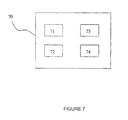
- Such a communication device 70 comprises means 71 for determining a temporal variation of an impulse response of a transmission channel established between a first entity and a second entity of a cell.
- the device 70 also comprises means 72 for determining a temporal variation of an impulse response of at least one global transmission channel established between the source entity and the destination entity and passing through at least one relay entity, to from the temporal variations of the impulse responses of said transmission channels;
- the device 70 further comprises means 73 for selecting a global transmission channel according to the temporal variations of the impulse responses of the global transmission channels, as well as the information means 74 of the relay entity M k by which transits the selected global channel to relay data exchanges between the source entity M i and the destination entity M j .
- the invention also relates to a computer program, in particular a computer program on or in an information or memory medium, adapted to implement the invention.
- This program can use any programming language, and be in the form of source code, object code, or intermediate code between source code and object code such as in a partially compiled form, or in any other form desirable to implement a method according to the invention.
- the information carrier may be any entity or device capable of storing the program.
- the medium may comprise storage means, such as a ROM, for example a CD ROM or a microelectronic circuit ROM, or a magnetic recording medium, for example a diskette (floppy disc) or a disk hard.
- the information medium can be a transmissible medium such as an electrical or optical signal, which can be routed via a cable electrical or optical, radio or other means.
- the program according to the invention can be downloaded in particular on an Internet type network.
Landscapes
- Engineering & Computer Science (AREA)
- Quality & Reliability (AREA)
- Computer Networks & Wireless Communication (AREA)
- Signal Processing (AREA)
- Mobile Radio Communication Systems (AREA)
Claims (8)
- Kommunikationsverfahren zwischen mindestens einer Quellentität und einer Zielentität in einem kooperativen Netz, das eine Vielzahl von Entitäten enthält, wobei das Verfahren einen Schritt der Bestimmung, für eine gegebene Entität des Netzes, einer zeitlichen Veränderung einer Impulsantwort eines Übertragungskanals aufweist, der zwischen der gegebenen Entität und einer anderen Entität aufgebaut ist,
dadurch gekennzeichnet, dass das Verfahren enthält:- einen Schritt der Bestimmung (201) einer zeitlichen Veränderung einer Impulsantwort mindestens eines globalen Übertragungskanals, der dazu bestimmt ist, zwischen der Quellentität und der Zielentität aufgebaut zu werden und über mindestens eine Relais-Entität geht, ausgehend von den zeitlichen Veränderungen der Impulsantworten der zwischen der Quellentität und der Relais-Entität bzw. der Relais-Entität und der Zielentität aufgebauten Übertragungskanäle, die den globalen Übertragungskanal bilden,- einen Schritt der Auswahl (202) eines globalen Übertragungskanals aus der Gruppe der globalen Übertragungskanäle, die durch Vergleich der zeitlichen Veränderung der Impulsantwort der globalen Übertragungskanäle mit einer zeitlichen Veränderung einer Impulsantwort eines Übertragungskanals bestimmt werden, der direkt zwischen der Quellentität und der Zielentität aufgebaut wird. - Kommunikationsverfahren nach Anspruch 1, dadurch gekennzeichnet, dass die zeitliche Veränderung einer Impulsantwort mindestens eines Übertragungskanals ausgehend von einem Mittelwert der Impulsantworten der Übertragungskanäle und von einer Verschiebungsgeschwindigkeit der gegebenen Entität bestimmt wird.
- Kommunikationsverfahren nach einem der vorhergehenden Ansprüche, dadurch gekennzeichnet, dass ein globaler Übertragungskanal ausgewählt wird, wenn die zeitliche Veränderung der Impulsantwort des globalen Übertragungskanals größer als eine vorbestimmte Schwelle ist, und wenn eine zeitliche Veränderung einer Impulsantwort eines direkt zwischen der Quellentität und der Relais-Entität aufgebauten Übertragungskanals geringer als die vorbestimmte Schwelle ist.
- Kommunikationsverfahren nach einem der Ansprüche 1 bis 3, dadurch gekennzeichnet, dass der Auswahlschritt mindestens ein zusätzliches Kriterium berücksichtigt, das zu der Gruppe gehört, die enthält:- eine Dämpfung eines Signals in dem Übertragungskanal;- eine Verschiebungsgeschwindigkeit der Relais-Entität;- eine Entfernung zwischen der Quellentität und der Relais-Entität;- eine Entfernung zwischen der Relais-Entität und der Zielentität;- eine verfügbare Bandbreite;- einen Betriebszustand der Relais-Entität;- Interferenzen (zwischen verschiedenen Strecken, zwischen Benutzern, zwischen Zellen).
- Kommunikationsverfahren nach einem der Ansprüche 1 bis 4, dadurch gekennzeichnet, dass es einen Schritt (203) der Benachrichtigung der Relais-Entität Mk aufweist, durch die der ausgewählte globale Kanal geht, um Datenaustauschvorgänge zwischen der Quellentität Mi und der Zielentität Mj weiterzuleiten.
- Vorrichtung (70) zur Verwaltung einer Kommunikation zwischen mindestens einer Quellentität und einer Zielentität in einem kooperativen Netz, das eine Vielzahl von Entitäten enthält, wobei die Vorrichtung Einrichtungen (71) zur Bestimmung, für eine gegebene Entität des Netzes, einer zeitlichen Veränderung einer Impulsantwort eines zwischen der gegebenen Entität und einer anderen Entität aufgebauten Übertragungskanals enthält,
dadurch gekennzeichnet, dass die Vorrichtung enthält:- Einrichtungen (72) zur Bestimmung einer zeitlichen Veränderung einer Impulsantwort mindestens eines globalen Übertragungskanals, der dazu bestimmt ist, zwischen der Quellentität und der Zielentität aufgebaut zu werden, und durch mindestens eine Relais-Entität geht, ausgehend von den zeitlichen Veränderungen der Impulsantworten der zwischen der Quellentität und der Relais-Entität bzw. der Relais-Entität und der Zielentität aufgebauten Übertragungskanäle, die den globalen Übertragungskanal bilden;- Einrichtungen (73) zur Auswahl eines globalen Übertragungskanals aus der Gruppe von globalen Übertragungskanälen, die durch Vergleich der zeitlichen Veränderung der Impulsantwort der globalen Übertragungskanäle mit einer zeitlichen Veränderung einer Impulsantwort eines direkt zwischen der Quellentität und der Zielentität aufgebauten Übertragungskanals bestimmt werden. - Vorrichtung zur Verwaltung einer Kommunikation nach Anspruch 6, dadurch gekennzeichnet, dass sie ebenfalls Einrichtungen (74) zur Benachrichtigung der Relais-Entität enthält, durch die der ausgewählte globale Kanal geht, um Datenaustauschvorgänge zwischen der Quellentität und der Zielentität weiterzuleiten.
- Computerprogrammprodukt, das von einem Kommunikationsnetz heruntergeladen werden kann und/oder auf einem computerlesbaren Träger gespeichert ist und/oder von einem Mikroprozessor ausgeführt werden kann, dadurch gekennzeichnet, dass es Programmcodeanweisungen für die Ausführung des Kommunikationsprogramms nach mindestens einem der Ansprüche 1 bis 5 enthält, wenn es auf einem Computer ausgeführt wird.
Applications Claiming Priority (2)
| Application Number | Priority Date | Filing Date | Title |
|---|---|---|---|
| FR0757614A FR2921222A1 (fr) | 2007-09-14 | 2007-09-14 | Procede de communication de donnees dans un reseau cellulaire cooperatif, dispositif, et produit programme d'ordinateur correspondants |
| PCT/FR2008/051629 WO2009047418A1 (fr) | 2007-09-14 | 2008-09-12 | Procede de communication de donnees dans un reseau cellulaire cooperatif, dispositif, et produit programme d'ordinateur correspondants |
Publications (2)
| Publication Number | Publication Date |
|---|---|
| EP2198661A1 EP2198661A1 (de) | 2010-06-23 |
| EP2198661B1 true EP2198661B1 (de) | 2014-07-02 |
Family
ID=39273262
Family Applications (1)
| Application Number | Title | Priority Date | Filing Date |
|---|---|---|---|
| EP08837230.5A Active EP2198661B1 (de) | 2007-09-14 | 2008-09-12 | Verfahren zur datenkommunikation in einem kooperativen zellnetzwerk sowie entsprechendes gerät und computerprogramm dafür |
Country Status (5)
| Country | Link |
|---|---|
| US (1) | US8489016B2 (de) |
| EP (1) | EP2198661B1 (de) |
| CN (1) | CN101861756B (de) |
| FR (1) | FR2921222A1 (de) |
| WO (1) | WO2009047418A1 (de) |
Families Citing this family (1)
| Publication number | Priority date | Publication date | Assignee | Title |
|---|---|---|---|---|
| US20090186645A1 (en) * | 2008-01-17 | 2009-07-23 | Sangiamwong Jaturong | Multicarrier radio communication system, base station, radio relay station, mobile station, and multicarrier radio communication method |
Family Cites Families (3)
| Publication number | Priority date | Publication date | Assignee | Title |
|---|---|---|---|---|
| WO1999044384A1 (de) * | 1998-02-27 | 1999-09-02 | Siemens Aktiengesellschaft | Weiterreichen in einem auf code- und zeitmultiplex basierenden telekommunikationssystem |
| US20070189260A1 (en) * | 2006-02-14 | 2007-08-16 | Mediatek Inc. | Method and apparatus for detecting channel types and method of employing same |
| JP2010525765A (ja) * | 2007-04-25 | 2010-07-22 | ネクスティヴィティー インコーポレイテッド | マルチホップブースタ |
-
2007
- 2007-09-14 FR FR0757614A patent/FR2921222A1/fr not_active Withdrawn
-
2008
- 2008-09-12 CN CN200880116062.1A patent/CN101861756B/zh active Active
- 2008-09-12 WO PCT/FR2008/051629 patent/WO2009047418A1/fr not_active Ceased
- 2008-09-12 EP EP08837230.5A patent/EP2198661B1/de active Active
- 2008-09-12 US US12/677,992 patent/US8489016B2/en active Active
Also Published As
| Publication number | Publication date |
|---|---|
| US8489016B2 (en) | 2013-07-16 |
| WO2009047418A1 (fr) | 2009-04-16 |
| US20100216393A1 (en) | 2010-08-26 |
| CN101861756B (zh) | 2013-08-14 |
| FR2921222A1 (fr) | 2009-03-20 |
| EP2198661A1 (de) | 2010-06-23 |
| CN101861756A (zh) | 2010-10-13 |
Similar Documents
| Publication | Publication Date | Title |
|---|---|---|
| EP2454917B1 (de) | Auswahl von dynamischen relais für kooperative kommunikaiton in einem drahtlosen netzwerk | |
| EP0775394B1 (de) | Verfahren zur luftschnittstellenanpassung in einer mobilen funkkommunikationsanordnung | |
| EP1860902A1 (de) | Verfahren zur Optimierung der Kapazität eines Mobiltelefonnetzes zur Erzeugung von Diensten, deren Fluss hauptsächlich abwärts gerichtet ist | |
| FR2929063A1 (fr) | Procede et dispositif d'allocation de chemins de transmission de donnees dans un reseau de communication synchrone, produit programme d'ordinateur et moyen de stockage correspondants | |
| WO2019162592A1 (fr) | Procédé et système omamrc de transmission avec adaptation lente de lien sous contrainte d'un bler | |
| EP2832169B1 (de) | Datenrouting in einem sensorarray | |
| EP2198661B1 (de) | Verfahren zur datenkommunikation in einem kooperativen zellnetzwerk sowie entsprechendes gerät und computerprogramm dafür | |
| WO2022200746A1 (fr) | Procede de controle d'une transmission multi-sauts dans un reseau de communication sans fil, procede de traitement d'une transmission multi-sauts, dispositifs, systeme et programmes d'ordinateur correspondants | |
| EP2294875B1 (de) | Technik zum ausstrahlen über einen kommunikationsnetzknoten | |
| EP4079033A1 (de) | Verfahren zum verwalten der kommunikation zwischen endgeräten in einem telekommunikationssystem und vorrichtungen zum implementieren des verfahrens | |
| EP3977785B1 (de) | Verfahren zur auswahl einer vielzahl von möglichen übertragungsleistungswerten, die für den unkoordinierten zugriff auf ein kommunikationsmedium bestimmt sind, und zugehörige vorrichtungen | |
| EP2039208B1 (de) | Koordination von endgeräten zur datensendung an ein endgerät auf einem hsdpa-kanal über mehrere basisstationen | |
| WO2022200745A1 (fr) | Procede de controle d'une transmission multi-sauts dans un reseau de communication sans fil, procede de traitement d'une transmission multi-sauts, dispositifs, equipement relais, equipement de communication, equipement source, systeme et programmes d'ordinateur correspondants | |
| FR3134671A1 (fr) | Procédé et dispositif de communication de messages de contrôle de topologie dans un réseau mobile ad-hoc | |
| WO2021260308A1 (fr) | Procédé et système omamrc avec transmission fdm | |
| WO2018220301A1 (fr) | Procede de communication directe entre terminaux | |
| WO2014013187A1 (fr) | Procédé de communication aérien - terrestre, programme, terminaux, installation | |
| EP3651370B1 (de) | Kontrollverfahren der funktionsweise eines kommunikationsnetzes, und entsprechende vorrichtungen | |
| FR3141028A1 (fr) | Procédé de retransmission coopérative dans un système OMAMRC avec allocation de ressources et sélections des sources à aider conjointes | |
| FR3124912A1 (fr) | Procédé de retransmission coopérative dans un système OMAMRC | |
| FR3144462A1 (fr) | Procédé de communication et système OMAMRC avec une sélection lors de retransmissions tenant compte d’un unique échange conditionnel de CSI | |
| FR3137234A1 (fr) | Procédé de retransmission coopérative dans un système OMAMRC | |
| WO2012001265A1 (fr) | Procede d'allocation de ressources a des terminaux mobiles | |
| FR3095097A1 (fr) | Procédé et dispositif de contrôle d’un mode de transmission de données utilisé par un véhicule pour communiquer | |
| FR3095096A1 (fr) | Procédé et dispositif de contrôle d’un mode de transmission de données utilisé par un véhicule pour communiquer |
Legal Events
| Date | Code | Title | Description |
|---|---|---|---|
| PUAI | Public reference made under article 153(3) epc to a published international application that has entered the european phase |
Free format text: ORIGINAL CODE: 0009012 |
|
| 17P | Request for examination filed |
Effective date: 20100317 |
|
| AK | Designated contracting states |
Kind code of ref document: A1 Designated state(s): AT BE BG CH CY CZ DE DK EE ES FI FR GB GR HR HU IE IS IT LI LT LU LV MC MT NL NO PL PT RO SE SI SK TR |
|
| AX | Request for extension of the european patent |
Extension state: AL BA MK RS |
|
| DAX | Request for extension of the european patent (deleted) | ||
| RAP1 | Party data changed (applicant data changed or rights of an application transferred) |
Owner name: ORANGE |
|
| GRAP | Despatch of communication of intention to grant a patent |
Free format text: ORIGINAL CODE: EPIDOSNIGR1 |
|
| INTG | Intention to grant announced |
Effective date: 20140207 |
|
| GRAS | Grant fee paid |
Free format text: ORIGINAL CODE: EPIDOSNIGR3 |
|
| GRAA | (expected) grant |
Free format text: ORIGINAL CODE: 0009210 |
|
| AK | Designated contracting states |
Kind code of ref document: B1 Designated state(s): AT BE BG CH CY CZ DE DK EE ES FI FR GB GR HR HU IE IS IT LI LT LU LV MC MT NL NO PL PT RO SE SI SK TR |
|
| REG | Reference to a national code |
Ref country code: GB Ref legal event code: FG4D Free format text: NOT ENGLISH |
|
| REG | Reference to a national code |
Ref country code: CH Ref legal event code: EP |
|
| REG | Reference to a national code |
Ref country code: IE Ref legal event code: FG4D Free format text: LANGUAGE OF EP DOCUMENT: FRENCH |
|
| REG | Reference to a national code |
Ref country code: DE Ref legal event code: R096 Ref document number: 602008033133 Country of ref document: DE Effective date: 20140821 |
|
| REG | Reference to a national code |
Ref country code: NL Ref legal event code: VDEP Effective date: 20140702 |
|
| REG | Reference to a national code |
Ref country code: AT Ref legal event code: REF Ref document number: 700151 Country of ref document: AT Kind code of ref document: T Effective date: 20141215 |
|
| REG | Reference to a national code |
Ref country code: LT Ref legal event code: MG4D |
|
| PG25 | Lapsed in a contracting state [announced via postgrant information from national office to epo] |
Ref country code: GR Free format text: LAPSE BECAUSE OF FAILURE TO SUBMIT A TRANSLATION OF THE DESCRIPTION OR TO PAY THE FEE WITHIN THE PRESCRIBED TIME-LIMIT Effective date: 20141003 Ref country code: NO Free format text: LAPSE BECAUSE OF FAILURE TO SUBMIT A TRANSLATION OF THE DESCRIPTION OR TO PAY THE FEE WITHIN THE PRESCRIBED TIME-LIMIT Effective date: 20141002 Ref country code: ES Free format text: LAPSE BECAUSE OF FAILURE TO SUBMIT A TRANSLATION OF THE DESCRIPTION OR TO PAY THE FEE WITHIN THE PRESCRIBED TIME-LIMIT Effective date: 20140702 Ref country code: LT Free format text: LAPSE BECAUSE OF FAILURE TO SUBMIT A TRANSLATION OF THE DESCRIPTION OR TO PAY THE FEE WITHIN THE PRESCRIBED TIME-LIMIT Effective date: 20140702 Ref country code: PT Free format text: LAPSE BECAUSE OF FAILURE TO SUBMIT A TRANSLATION OF THE DESCRIPTION OR TO PAY THE FEE WITHIN THE PRESCRIBED TIME-LIMIT Effective date: 20141103 Ref country code: FI Free format text: LAPSE BECAUSE OF FAILURE TO SUBMIT A TRANSLATION OF THE DESCRIPTION OR TO PAY THE FEE WITHIN THE PRESCRIBED TIME-LIMIT Effective date: 20140702 Ref country code: CZ Free format text: LAPSE BECAUSE OF FAILURE TO SUBMIT A TRANSLATION OF THE DESCRIPTION OR TO PAY THE FEE WITHIN THE PRESCRIBED TIME-LIMIT Effective date: 20140702 Ref country code: BG Free format text: LAPSE BECAUSE OF FAILURE TO SUBMIT A TRANSLATION OF THE DESCRIPTION OR TO PAY THE FEE WITHIN THE PRESCRIBED TIME-LIMIT Effective date: 20141002 Ref country code: SE Free format text: LAPSE BECAUSE OF FAILURE TO SUBMIT A TRANSLATION OF THE DESCRIPTION OR TO PAY THE FEE WITHIN THE PRESCRIBED TIME-LIMIT Effective date: 20140702 |
|
| PG25 | Lapsed in a contracting state [announced via postgrant information from national office to epo] |
Ref country code: LV Free format text: LAPSE BECAUSE OF FAILURE TO SUBMIT A TRANSLATION OF THE DESCRIPTION OR TO PAY THE FEE WITHIN THE PRESCRIBED TIME-LIMIT Effective date: 20140702 Ref country code: PL Free format text: LAPSE BECAUSE OF FAILURE TO SUBMIT A TRANSLATION OF THE DESCRIPTION OR TO PAY THE FEE WITHIN THE PRESCRIBED TIME-LIMIT Effective date: 20140702 Ref country code: HR Free format text: LAPSE BECAUSE OF FAILURE TO SUBMIT A TRANSLATION OF THE DESCRIPTION OR TO PAY THE FEE WITHIN THE PRESCRIBED TIME-LIMIT Effective date: 20140702 Ref country code: IS Free format text: LAPSE BECAUSE OF FAILURE TO SUBMIT A TRANSLATION OF THE DESCRIPTION OR TO PAY THE FEE WITHIN THE PRESCRIBED TIME-LIMIT Effective date: 20141102 Ref country code: CY Free format text: LAPSE BECAUSE OF FAILURE TO SUBMIT A TRANSLATION OF THE DESCRIPTION OR TO PAY THE FEE WITHIN THE PRESCRIBED TIME-LIMIT Effective date: 20140702 Ref country code: NL Free format text: LAPSE BECAUSE OF FAILURE TO SUBMIT A TRANSLATION OF THE DESCRIPTION OR TO PAY THE FEE WITHIN THE PRESCRIBED TIME-LIMIT Effective date: 20140702 |
|
| REG | Reference to a national code |
Ref country code: AT Ref legal event code: MK05 Ref document number: 700151 Country of ref document: AT Kind code of ref document: T Effective date: 20140702 |
|
| REG | Reference to a national code |
Ref country code: DE Ref legal event code: R097 Ref document number: 602008033133 Country of ref document: DE |
|
| PG25 | Lapsed in a contracting state [announced via postgrant information from national office to epo] |
Ref country code: MC Free format text: LAPSE BECAUSE OF FAILURE TO SUBMIT A TRANSLATION OF THE DESCRIPTION OR TO PAY THE FEE WITHIN THE PRESCRIBED TIME-LIMIT Effective date: 20140702 Ref country code: DK Free format text: LAPSE BECAUSE OF FAILURE TO SUBMIT A TRANSLATION OF THE DESCRIPTION OR TO PAY THE FEE WITHIN THE PRESCRIBED TIME-LIMIT Effective date: 20140702 Ref country code: LU Free format text: LAPSE BECAUSE OF FAILURE TO SUBMIT A TRANSLATION OF THE DESCRIPTION OR TO PAY THE FEE WITHIN THE PRESCRIBED TIME-LIMIT Effective date: 20140912 Ref country code: RO Free format text: LAPSE BECAUSE OF FAILURE TO SUBMIT A TRANSLATION OF THE DESCRIPTION OR TO PAY THE FEE WITHIN THE PRESCRIBED TIME-LIMIT Effective date: 20140702 Ref country code: EE Free format text: LAPSE BECAUSE OF FAILURE TO SUBMIT A TRANSLATION OF THE DESCRIPTION OR TO PAY THE FEE WITHIN THE PRESCRIBED TIME-LIMIT Effective date: 20140702 Ref country code: IT Free format text: LAPSE BECAUSE OF FAILURE TO SUBMIT A TRANSLATION OF THE DESCRIPTION OR TO PAY THE FEE WITHIN THE PRESCRIBED TIME-LIMIT Effective date: 20140702 Ref country code: SK Free format text: LAPSE BECAUSE OF FAILURE TO SUBMIT A TRANSLATION OF THE DESCRIPTION OR TO PAY THE FEE WITHIN THE PRESCRIBED TIME-LIMIT Effective date: 20140702 |
|
| REG | Reference to a national code |
Ref country code: CH Ref legal event code: PL |
|
| PLBE | No opposition filed within time limit |
Free format text: ORIGINAL CODE: 0009261 |
|
| STAA | Information on the status of an ep patent application or granted ep patent |
Free format text: STATUS: NO OPPOSITION FILED WITHIN TIME LIMIT |
|
| PG25 | Lapsed in a contracting state [announced via postgrant information from national office to epo] |
Ref country code: AT Free format text: LAPSE BECAUSE OF FAILURE TO SUBMIT A TRANSLATION OF THE DESCRIPTION OR TO PAY THE FEE WITHIN THE PRESCRIBED TIME-LIMIT Effective date: 20140702 |
|
| 26N | No opposition filed |
Effective date: 20150407 |
|
| REG | Reference to a national code |
Ref country code: IE Ref legal event code: MM4A |
|
| PG25 | Lapsed in a contracting state [announced via postgrant information from national office to epo] |
Ref country code: BE Free format text: LAPSE BECAUSE OF NON-PAYMENT OF DUE FEES Effective date: 20140930 |
|
| PG25 | Lapsed in a contracting state [announced via postgrant information from national office to epo] |
Ref country code: LI Free format text: LAPSE BECAUSE OF NON-PAYMENT OF DUE FEES Effective date: 20140930 Ref country code: CH Free format text: LAPSE BECAUSE OF NON-PAYMENT OF DUE FEES Effective date: 20140930 |
|
| PG25 | Lapsed in a contracting state [announced via postgrant information from national office to epo] |
Ref country code: IE Free format text: LAPSE BECAUSE OF NON-PAYMENT OF DUE FEES Effective date: 20140912 |
|
| PG25 | Lapsed in a contracting state [announced via postgrant information from national office to epo] |
Ref country code: SI Free format text: LAPSE BECAUSE OF FAILURE TO SUBMIT A TRANSLATION OF THE DESCRIPTION OR TO PAY THE FEE WITHIN THE PRESCRIBED TIME-LIMIT Effective date: 20140702 |
|
| PG25 | Lapsed in a contracting state [announced via postgrant information from national office to epo] |
Ref country code: MT Free format text: LAPSE BECAUSE OF FAILURE TO SUBMIT A TRANSLATION OF THE DESCRIPTION OR TO PAY THE FEE WITHIN THE PRESCRIBED TIME-LIMIT Effective date: 20140702 |
|
| PG25 | Lapsed in a contracting state [announced via postgrant information from national office to epo] |
Ref country code: HU Free format text: LAPSE BECAUSE OF FAILURE TO SUBMIT A TRANSLATION OF THE DESCRIPTION OR TO PAY THE FEE WITHIN THE PRESCRIBED TIME-LIMIT; INVALID AB INITIO Effective date: 20080912 Ref country code: TR Free format text: LAPSE BECAUSE OF FAILURE TO SUBMIT A TRANSLATION OF THE DESCRIPTION OR TO PAY THE FEE WITHIN THE PRESCRIBED TIME-LIMIT Effective date: 20140702 |
|
| REG | Reference to a national code |
Ref country code: FR Ref legal event code: PLFP Year of fee payment: 9 |
|
| REG | Reference to a national code |
Ref country code: FR Ref legal event code: PLFP Year of fee payment: 10 |
|
| REG | Reference to a national code |
Ref country code: FR Ref legal event code: PLFP Year of fee payment: 11 |
|
| REG | Reference to a national code |
Ref country code: DE Ref legal event code: R079 Ref document number: 602008033133 Country of ref document: DE Free format text: PREVIOUS MAIN CLASS: H04W0072080000 Ipc: H04W0072540000 |
|
| PGFP | Annual fee paid to national office [announced via postgrant information from national office to epo] |
Ref country code: DE Payment date: 20250820 Year of fee payment: 18 |
|
| PGFP | Annual fee paid to national office [announced via postgrant information from national office to epo] |
Ref country code: GB Payment date: 20250820 Year of fee payment: 18 |
|
| PGFP | Annual fee paid to national office [announced via postgrant information from national office to epo] |
Ref country code: FR Payment date: 20250821 Year of fee payment: 18 |