EP2198788A2 - Dispositif d'excision ajustable pour os - Google Patents
Dispositif d'excision ajustable pour os Download PDFInfo
- Publication number
- EP2198788A2 EP2198788A2 EP09014726A EP09014726A EP2198788A2 EP 2198788 A2 EP2198788 A2 EP 2198788A2 EP 09014726 A EP09014726 A EP 09014726A EP 09014726 A EP09014726 A EP 09014726A EP 2198788 A2 EP2198788 A2 EP 2198788A2
- Authority
- EP
- European Patent Office
- Prior art keywords
- guide block
- support block
- block
- recited
- holes
- Prior art date
- Legal status (The legal status is an assumption and is not a legal conclusion. Google has not performed a legal analysis and makes no representation as to the accuracy of the status listed.)
- Withdrawn
Links
- 210000000988 bone and bone Anatomy 0.000 title claims abstract description 62
- 229910001369 Brass Inorganic materials 0.000 claims description 2
- 229910000883 Ti6Al4V Inorganic materials 0.000 claims description 2
- 239000010951 brass Substances 0.000 claims description 2
- 239000002184 metal Substances 0.000 claims description 2
- 229910052751 metal Inorganic materials 0.000 claims description 2
- 229910000831 Steel Inorganic materials 0.000 claims 1
- RTAQQCXQSZGOHL-UHFFFAOYSA-N Titanium Chemical compound [Ti] RTAQQCXQSZGOHL-UHFFFAOYSA-N 0.000 claims 1
- 239000004411 aluminium Substances 0.000 claims 1
- 229910052782 aluminium Inorganic materials 0.000 claims 1
- XAGFODPZIPBFFR-UHFFFAOYSA-N aluminium Chemical compound [Al] XAGFODPZIPBFFR-UHFFFAOYSA-N 0.000 claims 1
- 229910001220 stainless steel Inorganic materials 0.000 claims 1
- 239000010935 stainless steel Substances 0.000 claims 1
- 239000010959 steel Substances 0.000 claims 1
- 239000010936 titanium Substances 0.000 claims 1
- 229910052719 titanium Inorganic materials 0.000 claims 1
- 238000003780 insertion Methods 0.000 description 3
- 230000037431 insertion Effects 0.000 description 3
- 238000000034 method Methods 0.000 description 3
- 238000001356 surgical procedure Methods 0.000 description 3
- 206010003246 arthritis Diseases 0.000 description 1
- 238000013461 design Methods 0.000 description 1
- 238000011161 development Methods 0.000 description 1
- 230000018109 developmental process Effects 0.000 description 1
- 239000007943 implant Substances 0.000 description 1
- 238000011065 in-situ storage Methods 0.000 description 1
- 208000014674 injury Diseases 0.000 description 1
- 150000002739 metals Chemical class 0.000 description 1
- 238000012986 modification Methods 0.000 description 1
- 230000004048 modification Effects 0.000 description 1
- 238000011084 recovery Methods 0.000 description 1
- 238000012502 risk assessment Methods 0.000 description 1
- 230000011218 segmentation Effects 0.000 description 1
- 208000037974 severe injury Diseases 0.000 description 1
- 230000009528 severe injury Effects 0.000 description 1
- 238000004904 shortening Methods 0.000 description 1
- 238000006467 substitution reaction Methods 0.000 description 1
- 210000001519 tissue Anatomy 0.000 description 1
- 230000008733 trauma Effects 0.000 description 1
Images


Classifications
-
- A—HUMAN NECESSITIES
- A61—MEDICAL OR VETERINARY SCIENCE; HYGIENE
- A61B—DIAGNOSIS; SURGERY; IDENTIFICATION
- A61B17/00—Surgical instruments, devices or methods
- A61B17/14—Surgical saws
- A61B17/15—Guides therefor
-
- A—HUMAN NECESSITIES
- A61—MEDICAL OR VETERINARY SCIENCE; HYGIENE
- A61B—DIAGNOSIS; SURGERY; IDENTIFICATION
- A61B17/00—Surgical instruments, devices or methods
- A61B17/14—Surgical saws
- A61B17/15—Guides therefor
- A61B17/151—Guides therefor for corrective osteotomy
Definitions
- the present invention relates to an adjustable excision device for bones.
- Osteotomy is a surgical procedure generally used for relieving pain in arthritis, to align a bone which bulges abnormally following a fracture or to shorten or lengthen the bone. Osteotomy involves making singular or multiple cuts into the bone followed by removal of a piece of bone present near a damaged joint.
- the piece of bone is typically removed by segmenting the bone with the use of a cutter.
- a variety of surgical techniques are required for segmenting a piece of bone.
- the success of the variety of surgical techniques relies on the preciseness with which a cut is made. An imprecise cut can often lead to severe injuries to patients. Even, unnecessary trauma can be caused to tissues surrounding the piece of bone leading to an increased recovery period.
- cutting guides are employed for straight accurate cuts while performing osteotomy.
- the cutting guides are fixed on bones/plates with the help of connecting means and have an opening for incorporating a cutter e.g. a saw.
- the cutter is guided along the opening and a cut is made on one side of a bone for segmenting the bone.
- the guide can be removed and then re-fixed in order to make a second cut alternatively guides have two or more slits for cuts.
- accurate parallelism between cuts is difficult to maintain.
- variable lengths of cut are predetermined and little flexibility is provided as to where these may be formed because of the fixed alignment of holes.
- One object of the present invention is to provide a device for precise segmenting of a bone.
- Another object of the present invention is to provide a device for maintaining parallelism while segmenting a bone.
- Yet another object of the present invention is to provide a device for enabling variable length of cuts on a bone.
- a device for segmenting a bone comprising:
- apertures or holes can be offset, only corresponding apertures or holes, on an opposite side can be used as they are in register one with another.
- pairs of holes or apertures are formed, in a bespoke manner, so as to be in register one with another.
- An advantage with this is that for example, when performing a risk assessment, there is less chance that an erroneous shortening of a bone will occur.
- holes may be indicated by an oval, angled slot or other shape of aperture.
- these may be stepped or offset one from another in order to unambiguously distinguish two apertures in register one with another.
- variable lengths of cut are predetermined and are formed in this manner because of the alignment of the holes.
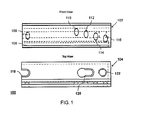
- Figure 1 is an orthographic projection of a support block 100 viewed from front and top in accordance with an embodiment of the present invention.
- the support block 100 is generally a block having at least a front surface 102 and a top surface 104.
- the front surface 102 of the support block 100 includes a dovetail joint 106.
- the dovetail joint 106 is integrally formed on the front surface 102 of the support block 100.
- the dovetail joint 106 may also be formed as a separate unit and is adapted to be connected to front surface 102. Further, the dovetail joint 106 includes at least one recess 108. Further recesses are shown as 110, 112, 114 and 116. Said recesses 108, 110, 112, 114 and 116 generally have a circular shape. However, the shape of the one or more recesses 108, 110, 112, 114 and 116 can also be square, rectangular, slot or oval or any other suitable shape.
- the one or more recesses 108, 110, 112, 114 and 116 include a first recess 108.
- the first recess 108 acts as a reference for locating the distance of the remaining recesses 110, 112, 114 and 116.
- the remaining recesses 110, 112, 114 and 116 are spaced at predetermined distances from the first recess 108.
- the recess 110 is at a horizontal distance of 35.10mm from the first recess 108.
- the remaining of the one or more recesses 110, 112, 114 and 116 are spaced apart from one another, typically between 5 and 10 mm and ideally 7mm horizontally.
- the predetermined distances are determined based on the length of cut on a bone being segmented.
- a line containing centre points of the remaining of the one or more recesses 110, 112, 114 and 116 establishes an angular relationship with a horizontal plane of the front surface 102 of the support block 100.
- Points may all be defined in the same plane, with shapes oriented on a different axis, e.g. a triangle could be rotated, for example through 180°, to prevent misalignment with the original form.
- points could all be located in the same plane, but oriented on a different axis, e.g. a triangle could be rotated through 180° to prevent misalignment with the original form,
- top surface 104 of the support block 100 Adjacent to front surface 102, is top surface 104 of the support block 100.
- the top surface 104 includes a plurality of grooves 118, 120 and 122. Grooves may be provided so as to improve purchase. Alternatively holes or recesses may be countersunk in order to provide some sort of improved purchase.
- the plurality of grooves 118, 120 and 122 are present on the top surface 104 for enabling the clamping of the support block 100 to the bone or bone plate. Spacing between the plurality of grooves 118, 120 and 122 is based on the desired rigidness of the clamping and the geometry of the bone plate and screws.
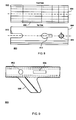
- Figure 2 is an orthographic projection of a guide block 200 as viewed from a front perspective. Similar to the support block 100, the guide block 200 is a block having at least a front surface 202.
- the front surface 202 includes one or more holes 204, 206, 208, 210 and 212. It is understood that the or hole or aperture 204, 206, 208, 210 and 212 may be threaded.
- a first hole 204 acts as a reference for locating the distance of the remaining one or more holes 206, 208, 210 and 212.
- the remaining holes 206, 208, 210 and 212 are located at predetermined distances from the first hole 204.
- the predetermined distances are determined based on the length of cut of the bone being segmented. Further, the predetermined distances between a first hole 204 and the remaining holes 206, 208, 210 and 212 are different than the predetermined distances between the first recess 108 and the remaining of the one or more recesses 110, 112, 114 and 116.
- the predetermined distances between the first hole 204 and the remaining holes 206, 208, 210 and 212 are smaller than the predetermined distances between the first recess 108 and the remaining recesses 110, 112, 114 and 116.
- hole or aperture 206 is at a horizontal distance of 33.10 mm from the first hole or aperture 204.
- the remaining of the one or more holes 206, 208, 210 and 212 are spaced apart 6 mm horizontally.
- a line containing the centre points of the remaining holes 206, 208, 210 and 212 establishes an angular relationship with a horizontal plane of the front surface 202 of the guide block 200.
- the angular relationship established between the remaining of the one or more holes 206, 208, 210 and 212 and the horizontal plane of the front surface 202 corresponds to the angular relationship established between the remaining of the one or more recesses 110, 112, 114 and 116 and horizontal plane of the front surface 102.
- the recesses are of a different shape, they can all be kept on the same plane and the recess rotated around a point.
- the angular relationship is established with a view to enable alignment of the one or more holes 204, 206, 208, 210 and 212 only with its corresponding one or more recesses 108, 110, 112, 114 and 116.
- the hole 206 can be only aligned with its corresponding recess 110. This enables precise alignment by avoiding any erroneous alignment of recesses 110, 112, 114 and 116 and the apertures or holes 206, 208, 210 and 212.
- the remaining holes 206, 208, 210 and 212 are dimensioned based on the first hole 204.
- the dimensioning enables a user to select a hole from the group of holes 206, 208, 210 and 212 based on the length of cut on the bone being segmented.
- Guide block 200 further includes a wedge 214.
- the wedge 214 is integrally formed with the guide block 200.
- the wedge 214 is formed in the guide block 200 for incorporating cutter 216.
- the cutter is incorporated in an opening 216 present in the wedge 214.
- An example of the cutter is a saw.
- a dovetail joint could be used so that the wedge may slide down and be located closer to the bone.
- the wedge 214 can be a separate unit.
- the separate unit can then be connected to the guide block 200. Examples of the connection of the separate unit and the guide block 200 include, but are not limited to, a riveted joint, a screwed joint, a welded joint, a glued joint, a brazed joint, a soldered joint, and a magnetic joint.
- the guide block 200 also includes a slot for incorporating the dovetail joint 106.
- the slot is present on a back surface of the guide block 200.
- Figure 3 is an orthographic projection of an assembly 300 of a support block 100 and a guide block 200 as viewed from front, top and side in accordance with an embodiment of the present invention.
- the assembly 300 of the support block 100 and the guide block 200 is performed by displacing the guide block 200, with respect to the support block 100 in a slideable manner.
- the slot present on the back surface of the guide block 200 is slid through the dovetail joint 106 present on the front surface 102 of the support block 100.
- the dovetail joint 106 permits only a lateral movement of the guide block 200 with respect to the support block 100.
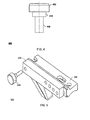
- FIG 4 is an orthographic projection of a stopper 400 as viewed from front in accordance with an embodiment of the present invention.
- the stopper 400 includes a top surface 402, an intermediate surface 404 and a bottom surface 406.
- the top surface 402 of the stopper 400 is ergonomically designed for the comfort of a user.
- the ergonomic design of the top surface 402 facilitates easy handling of the stopper 400 by the user.
- the intermediate surface 404 is located below the top surface 402.
- the intermediate surface 404 may be threaded for retaining the stopper 400 in a fixed position.
- the bottom surface 406 can also be used for retaining the stopper 400 in a fixed position and it is understood that the entire length may be threaded.
- Figure 5 is an isometric view of an assembly 500 of a guide block 200 and a support block 100 in an embodiment of the present invention.
- the isometric view is shown for better understanding of the assembly of the guide block 200 and the support block 100 as shown in Figure 3 . Further, the isometric view of the stopper 400 is also shown.
- Figure 6 shows an assembly 600 depicting the position of a guide block 200 during a first operation with an embodiment of the present invention.
- the first operation is performed for providing a first cut on a bone 602 to be segmented.
- a portion of the bone 602 is covered with a plate 604.
- the plate 604 is provided for retaining the clamping of the support block. It secures the bone; and is remains in situ after the procedure as an implant.
- the support block 100 is clamped on the plate 604 with the help of the plurality of grooves 118, 120 and 122 present on the support block 100.
- the support block 100 can be directly clamped on the bone 602.
- the guide block 200 is slid through the dovetail joint 106 present on the support block 100.
- the guide block 200 is slid for aligning the first hole 204 with the first recess 108.
- the remaining of the one or more holes 206, 208, 210 and 212 are offset to the remaining of the one or more recesses 110, 112, 114 and 116.
- the stopper 400 is inserted through the first hole 204 and the first recess 108. Threads present on the intermediate surface 404 are mated with the threads present in the first hole 204. The bottom surface 406 of the stopper 400 is mated in the first recess 108. Insertion of the stopper 400 enables restriction of movement of the guide block 200 with respect to the support block 100. The movement of the guide block 200 is restricted so as to permit the first operation to be performed.
- the first operation is performed by taking a first cut on the bone 602 with the help of the cutter.
- the cutter is inserted in the opening 216 of the wedge 214 for taking the first cut on the bone 602.
- Figure 7 is an orthographic projection of an assembly 700 depicting the position of a guide block 200 during a second operation of the present invention.
- the second operation is performed for providing a second cut on the bone 602.
- the second cut on the bone 602 is made after determining the length of cut on the bone 602 being segmented.
- a second hole for example, aperture or hole 208 is selected.
- Different holes can be selected from one or more holes 206, 208, 210 and 212 based on the requisite length of the cut on the bone 602.
- the stopper 400 is removed from the first recess 108 and the first hole 204.
- the removal of the stopper 400 thus enables the movement of the guide block 200 with respect to the support block 100 for aligning the second hole 208 with a second recess 112.
- the alignment of the second hole or aperture 208 and the second recess 112 is achieved by moving the guide block 200. Similar to the first operation, when the second hole 208 is aligned with the second recess 112 the remaining holes 204, 206, 210 and 212 are offset with respect to the one or more recesses 108, 110, 114 and 116. The offset thus permits a user to insert the stopper 400 only in the second hole 208 and the second recess 112.
- the stopper 400 is inserted through the second hole 208 and the second recess 112.
- the insertion of the stopper 400 is similar to the insertion done in the first operation.
- the second cut is made in the bone 602.
- the second cut is made on the bone 602 by the cutter.
- a segmented piece of bone 702 is then removed for performing further observations/procedures.
- This alignment procedure may be similar for aligning for example recess 110 with hole 206; or recess 114 with hole 210; or recess 116 with hole 212.
- Figure 8 is an orthographic projection of a support block 800 viewed from front and top in an alternate embodiment of the present invention.
- the alternate embodiment obviates the need of the one or more recesses on the support block 800.
- the support block 800 includes a front surface 802, and a top surface 804.
- the front surface 802 further includes a dovetail joint 806.
- the dovetail joint 806 is integrally formed in the front surface 802 of the support block 800.
- the dovetail joint 806 can also be a separate unit and can be connected to the front surface 102.
- the dovetail 806 includes a recess 808.
- the recess 808 is extended over an entire length of the support block 800.
- the top surface 804 on the support block 800 includes a plurality of grooves 810, 812 and 814.
- the plurality of grooves 810, 812 and 814 on the support block 800 serve similar function as that performed by the plurality of grooves 118, 120 and 122 on the support block 100.
- the plurality of grooves 810, 812 and 814 are used for securing the support block 800 on the bone 602.
- the plurality of grooves 810, 812 and 814 can be used to secure the support block 800 directly to the bone 602 or via a bone plate 604. In one embodiment, the plurality of grooves 810, 812 and 814 can be used to secure the support block 800 to the block 604 placed on the bone 602.
- Figure 9 is an orthographic projection of a guide block 900 viewed from front in accordance with an alternative embodiment of the present invention.
- the alternative embodiment obviates the need of the one or more holes on the guide block 900.
- the guide block 900 is in slideable connection with the support block 800.
- the guide block 900 includes a first hole 902, a scale 904 and a wedge 906.
- the first hole 902 may be threaded internally for incorporating the intermediate surface 404 of the stopper 400.
- the stopper 400 restricts the movement of the guide block 900 by passing through the hole 902 and then through the recess 808 present on the support block 800.
- the movement of the guide block 900 is restricted, based on the distance measured by the scale 904.
- the scale 904 is used for measuring the distance travelled by the guide block 900 during the first operation and the second operation.
- the first operation and the second operation are performed by cutting the bone 602 with the cutter.
- the cutter is incorporated in an opening present in the wedge 906.
- the support block 800 is clamped to the bone 602 or on the block 604 provided on the bone 602.
- the clamping is performed with the use of fasteners.
- a slot or groove present on a back surface of the guide block 900 slidably receives dovetail joint 806 present on the support block 800.
- the dovetail joint 806 enables a lateral movement of the guide block 900 with respect to the support block 800.
- the lateral movement of the guide block 900 can be measured with the help of the scale 904.
- the scale 904 is used to locate the guide block 900 for a first cut.
- the stopper 400 is inserted through the aperture or hole 902 and the recess 808, thus restricting the movement of the guide block 900.
- the first cut is then made by inserting the cutter through the opening present in the wedge 906.
- the stopper 400 is removed from the recess 808 and the hole 902 for enabling the movement of the guide block 900.
- the guide block 900 is then moved through a predetermined length for the second operation.
- the predetermined length is measured by the scale 904.
- the predetermined length corresponds to the length of cut of the bone 602 being segmented.
- the stopper 400 is again inserted through the hole 902 and the recess 808 for performing the second operation.
- the cutter is inserted through the opening present in the wedge 906 and the second cut is taken.
- the second cut results in the segmentation of the bone 602 and a piece of bone is removed thereof.
- a dovetail joint for sliding down to the bone.
Landscapes
- Health & Medical Sciences (AREA)
- Surgery (AREA)
- Life Sciences & Earth Sciences (AREA)
- Heart & Thoracic Surgery (AREA)
- Molecular Biology (AREA)
- Oral & Maxillofacial Surgery (AREA)
- Engineering & Computer Science (AREA)
- Biomedical Technology (AREA)
- Dentistry (AREA)
- Medical Informatics (AREA)
- Nuclear Medicine, Radiotherapy & Molecular Imaging (AREA)
- Animal Behavior & Ethology (AREA)
- General Health & Medical Sciences (AREA)
- Public Health (AREA)
- Veterinary Medicine (AREA)
- Orthopedic Medicine & Surgery (AREA)
- Surgical Instruments (AREA)
- Prostheses (AREA)
Applications Claiming Priority (1)
| Application Number | Priority Date | Filing Date | Title |
|---|---|---|---|
| GB0821667A GB2465625B (en) | 2008-11-27 | 2008-11-27 | Adjustable excision device for bones |
Publications (2)
| Publication Number | Publication Date |
|---|---|
| EP2198788A2 true EP2198788A2 (fr) | 2010-06-23 |
| EP2198788A3 EP2198788A3 (fr) | 2012-02-15 |
Family
ID=40230910
Family Applications (1)
| Application Number | Title | Priority Date | Filing Date |
|---|---|---|---|
| EP09014726A Withdrawn EP2198788A3 (fr) | 2008-11-27 | 2009-11-26 | Dispositif d'excision ajustable pour os |
Country Status (3)
| Country | Link |
|---|---|
| US (1) | US8475462B2 (fr) |
| EP (1) | EP2198788A3 (fr) |
| GB (1) | GB2465625B (fr) |
Families Citing this family (44)
| Publication number | Priority date | Publication date | Assignee | Title |
|---|---|---|---|---|
| US9974588B2 (en) * | 2012-12-27 | 2018-05-22 | Wright Medical Technology, Inc. | Ankle replacement system and method |
| US20160015426A1 (en) | 2014-07-15 | 2016-01-21 | Treace Medical Concepts, Inc. | Bone positioning and cutting system and method |
| US9687250B2 (en) | 2015-01-07 | 2017-06-27 | Treace Medical Concepts, Inc. | Bone cutting guide systems and methods |
| NZ734604A (en) * | 2015-02-05 | 2019-03-29 | Ossability Ltd | A surgical guide |
| US10849631B2 (en) | 2015-02-18 | 2020-12-01 | Treace Medical Concepts, Inc. | Pivotable bone cutting guide useful for bone realignment and compression techniques |
| US10653467B2 (en) | 2015-05-06 | 2020-05-19 | Treace Medical Concepts, Inc. | Intra-osseous plate system and method |
| US10849663B2 (en) * | 2015-07-14 | 2020-12-01 | Treace Medical Concepts, Inc. | Bone cutting guide systems and methods |
| US9622805B2 (en) | 2015-08-14 | 2017-04-18 | Treace Medical Concepts, Inc. | Bone positioning and preparing guide systems and methods |
| ES3000069T3 (en) | 2015-07-14 | 2025-02-27 | Treace Medical Concepts Inc | Bone positioning guide |
| US10342590B2 (en) | 2015-08-14 | 2019-07-09 | Treace Medical Concepts, Inc. | Tarsal-metatarsal joint procedure utilizing fulcrum |
| EP4494582A3 (fr) | 2015-08-14 | 2025-04-16 | Treace Medical Concepts, Inc. | Procédure d'articulation tarsal-métatarsale utilisant un point d'appui |
| JP6940488B2 (ja) | 2015-09-18 | 2021-09-29 | トリース メディカル コンセプツ,インコーポレイティド | 継手スペーサシステム及び方法 |
| US10512470B1 (en) | 2016-08-26 | 2019-12-24 | Treace Medical Concepts, Inc. | Osteotomy procedure for correcting bone misalignment |
| US10582936B1 (en) | 2016-11-11 | 2020-03-10 | Treace Medical Concepts, Inc. | Devices and techniques for performing an osteotomy procedure on a first metatarsal to correct a bone misalignment |
| US10939939B1 (en) | 2017-02-26 | 2021-03-09 | Treace Medical Concepts, Inc. | Fulcrum for tarsal-metatarsal joint procedure |
| US11147567B2 (en) * | 2018-02-28 | 2021-10-19 | Joint Restoration Foundation, Inc. | Methods and devices for restoration of a bone surface |
| AU2019302676B2 (en) | 2018-07-11 | 2025-03-06 | Treace Medical Concepts, Inc. | Compressor-distractor for angularly realigning bone portions |
| US11583323B2 (en) | 2018-07-12 | 2023-02-21 | Treace Medical Concepts, Inc. | Multi-diameter bone pin for installing and aligning bone fixation plate while minimizing bone damage |
| EP3890627B1 (fr) | 2018-12-03 | 2024-11-27 | Wright Medical Technology, Inc. | Guides et instruments de coupe minimalement invasifs |
| US11607250B2 (en) | 2019-02-13 | 2023-03-21 | Treace Medical Concepts, Inc. | Tarsal-metatarsal joint procedure utilizing compressor-distractor and instrument providing sliding surface |
| WO2021026448A1 (fr) | 2019-08-07 | 2021-02-11 | Treace Medical Concepts, Inc. | Instrument bi-planaire pour intervention de coupe osseuse et de réalignement d'articulation |
| US11889998B1 (en) | 2019-09-12 | 2024-02-06 | Treace Medical Concepts, Inc. | Surgical pin positioning lock |
| CA3150081A1 (fr) | 2019-09-13 | 2021-03-18 | Adam D. Perler | Procedes et instrumentation chirurgicaux robotises |
| US11986251B2 (en) | 2019-09-13 | 2024-05-21 | Treace Medical Concepts, Inc. | Patient-specific osteotomy instrumentation |
| US12490992B2 (en) | 2019-09-13 | 2025-12-09 | Treace Medical Concepts, Inc. | Patient-specific surgical methods and instrumentation |
| US11890039B1 (en) | 2019-09-13 | 2024-02-06 | Treace Medical Concepts, Inc. | Multi-diameter K-wire for orthopedic applications |
| US11622797B2 (en) | 2020-01-31 | 2023-04-11 | Treace Medical Concepts, Inc. | Metatarsophalangeal joint preparation and metatarsal realignment for fusion |
| US12004789B2 (en) | 2020-05-19 | 2024-06-11 | Treace Medical Concepts, Inc. | Devices and techniques for treating metatarsus adductus |
| CA3205246A1 (fr) | 2021-01-18 | 2022-07-21 | Paul Dayton | Plaque osseuse profilee ayant une vis de verrouillage pour la compression osseuse, particulierement a travers une articulation tarsometatarsienne |
| US12310603B2 (en) | 2021-02-18 | 2025-05-27 | Treace Medical Concepts, Inc. | System and technique for metatarsal realignment with reduced incision length |
| US12303150B2 (en) * | 2021-02-24 | 2025-05-20 | Wright Medical Technology, Inc. | Cut guide, systems, and methods |
| EP4340739A4 (fr) | 2021-05-20 | 2025-04-23 | Treace Medical Concepts, Inc. | Guide de coupe avec caractéristiques de réalignement d'articulation intégrées |
| USD1075012S1 (en) | 2022-02-23 | 2025-05-13 | Treace Medical Concepts, Inc. | Metatarsal lateral release instrument |
| USD1101146S1 (en) | 2022-02-23 | 2025-11-04 | Treace Medical Concepts, Inc. | Multi-sided cutting instrument for mobilizing small bones in the foot |
| USD1011524S1 (en) | 2022-02-23 | 2024-01-16 | Treace Medical Concepts, Inc. | Compressor-distractor for the foot |
| USD1057155S1 (en) | 2022-02-23 | 2025-01-07 | Treace Medical Concepts, Inc. | Lesser metatarsal cut guide with parallel cut faces |
| USD1051382S1 (en) | 2022-02-23 | 2024-11-12 | Treace Medical Concepts, Inc. | Lesser metatarsal cut guide |
| EP4482408A2 (fr) | 2022-02-23 | 2025-01-01 | Treace Medical Concepts, Inc. | Instrument de libération latérale de premier métatarsien et technique |
| US12599389B2 (en) | 2022-02-23 | 2026-04-14 | Treace Medical Concepts, Inc. | Multi-sided cutting instrument for mobilizing small bones in the foot |
| USD1079011S1 (en) | 2022-02-23 | 2025-06-10 | Treace Medical Concepts, Inc. | Metatarsal cut guide with parallel cut faces |
| US12478381B2 (en) | 2022-02-24 | 2025-11-25 | Treace Medical Concepts, Inc | Devices and techniques for treating lesser metatarsals of the foot |
| DE102022207575A1 (de) * | 2022-07-25 | 2024-01-25 | Aesculap Ag | Chirurgisches Instrument |
| USD1068077S1 (en) | 2023-02-08 | 2025-03-25 | Treace Medical Concepts, Inc. | Orthopedic rasp for preparing an intercuneiform joint |
| USD1068078S1 (en) | 2023-02-08 | 2025-03-25 | Treace Medical Concepts, Inc. | Handle for an orthopedic instrument |
Citations (1)
| Publication number | Priority date | Publication date | Assignee | Title |
|---|---|---|---|---|
| US5254119A (en) | 1991-08-23 | 1993-10-19 | Schreiber Saul N | Osteotomy device and method therefor |
Family Cites Families (6)
| Publication number | Priority date | Publication date | Assignee | Title |
|---|---|---|---|---|
| US4349018A (en) * | 1980-12-29 | 1982-09-14 | Chambers Gary R | Osteotomy apparatus |
| DE3842645A1 (de) * | 1988-12-14 | 1990-06-28 | Mecron Med Prod Gmbh | Saegelehrensystem |
| US5593411A (en) * | 1995-03-13 | 1997-01-14 | Zimmer, Inc. | Orthopaedic milling guide for milling intersecting planes |
| US8652142B2 (en) * | 2006-04-28 | 2014-02-18 | Acumed Llc | Osteotomy systems |
| US7887542B2 (en) * | 2003-01-15 | 2011-02-15 | Biomet Manufacturing Corp. | Method and apparatus for less invasive knee resection |
| AT506937B1 (de) * | 2008-11-27 | 2010-01-15 | I T S Gmbh | Vorrichtung zum verkürzen eines länglichen knochens |
-
2008
- 2008-11-27 GB GB0821667A patent/GB2465625B/en not_active Expired - Fee Related
-
2009
- 2009-11-24 US US12/591,572 patent/US8475462B2/en not_active Expired - Fee Related
- 2009-11-26 EP EP09014726A patent/EP2198788A3/fr not_active Withdrawn
Patent Citations (1)
| Publication number | Priority date | Publication date | Assignee | Title |
|---|---|---|---|---|
| US5254119A (en) | 1991-08-23 | 1993-10-19 | Schreiber Saul N | Osteotomy device and method therefor |
Also Published As
| Publication number | Publication date |
|---|---|
| GB0821667D0 (en) | 2008-12-31 |
| GB2465625A (en) | 2010-06-02 |
| US8475462B2 (en) | 2013-07-02 |
| GB2465625B (en) | 2011-06-08 |
| EP2198788A3 (fr) | 2012-02-15 |
| US20100130982A1 (en) | 2010-05-27 |
Similar Documents
| Publication | Publication Date | Title |
|---|---|---|
| US8475462B2 (en) | Adjustable excision device for bones | |
| BE1021823B1 (nl) | Hulpstuk voor osteotomie | |
| JP5596144B2 (ja) | 外科用器具及び外科用器具のシステム | |
| EP2671523A1 (fr) | Guide de coupe chirurgicale | |
| US20240277347A1 (en) | Surgical tools and methods of use | |
| WO2017172949A1 (fr) | Guide de référence de décalage pour applications chirurgicales orthopédiques | |
| EP3270829B1 (fr) | Système de transplantation méniscale | |
| US10285770B2 (en) | Bone plating system and implant card having at least one or a plurality of plates | |
| EP2549935B1 (fr) | Instrument chirurgical et système d'instrument chirurgical | |
| CN119523568A (zh) | 截骨引导装置 |
Legal Events
| Date | Code | Title | Description |
|---|---|---|---|
| PUAI | Public reference made under article 153(3) epc to a published international application that has entered the european phase |
Free format text: ORIGINAL CODE: 0009012 |
|
| AK | Designated contracting states |
Kind code of ref document: A2 Designated state(s): AT BE BG CH CY CZ DE DK EE ES FI FR GB GR HR HU IE IS IT LI LT LU LV MC MK MT NL NO PL PT RO SE SI SK SM TR |
|
| AX | Request for extension of the european patent |
Extension state: AL BA RS |
|
| PUAL | Search report despatched |
Free format text: ORIGINAL CODE: 0009013 |
|
| RIC1 | Information provided on ipc code assigned before grant |
Ipc: A61B 17/15 20060101AFI20120103BHEP Ipc: A61B 17/80 20060101ALI20120103BHEP |
|
| AK | Designated contracting states |
Kind code of ref document: A3 Designated state(s): AT BE BG CH CY CZ DE DK EE ES FI FR GB GR HR HU IE IS IT LI LT LU LV MC MK MT NL NO PL PT RO SE SI SK SM TR |
|
| AX | Request for extension of the european patent |
Extension state: AL BA RS |
|
| 17P | Request for examination filed |
Effective date: 20120816 |
|
| GRAP | Despatch of communication of intention to grant a patent |
Free format text: ORIGINAL CODE: EPIDOSNIGR1 |
|
| INTG | Intention to grant announced |
Effective date: 20160816 |
|
| STAA | Information on the status of an ep patent application or granted ep patent |
Free format text: STATUS: THE APPLICATION IS DEEMED TO BE WITHDRAWN |
|
| 18D | Application deemed to be withdrawn |
Effective date: 20170103 |