EP2198836A1 - Remineralisierende Mund- und Zahnpflege- und -reinigungsmittel mit spezieller Wirkstoffkombination - Google Patents
Remineralisierende Mund- und Zahnpflege- und -reinigungsmittel mit spezieller Wirkstoffkombination Download PDFInfo
- Publication number
- EP2198836A1 EP2198836A1 EP09172315A EP09172315A EP2198836A1 EP 2198836 A1 EP2198836 A1 EP 2198836A1 EP 09172315 A EP09172315 A EP 09172315A EP 09172315 A EP09172315 A EP 09172315A EP 2198836 A1 EP2198836 A1 EP 2198836A1
- Authority
- EP
- European Patent Office
- Prior art keywords
- weight
- och
- oral
- dental care
- cleaning
- Prior art date
- Legal status (The legal status is an assumption and is not a legal conclusion. Google has not performed a legal analysis and makes no representation as to the accuracy of the status listed.)
- Ceased
Links
- 239000012459 cleaning agent Substances 0.000 title claims abstract description 29
- 239000003795 chemical substances by application Substances 0.000 title description 25
- 238000004140 cleaning Methods 0.000 claims abstract description 34
- VYPSYNLAJGMNEJ-UHFFFAOYSA-N Silicium dioxide Chemical compound O=[Si]=O VYPSYNLAJGMNEJ-UHFFFAOYSA-N 0.000 claims abstract description 29
- -1 alcohol compound Chemical class 0.000 claims abstract description 20
- 239000004094 surface-active agent Substances 0.000 claims abstract description 18
- 239000003995 emulsifying agent Substances 0.000 claims abstract description 12
- 239000000377 silicon dioxide Substances 0.000 claims abstract description 12
- 239000001768 carboxy methyl cellulose Substances 0.000 claims abstract description 11
- 238000006467 substitution reaction Methods 0.000 claims abstract description 11
- 210000000214 mouth Anatomy 0.000 claims abstract description 9
- 229920001515 polyalkylene glycol Polymers 0.000 claims abstract description 9
- 125000000217 alkyl group Chemical group 0.000 claims abstract description 8
- DPXJVFZANSGRMM-UHFFFAOYSA-N acetic acid;2,3,4,5,6-pentahydroxyhexanal;sodium Chemical compound [Na].CC(O)=O.OCC(O)C(O)C(O)C(O)C=O DPXJVFZANSGRMM-UHFFFAOYSA-N 0.000 claims abstract description 7
- 235000019812 sodium carboxymethyl cellulose Nutrition 0.000 claims abstract description 7
- 229920001027 sodium carboxymethylcellulose Polymers 0.000 claims abstract description 7
- 239000000203 mixture Substances 0.000 claims description 41
- 239000000126 substance Substances 0.000 claims description 22
- KWIUHFFTVRNATP-UHFFFAOYSA-N Betaine Natural products C[N+](C)(C)CC([O-])=O KWIUHFFTVRNATP-UHFFFAOYSA-N 0.000 claims description 10
- 125000004432 carbon atom Chemical group C* 0.000 claims description 10
- 239000002537 cosmetic Substances 0.000 claims description 9
- FGIUAXJPYTZDNR-UHFFFAOYSA-N potassium nitrate Chemical compound [K+].[O-][N+]([O-])=O FGIUAXJPYTZDNR-UHFFFAOYSA-N 0.000 claims description 8
- 238000002360 preparation method Methods 0.000 claims description 7
- WCUXLLCKKVVCTQ-UHFFFAOYSA-M Potassium chloride Chemical compound [Cl-].[K+] WCUXLLCKKVVCTQ-UHFFFAOYSA-M 0.000 claims description 6
- 229960003237 betaine Drugs 0.000 claims description 6
- 229920001223 polyethylene glycol Polymers 0.000 claims description 6
- 235000010333 potassium nitrate Nutrition 0.000 claims description 5
- 239000004323 potassium nitrate Substances 0.000 claims description 5
- 230000002265 prevention Effects 0.000 claims description 5
- 229920006395 saturated elastomer Polymers 0.000 claims description 5
- 239000003945 anionic surfactant Substances 0.000 claims description 4
- 239000002202 Polyethylene glycol Substances 0.000 claims description 3
- IRXRGVFLQOSHOH-UHFFFAOYSA-L dipotassium;oxalate Chemical compound [K+].[K+].[O-]C(=O)C([O-])=O IRXRGVFLQOSHOH-UHFFFAOYSA-L 0.000 claims description 3
- 238000002845 discoloration Methods 0.000 claims description 3
- 230000003902 lesion Effects 0.000 claims description 3
- 238000000034 method Methods 0.000 claims description 3
- 235000015497 potassium bicarbonate Nutrition 0.000 claims description 3
- 229910000028 potassium bicarbonate Inorganic materials 0.000 claims description 3
- 239000011736 potassium bicarbonate Substances 0.000 claims description 3
- 239000001103 potassium chloride Substances 0.000 claims description 3
- 235000011164 potassium chloride Nutrition 0.000 claims description 3
- 239000001508 potassium citrate Substances 0.000 claims description 3
- 229960002635 potassium citrate Drugs 0.000 claims description 3
- QEEAPRPFLLJWCF-UHFFFAOYSA-K potassium citrate (anhydrous) Chemical compound [K+].[K+].[K+].[O-]C(=O)CC(O)(CC([O-])=O)C([O-])=O QEEAPRPFLLJWCF-UHFFFAOYSA-K 0.000 claims description 3
- 235000011082 potassium citrates Nutrition 0.000 claims description 3
- TYJJADVDDVDEDZ-UHFFFAOYSA-M potassium hydrogencarbonate Chemical compound [K+].OC([O-])=O TYJJADVDDVDEDZ-UHFFFAOYSA-M 0.000 claims description 3
- 159000000001 potassium salts Chemical class 0.000 claims description 3
- 206010020751 Hypersensitivity Diseases 0.000 claims description 2
- 230000002087 whitening effect Effects 0.000 claims description 2
- KWIUHFFTVRNATP-UHFFFAOYSA-O N,N,N-trimethylglycinium Chemical compound C[N+](C)(C)CC(O)=O KWIUHFFTVRNATP-UHFFFAOYSA-O 0.000 claims 2
- 125000005466 alkylenyl group Chemical group 0.000 claims 2
- 230000000694 effects Effects 0.000 abstract description 6
- 150000001875 compounds Chemical class 0.000 abstract description 5
- 230000000395 remineralizing effect Effects 0.000 abstract description 4
- 230000000844 anti-bacterial effect Effects 0.000 abstract description 3
- 125000003342 alkenyl group Chemical group 0.000 abstract 1
- 230000010534 mechanism of action Effects 0.000 abstract 1
- 239000011521 glass Substances 0.000 description 29
- PEDCQBHIVMGVHV-UHFFFAOYSA-N Glycerine Chemical compound OCC(O)CO PEDCQBHIVMGVHV-UHFFFAOYSA-N 0.000 description 28
- 239000000606 toothpaste Substances 0.000 description 23
- 239000000551 dentifrice Substances 0.000 description 14
- 239000004615 ingredient Substances 0.000 description 13
- 239000000843 powder Substances 0.000 description 12
- FBPFZTCFMRRESA-JGWLITMVSA-N D-glucitol Chemical compound OC[C@H](O)[C@@H](O)[C@H](O)[C@H](O)CO FBPFZTCFMRRESA-JGWLITMVSA-N 0.000 description 11
- 235000011187 glycerol Nutrition 0.000 description 11
- FBPFZTCFMRRESA-FSIIMWSLSA-N D-Glucitol Natural products OC[C@H](O)[C@H](O)[C@@H](O)[C@H](O)CO FBPFZTCFMRRESA-FSIIMWSLSA-N 0.000 description 10
- RTZKZFJDLAIYFH-UHFFFAOYSA-N Diethyl ether Chemical compound CCOCC RTZKZFJDLAIYFH-UHFFFAOYSA-N 0.000 description 10
- LFQSCWFLJHTTHZ-UHFFFAOYSA-N Ethanol Chemical compound CCO LFQSCWFLJHTTHZ-UHFFFAOYSA-N 0.000 description 10
- 239000002245 particle Substances 0.000 description 10
- 239000000600 sorbitol Substances 0.000 description 10
- DNIAPMSPPWPWGF-UHFFFAOYSA-N Propylene glycol Chemical compound CC(O)CO DNIAPMSPPWPWGF-UHFFFAOYSA-N 0.000 description 9
- FPIPGXGPPPQFEQ-OVSJKPMPSA-N all-trans-retinol Chemical compound OC\C=C(/C)\C=C\C=C(/C)\C=C\C1=C(C)CCCC1(C)C FPIPGXGPPPQFEQ-OVSJKPMPSA-N 0.000 description 9
- 239000005313 bioactive glass Substances 0.000 description 9
- 239000007788 liquid Substances 0.000 description 9
- 239000011734 sodium Substances 0.000 description 9
- GHOKWGTUZJEAQD-ZETCQYMHSA-N (D)-(+)-Pantothenic acid Chemical compound OCC(C)(C)[C@@H](O)C(=O)NCCC(O)=O GHOKWGTUZJEAQD-ZETCQYMHSA-N 0.000 description 8
- 125000002496 methyl group Chemical group [H]C([H])([H])* 0.000 description 8
- 238000005498 polishing Methods 0.000 description 8
- FPIPGXGPPPQFEQ-UHFFFAOYSA-N 13-cis retinol Natural products OCC=C(C)C=CC=C(C)C=CC1=C(C)CCCC1(C)C FPIPGXGPPPQFEQ-UHFFFAOYSA-N 0.000 description 7
- 229920002134 Carboxymethyl cellulose Polymers 0.000 description 7
- 125000000954 2-hydroxyethyl group Chemical group [H]C([*])([H])C([H])([H])O[H] 0.000 description 6
- OYPRJOBELJOOCE-UHFFFAOYSA-N Calcium Chemical compound [Ca] OYPRJOBELJOOCE-UHFFFAOYSA-N 0.000 description 6
- SNPLKNRPJHDVJA-ZETCQYMHSA-N D-panthenol Chemical compound OCC(C)(C)[C@@H](O)C(=O)NCCCO SNPLKNRPJHDVJA-ZETCQYMHSA-N 0.000 description 6
- VYGQUTWHTHXGQB-FFHKNEKCSA-N Retinol Palmitate Chemical compound CCCCCCCCCCCCCCCC(=O)OC\C=C(/C)\C=C\C=C(/C)\C=C\C1=C(C)CCCC1(C)C VYGQUTWHTHXGQB-FFHKNEKCSA-N 0.000 description 6
- POJWUDADGALRAB-UHFFFAOYSA-N allantoin Chemical compound NC(=O)NC1NC(=O)NC1=O POJWUDADGALRAB-UHFFFAOYSA-N 0.000 description 6
- 230000000845 anti-microbial effect Effects 0.000 description 6
- CUFNKYGDVFVPHO-UHFFFAOYSA-N azulene Chemical compound C1=CC=CC2=CC=CC2=C1 CUFNKYGDVFVPHO-UHFFFAOYSA-N 0.000 description 6
- 239000011575 calcium Substances 0.000 description 6
- 229910052791 calcium Inorganic materials 0.000 description 6
- RBLGLDWTCZMLRW-UHFFFAOYSA-K dicalcium;phosphate;dihydrate Chemical compound O.O.[Ca+2].[Ca+2].[O-]P([O-])([O-])=O RBLGLDWTCZMLRW-UHFFFAOYSA-K 0.000 description 6
- 239000002241 glass-ceramic Substances 0.000 description 6
- 229960003471 retinol Drugs 0.000 description 6
- 150000003839 salts Chemical class 0.000 description 6
- 235000010234 sodium benzoate Nutrition 0.000 description 6
- 239000004299 sodium benzoate Substances 0.000 description 6
- PUZPDOWCWNUUKD-UHFFFAOYSA-M sodium fluoride Chemical compound [F-].[Na+] PUZPDOWCWNUUKD-UHFFFAOYSA-M 0.000 description 6
- MGSRCZKZVOBKFT-UHFFFAOYSA-N thymol Chemical compound CC(C)C1=CC=C(C)C=C1O MGSRCZKZVOBKFT-UHFFFAOYSA-N 0.000 description 6
- XLYOFNOQVPJJNP-UHFFFAOYSA-N water Substances O XLYOFNOQVPJJNP-UHFFFAOYSA-N 0.000 description 6
- QTBSBXVTEAMEQO-UHFFFAOYSA-N Acetic acid Chemical compound CC(O)=O QTBSBXVTEAMEQO-UHFFFAOYSA-N 0.000 description 5
- 241000894006 Bacteria Species 0.000 description 5
- GHOKWGTUZJEAQD-UHFFFAOYSA-N Chick antidermatitis factor Natural products OCC(C)(C)C(O)C(=O)NCCC(O)=O GHOKWGTUZJEAQD-UHFFFAOYSA-N 0.000 description 5
- 229910004298 SiO 2 Inorganic materials 0.000 description 5
- XEFQLINVKFYRCS-UHFFFAOYSA-N Triclosan Chemical compound OC1=CC(Cl)=CC=C1OC1=CC=C(Cl)C=C1Cl XEFQLINVKFYRCS-UHFFFAOYSA-N 0.000 description 5
- 239000000654 additive Substances 0.000 description 5
- 235000014113 dietary fatty acids Nutrition 0.000 description 5
- 239000000194 fatty acid Substances 0.000 description 5
- 229930195729 fatty acid Natural products 0.000 description 5
- 239000011713 pantothenic acid Substances 0.000 description 5
- 235000020944 retinol Nutrition 0.000 description 5
- 239000011607 retinol Substances 0.000 description 5
- WXMKPNITSTVMEF-UHFFFAOYSA-M sodium benzoate Chemical compound [Na+].[O-]C(=O)C1=CC=CC=C1 WXMKPNITSTVMEF-UHFFFAOYSA-M 0.000 description 5
- 159000000000 sodium salts Chemical class 0.000 description 5
- 150000005846 sugar alcohols Polymers 0.000 description 5
- 230000001225 therapeutic effect Effects 0.000 description 5
- YBJHBAHKTGYVGT-ZKWXMUAHSA-N (+)-Biotin Chemical compound N1C(=O)N[C@@H]2[C@H](CCCCC(=O)O)SC[C@@H]21 YBJHBAHKTGYVGT-ZKWXMUAHSA-N 0.000 description 4
- OSCJHTSDLYVCQC-UHFFFAOYSA-N 2-ethylhexyl 4-[[4-[4-(tert-butylcarbamoyl)anilino]-6-[4-(2-ethylhexoxycarbonyl)anilino]-1,3,5-triazin-2-yl]amino]benzoate Chemical compound C1=CC(C(=O)OCC(CC)CCCC)=CC=C1NC1=NC(NC=2C=CC(=CC=2)C(=O)NC(C)(C)C)=NC(NC=2C=CC(=CC=2)C(=O)OCC(CC)CCCC)=N1 OSCJHTSDLYVCQC-UHFFFAOYSA-N 0.000 description 4
- 229910018072 Al 2 O 3 Inorganic materials 0.000 description 4
- GHXZTYHSJHQHIJ-UHFFFAOYSA-N Chlorhexidine Chemical compound C=1C=C(Cl)C=CC=1NC(N)=NC(N)=NCCCCCCN=C(N)N=C(N)NC1=CC=C(Cl)C=C1 GHXZTYHSJHQHIJ-UHFFFAOYSA-N 0.000 description 4
- ZLMJMSJWJFRBEC-UHFFFAOYSA-N Potassium Chemical compound [K] ZLMJMSJWJFRBEC-UHFFFAOYSA-N 0.000 description 4
- XSQUKJJJFZCRTK-UHFFFAOYSA-N Urea Chemical compound NC(N)=O XSQUKJJJFZCRTK-UHFFFAOYSA-N 0.000 description 4
- 239000002253 acid Substances 0.000 description 4
- 239000008112 carboxymethyl-cellulose Substances 0.000 description 4
- 238000002468 ceramisation Methods 0.000 description 4
- 229960003260 chlorhexidine Drugs 0.000 description 4
- 210000003298 dental enamel Anatomy 0.000 description 4
- MTHSVFCYNBDYFN-UHFFFAOYSA-N diethylene glycol Chemical compound OCCOCCO MTHSVFCYNBDYFN-UHFFFAOYSA-N 0.000 description 4
- 235000010228 ethyl p-hydroxybenzoate Nutrition 0.000 description 4
- NUVBSKCKDOMJSU-UHFFFAOYSA-N ethylparaben Chemical compound CCOC(=O)C1=CC=C(O)C=C1 NUVBSKCKDOMJSU-UHFFFAOYSA-N 0.000 description 4
- 150000004665 fatty acids Chemical class 0.000 description 4
- 150000002500 ions Chemical class 0.000 description 4
- 235000010270 methyl p-hydroxybenzoate Nutrition 0.000 description 4
- LXCFILQKKLGQFO-UHFFFAOYSA-N methylparaben Chemical compound COC(=O)C1=CC=C(O)C=C1 LXCFILQKKLGQFO-UHFFFAOYSA-N 0.000 description 4
- 239000002324 mouth wash Substances 0.000 description 4
- 239000003921 oil Substances 0.000 description 4
- 235000019198 oils Nutrition 0.000 description 4
- 229940101267 panthenol Drugs 0.000 description 4
- 229940055726 pantothenic acid Drugs 0.000 description 4
- 235000019161 pantothenic acid Nutrition 0.000 description 4
- 235000020957 pantothenol Nutrition 0.000 description 4
- 239000011619 pantothenol Substances 0.000 description 4
- NBIIXXVUZAFLBC-UHFFFAOYSA-K phosphate Chemical compound [O-]P([O-])([O-])=O NBIIXXVUZAFLBC-UHFFFAOYSA-K 0.000 description 4
- 239000011591 potassium Substances 0.000 description 4
- 229910052700 potassium Inorganic materials 0.000 description 4
- 229960003975 potassium Drugs 0.000 description 4
- NROKBHXJSPEDAR-UHFFFAOYSA-M potassium fluoride Chemical compound [F-].[K+] NROKBHXJSPEDAR-UHFFFAOYSA-M 0.000 description 4
- 235000010232 propyl p-hydroxybenzoate Nutrition 0.000 description 4
- 229960003500 triclosan Drugs 0.000 description 4
- BHHYHSUAOQUXJK-UHFFFAOYSA-L zinc fluoride Chemical compound F[Zn]F BHHYHSUAOQUXJK-UHFFFAOYSA-L 0.000 description 4
- POJWUDADGALRAB-PVQJCKRUSA-N Allantoin Natural products NC(=O)N[C@@H]1NC(=O)NC1=O POJWUDADGALRAB-PVQJCKRUSA-N 0.000 description 3
- CIWBSHSKHKDKBQ-JLAZNSOCSA-N Ascorbic acid Natural products OC[C@H](O)[C@H]1OC(=O)C(O)=C1O CIWBSHSKHKDKBQ-JLAZNSOCSA-N 0.000 description 3
- 206010006326 Breath odour Diseases 0.000 description 3
- OKTJSMMVPCPJKN-UHFFFAOYSA-N Carbon Chemical compound [C] OKTJSMMVPCPJKN-UHFFFAOYSA-N 0.000 description 3
- 244000060011 Cocos nucifera Species 0.000 description 3
- 235000013162 Cocos nucifera Nutrition 0.000 description 3
- OKKJLVBELUTLKV-UHFFFAOYSA-N Methanol Chemical compound OC OKKJLVBELUTLKV-UHFFFAOYSA-N 0.000 description 3
- 229910019142 PO4 Inorganic materials 0.000 description 3
- 239000005844 Thymol Substances 0.000 description 3
- 229910010413 TiO 2 Inorganic materials 0.000 description 3
- GWEVSGVZZGPLCZ-UHFFFAOYSA-N Titan oxide Chemical compound O=[Ti]=O GWEVSGVZZGPLCZ-UHFFFAOYSA-N 0.000 description 3
- 239000004480 active ingredient Substances 0.000 description 3
- 229960000458 allantoin Drugs 0.000 description 3
- 229910000147 aluminium phosphate Inorganic materials 0.000 description 3
- 239000011230 binding agent Substances 0.000 description 3
- LLEMOWNGBBNAJR-UHFFFAOYSA-N biphenyl-2-ol Chemical compound OC1=CC=CC=C1C1=CC=CC=C1 LLEMOWNGBBNAJR-UHFFFAOYSA-N 0.000 description 3
- 235000011092 calcium acetate Nutrition 0.000 description 3
- 239000001639 calcium acetate Substances 0.000 description 3
- KRKNYBCHXYNGOX-UHFFFAOYSA-N citric acid Chemical compound OC(=O)CC(O)(C(O)=O)CC(O)=O KRKNYBCHXYNGOX-UHFFFAOYSA-N 0.000 description 3
- 239000002131 composite material Substances 0.000 description 3
- GVJHHUAWPYXKBD-UHFFFAOYSA-N d-alpha-tocopherol Natural products OC1=C(C)C(C)=C2OC(CCCC(C)CCCC(C)CCCC(C)C)(C)CCC2=C1C GVJHHUAWPYXKBD-UHFFFAOYSA-N 0.000 description 3
- XBDQKXXYIPTUBI-UHFFFAOYSA-N dimethylselenoniopropionate Natural products CCC(O)=O XBDQKXXYIPTUBI-UHFFFAOYSA-N 0.000 description 3
- USIUVYZYUHIAEV-UHFFFAOYSA-N diphenyl ether Chemical class C=1C=CC=CC=1OC1=CC=CC=C1 USIUVYZYUHIAEV-UHFFFAOYSA-N 0.000 description 3
- 239000000796 flavoring agent Substances 0.000 description 3
- 235000019634 flavors Nutrition 0.000 description 3
- 235000013305 food Nutrition 0.000 description 3
- 239000000499 gel Substances 0.000 description 3
- 239000003906 humectant Substances 0.000 description 3
- 229910052500 inorganic mineral Inorganic materials 0.000 description 3
- JVTAAEKCZFNVCJ-UHFFFAOYSA-N lactic acid Chemical compound CC(O)C(O)=O JVTAAEKCZFNVCJ-UHFFFAOYSA-N 0.000 description 3
- 238000002844 melting Methods 0.000 description 3
- 230000008018 melting Effects 0.000 description 3
- BDAGIHXWWSANSR-UHFFFAOYSA-N methanoic acid Natural products OC=O BDAGIHXWWSANSR-UHFFFAOYSA-N 0.000 description 3
- 239000004292 methyl p-hydroxybenzoate Substances 0.000 description 3
- 235000010755 mineral Nutrition 0.000 description 3
- 239000011707 mineral Substances 0.000 description 3
- 229920000620 organic polymer Polymers 0.000 description 3
- 235000010292 orthophenyl phenol Nutrition 0.000 description 3
- TWNQGVIAIRXVLR-UHFFFAOYSA-N oxo(oxoalumanyloxy)alumane Chemical compound O=[Al]O[Al]=O TWNQGVIAIRXVLR-UHFFFAOYSA-N 0.000 description 3
- 239000010452 phosphate Substances 0.000 description 3
- 235000021317 phosphate Nutrition 0.000 description 3
- NBIIXXVUZAFLBC-UHFFFAOYSA-N phosphoric acid Substances OP(O)(O)=O NBIIXXVUZAFLBC-UHFFFAOYSA-N 0.000 description 3
- SCVFZCLFOSHCOH-UHFFFAOYSA-M potassium acetate Chemical compound [K+].CC([O-])=O SCVFZCLFOSHCOH-UHFFFAOYSA-M 0.000 description 3
- 235000010259 potassium hydrogen sulphite Nutrition 0.000 description 3
- QELSKZZBTMNZEB-UHFFFAOYSA-N propylparaben Chemical compound CCCOC(=O)C1=CC=C(O)C=C1 QELSKZZBTMNZEB-UHFFFAOYSA-N 0.000 description 3
- 229940108325 retinyl palmitate Drugs 0.000 description 3
- 235000019172 retinyl palmitate Nutrition 0.000 description 3
- 239000011769 retinyl palmitate Substances 0.000 description 3
- 229910052709 silver Inorganic materials 0.000 description 3
- 239000011775 sodium fluoride Substances 0.000 description 3
- 235000013024 sodium fluoride Nutrition 0.000 description 3
- LPXPTNMVRIOKMN-UHFFFAOYSA-M sodium nitrite Chemical compound [Na+].[O-]N=O LPXPTNMVRIOKMN-UHFFFAOYSA-M 0.000 description 3
- GEHJYWRUCIMESM-UHFFFAOYSA-L sodium sulfite Chemical compound [Na+].[Na+].[O-]S([O-])=O GEHJYWRUCIMESM-UHFFFAOYSA-L 0.000 description 3
- 235000019832 sodium triphosphate Nutrition 0.000 description 3
- RPACBEVZENYWOL-XFULWGLBSA-M sodium;(2r)-2-[6-(4-chlorophenoxy)hexyl]oxirane-2-carboxylate Chemical compound [Na+].C=1C=C(Cl)C=CC=1OCCCCCC[C@]1(C(=O)[O-])CO1 RPACBEVZENYWOL-XFULWGLBSA-M 0.000 description 3
- 230000008719 thickening Effects 0.000 description 3
- 229960000790 thymol Drugs 0.000 description 3
- 235000010384 tocopherol Nutrition 0.000 description 3
- 239000011732 tocopherol Substances 0.000 description 3
- 229960001295 tocopherol Drugs 0.000 description 3
- 229930003799 tocopherol Natural products 0.000 description 3
- 230000029663 wound healing Effects 0.000 description 3
- GVJHHUAWPYXKBD-IEOSBIPESA-N α-tocopherol Chemical compound OC1=C(C)C(C)=C2O[C@@](CCC[C@H](C)CCC[C@H](C)CCCC(C)C)(C)CCC2=C1C GVJHHUAWPYXKBD-IEOSBIPESA-N 0.000 description 3
- XHXUANMFYXWVNG-ADEWGFFLSA-N (-)-Menthyl acetate Chemical compound CC(C)[C@@H]1CC[C@@H](C)C[C@H]1OC(C)=O XHXUANMFYXWVNG-ADEWGFFLSA-N 0.000 description 2
- TYBHZVUFOINFDV-UHFFFAOYSA-N 2-bromo-6-[(3-bromo-5-chloro-2-hydroxyphenyl)methyl]-4-chlorophenol Chemical compound OC1=C(Br)C=C(Cl)C=C1CC1=CC(Cl)=CC(Br)=C1O TYBHZVUFOINFDV-UHFFFAOYSA-N 0.000 description 2
- PKRSYEPBQPFNRB-UHFFFAOYSA-N 2-phenoxybenzoic acid Chemical class OC(=O)C1=CC=CC=C1OC1=CC=CC=C1 PKRSYEPBQPFNRB-UHFFFAOYSA-N 0.000 description 2
- XGRSAFKZAGGXJV-UHFFFAOYSA-N 3-azaniumyl-3-cyclohexylpropanoate Chemical compound OC(=O)CC(N)C1CCCCC1 XGRSAFKZAGGXJV-UHFFFAOYSA-N 0.000 description 2
- 229940123208 Biguanide Drugs 0.000 description 2
- JMGZEFIQIZZSBH-UHFFFAOYSA-N Bioquercetin Natural products CC1OC(OCC(O)C2OC(OC3=C(Oc4cc(O)cc(O)c4C3=O)c5ccc(O)c(O)c5)C(O)C2O)C(O)C(O)C1O JMGZEFIQIZZSBH-UHFFFAOYSA-N 0.000 description 2
- 239000001736 Calcium glycerylphosphate Substances 0.000 description 2
- 208000006558 Dental Calculus Diseases 0.000 description 2
- LYCAIKOWRPUZTN-UHFFFAOYSA-N Ethylene glycol Chemical compound OCCO LYCAIKOWRPUZTN-UHFFFAOYSA-N 0.000 description 2
- VZCYOOQTPOCHFL-OWOJBTEDSA-N Fumaric acid Chemical compound OC(=O)\C=C\C(O)=O VZCYOOQTPOCHFL-OWOJBTEDSA-N 0.000 description 2
- WQZGKKKJIJFFOK-GASJEMHNSA-N Glucose Natural products OC[C@H]1OC(O)[C@H](O)[C@@H](O)[C@@H]1O WQZGKKKJIJFFOK-GASJEMHNSA-N 0.000 description 2
- AEMRFAOFKBGASW-UHFFFAOYSA-N Glycolic acid Chemical compound OCC(O)=O AEMRFAOFKBGASW-UHFFFAOYSA-N 0.000 description 2
- 208000032139 Halitosis Diseases 0.000 description 2
- 239000004280 Sodium formate Substances 0.000 description 2
- 239000004283 Sodium sorbate Substances 0.000 description 2
- 229920002125 Sokalan® Polymers 0.000 description 2
- 229920002472 Starch Polymers 0.000 description 2
- ZMZDMBWJUHKJPS-UHFFFAOYSA-M Thiocyanate anion Chemical compound [S-]C#N ZMZDMBWJUHKJPS-UHFFFAOYSA-M 0.000 description 2
- 229910021536 Zeolite Inorganic materials 0.000 description 2
- 239000003082 abrasive agent Substances 0.000 description 2
- 235000011054 acetic acid Nutrition 0.000 description 2
- 150000007513 acids Chemical class 0.000 description 2
- 239000008186 active pharmaceutical agent Substances 0.000 description 2
- 229910000318 alkali metal phosphate Inorganic materials 0.000 description 2
- SHGAZHPCJJPHSC-YCNIQYBTSA-N all-trans-retinoic acid Chemical compound OC(=O)\C=C(/C)\C=C\C=C(/C)\C=C\C1=C(C)CCCC1(C)C SHGAZHPCJJPHSC-YCNIQYBTSA-N 0.000 description 2
- WNROFYMDJYEPJX-UHFFFAOYSA-K aluminium hydroxide Chemical compound [OH-].[OH-].[OH-].[Al+3] WNROFYMDJYEPJX-UHFFFAOYSA-K 0.000 description 2
- 125000000129 anionic group Chemical group 0.000 description 2
- 239000002260 anti-inflammatory agent Substances 0.000 description 2
- 230000002882 anti-plaque Effects 0.000 description 2
- 239000004599 antimicrobial Substances 0.000 description 2
- 150000004283 biguanides Chemical class 0.000 description 2
- 230000004071 biological effect Effects 0.000 description 2
- 235000020958 biotin Nutrition 0.000 description 2
- 229960002685 biotin Drugs 0.000 description 2
- 239000011616 biotin Substances 0.000 description 2
- 235000010290 biphenyl Nutrition 0.000 description 2
- 239000004305 biphenyl Substances 0.000 description 2
- 239000004327 boric acid Substances 0.000 description 2
- 235000010338 boric acid Nutrition 0.000 description 2
- VSGNNIFQASZAOI-UHFFFAOYSA-L calcium acetate Chemical compound [Ca+2].CC([O-])=O.CC([O-])=O VSGNNIFQASZAOI-UHFFFAOYSA-L 0.000 description 2
- 229960005147 calcium acetate Drugs 0.000 description 2
- 235000010237 calcium benzoate Nutrition 0.000 description 2
- 239000004301 calcium benzoate Substances 0.000 description 2
- JUNWLZAGQLJVLR-UHFFFAOYSA-J calcium diphosphate Chemical compound [Ca+2].[Ca+2].[O-]P([O-])(=O)OP([O-])([O-])=O JUNWLZAGQLJVLR-UHFFFAOYSA-J 0.000 description 2
- 235000019255 calcium formate Nutrition 0.000 description 2
- 239000004281 calcium formate Substances 0.000 description 2
- UHHRFSOMMCWGSO-UHFFFAOYSA-L calcium glycerophosphate Chemical compound [Ca+2].OCC(CO)OP([O-])([O-])=O UHHRFSOMMCWGSO-UHFFFAOYSA-L 0.000 description 2
- 229940095618 calcium glycerophosphate Drugs 0.000 description 2
- 235000019299 calcium glycerylphosphate Nutrition 0.000 description 2
- 235000010260 calcium hydrogen sulphite Nutrition 0.000 description 2
- 235000010331 calcium propionate Nutrition 0.000 description 2
- 239000004330 calcium propionate Substances 0.000 description 2
- 229940043256 calcium pyrophosphate Drugs 0.000 description 2
- 235000010244 calcium sorbate Nutrition 0.000 description 2
- 239000004303 calcium sorbate Substances 0.000 description 2
- 235000010261 calcium sulphite Nutrition 0.000 description 2
- 235000010948 carboxy methyl cellulose Nutrition 0.000 description 2
- 239000004075 cariostatic agent Substances 0.000 description 2
- 125000002091 cationic group Chemical group 0.000 description 2
- 229920002678 cellulose Polymers 0.000 description 2
- 239000001913 cellulose Substances 0.000 description 2
- 229910052804 chromium Inorganic materials 0.000 description 2
- 239000006071 cream Substances 0.000 description 2
- 230000007423 decrease Effects 0.000 description 2
- 208000002925 dental caries Diseases 0.000 description 2
- 235000019821 dicalcium diphosphate Nutrition 0.000 description 2
- 235000010300 dimethyl dicarbonate Nutrition 0.000 description 2
- 239000004316 dimethyl dicarbonate Substances 0.000 description 2
- HNPSIPDUKPIQMN-UHFFFAOYSA-N dioxosilane;oxo(oxoalumanyloxy)alumane Chemical compound O=[Si]=O.O=[Al]O[Al]=O HNPSIPDUKPIQMN-UHFFFAOYSA-N 0.000 description 2
- ZUOUZKKEUPVFJK-UHFFFAOYSA-N diphenyl Chemical compound C1=CC=CC=C1C1=CC=CC=C1 ZUOUZKKEUPVFJK-UHFFFAOYSA-N 0.000 description 2
- IVTMALDHFAHOGL-UHFFFAOYSA-N eriodictyol 7-O-rutinoside Natural products OC1C(O)C(O)C(C)OC1OCC1C(O)C(O)C(O)C(OC=2C=C3C(C(C(O)=C(O3)C=3C=C(O)C(O)=CC=3)=O)=C(O)C=2)O1 IVTMALDHFAHOGL-UHFFFAOYSA-N 0.000 description 2
- 150000002148 esters Chemical class 0.000 description 2
- 150000002170 ethers Chemical class 0.000 description 2
- 125000001495 ethyl group Chemical group [H]C([H])([H])C([H])([H])* 0.000 description 2
- 239000004403 ethyl p-hydroxybenzoate Substances 0.000 description 2
- 230000009969 flowable effect Effects 0.000 description 2
- 150000002222 fluorine compounds Chemical class 0.000 description 2
- 230000004907 flux Effects 0.000 description 2
- 235000003599 food sweetener Nutrition 0.000 description 2
- 235000019253 formic acid Nutrition 0.000 description 2
- 238000009472 formulation Methods 0.000 description 2
- 239000001530 fumaric acid Substances 0.000 description 2
- 239000008103 glucose Substances 0.000 description 2
- 229930182470 glycoside Natural products 0.000 description 2
- 229910052737 gold Inorganic materials 0.000 description 2
- 238000000227 grinding Methods 0.000 description 2
- 229920000591 gum Polymers 0.000 description 2
- 235000010299 hexamethylene tetramine Nutrition 0.000 description 2
- 239000004312 hexamethylene tetramine Substances 0.000 description 2
- VKYKSIONXSXAKP-UHFFFAOYSA-N hexamethylenetetramine Chemical compound C1N(C2)CN3CN1CN2C3 VKYKSIONXSXAKP-UHFFFAOYSA-N 0.000 description 2
- 229910052742 iron Inorganic materials 0.000 description 2
- 235000014655 lactic acid Nutrition 0.000 description 2
- 239000004310 lactic acid Substances 0.000 description 2
- 235000010335 lysozyme Nutrition 0.000 description 2
- 239000004325 lysozyme Substances 0.000 description 2
- 229910052748 manganese Inorganic materials 0.000 description 2
- 239000011572 manganese Substances 0.000 description 2
- 238000004519 manufacturing process Methods 0.000 description 2
- 235000010298 natamycin Nutrition 0.000 description 2
- 239000004311 natamycin Substances 0.000 description 2
- NCXMLFZGDNKEPB-FFPOYIOWSA-N natamycin Chemical compound O[C@H]1[C@@H](N)[C@H](O)[C@@H](C)O[C@H]1O[C@H]1/C=C/C=C/C=C/C=C/C[C@@H](C)OC(=O)/C=C/[C@H]2O[C@@H]2C[C@H](O)C[C@](O)(C[C@H](O)[C@H]2C(O)=O)O[C@H]2C1 NCXMLFZGDNKEPB-FFPOYIOWSA-N 0.000 description 2
- 239000004309 nisin Substances 0.000 description 2
- 235000010297 nisin Nutrition 0.000 description 2
- 239000004306 orthophenyl phenol Substances 0.000 description 2
- 229920000193 polymethacrylate Polymers 0.000 description 2
- 235000011056 potassium acetate Nutrition 0.000 description 2
- 235000010235 potassium benzoate Nutrition 0.000 description 2
- 239000004300 potassium benzoate Substances 0.000 description 2
- DJEHXEMURTVAOE-UHFFFAOYSA-M potassium bisulfite Chemical compound [K+].OS([O-])=O DJEHXEMURTVAOE-UHFFFAOYSA-M 0.000 description 2
- 229940099427 potassium bisulfite Drugs 0.000 description 2
- 239000011698 potassium fluoride Substances 0.000 description 2
- 235000003270 potassium fluoride Nutrition 0.000 description 2
- 235000010289 potassium nitrite Nutrition 0.000 description 2
- 239000004304 potassium nitrite Substances 0.000 description 2
- 235000010332 potassium propionate Nutrition 0.000 description 2
- 239000004331 potassium propionate Substances 0.000 description 2
- 235000010241 potassium sorbate Nutrition 0.000 description 2
- 239000004302 potassium sorbate Substances 0.000 description 2
- 235000019260 propionic acid Nutrition 0.000 description 2
- 239000004405 propyl p-hydroxybenzoate Substances 0.000 description 2
- 229960003415 propylparaben Drugs 0.000 description 2
- FDRQPMVGJOQVTL-UHFFFAOYSA-N quercetin rutinoside Natural products OC1C(O)C(O)C(CO)OC1OCC1C(O)C(O)C(O)C(OC=2C(C3=C(O)C=C(O)C=C3OC=2C=2C=C(O)C(O)=CC=2)=O)O1 FDRQPMVGJOQVTL-UHFFFAOYSA-N 0.000 description 2
- IKGXIBQEEMLURG-BKUODXTLSA-N rutin Chemical compound O[C@H]1[C@H](O)[C@@H](O)[C@H](C)O[C@@H]1OC[C@H]1[C@H](O)[C@@H](O)[C@H](O)[C@@H](OC=2C(C3=C(O)C=C(O)C=C3OC=2C=2C=C(O)C(O)=CC=2)=O)O1 IKGXIBQEEMLURG-BKUODXTLSA-N 0.000 description 2
- 235000005493 rutin Nutrition 0.000 description 2
- ALABRVAAKCSLSC-UHFFFAOYSA-N rutin Natural products CC1OC(OCC2OC(O)C(O)C(O)C2O)C(O)C(O)C1OC3=C(Oc4cc(O)cc(O)c4C3=O)c5ccc(O)c(O)c5 ALABRVAAKCSLSC-UHFFFAOYSA-N 0.000 description 2
- 229960004555 rutoside Drugs 0.000 description 2
- 210000003296 saliva Anatomy 0.000 description 2
- 229910052708 sodium Inorganic materials 0.000 description 2
- 239000001632 sodium acetate Substances 0.000 description 2
- 235000019254 sodium formate Nutrition 0.000 description 2
- 235000010267 sodium hydrogen sulphite Nutrition 0.000 description 2
- 229960004711 sodium monofluorophosphate Drugs 0.000 description 2
- VWDWKYIASSYTQR-UHFFFAOYSA-N sodium nitrate Chemical compound [Na+].[O-][N+]([O-])=O VWDWKYIASSYTQR-UHFFFAOYSA-N 0.000 description 2
- 235000010344 sodium nitrate Nutrition 0.000 description 2
- 239000004317 sodium nitrate Substances 0.000 description 2
- 235000010288 sodium nitrite Nutrition 0.000 description 2
- 235000010334 sodium propionate Nutrition 0.000 description 2
- 239000004324 sodium propionate Substances 0.000 description 2
- LROWVYNUWKVTCU-STWYSWDKSA-M sodium sorbate Chemical compound [Na+].C\C=C\C=C\C([O-])=O LROWVYNUWKVTCU-STWYSWDKSA-M 0.000 description 2
- 235000019250 sodium sorbate Nutrition 0.000 description 2
- 235000010265 sodium sulphite Nutrition 0.000 description 2
- 235000010339 sodium tetraborate Nutrition 0.000 description 2
- 239000004328 sodium tetraborate Substances 0.000 description 2
- 239000002904 solvent Substances 0.000 description 2
- 235000010199 sorbic acid Nutrition 0.000 description 2
- 239000004334 sorbic acid Substances 0.000 description 2
- 239000008107 starch Substances 0.000 description 2
- 235000019698 starch Nutrition 0.000 description 2
- 229940032147 starch Drugs 0.000 description 2
- 239000003765 sweetening agent Substances 0.000 description 2
- 229940034610 toothpaste Drugs 0.000 description 2
- RUVINXPYWBROJD-ONEGZZNKSA-N trans-anethole Chemical compound COC1=CC=C(\C=C\C)C=C1 RUVINXPYWBROJD-ONEGZZNKSA-N 0.000 description 2
- 229960001727 tretinoin Drugs 0.000 description 2
- 229910052720 vanadium Inorganic materials 0.000 description 2
- 239000011782 vitamin Substances 0.000 description 2
- 239000010457 zeolite Substances 0.000 description 2
- 229910052725 zinc Inorganic materials 0.000 description 2
- 239000011701 zinc Substances 0.000 description 2
- WTVHAMTYZJGJLJ-UHFFFAOYSA-N (+)-(4S,8R)-8-epi-beta-bisabolol Natural products CC(C)=CCCC(C)C1(O)CCC(C)=CC1 WTVHAMTYZJGJLJ-UHFFFAOYSA-N 0.000 description 1
- DNIAPMSPPWPWGF-VKHMYHEASA-N (+)-propylene glycol Chemical compound C[C@H](O)CO DNIAPMSPPWPWGF-VKHMYHEASA-N 0.000 description 1
- RGZSQWQPBWRIAQ-CABCVRRESA-N (-)-alpha-Bisabolol Chemical compound CC(C)=CCC[C@](C)(O)[C@H]1CCC(C)=CC1 RGZSQWQPBWRIAQ-CABCVRRESA-N 0.000 description 1
- FTLYMKDSHNWQKD-UHFFFAOYSA-N (2,4,5-trichlorophenyl)boronic acid Chemical compound OB(O)C1=CC(Cl)=C(Cl)C=C1Cl FTLYMKDSHNWQKD-UHFFFAOYSA-N 0.000 description 1
- 239000001605 (5-methyl-2-propan-2-ylcyclohexyl) acetate Substances 0.000 description 1
- KJPRLNWUNMBNBZ-QPJJXVBHSA-N (E)-cinnamaldehyde Chemical compound O=C\C=C\C1=CC=CC=C1 KJPRLNWUNMBNBZ-QPJJXVBHSA-N 0.000 description 1
- DNIAPMSPPWPWGF-GSVOUGTGSA-N (R)-(-)-Propylene glycol Chemical compound C[C@@H](O)CO DNIAPMSPPWPWGF-GSVOUGTGSA-N 0.000 description 1
- 150000005207 1,3-dihydroxybenzenes Chemical class 0.000 description 1
- VBICKXHEKHSIBG-UHFFFAOYSA-N 1-monostearoylglycerol Chemical compound CCCCCCCCCCCCCCCCCC(=O)OCC(O)CO VBICKXHEKHSIBG-UHFFFAOYSA-N 0.000 description 1
- CHHHXKFHOYLYRE-UHFFFAOYSA-M 2,4-Hexadienoic acid, potassium salt (1:1), (2E,4E)- Chemical compound [K+].CC=CC=CC([O-])=O CHHHXKFHOYLYRE-UHFFFAOYSA-M 0.000 description 1
- OAYXUHPQHDHDDZ-UHFFFAOYSA-N 2-(2-butoxyethoxy)ethanol Chemical compound CCCCOCCOCCO OAYXUHPQHDHDDZ-UHFFFAOYSA-N 0.000 description 1
- VPWNQTHUCYMVMZ-UHFFFAOYSA-N 4,4'-sulfonyldiphenol Chemical class C1=CC(O)=CC=C1S(=O)(=O)C1=CC=C(O)C=C1 VPWNQTHUCYMVMZ-UHFFFAOYSA-N 0.000 description 1
- OSWFIVFLDKOXQC-UHFFFAOYSA-N 4-(3-methoxyphenyl)aniline Chemical compound COC1=CC=CC(C=2C=CC(N)=CC=2)=C1 OSWFIVFLDKOXQC-UHFFFAOYSA-N 0.000 description 1
- WIGIZIANZCJQQY-UHFFFAOYSA-N 4-ethyl-3-methyl-N-[2-[4-[[[(4-methylcyclohexyl)amino]-oxomethyl]sulfamoyl]phenyl]ethyl]-5-oxo-2H-pyrrole-1-carboxamide Chemical compound O=C1C(CC)=C(C)CN1C(=O)NCCC1=CC=C(S(=O)(=O)NC(=O)NC2CCC(C)CC2)C=C1 WIGIZIANZCJQQY-UHFFFAOYSA-N 0.000 description 1
- 150000005168 4-hydroxybenzoic acids Chemical class 0.000 description 1
- 229920001817 Agar Polymers 0.000 description 1
- GUBGYTABKSRVRQ-XLOQQCSPSA-N Alpha-Lactose Chemical compound O[C@@H]1[C@@H](O)[C@@H](O)[C@@H](CO)O[C@H]1O[C@@H]1[C@@H](CO)O[C@H](O)[C@H](O)[C@H]1O GUBGYTABKSRVRQ-XLOQQCSPSA-N 0.000 description 1
- BSYNRYMUTXBXSQ-UHFFFAOYSA-N Aspirin Chemical class CC(=O)OC1=CC=CC=C1C(O)=O BSYNRYMUTXBXSQ-UHFFFAOYSA-N 0.000 description 1
- 241000416162 Astragalus gummifer Species 0.000 description 1
- 229930185605 Bisphenol Natural products 0.000 description 1
- BHPQYMZQTOCNFJ-UHFFFAOYSA-N Calcium cation Chemical compound [Ca+2] BHPQYMZQTOCNFJ-UHFFFAOYSA-N 0.000 description 1
- UXVMQQNJUSDDNG-UHFFFAOYSA-L Calcium chloride Chemical compound [Cl-].[Cl-].[Ca+2] UXVMQQNJUSDDNG-UHFFFAOYSA-L 0.000 description 1
- CBOCVOKPQGJKKJ-UHFFFAOYSA-L Calcium formate Chemical compound [Ca+2].[O-]C=O.[O-]C=O CBOCVOKPQGJKKJ-UHFFFAOYSA-L 0.000 description 1
- BCZXFFBUYPCTSJ-UHFFFAOYSA-L Calcium propionate Chemical compound [Ca+2].CCC([O-])=O.CCC([O-])=O BCZXFFBUYPCTSJ-UHFFFAOYSA-L 0.000 description 1
- 240000000467 Carum carvi Species 0.000 description 1
- 235000005747 Carum carvi Nutrition 0.000 description 1
- 235000007866 Chamaemelum nobile Nutrition 0.000 description 1
- KRKNYBCHXYNGOX-UHFFFAOYSA-K Citrate Chemical compound [O-]C(=O)CC(O)(CC([O-])=O)C([O-])=O KRKNYBCHXYNGOX-UHFFFAOYSA-K 0.000 description 1
- RGJOEKWQDUBAIZ-IBOSZNHHSA-N CoASH Chemical compound O[C@@H]1[C@H](OP(O)(O)=O)[C@@H](COP(O)(=O)OP(O)(=O)OCC(C)(C)[C@@H](O)C(=O)NCCC(=O)NCCS)O[C@H]1N1C2=NC=NC(N)=C2N=C1 RGJOEKWQDUBAIZ-IBOSZNHHSA-N 0.000 description 1
- 244000303965 Cyamopsis psoralioides Species 0.000 description 1
- UDIPTWFVPPPURJ-UHFFFAOYSA-M Cyclamate Chemical compound [Na+].[O-]S(=O)(=O)NC1CCCCC1 UDIPTWFVPPPURJ-UHFFFAOYSA-M 0.000 description 1
- FBPFZTCFMRRESA-KVTDHHQDSA-N D-Mannitol Chemical compound OC[C@@H](O)[C@@H](O)[C@H](O)[C@H](O)CO FBPFZTCFMRRESA-KVTDHHQDSA-N 0.000 description 1
- XHXUANMFYXWVNG-UHFFFAOYSA-N D-menthyl acetate Natural products CC(C)C1CCC(C)CC1OC(C)=O XHXUANMFYXWVNG-UHFFFAOYSA-N 0.000 description 1
- 235000004866 D-panthenol Nutrition 0.000 description 1
- 239000011703 D-panthenol Substances 0.000 description 1
- 208000002064 Dental Plaque Diseases 0.000 description 1
- GZDFHIJNHHMENY-UHFFFAOYSA-N Dimethyl dicarbonate Chemical compound COC(=O)OC(=O)OC GZDFHIJNHHMENY-UHFFFAOYSA-N 0.000 description 1
- KCXVZYZYPLLWCC-UHFFFAOYSA-N EDTA Chemical compound OC(=O)CN(CC(O)=O)CCN(CC(O)=O)CC(O)=O KCXVZYZYPLLWCC-UHFFFAOYSA-N 0.000 description 1
- KRHYYFGTRYWZRS-UHFFFAOYSA-M Fluoride anion Chemical compound [F-] KRHYYFGTRYWZRS-UHFFFAOYSA-M 0.000 description 1
- PXGOKWXKJXAPGV-UHFFFAOYSA-N Fluorine Chemical compound FF PXGOKWXKJXAPGV-UHFFFAOYSA-N 0.000 description 1
- 229930091371 Fructose Natural products 0.000 description 1
- 239000005715 Fructose Substances 0.000 description 1
- RFSUNEUAIZKAJO-ARQDHWQXSA-N Fructose Chemical compound OC[C@H]1O[C@](O)(CO)[C@@H](O)[C@@H]1O RFSUNEUAIZKAJO-ARQDHWQXSA-N 0.000 description 1
- 241000233866 Fungi Species 0.000 description 1
- 239000004354 Hydroxyethyl cellulose Substances 0.000 description 1
- 229920000663 Hydroxyethyl cellulose Polymers 0.000 description 1
- DGAQECJNVWCQMB-PUAWFVPOSA-M Ilexoside XXIX Chemical compound C[C@@H]1CC[C@@]2(CC[C@@]3(C(=CC[C@H]4[C@]3(CC[C@@H]5[C@@]4(CC[C@@H](C5(C)C)OS(=O)(=O)[O-])C)C)[C@@H]2[C@]1(C)O)C)C(=O)O[C@H]6[C@@H]([C@H]([C@@H]([C@H](O6)CO)O)O)O.[Na+] DGAQECJNVWCQMB-PUAWFVPOSA-M 0.000 description 1
- 206010061218 Inflammation Diseases 0.000 description 1
- GUBGYTABKSRVRQ-QKKXKWKRSA-N Lactose Natural products OC[C@H]1O[C@@H](O[C@H]2[C@H](O)[C@@H](O)C(O)O[C@@H]2CO)[C@H](O)[C@@H](O)[C@H]1O GUBGYTABKSRVRQ-QKKXKWKRSA-N 0.000 description 1
- 240000007472 Leucaena leucocephala Species 0.000 description 1
- 235000010643 Leucaena leucocephala Nutrition 0.000 description 1
- 229920000161 Locust bean gum Polymers 0.000 description 1
- 229930195725 Mannitol Natural products 0.000 description 1
- 244000042664 Matricaria chamomilla Species 0.000 description 1
- 235000007232 Matricaria chamomilla Nutrition 0.000 description 1
- 102000016943 Muramidase Human genes 0.000 description 1
- 108010014251 Muramidase Proteins 0.000 description 1
- 108010062010 N-Acetylmuramoyl-L-alanine Amidase Proteins 0.000 description 1
- LRHPLDYGYMQRHN-UHFFFAOYSA-N N-Butanol Chemical class CCCCO LRHPLDYGYMQRHN-UHFFFAOYSA-N 0.000 description 1
- DAOANAATJZWTSJ-UHFFFAOYSA-N N-Decanoylmorpholine Chemical compound CCCCCCCCCC(=O)N1CCOCC1 DAOANAATJZWTSJ-UHFFFAOYSA-N 0.000 description 1
- NVNLLIYOARQCIX-MSHCCFNRSA-N Nisin Chemical compound N1C(=O)[C@@H](CC(C)C)NC(=O)C(=C)NC(=O)[C@@H]([C@H](C)CC)NC(=O)[C@@H](NC(=O)C(=C/C)/NC(=O)[C@H](N)[C@H](C)CC)CSC[C@@H]1C(=O)N[C@@H]1C(=O)N2CCC[C@@H]2C(=O)NCC(=O)N[C@@H](C(=O)N[C@H](CCCCN)C(=O)N[C@@H]2C(NCC(=O)N[C@H](C)C(=O)N[C@H](CC(C)C)C(=O)N[C@H](CCSC)C(=O)NCC(=O)N[C@H](CS[C@@H]2C)C(=O)N[C@H](CC(N)=O)C(=O)N[C@H](CCSC)C(=O)N[C@H](CCCCN)C(=O)N[C@@H]2C(N[C@H](C)C(=O)N[C@@H]3C(=O)N[C@@H](C(N[C@H](CC=4NC=NC=4)C(=O)N[C@H](CS[C@@H]3C)C(=O)N[C@H](CO)C(=O)N[C@H]([C@H](C)CC)C(=O)N[C@H](CC=3NC=NC=3)C(=O)N[C@H](C(C)C)C(=O)NC(=C)C(=O)N[C@H](CCCCN)C(O)=O)=O)CS[C@@H]2C)=O)=O)CS[C@@H]1C NVNLLIYOARQCIX-MSHCCFNRSA-N 0.000 description 1
- 108010053775 Nisin Proteins 0.000 description 1
- 208000002193 Pain Diseases 0.000 description 1
- 240000004760 Pimpinella anisum Species 0.000 description 1
- 235000012550 Pimpinella anisum Nutrition 0.000 description 1
- 229920000388 Polyphosphate Polymers 0.000 description 1
- 239000004372 Polyvinyl alcohol Substances 0.000 description 1
- 239000004115 Sodium Silicate Substances 0.000 description 1
- VMHLLURERBWHNL-UHFFFAOYSA-M Sodium acetate Chemical compound [Na+].CC([O-])=O VMHLLURERBWHNL-UHFFFAOYSA-M 0.000 description 1
- DWAQJAXMDSEUJJ-UHFFFAOYSA-M Sodium bisulfite Chemical compound [Na+].OS([O-])=O DWAQJAXMDSEUJJ-UHFFFAOYSA-M 0.000 description 1
- KSQXVLVXUFHGJQ-UHFFFAOYSA-M Sodium ortho-phenylphenate Chemical compound [Na+].[O-]C1=CC=CC=C1C1=CC=CC=C1 KSQXVLVXUFHGJQ-UHFFFAOYSA-M 0.000 description 1
- CZMRCDWAGMRECN-UGDNZRGBSA-N Sucrose Chemical compound O[C@H]1[C@H](O)[C@@H](CO)O[C@@]1(CO)O[C@@H]1[C@H](O)[C@@H](O)[C@H](O)[C@@H](CO)O1 CZMRCDWAGMRECN-UGDNZRGBSA-N 0.000 description 1
- 229930006000 Sucrose Natural products 0.000 description 1
- 208000010641 Tooth disease Diseases 0.000 description 1
- 229920001615 Tragacanth Polymers 0.000 description 1
- AXMVYSVVTMKQSL-UHFFFAOYSA-N UNPD142122 Natural products OC1=CC=C(C=CC=O)C=C1O AXMVYSVVTMKQSL-UHFFFAOYSA-N 0.000 description 1
- 241000700605 Viruses Species 0.000 description 1
- TVXBFESIOXBWNM-UHFFFAOYSA-N Xylitol Natural products OCCC(O)C(O)C(O)CCO TVXBFESIOXBWNM-UHFFFAOYSA-N 0.000 description 1
- HCHKCACWOHOZIP-UHFFFAOYSA-N Zinc Chemical compound [Zn] HCHKCACWOHOZIP-UHFFFAOYSA-N 0.000 description 1
- AZFNGPAYDKGCRB-XCPIVNJJSA-M [(1s,2s)-2-amino-1,2-diphenylethyl]-(4-methylphenyl)sulfonylazanide;chlororuthenium(1+);1-methyl-4-propan-2-ylbenzene Chemical compound [Ru+]Cl.CC(C)C1=CC=C(C)C=C1.C1=CC(C)=CC=C1S(=O)(=O)[N-][C@@H](C=1C=CC=CC=1)[C@@H](N)C1=CC=CC=C1 AZFNGPAYDKGCRB-XCPIVNJJSA-M 0.000 description 1
- 230000002378 acidificating effect Effects 0.000 description 1
- 230000000996 additive effect Effects 0.000 description 1
- 239000002671 adjuvant Substances 0.000 description 1
- 230000002411 adverse Effects 0.000 description 1
- 239000008272 agar Substances 0.000 description 1
- 235000010419 agar Nutrition 0.000 description 1
- 238000004220 aggregation Methods 0.000 description 1
- 230000002776 aggregation Effects 0.000 description 1
- 150000001298 alcohols Chemical class 0.000 description 1
- 235000010443 alginic acid Nutrition 0.000 description 1
- 229920000615 alginic acid Polymers 0.000 description 1
- 239000003513 alkali Substances 0.000 description 1
- 229910052910 alkali metal silicate Inorganic materials 0.000 description 1
- 235000019169 all-trans-retinol Nutrition 0.000 description 1
- 239000011717 all-trans-retinol Substances 0.000 description 1
- RGZSQWQPBWRIAQ-LSDHHAIUSA-N alpha-Bisabolol Natural products CC(C)=CCC[C@@](C)(O)[C@@H]1CCC(C)=CC1 RGZSQWQPBWRIAQ-LSDHHAIUSA-N 0.000 description 1
- PNEYBMLMFCGWSK-UHFFFAOYSA-N aluminium oxide Inorganic materials [O-2].[O-2].[O-2].[Al+3].[Al+3] PNEYBMLMFCGWSK-UHFFFAOYSA-N 0.000 description 1
- 239000002280 amphoteric surfactant Substances 0.000 description 1
- 229940011037 anethole Drugs 0.000 description 1
- 230000002272 anti-calculus Effects 0.000 description 1
- 230000003110 anti-inflammatory effect Effects 0.000 description 1
- 239000012736 aqueous medium Substances 0.000 description 1
- 239000010692 aromatic oil Substances 0.000 description 1
- 235000010323 ascorbic acid Nutrition 0.000 description 1
- 229960005070 ascorbic acid Drugs 0.000 description 1
- 239000011668 ascorbic acid Substances 0.000 description 1
- 239000006121 base glass Substances 0.000 description 1
- 239000011324 bead Substances 0.000 description 1
- 230000009286 beneficial effect Effects 0.000 description 1
- WPYMKLBDIGXBTP-UHFFFAOYSA-N benzoic acid Chemical compound OC(=O)C1=CC=CC=C1 WPYMKLBDIGXBTP-UHFFFAOYSA-N 0.000 description 1
- WHGYBXFWUBPSRW-FOUAGVGXSA-N beta-cyclodextrin Chemical compound OC[C@H]([C@H]([C@@H]([C@H]1O)O)O[C@H]2O[C@@H]([C@@H](O[C@H]3O[C@H](CO)[C@H]([C@@H]([C@H]3O)O)O[C@H]3O[C@H](CO)[C@H]([C@@H]([C@H]3O)O)O[C@H]3O[C@H](CO)[C@H]([C@@H]([C@H]3O)O)O[C@H]3O[C@H](CO)[C@H]([C@@H]([C@H]3O)O)O3)[C@H](O)[C@H]2O)CO)O[C@@H]1O[C@H]1[C@H](O)[C@@H](O)[C@@H]3O[C@@H]1CO WHGYBXFWUBPSRW-FOUAGVGXSA-N 0.000 description 1
- 230000003115 biocidal effect Effects 0.000 description 1
- 230000002599 biostatic effect Effects 0.000 description 1
- 230000015572 biosynthetic process Effects 0.000 description 1
- 229960002836 biphenylol Drugs 0.000 description 1
- 229940036350 bisabolol Drugs 0.000 description 1
- HHGZABIIYIWLGA-UHFFFAOYSA-N bisabolol Natural products CC1CCC(C(C)(O)CCC=C(C)C)CC1 HHGZABIIYIWLGA-UHFFFAOYSA-N 0.000 description 1
- 229910021538 borax Inorganic materials 0.000 description 1
- KGBXLFKZBHKPEV-UHFFFAOYSA-N boric acid Chemical compound OB(O)O KGBXLFKZBHKPEV-UHFFFAOYSA-N 0.000 description 1
- BOPYRAGETHISEV-UHFFFAOYSA-N butanedioic acid;2-hydroxybutanedioic acid Chemical compound OC(=O)CCC(O)=O.OC(=O)C(O)CC(O)=O BOPYRAGETHISEV-UHFFFAOYSA-N 0.000 description 1
- LVGQIQHJMRUCRM-UHFFFAOYSA-L calcium bisulfite Chemical compound [Ca+2].OS([O-])=O.OS([O-])=O LVGQIQHJMRUCRM-UHFFFAOYSA-L 0.000 description 1
- 239000001110 calcium chloride Substances 0.000 description 1
- 229910001628 calcium chloride Inorganic materials 0.000 description 1
- 229960002713 calcium chloride Drugs 0.000 description 1
- 235000011148 calcium chloride Nutrition 0.000 description 1
- 229940044172 calcium formate Drugs 0.000 description 1
- 239000004294 calcium hydrogen sulphite Substances 0.000 description 1
- 229910001424 calcium ion Inorganic materials 0.000 description 1
- 159000000007 calcium salts Chemical class 0.000 description 1
- 235000012241 calcium silicate Nutrition 0.000 description 1
- MCFVRESNTICQSJ-RJNTXXOISA-L calcium sorbate Chemical compound [Ca+2].C\C=C\C=C\C([O-])=O.C\C=C\C=C\C([O-])=O MCFVRESNTICQSJ-RJNTXXOISA-L 0.000 description 1
- GBAOBIBJACZTNA-UHFFFAOYSA-L calcium sulfite Chemical compound [Ca+2].[O-]S([O-])=O GBAOBIBJACZTNA-UHFFFAOYSA-L 0.000 description 1
- 239000004295 calcium sulphite Substances 0.000 description 1
- HZQXCUSDXIKLGS-UHFFFAOYSA-L calcium;dibenzoate;trihydrate Chemical compound O.O.O.[Ca+2].[O-]C(=O)C1=CC=CC=C1.[O-]C(=O)C1=CC=CC=C1 HZQXCUSDXIKLGS-UHFFFAOYSA-L 0.000 description 1
- 239000004202 carbamide Substances 0.000 description 1
- 150000001720 carbohydrates Chemical class 0.000 description 1
- 235000014633 carbohydrates Nutrition 0.000 description 1
- 235000010418 carrageenan Nutrition 0.000 description 1
- 239000000679 carrageenan Substances 0.000 description 1
- 229920001525 carrageenan Polymers 0.000 description 1
- 229940113118 carrageenan Drugs 0.000 description 1
- 150000001768 cations Chemical class 0.000 description 1
- 229920003086 cellulose ether Polymers 0.000 description 1
- 235000020221 chamomile extract Nutrition 0.000 description 1
- 239000002738 chelating agent Substances 0.000 description 1
- 229940112822 chewing gum Drugs 0.000 description 1
- 235000015218 chewing gum Nutrition 0.000 description 1
- FOCAUTSVDIKZOP-UHFFFAOYSA-N chloroacetic acid Chemical compound OC(=O)CCl FOCAUTSVDIKZOP-UHFFFAOYSA-N 0.000 description 1
- 229940117916 cinnamic aldehyde Drugs 0.000 description 1
- KJPRLNWUNMBNBZ-UHFFFAOYSA-N cinnamic aldehyde Natural products O=CC=CC1=CC=CC=C1 KJPRLNWUNMBNBZ-UHFFFAOYSA-N 0.000 description 1
- 239000004927 clay Substances 0.000 description 1
- 239000011248 coating agent Substances 0.000 description 1
- 238000000576 coating method Methods 0.000 description 1
- MRUAUOIMASANKQ-UHFFFAOYSA-N cocamidopropyl betaine Chemical compound CCCCCCCCCCCC(=O)NCCC[N+](C)(C)CC([O-])=O MRUAUOIMASANKQ-UHFFFAOYSA-N 0.000 description 1
- RGJOEKWQDUBAIZ-UHFFFAOYSA-N coenzime A Natural products OC1C(OP(O)(O)=O)C(COP(O)(=O)OP(O)(=O)OCC(C)(C)C(O)C(=O)NCCC(=O)NCCS)OC1N1C2=NC=NC(N)=C2N=C1 RGJOEKWQDUBAIZ-UHFFFAOYSA-N 0.000 description 1
- 239000005516 coenzyme A Substances 0.000 description 1
- 229940093530 coenzyme a Drugs 0.000 description 1
- 238000004040 coloring Methods 0.000 description 1
- 235000009508 confectionery Nutrition 0.000 description 1
- 238000007596 consolidation process Methods 0.000 description 1
- 239000000470 constituent Substances 0.000 description 1
- 229910052802 copper Inorganic materials 0.000 description 1
- 238000002425 crystallisation Methods 0.000 description 1
- 230000008025 crystallization Effects 0.000 description 1
- 239000000625 cyclamic acid and its Na and Ca salt Substances 0.000 description 1
- 150000004292 cyclic ethers Chemical class 0.000 description 1
- 230000018044 dehydration Effects 0.000 description 1
- 238000006297 dehydration reaction Methods 0.000 description 1
- 210000003074 dental pulp Anatomy 0.000 description 1
- KDTSHFARGAKYJN-UHFFFAOYSA-N dephosphocoenzyme A Natural products OC1C(O)C(COP(O)(=O)OP(O)(=O)OCC(C)(C)C(O)C(=O)NCCC(=O)NCCS)OC1N1C2=NC=NC(N)=C2N=C1 KDTSHFARGAKYJN-UHFFFAOYSA-N 0.000 description 1
- 229960003949 dexpanthenol Drugs 0.000 description 1
- GUJOJGAPFQRJSV-UHFFFAOYSA-N dialuminum;dioxosilane;oxygen(2-);hydrate Chemical compound O.[O-2].[O-2].[O-2].[Al+3].[Al+3].O=[Si]=O.O=[Si]=O.O=[Si]=O.O=[Si]=O GUJOJGAPFQRJSV-UHFFFAOYSA-N 0.000 description 1
- XPPKVPWEQAFLFU-UHFFFAOYSA-J diphosphate(4-) Chemical class [O-]P([O-])(=O)OP([O-])([O-])=O XPPKVPWEQAFLFU-UHFFFAOYSA-J 0.000 description 1
- BNIILDVGGAEEIG-UHFFFAOYSA-L disodium hydrogen phosphate Chemical compound [Na+].[Na+].OP([O-])([O-])=O BNIILDVGGAEEIG-UHFFFAOYSA-L 0.000 description 1
- 229910000397 disodium phosphate Inorganic materials 0.000 description 1
- 235000019800 disodium phosphate Nutrition 0.000 description 1
- UQGFMSUEHSUPRD-UHFFFAOYSA-N disodium;3,7-dioxido-2,4,6,8,9-pentaoxa-1,3,5,7-tetraborabicyclo[3.3.1]nonane Chemical compound [Na+].[Na+].O1B([O-])OB2OB([O-])OB1O2 UQGFMSUEHSUPRD-UHFFFAOYSA-N 0.000 description 1
- 239000006185 dispersion Substances 0.000 description 1
- 229940079593 drug Drugs 0.000 description 1
- 239000003814 drug Substances 0.000 description 1
- 239000000975 dye Substances 0.000 description 1
- BEFDCLMNVWHSGT-UHFFFAOYSA-N ethenylcyclopentane Chemical compound C=CC1CCCC1 BEFDCLMNVWHSGT-UHFFFAOYSA-N 0.000 description 1
- 239000010642 eucalyptus oil Substances 0.000 description 1
- 229940044949 eucalyptus oil Drugs 0.000 description 1
- 239000010643 fennel seed oil Substances 0.000 description 1
- 238000001914 filtration Methods 0.000 description 1
- 229940091249 fluoride supplement Drugs 0.000 description 1
- 239000011737 fluorine Substances 0.000 description 1
- 229910052731 fluorine Inorganic materials 0.000 description 1
- 239000002783 friction material Substances 0.000 description 1
- 208000024693 gingival disease Diseases 0.000 description 1
- 208000007565 gingivitis Diseases 0.000 description 1
- 125000003976 glyceryl group Chemical group [H]C([*])([H])C(O[H])([H])C(O[H])([H])[H] 0.000 description 1
- 229940075529 glyceryl stearate Drugs 0.000 description 1
- 150000002338 glycosides Chemical class 0.000 description 1
- 239000008187 granular material Substances 0.000 description 1
- 229910001385 heavy metal Inorganic materials 0.000 description 1
- FBPFZTCFMRRESA-UHFFFAOYSA-N hexane-1,2,3,4,5,6-hexol Chemical compound OCC(O)C(O)C(O)C(O)CO FBPFZTCFMRRESA-UHFFFAOYSA-N 0.000 description 1
- 238000011086 high cleaning Methods 0.000 description 1
- 239000000416 hydrocolloid Substances 0.000 description 1
- 125000004435 hydrogen atom Chemical group [H]* 0.000 description 1
- 238000005984 hydrogenation reaction Methods 0.000 description 1
- 125000002887 hydroxy group Chemical group [H]O* 0.000 description 1
- WGCNASOHLSPBMP-UHFFFAOYSA-N hydroxyacetaldehyde Natural products OCC=O WGCNASOHLSPBMP-UHFFFAOYSA-N 0.000 description 1
- 235000019447 hydroxyethyl cellulose Nutrition 0.000 description 1
- 229910052588 hydroxylapatite Inorganic materials 0.000 description 1
- 230000004054 inflammatory process Effects 0.000 description 1
- 229910001506 inorganic fluoride Inorganic materials 0.000 description 1
- 230000003993 interaction Effects 0.000 description 1
- 239000008101 lactose Substances 0.000 description 1
- 229960001375 lactose Drugs 0.000 description 1
- 235000010420 locust bean gum Nutrition 0.000 description 1
- 239000000711 locust bean gum Substances 0.000 description 1
- 229960000274 lysozyme Drugs 0.000 description 1
- 159000000003 magnesium salts Chemical class 0.000 description 1
- 239000001630 malic acid Substances 0.000 description 1
- 235000011090 malic acid Nutrition 0.000 description 1
- WPBNNNQJVZRUHP-UHFFFAOYSA-L manganese(2+);methyl n-[[2-(methoxycarbonylcarbamothioylamino)phenyl]carbamothioyl]carbamate;n-[2-(sulfidocarbothioylamino)ethyl]carbamodithioate Chemical compound [Mn+2].[S-]C(=S)NCCNC([S-])=S.COC(=O)NC(=S)NC1=CC=CC=C1NC(=S)NC(=O)OC WPBNNNQJVZRUHP-UHFFFAOYSA-L 0.000 description 1
- 239000000594 mannitol Substances 0.000 description 1
- 235000010355 mannitol Nutrition 0.000 description 1
- 239000011159 matrix material Substances 0.000 description 1
- 239000002609 medium Substances 0.000 description 1
- 239000001525 mentha piperita l. herb oil Substances 0.000 description 1
- 239000001683 mentha spicata herb oil Substances 0.000 description 1
- HEBKCHPVOIAQTA-UHFFFAOYSA-N meso ribitol Natural products OCC(O)C(O)C(O)CO HEBKCHPVOIAQTA-UHFFFAOYSA-N 0.000 description 1
- 230000001089 mineralizing effect Effects 0.000 description 1
- 229910052901 montmorillonite Inorganic materials 0.000 description 1
- 229960003255 natamycin Drugs 0.000 description 1
- QJGQUHMNIGDVPM-UHFFFAOYSA-N nitrogen group Chemical group [N] QJGQUHMNIGDVPM-UHFFFAOYSA-N 0.000 description 1
- 239000002736 nonionic surfactant Substances 0.000 description 1
- 230000009965 odorless effect Effects 0.000 description 1
- 238000006384 oligomerization reaction Methods 0.000 description 1
- RUVINXPYWBROJD-UHFFFAOYSA-N para-methoxyphenyl Natural products COC1=CC=C(C=CC)C=C1 RUVINXPYWBROJD-UHFFFAOYSA-N 0.000 description 1
- 239000006072 paste Substances 0.000 description 1
- 239000001814 pectin Substances 0.000 description 1
- 235000010987 pectin Nutrition 0.000 description 1
- 229920001277 pectin Polymers 0.000 description 1
- XYJRXVWERLGGKC-UHFFFAOYSA-D pentacalcium;hydroxide;triphosphate Chemical compound [OH-].[Ca+2].[Ca+2].[Ca+2].[Ca+2].[Ca+2].[O-]P([O-])([O-])=O.[O-]P([O-])([O-])=O.[O-]P([O-])([O-])=O XYJRXVWERLGGKC-UHFFFAOYSA-D 0.000 description 1
- 235000019477 peppermint oil Nutrition 0.000 description 1
- 150000002989 phenols Chemical class 0.000 description 1
- 229910052615 phyllosilicate Inorganic materials 0.000 description 1
- 239000000049 pigment Substances 0.000 description 1
- 229920003023 plastic Polymers 0.000 description 1
- 239000004033 plastic Substances 0.000 description 1
- 239000001205 polyphosphate Substances 0.000 description 1
- 235000011176 polyphosphates Nutrition 0.000 description 1
- 229920001451 polypropylene glycol Polymers 0.000 description 1
- 229920002451 polyvinyl alcohol Polymers 0.000 description 1
- 239000001267 polyvinylpyrrolidone Substances 0.000 description 1
- 229920000036 polyvinylpyrrolidone Polymers 0.000 description 1
- 235000013855 polyvinylpyrrolidone Nutrition 0.000 description 1
- XAEFZNCEHLXOMS-UHFFFAOYSA-M potassium benzoate Chemical compound [K+].[O-]C(=O)C1=CC=CC=C1 XAEFZNCEHLXOMS-UHFFFAOYSA-M 0.000 description 1
- 229940103091 potassium benzoate Drugs 0.000 description 1
- 229940094025 potassium bicarbonate Drugs 0.000 description 1
- 229960002816 potassium chloride Drugs 0.000 description 1
- 239000004293 potassium hydrogen sulphite Substances 0.000 description 1
- 239000004297 potassium metabisulphite Substances 0.000 description 1
- 235000010263 potassium metabisulphite Nutrition 0.000 description 1
- 229940093928 potassium nitrate Drugs 0.000 description 1
- BWILYWWHXDGKQA-UHFFFAOYSA-M potassium propanoate Chemical compound [K+].CCC([O-])=O BWILYWWHXDGKQA-UHFFFAOYSA-M 0.000 description 1
- CHHHXKFHOYLYRE-STWYSWDKSA-M potassium sorbate Chemical compound [K+].C\C=C\C=C\C([O-])=O CHHHXKFHOYLYRE-STWYSWDKSA-M 0.000 description 1
- 229940069338 potassium sorbate Drugs 0.000 description 1
- 238000001556 precipitation Methods 0.000 description 1
- 239000002243 precursor Substances 0.000 description 1
- 239000003755 preservative agent Substances 0.000 description 1
- 230000002335 preservative effect Effects 0.000 description 1
- 239000011164 primary particle Substances 0.000 description 1
- BDERNNFJNOPAEC-UHFFFAOYSA-N propan-1-ol Chemical class CCCO BDERNNFJNOPAEC-UHFFFAOYSA-N 0.000 description 1
- CMDGQTVYVAKDNA-UHFFFAOYSA-N propane-1,2,3-triol;hydrate Chemical compound O.OCC(O)CO CMDGQTVYVAKDNA-UHFFFAOYSA-N 0.000 description 1
- OJTDGPLHRSZIAV-UHFFFAOYSA-N propane-1,2-diol Chemical compound CC(O)CO.CC(O)CO OJTDGPLHRSZIAV-UHFFFAOYSA-N 0.000 description 1
- 238000011321 prophylaxis Methods 0.000 description 1
- 125000001436 propyl group Chemical group [H]C([*])([H])C([H])([H])C([H])([H])[H] 0.000 description 1
- 235000013772 propylene glycol Nutrition 0.000 description 1
- IUVKMZGDUIUOCP-BTNSXGMBSA-N quinbolone Chemical compound O([C@H]1CC[C@H]2[C@H]3[C@@H]([C@]4(C=CC(=O)C=C4CC3)C)CC[C@@]21C)C1=CCCC1 IUVKMZGDUIUOCP-BTNSXGMBSA-N 0.000 description 1
- 229930002330 retinoic acid Natural products 0.000 description 1
- 150000004609 retinol derivatives Chemical class 0.000 description 1
- 238000000518 rheometry Methods 0.000 description 1
- 229940085605 saccharin sodium Drugs 0.000 description 1
- 235000020752 sage extract Nutrition 0.000 description 1
- 238000006748 scratching Methods 0.000 description 1
- 230000002393 scratching effect Effects 0.000 description 1
- 230000035945 sensitivity Effects 0.000 description 1
- 230000001953 sensory effect Effects 0.000 description 1
- 239000005368 silicate glass Substances 0.000 description 1
- 239000006017 silicate glass-ceramic Substances 0.000 description 1
- 235000017281 sodium acetate Nutrition 0.000 description 1
- 235000011091 sodium acetates Nutrition 0.000 description 1
- 229960001462 sodium cyclamate Drugs 0.000 description 1
- HRZFUMHJMZEROT-UHFFFAOYSA-L sodium disulfite Chemical compound [Na+].[Na+].[O-]S(=O)S([O-])(=O)=O HRZFUMHJMZEROT-UHFFFAOYSA-L 0.000 description 1
- 239000004402 sodium ethyl p-hydroxybenzoate Substances 0.000 description 1
- 235000010226 sodium ethyl p-hydroxybenzoate Nutrition 0.000 description 1
- HLBBKKJFGFRGMU-UHFFFAOYSA-M sodium formate Chemical compound [Na+].[O-]C=O HLBBKKJFGFRGMU-UHFFFAOYSA-M 0.000 description 1
- 229940079827 sodium hydrogen sulfite Drugs 0.000 description 1
- 239000004289 sodium hydrogen sulphite Substances 0.000 description 1
- 235000010262 sodium metabisulphite Nutrition 0.000 description 1
- 239000004290 sodium methyl p-hydroxybenzoate Substances 0.000 description 1
- 235000010268 sodium methyl p-hydroxybenzoate Nutrition 0.000 description 1
- 239000004307 sodium orthophenyl phenol Substances 0.000 description 1
- 235000010294 sodium orthophenyl phenol Nutrition 0.000 description 1
- 239000001488 sodium phosphate Substances 0.000 description 1
- JXKPEJDQGNYQSM-UHFFFAOYSA-M sodium propionate Chemical compound [Na+].CCC([O-])=O JXKPEJDQGNYQSM-UHFFFAOYSA-M 0.000 description 1
- 229960003212 sodium propionate Drugs 0.000 description 1
- 239000004404 sodium propyl p-hydroxybenzoate Substances 0.000 description 1
- 235000010230 sodium propyl p-hydroxybenzoate Nutrition 0.000 description 1
- 229910052911 sodium silicate Inorganic materials 0.000 description 1
- 229940032158 sodium silicate Drugs 0.000 description 1
- PESXGULMKCKJCC-UHFFFAOYSA-M sodium;4-methoxycarbonylphenolate Chemical compound [Na+].COC(=O)C1=CC=C([O-])C=C1 PESXGULMKCKJCC-UHFFFAOYSA-M 0.000 description 1
- 239000000243 solution Substances 0.000 description 1
- 229940075582 sorbic acid Drugs 0.000 description 1
- 235000019721 spearmint oil Nutrition 0.000 description 1
- 230000002269 spontaneous effect Effects 0.000 description 1
- 239000005720 sucrose Substances 0.000 description 1
- 229960004793 sucrose Drugs 0.000 description 1
- 235000000346 sugar Nutrition 0.000 description 1
- 150000008163 sugars Chemical class 0.000 description 1
- VWHAEAMVKOWNBA-UHFFFAOYSA-N sulfur dioxide sulfurous acid Chemical compound O=S=O.OS(O)=O VWHAEAMVKOWNBA-UHFFFAOYSA-N 0.000 description 1
- 239000004291 sulphur dioxide Substances 0.000 description 1
- 235000010269 sulphur dioxide Nutrition 0.000 description 1
- 229910052718 tin Inorganic materials 0.000 description 1
- YUOWTJMRMWQJDA-UHFFFAOYSA-J tin(iv) fluoride Chemical compound [F-].[F-].[F-].[F-].[Sn+4] YUOWTJMRMWQJDA-UHFFFAOYSA-J 0.000 description 1
- 239000004408 titanium dioxide Substances 0.000 description 1
- 208000004371 toothache Diseases 0.000 description 1
- 230000002110 toxicologic effect Effects 0.000 description 1
- 231100000027 toxicology Toxicity 0.000 description 1
- 235000010487 tragacanth Nutrition 0.000 description 1
- 239000000196 tragacanth Substances 0.000 description 1
- 229940116362 tragacanth Drugs 0.000 description 1
- VZCYOOQTPOCHFL-UHFFFAOYSA-N trans-butenedioic acid Natural products OC(=O)C=CC(O)=O VZCYOOQTPOCHFL-UHFFFAOYSA-N 0.000 description 1
- UNXRWKVEANCORM-UHFFFAOYSA-I triphosphate(5-) Chemical compound [O-]P([O-])(=O)OP([O-])(=O)OP([O-])([O-])=O UNXRWKVEANCORM-UHFFFAOYSA-I 0.000 description 1
- MWOOGOJBHIARFG-UHFFFAOYSA-N vanillin Chemical compound COC1=CC(C=O)=CC=C1O MWOOGOJBHIARFG-UHFFFAOYSA-N 0.000 description 1
- FGQOOHJZONJGDT-UHFFFAOYSA-N vanillin Natural products COC1=CC(O)=CC(C=O)=C1 FGQOOHJZONJGDT-UHFFFAOYSA-N 0.000 description 1
- 235000012141 vanillin Nutrition 0.000 description 1
- 229940117960 vanillin Drugs 0.000 description 1
- 229940088594 vitamin Drugs 0.000 description 1
- 229930003231 vitamin Natural products 0.000 description 1
- 235000013343 vitamin Nutrition 0.000 description 1
- 235000019156 vitamin B Nutrition 0.000 description 1
- 239000011720 vitamin B Substances 0.000 description 1
- 229940046001 vitamin b complex Drugs 0.000 description 1
- 239000000341 volatile oil Substances 0.000 description 1
- 229920003169 water-soluble polymer Polymers 0.000 description 1
- 239000000230 xanthan gum Substances 0.000 description 1
- 235000010493 xanthan gum Nutrition 0.000 description 1
- 229920001285 xanthan gum Polymers 0.000 description 1
- 229940082509 xanthan gum Drugs 0.000 description 1
- 239000000811 xylitol Substances 0.000 description 1
- 235000010447 xylitol Nutrition 0.000 description 1
- HEBKCHPVOIAQTA-SCDXWVJYSA-N xylitol Chemical compound OC[C@H](O)[C@@H](O)[C@H](O)CO HEBKCHPVOIAQTA-SCDXWVJYSA-N 0.000 description 1
- 229960002675 xylitol Drugs 0.000 description 1
- UHVMMEOXYDMDKI-JKYCWFKZSA-L zinc;1-(5-cyanopyridin-2-yl)-3-[(1s,2s)-2-(6-fluoro-2-hydroxy-3-propanoylphenyl)cyclopropyl]urea;diacetate Chemical compound [Zn+2].CC([O-])=O.CC([O-])=O.CCC(=O)C1=CC=C(F)C([C@H]2[C@H](C2)NC(=O)NC=2N=CC(=CC=2)C#N)=C1O UHVMMEOXYDMDKI-JKYCWFKZSA-L 0.000 description 1
Classifications
-
- A—HUMAN NECESSITIES
- A61—MEDICAL OR VETERINARY SCIENCE; HYGIENE
- A61Q—SPECIFIC USE OF COSMETICS OR SIMILAR TOILETRY PREPARATIONS
- A61Q11/00—Preparations for care of the teeth, of the oral cavity or of dentures; Dentifrices, e.g. toothpastes; Mouth rinses
-
- A—HUMAN NECESSITIES
- A61—MEDICAL OR VETERINARY SCIENCE; HYGIENE
- A61K—PREPARATIONS FOR MEDICAL, DENTAL OR TOILETRY PURPOSES
- A61K8/00—Cosmetics or similar toiletry preparations
- A61K8/18—Cosmetics or similar toiletry preparations characterised by the composition
- A61K8/19—Cosmetics or similar toiletry preparations characterised by the composition containing inorganic ingredients
- A61K8/25—Silicon; Compounds thereof
-
- A—HUMAN NECESSITIES
- A61—MEDICAL OR VETERINARY SCIENCE; HYGIENE
- A61K—PREPARATIONS FOR MEDICAL, DENTAL OR TOILETRY PURPOSES
- A61K8/00—Cosmetics or similar toiletry preparations
- A61K8/18—Cosmetics or similar toiletry preparations characterised by the composition
- A61K8/72—Cosmetics or similar toiletry preparations characterised by the composition containing organic macromolecular compounds
- A61K8/73—Polysaccharides
- A61K8/731—Cellulose; Quaternized cellulose derivatives
-
- A—HUMAN NECESSITIES
- A61—MEDICAL OR VETERINARY SCIENCE; HYGIENE
- A61K—PREPARATIONS FOR MEDICAL, DENTAL OR TOILETRY PURPOSES
- A61K8/00—Cosmetics or similar toiletry preparations
- A61K8/18—Cosmetics or similar toiletry preparations characterised by the composition
- A61K8/72—Cosmetics or similar toiletry preparations characterised by the composition containing organic macromolecular compounds
- A61K8/84—Cosmetics or similar toiletry preparations characterised by the composition containing organic macromolecular compounds obtained by reactions otherwise than those involving only carbon-carbon unsaturated bonds
- A61K8/86—Polyethers
-
- A—HUMAN NECESSITIES
- A61—MEDICAL OR VETERINARY SCIENCE; HYGIENE
- A61K—PREPARATIONS FOR MEDICAL, DENTAL OR TOILETRY PURPOSES
- A61K2800/00—Properties of cosmetic compositions or active ingredients thereof or formulation aids used therein and process related aspects
- A61K2800/40—Chemical, physico-chemical or functional or structural properties of particular ingredients
- A61K2800/59—Mixtures
- A61K2800/594—Mixtures of polymers
Definitions
- the invention relates to preparations for oral and dental care and cleaning, which have a remineralizing effect due to special ingredients, have a high cleaning performance, without scratching the tooth surface or to be very abrasive and beyond preventing the development of halitosis and reduce bad breath.
- Dentifrices are available in various forms on the market and are primarily used to clean the tooth surface and to prevent tooth and gum disease. They usually contain a combination of polishes, humectants, surfactants, binders, flavorings and fluoride-containing and antimicrobial agents. In addition to toothpowder, which play a minor role because of their increased abrasiveness, dentifrices are mainly offered in paste, cream and translucent or transparent gel form. Liquid or liquid toothpastes and mouthwashes have also become increasingly important in recent years.
- the consumer of the generic products also expected a care of the teeth and the oral cavity.
- a "clean" feel i. a smooth and shiny tooth surface as well as a fresh feeling in the mouth essential aspects for the purchase incentive of preparations for oral and dental care and cleaning. Therefore, a successful means of the generic type should thoroughly clean the teeth without damaging the tooth or the tooth surface while reducing and / or preventing halitosis.
- the object of the present invention was to provide oral and dental care and cleaning agents that remineralize the teeth and insensitive to external influences.
- Oral and dental care products as well as mouth and tooth cleaning agents in the sense of the invention are mouthwashes and toothpowder, oral and toothpastes, liquid mouthwashes and toothpastes as well as oral and dental gels.
- suitable are toothpastes and liquid dentifrices.
- the oral and dental care and cleaning agents e.g. in the form of toothpastes, liquid toothpastes, toothpowder, mouthwashes or possibly also as gum, e.g. B. as chewing gum, present.
- they are present as more or less flowable or plastic toothpastes, as they are used for cleaning the teeth using a toothbrush.
- compositions according to the invention contain a particularly remineralizing combination of five ingredients. These are described below:
- the oral and dental care and cleaning compositions of the invention contain sodium carboxymethylcellulose. This is - based on the weight of the ready-to-use oral and dental care and cleaning agent - used in amounts of 0.1 to 5.0 wt .-% and has degrees of substitution of 0.65 to 0.85.
- Na carboxymethyl cellulose is the sodium salt of the glycolic acid ether of cellulose:
- Na-carboxymethyl cellulose is prepared industrially by reacting alkali cellulose with monochloroacetic acid or its sodium salt.
- the degree of substitution indicates how many of the radicals R in the abovementioned formula stand for hydrogen atoms or -CH 2 -COONa groupings.
- a degree of substitution of 1 means that one of the six radicals R per recurring formula unit represents a -CH 2 -COONa grouping while the remaining five radicals are -H.
- the Na-CMC in narrower ranges. Particular preference is given to amounts of from 0.25 to 4.0% by weight, preferably from 0.5 to 3.0% by weight, more preferably from - based on the weight of the ready-to-use mouth and dental care and cleaning agent 0.75 to 2.5 and especially from 1.0 to 1.75 wt .-%.
- carboxymethycelluloses having a degree of substitution of 0.75 to 0.85 are preferred.
- preferred oral and dental care and cleaning compositions according to the invention are characterized in that they contain, based on their weight, from 0.25 to 4.0% by weight, preferably from 0.5 to 3.0% by weight, particularly preferably 0.75 to 2.5 and in particular 1.0 to 1.75 wt .-% sodium carboxymethyl cellulose having a degree of substitution of 0.75 to 0.85 included.
- the oral and dental care and cleaning compositions according to the invention comprise at least one precipitated silica.
- Precipitated silicas are obtained by precipitation of silica from dilute alkali silicate solutions by addition of strong acids under conditions in which aggregation to the sol and gel can not occur.
- a precipitated silica having a BET surface area of 15 to 110 m 2 / g, a particle size of 0.5 to 20 microns, wherein at least 80 wt .-% of the primary particles should be less than 5 microns, and a viscosity in 30% iger glycerol-water (1: 1) dispersion of 30 - 60 Pa.s (20 ° C) in an amount of 10 - 20 wt .-% of the toothpaste.
- Particularly suitable precipitated silicas of this type have rounded corners and edges and are commercially available under the trade name ® Sident 12 DS (DEGUSSA).
- silicas of this type are Sident 22 S ® (Degussa). These silicas are characterized by a lower thickening effect and a slightly higher mean particle size of 7 microns at a specific surface area of about 190 m 2 / g (according to BET).
- particularly preferred oral and dental care and cleaning compositions contain, based on their weight, from 2.5 to 22.5, preferably from 3.5 to 20, particularly preferably from 5 to 17.5 and in particular from 6.0 to 15.0, by weight .-% precipitated silica (s).
- the oral and dental care and cleaning compositions according to the invention contain at least one surfactant.
- the surfactants anionic and / or amphoteric surfactants are particularly preferred. Very particular preference is given to fatty alcohol sulfates and / or betaine surfactants.
- compositions according to the invention are characterized in that they are - based on their weight - 0.25 to 1.9 wt .-%, preferably 0.5 to 1.8 wt .-%, particularly preferably From 0.75 to 1.7 and in particular from 1.0 to 1.5% by weight of at least one betaine of the formula (III) in which R is a straight-chain or branched, saturated or mono- or polyunsaturated alkyl or alkenyl radical having 8 to 24 carbon atoms.
- the agents of the invention may also contain amphoacetates.
- oral and dental care and cleaning compositions according to the invention are preferred which - based on their weight - 0.25 to 1.9 wt .-%, preferably 0.5 to 1.8 wt .-%, particularly preferably 0.75 to 1.7 and in particular 1.0 to 1.5% by weight of at least one betaine of the formula (IV) in which R is a straight-chain or branched, saturated or mono- or polyunsaturated alkyl or alkenyl radical having 8 to 24 carbon atoms.
- surfactants are referred to according to the INCI nomenclature as amphoacetates, wherein the representatives derived from coconut fatty acids are preferred and are referred to as cocoamphoactetates.
- surfactants of this type always also contain betaines of the formula (IVa)
- R is a straight-chain or branched, saturated or mono- or polyunsaturated alkyl or alkenyl radical having 8 to 24 carbon atoms and M is a cation.
- surfactants are referred to according to the INCI nomenclature as Amphodiacetate, wherein the representatives derived from coconut fatty acids are preferred and are referred to as Cocoamphodiactetate.
- compositions of the invention may also contain anionic surfactants.
- the fatty alcohol sulfates are particularly preferred.
- Particularly preferred oral and dental care and cleaning compositions according to the invention are characterized in that they - based on their weight - 0.15 to 1.9 wt .-%, preferably 0.5 to 1.8 wt .-%, particularly preferably 0.75 to 1.7 and in particular 1.0 to 1.5 wt .-% of at least one anionic surfactant from the group of fatty alcohol sulfates.
- the oral and dental care and cleaning compositions according to the invention comprise at least 0.05 to 5.0% by weight of at least one emulsifier of the formula (I) RC (O) O-CH 2 CH (OH) -CH 2 (OCH 2 CH 2 ) n OH (I), in which R is a long-chain alkyl or alkenyl radical having 7 to 21 carbon atoms and n is from 10 to 100.
- emulsifiers in narrower ranges. Particular preference is given to amounts of from 0.07 to 4.0% by weight, preferably from 0.1 to 3.0% by weight, particularly preferably 0, based on the weight of the ready-to-use mouth and dental care and cleaning agent. 15 to 2.0 and in particular 0.2 to 1.0 wt .-%.
- R represents - (CH 2) k CH 3 with k 8, 10, 12, 14, 16 or 18 and n represents the values 20, 21, 22, 23, 24, 25, 26, 27, 28, 29, 30, 31, 32, 33, 34, 35, 36, 37, 38, 39 or 40 stands.
- the oral and dental care and cleaning compositions according to the invention comprise at least 0.05 to 5.0% by weight of at least one polyalkylene glycol of the formula (II) H- (O-CH (R) -CH 2 ) m -OH (II), wherein R is -H or -CH 3 and M is selected such that the polyalkylene glycol has molecular weights between 200 and 2000 daltons.
- Oral and dental care and cleaning agents which are particularly preferred according to the invention are characterized in that , based on their weight, they are from 0.75 to 4.5% by weight, preferably from 1.0 to 4.0% by weight, particularly preferably From 1.5 to 3.5 and in particular from 2.0 to 3.0% by weight of polyethylene glycol (s) having molecular weights of from 200 to 2,000 daltons, preferably from 300 to 1,800 daltons, more preferably from 450 to 1700 daltons and in particular from 500 to 1500 daltons, included.
- polyethylene glycol (s) having molecular weights of from 200 to 2,000 daltons, preferably from 300 to 1,800 daltons, more preferably from 450 to 1700 daltons and in particular from 500 to 1500 daltons, included.
- the oral and dental care and cleaning compositions of the invention usually contain other ingredients.
- humectants which prevent dehydration in toothpastes.
- liquid tooth creams with flowable rheology these serve as a matrix and are used in higher amounts.
- Mouth and dental care and cleaning compositions according to the invention are preferred here which, based on their weight, contain 10 to 60% by weight, preferably 12.5 to 50% by weight, more preferably 15 to 45% by weight and in particular 20% to 40 wt .-% of at least one polyhydric alcohol from the group sorbitol and / or glycerol and / or 1,2-Propylenglycol .-%.
- Sorbitol also called glucitol
- Sorbitol is a sugar alcohol of glucose, which is a hexitol. Sorbitol can be prepared by hydrogenation of glucose, it breaks down intramolecularly relatively easily one or two molecules of water and forms cyclic ethers. Sorbitol can be expressed by the formula describe and comes in the form of colorless, moderately hygroscopic, optically active needles, which dissolve easily in water, in the trade.
- Glycerin (1,2,3-propanetriol, 1,2,3-trihydroxypropane, glycerol, oil sweet, INCI name: Glycerin, E 422) is a colorless, clear, heavy-bodied, odorless, sweet-tasting, hygroscopic liquid that combines with water and alcohol is miscible in any ratio.
- Glycerol can be defined by the formula
- 1,2-Propylene glycol (1,2-propanediol) is a colorless and highly hygroscopic liquid that is miscible in any ratio with water and alcohols (such as methanol, ethanol, propanols, butanols).
- Technical 1,2-propanediol is a racemate of (-) - ( R ) - and (+) - ( S ) -1,2-propylene glycol.
- sorbitol is preferred.
- mixtures of two of the three or all three may be preferred.
- Particularly advantageous here is a mixture of glycerol, sorbitol and 1,2-propylene glycol in a weight ratio of 1: (0.5-1): (0.1-0.5) has been found.
- sorbitol or glycerol or 1,2-propylene glycol are suitable as further polyhydric alcohols are those having at least 2 OH groups, preferably mannitol, xylitol and mixtures thereof. Particularly preferred is the use of sorbitol, so that agents which contain no other polyhydric alcohols other than sorbitol are particularly preferred.
- compositions according to the invention may contain further abrasives (abrasives).
- abrasives abrasives
- Cleaning bodies are amorphous, predominantly inorganic, largely water-insoluble, smallest-particle powders which have no sharp edges. In dental and oral care products, they promote the cleaning of the teeth and at the same time polish the tooth surface (polishing agent).
- polishing agent components are therefore aluminum hydroxide, aluminum oxide, sodium aluminum silicates, organic polymers or mixtures of such friction substances.
- Calcium containing polishing components such as e.g.
- chalk, calcium pyrophosphate, dicalcium phosphate dihydrate can be present in amounts of up to 5% by weight, based on the total composition.
- the total content of polishing agents is preferably in the range of 5 to 50% by weight of the dentifrice.
- polishing agent component e.g. Aluminum oxide in the form of weakly calcined clay containing - and -Aluminiumoxid in an amount of about 1-5 wt .-%.
- Aluminum oxide in the form of weakly calcined clay containing - and -Aluminiumoxid in an amount of about 1-5 wt .-% is available under the trade designation "Polianton earth P10 finest" (Giulini Chemie).
- polishing agent As a polishing agent are all further known for toothpastes friction body such.
- agents according to the invention are those which additionally have cleaning bodies, preferably aluminum hydroxide, aluminum oxide, calcium pyrophosphate, chalk, dicalcium phosphate dihydrate (CaHPO 4 .2H 2 O), sodium aluminum silicates, in particular zeolite A, organic polymers, in particular polymethacrylates or mixtures of these friction bodies, preferably in quantities from 1 to 30% by weight, preferably from 2.5 to 25% by weight and in particular from 5 to 22% by weight, in each case based on the total agent.
- cleaning bodies preferably aluminum hydroxide, aluminum oxide, calcium pyrophosphate, chalk, dicalcium phosphate dihydrate (CaHPO 4 .2H 2 O), sodium aluminum silicates, in particular zeolite A, organic polymers, in particular polymethacrylates or mixtures of these friction bodies, preferably in quantities from 1 to 30% by weight, preferably from 2.5 to 25% by weight and in particular from 5 to 22% by weight, in each case based on the total agent.
- Oral and dental care and cleaning agents in particular toothpastes, may e.g. also contain substances that are effective against plaque and / or tartar.
- Plaque is a rough, sticky coating on the teeth that consists of saliva, bacteria and food remnants. If mineral salts (for example calcium, phosphate) are released from the saliva in the dental plaque, hard, white or yellowish deposits on the tooth called tartar form. In the porous calculus, in turn, easily deposit plaque that attacks the gums.
- mineral salts for example calcium, phosphate
- the bacteria on the tooth surface reduce carbohydrates, especially sugars, from food to acid. This acid dissolves the tooth substance and it comes to tooth decay (tooth rot). In particular, the minerals calcium and phosphate are extracted from the enamel. After the enamel coat also inner layers of the tooth are attacked. Bacteria can invade the dental pulp and cause inflammation there. Usually it comes then to stinging toothache.
- plaque contains bacteria, so that antimicrobials are suitable for controlling plaque. These also have an effect as a preservative.
- Preferred substances are selected from methyl p-hydroxybenzoate, ethyl or propyl esters, sodium sorbate, sodium benzoate, bromochlorophene, triclosan, phenyl salicylic acid esters, biguanides, for example.
- Chlorhexidine (1,1'-hexamethylenebis [5- (4-chlorophenyl) -biguanide), thymol, etc.
- Agents preferred according to the invention additionally contain antiplaque agents, preferably methyl, ethyl or propyl p-hydroxybenzoate, sodium sorbate, sodium benzoate, bromochlorophene, triclosan, phenylsalicylic acid esters, biguanides, for example.
- antiplaque agents preferably methyl, ethyl or propyl p-hydroxybenzoate, sodium sorbate, sodium benzoate, bromochlorophene, triclosan, phenylsalicylic acid esters, biguanides, for example.
- B chlorhexidine, thymol, preferably in amounts of 0.1 to 5 wt.%, Preferably from 0.25 to 2.5 wt.% And in particular from 0.5 to 1.5 wt.%, Each based on the total Medium.
- Agents preferred according to the invention contain, for example, 0.1 to 2% by weight, preferably 0.2 to 1.75% by weight, more preferably 0.3 to 1.5% by weight and in particular 0.4 to 1.0 Wt .-% sodium benzoate. Further preferred agents according to the invention are characterized in that they contain 0.005 to 0.1 wt .-%, preferably 0.01 to 0.075 wt .-% and in particular 0.02 to 0.05 wt .-% chlorhexidine.
- Chlorhexidine is preferably used together with alkylpolyglycosides (APG), wherein in preferred agents according to the invention as alkyl glycosides those having 8-18 carbon atoms in the alkyl group and a mean degree of oligomerization of the glycoside of 1-3 in an amount of 0.025 to 2.5 wt. -% are included.
- APG alkylpolyglycosides
- Anti-calculus substances may be, for example, chelating agents such.
- chelating agents such as ethylenediaminetetraacetic acid and its sodium salts, pyrophosphate salts such as the water-soluble dialkali or Tetraalkalimetallpyrophosphat- salts, z. B. Na 4 P 2 O 7 , K 4 P 2 O 7 , Na 2 K 2 P 2 O 7, Na 2 H 2 P 2 O 7 and K 2 H 2 P 2 O 7 or polyphosphate salts, the z. B. from water-soluble Alkalimethalltripolyphosphaten as sodium tripolyphosphate and potassium tripolyphosphate can be selected.
- Agents preferred according to the invention are characterized in that they additionally contain phosphate (s), preferably alkali metal phosphate (s) and in particular sodium tripolyphosphate, preferably in amounts of from 1 to 10% by weight, more preferably from 2 to 8% by weight and in particular from 3 to 7 wt .-%, each based on the total agent included.
- phosphate preferably alkali metal phosphate (s) and in particular sodium tripolyphosphate, preferably in amounts of from 1 to 10% by weight, more preferably from 2 to 8% by weight and in particular from 3 to 7 wt .-%, each based on the total agent included.
- oral and dental care and cleaning agents may more preferably contain anti-caries agents.
- anti-caries agents may be selected, for example, from organic or inorganic fluorides, for. B. from sodium fluoride, potassium fluoride, sodium monofluorophosphate and Sodium fluorosilicate.
- zinc fluoride, tin (II) fluoride are preferred.
- An amount of 0.01-0.2% by weight of fluorine should preferably be present in the form of the compounds mentioned.
- Compositions according to the invention which additionally contain anti-caries agents, preferably fluorine compound (s), in particular sodium fluoride, potassium fluoride, sodium monofluorophosphate, zinc fluoride, tin fluoride and sodium fluorosilicate, preferably in amounts of from 0.01 to 5% by weight, preferably from 0.1 to 2.5 % By weight and in particular from 0.2 to 1.1% by weight, in each case based on the total agent, are preferred according to the invention.
- fluorine compound s
- sodium fluoride potassium fluoride
- sodium monofluorophosphate sodium fluoride
- zinc fluoride tin fluoride
- tin fluoride tin fluoride
- sodium fluorosilicate preferably in amounts of from 0.01 to 5% by weight, preferably from 0.1 to 2.5 % By weight and in particular from 0.2 to 1.1% by weight, in each case based on the total agent, are preferred according to the invention.
- a consistency regulator serve z.
- natural and / or synthetic water-soluble polymers such as alginates, carrageenan, tragacanth, starch and starch ethers, cellulose ethers such.
- z. B phyllosilicates
- montmorillonite clays colloidal thickened silicas such.
- airgel silicas fumed silicas or finely ground precipitated silicas.
- viscosity-stabilizing additives from the group of cationic, zwitterionic or ampholytic nitrogenous surfactants, hydroxypropyl-substituted hydrocolloids or polyethylene glycol / polypropylene glycol copolymers having an average molecular weight of 1000 to 5000 or a combination of said compounds in the toothpastes.
- the oral and dental care products may also contain the insensitivity of the teeth-enhancing substances, such as potassium salts such.
- potassium salts such as potassium nitrate, potassium citrate, potassium chloride, potassium bicarbonate and potassium oxalate.
- Oral and Zahnux- preferred according to the invention are characterized in that they the insensitivity of the teeth-enhancing substances, preferably potassium salts, more preferably potassium nitrate and / or potassium citrate and / or potassium chloride and / or potassium bicarbonate and / or potassium oxalate, preferably in amounts of 0.5 to 20% by weight, particularly preferably from 1.0 to 15% by weight, more preferably from 2.5 to 10% by weight and in particular from 4.0 to 8.0% by weight, in each case based on the total agent , contain.
- compositions according to the invention can also additionally other wound-healing and anti-inflammatory substances, eg. B. agents against Gingivitis, included.
- agents against Gingivitis included.
- Such substances may, for. B. be selected from allantoin, azulen, chamomile extracts, tocopherol, panthenol, bisabolol, sage extracts.
- non-cationic, bactericidal component e.g. Phenols, resorcinols, bisphenols, salicylanilides and their halogenated derivatives, halogenated carbanilides and p-hydroxybenzoic acid esters.
- Particularly preferred antimicrobial components are halogenated diphenyl ethers, e.g. 2,4-dichloro-2'-hydroxydiphenyl ether, 4,4'-dichloro-2'-hydroxydiphenyl ether, 2,4,4'-tribromo-2'-hydroxydiphenyl ether and 2,4,4'-trichloro-2'-hydroxydiphenyl ether (triclosan). They are preferably used in amounts of from 0.01 to 1% by weight in the dentifrices according to the invention. Triclosan is particularly preferably used in an amount of 0.01-0.3% by weight.
- D-panthenol D - (+) - 2,4-dihydroxy-N- (3-hydroxypropyl) -3,3-dimethyl-butyramide exhibits a biological activity corresponding to pantothenic acid.
- the pantothenic acid (R - (+) - N - (2,4-dihydroxy-3,3-dimethylbutyryl- ⁇ -alanine) is a precursor in the biosynthesis of coenzyme A and is counted to the vitamin B complex (B3).
- B3 vitamin B complex
- These substances are known to promote wound healing and have a beneficial effect on the skin and have therefore been occasionally described in toothpastes
- the dentifrices of the invention preferably contain 0.05-5% by weight of panthenol or a salt of pantothenic acid ,
- the agents according to the invention may also contain additional substances for increasing the mineralizing potential, for example calcium-containing substances such as, for example, Calcium chloride, calcium acetate and dicalcium phosphate dihydrate.
- additional substances for increasing the mineralizing potential for example calcium-containing substances such as, for example, Calcium chloride, calcium acetate and dicalcium phosphate dihydrate.
- concentration of the calcium-containing substance depends on the solubility of the substance and the interaction with other substances contained in the oral and dental care products.
- the dentifrices according to the invention may contain further adjuvants and additives known per se.
- An additive which has been known for a long time as a toothpaste component is particularly effective in the dentifrices according to the invention: calcium glycerophosphate, the calcium salt of glycerol-1-phosphoric acid or glycerol-2-phosphoric acid or the glycerol-1-phosphoric acid enantiomer Glycerol-3-phosphoric acid - or a mixture of these acids.
- the compound has a remineralizing effect in dentifrices as it provides both calcium and phosphate ions.
- the dentifrices according to the invention calcium glycerophosphate is preferably used in amounts of 0.01 to 1 wt .-%. Overall, the dentifrices according to the invention may contain customary auxiliaries and additives in amounts of up to 10% by weight.
- the dentifrices according to the invention may e.g. be improved by the addition of aromatic oils and sweeteners in their organoleptic properties.
- aroma oils all the natural and synthetic flavors customary for oral and dental care products can be used. Natural flavors can be contained both in the form of natural essential oils isolated from drugs and the individual components isolated therefrom.
- Suitable flavors are e.g. Peppermint oil, spearmint oil, eucalyptus oil, aniseed oil, fennel oil, caraway oil, menthyl acetate, cinnamic aldehyde, anethole, vanillin, thymol and mixtures of these components.
- Suitable sweeteners are e.g. Saccharin sodium, sodium cyclamate, sucrose, lactose, meltose, fructose.
- compositions of the invention are the so-called bioactive glasses.
- bioactive glasses in the context of the present application comprises glasses which are biologically active and / or biologically active.
- biologically active glass differs from conventional lime-sodium-silicate glasses in that it binds living tissue.
- Biologically active glass for example, refers to a glass which forms a firm bond with body tissue, forming a hydroxylapatite layer.
- Bioactive glass is also understood to mean a glass which exhibits antimicrobial and / or anti-inflammatory action.
- the glass powders show a biocidal or biostatic effect against bacteria, fungi and viruses; are in contact with humans skin-friendly, toxicologically safe and especially suitable for consumption.
- Agents which are particularly preferred according to the invention are characterized in that they contain from 0.2 to 20% by weight, preferably from 0.4 to 14% by weight, particularly preferably from 0.5 to 3% by weight and in particular from 0.6 to 2% by weight .-% of at least one bioactive glass.
- the oral and dental care and cleaning compositions of this embodiment contain bioactive glass or glass powder or glass ceramic powder or composite materials comprising such a bioactive glass.
- bioactive glass or glass powder or glass ceramic powder or composite materials comprising such a bioactive glass.
- glass powders are also understood as meaning granules and glass beads.
- the glass powder should be particularly pure.
- the burden of heavy metals is preferably low.
- the maximum concentration in the range of cosmetic formulations is preferably for Pb ⁇ 20 ppm, Cd ⁇ 5 ppm, As ⁇ 5 ppm, Sb ⁇ 10 ppm, Hg ⁇ 1 ppm, Ni ⁇ 10 ppm.
- the unfused starting glass which is contained directly in the preferred compositions of the invention or is optionally used for the production of a glass ceramic which can be used according to the invention, contains SiO 2 as a network former, preferably between 35-80% by weight. At lower concentrations, the spontaneous tendency to crystallize increases greatly and the chemical resistance decreases sharply. At higher SiO 2 values, the crystallization stability may decrease and the processing temperature is significantly increased, so that the hot-forming properties deteriorate. Na 2 O is used as a flux when melting the glass. At concentrations of less than 5%, the melting behavior is adversely affected.
- Sodium is a constituent of the phases which form during the ceramization and, if high crystalline phase fractions are to be adjusted by the ceramization, must be present in the glass in correspondingly high concentrations.
- K 2 O acts as a flux when melting the glass.
- potassium is released in aqueous systems. If high potassium concentrations are present in the glass, potassium-containing phases such as calcium silicates are also eliminated.
- the P 2 O 5 content of silicate glasses, glass ceramics or composites can be used to adjust the chemical resistance of the glass and thus the ion emission in aqueous media.
- P 2 O 5 is network images.
- the P 2 O 5 content is preferably between 0 and 80 wt .-%.
- the glass may contain up to 25% by weight of B 2 O 3 .
- Al 2 O 3 is used to adjust the chemical resistance of the glass.
- the antibacterial properties of the glass-ceramic antimicrobial acting ions such as Ag, Au, I, Ce, Cu, Zn in concentrations less than 5 wt .-% may be included.
- Coloring ions such as Mn, Cu, Fe, Cr, Co, V, may be contained individually or in combination, preferably in a total concentration less than 1 wt .-%.
- the glass or the glass ceramic is used in powder form.
- the ceramization can be done either with a glass block or Glasribbons or with glass powder. After ceramization, the glass ceramic blocks or ribbons must be ground to powder. If the powder has been ceramified, it may also be necessary to re-mill to remove agglomerates formed during the ceramification step.
- the grinding can be carried out both dry and in aqueous or non-aqueous grinding media.
- the particle sizes are less than 500 microns. As appropriate, particle sizes ⁇ 100 microns or ⁇ 20 microns have been found. Particularly suitable are particle sizes ⁇ 10 microns and less than 5 microns and less than 2 microns, see below.
- the bioactive glasses or glass powder or glass ceramic powder or composite compositions contained in the preferred compositions according to the invention comprise glasses which preferably comprise the following components: SiO 2 : 35-80% by weight, Na 2 O: 0-35% by weight, P 2 O 5 : 0-80 wt%, MgO: 0-5 wt%, Ag 2 O: 0-0.5 wt%, AgJ: 0-0.5 wt%, NaJ : 0-5 wt%, TiO 2 : 0-5 wt%, K 2 O: 0-35 wt%, ZnO: 0-10 wt%, Al 2 O 3 : 0-25 Wt .-% and B 2 O 3 : 0-25 wt .-%.
- the base glass according to the above composition to achieve further effects such as color or UV filtering ions such as Fe, Co, Cr, V, Ce, Cu, Mn, Ni, Bi, Sn, Ag, Au, J individually or in total to be added to 10 wt .-%.
- color or UV filtering ions such as Fe, Co, Cr, V, Ce, Cu, Mn, Ni, Bi, Sn, Ag, Au, J individually or in total to be added to 10 wt .-%.
- a further glass composition may be as follows: SiO 2 : 35-80 wt%, Na 2 O: 0-35 wt%, P 2 O 5 : 0-80 wt%, MgO: 0-5 wt %, Ag 2 O: 0-0.5 wt%, AgJ: 0-0.5 wt%, NaJ: 0-5 wt%, TiO 2 : 0-5 wt% , K 2 O: 0-35 wt .-%, ZnO: 0-10 wt .-%, Al 2 O 3 : 0-25 wt .-%, B 2 O 3 : 0- 25 wt .-%, SnO : 0-5 wt%, CeO 2 : 0-3 wt% and Au: 0.001-0.1 wt%.
- the bioactive glass - based on its weight - has the following composition: SiO 2 From 35 to 60% by weight, preferably 40 to 60% by weight, Na 2 O 0 to 35% by weight, preferably From 5 to 30% by weight, K 2 O 0 to 35% by weight, preferably 0 to 20% by weight, P 2 O 5 0 to 10% by weight, preferably From 2 to 10% by weight, MgO 0 to 10% by weight, preferably 0 to 5% by weight, CaO 0 to 35% by weight, preferably From 5 to 30% by weight, Al 2 O 3 0 to 25% by weight, preferably 0 to 5% by weight, B 2 O 3 0 to 25% by weight, preferably 0 to 5% by weight, TiO 2 0 to 10% by weight, preferably 0.1 to 5 wt .-%.
- the bioactive glass is preferably used in particulate form.
- the antimicrobial glass particle sizes ⁇ 10 .mu.m, preferably from 0.5 to 4 .mu.m, more preferably from 1 to 2 microns.
- Another object of the present invention is the non-therapeutic cosmetic use of oral and dental care and cleaning agents according to the invention for the prevention and / or control of hypersensitive teeth.
- Another object of the present invention is the non-therapeutic cosmetic use of oral and dental care and cleaning agents according to the invention for whitening the teeth and / or for the prevention of discoloration and discoloration.
- Another object of the present invention is the non-therapeutic cosmetic use of oral and dental care and cleaning agents according to the invention for the prevention of plaque adhesion to the tooth surface.
- Another object of the present invention is the non-therapeutic cosmetic use of oral and dental care and cleaning agents according to the invention for the remineralization of dental lesions.
- Another object of the present invention is a method for the remineralization of teeth, in which applying an inventive oral and Zahnfit- and -alismskar on a suitable for mechanical cleaning of the teeth object and used for cleaning the tooth surfaces, interdental spaces and the oral cavity.
Landscapes
- Health & Medical Sciences (AREA)
- Life Sciences & Earth Sciences (AREA)
- Animal Behavior & Ethology (AREA)
- General Health & Medical Sciences (AREA)
- Public Health (AREA)
- Veterinary Medicine (AREA)
- Birds (AREA)
- Epidemiology (AREA)
- Chemical & Material Sciences (AREA)
- Inorganic Chemistry (AREA)
- Oral & Maxillofacial Surgery (AREA)
- Cosmetics (AREA)
Abstract
Hochwirksame remineralisierende Mund- und Zahnpflege- und -reinigungsmittel, enthalten - bezogen auf sein Gewicht - 0,1 bis 5,0 Gew.-% Na-Carboxymethylcellulose mit einem Substitutionsgrad von 0,65 bis 0,85; 2,0 bis 25,0 Gew.-% Fällungskieselsäure(n); 0,1 bis 2 Gew.-% mindestens eines Tensids; 0,05 bis 5,0 Gew.-% mindestens eines Emulgators der Formel (I)
€ƒ€ƒ€ƒ€ƒ€ƒ€ƒ€ƒ€ƒ R-C(O)O-CH 2 CH(OH)-CH 2 (OCH 2 CH 2 ) n OH€ƒ€ƒ€ƒ€ƒ€ƒ(I),
in der R für einen langkettigen Alkyl- oder Alkenylrest mit 7 bis 21 Kohlenstoffatomen und n für Werte von 10 bis 100 steht, sowie 0,5 bis 5,0 Gew.-% mindestens eines Polyalkylenglycols der Formel (II)
€ƒ€ƒ€ƒ€ƒ€ƒ€ƒ€ƒ€ƒ H-(O-CH(R)-CH 2 )m-OH€ƒ€ƒ€ƒ€ƒ€ƒ(II),
in der R für -H oder -CH 3 steht undM so gewählt ist, daß das Polyalkylenglycol Molmassen zwischen 200 und 2000 Dalton aufweist.
Description
- Die Erfindung betrifft Zubereitungen zur Mund- und Zahnpflege- und -reinigung, die aufgrund von speziellen Inhaltsstoffen remineralisierend wirken, eine hohe Reinigungsleistung besitzen, ohne die Zahnoberfläche zu zerkratzen oder zu sehr abrasiv zu wirken und darüber hinaus die Entstehung von Mundgeruch verhindern und Mundgeruch verringern.
- Zahnreinigungsmittel sind in verschiedenen Formen auf dem Markt und dienen in erster Linie der Reinigung der Zahnoberfläche und der Vorbeugung von Zahn- und Zahnfleischerkrankungen. Sie enthalten üblicherweise eine Kombination aus Poliermitteln, Feuchthaltemitteln, Tensiden, Bindemitteln, Aromastoffen und fluoridhaltigen sowie antimikrobiellen Wirkstoffen. Neben Zahnpulvern, die wegen ihrer erhöhten Abrasivität eine untergeordnete Rolle spielen, werden Zahnreinigungsmittel vor allem in Pasten-, Creme- und transluzenter oder transparenter Gelform angeboten. In den letzten Jahren haben auch Liquid- oder Flüssigzahncremes und Mundwässer zunehmend an Bedeutung gewonnen.
- Neben der Reinigung der Zähne erwartet der Verbraucher von den gattungsgemäßen Produkten auch eine Pflege der Zähne und der Mundhöhle. So sind insbesondere ein "sauberes" Gefühl, d.h. eine glatte und glänzende Zahnoberfläche sowie ein frisches Gefühl im Mund wesentliche Aspekte für den Kaufanreiz von Zubereitungen zur Mund- und Zahnpflege- und -reinigung. Ein erfolgreiches Mittel der gattungsgemäßen Art sollte daher die Zähne gründlich reinigen, ohne den Zahn oder die Zahnoberfläche zu schädigen und gleichzeitig Mundgeruch verringern und/oder verhindern.
- Eine Aufgabe, die Zahnreinigungsmittel neben der bloßen Reinigung der Zahnoberfläche erfüllen sollten, ist die Förderung der Remineralisierung des Zahnschmelzes und die Festigung des Zahnschmelzes und damit die Kariesprophylaxe. Weiterhin soll durch die Reminealisierung und den Verschluss von Dentalläsionen auch die Empfindlichkeit der Zähne gegen taktile, sensorische oder chemische Reize (Berührung, Kälte/Wärme, saure oder stark zuckerhaltige Speisen) verringert werden.
- Es bestand daher nach wie vor die Aufgabe, die vorstehend genannten Probleme zu lösen, ohne hohe Mengen gegebenenfalls teurer Inhaltstoffe in die Formulierungen einarbeiten zu müssen. Darüber hinaus bestand die Aufgabe der vorliegenden Erfindung darin, Mund- und Zahnpflege-und -reinigungsmittel bereitzustellen, welche die Zähne remineralisren und gegen äußere Einflüsse unempfindlicher machen.
- Es wurde nun gefunden, daß eine spezielle Kombination von Inhaltsstoffen zu deutlich verbesserter Remineralisation beiträgt.
- Gegenstand der vorliegenden Erfindung ist in einer ersten Ausführungsform ein Mund- und Zahnpflege- und -reinigungsmittel, enthaltend - bezogen auf sein Gewicht -
- a) 0,1 bis 5,0 Gew.-% Na-Carboxymethylcellulose mit einem Substitutionsgrad von 0,65 bis 0,85;
- b) 2,0 bis 25,0 Gew.-% Fällungskieselsäure(n);
- c) 0,1 bis 2 Gew.-% mindestens eines Tensids;
- d) 0,05 bis 5,0 Gew.-% mindestens eines Emulgators der Formel (I)
R-C(O)O-CH2CH(OH)-CH2(OCH2CH2)nOH (I),
in der- R für einen langkettigen Alkyl- oder Alkenylrest mit 7 bis 21 Kohlenstoffatomen und
- n für Werte von 10 bis 100 steht,
- e) 0,5 bis 5,0 Gew.-% mindestens eines Polyalkylenglycols der Formel (II)
H-(O-CH(R)-CH2)m-OH (II),
in der- R für-H oder -CH3 steht,
- M so gewählt ist, daß das Polyalkylenglycol Molmassen zwischen 200 und 2000 Dalton aufweist.
- Mund- und Zahnpflegemittel sowie Mund- und Zahnreinigungsmittel im Sinne der Erfindung sind Mund- und Zahnpulver, Mund- und Zahnpasten, flüssige Mund- und Zahncremes sowie Mund- und Zahngele. Bevorzugt geeignet sind Zahnpasten und flüssige Zahnreinigungsmittel. Hierzu können die Mund- und Zahnpflege- und reinigungsmittel z.B. in Form von Zahnpasten, flüssigen Zahncremes, Zahnpulvern, Mundwässern oder gegebenenfalls auch als Kaumasse, z. B. als Kaugummi, vorliegen. Bevorzugt liegen sie jedoch als mehr oder weniger fließfähige oder plastische Zahnpasten vor, wie sie zur Reinigung der Zähne unter Einsatz einer Zahnbürste verwendet werden.
- Die erfindungsgemäßen Mund- und Zahnpflege- und -reinigungsmittel enthalten eine besonders remineralisierend wirkende Kombination aus fünf Inhaltsstoffen. Diese werden nachstehend beschrieben:
- Als ersten wesentlichen Inhaltsstoff enthalten die erfindungsgemäßen Mund- und Zahnpflege-und -reinigungsmittel Natrium-Carboxymethylcellulose. Diese wird - bezogen auf das Gewicht des anwendungsfertigen Mund- und Zahnpflege- und -reinigungsmittels - in Mengen von 0,1 bis 5,0 Gew.-% eingesetzt und weist Substitutionsgrade von 0,65 bis 0,85 auf.
- Na-Carboxymethylcellulose ist das Natriumsalz des Glycolsäureethers der Cellulose:


- Na-Carboxymethylcellulose wird technisch hergestellt durch Umsetzung von Alkalicellulose mit Monochloressigsäure bzw. deren Natriumsalz. Der Substituionsgrad gibt an, wie viele der Reste R in der o.g. Formel für Wasserstoffatome bzw. -CH2-COONa-Gruppierungen stehen. Ein Substitutionsgrad von 1 bedeutet dabei, daß einer der sechs Reste R pro wiederkehrender Formeleinheit für eine -CH2-COONa-Gruppierung steht, während die restlichen fünf Reste -H sind.
- Es ist erfindungsgemäß bevorzugt, die Na-CMC in engeren Mengenbereichen einzusetzen. Besonders bevorzugt sind - bezogen auf das Gewicht des anwendungsfertigen Mund- und Zahnpflege- und -reinigungsmittels - Mengen von 0,25 bis 4,0 Gew.-%, vorzugsweise von 0,5 bis 3,0 Gew.-%, besonders bevorzugt von 0,75 bis 2,5 und insbesondere von 1,0 bis 1,75 Gew.-%.
- Unabhängig von der Menge der eingesetzten Na-CMC sind Carboxymethycellulosen bevorzugt, die einen Substitutionsgrad von 0,75 bis 0,85 aufweisen.
- Zusammenfassend sind erfindungsgemäß bevorzugte Mund- und Zahnpflege- und - reinigungsmittel dadurch gekennzeichnet, daß sie - bezogen auf ihr Gewicht - 0,25 bis 4,0 Gew.-%, vorzugsweise 0,5 bis 3,0 Gew.-%, besonders bevorzugt 0,75 bis 2,5 und insbesondere 1,0 bis 1,75 Gew.-% Na-Carboxymethylcellulose mit einem Substitutionsgrad von 0,75 bis 0,85 enthalten.
- Als zweiten wesentlichen Inhaltsstoff enthalten die erfindungsgemäßen Mund- und Zahnpflege-und -reinigungsmittel mindestens eine Fällungskieselsäure.
- Fällungskieselsäuren werden durch Ausfällung von Kieselsäure aus verdünnten Alkalisilikat-Lösungen durch Zugabe von starken Säuren unter Bedingungen erhalten, bei welchen die Aggregation zum Sol und Gel nicht eintreten kann. Bevorzugt geeignet ist eine Fällungskieselsäure mit einer BET-Oberfläche von 15 - 110 m2/g, einer Partikelgröße von 0,5 - 20 µm, wobei wenigstens 80 Gew.-% der Primärpartikel unter 5 µm liegen sollen, und einer Viskosität in 30 %iger Glycerin-Wasser-(1 : 1)-Dispersion von 30 - 60 Pa.s (20°C) in einer Menge von 10 - 20 Gew.-% der Zahnpaste. Bevorzugt geeignete Fällungskieselsäuren dieser Art weisen außerdem gerundete Ecken und Kanten auf und sind unter der Handelsbezeichnung Sident®12 DS (DEGUSSA) erhältlich.
- Andere Fällungskieselsäuren dieser Art sind Sident® 8 (DEGUSSA) und Sorbosil® AC 39 (Crosfield Chemicals). Diese Kieselsäuren zeichnen sich durch eine geringere Verdickungswirkung und eine etwas höhere mittlere Teilchengröße von 8 --14 µm bei einer spezifischen Oberfläche von 40 - 75 m2/g (nach BET) aus und eignen sich besonders gut für flüssige Zahncremes. Diese sollten eine Viskosität (25°C, Scherrate D = 10 s-1) von 10 - 100 Pa.s aufweisen.
- Andere besonders bevorzugt geeignete Fällungskieselsäuren dieser Art sind Sident® 22 S (DEGUSSA). Diese Kieselsäuren zeichnen sich durch eine geringere Verdickungswirkung und eine etwas höhere mittlere Teilchengröße von 7 µm bei einer spezifischen Oberfläche von ca. 190 m2/g (nach BET) aus.
- Zahnpasten, die eine deutlich höhere Viskosität von mehr als 100 Pa.s (25° C, D = 10 s-1) aufweisen, benötigen hingegen einen genügend hohen Anteil an Kieselsäuren mit einer Teilchengröße von weniger als 5 µm, bevorzugt wenigstens 3 Gew.-% einer Kieselsäure mit einer Partikelgröße von 1 - 3 µm. Solchen Zahnpasten setzt man daher bevorzugt neben den genannten Fällungskieselsäuren noch feinteiligere, so genannte Verdickungskieselsäuren mit einer BET-Oberfläche von 150 -250 m2/g zu, z.B. die Handelsprodukte Sipernat 22 LS oder Sipernat® 320 DS.
- Erfindungsgemäß besonders bevorzugte Mund- und Zahnpflege- und -reinigungsmittel enthalten - bezogen auf ihr Gewicht - 2,5 bis 22,5, vorzugsweise 3,5 bis 20, besonders bevorzugt 5 bis 17,5 und insbesondere 6,0 bis 15,0 Gew.-% Fällungskieselsäure(n).
- Als dritten wesentlichen Inhaltsstoff enthalten die erfindungsgemäßen Mund- und Zahnpflege-und -reinigungsmittel mindestens ein Tensid. Unter den Tensiden sind anionische und/oder amphotere Tenside besonders bevorzugt. Ganz besonders bevorzugt sind Fettalkoholsulfate und/oder Betaintenside.
- Besonders bevorzugte erfindungsgemäße Mund- und Zahnpflege- und -reinigungsmittel sind dadurch gekennzeichnet, daß sie - bezogen auf ihr Gewicht - 0,25 bis 1,9 Gew.-%, vorzugsweise 0,5 bis 1,8 Gew.-%, besonders bevorzugt 0,75 bis 1,7 und insbesondere 1,0 bis 1,5 Gew.-% mindestens eines Betains der Formel (III)
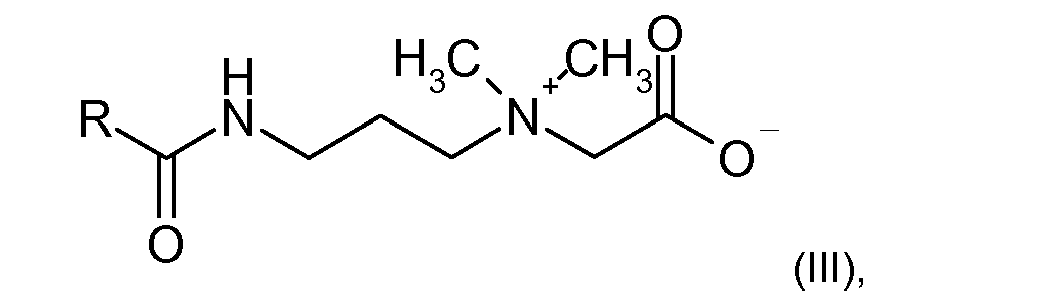
- Diese Tenside werden nach der INCI-Nomenklatur als Amidopropylbetaine bezeichnet, wobei die Vertreter, die sich von Kokosfettsäuren ableiten, bevorzugt sind und als Cocoamidopropylbetaine bezeichnet werden. Besonders bevorzugt werden erfindungsgemäß Tenside der Formel (III) eingesetzt, die ein Gemisch der folgenden Vertreter sind:
- H3C-(CH2)7-C(O)-NH-(CH2)3N+(CH3)2CH2COO-
- H3C-(CH2)9-C(O)-NH-(CH2)3N+(CH3)2CH2COO-
- H3C-(CH2)11-C(O)-NH-(CH2)3N+(CH3)2CH2COO-
- H3C-(CH2)13-C(O)-NH-(CH2)3N+(CH3)2CH2COO-
- H3C-(CH2)15-C(O)-NH-(CH2)3N+(CH3)2CH2COO-
- H3C-(CH2)7-CH=CH-(CH2)7-C(O)-NH-(CH2)3N+(CH3)2CH2COO-
- Zusätzlich zu dem bzw. den Amidopropylbetainen oder an ihrer Stelle können die erfindungsgemäßen Mittel auch Amphoacetate enthalten. Hier sind erfindungsgemäße Mund- und Zahnpflege- und -reinigungsmittel bevorzugt, die - bezogen auf ihr Gewicht - 0,25 bis 1,9 Gew.-%, vorzugsweise 0,5 bis 1,8 Gew.-%, besonders bevorzugt 0,75 bis 1,7 und insbesondere 1,0 bis 1,5 Gew.-% mindestens eines Betains der Formel (IV)

- Diese Tenside werden nach der INCI-Nomenklatur als Amphoacetate bezeichnet, wobei die Vertreter, die sich von Kokosfettsäuren ableiten bevorzugt sind und als Cocoamphoactetate bezeichnet werden.
- Aus herstellungstechnischen Gründen enthalten Tenside dieses Typs immer auch Betaine der Formel (IVa)

- in der R für einen geradkettigen oder verzweigten, gesättigten oder ein- bzw. mehrfach ungesättigten Alkyl- oder Alkenlyrest mit 8 bis 24 Kohlenstoffatomen und M für ein Kation steht.
- Diese Tenside werden nach der INCI-Nomenklatur als Amphodiacetate bezeichnet, wobei die Vertreter, die sich von Kokosfettsäuren ableiten, bevorzugt sind und als Cocoamphodiactetate bezeichnet werden.
- Besonders bevorzugt werden erfindungsgemäß Tenside der Formel (IV) eingesetzt, die ein Gemisch der folgenden Vertreter sind:
- H3C-(CH2)7-C(O)-NH-(CH2)2NH+(CH2CH2OH)CH2CH2COO-
- H3C-(CH2)9-C(O)-NH-(CH2)2NH+(CH2CH2OH)CH2CH2COO-
- H3C-(CH2)11-C(O)-NH-(CH2)2NH+(CH2CH2OH)CH2CH2COO-
- H3C-(CH2)13-C(O)-NH-(CH2)2NH+(CH2CH2OH)CH2CH2COO-
- H3C-(CH2)15-C(O)-NH-(CH2)2NH+(CH2CH2OH)CH2CH2COO-
- H3C-(CH2)7-CH=CH-(CH2)7-C(O)-NH-(CH2)2NH+(CH2CH2OH)CH2CH2COO-
- Zusammenfassend sind erfindungsgemäße Mund- und Zahnpflege- und -reinigungsmittel bevorzugt, bei denen der Rest R in den Formeln (III) und (IV) ausgewählt ist aus
- H3C-(CH2)7-
- H3C-(CH2)9-
- H3C-(CH2)11-
- H3C-(CH2)13-
- H3C-(CH2)15-
- H3C-(CH2)7-CH=CH-(CH2)7-
- Zusätzlich zu dem bzw. den Betaintensiden oder an ihrer Stelle können die erfindungsgemäßen Mittel auch anionische Tenside enthalten. Hier sind die Fettalkoholsulfate besonders bevorzugt. Besonders bevorzugte erfindungsgemäße Mund- und Zahnpflege- und -reinigungsmittel sind dadurch gekennzeichnet, daß sie - bezogen auf ihr Gewicht - 0,15 bis 1,9 Gew.-%, vorzugsweise 0,5 bis 1,8 Gew.-%, besonders bevorzugt 0,75 bis 1,7 und insbesondere 1,0 bis 1,5 Gew.-% mindestens eines anionischen Tensids aus der Gruppe der Fettalkoholsulfate enthalten.
- Als vierten wesentlichen Inhaltsstoff enthalten die erfindungsgemäßen Mund- und Zahnpflege-und -reinigungsmittel mindestens 0,05 bis 5,0 Gew.-% mindestens eines Emulgators der Formel (I)
R-C(O)O-CH2CH(OH)-CH2(OCH2CH2)nOH (I),
in der R für einen langkettigen Alkyl- oder Alkenylrest mit 7 bis 21 Kohlenstoffatomen und n für Werte von 10 bis 100 steht. - Es ist erfindungsgemäß bevorzugt, diese Emulgatoren in engeren Mengenbereichen einzusetzen. Besonders bevorzugt sind - bezogen auf das Gewicht des anwendungsfertigen Mund- und Zahnpflege- und -reinigungsmittels - Mengen von 0,07 bis 4,0 Gew.-%, vorzugsweise 0,1 bis 3,0 Gew.-%, besonders bevorzugt 0,15 bis 2,0 und insbesondere 0,2 bis 1,0 Gew.-%.
- Unabhängig von der Menge der eingesetzten Emulgatoren der Formel (I) sind solche Emulgatoren bevorzugt, bei denen in Formel (I) R für -(CH2)kCH3 mit k 8, 10, 12, 14, 16 oder 18 und n für die Werte 20, 21, 22, 23, 24, 25, 26, 27, 28, 29, 30, 31, 32, 33, 34, 35, 36, 37, 38, 39 oder 40 steht.
- Zusammenfassend sind erfindungsgemäße Mund- und Zahnpflege- und -reinigungsmittel bevorzugt, die - bezogen auf ihr Gewicht - 0,07 bis 4,0 Gew.-%, vorzugsweise 0,1 bis 3,0 Gew.-%, besonders bevorzugt 0,15 bis 2,0 und insbesondere 0,2 bis 1,0 Gew.-% mindestens eines Emulgators der Formel (I) enthalten
R-C(O)O-CH2CH(OH)-CH2(OCH2CH2)nOH (I),
in der - R für -(CH2)kCH3 mit k 8, 10, 12, 14, 16 oder 18 und
- n für die Werte 20, 21, 22, 23, 24, 25, 26, 27, 28, 29, 30, 31, 32, 33, 34, 35, 36, 37, 38, 39 oder 40 steht.
- Ganz besonders bevorzugt ist der Einsatz mindestens eines Emulgators aus der nachstehenden Liste:
- H3C-(CH2)8-C(O)O-CH2CH(OH)-CH2(OCH2CH2)20OH
- H3C-(CH2)8-C(O)O-CH2CH(OH)-CH2(OCH2CH2)21OH
- H3C-(CH2)8-C(O)O-CH2CH(OH)-CH2(OCH2CH2)22OH
- H3C-(CH2)8-C(O)O-CH2CH(OH)-CH2(OCH2CH2)23OH
- H3C-(CH2)8-C(O)O-CH2CH(OH)-CH2(OCH2CH2)240H
- H3C-(CH2)8-C(O)O-CH2CH(OH)-CH2(OCH2CH2)25OH
- H3C-(CH2)8-C(O)O-CH2CH(OH)-CH2(OCH2CH2)26OH
- H3C-(CH2)8-C(O)O-CH2CH(OH)-CH2(OCH2CH2)27OH
- H3C-(CH2)8-C(O)O-CH2CH(OH)-CH2(OCH2CH2)28OH
- H3C-(CH2)8-C(O)O-CH2CH(OH)-CH2(OCH2CH2)29OH
- H3C-(CH2)8-C(O)O-CH2CH(OH)-CH2(OCH2CH2)30OH
- H3C-(CH2)8-C(O)O-CH2CH(OH)-CH2(OCH2CH2)31OH
- H3C-(CH2)8-C(O)O-CH2CH(OH)-CH2(OCH2CH2)32OH
- H3C-(CH2)8-C(O)O-CH2CH(OH)-CH2(OCH2CH2)33OH
- H3C-(CH2)8-C(O)O-CH2CH(OH)-CH2(OCH2CH2)34OH
- H3C-(CH2)8-C(O)O-CH2CH(OH)-CH2(OCH2CH2)35OH
- H3C-(CH2)8-C(O)O-CH2CH(OH)-CH2(OCH2CH2)36OH
- H3C-(CH2)8-C(O)O-CH2CH(OH)-CH2(OCH2CH2)37OH
- H3C-(CH2)8-C(O)O-CH2CH(OH)-CH2(OCH2CH2)38OH
- H3C-(CH2)8-C(O)O-CH2CH(OH)-CH2(OCH2CH2)39OH
- H3C-(CH2)8-C(O)O-CH2CH(OH)-CH2(OCH2CH2)40OH
- H3C-(CH2)10-C(O)O-CH2CH(OH)-CH2(OCH2CH2)20OH
- H3C-(CH2)10-C(O)O-CH2CH(OH)-CH2(OCH2CH2)21OH
- H3C-(CH2)10-C(O)O-CH2CH(OH)-CH2(OCH2CH2)22OH
- H3C-(CH2)10-C(O)O-CH2CH(OH)-CH2(OCH2CH2)23OH
- H3C-(CH2)10-C(O)O-CH2CH(OH)-CH2(OCH2CH2)24OH
- H3C-(CH2)10-C(O)O-CH2CH(OH)-CH2(OCH2CH2)20OH
- H3C-(CH2)10-C(O)O-CH2CH(OH)-CH2(OCH2CH2)26OH
- H3C-(CH2)10-C(O)O-CH2CH(OH)-CH2(OCH2CH2)27OH
- H3C-(CH2)10-C(O)O-CH2CH(OH)-CH2(OCH2CH2)28OH
- H3C-(CH2)10-C(O)O-CH2CH(OH)-CH2(OCH2CH2)29OH
- H3C-(CH2)10-C(O)O-CH2CH(OH)-CH2(OCH2CH2)30OH
- H3C-(CH2)10-C(O)O-CH2CH(OH)-CH2(OCH2CH2)31OH
- H3C-(CH2)10-C(O)O-CH2CH(OH)-CH2(OCH2CH2)32OH
- H3C-(CH2)10-C(O)O-CH2CH(OH)-CH2(OCH2CH2)32OH
- H3C-(CH2)10-C(O)O-CH2CH(OH)-CH2(OCH2CH2)34OH
- H3C-(CH2)10-C(O)O-CH2CH(OH)-CH2(OCH2CH2)35OH
- H3C-(CH2)10-C(O)O-CH2CH(OH)-CH2(OCH2CH2)36OH
- H3C-(CH2)10-C(O)O-CH2CH(OH)-CH2(OCH2CH2)37OH
- H3C-(CH2)10-C(O)O-CH2CH(OH)-CH2(OCH2CH2)38OH
- H3C-(CH2)10-C(O)O-CH2CH(OH)-CH2(OCH2CH2)39OH
- H3C-(CH2)10-C(O)O-CH2CH(OH)-CH2(OCH2CH2)40OH
- H3C-(CH2)12-C(O)O-CH2CH(OH)-CH2(OCH2CH2)20OH
- H3C-(CH2)12-C(O)O-CH2CH(OH)-CH2(OCH2CH2)21OH
- H3C-(CH2)12-C(O)O-CH2CH(OH)-CH2(OCH2CH2)22OH
- H3C-(CH2)12-C(O)O-CH2CH(OH)-CH2(OCH2CH2)23OH
- H3C-(CH2)12-C(O)O-CH2CH(OH)-CH2(OCH2CH2)24OH
- H3C-(CH2)12-C(O)O-CH2CH(OH)-CH2(OCH2CH2)25OH
- H3C-(CH2)12-C(O)O-CH2CH(OH)-CH2(OCH2CH2)26OH
- H3C-(CH2)12-C(O)O-CH2CH(OH)-CH2(OCH2CH2)27OH
- H3C-(CH2)12-C(O)O-CH2CH(OH)-CH2(OCH2CH2)28OH
- H3C-(CH2)12-C(O)O-CH2CH(OH)-CH2(OCH2CH2)29OH
- H3C-(CH2)12-C(O)O-CH2CH(OH)-CH2(OCH2CH2)30OH
- H3C-(CH2)12-C(O)O-CH2CH(OH)-CH2(OCH2CH2)31OH
- H3C-(CH2)12-C(O)O-CH2CH(OH)-CH2(OCH2CH2)32OH
- H3C-(CH2)12-C(O)O-CH2CH(OH)-CH2(OCH2CH2)33OH
- H3C-(CH2)12C(O)O-CH2CH(OH)-CH2(OCH2CH2)34OH
- H3C-(CH2)12-C(O)O-CH2CH(OH)-CH2(OCH2CH2)35OH
- H3C-(CH2)12-C(O)O-CH2CH(OH)-CH2(OCH2CH2)36OH
- H3C-(CH2)12-C(O)O-CH2CH(OH)-CH2(OCH2CH2)37OH
- H3C-(CH2)12-C(O)O-CH2CH(OH)-CH2(OCH2CH2)38OH
- H3C-(CH2)12-C(O)O-CH2CH(OH)-CH2(OCH2CH2)39OH
- H3C-(CH2)12-C(O)O-CH2CH(OH)-CH2(OCH2CH2)40OH
- H3C-(CH2)14-C(O)O-CH2CH(OH)-CH2(OCH2CH2)20OH
- H3C-(CH2)14-C(O)O-CH2CH(OH)-CH2(OCH2CH2)21OH
- H3C-(CH2)14-C(O)O-CH2CH(OH)-CH2(OCH2CH2)22OH
- H3C-(CH2)14-C(O)O-CH2CH(OH)-CH2(OCH2CH2)23OH
- H3C-(CH2)14-C(O)O-CH2CH(OH)-CH2(OCH2CH2)24OH
- H3C-(CH2)14-C(O)O-CH2CH(OH)-CH2(OCH2CH2)25OH
- H3C-(CH2)14-C(O)O-CH2CH(OH)-CH2(OCH2CH2)26OH
- H3C-(CH2)14-C(O)O-CH2CH(OH)-CH2(OCH2CH2)27OH
- H3C-(CH2)14-C(O)O-CH2CH(OH)-CH2(OCH2CH2)28OH
- H3C-(CH2)14-C(O)O-CH2CH(OH)-CH2(OCH2CH2)29OH
- H3C-(CH2)14-C(O)O-CH2CH(OH)-CH2(OCH2CH2)30OH
- H3C-(CH2)14-C(O)O-CH2CH(OH)-CH2(OCH2CH2)31OH
- H3C-(CH2)14-C(O)O-CH2CH(OH)-CH2(OCH2CH2)32OH
- H3C-(CH2)14-C(O)O-CH2CH(OH)-CH2(OCH2CH2)33OH
- H3C-(CH2)14-C(O)O-CH2CH(OH)-CH2(OCH2CH2)34OH
- H3C-(CH2)14-C(O)O-CH2CH(OH)-CH2(OCH2CH2)35OH
- H3C-(CH2)14-C(O)O-CH2CH(OH)-CH2(OCH2CH2)36OH
- H3C-(CH2)14-C(O)O-CH2CH(OH)-CH2(OCH2CH2)37OH
- H3C-(CH2)14-C(O)O-CH2CH(OH)-CH2(OCH2CH2)38OH
- H3C-(CH2)14-C(O)O-CH2CH(OH)-CH2(OCH2CH2)39OH
- H3C-(CH2)14-C(O)O-CH2CH(OH)-CH2(OCH2CH2)40OH
- H3C-(CH2)16-C(O)O-CH2CH(OH)-CH2(OCH2CH2)20OH
- H3C-(CH2)16-C(O)O-CH2CH(OH)-CH2(OCH2CH2)21OH
- H3C-(CH2)16-C(O)O-CH2CH(OH)-CH2(OCH2CH2)22OH
- H3C-(CH2)16-C(O)O-CH2CH(OH)-CH2(OCH2CH2)23OH
- H3C-(CH2)16-C(O)O-CH2CH(OH)-CH2(OCH2CH2)24OH
- H3C-(CH2)16-C(O)O-CH2CH(OH)-CH2(OCH2CH2)25OH
- H3C-(CH2)16-C(O)O-CH2CH(OH)-CH2(OCH2CH2)26OH
- H3C-(CH2)16-C(O)O-CH2CH(OH)-CH2(OCH2CH2)27OH
- H3C-(CH2)16-C(O)O-CH2CH(OH)-CH2(OCH2CH2)28OH
- H3C-(CH2)16-C(O)O-CH2CH(OH)-CH2(OCH2CH2)29OH
- H3C-(CH2)16-C(O)O-CH2CH(OH)-CH2(OCH2CH2)30OH
- H3C-(CH2)16-C(O)O-CH2CH(OH)-CH2(OCH2CH2)31OH
- H3C-(CH2)16-C(O)O-CH2CH(OH)-CH2(OCH2CH2)32OH
- H3C-(CH2)16-C(O)O-CH2CH(OH)-CH2(OCH2CH2)33OH
- H3C-(CH2)16-C(O)O-CH2CH(OH)-CH2(OCH2CH2)34OH
- H3C-(CH2)16-C(O)O-CH2CH(OH)-CH2(OCH2CH2)35OH
- H3C-(CH2)16-C(O)O-CH2CH(OH)-CH2(OCH2CH2)36OH
- H3C-(CH2)16-C(O)O-CH2CH(OH)-CH2(OCH2CH2)37OH
- H3C-(CH2)16-C(O)O-CH2CH(OH)-CH2(OCH2CH2)38OH
- H3C-(CH2)16-C(O)O-CH2CH(OH)-CH2(OCH2CH2)39OH
- H3C-(CH2)16-C(O)O-CH2CH(OH)-CH2(OCH2CH2)40OH
- H3C-(CH2)18-C(O)O-CH2CH(OH)-CH2(OCH2CH2)20OH
- H3C-(CH2)18-C(O)O-CH2CH(OH)-CH2(OCH2CH2)21OH
- H3C-(CH2)18-C(O)O-CH2CH(OH)-CH2(OCH2CH2)22OH
- H3C-(CH2)18-C(O)O-CH2CH(OH)-CH2(OCH2CH2)23OH
- H3C-(CH2)18-C(O)O-CH2CH(OH)-CH2(OCH2CH2)24OH
- H3C-(CH2)18-C(O)O-CH2CH(OH)-CH2(OCH2CH2)25OH
- H3C-(CH2)18-C(O)O-CH2CH(OH)-CH2(OCH2CH2)26OH
- H3C-(CH2)18-C(O)O-CH2CH(OH)-CH2(OCH2CH2)27OH
- H3C-(CH2)18-C(O)O-CH2CH(OH)-CH2(OCH2CH2)28OH
- H3C-(CH2)18-C(O)O-CH2CH(OH)-CH2(OCH2CH2)29OH
- H3C-(CH2)18-C(O)O-CH2CH(OH)-CH2(OCH2CH2)30OH
- H3C-(CH2)18-C(O)O-CH2CH(OH)-CH2(OCH2CH2)31OH
- H3C-(CH2)18-C(O)O-CH2CH(OH)-CH2(OCH2CH2)32OH
- H3C-(CH2)18-C(O)O-CH2CH(OH)-CH2(OCH2CH2)33OH
- H3C-(CH2)18-C(O)O-CH2CH(OH)-CH2(OCH2CH2)34OH
- H3C-(CH2)18-C(O)O-CH2CH(OH)-CH2(OCH2CH2)35OH
- H3C-(CH2)18-C(O)O-CH2CH(OH)-CH2(OCH2CH2)36OH
- H3C-(CH2)18-C(O)O-CH2CH(OH)-CH2(OCH2CH2)37OH
- H3C-(CH2)18-C(O)O-CH2CH(OH)-CH2(OCH2CH2)38OH
- H3C-(CH2)18-C(O)O-CH2CH(OH)-CH2(OCH2CH2)39OH
- H3C-(CH2)18-C(O)O-CH2CH(OH)-CH2(OCH2CH2)40OH
- Ganz besonders bevorzugt ist der Einsatz von PEG-30 Glyceryl Sterate: H3C-(CH2)16-C(O)O-CH2CH(OH)-CH2(OCH2CH2)30OH
- Als fünften wesentlichen Inhaltsstoff enthalten die erfindungsgemäßen Mund- und Zahnpflege-und -reinigungsmittel mindestens 0,05 bis 5,0 Gew-% mindestens eines Polyalkylenglycols der Formel (II)
H-(O-CH(R)-CH2)m-OH (II),
in der R für -H oder -CH3 steht und M so gewählt ist, daß das Polyalkylenglycol Molmassen zwischen 200 und 2000 Dalton aufweist. - Ganz besonders bevorzugt ist der Einsatz von Polyethylenglycolen (R = H). Erfindungsgemäß besonders bevorzugte Mund- und Zahnpflege- und -reinigungsmittel sind dadurch gekennzeichnet, daß sie - bezogen auf ihr Gewicht - 0,75 bis 4,5 Gew.-%, vorzugsweise 1,0 bis 4,0 Gew.-%, besonders bevorzugt 1,5 bis 3,5 und insbesondere 2,0 bis 3,0 Gew.-% Polyethylenglycol(e) mit Molmassen von 200 bis 2000 Dalton, vorzugsweise von 300 bis 1800 Dalton, besonders bevorzugt von 450 bis 1700 Dalton und insbesondere von 500 bis 1500 Dalton, enthalten.
- Die erfindungsgemäßen Mund- und Zahnpflege- und -reinigungsmittel enthalten üblicherweise weitere Inhaltsstoffe.
- Bevorzugt ist hierbei der Einsatz von so genannten Feuchthaltemitteln, die bei Zahnpasten das Austrocknen verhindern. Bei so genannten Flüssigzahncremes mit fließfähiger Rheologie dienen diese als Matrix und werden in höheren Mengen eingesetzt.
- Hier sind erfindungsgemäße Mund und Zahnpflege- und -reinigungsmittel bevorzugt, die - bezogen auf ihr Gewicht - 10 bis 60 Gew.-%, vorzugsweise 12,5 bis 50 Gew.-%, besonders bevorzugt 15 bis 45 Gew.-% und insbesondere 20 bis 40 Gew.-% mindestens eines mehrwertigen Alkohols aus der Gruppe Sorbit und/oder Glycerin und/oder 1,2-Propylenglycol.-% enthalten. Sorbit (auch als Glucit bezeichnet) ist ein Zuckeralkohol von Glucose, also ein Hexit. Sorbit ist durch Hydrierung von Glucose herstellbar, spaltet intramolekular relativ leicht ein oder zwei Moleküle Wasser ab und bildet cyclische Ether. Sorbit läßt sich durch die Formel
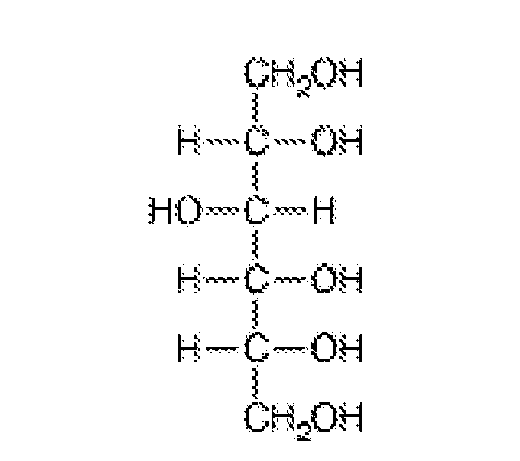
- Glycerin (1,2,3-Propantriol, 1,2,3-Trihydroxypropan, Glycerol, Ölsüß, INCI-Bezeichnung: Glycerin, E 422) ist eine farblose, klare, schwerbewegliche, geruchlose, süß schmeckende, hygroskopische Flüssigkeit, die mit Wasser und Alkohol in jedem Verhältnis mischbar ist.
-

- 1,2-Propylenglykol (1,2-Propandiol) ist eine farblose und stark hygroskopische Flüssigkeit, die in jedem Verhältnis mit Wasser und Alkoholen (wie Methanol, Ethanol, Propanolen, Butanolen) mischbar ist. Technisches 1,2-Propandiol ist ein Racemat aus (-)-(R)- und (+)-(S)-1,2-Prpylenglycol.
- Für bestimmte Anwendungsbereiche kann es vorteilhaft sein, nur einen der drei oben genannten Inhaltsstoffe einzusetzen. In den meisten Fällen ist dabei Sorbit bevorzugt. Allerdings können auf anderen Anwendungsgebieten Mischungen von zwei der drei Stoffe oder aller drei Stoffe bevorzugt sein. Besonders vorteilhaft hat sich hier eine Mischung aus Glycerin, Sorbit und 1,2-Propylenglycol in einem Gewichtsverhältnis von 1 : (0,5-1) : (0,1-0,5) erwiesen.
- Neben Sorbit bzw. Glycerin bzw. 1,2-Propylenglycol eignen sich als weitere mehrwertige Alkohole solche mit mindestens 2 OH-Gruppen, vorzugsweise Mannit, Xylitol und deren Mischungen. Besonders bevorzugt ist der Einsatz von Sorbit, so daß Mittel, die außer Sorbit keine anderen mehrwertigen Alkohole enthalten, besonders bevorzugt sind.
- Zusätzlich zu den Fällungskieselsäuren als zwingender Inhaltsstoff können die erfindungsgemäoßen Mittel weitere Putzkörper (Abrasiva) enthalten. Putzkörper sind amorphe, überwiegend anorganische, weitgehend wasserunlösliche, kleinstteilige Pulver, die keine scharfen Kanten aufweisen. Sie begünstigen in Zahn- und Mundpflegemitteln die Reinigung der Zähne und polieren gleichzeitig die Zahnoberfläche (Poliermittel).
- Als weitere Poliermittel eignen sich prinzipiell alle für Zahnpasten bekannten Reibkörper, insbesondere solche, die keine Calciumionen enthalten. Bevorzugte weitere geeignete Poliermittelkomponenten sind daher Aluminiumhydroxid, Aluminiumoxid, Natrium-aluminiumsilikate, organische Polymere oder Gemische solcher Reibkörper.
- Calciumhaltige Polierkomponenten wie z.B. Kreide, Calciumpyrophosphat, Dicalcium-phosphatdihydrat können aber in Mengen bis zu 5 Gew.-% - bezogen auf die Gesamtzusammensetzung - enthalten sein.
- Der Gesamtgehalt an Poliermitteln liegt vorzugsweise im Bereich von 5 - 50 Gew.-% des Zahnpflegemittels.
- Als weitere Poliermittelkomponente kann auch z.B. Aluminiumoxid in Form von schwach calcinierter Tonerde mit einem Gehalt an - und -Aluminiumoxid in einer Menge von ca. 1 - 5 Gew.-% enthalten sein. Ein solches geeignetes Aluminiumoxid ist unter der Handelsbezeichnung "Poliertonerde P10 feinst" (Giulini Chemie) erhältlich.
- Als Poliermittel eignen sich weiter alle für Zahnpasten bekannten Reibkörper wie z. B. Natriumaluminiumsilikate wie z. B. Zeolith A, organische Polymere wie z. B. Polymethacrylat oder Gemische dieser und der vorstehend genannten Reibkörper.
- Zusammenfassend sind erfindungsgemäße Mittel bevorzugt, die zusätzlich Putzkörper, vorzugsweise Aluminiumhydroxid, Aluminiumoxid, Calciumpyrophosphat, Kreide, Dicalciumphosphat-dihydrat (CaHPO4 ·2H2O), Natriumaluminiumsilikate, insbesondere Zeolith A, organische Polymere, insbesondere Polymethacrylate oder Gemische dieser Reibkörper, vorzugsweise in Mengen von 1 bis 30 Gew.%, vorzugsweise von 2,5 bis 25 Gew.% und insbesondere von 5 bis 22 Gew.%, jeweils bezogen auf das gesamte Mittel, enthalten.
- Mund- und Zahnpflege- und reinigungsmittel, insbesondere Zahnpasten, können z.B. auch Substanzen enthalten, die gegen Plaque und/oder Zahnstein wirksam sind.
- Zahnbelag (Plaque) ist ein rauher, klebriger Belag auf den Zähnen, der aus Speichel, Bakterien und Nahrungsresten besteht. Setzen sich Mineralsalze (z.B. Calcium, Phosphat) aus dem Speichel im Zahnbelag ab, so bilden sich harte, weiße oder gelbliche Ablagerungen am Zahn, die man Zahnstein nennt. In dem porösen Zahnstein kann sich wiederum leicht Zahnbelag absetzen, der das Zahnfleisch angreift.
- Die Bakterien auf der Zahnoberfläche bauen Kohlenhydrate, besonders Zucker, aus der Nahrung zu Säure ab. Diese Säure löst die Zahnsubstanz auf und es kommt zu Karies (Zahnfäule). Dabei werden besonders die Mineralien Calcium und Phosphat aus dem Zahnschmelz herausgelöst. Nach dem Zahnschmelzmantel werden auch innere Schichten des Zahnes angegriffen. Bakterien können in das Zahnmark eindringen und dort zu Entzündungen führen. Meist kommt es dann zu stechenden Zahnschmerzen.
- Wie bereits erwähnt, beinhaltet Plaque Bakterien, so daß sich zur Bekämpfung von Plaque antimikrobielle Stoffe eignen. Diese besitzen darüber hinaus eine Wirkung als Konservierungsmittel.
- In Mund und Zahnpflege- und -reinigungsmitteln können beispielsweise die auch in Lebensmitteln zugelassenen Konservierungsmittel Sorbinsäure (E 200), Kaliumsorbat (E 202), Calciumsorbat (E 203), Benzoesäure (E 210), Natriumbenzoat (E 211), Kaliumbenzoat (E 212), Calciumbenzoat (E 213), Ethyl-4-hydroxybenzoat (E 214), Ethyl-4-hydroxybenzoat, Natriumsalz (E 215), Propyl-4-hydroxybenzoat (E 216), Propyl-4-hydroxybenzoat, Natriumsalz (E 217), Methyl-4-hydroxybenzoat (E 218), Methyl-4-hydroxybenzoat, Natriumsalz (E 219), Schwefeldioxid (schweflige Säure), (E 220), Natriumsulfit (E 221), Natriumhydrogensulfit (E 222), Natriumdisulfit (E 223), Kaliumdisulfit (E 224), Calciumsulfit (E 226), Calciumhydrogensulfit (E 227), Kaliumhydrogensulfit (E 228), Biphenyl (E 230), Orthophenylphenol (2-Biphenylol), (E 231), Natriumorthophenylphenolat (E 232), Nisin (E 234), Natamycin (E 235), Ameisensäure (E 236), Natriumformiat (E 237), Calciumformiat (E 238), Hexamethylentetramin (E 239), Dimethyldicarbonat (E 242), Kaliumnitrit (E 249), Natriumnitrit (E 250), Natriumnitrat (E 251), Kaliumnitrat (E 252), Essigsäure (E 260), Kaliumacetat (E 261), Natriumacetat (E 262), Calciumacetat (E 263), Milchsäure (E 270), Propionsäure (E 280), Natriumpropionat (E 281), Calciumpropionat (E 282), Kaliumpropionat (E 283), Borsäure (E 284), Natriumtetraborat (E 285), Hydroxybernsteinsäure (Äpfelsäure), (E 296), Fumarsäure (E 297), Lysozym (E 1105), eingesetzt werden.
- Bevorzugte Stoffe sind ausgewählt aus p-Hydroxybenzoesäuremethyl-, -ethyl- oder propylester, Natriumsorbat, Natriumbenzoat, Bromchlorophen, Triclosan, Phenyl- Salicylsäureester, Biguaniden z. B. Chlorhexidin (1,1'-Hexamethylenbis[5-(4-chlorphenyl)-biguanid), Thymol usw..
- Erfindungsgemäß bevorzugte Mittel enthalten zusätzlich Antiplaque-Wirkstoffe, vorzugsweise p-Hydroxybenzoesäuremethyl-, -ethyl- oder propylester, Natriumsorbat, Natriumbenzoat, Bromchlorophen, Triclosan, Phenyl- Salicylsäureester, Biguanide z. B. Chlorhexidin, Thymol, vorzugsweise in Mengen von 0,1 bis 5 Gew.%, vorzugsweise von 0,25 bis 2,5 Gew.% und insbesondere von 0,5 bis 1,5 Gew.%, jeweils bezogen auf das gesamte Mittel.
- Die angegebenen Mengen beziehen sich auf die Gesamtmenge an Antiplaque-Wirkstoffen, wobei einzelne Wirkstoffe vorzugsweise in engeren Mengenbereichen eingesetzt werden. Erfindungsgemäß bevorzugte Mittel enthalten beispielsweise 0,1 bis 2 Gew.-%, vorzugsweise 0,2 bis 1,75 Gew.-%, weiter bevorzugt 0,3 bis 1,5 Gew.-% und insbesondere 0,4 bis 1,0 Gew.-% Natriumbenzoat. Weiter bevorzugte erfindungsgemäße Mittel sind dadurch gekennzeichnet, daß sie 0,005 bis 0,1 Gew.-%, vorzugsweise 0,01 bis 0,075 Gew.-% und insbesondere 0,02 bis 0,05 Gew.-% Chlorhexidin enthalten. Chlorhexidin wird vorzugsweise gemeinsam mit Alkylpolyglycosiden (APG) eingesetzt, wobei in bevorzugten erfindungsgemäßen Mitteln als Alkylglykoside solche mit 8-18 C-Atomen in der Alkylgruppe und einem mittleren Oligomerisationsgrad des Glycosidrestes von 1-3 in einer Menge von 0,025 bis 2,5 Gew.-% enthalten sind.
- Gegen Zahnstein wirksame Stoffe können beispielsweise Chelatbildner sein wie z. B. Ethylendiamintetraessigsäure und deren Natriumsalze, Pyrophosphat- Salze wie die wasserlöslichen Dialkali- oder Tetraalkalimetallpyrophosphat- Salze, z. B. Na4P2O7, K4P 2O7, Na2K2P2O7, Na2H2P2O7 und K 2H2P2O7 oder Polyphosphat-Salze, die z. B. aus wasserlöslichen Alkalimethalltripolyphosphaten wie Natriumtripolyphosphat und Kaliumtripolyphosphat ausgewählt sein können.
- Erfindungsgemäß bevorzugte Mittel sind dadurch gekennzeichnet, daß sie zusätzlich Phosphat(e), vorzugsweise Alkalimetallphosphat(e) und insbesondere Natriumtripolyphosphat, vorzugsweise in Mengen von 1 bis 10 Gew.-%, besonders bevorzugt von 2 bis 8 Gew.-% und insbesondere von 3 bis 7 Gew.-%, jeweils bezogen auf das gesamte Mittel, enthalten.
- Mund und Zahnpflege- und -reinigungsmittel können darüber hinaus mit besonderem Vorzug Antikaries-Wirkstoffe enthalten. Diese können beispielsweise aus organischen oder anorganischen Fluoriden ausgewählt sein, z. B. aus Natriumfluorid, Kaliumfluorid, Natriummonofluorphosphat und Natriumfluorosilikat. Auch Zinkfluorid, Zinn-(II)-fluorid sind bevorzugt. Bevorzugt sollte eine Menge von 0,01 - 0,2 Gew.-% Fluor in Form der genannten Verbindungen enthalten sein.
- Erfindungsgemäße Mittel, die zusätzlich Antikaries-Wirkstoffe, vorzugsweise Fluorverbindung(en), insbesondere Natriumfluorid, Kaliumfluorid, Natriummonofluorphosphat, Zinkfluorid, Zinnfluorid und Natriumfluorosilikat, vorzugsweise in Mengen von 0,01 bis 5 Gew.%, vorzugsweise von 0,1 bis 2,5 Gew.% und insbesondere von 0,2 bis 1,1 Gew.%, jeweils bezogen auf das gesamte Mittel, enthalten, sind erfindungsgemäß bevorzugt.
- Als Konsistenzregler (bzw. Bindemittel) dienen z. B. natürliche und/oder synthetische wasserlösliche Polymere wie Alginate, Carragheenate, Traganth, Stärke und Stärkeether, Celluloseether wie z. B. Carboxymethylcellulose (Na-Salz), Hydroxyethylcellulose, Methylhydroxypropylcellulose, Guar, Akaziengum, Agar-Agar, Xanthan- Gum, Succinoglycan-Gum, Johannisbrotmehl, Pectine, wasserlösliche Carboxyvinylpolymere (z. B. Carbopol®-Typen), Polyvinylalkohol, Polyvinylpyrrolidon, Polyethylenglycole, insbesondere solche mit Molekulargewichten von 1 500-1 000 000.
- Weitere Stoffe, die sich zur Viskositätskontrolle eignen, sind z. B. Schichtsilikate wie z. B. Montmorillonit-Tone, kolloidale Verdickungskieselsäuren wie z. B. Aerogel-Kieselsäuren, pyrogene Kieselsäuren oder feinstvermahlene Fällungskieselsäuren. Es können auch viskositätsstabilisierende Zusätze aus der Gruppe der kationischen, zwitterionischen oder ampholytischen stickstoffhaltigen Tenside, der hydroxypropylsubstituierten Hydrocolloide oder der Polyethylenglycol/Polypropylenglycol- Copolymere mit einem mittleren Molgewicht von 1000 bis 5000 oder eine Kombination der genannten Verbindungen in den Zahnpasten verwendet werden.
- Die Mund- und Zahnpflegemittel, insbesondere die Zahnpasten, können auch die Unempfindlichkeit der Zähne steigernde Substanzen enthalten, beispielsweise Kaliumsalze wie z. B. Kaliumnitrat, Kaliumcitrat, Kaliumchlorid, Kaliumbicarbonat und Kaliumoxalat. Erfindungsgemäß bevorzugte Mund- und Zahnpflege- sind dadurch gekennzeichnet, daß sie die Unempfindlichkeit der Zähne steigernde Substanzen, vorzugsweise Kaliumsalze, besonders bevorzugt Kaliumnitrat und/oder Kaliumcitrat und/oder Kaliumchlorid und/oder Kaliumbicarbonat und/oder Kaliumoxalat, vorzugsweise in Mengen von 0,5 bis 20 Gew.%, besonders bevorzugt von 1,0 bis 15 Gew.%, weiter bevorzugt von 2,5 bis 10 Gew.-% und insbesondere von 4,0 bis 8,0 Gew.%, jeweils bezogen auf das gesamte Mittel, enthalten.
- Die erfindungsgemäßen Mittel, insbesondere die Zahnpasten, können auch zusätzlich weitere wundheilende und entzündungshemmende Stoffe, z. B. Wirkstoffe gegen Zahnfleischentzündungen, enthalten. Derartige Stoffe können z. B. ausgewählt sein aus Allantoin, Azulen, Kamillenextrakten, Tocopherol, Panthenol, Bisabolol, Salbeiextrakten.
- Als nicht-kationische, bakterizide Komponente eignen sich z.B. Phenole, Resorcine, Bisphenole, Salicylanilide und deren halogenierte Derivate, halogenierte Carbanilide und p-Hydroxybenzoesäureester. Besonders bevorzugte antimikrobielle Komponenten sind halogenierte Diphenylether, z.B. 2,4-Dichlor-2'-hydroxydiphenylether, 4,4'-Dichlor-2'-hydroxydiphenylether, 2,4,4'-Tribrom-2'-hydroxydiphenylether und 2,4,4'-Trichlor-2'-hydroxydiphenylether (Triclosan). Sie werden bevorzugt in Mengen von 0,01 - 1 Gew.-% in die erfindungsgemäßen Zahnpflegemittel eingesetzt. Besonders bevorzugt wird Triclosan in einer Menge von 0,01 - 0,3 Gew.-% eingesetzt.
- D-Panthenol D - (+) - 2,4-Dihydroxy-N-(3-hydroxypropyl)-3,3-dimethyl-butyramid zeigt eine der Pantothensäure entsprechende biologische Aktivität. Die Pantothensäure (R - (+) - N - (2,4-Dihydroxy-3,3-dimethylbutyryl-β-alanin) ist eine Vorstufe in der Biosynthese des Coenzyms A und wird zum Vitamin-B-Komplex (B3) gezählt. Diese Stoffe sind dafür bekannt, daß sie die Wundheilung fördern und eine günstige Wirkung auf die Haut haben. Sie sind daher auch gelegentlich in Zahnpasten beschrieben worden. Die erfindungsgemäßen Zahnpflegemittel enthalten bevorzugt 0,05 - 5 Gew.-% Panthenol oder ein Salz der Pantothensäure.
- Retinol (3,7-Dimethyl-9-(2,6,6-trimethyl-1-cyclohexenyl)-2,4,6,8-nonatetraen-1-ol ist der internationale Freiname für Vitamin A1. Anstelle des Retinols kann auch eines seiner Derivate mit ähnlicher biologischer Wirkung, z.B. ein Ester oder die Retinoesäure (Tretinoin), eines ihrer Salze oder ihre Ester verwendet werden. Bevorzugt wird ein Retinol-Ester, insbesondere ein Fettsäureester einer Fettsäure mit 12 - 22 C-Atomen verwendet. Besonders bevorzugt ist Retinol-Palmitat geeignet. Bei Verwendung eines Retinol-Esters, z.B. Retinol-Palmitat mit einer Aktivität von 1,7 106 I.E. pro g ist eine Menge von 0,001 bis 0,1 Gew.-% bevorzugt. Bei Verwendung anderer Retinol-Derivate empfiehlt sich eine Einsatzmenge, die einer Konzentration von 103 bis 106 I.E. (Internationale Einheiten) pro 100 g entspricht.
Bevorzugte Zahnpflegemittel gemäß der vorliegenden Erfindung enthalten neben Poliermitteln, Fluorverbindungen, Feuchthaltemitteln und Bindemitteln bevorzugt - 0,01 - 1 Gew.-% eines halogenierten Diphenylethers
- 0,05 - 5 Gew.-% Panthenol oder ein Salz der Pantothensäure und
- 0,01 - 0,1 Gew.-% eines Retinol-Esters, bevorzugt Retinol-Palmitat.
- Die erfindungsgemäßen Mittel, insbesondere die Zahnpasten, können auch zusätzliche Substanzen zur Erhöhung des mineralisierenden Potentials enthalten, beispielsweise calciumhaltige Substanzen wie z. B. Calciumchlorid, Calciumacetat und Dicalciumphosphat-Dihydrat. Die Konzentration der calciumhaltigen Substanz hängt von der Löslichkeit der Substanz und dem Zusammenwirken mit anderen in dem Mund- und Zahnpflegemittel enthaltenen Substanzen ab.
- Neben den genannten obligatorischen Komponenten können die erfindungsgemäßen Zahnpflegemittel weitere, an sich bekannte Hilfs- und Zusatzstoffe enthalten. Dabei ist ein Zusatzstoff, der als Zahnpastenkomponente seit langem bekannt ist, in den erfindungsgemäßen Zahnpflegemitteln besonders wirksam: Calcium-glycerophosphat, das Calcium-Salz der Glycerin-1-phosphorsäure oder der Glycerin-2-phosphorsäure oder der zur Glycerin-1-phosphorsäure enantiomeren Glycerin-3-phosphorsäure - oder eines Gemisches dieser Säuren. Die Verbindung hat in Zahnpflegemitteln eine remineralisierende Wirkung, da sie sowohl Calcium- als auch Phosphationen liefert. In den erfindungsgemäßen Zahnpflegemitteln wird Calciumglycerophosphat bevorzugt in Mengen von 0,01 - 1 Gew.-% eingesetzt. Insgesamt können die erfindungsgemäßen Zahnreinigungsmittel übliche Hilfsmittel und Zusatzstoffe in Mengen bis zu 10 Gew.-% enthalten.
- Die erfindungsgemäßen Zahnpflegemittel können z.B. durch Zusatz von Aromaölen und Süßungsmitteln in ihren organoleptischen Eigenschaften verbessert werden.
- Als Aromaöle können alle die für Mund- und Zahnpflegemittel üblichen natürlichen und synthetischen Aromen eingesetzt werden. Natürliche Aromen können sowohl in Form der aus Drogen isolierten natürlichen ätherischen Öle als auch der daraus isolierten Einzelkomponenten enthalten sein.
- Geeignete Aromen sind z.B. Pfefferminzöl, Krauseminzöl, Eukalyptusöl, Anisöl, Fenchelöl, Kümmelöl, Menthylacetat, Zimtaldehyd, Anethol, Vanillin, Thymol sowie Mischungen dieser Komponenten.
- Geeignete Süßungsmittel sind z.B. Saccharin-Natrium, Natrium-Cyclamat, Sucrose, Lactose, Meltose, Fructose.
- Weitere übliche Hilfs- und Zusatzstoffe für Zahnpasten sind
- Oberflächenaktive Stoffe, bevorzugt anionische, zwitterionische, amphotere, nichtionische Tenside oder eine Kombination mehrerer verschiedener Tenside
- Lösungsmittel und Lösungsvermittler, z.B. niedere einwertige oder mehrwertige Alkohole oder Ether, z.B. Ethanol, 1,2-Propylenglycol, Diethylenglycol oder Butyldi- glycol
- Pigmente, wie z.B. Titandioxid
- Farbstoffe
- Puffersubstanzen, z.B. primäre, sekundäre oder tertiäre Alkaliphosphate oder Citronensäure-/Na-Citrat
- weitere wundheilende oder entzündungshemmende Stoffe, z.B. Allantoin, Harnstoff, Azulen, Kamillewirkstoffe, Acetylsalicylsäurederivate oder Rhodanid
- weitere Vitamine wie z.B. Ascorbinsäure, Biotin, Tocopherol oder Rutin
- Mineralsalze wie z.B. Mangan-, Zink- oder Magnesiumsalze.
- Eine weitere wichtige Gruppe von Inhaltstoffen, die in den erfindungsgemäßen Mitteln enthalten sein kann, sind die so genannten bioaktiven Gläser.
- Der Begriff "bioaktive Gläser" umfaßt im Rahmen der vorliegenden Anmeldung Gläser, welche biologisch wirksam und/oder biologisch aktiv sind. Die biologische Wirksamkeit eines Glases kann sich beispielsweise in dessen antimikrobiellen Eigenschaften zeigen, biologisch aktives Glas unterscheidet sich von herkömmlichen Kalk-Natrium-Silicat-Gläsern dadurch, daß es lebendes Gewebe bindet. Biologisch aktives Glas bezeichnet dabei beispielsweise ein Glas, das eine feste Bindung mit Körpergewebe eingeht, wobei eine Hydroxyl-Apatitschicht ausgebildet wird. Unter bioaktivem Glas wird auch ein Glas verstanden, das antimikrobielle und/oder entzündungshemmende Wirkung zeigt. Die Glaspulver zeigen gegenüber Bakterien, Pilzen sowie Viren eine biozide bzw. eine biostatische Wirkung; sind im Kontakt mit dem Menschen hautverträglich, toxikologisch unbedenklich und insbesondere auch zum Verzehr geeignet.
- Erfindungsgemäß besonders bevorzugte Mittel sind dadurch gekennzeichnet, daß sie 0,2 bis 20 Gew.-%, vorzugsweise 0,4 bis 14 Gew.-%, besonders bevorzugt 0,5 bis 3 Gew.-% und insbesondere 0,6 bis 2 Gew.-% mindestens eines bioaktiven Glases enthalten.
- Die erfindungsgemäßen Mund- und Zahnpflege- und -reinigungsmittel dieser Ausführungsform enthalten bioaktives Glas oder Glaspulver oder Glaskeramikpulver oder Kompositmaterialien, welche ein solches bioaktives Glas umfassen. Unter Glaspulvern werden im Rahmen der vorliegenden Anmeldung auch Granulate und Glaskügelchen verstanden.
- Aufgrund der Anforderungen an die toxikologische Unbedenklichkeit des Glases sowie deren Eignung zum Verzehr soll das Glaspulver besonders rein sein. Die Belastung durch Schwermetalle ist vorzugsweise gering. So beträgt die Maximalkonzentration im Bereich der kosmetischen Formulierungen vorzugsweise für Pb < 20 ppm, Cd < 5 ppm, As < 5 ppm, Sb < 10 ppm, Hg < 1 ppm, Ni < 10 ppm.
- Das unkeramisierte Ausgangsglas, das direkt in den bevorzugten erfindungsgemäßen Zusammensetzungen enthalten oder gegebenenfalls für die Herstellung einer erfindungsgemäß einsetzbaren Glaskeramik verwandt wird, enthält SiO2 als Netzwerkbildner, vorzugsweise zwischen 35-80 Gew.-%. Bei niedrigeren Konzentrationen nimmt die spontane Kristallisationsneigung stark zu und die chemische Beständigkeit stark ab. Bei höheren SiO2-Werten kann die Kristallisationsstabilität abnehmen, und die Verarbeitungstemperatur wird deutlich erhöht, so daß sich die Heißformgebungseigenschaften verschlechtern. Na2O wird als Flußmittel beim Schmelzen des Glases eingesetzt. Bei Konzentrationen kleiner 5% wird das Schmelzverhalten negativ beeinflußt. Natrium ist Bestandteil der sich bei der Keramisierung bildenden Phasen und muß, sofern hohe kristalline Phasenanteile durch die Keramisierung eingestellt werden sollen, in entsprechend hohen Konzentrationen im Glas enthalten sein. K2O wirkt als Flußmittel beim Schmelzen des Glases. Außerdem wird Kalium in wässrigen Systemen abgegeben. Liegen hohe Kaliumkonzentrationen im Glas vor, werden kaliumhaltige Phasen wie Kalzium-Silicaten ebenfalls ausgeschieden. Über den P2O5-Gehalt kann bei silikatischen Gläsern, Glaskeramiken oder Kompositen die chemische Beständigkeit des Glases und damit die Ionenabgabe in wässrigen Medien eingestellt werden. Bei Phospahtgläsern ist P2O5 Netzwerkbilder. Der P2O5-Gehalt liegt vorzugsweise zwischen 0 und 80 Gew.-%. Um die Schmelzbarkeit zu verbessern, kann das Glas bis zu 25 Gew.- % B2O3 enthalten. Al2O3 wird genutzt, um die chemische Beständigkeit des Glases einzustellen.
- Zur Verstärkung der antimikrobiellen, insbesondere der antibakteriellen Eigenschaften der Glaskeramik können antimikrobiell wirkende Ionen wie z. B. Ag, Au, I, Ce, Cu, Zn in Konzentrationen kleiner 5 Gew.-% enthalten sein.
- Farbgebende Ionen wie z. B. Mn, Cu, Fe, Cr, Co, V, können einzeln oder kombiniert, vorzugsweise in einer Gesamtkonzentration kleiner 1 Gew.-%, enthalten sein.
- Üblicherweise wird das Glas bzw. die Glaskeramik in Pulverform eingesetzt. Die Keramisierung kann entweder mit einem Glasblock bzw. Glasribbons erfolgen oder aber mit Glaspulver. Nach der Keramisierung müssen die Glaskeramikblöcke oder Ribbons zu Pulver gemahlen werden. Wurde das Pulver keramisiert, muß gegebenenfalls auch erneut gemahlen werden, um Agglomerate, die während des Keramisierungsschrittes entständen sind, zu entfernen. Die Mahlungen können sowohl trocken als auch in wässrigen oder nicht wässrigen Mahlmedien durchgeführt werden. Üblicherweise liegen die Partikelgrößen kleiner 500 µm. Als zweckmäßig haben sich Partikelgrößen < 100 µm bzw. < 20 µm erwiesen. Besonders geeignet sind Partikelgrößen < 10 µm sowie kleiner 5 µm sowie kleiner 2 µm, siehe weiter unten.
- Die in den bevorzugten erfindungsgemäßen Zusammensetzungen enthaltenen bioaktiven Gläser bzw. Glaspulver oder Glaskeramikpulver oder Komposit-Zusammensetzungen umfassen Gläser, die bevorzugt nachfolgende Komponenten umfassen: SiO2: 35-80 Gew.-%, Na2O: 0-35 Gew.- %, P2O5: 0-80 Gew.-%, MgO: 0-5 Gew.-%, Ag2O: 0-0,5 Gew.-%, AgJ: 0-0,5 Gew.- %, NaJ: 0-5 Gew.-%, TiO2: 0-5 Gew.-%, K2O: 0-35 Gew.-%, ZnO: 0-10 Gew.-%, Al 2O3: 0-25 Gew.-% und B2O3: 0-25 Gew.-% .
- Weiterhin können dem Grundglas gemäß obiger Zusammensetzung zur Erzielung weiterer Effekte wie beispielsweise Farbigkeit oder UV-Filterung Ionen wie Fe, Co, Cr, V, Ce, Cu, Mn, Ni, Bi, Sn, Ag, Au, J einzeln oder in Summe bis zu 10 Gew.-% zugegeben werden. Eine weiter Glaszusammensetzung kann wie folgt sein: SiO2: 35-80 Gew.-%, Na2O: 0-35 Gew.-%, P2O5: 0-80 Gew.-%, MgO: 0-5 Gew.- %, Ag2O: 0-0,5 Gew.-%, AgJ: 0-0,5 Gew.-%, NaJ: 0-5 Gew.-%, TiO2: 0-5 Gew.-%, K2O: 0-35 Gew.-%, ZnO: 0-10 Gew.-%, Al2 O3: 0-25 Gew.-%, B2O3: 0- 25 Gew.-%, SnO: 0-5 Gew.-%, CeO2: 0-3 Gew.- % und Au: 0,001-0,1 Gew.-%.
- Besonders bevorzugte erfindungsgemäße Mund- und Zahnpflege- und -reinigungsmittel sind dadurch gekennzeichnet, daß das bioaktive Glas - bezogen auf sein Gewicht - folgende Zusammensetzung aufweist:
SiO2 35 bis 60 Gew.-%, vorzugsweise 40 bis 60 Gew.-%, Na2O 0 bis 35 Gew.-%, vorzugsweise 5 bis 30 Gew.-%, K2O 0 bis 35 Gew.-%, vorzugsweise 0 bis 20 Gew.-%, P2O5 0 bis 10 Gew.-%, vorzugsweise 2 bis 10 Gew.-%, MgO 0 bis 10 Gew.-%, vorzugsweise 0 bis 5 Gew.-%, CaO 0 bis 35 Gew.-%, vorzugsweise 5 bis 30 Gew.-%, Al2O3 0 bis 25 Gew.-%, vorzugsweise 0 bis 5 Gew.-%, B2O3 0 bis 25 Gew.-%, vorzugsweise 0 bis 5 Gew.-%, TiO2 0 bis 10 Gew.-%, vorzugsweise 0,1 bis 5 Gew.-%. - Wie bereits weiter oben erwähnt, wird das bioaktive Glas vorzugsweise in partikulärer Form eingesetzt. Hier sind besonders bevorzugte erfindungsgemäße Mund- und Zahnpflege- und - reinigungsmittel dadurch gekennzeichnet, daß das antimikrobielle Glas Teilchengrößen < 10 µm, vorzugsweise von 0,5 bis 4 µm, besonders bevorzugt von 1 bis 2 µm, aufweist.
- Ein weiterer Gegenstand der vorliegenden Erfindung ist die nicht-therapeutische kosmetische Verwendung von erfindungsgemäßen Mund- und Zahnpflege- und -reinigungsmitteln zur Vorbeugung und/oder Bekämpfung hypersensibler Zähne.
- Ein weiterer Gegenstand der vorliegenden Erfindung ist die nicht-therapeutische kosmetische Verwendung von erfindungsgemäßen Mund- und Zahnpflege- und -reinigungsmitteln zur Aufhellung der Zähne und/oder zur Vorbeugung von Verfärbungen und Wiederverfärbungen.
- Ein weiterer Gegenstand der vorliegenden Erfindung ist die nicht-therapeutische kosmetische Verwendung von erfindungsgemäßen Mund- und Zahnpflege- und -reinigungsmitteln zur Vorbeugung gegen Plaqueadhäsion auf der Zahnoberfläche.
- Ein weiterer Gegenstand der vorliegenden Erfindung ist die nicht-therapeutische kosmetische Verwendung von erfindungsgemäßen Mund- und Zahnpflege- und -reinigungsmitteln zur Remineralisation von Dentalläsionen.
- Bezüglich bevorzugter Ausführungsformen der erfindungsgemäßen nicht-therapeutischen Verwendungen gilt mutatis mutandis das zu den erfindungsgemäßen Mitteln Gesagte.
- Ein weiterer Gegenstand der vorliegenden Erfindung ist ein Verfahren zur Remineralisation von Zähnen, bei dem man ein erfindungsgemäßes Mund- und Zahnpflege- und -reinigungsmittel auf einen zur mechanischen Reinigung der Zähne geeigneten Gegenstand aufbringt und zur Reinigung der Zahnoberflächen, Zahnzwischenräume und der Mundhöhle verwendet.
- Auch bezüglich bevorzugter Ausführungsformen des erfindungsgemäßen Verfahrens gilt mutatis mutandis das zu den erfindungsgemäßen Mitteln Gesagte.
- Die nachfolgenden beispiele verdeutlichen den Gegenstand der Erfindung:
- Es wurden folgende Zahncremes bereitgestellt (Angaben in Gew.-%):
1 2 3 4 5 Sorbitol, 70%ig 31,0 30,0 - - 20,0 Glycerin, 86%ig - - 35,0 41,0 21,0 Na-CMC (Substitutionsgrad 0,75) 1,0 0,75 1,1 2,0 1,5 Fällungskieselsäure (Sident®) 8) 9,0 8,0 12,0 14,0 8,0 Fällungskieselsäure (Sident®) 22 S) 7,0 7,0 4,0 10,0 8,0 C18-Fettalkoholsulfat, Na-Salz 1,5 - 0,75 1,5 - Cocoamidopropylbetain - 1,5 0,75 - 1,5 PEG-30 Glyceryl Stearat 0,2 0,25 0,1 0,5 1,0 PEG (MG = 1500) 1,5 2,0 3,0 0,5 1,5 Natriumfluorid 0,32 0,32 0,32 0,32 0,32 Dinatriumphosphat 0,1 0,1 0,1 0,1 0,1 Trinatriumphoyphat 0,1 0,1 0,1 0,1 0,1 Saccharin, Na-Salz 0,2 0,2 0,2 0,2 0,2 Natriumbenzoat 0,25 0,5 0,5 0,25 0,25 Aroma 1,0 1,0 1,0 1,0 1,0 Wasser, vollentsalzt ad 100 ad 100 ad 100 ad 100 ad 100
Claims (15)
- Mund- und Zahnpflege- und -reinigungsmittel, enthaltend - bezogen auf sein Gewicht -a) 0,1 bis 5,0 Gew.-% Na-Carboxymethylcellulose mit einem Substitutionsgrad von 0,65 bis 0,85;b) 2,0 bis 25,0 Gew.-% Fällungskieselsäure(n);c) 0,1 bis 2 Gew.-% mindestens eines Tensids;d) 0,05 bis 5,0 Gew.-% mindestens eines Emulgators der Formel (I)
R-C(O)O-CH2CH(OH)-CH2(OCH2CH2)nOH (I),
in der- R für einen langkettigen Alkyl- oder Alkenylrest mit 7 bis 21 Kohlenstoffatomen und- n für Werte von 10 bis 100 steht,e) 0,5 bis 5,0 Gew.-% mindestens eines Polyalkylenglycols der Formel (II)
H-(O-CH(R)-CH2)m-OH (II),
in der- R für-H oder-CH3 steht,- M so gewählt ist, daß das Polyalkylenglycol Molmassen zwischen 200 und 2000 Dalton aufweist. - Mund- und Zahnpflege- und -reinigungsmittel nach Anspruch 1, dadurch gekennzeichnet, daß es - bezogen auf sein Gewicht - 0,25 bis 4,0 Gew.-%, vorzugsweise 0,5 bis 3,0 Gew.-%, besonders bevorzugt 0,75 bis 2,5 und insbesondere 1,0 bis 1,75 Gew.-% Na-Carboxymethylcellulose mit einem Substitutionsgrad von 0,75 bis 0,85 enthält.
- Mund- und Zahnpflege- und -reinigungsmittel nach einem der Ansprüche 1 oder 2, dadurch gekennzeichnet, daß es - bezogen auf sein Gewicht - 2,5 bis 22,5, vorzugsweise 3,5 bis 20, besonders bevorzugt 5 bis 17,5 und insbesondere 6,0 bis 15,0 Gew.-% Fällungskieselsäure(n) enthält.
- Mund- und Zahnpflege- und -reinigungsmittel nach einem der Ansprüche 1 bis 3, dadurch gekennzeichnet, daß es - bezogen auf sein Gewicht - 0,25 bis 1,9 Gew.-%, vorzugsweise 0,5 bis 1,8 Gew.-%, besonders bevorzugt 0,75 bis 1,7 und insbesondere 1,0 bis 1,5 Gew.-% mindestens eines Betains der Formel (III)

- Mund- und Zahnpflege- und -reinigungsmittel nach einem der Ansprüche 1 bis 4, dadurch gekennzeichnet, daß es - bezogen auf sein Gewicht - 0,25 bis 1,9 Gew.-%, vorzugsweise 0,5 bis 1,8 Gew.-%, besonders bevorzugt 0,75 bis 1,7 und insbesondere 1,0 bis 1,5 Gew.-% mindestens eines Betains der Formel (IV)

- Mund- und Zahnpflege- und -reinigungsmittel nach einem der Ansprüche 4 oder 5, dadurch gekennzeichnet, daß der Rest R in den Formeln (III) und (IV) ausgewählt ist aus- H3C-(CH2)7-- H3C-(CH2)9-- H3C-(CH2)11-- H3C-(CH2)13-- H3C-(CH2)15-- H3C-(CH2)7-CH=CH-(CH2)7-oder Mischungen aus diesen.
- Mund- und Zahnpflege- und -reinigungsmittel nach einem der Ansprüche 1 bis 6, dadurch gekennzeichnet, daß es - bezogen auf sein Gewicht - 0,15 bis 1,9 Gew.-%, vorzugsweise 0,5 bis 1,8 Gew.-%, besonders bevorzugt 0,75 bis 1,7 und insbesondere 1,0 bis 1,5 Gew.-% mindestens eines anionischen Tensids aus der Gruppe der Fettalkoholsulfate enthält.
- Mund- und Zahnpflege- und -reinigungsmittel nach einem der Ansprüche 1 bis 7, dadurch gekennzeichnet, daß es - bezogen auf sein Gewicht - 0,07 bis 4,0 Gew.-%, vorzugsweise 0,1 bis 3,0 Gew.-%, besonders bevorzugt 0,15 bis 2,0 und insbesondere 0,2 bis 1,0 Gew.-% mindestens eines eines Emulgators der Formel (I)
R-C(O)O-CH2CH(OH)-CH2(OCH2CH2)nOH (I),
n der- R für -(CH2)kCH3 mit k 8, 10, 12, 14, 16 oder 18 und- n für die Werte 20, 21, 22, 23, 24, 25, 26, 27, 28, 29, 30, 31, 32, 33, 34, 35, 36, 37, 38, 39 oder 40 steht. - Mund- und Zahnpflege- und -reinigungsmittel nach einem der Ansprüche 1 bis 8, dadurch gekennzeichnet, daß es - bezogen auf sein Gewicht - 0,75 bis 4,5 Gew.-%, vorzugsweise 1,0 bis 4,0 Gew.-%, besonders bevorzugt 1,5 bis 3,5 und insbesondere 2,0 bis 3,0 Gew.-% Polyethylenglycol(e) mit Molmassen von 200 bis 2000 Dalton, vorzugsweise von 300 bis 1800 Dalton, besonders bevorzugt von 450 bis 1700 Dalton und insbesondere von 500 bis 1500 Dalton, enthält.
- Mund- und Zahnpflege- und -reinigungsmittel nach einem der Ansprüche 1 bis 9, dadurch gekennzeichnet, daß es die Unempfindlichkeit der Zähne steigernde Substanzen, vorzugsweise Kaliumsalze, besonders bevorzugt Kaliumnitrat und/oder Kaliumcitrat und/oder Kaliumchlorid und/oder Kaliumbicarbonat und/oder Kaliumoxalat, vorzugsweise in Mengen von 0,5 bis 20 Gew.%, besonders bevorzugt von 1,0 bis 15 Gew.%, weiter bevorzugt von 2,5 bis 10 Gew.-% und insbesondere von 4,0 bis 8,0 Gew.%, jeweils bezogen auf das gesamte Mittel, enthält.
- Nicht-therapeutische kosmetische Verwendung von Mund- und Zahnpflege- und - reinigungsmitteln nach einem der Ansprüche 1 bis 10 zur Vorbeugung und/oder Bekämpfung hypersensibler Zähne.
- Nicht-therapeutische kosmetische Verwendung von Mund- und Zahnpflege- und - reinigungsmitteln nach einem der Ansprüche 1 bis 10 zur Aufhellung der Zähne und/oder zur Vorbeugung von Verfärbungen und Wiederverfärbungen.
- Nicht-therapeutische kosmetische Verwendung von Mund- und Zahnpflege- und - reinigungsmitteln nach einem der Ansprüche 1 bis 10 zur Vorbeugung gegen Plaqueadhäsion auf der Zahnoberfläche.
- Nicht-therapeutische kosmetische Verwendung von Mund- und Zahnpflege- und - reinigungsmitteln nach einem der Ansprüche 1 bis 10 zur Remineralisation von Dentalläsionen.
- Verfahren zur Remineralisation von Zähnen, dadurch gekennzeichnet, daß man ein Mund- und Zahnpflege- und -reinigungsmittel nach einem der Ansprüche 1 bis 10 auf einen zur mechanischen Reinigung der Zähne geeigneten Gegenstand aufbringt und zur Reinigung der Zahnoberflächen, Zahnzwischenräume und der Mundhöhle verwendet.
Applications Claiming Priority (1)
| Application Number | Priority Date | Filing Date | Title |
|---|---|---|---|
| DE200810062238 DE102008062238A1 (de) | 2008-12-16 | 2008-12-16 | Remineralisierende Mund- und Zahnpflege- und -reinigungsmittel mit spezieller Wirkstoffkombination |
Publications (1)
| Publication Number | Publication Date |
|---|---|
| EP2198836A1 true EP2198836A1 (de) | 2010-06-23 |
Family
ID=41557686
Family Applications (1)
| Application Number | Title | Priority Date | Filing Date |
|---|---|---|---|
| EP09172315A Ceased EP2198836A1 (de) | 2008-12-16 | 2009-10-06 | Remineralisierende Mund- und Zahnpflege- und -reinigungsmittel mit spezieller Wirkstoffkombination |
Country Status (2)
| Country | Link |
|---|---|
| EP (1) | EP2198836A1 (de) |
| DE (1) | DE102008062238A1 (de) |
Cited By (1)
| Publication number | Priority date | Publication date | Assignee | Title |
|---|---|---|---|---|
| DE102013004088A1 (de) | 2013-03-11 | 2014-09-11 | Voco Gmbh | Besonders lagerstabile und thixotrop standfeste Prophylaxepaste für den professionellen zahnärztlichen Gebrauch |
Citations (4)
| Publication number | Priority date | Publication date | Assignee | Title |
|---|---|---|---|---|
| DE19930335A1 (de) * | 1999-07-02 | 2001-01-18 | Henkel Kgaa | Kompositmaterialien aus Calciumverbindungen und Proteinkomponenten |
| WO2001062209A2 (de) * | 2000-02-25 | 2001-08-30 | Henkel Kommanditgesellschaft Auf Aktien | Treibgashaltiges zahnreinigungsmittel |
| WO2001076548A1 (de) * | 2000-04-11 | 2001-10-18 | Henkel Kommanditgesellschaft Auf Aktien | Belaghemmendes flüssiges zahnreinigungsmittel |
| DE10340542A1 (de) * | 2003-09-01 | 2005-03-24 | Henkel Kgaa | Mund- und Zahnpflegemittel |
-
2008
- 2008-12-16 DE DE200810062238 patent/DE102008062238A1/de not_active Withdrawn
-
2009
- 2009-10-06 EP EP09172315A patent/EP2198836A1/de not_active Ceased
Patent Citations (4)
| Publication number | Priority date | Publication date | Assignee | Title |
|---|---|---|---|---|
| DE19930335A1 (de) * | 1999-07-02 | 2001-01-18 | Henkel Kgaa | Kompositmaterialien aus Calciumverbindungen und Proteinkomponenten |
| WO2001062209A2 (de) * | 2000-02-25 | 2001-08-30 | Henkel Kommanditgesellschaft Auf Aktien | Treibgashaltiges zahnreinigungsmittel |
| WO2001076548A1 (de) * | 2000-04-11 | 2001-10-18 | Henkel Kommanditgesellschaft Auf Aktien | Belaghemmendes flüssiges zahnreinigungsmittel |
| DE10340542A1 (de) * | 2003-09-01 | 2005-03-24 | Henkel Kgaa | Mund- und Zahnpflegemittel |
Cited By (3)
| Publication number | Priority date | Publication date | Assignee | Title |
|---|---|---|---|---|
| DE102013004088A1 (de) | 2013-03-11 | 2014-09-11 | Voco Gmbh | Besonders lagerstabile und thixotrop standfeste Prophylaxepaste für den professionellen zahnärztlichen Gebrauch |
| EP2801346A2 (de) | 2013-03-11 | 2014-11-12 | VOCO GmbH | Besonders lagerstabile und thixotrop standfeste Prophylaxepaste für den professionellen zahnärztlichen Gebrauch |
| US10299997B2 (en) | 2013-03-11 | 2019-05-28 | Voco Gmbh | Particularly storage-stable and thixotropically stable prophylaxis paste for professional dental use |
Also Published As
| Publication number | Publication date |
|---|---|
| DE102008062238A1 (de) | 2010-06-17 |
Similar Documents
| Publication | Publication Date | Title |
|---|---|---|
| EP1098629B1 (de) | Entzündungshemmende zahnpflegemittel | |
| EP2332514A1 (de) | Antibakterielle Mund- und Zahnpflege- und -Reinigungsmittel mit Silber | |
| EP3968940A1 (de) | Biotensidhaltige zahncremes | |
| EP2361606A2 (de) | Mund- und Zahnpflege- und -Reinigungsmittel mit Ethyllaurolarginat | |
| EP2700395A2 (de) | Lactoperoxidase-aktivierendes Mund- und Zahnpflege- und Reinigungsmittel | |
| EP1802374A1 (de) | Zahnglättende und mundgeruchsreduzierende mund- und zahnpflege- und -reinigungsmittel | |
| EP2025319B1 (de) | Desensibilisierende Mund- und Zahnpflege- und reinigungsmittel | |
| EP2111853A1 (de) | Mund- und Zahnphlege- und- Reinigungsmittel mit Granatapfelextrakt | |
| DE102010003280A1 (de) | Mund- und Zahnpflege- und -reinigungsmittel mit pflanzlichen Peptiden | |
| DE102008033105A1 (de) | Optisch differenzierte Mund- und Zahnpflege- und -reinigungsmittel | |
| EP2198836A1 (de) | Remineralisierende Mund- und Zahnpflege- und -reinigungsmittel mit spezieller Wirkstoffkombination | |
| EP1935397B1 (de) | Mund- und Zahnpflege- und Reinigungsmittel zur Bekämpfung von Halitosis | |
| EP2104485A1 (de) | Mund- und zahnpflege- und reinigungsmittel mit verbesserter fluoriddeposition | |
| EP2462916A2 (de) | Mund- und Zahnpflege- und -Reinigungsmittel mit gesteigerter antibakterieller Wirkung I | |
| DE102009029164A1 (de) | Antibakterielle Mund- und Zahnpflege- und -reinigungsmittel II | |
| EP1774954B1 (de) | Mund-und Zahnpflege-und Reinigunsmittel | |
| EP2732850B1 (de) | Feinschaumige Zahncreme mit verbessertem Mundgefühl | |
| DE102006060947A1 (de) | Antibakterielle Mund- und Zahnpflege- und -reinigungsmittel | |
| EP1774957A2 (de) | Mund- und Zahnpflege- und -reinigungsmittel mit hydroxyalkylsubstituiertem Harnstoff | |
| WO2013010724A2 (de) | Desensibilisierende mund- und zahnpflege- und -reinigungsmittel | |
| EP2361603A2 (de) | Desensibilisierende Mund- und Zahnpflege- und -Reinigungsmittel mit Ethyllaroylarginat | |
| EP1774956A2 (de) | Mund- und Zahnpflege und -reinigunsmittel | |
| DE102014225427A1 (de) | Mund- und Zahnpflege- und -reinigungsmittel mit Argininderivat zur verbesserten Plaqueentfernung |
Legal Events
| Date | Code | Title | Description |
|---|---|---|---|
| PUAI | Public reference made under article 153(3) epc to a published international application that has entered the european phase |
Free format text: ORIGINAL CODE: 0009012 |
|
| 17P | Request for examination filed |
Effective date: 20091006 |
|
| AK | Designated contracting states |
Kind code of ref document: A1 Designated state(s): AT BE BG CH CY CZ DE DK EE ES FI FR GB GR HR HU IE IS IT LI LT LU LV MC MK MT NL NO PL PT RO SE SI SK SM TR |
|
| AX | Request for extension of the european patent |
Extension state: AL BA RS |
|
| STAA | Information on the status of an ep patent application or granted ep patent |
Free format text: STATUS: THE APPLICATION HAS BEEN REFUSED |
|
| 18R | Application refused |
Effective date: 20120204 |