EP2198910A1 - Verschieben einer ruhenden Fläche - Google Patents
Verschieben einer ruhenden Fläche Download PDFInfo
- Publication number
- EP2198910A1 EP2198910A1 EP08172261A EP08172261A EP2198910A1 EP 2198910 A1 EP2198910 A1 EP 2198910A1 EP 08172261 A EP08172261 A EP 08172261A EP 08172261 A EP08172261 A EP 08172261A EP 2198910 A1 EP2198910 A1 EP 2198910A1
- Authority
- EP
- European Patent Office
- Prior art keywords
- actuator
- human
- sleeping surface
- movement controller
- operational mode
- Prior art date
- Legal status (The legal status is an assumption and is not a legal conclusion. Google has not performed a legal analysis and makes no representation as to the accuracy of the status listed.)
- Ceased
Links
Images


Classifications
-
- A—HUMAN NECESSITIES
- A61—MEDICAL OR VETERINARY SCIENCE; HYGIENE
- A61M—DEVICES FOR INTRODUCING MEDIA INTO, OR ONTO, THE BODY; DEVICES FOR TRANSDUCING BODY MEDIA OR FOR TAKING MEDIA FROM THE BODY; DEVICES FOR PRODUCING OR ENDING SLEEP OR STUPOR
- A61M21/00—Other devices or methods to cause a change in the state of consciousness; Devices for producing or ending sleep by mechanical, optical, or acoustical means, e.g. for hypnosis
-
- A—HUMAN NECESSITIES
- A47—FURNITURE; DOMESTIC ARTICLES OR APPLIANCES; COFFEE MILLS; SPICE MILLS; SUCTION CLEANERS IN GENERAL
- A47C—CHAIRS; SOFAS; BEDS
- A47C21/00—Attachments for beds, e.g. sheet holders or bed-cover holders; Ventilating, cooling or heating means in connection with bedsteads or mattresses
- A47C21/006—Oscillating, balancing or vibrating mechanisms connected to the bedstead
-
- A—HUMAN NECESSITIES
- A61—MEDICAL OR VETERINARY SCIENCE; HYGIENE
- A61H—PHYSICAL THERAPY APPARATUS, e.g. DEVICES FOR LOCATING OR STIMULATING REFLEX POINTS IN THE BODY; ARTIFICIAL RESPIRATION; MASSAGE; BATHING DEVICES FOR SPECIAL THERAPEUTIC OR HYGIENIC PURPOSES OR SPECIFIC PARTS OF THE BODY
- A61H1/00—Apparatus for passive exercising; Vibrating apparatus; Chiropractic devices, e.g. body impacting devices, external devices for briefly extending or aligning unbroken bones
- A61H1/001—Apparatus for applying movements to the whole body
-
- A—HUMAN NECESSITIES
- A61—MEDICAL OR VETERINARY SCIENCE; HYGIENE
- A61H—PHYSICAL THERAPY APPARATUS, e.g. DEVICES FOR LOCATING OR STIMULATING REFLEX POINTS IN THE BODY; ARTIFICIAL RESPIRATION; MASSAGE; BATHING DEVICES FOR SPECIAL THERAPEUTIC OR HYGIENIC PURPOSES OR SPECIFIC PARTS OF THE BODY
- A61H2201/00—Characteristics of apparatus not provided for in the preceding codes
- A61H2201/01—Constructive details
- A61H2201/0119—Support for the device
- A61H2201/0138—Support for the device incorporated in furniture
- A61H2201/0142—Beds
-
- A—HUMAN NECESSITIES
- A61—MEDICAL OR VETERINARY SCIENCE; HYGIENE
- A61H—PHYSICAL THERAPY APPARATUS, e.g. DEVICES FOR LOCATING OR STIMULATING REFLEX POINTS IN THE BODY; ARTIFICIAL RESPIRATION; MASSAGE; BATHING DEVICES FOR SPECIAL THERAPEUTIC OR HYGIENIC PURPOSES OR SPECIFIC PARTS OF THE BODY
- A61H2201/00—Characteristics of apparatus not provided for in the preceding codes
- A61H2201/50—Control means thereof
- A61H2201/5023—Interfaces to the user
- A61H2201/5035—Several programs selectable
-
- A—HUMAN NECESSITIES
- A61—MEDICAL OR VETERINARY SCIENCE; HYGIENE
- A61H—PHYSICAL THERAPY APPARATUS, e.g. DEVICES FOR LOCATING OR STIMULATING REFLEX POINTS IN THE BODY; ARTIFICIAL RESPIRATION; MASSAGE; BATHING DEVICES FOR SPECIAL THERAPEUTIC OR HYGIENIC PURPOSES OR SPECIFIC PARTS OF THE BODY
- A61H2230/00—Measuring physical parameters of the user
- A61H2230/08—Other bio-electrical signals
- A61H2230/10—Electroencephalographic signals
-
- A—HUMAN NECESSITIES
- A61—MEDICAL OR VETERINARY SCIENCE; HYGIENE
- A61H—PHYSICAL THERAPY APPARATUS, e.g. DEVICES FOR LOCATING OR STIMULATING REFLEX POINTS IN THE BODY; ARTIFICIAL RESPIRATION; MASSAGE; BATHING DEVICES FOR SPECIAL THERAPEUTIC OR HYGIENIC PURPOSES OR SPECIFIC PARTS OF THE BODY
- A61H2230/00—Measuring physical parameters of the user
- A61H2230/40—Respiratory characteristics
- A61H2230/42—Rate
-
- A—HUMAN NECESSITIES
- A61—MEDICAL OR VETERINARY SCIENCE; HYGIENE
- A61H—PHYSICAL THERAPY APPARATUS, e.g. DEVICES FOR LOCATING OR STIMULATING REFLEX POINTS IN THE BODY; ARTIFICIAL RESPIRATION; MASSAGE; BATHING DEVICES FOR SPECIAL THERAPEUTIC OR HYGIENIC PURPOSES OR SPECIFIC PARTS OF THE BODY
- A61H2230/00—Measuring physical parameters of the user
- A61H2230/62—Posture
-
- A—HUMAN NECESSITIES
- A61—MEDICAL OR VETERINARY SCIENCE; HYGIENE
- A61M—DEVICES FOR INTRODUCING MEDIA INTO, OR ONTO, THE BODY; DEVICES FOR TRANSDUCING BODY MEDIA OR FOR TAKING MEDIA FROM THE BODY; DEVICES FOR PRODUCING OR ENDING SLEEP OR STUPOR
- A61M21/00—Other devices or methods to cause a change in the state of consciousness; Devices for producing or ending sleep by mechanical, optical, or acoustical means, e.g. for hypnosis
- A61M2021/0005—Other devices or methods to cause a change in the state of consciousness; Devices for producing or ending sleep by mechanical, optical, or acoustical means, e.g. for hypnosis by the use of a particular sense, or stimulus
- A61M2021/0022—Other devices or methods to cause a change in the state of consciousness; Devices for producing or ending sleep by mechanical, optical, or acoustical means, e.g. for hypnosis by the use of a particular sense, or stimulus by the tactile sense, e.g. vibrations
-
- A—HUMAN NECESSITIES
- A61—MEDICAL OR VETERINARY SCIENCE; HYGIENE
- A61M—DEVICES FOR INTRODUCING MEDIA INTO, OR ONTO, THE BODY; DEVICES FOR TRANSDUCING BODY MEDIA OR FOR TAKING MEDIA FROM THE BODY; DEVICES FOR PRODUCING OR ENDING SLEEP OR STUPOR
- A61M21/00—Other devices or methods to cause a change in the state of consciousness; Devices for producing or ending sleep by mechanical, optical, or acoustical means, e.g. for hypnosis
- A61M2021/0005—Other devices or methods to cause a change in the state of consciousness; Devices for producing or ending sleep by mechanical, optical, or acoustical means, e.g. for hypnosis by the use of a particular sense, or stimulus
- A61M2021/0083—Other devices or methods to cause a change in the state of consciousness; Devices for producing or ending sleep by mechanical, optical, or acoustical means, e.g. for hypnosis by the use of a particular sense, or stimulus especially for waking up
-
- A—HUMAN NECESSITIES
- A61—MEDICAL OR VETERINARY SCIENCE; HYGIENE
- A61M—DEVICES FOR INTRODUCING MEDIA INTO, OR ONTO, THE BODY; DEVICES FOR TRANSDUCING BODY MEDIA OR FOR TAKING MEDIA FROM THE BODY; DEVICES FOR PRODUCING OR ENDING SLEEP OR STUPOR
- A61M2205/00—General characteristics of the apparatus
- A61M2205/35—Communication
- A61M2205/3546—Range
- A61M2205/3569—Range sublocal, e.g. between console and disposable
-
- A—HUMAN NECESSITIES
- A61—MEDICAL OR VETERINARY SCIENCE; HYGIENE
- A61M—DEVICES FOR INTRODUCING MEDIA INTO, OR ONTO, THE BODY; DEVICES FOR TRANSDUCING BODY MEDIA OR FOR TAKING MEDIA FROM THE BODY; DEVICES FOR PRODUCING OR ENDING SLEEP OR STUPOR
- A61M2205/00—General characteristics of the apparatus
- A61M2205/50—General characteristics of the apparatus with microprocessors or computers
- A61M2205/502—User interfaces, e.g. screens or keyboards
- A61M2205/505—Touch-screens; Virtual keyboard or keypads; Virtual buttons; Soft keys; Mouse touches
-
- A—HUMAN NECESSITIES
- A61—MEDICAL OR VETERINARY SCIENCE; HYGIENE
- A61M—DEVICES FOR INTRODUCING MEDIA INTO, OR ONTO, THE BODY; DEVICES FOR TRANSDUCING BODY MEDIA OR FOR TAKING MEDIA FROM THE BODY; DEVICES FOR PRODUCING OR ENDING SLEEP OR STUPOR
- A61M2230/00—Measuring parameters of the user
- A61M2230/04—Heartbeat characteristics, e.g. ECG, blood pressure modulation
- A61M2230/06—Heartbeat rate only
-
- A—HUMAN NECESSITIES
- A61—MEDICAL OR VETERINARY SCIENCE; HYGIENE
- A61M—DEVICES FOR INTRODUCING MEDIA INTO, OR ONTO, THE BODY; DEVICES FOR TRANSDUCING BODY MEDIA OR FOR TAKING MEDIA FROM THE BODY; DEVICES FOR PRODUCING OR ENDING SLEEP OR STUPOR
- A61M2230/00—Measuring parameters of the user
- A61M2230/08—Other bio-electrical signals
- A61M2230/10—Electroencephalographic signals
-
- A—HUMAN NECESSITIES
- A61—MEDICAL OR VETERINARY SCIENCE; HYGIENE
- A61M—DEVICES FOR INTRODUCING MEDIA INTO, OR ONTO, THE BODY; DEVICES FOR TRANSDUCING BODY MEDIA OR FOR TAKING MEDIA FROM THE BODY; DEVICES FOR PRODUCING OR ENDING SLEEP OR STUPOR
- A61M2230/00—Measuring parameters of the user
- A61M2230/40—Respiratory characteristics
- A61M2230/42—Rate
-
- A—HUMAN NECESSITIES
- A61—MEDICAL OR VETERINARY SCIENCE; HYGIENE
- A61M—DEVICES FOR INTRODUCING MEDIA INTO, OR ONTO, THE BODY; DEVICES FOR TRANSDUCING BODY MEDIA OR FOR TAKING MEDIA FROM THE BODY; DEVICES FOR PRODUCING OR ENDING SLEEP OR STUPOR
- A61M2230/00—Measuring parameters of the user
- A61M2230/60—Muscle strain, i.e. measured on the user
-
- A—HUMAN NECESSITIES
- A61—MEDICAL OR VETERINARY SCIENCE; HYGIENE
- A61M—DEVICES FOR INTRODUCING MEDIA INTO, OR ONTO, THE BODY; DEVICES FOR TRANSDUCING BODY MEDIA OR FOR TAKING MEDIA FROM THE BODY; DEVICES FOR PRODUCING OR ENDING SLEEP OR STUPOR
- A61M2230/00—Measuring parameters of the user
- A61M2230/62—Posture
-
- A—HUMAN NECESSITIES
- A61—MEDICAL OR VETERINARY SCIENCE; HYGIENE
- A61M—DEVICES FOR INTRODUCING MEDIA INTO, OR ONTO, THE BODY; DEVICES FOR TRANSDUCING BODY MEDIA OR FOR TAKING MEDIA FROM THE BODY; DEVICES FOR PRODUCING OR ENDING SLEEP OR STUPOR
- A61M2230/00—Measuring parameters of the user
- A61M2230/63—Motion, e.g. physical activity
Definitions
- the present invention relates to a system for moving a sleeping surface.
- the present invention further relates to a sleeping surface provided with such a system.
- the present invention further relates to a method of moving a sleeping surface.
- Sleeplessness is pervasive and in all its forms almost affects the life of all families in the world. For example, 79% of the population in US reports difficult initiating, maintaining sleep and waking up freshly, in which falling into sleep and difficult waking up are most prevalent problems in general population. Additionally the sleeplessness sufferers reported unsatisfied performance, emotional problems and social difficulties more often and severe than normal sleepers. Therefore sleep enhancement is of great interests in both technical and market aspects.
- US6,682,495 describes a vibrating bed comprising a basic bed having a bed frame, casters secured on the basic bed, a lateral vibrating bed plate movably ridden on the casters, a mechanism for reciprocally moving the vibrating bed plate with respect to the bed frame, a connecting rod adjusting device and tension coil springs for dampening the vibrations of the vibrating bed plate as the vibrating bed plate reaches a predetermined horizontal, or lateral, position.
- the vibrating bed has a timer switch enabling the user to select a time period. Furthermore the user can select a frequency by adjusting a motor speed controller.
- a system for moving a sleeping surface for a human being comprising
- a sleeping surface provided with such a system.
- a method for moving a sleeping surface for a human being comprising
- sleep can be more efficiently induced and maintained. For example once it is detected that the human being is asleep the intensity of the movements of the actuator may be reduced, for example by reducing a movement frequency or amplitude. While movements mimicking the motion of a car may induce sleep, they may prevent the human being from attaining deep sleep. Accordingly by the measures of the present invention a better relaxation of the human being is achieved. This results in the additional advantage of a relatively modest overall power consumption as unnecessary motion by the actuator is prevented.
- the physiological parameters may be estimated in a contact-free or in a contact-based manner.
- contact-free is used for systems wherein the physiological parameters of a subject are established without physical contact with the subject
- contact-based is used for systems wherein the physiological parameters of a human are established using physical contact with the subject.
- Examples of contact-free methods of establishing such physiological parameters are the use of a microphone to detect the breathing pattern or the use of inductive measurement of bio-impedance as disclosed in International Application W02006/129212 .
- the above examples clearly do not form an exhaustive list of all possible methods of contact-free physiological parameter estimation.
- a distinct advantage of contact-free estimation over contact-based estimation is that it is less intrusive as it does not require the user to attach sensors to the body.
- a further advantage of the use of contact-free parameter estimation is that the sensors may be integrated in the sleeping surface or in the system for moving the sleeping surface.
- a contact-based estimation may be used, e.g. by means of a wearable ECG measurement system as disclosed in International Application W02006/111875 .
- a wrist mounted heart monitoring device may be used as described in WO2007/072239 , this device is due to its form factor preferable to W02006/111875 and may communicate the physiological parameters to the movement controller by means of a wireless transmission.
- the advantage of contact based estimation being that the reliability of the established parameters generally is higher at the cost of minor discomfort to the user.
- embodiments of the invention should not be construed as limited to the particular shapes of regions illustrated herein but are to include deviations in shapes that result, for example, from manufacturing.
- the regions illustrated in the figures are schematic in nature and their shapes are not intended to illustrate the actual shape of a region of a device and are not intended to limit the scope of the invention.
- first, second, third etc. may be used herein to describe various elements, components, regions, layers and/or sections, these elements, components, regions, layers and/or sections should not be limited by these terms. These terms are only used to distinguish one element, component, region, layer or section from another region, layer or section. Thus, a first element, component, region, layer or section discussed below could be termed a second element, component, region, layer or section without departing from the teachings of the present invention.
- spatially relative terms such as “beneath”, “below”, “lower”, “above”, “upper” and the like, may be used herein for ease of description to describe one element or feature's relationship to another element(s) or feature(s) as illustrated in the figures. It will be understood that the spatially relative terms are intended to encompass different orientations of the device in use or operation in addition to the orientation depicted in the figures. For example, if the device in the figures is turned over, elements described as “below” or “beneath” other elements or features would then be oriented “above” the other elements or features. Thus, the exemplary term “below” can encompass both an orientation of above and below. The device may be otherwise oriented (rotated 90 degrees or at other orientations) and the spatially relative descriptors used herein interpreted accordingly.
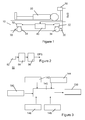
- Figure 1 schematically shows a system for moving a sleeping surface 10 for a human being 20.
- the sleeping surface a bed 10
- the sleeping surface is arranged at rotatable balls 34 that are moved by a motor 32.
- the combination of rotatable ball 34 and the motor 32 forms an actuator 30 for moving the sleeping surface.
- the system further comprises a movement controller 40 for controlling the actuator 30.
- the system further comprises a physiological state estimation unit 50 for estimating a physiological state of the human being on the basis of a sensed value of at least one sensed physiological parameter of said human being 20.
- the operation of the movement controller is dependent on the estimated physiological state EPS.
- the movement controller 40 has an input coupled via signal line EPS to the physiological state estimation unit 50.
- FIG. 2 shows an embodiment of the physiological state estimation unit 50.
- the physiological state estimation unit 50 comprises a sensor 52 for sensing a physiological parameter.
- the sensor 52 is a microphone that senses the breathing of the human being.
- the sensor 52 is a heart signal detector, and in still another embodiment the sensor 52 is arranged to sense muscle activity or brain activity.
- the signal from the sensor 52 is amplified and converted into a digital signal by an amplification and conversion circuit 54.
- the amplification and conversion circuit 54 provides a digital signal to a state recognition circuit 56.
- the state recognition circuit 56 estimates a physiological state of the human 20 on the basis of this digital signal.
- the state recognition circuit 56 may for example determine that the physiological state is "awake” if the breathing rate of the human being 20 is greater than a predetermined value, and determine that the physiological state is "asleep” if the breathing rate of the human being 20 is less than that predetermined value.
- the predetermined value may be set by the user or by a learning algorithm.
- the state recognition circuit 56 may for example determine that the physiological state is "awake” if the heart beat rate of the human being 20 is greater than another predetermined value, and determine that the physiological state is "asleep” if the heart beat rate of the human being 20 is less than the another predetermined value.
- the predetermined value may be set by the user or by a learning algorithm.
- methods are known to determine the physiological state from EEG measurements.
- position and movement are indicators for the physiological state of the human being. These can be observed by a camera. The observed image can be corrected for motion caused by the actuators, and after motion correction a physiological state of the human being can be detected by pattern recognition techniques.
- Various measurements may be combined to obtain a more reliable physiological state estimation. Instead of merely detecting a binary state “asleep” or “awake”, alternatively a more detailed state estimation may be given. For example a more detailed state estimation may indicate the state as “stressed”, “relaxed but awake”, “REM-sleep”, “light-sleep” and “deep-sleep”.
- Figure 3 shows a part of a further embodiment of a system according to the invention. Parts therein corresponding to those in Figure 1 have a reference number that is 100 higher.
- the movement controller 140 is coupled to a user interface module (UI module) 142.
- the UI-module 142 has input facilities, such as a keyboard, touch screen, a microphone, a camera that allows the user to set the system according to his own preferences. The preferences are stored in a memory 144.
- the UI-module 142 may further comprise output facilities, e.g. a screen, a speaker, control lamps that may inform the user about current settings of the system.
- the movement controller 140 further is coupled to a duration timer 146 and an alert timer 148.
- the duration timer 146 may serve to enforce the maintenance of various operational modes of the system during a predetermined time-interval.
- the alert timer 148 may be set to provide an "awake" signal at a predetermined point in time. Both the duration timer 146 and the alert timer 148 may be set by the user via the UI-module 142.
- the sleeping surface and the at least one actuator may for example be constructed as described in US6,682,495
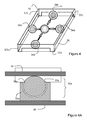
- Figure 4 shows a more preferred embodiment that is relatively noise free.
- the sleeping surface 10 is arranged at one or more balls 34a, ..., 34d, that are rotatably housed in a socket mounted at a bottom plate 36.
- the ball 34a is arranged with play 33a in the socket 35a.
- the socket 35a may form a ball-bearing for the ball 34a, but alternatively may be an oil bearing.
- An actuator 32a may be formed by the combination of the socket 35a and the ball 34a.
- the ball 34a may comprise permanent magnetic elements, while the socket 35a comprises coils that are actuated by the movement controller 40.
- the weight of the sleeping surface 10 is supported by the balls 34a, ..., 34d, and by the supporting columns 37a,.., 37d that are arranged shiftable on the bottom plate 36.
- actuators may be used that provide for a linear movement of the sleeping surface 10.
- Figure 5 schematically illustrates operation of an embodiment of a system according to the invention.
- the system After startup of the system (Start), the system assumes an initial operational mode M0, wherein the one or more actuators 30 are controlled to move the sleeping surface according to a default movement pattern, or according to a preferred movement pattern stored by the user in the memory 144.
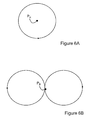
- FIGS 6A, 6B Examples of typical movement patterns are shown in Figures 6A, 6B .
- the actuators 30 move the sleeping surface in a horizontal plane with a movement centered according to a reference point P R .
- the movement is a circular movement around the reference point P R .
- Figure 6B shows another example of a movement pattern. Therein the sleeping surface moves in an 8-like pattern that is centered relative to reference point P R .
- Centered movements in a horizontal plane are considered the most comfortable, while uncentered or vertical movements may in some cases cause dizziness and/or disorientation.
- the movement pattern is a translation of the sleeping surface.
- the orientation of the sleeping surface 10 remains substantially constant.
- the movement typically has a repetition frequency in the order of 2 Hz, e.g. from 1 to 5 Hz.
- a substantially lower frequency e.g. less than 0.1 Hz would have no measurable effect.
- a frequency higher than 5 Hz would not result in a better sleep induction than is already obtained with lower frequencies and would merely result in unnecessary power consumption.
- a substantially higher frequency e.g. 10 Hz would be uncomfortable and prevent the user from sleeping.
- the amplitude A, corresponding to the radius is typically in a range from a few mm, e.g. 2 mm up to a few cm, e.g. 5 cm.
- An amplitude significantly smaller than 2mm, e.g. 1 mm would not have a sleep inducing effect.
- An amplitude significantly larger than 5 cm, e.g. 10 cm would be uncomfortable, and merely result in a high power consumption.
- the jerk occurring during the initial operational mode and the first and the second main operational mode should be limited to a maximum of 5 m.s -3 , although for some individuals a higher jerk level, e.g. 10 m.s -3 may be allowable.
- a system according to the present invention is a system wherein the jerk is less than 10 m/s 3 or alternatively less than 5 m/s 3 when it should be designed to accommodate more selective users.
- a suitable upper limit A max for the amplitude during those operational modes is A max ⁇ 0.02 ⁇ f - 3
- the amplitude of the movements is variable instead of constant. This is shown in Figure 7 by way of example.
- the amplitude varies with a deviation a 1 around a nominal value a 0 .
- the amplitude varies with a deviation b 1 around a nominal value b 0 .
- the amplitude is varied with a frequency that is small as compared to the frequency of the movement of the at least one actuator. For example if the actuator is moved with 2 Hz, then the amplitude is varied with a frequency of 0.5 Hz or lower, e.g. 0.2 Hz. Varying the amplitude has the advantage that mode changes, e.g. from the initial operational mode to the first main operational mode are cloaked. This reduces a risk that the user notices these changes and awakes.
- a preferred setting may be defined by the user.
- the movement controller 40 assumes a first main operational mode M1, wherein the at least one actuator 30 is controlled to move with a gradually reducing amplitude or frequency. The gradual reduction of the amplitude or frequency may take place in a course of e.g. 1 or 2 hours. Subsequently the movement controller assumes a second main operational mode M2, wherein the at least one actuator 30 is controlled to move with an intermittent motion.
- the intermittent motion may for example have a duty cycle of 5-20%, e.g. 10%, e.g. motion may occur each 10 minutes and have a duration of 1 minute, or occur each hour and have a duration of about 5 minutes.
- the movement controller 40 may enter awake-up mode M3, wherein the movement controller 40 controls the at least one actuator 30 to move according to a movement pattern that results in an awakening of the human being.
- the movement pattern applied during the wake-up mode M3, may correspond to that during the other operational modes M0- M2, but the amplitude and/or frequency preferably is higher than during the initial operating mode M0.
- the movement controller is adaptive, i.e. determines itself what are the most suitable settings for the movement pattern.
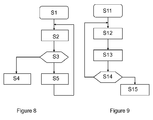
- Figure 8 shows an example of a learning algorithm for learning settings of mode M0.
- step S1 the moment that the user goes to bed, the movement controller starts with an initial setting for amplitude and frequency.
- Physiological parameters are measured in step S2, and subsequently the physiological state of the user is determined in step S3. If it is determined in step S3 that the user tends to sleep this confirms that the initial settings are suitable to induce sleep with that user, and these settings are stored in step S4. If rather it is determined in step S3 that the user tends to wake-up, different settings are generated in step S5, and control flow returns to step S2.
- the sequence of steps S2, S3, S5 is repeated until suitable settings are found for the purpose of inducing sleep.
- Figure 9 shows an example of a learning algorithm for learning settings of mode M3.
- a moment t1 is determined that is a period of time ⁇ 2 before the scheduled wake-up time.
- the movement controller initiates a movement with an initial setting for amplitude and frequency.
- Physiological parameters are measured in step S13, and subsequently the physiological state of the user is determined in step S14. If it is determined in step S 14 that the user tends to wake up, this confirms that the initial settings are suitable for wake-up purposes with that user, and these settings are stored in step S 15. If rather it is determined in step S 14 that the user tends to stay asleep, control flow returns to step S12, where different settings are generated. The sequence of steps S12, S 13, S 14 is repeated until suitable settings are found for waking up purposes.
- a system according to the present invention may be incorporated in a single device; this is particularly the case wherein contact-free sensors are employed.
- the entire system can be integrated in a single device, preferably is a floor-mounted bed.
- two systems according to the present invention may readily be combined into a larger bed so as to accommodate a sleep inducing facility for two individuals.
- the sensor means may need to be adapted so as to isolate the relevant physiological signals for the respective individuals.
- two directional microphones may be used.
- two omni-directional microphones located at opposing sides of the bed may be used to emulate directional microphones by means of signal processing on the registered audio input signals.
- the inputs from both microphones can be used in the process, e.g. by cancelling out audible signals from one individual when estimating the physiological state of the other individual.
- the movement controller may be implemented so as to provide two actuator outputs, but to use one and the same movement controller to control the actuators for both sleeping surfaces.
- the processor could perform all processing in a time-sequential or parallel manner.
Landscapes
- Health & Medical Sciences (AREA)
- Biomedical Technology (AREA)
- Acoustics & Sound (AREA)
- Psychology (AREA)
- Engineering & Computer Science (AREA)
- Anesthesiology (AREA)
- Physics & Mathematics (AREA)
- Heart & Thoracic Surgery (AREA)
- Hematology (AREA)
- Life Sciences & Earth Sciences (AREA)
- Animal Behavior & Ethology (AREA)
- General Health & Medical Sciences (AREA)
- Public Health (AREA)
- Veterinary Medicine (AREA)
- Measurement Of The Respiration, Hearing Ability, Form, And Blood Characteristics Of Living Organisms (AREA)
Priority Applications (1)
| Application Number | Priority Date | Filing Date | Title |
|---|---|---|---|
| EP08172261A EP2198910A1 (de) | 2008-12-19 | 2008-12-19 | Verschieben einer ruhenden Fläche |
Applications Claiming Priority (1)
| Application Number | Priority Date | Filing Date | Title |
|---|---|---|---|
| EP08172261A EP2198910A1 (de) | 2008-12-19 | 2008-12-19 | Verschieben einer ruhenden Fläche |
Publications (1)
| Publication Number | Publication Date |
|---|---|
| EP2198910A1 true EP2198910A1 (de) | 2010-06-23 |
Family
ID=40578775
Family Applications (1)
| Application Number | Title | Priority Date | Filing Date |
|---|---|---|---|
| EP08172261A Ceased EP2198910A1 (de) | 2008-12-19 | 2008-12-19 | Verschieben einer ruhenden Fläche |
Country Status (1)
| Country | Link |
|---|---|
| EP (1) | EP2198910A1 (de) |
Cited By (3)
| Publication number | Priority date | Publication date | Assignee | Title |
|---|---|---|---|---|
| EP2443968A1 (de) * | 2010-10-25 | 2012-04-25 | Peter Larsson | Betteinsatz |
| WO2012164554A1 (en) * | 2011-06-01 | 2012-12-06 | Mijan David | Bed vibration system and method |
| CN108210241A (zh) * | 2018-02-07 | 2018-06-29 | 上海愿航医疗器械有限公司 | 一种水平气血脉动床 |
Citations (10)
| Publication number | Priority date | Publication date | Assignee | Title |
|---|---|---|---|---|
| DE2552488A1 (de) * | 1975-11-22 | 1977-10-13 | Heinrich Joachim | Liege zur heilbehandlung von personen |
| US4619270A (en) * | 1984-04-16 | 1986-10-28 | Margolis Frederick J | Infant respiratory arrest stimulator device |
| WO1998039996A1 (en) * | 1997-03-14 | 1998-09-17 | Nims, Inc. | Reciprocating movement platform for shifting subject to and fro in headwards-footwards direction |
| DE19811207C1 (de) * | 1998-03-10 | 2000-01-05 | Burkhard Kopp | Schwing-Bett mit biologischer Rückkopplung |
| US6155976A (en) * | 1997-03-14 | 2000-12-05 | Nims, Inc. | Reciprocating movement platform for shifting subject to and fro in headwards-footwards direction |
| US6682495B2 (en) | 2001-08-09 | 2004-01-27 | Young-Go Park | Horizontal motion vibrating bed |
| WO2006111875A1 (en) | 2005-04-19 | 2006-10-26 | Philips Intellectual Property & Standards Gmbh | Belt device |
| WO2006129212A2 (en) | 2005-05-31 | 2006-12-07 | Philips Intellectual Property & Standards Gmbh | Method and apparatus for inductively measuring the bio-impedance of a user's body |
| WO2007072239A2 (en) | 2005-12-19 | 2007-06-28 | Koninklijke Philips Electronics N.V. | Apparatus for monitoring a person's heart rate and/or heart rate variation; wristwatch comprising the same |
| US20070179334A1 (en) * | 2006-01-30 | 2007-08-02 | Groves Laurie L | Sleep aid |
-
2008
- 2008-12-19 EP EP08172261A patent/EP2198910A1/de not_active Ceased
Patent Citations (10)
| Publication number | Priority date | Publication date | Assignee | Title |
|---|---|---|---|---|
| DE2552488A1 (de) * | 1975-11-22 | 1977-10-13 | Heinrich Joachim | Liege zur heilbehandlung von personen |
| US4619270A (en) * | 1984-04-16 | 1986-10-28 | Margolis Frederick J | Infant respiratory arrest stimulator device |
| WO1998039996A1 (en) * | 1997-03-14 | 1998-09-17 | Nims, Inc. | Reciprocating movement platform for shifting subject to and fro in headwards-footwards direction |
| US6155976A (en) * | 1997-03-14 | 2000-12-05 | Nims, Inc. | Reciprocating movement platform for shifting subject to and fro in headwards-footwards direction |
| DE19811207C1 (de) * | 1998-03-10 | 2000-01-05 | Burkhard Kopp | Schwing-Bett mit biologischer Rückkopplung |
| US6682495B2 (en) | 2001-08-09 | 2004-01-27 | Young-Go Park | Horizontal motion vibrating bed |
| WO2006111875A1 (en) | 2005-04-19 | 2006-10-26 | Philips Intellectual Property & Standards Gmbh | Belt device |
| WO2006129212A2 (en) | 2005-05-31 | 2006-12-07 | Philips Intellectual Property & Standards Gmbh | Method and apparatus for inductively measuring the bio-impedance of a user's body |
| WO2007072239A2 (en) | 2005-12-19 | 2007-06-28 | Koninklijke Philips Electronics N.V. | Apparatus for monitoring a person's heart rate and/or heart rate variation; wristwatch comprising the same |
| US20070179334A1 (en) * | 2006-01-30 | 2007-08-02 | Groves Laurie L | Sleep aid |
Cited By (5)
| Publication number | Priority date | Publication date | Assignee | Title |
|---|---|---|---|---|
| EP2443968A1 (de) * | 2010-10-25 | 2012-04-25 | Peter Larsson | Betteinsatz |
| WO2012164554A1 (en) * | 2011-06-01 | 2012-12-06 | Mijan David | Bed vibration system and method |
| US20140189957A1 (en) * | 2011-06-01 | 2014-07-10 | David Mijan | Bed Vibration System and Method |
| US9032573B2 (en) * | 2011-06-01 | 2015-05-19 | David Mijan | Bed vibration system and method |
| CN108210241A (zh) * | 2018-02-07 | 2018-06-29 | 上海愿航医疗器械有限公司 | 一种水平气血脉动床 |
Similar Documents
| Publication | Publication Date | Title |
|---|---|---|
| US20230046430A1 (en) | Vibrating pillow strip and operating methods | |
| US11642077B2 (en) | Sleep monitoring system with optional alarm functionality | |
| US9962123B2 (en) | Mattress with alarm features | |
| EP3376343B1 (de) | Technik zur steuerung von ausrüstung auf basis von biometrischen informationen | |
| JP7146419B2 (ja) | 制御装置及び電動家具 | |
| US20120152260A1 (en) | Snoring reduction apparatus | |
| JP5613245B2 (ja) | アラーム時計及び目覚ましアラーム制御方法 | |
| CA2985464A1 (en) | Vibrating pillow strip and operating methods | |
| JP2016501565A5 (de) | ||
| KR101857572B1 (ko) | 스마트 베개 | |
| US20230405263A1 (en) | Systems, methods, and apparatus for monitoring sleep | |
| CN114009994A (zh) | 一种多自由度的智能摇摆助眠床 | |
| US10847010B2 (en) | Method, mobile device and system for optimizing wake-up alarm for two or more persons | |
| JP2011200592A (ja) | 照明装置 | |
| WO2022109192A1 (en) | Systems, methods, and apparatus for monitoring sleep | |
| JP2025120459A (ja) | 端末装置、プログラム及び制御方法 | |
| JP2012112664A (ja) | 目覚まし装置 | |
| KR20230038338A (ko) | 모션 제어 방법 및 시스템 | |
| JP2015013070A (ja) | 覚醒度判定装置及び刺激付与装置 | |
| KR20250054299A (ko) | 수면 관리 시스템 및 수면 관리 방법 | |
| WO2024110342A1 (en) | Controlling a tactile breathing guidance device | |
| KR20180057164A (ko) | 졸음 방지 진동 팔찌 | |
| JP2016005518A (ja) | 目覚まし装置 | |
| JP5741472B2 (ja) | 睡眠制御装置 | |
| EP3984582A1 (de) | Schlafkontrollvorrichtung |
Legal Events
| Date | Code | Title | Description |
|---|---|---|---|
| PUAI | Public reference made under article 153(3) epc to a published international application that has entered the european phase |
Free format text: ORIGINAL CODE: 0009012 |
|
| AK | Designated contracting states |
Kind code of ref document: A1 Designated state(s): AT BE BG CH CY CZ DE DK EE ES FI FR GB GR HR HU IE IS IT LI LT LU LV MC MT NL NO PL PT RO SE SI SK TR |
|
| AX | Request for extension of the european patent |
Extension state: AL BA MK RS |
|
| STAA | Information on the status of an ep patent application or granted ep patent |
Free format text: STATUS: THE APPLICATION HAS BEEN REFUSED |
|
| 18R | Application refused |
Effective date: 20100716 |