EP2199087B1 - Druckverbesserung von Pixeln zur Verbesserung der Lesbarkeit - Google Patents
Druckverbesserung von Pixeln zur Verbesserung der Lesbarkeit Download PDFInfo
- Publication number
- EP2199087B1 EP2199087B1 EP09014046A EP09014046A EP2199087B1 EP 2199087 B1 EP2199087 B1 EP 2199087B1 EP 09014046 A EP09014046 A EP 09014046A EP 09014046 A EP09014046 A EP 09014046A EP 2199087 B1 EP2199087 B1 EP 2199087B1
- Authority
- EP
- European Patent Office
- Prior art keywords
- pixels
- printed
- medium
- substance
- Prior art date
- Legal status (The legal status is an assumption and is not a legal conclusion. Google has not performed a legal analysis and makes no representation as to the accuracy of the status listed.)
- Not-in-force
Links
- 238000000034 method Methods 0.000 claims abstract description 26
- 239000007787 solid Substances 0.000 claims abstract description 14
- 239000003086 colorant Substances 0.000 claims abstract description 5
- 239000000976 ink Substances 0.000 claims description 59
- 238000007639 printing Methods 0.000 claims description 13
- 238000009966 trimming Methods 0.000 claims description 9
- 239000002904 solvent Substances 0.000 claims description 6
- 238000011176 pooling Methods 0.000 claims description 4
- 239000000126 substance Substances 0.000 claims 12
- 238000007641 inkjet printing Methods 0.000 abstract description 4
- 239000000463 material Substances 0.000 abstract description 4
- 230000000740 bleeding effect Effects 0.000 abstract description 3
- 230000002708 enhancing effect Effects 0.000 abstract 1
- 239000011159 matrix material Substances 0.000 description 8
- 230000003287 optical effect Effects 0.000 description 3
- 230000002457 bidirectional effect Effects 0.000 description 2
- 238000010586 diagram Methods 0.000 description 2
- 238000005516 engineering process Methods 0.000 description 2
- 239000000835 fiber Substances 0.000 description 2
- 239000012530 fluid Substances 0.000 description 2
- 238000009472 formulation Methods 0.000 description 2
- 238000004519 manufacturing process Methods 0.000 description 2
- 239000000203 mixture Substances 0.000 description 2
- 230000008961 swelling Effects 0.000 description 2
- XLYOFNOQVPJJNP-UHFFFAOYSA-N water Substances O XLYOFNOQVPJJNP-UHFFFAOYSA-N 0.000 description 2
- 230000015556 catabolic process Effects 0.000 description 1
- 238000006731 degradation reaction Methods 0.000 description 1
- 238000001035 drying Methods 0.000 description 1
- 230000009977 dual effect Effects 0.000 description 1
- 239000000975 dye Substances 0.000 description 1
- 230000000694 effects Effects 0.000 description 1
- 238000011065 in-situ storage Methods 0.000 description 1
- 239000000155 melt Substances 0.000 description 1
- 238000013508 migration Methods 0.000 description 1
- 230000005012 migration Effects 0.000 description 1
- 239000000049 pigment Substances 0.000 description 1
- -1 printers Substances 0.000 description 1
- 230000000750 progressive effect Effects 0.000 description 1
- 229920006395 saturated elastomer Polymers 0.000 description 1
- 238000010023 transfer printing Methods 0.000 description 1
- 238000011179 visual inspection Methods 0.000 description 1
Images



Classifications
-
- B—PERFORMING OPERATIONS; TRANSPORTING
- B41—PRINTING; LINING MACHINES; TYPEWRITERS; STAMPS
- B41J—TYPEWRITERS; SELECTIVE PRINTING MECHANISMS, i.e. MECHANISMS PRINTING OTHERWISE THAN FROM A FORME; CORRECTION OF TYPOGRAPHICAL ERRORS
- B41J11/00—Devices or arrangements of selective printing mechanisms, e.g. ink-jet printers or thermal printers, for supporting or handling copy material in sheet or web form
- B41J11/0015—Devices or arrangements of selective printing mechanisms, e.g. ink-jet printers or thermal printers, for supporting or handling copy material in sheet or web form for treating before, during or after printing or for uniform coating or laminating the copy material before or after printing
-
- B—PERFORMING OPERATIONS; TRANSPORTING
- B41—PRINTING; LINING MACHINES; TYPEWRITERS; STAMPS
- B41J—TYPEWRITERS; SELECTIVE PRINTING MECHANISMS, i.e. MECHANISMS PRINTING OTHERWISE THAN FROM A FORME; CORRECTION OF TYPOGRAPHICAL ERRORS
- B41J3/00—Typewriters or selective printing or marking mechanisms characterised by the purpose for which they are constructed
- B41J3/54—Typewriters or selective printing or marking mechanisms characterised by the purpose for which they are constructed with two or more sets of type or printing elements
- B41J3/543—Typewriters or selective printing or marking mechanisms characterised by the purpose for which they are constructed with two or more sets of type or printing elements with multiple inkjet print heads
Definitions
- the invention relates generally to the field of printing and more particularly to improving the readability of printed matter.
- Print matter needs to be printed with a high level of quality to ensure readability by automation equipment, especially when old technology readers require very high print contrast ratios to ensure readability. The problem is particularly evident when barcodes are automatically read by postal automation equipment and other barcode readers.
- Barcodes have been used in a wide variety of applications as a source for information. Typically barcodes are used at a point-of-sale terminal in merchandising for pricing and inventory control. Barcodes are also used in controlling personnel access systems, mailing systems, and in manufacturing for work-in process and inventory control systems, etc.
- the barcodes themselves represent numbers or alphanumeric characters by series of adjacent stripes of various widths, (i.e. a width modulated universal product code), heights (i.e. a height modulated POSTNET barcode), or position (2D barcode).
- An ordinary barcode is a set of binary numbers. It typically consists of black bars and white spaces. A wide black bar space may signify a one and a thin black bar or space may signify a zero. The binary numbers stand for decimal numbers or letters. There are several different kinds of barcodes. In each one, a number, letter or other character is formed by a pre-established number of bars and spaces.
- Width modulated barcodes are "vertically redundant", meaning that the same information is repeated vertically. They are in fact a one-dimensional code. The heights of the bars can be truncated without any lose of information. A two-dimensional code stores information along the height as well as the length of the symbol. Thus, in the same area more information may be stored in a two dimensional barcode than in a one dimensional barcode.
- Barcodes are also very sensitive to ink in unwanted locations - the line of contact and the white spaces in barcodes must be preserved and readability can be severely impacted if ink is allowed to bleed into regions which are intended to be blank (print growth).
- Another problem of the prior art is that it is often difficult to automatically read printed information that has a low print contrast ratio which is due to non optimal print coverage.
- EP-A1-1 291 187 provides a method of optimized ink jet printing of barcodes. Inkjet printing of barcodes is enhanced by several methods. In a printhead having two staggered columns of nozzles, using only the even (or odd) column enhances resolution of a vertical barcode element. Filling interior portions of the barcode element with the odd (or even) column improves barcode appearance. Barcode swelling, due to ink migration after application, is reduced by use of a depletion matrix to lessen the quantity of ink applied. Application of the depletion matrix to the edges of the barcode elements resists swelling where resolution is most required.
- edges of the barcode elements may be printed only by one column of printhead nozzles, or only during one direction of printhead movement, or both. Alternately, removal of one or more pixels along the edge of a barcode element allows each barcode element to swell to the desired size.
- This invention overcomes the disadvantages of the prior art by providing a method to improve barcode print image quality by printing the bar code ink from one printhead or trench and then applying the solvent from a second printhead on the first printed image in order to improve the printed area uniformity.
- the conditions of the 2 inks to be printed are the following : the first ink has to have a low percentage of colorant soluble in the post printed solvent and the solvent has to be able to wet the first print efficiently during the printing process.
- the invention utilizes a print head to cause localized improvement by applying a fluid that acts on prints generated by another print head.
- the invention also prevents bleeding into unwanted areas where it could lower the quality of the printed material by utilizing the localized (targeted) print capabilities of print heads.
- Barcode 11 represents an enlarged detail portion of a width modulated barcode.
- Barcode 11 contains bars 12, 13 and 14 and spaces 15, 16 and 17.
- Bar 12 is three pixels wide, bar 13 is two pixels wide, and bar 14 is one pixel wide.
- Bar 12 represents a unique number (i.e., three), bar 13 represents a unique number (i.e., two), and bar 14 represents a unique number (i.e., one).
- Spaces 15, 16 and 17 are one unit wide.
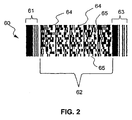
- Fig. 2 is a drawing of a two dimensional (2-d) barcode 60.
- Barcode 60 includes: a start pattern 61, that informs a scanner (not shown) when to begin reading data; a data portion 62; and a stop pattern 63, that informs a scanner when to stop reading data.
- Data portion 62 comprises printed barcode data elements (rectangles) 64 and non printed barcode data elements (spaces) 65.
- the coded information represented by data portion 62 is contained in the relative positions of the printed (64) and non printed (65) barcode data elements that are scanned.
- Fig. 3 illustrates in enlarged detail an idealized black rectangle 64 of Fig. 2 .
- Fig. 4 illustrates in enlarged detail a black rectangle 64 of Fig. 2 that comprises a matrix of 5 by 5 printed pixels 66.
- the printed pixels 66 have unintended voids 67 between them.
- the print contrast within the printed area of rectangle 64 is diluted by the unintended voids 67 or white space between pixels 66 resulting in an average lower optical density and therefore lowered contrast ratio even in the presence of an "ideal" 100% black ink.
- Fig. 5 illustrates in enlarged detail a black rectangle 64 of Fig. 2 that comprise a matrix of 5 by 5 printed pixels 66, including nine pixels 66 in the enhanced coverage area 68 of rectangle 64.
- a facilitator e.g. water
- the pixel trimmed area 68 has been defined as the area remaining after trimming one row of pixels 66 off the top and bottom of the original rectangle 64 and one column off the left and right of the original rectangle 64. This prevents any unwanted bleeding of the image outside the intended boundaries of rectangle 64.
- This facilitator causes enhanced coverage of the pixels 66 in area 68 resulting in the image displayed in Fig. 6 after the ink dries.
- Any number of pixels may be trimmed in different applications (more may be trimmed at higher print resolutions).
- the pixel trimming may also be different in different directions. For instance, the manufacturing process of paper results in a "grain" of preferred fiber orientation. Ink may show unintended bleed differently along the grain of the paper than across the grain of the paper. Therefore it may be desirable for the print area 68 for facilitator application to be trimmed more from the original rectangle 64 along the long axis (with the grain) of the paper than across the grain.
- a first print head may be used to apply a facilitator like water.
- the first print head may also be an existing print cartridge containing both ink and facilitator which is utilized for this function.
- a second print head like Xerox Y100 produced by Xerox Corporation, 100 South Clinton Avenue, Rochester, NY 14644, U.S.A. may be used to print pixels 66 with a black ink.
- Fig. 6 illustrates in enlarged detail a black rectangle 64 of Fig. 5 that formed an almost solid black area 69 after the ink dried.
- the print quality and readability of rectangle 64 is improved because rectangle 64 is practically a solid black mass that contains no white areas or voids.
- the enhanced coverage printed area has been homogenized (resulting in a more uniform optical density within the area) by adding the facilitator.
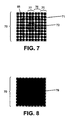
- FIG. 7 illustrates a print rectangle 70 from which two pixel columns (75) have been stripped from the right and left side (as well as pixel rows from the top and bottom) to define the reduced print area rectangle 71.
- a further embodiment of this invention recognizes that when large solid rectangles (70) are printed on paper, there may be a central area (rectangle 72) in which ink tends to pool because the paper fibers are saturated with ink. Therefore, a second parameter may be defined which further limits the maximum solid rectangular area (71) over which facilitator will be applied.
- facilitator While facilitator will be applied to the rectangular area 71, it will be applied in reduced volume (e.g. 50%) in the inner rectangular reduced print area (72). Considering a cross section of this printed area therefore, we observe that the entire rectangle (70) has been printed with black ink.
- the facilitator raster print area has been defined as the original print area (70) less a two pixel boundary (75) on the right, left, top, and bottom resulting in a facilitator print area of rectangle 71.
- This rectangle could be computed as the facilitator print area less a defined number of border pixels (76) resulting in 4 pixels (77) trimmed from the original rectangle height (and 4 from the width) to which the reduced facilitator volume is applied to prevent ink pooling.
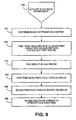
- Fig. 9 is a process flow diagram of the printing of rectangle 64 of Fig. 6 .
- the process begins in step 100 to activate in situ image enhancement.
- the image is rasterized for the printing of rectangle 64 with black ink.
- Rasterization means that the original two dimensional image is converted into a series of strips (rows) by the computer.
- For each potential print pixel a determination is made as to whether it should be printed in black or left unprinted (white).
- This raster data is then used to drive print commands or signals to the print head as it scans across the corresponding points on the unprinted paper.
- step 102 the present invention takes the existing rasterized image and trims one (or more as desired) pixel from all contiguous solid print areas to generate the corresponding enhanced print area 68 facilitator print raster data. Pixels are not trimmed from rectangles 64 which are completely surrounded (within the contiguous print area) by other printed rectangles 64.
- step 103 the media is passed through the printer. As it passes through, in step 104 the first (facilitator) print head prints (overlays) facilitator on all subset areas 68 within rectangles 64. Then in step 105 the second (ink) print head of the printer prints pixels 66 in all rectangles 64 as directed by the black ink raster data. Now in step 106 the facilitator and ink produce an enhanced coverage solid black area 69 that contains virtually no white areas or voids within the boundaries of rectangles 64.
- Fig. 10 is a drawing of the apparatus of this invention showing two print heads (ink 201 and facilitator 202) that print the enhanced barcode 60.
- Print head controller 200 is coupled to print head 201 that ejects a black ink and controller 200 is coupled to print head 202 that ejects the facilitator for the aforementioned black ink.
- Controller 200 causes ink drops from print head 201 and facilitator from ink jet 202 to fall on paper 204 that moves in direction A.
- Ink jets 201 and 202 move in direction B.
- Controller 200 will cause print heads 201 and 202 to print bar code 60.
- controller 200 may be used to control various print heads that eject colored inks so that bar code 60 may be a bar code that has multiple colors.
- Bidirectional print heads may utilize dual facilitator heads (either side) or ink which remain unfixed long enough for the facilitator to be effective when deposited after the ink is printed.
- Figure 11 illustrates the black and facilitator print heads (201, 202) as they progress across the paper (204) in direction B printing a strip of the rasterized barcode (60).
- Printed material is visible to the left of the print heads while the paper remains white in advance of the print operation to the right.
- the print head will reset to the left position, and the print operation can repeat.
- the present invention recognizes that columns of pixels are printed simultaneously across the face of the print head as it advances across the paper but that pixels in subsequent strips will be printed with a significant latency.
- each ink has a material, solvent, or fluid ("facilitator") which facilitates the enhanced coverage of ink into nearby areas. If this facilitator is applied when the ink is printed as described in this application then the ink will be better able to spread into the unwanted voids 67 and enhance coverage.
- the application describes the concept of taking the area to be printed and pixel trimming the dimensions of that area for application of the facilitator to prevent unintended bleed of the ink.
- a straightforward calibration process may be utilized to determine the desired facilitator load and pixel trimming of the print area for facilitator application.
- a monochrome black dot pattern, as presented in the application figures, may be printed and the unintended voids between pixels observed as well as the quality of test barcodes.
- Test patterns allow for a progressive series of dot or barcode tests in which the quantity of facilitator and number of pixels trimmed is varied: Table 1: Matrix Describing Print Quality Test Barcodes Pixels Trimmed % Maximum Facilitator 0% 25% 50% 75% 100% 0 A B C D E 1 F G H I J 2 K L M N O 5 P Q S T U 10 V W X Y Z
- test cases "A, F, K, P, and V” correspond to the instances in which no facilitator is applied (and therefore the trimming of the pixels is moot).
- test cases in the final column represent instances in which the maximum facilitator is applied.
- Comparison of case “E” (no pixels trimmed) to cases with progressively greater numbers of pixels trimmed (“J, O, U, Z”) will reveal the point at which the enhanced coverage extends beyond the boundaries is the intended pattern and therefore is causing unwanted image distortion.
- This test pattern would easily fit on a single sheet of paper and therefore the test print is accomplished quickly. Selection of the "best" pattern in which black and white pixels are of equal size could be done by visual inspection (as alignment patterns are done on many printers today) or through automation.
- Test cases may also be included to identify the effects of paper grain and allow setting of different pixel trimming parameters in the horizontal and vertical axes.
- An automated solution would be to utilize a barcode reader / verifier to read each of the printed barcodes and identify the point at which the read rates and quality are highest.
- Some print heads may have the ability to delivery varying quantities of ink (underdrive or overdrive) resulting in reduced or enlarged pixels as described in other applications by Check and Sansone in U.S. Patent Number 4,386,272 assigned to Pitney Bowes Inc.
- the quantities of black ink delivered within regions 68 or 71 may be deliberately increased to produce enlarged pixels and the volumes of ink delivered to pixels within regions 72 may be reduced to produce reduced pixels.
- Dithering of pixels may also be used to reduce unwanted pooling of ink due to saturation in large print areas 71.
Landscapes
- Ink Jet (AREA)
Claims (12)
- Ein Verfahren zum Bilden von Strichen eines Strichcodes (11), wobei das Verfahren die Schritte umfasst:Drucken (103) von Pixeln (66) auf ein Medium (204) mit einer Tinte; undAufbringen (104) einer Substanz, die die Ausbreitung der gedruckten Pixel (66) auf dem Medium (204) fördert,wobei die Substanz, die die Ausbreitung der Pixel (66) auf dem Medium fördert, aufgebracht wird vor oder nachdem die Pixel gedruckt werden.
- Das in einem vorhergehenden Anspruch beanspruchte Verfahren, wobei die Substanz, die die Ausbreitung der Pixel (66) fördert, ein Lösemittel der Tinte ist.
- Das in einem vorhergehenden Anspruch beanspruchte Verfahren, wobei die Substanz, die die Ausbreitung der Pixel fördert, eine existierende Tinte ist.
- Das in einem vorhergehenden Anspruch beanspruchte Verfahren, wobei die Substanz, die die Ausbreitung der Pixel fördert, mehrere Tinten aus mehreren Druckköpfen (201, 202) sind.
- Das in einem vorhergehenden Anspruch beanspruchte Verfahren, wobei die Tinte darüber hinaus aufgebracht wird, um Wachstum von Pixeln in den angrenzenden Raum auf dem Mediums zu veranlassen.
- Das in einem vorhergehenden Anspruch beanspruchte Verfahren, wobei die Substanz, die die Ausbreitung von Pixeln (66) auf einem Medium (204) fördert, auf eine Teilmenge der Pixel auf dem Medium (204) aufgebracht wird.
- Das in Anspruch 6 beanspruchte Verfahren, wobei die Substanz, die die Ausbreitung der Pixel (66) auf einem Medium (204) fördert, auf eine Teilmenge der Pixel (66) auf dem Medium (204) aufgebracht wird, die bestimmt wird durch Reduzieren der horizontalen Dimension der Festpixel-Druckflächen um M Pixel.
- Das in Anspruch 6 beanspruchte Verfahren, wobei die Substanz, die die Ausbreitung der Pixel (66) auf einem Medium fördert, auf eine Teilmenge der Pixel (66) auf dem Medium aufgebracht wird, die bestimmt wird durch Reduzieren der vertikalen Dimension der Festpixel-Druckflächen um N Pixel.
- Das in Anspruch 6 beanspruchte Verfahren, wobei die Teilmenge der Pixel auf dem Medium zum Aufbringen der Substanz bestimmt wird während der Rasterung (101) des Bildes durch Abschneiden (102) der Begrenzungen der Festdruckflächen durch N Pixel.
- Das in Anspruch 9 beanspruchte Verfahren, wobei:die Teilmenge der Pixel auf dem Medium zum Aufbringen der Substanz während der Rasterung (101) des Bildes bestimmt wird;Information betreffend die Zuweisung von Druckdaten an separate Druckkopf- (201, 202) Verarbeitungsschritte beinhaltet ist; und Grenzen der Festdruckflächen innerhalb von Druckkopf-Verarbeitungsschritten um N Pixel abgeschnitten (102) werden.
- Das in Anspruch 9 beanspruchte Verfahren, wobei:die Teilmenge der Pixel auf dem Medium zum Aufbringen der Substanz während der Rasterung (101) des Bildes bestimmt wird;Information betreffend das Ausmaß der beabsichtigten Festfläche beinhaltet ist; unddie Menge der Substanz, die im Zentrum einer großen Überdruckfläche aufzubringen ist, reduziert wird, um Poolbildung zu reduzieren.
- Das in einem vorhergehenden Anspruch beanspruchte Verfahren, wobei die gedruckte Tinte ein Teil eines Farbmittels aufweist, das in einem nach dem Druck aufgebrachten Lösungsmittel lösbar ist.
Applications Claiming Priority (1)
| Application Number | Priority Date | Filing Date | Title |
|---|---|---|---|
| US12/337,792 US8235516B2 (en) | 2008-12-18 | 2008-12-18 | Print enhancement of pixels to improve readability |
Publications (2)
| Publication Number | Publication Date |
|---|---|
| EP2199087A1 EP2199087A1 (de) | 2010-06-23 |
| EP2199087B1 true EP2199087B1 (de) | 2012-01-18 |
Family
ID=42101805
Family Applications (1)
| Application Number | Title | Priority Date | Filing Date |
|---|---|---|---|
| EP09014046A Not-in-force EP2199087B1 (de) | 2008-12-18 | 2009-11-10 | Druckverbesserung von Pixeln zur Verbesserung der Lesbarkeit |
Country Status (3)
| Country | Link |
|---|---|
| US (1) | US8235516B2 (de) |
| EP (1) | EP2199087B1 (de) |
| AT (1) | ATE541707T1 (de) |
Families Citing this family (4)
| Publication number | Priority date | Publication date | Assignee | Title |
|---|---|---|---|---|
| JP5858708B2 (ja) * | 2011-09-27 | 2016-02-10 | 理想科学工業株式会社 | バーコード印刷制御装置 |
| WO2017007481A1 (en) | 2015-07-09 | 2017-01-12 | Hewlett-Packard Development Company, L.P. | Printer configuration |
| US10882309B2 (en) | 2017-07-25 | 2021-01-05 | Illinois Tool Works Inc. | Printing system and method |
| FR3087557B1 (fr) * | 2018-10-18 | 2021-04-30 | Novatec | Procede d'impression et d'authentification d'un marquage imprime |
Family Cites Families (16)
| Publication number | Priority date | Publication date | Assignee | Title |
|---|---|---|---|---|
| US711933A (en) | 1902-03-22 | 1902-10-28 | Amos R Black | Agricultural rake. |
| US4386272C1 (en) | 1978-07-07 | 2001-02-06 | Pitney Bowes Inc | Apparatus and method for generating images by producing light spots of different sizes |
| US5625397A (en) * | 1994-11-23 | 1997-04-29 | Iris Graphics, Inc. | Dot on dot ink jet printing using inks of differing densities |
| US6102537A (en) * | 1995-02-13 | 2000-08-15 | Canon Kabushiki Kaisha | Method and apparatus for ink-jet printing |
| JP2001246767A (ja) | 2000-03-07 | 2001-09-11 | Sharp Corp | インクジェット画像形成方法及びインクジェット画像形成装置 |
| US6805422B2 (en) * | 2000-06-27 | 2004-10-19 | Canon Kabushiki Kaisha | Ink jet recording method, recording apparatus and data processing method |
| JP3870020B2 (ja) | 2000-10-24 | 2007-01-17 | キヤノン株式会社 | インクジェットプリント装置および吐出データ作成方法 |
| US6585364B2 (en) * | 2001-05-29 | 2003-07-01 | Hewlett-Packard Development Company, L.P. | Methods and apparatus for improving inkjet print quality |
| US7311395B2 (en) | 2001-09-07 | 2007-12-25 | Hewlett-Packard Development Company, L.P. | Optimized ink jet printing of barcodes |
| US6863374B2 (en) * | 2002-04-16 | 2005-03-08 | Seiko Epson Corporation | Image printing using print quality enhancing ink |
| US6672718B1 (en) | 2002-07-23 | 2004-01-06 | Laser Lock Technologies, Inc. | Aqueous latent image printing method and aqueous latent image printing ink for use therewith |
| DE60314539D1 (de) | 2002-11-13 | 2007-08-02 | Kodak Il Ltd | Verwendung eines kontinuierlichen tintenstrahldruckers zum präzisen drucken mit titanoxidbasierten tinte |
| JP2004291401A (ja) | 2003-03-27 | 2004-10-21 | Toppan Forms Co Ltd | インクジェットプリントシステムおよび方法 |
| JP4822759B2 (ja) * | 2005-07-28 | 2011-11-24 | 富士フイルム株式会社 | 画像形成装置 |
| JP2008006734A (ja) | 2006-06-30 | 2008-01-17 | Canon Finetech Inc | 画像形成装置及び画像形成方法 |
| WO2008133630A1 (en) | 2007-04-30 | 2008-11-06 | Hewlett-Packard Development Company, L.P. | Method and apparatus for printing fluid on a substrate |
-
2008
- 2008-12-18 US US12/337,792 patent/US8235516B2/en not_active Expired - Fee Related
-
2009
- 2009-11-10 EP EP09014046A patent/EP2199087B1/de not_active Not-in-force
- 2009-11-10 AT AT09014046T patent/ATE541707T1/de active
Also Published As
| Publication number | Publication date |
|---|---|
| EP2199087A1 (de) | 2010-06-23 |
| US20100157007A1 (en) | 2010-06-24 |
| ATE541707T1 (de) | 2012-02-15 |
| US8235516B2 (en) | 2012-08-07 |
Similar Documents
| Publication | Publication Date | Title |
|---|---|---|
| US20100155494A1 (en) | Print containment of pixels to improve readability | |
| US6199765B1 (en) | Printer media with bar code identification system | |
| EP0622758B1 (de) | Verringerung der Anzahl der zu druckenden Punkte in einem Rasterbild mit hoher Auflösung | |
| US5745131A (en) | Gray scale ink jet printer | |
| US5883644A (en) | Resolution-dependent and color-dependent print masking | |
| US7377619B2 (en) | Printing apparatus and printing method | |
| KR20030022059A (ko) | 바코드 프린트 방법 | |
| MX2008015959A (es) | Simbologias multidimensionales y metodos relacionados. | |
| US20090174908A1 (en) | Method of printing and printer | |
| US6027203A (en) | Page wide ink-jet printer and method of making | |
| US8235516B2 (en) | Print enhancement of pixels to improve readability | |
| US20020039118A1 (en) | Ink-jet printing apparatus and method, and computer readable memory | |
| US6702416B2 (en) | Methods and apparatus for printing grey levels | |
| EP0730247A1 (de) | Tintenstrahldruckverfahren unter Verwendung von Farbenverstärkung in schwarzen Gebieten | |
| US6543871B1 (en) | Mask generator and image mask patterns | |
| US7452046B2 (en) | Method for preparing a print mask | |
| AU2002227320A1 (en) | Mask generator and image mask patterns | |
| US8387888B2 (en) | Reduced-ink barcodes | |
| DE60010081T2 (de) | Vorrichtung zur bilderzeugung | |
| US6146030A (en) | Method and apparatus for printing laminated bar code symbols and other symbols suffering from specular reflection distortions | |
| EP1350629B1 (de) | Verfahren und Vorrichtung zum Drucken von Grautönen mittels härtbarer Tinten | |
| US6905193B2 (en) | Method and apparatus for printing grey levels with curable inks | |
| US12109821B2 (en) | Printing apparatus and printing method | |
| US20060087527A1 (en) | Method for preparing a print mask | |
| CN115610112B (zh) | 喷墨记录设备和喷墨记录方法 |
Legal Events
| Date | Code | Title | Description |
|---|---|---|---|
| PUAI | Public reference made under article 153(3) epc to a published international application that has entered the european phase |
Free format text: ORIGINAL CODE: 0009012 |
|
| AK | Designated contracting states |
Kind code of ref document: A1 Designated state(s): AT BE BG CH CY CZ DE DK EE ES FI FR GB GR HR HU IE IS IT LI LT LU LV MC MK MT NL NO PL PT RO SE SI SK SM TR |
|
| AX | Request for extension of the european patent |
Extension state: AL BA RS |
|
| 17P | Request for examination filed |
Effective date: 20101207 |
|
| GRAP | Despatch of communication of intention to grant a patent |
Free format text: ORIGINAL CODE: EPIDOSNIGR1 |
|
| RIC1 | Information provided on ipc code assigned before grant |
Ipc: B41J 3/01 20060101AFI20110701BHEP Ipc: B41J 11/00 20060101ALI20110701BHEP |
|
| GRAS | Grant fee paid |
Free format text: ORIGINAL CODE: EPIDOSNIGR3 |
|
| GRAA | (expected) grant |
Free format text: ORIGINAL CODE: 0009210 |
|
| AK | Designated contracting states |
Kind code of ref document: B1 Designated state(s): AT BE BG CH CY CZ DE DK EE ES FI FR GB GR HR HU IE IS IT LI LT LU LV MC MK MT NL NO PL PT RO SE SI SK SM TR |
|
| REG | Reference to a national code |
Ref country code: GB Ref legal event code: FG4D |
|
| REG | Reference to a national code |
Ref country code: CH Ref legal event code: EP |
|
| REG | Reference to a national code |
Ref country code: IE Ref legal event code: FG4D Ref country code: AT Ref legal event code: REF Ref document number: 541707 Country of ref document: AT Kind code of ref document: T Effective date: 20120215 |
|
| REG | Reference to a national code |
Ref country code: DE Ref legal event code: R096 Ref document number: 602009004660 Country of ref document: DE Effective date: 20120315 |
|
| REG | Reference to a national code |
Ref country code: NL Ref legal event code: VDEP Effective date: 20120118 |
|
| LTIE | Lt: invalidation of european patent or patent extension |
Effective date: 20120118 |
|
| PG25 | Lapsed in a contracting state [announced via postgrant information from national office to epo] |
Ref country code: LT Free format text: LAPSE BECAUSE OF FAILURE TO SUBMIT A TRANSLATION OF THE DESCRIPTION OR TO PAY THE FEE WITHIN THE PRESCRIBED TIME-LIMIT Effective date: 20120118 Ref country code: BG Free format text: LAPSE BECAUSE OF FAILURE TO SUBMIT A TRANSLATION OF THE DESCRIPTION OR TO PAY THE FEE WITHIN THE PRESCRIBED TIME-LIMIT Effective date: 20120418 Ref country code: NL Free format text: LAPSE BECAUSE OF FAILURE TO SUBMIT A TRANSLATION OF THE DESCRIPTION OR TO PAY THE FEE WITHIN THE PRESCRIBED TIME-LIMIT Effective date: 20120118 Ref country code: IS Free format text: LAPSE BECAUSE OF FAILURE TO SUBMIT A TRANSLATION OF THE DESCRIPTION OR TO PAY THE FEE WITHIN THE PRESCRIBED TIME-LIMIT Effective date: 20120518 Ref country code: BE Free format text: LAPSE BECAUSE OF FAILURE TO SUBMIT A TRANSLATION OF THE DESCRIPTION OR TO PAY THE FEE WITHIN THE PRESCRIBED TIME-LIMIT Effective date: 20120118 Ref country code: NO Free format text: LAPSE BECAUSE OF FAILURE TO SUBMIT A TRANSLATION OF THE DESCRIPTION OR TO PAY THE FEE WITHIN THE PRESCRIBED TIME-LIMIT Effective date: 20120418 Ref country code: HR Free format text: LAPSE BECAUSE OF FAILURE TO SUBMIT A TRANSLATION OF THE DESCRIPTION OR TO PAY THE FEE WITHIN THE PRESCRIBED TIME-LIMIT Effective date: 20120118 |
|
| PG25 | Lapsed in a contracting state [announced via postgrant information from national office to epo] |
Ref country code: PT Free format text: LAPSE BECAUSE OF FAILURE TO SUBMIT A TRANSLATION OF THE DESCRIPTION OR TO PAY THE FEE WITHIN THE PRESCRIBED TIME-LIMIT Effective date: 20120518 Ref country code: LV Free format text: LAPSE BECAUSE OF FAILURE TO SUBMIT A TRANSLATION OF THE DESCRIPTION OR TO PAY THE FEE WITHIN THE PRESCRIBED TIME-LIMIT Effective date: 20120118 Ref country code: PL Free format text: LAPSE BECAUSE OF FAILURE TO SUBMIT A TRANSLATION OF THE DESCRIPTION OR TO PAY THE FEE WITHIN THE PRESCRIBED TIME-LIMIT Effective date: 20120118 Ref country code: FI Free format text: LAPSE BECAUSE OF FAILURE TO SUBMIT A TRANSLATION OF THE DESCRIPTION OR TO PAY THE FEE WITHIN THE PRESCRIBED TIME-LIMIT Effective date: 20120118 Ref country code: GR Free format text: LAPSE BECAUSE OF FAILURE TO SUBMIT A TRANSLATION OF THE DESCRIPTION OR TO PAY THE FEE WITHIN THE PRESCRIBED TIME-LIMIT Effective date: 20120419 |
|
| REG | Reference to a national code |
Ref country code: AT Ref legal event code: MK05 Ref document number: 541707 Country of ref document: AT Kind code of ref document: T Effective date: 20120118 |
|
| PG25 | Lapsed in a contracting state [announced via postgrant information from national office to epo] |
Ref country code: CY Free format text: LAPSE BECAUSE OF FAILURE TO SUBMIT A TRANSLATION OF THE DESCRIPTION OR TO PAY THE FEE WITHIN THE PRESCRIBED TIME-LIMIT Effective date: 20120118 |
|
| PG25 | Lapsed in a contracting state [announced via postgrant information from national office to epo] |
Ref country code: SI Free format text: LAPSE BECAUSE OF FAILURE TO SUBMIT A TRANSLATION OF THE DESCRIPTION OR TO PAY THE FEE WITHIN THE PRESCRIBED TIME-LIMIT Effective date: 20120118 Ref country code: SE Free format text: LAPSE BECAUSE OF FAILURE TO SUBMIT A TRANSLATION OF THE DESCRIPTION OR TO PAY THE FEE WITHIN THE PRESCRIBED TIME-LIMIT Effective date: 20120118 Ref country code: EE Free format text: LAPSE BECAUSE OF FAILURE TO SUBMIT A TRANSLATION OF THE DESCRIPTION OR TO PAY THE FEE WITHIN THE PRESCRIBED TIME-LIMIT Effective date: 20120118 Ref country code: CZ Free format text: LAPSE BECAUSE OF FAILURE TO SUBMIT A TRANSLATION OF THE DESCRIPTION OR TO PAY THE FEE WITHIN THE PRESCRIBED TIME-LIMIT Effective date: 20120118 Ref country code: DK Free format text: LAPSE BECAUSE OF FAILURE TO SUBMIT A TRANSLATION OF THE DESCRIPTION OR TO PAY THE FEE WITHIN THE PRESCRIBED TIME-LIMIT Effective date: 20120118 Ref country code: RO Free format text: LAPSE BECAUSE OF FAILURE TO SUBMIT A TRANSLATION OF THE DESCRIPTION OR TO PAY THE FEE WITHIN THE PRESCRIBED TIME-LIMIT Effective date: 20120118 |
|
| PLBE | No opposition filed within time limit |
Free format text: ORIGINAL CODE: 0009261 |
|
| STAA | Information on the status of an ep patent application or granted ep patent |
Free format text: STATUS: NO OPPOSITION FILED WITHIN TIME LIMIT |
|
| PG25 | Lapsed in a contracting state [announced via postgrant information from national office to epo] |
Ref country code: SK Free format text: LAPSE BECAUSE OF FAILURE TO SUBMIT A TRANSLATION OF THE DESCRIPTION OR TO PAY THE FEE WITHIN THE PRESCRIBED TIME-LIMIT Effective date: 20120118 Ref country code: IT Free format text: LAPSE BECAUSE OF FAILURE TO SUBMIT A TRANSLATION OF THE DESCRIPTION OR TO PAY THE FEE WITHIN THE PRESCRIBED TIME-LIMIT Effective date: 20120118 |
|
| 26N | No opposition filed |
Effective date: 20121019 |
|
| PG25 | Lapsed in a contracting state [announced via postgrant information from national office to epo] |
Ref country code: AT Free format text: LAPSE BECAUSE OF FAILURE TO SUBMIT A TRANSLATION OF THE DESCRIPTION OR TO PAY THE FEE WITHIN THE PRESCRIBED TIME-LIMIT Effective date: 20120118 |
|
| REG | Reference to a national code |
Ref country code: DE Ref legal event code: R097 Ref document number: 602009004660 Country of ref document: DE Effective date: 20121019 |
|
| PG25 | Lapsed in a contracting state [announced via postgrant information from national office to epo] |
Ref country code: ES Free format text: LAPSE BECAUSE OF FAILURE TO SUBMIT A TRANSLATION OF THE DESCRIPTION OR TO PAY THE FEE WITHIN THE PRESCRIBED TIME-LIMIT Effective date: 20120429 |
|
| REG | Reference to a national code |
Ref country code: IE Ref legal event code: MM4A |
|
| PG25 | Lapsed in a contracting state [announced via postgrant information from national office to epo] |
Ref country code: IE Free format text: LAPSE BECAUSE OF NON-PAYMENT OF DUE FEES Effective date: 20121110 |
|
| PG25 | Lapsed in a contracting state [announced via postgrant information from national office to epo] |
Ref country code: MT Free format text: LAPSE BECAUSE OF FAILURE TO SUBMIT A TRANSLATION OF THE DESCRIPTION OR TO PAY THE FEE WITHIN THE PRESCRIBED TIME-LIMIT Effective date: 20120118 |
|
| PG25 | Lapsed in a contracting state [announced via postgrant information from national office to epo] |
Ref country code: MC Free format text: LAPSE BECAUSE OF NON-PAYMENT OF DUE FEES Effective date: 20121130 Ref country code: TR Free format text: LAPSE BECAUSE OF FAILURE TO SUBMIT A TRANSLATION OF THE DESCRIPTION OR TO PAY THE FEE WITHIN THE PRESCRIBED TIME-LIMIT Effective date: 20120118 |
|
| PG25 | Lapsed in a contracting state [announced via postgrant information from national office to epo] |
Ref country code: LU Free format text: LAPSE BECAUSE OF NON-PAYMENT OF DUE FEES Effective date: 20121110 Ref country code: SM Free format text: LAPSE BECAUSE OF FAILURE TO SUBMIT A TRANSLATION OF THE DESCRIPTION OR TO PAY THE FEE WITHIN THE PRESCRIBED TIME-LIMIT Effective date: 20120118 |
|
| REG | Reference to a national code |
Ref country code: CH Ref legal event code: PL |
|
| PG25 | Lapsed in a contracting state [announced via postgrant information from national office to epo] |
Ref country code: CH Free format text: LAPSE BECAUSE OF NON-PAYMENT OF DUE FEES Effective date: 20131130 Ref country code: LI Free format text: LAPSE BECAUSE OF NON-PAYMENT OF DUE FEES Effective date: 20131130 Ref country code: HU Free format text: LAPSE BECAUSE OF FAILURE TO SUBMIT A TRANSLATION OF THE DESCRIPTION OR TO PAY THE FEE WITHIN THE PRESCRIBED TIME-LIMIT Effective date: 20091110 |
|
| PG25 | Lapsed in a contracting state [announced via postgrant information from national office to epo] |
Ref country code: MK Free format text: LAPSE BECAUSE OF FAILURE TO SUBMIT A TRANSLATION OF THE DESCRIPTION OR TO PAY THE FEE WITHIN THE PRESCRIBED TIME-LIMIT Effective date: 20120118 |
|
| REG | Reference to a national code |
Ref country code: FR Ref legal event code: PLFP Year of fee payment: 7 |
|
| REG | Reference to a national code |
Ref country code: FR Ref legal event code: PLFP Year of fee payment: 8 |
|
| REG | Reference to a national code |
Ref country code: FR Ref legal event code: PLFP Year of fee payment: 9 |
|
| PGFP | Annual fee paid to national office [announced via postgrant information from national office to epo] |
Ref country code: DE Payment date: 20181128 Year of fee payment: 10 |
|
| PGFP | Annual fee paid to national office [announced via postgrant information from national office to epo] |
Ref country code: FR Payment date: 20181127 Year of fee payment: 10 Ref country code: GB Payment date: 20181127 Year of fee payment: 10 |
|
| REG | Reference to a national code |
Ref country code: DE Ref legal event code: R119 Ref document number: 602009004660 Country of ref document: DE |
|
| GBPC | Gb: european patent ceased through non-payment of renewal fee |
Effective date: 20191110 |
|
| PG25 | Lapsed in a contracting state [announced via postgrant information from national office to epo] |
Ref country code: GB Free format text: LAPSE BECAUSE OF NON-PAYMENT OF DUE FEES Effective date: 20191110 Ref country code: DE Free format text: LAPSE BECAUSE OF NON-PAYMENT OF DUE FEES Effective date: 20200603 |
|
| PG25 | Lapsed in a contracting state [announced via postgrant information from national office to epo] |
Ref country code: FR Free format text: LAPSE BECAUSE OF NON-PAYMENT OF DUE FEES Effective date: 20191130 |