EP2199225B1 - Deckel für einen Gewürzbehälter - Google Patents
Deckel für einen Gewürzbehälter Download PDFInfo
- Publication number
- EP2199225B1 EP2199225B1 EP09156800A EP09156800A EP2199225B1 EP 2199225 B1 EP2199225 B1 EP 2199225B1 EP 09156800 A EP09156800 A EP 09156800A EP 09156800 A EP09156800 A EP 09156800A EP 2199225 B1 EP2199225 B1 EP 2199225B1
- Authority
- EP
- European Patent Office
- Prior art keywords
- cap
- seal
- central
- peripheral wall
- outer portion
- Prior art date
- Legal status (The legal status is an assumption and is not a legal conclusion. Google has not performed a legal analysis and makes no representation as to the accuracy of the status listed.)
- Not-in-force
Links
- 235000013409 condiments Nutrition 0.000 title claims description 44
- 230000002093 peripheral effect Effects 0.000 claims description 110
- 230000000295 complement effect Effects 0.000 claims description 11
- 239000000463 material Substances 0.000 claims description 9
- 238000007373 indentation Methods 0.000 claims description 5
- 230000006854 communication Effects 0.000 abstract 2
- 230000007175 bidirectional communication Effects 0.000 abstract 1
- 238000000034 method Methods 0.000 abstract 1
- 150000003839 salts Chemical class 0.000 description 4
- 235000012054 meals Nutrition 0.000 description 2
- 229920001296 polysiloxane Polymers 0.000 description 2
- 229920002725 thermoplastic elastomer Polymers 0.000 description 2
- 244000043261 Hevea brasiliensis Species 0.000 description 1
- 238000009825 accumulation Methods 0.000 description 1
- 239000011324 bead Substances 0.000 description 1
- 230000006835 compression Effects 0.000 description 1
- 238000007906 compression Methods 0.000 description 1
- 239000000428 dust Substances 0.000 description 1
- 239000012535 impurity Substances 0.000 description 1
- 238000002347 injection Methods 0.000 description 1
- 239000007924 injection Substances 0.000 description 1
- 238000003780 insertion Methods 0.000 description 1
- 230000037431 insertion Effects 0.000 description 1
- 238000012986 modification Methods 0.000 description 1
- 230000004048 modification Effects 0.000 description 1
- 229920003052 natural elastomer Polymers 0.000 description 1
- 229920001194 natural rubber Polymers 0.000 description 1
- 239000002689 soil Substances 0.000 description 1
- 230000000007 visual effect Effects 0.000 description 1
Images


Classifications
-
- B—PERFORMING OPERATIONS; TRANSPORTING
- B65—CONVEYING; PACKING; STORING; HANDLING THIN OR FILAMENTARY MATERIAL
- B65D—CONTAINERS FOR STORAGE OR TRANSPORT OF ARTICLES OR MATERIALS, e.g. BAGS, BARRELS, BOTTLES, BOXES, CANS, CARTONS, CRATES, DRUMS, JARS, TANKS, HOPPERS, FORWARDING CONTAINERS; ACCESSORIES, CLOSURES, OR FITTINGS THEREFOR; PACKAGING ELEMENTS; PACKAGES
- B65D47/00—Closures with filling and discharging, or with discharging, devices
- B65D47/04—Closures with discharging devices other than pumps
- B65D47/20—Closures with discharging devices other than pumps comprising hand-operated members for controlling discharge
- B65D47/2018—Closures with discharging devices other than pumps comprising hand-operated members for controlling discharge comprising a valve or like element which is opened or closed by deformation of the container or closure
Definitions
- the present invention relates to a cap for a condiment container.
- Condiment containers such as salt shakers traditionally have caps with dispensing openings provided therein to allow the escape of condiments through the cap when the container is inverted.
- the condiment container can thus be used to spread condiments over, e.g., a meal by inverting the container over the meal to allow the condiment from escaping through the cap onto the plate.
- condiments may escape accidentally if the container is tilted or tipped unwillingly. Furthermore, the open dispensing openings allow the entry of humidity, dust and other impurities into the condiment container which may soil the condiments. As such, caps for condiment containers that provide a closing mechanism are preferred to those that do not.
- US Patent 5,597,096 provides a shaker for condiments with a cap that can open and close.
- the cap which is in accordance with the preamble of claim 1, has an arcuate form and can be opened by a user by pressing on the apex of the form. When opened, the cap arches upwards and reveals dispensing openings.
- This cap suffers from multiple drawbacks. For example, it is only mountable on a shaker having an integral mounting bead along the mouth.
- the present invention provides a cap for a container defining an interior for storing condiments for human consumption and having an upper portion defining a mouth.
- the cap comprises a member having an inner portion and an outer portion, the inner portion having a top portion with a peripheral wall extending downwardly for covering the mouth of the container, the peripheral wall of the inner portion having means for retaining the cap onto the container, the top portion of the inner portion having a plurality of openings for allowing passage of the condiments, the outer portion having a top portion with a peripheral wall extending downwardly for covering at least partially the peripheral wall of the inner portion, the top portion of the outer portion having a plurality of dispensing openings for allowing passage of the condiments outwards from the interior of the container.
- the cap further comprises a seal having a top portion comprising a central portion, a flange portion extending around the central portion for overlapping the dispensing openings, and a central peripheral wall extending downwardly from said top portion and having a lower end mounted to the member.
- the seal is moveable between a closed position, wherein the central portion is above the flange portion and the flange portion covers the dispensing openings of the outer portion for preventing passage of the condiments outwards from the interior of the container, and an open position, wherein the central portion is below the flange portion and the flange portion frees the dispensing openings for allowing passage of the condiments outwards from the interior of the container.
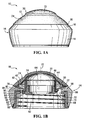
- Figure 1A shows a cap 10 for a condiment container such as a salt shaker.
- the cap is suitable for fastening to a container having an upper portion with a peripheral wall defining a mount and an interior for receiving condiments.
- orientationally descriptive terms such as 'upward', 'top', 'vertical' or 'upper', will generally refer to this particular frame of reference. However, it should be understood that this orientation is used only as an example to facilitate understanding of the invention, but that the invention is not limited to any particular orientation of its elements.
- the mouth of the container described above is described as being defined at an upper portion of the container, it should be understood that the container could be reoriented or otherwise shaped such that the portion defining the mouth is no longer "up” without departing from the intended scope of the invention.
- the cap 10 comprises a seal 12 and a member 14.
- the member 14 comprises a top portion 16 and a peripheral wall 18 extending downwardly from the top portion 16.
- the peripheral wall 18 is circular in cross-section; however it should be understood that the peripheral wall 18 of the member 14, and indeed, all parts of the cap 10 and the cap 10 itself may vary in shape and size and that the invention is not intended to be limited to the particular shape shown in the figures.
- the cap 10 is suited for attachment to a condiment container at a mouth of the condiment container by any appropriate retaining mean. When the cap is attached to the container, the peripheral wall of the member is said to cover the mouth of the container.
- the peripheral wall of the member has threads 92 and can be twisted onto a suitably threaded container, however the particular retaining means used is not meant to limit the invention and in any arrangement when the mouth of the container is covered by the cap, it is said that the peripheral wall of the member covers the mouth of the container.
- the seal 12 comprises a top portion 20, which is the only portion of the seal 12 visible in Figure 1A .
- the top portion 20 comprises a central portion 22 and an annular flange portion 24 extending around the central portion 22.
- the seal 12 has a substantially circular circumference.
- the central portion 22 is substantially circular and is surrounded by the flange portion 24.
- Figures 1A, 1B and 3 show the seal 12 in a closed position. In the closed position, the seal 12 adopts a substantially convex form, so called because from a perspective outside of the cap 10 and the container, the seal 12 swells outwards. At least an area 28 within the top portion 16 of the member 14 is covered by the seal 12 when the seal 12 is in the closed position.
- the area 28 is a peripheral surface which surrounds a central opening 40 provided in the member.
- the peripheral surface comprises a plurality of dispensing openings 30.
- the dispensing openings 30 can be located anywhere on the member 14 but are preferably on the top portion 16 thereof and preferably still on the peripheral surface. When not blocked, the dispensing openings 30 allow the passage of condiments through the member 14, for example from the interior of a container attached to the cap 10 outwards.
- the peripheral surface comprises a flat section 34, an inclined section 36 and a crest 38.
- the inclined section 36 extends upwardly from the flat section to the crest 38.
- the flat section 34, inclined section 36 and crest 38 are shown here as three discrete section, they can be merely portions of a continuum, and even infinitesimal such portions.
- the flat section 34 and the inclined section 38 could form a continuous curve from the central opening 40 up to the crest 38.
- the crest 38 is shown here as a circular peak, it should be understood that it could be any section of any shape located upwardly from the flat section 34, such as a flat section extending outward from the inclined section 36 or even an inclined continuation of the inclined section 36.
- the area 28 is said to be covered or overlapped by the seal 12 because the seal 12 blocks it and makes it inaccessible.
- the top portion 20 forms a seal around this area. It should be understood that it is not necessary for there to be direct contact between the seal and the area 28 for it to be considered covered. Rather, it must merely be blocked e.g. in such a manner that condiments cannot exit to the exterior through the dispensing openings 30.
- the top portion 20 rests against the crest 38 but leaves an open gap 42 above the inclined section 36 and the flat section 34. Nevertheless, the gap 42, flat section 34, inclined section 36 and dispensing openings 30 are considered covered by the seal 12, since they are blocked. For example, condiments such as salt cannot pass through the dispensing openings 30 and out away from the cap when the seal is in the closed position.
- the seal 12 could lay physically on the covered area 28, leaving no gap between the seal 12 and the member 14 at the area 28.
- the flange portion 24 of the seal 12 comprises a lower peripheral end wall 80 for abutting against the member 14.
- the lower peripheral end wall 80 is generally horizontally flat, or aligned perpendicularly with a longitudinal axis 72 of the cap 10 and rests against the crest 38 for forming a seal for preventing exit of the condiments.
- the lower peripheral end wall 80 is, along with the rest of the flange portion 24, moved upwards from its closed-position location and no longer prevents passage of condiments outwards.
- the lower peripheral end wall 80 is aligned transversely with respect to the vertical axis 72 of the cap 10, not perpendicularly but rather obliquely.
- the flange portion 24 comprises on its lower surface an annular indentation 82 located radially interiorly of the lower peripheral end wall 80.
- the annular indentation 82 is adjacent the lower peripheral end wall 80.
- the annular indentation 82 may reduce resilience in the material in the flange portion 24, which resilience may otherwise impede the seal 12 from adopting the closed position or the open position.
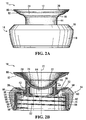
- Figures 2A, 2B and 4 show the seal 12 in an open position.
- the seal 12 adopts a substantially concave form, so called because it defines a depression visible from a perspective outside of the cap 10 and the container.
- the seal 12 is in the open position, the area 28 of the top portion 16 of the member 14 is considered uncovered even though part of the seal 12 may lie physically above it because it is not blocked.
- the top portion 16 of the member 14 has the dispensing openings 30 located in the section 28 that is covered by the seal 12 when the seal 12 is in the closed position.
- grooves 32 are provided adjacent the dispensing openings 30.
- the dispensing openings 30 are each located inside a respective groove 32, each groove 32 extending outwards into the inclined section 36.
- each dispensing opening 30 is located in a respective groove 32, it should be noted that many other configurations of grooves 32 and dispensing openings 30 are possible.
- the dispensing openings 30 may be near, but not in, the grooves 32 and there may be multiple dispensing openings 30 to a groove 32.
- the seal 12 comprises a central peripheral wall 44 extending downwardly from the top portion 20 of the seal 12 at a peripheral live hinge 46.
- the central peripheral wall 44 has a generally cylindrical shape however, other shapes are possible.
- the central peripheral wall 44 has a lower end 66 to be mounted to the member 14.
- the peripheral live hinge 46 allows movement of the top portion 20 of the seal 12 with respect to the central peripheral wall 44.
- the peripheral live hinge 46 defines an area of reduced thickness with respect to the central peripheral wall 44, although any configuration providing adequate hinging could be used.
- the live hinge 46 connects the central peripheral wall 44 to the underside of the top portion 20 of the seal 12 around the periphery of central portion 22.
- the top portion 20 of the seal 12 adopts a substantially concave form when in the closed position and a substantially concave form when in the open position.
- the flange portion 24 extends downwardly from the central portion 22.
- the flange portion 24 extends above the central portion 22 and the central portion 22 is located within the central peripherall wall 44.
- the central portion 22 moves downwards below the level of the live hinge 46. As best seen in Figure 2B , the central portion 22 moves into the cylindrical form defined by the central peripheral wall 44 of the member. When the central portion 22 is pushed downwards, resilience in the material of the top portion 20 of the seal 12 causes the flange portion 24 to move upwards above the live hinge 46. As a result, the top portion 20 of the seal 12 adopts the convex form characteristic of the open position of the seal 12. In order to return the seal 12 to the closed position, a user moves the flange portion 24 downwards towards its closed-position arrangement. Resilience in the material of the top portion 40 of the seal 12 causes the central portion 22 to move upwards above the live hinge 46 and return to the open-position arrangement.
- the central peripheral wall 44 and the peripheral live hinge 46 can be made of any suitable material and do not need to be of the same material as the top portion 20 of the seal 12.
- the central peripheral wall 44 and/or the peripheral live hinge 46 could be made of different materials, e.g. by overmolding.
- the central peripheral wall 44, live hinge 46 and top portion 20 of the seal 12 together form an integral piece made of a soft single flexible material with a good shape memory.
- the seal can be made of injection molded silicone, compression molded silicone, thermoplastic rubber (TPR) or natural rubber.
- the lower end 66 of the central peripheral wall 44 is affixed to the member 14 in an area adjacent the central opening 40.
- the central peripheral wall 44 may be affixed to the member 14 in such a way as to block or seal the central opening 40, if present, such that condiments cannot pass through the central opening 40.
- the central peripheral wall 44 passes through at least a part of the central opening 40 and the lower end 66 is held against a bottom surface of the member 14 such that condiment cannot escape through the central opening 40.
- condiments can enter the cylindrical form of the central peripheral wall 40, but then find no opening through which to escape to the exterior.
- the central peripheral wall 44 can be affixed to the member 14 by any suitable means.
- the lower end 66 of the central peripheral wall 14 can be glued to the member 14 or held by friction.
- the member 14 may be a single integral piece or may be made of two or more pieces. As best shown in Figures 1B , 2B and 5 , the member 14 is made up of an inner portion 50 and an outer portion 52.
- the inner portion 50 has a top portion 54 and a peripheral wall 56 that extends downwardly from the top portion 50.
- the peripheral wall 56 of the inner portion 50 comprises threads 92 disposed on the inside thereof that match treads on the outside surface of the container for attaching the cap 10 thereto.
- the outer portion 52 has a top portion 58 and a peripheral wall 60 that extends downwardly from the top portion 58 and may make up a portion of the peripheral wall 18 of the member 14.
- the peripheral wall 60 of the outer portion 52 covers at least partially the peripheral wall 56 of the inner portion, as shown in Figures 1B and 2B .
- the outer portion 52 comprises the dispensing openings 30, the area 28 having the peripheral surface, the grooves 32 and the central opening 40.
- the inner portion 50 comprises a plurality of openings 62 adjacent with the dispensing openings 30 of the outer portion 52. It is not necessary for the openings 62 of the inner portion 50 to be similar in shape, size or quantity as the dispensing openings 30 of the outer portion, rather it is merely necessary for at least a portion of the dispensing openings 30 to be aligned with at least a portion of the openings 62 such that condiments can flow out through the member 14. As seen in Figure 5 , the openings 62 of the inner portion 50 are much larger than the dispensing openings 30 of the outer portion, each being aligned with four dispensing openings 30.
- a central opening 64 could be provided in the inner portion 50, as shown in Figures 1B and 2B .
- the central opening 64 is generally circular and encircles the vertical axis 72 of the cap 10.
- the central opening 64 may allow passage of air downward into the container and out through the dispensing openings 30.
- the air flow enabled by the central opening 64 also facilitates movement of the seal 12 from the open position to the closed position by preventing a decrease of pressure that would result from moving the central portion 22 upwards and increasing the volume of space between the central portion 22, the central peripheral wall 44 and the member 14, which decrease in pressure would resist the movement of the central portion 22 upwards. It should be appreciated however, that it is not necessary to provide central opening 40, and that other means could be provided for allowing airflow. For example, holes in the top portion of the seal could be provided.
- the central peripheral wall 44 passes through the central opening 40 of the outer portion 52.
- the central peripheral wall 44 has a peripheral ring 68 at the lower end 66.
- the peripheral ring 68 can be a simple enlargement of the diameter of the central peripheral wall 44 or any other form that projects radially outwards therefrom.
- the term peripheral "ring" is used here because in this non-limiting example the central peripheral wall 44 is cylindrical and the peripheral ring 68 follows the contour of the central peripheral wall 44, thus defining a ring-like shape.
- the peripheral ring 68 can be any form that projects outwards from the central peripheral wall 44, not necessarily following the shape of the central peripheral wall 44 which in any case does not necessarily have to be cylindrical in form. While the peripheral ring 68 is disposed around the periphery of central peripheral wall 44 at the lower end, it does not necessarily need to follow the entire periphery of central peripheral wall 44, and may be present only on a section or sections thereof.
- the central peripheral wall 44 passes through the central opening 40 of the outer portion 52 and rests against the inner periphery of the central opening 40.
- the peripheral ring 68 is below the outer portion 52 and projects radially outwards beyond the central opening 40. As such, the peripheral ring 68 abuts against a bottom surface 70 of the top portion 58 of the outer portion 52 and prevents movement of the seal 12.
- the top portion 54 of the inner portion 50 rests against the peripheral ring 68 from beneath, such that the peripheral ring 68 is sandwiched between the bottom surface 70 of the top portion 58 of the outer portion 52 and the top portion 54 of the inner portion 50. The seal 12 is thus securely held in place with respect to the member 14.
- the peripheral ring 68 can include one or more projection 90 with a hole 86.
- the projection 90 may project radially outwards beyond the rest of the peripheral ring 68 and may receive within the hole 86 a pin 88 projecting downwardly from the outer portion 52.
- the hole 86 receives the pin 88 projecting downwardly from the bottom surface 70.
- Four projections 90 can be included in the peripheral ring 68 located at four equidistant points on the peripheral ring 68; although more or less projections 90 could be provided.
- a pin 88 is provided on the outer portion 52 so as to align with the projection 90.
- holes 84 are provided in the top portion 54 of the inner portion 50 to accommodate the respective pins 88, such that each pin 88 can pass through the respective holes 86, 84 (see Figures 1B , 2B and 5 ).
- the pin 88 was described as projecting downwards from the bottom surface 70 of the top portion 58 of the outer portion 52, it will be readily appreciated that the pin 88 could equally project upwards from the top portion 54 of the inner portion 50 and that accordingly, corresponding hole could be located in the outer portion 52.
- pins projecting downwardly from the bottom surface of the member 14 can be received in the respective holes 86 of the seal 12.
- the projection 90 and pin 88 combination impedes rotational motion of the seal 12 relative to the member 14.
- the central opening 40 of the outer portion 52 overlaps at least partially the central opening 64 of the inner portion 50 so that air can flow as described above.
- the top portion 54 of the inner portion 50 comprises a projection 74 extending upwardly inside the volume enclosed by the central peripheral wall 44 of the seal 12.
- the projection 74 follows at least partly the inner contour of central peripheral wall 44.
- the projection 74 may rest against the interior surface of central peripheral wall 44 and so hold the central peripheral wall 44 against the inner periphery of central opening 40 of the outer portion 52, as best shown in Figures 1B and 2B .
- the projection 74 extends upwards past the top portion 58 of the outer portion 52 and supports the central peripheral wall 44.
- the inner portion 50 and the outer portion 52 can be connected in any suitable manner. Their connection can be permanent or releasable. For example, they can be glued together. In another example, the inner portion 50 and the outer portion 52 are held together by friction-fit arrangement.
- a protrusion and a complementary recess combination can be provided on the inner portion and outer portion to prevent movement of the inner portion and outer portion relative to one another in the vertical direction.
- the protrusion and complementary recess can follow the curvature of the inner and outer portions 50, 52 respectively and impede translational movement of the inner portion 50 relative to the outer portion 52 along the vertical axis. Additional protrusions and complementary recesses can be provided to prevent other motion between the inner and outer portions 50, 52.
- Vertical protrusions extending vertically along the interior surface of the outer portion and complementary vertical recesses extending vertically along the exterior surface of the inner portion can be provided.
- vertical protrusions and corresponding complementary recess combinations can be provided along the contour of the respective inner and outer portions 50, 52, each of which can be aligned with the hole 84 of the inner portion 50 which may facilitate visual alignment of the inner portion 50 with the outer portion 52 for insertion therein.
- Vertical protrusions and corresponding complementary recesses may prevent rotational motion of the inner portion 50 relative to the outer portion 52, particularly when twisting the cap 10 on or off a container. It will be appreciated that these protrusions and complementary recesses could be inverted, the protrusions being on the inner portion 50 and the complementary recesses on the outer portion 52.
- Figure 6 is a cross-sectional view of a seal 12 with various thicknesses of materials indicated.
- the table below indicates the values of dimensions referred to by the variables in Figure 6 .
- the entries in the table indicate a range of possible values for each variable and at least one preferred value.
- the seal can have an external diameter of between 30 millimeters and 60 millimeters. These dimensions are in no way intended to limit the invention.
Landscapes
- Engineering & Computer Science (AREA)
- Mechanical Engineering (AREA)
- Closures For Containers (AREA)
- Mobile Radio Communication Systems (AREA)
Claims (32)
- Verschluss (10) für einen Behälter, der einen Innenraum definiert zur Aufbewahrung von Gewürzen für den menschlichen Verzehr und der einen oberen Anteil hat, der eine Öffnung definiert, wobei der Verschluss eine Mehrzahl von Ausgabeöffnungen (30), die einen Durchgang der Gewürze aus dem Innenraum des Behälters heraus erlauben, und eine Dichtung (12) umfasst, die einen oberen Anteil (20) hat, der einen zentralen Anteil (22), einen Flanschanteil (24), der sich um den zentralen Anteil herum erstreckt, um die Ausgabeöffnungen (30) zu überdecken, und eine zentrale Umfangswand (44) umfasst, die sich von dem oberen Anteil nach unten hin erstreckt, wobei der Verschluss sich dadurch kennzeichnet, dass der Verschluss ein Element (14) umfasst, das einen inneren Anteil (50) und einen äußeren Anteil (52) aufweist, wobei der innere Anteil einen oberen Anteil (54) mit einer Umfangswand (56) aufweist, die sich nach unten hin erstreckt, um die Öffnung des Behälters abzudecken, wobei die Umfangswand des inneren Anteils Mittel (92) aufweist, um den Verschluss auf dem Behälter festzuhalten, wobei der obere Anteil des inneren Anteils eine Mehrzahl von Öffnungen (62) aufweist, die einen Durchgang der Gewürze erlauben, wobei der äußere Anteil einen oberen Anteil (16) mit einer Umfangswand (18) aufweist, die sich nach unten hin erstreckt, um die Umfangswand des inneren Anteils zumindest teilweise zu überdecken, wobei der obere Anteil des äußeren Anteils die Mehrzahl von Ausgabeöffnungen (30) aufweist und die zentrale Umfangswand (44) ein unteres Ende (66) aufweist, das an dem Element (14) befestigt ist; wobei beim Benutzen die Dichtung zwischen einer geschlossenen Position, in der der zentrale Anteil (22) oberhalb des Flanschanteils (24) ist und der Flanschanteil (24) die Ausgabeöffnungen (30) des äußeren Anteils überdeckt, um einen Durchgang der Gewürze aus dem Innenraum des Behälters heraus zu verhindern, und einer geöffneten Position bewegbar ist, in der der zentrale Anteil (22) unterhalb des Flanschanteils (24) ist und der Flanschanteil (24) die Ausgabeöffnungen (30) des äußeren Anteils freigibt, um einen Durchgang der Gewürze aus dem Innenraum des Behälters heraus zu erlauben.
- Verschluss nach Anspruch 1, wobei jede Ausgabeöffnung (30) in einer Kerbe (32) angeordnet ist, die in dem äußeren Anteil definiert ist, wobei die Kerbe sich nach außen hin erstreckt, so dass Gewürze, die durch die Ausgabeöffnungen gelangen, nach außen geleitet werden.
- Verschluss nach Anspruch 1 oder 2, wobei im Gebrauch der zentrale Anteil (22) der Dichtung (12) von einem Benutzer gedrückt werden kann, um die Dichtung von der geschlossenen Position in die geöffnete Position zu bewegen.
- Verschluss nach einem der Ansprüche 1 bis 3, wobei im Gebrauch die Dichtung (12) durch Drücken auf den Flanschanteil von einem Benutzer aus der geöffneten Position in die geschlossene Position bewegt werden kann.
- Verschluss nach einem der Ansprüche 1 bis 4, wobei der äußere Anteil (52) eine zentrale Öffnung (40) umfasst, die eine vertikale Achse des Verschlusses umschließt, wobei die vertikale Achse durch den zentralen Anteil der Dichtung verläuft.
- Verschluss nach Anspruch 5, wobei der zentrale Anteil (22) der Dichtung (12) innerhalb der zentralen Umfangswand der Dichtung angeordnet ist, wenn die Dichtung sich in der geöffneten Position befindet.
- Verschluss nach Anspruch 5, wobei der innere Anteil (50) eine zentrale Öffnung (64) umfasst, die die vertikale Achse des Verschlusses umschließt, um es Luft zu erlauben, durch die zentrale Öffnung des inneren Anteils zu fließen.
- Verschluss nach Anspruch 7, wobei die zentrale Umfangswand (44) sich vom oberen Anteil an einem Umfangsfilmgelenk (46) nach unten erstreckt und durch die zentrale Öffnung (40) des äußeren Anteils (52) verläuft.
- Verschluss nach Anspruch 8, wobei die zentrale Umfangswand (44) eine Dicke zwischen 0,60 Millimetern und 0,80 Millimetern aufweist.
- Verschluss nach Anspruch 9, wobei das Filmgelenk (46) eine Dicke zwischen 0,35 Millimetern und 0,45 Millimetern aufweist.
- Verschluss nach Anspruch 5, wobei das untere Ende (66) der zentralen Umfangswand (44) an dem inneren Anteil oder dem äußeren Anteil in einem Bereich angebracht ist, der zu der zentralen Öffnung (40) des äußeren Anteils (52) benachbart ist.
- Verschluss nach Anspruch 11, wobei die zentrale Umfangswand (44) durch die zentrale Öffnung (40) des äußeren Anteils (52) verläuft.
- Verschluss nach Anspruch 12, wobei der obere Anteil (54) des inneren Anteils (50) einen Vorsprung (74) umfasst, der sich innerhalb der zentralen Umfangswand (44) der Dichtung nach oben erstreckt.
- Verschluss nach Anspruch 13, wobei das untere Ende (66) der zentralen Umfangswand (44) einen Umfangsring (68) umfasst, der sich nach radial außen über die zentrale Öffnung des äußeren Anteils hinaus erstreckt.
- Verschluss nach Anspruch 14, wobei der Umfangsring (68) radial außen jenseits der zentralen Öffnung (64) des inneren Anteils (50) hinaus angeordnet ist, so dass er zwischen einer Unterseite des oberen Anteils des äußeren Anteils und dem oberen Anteil des inneren Anteils angeordnet ist.
- Verschluss nach Anspruch 14, wobei der Umfangsring (68) wenigstens einen Vorsprung (90) mit einem Loch (86) zum Aufnehmen eines Stiftes (88) umfasst, der entweder von dem inneren Anteil oder von dem äußeren Anteil hervorsteht.
- Verschluss nach Anspruch 5, wobei der obere Anteil (16) des äußeren Anteils (52) eine Umfangsfläche definiert, die die zentrale Öffnung (40) des äußeren Anteils umgibt, wobei die Umfangsfläche einen flachen Abschnitt (34) und einen geneigten Abschnitt (36) umfasst, der sich von diesem nach oben zu einem Kamm (38) erstreckt.
- Verschluss nach Anspruch 17, wobei die Ausgabeöffnungen (30) in der Umfangsfläche angeordnet sind.
- Verschluss nach Anspruch 18, wobei die Ausgabeöffnungen (30) im flachen Abschnitt (34) der Umfangsfläche angeordnet sind, wobei die geneigte Oberfläche (36) eine Mehrzahl von Kerben (32) umfasst, die zu der jeweiligen Ausgabeöffnung benachbart sind, um durch die jeweilige Ausgabeöffnung nach draußen austretende Gewürze zu leiten.
- Verschluss nach Anspruch 17, wobei der Flanschanteil (24) eine Umfangsendwand (80) aufweist, die an dem Kamm anliegt, wenn die Dichtung in der geschlossen Position ist.
- Verschluss nach Anspruch 20, wobei die Umfangsendwand (80) senkrecht zu der vertikalen Achse des Verschlusses ausgerichtet ist, wenn sich die Dichtung in der geschlossenen Position befindet und wobei die Umfangswand (80) quer zur vertikalen Achse des Verschlusses ausgerichtet ist, wenn sich die Dichtung in der geöffneten Position befindet.
- Verschluss nach Anspruch 21, wobei der Flanschanteil (24) zudem eine ringförmige Vertiefung (82) an seiner Unterseite aufweist, wobei die ringförmige Vertiefung (82) radial innen von der unteren Umfangswand angeordnet ist.
- Verschluss nach Anspruch 22, wobei die untere Umfangswand (44) eine ringförmige Dicke zwischen 3 Millimetern und 5 Millimetern aufweist.
- Verschluss nach einem der Ansprüche 1 bis 23, wobei der obere Anteil (20) der Dichtung einen im Wesentlichen kreisförmigen Umfang aufweist.
- Verschluss nach einem der Ansprüche 1 bis 24, wobei die Dichtung (12) einen Durchmesser zwischen 30 Millimetern und 60 Millimetern aufweist.
- Verschluss nach einem der Ansprüche 1 bis 25, wobei der zentrale Anteil (22) der Dichtung (12) im Wesentlichen kreisförmig ist und einen Durchmesser zwischen 21,5 Millimetern und 27,5 Millimetern aufweist.
- Verschluss nach einem der Ansprüche 1 bis 26, wobei der Flanschanteil (24) eine Dicke zwischen 2,45 Millimetern und 3,05 Millimetern aufweist.
- Verschluss nach einem der Ansprüche 1 bis 27, wobei, wenn sich die Dichtung (12) in der geschlossenen Position befindet, der obere Anteil (20) im Wesentlichen konvex ist und, wenn sich die Dichtung (12) in der geöffneten Position befindet, der obere Anteil (20) im Wesentlichen konkav ist.
- Verschluss nach einem der Ansprüche 1 bis 28, wobei die Dichtung (12) aus einem weichen, flexiblen Material hergestellt ist.
- Verschluss nach einem der Ansprüche 1 bis 29, wobei der innere Anteil (50) und der äußere Anteil (52) durch eine Reibschlussanordnung zusammen gehalten werden.
- Verschluss nach einem der Ansprüche 1 bis 30, wobei der innere Anteil (50) Gewinde (92) aufweist, um den Verschluss an dem Behälter zu sichern.
- Verschluss nach Anspruch 31, wobei die Umfangswand des inneren Anteils (50) eines von einem Vorsprung und einer dazu komplementären Vertiefung an ihrer äußeren Oberfläche aufweist und die Umfangswand des äußeren Anteils (52) das jeweils andere von dem Vorsprung und der dazu komplementären Vertiefung an ihrer inneren Oberfläche aufweist, wobei bei Benutzung der Vorsprung und die dazu komplementäre Vertiefung ineinander greifen, um eine Drehbewegung zwischen dem inneren Anteil und dem äußeren Anteil zu verhindern.
Applications Claiming Priority (1)
| Application Number | Priority Date | Filing Date | Title |
|---|---|---|---|
| CA2647406A CA2647406C (en) | 2008-12-17 | 2008-12-17 | Cap for a condiment container |
Publications (2)
| Publication Number | Publication Date |
|---|---|
| EP2199225A1 EP2199225A1 (de) | 2010-06-23 |
| EP2199225B1 true EP2199225B1 (de) | 2011-11-30 |
Family
ID=40688436
Family Applications (1)
| Application Number | Title | Priority Date | Filing Date |
|---|---|---|---|
| EP09156800A Not-in-force EP2199225B1 (de) | 2008-12-17 | 2009-03-31 | Deckel für einen Gewürzbehälter |
Country Status (3)
| Country | Link |
|---|---|
| EP (1) | EP2199225B1 (de) |
| AT (1) | ATE535463T1 (de) |
| CA (1) | CA2647406C (de) |
Families Citing this family (2)
| Publication number | Priority date | Publication date | Assignee | Title |
|---|---|---|---|---|
| CN114145666A (zh) * | 2021-12-07 | 2022-03-08 | 湖南怀化俊诚环保节能科技有限公司 | 一种厨房用调味品存放装置 |
| WO2026035777A1 (en) * | 2024-08-05 | 2026-02-12 | Munchkin Incorporated | Drinking container with multi-position valve |
Family Cites Families (2)
| Publication number | Priority date | Publication date | Assignee | Title |
|---|---|---|---|---|
| JPS5041940U (de) * | 1973-08-10 | 1975-04-28 | ||
| US5597096A (en) | 1996-02-15 | 1997-01-28 | Dart Industries Inc. | Shaker for condiments |
-
2008
- 2008-12-17 CA CA2647406A patent/CA2647406C/en active Active
-
2009
- 2009-03-31 EP EP09156800A patent/EP2199225B1/de not_active Not-in-force
- 2009-03-31 AT AT09156800T patent/ATE535463T1/de active
Also Published As
| Publication number | Publication date |
|---|---|
| ATE535463T1 (de) | 2011-12-15 |
| CA2647406A1 (en) | 2010-06-17 |
| EP2199225A1 (de) | 2010-06-23 |
| CA2647406C (en) | 2014-01-28 |
Similar Documents
| Publication | Publication Date | Title |
|---|---|---|
| KR100249868B1 (ko) | 양념 셰이커 | |
| AU2011202432B2 (en) | Discharge cap for bottle-like container | |
| JP6453925B2 (ja) | 飲料容器及びその関連方法 | |
| CA2278078C (en) | Hinged cap and cap body | |
| US8152032B2 (en) | Cap for a condiment container | |
| WO2006009984A3 (en) | Dispensing closure, package and method of manufacture | |
| MX2007009742A (es) | Valvula distribuidora integralmente moldeada y metodo de manufactura. | |
| CN101238043A (zh) | 关闭件 | |
| KR101991776B1 (ko) | 배출량 조절이 가능한 소스 용기 | |
| US20050205587A1 (en) | Cup assembly | |
| JP6349416B2 (ja) | 飲料容器のためのカバー装置 | |
| AU1833801A (en) | Sealed dispensing container | |
| US7578386B2 (en) | Cover assembly enable to mix interior material at opening | |
| ES2174523T3 (es) | Recipiente para productos alimentarios. | |
| KR101564981B1 (ko) | 화장품 케이스 | |
| US5961010A (en) | Dispensing beverage closure | |
| EP2199225A1 (de) | Deckel für einen Gewürzbehälter | |
| US7434689B2 (en) | Packing unit comprising interconnection means | |
| CN112707011B (zh) | 冷藏箱 | |
| KR200496017Y1 (ko) | 스포이드형 화장품 용기 뚜껑 | |
| US10597194B2 (en) | Seed Container and Shell Receptacle | |
| JP7044499B2 (ja) | ヒンジキャップ | |
| USD446076S1 (en) | Food pan lid with an elastomeric seal | |
| KR102852879B1 (ko) | 화장품 용기용 원터치 캡 | |
| KR200499088Y1 (ko) | 조미료 병 뚜껑 |
Legal Events
| Date | Code | Title | Description |
|---|---|---|---|
| PUAI | Public reference made under article 153(3) epc to a published international application that has entered the european phase |
Free format text: ORIGINAL CODE: 0009012 |
|
| AK | Designated contracting states |
Kind code of ref document: A1 Designated state(s): AT BE BG CH CY CZ DE DK EE ES FI FR GB GR HR HU IE IS IT LI LT LU LV MC MK MT NL NO PL PT RO SE SI SK TR |
|
| AX | Request for extension of the european patent |
Extension state: AL BA RS |
|
| 17P | Request for examination filed |
Effective date: 20101102 |
|
| GRAP | Despatch of communication of intention to grant a patent |
Free format text: ORIGINAL CODE: EPIDOSNIGR1 |
|
| AKX | Designation fees paid |
Designated state(s): AT BE BG CH CY CZ DE DK EE ES FI FR GB GR HR HU IE IS IT LI LT LU LV MC MK MT NL NO PL PT RO SE SI SK TR |
|
| GRAS | Grant fee paid |
Free format text: ORIGINAL CODE: EPIDOSNIGR3 |
|
| 17Q | First examination report despatched |
Effective date: 20110711 |
|
| GRAA | (expected) grant |
Free format text: ORIGINAL CODE: 0009210 |
|
| AK | Designated contracting states |
Kind code of ref document: B1 Designated state(s): AT BE BG CH CY CZ DE DK EE ES FI FR GB GR HR HU IE IS IT LI LT LU LV MC MK MT NL NO PL PT RO SE SI SK TR |
|
| REG | Reference to a national code |
Ref country code: GB Ref legal event code: FG4D Ref country code: CH Ref legal event code: EP |
|
| REG | Reference to a national code |
Ref country code: IE Ref legal event code: FG4D |
|
| REG | Reference to a national code |
Ref country code: DE Ref legal event code: R096 Ref document number: 602009003885 Country of ref document: DE Effective date: 20120216 |
|
| REG | Reference to a national code |
Ref country code: NL Ref legal event code: VDEP Effective date: 20111130 |
|
| LTIE | Lt: invalidation of european patent or patent extension |
Effective date: 20111130 |
|
| PG25 | Lapsed in a contracting state [announced via postgrant information from national office to epo] |
Ref country code: NO Free format text: LAPSE BECAUSE OF FAILURE TO SUBMIT A TRANSLATION OF THE DESCRIPTION OR TO PAY THE FEE WITHIN THE PRESCRIBED TIME-LIMIT Effective date: 20120229 Ref country code: IS Free format text: LAPSE BECAUSE OF FAILURE TO SUBMIT A TRANSLATION OF THE DESCRIPTION OR TO PAY THE FEE WITHIN THE PRESCRIBED TIME-LIMIT Effective date: 20120330 Ref country code: LT Free format text: LAPSE BECAUSE OF FAILURE TO SUBMIT A TRANSLATION OF THE DESCRIPTION OR TO PAY THE FEE WITHIN THE PRESCRIBED TIME-LIMIT Effective date: 20111130 |
|
| PG25 | Lapsed in a contracting state [announced via postgrant information from national office to epo] |
Ref country code: PT Free format text: LAPSE BECAUSE OF FAILURE TO SUBMIT A TRANSLATION OF THE DESCRIPTION OR TO PAY THE FEE WITHIN THE PRESCRIBED TIME-LIMIT Effective date: 20120330 Ref country code: SI Free format text: LAPSE BECAUSE OF FAILURE TO SUBMIT A TRANSLATION OF THE DESCRIPTION OR TO PAY THE FEE WITHIN THE PRESCRIBED TIME-LIMIT Effective date: 20111130 Ref country code: LV Free format text: LAPSE BECAUSE OF FAILURE TO SUBMIT A TRANSLATION OF THE DESCRIPTION OR TO PAY THE FEE WITHIN THE PRESCRIBED TIME-LIMIT Effective date: 20111130 Ref country code: SE Free format text: LAPSE BECAUSE OF FAILURE TO SUBMIT A TRANSLATION OF THE DESCRIPTION OR TO PAY THE FEE WITHIN THE PRESCRIBED TIME-LIMIT Effective date: 20111130 Ref country code: NL Free format text: LAPSE BECAUSE OF FAILURE TO SUBMIT A TRANSLATION OF THE DESCRIPTION OR TO PAY THE FEE WITHIN THE PRESCRIBED TIME-LIMIT Effective date: 20111130 Ref country code: GR Free format text: LAPSE BECAUSE OF FAILURE TO SUBMIT A TRANSLATION OF THE DESCRIPTION OR TO PAY THE FEE WITHIN THE PRESCRIBED TIME-LIMIT Effective date: 20120301 Ref country code: BE Free format text: LAPSE BECAUSE OF FAILURE TO SUBMIT A TRANSLATION OF THE DESCRIPTION OR TO PAY THE FEE WITHIN THE PRESCRIBED TIME-LIMIT Effective date: 20111130 Ref country code: HR Free format text: LAPSE BECAUSE OF FAILURE TO SUBMIT A TRANSLATION OF THE DESCRIPTION OR TO PAY THE FEE WITHIN THE PRESCRIBED TIME-LIMIT Effective date: 20111130 |
|
| PG25 | Lapsed in a contracting state [announced via postgrant information from national office to epo] |
Ref country code: CY Free format text: LAPSE BECAUSE OF FAILURE TO SUBMIT A TRANSLATION OF THE DESCRIPTION OR TO PAY THE FEE WITHIN THE PRESCRIBED TIME-LIMIT Effective date: 20111130 |
|
| PG25 | Lapsed in a contracting state [announced via postgrant information from national office to epo] |
Ref country code: EE Free format text: LAPSE BECAUSE OF FAILURE TO SUBMIT A TRANSLATION OF THE DESCRIPTION OR TO PAY THE FEE WITHIN THE PRESCRIBED TIME-LIMIT Effective date: 20111130 Ref country code: SK Free format text: LAPSE BECAUSE OF FAILURE TO SUBMIT A TRANSLATION OF THE DESCRIPTION OR TO PAY THE FEE WITHIN THE PRESCRIBED TIME-LIMIT Effective date: 20111130 Ref country code: CZ Free format text: LAPSE BECAUSE OF FAILURE TO SUBMIT A TRANSLATION OF THE DESCRIPTION OR TO PAY THE FEE WITHIN THE PRESCRIBED TIME-LIMIT Effective date: 20111130 Ref country code: BG Free format text: LAPSE BECAUSE OF FAILURE TO SUBMIT A TRANSLATION OF THE DESCRIPTION OR TO PAY THE FEE WITHIN THE PRESCRIBED TIME-LIMIT Effective date: 20120229 Ref country code: DK Free format text: LAPSE BECAUSE OF FAILURE TO SUBMIT A TRANSLATION OF THE DESCRIPTION OR TO PAY THE FEE WITHIN THE PRESCRIBED TIME-LIMIT Effective date: 20111130 |
|
| PG25 | Lapsed in a contracting state [announced via postgrant information from national office to epo] |
Ref country code: PL Free format text: LAPSE BECAUSE OF FAILURE TO SUBMIT A TRANSLATION OF THE DESCRIPTION OR TO PAY THE FEE WITHIN THE PRESCRIBED TIME-LIMIT Effective date: 20111130 Ref country code: IT Free format text: LAPSE BECAUSE OF FAILURE TO SUBMIT A TRANSLATION OF THE DESCRIPTION OR TO PAY THE FEE WITHIN THE PRESCRIBED TIME-LIMIT Effective date: 20111130 Ref country code: RO Free format text: LAPSE BECAUSE OF FAILURE TO SUBMIT A TRANSLATION OF THE DESCRIPTION OR TO PAY THE FEE WITHIN THE PRESCRIBED TIME-LIMIT Effective date: 20111130 |
|
| REG | Reference to a national code |
Ref country code: AT Ref legal event code: MK05 Ref document number: 535463 Country of ref document: AT Kind code of ref document: T Effective date: 20111130 |
|
| PLBE | No opposition filed within time limit |
Free format text: ORIGINAL CODE: 0009261 |
|
| STAA | Information on the status of an ep patent application or granted ep patent |
Free format text: STATUS: NO OPPOSITION FILED WITHIN TIME LIMIT |
|
| PG25 | Lapsed in a contracting state [announced via postgrant information from national office to epo] |
Ref country code: MC Free format text: LAPSE BECAUSE OF NON-PAYMENT OF DUE FEES Effective date: 20120331 |
|
| 26N | No opposition filed |
Effective date: 20120831 |
|
| REG | Reference to a national code |
Ref country code: DE Ref legal event code: R097 Ref document number: 602009003885 Country of ref document: DE Effective date: 20120831 |
|
| REG | Reference to a national code |
Ref country code: IE Ref legal event code: MM4A |
|
| PG25 | Lapsed in a contracting state [announced via postgrant information from national office to epo] |
Ref country code: AT Free format text: LAPSE BECAUSE OF FAILURE TO SUBMIT A TRANSLATION OF THE DESCRIPTION OR TO PAY THE FEE WITHIN THE PRESCRIBED TIME-LIMIT Effective date: 20111130 Ref country code: IE Free format text: LAPSE BECAUSE OF NON-PAYMENT OF DUE FEES Effective date: 20120331 |
|
| PG25 | Lapsed in a contracting state [announced via postgrant information from national office to epo] |
Ref country code: MK Free format text: LAPSE BECAUSE OF FAILURE TO SUBMIT A TRANSLATION OF THE DESCRIPTION OR TO PAY THE FEE WITHIN THE PRESCRIBED TIME-LIMIT Effective date: 20111130 |
|
| PG25 | Lapsed in a contracting state [announced via postgrant information from national office to epo] |
Ref country code: ES Free format text: LAPSE BECAUSE OF FAILURE TO SUBMIT A TRANSLATION OF THE DESCRIPTION OR TO PAY THE FEE WITHIN THE PRESCRIBED TIME-LIMIT Effective date: 20120311 |
|
| PGFP | Annual fee paid to national office [announced via postgrant information from national office to epo] |
Ref country code: GB Payment date: 20130318 Year of fee payment: 5 Ref country code: DE Payment date: 20130320 Year of fee payment: 5 |
|
| PG25 | Lapsed in a contracting state [announced via postgrant information from national office to epo] |
Ref country code: FI Free format text: LAPSE BECAUSE OF FAILURE TO SUBMIT A TRANSLATION OF THE DESCRIPTION OR TO PAY THE FEE WITHIN THE PRESCRIBED TIME-LIMIT Effective date: 20111130 |
|
| PG25 | Lapsed in a contracting state [announced via postgrant information from national office to epo] |
Ref country code: MT Free format text: LAPSE BECAUSE OF FAILURE TO SUBMIT A TRANSLATION OF THE DESCRIPTION OR TO PAY THE FEE WITHIN THE PRESCRIBED TIME-LIMIT Effective date: 20111130 |
|
| PGFP | Annual fee paid to national office [announced via postgrant information from national office to epo] |
Ref country code: FR Payment date: 20130415 Year of fee payment: 5 |
|
| REG | Reference to a national code |
Ref country code: CH Ref legal event code: PL |
|
| PG25 | Lapsed in a contracting state [announced via postgrant information from national office to epo] |
Ref country code: LI Free format text: LAPSE BECAUSE OF NON-PAYMENT OF DUE FEES Effective date: 20130331 Ref country code: CH Free format text: LAPSE BECAUSE OF NON-PAYMENT OF DUE FEES Effective date: 20130331 |
|
| PG25 | Lapsed in a contracting state [announced via postgrant information from national office to epo] |
Ref country code: TR Free format text: LAPSE BECAUSE OF FAILURE TO SUBMIT A TRANSLATION OF THE DESCRIPTION OR TO PAY THE FEE WITHIN THE PRESCRIBED TIME-LIMIT Effective date: 20111130 |
|
| PG25 | Lapsed in a contracting state [announced via postgrant information from national office to epo] |
Ref country code: LU Free format text: LAPSE BECAUSE OF NON-PAYMENT OF DUE FEES Effective date: 20120331 |
|
| PG25 | Lapsed in a contracting state [announced via postgrant information from national office to epo] |
Ref country code: HU Free format text: LAPSE BECAUSE OF FAILURE TO SUBMIT A TRANSLATION OF THE DESCRIPTION OR TO PAY THE FEE WITHIN THE PRESCRIBED TIME-LIMIT Effective date: 20090331 |
|
| REG | Reference to a national code |
Ref country code: DE Ref legal event code: R119 Ref document number: 602009003885 Country of ref document: DE |
|
| GBPC | Gb: european patent ceased through non-payment of renewal fee |
Effective date: 20140331 |
|
| REG | Reference to a national code |
Ref country code: FR Ref legal event code: ST Effective date: 20141128 |
|
| REG | Reference to a national code |
Ref country code: DE Ref legal event code: R119 Ref document number: 602009003885 Country of ref document: DE Effective date: 20141001 |
|
| PG25 | Lapsed in a contracting state [announced via postgrant information from national office to epo] |
Ref country code: FR Free format text: LAPSE BECAUSE OF NON-PAYMENT OF DUE FEES Effective date: 20140331 Ref country code: GB Free format text: LAPSE BECAUSE OF NON-PAYMENT OF DUE FEES Effective date: 20140331 Ref country code: DE Free format text: LAPSE BECAUSE OF NON-PAYMENT OF DUE FEES Effective date: 20141001 |