EP2199374A2 - Use of manganese compounds to increase the efficiency of an electrostatic precipitator of a combustion unit - Google Patents
Use of manganese compounds to increase the efficiency of an electrostatic precipitator of a combustion unit Download PDFInfo
- Publication number
- EP2199374A2 EP2199374A2 EP10158754A EP10158754A EP2199374A2 EP 2199374 A2 EP2199374 A2 EP 2199374A2 EP 10158754 A EP10158754 A EP 10158754A EP 10158754 A EP10158754 A EP 10158754A EP 2199374 A2 EP2199374 A2 EP 2199374A2
- Authority
- EP
- European Patent Office
- Prior art keywords
- manganese
- fuel
- combustion
- amount
- combustion unit
- Prior art date
- Legal status (The legal status is an assumption and is not a legal conclusion. Google has not performed a legal analysis and makes no representation as to the accuracy of the status listed.)
- Withdrawn
Links
Images

Classifications
-
- B—PERFORMING OPERATIONS; TRANSPORTING
- B03—SEPARATION OF SOLID MATERIALS USING LIQUIDS OR USING PNEUMATIC TABLES OR JIGS; MAGNETIC OR ELECTROSTATIC SEPARATION OF SOLID MATERIALS FROM SOLID MATERIALS OR FLUIDS; SEPARATION BY HIGH-VOLTAGE ELECTRIC FIELDS
- B03C—MAGNETIC OR ELECTROSTATIC SEPARATION OF SOLID MATERIALS FROM SOLID MATERIALS OR FLUIDS; SEPARATION BY HIGH-VOLTAGE ELECTRIC FIELDS
- B03C3/00—Separating dispersed particles from gases or vapour, e.g. air, by electrostatic effect
- B03C3/01—Pretreatment of the gases prior to electrostatic precipitation
- B03C3/013—Conditioning by chemical additives, e.g. with SO3
-
- C—CHEMISTRY; METALLURGY
- C10—PETROLEUM, GAS OR COKE INDUSTRIES; TECHNICAL GASES CONTAINING CARBON MONOXIDE; FUELS; LUBRICANTS; PEAT
- C10G—CRACKING HYDROCARBON OILS; PRODUCTION OF LIQUID HYDROCARBON MIXTURES, e.g. BY DESTRUCTIVE HYDROGENATION, OLIGOMERISATION, POLYMERISATION; RECOVERY OF HYDROCARBON OILS FROM OIL-SHALE, OIL-SAND, OR GASES; REFINING MIXTURES MAINLY CONSISTING OF HYDROCARBONS; REFORMING OF NAPHTHA; MINERAL WAXES
- C10G75/00—Inhibiting corrosion or fouling in apparatus for treatment or conversion of hydrocarbon oils, in general
- C10G75/02—Inhibiting corrosion or fouling in apparatus for treatment or conversion of hydrocarbon oils, in general by addition of corrosion inhibitors
-
- C—CHEMISTRY; METALLURGY
- C10—PETROLEUM, GAS OR COKE INDUSTRIES; TECHNICAL GASES CONTAINING CARBON MONOXIDE; FUELS; LUBRICANTS; PEAT
- C10L—FUELS NOT OTHERWISE PROVIDED FOR; NATURAL GAS; SYNTHETIC NATURAL GAS OBTAINED BY PROCESSES NOT COVERED BY SUBCLASSES C10G OR C10K; LIQUIFIED PETROLEUM GAS; USE OF ADDITIVES TO FUELS OR FIRES; FIRE-LIGHTERS
- C10L1/00—Liquid carbonaceous fuels
- C10L1/10—Liquid carbonaceous fuels containing additives
- C10L1/12—Inorganic compounds
- C10L1/1216—Inorganic compounds metal compounds, e.g. hydrides, carbides
-
- C—CHEMISTRY; METALLURGY
- C10—PETROLEUM, GAS OR COKE INDUSTRIES; TECHNICAL GASES CONTAINING CARBON MONOXIDE; FUELS; LUBRICANTS; PEAT
- C10L—FUELS NOT OTHERWISE PROVIDED FOR; NATURAL GAS; SYNTHETIC NATURAL GAS OBTAINED BY PROCESSES NOT COVERED BY SUBCLASSES C10G OR C10K; LIQUIFIED PETROLEUM GAS; USE OF ADDITIVES TO FUELS OR FIRES; FIRE-LIGHTERS
- C10L1/00—Liquid carbonaceous fuels
- C10L1/10—Liquid carbonaceous fuels containing additives
- C10L1/12—Inorganic compounds
- C10L1/1233—Inorganic compounds oxygen containing compounds, e.g. oxides, hydroxides, acids and salts thereof
-
- C—CHEMISTRY; METALLURGY
- C10—PETROLEUM, GAS OR COKE INDUSTRIES; TECHNICAL GASES CONTAINING CARBON MONOXIDE; FUELS; LUBRICANTS; PEAT
- C10L—FUELS NOT OTHERWISE PROVIDED FOR; NATURAL GAS; SYNTHETIC NATURAL GAS OBTAINED BY PROCESSES NOT COVERED BY SUBCLASSES C10G OR C10K; LIQUIFIED PETROLEUM GAS; USE OF ADDITIVES TO FUELS OR FIRES; FIRE-LIGHTERS
- C10L1/00—Liquid carbonaceous fuels
- C10L1/10—Liquid carbonaceous fuels containing additives
- C10L1/14—Organic compounds
- C10L1/30—Organic compounds compounds not mentioned before (complexes)
- C10L1/301—Organic compounds compounds not mentioned before (complexes) derived from metals
-
- C—CHEMISTRY; METALLURGY
- C10—PETROLEUM, GAS OR COKE INDUSTRIES; TECHNICAL GASES CONTAINING CARBON MONOXIDE; FUELS; LUBRICANTS; PEAT
- C10L—FUELS NOT OTHERWISE PROVIDED FOR; NATURAL GAS; SYNTHETIC NATURAL GAS OBTAINED BY PROCESSES NOT COVERED BY SUBCLASSES C10G OR C10K; LIQUIFIED PETROLEUM GAS; USE OF ADDITIVES TO FUELS OR FIRES; FIRE-LIGHTERS
- C10L10/00—Use of additives to fuels or fires for particular purposes
- C10L10/02—Use of additives to fuels or fires for particular purposes for reducing smoke development
-
- C—CHEMISTRY; METALLURGY
- C10—PETROLEUM, GAS OR COKE INDUSTRIES; TECHNICAL GASES CONTAINING CARBON MONOXIDE; FUELS; LUBRICANTS; PEAT
- C10L—FUELS NOT OTHERWISE PROVIDED FOR; NATURAL GAS; SYNTHETIC NATURAL GAS OBTAINED BY PROCESSES NOT COVERED BY SUBCLASSES C10G OR C10K; LIQUIFIED PETROLEUM GAS; USE OF ADDITIVES TO FUELS OR FIRES; FIRE-LIGHTERS
- C10L10/00—Use of additives to fuels or fires for particular purposes
- C10L10/04—Use of additives to fuels or fires for particular purposes for minimising corrosion or incrustation
-
- C—CHEMISTRY; METALLURGY
- C10—PETROLEUM, GAS OR COKE INDUSTRIES; TECHNICAL GASES CONTAINING CARBON MONOXIDE; FUELS; LUBRICANTS; PEAT
- C10L—FUELS NOT OTHERWISE PROVIDED FOR; NATURAL GAS; SYNTHETIC NATURAL GAS OBTAINED BY PROCESSES NOT COVERED BY SUBCLASSES C10G OR C10K; LIQUIFIED PETROLEUM GAS; USE OF ADDITIVES TO FUELS OR FIRES; FIRE-LIGHTERS
- C10L10/00—Use of additives to fuels or fires for particular purposes
- C10L10/06—Use of additives to fuels or fires for particular purposes for facilitating soot removal
-
- C—CHEMISTRY; METALLURGY
- C10—PETROLEUM, GAS OR COKE INDUSTRIES; TECHNICAL GASES CONTAINING CARBON MONOXIDE; FUELS; LUBRICANTS; PEAT
- C10G—CRACKING HYDROCARBON OILS; PRODUCTION OF LIQUID HYDROCARBON MIXTURES, e.g. BY DESTRUCTIVE HYDROGENATION, OLIGOMERISATION, POLYMERISATION; RECOVERY OF HYDROCARBON OILS FROM OIL-SHALE, OIL-SAND, OR GASES; REFINING MIXTURES MAINLY CONSISTING OF HYDROCARBONS; REFORMING OF NAPHTHA; MINERAL WAXES
- C10G2300/00—Aspects relating to hydrocarbon processing covered by groups C10G1/00 - C10G99/00
- C10G2300/10—Feedstock materials
- C10G2300/1003—Waste materials
-
- C—CHEMISTRY; METALLURGY
- C10—PETROLEUM, GAS OR COKE INDUSTRIES; TECHNICAL GASES CONTAINING CARBON MONOXIDE; FUELS; LUBRICANTS; PEAT
- C10G—CRACKING HYDROCARBON OILS; PRODUCTION OF LIQUID HYDROCARBON MIXTURES, e.g. BY DESTRUCTIVE HYDROGENATION, OLIGOMERISATION, POLYMERISATION; RECOVERY OF HYDROCARBON OILS FROM OIL-SHALE, OIL-SAND, OR GASES; REFINING MIXTURES MAINLY CONSISTING OF HYDROCARBONS; REFORMING OF NAPHTHA; MINERAL WAXES
- C10G2300/00—Aspects relating to hydrocarbon processing covered by groups C10G1/00 - C10G99/00
- C10G2300/10—Feedstock materials
- C10G2300/1011—Biomass
-
- C—CHEMISTRY; METALLURGY
- C10—PETROLEUM, GAS OR COKE INDUSTRIES; TECHNICAL GASES CONTAINING CARBON MONOXIDE; FUELS; LUBRICANTS; PEAT
- C10G—CRACKING HYDROCARBON OILS; PRODUCTION OF LIQUID HYDROCARBON MIXTURES, e.g. BY DESTRUCTIVE HYDROGENATION, OLIGOMERISATION, POLYMERISATION; RECOVERY OF HYDROCARBON OILS FROM OIL-SHALE, OIL-SAND, OR GASES; REFINING MIXTURES MAINLY CONSISTING OF HYDROCARBONS; REFORMING OF NAPHTHA; MINERAL WAXES
- C10G2300/00—Aspects relating to hydrocarbon processing covered by groups C10G1/00 - C10G99/00
- C10G2300/10—Feedstock materials
- C10G2300/1022—Fischer-Tropsch products
-
- C—CHEMISTRY; METALLURGY
- C10—PETROLEUM, GAS OR COKE INDUSTRIES; TECHNICAL GASES CONTAINING CARBON MONOXIDE; FUELS; LUBRICANTS; PEAT
- C10G—CRACKING HYDROCARBON OILS; PRODUCTION OF LIQUID HYDROCARBON MIXTURES, e.g. BY DESTRUCTIVE HYDROGENATION, OLIGOMERISATION, POLYMERISATION; RECOVERY OF HYDROCARBON OILS FROM OIL-SHALE, OIL-SAND, OR GASES; REFINING MIXTURES MAINLY CONSISTING OF HYDROCARBONS; REFORMING OF NAPHTHA; MINERAL WAXES
- C10G2300/00—Aspects relating to hydrocarbon processing covered by groups C10G1/00 - C10G99/00
- C10G2300/10—Feedstock materials
- C10G2300/1025—Natural gas
-
- C—CHEMISTRY; METALLURGY
- C10—PETROLEUM, GAS OR COKE INDUSTRIES; TECHNICAL GASES CONTAINING CARBON MONOXIDE; FUELS; LUBRICANTS; PEAT
- C10G—CRACKING HYDROCARBON OILS; PRODUCTION OF LIQUID HYDROCARBON MIXTURES, e.g. BY DESTRUCTIVE HYDROGENATION, OLIGOMERISATION, POLYMERISATION; RECOVERY OF HYDROCARBON OILS FROM OIL-SHALE, OIL-SAND, OR GASES; REFINING MIXTURES MAINLY CONSISTING OF HYDROCARBONS; REFORMING OF NAPHTHA; MINERAL WAXES
- C10G2300/00—Aspects relating to hydrocarbon processing covered by groups C10G1/00 - C10G99/00
- C10G2300/10—Feedstock materials
- C10G2300/1033—Oil well production fluids
-
- C—CHEMISTRY; METALLURGY
- C10—PETROLEUM, GAS OR COKE INDUSTRIES; TECHNICAL GASES CONTAINING CARBON MONOXIDE; FUELS; LUBRICANTS; PEAT
- C10G—CRACKING HYDROCARBON OILS; PRODUCTION OF LIQUID HYDROCARBON MIXTURES, e.g. BY DESTRUCTIVE HYDROGENATION, OLIGOMERISATION, POLYMERISATION; RECOVERY OF HYDROCARBON OILS FROM OIL-SHALE, OIL-SAND, OR GASES; REFINING MIXTURES MAINLY CONSISTING OF HYDROCARBONS; REFORMING OF NAPHTHA; MINERAL WAXES
- C10G2300/00—Aspects relating to hydrocarbon processing covered by groups C10G1/00 - C10G99/00
- C10G2300/10—Feedstock materials
- C10G2300/1037—Hydrocarbon fractions
- C10G2300/104—Light gasoline having a boiling range of about 20 - 100 °C
-
- C—CHEMISTRY; METALLURGY
- C10—PETROLEUM, GAS OR COKE INDUSTRIES; TECHNICAL GASES CONTAINING CARBON MONOXIDE; FUELS; LUBRICANTS; PEAT
- C10G—CRACKING HYDROCARBON OILS; PRODUCTION OF LIQUID HYDROCARBON MIXTURES, e.g. BY DESTRUCTIVE HYDROGENATION, OLIGOMERISATION, POLYMERISATION; RECOVERY OF HYDROCARBON OILS FROM OIL-SHALE, OIL-SAND, OR GASES; REFINING MIXTURES MAINLY CONSISTING OF HYDROCARBONS; REFORMING OF NAPHTHA; MINERAL WAXES
- C10G2300/00—Aspects relating to hydrocarbon processing covered by groups C10G1/00 - C10G99/00
- C10G2300/10—Feedstock materials
- C10G2300/1037—Hydrocarbon fractions
- C10G2300/1044—Heavy gasoline or naphtha having a boiling range of about 100 - 180 °C
-
- C—CHEMISTRY; METALLURGY
- C10—PETROLEUM, GAS OR COKE INDUSTRIES; TECHNICAL GASES CONTAINING CARBON MONOXIDE; FUELS; LUBRICANTS; PEAT
- C10G—CRACKING HYDROCARBON OILS; PRODUCTION OF LIQUID HYDROCARBON MIXTURES, e.g. BY DESTRUCTIVE HYDROGENATION, OLIGOMERISATION, POLYMERISATION; RECOVERY OF HYDROCARBON OILS FROM OIL-SHALE, OIL-SAND, OR GASES; REFINING MIXTURES MAINLY CONSISTING OF HYDROCARBONS; REFORMING OF NAPHTHA; MINERAL WAXES
- C10G2300/00—Aspects relating to hydrocarbon processing covered by groups C10G1/00 - C10G99/00
- C10G2300/10—Feedstock materials
- C10G2300/1037—Hydrocarbon fractions
- C10G2300/1048—Middle distillates
- C10G2300/1051—Kerosene having a boiling range of about 180 - 230 °C
-
- C—CHEMISTRY; METALLURGY
- C10—PETROLEUM, GAS OR COKE INDUSTRIES; TECHNICAL GASES CONTAINING CARBON MONOXIDE; FUELS; LUBRICANTS; PEAT
- C10G—CRACKING HYDROCARBON OILS; PRODUCTION OF LIQUID HYDROCARBON MIXTURES, e.g. BY DESTRUCTIVE HYDROGENATION, OLIGOMERISATION, POLYMERISATION; RECOVERY OF HYDROCARBON OILS FROM OIL-SHALE, OIL-SAND, OR GASES; REFINING MIXTURES MAINLY CONSISTING OF HYDROCARBONS; REFORMING OF NAPHTHA; MINERAL WAXES
- C10G2300/00—Aspects relating to hydrocarbon processing covered by groups C10G1/00 - C10G99/00
- C10G2300/10—Feedstock materials
- C10G2300/1037—Hydrocarbon fractions
- C10G2300/1048—Middle distillates
- C10G2300/1055—Diesel having a boiling range of about 230 - 330 °C
-
- C—CHEMISTRY; METALLURGY
- C10—PETROLEUM, GAS OR COKE INDUSTRIES; TECHNICAL GASES CONTAINING CARBON MONOXIDE; FUELS; LUBRICANTS; PEAT
- C10G—CRACKING HYDROCARBON OILS; PRODUCTION OF LIQUID HYDROCARBON MIXTURES, e.g. BY DESTRUCTIVE HYDROGENATION, OLIGOMERISATION, POLYMERISATION; RECOVERY OF HYDROCARBON OILS FROM OIL-SHALE, OIL-SAND, OR GASES; REFINING MIXTURES MAINLY CONSISTING OF HYDROCARBONS; REFORMING OF NAPHTHA; MINERAL WAXES
- C10G2300/00—Aspects relating to hydrocarbon processing covered by groups C10G1/00 - C10G99/00
- C10G2300/10—Feedstock materials
- C10G2300/107—Atmospheric residues having a boiling point of at least about 538 °C
-
- C—CHEMISTRY; METALLURGY
- C10—PETROLEUM, GAS OR COKE INDUSTRIES; TECHNICAL GASES CONTAINING CARBON MONOXIDE; FUELS; LUBRICANTS; PEAT
- C10G—CRACKING HYDROCARBON OILS; PRODUCTION OF LIQUID HYDROCARBON MIXTURES, e.g. BY DESTRUCTIVE HYDROGENATION, OLIGOMERISATION, POLYMERISATION; RECOVERY OF HYDROCARBON OILS FROM OIL-SHALE, OIL-SAND, OR GASES; REFINING MIXTURES MAINLY CONSISTING OF HYDROCARBONS; REFORMING OF NAPHTHA; MINERAL WAXES
- C10G2300/00—Aspects relating to hydrocarbon processing covered by groups C10G1/00 - C10G99/00
- C10G2300/10—Feedstock materials
- C10G2300/1077—Vacuum residues
-
- C—CHEMISTRY; METALLURGY
- C10—PETROLEUM, GAS OR COKE INDUSTRIES; TECHNICAL GASES CONTAINING CARBON MONOXIDE; FUELS; LUBRICANTS; PEAT
- C10G—CRACKING HYDROCARBON OILS; PRODUCTION OF LIQUID HYDROCARBON MIXTURES, e.g. BY DESTRUCTIVE HYDROGENATION, OLIGOMERISATION, POLYMERISATION; RECOVERY OF HYDROCARBON OILS FROM OIL-SHALE, OIL-SAND, OR GASES; REFINING MIXTURES MAINLY CONSISTING OF HYDROCARBONS; REFORMING OF NAPHTHA; MINERAL WAXES
- C10G2300/00—Aspects relating to hydrocarbon processing covered by groups C10G1/00 - C10G99/00
- C10G2300/20—Characteristics of the feedstock or the products
- C10G2300/201—Impurities
- C10G2300/202—Heteroatoms content, i.e. S, N, O, P
-
- C—CHEMISTRY; METALLURGY
- C10—PETROLEUM, GAS OR COKE INDUSTRIES; TECHNICAL GASES CONTAINING CARBON MONOXIDE; FUELS; LUBRICANTS; PEAT
- C10G—CRACKING HYDROCARBON OILS; PRODUCTION OF LIQUID HYDROCARBON MIXTURES, e.g. BY DESTRUCTIVE HYDROGENATION, OLIGOMERISATION, POLYMERISATION; RECOVERY OF HYDROCARBON OILS FROM OIL-SHALE, OIL-SAND, OR GASES; REFINING MIXTURES MAINLY CONSISTING OF HYDROCARBONS; REFORMING OF NAPHTHA; MINERAL WAXES
- C10G2300/00—Aspects relating to hydrocarbon processing covered by groups C10G1/00 - C10G99/00
- C10G2300/20—Characteristics of the feedstock or the products
- C10G2300/201—Impurities
- C10G2300/205—Metal content
-
- C—CHEMISTRY; METALLURGY
- C10—PETROLEUM, GAS OR COKE INDUSTRIES; TECHNICAL GASES CONTAINING CARBON MONOXIDE; FUELS; LUBRICANTS; PEAT
- C10G—CRACKING HYDROCARBON OILS; PRODUCTION OF LIQUID HYDROCARBON MIXTURES, e.g. BY DESTRUCTIVE HYDROGENATION, OLIGOMERISATION, POLYMERISATION; RECOVERY OF HYDROCARBON OILS FROM OIL-SHALE, OIL-SAND, OR GASES; REFINING MIXTURES MAINLY CONSISTING OF HYDROCARBONS; REFORMING OF NAPHTHA; MINERAL WAXES
- C10G2300/00—Aspects relating to hydrocarbon processing covered by groups C10G1/00 - C10G99/00
- C10G2300/40—Characteristics of the process deviating from typical ways of processing
- C10G2300/4075—Limiting deterioration of equipment
-
- C—CHEMISTRY; METALLURGY
- C10—PETROLEUM, GAS OR COKE INDUSTRIES; TECHNICAL GASES CONTAINING CARBON MONOXIDE; FUELS; LUBRICANTS; PEAT
- C10G—CRACKING HYDROCARBON OILS; PRODUCTION OF LIQUID HYDROCARBON MIXTURES, e.g. BY DESTRUCTIVE HYDROGENATION, OLIGOMERISATION, POLYMERISATION; RECOVERY OF HYDROCARBON OILS FROM OIL-SHALE, OIL-SAND, OR GASES; REFINING MIXTURES MAINLY CONSISTING OF HYDROCARBONS; REFORMING OF NAPHTHA; MINERAL WAXES
- C10G2300/00—Aspects relating to hydrocarbon processing covered by groups C10G1/00 - C10G99/00
- C10G2300/70—Catalyst aspects
- C10G2300/705—Passivation
-
- C—CHEMISTRY; METALLURGY
- C10—PETROLEUM, GAS OR COKE INDUSTRIES; TECHNICAL GASES CONTAINING CARBON MONOXIDE; FUELS; LUBRICANTS; PEAT
- C10L—FUELS NOT OTHERWISE PROVIDED FOR; NATURAL GAS; SYNTHETIC NATURAL GAS OBTAINED BY PROCESSES NOT COVERED BY SUBCLASSES C10G OR C10K; LIQUIFIED PETROLEUM GAS; USE OF ADDITIVES TO FUELS OR FIRES; FIRE-LIGHTERS
- C10L1/00—Liquid carbonaceous fuels
- C10L1/10—Liquid carbonaceous fuels containing additives
- C10L1/14—Organic compounds
- C10L1/18—Organic compounds containing oxygen
- C10L1/182—Organic compounds containing oxygen containing hydroxy groups; Salts thereof
- C10L1/183—Organic compounds containing oxygen containing hydroxy groups; Salts thereof at least one hydroxy group bound to an aromatic carbon atom
-
- C—CHEMISTRY; METALLURGY
- C10—PETROLEUM, GAS OR COKE INDUSTRIES; TECHNICAL GASES CONTAINING CARBON MONOXIDE; FUELS; LUBRICANTS; PEAT
- C10L—FUELS NOT OTHERWISE PROVIDED FOR; NATURAL GAS; SYNTHETIC NATURAL GAS OBTAINED BY PROCESSES NOT COVERED BY SUBCLASSES C10G OR C10K; LIQUIFIED PETROLEUM GAS; USE OF ADDITIVES TO FUELS OR FIRES; FIRE-LIGHTERS
- C10L1/00—Liquid carbonaceous fuels
- C10L1/10—Liquid carbonaceous fuels containing additives
- C10L1/14—Organic compounds
- C10L1/18—Organic compounds containing oxygen
- C10L1/188—Carboxylic acids; metal salts thereof
- C10L1/189—Carboxylic acids; metal salts thereof having at least one carboxyl group bound to an aromatic carbon atom
-
- C—CHEMISTRY; METALLURGY
- C10—PETROLEUM, GAS OR COKE INDUSTRIES; TECHNICAL GASES CONTAINING CARBON MONOXIDE; FUELS; LUBRICANTS; PEAT
- C10L—FUELS NOT OTHERWISE PROVIDED FOR; NATURAL GAS; SYNTHETIC NATURAL GAS OBTAINED BY PROCESSES NOT COVERED BY SUBCLASSES C10G OR C10K; LIQUIFIED PETROLEUM GAS; USE OF ADDITIVES TO FUELS OR FIRES; FIRE-LIGHTERS
- C10L1/00—Liquid carbonaceous fuels
- C10L1/10—Liquid carbonaceous fuels containing additives
- C10L1/14—Organic compounds
- C10L1/24—Organic compounds containing sulfur, selenium and/or tellurium
- C10L1/2431—Organic compounds containing sulfur, selenium and/or tellurium sulfur bond to oxygen, e.g. sulfones, sulfoxides
- C10L1/2437—Sulfonic acids; Derivatives thereof, e.g. sulfonamides, sulfosuccinic acid esters
-
- Y—GENERAL TAGGING OF NEW TECHNOLOGICAL DEVELOPMENTS; GENERAL TAGGING OF CROSS-SECTIONAL TECHNOLOGIES SPANNING OVER SEVERAL SECTIONS OF THE IPC; TECHNICAL SUBJECTS COVERED BY FORMER USPC CROSS-REFERENCE ART COLLECTIONS [XRACs] AND DIGESTS
- Y02—TECHNOLOGIES OR APPLICATIONS FOR MITIGATION OR ADAPTATION AGAINST CLIMATE CHANGE
- Y02P—CLIMATE CHANGE MITIGATION TECHNOLOGIES IN THE PRODUCTION OR PROCESSING OF GOODS
- Y02P30/00—Technologies relating to oil refining and petrochemical industry
- Y02P30/20—Technologies relating to oil refining and petrochemical industry using bio-feedstock
Definitions
- the present invention relates to the reduction or inhibition of corrosion in an atmospheric burner unit by using a fuel-borne organometallic combustion system containing manganese, or a manganese precursor source, or derivative.
- the system may further contain a catalyst package that may be composed of one or more individual organometallic compounds of Li, Na, K, Mg, Ca, Sr, Ba, Mo, Fe, Co, Pt, Ce, and combinations, mixtures or precursors thereof.
- the manganese component of the catalyst package of the present invention reduces or eliminates the poisoning of the combustion system, whereby improved combustion and reduced emissions result.
- this invention serves a second purpose of lowering both high- and low-temperature corrosion that occurs on the hot surfaces of burner furnace walls and tubes, and on cooler surfaces of the burner unit exhaust stack.
- Fuel-borne organometallic combustion catalysts are becoming important in the control of environmental pollutants where fossil fuel is burned, for example, in internal combustion engines and in stationary burners such as those used in home heating, industrial furnaces, and steam power generators that bum fuel oil or coal.
- Organometallics derived from transition metals such as manganese, cerium, platinum, iron, and molybdenum; alkali metals such as lithium, sodium, and potassium; and alkaline earth metals such as calcium, magnesium, strontium and barium can all serve variously as effective fuel-borne emission control catalysts for controlling production of soot, smoke, hydrocarbon, carbon monoxide, sulfur trioxides, and oxides of nitrogen emissions.
- High-temperature corrosion (above 400° C) occurring on hot surfaces of the combustion unit is promoted by fuel contaminants such as sodium, vanadium and iron. This corrosion is promoted by oxygen near and on the surfaces in question. Sodium vanadate combustion products absorb this oxygen to form low-melting sodium vanadylvanadate fluxes that oxidatively corrode and physically erode the metal surface by forming a corrosive and free-flowing surface alloy with the metal.
- Fuels such as coal that have high levels of iron give an ash surface deposit whose fusion temperature falls with iron concentration increase in the fuel. The iron in effect lowers the fusion temperature of the slag, and just like the low melting sodium vanadylvanadate fluxes described above, this molten slag corrodes and erodes the metal surface in a similar manner.
- Low-temperature corrosion can occur in the cooler region of a combustion unit towards the exhaust stack.
- Fuel sulfur, sodium, vanadium and iron can cause this corrosion.
- the key to both high- and low-temperature corrosion processes is availability of oxygen near species and surfaces capable of shunting it into the corroding surfaces. To avoid an expensive maintenance cost, corrosion must be inhibited or slowed down. It would therefore be desirable to scavenge the oxygen used to promote the corrosion.
- Fuel-borne organometallic combustion and emissions control catalysts such as those of cerium, platinum, manganese, and iron are used in engines and burners both to lower exhaust particulates, NO x , hydrocarbon, etc, and as light-off catalysts for passive diesel particulate filters (DPFs), catalyzed diesel particulate filters (C-DPFs), and continuously regenerating technology diesel particulate filters (CRT-DPFs) used to filter particulate from the exhaust stream.
- DPFs passive diesel particulate filters
- C-DPFs catalyzed diesel particulate filters
- CRT-DPFs continuously regenerating technology diesel particulate filters
- manganese when introduced in its various forms preferentially reacts with the fuel contaminants or surface contaminants thus allowing the respective organometallic catalyst to complete its intended emission control role more efficiently.
- the manganese also scavenges oxygen away from critical surfaces and from species such as sodium vanadylvanadates, iron, platinum, etc that would otherwise utilize this oxygen to promote surface corrosion, and shunts this oxygen to the more desirable carbon oxidation reactions.
- the manganese in the catalyst package achieves this by reacting with this oxygen and using it to oxidize carbon, and carbon monoxide to carbon dioxide. The result is a significant reduction in corrosion of the surface areas of the combustion unit and its exhaust passageways.
- manganese in the fuel when admixed with fuel-borne organometallic catalysts preferentially reacts with certain contaminants in the fuel or otherwise introduced into the combustion, such as sulfur, vanadium, iron and phosphorus.
- the interaction between manganese and the fuel contaminant produces a non-poisoning environment in which it is ideal for the organometallic catalysts to effectively operate.
- the catalysts useful in the present invention can include one or more organometallic compounds of elements selected from the group consisting of Li, Na, K, Mg, Ca, Sr, Ba, Mo, Fe, Co, Pt, Ce, and combinations, mixtures, or precursors thereof.
- a method to inhibit corrosion of a combustion unit combusting a fuel includes adding to the combustion a corrosion-inhibiting amount of a manganese source.
- scavenging herein is meant the contacting, combining with, reacting, incorporating, chemically bonding with or to, physically bonding with or to, adhering to, agglomerating with, affixing, inactivating, rendering inert, consuming, alloying, gathering, cleansing, consuming, or any other way or means whereby a first material makes a second material unavailable or less available.
- manganese any manganese or manganese-containing material, compound or precursor, such as but not limited to methyl cyclopentadienyl manganese tricarbonyl, available from Ethyl Corporation as MMT®, and manganese sulfonate, manganese phenate, manganese salicylate, cyclopentadienyl manganese tricarbonyl, alkyl cyclopentadienyl manganese tricarbonyl, organic manganese tricarbonyl derivatives, alkyl cyclopentadienyl manganese derivatives, bis -cyclopentadienyl manganese, bis -alkyl cyclopentandienyl manganese, neutral and overbased manganese salicylates, neutral and overbased manganese phenates, neutral and overbased manganese sulfonates, manganese carboxylates, and combinations and mixtures thereof.
- MMT® manganese sulfonate
- the present invention provides a method to inhibit corrosion of a combustion unit combusting a fuel, said method comprising adding to the combustion a corrosion-inhibiting amount of a manganese source.
- the present invention provides a fuel-borne organometallic combustion system, containing a fuel and a catalyst package containing at least one metal source, and manganese as a co-catalyst, wherein the manganese in the system combines or interacts with at least one fuel contaminant selected from the group consisting of sulfur, phosphorus, vanadium, iron, and compounds thereof, and precursors thereof.
- the contaminant such as sulfur, vanadium, iron, phosphorus, and other elements and their precursors, can originate in or from the degradation of the steel or iron-containing structural units of the combustion unit and/or its exhaust passageways.
- the contaminant can also find its way into the combustion system of the present invention by or from any other means or sources, such as but not limited to combustion aids and adjuvants, lubricants, in the fuel source, such as is often found in crude fuel, tar sands, coal or still bottoms, and air.
- combustion unit herein is meant any and all internal and external combustion devices, machines, boilers, furnaces, incinerators, evaporative burners, plasma burner systems, plasma arc, stationary burners and the like which can combust or in which can be combusted a hydrocarbonaceous fuel.
- the combustion units effective in the utilization of the present invention include any and all burners or combustion devices, including for example and without limitation herein, stationary burners, waste incinerators, diesel fuel burners, gasoline fuel burners, power plant generators, power plant furnaces, and the like.
- the hydrocarbonaceous fuel combustion units that may benefit from the present invention include all combustion units, systems, devices, and/or engines that burn or oxidatively decompose hydrocarbonaceous fuels.
- Fuels suitable for use in the operation of combustion units of the present invention include hydrocarbonaceous fuels such as but not limited to diesel fuel, jet fuel, alcohols, ethers, kerosene, low sulfur fuels, synthetic fuels, such as Fischer-Tropsch fuels, liquid petroleum gas, fuels derived from coal, coal, genetically engineered biofuels and crops and extracts therefrom, natural gas, propane, butane, unleaded motor and aviation gasolines, and so-called reformulated gasolines which typically contain both hydrocarbons of the gasoline boiling range and fuel-soluble oxygenated blending agents, such as alcohols, ethers and other suitable oxygen-containing organic compounds.
- hydrocarbonaceous fuels such as but not limited to diesel fuel, jet fuel, alcohols, ethers, kerosene, low sulfur fuels
- synthetic fuels such as Fischer-Tropsch fuels
- liquid petroleum gas fuels derived from coal, coal, genetically engineered biofuels and crops and extracts therefrom
- natural gas propane, butane, unleaded motor and
- diesel fuel herein is meant one or more fuels selected from the group consisting of diesel fuel, biodiesel, biodiesel-derived fuel, synthetic diesel and mixtures thereof.
- Oxygenates suitable for optional use in the present invention include methanol, ethanol, isopropanol, t-butanol, mixed alcohols, dimethoxy ethane (DME), methyl tertiary butyl ether, tertiary amyl methyl ether, ethyl tertiary butyl ether and mixed ethers.
- Oxygenates, when used, will normally be present in the reformulated gasoline fuel in an amount below about 25% by volume, and preferably in an amount that provides an oxygen content in the overall fuel in the range of about 0.5 to about 5 percent by volume.
- the present invention provides a method to inhibit corrosion at a temperature less than 250 °C in the exhaust passageway of a combustion unit combusting a fuel, said method comprising adding to the combustion a corrosion-inhibiting amount of manganese.
- Another feature of the present invention is to provide lower maintenance time, materials, and costs due to reduced low and high temperature corrosion occurring in the burner or combustion units.
- a method to reduce corrosion in the combustion unit and/or its exhaust passageway which contains steel, iron or other corrosion-prone materials in a combustion unit combusting fuel and a manganese source is provided.
- a further feature of the present invention is to provide a method of tying up elements, such as vanadium, iron, sulfur, and phosphorus, which can otherwise poison the catalytic activity of a catalysed fuel combustion system.
- the present invention relates in another embodiment to use in a fuel-borne organometallic emissions control catalyst system of manganese as a co-catalyst, whereby the organometallic catalyst is rendered more effective to improve carbon burnout in either the combustion chamber or the exhaust stream, or both, where the temperature is above about 250 °C.
- the present invention also relates in another embodiment to use in a fuel-borne organometallic emissions control catalyst system of manganese as a co-catalyst, whereby the organometallic catalyst is rendered more effective to control corrosive sulfur trioxide production in either the combustion chamber or the exhaust stream, or both, where the temperature is above about 250 °C.
- the present invention provides a combustion system having a fuel-borne organometallic emissions control combustion catalyst, wherein a fuel contaminant preferentially reacts with a manganese co-catalyst rather than the organometallic catalyst. In this manner, scavenging of the contaminant by the manganese is achieved.
- the present invention provides a method to passivate metal surfaces containing Fe 2 O 3 within a combustion unit combusting a fuel, wherein the surfaces are exposed to the product of the combustion, and the method includes adding a sufficient amount of a source of manganese to the combustion, whereby the manganese reduces at least some of the Fe 2 O 3 to Fe 3 O 4 , whereby the metal surface is passivated.
- the present invention further relates to methods to retard, impede or prevent the oxidation of SO 2 to SO 3 , since SO 3 is an undesirable combustion by-product.
- the use of manganese in the combustion process or immediately thereafter prevents the undesired oxidation of SO 2 to SO 3 , usually catalysed by iron, platinum, and/or vanadium often found in combustion products. This has the beneficial effect of reducing or eliminating the production of acid rain-causing SO 3 from the combustion of hydrocarbonaceous fuel.
- a method of improving the efficiency of fuel-borne organometallic combustion catalysts utilized in a fuel combustion system comprising adding to a fuel having one or more contaminants selected from sulfur, vanadium, iron and phosphorus an amount of manganese sufficient to, upon combustion of the fuel, interact with at least one of the contaminants.
- the manganese can be added to the main catalyst package as a co-catalyst.
- the main catalyst package may be composed of one or more individual organometallics compounds of Li, Na, K, Mg, Ca, Sr, Ba, Mo, Fe, Co, Pt, Ce, and combinations or mixtures, or precursors thereof.
- the intended purpose of the catalyst is environmental pollution control by promoting carbon burnout in combustion particulate byproducts such as soot and smoke (particulate matter or PM), and in some instances control of hydrocarbon (HC), carbon monoxide (CO), and oxides of nitrogen (NO x ) emissions.
- To the fuel treated with this catalyst package can be added, for example and without limitation, between 2 - 18 mg Mn/liter fuel when used in internal combustion engines, and between 2 - 200 ppm v/v Mn/liter fuel when used in atmospheric burners such as those found in industrial furnaces, home heating, and utility power generation furnaces.
- a preferred manganese source is methylcyclopentadienyl manganese tricarbonyl, available from Ethyl Corporation as MMT® Gasoline Additive, or HiTEC® 3000 Performance Additive, or GREENBURN® Fuel Additive.
- manganese in a fuel combines with, reacts with, inactivates or otherwise ties up catalysts poisons, such as sulfur and phosphorus, hence leaving a cleaner or clean combustion environment in which the fuel-borne organometallic catalyst can function with surprisingly improved efficiency.
- organometallic-containing fuel additives decompose in the flame to give the respective metal atoms.
- the level of fuel air mixedness at the time of combustion is nonhomogeneous because ignition occurs while the fuel is being injected and combustion heat radiates back into the fuel core as it is being injected, causing pyrolysis reactions of the fuel in this fuel-rich zone.
- the pyrolysis products form soot nucleation sites that grow into visible soot by coagulation and agglomeration mechanisms.
- manganese atoms from the thermal decomposition of the manganese-containing fuel additive collide with one another and with the fuel pyrolysis products, which are coagulating and agglomerating into visible soot.
- metal atoms also collide with oxygen according to the schematic reaction below.
- Any collisions between metal atoms (i.e. Pt, Fe, Ce, Mn, etc) in the combusting environment are non elastic (this is the nature of "naked” metal atom collisions) and lead to reduced dispersion of the metal in the combusting gases.
- collisions of metal atoms with fuel pyrolysis products as they agglomerate maintains the dispersion by charging the particles, resulting in soot particles that are impacted with highly dispersed metal atoms and with clusters thereof that might have formed prior to collision with soot particles.
- reaction cycle above is oxygen concentration dependent and will continue to take place in the combustion gases all the way to temperatures as low as 250 °C.
- fuel borne organometallic catalysts such as compounds derived from Pt, Fe, Ce, etc. can be inhibited by fuel components bearing sulfur, phosphorus, vanadium, lead, etc. which react with and deactivate these catalysts.
- a manganese compound can be added to the main catalyst package as a co-catalyst to scavenge these "poisons" from the combustion environment thus optimizing the performance of the main fuel-borne organometallic catalyst in promoting carbon burnout in combustion particulate byproducts.
- the manganese compound is not added to the main catalyst package directly, but is subsequently and/or separately introduced to the combustion unit or combustion byproducts therefrom.
- the manganese in addition to combining with, reacting with, inactivating, or otherwise tying down sulfur and phosphorus, also inhibits SO 2 to SO 3 oxidation generally facilitated by Fe or Pt.
- the fuel-borne catalysts i.e. Fe and Pt
- surface contaminants e.g. Fe and oxides thereof
- Stationary burner furnaces also suffer from high temperature corrosion that is mainly caused by high iron and vanadium levels in the fuel that form low melting iron derivatives, and vanadylvanadate fluxes with alkali and alkaline earth metals that may be added as fuel-borne combustion and emissions catalysts.
- Co-addition of manganese inhibits formation of low-melting alkali/alkaline earth metal vanadylvanadates by reacting with the oxygen necessary for the formation of these low melting fluxes.
- These fluxes corrode surfaces in the high temperature zone of stationary burner furnaces leading to frequent expensive maintenance work.
- An increase in vanadium and iron in the fly ash is a diagnosis of this high temperature corrosion.
- Sulfur trioxide (SO 3 ) produced in the combustion of hydrocarbonaceous fuels combines with water vapor to form sulfuric acid as the temperature of the exhaust cools down below the dew point of water.
- the presence of this acid results in both low temperature corrosion of exhaust equipment and in corrosive environmental pollution (acid rain).
- acid rain In atmospheric (stationary) burners, the corrosion of exhaust equipment can be quite considerable in terms of cost and down time for repairs.
- Fuel-borne metallic catalysts convert sulfur dioxide (SO 2 ) to sulfur trioxide at very high rates. The efficiencies of some of these reactions are shown below.
- Platinum thus provides extremely efficient conversion of SO 2 to SO 3 .
- This metal is used commercially at very low treat levels (2-4 ppm) in diesel as a fuel-borne catalyst for control of particulate and NOx emissions.
- the reaction goes further to form PtSO 4 which is inactive towards its intended PM and NO x control.
- this fuel-borne catalyst is formulated with a manganese co-catalyst according to the present invention, the manganese will keep the sulfur away from the platinum by forming a sacrificial MnSO 4 , thus maintaining the performance of the platinum at its optimum.
- the active form in converting SO 2 to SO 3 is Fe 2 O 3 .
- the manganese used in this invention inhibits this reaction by reducing this active iron species to the less sulfur active Fe 3 O 4 lower oxidation state form as shown below. 2MnO + 3Fe 2 O 3 --> Mn 2 O 3 + 2Fe 3 O 4 2Mn 3 O 4 + 3Fe 2 O 3 --> 3Mn 2 O 3 + 2Fe 3 O 4
- Fe 3 O 4 does not promote the oxidation of SO 2 to SO 3 . Since Fe 2 O 3 but not Fe 3 O 4 catalyzes thermal oxidation of SO 2 to SO 3 , surface catalysis of SO 2 to SO 3 is eliminated or inhibited by the use of Mn in the present invention. And SO 3 formed by other reaction means within the combustion unit will react with MnO according to the reaction described by Gray below. MnO + SO 3 --> MnSO 4 [Melting point of MnSO 4 is 700 °C] ( Gray, M.A., "The Effect of a Volatile Fireside Manganese Additive on Coal-Fired Utility Boiler Operation," ASME presentation at the Joint Power Generation Conference, Phoenix, Arizona, Sept. 28 to Oct. 2, 1980 ).
- the present invention provides in one embodiment a method to passivate metal structural surfaces within combustion units, which surfaces might otherwise catalyze the oxidation of SO 2 to SO 3 .
- This passivation of iron and steel surfaces by manganese against catalyzing the SO 2 to SO 3 oxidation reaction is important in utility steam furnaces where the surface area presented to the combustion products is by design very large in order to extract maximum heat from the flue gases to generate steam.
- the present invention prevents or inhibits the oxidation of Fe 3 O 4 to Fe 2 O 3 on a surface of a combustion unit.
- a manganese co-catalyst added with the fuel-borne catalyst according to an embodiment of the present invention maximizes the protective effect by ensuring the highest probability of the manganese being juxtaposed to the fuel-borne catalyst during the combustion and exhaust phases.
- Other fuel-borne catalysts poisons such as phosphorus, vanadium, etc. would be similarly inhibited or scavenged by the manganese.
- emission filters showed declining particulate mass with time. Specifically, a reduction in electrostatic precipitator ash as carbon of up to and including 38% by mass was observed.
- Another measure of the effectiveness of reduced ash production is the observed trend of increasing efficiency such as resistivity as loss on ignition of an electrostatic precipitator fly ash decreases. This is because the carbon deposits act as a conductor on the electrostatic precipitator and resistivity is increased as carbon deposition and deposits are decreased.
- the overall efficiency of the combustion unit is increased according to the present invention by burning more particulate hence reducing the deposition of carbon ash.
- the present invention is particularly effective in reducing the amount of vanadium and iron in the fly ash resulting from the combustion of fuel oil, such as for example #6 fuel oil, in a power plant furnace.
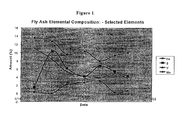
- the present invention is particularly effective in lowering high- and low-temperature corrosion in steam utility power generator furnaces combusting a fuel oil as demonstrated by the modified composition of the fly ash and bottom ash shown in Figures 1 & 2 .
- High temperature corrosion from the combustion of fuel oils loads these ashes with iron, sulfur, and vanadium.
- the iron comes from surface corrosion in the furnace and steam pipes surfaces.
- Figure 1 shows a decrease in fly ash iron content as duration of manganese use increases from the combustion of #6 fuel oil according to the present invention.
- the sulfur level in the ash is also lowered showing that the manganese is inhibiting oxidation of SO 2 to SO 3 and the SO 3 would form either metallic sulfates on reaction with other fuel-borne and system surface metals, or form sulfuric acid on reaction with combustion water leading to low temperature corrosion.
- a decreasing amount of iron in the ashes is indicative of a lowering in high temperature surface corrosion, and a decreasing ash sulfur level is indicative of less sulfuric acid formation in the flue gases.
- Figure 2 supplements the results in Figure 1 by showing a corresponding decrease in vanadium and sulfur in the bottom ash resulting from the combustion of #6 fuel oil. These decreases in iron, sulfur, and vanadium in the ashes do not trend with the respective levels in the fuel oil used. The corresponding levels of sulfur and vanadium in the fuel oil used were actually trending up with time as shown in Figure 3, hence demonstrating even more the unexpected efficacy of manganese to control the fate of these contaminants in the combustion system according to the present invention.
- the invention also refers to the following items:
Landscapes
- Chemical & Material Sciences (AREA)
- Oil, Petroleum & Natural Gas (AREA)
- Engineering & Computer Science (AREA)
- Organic Chemistry (AREA)
- Chemical Kinetics & Catalysis (AREA)
- General Chemical & Material Sciences (AREA)
- Combustion & Propulsion (AREA)
- Inorganic Chemistry (AREA)
- Catalysts (AREA)
- Solid Fuels And Fuel-Associated Substances (AREA)
- Exhaust Gas Treatment By Means Of Catalyst (AREA)
- Electrostatic Separation (AREA)
- Processing Of Solid Wastes (AREA)
- Feeding And Controlling Fuel (AREA)
- Inorganic Compounds Of Heavy Metals (AREA)
Abstract
Description
- The present invention relates to the reduction or inhibition of corrosion in an atmospheric burner unit by using a fuel-borne organometallic combustion system containing manganese, or a manganese precursor source, or derivative. The system may further contain a catalyst package that may be composed of one or more individual organometallic compounds of Li, Na, K, Mg, Ca, Sr, Ba, Mo, Fe, Co, Pt, Ce, and combinations, mixtures or precursors thereof. The manganese component of the catalyst package of the present invention reduces or eliminates the poisoning of the combustion system, whereby improved combustion and reduced emissions result. In addition, this invention serves a second purpose of lowering both high- and low-temperature corrosion that occurs on the hot surfaces of burner furnace walls and tubes, and on cooler surfaces of the burner unit exhaust stack.
- Fuel-borne organometallic combustion catalysts are becoming important in the control of environmental pollutants where fossil fuel is burned, for example, in internal combustion engines and in stationary burners such as those used in home heating, industrial furnaces, and steam power generators that bum fuel oil or coal. Organometallics derived from transition metals such as manganese, cerium, platinum, iron, and molybdenum; alkali metals such as lithium, sodium, and potassium; and alkaline earth metals such as calcium, magnesium, strontium and barium can all serve variously as effective fuel-borne emission control catalysts for controlling production of soot, smoke, hydrocarbon, carbon monoxide, sulfur trioxides, and oxides of nitrogen emissions. However, the vast majority of fossil fuels contain certain contaminant elements such as sulfur, phosphorus, vanadium, etc. that bind with these fuel-borne catalysts and inhibit them from efficiently performing their intended purpose. In addition, some combustion units are constructed with metals, such as iron, which can oxidize, corrode, or poison an emission control system.
- High-temperature corrosion (above 400° C) occurring on hot surfaces of the combustion unit is promoted by fuel contaminants such as sodium, vanadium and iron. This corrosion is promoted by oxygen near and on the surfaces in question. Sodium vanadate combustion products absorb this oxygen to form low-melting sodium vanadylvanadate fluxes that oxidatively corrode and physically erode the metal surface by forming a corrosive and free-flowing surface alloy with the metal. Fuels such as coal that have high levels of iron give an ash surface deposit whose fusion temperature falls with iron concentration increase in the fuel. The iron in effect lowers the fusion temperature of the slag, and just like the low melting sodium vanadylvanadate fluxes described above, this molten slag corrodes and erodes the metal surface in a similar manner.
- Low-temperature corrosion (below 250° C) can occur in the cooler region of a combustion unit towards the exhaust stack. Fuel sulfur, sodium, vanadium and iron can cause this corrosion. Sodium vanadylvanadates and iron, in the presence of oxygen, both independently catalyze conversion of SO2 to SO3 at high temperatures and the resulting SO3 hydrates with combustion water at lower temperatures in the exhaust stack to give corrosive sulfuric acid. The key to both high- and low-temperature corrosion processes is availability of oxygen near species and surfaces capable of shunting it into the corroding surfaces. To avoid an expensive maintenance cost, corrosion must be inhibited or slowed down. It would therefore be desirable to scavenge the oxygen used to promote the corrosion.
- Fuel-borne organometallic combustion and emissions control catalysts, such as those of cerium, platinum, manganese, and iron are used in engines and burners both to lower exhaust particulates, NOx, hydrocarbon, etc, and as light-off catalysts for passive diesel particulate filters (DPFs), catalyzed diesel particulate filters (C-DPFs), and continuously regenerating technology diesel particulate filters (CRT-DPFs) used to filter particulate from the exhaust stream. The true efficiency of these catalytic additives is compromised by the presence in the fuel, or from the surfaces of the combustion unit, of certain metal contaminants with which these additives have to react first. In doing so, a portion of the catalytic activity of the additive is sacrificed and is no longer available to perform its intended task.
- According to the present invention, manganese, when introduced in its various forms preferentially reacts with the fuel contaminants or surface contaminants thus allowing the respective organometallic catalyst to complete its intended emission control role more efficiently.
- By the present invention, the manganese also scavenges oxygen away from critical surfaces and from species such as sodium vanadylvanadates, iron, platinum, etc that would otherwise utilize this oxygen to promote surface corrosion, and shunts this oxygen to the more desirable carbon oxidation reactions. The manganese in the catalyst package achieves this by reacting with this oxygen and using it to oxidize carbon, and carbon monoxide to carbon dioxide. The result is a significant reduction in corrosion of the surface areas of the combustion unit and its exhaust passageways.
- In one embodiment of the present invention, it has thus been discovered that manganese in the fuel when admixed with fuel-borne organometallic catalysts preferentially reacts with certain contaminants in the fuel or otherwise introduced into the combustion, such as sulfur, vanadium, iron and phosphorus. The interaction between manganese and the fuel contaminant produces a non-poisoning environment in which it is ideal for the organometallic catalysts to effectively operate. The catalysts useful in the present invention can include one or more organometallic compounds of elements selected from the group consisting of Li, Na, K, Mg, Ca, Sr, Ba, Mo, Fe, Co, Pt, Ce, and combinations, mixtures, or precursors thereof.
- In another embodiment is provided a method to inhibit corrosion of a combustion unit combusting a fuel, whereby the method includes adding to the combustion a corrosion-inhibiting amount of a manganese source.
- By "interaction," "interacting," "interact" and "interacts" herein is meant scavenging.
- By "scavenging" herein is meant the contacting, combining with, reacting, incorporating, chemically bonding with or to, physically bonding with or to, adhering to, agglomerating with, affixing, inactivating, rendering inert, consuming, alloying, gathering, cleansing, consuming, or any other way or means whereby a first material makes a second material unavailable or less available.
- By "manganese" herein is meant any manganese or manganese-containing material, compound or precursor, such as but not limited to methyl cyclopentadienyl manganese tricarbonyl, available from Ethyl Corporation as MMT®, and manganese sulfonate, manganese phenate, manganese salicylate, cyclopentadienyl manganese tricarbonyl, alkyl cyclopentadienyl manganese tricarbonyl, organic manganese tricarbonyl derivatives, alkyl cyclopentadienyl manganese derivatives, bis-cyclopentadienyl manganese, bis-alkyl cyclopentandienyl manganese, neutral and overbased manganese salicylates, neutral and overbased manganese phenates, neutral and overbased manganese sulfonates, manganese carboxylates, and combinations and mixtures thereof.
- Thus, in an embodiment the present invention provides a method to inhibit corrosion of a combustion unit combusting a fuel, said method comprising adding to the combustion a corrosion-inhibiting amount of a manganese source.
- Thus, in an another embodiment the present invention provides a fuel-borne organometallic combustion system, containing a fuel and a catalyst package containing at least one metal source, and manganese as a co-catalyst, wherein the manganese in the system combines or interacts with at least one fuel contaminant selected from the group consisting of sulfur, phosphorus, vanadium, iron, and compounds thereof, and precursors thereof.
- The contaminant, such as sulfur, vanadium, iron, phosphorus, and other elements and their precursors, can originate in or from the degradation of the steel or iron-containing structural units of the combustion unit and/or its exhaust passageways. The contaminant can also find its way into the combustion system of the present invention by or from any other means or sources, such as but not limited to combustion aids and adjuvants, lubricants, in the fuel source, such as is often found in crude fuel, tar sands, coal or still bottoms, and air.
- By "combustion unit" herein is meant any and all internal and external combustion devices, machines, boilers, furnaces, incinerators, evaporative burners, plasma burner systems, plasma arc, stationary burners and the like which can combust or in which can be combusted a hydrocarbonaceous fuel. The combustion units effective in the utilization of the present invention include any and all burners or combustion devices, including for example and without limitation herein, stationary burners, waste incinerators, diesel fuel burners, gasoline fuel burners, power plant generators, power plant furnaces, and the like. The hydrocarbonaceous fuel combustion units that may benefit from the present invention include all combustion units, systems, devices, and/or engines that burn or oxidatively decompose hydrocarbonaceous fuels.
- Fuels suitable for use in the operation of combustion units of the present invention include hydrocarbonaceous fuels such as but not limited to diesel fuel, jet fuel, alcohols, ethers, kerosene, low sulfur fuels, synthetic fuels, such as Fischer-Tropsch fuels, liquid petroleum gas, fuels derived from coal, coal, genetically engineered biofuels and crops and extracts therefrom, natural gas, propane, butane, unleaded motor and aviation gasolines, and so-called reformulated gasolines which typically contain both hydrocarbons of the gasoline boiling range and fuel-soluble oxygenated blending agents, such as alcohols, ethers and other suitable oxygen-containing organic compounds. Other fuels that are useful in the methods and combustion units of the present invention are gasoline, bunker fuel, coal (dust or slurry), crude oil, refinery "bottoms" and by-products, crude oil extracts, hazardous wastes, yard trimmings and waste, wood chips and saw dust, agricultural waste, fodder, silage, plastics and other organic waste and/or by-products, and mixtures thereof, and emulsions, suspensions, and dispersions thereof in water, alcohol, or other carrier fluids. By "diesel fuel" herein is meant one or more fuels selected from the group consisting of diesel fuel, biodiesel, biodiesel-derived fuel, synthetic diesel and mixtures thereof.
- Oxygenates suitable for optional use in the present invention include methanol, ethanol, isopropanol, t-butanol, mixed alcohols, dimethoxy ethane (DME), methyl tertiary butyl ether, tertiary amyl methyl ether, ethyl tertiary butyl ether and mixed ethers. Oxygenates, when used, will normally be present in the reformulated gasoline fuel in an amount below about 25% by volume, and preferably in an amount that provides an oxygen content in the overall fuel in the range of about 0.5 to about 5 percent by volume.
- Thus, in an embodiment the present invention provides a method to inhibit corrosion at a temperature less than 250 °C in the exhaust passageway of a combustion unit combusting a fuel, said method comprising adding to the combustion a corrosion-inhibiting amount of manganese.
- Another feature of the present invention is to provide lower maintenance time, materials, and costs due to reduced low and high temperature corrosion occurring in the burner or combustion units. Thus is provided a method to reduce corrosion in the combustion unit and/or its exhaust passageway which contains steel, iron or other corrosion-prone materials in a combustion unit combusting fuel and a manganese source.
- A further feature of the present invention is to provide a method of tying up elements, such as vanadium, iron, sulfur, and phosphorus, which can otherwise poison the catalytic activity of a catalysed fuel combustion system.
- Accordingly, the present invention relates in another embodiment to use in a fuel-borne organometallic emissions control catalyst system of manganese as a co-catalyst, whereby the organometallic catalyst is rendered more effective to improve carbon burnout in either the combustion chamber or the exhaust stream, or both, where the temperature is above about 250 °C.
- The present invention also relates in another embodiment to use in a fuel-borne organometallic emissions control catalyst system of manganese as a co-catalyst, whereby the organometallic catalyst is rendered more effective to control corrosive sulfur trioxide production in either the combustion chamber or the exhaust stream, or both, where the temperature is above about 250 °C.
- Additionally, the present invention provides a combustion system having a fuel-borne organometallic emissions control combustion catalyst, wherein a fuel contaminant preferentially reacts with a manganese co-catalyst rather than the organometallic catalyst. In this manner, scavenging of the contaminant by the manganese is achieved.
- In yet another embodiment, the present invention provides a method to passivate metal surfaces containing Fe2O3 within a combustion unit combusting a fuel, wherein the surfaces are exposed to the product of the combustion, and the method includes adding a sufficient amount of a source of manganese to the combustion, whereby the manganese reduces at least some of the Fe2O3 to Fe3O4, whereby the metal surface is passivated.
- The present invention further relates to methods to retard, impede or prevent the oxidation of SO2 to SO3, since SO3 is an undesirable combustion by-product. According to one embodiment of the present invention, the use of manganese in the combustion process or immediately thereafter prevents the undesired oxidation of SO2 to SO3, usually catalysed by iron, platinum, and/or vanadium often found in combustion products. This has the beneficial effect of reducing or eliminating the production of acid rain-causing SO3 from the combustion of hydrocarbonaceous fuel.
- Thus, in yet another embodiment of the present invention is provided a method of improving the efficiency of fuel-borne organometallic combustion catalysts utilized in a fuel combustion system, comprising adding to a fuel having one or more contaminants selected from sulfur, vanadium, iron and phosphorus an amount of manganese sufficient to, upon combustion of the fuel, interact with at least one of the contaminants.
- It is to be understood that both the foregoing general description and the following detailed description are exemplary and explanatory only and are intended to provide further explanation of the present invention, as claimed.
- Thus, according to one embodiment of the present invention, the manganese can be added to the main catalyst package as a co-catalyst. The main catalyst package may be composed of one or more individual organometallics compounds of Li, Na, K, Mg, Ca, Sr, Ba, Mo, Fe, Co, Pt, Ce, and combinations or mixtures, or precursors thereof. The intended purpose of the catalyst is environmental pollution control by promoting carbon burnout in combustion particulate byproducts such as soot and smoke (particulate matter or PM), and in some instances control of hydrocarbon (HC), carbon monoxide (CO), and oxides of nitrogen (NOx) emissions. To the fuel treated with this catalyst package can be added, for example and without limitation, between 2 - 18 mg Mn/liter fuel when used in internal combustion engines, and between 2 - 200 ppm v/v Mn/liter fuel when used in atmospheric burners such as those found in industrial furnaces, home heating, and utility power generation furnaces.
- According to one embodiment of the present invention, a preferred manganese source is methylcyclopentadienyl manganese tricarbonyl, available from Ethyl Corporation as MMT® Gasoline Additive, or HiTEC® 3000 Performance Additive, or GREENBURN® Fuel Additive.
- In internal combustion engines, manganese in a fuel combines with, reacts with, inactivates or otherwise ties up catalysts poisons, such as sulfur and phosphorus, hence leaving a cleaner or clean combustion environment in which the fuel-borne organometallic catalyst can function with surprisingly improved efficiency.
- Most organometallic-containing fuel additives decompose in the flame to give the respective metal atoms. The level of fuel air mixedness at the time of combustion is nonhomogeneous because ignition occurs while the fuel is being injected and combustion heat radiates back into the fuel core as it is being injected, causing pyrolysis reactions of the fuel in this fuel-rich zone. The pyrolysis products form soot nucleation sites that grow into visible soot by coagulation and agglomeration mechanisms. As combustion takes place, manganese atoms from the thermal decomposition of the manganese-containing fuel additive collide with one another and with the fuel pyrolysis products, which are coagulating and agglomerating into visible soot. The metal atoms also collide with oxygen according to the schematic reaction below.
M (atomic) + ½ O2 ---> MO
Any collisions between metal atoms (i.e. Pt, Fe, Ce, Mn, etc) in the combusting environment are non elastic (this is the nature of "naked" metal atom collisions) and lead to reduced dispersion of the metal in the combusting gases. However, collisions of metal atoms with fuel pyrolysis products as they agglomerate maintains the dispersion by charging the particles, resulting in soot particles that are impacted with highly dispersed metal atoms and with clusters thereof that might have formed prior to collision with soot particles. As this process transpires, the level of mixedness increases, and at temperatures above 400 °C thermal oxidation of the soot occurs as fast as oxygen collides with these particles. The rate of this oxidation is temperature dependent, slowing down as the temperature fall below 400 °C. However, particles with metal atoms impacted continue to oxidize at a high rate due to carbon oxidation catalyzed by carbon dioxide and the metal catalyst species as shown in the following equations.
MOx + CO --> MOx-1 (cat) + CO2
C (on soot particle) + CO2 + MOx-1 (cat) --> 2CO + MOx-1 (cat)
MOx-1 (cat) + ½O2 --> MOx
- This "carbon burnout" reaction catalyzed by metal oxides according to the above three equations can be sustained to temperatures as low as 250 °C. Finally, the carbon monoxide thus formed is further oxidized to carbon dioxide as oxygen abundance increases in the combusting mixture due to increasing level of mixing with time. This builds up the level of MOx according to the reaction equations,
Mx-1 (cat) + ½O2 --> MOx
MOx + CO --> MOx-1 (cat) + CO2
- The reaction cycle above is oxygen concentration dependent and will continue to take place in the combustion gases all the way to temperatures as low as 250 °C. These carbon burnout, hydrocarbon oxidation and carbon dioxide removal reactions catalyzed by fuel borne organometallic catalysts such as compounds derived from Pt, Fe, Ce, etc. can be inhibited by fuel components bearing sulfur, phosphorus, vanadium, lead, etc. which react with and deactivate these catalysts.
- By the present invention, a manganese compound can be added to the main catalyst package as a co-catalyst to scavenge these "poisons" from the combustion environment thus optimizing the performance of the main fuel-borne organometallic catalyst in promoting carbon burnout in combustion particulate byproducts.
- In another embodiment, the manganese compound is not added to the main catalyst package directly, but is subsequently and/or separately introduced to the combustion unit or combustion byproducts therefrom.
- In stationary burners the manganese in addition to combining with, reacting with, inactivating, or otherwise tying down sulfur and phosphorus, also inhibits SO2 to SO3 oxidation generally facilitated by Fe or Pt. The SO3 hydrates in the exhaust stream as the temperatures drop below the dew point to give sulfuric acid that results in serious tail end corrosion in the exhaust stack. This so-called "low temperature corrosion" is minimized herein by the addition of a sufficient amount of a source of Mn in cases where the fuel-borne catalysts (i.e. Fe and Pt) or surface contaminants (e.g. Fe and oxides thereof) are known to also catalyze the SO2 to SO3 reaction.
- Stationary burner furnaces also suffer from high temperature corrosion that is mainly caused by high iron and vanadium levels in the fuel that form low melting iron derivatives, and vanadylvanadate fluxes with alkali and alkaline earth metals that may be added as fuel-borne combustion and emissions catalysts. Co-addition of manganese inhibits formation of low-melting alkali/alkaline earth metal vanadylvanadates by reacting with the oxygen necessary for the formation of these low melting fluxes. These fluxes corrode surfaces in the high temperature zone of stationary burner furnaces leading to frequent expensive maintenance work. An increase in vanadium and iron in the fly ash is a diagnosis of this high temperature corrosion. When manganese is added to the fuel according to the present invention, there is a decrease in these elements in the fly ash thereby indicating a decreased level of high temperature corrosion.
- Sulfur trioxide (SO3) produced in the combustion of hydrocarbonaceous fuels combines with water vapor to form sulfuric acid as the temperature of the exhaust cools down below the dew point of water. The presence of this acid results in both low temperature corrosion of exhaust equipment and in corrosive environmental pollution (acid rain). In atmospheric (stationary) burners, the corrosion of exhaust equipment can be quite considerable in terms of cost and down time for repairs. Fuel-borne metallic catalysts convert sulfur dioxide (SO2) to sulfur trioxide at very high rates. The efficiencies of some of these reactions are shown below.
- Surface metal catalyzed heterogeneous reactions of SO2 to SO3 have been summarized by Salooja as follows.
Reaction Conversion Efficiency SO2 + ½O2 (Ptcat) --> SO3 + (Ptcat) 100% SO2 + ½O2 (V2O5cat) --> SO3 + (V2O5cat) 85% SO2 + ½O2 (Cr2O3cat) --> SO3 + (Cr2O3cat) 80% SO2 + ½O2 (Fe2O3cat) --> SO3 + (Fe2O3cat) 65% SO2 + ½O2 (CuOcat) --> SO3 + (CuOcat) 58% - The conversion efficiencies shown are achieved at temperatures of: 450 °C (Pt), 520°C (V2O5), 575 °C (Cr2O3), 620 °C (Fe2O3), and 680 °C (CuO). (Salooja, K. C., Burner Fuel Additives. Journal of the Institute of Fuel, 37, p. 37, 1972 . )
- Platinum thus provides extremely efficient conversion of SO2 to SO3. This metal is used commercially at very low treat levels (2-4 ppm) in diesel as a fuel-borne catalyst for control of particulate and NOx emissions. When it reacts with SO2 to form undesirable SO3, the reaction goes further to form PtSO4 which is inactive towards its intended PM and NOx control. When this fuel-borne catalyst is formulated with a manganese co-catalyst according to the present invention, the manganese will keep the sulfur away from the platinum by forming a sacrificial MnSO4, thus maintaining the performance of the platinum at its optimum. In the case of iron, the active form in converting SO2 to SO3 is Fe2O3. The manganese used in this invention inhibits this reaction by reducing this active iron species to the less sulfur active Fe3O4 lower oxidation state form as shown below.
2MnO + 3Fe2O3 --> Mn2O3 + 2Fe3O4
2Mn3O4 + 3Fe2O3 --> 3Mn2O3 + 2Fe3O4
- Fe3O4 does not promote the oxidation of SO2 to SO3. Since Fe2O3 but not Fe3O4 catalyzes thermal oxidation of SO2 to SO3, surface catalysis of SO2 to SO3 is eliminated or inhibited by the use of Mn in the present invention. And SO3 formed by other reaction means within the combustion unit will react with MnO according to the reaction described by Gray below.
MnO + SO3 --> MnSO4 [Melting point of MnSO4 is 700 °C]
(Gray, M.A., "The Effect of a Volatile Fireside Manganese Additive on Coal-Fired Utility Boiler Operation," ASME presentation at the Joint Power Generation Conference, Phoenix, Arizona, Sept. 28 to Oct. 2, 1980 ). - Thus, the present invention provides in one embodiment a method to passivate metal structural surfaces within combustion units, which surfaces might otherwise catalyze the oxidation of SO2 to SO3. This passivation of iron and steel surfaces by manganese against catalyzing the SO2 to SO3 oxidation reaction is important in utility steam furnaces where the surface area presented to the combustion products is by design very large in order to extract maximum heat from the flue gases to generate steam.
- In another embodiment, the present invention prevents or inhibits the oxidation of Fe3O4 to Fe2O3 on a surface of a combustion unit. A manganese co-catalyst added with the fuel-borne catalyst according to an embodiment of the present invention maximizes the protective effect by ensuring the highest probability of the manganese being juxtaposed to the fuel-borne catalyst during the combustion and exhaust phases. Other fuel-borne catalysts poisons such as phosphorus, vanadium, etc. would be similarly inhibited or scavenged by the manganese.
- One skilled in the art can expect high temperature corrosion to occur if the fuel used contains sodium (Na), and/or vanadium (V), since highly corrosive complex oxides of these species such as "5Na2O•V2O4•11V2O5" (sodium vanadylvanadates) form on utility furnace surfaces in the temperature range between 550 and 680 °C. These low melting oxides are efficient as 1) SO2 to SO3 conversion catalysts, and 2) oxygen transport catalysts from the gas phase to the iron surface of the unit. A manganese co-catalyst added with the fuel-borne catalyst (Pt, Fe, Ce, etc.) would preferentially scavenge the oxygen from the surface deposit and utilize it in the carbon burnout reactions. This would inhibit oxidation of higher melting sodium vanadylvanadates to their more corrosive lower melting analogues which are responsible for high temperature corrosion by forming a eutectic flux with the utility furnace and pipes surfaces resulting in surface erosion. (See, for example, Pollman, S., Mineralogisch kristallographische Untersuchungen an Schlaken und Rohrbelägen aus dem Hochtemperaturbereich ölgefeuerter Großkessel. VGB-Mitteilungen, 94, p. 1, 1965. Volker Hoenig, L., "Untersuchung der Wirkungsmechanismen von Additiven fur shweres Heizöl". Fortschritt-Berichte VDI, Reihe 15. Umwelttechnik, Nr. 84, pp. 57-59 and references therein, Düsseldorf. VDI-Verlag 1991, and Wahnschaffe, E., Kontinuierliche SO3- und Taubereichsmessunged auf ölgefeurten Dampferzuegern. Mitteilungen der VGB, Heft 3, p. 193, 1968.)
- The following examples further illustrate aspects of the present invention but do not limit the present invention.
- When fuel-borne organometallic combustion control catalysts including a manganese source were utilised in a power plant generator burning #6 fuel oil according to an embodiment of the present invention, emission filters showed declining particulate mass with time. Specifically, a reduction in electrostatic precipitator ash as carbon of up to and including 38% by mass was observed.
- Another measure of the effectiveness of reduced ash production is the observed trend of increasing efficiency such as resistivity as loss on ignition of an electrostatic precipitator fly ash decreases. This is because the carbon deposits act as a conductor on the electrostatic precipitator and resistivity is increased as carbon deposition and deposits are decreased. The overall efficiency of the combustion unit is increased according to the present invention by burning more particulate hence reducing the deposition of carbon ash.
- The present invention is particularly effective in reducing the amount of vanadium and iron in the fly ash resulting from the combustion of fuel oil, such as for example #6 fuel oil, in a power plant furnace.
- The present invention is particularly effective in lowering high- and low-temperature corrosion in steam utility power generator furnaces combusting a fuel oil as demonstrated by the modified composition of the fly ash and bottom ash shown in
Figures 1 &2 . High temperature corrosion from the combustion of fuel oils loads these ashes with iron, sulfur, and vanadium. The iron comes from surface corrosion in the furnace and steam pipes surfaces. -
Figure 1 shows a decrease in fly ash iron content as duration of manganese use increases from the combustion of #6 fuel oil according to the present invention. The sulfur level in the ash is also lowered showing that the manganese is inhibiting oxidation of SO2 to SO3 and the SO3 would form either metallic sulfates on reaction with other fuel-borne and system surface metals, or form sulfuric acid on reaction with combustion water leading to low temperature corrosion. A decreasing amount of iron in the ashes is indicative of a lowering in high temperature surface corrosion, and a decreasing ash sulfur level is indicative of less sulfuric acid formation in the flue gases. -
Figure 2 supplements the results inFigure 1 by showing a corresponding decrease in vanadium and sulfur in the bottom ash resulting from the combustion of #6 fuel oil. These decreases in iron, sulfur, and vanadium in the ashes do not trend with the respective levels in the fuel oil used. The corresponding levels of sulfur and vanadium in the fuel oil used were actually trending up with time as shown in Figure 3, hence demonstrating even more the unexpected efficacy of manganese to control the fate of these contaminants in the combustion system according to the present invention. - Other embodiments of the present invention will be apparent to those skilled in the art from consideration of the specification and practice of the invention disclosed herein. It is intended that the specification and examples be considered as exemplary only, with a true scope and spirit of the invention being indicated by the following claims.
- The invention also refers to the following items:
- 1. A method to inhibit corrosion of a combustion unit combusting a fuel, said method comprising adding to the combustion a corrosion-inhibiting amount of a manganese source.
- 2. The method of item 1, wherein the corrosion is at a temperature above 400°C.
- 3. The method of item 1, wherein the corrosion is at a temperature below 250°C.
- 4. A method of reducing the amount of vanadium in the fly ash resulting from the combustion of a fuel containing vanadium in a combustion unit, said method comprising adding to the fuel or its combustion products an amount of a source of manganese effective to combine with the vanadium or its combustion products, whereby the amount of vanadium in the resulting fly ash is reduced.
- 5. A method of reducing the amount of iron in the fly ash resulting from the combustion of fuel containing iron in a combustion unit, said method comprising adding to the fuel or its combustion products an amount of a source of manganese effective to combine with the iron or its combustion products, whereby the amount of iron in the resulting fly ash is reduced.
- 6. A method of reducing the amount of sulfur in the fly ash resulting from the combustion of fuel containing sulfur in a combustion unit, said method comprising adding to the fuel or its combustion products an amount of a source of manganese effective to combine with the sulfur or its combustion products, whereby the amount of sulfur in the resulting fly ash is reduced.
- 7. A method for improving the effectiveness of one or more fuel-borne organometallic emissions control catalyst compounds of at least one element selected from the group consisting of Li, Na, K, Mg, Ca, Sr, Ba, Mo, Fe, Co, Pt, Ce, and combinations, mixtures, and precursors thereof for controlling sulfur trioxide production in or from the combustion in a combustion und of a hydrocarbonaceous fuel having at least one contaminant selected from the group consisting of sulfur, vanadium, iron and phosphorus, said method comprising combining said at least one contaminant with a sufficient amount of manganese or a source thereof.
- 8. A method to passivate metal surfaces containing Fe203 within a combustion unit combusting a fuel, wherein said surfaces are exposed to the product of said combustion, said method comprising adding a sufficient amount of manganese or a source thereof to the combustion, whereby the manganese reduces at least some of the Fe2O3 to Fe3O4, whereby the metal surface is passivated.
- 9. A method to inhibit the oxidation of Fe3O4 to Fe2O3 on a surface in a combustion unit combusting a fuel, said method comprising adding a sufficient amount of a source of manganese to the combustion, whereby manganese scavenges oxygen to thereby inhibit the oxidation of Fe3O4 to Fe2O3.
- 10. A method of increasing the efficiency of an electrostatic precipitator of a combustion unit which combusts fuel and produces carbon-containing fly ash, said method comprising adding a sufficient amount of a source of manganese to the combustion, whereby carbon deposition on said electrostatic precipitator is decreased, and electrostatic precipitator efficiency is increased.
- 11. The method of any one of items 1 - 10, wherein the combustion unit is selected from the group consisting of any and all burners or combustion units, stationary burners, waste incinerators, diesel fuel burners, gasoline fuel burners, power plant generators, power plant furnaces, any and all internal and external combustion devices, boilers, furnaces, evaporative burners, plasma burner systems, plasma arc, and devices that can combust or in which can be combusted a hydrocarbonaceous fuel.
- 12. The method of any one of items 1 - 11, wherein the fuel is selected from the group consisting of diesel fuel, biodiesel, biodiesel-derived fuel, synthetic diesel, jet fuel, alcohols, ethers, kerosene, low sulfur fuels, synthetic fuels, Fischer-Tropsch fuels, liquid petroleum gas, fuels derived from coal, coal, genetically engineered biofuels and crops and extracts therefrom, natural gas, propane, butane, unleaded motor and aviation gasolines, reformulated gasolines which contain both hydrocarbons of the gasoline boiling range and fuel-soluble oxygenated blending agents, gasoline, bunker fuel, coal (dust or slurry), crude oil, refinery "bottoms" and by-products, crude oil extracts, hazardous wastes, yard trimmings and waste, wood chips and saw dust, agricultural waste, fodder, silage, plastics, organic waste, and mixtures thereof, and emulsions, suspensions, and dispersions thereof in water, alcohol, and other carrier fluids.
- 13. A method of any one of items 1 - 12, wherein the manganese is selected from the group consisting of methyl cyclopentadienyl manganese tricarbonyl, cyclopentadienyl manganese tricarbonyl, bis-cyclopentadienyl manganese (manganocene), bis-alkyl cyclopentadienyl manganese, manganese sulfonate, manganese phenate, manganese salicylate, alkyl cyclopentadienyl manganese tricarbonyl, organic manganese tricarbonyl derivatives, alkyl cyclopentadienyl manganese derivatives, neutral and overbased manganese salicylates, neutral and overbased manganese phenates, neutral and overbased manganese sulfonates, manganese carboxylates, and combinations and mixtures thereof.
Claims (10)
- Use of a sufficient amount of a source of manganese for addition to the combustion unit to increase the efficiency of an electrostatic precipitator of a combustion unit which combusts fuel and produces carbon-containing fly ash, whereby carbon deposition on said electrostatic precipitator is decreased, and electrostatic precipitator efficiency is increased.
- Use of an amount of a source of manganese effective to combine with the vanadium or its combustion products for addition to the fuel or its combustion products for reducing the amount of vanadium in the fly ash resulting from the combustion of a fuel containing vanadium in a combustion unit, whereby the amount of vanadium in the resulting fly ash is reduced.
- Use of an amount of a source of manganese effective to combine with the iron or its combustion products for addition to the fuel or its combustion products for reducing the amount of iron in the fly ash resulting from the combustion of fuel containing iron in a combustion unit, whereby the amount of iron in the resulting fly ash is reduced.
- Use of an amount of a source of manganese effective to combine with the sulfur or its combustion products for addition to the fuel or its combustion products for reducing the amount of sulfur in the fly ash resulting from the combustion of fuel containing sulfur in a combustion unit, whereby the amount of sulfur in the resulting fly ash is reduced.
- Use of a sufficient amount of manganese or a source thereof for combining with at least one contaminant for improving the effectiveness of one or more fuel-borne organometallic emissions control catalyst compounds of at least one element selected from the group consisting of Li, Na, K, Mg, Ca, Sr, Ba, Mo, Fe, Co, Pt, Ce, and combinations, mixtures, and precursors thereof for controlling sulfur trioxide production in or from the combustion in a combustion unit of a hydrocarbonaceous fuel having said at least one contaminant selected from the group consisting of sulfur, vanadium, iron and phosphorus.
- Use of a sufficient amount of manganese or a source thereof for addition to the combustion unit to passivate metal surfaces containing Fe2O3 within a combustion unit combusting a fuel, wherein said surfaces are exposed to the product of said combustion, whereby the manganese reduces at least some of the Fe2O3 to Fe3O4, whereby the metal surface is passivated.
- Use of a sufficient amount of a source of manganese for addition to the combustion unit to inhibit the oxidation of Fe3O4 to Fe2O3 on a surface in a combustion unit combusting a fuel, whereby manganese scavenges oxygen to thereby inhibit the oxidation of Fe3O4 to Fe2O3.
- The use of any one of claims 1 - 7, wherein the combustion unit is selected from the group consisting of any and all burners or combustion units, stationary burners, waste incinerators, diesel fuel burners, gasoline fuel burners, power plant generators, power plant furnaces, any and all internal and external combustion devices, boilers, furnaces, evaporative burners, plasma burner systems, plasma arc, and devices that can combust or in which can be combusted a hydrocarbonaceous fuel.
- The use of any one of claims 1 - 8, wherein the fuel is selected from the group consisting of diesel fuel, biodiesel, biodiesel-derived fuel, synthetic diesel, jet fuel, alcohols, ethers, kerosene, low sulfur fuels, synthetic fuels, Fischer-Tropsch fuels, liquid petroleum gas, fuels derived from coal, coal, genetically engineered biofuels and crops and extracts therefrom, natural gas, propane, butane, unleaded motor and aviation gasolines, reformulated gasolines which contain both hydrocarbons of the gasoline boiling range and fuel-soluble oxygenated blending agents, gasoline, bunker fuel, coal (dust or slurry), crude oil, refinery "bottoms" and by-products, crude oil extracts, hazardous wastes, yard trimmings and waste, wood chips and saw dust, agricultural waste, fodder, silage, plastics, organic waste, and mixtures thereof, and emulsions, suspensions, and dispersions thereof in water, alcohol, and other carrier fluids.
- A use of any one of claims 1 - 9, wherein the manganese is selected from the group consisting of methyl cyclopentadienyl manganese tricarbonyl, cyclopentadienyl manganese tricarbonyl, bis-cyclopentadienyl manganese (manganocene), bis-alkyl cyclopentadienyl manganese, manganese sulfonate, manganese phenate, manganese salicylate, alkyl cyclopentadienyl manganese tricarbonyl, organic manganese tricarbonyl derivatives, alkyl cyclopentadienyl manganese derivatives, neutral and overbased manganese salicylates, neutral and overbased manganese phenates, neutral and overbased manganese sulfonates, manganese carboxylates, and combinations and mixtures thereof.
Applications Claiming Priority (2)
| Application Number | Priority Date | Filing Date | Title |
|---|---|---|---|
| US10/322,158 US8257450B2 (en) | 2002-12-18 | 2002-12-18 | Manganese compounds to inhibit both low-and high-temperature corrosion in utility and industrial furnace systems |
| EP03022906A EP1431372B1 (en) | 2002-12-18 | 2003-10-09 | Use of manganese compounds to inhibit both low- and high-temperature corrosion in utility and industrial furnace systems |
Related Parent Applications (1)
| Application Number | Title | Priority Date | Filing Date |
|---|---|---|---|
| EP03022906.6 Division | 2003-10-09 |
Publications (2)
| Publication Number | Publication Date |
|---|---|
| EP2199374A2 true EP2199374A2 (en) | 2010-06-23 |
| EP2199374A3 EP2199374A3 (en) | 2011-08-17 |
Family
ID=32393014
Family Applications (2)
| Application Number | Title | Priority Date | Filing Date |
|---|---|---|---|
| EP03022906A Expired - Lifetime EP1431372B1 (en) | 2002-12-18 | 2003-10-09 | Use of manganese compounds to inhibit both low- and high-temperature corrosion in utility and industrial furnace systems |
| EP10158754A Withdrawn EP2199374A3 (en) | 2002-12-18 | 2003-10-09 | Use of manganese compounds to increase the efficiency of an electrostatic precipitator of a combustion unit |
Family Applications Before (1)
| Application Number | Title | Priority Date | Filing Date |
|---|---|---|---|
| EP03022906A Expired - Lifetime EP1431372B1 (en) | 2002-12-18 | 2003-10-09 | Use of manganese compounds to inhibit both low- and high-temperature corrosion in utility and industrial furnace systems |
Country Status (9)
| Country | Link |
|---|---|
| US (1) | US8257450B2 (en) |
| EP (2) | EP1431372B1 (en) |
| JP (1) | JP2004198099A (en) |
| CN (1) | CN100584931C (en) |
| AT (1) | ATE483782T1 (en) |
| AU (1) | AU2003241646A1 (en) |
| CA (1) | CA2437845A1 (en) |
| DE (1) | DE60334434D1 (en) |
| SG (1) | SG112890A1 (en) |
Cited By (1)
| Publication number | Priority date | Publication date | Assignee | Title |
|---|---|---|---|---|
| CN108295856A (en) * | 2018-03-15 | 2018-07-20 | 清华大学 | Coal ash lifting silicon residue prepares the method that biogas dry type reforms bimetallic catalyst |
Families Citing this family (22)
| Publication number | Priority date | Publication date | Assignee | Title |
|---|---|---|---|---|
| US20050011413A1 (en) * | 2003-07-18 | 2005-01-20 | Roos Joseph W. | Lowering the amount of carbon in fly ash from burning coal by a manganese additive to the coal |
| US20050016057A1 (en) * | 2003-07-21 | 2005-01-27 | Factor Stephen A. | Simultaneous reduction in NOx and carbon in ash from using manganese in coal burners |
| CN100445644C (en) * | 2005-11-21 | 2008-12-24 | 刘翠霄 | A boiler coal-saving method using atomized matter and an atomized output device |
| KR100855703B1 (en) * | 2006-11-03 | 2008-09-03 | 한국전력공사 | Method for forming corrosion resistance and oxidation resistant coating layer on gas turbine high temperature parts by fuel additive |
| US20080168709A1 (en) * | 2007-01-16 | 2008-07-17 | Aradi Allen A | Safe combustion additives and methods of formulation |
| JP2010539281A (en) * | 2007-09-13 | 2010-12-16 | ティムバーン・インコーポレーテッド | Methods for reducing flammable creosote and other organic deposits in fireboxes |
| US20090071067A1 (en) * | 2007-09-17 | 2009-03-19 | Ian Macpherson | Environmentally-Friendly Additives And Additive Compositions For Solid Fuels |
| US7878160B2 (en) * | 2007-09-24 | 2011-02-01 | Afton Chemical Corporation | Surface passivation and to methods for the reduction of fuel thermal degradation deposits |
| EP2318494B1 (en) | 2008-07-08 | 2013-11-27 | The Lubrizol Corporation | Marine diesel cylinder lubricant |
| SG11201500453XA (en) * | 2012-07-26 | 2015-04-29 | Efficient Fuel Solutions Llc | Body of molecular sized fuel additive |
| MX368425B (en) * | 2013-10-18 | 2019-10-02 | Fuel Tech Inc | A process for controlling injection of magnesium oxide for controlling so3 with enhanced boiler efficiency. |
| US11028480B2 (en) | 2018-03-19 | 2021-06-08 | Applied Materials, Inc. | Methods of protecting metallic components against corrosion using chromium-containing thin films |
| US11015252B2 (en) | 2018-04-27 | 2021-05-25 | Applied Materials, Inc. | Protection of components from corrosion |
| WO2020219332A1 (en) | 2019-04-26 | 2020-10-29 | Applied Materials, Inc. | Methods of protecting aerospace components against corrosion and oxidation |
| US11794382B2 (en) | 2019-05-16 | 2023-10-24 | Applied Materials, Inc. | Methods for depositing anti-coking protective coatings on aerospace components |
| US11697879B2 (en) | 2019-06-14 | 2023-07-11 | Applied Materials, Inc. | Methods for depositing sacrificial coatings on aerospace components |
| US11466364B2 (en) | 2019-09-06 | 2022-10-11 | Applied Materials, Inc. | Methods for forming protective coatings containing crystallized aluminum oxide |
| US11519066B2 (en) | 2020-05-21 | 2022-12-06 | Applied Materials, Inc. | Nitride protective coatings on aerospace components and methods for making the same |
| US11739429B2 (en) | 2020-07-03 | 2023-08-29 | Applied Materials, Inc. | Methods for refurbishing aerospace components |
| CN112628784B (en) * | 2020-11-23 | 2022-12-16 | 西安热工研究院有限公司 | A method for controlling the composition of Zhundong coal ash |
| CN118440753A (en) * | 2024-07-08 | 2024-08-06 | 中国科学技术大学先进技术研究院 | Coal-fired catalyst and preparation method thereof |
| CN119771430B (en) * | 2025-03-10 | 2025-05-27 | 全同诚(安徽)节能技术有限公司 | An environmentally friendly catalyst for promoting efficient and clean combustion of pulverized coal and its preparation method |
Family Cites Families (17)
| Publication number | Priority date | Publication date | Assignee | Title |
|---|---|---|---|---|
| US2943925A (en) * | 1956-08-27 | 1960-07-05 | Gulf Research Development Co | Residual fuel oils |
| GB1061161A (en) | 1963-05-29 | 1967-03-08 | Basic Inc | Fuel oil additives |
| GB1189356A (en) | 1967-07-13 | 1970-04-22 | Apollo Chem | Improvements in or relating to Fuel Compositions |
| BE715430A (en) | 1967-08-31 | 1968-10-16 | ||
| US3443916A (en) * | 1968-05-07 | 1969-05-13 | Rolfe Chem Corp | Composition and method for reducing air pollutants |
| US3692503A (en) * | 1969-02-26 | 1972-09-19 | Apollo Chem | Activated manganese containing additive for fuels |
| US3837820A (en) * | 1971-09-01 | 1974-09-24 | Apollo Chem | Combustion control by additives introduced in both hot and cold zones |
| CA1067835A (en) | 1975-10-22 | 1979-12-11 | Walter F. Lorenc | Increasing the efficiency of electrostatic precipitators |
| US4035530A (en) * | 1976-05-07 | 1977-07-12 | Apollo Chemical Corporation | Method of inhibiting sulfidation and modifying deposits |
| DE2809199A1 (en) | 1978-03-03 | 1979-09-06 | Metallgesellschaft Ag | Sepg. dust with high electric resistance from hot waste gas - by adding catalyst to convert sulphur di:oxide into sulphur tri:oxide, then using electrostatic filters |
| US4512774A (en) * | 1978-12-27 | 1985-04-23 | Calgon Corporation | Residual fuel oil conditioners containing metal salts in aqueous solution |
| FR2502300A2 (en) | 1979-06-28 | 1982-09-24 | Gaillardin Jacqueline | Increased heat output from furnace and reduced soot lay-down - by entraining aq. peroxide soln. in part stream of combustion air |
| DK152925C (en) | 1985-06-28 | 1989-04-10 | Sparol Int Aps | ADDITIVE TO LIQUID FUEL |
| US6187064B1 (en) * | 1991-10-28 | 2001-02-13 | Ethyl Petroleum Additives, Inc. | Unleaded aviation gasoline |
| GB2285057B (en) * | 1993-12-23 | 1997-12-10 | Ethyl Petroleum Additives Ltd | Evaporative burner fuels and additives therefor |
| US6729248B2 (en) * | 2000-06-26 | 2004-05-04 | Ada Environmental Solutions, Llc | Low sulfur coal additive for improved furnace operation |
| US6629407B2 (en) | 2000-12-12 | 2003-10-07 | Ethyl Corporation | Lean burn emissions system protectant composition and method |
-
2002
- 2002-12-18 US US10/322,158 patent/US8257450B2/en not_active Expired - Fee Related
-
2003
- 2003-08-21 CA CA002437845A patent/CA2437845A1/en not_active Abandoned
- 2003-08-28 AU AU2003241646A patent/AU2003241646A1/en not_active Abandoned
- 2003-09-08 SG SG200305661A patent/SG112890A1/en unknown
- 2003-09-11 JP JP2003320114A patent/JP2004198099A/en active Pending
- 2003-09-11 CN CN03125522A patent/CN100584931C/en not_active Expired - Fee Related
- 2003-10-09 EP EP03022906A patent/EP1431372B1/en not_active Expired - Lifetime
- 2003-10-09 AT AT03022906T patent/ATE483782T1/en not_active IP Right Cessation
- 2003-10-09 DE DE60334434T patent/DE60334434D1/en not_active Expired - Lifetime
- 2003-10-09 EP EP10158754A patent/EP2199374A3/en not_active Withdrawn
Non-Patent Citations (5)
| Title |
|---|
| "Dusseldorf", 1991, VDI-VERLAG |
| GRAY, M.A.: "The Effect of a Volatile Fireside Manganese Additive on Coal-Fired Utility Boiler Operation", ASME PRESENTATION AT THE JOINT POWER GENERATION CONFERENCE, 28 September 1980 (1980-09-28) |
| POLLMAN, S.: "Mineralogisch kristallographische Untersuchungen an Schlaken und Rohrbelagen aus dem Hochtemperaturbereich olgefeuerter Gropkessel", VGB-MITTEILUNGEN, vol. 94, 1965, pages 1 |
| VOLKER HOENIG, L.: "Untersuchung der Wirkungsmechanismen von Additiven fur shweres Heizol", FORTSCHRITT-BERICHTE VDI, vol. 15, pages 57 - 59 |
| WAHNSCHAFFE, E., KONTINUIERLICHE SO3- UND TAUBEREICHSMESSUNGED AUFOLGEFEURTEN, 1968, pages 193 |
Cited By (2)
| Publication number | Priority date | Publication date | Assignee | Title |
|---|---|---|---|---|
| CN108295856A (en) * | 2018-03-15 | 2018-07-20 | 清华大学 | Coal ash lifting silicon residue prepares the method that biogas dry type reforms bimetallic catalyst |
| CN108295856B (en) * | 2018-03-15 | 2020-06-02 | 清华大学 | Method for preparing methane dry reforming bimetallic catalyst from fly ash silicon extraction residues |
Also Published As
| Publication number | Publication date |
|---|---|
| JP2004198099A (en) | 2004-07-15 |
| SG112890A1 (en) | 2005-07-28 |
| CA2437845A1 (en) | 2004-06-18 |
| EP1431372B1 (en) | 2010-10-06 |
| DE60334434D1 (en) | 2010-11-18 |
| CN1508235A (en) | 2004-06-30 |
| EP2199374A3 (en) | 2011-08-17 |
| ATE483782T1 (en) | 2010-10-15 |
| EP1431372A3 (en) | 2004-10-27 |
| US20040118032A1 (en) | 2004-06-24 |
| AU2003241646A1 (en) | 2004-07-08 |
| US8257450B2 (en) | 2012-09-04 |
| EP1431372A2 (en) | 2004-06-23 |
| CN100584931C (en) | 2010-01-27 |
Similar Documents
| Publication | Publication Date | Title |
|---|---|---|
| EP1431372B1 (en) | Use of manganese compounds to inhibit both low- and high-temperature corrosion in utility and industrial furnace systems | |
| AU2004231173B2 (en) | Mixed metal catalyst additive and method for use in hydrocarbonaceous fuel combustion system | |
| US20030226312A1 (en) | Aqueous additives in hydrocarbonaceous fuel combustion systems | |
| EP0815185A1 (en) | Utilization of platinum group in diesel engines | |
| CA2476311A1 (en) | Reduced-emissions combustion utilizing multiple-component metallic combustion catalyst | |
| AU2010201985A1 (en) | Emissions control system for diesel fuel combustion after treatment system | |
| CA2453394C (en) | Method of reducing smoke and particulate emissions for compression-ignited reciprocating engines | |
| CN1279149C (en) | Method of oxidizing soot and reducing soot accumulation in adiesel fuel combustion after treatment system | |
| EP1468740B1 (en) | Use of manganese compounds to improve the efficiency of and reduce back-corona discharge on electrostatic precipitators | |
| US7111591B2 (en) | Method of improving the operation of combustion particulate filters | |
| AU2004202530A1 (en) | Lowering the amount of carbon in fly ash burning coal by a manganese additive to the coal | |
| US7524340B2 (en) | Catalyst and method for improving combustion efficiency in engines, boilers, and other equipment operating on fuels | |
| CN1497041A (en) | Method for increasing working efficiency of diesel fuel combustion treatment system | |
| WO2008073017A1 (en) | Fuel or crude oil additive and fuel or crude oil composition comprising said additive | |
| MXPA05001755A (en) | Mixed metal catalyst additive and method for use in hydrocarbonaceous fuel combustion system | |
| Ali et al. | Nanoparticle and additive application in alternative fuels | |
| Bok et al. | Effects of catalysts on emissions of pollutants from combustion processes of liquid fuels |
Legal Events
| Date | Code | Title | Description |
|---|---|---|---|
| PUAI | Public reference made under article 153(3) epc to a published international application that has entered the european phase |
Free format text: ORIGINAL CODE: 0009012 |
|
| 17P | Request for examination filed |
Effective date: 20100331 |
|
| AC | Divisional application: reference to earlier application |
Ref document number: 1431372 Country of ref document: EP Kind code of ref document: P |
|
| AK | Designated contracting states |
Kind code of ref document: A2 Designated state(s): AT BE BG CH CY CZ DE DK EE ES FI FR GB GR HU IE IT LI LU MC NL PT RO SE SI SK TR |
|
| RIN1 | Information on inventor provided before grant (corrected) |
Inventor name: ADAMS, MICHAEL WAYNE Inventor name: ARADI, ALLEN A. Inventor name: FACTOR, STEPHEN ALAN |
|
| RIN1 | Information on inventor provided before grant (corrected) |
Inventor name: ADAMS, MICHAEL WAYNE Inventor name: ARADI, ALLEN A. Inventor name: FACTOR, STEPHEN ALAN |
|
| RIC1 | Information provided on ipc code assigned before grant |
Ipc: C10G 75/02 20060101AFI20100503BHEP Ipc: C10L 1/12 20060101ALI20110125BHEP Ipc: B03C 3/013 20060101ALI20110125BHEP Ipc: F01N 3/01 20060101ALI20110125BHEP Ipc: C10L 10/02 20060101ALI20110125BHEP |
|
| PUAL | Search report despatched |
Free format text: ORIGINAL CODE: 0009013 |
|
| RIN1 | Information on inventor provided before grant (corrected) |
Inventor name: ARADI, ALLEN A. Inventor name: FACTOR, STEPHEN ALAN Inventor name: ADAMS, MICHAEL WAYNE |
|
| AK | Designated contracting states |
Kind code of ref document: A3 Designated state(s): AT BE BG CH CY CZ DE DK EE ES FI FR GB GR HU IE IT LI LU MC NL PT RO SE SI SK TR |
|
| RIC1 | Information provided on ipc code assigned before grant |
Ipc: C10G 75/02 20060101AFI20110711BHEP Ipc: C10L 10/02 20060101ALI20110711BHEP Ipc: C10L 1/12 20060101ALI20110711BHEP Ipc: B03C 3/013 20060101ALI20110711BHEP Ipc: F01N 3/01 20060101ALI20110711BHEP |
|
| 18D | Application deemed to be withdrawn |
Effective date: 20120218 |