EP2199569A1 - Système et procédé de fonctionnement d'une turbine à gaz utilisant des carburants contenant du vanadium - Google Patents
Système et procédé de fonctionnement d'une turbine à gaz utilisant des carburants contenant du vanadium Download PDFInfo
- Publication number
- EP2199569A1 EP2199569A1 EP09179162A EP09179162A EP2199569A1 EP 2199569 A1 EP2199569 A1 EP 2199569A1 EP 09179162 A EP09179162 A EP 09179162A EP 09179162 A EP09179162 A EP 09179162A EP 2199569 A1 EP2199569 A1 EP 2199569A1
- Authority
- EP
- European Patent Office
- Prior art keywords
- combustion product
- water vapor
- turbine
- vanadium
- combustion
- Prior art date
- Legal status (The legal status is an assumption and is not a legal conclusion. Google has not performed a legal analysis and makes no representation as to the accuracy of the status listed.)
- Withdrawn
Links
- LEONUFNNVUYDNQ-UHFFFAOYSA-N vanadium atom Chemical compound [V] LEONUFNNVUYDNQ-UHFFFAOYSA-N 0.000 title claims abstract description 77
- 229910052720 vanadium Inorganic materials 0.000 title claims abstract description 76
- 238000000034 method Methods 0.000 title claims abstract description 45
- 239000000446 fuel Substances 0.000 title claims abstract description 33
- XLYOFNOQVPJJNP-UHFFFAOYSA-N water Chemical compound O XLYOFNOQVPJJNP-UHFFFAOYSA-N 0.000 claims abstract description 87
- 238000002485 combustion reaction Methods 0.000 claims abstract description 82
- 230000001965 increasing effect Effects 0.000 claims abstract description 26
- 239000007789 gas Substances 0.000 claims description 62
- 229910001868 water Inorganic materials 0.000 claims description 22
- 239000007788 liquid Substances 0.000 claims description 19
- 239000012535 impurity Substances 0.000 claims description 7
- 238000004891 communication Methods 0.000 claims description 6
- 238000009833 condensation Methods 0.000 claims description 6
- 230000005494 condensation Effects 0.000 claims description 6
- 239000012530 fluid Substances 0.000 claims description 6
- 238000010248 power generation Methods 0.000 claims description 5
- 238000010438 heat treatment Methods 0.000 claims description 4
- MYMOFIZGZYHOMD-UHFFFAOYSA-N Dioxygen Chemical compound O=O MYMOFIZGZYHOMD-UHFFFAOYSA-N 0.000 claims description 2
- 239000011734 sodium Substances 0.000 description 41
- 239000000203 mixture Substances 0.000 description 32
- 229910001935 vanadium oxide Inorganic materials 0.000 description 29
- 239000000155 melt Substances 0.000 description 28
- 230000000694 effects Effects 0.000 description 20
- 238000002474 experimental method Methods 0.000 description 16
- GNTDGMZSJNCJKK-UHFFFAOYSA-N divanadium pentaoxide Chemical compound O=[V](=O)O[V](=O)=O GNTDGMZSJNCJKK-UHFFFAOYSA-N 0.000 description 15
- HEMHJVSKTPXQMS-UHFFFAOYSA-M Sodium hydroxide Chemical compound [OH-].[Na+] HEMHJVSKTPXQMS-UHFFFAOYSA-M 0.000 description 12
- 239000007832 Na2SO4 Substances 0.000 description 9
- 238000006243 chemical reaction Methods 0.000 description 9
- 238000001816 cooling Methods 0.000 description 9
- 229910052938 sodium sulfate Inorganic materials 0.000 description 9
- QKDGGEBMABOMMW-UHFFFAOYSA-I [OH-].[OH-].[OH-].[OH-].[OH-].[V+5] Chemical compound [OH-].[OH-].[OH-].[OH-].[OH-].[V+5] QKDGGEBMABOMMW-UHFFFAOYSA-I 0.000 description 7
- 230000004580 weight loss Effects 0.000 description 7
- PMZURENOXWZQFD-UHFFFAOYSA-L Sodium Sulfate Chemical compound [Na+].[Na+].[O-]S([O-])(=O)=O PMZURENOXWZQFD-UHFFFAOYSA-L 0.000 description 6
- CMZUMMUJMWNLFH-UHFFFAOYSA-N sodium metavanadate Chemical compound [Na+].[O-][V](=O)=O CMZUMMUJMWNLFH-UHFFFAOYSA-N 0.000 description 6
- 239000007787 solid Substances 0.000 description 6
- 238000005260 corrosion Methods 0.000 description 5
- 230000007797 corrosion Effects 0.000 description 5
- 238000011067 equilibration Methods 0.000 description 5
- 239000011777 magnesium Substances 0.000 description 5
- 229910052749 magnesium Inorganic materials 0.000 description 5
- LSGOVYNHVSXFFJ-UHFFFAOYSA-N vanadate(3-) Chemical class [O-][V]([O-])([O-])=O LSGOVYNHVSXFFJ-UHFFFAOYSA-N 0.000 description 5
- 230000004584 weight gain Effects 0.000 description 5
- 235000019786 weight gain Nutrition 0.000 description 5
- FYYHWMGAXLPEAU-UHFFFAOYSA-N Magnesium Chemical compound [Mg] FYYHWMGAXLPEAU-UHFFFAOYSA-N 0.000 description 4
- XHCLAFWTIXFWPH-UHFFFAOYSA-N [O-2].[O-2].[O-2].[O-2].[O-2].[V+5].[V+5] Chemical class [O-2].[O-2].[O-2].[O-2].[O-2].[V+5].[V+5] XHCLAFWTIXFWPH-UHFFFAOYSA-N 0.000 description 4
- 239000000567 combustion gas Substances 0.000 description 4
- 230000008021 deposition Effects 0.000 description 4
- 238000000151 deposition Methods 0.000 description 4
- 238000009792 diffusion process Methods 0.000 description 4
- 238000005259 measurement Methods 0.000 description 4
- BASFCYQUMIYNBI-UHFFFAOYSA-N platinum Chemical compound [Pt] BASFCYQUMIYNBI-UHFFFAOYSA-N 0.000 description 4
- 229910000166 zirconium phosphate Inorganic materials 0.000 description 4
- 238000013459 approach Methods 0.000 description 3
- QVGXLLKOCUKJST-UHFFFAOYSA-N atomic oxygen Chemical compound [O] QVGXLLKOCUKJST-UHFFFAOYSA-N 0.000 description 3
- 238000001704 evaporation Methods 0.000 description 3
- 239000011521 glass Substances 0.000 description 3
- 150000004679 hydroxides Chemical class 0.000 description 3
- 238000009533 lab test Methods 0.000 description 3
- 239000001301 oxygen Substances 0.000 description 3
- 229910052760 oxygen Inorganic materials 0.000 description 3
- 150000003682 vanadium compounds Chemical class 0.000 description 3
- 229910019501 NaVO3 Inorganic materials 0.000 description 2
- 239000000654 additive Substances 0.000 description 2
- 238000004458 analytical method Methods 0.000 description 2
- 239000011324 bead Substances 0.000 description 2
- 230000015572 biosynthetic process Effects 0.000 description 2
- 239000012159 carrier gas Substances 0.000 description 2
- 239000003054 catalyst Substances 0.000 description 2
- 238000012937 correction Methods 0.000 description 2
- 230000008020 evaporation Effects 0.000 description 2
- 238000010304 firing Methods 0.000 description 2
- -1 magnesium vanadates Chemical class 0.000 description 2
- 239000000463 material Substances 0.000 description 2
- 229910052697 platinum Inorganic materials 0.000 description 2
- 239000011833 salt mixture Substances 0.000 description 2
- 150000003839 salts Chemical class 0.000 description 2
- 239000000243 solution Substances 0.000 description 2
- 238000012546 transfer Methods 0.000 description 2
- 230000005068 transpiration Effects 0.000 description 2
- 238000009834 vaporization Methods 0.000 description 2
- 230000008016 vaporization Effects 0.000 description 2
- 238000005406 washing Methods 0.000 description 2
- KKCBUQHMOMHUOY-UHFFFAOYSA-N Na2O Inorganic materials [O-2].[Na+].[Na+] KKCBUQHMOMHUOY-UHFFFAOYSA-N 0.000 description 1
- 229910020267 Na2V2O5 Inorganic materials 0.000 description 1
- 229910020522 Na4V2 Inorganic materials 0.000 description 1
- 239000000956 alloy Substances 0.000 description 1
- 229910045601 alloy Inorganic materials 0.000 description 1
- 239000011575 calcium Substances 0.000 description 1
- 229910052791 calcium Inorganic materials 0.000 description 1
- 229940043430 calcium compound Drugs 0.000 description 1
- 150000001674 calcium compounds Chemical class 0.000 description 1
- 230000001627 detrimental effect Effects 0.000 description 1
- 239000010763 heavy fuel oil Substances 0.000 description 1
- 238000002347 injection Methods 0.000 description 1
- 239000007924 injection Substances 0.000 description 1
- 238000004519 manufacturing process Methods 0.000 description 1
- 230000009972 noncorrosive effect Effects 0.000 description 1
- 238000013021 overheating Methods 0.000 description 1
- 230000000737 periodic effect Effects 0.000 description 1
- 239000003208 petroleum Substances 0.000 description 1
- 150000004032 porphyrins Chemical class 0.000 description 1
- 239000010453 quartz Substances 0.000 description 1
- 230000035484 reaction time Effects 0.000 description 1
- VYPSYNLAJGMNEJ-UHFFFAOYSA-N silicon dioxide Inorganic materials O=[Si]=O VYPSYNLAJGMNEJ-UHFFFAOYSA-N 0.000 description 1
- 239000000126 substance Substances 0.000 description 1
- 238000006467 substitution reaction Methods 0.000 description 1
- UUUGYDOQQLOJQA-UHFFFAOYSA-L vanadyl sulfate Chemical compound [V+2]=O.[O-]S([O-])(=O)=O UUUGYDOQQLOJQA-UHFFFAOYSA-L 0.000 description 1
- 229910000352 vanadyl sulfate Inorganic materials 0.000 description 1
- 229940041260 vanadyl sulfate Drugs 0.000 description 1
Images

Classifications
-
- F—MECHANICAL ENGINEERING; LIGHTING; HEATING; WEAPONS; BLASTING
- F02—COMBUSTION ENGINES; HOT-GAS OR COMBUSTION-PRODUCT ENGINE PLANTS
- F02C—GAS-TURBINE PLANTS; AIR INTAKES FOR JET-PROPULSION PLANTS; CONTROLLING FUEL SUPPLY IN AIR-BREATHING JET-PROPULSION PLANTS
- F02C3/00—Gas-turbine plants characterised by the use of combustion products as the working fluid
- F02C3/20—Gas-turbine plants characterised by the use of combustion products as the working fluid using a special fuel, oxidant, or dilution fluid to generate the combustion products
- F02C3/30—Adding water, steam or other fluids for influencing combustion, e.g. to obtain cleaner exhaust gases
-
- F—MECHANICAL ENGINEERING; LIGHTING; HEATING; WEAPONS; BLASTING
- F01—MACHINES OR ENGINES IN GENERAL; ENGINE PLANTS IN GENERAL; STEAM ENGINES
- F01K—STEAM ENGINE PLANTS; STEAM ACCUMULATORS; ENGINE PLANTS NOT OTHERWISE PROVIDED FOR; ENGINES USING SPECIAL WORKING FLUIDS OR CYCLES
- F01K21/00—Steam engine plants not otherwise provided for
- F01K21/04—Steam engine plants not otherwise provided for using mixtures of steam and gas; Plants generating or heating steam by bringing water or steam into direct contact with hot gas
- F01K21/047—Steam engine plants not otherwise provided for using mixtures of steam and gas; Plants generating or heating steam by bringing water or steam into direct contact with hot gas having at least one combustion gas turbine
-
- F—MECHANICAL ENGINEERING; LIGHTING; HEATING; WEAPONS; BLASTING
- F02—COMBUSTION ENGINES; HOT-GAS OR COMBUSTION-PRODUCT ENGINE PLANTS
- F02C—GAS-TURBINE PLANTS; AIR INTAKES FOR JET-PROPULSION PLANTS; CONTROLLING FUEL SUPPLY IN AIR-BREATHING JET-PROPULSION PLANTS
- F02C3/00—Gas-turbine plants characterised by the use of combustion products as the working fluid
- F02C3/20—Gas-turbine plants characterised by the use of combustion products as the working fluid using a special fuel, oxidant, or dilution fluid to generate the combustion products
- F02C3/24—Gas-turbine plants characterised by the use of combustion products as the working fluid using a special fuel, oxidant, or dilution fluid to generate the combustion products the fuel or oxidant being liquid at standard temperature and pressure
Definitions
- An embodiment of the invention relates to the operation of gas turbines. More specifically, embodiments of the invention relate to gas turbines that are operated using heavy fuels that contain vanadium and/or vanadium species.
- Vanadium impurity concentrations in petroleum fuels range from less than 0.5 ppm in distillate fuels to as much as 200 ppm in residual fuels. Corrosion problems associated with liquid vanadium-containing deposits on turbine surfaces limit the use of the cheaper fuels. Present practice is to treat such fuels with magnesium additives which convert the vanadium impurities to solid magnesium vanadates resulting in solid, non-corrosive ash deposits on the blades.
- Non-distillate fuels containing more than 2-3 ppm vanadium by weight can be burned in conventional gas turbines only if magnesium or calcium compounds are added to the fuel to form vanadates during combustion. While the liquid vanadium oxide (V 2 O 5 ) and sodium vanadate (NaVO 3 ) that would otherwise be formed are highly corrosive to gas turbine hot stage materials at moderate temperatures and above, the alkaline earth vanadates (magnesium/calcium vanadates) are solid and result only in deposits within the turbine that are comparatively innocuous from a corrosion standpoint. Solid vanadate-containing deposits can be detrimental to gas turbine operation in other ways, however.
- the deposits decrease aerodynamic efficiency of turbine airfoils, leading to the necessity of periodic removal procedures ("nutshelling" while the turbine is hot, water washing when the turbine is cold). This problem becomes particularly severe for machines with higher firing temperature and high turbine component temperatures where the deposits are hard and difficult to remove by nutshelling and water washing.
- Vanadium occurs in the form of soluble porphyrin complex molecules in fuels, but after combustion it would be present in form of gaseous oxides and hydroxides.
- vanadium oxides have been assumed to be the major vanadium containing species in the gas phase. See, W. D. Halstead, Deposition and Corrosion in Gas Turbines, J. Wiley, 1972, p. 22 ; W. D. Halstead, J. Inst. of Fuel, 42, (1969) 419 ; and N. S. Bornstein and M. A. DeCrescente, "Properties of High Temperature Alloys," The Electrochemical Society, Princeton, 1976, p. 626 .
- An embodiment of the invention for a method of operating a gas turbine that utilizes vanadium-containing fuels.
- a combustion product having vanadium gaseous species is produced and may result in condensation of vanadium depositions on blades of the turbine.
- An embodiment of the invention comprises increasing the vapor pressure of the vanadium gaseous species in the combustion product atmosphere generated in the combustor of the turbine by increasing the water vapor pressure of the combustion product.
- Steam or water vapor may be introduced into the turbine component at location where deposition can occur and cause corrosion of the turbine components; or, the steam/water vapor may be introduced into the combustor.
- the steam/water vapor may be introduced at locations having moving items such as rotary blades and/or stationary components such as nozzles. Introduction of the steam/water vapor at predetermined temperatures and vapor pressures increases the volatility of the vanadium species. More specifically, vanadium oxide (V 2 O 5 ) and sodium vanadate (Na 2 V 2 O 5 ) are oxidized in the presence of the steam/water vapor to form VO(OH) 3 and sodium hydroxide (NaOH) gases, which may not as readily condense on the turbine blades forming the solid vanadium depositions.
- V 2 O 5 vanadium oxide
- Na 2 V 2 O 5 sodium vanadate
- NaOH sodium hydroxide
- An embodiment of the invention may also be described as a gas turbine power generation system that comprises a water vapor source in fluid communication with the turbine element for the introduction of the water vapor into the turbine element and/or combustor to increase a vapor pressure of vanadium gaseous species in the combustion product.
- a water vapor source in fluid communication with the turbine element for the introduction of the water vapor into the turbine element and/or combustor to increase a vapor pressure of vanadium gaseous species in the combustion product.
- increasing water vapor pressure results in an increase of the vanadium gas species vapor pressure, which may reduce the condensation of the vanadium gaseous species on to hot components of the turbine element.
- the system may comprise a closed loop system that takes combustion product and steam (water vapor) exhausted from the turbine element, condenses the gases/vapors into liquid and cleans the liquid, which is then heated and introduced into the turbine element and/or combustor to increase the volatility of the vanadium gaseous species.
- V 2 O 5 and V 4 O 10 The major vanadium containing gaseous oxides under turbine conditions are V 2 O 5 and V 4 O 10 .
- Yannoupoulos observed that the vapor pressure of vanadium hydroxide was very much greater than that of the oxides in O 2 -H 2 O mixtures with P H 2 O greater than about 0.1 atm.
- the vanadium hydroxide vapor pressure would predominate at even lower values of P H 2 O .
- vanadium hydroxide is expected to be the major vanadium containing gaseous species in the first stage region of the turbine where P H 2 O is greater than 0.1 atm.
- V 2 ⁇ O 5 ⁇ l + 3 ⁇ H 2 ⁇ O g 2 ⁇ V ⁇ 0 ⁇ OH 3 g
- P H 2 O water vapor pressure
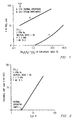
- the graph shows the effect of water vapor on the condensate composition at 900°C.
- the combined sodium vanadate and V 2 O 5 content of the condensate can be reduced from about 36 mole % to about 0.2 mole % by increasing the steam content in the combustion gases from about 3% for normal operation to about 24%.
- FIG. 2 provides a graphic illustration of the effect of water vapor on the allowable fuel level of vanadium (tolerance limit) to maintain the same total concentration of vanadium in the deposit.
- concentration of H 2 O in the gas stream is increased from about 3% to 24%
- concentration of vanadium in the condensate obtained at 900°C from a fuel containing about 23 ppm vanadium (V) would be about the same as that from a fuel containing 1 ppm V for no enrichment in H 2 O.
- the tolerance limit is increased from 1 ppm to 23 ppm under these conditions.
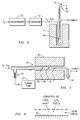
- FIGS. 3 and 4 Two kinds of experimental arrangements shown in FIGS. 3 and 4 were used.
- P H 2 O in the O 2 -H 2 O mixture was controlled by passing O 2 first through a water presaturator 10, maintained at a few degrees above the desired temperature, and then through a saturator 12 filled with glass beads at the desired temperature.
- the glass beads provide a large surface area for equilibration of the gas.
- the entire section of glass tubing between the presaturator and the furnace tube 14 was heated to above 100°C to avoid condensation of H 2 O.
- the O 2 -H 2 O mixture was passed over the salt mixture suspended in a crucible 16 from the arm of a Cahn thermogravimetric balance 18.
- thermocouple 20 was provided to monitor or estimate the temperature of the crucible 16. Measurements of the steady state rate of weight loss from the V 2 O 5 sample provided the vanadium saturation limit of the gas stream. The experiments, however, had some uncertainties due to steep temperature gradients in the furnace tube and relatively poor ( ⁇ 4°c) temperature control.
- the experimental arrangement shown in FIG. 4 was used for volatilization studies on Na 2 V 2 O 6 -Na 2 SO 4 -V 2 O 5 melts.
- the volatilization experiments were carried out in O 2 -SO 2 -SO 3 -H 2 O gas mixtures over a range of water vapor pressures (0-0.83 atm.).
- the required amount of water vapor was obtained using a syringe pump 22 to inject a controlled flow rate of liquid water through a heated thin capillary 24 of about 0.5 mm internal diameter.
- the equilibrium value of P SO 3 was attained by passing the O 2 -SO2-H 2 O gas mixture over a platinum catalyst 26.
- the specimen and catalyst were controlled at the same temperature to within ⁇ 2°C.
- the gas mixture After passing over the melt placed in a platinum crucible 28 in the wider section (12 mm i.d.) of the quartz tube 36 (disposed within a furnace 30), the gas mixture passed through the narrow section (6 mm i.d.) where vanadium oxide and vanadyl sulfate condensed (designated with number 32) on the cooler parts. The cooled gas mixture was finally led through a bubbler 34 to the exhaust. After the experiment was over, the condensate in the cooler parts of the tube was dissolved in dilute HF and analyzed for vanadium content.
- FIG. 5 shows the dependence of vapor density on gas flow rate.
- the curve for P H 2 O 0.045 illustrates typical effects of varying flow rates. At low flow rates, an erroneously high vapor density is obtained because vapor diffusion from the sample to the cooler sections of the tube contributes significantly to the volatilization rates.
- FIG. 5 A plot of the results as a function of P H 2 O is shown in FIG. 5 .
- Table I below gives the results of experiments at 750 and 900°C.
- Table I Volatization Studies with Ns 2 SO 4 -V 2 O 5 -Na 2 V 2 O 6 Gas Mixture P H 2 O Total flow rate at room temp. (cc/min.) Temp.° C Equilibrium P SO 3 Reaction Time (Hours) Total Vanadium Loss (ug) Vapor Density (ug V/litre of gas at STP O 2 + 0.15%SO 2 0.0 50 750 8.7 24 ⁇ 6 ⁇ 0.09 O 2 + 0.2% SO 2 0.21 50 750 8.7 57 145 0.93 O 2 + 0.2% SO 2 0.17 55 750 9.3 66 185 0.92 O 2 + 0.4% SO 2 0.55 50 750 8.7 41 675 6.00 O 2 + 2% SO 2 0.87 50 750 8.7 24 602 9.13 O 2 + 2% SO 2 0.87 50 750 8.7 23.5 625 9.68 O 2 + 0.15%SO 2 0.0 50 900 3.7 48 ⁇ 6 ⁇
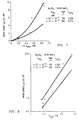
- FIG. 7 there is graphically shown the inferred values of vapor densities as a function of P H 2 O . It is clear that the vapor density of vanadium increases with P H 2 O. Since the vapor density of vanadium should increase with increasing activity of V 2 O 5 (reaction 1), the higher vapor density of vanadium at 750°C than at 900°C (the combustion product temperature may be between about 600°C to about 1100°C) is expected as a result of the higher activity of V 2 O 5 in the melt, as referenced in Table II below.
- the agreement between the experimental vapor density data and the calculated vapor densities using Yannoupoulos' data is extremely good.
- VO(OH) 3 was assumed to be the predominant vanadium containing gaseous species in the presence of steam;
- a log-log plot of the experimental vanadium vapor density ( FIG. 8 ) as a function of P H 2 O shows that the vapor density increases linearly with (P H 2 O ) 1.5 , which is consistent with VO(OH) 3 being the predominant vanadium containing gaseous species.
- FIG. 9 An embodiment of the invention is shown schematically in FIG. 9 .
- V 2 O 5 and Na 2 V 2 O 6 reaching the blade 38 surface will tend to volatilize in the form of vanadium hydroxide and NaOH by reactions (1) and (3):
- Na 2 ⁇ V 2 ⁇ O 6 l + 4 ⁇ H 2 ⁇ O g 2 ⁇ VO ⁇ OH 3 g + 2 ⁇ NaOH g
Landscapes
- Engineering & Computer Science (AREA)
- Chemical & Material Sciences (AREA)
- Combustion & Propulsion (AREA)
- Mechanical Engineering (AREA)
- General Engineering & Computer Science (AREA)
- Inorganic Compounds Of Heavy Metals (AREA)
- Manufacture And Refinement Of Metals (AREA)
- Engine Equipment That Uses Special Cycles (AREA)
Applications Claiming Priority (1)
| Application Number | Priority Date | Filing Date | Title |
|---|---|---|---|
| US12/341,428 US20100154430A1 (en) | 2008-12-22 | 2008-12-22 | System and method for operating a gas turbine using vanadium-containing fuels |
Publications (1)
| Publication Number | Publication Date |
|---|---|
| EP2199569A1 true EP2199569A1 (fr) | 2010-06-23 |
Family
ID=42112352
Family Applications (1)
| Application Number | Title | Priority Date | Filing Date |
|---|---|---|---|
| EP09179162A Withdrawn EP2199569A1 (fr) | 2008-12-22 | 2009-12-15 | Système et procédé de fonctionnement d'une turbine à gaz utilisant des carburants contenant du vanadium |
Country Status (4)
| Country | Link |
|---|---|
| US (1) | US20100154430A1 (fr) |
| EP (1) | EP2199569A1 (fr) |
| JP (1) | JP2010144728A (fr) |
| CN (1) | CN101806248A (fr) |
Families Citing this family (3)
| Publication number | Priority date | Publication date | Assignee | Title |
|---|---|---|---|---|
| ITBA20120048A1 (it) * | 2012-07-24 | 2014-01-25 | Itea Spa | Processo di combustione |
| ITBA20120049A1 (it) * | 2012-07-24 | 2014-01-25 | Itea Spa | Processo di combustione |
| FR3011005B1 (fr) * | 2013-09-26 | 2016-08-19 | Ge Energy Products France Snc | Agents de nettoyage mineraux mis en oeuvre sous forme de suspensions |
Citations (5)
| Publication number | Priority date | Publication date | Assignee | Title |
|---|---|---|---|---|
| US3359723A (en) * | 1965-10-29 | 1967-12-26 | Exxon Research Engineering Co | Method of combusting a residual fuel utilizing a two-stage air injection technique and an intermediate steam injection step |
| GB2187273A (en) * | 1985-10-31 | 1987-09-03 | Bernard George Ediss | A gas turbine binary cycle |
| EP1342771A1 (fr) * | 2002-03-08 | 2003-09-10 | Hitachi, Ltd. | Procédé et appareil pour traiter un hydrocarbure lourd et système de production d'électricité en étant équipé |
| GB2403272A (en) * | 2003-06-28 | 2004-12-29 | Rolls Royce Plc | A gas turbine engine having regulated combustion and steam cooled guide vanes |
| EP1522695A1 (fr) * | 1995-10-20 | 2005-04-13 | Arthur T. Griffin, Jr. | Systeme de refroidissement pour moteurs à turbines à gaz |
Family Cites Families (21)
| Publication number | Priority date | Publication date | Assignee | Title |
|---|---|---|---|---|
| US3876363A (en) * | 1974-01-02 | 1975-04-08 | Aqua Chem Inc | Atomizing method and apparatus |
| US4659339A (en) * | 1975-03-31 | 1987-04-21 | Petrolite Corporation | Inhibition of corrosion in fuels with Mg/Al/Si combinations |
| US4545197A (en) * | 1978-10-26 | 1985-10-08 | Rice Ivan G | Process for directing a combustion gas stream onto rotatable blades of a gas turbine |
| US4680927A (en) * | 1979-07-23 | 1987-07-21 | International Power Technology, Inc. | Control system for Cheng dual-fluid cycle engine system |
| US4714032A (en) * | 1985-12-26 | 1987-12-22 | Dipac Associates | Pollution-free pressurized combustion utilizing a controlled concentration of water vapor |
| US5442906A (en) * | 1992-11-30 | 1995-08-22 | Union Oil Company Of California | Combined geothermal and fossil fuel power plant |
| US5312585A (en) * | 1993-06-28 | 1994-05-17 | The United States Of America As Represented By The Secretary Of The Navy | Corrosion inhibition in high temperature environment |
| US5461854A (en) * | 1993-07-07 | 1995-10-31 | Griffin, Jr.; Arthur T. | Combustor cooling for gas turbine engines |
| US5637118A (en) * | 1994-06-30 | 1997-06-10 | United Technologies Corporation | Vanadium corrosion inhibitor |
| WO1996030637A1 (fr) * | 1995-03-24 | 1996-10-03 | Ultimate Power Engineering Group, Inc. | Chaudiere a combustible a forte teneur en vanadium et systeme |
| DE69603640T2 (de) * | 1995-03-31 | 2000-03-16 | United Technologies Corp. | Gasturbine und Verfahren zur Reduzierung von Hochtemperaturskorrosion in Gasturbinenteilen |
| GB9517646D0 (en) * | 1995-08-30 | 1995-11-01 | Quadrise Ltd | Emulsion fuels and their use in gas turbines |
| JPH1082329A (ja) * | 1996-09-09 | 1998-03-31 | Toshiba Corp | ガスタービン装置 |
| JPH1135950A (ja) * | 1996-12-26 | 1999-02-09 | Mitsubishi Heavy Ind Ltd | 発電方法及び発電装置 |
| DE19806823C2 (de) * | 1998-02-18 | 1999-12-09 | Loesche Gmbh | Vorrichtung und Verfahren zur Verbrennung vanadiumhaltiger Brennstoffe |
| US6632257B1 (en) * | 1999-05-13 | 2003-10-14 | General Electric Company | Fuel composition and method for extending the time between turbine washes when burning ash bearing fuel in a turbine |
| US6779333B2 (en) * | 2002-05-21 | 2004-08-24 | Conocophillips Company | Dual fuel power generation system |
| AU2003259174A1 (en) * | 2002-07-24 | 2004-02-09 | Mark D. Hughes | Methods and compositions for on-line gas turbine cleaning |
| US6786635B2 (en) * | 2002-11-06 | 2004-09-07 | General Electric Company | Turbine blade (bucket) health monitoring and prognosis using neural network based diagnostic techniques in conjunction with pyrometer signals |
| EP1585889A2 (fr) * | 2003-01-22 | 2005-10-19 | Vast Power Systems, Inc. | Cycles thermodynamiques faisant intervenir un diluant thermique |
| US7435330B2 (en) * | 2003-10-07 | 2008-10-14 | Hitachi, Ltd. | Heavy oil reforming method, an apparatus therefor, and gas turbine power generation system |
-
2008
- 2008-12-22 US US12/341,428 patent/US20100154430A1/en not_active Abandoned
-
2009
- 2009-12-15 EP EP09179162A patent/EP2199569A1/fr not_active Withdrawn
- 2009-12-17 JP JP2009285849A patent/JP2010144728A/ja active Pending
- 2009-12-22 CN CN200910262246A patent/CN101806248A/zh active Pending
Patent Citations (5)
| Publication number | Priority date | Publication date | Assignee | Title |
|---|---|---|---|---|
| US3359723A (en) * | 1965-10-29 | 1967-12-26 | Exxon Research Engineering Co | Method of combusting a residual fuel utilizing a two-stage air injection technique and an intermediate steam injection step |
| GB2187273A (en) * | 1985-10-31 | 1987-09-03 | Bernard George Ediss | A gas turbine binary cycle |
| EP1522695A1 (fr) * | 1995-10-20 | 2005-04-13 | Arthur T. Griffin, Jr. | Systeme de refroidissement pour moteurs à turbines à gaz |
| EP1342771A1 (fr) * | 2002-03-08 | 2003-09-10 | Hitachi, Ltd. | Procédé et appareil pour traiter un hydrocarbure lourd et système de production d'électricité en étant équipé |
| GB2403272A (en) * | 2003-06-28 | 2004-12-29 | Rolls Royce Plc | A gas turbine engine having regulated combustion and steam cooled guide vanes |
Also Published As
| Publication number | Publication date |
|---|---|
| CN101806248A (zh) | 2010-08-18 |
| JP2010144728A (ja) | 2010-07-01 |
| US20100154430A1 (en) | 2010-06-24 |
Similar Documents
| Publication | Publication Date | Title |
|---|---|---|
| Luthra et al. | Impurity deposits in gas turbines from fuels containing sodium and vanadium | |
| KR100742440B1 (ko) | 연소 가스 환경에서 실리카 및 규소 함유 물질의 감쇠손실을 방지하는 방법 | |
| CN113544372A (zh) | 氨分解设备、具备该氨分解设备的燃气轮机成套设备、氨分解方法 | |
| KR20090060171A (ko) | 요소로부터의 암모니아 제조 방법 | |
| CA2759031C (fr) | Appareil et procedes pour former des revetements metalliques modifies | |
| Zhu et al. | Quantitative analysis of the carbon generation characteristics during Mg/CO2 combustion: Implications for suppressing carbon deposition | |
| Steinbrecher et al. | Stabilization of Solar Salt at 650° C–Thermodynamics and practical implications for thermal energy storage systems | |
| SK279647B6 (sk) | Spôsob výroby kyseliny sírovej kondenzáciou pár te | |
| CN104995156B (zh) | 用于减少含硅材料中二氧化硅消退的方法和系统 | |
| TWI856663B (zh) | 裂解氨之方法 | |
| US20100154430A1 (en) | System and method for operating a gas turbine using vanadium-containing fuels | |
| O'Brien et al. | Developments in CVD delivery systems: A chemist's perspective on the chemical and physical interactions between precursors | |
| Ridley et al. | High-temperature water-vapor reaction mechanism of barium strontium aluminosilicate (BSAS) | |
| Myers et al. | Thermochemistry of volatile metal hydroxides and oxyhydroxides at elevated temperatures | |
| Yuan et al. | Exploration of chloride ion impurities on solid-liquid-vapor phase diagram and thermal performance of nitrate molten salts | |
| EP3102307B1 (fr) | Dispositif et procédé d'extraction d'un composé chimique dans des gaz acides | |
| Fenimore et al. | Rate of Reaction, O+ h2→ OH+ H, in Flames | |
| Holquist et al. | Experimental proof of concept of a cold trap as a purification step for lunar water processing | |
| Zherikova et al. | Towards the MOCVD’s paradise: Thermodynamics of phase transitions of new scandium precursors | |
| Steinberg et al. | The controlling chemistry in flame generated surface deposition of Na2SO4 and the effects of chlorine | |
| CN1036706A (zh) | 向在所说氯化物的压力下的连续萃取蒸馏塔中引入四氯化锆、四氯化铪及其混合物的方法和设备 | |
| KR100762769B1 (ko) | 증기 가열 방법 | |
| Korolev | Deposition of tungsten by reduction of its hexafluoride with hydrogen under the stoichiometric component ratio: an environmentally pure production process | |
| NZ519782A (en) | Method and composition for the prevention of high temperature corrosion due to alkali sulfates and alkali chlorides and composition for use in the same | |
| Faizullin et al. | Heat capacity of glymes from monoglyme to tetraglyme |
Legal Events
| Date | Code | Title | Description |
|---|---|---|---|
| PUAI | Public reference made under article 153(3) epc to a published international application that has entered the european phase |
Free format text: ORIGINAL CODE: 0009012 |
|
| AK | Designated contracting states |
Kind code of ref document: A1 Designated state(s): AT BE BG CH CY CZ DE DK EE ES FI FR GB GR HR HU IE IS IT LI LT LU LV MC MK MT NL NO PL PT RO SE SI SK SM TR |
|
| AX | Request for extension of the european patent |
Extension state: AL BA RS |
|
| 17P | Request for examination filed |
Effective date: 20101223 |
|
| STAA | Information on the status of an ep patent application or granted ep patent |
Free format text: STATUS: THE APPLICATION IS DEEMED TO BE WITHDRAWN |
|
| 18D | Application deemed to be withdrawn |
Effective date: 20140701 |