EP2199791A1 - Méthode pour evaluer l'hémolyse dans les érythrocytes et dispositif associé - Google Patents
Méthode pour evaluer l'hémolyse dans les érythrocytes et dispositif associé Download PDFInfo
- Publication number
- EP2199791A1 EP2199791A1 EP08022111A EP08022111A EP2199791A1 EP 2199791 A1 EP2199791 A1 EP 2199791A1 EP 08022111 A EP08022111 A EP 08022111A EP 08022111 A EP08022111 A EP 08022111A EP 2199791 A1 EP2199791 A1 EP 2199791A1
- Authority
- EP
- European Patent Office
- Prior art keywords
- hemolysis
- blood sample
- measurement
- values
- absorption spectrum
- Prior art date
- Legal status (The legal status is an assumption and is not a legal conclusion. Google has not performed a legal analysis and makes no representation as to the accuracy of the status listed.)
- Granted
Links
Images


Classifications
-
- G—PHYSICS
- G01—MEASURING; TESTING
- G01N—INVESTIGATING OR ANALYSING MATERIALS BY DETERMINING THEIR CHEMICAL OR PHYSICAL PROPERTIES
- G01N21/00—Investigating or analysing materials by the use of optical means, i.e. using sub-millimetre waves, infrared, visible or ultraviolet light
- G01N21/17—Systems in which incident light is modified in accordance with the properties of the material investigated
- G01N21/25—Colour; Spectral properties, i.e. comparison of effect of material on the light at two or more different wavelengths or wavelength bands
- G01N21/31—Investigating relative effect of material at wavelengths characteristic of specific elements or molecules, e.g. atomic absorption spectrometry
-
- G—PHYSICS
- G01—MEASURING; TESTING
- G01N—INVESTIGATING OR ANALYSING MATERIALS BY DETERMINING THEIR CHEMICAL OR PHYSICAL PROPERTIES
- G01N21/00—Investigating or analysing materials by the use of optical means, i.e. using sub-millimetre waves, infrared, visible or ultraviolet light
- G01N21/17—Systems in which incident light is modified in accordance with the properties of the material investigated
- G01N21/25—Colour; Spectral properties, i.e. comparison of effect of material on the light at two or more different wavelengths or wavelength bands
- G01N21/31—Investigating relative effect of material at wavelengths characteristic of specific elements or molecules, e.g. atomic absorption spectrometry
- G01N21/314—Investigating relative effect of material at wavelengths characteristic of specific elements or molecules, e.g. atomic absorption spectrometry with comparison of measurements at specific and non-specific wavelengths
- G01N2021/3144—Investigating relative effect of material at wavelengths characteristic of specific elements or molecules, e.g. atomic absorption spectrometry with comparison of measurements at specific and non-specific wavelengths for oxymetry
Definitions
- the invention relates to techniques for determining hemolysis of a blood sample.
- oximeters For blood sampling so-called oximeters are used. These are optical devices that can be used to detect total hemoglobin (tHb), hemoglobin derivatives such as oxyhemoglobin (O2Hb), carboxyhemoglobin (COHb), methemoglobin (MetHb) and the breakdown product bilirubin. These parameters are determined photometrically based on the Lambert-Beer law. For this purpose, the additive absorption of the individual components is usually measured at several discrete wavelengths in the visible range, for example between 459 nm and 666 nm. The determined measured values form an over-determined linear system of equations, which can be solved by means of multiple linear regression to determine the respective concentrations.
- the hemoglobin derivatives are measured in the hemolysate, ie a hemolyzed blood sample.
- hemolysate ie a hemolyzed blood sample.
- all scattering corpuscular blood components such as erythrocytes and the like are as completely as possible destroyed, ie hemolyzed, before the optical data acquisition.
- Hemolysis of the blood cells typically occurs by coupling ultrasound to the blood sample.
- Lambert-Becr's law for the actual concentration determination of the constituents, which describes the constant attenuation of light irradiated into the blood sample to be examined along the path through the blood sample.
- Hemolysis is therefore an essential prerequisite for a subsequent photometric examination of blood samples. There is therefore a need for techniques for determining hemolysis itself, in particular to provide initial conditions defined for a subsequent examination of the hemolyzed blood sample and thus to improve the accuracy and reproducibility of analytical studies.
- the object of the invention is to provide improved techniques for determining the hemolysis of a blood sample, with which the hemolysis state of the blood sample can be determined in more detail.
- a method for determining the hemolysis of a blood sample in which a measure of the hemolysis progress is determined is provided by irradiating measuring light emitted by a measuring light source to the blood sample during hemolysis, with a detector device for transmitting through the blood sample and / or measurement light reflected from the blood sample is detected at a plurality of measurement times of measurement light values, and an evaluation device compares a plurality of the measurement light values for different measurement times and from this a measure for the progress of the hemolysis is determined.
- the desired absorption spectrum can be obtained in various ways theoretically or experimentally, which is explained in more detail below. It corresponds to an absorption spectrum for a known degree of hemolysis, preferably for a completely hemolyzed blood sample.
- the at least one measurement absorption spectrum is then measured for the determination of the hemolysis of the blood sample to be examined in order to compare it with the at least one desired absorption spectrum.
- the invention provides, in another aspect, an apparatus for determining the hemolysis of a blood sample configured to determine a measure of hemolysis progress, with a measurement light source configured to irradiate measurement light upon hemolyzing on the blood sample, a detector device that is configured, measuring light values for measurement light transmitted through the blood sample and / or reflected by the blood sample, and an evaluation device configured to compare a plurality of the measurement light values for different measurement times and to determine therefrom a measure of the hemolysis progress.
- an apparatus for determining hemolysis of a blood sample configured to determine a measure of the degree of hemolysis of the blood sample, comprising an evaluator configured to have at least one desired absorption spectrum and at least one measurement absorption spectrum for the blood sample, and output means operatively connected to the evaluation means and configured to output an information signal derived from the measure of the degree of hemolysis.
- the aforementioned devices may be provided singly or in combination in a hemolyser.
- the invention provides improved techniques that allow reliable determination of the hemolysis of a blood sample.
- the hemolysis of the blood sample itself may in this case be carried out in any desired manner using one or more hemolysis methods which are known as such in various embodiments. It can thus be provided that the blood sample in a measuring chamber is subjected to ultrasound for hemolyzing. Additionally or alternatively, hemolysis of the blood sample may be effected by addition of one or more chemical reagents or by lowering the osmotic value of the blood sample.
- the detection of the measured light values for the measurement light transmitted through the blood sample and / or reflected by the blood sample can take place continuously or discontinuously.
- no spectrally resolved measurement is provided in the hemolysis progress determination, so that the measurement light values are detected free from a spectral assignment.
- a wavelength-selective detection of the measured light values can also take place, which can be achieved in particular by monochromatic light being irradiated and detected separately for a plurality of wavelengths.
- the determination of the measure of the degree of hemolysis of the blood sample is preferably spectrally resolved, which means that target absorption values from the at least one desired absorption spectrum and measurement absorption values from the at least one measurement absorption spectrum are compared correspondingly to their respective spectral assignment. For example, measured values assigned to the same wavelength can be compared with one another.
- the determination of the hemolysis progress and the determination of the measure of the degree of hemolysis of the blood sample in each case contribute to the improved efficiency and optimized reproducibility in the blood sample determination. Their possible combination results in additional effects.
- it may be provided to first observe the progress of a hemolysis, in order subsequently to determine from the determination of the measure of the degree of hemolysis whether there is sufficient hemolysis. If this is not the case, a post-hemolysis can be performed, for which the course of the hemolysis progress is again observed. This results in additional information, so that it can be determined with greater certainty whether and to what extent the post-hemolysis contributes to the improvement of the hemolyzed blood sample.
- the determination of the degree of hemolysis can be used in parallel with the determination of hemolysis progress to obtain additional information about the degree of hemolysis currently occurring. Combined, the determination of hemolysis progress and the determination of the degree of hemolysis thus potentiate the improvements in hemolysis determination of a blood sample achieved with the invention.
- a further development of the invention provides that the detection of the measured values is carried out at least partially during a hemolysis operation of a hemolysis device used for hemolysis of the blood sample.
- the hemolysis device also referred to as a hemolyser, actually acts on the blood sample to hemolyze. This is done, for example, by applying ultrasound to the blood sample.
- the detection of the measured light values is carried out at least partially during a break in operation of the hemolysis device used for hemolysis of the blood sample.
- the break in operation no hemolysis promoting action of the hemolysis device on the blood sample.
- the ultrasound is interrupted.
- a combined acquisition of the measured light values during the hemolysis operation on the one hand and the operating pauses on the other hand can also be provided.
- subsequent process steps can be selected. If, for example, it is determined that a further progress of the hemolytic process can not be observed, it is possible to pass on the hemolyzed sample to another determination, for example the photometric determination of the hemoglobin derivatives. It may also be followed by a determination of the degree of hemolysis, in order then to decide whether post-hemolysis should be carried out, which in turn can be observed in the course of progress.
- a development of the invention can provide that the detection of the measured light values is carried out at least partially during the action of one or more reagents which promote hemolysis of the blood sample. It can also be provided to perform the hemolysis both by means of one or more reagents and by means of ultrasound.
- hemolytic surfactants can be used as Triton X-100 in diluted form, TWEEN 621 and BRIJ 56 (available from Sigma Aldrich).
- a preferred embodiment of the invention provides that the detection of the measured light values is carried out at least partially during a period in which the blood sample is free from the action of one or more reagents promoting hemolysis of the blood sample.
- the blood sample is free from the action of the one or more reagents when their hemolytic effect is depleted or inhibited.
- further reagents can be added, in particular for a post-hemolysis.
- a preferred embodiment of the invention provides that intensity measurement values for the measurement light are detected as measurement light values.
- a time-dependent profile for the measured light values is formed from the detected measured light values and for the time-dependent course at least in sections an increase of an associated measurement curve is determined as a comparison measure for the comparison of the measurement light values to the different measurement times.
- the increase can be determined for individual points in the course of the curve or also for curve sections running through several points of the curve. There may be positive and negative slope values indicating a rising and a falling curve.
- An advantageous embodiment of the invention provides that a conclusion of the hemolysis is determined if the increase falls within a selectable measurement accuracy after a measurement period in which the increase is different from zero to a minimum to zero.
- scattering and diffraction of the embedded particles takes place for the irradiated measuring light in addition to the absorption.
- the blood is completely hemolyzed and all scattering cell fragments are removed, the incident measuring light is absorbed exclusively in idcal cases.
- the transition between the state of combined absorption, scattering, and diffraction to pure absorption is seen in the temporal waveform as a transition between a nonzero slope and decreasing slope of the trace, which goes up to a zero slope. If the increase does not change over time, it indicates that the hemolysis process is complete as far as the current hemolysis is concerned.
- An expedient embodiment of the invention provides that after the conclusion of the hemolysis hemoglobin values of the blood sample are determined by means of an optical measuring method.
- optical methods are known as such in various embodiments.
- partially the optical measuring components can be used, for example the measuring light source and / or the Dctcktorcinraum, which are used to determine the Hämolysefort Vietnameses.
- An advantageous embodiment of the invention provides that in the comparison local Kurvenanieristone be compared for spectrally associated desired absorption values from the at least one desired absorption spectrum and measurement absorption values from the at least one measurement absorption spectrum.
- An incomplete hemolysis leads Compared to the target absorption spectrum, which represents a completely hemolyzed blood sample, spectral changes in the measurement absorption spectrum. These include, first, an increase in the absorption spectrum due to the raising of absorption bands by a degree of hemolysis dependent offset. In addition, differences in slope appear in areas of lesser absorption. Furthermore, the signal-to-noise ratio is improved at higher levels of hemolysis, which makes the pixel-pixel noise sensitive to hemolysequence.
- the local slope values indicate, in particular, the differences in slope.
- the noise behavior is also indicated by this.
- the values determined from the comparison can optionally be further processed, including, in particular, averaging or summation or also a weighting of the comparison values.
- a further development of the invention preferably provides that in the comparison the spectrally associated desired absorption values from the at least one desired absorption spectrum and measurement absorption values from the at least one measurement absorption spectrum are compared.
- the comparison of spectrally associated absorption values can in particular be carried out as a subtraction formation, so that so-called residuals are determined. These are related to the more or less formed and previously described offset increase depending on the degree of haemolysis. Also in connection with these comparative values can optionally be provided further processing.
- a model absorption spectrum formed by means of absorption band summation is used for the at least one desired absorption spectrum.
- a desired absorption spectrum is formed by summing up for the expected constituents of the respective known absorption bands in the spectral region of interest, so that an overall absorption spectrum is produced.
- the absorption bands are added in a linear manner.
- a development of the invention can provide that a measured calibration absorption spectrum is used for the at least one desired absorption spectrum.
- the measured calibration song absorption spectrum can be experimentally for one with certainty hemolyzed blood sample can be determined experimentally. It can also be provided in one embodiment that both the model absorption spectrum and the measured calibration absorption spectrum are used to determine the degree of the degree of hemolysis.
- a preferred embodiment of the invention provides that a quality control measure for a sample quality of the blood sample is displayed with the information signal.
- the determination of the degree of hemolysis of a blood sample can also be used to determine the still or no longer existing quality of a blood sample.
- the quality control measure may indicate that an examined blood sample is still or no longer usable if it exceeds or falls short of a predetermined threshold value, for example as a result of too advanced aging.
- a post-hemolysis of the blood sample is started if the degree of the degree of hemolysis falls below a predetermined threshold value.
- a signal which causes an indication of the achievement of a predetermined threshold degree of hemolysis.
- Such signaling may be in audible and / or visual form. For example, a corresponding indication may alert the user to this. If, however, the threshold value is undershot, this can also be communicated to the user.
- the evaluation device can automatically generate a control signal, which is applied to the hemolysis device used for the hemolysis in order to initiate post-hemolysis, for example by ultrasound being applied to the blood sample again. Subsequently, the degree of the degree of hemolysis is determined again, and then again to decide whether the hemolysis was sufficiently carried out. In this way, an automatic control loop is implemented which controls the operation of the hemolyzer depending on the degree of hemolysis.
- a hemolysis progress is determined by irradiating the blood sample from the measuring light source, emitted measuring light during hemolysis, with a detector device for transmitted through the blood sample and / or from the blood test Reflected measuring light to several measuring time point measuring light values are detected and compared with the evaluation several of the measured light values for different measuring times and from this a measure of the hemolysis progress is determined.
- the determination of the degree of hemolysis of the blood sample can be carried out in parallel with the hemolysis progress determination. But also a use following the determination of progress can be provided. In this way, for example, an additional final inspection is possible.
- the measure of the degree of haemolysis is used during pauses in operation of the hemolysis device as a kind of intermediate information about the hemolysis.
- the determination of the hemoglobin values of the blood sample can be provided by means of an optical measuring method.
- the explanations made in connection with the methods for determining hemolysis apply correspondingly.
- the apparatus for determining hemolysis may be configured according to the various process designs.
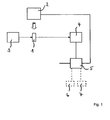
- Fig. 1 shows a schematic representation of an apparatus for determining the hemolysis of a blood sample.
- the blood sample in a measuring chamber 1 is subjected to ultrasound by an ultrasonic device 2 in the illustrated embodiment.
- a light source 3 which can emit light with a broadband spectrum or monochromatic light of different wavelengths, measuring light is applied to the measuring chamber 1.
- Measurement light transmitted through the blood sample then passes to a detector. With the aid of the detector 4, intensity measured values are recorded for the transmitted measuring light, optionally in spectrally resolved form.
- the detector 4 is connected to an evaluation device 5, by means of which the detected measurement light values can be evaluated to determine a transmission and / or absorption.
- a detector (not shown) may be provided, which is configured to measure light reflected from the blood sample in the measuring chamber 1 for the determination of the hemolysis progress.
- the evaluation device 5 is coupled to the ultrasound device 2 so that it can be controlled as a function of the evaluation results.
- Fig. 1 an optional output device 6 is shown, via which audio and / or video signals can be output, which display evaluation results. Furthermore, an input device 7 is provided, by means of which user's subscriptions are detected.
- the detector 4 is used with the evaluation device 5 for determining the hemolysis progress of the hemolysis of the blood sample and for determining a measure of the degree of hemolysis of the blood sample.
- a separate design of the two measuring systems can be provided so that they can be integrated individually or in combination in a hemolyser, for example as a single module or integrated module.
- Fig. 2 shows graphs for the measuring light intensity as a function of time.
- Fig. 1 It is apparent that during an initial period I (0 to about 4000 ms) in the curve, the measured light intensity remains substantially unchanged. Hemolysis has not started yet. In another curve section II (about 4000 to about 8000ms), the intensity of the detected measuring light then increases, indicating the beginning (at 4000 ms) and the further progress of the hemolysis. As the hemolysis proceeds, the curve progresses to a saturation section III (about 8000 to about 12000 ms) in which the transmitted measuring light intensity barely changes. This indicates complete hemolysis.
- the measurement curve represented by squares represents value pairs of a blood sample in which the course of hemolysis and the hemolysis result were in order.
- the measurement curve represented by circles shows value pairs of a blood sample in which the course of hemolysis and the hemolysis result were not in order.
- the time-dependent curve for the intensity of the transmitted measuring light can also be used to check whether bubbles form in the hemolysis, leading to a change in the curve. Air bubbles lead to a sudden increase of transmitted measuring light, since absorption and scattering are eliminated. Furthermore the focusing light can be focused through the air bubbles. This creates an unwanted local slope in the trace.
- Fig. 2 Based on the course of progress of hemolysis according to Fig. 2 can then be decided, for example, whether an initially scheduled hemolysis time must be extended or not. It can also be decided whether, if necessary, a repetition of the hemolysis process is carried out.
- Fig. 3 shows a graphical representation of a curve for the temporal dependence of the intensity of transmitted measuring light and the curve ascending characterizing first derivative thereof, wherein the hemolysis was classified as "in order".
- the hemolysis leads to a strong noise of the acquired measurement data (raw data crosses in Fig. 3 ). There may be noise reduction by filtering. This simplifies the measurement data entry.
- These filtered data are represented by circles in the figure.
- a classification of the hemolysis was made as a function of the time position of a last significant increase in the curve. This occurs when the curve increase is above a threshold value. Such measured values are additionally shown by open squares in the upper part of the figure. If the last significant curve approach is within a valid time window, hemolysis is "OK". Hemolysis is classified as "borderline” (vg1. Fig. 4 below) when the last significant curve increase is at the edge of the time window. Hemolysis is not "OK” if the last significant curve increase is outside the time window.
- Fig. 4 shows a graphical representation of a curve for the temporal dependence of the intensity of transmitted measuring light and the curve ascending characterizing first derivative thereof, wherein the hemolysis was classified as "borderline".
- Fig. 5 shows a graphical representation of a curve for the temporal dependence of the intensity of the transmitted measuring light and the curve ascending characterizing first derivative thereof, wherein the hemolysis was classified as "not in order".
- Fig. 6 shows a plot of the absorbance as a function of wavelength for the individual absorption bands of hemoglobin derivatives and the degradation product bilirubin.
- FIG. 7 Figure 4 shows a plot of several absorbance spectra of a blood sample for different degrees of hemolysis indicated on the top right.
- Fig. 8 shows a graphical representation for the association between degree of hemolysis and the determined curve increase in measurement absorption spectra for multiple blood samples. It turns out that the relationship between degree of haemolysis and curve increase can be described by means of a straight line equation (linear fit straight line). For comparison, samples were prepared with a fixed degree of hemolysis by selectively mixing quantities of hemolyzed blood and non-hemolyzed blood. As an additional control, the erythrocytes were counted under a microscope. In the Fig.
- Curve elevation values obtained were determined by comparing mutually associated local slopes for an absorption curve of a sample with a 100% degree of hemolysis on the one hand and a measurement curve with a different degree of hemolysis on the other hand for the wavelengths in the examined area Averaging for the differences found.
- Fig. 9 shows a graph for the association between degree of hemolysis and so-called residues for multiple blood samples. There is a quadratic correlation between the degree of hemolysis and the residuals (quadratic fit function). The residuals are a measure of the correspondence of the regression-finding fit curves with the experimentally measured values.
Landscapes
- Physics & Mathematics (AREA)
- Spectroscopy & Molecular Physics (AREA)
- Health & Medical Sciences (AREA)
- Life Sciences & Earth Sciences (AREA)
- Chemical & Material Sciences (AREA)
- Analytical Chemistry (AREA)
- Biochemistry (AREA)
- General Health & Medical Sciences (AREA)
- General Physics & Mathematics (AREA)
- Immunology (AREA)
- Pathology (AREA)
- Investigating Or Analysing Biological Materials (AREA)
- Investigating Or Analysing Materials By Optical Means (AREA)
- Measurement Of The Respiration, Hearing Ability, Form, And Blood Characteristics Of Living Organisms (AREA)
Priority Applications (8)
| Application Number | Priority Date | Filing Date | Title |
|---|---|---|---|
| EP08022111.2A EP2199791B1 (fr) | 2008-12-19 | 2008-12-19 | Méthode pour evaluer l'hémolyse dans les érythrocytes et dispositif associé |
| CA2688757A CA2688757A1 (fr) | 2008-12-19 | 2009-12-17 | Methode et instrument pour la determination de l'hemolyse d'un echantillon de sang |
| JP2009287493A JP2010156688A (ja) | 2008-12-19 | 2009-12-18 | 血液サンプルの溶血の測定方法および装置 |
| CN201310061170.6A CN103149168B (zh) | 2008-12-19 | 2009-12-18 | 用于确定血样溶血的方法和装置 |
| US12/641,688 US8675185B2 (en) | 2008-12-19 | 2009-12-18 | Determination of haemolysis of a blood sample using gradient analysis |
| CN200911000174.3A CN101876629B (zh) | 2008-12-19 | 2009-12-18 | 用于确定血样溶血的方法和装置 |
| HK11104077.5A HK1149801B (en) | 2008-12-19 | 2011-04-21 | Method and device for determining the haemolysis of a blood sample |
| HK13109514.3A HK1182175B (en) | 2008-12-19 | 2013-08-14 | Method for determining the haemolysis of a blood sample and device |
Applications Claiming Priority (1)
| Application Number | Priority Date | Filing Date | Title |
|---|---|---|---|
| EP08022111.2A EP2199791B1 (fr) | 2008-12-19 | 2008-12-19 | Méthode pour evaluer l'hémolyse dans les érythrocytes et dispositif associé |
Publications (2)
| Publication Number | Publication Date |
|---|---|
| EP2199791A1 true EP2199791A1 (fr) | 2010-06-23 |
| EP2199791B1 EP2199791B1 (fr) | 2019-05-01 |
Family
ID=40557134
Family Applications (1)
| Application Number | Title | Priority Date | Filing Date |
|---|---|---|---|
| EP08022111.2A Active EP2199791B1 (fr) | 2008-12-19 | 2008-12-19 | Méthode pour evaluer l'hémolyse dans les érythrocytes et dispositif associé |
Country Status (5)
| Country | Link |
|---|---|
| US (1) | US8675185B2 (fr) |
| EP (1) | EP2199791B1 (fr) |
| JP (1) | JP2010156688A (fr) |
| CN (2) | CN101876629B (fr) |
| CA (1) | CA2688757A1 (fr) |
Cited By (1)
| Publication number | Priority date | Publication date | Assignee | Title |
|---|---|---|---|---|
| WO2015063113A1 (fr) * | 2013-10-31 | 2015-05-07 | Fresenius Medical Care Deutschland Gmbh | Procédé et dispositif de détection d'hémolyse ou de détermination d'un facteur de correction corrigeant l'influence de l'hémolyse sur une mesure de l'hématocrite |
Families Citing this family (9)
| Publication number | Priority date | Publication date | Assignee | Title |
|---|---|---|---|---|
| JP5824950B2 (ja) * | 2011-08-08 | 2015-12-02 | ソニー株式会社 | 血液分析装置および血液分析方法 |
| JP5959814B2 (ja) * | 2011-08-08 | 2016-08-02 | ソニー株式会社 | 血液分析装置および血液分析方法 |
| CN104034667A (zh) * | 2014-06-06 | 2014-09-10 | 中国科学院长春光学精密机械与物理研究所 | 一种在线式分光测色仪及其使用方法 |
| CN104897589B (zh) * | 2015-06-02 | 2017-05-31 | 中国农业科学院兰州畜牧与兽药研究所 | 一种定量评估药物溶血性指标的方法 |
| CN106092902A (zh) * | 2016-06-30 | 2016-11-09 | 上海市奉贤区中心医院 | 医用扫描装置 |
| WO2018017199A1 (fr) | 2016-07-18 | 2018-01-25 | Siemens Healthcare Diagnostics Inc. | Système et procédé de détection optique totale d'hémolyse de sang |
| CN110530824B (zh) * | 2019-09-04 | 2021-06-04 | 深圳褀氏生物科技有限公司 | 一种红细胞渗透脆性测定方法及其试剂盒 |
| CN111398186A (zh) * | 2020-04-15 | 2020-07-10 | 深圳市康立生物医疗有限公司 | 一种血红蛋白及其衍生物测试装置 |
| US20230404420A1 (en) * | 2020-10-30 | 2023-12-21 | The Regents Of The University Of California | Non-invasive optical measurement of blood flow speed |
Citations (7)
| Publication number | Priority date | Publication date | Assignee | Title |
|---|---|---|---|---|
| DE1295888B (de) | 1964-04-24 | 1969-05-22 | Yeda Res & Dev | Verfahren zur Resistenzbestimmung an roten Blutkoerperchen |
| EP0268025A1 (fr) * | 1986-08-20 | 1988-05-25 | Hitachi, Ltd. | Procédé pour analyser un échantillon sanguin hémolysé |
| US4813420A (en) * | 1986-10-20 | 1989-03-21 | Sanki Engineering Ltd. | Hemolysis reaction measuring device |
| EP0535618A1 (fr) * | 1991-10-04 | 1993-04-07 | Fresenius AG | Appareil pour la séparation des fluides en leurs constituants |
| EP0695805A2 (fr) * | 1994-08-03 | 1996-02-07 | Roche Diagnostics GmbH | Méthode d'analyse d'un échantillon médical avec prévention de dérangements causés par l'hémolyse |
| US20050051466A1 (en) * | 2003-07-02 | 2005-03-10 | Carter Lee F. | Monitoring and control system for blood processing |
| US20080297769A1 (en) | 2007-06-01 | 2008-12-04 | Eberhard Bamberg | Through-container optical evaluation system |
Family Cites Families (7)
| Publication number | Priority date | Publication date | Assignee | Title |
|---|---|---|---|---|
| US4040742A (en) * | 1976-08-09 | 1977-08-09 | The United States Of America As Represented By The Secretary Of The Department Of Health, Education And Welfare | Capillary flow method and apparatus for determination of cell osmotic fragility |
| JPH04151541A (ja) * | 1990-10-15 | 1992-05-25 | Hitachi Ltd | 細胞分析装置 |
| US6995835B2 (en) * | 1997-03-03 | 2006-02-07 | Nir Diagnostics Inc. | Method and apparatus for measuring analytes in blood bags |
| US6330058B1 (en) * | 1999-04-14 | 2001-12-11 | University Of South Florida | Spectrophotometric method and apparatus for blood typing |
| AU777102B2 (en) * | 2000-01-13 | 2004-09-30 | Ortho-Clinical Diagnostics, Inc. | Failure detection in automated clinical analyzers |
| FR2873925B1 (fr) * | 2004-08-05 | 2006-10-13 | Erytech Pharma Soc Par Actions | Procede et dispositif de lyse-rescellement pour l'incorporation de principe actif notamment asparaginase ou inositol hexaphosphate, dans des erythrocytes |
| DE602005027907D1 (de) * | 2004-12-13 | 2011-06-16 | Bayer Healthcare Llc | Transmissionspektroskopiesystem zur verwendung bei der bestimmung von analyten in körperflüssigkeit |
-
2008
- 2008-12-19 EP EP08022111.2A patent/EP2199791B1/fr active Active
-
2009
- 2009-12-17 CA CA2688757A patent/CA2688757A1/fr not_active Abandoned
- 2009-12-18 JP JP2009287493A patent/JP2010156688A/ja active Pending
- 2009-12-18 CN CN200911000174.3A patent/CN101876629B/zh active Active
- 2009-12-18 CN CN201310061170.6A patent/CN103149168B/zh active Active
- 2009-12-18 US US12/641,688 patent/US8675185B2/en active Active
Patent Citations (8)
| Publication number | Priority date | Publication date | Assignee | Title |
|---|---|---|---|---|
| DE1295888B (de) | 1964-04-24 | 1969-05-22 | Yeda Res & Dev | Verfahren zur Resistenzbestimmung an roten Blutkoerperchen |
| EP0268025A1 (fr) * | 1986-08-20 | 1988-05-25 | Hitachi, Ltd. | Procédé pour analyser un échantillon sanguin hémolysé |
| US4813420A (en) * | 1986-10-20 | 1989-03-21 | Sanki Engineering Ltd. | Hemolysis reaction measuring device |
| EP0535618A1 (fr) * | 1991-10-04 | 1993-04-07 | Fresenius AG | Appareil pour la séparation des fluides en leurs constituants |
| EP0695805A2 (fr) * | 1994-08-03 | 1996-02-07 | Roche Diagnostics GmbH | Méthode d'analyse d'un échantillon médical avec prévention de dérangements causés par l'hémolyse |
| US6268167B1 (en) * | 1994-08-03 | 2001-07-31 | Roche Diagnostics Gmbh | Methods for determining an analyte in a plasma or serum sample which may be contaminated with interfering substances resulting from hemolysis |
| US20050051466A1 (en) * | 2003-07-02 | 2005-03-10 | Carter Lee F. | Monitoring and control system for blood processing |
| US20080297769A1 (en) | 2007-06-01 | 2008-12-04 | Eberhard Bamberg | Through-container optical evaluation system |
Non-Patent Citations (2)
| Title |
|---|
| NEUDEL F ET AL: "Effect of hemolysis on oxygen and hematocrit measurements by near infrared reflectance spectroscopy", MEDICAL ENGINEERING & PHYSICS ELSEVIER UK, vol. 24, no. 4, May 2002 (2002-05-01), pages 301 - 307, XP002525468, ISSN: 1350-4533, Retrieved from the Internet <URL:http://www.sciencedirect.com/science?_ob=ArticleURL&_udi=B6T9K-458N9JV-1&_user=987766&_rdoc=1&_fmt=&_orig=search&_sort=d&view=c&_acct=C000049880&_version=1&_urlVersion=0&_userid=987766&md5=222ebcf0cb6ce5ab740d4a339a06fbba> [retrieved on 20090424] * |
| PAZDZIOR GRZEGORZ ET AL: "The kinetics of haemolysis of spherocytic erythrocytes.", CELLULAR & MOLECULAR BIOLOGY LETTERS, vol. 8, no. 3, 2003, pages 639 - 648, XP002525467, ISSN: 1425-8153, Retrieved from the Internet <URL:http://www.cmbl.org.pl/pdf/Vol8_p639.pdf> [retrieved on 20090424] * |
Cited By (1)
| Publication number | Priority date | Publication date | Assignee | Title |
|---|---|---|---|---|
| WO2015063113A1 (fr) * | 2013-10-31 | 2015-05-07 | Fresenius Medical Care Deutschland Gmbh | Procédé et dispositif de détection d'hémolyse ou de détermination d'un facteur de correction corrigeant l'influence de l'hémolyse sur une mesure de l'hématocrite |
Also Published As
| Publication number | Publication date |
|---|---|
| HK1149801A1 (en) | 2011-10-14 |
| US8675185B2 (en) | 2014-03-18 |
| EP2199791B1 (fr) | 2019-05-01 |
| CN101876629A (zh) | 2010-11-03 |
| US20100159500A1 (en) | 2010-06-24 |
| CN103149168B (zh) | 2016-04-06 |
| HK1182175A1 (zh) | 2013-11-22 |
| CN103149168A (zh) | 2013-06-12 |
| CN101876629B (zh) | 2013-04-03 |
| CA2688757A1 (fr) | 2010-06-19 |
| JP2010156688A (ja) | 2010-07-15 |
Similar Documents
| Publication | Publication Date | Title |
|---|---|---|
| EP2199791B1 (fr) | Méthode pour evaluer l'hémolyse dans les érythrocytes et dispositif associé | |
| EP3051272B1 (fr) | Procédé et analyseur automatique de détermination de lipides et d'autres substances interférentes dans des échantillons de liquide corporel | |
| DE69623544T2 (de) | Verfahren zum optischen Bestimmung eines Stoffes in Lösung | |
| EP2246692B1 (fr) | Procédé de détection d'impuretés d'une cuvette de mesure optique | |
| DE60024269T2 (de) | Messung der gesamtkonzentration von hämoglobin | |
| EP0034156B1 (fr) | Procede et dispositif pour la determination de glucose dans serum ou l'urine | |
| DE69032442T2 (de) | Verfahren zur Kennzeichnung eines Materials biologischer Herkunft, unter Verwendung der Nah-Infrarotspektroskopie | |
| EP2710348B1 (fr) | Procédé et système de détermination de la concentration de substances dans des liquides corporels | |
| EP3052934B1 (fr) | Procédé de reconnaissance d'un état d'un échantillon, dispositif d'analyse des échantillons et système de laboratoire automatique | |
| DE4417639A1 (de) | Verfahren zur Bestimmung eines Analyten in einer biologischen Probe | |
| EP3108220B1 (fr) | Procédé et dispositif d'affectation d'un échantillon de plasma sanguin | |
| WO2007090378A2 (fr) | Dispositif de mesure destiné à déterminer la dimension, la répartition dimensionnelle et la quantité de particules à l'échelle nanoscopique | |
| DE602004001794T2 (de) | Verfahren und Vorrichtung zur in vitro oder in vivo Messung der Konzentration einer Substanz | |
| DE102010023486A1 (de) | Nachweisvorrichtung und -verfahren | |
| DE69220906T2 (de) | Verfahren zur Bestimmung von Retikulozyten | |
| DE69736336T2 (de) | Verfahren zur messung von blutersatzstoffen | |
| EP3591378B1 (fr) | Procédé de détermination des lipides, de hémoglobine et de bilirubine dans des échantillons de liquide corporel | |
| DE69221669T2 (de) | Gerät zur Messung von Zellen im Urin | |
| DE69727542T2 (de) | Verfahren zur Messung der Konzentration eines spezifischen Bestandteils | |
| EP2502054B1 (fr) | Procédé et dispositif destinés à l'examen d'un liquide corporel | |
| DE102011012674B3 (de) | Verfahren und Nachweisvorrichtung zur Bestimmung eines Nierenfunktionsparameters | |
| DE102017008631A1 (de) | Anordnung zur Filterung von Blut, insbesondere im Rahmen einer extrakorporalen Leberersatztherapie, sowie Verfahren zum Betrieb serselben | |
| DE69614374T2 (de) | Verfahren zur spektralanalyse von inhomogenen proben | |
| EP4384802B1 (fr) | Procédé de création d'une base de données pour déterminer une valeur de référence d'aggrégométrie à transmission de lumière et procédé et dispositif de mise en oeuvre d'une mesure d'aggrégométrie à transmission de lumière | |
| EP3296739A1 (fr) | Procede et systeme de classement d'un echantillon de liquide corporel dans une categorie d'echantillon de liquide corporel |
Legal Events
| Date | Code | Title | Description |
|---|---|---|---|
| PUAI | Public reference made under article 153(3) epc to a published international application that has entered the european phase |
Free format text: ORIGINAL CODE: 0009012 |
|
| 17P | Request for examination filed |
Effective date: 20100108 |
|
| AK | Designated contracting states |
Kind code of ref document: A1 Designated state(s): AT BE BG CH CY CZ DE DK EE ES FI FR GB GR HR HU IE IS IT LI LT LU LV MC MT NL NO PL PT RO SE SI SK TR |
|
| AX | Request for extension of the european patent |
Extension state: AL BA MK RS |
|
| AKX | Designation fees paid |
Designated state(s): AT BE BG CH CY CZ DE DK EE ES FI FR GB GR HR HU IE IS IT LI LT LU LV MC MT NL NO PL PT RO SE SI SK TR |
|
| 17Q | First examination report despatched |
Effective date: 20121011 |
|
| GRAP | Despatch of communication of intention to grant a patent |
Free format text: ORIGINAL CODE: EPIDOSNIGR1 |
|
| STAA | Information on the status of an ep patent application or granted ep patent |
Free format text: STATUS: GRANT OF PATENT IS INTENDED |
|
| INTG | Intention to grant announced |
Effective date: 20180314 |
|
| GRAJ | Information related to disapproval of communication of intention to grant by the applicant or resumption of examination proceedings by the epo deleted |
Free format text: ORIGINAL CODE: EPIDOSDIGR1 |
|
| STAA | Information on the status of an ep patent application or granted ep patent |
Free format text: STATUS: EXAMINATION IS IN PROGRESS |
|
| INTC | Intention to grant announced (deleted) | ||
| GRAP | Despatch of communication of intention to grant a patent |
Free format text: ORIGINAL CODE: EPIDOSNIGR1 |
|
| STAA | Information on the status of an ep patent application or granted ep patent |
Free format text: STATUS: GRANT OF PATENT IS INTENDED |
|
| INTG | Intention to grant announced |
Effective date: 20180918 |
|
| GRAS | Grant fee paid |
Free format text: ORIGINAL CODE: EPIDOSNIGR3 |
|
| RAP1 | Party data changed (applicant data changed or rights of an application transferred) |
Owner name: F. HOFFMANN-LA ROCHE AG Owner name: ROCHE DIAGNOSTICS GMBH |
|
| RAP1 | Party data changed (applicant data changed or rights of an application transferred) |
Owner name: F. HOFFMANN-LA ROCHE AG Owner name: ROCHE DIAGNOSTICS GMBH |
|
| GRAA | (expected) grant |
Free format text: ORIGINAL CODE: 0009210 |
|
| STAA | Information on the status of an ep patent application or granted ep patent |
Free format text: STATUS: THE PATENT HAS BEEN GRANTED |
|
| AK | Designated contracting states |
Kind code of ref document: B1 Designated state(s): AT BE BG CH CY CZ DE DK EE ES FI FR GB GR HR HU IE IS IT LI LT LU LV MC MT NL NO PL PT RO SE SI SK TR |
|
| REG | Reference to a national code |
Ref country code: GB Ref legal event code: FG4D Free format text: NOT ENGLISH |
|
| REG | Reference to a national code |
Ref country code: CH Ref legal event code: EP Ref country code: AT Ref legal event code: REF Ref document number: 1127624 Country of ref document: AT Kind code of ref document: T Effective date: 20190515 |
|
| REG | Reference to a national code |
Ref country code: DE Ref legal event code: R096 Ref document number: 502008016729 Country of ref document: DE |
|
| REG | Reference to a national code |
Ref country code: IE Ref legal event code: FG4D Free format text: LANGUAGE OF EP DOCUMENT: GERMAN |
|
| REG | Reference to a national code |
Ref country code: NL Ref legal event code: MP Effective date: 20190501 |
|
| REG | Reference to a national code |
Ref country code: LT Ref legal event code: MG4D |
|
| PG25 | Lapsed in a contracting state [announced via postgrant information from national office to epo] |
Ref country code: PT Free format text: LAPSE BECAUSE OF FAILURE TO SUBMIT A TRANSLATION OF THE DESCRIPTION OR TO PAY THE FEE WITHIN THE PRESCRIBED TIME-LIMIT Effective date: 20190901 Ref country code: ES Free format text: LAPSE BECAUSE OF FAILURE TO SUBMIT A TRANSLATION OF THE DESCRIPTION OR TO PAY THE FEE WITHIN THE PRESCRIBED TIME-LIMIT Effective date: 20190501 Ref country code: SE Free format text: LAPSE BECAUSE OF FAILURE TO SUBMIT A TRANSLATION OF THE DESCRIPTION OR TO PAY THE FEE WITHIN THE PRESCRIBED TIME-LIMIT Effective date: 20190501 Ref country code: HR Free format text: LAPSE BECAUSE OF FAILURE TO SUBMIT A TRANSLATION OF THE DESCRIPTION OR TO PAY THE FEE WITHIN THE PRESCRIBED TIME-LIMIT Effective date: 20190501 Ref country code: NL Free format text: LAPSE BECAUSE OF FAILURE TO SUBMIT A TRANSLATION OF THE DESCRIPTION OR TO PAY THE FEE WITHIN THE PRESCRIBED TIME-LIMIT Effective date: 20190501 Ref country code: LT Free format text: LAPSE BECAUSE OF FAILURE TO SUBMIT A TRANSLATION OF THE DESCRIPTION OR TO PAY THE FEE WITHIN THE PRESCRIBED TIME-LIMIT Effective date: 20190501 Ref country code: FI Free format text: LAPSE BECAUSE OF FAILURE TO SUBMIT A TRANSLATION OF THE DESCRIPTION OR TO PAY THE FEE WITHIN THE PRESCRIBED TIME-LIMIT Effective date: 20190501 Ref country code: NO Free format text: LAPSE BECAUSE OF FAILURE TO SUBMIT A TRANSLATION OF THE DESCRIPTION OR TO PAY THE FEE WITHIN THE PRESCRIBED TIME-LIMIT Effective date: 20190801 |
|
| PG25 | Lapsed in a contracting state [announced via postgrant information from national office to epo] |
Ref country code: GR Free format text: LAPSE BECAUSE OF FAILURE TO SUBMIT A TRANSLATION OF THE DESCRIPTION OR TO PAY THE FEE WITHIN THE PRESCRIBED TIME-LIMIT Effective date: 20190802 Ref country code: LV Free format text: LAPSE BECAUSE OF FAILURE TO SUBMIT A TRANSLATION OF THE DESCRIPTION OR TO PAY THE FEE WITHIN THE PRESCRIBED TIME-LIMIT Effective date: 20190501 Ref country code: BG Free format text: LAPSE BECAUSE OF FAILURE TO SUBMIT A TRANSLATION OF THE DESCRIPTION OR TO PAY THE FEE WITHIN THE PRESCRIBED TIME-LIMIT Effective date: 20190801 |
|
| PG25 | Lapsed in a contracting state [announced via postgrant information from national office to epo] |
Ref country code: IS Free format text: LAPSE BECAUSE OF FAILURE TO SUBMIT A TRANSLATION OF THE DESCRIPTION OR TO PAY THE FEE WITHIN THE PRESCRIBED TIME-LIMIT Effective date: 20190901 |
|
| PG25 | Lapsed in a contracting state [announced via postgrant information from national office to epo] |
Ref country code: DK Free format text: LAPSE BECAUSE OF FAILURE TO SUBMIT A TRANSLATION OF THE DESCRIPTION OR TO PAY THE FEE WITHIN THE PRESCRIBED TIME-LIMIT Effective date: 20190501 Ref country code: RO Free format text: LAPSE BECAUSE OF FAILURE TO SUBMIT A TRANSLATION OF THE DESCRIPTION OR TO PAY THE FEE WITHIN THE PRESCRIBED TIME-LIMIT Effective date: 20190501 Ref country code: SK Free format text: LAPSE BECAUSE OF FAILURE TO SUBMIT A TRANSLATION OF THE DESCRIPTION OR TO PAY THE FEE WITHIN THE PRESCRIBED TIME-LIMIT Effective date: 20190501 Ref country code: CZ Free format text: LAPSE BECAUSE OF FAILURE TO SUBMIT A TRANSLATION OF THE DESCRIPTION OR TO PAY THE FEE WITHIN THE PRESCRIBED TIME-LIMIT Effective date: 20190501 Ref country code: EE Free format text: LAPSE BECAUSE OF FAILURE TO SUBMIT A TRANSLATION OF THE DESCRIPTION OR TO PAY THE FEE WITHIN THE PRESCRIBED TIME-LIMIT Effective date: 20190501 |
|
| REG | Reference to a national code |
Ref country code: DE Ref legal event code: R097 Ref document number: 502008016729 Country of ref document: DE |
|
| PG25 | Lapsed in a contracting state [announced via postgrant information from national office to epo] |
Ref country code: IT Free format text: LAPSE BECAUSE OF FAILURE TO SUBMIT A TRANSLATION OF THE DESCRIPTION OR TO PAY THE FEE WITHIN THE PRESCRIBED TIME-LIMIT Effective date: 20190501 |
|
| PLBE | No opposition filed within time limit |
Free format text: ORIGINAL CODE: 0009261 |
|
| STAA | Information on the status of an ep patent application or granted ep patent |
Free format text: STATUS: NO OPPOSITION FILED WITHIN TIME LIMIT |
|
| PG25 | Lapsed in a contracting state [announced via postgrant information from national office to epo] |
Ref country code: TR Free format text: LAPSE BECAUSE OF FAILURE TO SUBMIT A TRANSLATION OF THE DESCRIPTION OR TO PAY THE FEE WITHIN THE PRESCRIBED TIME-LIMIT Effective date: 20190501 |
|
| 26N | No opposition filed |
Effective date: 20200204 |
|
| PG25 | Lapsed in a contracting state [announced via postgrant information from national office to epo] |
Ref country code: PL Free format text: LAPSE BECAUSE OF FAILURE TO SUBMIT A TRANSLATION OF THE DESCRIPTION OR TO PAY THE FEE WITHIN THE PRESCRIBED TIME-LIMIT Effective date: 20190501 |
|
| PG25 | Lapsed in a contracting state [announced via postgrant information from national office to epo] |
Ref country code: SI Free format text: LAPSE BECAUSE OF FAILURE TO SUBMIT A TRANSLATION OF THE DESCRIPTION OR TO PAY THE FEE WITHIN THE PRESCRIBED TIME-LIMIT Effective date: 20190501 |
|
| REG | Reference to a national code |
Ref country code: CH Ref legal event code: PL |
|
| REG | Reference to a national code |
Ref country code: BE Ref legal event code: MM Effective date: 20191231 |
|
| PG25 | Lapsed in a contracting state [announced via postgrant information from national office to epo] |
Ref country code: MC Free format text: LAPSE BECAUSE OF FAILURE TO SUBMIT A TRANSLATION OF THE DESCRIPTION OR TO PAY THE FEE WITHIN THE PRESCRIBED TIME-LIMIT Effective date: 20190501 |
|
| PG25 | Lapsed in a contracting state [announced via postgrant information from national office to epo] |
Ref country code: IE Free format text: LAPSE BECAUSE OF NON-PAYMENT OF DUE FEES Effective date: 20191219 Ref country code: LU Free format text: LAPSE BECAUSE OF NON-PAYMENT OF DUE FEES Effective date: 20191219 |
|
| PG25 | Lapsed in a contracting state [announced via postgrant information from national office to epo] |
Ref country code: BE Free format text: LAPSE BECAUSE OF NON-PAYMENT OF DUE FEES Effective date: 20191231 Ref country code: CH Free format text: LAPSE BECAUSE OF NON-PAYMENT OF DUE FEES Effective date: 20191231 Ref country code: LI Free format text: LAPSE BECAUSE OF NON-PAYMENT OF DUE FEES Effective date: 20191231 |
|
| REG | Reference to a national code |
Ref country code: AT Ref legal event code: MM01 Ref document number: 1127624 Country of ref document: AT Kind code of ref document: T Effective date: 20191219 |
|
| PG25 | Lapsed in a contracting state [announced via postgrant information from national office to epo] |
Ref country code: AT Free format text: LAPSE BECAUSE OF NON-PAYMENT OF DUE FEES Effective date: 20191219 Ref country code: CY Free format text: LAPSE BECAUSE OF FAILURE TO SUBMIT A TRANSLATION OF THE DESCRIPTION OR TO PAY THE FEE WITHIN THE PRESCRIBED TIME-LIMIT Effective date: 20190501 |
|
| PG25 | Lapsed in a contracting state [announced via postgrant information from national office to epo] |
Ref country code: MT Free format text: LAPSE BECAUSE OF FAILURE TO SUBMIT A TRANSLATION OF THE DESCRIPTION OR TO PAY THE FEE WITHIN THE PRESCRIBED TIME-LIMIT Effective date: 20190501 Ref country code: HU Free format text: LAPSE BECAUSE OF FAILURE TO SUBMIT A TRANSLATION OF THE DESCRIPTION OR TO PAY THE FEE WITHIN THE PRESCRIBED TIME-LIMIT; INVALID AB INITIO Effective date: 20081219 |
|
| PGFP | Annual fee paid to national office [announced via postgrant information from national office to epo] |
Ref country code: DE Payment date: 20251126 Year of fee payment: 18 |
|
| PGFP | Annual fee paid to national office [announced via postgrant information from national office to epo] |
Ref country code: GB Payment date: 20251120 Year of fee payment: 18 |
|
| PGFP | Annual fee paid to national office [announced via postgrant information from national office to epo] |
Ref country code: FR Payment date: 20251120 Year of fee payment: 18 |