EP2199802A1 - Contenant et contenant d'analyse l'utilisant - Google Patents
Contenant et contenant d'analyse l'utilisant Download PDFInfo
- Publication number
- EP2199802A1 EP2199802A1 EP09708014A EP09708014A EP2199802A1 EP 2199802 A1 EP2199802 A1 EP 2199802A1 EP 09708014 A EP09708014 A EP 09708014A EP 09708014 A EP09708014 A EP 09708014A EP 2199802 A1 EP2199802 A1 EP 2199802A1
- Authority
- EP
- European Patent Office
- Prior art keywords
- cover body
- vessel
- containing portion
- main body
- body containing
- Prior art date
- Legal status (The legal status is an assumption and is not a legal conclusion. Google has not performed a legal analysis and makes no representation as to the accuracy of the status listed.)
- Granted
Links
Images




Classifications
-
- B—PERFORMING OPERATIONS; TRANSPORTING
- B01—PHYSICAL OR CHEMICAL PROCESSES OR APPARATUS IN GENERAL
- B01L—CHEMICAL OR PHYSICAL LABORATORY APPARATUS FOR GENERAL USE
- B01L3/00—Containers or dishes for laboratory use, e.g. laboratory glassware; Droppers
- B01L3/50—Containers for the purpose of retaining a material to be analysed, e.g. test tubes
- B01L3/508—Rigid containers without fluid transport within
- B01L3/5082—Test tubes per se
- B01L3/50825—Closing or opening means, corks, bungs
-
- A—HUMAN NECESSITIES
- A61—MEDICAL OR VETERINARY SCIENCE; HYGIENE
- A61J—CONTAINERS SPECIALLY ADAPTED FOR MEDICAL OR PHARMACEUTICAL PURPOSES; DEVICES OR METHODS SPECIALLY ADAPTED FOR BRINGING PHARMACEUTICAL PRODUCTS INTO PARTICULAR PHYSICAL OR ADMINISTERING FORMS; DEVICES FOR ADMINISTERING FOOD OR MEDICINES ORALLY; BABY COMFORTERS; DEVICES FOR RECEIVING SPITTLE
- A61J1/00—Containers specially adapted for medical or pharmaceutical purposes
-
- F—MECHANICAL ENGINEERING; LIGHTING; HEATING; WEAPONS; BLASTING
- F16—ENGINEERING ELEMENTS AND UNITS; GENERAL MEASURES FOR PRODUCING AND MAINTAINING EFFECTIVE FUNCTIONING OF MACHINES OR INSTALLATIONS; THERMAL INSULATION IN GENERAL
- F16K—VALVES; TAPS; COCKS; ACTUATING-FLOATS; DEVICES FOR VENTING OR AERATING
- F16K3/00—Gate valves or sliding valves, i.e. cut-off apparatus with closing members having a sliding movement along the seat for opening and closing
- F16K3/22—Gate valves or sliding valves, i.e. cut-off apparatus with closing members having a sliding movement along the seat for opening and closing with sealing faces shaped as surfaces of solids of revolution
- F16K3/24—Gate valves or sliding valves, i.e. cut-off apparatus with closing members having a sliding movement along the seat for opening and closing with sealing faces shaped as surfaces of solids of revolution with cylindrical valve members
- F16K3/26—Gate valves or sliding valves, i.e. cut-off apparatus with closing members having a sliding movement along the seat for opening and closing with sealing faces shaped as surfaces of solids of revolution with cylindrical valve members with fluid passages in the valve member
- F16K3/262—Gate valves or sliding valves, i.e. cut-off apparatus with closing members having a sliding movement along the seat for opening and closing with sealing faces shaped as surfaces of solids of revolution with cylindrical valve members with fluid passages in the valve member with a transverse bore in the valve member
-
- F—MECHANICAL ENGINEERING; LIGHTING; HEATING; WEAPONS; BLASTING
- F16—ENGINEERING ELEMENTS AND UNITS; GENERAL MEASURES FOR PRODUCING AND MAINTAINING EFFECTIVE FUNCTIONING OF MACHINES OR INSTALLATIONS; THERMAL INSULATION IN GENERAL
- F16K—VALVES; TAPS; COCKS; ACTUATING-FLOATS; DEVICES FOR VENTING OR AERATING
- F16K5/00—Plug valves; Taps or cocks comprising only cut-off apparatus having at least one of the sealing faces shaped as a more or less complete surface of a solid of revolution, the opening and closing movement being predominantly rotary
- F16K5/04—Plug valves; Taps or cocks comprising only cut-off apparatus having at least one of the sealing faces shaped as a more or less complete surface of a solid of revolution, the opening and closing movement being predominantly rotary with plugs having cylindrical surfaces; Packings therefor
- F16K5/0492—Easy mounting or dismounting means
-
- G—PHYSICS
- G01—MEASURING; TESTING
- G01N—INVESTIGATING OR ANALYSING MATERIALS BY DETERMINING THEIR CHEMICAL OR PHYSICAL PROPERTIES
- G01N35/00—Automatic analysis not limited to methods or materials provided for in any single one of groups G01N1/00 - G01N33/00; Handling materials therefor
-
- B—PERFORMING OPERATIONS; TRANSPORTING
- B01—PHYSICAL OR CHEMICAL PROCESSES OR APPARATUS IN GENERAL
- B01L—CHEMICAL OR PHYSICAL LABORATORY APPARATUS FOR GENERAL USE
- B01L2300/00—Additional constructional details
- B01L2300/04—Closures and closing means
- B01L2300/046—Function or devices integrated in the closure
- B01L2300/049—Valves integrated in closure
-
- B—PERFORMING OPERATIONS; TRANSPORTING
- B01—PHYSICAL OR CHEMICAL PROCESSES OR APPARATUS IN GENERAL
- B01L—CHEMICAL OR PHYSICAL LABORATORY APPARATUS FOR GENERAL USE
- B01L2400/00—Moving or stopping fluids
- B01L2400/06—Valves, specific forms thereof
- B01L2400/0633—Valves, specific forms thereof with moving parts
- B01L2400/0644—Valves, specific forms thereof with moving parts rotary valves
-
- G—PHYSICS
- G01—MEASURING; TESTING
- G01N—INVESTIGATING OR ANALYSING MATERIALS BY DETERMINING THEIR CHEMICAL OR PHYSICAL PROPERTIES
- G01N35/00—Automatic analysis not limited to methods or materials provided for in any single one of groups G01N1/00 - G01N33/00; Handling materials therefor
- G01N35/02—Automatic analysis not limited to methods or materials provided for in any single one of groups G01N1/00 - G01N33/00; Handling materials therefor using a plurality of sample containers moved by a conveyor system past one or more treatment or analysis stations
- G01N35/04—Details of the conveyor system
- G01N2035/0401—Sample carriers, cuvettes or reaction vessels
- G01N2035/0403—Sample carriers with closing or sealing means
- G01N2035/0405—Sample carriers with closing or sealing means manipulating closing or opening means, e.g. stoppers, screw caps, lids or covers
Definitions
- the present invention relates to a vessel and an analysis vessel using the same.
- a vessel that stores an object to be analyzed has been used.
- the vessel In order to prevent deterioration in the analysis accuracy due to evaporation and dispersion of a sample in a vessel during an analysis, the vessel is required to be sealed in an air-tight and liquid-tight manner. Therefore, in conventionally used vessels, for example, a screw cap structure and a fit-in structure (for example, Patent Document 1) are used.
- the screw cap structure is provided with a packing and the fit-in structure uses flexibility of resin. Accordingly, conventional vessels require operations of removing a cover, moving the thus removed cover elsewhere, reattaching the removed cover, and the like at the time of opening and closing the vessels.
- an autoanalyzer in which the whole series of measurement operation is automated is desired.
- an autoanalyzer requires a mechanism for operating an opening and closing of the vessel.
- operation accuracy such as positioning at the time of fitting a cover into a vessel body. Therefore, with respect to the autoanalyzer, the number of apparatus mechanisms is increased, the apparatus thus is complicated, and the size of the apparatus itself is also increased.
- the present invention is intended to provide a vessel easily capable of being opened and closed without detaching and attaching a cover and easily applicable to an autoanalyzer.
- the vessel of the present invention is a vessel that includes:
- the vessel of the present invention can perform opening and closing by rotating a cover body, the vessel can be opened and closed easily without detaching and attaching a cover. Therefore, the vessel is easily applicable to an autoanalyzer and is excellent in sealing ability. Further, when the vessel of the present invention is applied to an autoanalyzer, the vessel requires neither a means for moving a cover nor a high positioning accuracy. Therefore, opening and closing of the vessel can be performed with a simple mechanism.
- the cover body containing portion is cylindrical tubular and the cover body is cylindrical columnar, two sealing positions are placed at positions opposed to each other in a radial direction of the cover body in the cover body, and an inner diameter X of the cover body containing portion in a direction perpendicular to an axial direction of the cover body containing portion and an outer diameter Y of the cover body in a radial direction at the two sealing positions satisfy a relationship of Y > X. More preferably, the inner diameter X and the outer diameter Y satisfy a relationship of X ⁇ Y ⁇ 1.5. When the relationship of X ⁇ Y ⁇ 1.5 is satisfied, in the vessel of the present invention, the cover body has outward pressure-contact with the cover body containing portion at the sealing positions, rotation of the cover body is facilitated, and good sealing ability and operability can be achieved.
- the number of the sealing positions is preferably two although it is not particularly limited.
- the shape of the sealing position is preferably a convex, which fits into the upper open-end, or a thin plate.
- the vessel has a ribbed surface at an inner peripheral surface of the cover body containing portion adjacent to the upper open-end.
- a rotation operating portion for rotationally operating the cover body is formed at at least one end of the cover body.
- the rotation operating portion is formed linearly.
- a holding portion may be formed at an outer peripheral surface of the cover body containing portion.
- a rotation adjusting portion which is made by notching a part of a peripheral edge into strips, may be formed at at least one end of the cover body containing portion, a stopping portion may be formed on an outer peripheral surface at at least one end of the cover body, and the stopping portion may be rotationally movable only within the rotation adjusting portion during a rotational operation of the cover body.
- a latching portion may be formed at a part of an outer peripheral edge at one end of the cover body.
- an opening and closing recognizing portion is formed at at least one end of the cover body.
- an autoanalyzer can recognize opening and closing of the vessel.
- the vessel body and the cover body are made of plastic.
- the analysis vessel of the present invention uses the vessel of the present invention.
- the analysis vessel of the present invention may be an analysis vessel for use in a gene analysis, for example.
- the gene analysis is not particularly limited, and examples thereof include PCR reaction and the like.
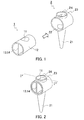
- FIG. 1 is an exploded perspective view of a vessel of Example 1.
- FIG. 2 is a perspective view of the vessel of Example 1.
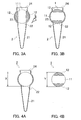
- FIG. 3 is a cross-sectional view of the vessel of Example 1 taken along line I-I of FIG. 2 .
- FIG. 4 (A) is a cross-sectional view of a vessel body and
- FIG. 4 (B) is a cross-sectional view of a cover body.
- identical parts are indicated with identical numerals and symbols.
- a cover body 1 is cylindrical columnar and has a through-hole 11 in a direction perpendicular to an axial direction of the cylindrical column and two sealing positions 12 placed at positions shifted from an opening of the through-hole 11 in a peripheral direction.
- the two sealing positions 12 are opposed to each other in a radial direction of the cover body 1.
- the through-hole 11 is formed so as to be placed at a position corresponding to a side wall opening portion 24 of a cover body containing portion 23 and an upper open-end 22 of a vessel main body 21 in a condition where the cover body 1 is contained in the cover body containing portion 23.
- the shape of the through-hole 11 is not particularly limited.
- the sealing position 12 is a part of an outer peripheral surface of the cover body 1.
- the sealing position 12 is not particularly limited and is applicable as long as it can seal over the upper open-end 22.
- the sealing position 12 may be a part of an outer peripheral surface of the cover body 1, may be formed separately as a thin plate at a part of the outer peripheral surface, or may be formed as convex that fits into the upper open-end 22, for example.
- the shape of the thin plate is not particularly limited, and examples thereof include rectangular, circular, and the like.
- the shape of the convex is not particularly limited, and examples thereof include prismatic column, cylindrical column, sphere, and the like.
- the vessel of the present invention can increase its sealing ability.
- a rotation operating portion 13 is formed at one end of the cover body 1. As shown in FIGs. 1 and 2 , the rotation operating portion 13 is formed by making a hole at the end of the cover body 1 while leaving a linear part.
- the numeral 14 indicates a linear rotation operating portion.
- the shape of the rotation operating portion 13 is not particularly limited.
- the shape of the rotation operating portion 13 examples include a protruding portion and a grooved portion, that have linear shape, cross shape, and the like, and the linear shape is preferable.
- the vessel of the present invention can be opened and closed easily, without detaching and attaching a cover, by rotating the rotation operating portion 13 around the axial direction of the cylindrical columnar cover body by using a rotation portion of an autoanalyzer, for example. Further, in the vessel of the present invention, as described above, the rotation operating portion 13 can be used as the opening and closing recognizing portion.
- an autoanalyzer which uses the vessel of the present invention as an analysis vessel, includes a rotation portion for rotating the rotation operating portion 13, and a state of opening and closing of the vessel of the present invention may be estimated by a rotational angle of the rotation operating portion 13, for example.
- a vessel body 2 includes the vessel main body 21 that is tubular and has an upper open-end and a lower closed-end, and the cover body containing portion 23 that is cylindrical tubular and having at least one open-end.
- the vessel main body 21 and the cover body containing portion 23 are combined by placing the cover body containing portion 23 at the upper open-end 22 of the vessel main body 21 in a condition where an axial direction of the vessel main body 21 is approximately perpendicular to an axial direction of the cover body containing portion 23.
- the axial direction of the vessel main body 21 is approximately perpendicular to the axial direction of the cover body containing portion 23.
- FIG. 5 An example of a vessel body of the vessel of the present invention is shown in FIG. 5 .
- an arrow X indicates the axial direction of the cover body containing portion 23 and an arrow Y indicates the axial direction of the vessel main body 21.
- FIG. 5 (A) is a side view of the vessel body 2 in which the axial direction X of the cover body containing portion 23 is approximately perfectly perpendicular to the axial direction Y of the vessel main body 21.
- FIG. 5 (B) is a side view of the vessel body 2, in which the axial direction X of the cover body containing portion 23 is practically perpendicular to the axial direction Y of the vessel main body 21 although the axial direction Y of the vessel main body 21 is inclined a little.
- identical parts to those shown in FIGs.1 to 4 are indicated with identical numerals and symbols.
- the vessel main body 21 has a shape that tapers downwardly.
- the shape of the vessel main body 21 is tubular, and examples of the tubular include cylindrical tubular, square tubular, and the like.
- the vessel main body 21 may have a shape that tapers downwardly.
- the shape of the cover body containing portion 23 is tubular, and is preferably cylindrical tubular although the tubular is not particularly limited.
- the shape of the upper open-end 22 of the vessel main body 21 is not particularly limited.
- Examples of the shape of the upper open-end 22 of the vessel main body 21 include circular, rectangular, rhombic, elliptical, and the like, and circular is preferable.
- an inside of the vessel main body 21 is communicated with an inside of the cover body containing portion 23 through the upper open-end 22, and a side wall opening portion 24 is formed at a side wall of the cover body containing portion 23 over the upper open-end 22 of the vessel main body 21.
- the side wall opening portion 24 is an opening for introducing and discharging a sample, a reagent, and the like.
- the shape of the side wall opening portion 24 is not particularly limited. Examples of the shape of the side wall opening portion 24 include circular, rectangular, and the like, and circular is preferable.
- X is a length of an inner diameter of the cover body containing portion 23 in a direction perpendicular to the axial direction of the cover body containing portion 23, and Y is a length of an outer diameter of the cover body 1 in a radial direction at the two sealing positions 12.
- the vessel of the present invention is configured such that Y is slightly larger than X.
- the length of Y is, for example, in the range of X ⁇ Y ⁇ 1.5X, and preferably in the range of 1.02X ⁇ Y ⁇ 1.06X.
- the material of the vessel body 2 and the cover body 1 is polypropylene.
- the material of the vessel body 2 and the cover body 1 is not limited to the material of Example 1, and an example thereof includes plastic.
- plastic has a property of flexibility or elasticity, or both properties.
- the plastic having the aforementioned properties include polypropylene, polyethylene, polystyrene, polytetrafluoroethylene, and the like.
- capacity of the vessel main body 21 is 0.5 mL. In the vessel of the present invention, capacity of the vessel main body is not limited to the capacity of Example 1.
- the capacity of the vessel main body 21 is, for example, in the range of 0.0001 mL to 100 mL, preferably in the range of 0.01 mL to 10 mL, and more preferably in the range of 0.1 mL to 2 mL.
- the vessel of Example 1 is used as follows.
- FIG. 3 (A) shows a cover-opened state in which an inside of the vessel main body 21 is communicated with the side wall opening portion 24 through the through-hole 11. From the cover-opened state shown in FIG.
- the cover body 1 is rotated by the rotation operating portion 13 (not shown), one of the sealing positions 12 is moved below the side wall opening portion 24 and the other of the sealing positions 12 is moved above the upper open-end 22 of the vessel main body 21, and thereby the inside of the vessel main body 21 is sealed from the outside. Further, from a sealed state (a cover-closed state) shown in FIG.
- the cover body 1 is rotated by the rotation operating portion 13 (not shown), one end of the through-hole 11 is moved below the side wall opening portion 24 and the other end of the through-hole 11 is moved above the upper open-end 22 of the vessel main body 21, the inside of the vessel main body 21 is communicated with the side wall opening portion 24 through the through-hole 11, and thereby the vessel of Example 1 becomes the cover-opened state (see FIG. 3 (A) ).
- the vessel of the present invention is configured such that Y, which is the length of an outer diameter of the cover body in a radial direction at the two sealing positions, is slightly longer than X, which is the length of an inner diameter of the cover body containing portion in a direction perpendicular to the axial direction of the cover body containing portion. Therefore, in the sealed state, the upper open-end and the side wall opening portion have outward pressure-contact with the two sealing positions. Because of this outward pressure-contact, the vessel of the present invention can obtain higher sealing ability.
- the vessel of Example 1 is provided with the aforementioned structure, configured such that the outer diameter Y is larger than the inner diameter X, and utilizes the property of flexibility or elasticity, or both properties. Thereby, the vessel can be opened and closed easily, and achieves higher sealing ability. Further, since the vessel of Example 1 does not require a sealing member such as packing and the like, the number of components and the manufacturing cost can be reduced. Moreover, since the vessel of Example 1 can be opened and closed only by rotational operation of the rotation operating portion 13, it is applicable to an autoanalyzer.
- FIG. 6 is an exploded perspective view of the vessel of Example 2.
- FIG. 7 is a perspective view of the vessel of Example 2.
- identical parts to those shown in FIGs.1 to 5 are indicated with identical numerals and symbols.
- the vessel of Example 2 in the vessel of Example 2, plural plate-like holding portions 27 are formed in a vertical direction at an outer peripheral surface of the cover body containing portion 23 adjacent to the side wall opening portion 24.
- the structure and the usage pattern of the vessel of Example 2 are similar to those of the vessel of Example 1. Since the vessel of Example 2 includes the holding portions 27, it easily can be held by an analyzer or a human hand, and thereby the vessel easily can be attached to or detached from the analyzer.
- the number of the sealing positions 12 is two. However, in the vessel of the present invention, the number of the sealing positions is not limited to two.
- the shape of the holding portion 27 is not particularly limited, and examples thereof include a plate shape, and the like.
- a heat releasing area of the vessel is increased, and temperature control can be performed precisely in analysis with temperature change such as PCR, and the like.
- FIG. 8 is an exploded perspective view of the vessel of Example 3.
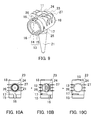
- FIG. 9 is a perspective view of the vessel of Example 3.
- identical parts to those shown in FIGs. 1 to 7 are indicated with identical numerals and symbols.
- a rotation operating ring 15 As shown in FIGs. 8 and 9 , in the vessel of Example 3, a rotation operating ring 15, an opening and closing recognizing portion 16 (an apparatus switch), a stopping portion 17, a latching portion 18, and a support plate 19 further are arranged on the cover body 1.
- the sealing position 12 is formed as a thin plate, and a ribbed surface 25 and a rotation adjusting portion 26 are further arranged on the vessel body 2.
- the structure of the vessel of Example 3 is similar to that of the vessel of Examples 1 and 2.
- the usage pattern of the vessel of Example 3 is similar to that of the vessel of Examples 1 and 2 except for the usage pattern described below.
- the rotation operating ring 15 is formed as the rotation operating portion 13 in addition to the linear rotation operating portion 14.
- the rotation operating ring 15 is provided around the outer peripheral edge of the cover body 1 at one end, and is in contact with one end of the cover body containing portion 23 when the cover body 1 is inserted into the cover body containing portion 23.
- two concaved opening and closing recognizing portions 16 are formed by symmetrically notching a part of the outer peripheral edge.
- the shape of the opening and closing recognizing portion 16 is not particularly limited, and examples thereof include a convex shape, a concave shape, and the like.
- the number of the opening and closing recognizing portions 16 is not particularly limited, and it may be one or more than one.
- the latching portion 18 is formed on the cover body 1 at the other side of the rotation operating ring 15 such that the outer peripheral edge of the cover body 1 is cut at two positions, and an end portion between the insections is outwardly protruded.
- Two latching portions 18 are provided symmetrically at the outer peripheral edge (only one latching portion 18 is shown in FIGs. 8 and 9 ). In a condition where the cover body 1 is contained in the cover body containing portion 23, a protruding portion of the latching portion 18 is latched movably along the outer peripheral edge at one end of the cover body containing portion 23.
- the cover body 1 can be rotated stably without shifting positions of the through-hole 11, the side wall opening portion 24, and the upper open-end 22 in a horizontal direction.
- two stopping portions 17 are symmetrically formed being in contact with the rotation operating ring 15 (only one stopping portion 17 is shown in FIGs. 8 and 9 ).
- a support plate 19 is arranged in the inside of the cover body 1 except for the through-hole 11.
- the number of the sealing positions 12 is two.
- the number of the sealing positions is not limited to two.
- the number of the latching portions 18 and the number of the stopping portions 17 are two.
- the number of the latching portions and the number of the stopping portions are not limited to two.
- the rotation adjusting portion 26 is formed by notching 1/4 of both peripheral edges of the cover body containing portion 23 into strips.
- the number of the rotation adjusting portions is not particularly limited, and it may be one or more than one, for example.
- a slightly raised ribbed surface 25 is formed parallel to the axial direction. In the sealed state, the sealing positions 12 have outward pressure-contact with the ribbed surface 25, and thereby the vessel of Example 3 further can obtain higher sealing ability and strength.
- the ribbed surface is not limited to be formed at the inner peripheral surface of the cover body containing portion adjacent to the upper open-end, and further may be formed at an inner peripheral surface of the cover body containing portion adjacent to the side wall opening portion, for example.
- the vessel of the present invention can obtain higher sealing ability and strength.
- the vessel of Example 3 is used as follows.
- the cover body 1 is inserted rotatably into an inside of the cover body containing portion 23 from one end thereof.
- FIG. 10 is a top view of the vessel in the cover-opened state, in the cover-closed state, and a halfway of a process of opening and closing.
- FIG. 10 (A) is a top view of the vessel when the cover is opened.
- FIG. 10 (B) is a top view of the vessel at the halfway of the process of opening and closing.
- FIG. 10 (C) is a top view of the vessel when the cover is sealed.
- the upper open-end 22 is communicated with the side wall opening portion 24 through the through-hole 11, and the vessel is opened. Further, in FIG.
- the stopping portion 17 is arranged at a left end of the rotation adjusting portion 26, and is movable in rightward direction (clockwise direction viewed from the side of the rotation operating ring 15) in FIG. 10 (A) .
- FIG. 10 (B) by rotating clockwise the linear rotation operating portion 14 (not shown) or the rotation operating ring 15, the through-hole 11 formed on the cover body 1 is rotated clockwise. Because of this rotation, one of the two sealing positions 12 begins to cover the side wall opening portion 24. As shown in FIG.
- the autoanalyzer using the vessel of Example 3 can use the positions of the two opening and closing recognizing portions 16 as a signal for opening and closing of the vessel.
- FIG. 11 shows schematic views of an example of the relationship between the opening and closing recognizing portions 16 of the cover body 1 and the recognizing mechanism of the autoanalyzer.
- FIG. 11 (A) is a schematic view of the vessel in a state where a cover is recognized to be opened.
- FIG. 11 (B) is a schematic view in a state where the cover is recognized to be sealed. In FIGs.
- FIG. 11 (A) and 11 (B) the vessel body 1 is viewed from a rotational axis direction.
- An arrow in a rotational direction in FIG. 11 (A) shows a rotational direction of the cover body 1.
- arrows in the right and left directions in FIGs. 11 (A) and 11 (B) indicate a moving direction of a terminal 41 of the autoanalyzer.
- the terminal 41 of the autoanalyzer is pushed by the cover body 1 and moved rightward in FIG. 11 (A) .
- a leaf spring 43 is pressed and a switch 42 of the autoanalyzer is turned on.
- FIG. 11 (B) when the opening and closing recognizing portions 16 are positioned in the horizontal direction (right and left direction), the terminal 41 of the autoanalyzer is fitted into the concaved opening and closing recognizing portions 16 and is moved leftward in FIG. 11 (B) . Therefore, the leaf spring 43 is released from a compressed state and the switch 42 of the autoanalyzer is turned off.
- the relationship between ON and OFF may be reversed.
- the relationship between the opening and closing recognizing portions 16 and the recognizing mechanism of the autoanalyzer is not limited to this example.
- FIG. 12 is an exploded perspective view of the vessel of Example 4.
- FIG. 13 is a perspective view of the vessel of Example 4.
- FIG. 14 is a perspective view of a cover body 1 of the vessel of Example 4 before attaching an O ring 32.
- FIG. 15 is cross-sectional views of the vessel of Example 4 taken along line II to II of FIG. 13 .
- identical parts to those shown in FIGs.1 to 11 are indicated with identical numerals and symbols.
- an annular groove 31 further is formed at the sealing position 12 of the cover body 1, and an O ring 32 being a circular ring is attached to the annular groove 31.
- the annular groove 31 is formed to be placed at a position surrounding around the upper open-end 22 at the time of sealing.
- the structure of the vessel of Example 4 is similar to that of the vessel of Examples 1 to 3.
- the usage pattern of the vessel of Example 4 is similar to that of the vessel of Examples 1 to 3 except for the usage pattern described below.
- the number of annular grooves 31 is not particularly limited, and it may be one or more than one, for example.
- the material of the O ring 32 is not particularly limited, and examples thereof include nitrile rubber, fluorine-containing rubber, silicone rubber, Teflon (registered trademark), and the like.
- the vessel of Example 4 is used as follows.
- the cover body 1 is rotatably inserted into an inside of the cover body containing portion 23 from one end thereof.
- FIG. 15 (A) is a cross-sectional view of the vessel of Example 4 in the cover-opened state.
- FIG. 15 (B) is a cross-sectional view of the vessel of Example 4 in the cover-sealed state.
- the upper open-end 22 is communicated with the side wall opening portion 24 through the through-hole 11, and the vessel is opened.
- FIG. 13 (B) by rotating clockwise the rotation operating portion 13 (not shown), the sealing position 12 formed on the cover body 1 is rotated clockwise. Because of this rotation, the sealing position 12 at which the annular groove 31 is formed is moved above the upper open-end 22, and the O ring 32 attached to the annular groove 31 is closely in contact with an inner peripheral surface of the cover body containing portion 23. Thereby the vessel of Example 4 is sealed (see FIG. 15 (B) ).
- the vessel of Example 4 can obtain higher sealing ability.
- the vessel of Example 4 is provided with the aforementioned structure in addition to the structure of Example 3, the vessel can increase the sealing ability.
- the vessel of the present invention When the vessel of the present invention is used, the vessel can easily be opened and closed without detaching and attaching the cover. Therefore, the vessel of the present invention is easily applicable to an autoanalyzer.
- the vessel of the present invention is also excellent in sealing ability. Therefore, the intended use of the vessel of the present invention is not limited and it can be applied suitably to a broad range of technical fields such as genetic engineering, biochemistry, physics and chemistry, medical science, and the like.
Landscapes
- Engineering & Computer Science (AREA)
- General Engineering & Computer Science (AREA)
- Health & Medical Sciences (AREA)
- Chemical & Material Sciences (AREA)
- General Health & Medical Sciences (AREA)
- Mechanical Engineering (AREA)
- Analytical Chemistry (AREA)
- Chemical Kinetics & Catalysis (AREA)
- Life Sciences & Earth Sciences (AREA)
- Clinical Laboratory Science (AREA)
- Hematology (AREA)
- Veterinary Medicine (AREA)
- Immunology (AREA)
- Pathology (AREA)
- General Physics & Mathematics (AREA)
- Biochemistry (AREA)
- Physics & Mathematics (AREA)
- Public Health (AREA)
- Animal Behavior & Ethology (AREA)
- Pharmacology & Pharmacy (AREA)
- Automatic Analysis And Handling Materials Therefor (AREA)
- Closures For Containers (AREA)
- Sampling And Sample Adjustment (AREA)
- Apparatus Associated With Microorganisms And Enzymes (AREA)
Applications Claiming Priority (2)
| Application Number | Priority Date | Filing Date | Title |
|---|---|---|---|
| JP2008027392 | 2008-02-07 | ||
| PCT/JP2009/052119 WO2009099223A1 (fr) | 2008-02-07 | 2009-02-07 | Contenant et contenant d'analyse l'utilisant |
Publications (3)
| Publication Number | Publication Date |
|---|---|
| EP2199802A1 true EP2199802A1 (fr) | 2010-06-23 |
| EP2199802A4 EP2199802A4 (fr) | 2011-10-05 |
| EP2199802B1 EP2199802B1 (fr) | 2017-08-02 |
Family
ID=40952290
Family Applications (1)
| Application Number | Title | Priority Date | Filing Date |
|---|---|---|---|
| EP09708014.7A Active EP2199802B1 (fr) | 2008-02-07 | 2009-02-07 | Contenant et son utilisation dans une analyse |
Country Status (6)
| Country | Link |
|---|---|
| US (1) | US20100255563A1 (fr) |
| EP (1) | EP2199802B1 (fr) |
| JP (1) | JP5190058B2 (fr) |
| KR (1) | KR101226393B1 (fr) |
| CN (1) | CN101680907B (fr) |
| WO (1) | WO2009099223A1 (fr) |
Family Cites Families (12)
| Publication number | Priority date | Publication date | Assignee | Title |
|---|---|---|---|---|
| US3603471A (en) * | 1969-11-24 | 1971-09-07 | Precision Sampling Corp | Septum valves |
| JPS51146981A (en) * | 1975-06-10 | 1976-12-16 | Kondo Hiroatsu | Lid of vessel |
| US4358111A (en) * | 1981-04-02 | 1982-11-09 | Air Products And Chemicals, Inc. | Pressurized, non-refillable recreation ball inflated with sulfur hexafluoride |
| US4395382A (en) * | 1981-09-25 | 1983-07-26 | Miskinis Robert J | Glassware stopcock with freeze extractor |
| DE3402276C1 (de) * | 1984-01-24 | 1985-02-21 | Eppendorf Gerätebau Netheler + Hinz GmbH, 2000 Hamburg | Reaktionsgefaess aus Kunststoff fuer kleine Fluessigkeitsmengen |
| JP3075569B2 (ja) * | 1990-09-06 | 2000-08-14 | アサマ化成株式会社 | 嫌気性菌の増殖細胞量の測定方法 |
| US6152189A (en) * | 1993-03-30 | 2000-11-28 | Isco, Inc. | Sampler |
| US6350415B1 (en) * | 1997-09-12 | 2002-02-26 | Becton, Dickinson And Company | Ball and socket closure for specimen collection container incorporating a dimple locking mechanism |
| US7700046B2 (en) * | 2004-09-14 | 2010-04-20 | Goldenberg Alec S | Controlled additive/reactant delivery system |
| JP2006189346A (ja) * | 2005-01-06 | 2006-07-20 | Olympus Corp | 薬液容器、薬液保冷庫および培養処理装置 |
| JP2007015446A (ja) * | 2005-07-05 | 2007-01-25 | Nissan Motor Co Ltd | 給油構造 |
| JP4642587B2 (ja) * | 2005-08-04 | 2011-03-02 | ベックマン コールター, インコーポレイテッド | 試薬用容器の蓋構造 |
-
2009
- 2009-02-07 CN CN2009800001730A patent/CN101680907B/zh active Active
- 2009-02-07 EP EP09708014.7A patent/EP2199802B1/fr active Active
- 2009-02-07 US US12/741,321 patent/US20100255563A1/en not_active Abandoned
- 2009-02-07 JP JP2009524833A patent/JP5190058B2/ja active Active
- 2009-02-07 WO PCT/JP2009/052119 patent/WO2009099223A1/fr not_active Ceased
- 2009-02-07 KR KR1020097017289A patent/KR101226393B1/ko active Active
Also Published As
| Publication number | Publication date |
|---|---|
| WO2009099223A1 (fr) | 2009-08-13 |
| KR20090115154A (ko) | 2009-11-04 |
| US20100255563A1 (en) | 2010-10-07 |
| CN101680907A (zh) | 2010-03-24 |
| CN101680907B (zh) | 2013-06-05 |
| JP5190058B2 (ja) | 2013-04-24 |
| EP2199802B1 (fr) | 2017-08-02 |
| EP2199802A4 (fr) | 2011-10-05 |
| KR101226393B1 (ko) | 2013-01-24 |
| JPWO2009099223A1 (ja) | 2011-06-02 |
Similar Documents
| Publication | Publication Date | Title |
|---|---|---|
| US9302831B2 (en) | Reagent bottles, valves therefor, washing modules and methods and apparatus for dispensing reagents | |
| CA2211126C (fr) | Dispositif d'obturation a rotule | |
| US5919420A (en) | Ball and socket closure for specimen collection container incorporating a resilient elastomeric seal | |
| JP3054060B2 (ja) | 容器用密閉装置 | |
| US6350415B1 (en) | Ball and socket closure for specimen collection container incorporating a dimple locking mechanism | |
| JP2008128776A (ja) | 蓋付き容器 | |
| US6032813A (en) | Ball and socket closure for specimen collection container incorporating an integral flexible seal | |
| US5948364A (en) | Ball and socket closure for specimen collection container | |
| US7648037B2 (en) | Lid structure of reagent container | |
| WO2007145767A2 (fr) | Ensemble de flacon étanche en deux pièces | |
| AU8317698A (en) | Ball and socket closure for specimen collection container incorporating a septum | |
| US20130309147A1 (en) | Sample tube with improved seal | |
| EP2199802A1 (fr) | Contenant et contenant d'analyse l'utilisant | |
| US20230321661A1 (en) | Reagent container cap, reagent container unit and reagent kit | |
| JP7689959B2 (ja) | 検査チップおよび液体導入方法 | |
| JP5195284B2 (ja) | 試薬容器のキャップ構造および試薬の分取方法 | |
| WO2013170539A1 (fr) | Tube échantillon à joint d'étanchéité amélioré | |
| WO2016010687A1 (fr) | Dispositif d'échantillonnage | |
| CN213835337U (zh) | 一种全封闭式靶核酸扩增物快速检测装置 | |
| CN215917455U (zh) | 用于离心管的管盖及离心管套件 | |
| WO2015081872A1 (fr) | Ensembles de tubes échantillons et embout de pipette présentant une prévention des fuites améliorée | |
| WO2014139139A1 (fr) | Ensemble tube d'échantillon | |
| JP2011057264A (ja) | 容器 | |
| JP3071174U (ja) | 弾性エラストマーシールを組込んだ試料収集容器用ボール及びソケット蓋 | |
| CN213832504U (zh) | 用于容纳试剂的容器 |
Legal Events
| Date | Code | Title | Description |
|---|---|---|---|
| PUAI | Public reference made under article 153(3) epc to a published international application that has entered the european phase |
Free format text: ORIGINAL CODE: 0009012 |
|
| 17P | Request for examination filed |
Effective date: 20100422 |
|
| AK | Designated contracting states |
Kind code of ref document: A1 Designated state(s): AT BE BG CH CY CZ DE DK EE ES FI FR GB GR HR HU IE IS IT LI LT LU LV MC MK MT NL NO PL PT RO SE SI SK TR |
|
| AX | Request for extension of the european patent |
Extension state: AL BA RS |
|
| DAX | Request for extension of the european patent (deleted) | ||
| A4 | Supplementary search report drawn up and despatched |
Effective date: 20110902 |
|
| RIC1 | Information provided on ipc code assigned before grant |
Ipc: G01N 35/02 20060101AFI20110829BHEP Ipc: C12M 1/00 20060101ALI20110829BHEP Ipc: G01N 1/10 20060101ALI20110829BHEP |
|
| 17Q | First examination report despatched |
Effective date: 20131108 |
|
| GRAP | Despatch of communication of intention to grant a patent |
Free format text: ORIGINAL CODE: EPIDOSNIGR1 |
|
| INTG | Intention to grant announced |
Effective date: 20170315 |
|
| GRAS | Grant fee paid |
Free format text: ORIGINAL CODE: EPIDOSNIGR3 |
|
| GRAA | (expected) grant |
Free format text: ORIGINAL CODE: 0009210 |
|
| AK | Designated contracting states |
Kind code of ref document: B1 Designated state(s): AT BE BG CH CY CZ DE DK EE ES FI FR GB GR HR HU IE IS IT LI LT LU LV MC MK MT NL NO PL PT RO SE SI SK TR |
|
| REG | Reference to a national code |
Ref country code: GB Ref legal event code: FG4D |
|
| REG | Reference to a national code |
Ref country code: CH Ref legal event code: EP Ref country code: AT Ref legal event code: REF Ref document number: 915050 Country of ref document: AT Kind code of ref document: T Effective date: 20170815 |
|
| REG | Reference to a national code |
Ref country code: IE Ref legal event code: FG4D |
|
| REG | Reference to a national code |
Ref country code: DE Ref legal event code: R096 Ref document number: 602009047481 Country of ref document: DE |
|
| REG | Reference to a national code |
Ref country code: NL Ref legal event code: MP Effective date: 20170802 |
|
| REG | Reference to a national code |
Ref country code: AT Ref legal event code: MK05 Ref document number: 915050 Country of ref document: AT Kind code of ref document: T Effective date: 20170802 |
|
| REG | Reference to a national code |
Ref country code: LT Ref legal event code: MG4D |
|
| PG25 | Lapsed in a contracting state [announced via postgrant information from national office to epo] |
Ref country code: AT Free format text: LAPSE BECAUSE OF FAILURE TO SUBMIT A TRANSLATION OF THE DESCRIPTION OR TO PAY THE FEE WITHIN THE PRESCRIBED TIME-LIMIT Effective date: 20170802 Ref country code: SE Free format text: LAPSE BECAUSE OF FAILURE TO SUBMIT A TRANSLATION OF THE DESCRIPTION OR TO PAY THE FEE WITHIN THE PRESCRIBED TIME-LIMIT Effective date: 20170802 Ref country code: NL Free format text: LAPSE BECAUSE OF FAILURE TO SUBMIT A TRANSLATION OF THE DESCRIPTION OR TO PAY THE FEE WITHIN THE PRESCRIBED TIME-LIMIT Effective date: 20170802 Ref country code: NO Free format text: LAPSE BECAUSE OF FAILURE TO SUBMIT A TRANSLATION OF THE DESCRIPTION OR TO PAY THE FEE WITHIN THE PRESCRIBED TIME-LIMIT Effective date: 20171102 Ref country code: LT Free format text: LAPSE BECAUSE OF FAILURE TO SUBMIT A TRANSLATION OF THE DESCRIPTION OR TO PAY THE FEE WITHIN THE PRESCRIBED TIME-LIMIT Effective date: 20170802 Ref country code: HR Free format text: LAPSE BECAUSE OF FAILURE TO SUBMIT A TRANSLATION OF THE DESCRIPTION OR TO PAY THE FEE WITHIN THE PRESCRIBED TIME-LIMIT Effective date: 20170802 Ref country code: FI Free format text: LAPSE BECAUSE OF FAILURE TO SUBMIT A TRANSLATION OF THE DESCRIPTION OR TO PAY THE FEE WITHIN THE PRESCRIBED TIME-LIMIT Effective date: 20170802 |
|
| REG | Reference to a national code |
Ref country code: FR Ref legal event code: PLFP Year of fee payment: 10 |
|
| PG25 | Lapsed in a contracting state [announced via postgrant information from national office to epo] |
Ref country code: GR Free format text: LAPSE BECAUSE OF FAILURE TO SUBMIT A TRANSLATION OF THE DESCRIPTION OR TO PAY THE FEE WITHIN THE PRESCRIBED TIME-LIMIT Effective date: 20171103 Ref country code: ES Free format text: LAPSE BECAUSE OF FAILURE TO SUBMIT A TRANSLATION OF THE DESCRIPTION OR TO PAY THE FEE WITHIN THE PRESCRIBED TIME-LIMIT Effective date: 20170802 Ref country code: IS Free format text: LAPSE BECAUSE OF FAILURE TO SUBMIT A TRANSLATION OF THE DESCRIPTION OR TO PAY THE FEE WITHIN THE PRESCRIBED TIME-LIMIT Effective date: 20171202 Ref country code: BG Free format text: LAPSE BECAUSE OF FAILURE TO SUBMIT A TRANSLATION OF THE DESCRIPTION OR TO PAY THE FEE WITHIN THE PRESCRIBED TIME-LIMIT Effective date: 20171102 Ref country code: PL Free format text: LAPSE BECAUSE OF FAILURE TO SUBMIT A TRANSLATION OF THE DESCRIPTION OR TO PAY THE FEE WITHIN THE PRESCRIBED TIME-LIMIT Effective date: 20170802 Ref country code: LV Free format text: LAPSE BECAUSE OF FAILURE TO SUBMIT A TRANSLATION OF THE DESCRIPTION OR TO PAY THE FEE WITHIN THE PRESCRIBED TIME-LIMIT Effective date: 20170802 |
|
| PG25 | Lapsed in a contracting state [announced via postgrant information from national office to epo] |
Ref country code: DK Free format text: LAPSE BECAUSE OF FAILURE TO SUBMIT A TRANSLATION OF THE DESCRIPTION OR TO PAY THE FEE WITHIN THE PRESCRIBED TIME-LIMIT Effective date: 20170802 Ref country code: RO Free format text: LAPSE BECAUSE OF FAILURE TO SUBMIT A TRANSLATION OF THE DESCRIPTION OR TO PAY THE FEE WITHIN THE PRESCRIBED TIME-LIMIT Effective date: 20170802 Ref country code: CZ Free format text: LAPSE BECAUSE OF FAILURE TO SUBMIT A TRANSLATION OF THE DESCRIPTION OR TO PAY THE FEE WITHIN THE PRESCRIBED TIME-LIMIT Effective date: 20170802 |
|
| REG | Reference to a national code |
Ref country code: DE Ref legal event code: R097 Ref document number: 602009047481 Country of ref document: DE |
|
| PG25 | Lapsed in a contracting state [announced via postgrant information from national office to epo] |
Ref country code: EE Free format text: LAPSE BECAUSE OF FAILURE TO SUBMIT A TRANSLATION OF THE DESCRIPTION OR TO PAY THE FEE WITHIN THE PRESCRIBED TIME-LIMIT Effective date: 20170802 Ref country code: SK Free format text: LAPSE BECAUSE OF FAILURE TO SUBMIT A TRANSLATION OF THE DESCRIPTION OR TO PAY THE FEE WITHIN THE PRESCRIBED TIME-LIMIT Effective date: 20170802 |
|
| PLBE | No opposition filed within time limit |
Free format text: ORIGINAL CODE: 0009261 |
|
| STAA | Information on the status of an ep patent application or granted ep patent |
Free format text: STATUS: NO OPPOSITION FILED WITHIN TIME LIMIT |
|
| 26N | No opposition filed |
Effective date: 20180503 |
|
| PG25 | Lapsed in a contracting state [announced via postgrant information from national office to epo] |
Ref country code: SI Free format text: LAPSE BECAUSE OF FAILURE TO SUBMIT A TRANSLATION OF THE DESCRIPTION OR TO PAY THE FEE WITHIN THE PRESCRIBED TIME-LIMIT Effective date: 20170802 |
|
| REG | Reference to a national code |
Ref country code: CH Ref legal event code: PL |
|
| PG25 | Lapsed in a contracting state [announced via postgrant information from national office to epo] |
Ref country code: MC Free format text: LAPSE BECAUSE OF FAILURE TO SUBMIT A TRANSLATION OF THE DESCRIPTION OR TO PAY THE FEE WITHIN THE PRESCRIBED TIME-LIMIT Effective date: 20170802 |
|
| REG | Reference to a national code |
Ref country code: IE Ref legal event code: MM4A |
|
| REG | Reference to a national code |
Ref country code: BE Ref legal event code: MM Effective date: 20180228 |
|
| PG25 | Lapsed in a contracting state [announced via postgrant information from national office to epo] |
Ref country code: LI Free format text: LAPSE BECAUSE OF NON-PAYMENT OF DUE FEES Effective date: 20180228 Ref country code: CH Free format text: LAPSE BECAUSE OF NON-PAYMENT OF DUE FEES Effective date: 20180228 Ref country code: LU Free format text: LAPSE BECAUSE OF NON-PAYMENT OF DUE FEES Effective date: 20180207 |
|
| PG25 | Lapsed in a contracting state [announced via postgrant information from national office to epo] |
Ref country code: IE Free format text: LAPSE BECAUSE OF NON-PAYMENT OF DUE FEES Effective date: 20180207 |
|
| PG25 | Lapsed in a contracting state [announced via postgrant information from national office to epo] |
Ref country code: BE Free format text: LAPSE BECAUSE OF NON-PAYMENT OF DUE FEES Effective date: 20180228 |
|
| PG25 | Lapsed in a contracting state [announced via postgrant information from national office to epo] |
Ref country code: MT Free format text: LAPSE BECAUSE OF NON-PAYMENT OF DUE FEES Effective date: 20180207 |
|
| PG25 | Lapsed in a contracting state [announced via postgrant information from national office to epo] |
Ref country code: TR Free format text: LAPSE BECAUSE OF FAILURE TO SUBMIT A TRANSLATION OF THE DESCRIPTION OR TO PAY THE FEE WITHIN THE PRESCRIBED TIME-LIMIT Effective date: 20170802 |
|
| PG25 | Lapsed in a contracting state [announced via postgrant information from national office to epo] |
Ref country code: HU Free format text: LAPSE BECAUSE OF FAILURE TO SUBMIT A TRANSLATION OF THE DESCRIPTION OR TO PAY THE FEE WITHIN THE PRESCRIBED TIME-LIMIT; INVALID AB INITIO Effective date: 20090207 Ref country code: PT Free format text: LAPSE BECAUSE OF FAILURE TO SUBMIT A TRANSLATION OF THE DESCRIPTION OR TO PAY THE FEE WITHIN THE PRESCRIBED TIME-LIMIT Effective date: 20170802 |
|
| PG25 | Lapsed in a contracting state [announced via postgrant information from national office to epo] |
Ref country code: MK Free format text: LAPSE BECAUSE OF NON-PAYMENT OF DUE FEES Effective date: 20170802 Ref country code: CY Free format text: LAPSE BECAUSE OF FAILURE TO SUBMIT A TRANSLATION OF THE DESCRIPTION OR TO PAY THE FEE WITHIN THE PRESCRIBED TIME-LIMIT Effective date: 20170802 |
|
| PGFP | Annual fee paid to national office [announced via postgrant information from national office to epo] |
Ref country code: GB Payment date: 20260219 Year of fee payment: 18 |
|
| PGFP | Annual fee paid to national office [announced via postgrant information from national office to epo] |
Ref country code: DE Payment date: 20260218 Year of fee payment: 18 |
|
| PGFP | Annual fee paid to national office [announced via postgrant information from national office to epo] |
Ref country code: IT Payment date: 20260224 Year of fee payment: 18 |
|
| PGFP | Annual fee paid to national office [announced via postgrant information from national office to epo] |
Ref country code: FR Payment date: 20260218 Year of fee payment: 18 |