EP2199882A1 - Procédé et ordinateur destinés à la production d'un ordre de commande d'un programme de pièces - Google Patents
Procédé et ordinateur destinés à la production d'un ordre de commande d'un programme de pièces Download PDFInfo
- Publication number
- EP2199882A1 EP2199882A1 EP08171818A EP08171818A EP2199882A1 EP 2199882 A1 EP2199882 A1 EP 2199882A1 EP 08171818 A EP08171818 A EP 08171818A EP 08171818 A EP08171818 A EP 08171818A EP 2199882 A1 EP2199882 A1 EP 2199882A1
- Authority
- EP
- European Patent Office
- Prior art keywords
- tool
- orientation
- axis
- workpiece
- machine tool
- Prior art date
- Legal status (The legal status is an assumption and is not a legal conclusion. Google has not performed a legal analysis and makes no representation as to the accuracy of the status listed.)
- Withdrawn
Links
Images


Classifications
-
- G—PHYSICS
- G05—CONTROLLING; REGULATING
- G05B—CONTROL OR REGULATING SYSTEMS IN GENERAL; FUNCTIONAL ELEMENTS OF SUCH SYSTEMS; MONITORING OR TESTING ARRANGEMENTS FOR SUCH SYSTEMS OR ELEMENTS
- G05B19/00—Program-control systems
- G05B19/02—Program-control systems electric
- G05B19/18—Numerical control [NC], i.e. automatically operating machines, in particular machine tools, e.g. in a manufacturing environment, so as to execute positioning, movement or co-ordinated operations by means of program data in numerical form
- G05B19/4093—Numerical control [NC], i.e. automatically operating machines, in particular machine tools, e.g. in a manufacturing environment, so as to execute positioning, movement or co-ordinated operations by means of program data in numerical form characterised by part programming, e.g. entry of geometrical information as taken from a technical drawing, combining this with machining and material information to obtain control information, named part program, for the NC machine
-
- G—PHYSICS
- G05—CONTROLLING; REGULATING
- G05B—CONTROL OR REGULATING SYSTEMS IN GENERAL; FUNCTIONAL ELEMENTS OF SUCH SYSTEMS; MONITORING OR TESTING ARRANGEMENTS FOR SUCH SYSTEMS OR ELEMENTS
- G05B2219/00—Program-control systems
- G05B2219/30—Nc systems
- G05B2219/35—Nc in input of data, input till input file format
- G05B2219/35215—Generate optimal nc program variant as function of cost, time, surface, energy
-
- Y—GENERAL TAGGING OF NEW TECHNOLOGICAL DEVELOPMENTS; GENERAL TAGGING OF CROSS-SECTIONAL TECHNOLOGIES SPANNING OVER SEVERAL SECTIONS OF THE IPC; TECHNICAL SUBJECTS COVERED BY FORMER USPC CROSS-REFERENCE ART COLLECTIONS [XRACs] AND DIGESTS
- Y02—TECHNOLOGIES OR APPLICATIONS FOR MITIGATION OR ADAPTATION AGAINST CLIMATE CHANGE
- Y02P—CLIMATE CHANGE MITIGATION TECHNOLOGIES IN THE PRODUCTION OR PROCESSING OF GOODS
- Y02P90/00—Enabling technologies with a potential contribution to greenhouse gas [GHG] emissions mitigation
- Y02P90/02—Total factory control, e.g. smart factories, flexible manufacturing systems [FMS] or integrated manufacturing systems [IMS]
Definitions
- the invention relates to a method for generating a control command of a part program. Furthermore, the invention relates to a computer for carrying out the method.
- Machine tools are nowadays controlled by means of a control device, e.g. a CNC control, controlled.
- the control device controls the movements of machine elements of the machine tool, such as e.g. a tool holding device in which a tool is clamped, based on a part program.
- the parts program consists of control commands that are read in and interpreted by the control device.
- the control device controls the movement of the tool and / or the movement of the workpiece and thus the relative movement between the tool and the workpiece of the machine tool.
- motion information about movements of the tool to be performed is generated by a CAM system (Computer Aided Manufacturing), preferably in a standardized data format, and read in by a downstream post processor.
- a CAM system Computer Aided Manufacturing
- the postprocessor Based on the movement information and machine data of the machine tool generated by the CAM system, the postprocessor generates a part program adapted for the particular concrete machine tool on which the machining operation is to take place in the form of control commands adapted to the specific control device of the machine tool.
- the postprocessor converts the motion information generated by the CAM system, preferably in a standardized data format, into control commands which can be read by the control device and adapted to the respective control device.
- the post-processor takes into account the specific machine-specific kinematic conditions of the machine tool, such as Geometry, maximum travel ranges of the drive axes and maximum speeds of the machine element. These data are in the form of machine data.
- the movement information generated by the CAM system consists of so-called GOTO instructions which contain information about movements of the tool to be carried out.
- the movement information consists on the one hand of the positions to be approached by the tool and on the other hand of the spatial orientations of the tool which the tool is to adopt at the positions.
- This object is achieved by a method for generating a control command of a part program, wherein the movements of a tool and / or a workpiece are controllable based on the part program of a control device of a machine tool, wherein the tool is rotationally symmetrical, wherein the machine tool at least three rotary axes for the realization of Orientations of the tool with respect to the workpiece, wherein a first orientation of the tool is given, wherein a second orientation of the tool is specified, wherein an optimization criterion for optimizing the movement of the at least three rotary axes is given, wherein from the first orientation and the second Orientation at least three combinations of possible rotating coils are determined by the three rotary axes must be rotated in each case in order to change the orientation of the tool with respect to the workpiece from the first orientation to the second orientation rn, wherein on the basis of the optimization criterion one of the at least three combinations is selected, whereby the control command is generated based on the selected combination.
- this object is achieved by a computer which is designed to carry out the method according to the invention and a mass storage on which a computer program is stored, wherein when calling the computer program from the computer, the inventive method is executable.
- the optimization criterion consists in that the rotation angles about which the at least three rotary axes must be rotated are as far as possible, since then the rotary axes must be moved the least.
- the optimization criterion is that the change from the first orientation to the second orientation takes place as quickly as possible on the machine tool, since then the desired orientation of the tool can be achieved very quickly.
- the optimization criterion is that the translational axes of the machine tool are moved as little as possible, since then the wear of the translational axes of the machine tool is low.
- FIG. 1 is shown in the form of a schematic representation of a machine tool 38.
- the machine tool 38 in this case has three translatory axes, which allow a translational movement of a tool 6 in the X direction, Y direction and Z direction.
- the machine tool 38 thus has a translatory X-axis, a translational Y-axis and a translatory Z-axis.
- the machine tool 38 has a motor 39 which moves via a threaded spindle 3 via a fastening device 40 a linear motor 5 in the X direction.
- the machine tool 38 For realizing the movement of the tool 6 in the Z direction, the machine tool 38 the linear motor 5, the tool 6 translationally in the Z direction, ie in the illustration according to FIG. 1 up or down, moving.
- the machine tool 38 has a frame 2, which is not shown for the sake of clarity, and which can be moved translationally via guides 4 in the Y direction by means of the motors.
- a tool head 1 which in FIG. 2 is shown enlarged. Same elements are in FIG. 2 provided with the same reference numerals as in FIG. 1 ,
- the tool head 1 has three mutually perpendicular rotary axes A, B and C for setting spatial orientations of the tool 6 with respect to a workpiece 42.
- the orientation OR of the tool 6, which is rotationally symmetrical, is shown in the form of an orientation vector OR, which points from the tool tip along the axis of rotation R of the tool in the direction of the tool head 1.
- the rotary axis C the tool can be rotated about the Z axis (see X, Y, Z coordinate system shown).
- the Z-axis is realized via a motor 36 which rotatably moves a U-shaped element 10 via a shaft 11. Furthermore, the tool 6 can be rotated about the rotary axis B, which allows rotation of the tool 6 about the Y-axis.
- the rotary axis B is above the U-shaped element 10, which has a in FIG. 2 for the sake of clarity has not shown motor, which allows a rotational movement about a shaft 37, realized.
- the rotary axis B is in the context of the embodiment in the form of a pivot axis, since the U-shaped element can not be completely rotated over a rotation angle of 360 °.
- the rotary axis A which allows rotation of the tool 6 about the X-axis, is in this case via a shaft 9, to which a motor 7 is fixed, and an in FIG. 2 the sake of clarity, not shown in the U-shaped element 10 integrated motor, the shaft 9th rotates drives, realized.
- the rotary axis A is also in the context of the embodiment in the form of a pivot axis, ie it can not be completely rotated over a rotation angle of 360 °.
- the motor 7 rotatably drives a tool holding device 8, in which the tool 6 is clamped.
- the tool 6 is formed in the context of the embodiment as a milling cutter. Subject-specific, the motor 7 is also referred to as a spindle motor.
- the machine tool 38 has a translatory X-axis, a translational Y-axis and a translatory Z-axis and the three rotary axes A, B and C.
- any desired spatial orientation OR of the tool 6 with respect to the workpiece 42 can be realized.
- the rotary axes A, B and C need only be rotated accordingly to align the tool 6 accordingly to realize the desired spatial orientation OR of the tool 6 with respect to the workpiece 42.
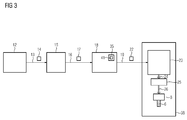
- FIG. 3 is shown in the form of a schematic block diagram of the overall process that is performed when creating a part program.
- a CAD system 12 Computer Aided Design
- a workpiece to be manufactured is constructed and displayed.
- the workpiece has a geometry which is described by means of geometry data 14, the geometry data of the workpiece generally being present in the form of a point cloud which reproduces the outer contour of the workpiece.
- the geometry data 14 of the workpiece is transmitted to a CAM system 3 (Computer Aided Manufacturing) from the CAD system 12, which is represented by an arrow 2.
- CAM system 3 Computer Aided Manufacturing
- the CAM system 3 determines from the geometric data 14 of the workpiece and the geometry data of a blank from which the workpiece, for example, in the case of a milling, to be milled, the necessary for milling of the blank movements of the tool. 6
- the movements of the tool 6 are thereby by a control device 23, which is present in the context of the embodiment in the form of a CNC control, in the in FIG. 1 in the context of the embodiment shown machine tool 38 via the movement of the tool holder 8, controlled.
- the control device 23 generates setpoint values as setpoint control values for a drive system 25 which moves the tool holding device 8 in an equidistant time cycle, which is represented by an arrow 26.
- the setpoints are transmitted from the control device 23 to the drive system 25, which is indicated by an arrow 24 in the FIG. 3 is shown.
- the drive system 25 essentially contains the control devices, converters, motors and transmissions necessary for moving the tool holder 8 over the X-axis, Y-axis, Z-axis, A-axis, B-axis and C-axis.
- the control device 23 controls the movement of the tool 6 by means of a part program 22 having control commands, by means of which the machine tool 38 is controlled by the control device 23.
- the CAM system 15 On the output side, the CAM system 15 generates motion information 17 from the geometric data of the workpiece transmitted by the CAD system 12 and the movements of the tool 6 to be made from the blank for production of the workpiece.
- the movement information 17 about the movements of the tool 6 to be performed are generated by the CAM system 15 usually in a standardized data format, such as CLDATA or APT.
- the movement information generated by the CAM system consists of so-called GOTO instructions which contain information about movements of the tool 6 to be performed.
- the movement information consists on the one hand of the positions to be approached by the tool and on the other hand of the spatial orientations of the tool which the tool is to adopt at the positions.
- the position may refer to the tool center point of the tool 6, for example.
- the movement information about the movements to be performed are generally present in the form of so-called standardized GOTO instructions.
- the GOTO instructions define positions in a three-dimensional space that must be approached one after the other by the tool in order to produce the desired workpiece from the blank.
- the CAM system 15 also outputs the orientation of the tool associated with each position in the form of an orientation vector.
- the tool 6 has a first orientation OR1
- the tool 6 has a second orientation OR2, which differs from the first orientation OR1.
- the movement information 17 is now transmitted to a computer 18 (see arrow 16 in FIG. 3 ) on which runs a computer program 41 for creating the parts program, wherein the computer 18 in connection with the computer program running on it 41 is also referred to as a post-processor.
- the computer program 41 is stored on a mass storage device, eg a hard disk, and can be called by a user to execute the computer program.
- a commercial post-processor generates in a machine tool, in which the orientation of the tool with respect to the workpiece can be adjusted by only two rotary axes and thus kinematically not over-determined, from the motion information generated by the CAM system 17 and machine data of the machine tool, eg Information about the kinematics of the machine tool, the drive system the machine tool, allowable travel ranges of the tool and eg permissible maximum speeds of the axes of the machine tool include a part program 22, which is subsequently transmitted to the control device 23 for controlling the movement of the tool, which is indicated by an arrow 19 in the FIG. 3 is shown.
- the part program 22 consists of a sequence of control commands.
- the index W indicates that it is the vector values of the orientation vector OR of the tool.
- X w 0.061628416
- the first orientation OR1 and second orientation OR2 are predetermined by the CAM system 15 within the scope of the exemplary embodiment.
- one of the three combinations is selected based on a predetermined optimization criterion for optimizing the movement of the three rotary axes, and a control command of the part program is generated on the basis of the selected combination. If, for example, given as an optimization criterion that the rotation angle C w , A w and B w by which the three rotary axes C, A and B must be rotated, are as small as possible, then the third combination is selected as a solution, because in her the Rotary axes A, B and C least need to be rotated and thus the angles of rotation are as small as possible to change the orientation of the tool from the first orientation OR1 to the second orientation OR2.
- the optimization criterion can also be that the change from the first orientation to the second orientation should take place as quickly as possible on the machine tool.
- the C-axis and the A-axis have a particularly high dynamic, ie, for example, can be accelerated particularly strong, while eg the B-axis has a very low dynamics
- the first combination can be selected as a solution with respect to this optimization criterion.
- the tool and / or workpiece be moved such that movement occurs about the tip of the tool.
- the translational X-axes, Y-axis, Z-axis of the machine tool in addition to the rotary axes A, B, and C of the machine tool must be moved. The optimization criterion can then also be more complex.
- additional restrictions can also be specified in the optimization, such as, for example, Motion range restrictions of rotary axes and translatory axes.
- the possible pivoting range of the axis in the case of a formation of the rotary axis can be specified as a pivot axis.
- the machine tool must be designed so that their three rotary axes all move the tool to implement an orientation of the tool with respect to the workpiece, but that the rotary axes can also be realized in such a way in that by means of the rotary axes not or not only the tool is moved but also the workpiece or only the workpiece is moved.
- the machine tool for realizing an orientation of the tool with respect to the workpiece, can have two rotary axes with which the tool can be moved and one Have round axis by means of which the workpiece can be moved.
Landscapes
- Physics & Mathematics (AREA)
- Engineering & Computer Science (AREA)
- Geometry (AREA)
- Human Computer Interaction (AREA)
- Manufacturing & Machinery (AREA)
- General Physics & Mathematics (AREA)
- Automation & Control Theory (AREA)
- Numerical Control (AREA)
Priority Applications (1)
| Application Number | Priority Date | Filing Date | Title |
|---|---|---|---|
| EP08171818A EP2199882A1 (fr) | 2008-12-16 | 2008-12-16 | Procédé et ordinateur destinés à la production d'un ordre de commande d'un programme de pièces |
Applications Claiming Priority (1)
| Application Number | Priority Date | Filing Date | Title |
|---|---|---|---|
| EP08171818A EP2199882A1 (fr) | 2008-12-16 | 2008-12-16 | Procédé et ordinateur destinés à la production d'un ordre de commande d'un programme de pièces |
Publications (1)
| Publication Number | Publication Date |
|---|---|
| EP2199882A1 true EP2199882A1 (fr) | 2010-06-23 |
Family
ID=40365387
Family Applications (1)
| Application Number | Title | Priority Date | Filing Date |
|---|---|---|---|
| EP08171818A Withdrawn EP2199882A1 (fr) | 2008-12-16 | 2008-12-16 | Procédé et ordinateur destinés à la production d'un ordre de commande d'un programme de pièces |
Country Status (1)
| Country | Link |
|---|---|
| EP (1) | EP2199882A1 (fr) |
Cited By (3)
| Publication number | Priority date | Publication date | Assignee | Title |
|---|---|---|---|---|
| US8255078B2 (en) | 2010-05-10 | 2012-08-28 | Fanuc Corporation | Numerical controller for multi-axis machine tool |
| DE102011102810B4 (de) * | 2010-06-30 | 2016-02-11 | Fanuc Corporation | Numerische Steuerung für eine mehrachsige Maschine |
| CN108983698A (zh) * | 2018-07-09 | 2018-12-11 | 华中科技大学 | 一种基于多目标约束的刀轴矢量优化方法及系统 |
Citations (3)
| Publication number | Priority date | Publication date | Assignee | Title |
|---|---|---|---|---|
| WO1991004521A1 (fr) * | 1989-09-12 | 1991-04-04 | Aitec Oy | Procede pour commander la trajectoire d'une cellule de robot |
| WO2000028393A1 (fr) * | 1998-11-05 | 2000-05-18 | Imcs, Inc. | Programme informatique visuel de commande numerique destine a la generation de pieces usinees |
| WO2006134036A1 (fr) * | 2005-06-14 | 2006-12-21 | Siemens Aktiengesellschaft | Procede pour guider le mouvement d'un element deplaçable d'une machine |
-
2008
- 2008-12-16 EP EP08171818A patent/EP2199882A1/fr not_active Withdrawn
Patent Citations (3)
| Publication number | Priority date | Publication date | Assignee | Title |
|---|---|---|---|---|
| WO1991004521A1 (fr) * | 1989-09-12 | 1991-04-04 | Aitec Oy | Procede pour commander la trajectoire d'une cellule de robot |
| WO2000028393A1 (fr) * | 1998-11-05 | 2000-05-18 | Imcs, Inc. | Programme informatique visuel de commande numerique destine a la generation de pieces usinees |
| WO2006134036A1 (fr) * | 2005-06-14 | 2006-12-21 | Siemens Aktiengesellschaft | Procede pour guider le mouvement d'un element deplaçable d'une machine |
Non-Patent Citations (2)
| Title |
|---|
| SHIBATA M ET AL: "Time-optimal trajectory planning for robot manipulators based on the distortive configuration space method", INDUSTRIAL ELECTRONICS, CONTROL AND INSTRUMENTATION, 1994. IECON '94., 20TH INTERNATIONAL CONFERENCE ON BOLOGNA, ITALY 5-9 SEPT. 1994, NEW YORK, NY, USA,IEEE, vol. 2, 5 September 1994 (1994-09-05), pages 1052 - 1057, XP010137473, ISBN: 978-0-7803-1328-6 * |
| WU P-H ET AL: "Optimized tool path generation based on dynamic programming for five-axis flank milling of rule surface", INTERNATIONAL JOURNAL OF MACHINE TOOLS AND MANUFACTURE, ELSEVIER, US, vol. 48, no. 11, 1 September 2008 (2008-09-01), pages 1224 - 1233, XP022703846, ISSN: 0890-6955, [retrieved on 20080327] * |
Cited By (3)
| Publication number | Priority date | Publication date | Assignee | Title |
|---|---|---|---|---|
| US8255078B2 (en) | 2010-05-10 | 2012-08-28 | Fanuc Corporation | Numerical controller for multi-axis machine tool |
| DE102011102810B4 (de) * | 2010-06-30 | 2016-02-11 | Fanuc Corporation | Numerische Steuerung für eine mehrachsige Maschine |
| CN108983698A (zh) * | 2018-07-09 | 2018-12-11 | 华中科技大学 | 一种基于多目标约束的刀轴矢量优化方法及系统 |
Similar Documents
| Publication | Publication Date | Title |
|---|---|---|
| DE3707579C2 (fr) | ||
| DE4291619C2 (de) | Verfahren zum Betreiben einer mehrachsigen computernumerisch gesteuerten Werkzeugmaschine | |
| DE112017000203B4 (de) | Numerische Steuerung und numerisches Steuerungsverfahren | |
| DE102012003196B4 (de) | Numerische Steuervorrichtung mit einer Geschwindigkeitssteuerfunktion für eine maschinelle Mehrachsenverarbeitungsvorrichtung | |
| EP2189861B1 (fr) | Procédé de fabrication d'un programme de pièce | |
| DE102013010404A1 (de) | Numerische Steuerung mit einer Werkzeugausrichtungssteuerfunktion für Mehrachsen-Bearbeitungsmaschinen | |
| DE102017207822B4 (de) | Vorrichtung zur verarbeitung eines bearbeitungsprogramms und damit ausgestattete mehrachsige bearbeitungsmaschine | |
| DE112009004603T5 (de) | Numerische Steuervorrichtung und Verfahren zum Steuern dernumerischen Steuervorrichtung | |
| DE112014006119T5 (de) | Bahnkurvensteuereinrichtung | |
| DE102016003049B4 (de) | Numerische Steuerung zur Ausführung reziproken Drehens in komplex fixiertem Zyklus | |
| DE102020124734A1 (de) | Simulationsgerät | |
| DE102011108282A1 (de) | Numerische Steuerung für eine Mehrachsenmaschine zum Bearbeiten einer geneigten Bearbeitungsebene | |
| EP3873703B1 (fr) | Optimisation assistée par ordinateur d'un usinage à commande numérique d'une pièce à usiner | |
| DE102013016489A1 (de) | Werkzeugbewegungsbahn-Anzeigeeinrichtung mit einer Funktion zum Anzeigen der Umkehrposition einer Servo-Achse | |
| EP3582043B1 (fr) | Procédé, dispositif de commande numérique ainsi que machine-outil destiné à l'usinage d'une pièce à usiner | |
| DE102005005905A1 (de) | Werkzeugkopf zum Bewegen eines Werkzeugs mit mehreren beweglichen Achsen | |
| DE102013102656A1 (de) | Schneidstrecken-berechnungseinrichtung für eine mehrachsen-werkzeugmaschine | |
| EP3945381A1 (fr) | Fabrication de surfaces déterminables à l'aide des segments coniques au moyen d'une machine-outil | |
| DE10322340B4 (de) | Verfahren und Vorrichtung zum Fräsen von Freiformflächen | |
| DE10330828B4 (de) | Verfahren und Vorrichtung zum Fräsen von Freiformflächen | |
| DE112023005859T5 (de) | Steuervorrichtung und computerlesbares aufzeichnungsmedium | |
| WO1998010339A1 (fr) | Technique et dispositif de commande de mouvement d'une poutre | |
| DE102013110130B4 (de) | Werkzeug, Verfahren und Maschine zum Erzeugen eines Verzahnungsprofils an einem Werkstück durch Wälzschälen | |
| DE10144508C5 (de) | Verfahren zur Steuerung von Relativbewegungen eines Werkzeuges gegen ein Werkstück | |
| DE102014005844B4 (de) | Numerische Steuerung mit Anzeige und Eingabe einer Werkzeugrichtung in Bezug auf ein Werkstück |
Legal Events
| Date | Code | Title | Description |
|---|---|---|---|
| PUAI | Public reference made under article 153(3) epc to a published international application that has entered the european phase |
Free format text: ORIGINAL CODE: 0009012 |
|
| AK | Designated contracting states |
Kind code of ref document: A1 Designated state(s): AT BE BG CH CY CZ DE DK EE ES FI FR GB GR HR HU IE IS IT LI LT LU LV MC MT NL NO PL PT RO SE SI SK TR |
|
| AX | Request for extension of the european patent |
Extension state: AL BA MK RS |
|
| AKY | No designation fees paid | ||
| STAA | Information on the status of an ep patent application or granted ep patent |
Free format text: STATUS: THE APPLICATION IS DEEMED TO BE WITHDRAWN |
|
| 18D | Application deemed to be withdrawn |
Effective date: 20101224 |