EP2199889A1 - Bildanzeigeeinrichtung - Google Patents
Bildanzeigeeinrichtung Download PDFInfo
- Publication number
- EP2199889A1 EP2199889A1 EP08827203A EP08827203A EP2199889A1 EP 2199889 A1 EP2199889 A1 EP 2199889A1 EP 08827203 A EP08827203 A EP 08827203A EP 08827203 A EP08827203 A EP 08827203A EP 2199889 A1 EP2199889 A1 EP 2199889A1
- Authority
- EP
- European Patent Office
- Prior art keywords
- image
- plane
- picturized
- display apparatus
- pointing
- Prior art date
- Legal status (The legal status is an assumption and is not a legal conclusion. Google has not performed a legal analysis and makes no representation as to the accuracy of the status listed.)
- Withdrawn
Links
Images




Classifications
-
- G—PHYSICS
- G09—EDUCATION; CRYPTOGRAPHY; DISPLAY; ADVERTISING; SEALS
- G09G—ARRANGEMENTS OR CIRCUITS FOR CONTROL OF INDICATING DEVICES USING STATIC MEANS TO PRESENT VARIABLE INFORMATION
- G09G3/00—Control arrangements or circuits, of interest only in connection with visual indicators other than cathode-ray tubes
- G09G3/02—Control arrangements or circuits, of interest only in connection with visual indicators other than cathode-ray tubes by tracing or scanning a light beam on a screen
-
- G—PHYSICS
- G02—OPTICS
- G02B—OPTICAL ELEMENTS, SYSTEMS OR APPARATUS
- G02B5/00—Optical elements other than lenses
- G02B5/18—Diffraction gratings
- G02B5/1876—Diffractive Fresnel lenses; Zone plates; Kinoforms
- G02B5/189—Structurally combined with optical elements not having diffractive power
-
- G—PHYSICS
- G06—COMPUTING OR CALCULATING; COUNTING
- G06F—ELECTRIC DIGITAL DATA PROCESSING
- G06F3/00—Input arrangements for transferring data to be processed into a form capable of being handled by the computer; Output arrangements for transferring data from processing unit to output unit, e.g. interface arrangements
- G06F3/01—Input arrangements or combined input and output arrangements for interaction between user and computer
- G06F3/03—Arrangements for converting the position or the displacement of a member into a coded form
- G06F3/041—Digitisers, e.g. for touch screens or touch pads, characterised by the transducing means
- G06F3/042—Digitisers, e.g. for touch screens or touch pads, characterised by the transducing means by opto-electronic means
- G06F3/0425—Digitisers, e.g. for touch screens or touch pads, characterised by the transducing means by opto-electronic means using a single imaging device like a video camera for tracking the absolute position of a single or a plurality of objects with respect to an imaged reference surface, e.g. video camera imaging a display or a projection screen, a table or a wall surface, on which a computer generated image is displayed or projected
-
- G—PHYSICS
- G09—EDUCATION; CRYPTOGRAPHY; DISPLAY; ADVERTISING; SEALS
- G09G—ARRANGEMENTS OR CIRCUITS FOR CONTROL OF INDICATING DEVICES USING STATIC MEANS TO PRESENT VARIABLE INFORMATION
- G09G2320/00—Control of display operating conditions
- G09G2320/02—Improving the quality of display appearance
-
- G—PHYSICS
- G09—EDUCATION; CRYPTOGRAPHY; DISPLAY; ADVERTISING; SEALS
- G09G—ARRANGEMENTS OR CIRCUITS FOR CONTROL OF INDICATING DEVICES USING STATIC MEANS TO PRESENT VARIABLE INFORMATION
- G09G2340/00—Aspects of display data processing
- G09G2340/04—Changes in size, position or resolution of an image
- G09G2340/0407—Resolution change, inclusive of the use of different resolutions for different screen areas
-
- G—PHYSICS
- G09—EDUCATION; CRYPTOGRAPHY; DISPLAY; ADVERTISING; SEALS
- G09G—ARRANGEMENTS OR CIRCUITS FOR CONTROL OF INDICATING DEVICES USING STATIC MEANS TO PRESENT VARIABLE INFORMATION
- G09G2340/00—Aspects of display data processing
- G09G2340/04—Changes in size, position or resolution of an image
- G09G2340/0464—Positioning
Definitions
- the present invention relates to an image display apparatus which can display an image on a plane by two-dimensionally scanning visible light from a light source on the plane by a scanning means.
- an image display apparatus which emits invisible light L1 from a light emitting means 11 to a pointing means 10 for detecting a position of the pointing means 10 which is used to point out an optional position on an image G1
- a retroreflector member which deflects the invisible light L1 from the light emitting means 11 and reflects the invisible light L1 to the incident direction, is provided on the pointing means 10.
- the invisible light L1 which is reflected by the pointing means 10 is received by a photoreception means in the light emitting means 11.
- the position of the pointing means 10 is estimated based on a photoreception timing of the invisible light by the photoreception means.
- the present invention is conceived to solve the above mentioned conventional problems and purposed to provide an image display apparatus which enables to judge the presence or absence of pointing out of an image even when a finger or fingers of a person is or are used as a pointing means to point out an optional position on the image, and consequently enables to reduce a number of components, to simplify a configuration and to reduce manufacturing cost.
- an image display apparatus of the present invention comprises: a scanning means which two-dimensionally scans light from a light source; a light source which can display an image on a plane by modulating and emitting visible light in synchronism with the scanning means; an imaging means which picturizes an image of the image displayed on the plane by the light source; and a judging means which judges presence or absence of a pointing means used to point out an optional position on the image based on temporal change of the image picturized by the imaging means.
- the picturized image temporally changes responding to presence or absence of the pointing means on the image, and the presence or absence of the pointing out of the image by the pointing means is judged on the basis of the change, so that the presence or absence of the pointing out of the image can be judged even when a finger or fingers of a person or the like is used as the pointing means.
- a complex detection circuit having a high time-resolution becomes unnecessary, so that it is possible to simplify the configuration and to reduce the manufacturing cost.
- the filter since the filter passes only the visible light of the same color as the visible light emitted from the light source and shields lights of other colors, the image displayed by the visible light from the light source is extracted by the filter and thus, the imaging means can picturize the extracted ones. Therefore, temporal change of the picturized image can be judged in high accuracy. Accordingly, it is judged whether a part of the image is covered due to pointing out of the image by the pointing means or not, that is, presence or absence of the pointing means on the image can be judged in high accuracy.
- the light source further can display reference marks on the plane; the imaging means picturizes images of the reference marks displayed on the plane by the light source; and the judging means divides the image picturized by the imaging means based on the reference marks, and detects temporal change with respect to each divided images.
- the image is divided using the reference marks based on the picturized image, and presence or absence of the pointing out of the image by the pointing means is judged for each divided image, so that a portion in the image pointed out by the pointing means can be detected with no relation to a distance between the plane on which the image is displayed, a light emitting direction to the plane or the shape of the plane.
- the judging means detects reduction of a number of pixels which form the image displayed on the plane by the light source in the picturized and divided image.
- the judging means judges that pointing out by the pointing means is done when a detected number of reduction of the pixels is equal to or larger than a lower limit and equal to or smaller than an upper limit.
- the judging means detects inclination or distortion of the reference marks picturized by the imaging means; and the light source compensates an image corresponding to detection result by the judging means.
- the picturized reference marks are inclined or distorted responding to the light emitting direction to the plane or the shape of the plane, by compensating the image corresponding to the inclination or distortion, it is possible to display an image on the plane with a desired size and shape with no relation to the above light emitting direction and the shape of the plane.
- the light source switches to display an image on the plane when the judging means detects the pointing means on a specific image among the divided images.
- images are switched by pointing out the specific portion on the image by the pointing means, so that the plane on which the images are displayed can be used as a touching screen.
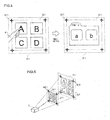
- FIG. 1 An image display apparatus in accordance with a first embodiment of the present invention is described below with reference to FIG. 1 to FIGS. 6A to 6D .
- This image display apparatus 1 displays an image G1 by projecting light on a plane P1, detects pointing out and a position thereof on the image G1 by a finger or fingers of a person or the like by taking an image of the image G1, and switches the display of the image G1 responding to a result of the detection, for example.
- the image display apparatus 1 comprises a laser diode (hereinafter, abbreviated as "LD") 2 which emits visible light, an LD driving unit 3 which is configured by a driving circuit for driving the LD 2, an optical scanning device (scanning means) 4 which two-dimensionally scans the visible light from the LD 2 on a plane P1.
- the LD driving unit 3 displays an image G1 and reference marks M1 on the plane P1 by modulating light output of the LD 2 and emits the modulated visible light from the LD 2.
- the LD 2 and the LD driving unit 3 constitute a light source by this manner.
- the image display apparatus 1 comprises an imaging unit (imaging means) 5 which picturizes an image of the image G1 and the reference marks M1 displayed on the plane P1 by the LD 2, the LD driving unit 3 and the optical scanning device 4 (hereinafter, abbreviated as "LD 2 and so on”).
- imaging unit 5 which picturizes an image of the image G1 and the reference marks M1 displayed on the plane P1 by the LD 2, the LD driving unit 3 and the optical scanning device 4 (hereinafter, abbreviated as "LD 2 and so on”).
- the image G1 and the reference marks M1 picturized by the imaging unit 5 are respectively called “picturized image G2" and “picturized reference marks M2".
- the image display apparatus 1 further comprises an image processing unit 6 which processes the picturized image G2 based on the picturized reference marks M2 and a control unit 7 which controls the LD driving unit 3 and the optical scanning device 4 responding to the image G1 to be displayed or signals from the image processing unit 6.
- the LD driving unit 3 and the optical scanning unit 4 are synchronously driven by the control unit 7.
- the image processing unit (judging means) 6 judges whether pointing means which is used to point out an optional position on the image G1 exists or not based on temporal change of the processed picturized image G2.
- a pointing means is not limited in particular, and it is sufficient to be a material object such as a finger or fingers of a person or a pen.
- a filter 8 which is formed of an optical material enabling to pass through only a visible light of the same color as the visible light from the LD 2, is provided between the plane P1 on which the image G1 is displayed and the imaging unit 5.
- the LD 2 and so on, the image processing unit 6 and the control unit 7 are built in a housing (not illustrated) of a main body of the apparatus.
- the imaging unit 5 and the filter 8 may be provided inside the housing of the main body of the apparatus or outside of the housing.
- alphabets A, B, C and D are illustrated as examples of the keys in the image G1.
- the reference marks M1 each having a shape of a cross, for example, are displayed so that cross points coincide with the corners of the image G1.
- Shape of the image G1, a number, positions and shapes of the reference marks M1 are not limited as above in particular.
- the optical scanning device 4 is configured of a polygon mirror, a galvanometer mirror or a MEMS (Micro Electro Mechanical Systems) or a combination of them, for example, and it enables to scan the visible light from the LD 2 in two directions of vertical direction and horizontal direction, that is, biaxial direction.
- the biaxial optical scanning enables to project a two-dimensional image G1 on the plane P1.
- the imaging unit 5 is configured of a CCD camera or a CMOS camera and so on. Only the visible light of the same color as the visible light from the LD 2 enters into the imaging unit 5 by the function of the filter 8. Picturizing operations of the image G1 and the reference marks M1 by the imaging unit 5 is executed at a predetermined time period. Data of the picturized image G2 and the picturized reference marks M2 are outputted from the imaging unit 5 to the image processing unit 6. When the imaging unit 5 is provided outside the housing of the main body of the apparatus, it transmits the data to the image processing unit via wires or radio.
- the image processing unit 6 is configured by a microcomputer including CPU and so on.
- the microcomputer and so on binarize shading value of each pixel of the picturized image G2 based on the data of the picturized image G2 and the picturized reference marks M2 outputted from the imaging unit 5 and divide the picturized image G2 using the picturized reference marks M2 as criteria.
- the image processing units 6 divides the picturized image G2 along a plurality of dividing lines to carve up the picturized image G2 corresponding to the keys. As shown in FIG.
- a vertical and a horizontal dividing lines D are respectively specified at a substantially center of the upper and lower picturized reference marks M2 in the figure and at a substantially center of the left and right picturized reference marks M2.
- the picturized image G2 is divided and carved into four keys.
- the image processing unit 6 detects temporal change in each divided images G2. Specifically, the image processing unit 6 compares a current picturized image G2 with a previous picturized image temporally in each divided picturized image G2, and detects reduction of an area of a character or a key frame (hereinafter, it is called "character or the like") in the picturized image G2, that is reduction of a number of pixels that form the character or the like. Such reduction of the number of pixels occurs due to a certain pointing out on the image G1 by the pointing means.
- the image processing unit 6 detects the pointing means on a specific picturized image among the divided picturized images G2, that is, when detecting the pointing out of a specific position of the image G1 by the pointing means, it outputs detection information to the control unit 7.
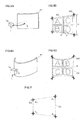
- a key image G11 of alphabet "A” is pointed out with fingers F1 in an image including a plurality of leys by a user as shown in FIG. 3A , so that key-touching operation of the key image G11 is performed.
- FIG. 3B a picturized image of the key image G11 which is obtained by dividing in the image processing unit 6 (hereinafter, it is called "picturized key image G21") becomes a shape that a part of a character or the like therein is hollowed.
- a portion "g" of the character or the like in the picturized key image G21 which corresponds to a portion of the key image G11 covered by fingers F1 or a hand, becomes a shape which is hollowed to correspond to the shape of the fingers F1 or the hand and so on. Consequently, the area of the character or the like in the picturized key image G21 is reduced in comparison with that before key-touching operation. That is, the number of pixels forming the character or the like is reduced. Therefore, it is possible to detect the key-touching of the key image G11, that is, the pointing out of the key image G11 by the pointing means such as fingers F1 or the like by detecting the reduction of the number of pixels.
- the control unit 7 is configured of the microcomputer including CPU and so on. Data of the image G1 to be displayed is inputted to the microcomputer and so on from an external apparatus such as a personal computer or the like. The microcomputer and so on controls the LD 2 and so on responding to the inputted data of the image G1. The data of the image G1 may be stored in a memory provided in the control unit 7.
- control unit 7 controls the LD 2 depending on detection information outputted from the image processing unit 6.
- the LD 2 and so on switches the display of the image G1 on a plane responding to a picturized image on which the pointing means is detected among the divided picturized images G2.
- hierarchical display of menus shown in FIG. 4 can be exemplified.
- a plurality of keys which show various kinds of menus are displayed in the image G1, and when a menu is selected by pointing one of them by a finger or fingers F1 of the user, keys (illustrated as "a" and "b" keys) which show low-order menus depending on the menu are displayed as an image G1.
- keys illustrated as "a" and "b" keys
- images showing menus are not limited to the keys, and they may be tags.
- page skip or page return may be performed by switching display of the image other than hierarchical display of menus.
- the picturized image G2 is temporally changed corresponding to presence or absence of the pointing means on the image G1, and presence or absence of the pointing out of the image by the pointing means is judged depending on the change, so that, even when a finger or fingers of a person is or are used as the pointing means, it is possible to judge whether the pointing out of the image by the finger or fingers of the person presences or not. Thereby, a number of components can be reduced.
- a complex detection circuit having a high time-resolution becomes unnecessary, so that it enables to simplify the configuration and to reduce the manufacturing cost.
- the filter 8 passes only the visible light of the same color as the visible light emitted from the LD 2 and shields lights of other colors, the image G1 and the reference marks M1 which are displayed by the visible light from the LD 2 can be extracted by the filter 8, and thus, the imaging unit 5 can picturize the extracted ones. Therefore, temporal change of the picturized image G1 can be judged in high accuracy. Accordingly, it is judged whether a part of the image G1 is covered due to pointing out of the image by the pointing means or not, that is, presence or absence of the pointing means on the image G1 can be judged in high accuracy.
- FIG. 5 when a distance between the image display apparatus 1 and the plane P1 varies, the shape of the image G1 is not varied, but the size of the image G1 varies corresponding to the distance.
- the positions of the reference marks M1 vary responding to variation of the size of the image G1, the reference marks M1 are displayed at four corners with no relation to the size of the image G1. Therefore, positional relations between the image G1 and the reference marks M1 are invariant with no relation to the above distance.
- the portion pointed out by the pointing means in the image G1 can be derived with the reference marks M1 with no relation to the distance between the image display apparatus 1 and the plane P1.
- the picturized image G2 becomes a trapezoid that the left vertical side is shorter than the right vertical side not the rectangle.
- a vertical length at an optional position in the picturized image G2 is designated by a character "y”.
- a value obtained by calculating a mathematical formula (H-y)/H ⁇ 100 is called compression ratio of the picturized image G2.
- the picturized image G2 shown in FIG. 6B is regarded as a shape compressed in vertical direction in a manner so that the compression ratio is gradually increased from a side to the other side in horizontal direction.
- the imaging unit 5 When the main body 1a of the apparatus exists at a position facing the center of the plane P1, the imaging unit 5 is built in the housing of the main body 1a of the apparatus and a horizontal section pg the plane P1 forms a curve convex to the image display apparatus 1 as shown in FIG. 6C , the picturized image G2 becomes a shape compressed in vertical direction from both side to the center in horizontal direction as shown in FIG. 6D
- the reference marks M1 are displayed at four corners of the image G1, even when shape distortion occurs in the picturized image G2, the positional relations between the picturized image G2 and the picturized reference marks M2 are invariant with no relation to the projection direction of the image G1 to the plane P1 and the shape of the plane P1. Therefore, it is possible to set the dividing lines D based on the positional relations of the picturized reference marks M2, the picturized image G2 is divided along the dividing lines D, and presence or absence of the pointing out of the image by the pointing means in each divided picturized images G2 is judged. Therefore, the pointed portion on the image G1 can be derived using the reference marks M1 with no relation to the projection direction of the image G1 to the plane p1 and the shape of the plane P1.
- a reduction number of pixels which forms the character or the like, becomes small.
- the above reduction number of pixels becomes large. Therefore, for preventing erroneous detection of the pointing out, it is preferable to establish an upper limit and a lower limit previously for the reduction number of pixels, which serves as references to judge the presence or absence of the pointing out of the image.
- the image processing unit 6 preferably judges that the pointing out by the pointing means is existed.
- an image display apparatus in accordance with a second embodiment of the present invention is described with reference to FIG. 7 to FIGS. 12A to 12C . Since a configuration of the image display apparatus in this embodiment is the same as that in the first embodiment, the configuration is described to divert FIG. 1 .
- the image display apparatus 1 of this embodiment is different that the image processing unit 6 performs a process to compensate an image G1 referring to positional relations to a plane P1 on which the image G1 is displayed or a shape of the plane P1 or the like (hereinafter, it is called "positional relations to the plane P1 or the like") in comparison with the first embodiment.
- the image processing unit 6 detects inclination or distortion of picturized reference marks M2 which occurs due to the positional relations to the plane P1 or the like, and estimates the positional relations to the plane P1 or the shape of the plane P1 corresponding to the detection result. Then, the image processing unit 6 compensates the image G1 based on the estimation result.
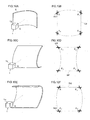
- the picturized image G2 becomes a distorted shape, for example.
- the vertical lines of the picturized reference marks M2 are not varied from the case that no distortion exists, but horizontal lines of them incline.
- the horizontal lines incline in respective picturized reference marks M2 at upper left, upper light, lower left and lower right positions in the figure, and internal angles ⁇ 1, ⁇ 2, ⁇ 3 and ⁇ 4 of the picturized image G2 which are shown by vertical lines and the horizontal lines satisfy mathematical formulae ⁇ 1 ⁇ ⁇ 3>90 degrees and ⁇ 2 ⁇ ⁇ 4 ⁇ 90 degrees, as shown in FIG. 7 .
- the image processing unit 6 calculates that the internal angles ⁇ 1 to ⁇ 4 satisfy the mathematical formulae, it is estimated that the image display apparatus 1 projects the image G1 and the reference marks M1 to the plane P1 from the position having an angle in clockwise direction to the plane P1 in planar observation.
- the internal angles ⁇ 1, ⁇ 2, ⁇ 3 and ⁇ 4 satisfy mathematical formulae ⁇ 1 ⁇ ⁇ 3 ⁇ 90 degrees and ⁇ 2 ⁇ ⁇ 4>90 degrees, as shown in FIG. 8B .
- the main body 1a of the apparatus is positioned at a position having an angle from a position facing a center of the plane P1 in clockwise direction to the plane P1 in side observation as shown in FIG.
- the internal angles ⁇ 1, ⁇ 2, ⁇ 3 and ⁇ 4 satisfy mathematical formulae ⁇ 1 ⁇ ⁇ 2>90 degrees and ⁇ 3 ⁇ ⁇ 4 ⁇ 90 degrees, as shown in FIG. 8D .
- the internal angles ⁇ 1, ⁇ 2, ⁇ 3 and ⁇ 4 satisfy mathematical formulae ⁇ 1 ⁇ ⁇ 2 ⁇ 90 degrees and ⁇ 3 ⁇ ⁇ 4>90 degrees, as shown in FIG. 8F .
- the image processing unit 6 estimates the positional relations to the plane P1 based on the above mathematical formulae that the internal angles ⁇ 1, ⁇ 2, ⁇ 3 and ⁇ 4 satisfy.
- the image processing unit 6 detects the inclination of the horizontal lines of the picturized reference marks M2 toward the center of the image and calculates that the internal angles ⁇ 1 to ⁇ 4 satisfy the mathematical formula, it is estimated that the horizontal section of the plane P1 forms a curve convex to the image display apparatus 1.
- the horizontal lines of the picturized reference marks M2 incline in opposite directions to the directions to the center of the image and the internal angles ⁇ 1, ⁇ 2, ⁇ 3 and ⁇ 4 satisfy mathematical formulae ⁇ 1 ⁇ ⁇ 2 ⁇ ⁇ 3 ⁇ ⁇ 4>90 degrees, as shown in FIG. 10B .
- the horizontal section of the plane P1 forms a curve convex to the image display apparatus 1 as shown in FIG.
- the vertical lines of the picturized reference marks M2 incline in the directions to the center of the image and the internal angles ⁇ 1, ⁇ 2, ⁇ 3 and ⁇ 4 satisfy mathematical formulae ⁇ 1 ⁇ ⁇ 2 ⁇ ⁇ 3 ⁇ ⁇ 4 ⁇ 90 degrees, as shown in FIG. 10D .
- the vertical lines of the picturized reference marks M2 incline in directions opposite to the directions to the center of the image and the internal angles ⁇ 1, ⁇ 2, ⁇ 3 and ⁇ 4 satisfy mathematical formulae ⁇ 1 ⁇ ⁇ 2 ⁇ ⁇ 3 ⁇ ⁇ 4>90 degrees, as shown in FIG. 10F .
- the image processing unit 6 detects the inclination of the horizontal lines or vertical lines of the picturized reference marks M2 toward the center of the image and calculates that the internal angles ⁇ 1 to ⁇ 4 satisfy the mathematical formula, it is estimated that the shape of the plane P1.
- FIGS. 11A to 11C and FIG. 12A to 12C the image compensation process in the image processing unit 6 is described with reference to FIGS. 11A to 11C and FIG. 12A to 12C .
- the imaging unit 5 is positioned at the position facing the center of the plane P1 as shown in the above FIG. 6A .
- distortions occur in the picturized image G2 as shown in FIG. 11A , and a relation H L ⁇ H R is concluded between a vertical length H L of a left side and a vertical length H R of a right side in the figure.
- the image processing unit 6 calculates quantities of distortions in the picturized image G2.
- the image processing unit 6 instructs the control unit 7 to project an image G1 in which a relation H L '>H R ' is concluded between a vertical length H L ' of a left side and a vertical length H R ' of a right side as shown in FIG. 11B , based on the calculation result.
- the control unit 7 controls the LD 2 and so on and the optical scanning device 4 based on this instruction, and the LD 2 and so on compensates the image G1 based on this control.
- the image G1 actually displayed on the plane P1 becomes a desired shape, for example, a rectangular shape shown in FIG. 11C .
- the image processing unit 6 may narrow the width of scanning by the optical scanning device 4 and modulate light outputs of the LD 2 corresponding thereto so as to display the image G1 compressing in horizontal direction entirely. In such a case, it is possible to prevent that the image G1 is displayed expanding in horizontal direction on the plane P1.
- the image processing unit 6 instructs the control unit 7 to project an image G1 in which a relation H M '>H E ' is concluded between a vertical length H M ' at the center and vertical lengths HE' at both ends as shown in FIG. 12B , based on the calculation result.
- the control unit 7 controls the LD 2 and so on and the optical scanning device 4 based on this instruction, and the LD 2 and so on compensates the image G1 based on this control.
- the image G1 actually displayed on the plane P1 becomes a desired shape, for example, a rectangular shape shown in FIG. 12C .
- an image can be displayed on the plane P1 with a desired size and shape with no relation to the light projection direction to the plane PI, that is, the projection direction of the image G1 or the shape of the plane P1.
- the same effects as those in the first embodiment can be brought in this embodiment.
- detection of temporal change of the picturized image G2 may be performed by performing a pattern matching of a temporally prior picturized image and a current picturized image and detecting whether they coincide each other or not.
- detection of pointing out the image may be performed by comparing the image G1 memorized in the image processing unit 6 with the picturized image G2.
- judgment of presence or absence of the pointing out of the image may be performed based on a time that the image G1 has been pointed out by the pointing means or a motion, for example, a speed of the pointing means on the image G1.
Landscapes
- Engineering & Computer Science (AREA)
- Physics & Mathematics (AREA)
- General Engineering & Computer Science (AREA)
- Theoretical Computer Science (AREA)
- General Physics & Mathematics (AREA)
- Optics & Photonics (AREA)
- Computer Hardware Design (AREA)
- Multimedia (AREA)
- Human Computer Interaction (AREA)
- Position Input By Displaying (AREA)
- Controls And Circuits For Display Device (AREA)
- Control Of Indicators Other Than Cathode Ray Tubes (AREA)
- Mechanical Optical Scanning Systems (AREA)
Applications Claiming Priority (2)
| Application Number | Priority Date | Filing Date | Title |
|---|---|---|---|
| JP2007209748A JP4835538B2 (ja) | 2007-08-10 | 2007-08-10 | 画像表示装置 |
| PCT/JP2008/064327 WO2009022659A1 (ja) | 2007-08-10 | 2008-08-08 | 画像表示装置 |
Publications (2)
| Publication Number | Publication Date |
|---|---|
| EP2199889A1 true EP2199889A1 (de) | 2010-06-23 |
| EP2199889A4 EP2199889A4 (de) | 2012-07-04 |
Family
ID=40350712
Family Applications (1)
| Application Number | Title | Priority Date | Filing Date |
|---|---|---|---|
| EP08827203A Withdrawn EP2199889A4 (de) | 2007-08-10 | 2008-08-08 | Bildanzeigeeinrichtung |
Country Status (7)
| Country | Link |
|---|---|
| US (1) | US8390586B2 (de) |
| EP (1) | EP2199889A4 (de) |
| JP (1) | JP4835538B2 (de) |
| CN (1) | CN101802758A (de) |
| DE (1) | DE08827203T1 (de) |
| TW (1) | TWI400636B (de) |
| WO (1) | WO2009022659A1 (de) |
Cited By (2)
| Publication number | Priority date | Publication date | Assignee | Title |
|---|---|---|---|---|
| EP2908239A1 (de) * | 2014-02-12 | 2015-08-19 | Ricoh Company, Ltd. | Bildverarbeitungsvorrichtung, Bildverarbeitungsverfahren und Computerprogrammprodukt |
| EP2980784B1 (de) * | 2014-07-31 | 2019-09-11 | Samsung Electronics Co., Ltd. | Anzeigevorrichtung und verfahren zur steuerung des bildschirms davon |
Families Citing this family (21)
| Publication number | Priority date | Publication date | Assignee | Title |
|---|---|---|---|---|
| WO2010137626A1 (ja) * | 2009-05-27 | 2010-12-02 | 京セラ株式会社 | 携帯電子機器 |
| JP5244084B2 (ja) * | 2009-12-21 | 2013-07-24 | パナソニック株式会社 | 表示制御システムおよび表示制御方法 |
| JP5141701B2 (ja) * | 2010-02-25 | 2013-02-13 | 株式会社ニコン | プロジェクタ |
| TWI420369B (zh) * | 2011-05-12 | 2013-12-21 | Wistron Corp | 影像式觸控裝置及影像式觸控系統 |
| EP2713251A4 (de) * | 2011-07-04 | 2014-08-06 | Huawei Device Co Ltd | Verfahren und elektronische vorrichtung für virtuelle handgeschriebene eingabe |
| JP2013070368A (ja) | 2011-09-05 | 2013-04-18 | Panasonic Corp | テレビ対話システム、端末および方法 |
| US20130169887A1 (en) * | 2012-01-03 | 2013-07-04 | Aiptek International Inc. | Projection Application Device Working Through a Wireless Video Output Device and Its Video Output Control Unit |
| CN104583921A (zh) * | 2012-08-27 | 2015-04-29 | 西铁城控股株式会社 | 信息输入装置 |
| US9298072B2 (en) * | 2012-12-19 | 2016-03-29 | Seiko Epson Corporation | Projector having inclination detection section for detecting inclination of projector enclosure and method for controlling the same |
| US9317171B2 (en) * | 2013-04-18 | 2016-04-19 | Fuji Xerox Co., Ltd. | Systems and methods for implementing and using gesture based user interface widgets with camera input |
| JP6149825B2 (ja) | 2014-08-22 | 2017-06-21 | トヨタ自動車株式会社 | 車両用操作装置 |
| JP6592904B2 (ja) * | 2015-01-22 | 2019-10-23 | セイコーエプソン株式会社 | 電子機器、プログラム |
| JP6635679B2 (ja) * | 2015-05-26 | 2020-01-29 | 国立大学法人千葉大学 | マーカーの解析方法 |
| US20180059863A1 (en) * | 2016-08-26 | 2018-03-01 | Lenovo (Singapore) Pte. Ltd. | Calibration of pen location to projected whiteboard |
| JP6911439B2 (ja) * | 2017-03-24 | 2021-07-28 | セイコーエプソン株式会社 | プロジェクター |
| US10691217B2 (en) * | 2017-04-20 | 2020-06-23 | Fuji Xerox Co., Ltd. | Methods and systems for providing a camera-based graphical user interface |
| JP7285470B2 (ja) | 2018-05-17 | 2023-06-02 | パナソニックIpマネジメント株式会社 | 投影システム、投影装置及び投影方法 |
| JP7114415B2 (ja) * | 2018-09-07 | 2022-08-08 | キヤノン株式会社 | 投影制御装置、投影制御方法、及び、プログラム |
| JP7025391B2 (ja) | 2018-10-11 | 2022-02-24 | アプティブ・テクノロジーズ・リミテッド | 自動車用通信ケーブル |
| WO2022003876A1 (ja) * | 2020-07-01 | 2022-01-06 | 日本電気株式会社 | 制御装置、制御方法、及びコンピュータ可読媒体 |
| JP7600703B2 (ja) | 2021-01-21 | 2024-12-17 | 日本電気株式会社 | 手動走査装置、及びシステム |
Family Cites Families (14)
| Publication number | Priority date | Publication date | Assignee | Title |
|---|---|---|---|---|
| DE69422074D1 (de) * | 1993-03-17 | 2000-01-20 | Matsushita Electric Industrial Co Ltd | Bildkorrekturvorrichtung |
| JPH089309A (ja) * | 1994-06-23 | 1996-01-12 | Canon Inc | 表示方法及び装置 |
| KR100320262B1 (ko) * | 1996-08-05 | 2002-04-22 | 기노시타 구니아키 | 디스플레이화상에서의지점을지정하는장치와방법및디스플레이되는화상에서의지점을지정하기위한프로그램을저장하는읽을수있는기록매체 |
| JP3804212B2 (ja) * | 1997-09-18 | 2006-08-02 | ソニー株式会社 | 情報入力装置 |
| US6512507B1 (en) * | 1998-03-31 | 2003-01-28 | Seiko Epson Corporation | Pointing position detection device, presentation system, and method, and computer-readable medium |
| JP2001222375A (ja) * | 2000-02-08 | 2001-08-17 | Seiko Epson Corp | 指示位置検出システムおよび方法、プレゼンテーションシステム並びに情報記憶媒体 |
| EP1316055A4 (de) | 2000-05-29 | 2006-10-04 | Vkb Inc | Einrichtung zur eingabe virtueller daten und verfahren zum eingeben alphanumerischer und anderer daten |
| WO2005069114A1 (ja) | 2004-01-15 | 2005-07-28 | Vodafone K.K. | 移動体通信端末 |
| DE102005001417B4 (de) * | 2004-01-29 | 2009-06-25 | Heidelberger Druckmaschinen Ag | Projektionsflächenabhängige Anzeige-/Bedienvorrichtung |
| US20060026533A1 (en) | 2004-08-02 | 2006-02-02 | Joshua Napoli | Method for pointing and selection of regions in 3-D image displays |
| JP4612853B2 (ja) * | 2005-03-29 | 2011-01-12 | キヤノン株式会社 | 指示位置認識装置及びそれを有する情報入力装置 |
| WO2007097122A1 (en) | 2006-02-21 | 2007-08-30 | Matsushita Electric Works, Ltd. | Image display apparatus and image distortion correction method of the same |
| JP5027498B2 (ja) | 2006-12-25 | 2012-09-19 | パナソニック株式会社 | 放電灯点灯装置および画像表示装置 |
| JP5089528B2 (ja) | 2008-08-18 | 2012-12-05 | パナソニック株式会社 | データ取り込み回路および表示パネル駆動回路および画像表示装置 |
-
2007
- 2007-08-10 JP JP2007209748A patent/JP4835538B2/ja not_active Expired - Fee Related
-
2008
- 2008-08-05 TW TW097129728A patent/TWI400636B/zh not_active IP Right Cessation
- 2008-08-08 CN CN200880102805A patent/CN101802758A/zh active Pending
- 2008-08-08 EP EP08827203A patent/EP2199889A4/de not_active Withdrawn
- 2008-08-08 DE DE08827203T patent/DE08827203T1/de active Pending
- 2008-08-08 WO PCT/JP2008/064327 patent/WO2009022659A1/ja not_active Ceased
-
2010
- 2010-02-09 US US12/702,595 patent/US8390586B2/en not_active Expired - Fee Related
Cited By (2)
| Publication number | Priority date | Publication date | Assignee | Title |
|---|---|---|---|---|
| EP2908239A1 (de) * | 2014-02-12 | 2015-08-19 | Ricoh Company, Ltd. | Bildverarbeitungsvorrichtung, Bildverarbeitungsverfahren und Computerprogrammprodukt |
| EP2980784B1 (de) * | 2014-07-31 | 2019-09-11 | Samsung Electronics Co., Ltd. | Anzeigevorrichtung und verfahren zur steuerung des bildschirms davon |
Also Published As
| Publication number | Publication date |
|---|---|
| JP2009043157A (ja) | 2009-02-26 |
| US20100141897A1 (en) | 2010-06-10 |
| US8390586B2 (en) | 2013-03-05 |
| TW200925959A (en) | 2009-06-16 |
| JP4835538B2 (ja) | 2011-12-14 |
| CN101802758A (zh) | 2010-08-11 |
| TWI400636B (zh) | 2013-07-01 |
| DE08827203T1 (de) | 2011-03-17 |
| WO2009022659A1 (ja) | 2009-02-19 |
| EP2199889A4 (de) | 2012-07-04 |
Similar Documents
| Publication | Publication Date | Title |
|---|---|---|
| US8390586B2 (en) | Image display apparatus that detects pointing element using imaging device | |
| EP2120455B1 (de) | Elektronikvorrichtung mit Projektormodul | |
| US8408720B2 (en) | Image display apparatus, image display method, and recording medium having image display program stored therein | |
| US8123361B2 (en) | Dual-projection projector and method for projecting images on a plurality of planes | |
| EP2026170B1 (de) | Positionsbestimmungsvorrichtung | |
| JP5300859B2 (ja) | 撮像装置、表示撮像装置および電子機器 | |
| US20050280628A1 (en) | Projector pen image stabilization system | |
| JP2010539557A (ja) | カメラとマーク出力とによるポインティング装置 | |
| CN103365549A (zh) | 输入装置、显示系统及输入方法 | |
| US20110050644A1 (en) | Touch system and pointer coordinate detection method therefor | |
| US10244197B2 (en) | Projector and control method of projector | |
| US20110193969A1 (en) | Object-detecting system and method by use of non-coincident fields of light | |
| US20140001346A1 (en) | Image projection device and detection method thereof | |
| HK1145364A (en) | Image display device | |
| US20140085264A1 (en) | Optical touch panel system, optical sensing module, and operation method thereof | |
| KR100860158B1 (ko) | 펜 형의 위치 입력 장치 | |
| US12468147B2 (en) | Multi-beam laser beam scanner in a picture generation unit | |
| US11228744B2 (en) | Method for controlling projection system, projection system, and control program | |
| JP5208719B2 (ja) | 撮像装置、表示装置および撮像方法 | |
| US12328535B2 (en) | Projection device, display system, and display method | |
| US9335158B2 (en) | Projector and projector system | |
| JP2020122696A (ja) | 位置検出装置、位置検出ユニット、画像表示システムおよび位置検出方法 | |
| US10860144B2 (en) | Projector and method for controlling projector | |
| JP2011198258A (ja) | 情報入力装置、情報入出力装置および電子機器 | |
| JPWO2018207235A1 (ja) | 入出力システム、スクリーンセット、入出力方法、及び、プログラム |
Legal Events
| Date | Code | Title | Description |
|---|---|---|---|
| PUAI | Public reference made under article 153(3) epc to a published international application that has entered the european phase |
Free format text: ORIGINAL CODE: 0009012 |
|
| 17P | Request for examination filed |
Effective date: 20100301 |
|
| AK | Designated contracting states |
Kind code of ref document: A1 Designated state(s): AT BE BG CH CY CZ DE DK EE ES FI FR GB GR HR HU IE IS IT LI LT LU LV MC MT NL NO PL PT RO SE SI SK TR |
|
| AX | Request for extension of the european patent |
Extension state: AL BA MK RS |
|
| DAX | Request for extension of the european patent (deleted) | ||
| EL | Fr: translation of claims filed | ||
| DET | De: translation of patent claims | ||
| REG | Reference to a national code |
Ref country code: DE Ref legal event code: R210 Effective date: 20110317 |
|
| REG | Reference to a national code |
Ref country code: HK Ref legal event code: DE Ref document number: 1145364 Country of ref document: HK |
|
| RAP1 | Party data changed (applicant data changed or rights of an application transferred) |
Owner name: PANASONIC CORPORATION |
|
| A4 | Supplementary search report drawn up and despatched |
Effective date: 20120604 |
|
| RIC1 | Information provided on ipc code assigned before grant |
Ipc: G06F 3/03 20060101ALI20120529BHEP Ipc: G09G 5/00 20060101ALI20120529BHEP Ipc: G06F 3/041 20060101AFI20120529BHEP Ipc: G09G 3/02 20060101ALI20120529BHEP |
|
| STAA | Information on the status of an ep patent application or granted ep patent |
Free format text: STATUS: THE APPLICATION IS DEEMED TO BE WITHDRAWN |
|
| 18D | Application deemed to be withdrawn |
Effective date: 20130103 |
|
| REG | Reference to a national code |
Ref country code: HK Ref legal event code: WD Ref document number: 1145364 Country of ref document: HK |