EP2199905A1 - Gestion du cycle de vie et vérification de cohérence de modèles d'objet utilisant des outils de plate-forme d'application - Google Patents
Gestion du cycle de vie et vérification de cohérence de modèles d'objet utilisant des outils de plate-forme d'application Download PDFInfo
- Publication number
- EP2199905A1 EP2199905A1 EP09011216A EP09011216A EP2199905A1 EP 2199905 A1 EP2199905 A1 EP 2199905A1 EP 09011216 A EP09011216 A EP 09011216A EP 09011216 A EP09011216 A EP 09011216A EP 2199905 A1 EP2199905 A1 EP 2199905A1
- Authority
- EP
- European Patent Office
- Prior art keywords
- object model
- lifecycle
- action
- status
- business
- Prior art date
- Legal status (The legal status is an assumption and is not a legal conclusion. Google has not performed a legal analysis and makes no representation as to the accuracy of the status listed.)
- Ceased
Links
Images


Classifications
-
- G—PHYSICS
- G06—COMPUTING OR CALCULATING; COUNTING
- G06F—ELECTRIC DIGITAL DATA PROCESSING
- G06F9/00—Arrangements for program control, e.g. control units
- G06F9/06—Arrangements for program control, e.g. control units using stored programs, i.e. using an internal store of processing equipment to receive or retain programs
- G06F9/44—Arrangements for executing specific programs
- G06F9/448—Execution paradigms, e.g. implementations of programming paradigms
- G06F9/4488—Object-oriented
Definitions
- Some embodiments relate to business objects supported by an application platform. More specifically, some embodiments relate to the use of application platform tools to facilitate the development of object models.
- a business object is a software model representing real-world items used during the transaction of business.
- a business object model may represent a business document such as a sales order, a purchase order, or an invoice.
- a business object model may also represent master data objects such as a product, a business partner, or a piece of equipment.
- Particular documents e.g., SalesOrder SO435539
- master data objects e.g., BusinessPartner ACME corporation
- Conventional business process platforms such as the Application Platform provided by SAP of Walldorf, Germany, provide services and tools to support the use of business object models and instances thereof. For example, such platforms may expose application programming interfaces to provide read and write access to business object instances. Also included may be a business object processing framework to validate business object instances, lifecycle services to manage business object instance lifecycles, and a status and action management component to manage states of the business object instances.
- Each of the specific business object models supported by the business process platform conforms to a generic business object model (i.e., a meta-metadata model).
- a generic business object model i.e., a meta-metadata model.
- Consistency checking presents particular difficulties in the development of new object models which are themselves instances of a metadata object model.
- a metadata object model provides an abstract syntax stating the structural characteristics of entities and the relationships between them.
- a metadata object model may also be associated with a static semantic providing additional information about the metadata object model. This static semantic contains information that cannot be expressed in structural features.
- an abstract syntax may express a structural characteristic such as "an instance of Entity A is connected to an instance of Entity B".
- An object modeling system is desired to efficiently address static semantics as described above.
- Such a system may provide formal means to express constraints, a system to connect a constraint to a context entity to which it belongs, an engine that is able to receive an object model as input and evaluate the constraints thereof, and an indicator for the current state of an object model under development.
- Meta Object Facilities MOF
- Ecore from the Eclipse Modeling Framework
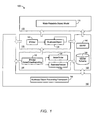
- FIG. 1 is a block diagram of metadata modeling architecture 100 according to some embodiments.
- FIG. 1 represents a logical architecture for describing some embodiments, and actual implementations may include more or different components arranged in any manner.
- Architecture 100 may be implemented using any number of computer devices, the meta-metadata object models, metadata object models, and object models shown therein may be embodied in any types of electronic data structures, and one or more processors may execute program code to perform any processes described herein.
- Meta-metadata model layer 110 includes meta-metadata model 115.
- Meta-metadata object model 115 may consist of nodes, composite associations, associations, elements structure and attribute properties.
- Metadata model layer 120 includes metadata object models 122 and 124 which are instances of meta-metadata object model 115. Metadata object models 122 and 124 describe, respectively, generic object models of a Business Intelligence (BI) view and a business object. As shown, a logical dependency exists between metadata object models 122 and 124. Other metadata models that may reside in metadata model layer 120 may describe, for example, a work center, user interface texts, and process components, but embodiments are not limited thereto.
- BI Business Intelligence
- Object model layer 130 includes object models which are instances of metadata object models from metadata model layer 120. More specifically, object model 132 is an instance of metadata object model 122 and object models 134 and 136 are instances of metadata object model 124. For purposes of the present description, metadata object models 122 and 124 and object models 132 through 136 may all be referred to as "object models” as well as “object model instances”.
- the object models of all layers of architecture 100 may be embodied in any type of data structure, including but not limited to eXtensible Markup Language files.
- meta-metadata object model 115 is identical to business object metadata object model 122.
- business object metadata object model 122 may comprise an instance of itself.
- FIG. 2 is a diagram of meta-metadata object model 115 according to some embodiments.
- FIG. 3 is a diagram illustrating the modeling of logical dependencies of different metadata object models (e.g., Business Information View; List; Business Object) of metadata model layer 120 using meta-metadata object model 115.
- the runtime components of a business process platform used to support instances of a business object model may be leveraged to facilitate the development of object models. This leveraging is particularly strong in embodiments where the object models being developed are themselves instances of the business object model for which the runtime components were developed.
- some embodiments may be used to develop instances of meta-metadata object model 115 (e.g., metadata object models 122 and 124), as well as instances of metadata object models 122 and 124 (e.g., object models 132, 134 and 136).
- repository services 140 and implementation layer 150 may comprise components typically used at runtime to manage business object instances (e.g., SalesOrder SO435539, BusinessPartner ACME Corporation).
- Repository services 140 include Status & Action Management (S&AM) component 142 and S&AM schemas 144.
- S&AM Status & Action Management
- each business object model (e.g., SalesOrder) of a platform is associated with an S&AM schema.
- component 142 uses a schema 144 associated with a business object and status variables of the business object to provide services relating to instances of the business object.
- Such services include determining states of the instances, managing actions that can be performed on the instances, and identifying state transitions of the instances.
- S&AM component 142 is used in conjunction with an appropriate S&AM schema 144 during design time to manage the development lifecycle of an object model (e.g., any object model of layer 120 or layer 130).
- FIG. 4 is a diagram of S&AM schema 400 which characterizes the development lifecycle of an object model according to some embodiments.
- the development lifecycle consists of consecutive states of the object model and actions that can be performed on the object model to move from one state to another.
- schema 400 characterizes the development lifecycle of an object model using the status variables "Correctness”, Deployment” and “Publishment”. Schema 400 also indicates the following state transitions (i.e., actions): “Check”, “Activate” and "Publish”.
- business object processing framework (BOPF) 155 conventionally consists of business logic (e.g., ABAP code) associated with a trigger event and a business object node.
- business logic e.g., ABAP code
- the business logic is executed to validate instances of the business object node against a constraint. Accordingly, the constraints need not be satisfied at all times, but only upon detection of the trigger event.
- every constraint in a parent metadata object model can be expressed in BOPF validation code.
- the modeler can specify the conditions under which a specific constraint must be satisfied, and these conditions may include the state (i.e., per S&AM status variables) of the object model.
- FIG. 5 is a flow diagram of process 500 according to some embodiments.
- Process 500 may be performed during design time by executing program code of S&AM component 142 of architecture 100, but embodiments are not limited thereto.
- a lifecycle state of an object model is determined based on an S&AM schema associated with an object model development lifecycle.
- the object model may comprise any object model for which a parent object model exists.
- the object model may comprise any object model of layer 120 (i.e., having parent object model 115) or layer 130 (i.e., having parent object model 122 or 124) of architecture 100.
- the S&AM schema may comprise schema 400 of FIG. 4 .
- the S&AM schema may be specifically associated with the object model of which the object model being developed is an instance.
- the S&AM schema may be associated with all object models under the assumption that the development lifecycle specified therein applies to each object model.
- S&AM component 142 may determine the lifecycle state at 510 by evaluating status variables associated with the object model in view of the S&AM schema. This determination may use conventional capabilities of S&AM component 142, albeit in an inventive context.
- a request to perform a lifecycle action on the object model has been received. If not, flow cycles between 510 and 520 to periodically re-determine a lifecycle state of the object model (e.g., in case a value of a status variable has changed) and re-determine whether a request has been received.
- S&AM component 142 may refer to the S&AM schema at 530 to determine if the requested action is permitted to follow from the currently-determined lifecycle state. For example, and with reference to S&AM schema 400, it may be determined that the "Activate" action is not allowed if the currently-determined lifecycle state is "Incorrect". Flow therefore returns to 510.
- a BOPF is called at 550 to execute a validation to check the constraint.
- the validation is code associated with the object model and designed to perform the requested check.
- the BOPF may determine whether the object model under development is semantically correct. Any other constraint may be evaluated at 550.
- the status variables of the object model are changed, if necessary, based on the results of the check. Flow then returns to 510 and continues as described above. In this regard, a new lifecycle state may be determined at 510 depending on whether and how the status variables of the object model were changed as a result of the check.
- flow proceeds from 540 directly to 560 if the requested action is not a constraint check (i.e., doesn't require services of BOPF 155).
- the requested lifecycle action is allowed at 560 and flow returns to 510.
- the lifestyle action may result in a change to the status variables of the object model. Accordingly, a new lifecycle state may be determined at 510 depending on the values of the status variables of the object model upon return to 510.
- BOPF 155 may execute a validation based on trigger events other than that described with respect to process 500. Such a capability provides helpful flexibility in defining and evaluating constraints during the development lifecycle.
- Process 600 may be executed by BOPF 155 with respect to an object model during development of the object model according to some embodiments.
- the BOPF detects a trigger event associated with the object model at 610.
- the trigger event may comprise a call from S&AM component 142 as described with respect to process 500, but embodiments are not limited thereto.
- Some examples of trigger events include, but are not limited to, creation of a node of the object model, an instruction to save the object model, etc.
- BOPF 155 executes validation code associated with the trigger event.
- the validation code allows BOPF 155 to evaluate a given constraint associated with the event and the object model. BOPF 155 may consider S&AM status variables during the evaluation at 620.
- attributes of business objects may be grouped in an analytical report into characteristics (rows and columns) and key figures (cell data).
- Key figures can be aggregated (e.g., the net amount of a SalesOrder instance can be aggregated by buyer, seller, buyer's company, etc.).
- Some types of aggregation e.g., sum
- the key figures must comprise numerical values. This constraint cannot be expressed in the structure of the metadata object model of which the object model being developed is an instance.
- Validation code is therefore executed at 620 to determine whether the aggregation can be performed on the selected business object attribute.
- a result of the evaluation is returned at 630.
- the result may consist of node keys of object model nodes which failed the evaluation, messages, and/or any other suitable result.
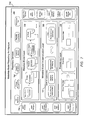
- FIG. 7 illustrates architecture 700 according to some embodiments.
- Architecture 700 may comprise a specific implementation of architecture 100, but embodiments are not limited thereto.
- Metadata model layer 710 includes metadata models as described above, and illustrates logical dependencies between the metadata models. As also described above, each metadata model may comprise an instance of a meta-metadata model.
- Metadata implementation layer 720 includes business object processing framework 725 to provide constraint checks and validations as described herein. Unlike conventional checks and validations of object model instance data, business object processing framework 725 may check and validate object models developed using architecture 700. BOPF 725 may also generate appropriate database tables in persistency layer 730 to store data structures comprising object models derived from the metadata models of layer 710.
- ABAP services 740 represent a generic connection to ABAP services provided for all instances (i.e., object models) derived from the repository metadata models. Such services may include transport and correction tools and an ABAP development workbench. ABAP services 740 may be similar to corresponding ABAP services currently provided for business object instances.
- Access layer 750 provides uniform mechanisms to access repository object models. For example, Business Query Language/BSA++ may be used to access design time aspects of the object models. During runtime, access layer may provide specific performance-optimized application programming interfaces and buffering facilities.
- Repository services 760 also reflect services that may be conventionally available with respect to object model instances, but not with respect to object models themselves.
- process enforcement services 765 may comprise a Status & Action Management component for operating in conjunction with a status and action management schema associated with an object model development lifecycle as described herein.
- Each system and device described herein may be implemented by any number of devices in communication via any number of other public and/or private networks. Two or more of devices of may be located remote from one another and may communicate with one another via any known manner of network(s) and/or a dedicated connection. Moreover, each device may comprise any number of hardware and/or software elements suitable to provide the functions described herein as well as any other functions. Other topologies may be used in conjunction with other embodiments.
- All systems and processes discussed herein may be embodied in program code stored on one or more computer-readable media and executed by a processor.
- Such media may include, for example, a floppy disk, a CD-ROM, a DVD-ROM, a ZipTM disk, magnetic tape, and solid state RAM or ROM memories.
- Embodiments are therefore not limited to any specific combination of hardware and software.
- the embodiments described herein are solely for the purpose of illustration. Those in the art will recognize other embodiments may be practiced with modifications and alterations limited only by the claims.
Landscapes
- Engineering & Computer Science (AREA)
- Software Systems (AREA)
- Theoretical Computer Science (AREA)
- Physics & Mathematics (AREA)
- General Engineering & Computer Science (AREA)
- General Physics & Mathematics (AREA)
- Stored Programmes (AREA)
Applications Claiming Priority (1)
| Application Number | Priority Date | Filing Date | Title |
|---|---|---|---|
| US12/339,368 US20100161676A1 (en) | 2008-12-19 | 2008-12-19 | Lifecycle management and consistency checking of object models using application platform tools |
Publications (1)
| Publication Number | Publication Date |
|---|---|
| EP2199905A1 true EP2199905A1 (fr) | 2010-06-23 |
Family
ID=41202856
Family Applications (1)
| Application Number | Title | Priority Date | Filing Date |
|---|---|---|---|
| EP09011216A Ceased EP2199905A1 (fr) | 2008-12-19 | 2009-09-01 | Gestion du cycle de vie et vérification de cohérence de modèles d'objet utilisant des outils de plate-forme d'application |
Country Status (2)
| Country | Link |
|---|---|
| US (1) | US20100161676A1 (fr) |
| EP (1) | EP2199905A1 (fr) |
Families Citing this family (8)
| Publication number | Priority date | Publication date | Assignee | Title |
|---|---|---|---|---|
| US20080162502A1 (en) * | 2006-12-27 | 2008-07-03 | Udo Klein | System integrated flexible development process |
| US8578278B2 (en) * | 2010-12-22 | 2013-11-05 | Sap Ag | Dynamic user interface content adaptation and aggregation |
| US8627340B2 (en) | 2011-06-23 | 2014-01-07 | International Business Machines Corporation | Managing events generated from business objects |
| US8996472B2 (en) | 2012-04-16 | 2015-03-31 | Sap Se | Verification of status schemas based on business goal definitions |
| US8612406B1 (en) | 2012-05-22 | 2013-12-17 | Sap Ag | Sharing business data across networked applications |
| US8996473B2 (en) | 2012-08-06 | 2015-03-31 | Sap Se | Checking compatibility of extended and core SAM schemas based on complex goals |
| US10417594B2 (en) | 2013-05-02 | 2019-09-17 | Sap Se | Validation of functional correctness of SAM schemas including action chains |
| US12436760B2 (en) * | 2022-06-10 | 2025-10-07 | The Travelers Indemnity Company | Interactive code visualization system |
Family Cites Families (9)
| Publication number | Priority date | Publication date | Assignee | Title |
|---|---|---|---|---|
| US7349912B2 (en) * | 2000-12-22 | 2008-03-25 | Oracle International Corporation | Runtime modification of entries in an identity system |
| US7487512B2 (en) * | 2004-09-30 | 2009-02-03 | Sap Ag | Publish-subscribe event notifications |
| US7756902B2 (en) * | 2004-12-30 | 2010-07-13 | Sap Aktiengesellschaft | Auto-id simulator |
| US10394543B2 (en) * | 2005-01-21 | 2019-08-27 | International Business Machines Corporation | Lifecycle objectification of non-activity objects in an activity thread |
| US7205897B2 (en) * | 2005-03-01 | 2007-04-17 | Sap Aktiengesellschaft | Product flow based auto-ID infrastructure |
| US8838466B2 (en) * | 2005-12-02 | 2014-09-16 | Guard Insurance Group | System and method to track the status, physical location, and logical location of workflow objects in a workflow cycle |
| US8924269B2 (en) * | 2006-05-13 | 2014-12-30 | Sap Ag | Consistent set of interfaces derived from a business object model |
| US7797708B2 (en) * | 2006-06-26 | 2010-09-14 | Sap Ag | Simulating actions on mockup business objects |
| US7966621B2 (en) * | 2006-06-30 | 2011-06-21 | Sap Ag | Using multiple status models in a computer system |
-
2008
- 2008-12-19 US US12/339,368 patent/US20100161676A1/en not_active Abandoned
-
2009
- 2009-09-01 EP EP09011216A patent/EP2199905A1/fr not_active Ceased
Non-Patent Citations (2)
| Title |
|---|
| DOCUMENT G. PECHT-SEIBERT, SERVICE ORIENTED ARCHITECTURE IN BUSINESS BY DESIGN, 12 October 2007 (2007-10-12) |
| PECHT-SEIBERT G: "Service Oriented Architecture in Business By Design", INTERNET ARTICLE, 12 October 2007 (2007-10-12), pages 1 - 73, XP002552338, Retrieved from the Internet <URL:http://www.wiinf.uni-wuerzburg.de/Dateianlagen/Lehrveranstaltungen/zencke/Architecture.pdf> [retrieved on 20091026] * |
Also Published As
| Publication number | Publication date |
|---|---|
| US20100161676A1 (en) | 2010-06-24 |
Similar Documents
| Publication | Publication Date | Title |
|---|---|---|
| US8555248B2 (en) | Business object change management using release status codes | |
| US8176470B2 (en) | Collaborative derivation of an interface and partial implementation of programming code | |
| US8352914B2 (en) | Impact analysis of software change requests | |
| US20140279979A1 (en) | System for metadata management | |
| EP2199904A1 (fr) | Support flexible partagé d'extensions de métadonnées | |
| EP2199905A1 (fr) | Gestion du cycle de vie et vérification de cohérence de modèles d'objet utilisant des outils de plate-forme d'application | |
| US11662998B2 (en) | Detecting duplicated code patterns in visual programming language code instances | |
| CN119201043B (zh) | 基于云平台的业务需求确认方法及系统 | |
| US20150081744A1 (en) | Metadata model repository | |
| US12265949B2 (en) | Dynamically controlling case model structure using case fragments | |
| Silva Souza et al. | Monitoring strategic goals in data warehouses with awareness requirements | |
| CN107247581B (zh) | 系统分析与概要设计交付模型的构建方法 | |
| Oliveira et al. | Using reo on etl conceptual modelling: a first approach | |
| Biffl et al. | Semantic integration of heterogeneous data sources for monitoring frequent-release software projects | |
| EP4315070B1 (fr) | Essai automatique de composants interdépendants d'une application logicielle | |
| US20070299705A1 (en) | Method and apparatus for observation model validation | |
| ElGamal et al. | An Architecture-Oriented Data Warehouse Testing Approach. | |
| Zhang et al. | Composite‐Level Conflict Detection in UML Model Versioning | |
| US20250335849A1 (en) | No-Code Integration System for Custom Objects in Automated Workflows | |
| Pulgarín et al. | Cost Estimate Migration for Crystal Reports | |
| Hess | Evaluating Domain-Driven Design for Refactoring Existing Information Systems | |
| CN121501384A (zh) | 工具调用方法、装置、电子设备、介质和程序产品 | |
| CN117111888A (zh) | 详细设计文档的生成方法、装置、电子设备和存储介质 | |
| Li | Software reliability measurement: a survey | |
| Sonnleitner et al. | Persistence of workflow control data in temporal databases |
Legal Events
| Date | Code | Title | Description |
|---|---|---|---|
| PUAI | Public reference made under article 153(3) epc to a published international application that has entered the european phase |
Free format text: ORIGINAL CODE: 0009012 |
|
| AK | Designated contracting states |
Kind code of ref document: A1 Designated state(s): AT BE BG CH CY CZ DE DK EE ES FI FR GB GR HR HU IE IS IT LI LT LU LV MC MK MT NL NO PL PT RO SE SI SK SM TR |
|
| AX | Request for extension of the european patent |
Extension state: AL BA RS |
|
| 17P | Request for examination filed |
Effective date: 20101202 |
|
| 17Q | First examination report despatched |
Effective date: 20130318 |
|
| RAP1 | Party data changed (applicant data changed or rights of an application transferred) |
Owner name: SAP SE |
|
| STAA | Information on the status of an ep patent application or granted ep patent |
Free format text: STATUS: THE APPLICATION HAS BEEN REFUSED |
|
| 18R | Application refused |
Effective date: 20141225 |