EP2200253A1 - Verfahren zur Verwaltung von sensiblen Daten in einem elektronischen Token - Google Patents
Verfahren zur Verwaltung von sensiblen Daten in einem elektronischen Token Download PDFInfo
- Publication number
- EP2200253A1 EP2200253A1 EP08305985A EP08305985A EP2200253A1 EP 2200253 A1 EP2200253 A1 EP 2200253A1 EP 08305985 A EP08305985 A EP 08305985A EP 08305985 A EP08305985 A EP 08305985A EP 2200253 A1 EP2200253 A1 EP 2200253A1
- Authority
- EP
- European Patent Office
- Prior art keywords
- data
- electronic token
- secret
- instructions
- intended
- Prior art date
- Legal status (The legal status is an assumption and is not a legal conclusion. Google has not performed a legal analysis and makes no representation as to the accuracy of the status listed.)
- Withdrawn
Links
Images

Classifications
-
- H—ELECTRICITY
- H04—ELECTRIC COMMUNICATION TECHNIQUE
- H04W—WIRELESS COMMUNICATION NETWORKS
- H04W12/00—Security arrangements; Authentication; Protecting privacy or anonymity
- H04W12/04—Key management, e.g. using generic bootstrapping architecture [GBA]
-
- G—PHYSICS
- G06—COMPUTING OR CALCULATING; COUNTING
- G06Q—INFORMATION AND COMMUNICATION TECHNOLOGY [ICT] SPECIALLY ADAPTED FOR ADMINISTRATIVE, COMMERCIAL, FINANCIAL, MANAGERIAL OR SUPERVISORY PURPOSES; SYSTEMS OR METHODS SPECIALLY ADAPTED FOR ADMINISTRATIVE, COMMERCIAL, FINANCIAL, MANAGERIAL OR SUPERVISORY PURPOSES, NOT OTHERWISE PROVIDED FOR
- G06Q20/00—Payment architectures, schemes or protocols
- G06Q20/30—Payment architectures, schemes or protocols characterised by the use of specific devices or networks
- G06Q20/308—Payment architectures, schemes or protocols characterised by the use of specific devices or networks using the Internet of Things
-
- G—PHYSICS
- G06—COMPUTING OR CALCULATING; COUNTING
- G06Q—INFORMATION AND COMMUNICATION TECHNOLOGY [ICT] SPECIALLY ADAPTED FOR ADMINISTRATIVE, COMMERCIAL, FINANCIAL, MANAGERIAL OR SUPERVISORY PURPOSES; SYSTEMS OR METHODS SPECIALLY ADAPTED FOR ADMINISTRATIVE, COMMERCIAL, FINANCIAL, MANAGERIAL OR SUPERVISORY PURPOSES, NOT OTHERWISE PROVIDED FOR
- G06Q20/00—Payment architectures, schemes or protocols
- G06Q20/30—Payment architectures, schemes or protocols characterised by the use of specific devices or networks
- G06Q20/34—Payment architectures, schemes or protocols characterised by the use of specific devices or networks using cards, e.g. integrated circuit [IC] cards or magnetic cards
- G06Q20/356—Aspects of software for card payments
- G06Q20/3563—Software being resident on card
-
- G—PHYSICS
- G06—COMPUTING OR CALCULATING; COUNTING
- G06Q—INFORMATION AND COMMUNICATION TECHNOLOGY [ICT] SPECIALLY ADAPTED FOR ADMINISTRATIVE, COMMERCIAL, FINANCIAL, MANAGERIAL OR SUPERVISORY PURPOSES; SYSTEMS OR METHODS SPECIALLY ADAPTED FOR ADMINISTRATIVE, COMMERCIAL, FINANCIAL, MANAGERIAL OR SUPERVISORY PURPOSES, NOT OTHERWISE PROVIDED FOR
- G06Q20/00—Payment architectures, schemes or protocols
- G06Q20/30—Payment architectures, schemes or protocols characterised by the use of specific devices or networks
- G06Q20/34—Payment architectures, schemes or protocols characterised by the use of specific devices or networks using cards, e.g. integrated circuit [IC] cards or magnetic cards
- G06Q20/357—Cards having a plurality of specified features
- G06Q20/3574—Multiple applications on card
-
- G—PHYSICS
- G07—CHECKING-DEVICES
- G07F—COIN-FREED OR LIKE APPARATUS
- G07F7/00—Mechanisms actuated by objects other than coins to free or to actuate vending, hiring, coin or paper currency dispensing or refunding apparatus
- G07F7/08—Mechanisms actuated by objects other than coins to free or to actuate vending, hiring, coin or paper currency dispensing or refunding apparatus by coded identity card or credit card or other personal identification means
- G07F7/10—Mechanisms actuated by objects other than coins to free or to actuate vending, hiring, coin or paper currency dispensing or refunding apparatus by coded identity card or credit card or other personal identification means together with a coded signal, e.g. in the form of personal identification information, like personal identification number [PIN] or biometric data
- G07F7/1008—Active credit-cards provided with means to personalise their use, e.g. with PIN-introduction/comparison system
-
- H—ELECTRICITY
- H04—ELECTRIC COMMUNICATION TECHNIQUE
- H04L—TRANSMISSION OF DIGITAL INFORMATION, e.g. TELEGRAPHIC COMMUNICATION
- H04L63/00—Network architectures or network communication protocols for network security
- H04L63/06—Network architectures or network communication protocols for network security for supporting key management in a packet data network
- H04L63/062—Network architectures or network communication protocols for network security for supporting key management in a packet data network for key distribution, e.g. centrally by trusted party
-
- H—ELECTRICITY
- H04—ELECTRIC COMMUNICATION TECHNIQUE
- H04L—TRANSMISSION OF DIGITAL INFORMATION, e.g. TELEGRAPHIC COMMUNICATION
- H04L9/00—Cryptographic mechanisms or cryptographic arrangements for secret or secure communications; Network security protocols
- H04L9/08—Key distribution or management, e.g. generation, sharing or updating, of cryptographic keys or passwords
- H04L9/0816—Key establishment, i.e. cryptographic processes or cryptographic protocols whereby a shared secret becomes available to two or more parties, for subsequent use
- H04L9/0838—Key agreement, i.e. key establishment technique in which a shared key is derived by parties as a function of information contributed by, or associated with, each of these
-
- H—ELECTRICITY
- H04—ELECTRIC COMMUNICATION TECHNIQUE
- H04L—TRANSMISSION OF DIGITAL INFORMATION, e.g. TELEGRAPHIC COMMUNICATION
- H04L63/00—Network architectures or network communication protocols for network security
- H04L63/08—Network architectures or network communication protocols for network security for authentication of entities
- H04L63/0853—Network architectures or network communication protocols for network security for authentication of entities using an additional device, e.g. smartcard, SIM or a different communication terminal
-
- H—ELECTRICITY
- H04—ELECTRIC COMMUNICATION TECHNIQUE
- H04W—WIRELESS COMMUNICATION NETWORKS
- H04W12/00—Security arrangements; Authentication; Protecting privacy or anonymity
- H04W12/02—Protecting privacy or anonymity, e.g. protecting personally identifiable information [PII]
-
- H—ELECTRICITY
- H04—ELECTRIC COMMUNICATION TECHNIQUE
- H04W—WIRELESS COMMUNICATION NETWORKS
- H04W12/00—Security arrangements; Authentication; Protecting privacy or anonymity
- H04W12/06—Authentication
-
- H—ELECTRICITY
- H04—ELECTRIC COMMUNICATION TECHNIQUE
- H04W—WIRELESS COMMUNICATION NETWORKS
- H04W12/00—Security arrangements; Authentication; Protecting privacy or anonymity
- H04W12/60—Context-dependent security
- H04W12/69—Identity-dependent
- H04W12/72—Subscriber identity
-
- H—ELECTRICITY
- H04—ELECTRIC COMMUNICATION TECHNIQUE
- H04W—WIRELESS COMMUNICATION NETWORKS
- H04W4/00—Services specially adapted for wireless communication networks; Facilities therefor
- H04W4/50—Service provisioning or reconfiguring
-
- H—ELECTRICITY
- H04—ELECTRIC COMMUNICATION TECHNIQUE
- H04W—WIRELESS COMMUNICATION NETWORKS
- H04W8/00—Network data management
- H04W8/18—Processing of user or subscriber data, e.g. subscribed services, user preferences or user profiles; Transfer of user or subscriber data
-
- H—ELECTRICITY
- H04—ELECTRIC COMMUNICATION TECHNIQUE
- H04W—WIRELESS COMMUNICATION NETWORKS
- H04W88/00—Devices specially adapted for wireless communication networks, e.g. terminals, base stations or access point devices
- H04W88/02—Terminal devices
Definitions
- the present invention relates to methods of managing sensitive data in an electronic token. It relates particularly to methods of initializing a secret data in an electronic token.
- the present invention is well suited for initializing a secret data in an electronic token intended to be used in machine to machine systems.
- Electronic tokens are electronic devices with limited resources and a microprocessor.
- electronic tokens comprise a plurality of memories of different types.
- they may comprise memory of RAM, ROM, EEPROM or Flash type.
- Smart cards, and particularly SIM cards, are electronic tokens.
- M2M domain requires hardware and software components able to run in environment conditions covering a large scope and during a long time.
- the M2M domain uses wireless modules which are integrated in systems for providing M2M communicating services.
- the wireless modules may comprise electronic tokens such as SIM cards which may be welded to the wireless modules at an early stage of the SIM card lifecycle. Welding an already personalized SIM card implies anticipation in the value chain of the mobile network operator selection and logistic issues.
- SIM cards which may be welded to a wireless module in a non-personalized state
- secret data which is compulsory for the SIM functions may remain in a virgin state.
- the secret data may remain in a state which is not initialized.
- the couple IMSI/Ki as defined by GSM standards may remain with undefined value.
- the future usage of the wireless device and of the associated SIM card may not be known at welding stage.
- the mobile network operator, also named MNO, which will be assigned to the SIM card may be defined at a late stage of the wireless device lifecycle.
- An object of the invention is to solve the above mentioned technical problem.
- the object of the present invention is a method of managing sensitive data in an electronic token.
- the electronic token is intended to comprise subscriber identification data allowing connecting a Telecom operator network.
- the method comprises the steps of:
- the method may comprise the further step of storing the secret data in a targeted object, said targeted object being defined by an identifier, wherein said identifier is preset in the electronic token or is sent to the electronic token.
- the instructions may be preset in the electronic token or may be sent to the electronic token.
- the electronic token may comprise an operating system and an application.
- the first data may be randomly generated outside the electronic token or may be made of third data stored in the electronic token.
- the third data may be intended to be used by the operating system or by the application for a treatment different from a generation of a secret data.
- Another object of the invention is an electronic token intended to comprise subscriber identification data allowing connecting a Telecom operator network.
- the electronic token comprises a first data and is intended to comprise instructions and is intended to receive a reference.
- the reference allows identifying a subset of said first data.
- the electronic token comprises a means capable of building a secret data from the first data and from the reference by applying the instructions.
- the secret data may be stored in a targeted object wherein the targeted object is defined by an identifier.
- the identifier may be preset in the electronic token or may be sent to the electronic token.
- the instructions may be preset in the electronic token or may be sent to the electronic token.
- the electronic token may comprise an operating system and an application.
- the first data may be randomly generated outside the electronic token or may be made of third data stored in the electronic token, wherein said third data is intended to be used by the operating system or by the application for a treatment different from a generation of a secret data.
- the electronic token may be intended to be connected to a device able to establish a wireless channel with a remote machine for machine to machine service.
- Another object of the invention is a system comprising a secured site and an electronic token.
- the secured site comprises a first data.
- the electronic token comprises said first data and a subscriber identification data allowing connecting a Telecom operator network.
- the electronic token is intended to comprise instructions and intended to receive a reference allowing identifying a subset of the first data.
- the electronic token comprises a first means capable of building a secret data from the first data and from the reference by applying the instructions.
- the secured site comprises a second means able to identify the instructions and the reference corresponding to the secret data, the reference allowing identifying said subset.
- Another object of the invention is a wireless device comprising the above described electronic token.
- the electronic token may be soldered to the wireless device.
- the invention may apply to any types of electronic token intended to connect to a telecom operator network.
- the present invention relies on the fact that no part of the secret value is sent to the electronic token when the electronic token is outside a high security level site.
- a recipe and reference to a data which is already stored in the electronic token are sent to the electronic token.
- the recipe allows the electronic token to build the secret value from data already stored in the electronic token. Firstly the secret value is identified outside the electronic token then the electronic token rebuilds the identified secret value.
- An advantage of the invention is to allow a secure initialization of secret data in an electronic token where said secure initialization complies with high secure requirements.
- the method of managing sensitive data according to the invention complies with the requirements of the Memorandum of Understanding (MoU) of the GSM Security Accreditation Scheme (SAS) versions 3.1.0, 3.2.2, 3.2.4 and furthers.
- MoU Memorandum of Understanding
- SAS GSM Security Accreditation Scheme
- Another advantage of the invention is to provide a secured solution for switching the electronic token from a MNO to another one when the electronic token is on the field.
- MNO subscription switching may be achieved using the setting of new secret data in the electronic token according to the invention.
- Figure 1 shows the architecture of an electronic token SC of SIM card type according to a preferred embodiment of the invention and the links between involved actors.
- the portable electronic device SC is intended to be connected to a wireless device allowing communication exchanges in particular for M2M domain.
- the portable electronic device SC comprises a working memory MEM1 of RAM type, two non volatile memories MEM2 and MEM3, a microprocessor MP and a communication interface IN.
- the non volatile memory MEM3 comprises an operating system OS.
- the non volatile memory MEM2 comprises a card identifier CID, a data DA, a means M1, two key sets KS1 and KS2, and a security domain SED as defined by the GlobalPlatform ® v2.x standard.
- three subsets DA1, DA2 and DA3 belong to the data DA.
- the two memories MEM2 and MEM3 may be implemented as any combinations of one, two or more memories. These memories may be NAND flash or EEPROM memory or another type of non volatile memory.
- the SIM card SC is intended to exchange messages with a wireless device through the communication interface IN.
- the wireless device is not drawn in Figure 1 .
- the SIM card SC is a Java Card and the means M1 is implemented as an applet.
- the applet M1 is able to build a sensitive data SD from the data DA and a specific command comprising a reference to one or several subsets of data DA.
- a secured personalization site SPS comprises the same data DA which comprises the three subsets DA1, DA2 and DA3.
- the secured personalization site SPS comprises the card identifier CID associated to the data DA and two key sets KS1 and KS2 associated to the data DA.
- the secured personalization site SPS also comprises the two triplets made of a secret identifier SDI1, respectively SDI2, reference REF1, respectively REF2 and instructions INS1, respectively INS2. These two triplets are associated to the card identifier CID.
- the references REF1 and REF2 correspond to at least one subset of data DA.
- reference REF1 may correspond to the subset DA1
- reference REF2 may correspond to the two subsets DA2 and DA3.
- Each of the two triplets corresponds to a secret value to be initialized in the electronic token having a card identifier equal to CID.
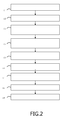
- Figure 2 shows an example of a step sequence for initializing a secret key in an electronic token according Figure 1 .
- the electronic token is a SIM card.
- a buffer of data DA is generated then loaded and stored into the SIM card SC at step S1 in a secured personalization site SPS.
- the buffer of data DA is stored into the secured personalization site SPS.
- An identifier of the SIM card may be associated to the data DA and stored in the site SPS.
- data DA and the card identifier are stored into a database in the secured personalization site SPS.
- a secret value SD is identified.
- the secret value SD is intended to be used for initializing and activating a targeted secret object in the electronic token SC.
- the targeted secret object is a secret key.
- the secret value SD is intended to be stored into the secret key in the SIM card SC.
- the site SPS identifies a plurality of subsets DA1, DA2 belonging to data DA and identifies instructions INS1.
- the subsets DA1 and DA2 allow building the secret value SD by applying the instructions INS1.
- the site SPS comprises a dedicated means M2 which is able to identify the relevant subsets DA1 and DA2 and the associated instructions INS1.
- the means M2 may be implemented as a software in a computer machine.
- the means M2 identifies a reference REF1 corresponding to the two subsets DA1 and DA2.
- the reference REF1 may comprise an offset and a length, where the offset corresponds to the beginning of the subset in DA.
- a secure channel is established between the site SPS and the SIM card SC through a Personalization center MPC.
- the secure channel may be a secure session between the site SPS and the card SC where the center MPC has a proxy function.
- the secure channel may be a combination of two secure sessions: a first secure session between the site SPS and the center MPC and a second secure session between the center MPC and the card SC.
- the reference REF1 is sent to the SIM card SC at step S7.
- the SIM card SC rebuilds the secret value SD from the reference REF1 and from data DA by applying the instructions INS1.
- the instructions INS1 are supposed to be already known by the means M1 of SIM card SC.
- instructions INS1 may implicitly consist of extracting and concatenating the two subsets DA1 and DA2.
- the rebuilt secret value SD is stored in the secret key which is the targeted secret object.
- the identification of the targeted secret object is supposed to be already known by the SIM card SC.
- the targeted secret object may be the GSM authentication key Ki.
- the data DA is generated in the secured personalization site SPS so as to be a series of random values which may be used as secret values for initializing secret objects.
- the data DA is then composed of the juxtaposition of several random values.
- This embodiment allows using only one subset of DA for each secret object to be initialized.
- the subset may correspond to one of the random value.
- each generated random value may comply with mathematical criteria in order to increase security of secret object which uses such random value.
- the identification of the secret value may be carried out by selecting one of the random values in data DA.
- the SIM card SC is personalized in a manufacturing plant compliant with the GSM SAS MoU requirements.
- the manufacturing plant is the secured personalization site SPS.
- the following operations are executed for the token SC through a first channel SL1:
- the SIM card SC has been personalized using the issuer profile.
- the SIM card is still not diversified according to MNO requirements.
- the first channel SL1 may correspond to a communication session between a personalization reader and the SIM card SC.
- the first channel SL1 is a secure channel since it fully takes place in the secured personalization site SPS.
- the first channel SL1 may be established with a secure session requiring authentication between the reader and the card SC.
- the card SC is sent to a M2M personalization center MPC.
- the center MPC does not comply with GSM SAS MoU requirements.
- the card may be then soldered into a M2M wireless device.
- the size of the data buffer DA is the same for all the cards and a unique identifier CID is associated to each card.
- SIM cards may be managed through batch.
- the MNO sends an order for subscription personalization for a given SIM card or for a batch of SIM cards through a secure channel SL2.
- the order for subscription personalization is received by the site SPS.
- the order of the MNO may be associated with a specifications file corresponding to MNO requirements also named BAP specifications file.
- the SPS sends to the personalization center MPC an identifier of the order for subscription personalization.
- the center MPC requests to the site SPS a remote personalization of the targeted MNO subscription order using this identifier.
- the MNO may ask for the initialisation of two secret objects ADM and Ki in the SIM card SC where ADM is the Administration secret code and Ki is the Authentication Key as defined by telecom standards.
- the card identifier CID allows to retrieve the corresponding key sets KS1 and KS2 and data DA which are associated to the SIM card SC.
- a machine M2 When a remote personalization is requested by a site MPC, a machine M2 identifies the secret values to be used then builds a set of commands intended to be sent to the SIM card SC for personalization purpose.
- the machine M2 belongs to the secured site SPS.
- Each secret value is selected as being a subset of data DA or the combination of several subsets of data DA.
- the set of commands is based on key sets KS1 and KS2 in order to comply with authentication and security requirements.
- the key set KS1 is used for generation of commands related to file creation and to non sensitive data update.
- the key set KS2 is used for generation of commands related to sensitive data update, in particular for the ADM/Ki initialization and activation.
- the machine M2 generates a command for updating ADM and another one for updating Ki. Both commands comprise an identifier of the targeted secret data to be initialized. Each of the two commands comprises reference to subset of DA and instructions to be applied on the reference.
- a reference may be a couple made of a start index of the secret value in the data DA and a length or an end index.
- the command for updating ADM may comprise a reference REF1, the instruction INS1 and the secret identifier SDI1, where reference REF1 defines the subsets DA2 and DA3, the instructions INS1 correspond to a concatenation of DA3 with DA2 and the secret identifier SDI1 defines the ADM code.
- the command for updating Ki may comprise a reference REF2, the instruction INS2 and the secret identifier SDI2, where reference REF2 defines the subsets DA1 and DA2, the instructions INS2 correspond to a concatenation of DA1 with DA2 and SDI2 defines the targeted secret data as being ki.
- the two triplet (SD1, REF1, INS1 and SD2, REF2, INS2) may be stored in the site SPS. If instructions are implicit, only two couples (SD1, REF1 and SD2, REF2) are stored in the site SPS.
- the card identifier CID is retrieved from the SIM card by the M2M personalization center MPC.
- the card identifier CID corresponds to the SIM card SC intended to be customized.
- This CID is sent to the site SPS through a secure channel SL3.
- the secure channel SL3 may be a virtual private network or any secured link able to provide a secure session.
- the set of data corresponding to the CID is retrieved from the database.
- the means M2 generates the relevant secured command set corresponding to SIM card SC. Then the command set is securely sent to MPC through the secure channel SL3.
- the M2M personalization center MPC comprises a machine CPLM.
- the machine CPLM may send the command set to the SIM card through a channel SL4.
- sent commands do not contain any sensitive data as such.
- the sent commands do not contain any secret code or key value.
- a secure session is established between the site SPS and the SIM card SC, via the center MPC.
- the personalization center MPC acts as a proxy or a relay between the site SPS and the card SC.
- a session is established between the site SPS and the SIM card SC, via the Over The Air mechanism or the Global Platform Secure Channel Protocol SCP.
- the CPLM may be a wireless communicating equipment such as a mobile phone or a wireless module.
- the SIM card is assumed to be already personalized with a temporary couple IMSI/Ki which is used for performing the OTA communication.
- the wireless communication may also be carried out through Wifi, GSM or Bluetooth ® standard.
- the personalization is carried out by the operating system OS which creates the files according to commands secured with KS1.
- the sensitive data ADM code and Ki are updated and activated by the applet M1 according to commands secured with KS2.
- the applet M1 When the SIM card receives the two commands, the applet M1 extracts and concatenates the secret values defined by DA3 and DA2 and copies the result in the relevant object: the ADM code. Then the applet M1 extracts and concatenates the secret value defined by the DA1 and DA2 and copies the result in Ki.
- the means M1 gets the instructions to be applied in the received command.
- the applet M1 may already know the instructions to be applied to the references of subset of data DA. In such a case the instructions may correspond to the copy of a single block of data into the targeted object intended to contain the targeted secret value. In such a case instructions are implicit.
- this first embodiment allows to select an unpredictable value to be used for initializing the targeted secret data.
- the data DA may comprise at least one of each value in the range [0x0, ..., 0xF] or in the range [0x00, ..., 0xFF].
- the site SPS After data processing, the site SPS stores the set made of references, instructions and secret identifier associated to DA and CID. In a preferred embodiment, the site SPS stores the selected secret value SD as such, instead of storing the reference.
- the site SPS may also store additional data related to the MNO like IMSI and ICCID.
- the subsets of DA which are used for initializing the secret objects may be marked as "used" in the SIM card.
- markers may be used for avoiding the use of a same subset for several secret objects initialization in the token SC.
- markers allow improving the security level of the secret object activation in the electronic token.
- the data DA, the key set KS2 and the applet M1 may be removed from the SIM card SC in order to save memory space.
- the site SPS may send the secrets value SD associated to the SIM card to the MNO through the secure channel SL2.
- the secure channel SL2 may be carried out by the Secure FTP mechanism.
- the two targeted secrets value ADM code and Ki are referenced by the secret data identifier SDI1 and SDI2.
- the secret data identifier may be implicit.
- the commands sent to the electronic token SC do not contain any secret data identifier and the means M1 is able to automatically identify the relevant target secret data to be initialized.
- This embodiment is useful when there is only one secret data to be initialized in the electronic token or when the targeted secret data is identified according to an additional element.
- Such an additional element may be the length of the result computed by the applet M1 or the command position in the command set.
- only one subset DA1 belonging to the data DA is used for building the targeted secret value by applying the instructions INS1.
- the instructions INS1 may correspond to the extraction of L bytes from the offset X in data DA and the copying of the extracted string in the relevant memory area corresponding to the targeted secret object.
- instructions INS1 may comprise basic mathematical operation which must be carried out on a subset. This mathematical operation may require an additional parameter. For example a first subset DA1 may be equal to "1234567”, the second subset DA2 may be equal to "7” and a third subset DA3 may be equal to "1".
- the instructions INS1 may correspond to the addition of the second and third subset DA2 and DA3 then the concatenation of the subset DA1 with the result of the addition.
- the means M1 concatenates "1234567” with "7"+”1" and the generated secret value is "12345678". It is important to note that these basic mathematical operations are different from complex cryptographic operations. These basic mathematical operations do require only low CPU and memory resources and are quickly performed.
- This embodiment allows generating any secret value whatever the content of the data DA is.
- this embodiment allows rebuilding a secret value corresponding to a given value specified by the MNO.
- the invention allows generating relevant secret values even if the MNO requests that secret values comply with mathematical constraints. This embodiment is also useful when the MNO generates its own secret value before sending it to the site SPS.
- identification of the secret value may be carried out by seeking part or the whole of a specified string in the data DA.
- the means M1 is able to juxtapose data extracted from several memory areas in order to build a secret value SD.
- the means M2 may build only one command comprising references allowing rebuilding several secret values instead of generating one command for each secret value.
- the data DA is not stored as such in the site SPS for each token SC.
- a second data DB is stored in the site SPS, where the data DB allows retrieving the data DA.
- the data DB may be a key K associated to an electronic token SC.
- the key K may be intended to scramble a preset buffer of data.
- the data DA may be recomputed by scrambling the preset data buffer with the key K and according to a preset algorithm.
- the preset buffer of data and the algorithm may be unique for a batch of cards.
- the preset buffer of data and the preset algorithm are stored in the site SPS.
- the preset buffer of data comprises all digits in the range [0x0, ..., 0xF].
- the data DA may be made of subsets stored in several memory areas of the electronic token SC.
- the data DA may be made of data which is extracted from several objects and/or files and/or containers.
- the data DA may be made of data extracted from the code of the operating system OS, the code of an application AP, the file system or applicative data.
- the data DA is not stored in the token SC for the exclusive purpose of building sensitive data value.
- the data DA reuses bytes which are present in the token for other reasons.
- the invention allows initializing a secret value in an electronic token through a wired line for remote personalization purpose when the electronic token is in a site which has a low security level. Moreover the invention allows initializing a secret value in an electronic token which is on the field through Over The Air mechanism as defined by GSM standards. Such secret value initialization is useful for post-allocation or MNO switching purpose.
- the electronic token SC exchanges messages via the wireless device where the token SC may be soldered.
- the invention securely allows initializing all kind of sensitive data, like secret data belonging to a MNO, ADM code, secret key, and secret applicative data.
- the invention also allows initializing all kind of non-sensitive data, such as applicative data or MNO card-per-card diversified parameters.
- the secret data may be identified in the electronic token in the first place. Then the corresponding reference is sent to the secure site and the secret data is rebuilt in the secure site.
- the invention may be implemented in a software component which provides the same features as the above described electronic token.
- the software component takes the place of the electronic token.
- the invention may be carried out thanks to specific software running on a memory.
Landscapes
- Engineering & Computer Science (AREA)
- Computer Networks & Wireless Communication (AREA)
- Business, Economics & Management (AREA)
- Physics & Mathematics (AREA)
- General Physics & Mathematics (AREA)
- Computer Security & Cryptography (AREA)
- Signal Processing (AREA)
- Strategic Management (AREA)
- General Business, Economics & Management (AREA)
- Accounting & Taxation (AREA)
- Theoretical Computer Science (AREA)
- Microelectronics & Electronic Packaging (AREA)
- Computing Systems (AREA)
- Computer Hardware Design (AREA)
- General Engineering & Computer Science (AREA)
- Mobile Radio Communication Systems (AREA)
- Storage Device Security (AREA)
Priority Applications (4)
| Application Number | Priority Date | Filing Date | Title |
|---|---|---|---|
| EP08305985A EP2200253A1 (de) | 2008-12-19 | 2008-12-19 | Verfahren zur Verwaltung von sensiblen Daten in einem elektronischen Token |
| PCT/EP2009/063593 WO2010069631A1 (en) | 2008-12-19 | 2009-10-16 | Method of managing sensitive data in an electronic token |
| EP09832961.8A EP2380329B1 (de) | 2008-12-19 | 2009-10-16 | Verfahren zur verwaltung von sensiblen daten in einem elektronischen token |
| US13/140,210 US9148783B2 (en) | 2008-12-19 | 2009-10-16 | Method of managing sensitive data in an electronic token |
Applications Claiming Priority (1)
| Application Number | Priority Date | Filing Date | Title |
|---|---|---|---|
| EP08305985A EP2200253A1 (de) | 2008-12-19 | 2008-12-19 | Verfahren zur Verwaltung von sensiblen Daten in einem elektronischen Token |
Publications (1)
| Publication Number | Publication Date |
|---|---|
| EP2200253A1 true EP2200253A1 (de) | 2010-06-23 |
Family
ID=40846438
Family Applications (2)
| Application Number | Title | Priority Date | Filing Date |
|---|---|---|---|
| EP08305985A Withdrawn EP2200253A1 (de) | 2008-12-19 | 2008-12-19 | Verfahren zur Verwaltung von sensiblen Daten in einem elektronischen Token |
| EP09832961.8A Active EP2380329B1 (de) | 2008-12-19 | 2009-10-16 | Verfahren zur verwaltung von sensiblen daten in einem elektronischen token |
Family Applications After (1)
| Application Number | Title | Priority Date | Filing Date |
|---|---|---|---|
| EP09832961.8A Active EP2380329B1 (de) | 2008-12-19 | 2009-10-16 | Verfahren zur verwaltung von sensiblen daten in einem elektronischen token |
Country Status (3)
| Country | Link |
|---|---|
| US (1) | US9148783B2 (de) |
| EP (2) | EP2200253A1 (de) |
| WO (1) | WO2010069631A1 (de) |
Cited By (2)
| Publication number | Priority date | Publication date | Assignee | Title |
|---|---|---|---|---|
| WO2012080740A1 (en) * | 2010-12-15 | 2012-06-21 | Vodafone Ip Licensing Limited | Key derivation |
| EP2495928A1 (de) * | 2011-03-03 | 2012-09-05 | Gemalto SA | Verfahren zur Verwaltung der Kommunikation zwischen einem Hostgerät und einem eingebetteten Internetserver |
Families Citing this family (3)
| Publication number | Priority date | Publication date | Assignee | Title |
|---|---|---|---|---|
| US9596244B1 (en) | 2011-06-16 | 2017-03-14 | Amazon Technologies, Inc. | Securing services and intra-service communications |
| US9419841B1 (en) | 2011-06-29 | 2016-08-16 | Amazon Technologies, Inc. | Token-based secure data management |
| US20160295544A1 (en) * | 2015-03-31 | 2016-10-06 | Globetouch, Inc. | Enhanced cloud sim |
Citations (8)
| Publication number | Priority date | Publication date | Assignee | Title |
|---|---|---|---|---|
| FR2681165A1 (fr) * | 1991-09-05 | 1993-03-12 | Gemplus Card Int | Procede de transmission d'information confidentielle entre deux cartes a puces. |
| WO1993007697A1 (en) * | 1991-09-30 | 1993-04-15 | Comvik Gsm Ab | Method for personalisation of an active card |
| US6971025B1 (en) * | 1999-08-19 | 2005-11-29 | International Business Machines Corporation | Secure personalization of chip cards |
| US7023994B1 (en) * | 1997-08-04 | 2006-04-04 | T-Mobile Deutschland Gmbh | Method and device for customer personalization of GSM chips |
| WO2006048051A1 (en) * | 2005-04-06 | 2006-05-11 | Telit Communications S.P.A. | Subscriber identity module and mobile communications device using such module |
| WO2006067037A1 (fr) | 2004-12-22 | 2006-06-29 | Gemplus | Systeme d'allocation de carte a puce a un operateur de reseau |
| US20080116261A1 (en) * | 2004-12-01 | 2008-05-22 | Wolfgang Gebhardt | Method for Personalizing Chip Cards |
| US20080311956A1 (en) * | 2007-06-15 | 2008-12-18 | Pouya Taaghol | Field programing of a mobile station with subscriber identification and related information |
Family Cites Families (5)
| Publication number | Priority date | Publication date | Assignee | Title |
|---|---|---|---|---|
| JP2004524605A (ja) * | 2000-12-14 | 2004-08-12 | クィジッド テクノロジーズ リミテッド | 認証システム |
| US7913312B2 (en) * | 2002-09-13 | 2011-03-22 | Oracle America, Inc. | Embedded content requests in a rights locker system for digital content access control |
| US9071439B2 (en) * | 2007-04-26 | 2015-06-30 | Emc Corporation | Method and apparatus for remote administration of cryptographic devices |
| DE102008000067C5 (de) * | 2008-01-16 | 2012-10-25 | Bundesdruckerei Gmbh | Verfahren zum Lesen von Attributen aus einem ID-Token |
| US8793497B2 (en) * | 2008-05-09 | 2014-07-29 | Qualcomm Incorporated | Puzzle-based authentication between a token and verifiers |
-
2008
- 2008-12-19 EP EP08305985A patent/EP2200253A1/de not_active Withdrawn
-
2009
- 2009-10-16 EP EP09832961.8A patent/EP2380329B1/de active Active
- 2009-10-16 WO PCT/EP2009/063593 patent/WO2010069631A1/en not_active Ceased
- 2009-10-16 US US13/140,210 patent/US9148783B2/en active Active
Patent Citations (8)
| Publication number | Priority date | Publication date | Assignee | Title |
|---|---|---|---|---|
| FR2681165A1 (fr) * | 1991-09-05 | 1993-03-12 | Gemplus Card Int | Procede de transmission d'information confidentielle entre deux cartes a puces. |
| WO1993007697A1 (en) * | 1991-09-30 | 1993-04-15 | Comvik Gsm Ab | Method for personalisation of an active card |
| US7023994B1 (en) * | 1997-08-04 | 2006-04-04 | T-Mobile Deutschland Gmbh | Method and device for customer personalization of GSM chips |
| US6971025B1 (en) * | 1999-08-19 | 2005-11-29 | International Business Machines Corporation | Secure personalization of chip cards |
| US20080116261A1 (en) * | 2004-12-01 | 2008-05-22 | Wolfgang Gebhardt | Method for Personalizing Chip Cards |
| WO2006067037A1 (fr) | 2004-12-22 | 2006-06-29 | Gemplus | Systeme d'allocation de carte a puce a un operateur de reseau |
| WO2006048051A1 (en) * | 2005-04-06 | 2006-05-11 | Telit Communications S.P.A. | Subscriber identity module and mobile communications device using such module |
| US20080311956A1 (en) * | 2007-06-15 | 2008-12-18 | Pouya Taaghol | Field programing of a mobile station with subscriber identification and related information |
Cited By (6)
| Publication number | Priority date | Publication date | Assignee | Title |
|---|---|---|---|---|
| WO2012080740A1 (en) * | 2010-12-15 | 2012-06-21 | Vodafone Ip Licensing Limited | Key derivation |
| CN103493426A (zh) * | 2010-12-15 | 2014-01-01 | 沃达方Ip许可有限公司 | 密钥衍生 |
| GB2486461B (en) * | 2010-12-15 | 2015-07-29 | Vodafone Ip Licensing Ltd | Key derivation |
| US9247429B2 (en) | 2010-12-15 | 2016-01-26 | Vodafone Ip Licensing Limited | Key derivation |
| EP2495928A1 (de) * | 2011-03-03 | 2012-09-05 | Gemalto SA | Verfahren zur Verwaltung der Kommunikation zwischen einem Hostgerät und einem eingebetteten Internetserver |
| WO2012116950A1 (en) * | 2011-03-03 | 2012-09-07 | Gemalto Sa | Method of managing the communication between a host device and an embedded web server |
Also Published As
| Publication number | Publication date |
|---|---|
| US9148783B2 (en) | 2015-09-29 |
| US20120030744A1 (en) | 2012-02-02 |
| WO2010069631A1 (en) | 2010-06-24 |
| EP2380329A1 (de) | 2011-10-26 |
| EP2380329B1 (de) | 2018-07-25 |
Similar Documents
| Publication | Publication Date | Title |
|---|---|---|
| US11032713B2 (en) | Method and electronic device for providing communication service | |
| US10244074B2 (en) | Method and apparatus for receiving profile by terminal in mobile communication system | |
| KR101504855B1 (ko) | 단말에 포함된 uicc에 포함된 데이터를 보안 서버 상에 내보내기 위한 방법 | |
| US8533369B2 (en) | Smart card driven device configuration changes | |
| EP2510716B1 (de) | Verfahren zur automatischen bereitstellung einer sim-karte | |
| US8914489B2 (en) | Method of personalizing an application embedded in a secured electronic token | |
| EP2182439A1 (de) | Verfahren zur Verwaltung von Daten, die über die Luft an eine Anwendung mit eingeschränkter Schnittstelle gesendet werden | |
| EP4329348B1 (de) | Personalisierung eines secure element | |
| EP1542486A1 (de) | Mobiltelefongerät und datenverwaltungsverfahren | |
| CN1989780B (zh) | 移动终端的安全开锁方法 | |
| EP2380329B1 (de) | Verfahren zur verwaltung von sensiblen daten in einem elektronischen token | |
| CN109328467A (zh) | 用于下载更新的简档的方法、服务器和系统 | |
| US12500896B2 (en) | Offline scripting for remote file management | |
| CN104519480A (zh) | 通信控制装置、鉴权装置、中心控制装置及通信系统 | |
| EP1675029A2 (de) | Verfahren und Vorrichtung zur Verhinderung des Hackens eines Teilnehmeridentifizierungsmoduls in einem mobilen Kommunikationsendgerät | |
| EP2209080A1 (de) | Verfahren zum Laden von Daten in ein elektronisches Gerät | |
| KR20130006257A (ko) | 내장 sim에서의 키 관리방법, 및 그를 위한 내장 sim과 기록매체 | |
| KR102030619B1 (ko) | 이동통신 가입 시스템 및 그 방법, 이동통신 가입자 인증 시스템 | |
| CN103124395A (zh) | 对终端中的应用进行选择的选择方法与执行该方法的终端 | |
| JP2010534369A (ja) | 独自のメモリ装置識別表示を管理する方法、サーバー及びモバイル通信装置 | |
| EP3664490B1 (de) | Imei speicherung | |
| EP3731548A1 (de) | Verteilung von befehlssatzmodulen | |
| JP5492988B2 (ja) | 保全された電子トークン中に埋込まれたアプリケーションを管理する方法 | |
| EP2213083B1 (de) | Verfahren zur auswahl eines satzes von telefonbucheinträgen in einer karte | |
| EP4607981A1 (de) | Vorrichtungs-euicc-bindung auf basis von vorrichtungsspezifischen informationen |
Legal Events
| Date | Code | Title | Description |
|---|---|---|---|
| PUAI | Public reference made under article 153(3) epc to a published international application that has entered the european phase |
Free format text: ORIGINAL CODE: 0009012 |
|
| AK | Designated contracting states |
Kind code of ref document: A1 Designated state(s): AT BE BG CH CY CZ DE DK EE ES FI FR GB GR HR HU IE IS IT LI LT LU LV MC MT NL NO PL PT RO SE SI SK TR |
|
| AX | Request for extension of the european patent |
Extension state: AL BA MK RS |
|
| AKY | No designation fees paid | ||
| REG | Reference to a national code |
Ref country code: DE Ref legal event code: R108 Effective date: 20110201 Ref country code: DE Ref legal event code: 8566 |
|
| STAA | Information on the status of an ep patent application or granted ep patent |
Free format text: STATUS: THE APPLICATION IS DEEMED TO BE WITHDRAWN |
|
| 18D | Application deemed to be withdrawn |
Effective date: 20101224 |