EP2200375A2 - Procédé et appareil pour découvrir un système d'accès dans un environnement de système mobile/sans fil multi-accessible - Google Patents
Procédé et appareil pour découvrir un système d'accès dans un environnement de système mobile/sans fil multi-accessible Download PDFInfo
- Publication number
- EP2200375A2 EP2200375A2 EP09168089A EP09168089A EP2200375A2 EP 2200375 A2 EP2200375 A2 EP 2200375A2 EP 09168089 A EP09168089 A EP 09168089A EP 09168089 A EP09168089 A EP 09168089A EP 2200375 A2 EP2200375 A2 EP 2200375A2
- Authority
- EP
- European Patent Office
- Prior art keywords
- cell
- distance
- mobile terminal
- access system
- interval
- Prior art date
- Legal status (The legal status is an assumption and is not a legal conclusion. Google has not performed a legal analysis and makes no representation as to the accuracy of the status listed.)
- Granted
Links
Images




Classifications
-
- H—ELECTRICITY
- H04—ELECTRIC COMMUNICATION TECHNIQUE
- H04W—WIRELESS COMMUNICATION NETWORKS
- H04W48/00—Access restriction; Network selection; Access point selection
- H04W48/20—Selecting an access point
-
- H—ELECTRICITY
- H04—ELECTRIC COMMUNICATION TECHNIQUE
- H04W—WIRELESS COMMUNICATION NETWORKS
- H04W48/00—Access restriction; Network selection; Access point selection
- H04W48/16—Discovering, processing access restriction or access information
-
- H—ELECTRICITY
- H04—ELECTRIC COMMUNICATION TECHNIQUE
- H04W—WIRELESS COMMUNICATION NETWORKS
- H04W64/00—Locating users or terminals or network equipment for network management purposes, e.g. mobility management
-
- H—ELECTRICITY
- H04—ELECTRIC COMMUNICATION TECHNIQUE
- H04W—WIRELESS COMMUNICATION NETWORKS
- H04W92/00—Interfaces specially adapted for wireless communication networks
- H04W92/02—Inter-networking arrangements
Definitions
- Embodiments of the present invention relate to a method and apparatus for discovering an access system in a multi-accessible wireless/mobile system environment.
- a current wireless/mobile communication system may provide a user with an enhanced high quality service using a cell structure where a plurality of access systems are overlaid, and may also effectively use an access network of a provider.
- 3GPP 3 rd Generation Partnership Project
- 3GPP2 3 rd Generation Partnership Project2
- IEEE Institute of Electrical and Electronics Engineers
- BWA Broadband Wireless Access
- WiMAX World Interoperability for Microwave Access
- WLAN Wireless Local Area Network
- the 3GPP generally proposes an interoperation scheme such as an I-WLAN, a Generic Access Network (GAN), a Voice Call Continuity (VCC) using an IP Multimedia System (IMS), and the like.
- the I-WLAN proposes an interoperation scheme and structure between a 3GPP system and the WLAN.
- a standardization for an accounting integration function is gonging.
- a handover and interoperation scheme are integrated with the GAN and the VCC.
- the GAN denotes a standard where an Unlicensed Mobile Access (UMA) solution for supporting a handover between a Global System for Mobile Communication (GSM) and the WLAN is integrated with a 3GPP standard.
- UMA Unlicensed Mobile Access
- the VCC denotes a solution using the IMS in order to secure a mobility between a circuit service domain and a packet service domain, and is defined in 3GPP Release7.
- a standardization is ongoing for an interoperation between different access systems such as an IEEE system and a mobile communication system according to an IEEE 802.21.
- the IEEE 802.21 intends to provide a seamless handover between heterogeneous access networks for the purpose of a Media Independent Handover (MIH).
- MIH Media Independent Handover
- a standardization is ongoing with respect to a handover scenario based on the IEEE such as an IEEE 802.3, and a handover scenario with mobile communication systems such as a 3GPP and a 3GPP2.
- a standardization is being performed for a structure and a function of the MIH, a standard for event/information/trigger services, and a handover procedure between heterogeneous networks.
- An end-to-end reconfigurability (E2R) project proposes a Cognitive Pilot channel or a Common Pilot Channel (CPC) that may allocate a dynamic spectrum and broadcast system deployment information in a wireless network where a plurality of heterogeneous access systems is deployed.
- a CPC embodiment scheme, proposed in the E2R project may be classified into an out-band CPC scheme and an in-band CPC scheme.
- the out-band CPC scheme may provide a CPC service using a particular frequency channel capable of exclusively transmitting CPC information.
- the in-band CPC scheme may provide the CPC service using an existing wireless/mobile communication system.
- a location obtainment scheme based on a mobile communication may include a cell identification (ID) scheme that depends on a cell radius, a Time Difference of Arrival (TDOA) scheme using a triangulation, and a scheme using a GPS.
- ID cell identification
- TDOA Time Difference of Arrival
- the cell ID scheme estimates a location of a mobile terminal based on a servicing cell, and thus many errors may occur in a cell that has a great radius and a shadowed region.
- TDOA scheme When the TDOA scheme is used, a location of a mobile terminal may be measured by calculating a distance between the mobile terminal and a base station, and by using time information when a signal is distributed. Accordingly, a separate equipment may need to be installed in the mobile terminal and the base station. Also, in the case of the scheme using the GPS, a separate module for the GPS may need to be installed in the mobile terminal.
- a module in charge of a wireless access function of a mobile terminal may need to be periodically activated, or may need to start discovery of a wireless/mobile communication system using another scheme, for example, an advertisement, a bulletin board, and the like.
- a functional element to manage an interoperation between networks of heterogeneous access systems does not exist. Accordingly, it is impossible to generate information associated with an interoperating wireless/mobile communication system and to transfer the generated information to a mobile terminal.
- the mobile terminal may perform an access system discovery according to a location of the mobile terminal.
- An aspect of the present invention provides a method and apparatus that may effectively discover an access system using a location of a mobile terminal and a received power strength.
- Another aspect of the present invention also provides a method and apparatus that may discover an access system using corresponding Location Based Information (LBS), even in a system where a Global Positioning System (GPS) module does not exist, or where a Time Difference of Arrival (TDOA) based triangulation is impossible.
- LBS Location Based Information
- GPS Global Positioning System
- TDOA Time Difference of Arrival
- Another aspect of the present invention also provides a method and apparatus that may discover an access system using an inter-cell distance, an effective cell radius, and the like.
- Another aspect of the present invention also provides a method and apparatus that may discover an access system using a path loss model.
- Another aspect of the present invention also provides a method and apparatus that may accurately discover an access system using beamforming information used in a smart antenna, sector information of a cell, and the like.
- Another aspect of the present invention also provides a method and apparatus that may effectively discover an access system, while saving a battery consumption of a mobile terminal.
- a method of discovering an access system in a multi-accessible wireless/mobile system environment including: calculating a first distance between an access system of a first cell providing a service to a mobile terminal, and an access system of a second cell adjacent to the first cell, using deployment information received from a server; measuring a received signal strength of a signal, received from the access system of the first cell, to calculate a second distance between the mobile terminal and the access system of the first cell; estimating a location of the mobile terminal using the first distance and the second distance; and adjusting an activation interval of an interface associated with discovering of the access system of the second cell, using the estimated location of the mobile terminal.
- the adjusting may include variably adjusting the activation interval of the interface by further using an effective radius of the second cell and the first distance.
- the method may further include determining whether the second cell overlaps a center of the first cell.
- the adjusting may include variably adjusting the activation interval of the interface depending on whether the second cell overlaps the center of the first cell.
- the variably adjusting may include: adjusting the activation interval of the interface to be a first interval in a first region that is divided based on a difference value between an effective radius of the second cell and the first distance; adjusting the activation interval of the interface to be a second interval in a second region that is divided based on an addition value between the effective radius of the second cell and the first distance; and adjusting the activation interval of the interface to be a third interval outside the second region.
- the variably adjusting may include: adjusting the activation interval of the interface to be a first interval outside a third region that is divided based on a difference value between an effective radius of the second cell and the first distance; adjusting the activation interval of the interface to be a second interval between the third region and a fourth region that is divided based on an addition value between the effective radius of the second cell and the first distance, when the addition value is less than an effective radius of the first cell; and adjusting the activation interval of the interface to be a third interval in the third region.
- the determining may include determining whether the second cell overlaps the center of the first cell, using an effective radius of the second cell and the first distance.
- the calculating of the first distance may include: receiving the deployment information that is divided into a plurality of sector deployment information; and calculating the first distance using the received sector deployment information.
- the calculating of the first distance may include: receiving the deployment information via a smart antenna; and extracting beamforming information from the received deployment information to calculate the first distance.
- the calculating of the second distance may include calculating the second distance using a path loss model based on the measured value of the received signal strength.
- the adjusting may include increasing or decreasing the activation interval of the interface based on a comparison result between the measured value of the received signal strength and a threshold value.
- an apparatus for discovering an access system in a multi-accessible wireless/mobile system environment including: a calculation unit to calculate a first distance between an access system of a first cell providing a service to a mobile terminal, and an access system of a second cell adjacent to the first cell, using deployment information received from a server, and to measure a received signal strength of a signal, received from the access system of the first cell, to calculate a second distance between the mobile terminal and the access system of the first cell; an estimation unit to estimate a location of the mobile terminal using the first distance and the second distance; and an adjustment unit to adjust an activation interval of an interface associated with discovering of the access system of the second cell, using the estimated location of the mobile terminal.
- the adjustment unit may variably adjust the activation interval of the interface by further using an effective radius of the second cell and the first distance.
- the apparatus may further include a decision unit to determine whether the second cell overlaps a center of the first cell.
- the adjustment unit may variably adjust the activation interval of the interface depending on whether the second cell overlaps the center of the first cell.
- the calculation unit may receive the deployment information that is divided into a plurality of sector deployment information, and calculate the first distance using the received sector deployment information.
- the calculation unit may receive the deployment information via a smart antenna; and extract beamforming information from the received deployment information to calculate the first distance.
- LBS Location Based Information
- GPS Global Positioning System
- TDOA Time Difference of Arrival
- FIG. 1 is a block diagram illustrating a configuration of an apparatus 100 for discovering an access system (hereinafter, "AS discovery apparatus") in a multi-accessible wireless/mobile system environment according to an embodiment of the present invention.
- the AS discovery apparatus 100 may be provided in a mobile terminal that is a user equipment (UE).
- UE user equipment
- the AS discovery apparatus 100 may include a calculation unit 110, an estimation unit 120, an adjustment unit 130, a decision unit 140, and a control unit 150.
- the calculation unit 110 may calculate a first distance between an AS of a first cell providing a service to a mobile terminal, and an AS of a second cell adjacent to the first cell, using cell deployment information received from a Common Pilot Channel or Cognitive Pilot Channel (CPC) server.
- CPC Common Pilot Channel or Cognitive Pilot Channel
- the calculation unit 110 may receive the cell deployment information that is divided into a plurality of sector deployment information and calculate the first distance using the received sector deployment information. Also, the calculation unit 110 may receive the cell deployment information via a smart antenna, and extract beamforming information from the received cell deployment information to thereby calculate the first distance.
- the calculation unit 110 may measure a received signal strength (RSS) of a signal, received from the AS of the first cell, to calculate a second distance between the mobile terminal and the AS of the first cell. In this instance, the calculation unit 110 may calculate the second distance using a path loss model based on the measured value of the RSS.
- RSS received signal strength
- the estimation unit 120 may estimate a location of the mobile terminal using the first distance and the second distance.
- the adjustment unit 130 may adjust an activation interval of an interface associated with discovering of the AS of the second cell, using the estimated location of the mobile terminal. In this instance, the adjustment unit 130 may variably adjust the activation interval of the interface by further using an effective radius of the second cell and the first distance.
- the adjustment unit 130 may variably adjust the activation interval of the interface depending on whether the second cell overlaps a center of the first cell. For this, the decision unit 140 may determine whether the second cell overlaps the center of the first cell. In this instance, the decision unit 140 may determine whether the second cell overlaps the center of the first cell, using the effective radius of the second cell and the first distance.
- the adjustment unit 130 may adjust the activation interval of the interface to be a first interval in a first region that is divided based on a difference value between the effective radius of the second cell and the first distance. Also, the adjustment unit 130 may adjust the activation interval of the interface to be a second interval in a second region that is divided based on an addition value between the effective radius of the second cell and the first distance. Also, the adjustment unit 130 may adjust the activation interval of the interface to be a third interval outside the second region.
- the adjustment unit 130 may adjust the activation interval of the interface to be a first interval outside a third region that is divided based on a difference value between the effective radius of the second cell and the first distance. Also, when an addition value between the effective radius of the second cell and the first distance is less than an effective radius of the first cell, the adjustment unit 130 may adjust the activation interval of the interface to be a second interval between the third region and a fourth region that is divided based on the addition value. Also, the adjustment unit 130 may adjust the activation interval of the interface to be a third interval in the third region.
- the adjustment unit 130 may increase or decrease the activation interval of the interface based on a comparison result between the measured value of the RSS and a threshold value. Specifically, when the measured value of the RSS is less than the threshold value, the adjustment unit 130 may increase the activation interval of the interface. Conversely, when the measured value of the RSS is greater than the threshold value, the adjustment unit 130 may decrease the activation interval of the interface.
- the control unit 150 may control a general operation of the AS discovery apparatus 100. Specifically, the control unit 150 may control operations of the calculation unit 110, the estimation unit 120, the adjustment unit 130, the decision unit 140, and the like.
- FIG. 2 is a diagram illustrating an interoperation structure of wireless/mobile communication access systems adopting an AS discovery apparatus according to an embodiment of the present invention.
- the present embodiment considers a CPC server 220 to provide cell deployment information of a heterogeneous wireless AS, and a mobile terminal 240 to perform a CPC client function based on a Software Defined Radio (SDR).
- SDR Software Defined Radio
- the CPC server 220 may manage dynamically changing deployment information of a mobile/wireless communication AS 230 in interoperation with a spectrum broker 210.
- the spectrum broker 210 functions to dynamically designate a frequency according to an operator request and a policy, and allocate the AS 230. Also, the spectrum broker 210 may transfer information associated with the allocated AS 230 to the CPC server 220.
- the CPC server 220 may periodically broadcast, via a CPC, radio access technology (RAT) deployment information that is provided from the spectrum broker 210.
- RAT radio access technology
- the mobile terminal 240 may periodically receive the deployment information to obtain information associated with an available AS, and select the available AS by considering a service request and various parameters, based on the obtained deployment information.
- the CPC server 220 corresponds to a server with a database that may manage the deployment information of the AS 230 provided by the operator.
- the CPC server 220 functions to provide the mobile terminal 240 with the deployment information of the AS 230.
- the deployment information provided from the CPC server 220 may be periodically transferred to the mobile terminal 240, and be given by the following Table 1: [Table 1] RAT deployment information - Adjacent cell list [1,...
- Operator information e.g., Orange, 10.1 MHz ⁇ 930 MHz, 10.1 MHz, 10.1 MHz, 10.1 MHz, 10.1 MHz, 10.1 MHz, 10.1 MHz, 10.1 MHz, 10.1 MHz, 10.1 MHz, 10.1 MHz, 10.1 MHz, 10.1 MHz, 10.1 MHz, 10.1 MHz, 10.1 MHz, 10.1 MHz, 10.1 MHz, 10.1 MHz, 10.1 MHz, 10.1 MHz, 10.1 MHz, 10.1 MHz, 10.1 MHz, 10.1 MHz, 10.1 MHz, 10.1 MHz, 10.1 MHz, 10.1 MHz, 10.1 MHz, 10.1 MHz, 10.1 MHz, 10.1 MHz, 10.1 MHz, 10.1 MHz, 10.1 MHz, 10.1 MHz, 10.1 MHz, 10.1 MHz, 10.1 MHz, 10.1 MHz, 10.1 MHz, 10.1 MHz, 10.1 MHz, 10.1 MHz, 10.1 MHz, 10.1 MHz, 10.1
- the aforementioned RAT deployment information is associated with the AS 230 managed by the operator. Therefore, the AS 230 may be aware of a serviceable effective radius, a location of an adjacent cell, a type of an RAT, and the like. Also, when an agreement exists among operators, an AS of each of the operators may be aware of information associated with an AS of another operator by exchanging their RAT deployment information.
- the preset embodiment discloses a method of regionally dividing cell deployment information to thereby transmit the divided cell deployment information.
- a Common Radio Resource management (CRRM) 250 may mange common radio resources.
- FIG. 3 is a diagram illustrating an example of regionally dividing cell deployment information and transmitting the divided cell deployment information according to an embodiment of the present invention.
- the present embodiment discloses a method of effectively discovering an AS using information of an adjacent cell to a cell performing a current service among the regionally divided cell deployment information.
- a location of a mobile terminal may be estimated using a distance, that is, a first distance between a BS or an AP of a currently accessing cell and a BS or an AP of an adjacent cell, and using an RSS of a signal received from the currently accessing cell.
- An activation process of an interface for the AS discovery may be performed based on the estimated location of the mobile terminal.
- the mobile terminal may periodically measure the RSS of the currently accessing cell, and may calculate a distance, that is, a second distance between the mobile terminal and the BS or the AP of the currently accessing cell, using a path loss model, based on the measured RSS.
- the mobile terminal may extract the first distance and radius information of the adjacent cell from RAT deployment information received from a CPC server, and may use the extracted first distance and the radius information, and the calculated second distance to determine whether to start the AS discovery.
- FIG. 4 is a graph illustrating an example of an AS discovery according to an embodiment of the present invention.
- a mobile terminal(UE) may currently access a cell A and periodically measure an RSS of the cell A. Also, the mobile terminal may recognize that a cell B is adjacent to the cell A, using broadcast information received from a CPC server, and may discover the cell B around a location of a k where the received signal is received from the cell A.
- the present embodiment discloses a method that may discover the AS by setting a discovery interval to be short in a region with a relatively high probability that the cell B exists, according to an RSS of the signal received from the cell A, and may discover the AS by setting the discovery interval to be long in the remaining regions, or may not perform the AS discovery.
- the above Equation 1 represents a log-linear path loss model used to verify a current location of the mobile terminal according to an embodiment of the present invention.
- the RSS may be calculated based on a loss by the distance and the fading. Since some errors may occur in a building region where a Line of Sight (LOS) is not secured and multiple paths exist, the log-linear path loss model may need to consider the errors.
- the mobile terminal may periodically measure the RSS and then calculate the distance from the BS or the AP of the currently accessing cell using the linear-path loss mode, as given by the above Equation 1.
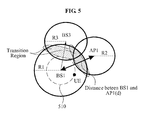
- FIG. 5 is a diagram illustrating an example of an AS discovery using an RSS according to an embodiment of the present invention.
- a mobile terminal(UE) may continuously measure an RSS of a signal that is received from a BS1 in order to search an AP1 in a current cell that is being serviced by the BS 1.
- the mobile terminal may activate an interface of an AP1 and then determine whether to access the cell that is being serviced by the AP1, based on the received RSS.
- the mobile terminal may receive the received signal with the same strength from the BS1 on a concentric circle 510, indicated by a dotted line.
- the concentric circle 510 includes a central location of the current cell, that is, a location of the BS1. Accordingly, the mobile terminal may perform an unnecessary discovery in the concentric circle 510.
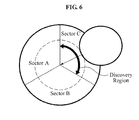
- a mobile communication system may divide a single cell into a plurality of sectors and then provide a service. For example, as shown in FIG. 6 , a mobile terminal may obtain an accurate current location of the mobile terminal based on sector information associated with a sector A, a sector B, and a sector C. In this instance, the mobile terminal may generate the sector information using deployment information received from a CPC server.
- the mobile terminal may obtain a more accurate current location of the mobile terminal using beamforming region information (BFR1, BFR2, BFR3, BFR4, BFR5, BFR6, BFR7, BFR8) as shown in FIG. 7 .
- beamforming region information BFR1, BFR2, BFR3, BFR4, BFR5, BFR6, BFR7, BFR8
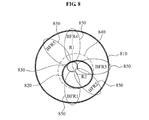
- FIG. 8 is a diagram illustrating an example of an AS discovery when centers of cells overlap according to an embodiment of the present invention.
- an adjacent cell 820 may overlap a center of a current cell 810.
- an AS discovery probability may be highest in a first region 830 where the center of the current cell 810 overlaps the adjacent cell 820.
- the AS discovery probability may be a second highest in a second region 840, indicated by a dotted line, using the center of the current cell 810 and a radius R2 of the adjacent cell 820.
- the AS discovery probability may be low outside the second region 840 using the center of the current cell 810 and the radius R2 of the adjacent cell 820.
- the AS discovery probability according to an RSS may increase.
- R1 denotes an effective radius of the current cell 810
- R2 denotes an effective radius of the adjacent cell
- d denotes a distance between the center of the current cell 810 and the center of the adjacent cell 820.
- the mobile terminal may determine the center of the current cell 810 overlaps the adjacent cell 820, and thereby may determine a probability of receiving the received signal of the adjacent cell 820 is high in a concentric circle included in a distance of R2 - d, that is, in the first region 830. Also, when drawing a concentric circle using a distance from the center of the current cell 810 to R2, that is, a distance of d + R2, the mobile terminal may determine the probability of receiving the received signal of the adjacent cell 820 is next high in the drawn concentric circle, that is, the second region 840. The mobile terminal may determine the probability of receiving the received signal of the adjacent cell 820 is low outside the drawn concentric circle.
- the mobile terminal may discover an AS in the adjacent cell 820 overlapping the center of the current cell 810, using location based information and sectors or beamforming regions (BFR1, BFR2, BFR3, BFR4, BFR5) 850. Through this, the mobile terminal may more effectively discover the AS in comparison to an existing discovery scheme.
- BFR1, BFR2, BFR3, BFR4, BFR5 location based information and sectors or beamforming regions
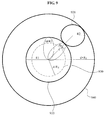
- FIG. 9 is a diagram illustrating an example of an AS discovery when centers of cells do not overlap according to an embodiment of the present invention.
- an adjacent cell 920 may not overlap a center of a current cell 910.
- a mobile terminal may determine the center of the current cell 910 does not overlap the adjacent cell 920, and thereby may determine a probability of receiving a received signal of the adjacent cell 920 is high outside a concentric circle 930 that is included in a distance of d - R2, that is, outside a third region.
- the mobile terminal may determine the probability of the received signal of the adjacent cell 920 is high in a region between the concentric circle 930 of d - R2, that is, the third region and a concentric circle 940 of d + R2, that is, a fourth region.
- the mobile terminal may determine the probability of receiving the received signal of the adjacent cell 920 is low in the circle 930 of d - R2, that is, in the third region.
- the mobile terminal may discover an AS in the adjacent cell 920 that does not overlap the center of the current cell 910 using received signal information based on location based information, and sectors or beamforming regions (BFR1, BFR2). Through this, the mobile terminal may more effectively discover the AS in comparison to the existing AS discovery scheme.
- the mobile terminal may variably change an AS discovery interval based on measured RSS information and RAT deployment information that is periodically received from a CPC server. Through this, it is possible to save a battery consumption according to the AS discovery, costs for setting an interface activation, and the like.
- an embodiment of the present invention discloses a method of variably operating a discovery interval according to a cell location probability, for example, a discovery interval change algorithm based on a backoff window.
- the mobile terminal may measure an RSS of an AS that the mobile terminal desires to newly access in a corresponding location, using the discovery interval change algorithm based on the backoff window. Next, when the RSS of the corresponding AS is less than a serviceable or accessible threshold value, the mobile terminal may geometrically increase the window size for the discovery interval and determine a backoff step in the increased window. Next, the mobile terminal may perform the AS discovery by applying the increased element to the existing discovery interval.
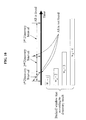
- FIG. 10 is a diagram illustrating an example of an AS discovery applying a backoff window according to an embodiment of the present invention.
- a mobile terminal may perform an AS discovery based on a periodically operating timer. Also, the mobile terminal may perform the AS discovery based on RAT deployment information that is broadcast from a CPC server. As described above, the mobile terminal may verify a location between a current cell and an adjacent cell, using an RSS rss pos that is periodically measured from a BS or an AP of the current cell, effective radius information r adj of the adjacent cell, included in RAT deployment information, and a distance d adj between a BS or an AP of the current cell and the BS or the AP of the adjacent cell.
- the mobile terminal may set, as an interface discovery interval, a sampling interval with a minimum discovery interval ⁇ unit , in a central region with a highest adjacent cell location probability. Also, the mobile terminal may set, as the interface discovery interval, a sampling interval with a discovery interval greater than the minimum discovery interval ⁇ unit , in a location where the center of the current cell overlaps the adjacent cell, and that is separated away from the center overlapping region, that is, in a region of rss radj + dadj ⁇ rss pos ⁇ rss radj-dadj .
- the mobile terminal may measure the RSS and set, as the interface discovery interval, a sampling interval with the discovery interval greater than the minimum discovery interval ⁇ unit in an effective radius distance.
- Equation 2 and Equation 3 when the distance between the BS or the AP of the current cell and the BS or the AP of the adjacent cell is close and the effective cell radius is great, ⁇ and ⁇ may have a great value between zero and 1.
- the mobile terminal may set the sampling interval.
- the mobile terminal may access an AS of the adjacent cell to measure the RSS.
- the mobile terminal may set a maximum sampling interval ⁇ max as the interface discovery interval.
- the mobile terminal may measure the RSS of the adjacent cell. When the measured value of the RSS is greater than a serviceable or accessible threshold value, the mobile terminal may provide a candidate set for an access decision with corresponding AS information, and terminate the discovery process. When the measured value of the RSS of the adjacent cell is less than the threshold value, the mobile terminal may adjust the sampling interval using the backoff window and then perform the AS discovery.
- FIG. 11 is a flowchart illustrating a method of discovering an AS in a multi-accessible wireless/mobile system environment according to an embodiment of the present invention.
- the AS discovery method may be performed by an AS discovery apparatus according to an embodiment of the present invention.
- the AS discovery apparatus may calculate a first distance between an AS of a first cell providing a service to a mobile terminal, and an AS of a second cell adjacent to the first cell, using cell deployment information received from a CPC server.
- the first cell denotes a current cell
- the second cell denotes an adjacent cell.
- the AS discovery apparatus may receive the cell deployment information that is divided into a plurality of sector deployment information, and calculate the first distance using the received sector deployment information. Also, the AS discovery apparatus may receive the cell deployment information via a smart antenna, and extract beamforming information from the received cell deployment information to thereby calculate the first distance.
- the AS discovery apparatus may measure an RSS of a signal, received from the AS of the first cell, to calculate a second distance between the mobile terminal and the AS of the first cell. In this instance, the AS discovery apparatus may calculate the second distance using a path loss model based on the measured value of the RSS.
- the AS discovery apparatus may estimate a location of the mobile terminal using the first distance and the second distance.
- the AS discovery apparatus may adjust an activation interval of an interface associated with discovering of the AS of the second cell, using the estimated location of the mobile terminal.
- the AS discovery apparatus may variably adjust the activation interval of the interface by further using an effective radius of the second cell and the first distance.
- the AS discovery apparatus may variably adjust the activation interval of the interface depending on whether the second cell overlaps a center of the first cell. For this, the AS discovery apparatus may determine whether the second cell overlaps the center of the first cell. In this instance, the AS discovery apparatus may determine whether the second cell overlaps the center of the first cell, using the effective radius of the second cell and the first distance.
- the AS discovery apparatus may adjust the activation interval of the interface to be a first interval in a first region that is divided based on a difference value between the effective radius of the second cell and the first distance. Also, the AS discovery apparatus may adjust the activation interval of the interface to be a second interval in a second region that is divided based on an addition value between the effective radius of the second cell and the first distance. Also, the AS discovery apparatus may adjust the activation interval of the interface to be a third interval outside the second region.
- the AS discovery apparatus may adjust the activation interval of the interface to be a first interval outside a third region that is divided based on a difference value between an effective radius of the second cell and the first distance. Also, when an addition value between the effective radius of the second cell and the first distance is less than the effective radius of the first cell, the AS discovery apparatus may adjust the activation interval of the interface to be a second interval between the third region and a fourth region that is divided based on the addition value. Also, the AS discovery apparatus may adjust the activation interval of the interface to be a third interval in the third region.
- the AS discovery apparatus may increase or decrease the activation interval of the interface based on a comparison result between the measured value of the RSS and a threshold value. Specifically, when the measured value of the RSS is less than the threshold value, the AS discovery apparatus may increase the activation interval of the interface. Conversely, when the measured value of the RSS is greater than the threshold value, the AS discovery apparatus may decrease the activation interval of the interface.
- the AS discovery method may be recorded in computer-readable media including program instructions to implement various operations embodied by a computer.
- the media may also include, alone or in combination with the program instructions, data files, data structures, and the like.
- Examples of computer-readable media include magnetic media such as hard disks, floppy disks, and magnetic tape; optical media such as CD ROM disks and DVDs; magneto-optical media such as floptical disks; and hardware devices that are specially configured to store and perform program instructions, such as read-only memory (ROM), random access memory (RAM), flash memory, and the like.
- Examples of program instructions include both machine code, such as produced by a compiler, and files containing higher level code that may be executed by the computer using an interpreter.
- the described hardware devices may be configured to act as one or more software modules in order to perform the operations of the above-described exemplary embodiments of the present invention, or vice versa.
Landscapes
- Engineering & Computer Science (AREA)
- Computer Networks & Wireless Communication (AREA)
- Signal Processing (AREA)
- Computer Security & Cryptography (AREA)
- Mobile Radio Communication Systems (AREA)
Applications Claiming Priority (1)
| Application Number | Priority Date | Filing Date | Title |
|---|---|---|---|
| KR1020080127927A KR101159888B1 (ko) | 2008-12-16 | 2008-12-16 | 다중 액세스 가능한 무선/이동 시스템 환경에서의 as 탐색 방법 및 장치 |
Publications (3)
| Publication Number | Publication Date |
|---|---|
| EP2200375A2 true EP2200375A2 (fr) | 2010-06-23 |
| EP2200375A3 EP2200375A3 (fr) | 2014-02-12 |
| EP2200375B1 EP2200375B1 (fr) | 2016-03-23 |
Family
ID=42046190
Family Applications (1)
| Application Number | Title | Priority Date | Filing Date |
|---|---|---|---|
| EP09168089.2A Not-in-force EP2200375B1 (fr) | 2008-12-16 | 2009-08-18 | Procédé et appareil pour découvrir un système d'accès dans un environnement de système mobile/sans fil multi-accessible |
Country Status (2)
| Country | Link |
|---|---|
| EP (1) | EP2200375B1 (fr) |
| KR (1) | KR101159888B1 (fr) |
Cited By (3)
| Publication number | Priority date | Publication date | Assignee | Title |
|---|---|---|---|---|
| CN102905346A (zh) * | 2011-07-27 | 2013-01-30 | 联芯科技有限公司 | 无线通信系统中实现快速小区选择的方法和系统 |
| US9830443B2 (en) | 2013-07-12 | 2017-11-28 | Blinksight | Device and method for controlling access to at least one machine |
| EP3454615A1 (fr) * | 2017-09-12 | 2019-03-13 | Thomson Licensing | Dispositif et procédé d'estimation d'intensité de signal dans un réseau sans fil ayant de multiples points d'accès |
Family Cites Families (7)
| Publication number | Priority date | Publication date | Assignee | Title |
|---|---|---|---|---|
| US6167268A (en) * | 1999-02-16 | 2000-12-26 | Motorola, Inc. | Method and apparatus for controlling scanning of a subscriber unit |
| US6970708B1 (en) * | 2000-02-05 | 2005-11-29 | Ericsson Inc. | System and method for improving channel monitoring in a cellular system |
| GB0408417D0 (en) * | 2004-04-15 | 2004-05-19 | Koninkl Philips Electronics Nv | Wireless network |
| US7839814B2 (en) * | 2005-06-23 | 2010-11-23 | Motorola Mobility, Inc. | Method and system for adjusting inter-scan period of a mobile station |
| KR100645355B1 (ko) * | 2005-10-05 | 2006-11-15 | 에스케이 텔레콤주식회사 | 파일롯 셀 데이터베이스를 이용한 네트워크 기반의측위방법 및 시스템 |
| KR100726184B1 (ko) * | 2005-11-28 | 2007-06-11 | 한국전자통신연구원 | 이종 무선 네트워크간 핸드오버를 위한 무선 네트워크 탐지방법, 이를 구현하는 다중모드 단말 및 연동 서비스 서버 |
| US8798619B2 (en) * | 2007-03-20 | 2014-08-05 | Qualcomm Incorporated | Method and apparatus for performing inter-system searches in idle mode |
-
2008
- 2008-12-16 KR KR1020080127927A patent/KR101159888B1/ko not_active Expired - Fee Related
-
2009
- 2009-08-18 EP EP09168089.2A patent/EP2200375B1/fr not_active Not-in-force
Cited By (6)
| Publication number | Priority date | Publication date | Assignee | Title |
|---|---|---|---|---|
| CN102905346A (zh) * | 2011-07-27 | 2013-01-30 | 联芯科技有限公司 | 无线通信系统中实现快速小区选择的方法和系统 |
| CN102905346B (zh) * | 2011-07-27 | 2015-08-26 | 联芯科技有限公司 | 无线通信系统中实现快速小区选择的方法和系统 |
| US9830443B2 (en) | 2013-07-12 | 2017-11-28 | Blinksight | Device and method for controlling access to at least one machine |
| EP3454615A1 (fr) * | 2017-09-12 | 2019-03-13 | Thomson Licensing | Dispositif et procédé d'estimation d'intensité de signal dans un réseau sans fil ayant de multiples points d'accès |
| EP3454616A1 (fr) * | 2017-09-12 | 2019-03-13 | InterDigital CE Patent Holdings | Dispositif et procédé d'estimation d'intensité de signal dans un réseau sans fil ayant de multiples points d'accès |
| CN109495194A (zh) * | 2017-09-12 | 2019-03-19 | 交互数字Ce专利控股公司 | 多个接入点的无线网络中的信号强度估计的设备和方法 |
Also Published As
| Publication number | Publication date |
|---|---|
| KR20100069278A (ko) | 2010-06-24 |
| EP2200375A3 (fr) | 2014-02-12 |
| KR101159888B1 (ko) | 2012-06-25 |
| EP2200375B1 (fr) | 2016-03-23 |
Similar Documents
| Publication | Publication Date | Title |
|---|---|---|
| CN103974275B (zh) | 无线通信系统中的装置和方法 | |
| KR101950361B1 (ko) | 이동 통신 시스템에서 인접기지국정보의 관리 방법 및 그를 위한 시스템 | |
| US20220272544A1 (en) | COMMUNICATION APPARATUS AND COMMUNICATION METHOD FOR 6GHz BAND FREQUENCY COORDINATION | |
| US8774134B2 (en) | Access terminal hand-off methods in wireless networks | |
| US7839827B2 (en) | Method for determining handoff in a mobile communication system, and system supporting the same | |
| US9055474B2 (en) | Apparatus for improved mobility in a wireless heterogeneous network | |
| US11044774B2 (en) | System and method for triggering split bearer activation in 5G new radio environments | |
| US9668197B2 (en) | System and method for wireless network access MAP and applications | |
| EP2761912B1 (fr) | Interférences inter-système dans des systèmes de communication | |
| US10871545B2 (en) | Radio network node, location node, wireless device and methods performed therein for reporting measured positioning information | |
| US8520630B2 (en) | Method and apparatus for predicting handover in wireless communication network | |
| US9992697B2 (en) | Method and apparatus for reporting of measurement data | |
| EP2763478B1 (fr) | Procédé et dispositif utilisant une différence de temps d'arrivée observée pour localiser une station mobile | |
| EP3679744B1 (fr) | Procédé dans un réseau de télécommunications cellulaire, programme informatique, support de données lisible par ordinateur et noeud de réseau | |
| KR20060136277A (ko) | 이동통신 시스템에서의 핸드오프 결정 방법 | |
| US9462507B2 (en) | Load balancing method and system for multi-band network | |
| CN105228198A (zh) | 小区测量处理方法、装置、终端及基站 | |
| EP2316235B1 (fr) | Procédé de transmission d'informations d'identité de cellule | |
| EP2200375B1 (fr) | Procédé et appareil pour découvrir un système d'accès dans un environnement de système mobile/sans fil multi-accessible | |
| US20150334616A1 (en) | Method of user equipment selecting cell in wireless communication system and user equipment using the method | |
| JP2012531861A (ja) | セルラー無線システムにおいてハンドオーバーを管理する方法 | |
| EP2048907B1 (fr) | Procédé pour déterminer la gamme d'hystérèse, procédé de déclenchement de transfert, et station mobile pour effectuer le procédé | |
| US9026157B1 (en) | Identifying frequency band interference using a frequency activity record of a mobile device | |
| EP3371996A1 (fr) | Reconfiguration préventive d'une station de base radio d'utilisateur secondaire |
Legal Events
| Date | Code | Title | Description |
|---|---|---|---|
| PUAI | Public reference made under article 153(3) epc to a published international application that has entered the european phase |
Free format text: ORIGINAL CODE: 0009012 |
|
| AK | Designated contracting states |
Kind code of ref document: A2 Designated state(s): AT BE BG CH CY CZ DE DK EE ES FI FR GB GR HR HU IE IS IT LI LT LU LV MC MK MT NL NO PL PT RO SE SI SK SM TR |
|
| PUAL | Search report despatched |
Free format text: ORIGINAL CODE: 0009013 |
|
| RIC1 | Information provided on ipc code assigned before grant |
Ipc: H04W 48/16 20090101AFI20131219BHEP Ipc: H04W 64/00 20090101ALI20131219BHEP |
|
| AK | Designated contracting states |
Kind code of ref document: A3 Designated state(s): AT BE BG CH CY CZ DE DK EE ES FI FR GB GR HR HU IE IS IT LI LT LU LV MC MK MT NL NO PL PT RO SE SI SK SM TR |
|
| RIC1 | Information provided on ipc code assigned before grant |
Ipc: H04W 64/00 20090101ALI20140107BHEP Ipc: H04W 48/16 20090101AFI20140107BHEP |
|
| 17P | Request for examination filed |
Effective date: 20140812 |
|
| RBV | Designated contracting states (corrected) |
Designated state(s): AT BE BG CH CY CZ DE DK EE ES FI FR GB GR HR HU IE IS IT LI LT LU LV MC MK MT NL NO PL PT RO SE SI SK SM TR |
|
| 17Q | First examination report despatched |
Effective date: 20150119 |
|
| GRAP | Despatch of communication of intention to grant a patent |
Free format text: ORIGINAL CODE: EPIDOSNIGR1 |
|
| INTG | Intention to grant announced |
Effective date: 20150930 |
|
| RIN1 | Information on inventor provided before grant (corrected) |
Inventor name: YANG, SUNHEE Inventor name: KIM, JIN UP Inventor name: BAEK, SEUNG-KWON |
|
| GRAS | Grant fee paid |
Free format text: ORIGINAL CODE: EPIDOSNIGR3 |
|
| GRAA | (expected) grant |
Free format text: ORIGINAL CODE: 0009210 |
|
| AK | Designated contracting states |
Kind code of ref document: B1 Designated state(s): AT BE BG CH CY CZ DE DK EE ES FI FR GB GR HR HU IE IS IT LI LT LU LV MC MK MT NL NO PL PT RO SE SI SK SM TR |
|
| REG | Reference to a national code |
Ref country code: GB Ref legal event code: FG4D |
|
| REG | Reference to a national code |
Ref country code: CH Ref legal event code: EP |
|
| REG | Reference to a national code |
Ref country code: AT Ref legal event code: REF Ref document number: 784223 Country of ref document: AT Kind code of ref document: T Effective date: 20160415 |
|
| REG | Reference to a national code |
Ref country code: IE Ref legal event code: FG4D |
|
| REG | Reference to a national code |
Ref country code: DE Ref legal event code: R096 Ref document number: 602009036959 Country of ref document: DE |
|
| REG | Reference to a national code |
Ref country code: LT Ref legal event code: MG4D |
|
| REG | Reference to a national code |
Ref country code: NL Ref legal event code: MP Effective date: 20160323 |
|
| PG25 | Lapsed in a contracting state [announced via postgrant information from national office to epo] |
Ref country code: FI Free format text: LAPSE BECAUSE OF FAILURE TO SUBMIT A TRANSLATION OF THE DESCRIPTION OR TO PAY THE FEE WITHIN THE PRESCRIBED TIME-LIMIT Effective date: 20160323 Ref country code: GR Free format text: LAPSE BECAUSE OF FAILURE TO SUBMIT A TRANSLATION OF THE DESCRIPTION OR TO PAY THE FEE WITHIN THE PRESCRIBED TIME-LIMIT Effective date: 20160624 Ref country code: NO Free format text: LAPSE BECAUSE OF FAILURE TO SUBMIT A TRANSLATION OF THE DESCRIPTION OR TO PAY THE FEE WITHIN THE PRESCRIBED TIME-LIMIT Effective date: 20160623 |
|
| REG | Reference to a national code |
Ref country code: AT Ref legal event code: MK05 Ref document number: 784223 Country of ref document: AT Kind code of ref document: T Effective date: 20160323 |
|
| PG25 | Lapsed in a contracting state [announced via postgrant information from national office to epo] |
Ref country code: LT Free format text: LAPSE BECAUSE OF FAILURE TO SUBMIT A TRANSLATION OF THE DESCRIPTION OR TO PAY THE FEE WITHIN THE PRESCRIBED TIME-LIMIT Effective date: 20160323 Ref country code: SE Free format text: LAPSE BECAUSE OF FAILURE TO SUBMIT A TRANSLATION OF THE DESCRIPTION OR TO PAY THE FEE WITHIN THE PRESCRIBED TIME-LIMIT Effective date: 20160323 Ref country code: LV Free format text: LAPSE BECAUSE OF FAILURE TO SUBMIT A TRANSLATION OF THE DESCRIPTION OR TO PAY THE FEE WITHIN THE PRESCRIBED TIME-LIMIT Effective date: 20160323 Ref country code: NL Free format text: LAPSE BECAUSE OF FAILURE TO SUBMIT A TRANSLATION OF THE DESCRIPTION OR TO PAY THE FEE WITHIN THE PRESCRIBED TIME-LIMIT Effective date: 20160323 |
|
| PG25 | Lapsed in a contracting state [announced via postgrant information from national office to epo] |
Ref country code: EE Free format text: LAPSE BECAUSE OF FAILURE TO SUBMIT A TRANSLATION OF THE DESCRIPTION OR TO PAY THE FEE WITHIN THE PRESCRIBED TIME-LIMIT Effective date: 20160323 Ref country code: PL Free format text: LAPSE BECAUSE OF FAILURE TO SUBMIT A TRANSLATION OF THE DESCRIPTION OR TO PAY THE FEE WITHIN THE PRESCRIBED TIME-LIMIT Effective date: 20160323 Ref country code: IS Free format text: LAPSE BECAUSE OF FAILURE TO SUBMIT A TRANSLATION OF THE DESCRIPTION OR TO PAY THE FEE WITHIN THE PRESCRIBED TIME-LIMIT Effective date: 20160723 |
|
| PG25 | Lapsed in a contracting state [announced via postgrant information from national office to epo] |
Ref country code: SK Free format text: LAPSE BECAUSE OF FAILURE TO SUBMIT A TRANSLATION OF THE DESCRIPTION OR TO PAY THE FEE WITHIN THE PRESCRIBED TIME-LIMIT Effective date: 20160323 Ref country code: ES Free format text: LAPSE BECAUSE OF FAILURE TO SUBMIT A TRANSLATION OF THE DESCRIPTION OR TO PAY THE FEE WITHIN THE PRESCRIBED TIME-LIMIT Effective date: 20160323 Ref country code: RO Free format text: LAPSE BECAUSE OF FAILURE TO SUBMIT A TRANSLATION OF THE DESCRIPTION OR TO PAY THE FEE WITHIN THE PRESCRIBED TIME-LIMIT Effective date: 20160323 Ref country code: PT Free format text: LAPSE BECAUSE OF FAILURE TO SUBMIT A TRANSLATION OF THE DESCRIPTION OR TO PAY THE FEE WITHIN THE PRESCRIBED TIME-LIMIT Effective date: 20160725 Ref country code: AT Free format text: LAPSE BECAUSE OF FAILURE TO SUBMIT A TRANSLATION OF THE DESCRIPTION OR TO PAY THE FEE WITHIN THE PRESCRIBED TIME-LIMIT Effective date: 20160323 Ref country code: CZ Free format text: LAPSE BECAUSE OF FAILURE TO SUBMIT A TRANSLATION OF THE DESCRIPTION OR TO PAY THE FEE WITHIN THE PRESCRIBED TIME-LIMIT Effective date: 20160323 Ref country code: SM Free format text: LAPSE BECAUSE OF FAILURE TO SUBMIT A TRANSLATION OF THE DESCRIPTION OR TO PAY THE FEE WITHIN THE PRESCRIBED TIME-LIMIT Effective date: 20160323 |
|
| PG25 | Lapsed in a contracting state [announced via postgrant information from national office to epo] |
Ref country code: BE Free format text: LAPSE BECAUSE OF FAILURE TO SUBMIT A TRANSLATION OF THE DESCRIPTION OR TO PAY THE FEE WITHIN THE PRESCRIBED TIME-LIMIT Effective date: 20160323 Ref country code: IT Free format text: LAPSE BECAUSE OF FAILURE TO SUBMIT A TRANSLATION OF THE DESCRIPTION OR TO PAY THE FEE WITHIN THE PRESCRIBED TIME-LIMIT Effective date: 20160323 |
|
| REG | Reference to a national code |
Ref country code: DE Ref legal event code: R097 Ref document number: 602009036959 Country of ref document: DE |
|
| PLBE | No opposition filed within time limit |
Free format text: ORIGINAL CODE: 0009261 |
|
| STAA | Information on the status of an ep patent application or granted ep patent |
Free format text: STATUS: NO OPPOSITION FILED WITHIN TIME LIMIT |
|
| PG25 | Lapsed in a contracting state [announced via postgrant information from national office to epo] |
Ref country code: DK Free format text: LAPSE BECAUSE OF FAILURE TO SUBMIT A TRANSLATION OF THE DESCRIPTION OR TO PAY THE FEE WITHIN THE PRESCRIBED TIME-LIMIT Effective date: 20160323 |
|
| PG25 | Lapsed in a contracting state [announced via postgrant information from national office to epo] |
Ref country code: BG Free format text: LAPSE BECAUSE OF FAILURE TO SUBMIT A TRANSLATION OF THE DESCRIPTION OR TO PAY THE FEE WITHIN THE PRESCRIBED TIME-LIMIT Effective date: 20160623 |
|
| 26N | No opposition filed |
Effective date: 20170102 |
|
| REG | Reference to a national code |
Ref country code: DE Ref legal event code: R119 Ref document number: 602009036959 Country of ref document: DE |
|
| PG25 | Lapsed in a contracting state [announced via postgrant information from national office to epo] |
Ref country code: MC Free format text: LAPSE BECAUSE OF FAILURE TO SUBMIT A TRANSLATION OF THE DESCRIPTION OR TO PAY THE FEE WITHIN THE PRESCRIBED TIME-LIMIT Effective date: 20160323 |
|
| REG | Reference to a national code |
Ref country code: CH Ref legal event code: PL |
|
| GBPC | Gb: european patent ceased through non-payment of renewal fee |
Effective date: 20160818 |
|
| PG25 | Lapsed in a contracting state [announced via postgrant information from national office to epo] |
Ref country code: LI Free format text: LAPSE BECAUSE OF NON-PAYMENT OF DUE FEES Effective date: 20160831 Ref country code: CH Free format text: LAPSE BECAUSE OF NON-PAYMENT OF DUE FEES Effective date: 20160831 |
|
| REG | Reference to a national code |
Ref country code: FR Ref legal event code: ST Effective date: 20170428 |
|
| PG25 | Lapsed in a contracting state [announced via postgrant information from national office to epo] |
Ref country code: SI Free format text: LAPSE BECAUSE OF FAILURE TO SUBMIT A TRANSLATION OF THE DESCRIPTION OR TO PAY THE FEE WITHIN THE PRESCRIBED TIME-LIMIT Effective date: 20160323 |
|
| REG | Reference to a national code |
Ref country code: IE Ref legal event code: MM4A |
|
| PG25 | Lapsed in a contracting state [announced via postgrant information from national office to epo] |
Ref country code: GB Free format text: LAPSE BECAUSE OF NON-PAYMENT OF DUE FEES Effective date: 20160818 Ref country code: IE Free format text: LAPSE BECAUSE OF NON-PAYMENT OF DUE FEES Effective date: 20160818 Ref country code: FR Free format text: LAPSE BECAUSE OF NON-PAYMENT OF DUE FEES Effective date: 20160831 Ref country code: DE Free format text: LAPSE BECAUSE OF NON-PAYMENT OF DUE FEES Effective date: 20170301 |
|
| PG25 | Lapsed in a contracting state [announced via postgrant information from national office to epo] |
Ref country code: LU Free format text: LAPSE BECAUSE OF NON-PAYMENT OF DUE FEES Effective date: 20160818 |
|
| PG25 | Lapsed in a contracting state [announced via postgrant information from national office to epo] |
Ref country code: HU Free format text: LAPSE BECAUSE OF FAILURE TO SUBMIT A TRANSLATION OF THE DESCRIPTION OR TO PAY THE FEE WITHIN THE PRESCRIBED TIME-LIMIT; INVALID AB INITIO Effective date: 20090818 Ref country code: CY Free format text: LAPSE BECAUSE OF FAILURE TO SUBMIT A TRANSLATION OF THE DESCRIPTION OR TO PAY THE FEE WITHIN THE PRESCRIBED TIME-LIMIT Effective date: 20160323 |
|
| PG25 | Lapsed in a contracting state [announced via postgrant information from national office to epo] |
Ref country code: HR Free format text: LAPSE BECAUSE OF FAILURE TO SUBMIT A TRANSLATION OF THE DESCRIPTION OR TO PAY THE FEE WITHIN THE PRESCRIBED TIME-LIMIT Effective date: 20160323 Ref country code: MK Free format text: LAPSE BECAUSE OF FAILURE TO SUBMIT A TRANSLATION OF THE DESCRIPTION OR TO PAY THE FEE WITHIN THE PRESCRIBED TIME-LIMIT Effective date: 20160323 Ref country code: MT Free format text: LAPSE BECAUSE OF NON-PAYMENT OF DUE FEES Effective date: 20160831 Ref country code: TR Free format text: LAPSE BECAUSE OF FAILURE TO SUBMIT A TRANSLATION OF THE DESCRIPTION OR TO PAY THE FEE WITHIN THE PRESCRIBED TIME-LIMIT Effective date: 20160323 |