EP2200762B1 - Procédé et appareil de décharge d'un spray cryogénique non linéaire sur la largeur d'une cage de laminoir - Google Patents
Procédé et appareil de décharge d'un spray cryogénique non linéaire sur la largeur d'une cage de laminoir Download PDFInfo
- Publication number
- EP2200762B1 EP2200762B1 EP08798811.9A EP08798811A EP2200762B1 EP 2200762 B1 EP2200762 B1 EP 2200762B1 EP 08798811 A EP08798811 A EP 08798811A EP 2200762 B1 EP2200762 B1 EP 2200762B1
- Authority
- EP
- European Patent Office
- Prior art keywords
- cryogenic cooling
- cooling device
- cryogenic
- throttling gas
- gas supply
- Prior art date
- Legal status (The legal status is an assumption and is not a legal conclusion. Google has not performed a legal analysis and makes no representation as to the accuracy of the status listed.)
- Not-in-force
Links
- 238000000034 method Methods 0.000 title claims description 42
- 239000007921 spray Substances 0.000 title description 13
- 238000007599 discharging Methods 0.000 title description 2
- 238000001816 cooling Methods 0.000 claims description 126
- 239000007789 gas Substances 0.000 claims description 78
- 239000012530 fluid Substances 0.000 claims description 35
- 238000005097 cold rolling Methods 0.000 claims description 26
- 230000008569 process Effects 0.000 claims description 21
- 238000004519 manufacturing process Methods 0.000 claims description 17
- IJGRMHOSHXDMSA-UHFFFAOYSA-N Atomic nitrogen Chemical compound N#N IJGRMHOSHXDMSA-UHFFFAOYSA-N 0.000 claims description 12
- 239000007788 liquid Substances 0.000 claims description 10
- 238000005259 measurement Methods 0.000 claims description 7
- 229910052757 nitrogen Inorganic materials 0.000 claims description 6
- 230000001105 regulatory effect Effects 0.000 claims description 6
- 230000008859 change Effects 0.000 claims description 5
- 230000000704 physical effect Effects 0.000 claims description 2
- 230000004044 response Effects 0.000 claims description 2
- 238000009529 body temperature measurement Methods 0.000 claims 4
- 238000010926 purge Methods 0.000 description 16
- 239000002826 coolant Substances 0.000 description 12
- 238000005096 rolling process Methods 0.000 description 11
- 239000000463 material Substances 0.000 description 8
- 230000007423 decrease Effects 0.000 description 4
- 230000002123 temporal effect Effects 0.000 description 4
- 238000009833 condensation Methods 0.000 description 3
- 230000005494 condensation Effects 0.000 description 3
- 238000011144 upstream manufacturing Methods 0.000 description 3
- XKRFYHLGVUSROY-UHFFFAOYSA-N Argon Chemical compound [Ar] XKRFYHLGVUSROY-UHFFFAOYSA-N 0.000 description 2
- CURLTUGMZLYLDI-UHFFFAOYSA-N Carbon dioxide Chemical compound O=C=O CURLTUGMZLYLDI-UHFFFAOYSA-N 0.000 description 2
- MYMOFIZGZYHOMD-UHFFFAOYSA-N Dioxygen Chemical compound O=O MYMOFIZGZYHOMD-UHFFFAOYSA-N 0.000 description 2
- 230000002411 adverse Effects 0.000 description 2
- 238000009835 boiling Methods 0.000 description 2
- 230000003247 decreasing effect Effects 0.000 description 2
- 239000000203 mixture Substances 0.000 description 2
- 239000006200 vaporizer Substances 0.000 description 2
- 235000013290 Sagittaria latifolia Nutrition 0.000 description 1
- 230000004075 alteration Effects 0.000 description 1
- 229910052786 argon Inorganic materials 0.000 description 1
- 238000003491 array Methods 0.000 description 1
- 229910002092 carbon dioxide Inorganic materials 0.000 description 1
- 239000001569 carbon dioxide Substances 0.000 description 1
- 235000015246 common arrowhead Nutrition 0.000 description 1
- 230000007547 defect Effects 0.000 description 1
- 238000010586 diagram Methods 0.000 description 1
- 238000010438 heat treatment Methods 0.000 description 1
- 239000011261 inert gas Substances 0.000 description 1
- 238000002372 labelling Methods 0.000 description 1
- 239000000314 lubricant Substances 0.000 description 1
- 239000002184 metal Substances 0.000 description 1
- 238000002156 mixing Methods 0.000 description 1
- 230000004048 modification Effects 0.000 description 1
- 238000012986 modification Methods 0.000 description 1
- 230000003287 optical effect Effects 0.000 description 1
- 230000002265 prevention Effects 0.000 description 1
- 230000009467 reduction Effects 0.000 description 1
- 238000013000 roll bending Methods 0.000 description 1
- 238000005507 spraying Methods 0.000 description 1
- 238000010301 surface-oxidation reaction Methods 0.000 description 1
- 230000007704 transition Effects 0.000 description 1
- XLYOFNOQVPJJNP-UHFFFAOYSA-N water Substances O XLYOFNOQVPJJNP-UHFFFAOYSA-N 0.000 description 1
Images


Classifications
-
- B—PERFORMING OPERATIONS; TRANSPORTING
- B21—MECHANICAL METAL-WORKING WITHOUT ESSENTIALLY REMOVING MATERIAL; PUNCHING METAL
- B21B—ROLLING OF METAL
- B21B27/00—Rolls, roll alloys or roll fabrication; Lubricating, cooling or heating rolls while in use
- B21B27/06—Lubricating, cooling or heating rolls
- B21B27/10—Lubricating, cooling or heating rolls externally
-
- B—PERFORMING OPERATIONS; TRANSPORTING
- B21—MECHANICAL METAL-WORKING WITHOUT ESSENTIALLY REMOVING MATERIAL; PUNCHING METAL
- B21B—ROLLING OF METAL
- B21B37/00—Control devices or methods specially adapted for metal-rolling mills or the work produced thereby
- B21B37/74—Temperature control, e.g. by cooling or heating the rolls or the product
-
- B—PERFORMING OPERATIONS; TRANSPORTING
- B21—MECHANICAL METAL-WORKING WITHOUT ESSENTIALLY REMOVING MATERIAL; PUNCHING METAL
- B21B—ROLLING OF METAL
- B21B45/00—Devices for surface or other treatment of work, specially combined with or arranged in, or specially adapted for use in connection with, metal-rolling mills
- B21B45/02—Devices for surface or other treatment of work, specially combined with or arranged in, or specially adapted for use in connection with, metal-rolling mills for lubricating, cooling, or cleaning
- B21B45/0203—Cooling
- B21B45/0206—Coolants
-
- B—PERFORMING OPERATIONS; TRANSPORTING
- B21—MECHANICAL METAL-WORKING WITHOUT ESSENTIALLY REMOVING MATERIAL; PUNCHING METAL
- B21B—ROLLING OF METAL
- B21B45/00—Devices for surface or other treatment of work, specially combined with or arranged in, or specially adapted for use in connection with, metal-rolling mills
- B21B45/02—Devices for surface or other treatment of work, specially combined with or arranged in, or specially adapted for use in connection with, metal-rolling mills for lubricating, cooling, or cleaning
- B21B45/0203—Cooling
- B21B45/0209—Cooling devices, e.g. using gaseous coolants
-
- B—PERFORMING OPERATIONS; TRANSPORTING
- B21—MECHANICAL METAL-WORKING WITHOUT ESSENTIALLY REMOVING MATERIAL; PUNCHING METAL
- B21B—ROLLING OF METAL
- B21B45/00—Devices for surface or other treatment of work, specially combined with or arranged in, or specially adapted for use in connection with, metal-rolling mills
- B21B45/02—Devices for surface or other treatment of work, specially combined with or arranged in, or specially adapted for use in connection with, metal-rolling mills for lubricating, cooling, or cleaning
- B21B45/0203—Cooling
- B21B45/0209—Cooling devices, e.g. using gaseous coolants
- B21B2045/0212—Cooling devices, e.g. using gaseous coolants using gaseous coolants
-
- B—PERFORMING OPERATIONS; TRANSPORTING
- B21—MECHANICAL METAL-WORKING WITHOUT ESSENTIALLY REMOVING MATERIAL; PUNCHING METAL
- B21B—ROLLING OF METAL
- B21B45/00—Devices for surface or other treatment of work, specially combined with or arranged in, or specially adapted for use in connection with, metal-rolling mills
- B21B45/02—Devices for surface or other treatment of work, specially combined with or arranged in, or specially adapted for use in connection with, metal-rolling mills for lubricating, cooling, or cleaning
- B21B45/0203—Cooling
- B21B45/0209—Cooling devices, e.g. using gaseous coolants
- B21B45/0215—Cooling devices, e.g. using gaseous coolants using liquid coolants, e.g. for sections, for tubes
Definitions
- the present invention is directed to the use of cryogenic spay devices in cold rolling processes, as well as other industrial applications, such as hot and profile rolling and thermal spray coating of cylindrical shapes, see method (claim 1) and corresponding apparatus (claim 11).
- Cold rolling is a process used to produce metallic sheet or strip with specific mechanical properties such as surface finish and dimensional tolerances.
- the metallic sheet or strip (rolled product) passes between two counter-rotating work rolls adjusted at a predetermined roll gap so that the rolled product is plastically deformed to a required thickness defined by the selected gap setting.
- Cold rolling generates heat in response to the forces required to deform the strip and friction between the work rolls and the rolled product. This generated heat accumulates in both the work rolls and rolled product, and it must be dissipated to maintain mill stand temperature at acceptable cold rolling levels.
- Cold rolling temperatures are normally above about 120° C in a cold reduction mill, and about 205° C in a high-speed cold tandem mill. Excessive rolling temperatures adversely affect the rolled product properties, causing surface oxidation, defects in surface quality, and inconsistent gauge, shape, and flatness, hereinafter referred to as "product shape.”
- cryogenic and non-cryogenic cooling devices have been used to keep strip and work roll temperatures within acceptable ranges.
- attempts have been made to keep mill temperatures within a desired range by varying the overall intensity of a uniform cryogenic spray profile based on data received from optical pyrometers directed at a roll surface.
- EP 0 136 921 A2 which is considered to represent the closest prior art of the present application, discloses a rolling mill for rolling metal strip 15, comprising a shape sensor for giving an indication of strip 15 shape by detecting widthwise variations in tension in the strip 15, a temperature sensor upstream of the shape sensor for detecting widthwise temperature variations in the strip 15, and means for applying coolant to the strip 15 for differentially cooling the strip 15 across its width to reduce those temperature variations prior to arrival of the strip 15 at the shape sensor.
- row of spray nozzles is arranged beneath the strip 15, across the width of the strip 15.
- the spray nozzles are mounted on a coolant manifold.
- Each spray nozzle 35 has a supply conduit 43 which has an opening 44 in the manifold 42.
- the opening 44 can be closed by pneumatically controlled diaphragm valve 45.
- a flexible diaphragm 46 is mounted adjacent the opening 44.
- a chamber 47 Behind the diaphragm 46 is a chamber 47 which can be selectively connected to a source of pressurized air which will, when applied, sufficiently deform the diaphragm 46 to close the opening 44.
- coolant under pressure supplied in manifold 42 is applied via spray nozzles 41 to the underside of the strip 15.
- US 6,874,344 B1 relates to a method for cold-rolling metallic rolling stock (4), in which the rolling stock (4) passes through the roll nip (3) between oppositely driven rollers (2) at room temperature in order to undergo a plastic shape change.
- the invention proposes that inert gas, which is at a lower temperature than the rolling -stock temperature in the roll nip, is blown into the region of the roll nip (3).
- the invention also relates to a cold-rolling stand for carrying out this method.
- US 6,860,950 B1 describes a method for cooling a hot-rolled material having a rolled-material cross section in a cooling line, comprising the steps of recording a starting temperature for a rolled-material at a location upstream of the cooling line, determining a temporal quantitative coolant profile on the basis of a cooling-line model and predetermined desired properties of the rolled material, applying a coolant to the rolled-material location in accordance with the temporal quantitative coolant profile which has been determined, and an expected temporal temperature profile of the rolled material at the rolled-material location across the rolled-material cross section is determined on the basis of the cooling-line model and the temporal quantitative coolant profile, by use of a certain formula.
- the invention comprises a method as defined in claim 1.
- the invention comprises an apparatus for use in an industrial process as defined in claim 11.
- directional terms may be used in the specification and claims to describe portions of the present invention (e.g., upper, lower, left, right, etc.). These directional terms are merely intended to assist in describing and claiming the invention and are not intended to limit the invention in any way.
- reference numerals that are introduced in the specification in association with a drawing figure may be repeated in one or more subsequent figures without additional description in the specification in order to provide context for other features.
- a first embodiment of a cryogenic cooling device is identified in the specification and in Fig. 2A by reference numeral 14 and a second embodiment of the cryogenic cooling device is identified in the specification and in Fig. 2B by reference numeral 114.
- Elements which are discussed in the specification with respect to one embodiment may be identified by reference numeral in other embodiments in which that element appears, but may not be independently referred to in the specification.
- cryogenic fluid is intended to mean a liquid, gas or mixed-phase fluid having a temperature less than -70 degrees C (203 degrees K).
- cryogenic fluids include liquid nitrogen (LIN), liquid oxygen (LOX), and liquid argon (LAR), liquid carbon dioxide and pressurized, mixed phase cryogens (e.g., a mixture of LIN and gaseous nitrogen).
- cryogenic cooling device is intended to mean any type of apparatus or device which is designed to discharge or spray a cryogenic fluid (either in liquid, mixed-phase, or gaseous form).
- cryogenic cooling devices include, but are not limited to, cryogenic spray bars, individual cryogenic spray nozzles, and devices containing arrays of cryogenic spray nozzles.
- a cryogenic cooling device 14 is installed in a cold roll mill stand 1, which forms part of a cold rolling process.
- the mill stand 1 includes a pair of opposed work rolls 2 and 3, adjusted to a selected roll gap 4 for receiving and deforming incoming metallic sheet (or strip) 5 that moves in a direction 8 to a predetermined thickness.
- the strip 5 is plastically deformed between the work rolls 2 and 3 to a desired thickness.
- the cryogenic cooling device 14 is positioned above the strip 5 and is discharging cryogenic coolant onto the surface of the strip 5.
- the cryogenic cooling device 14 could be positioned and directed to discharge coolant onto other surfaces, such as the bottom surface of the strip 5, onto the surface of one of the rolls 2, 3 or into the roll "bite" (where the strip 5 meets the rolls 2, 3).
- multiple cryogenic cooling devices 14 could be provided. The position, direction of discharge and number of cryogenic cooling devices 14 will depend upon the operating parameters of the cold rolling process in which they are used.
- the cryogenic cooling device 14 is a spray bar having a plurality of nozzles 18 from which coolant is discharged.
- the nozzles 18 are arranged in a (linear) row.
- the coolant discharge from the plurality of nozzles 18 as a group defines a cryogenic cooling profile 16 (shown schematically in Fig. 1 ).
- the cryogenic cooling device 14 is capable of producing non-uniform cryogenic cooling profiles.
- An exemplary non-uniform cryogenic cooling profile 16 is shown in Fig. 2A .
- the length of the arrow-headed dashed lines 26a through 26k represent the cooling intensity discharged from each of the respective nozzles 18a through 18k, with a longer line indicating greater cooling intensity and the arrow head indicating the direction of flow.
- the cryogenic cooling profile 16 has maximum cooling intensity at the center of the cryogenic cooling device 14. The cooling intensity decreases to a minimum at each end of the cryogenic cooling device 14.
- Cryogenic cooling devices 14 and 114 are very similar to the tube-in-tube cryogenic spray bar disclosed in U.S. Patent Application No. 11/846,116, filed August 28, 2007 , which is incorporated herein by reference as if fully set forth.
- a cryogenic fluid is supplied to the cryogenic cooling device 14 by two cryogenic fluid supply lines L1 and L2.
- a throttling gas is supplied to the cryogenic cooling device by two throttling gas supply lines G1 and G2.
- An optional purge gas is supplied to the cryogenic cooling device by two purge gas supply lines P1 and P2.
- the supplied cryogenic fluid flows into an inner tube and then into a "contact zone" located between the inner tube and the outer tube, where it mixes with the throttling gas.
- the tube-in-tube structure is fully disclosed in U.S. Patent Application No. 11/846,116 , and therefore is neither shown in Fig. 2A nor discussed in detail herein.
- adjusting the pressure at which the throttling gas is supplied to the cryogenic cooling device 14 via each of the throttling gas supply lines G1 and G2 enables the cryogenic cooling profile to be adjusted and controlled and enables the generation of non-uniform cryogenic cooling profiles.
- a proportional valve 15a, 15b (i.e., adjustable over a range of positions between fully open and fully closed) is provided on each of the throttling gas supply lines G1 and G2, which enable the pressure at which the throttling gas is supplied to the cryogenic cooling device 14 to be regulated in each of the throttling gas supply lines G1 and G2.
- a single valve 13 is provided to control the flow of cryogenic fluid through the cryogenic fluid supply lines L1 and L2.
- a single valve 13 is used in this embodiment because it is unnecessary (and difficult) to independently adjust the respective flow rates in each of the cryogenic fluid supply lines L1 and L2.
- a valve could be provided on each of the cryogenic fluid supply lines L1 and L2.
- Proportional valves are described in this application as being used to regulate the pressure at which throttling gas is supplied to a cryogenic cooling device (including device 14). It should be understood that, the proportional valves of the embodiments of the invention described herein, are adjusted by increasing or decreasing the size of the opening through which the throttling gas flows, which causes a corresponding increase or decrease, respectively, in the flow rate of throttling gas through the opening. Increasing the size of the opening also decreases the pressure drop across the proportional valve, and therefore, increases the pressure of the throttling gas downstream of the proportional valve. Conversely, decreasing the size of the opening increases the pressure drop across the proportional valve, and therefore, decreases the downstream pressure of the throttling gas. Therefore, in the embodiments of the invention described herein, adjusting a proportional valve regulates both the flow rate and the pressure at which the throttling gas is provided to the cryogenic cooling device.
- valve 13 is normally opened at the start of rolling operations to provide a desired flow rate of cryogenic fluid and is not adjusted until rolling is terminated. It should be understood, however, that adjusting the valve 13 during rolling operations is not considered outside the scope of the present invention.
- the purge gas supply lines P1 and P2 provide a means for preventing the build-up of condensation and frost on the cryogenic cooling device 14, as set forth in PCT International Application No. PCT/US08/74462 on August 27, 2008 , filed concurrently with this application, which is incorporated herein by reference as if fully set forth.
- a single valve 20 is provided to control the flow of purge gas through the purge gas supply lines P1 and P2.
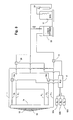
- Fig. 3 shows a delivery and control system embodiment for use with the cryogenic cooling device 14.
- the cryogenic fluid is supplied to the cryogenic fluid supply lines L1 and L2 by a tank 50, which may optionally include a pressure regulator 53.
- the throttling gas is supplied to the throttling gas supply lines G1 and G2 by a tank 51, which may optionally include a vaporizer 54.
- the tank 51 also supplies the purge gas to the purge gas supply lines P1 and P2.
- the cryogenic fluid, throttling gas and purge gas could be supplied by a single tank, which would preferably have a vaporizer and a phase separator.
- the cryogenic fluid is liquid nitrogen (LIN) and the throttling and purge gases are gaseous nitrogen (at ambient temperature).
- the LIN may be supplied to the cryogenic cooling device as a liquid or in mixed-phase.
- throttling gases and purge gases could be used.
- the boiling point of the throttling gas be no greater than the boiling point of the cryogenic fluid.
- a controller 17 receives data from a group of sensors 52a through 52c, each of which measure a parameter of the cold rolling process.
- the sensors 52a through 52c each preferably measure a parameter of the cold rolling process which will affect the desired cryogenic cooling profile 16 of the cryogenic cooling device 14.
- the desired cryogenic cooling profile 16 is preferably a profile that improves uniformity of the strip 5 and/or minimizes damage to the strip 5 during the cold rolling process.
- the desired cryogenic cooling profile 16 will depend upon many factors, including, but not limited to, the parameters measured by one or more of the sensors 52a through 52c.
- sensor 52a measures the velocity of the strip 5
- sensor 52b measures the temperature profile across the width of the strip 5
- sensor 52c measures the width of the strip 5.
- Different numbers of sensors could be provided in other embodiments and different combinations of parameters could be measured.
- the controller 17 is preferably programmed to determine a desired cryogenic cooling profile 16 based on data received from the sensors 52a through 52c. For example, the controller 17 could be programmed to increase the overall intensity of the desired cryogenic cooling profile 16 (by further opening both valves 15a and 15b) if the sensor 52a detects an increase in the velocity of the strip 5. As another example, the controller 17 could be programmed to generate a cryogenic cooling profile 16 having a localized increase in intensity at the portion of the strip 5 in which a higher temperature is measured by the sensor 52b (e.g., in the center of the strip 5).
- the controller 17 makes any necessary adjustments to the valves 15a and 15b to generate the desired cryogenic cooling profile 16.
- the desired cryogenic cooling profile 16 may change, in which case the controller 17 will make further adjustments to the valves 15a and 15b to regulate the throttling gas pressure in the throttling gas supply lines G1 and G2 to generate the current desired cryogenic cooling profile 16.
- the present invention provides that capability to quickly and automatically adjust the cryogenic cooling profile 16 to changing process conditions.
- the physical characteristics of the strip e.g., temperature, thickness, etc.
- the capability of the present invention to produce non-uniform cryogenic cooling profiles can be advantageously used on cold rolling processes to produce an improved shape in a rolled product.
- controller 17 is also adapted to adjust the valve 13 for the cryogenic fluid supply lines L1 and L2, as well as the valve 20 for the purge gas supply lines P1 and P2. Controller 17 may adjust valve 13 to increase the flow of purge gas if there is an overall increase in the intensity of the cryogenic cooling profile 16.
- the valve 20 is preferably not adjusted during operation of the cold rolling process.
- Fig. 2B shows a second embodiment of the cryogenic cooling device 114.
- the cryogenic cooling device 114 is very similar to the cryogenic cooling device 14 shown in Fig. 2A , the primary difference being that the discharge comprises an elongated slot 118 instead of a plurality of nozzles 18a through 18k.
- the cryogenic cooling profile 116 shown in this embodiment is slightly different.
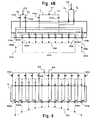
- Fig. 4A shows a third embodiment of the cryogenic cooling device 314, which provides for "sectionalized” or “zoned” control of a plurality of discharge nozzles 318a through 318k.
- Each of the nozzles 318a through 318k includes an internal manifold 335a through 335k, respectively, which is where the throttling gas and cryogenic fluid meet and mix (performing the same function of the mixing zone in the cryogenic cooling devices 14 and 114).
- the plurality of discharge nozzles 318a through 318k are grouped into three zones.
- the first zone comprises the nozzles 318d through 318h, which are the nozzles in the center of the cryogenic cooling device 314.
- the second zone consists of the nozzles 318b, 318c, 318i and 318j, which are outboard of (i.e., on either side of or flank) the nozzles of the first zone.
- the third zone consists of nozzles 318a and 318k, which are outboard of the nozzles of the first and second zones.
- the cryogenic fluid, throttling gas and purge gas are supplied to the nozzles of each of the zones using one supply line per zone.
- nozzles 318a and 318k of the third zone are supplied with cryogenic fluid by a cryogenic supply line L1, with throttling gas by throttling gas supply line G1, and with purge gas by purge gas supply line P1.
- an adjustable valve 315a, 315b, 315c is provided on each of the throttling gas supply lines G1, G2 and G3.
- a valve 320a, 320b, 320c is also provided on each of the cryogenic fluid supply lines.
- a backend throttling gas supply line 312 is provided, which splits into the throttling gas supply lines G1, G2 and G3 upstream from the valves 315a, 315b, 315c.
- backend supply lines 311 and 319 are also provided for the cryogenic supply lines L1, L2 and L3 and the purge supply lines P1, P2 and P3, respectively.
- Having multiple nozzles grouped in "zones," with each zone having an independently-adjustable throttling gas supply, provides additional flexibility in the operation of the cryogenic cooling device 314.
- a larger cooling intensity difference between zones is possible in this embodiment than in the cryogenic cooling devices 14 and 114 shown in Figs. 2A and 2B .
- zoned or “sectionalized” nozzles also enables the nozzles in any one of the zones to be turned off by increasing the throttling gas pressure delivered to nozzles in that zone until little or no cryogenic fluid is being discharged, or by closing the valve on the associated cryogenic supply line.
- This enables the cryogenic cooling device 314 to operate more efficiently when a relatively narrow strip is being rolled in the cold rolling process, which could result in significant operating cost savings. For example, if the width of the strip being rolled was only as wide as the first zone (spanning from nozzles 318d through 318h), the nozzles of the second and third zones could be turned off.
- sensor 52c is configured to detect the width of the strip 5. Therefore, the controller 17 could be programmed to automatically turn zones on and off depending upon the detected width of the strip 5.
- the sectionalized cooling capability of the cryogenic cooling device 314 would also enable quick operational transitions between strips of different widths.
- Fig. 4B shows a fourth embodiment of the cryogenic cooling device 414, which is very similar to the third embodiment of the cryogenic cooling device 314, but includes two zones instead of three zones.
- Fig. 5 shows a fifth embodiment of the cryogenic cooling device 614, which includes a throttling gas supply line having an adjustable valve and a cryogenic fluid supply line for each of a plurality of nozzles.
- a throttling gas supply line having an adjustable valve
- a cryogenic fluid supply line for each of a plurality of nozzles.
- the throttling gas supply lines are shown as solid lines and the cryogenic fluid supply lines are shown using lines having a dash, double-dot pattern.
- a single valve 613 controls the flow of cryogenic fluid through all of the cryogenic fluid supply lines.
- cryogenic cooling device 614 Due to the fact that each nozzle has its own throttling gas supply line and adjustable valve, the cryogenic cooling device 614 provides the greatest degree of flexibility in generating cryogenic cooling profiles. This flexibility comes at the cost, however, of increased weight, complexity and manufacturing cost. Therefore, use of the cryogenic cooling device 614 is likely to only be warranted in applications having desired cryogenic cooling profiles that cannot be generated using the any of the first through fourth embodiments of the cryogenic cooling device discussed above.
Landscapes
- Engineering & Computer Science (AREA)
- Mechanical Engineering (AREA)
- Control Of Metal Rolling (AREA)
- Heat Treatment Of Strip Materials And Filament Materials (AREA)
- Metal Rolling (AREA)
Claims (14)
- Une méthode comprenant :la détermination d'un profil de refroidissement cryogénique non uniforme (16) pour une décharge d'un dispositif de refroidissement cryogénique (14) qui fait partie d'un procédé industriel basé sur au moins un paramètre opératoire du procédé industriel ; etla production du profil de refroidissement cryogénique non uniforme (16),
dans laquelle l'étape de production comprend :l'apport d'un fluide cryogénique à chacune d'une pluralité de tuyères (18) du dispositif de refroidissement cryogénique (14) et l'apport d'un gaz étranglé ; etle réglage d'une pression du gaz étranglé d'une manière qui génère le profil de refroidissement cryogénique non uniforme (16), dans laquellele gaz étranglé est amené à la pluralité de tuyères (18) du dispositif de refroidissement cryogénique (14). - La méthode selon la revendication 1, dans laquelle l'étape de détermination comprend la détermination du profil de refroidissement cryogénique non uniforme (16) pour la décharge du dispositif de refroidissement cryogénique (14) basé sur un paramètre opératoire au moins du procédé industriel afin d'améliorer l'uniformité d'un produit du procédé industriel.
- La méthode selon la revendication 1, dans laquelle l'étape de production comprend la production d'un profil de refroidissement non uniforme (16) en amenant un fluide cryogénique au dispositif de refroidissement cryogénique (14) et en réglant la pression de chacune des au moins une ligne d'alimentation du gaz étranglé (G1, G2) au dispositif de refroidissement cryogénique (14).
- La méthode selon la revendication 3, dans laquelle l'étape de production comprend la production du profil de refroidissement non uniforme (16) en amenant un fluide cryogénique au dispositif de refroidissement cryogénique (14) et en réglant la pression de chacune des au moins une ligne d'alimentation de gaz étranglé (G1, G2) vers le dispositif de refroidissement cryogénique (14) en utilisant une commande (17) qui est destiné à commander une valve réglable (15a, 15b) sur chacune des au moins une ligne d'alimentation de gaz étranglé (G1, G2).
- La méthode selon la revendication 1, dans laquelle l'étape de production comprend la production du profil de refroidissement non uniforme (16) en amenant de l'azote liquide ou en phase mixte au dispositif de refroidissement cryogénique (14) et en réglant la pression d'au moins une ligne d'alimentation en azote gazeux vers le dispositif de refroidissement cryogénique (14).
- La méthode selon la revendication 1, dans laquelle l'étape de production comprend l'apport du gaz étranglé vers chacune des deux lignes d'alimentation de gaz étranglé (G1, G2) situées sur le dispositif de refroidissement cryogénique (14) à une pression qui génère le profil de refroidissement cryogénique non uniforme (16), la décharge du dispositif de refroidissement cryogénique (14) comprenant une fente allongée (118).
- La méthode selon la revendication 1, dans laquelle l'étape de production comprend :l'apport du gaz étranglé à chacune des première et deuxième lignes d'alimentation de gaz étranglé (G1, G2), la première ligne d'alimentation de gaz étranglé (G1) se trouvant en communication fluide avec un premier groupe de tuyères (18) et la deuxième ligne d'alimentation de gaz étranglé (G2) se trouvant en communication fluide avec un deuxième groupe de tuyères (18), le deuxième groupe de tuyères (18) étant situé à l'extérieur du premier groupe de tuyères (18) etle réglage d'une pression du gaz étranglé amené à chacune des première et deuxième lignes d'alimentation de gaz étranglé (G1, G2).
- La méthode selon la revendication 1, comprenant par ailleurs :le réglage du profil de refroidissement non uniforme (16) en réponse à une variation d'au moins un paramètre opératoire du procédé industriel ; etla production du profil de refroidissement non uniforme ajusté (16), et, optionnellement, dans laquelle la production du profil de refroidissement non uniforme ajusté (16) comprend l'ajustement d'au moins une ligne d'alimentation de gaz étranglé (G1, G2) vers le dispositif de refroidissement cryogénique sans ajuster aucune des au moins une ligne d'alimentation de fluide cryogénique (L1, 12) vers le dispositif de refroidissement cryogénique (14).
- La méthode selon la revendication 1, dans laquelle étape de détermination comprend la détermination du profil de refroidissement cryogénique non uniforme (16) pour la décharge du dispositif de refroidissement cryogénique (14) sur la base d'au moins un paramètre opératoire d'un procédé de laminage à froid et dans laquelle, optionnellement, l'étape de détermination comprend la détermination du profil de refroidissement cryogénique non uniforme pour la décharge du dispositif de refroidissement cryogénique (14) sur la base d'au moins un paramètre opératoire d'un procédé de laminage à froid, le au moins un paramètre opératoire comprenant un ou plusieurs paramètres choisis dans le groupe de mesures de température d'une bande (5) laminée par le procédé de laminage à froid, les mesures de température d'un cylindre (2, 3) qui fait partie du procédé de laminage à froid, les mesures de forme de la bande (5), les mesures de contrainte de la bande (5) et les mesures de contrainte du cylindre (2, 3).
- La méthode selon la revendication 1, comprenant par ailleurs le positionnement de la décharge du dispositif de refroidissement cryogénique (14) à un élément du procédé industriel et dans laquelle l'étape de positionnement comprend optionnellement le positionnement de la décharge du dispositif de refroidissement cryogénique à un élément du procédé industriel, l'élément étant choisi dans le groupe d'un cylindre (2, 3) qui fait partie du procédé industriel et d'une bande (5) laminée par le procédé industriel.
- Un appareil à utiliser dans un procédé industriel, l'appareil comprenant :un dispositif de refroidissement cryogénique (14) possédant au moins une ouverture de décharge, le dispositif de refroidissement cryogénique (14) étant relié à au moins une ligne d'alimentation de fluide cryogénique (L1, L2) et à au moins une ouverture de décharge, le dispositif de refroidissement cryogénique étant configuré de telle sorte que le flux de fluide cryogénique par chacune des au moins une ouverture de décharge soit une fonction de la pression à laquelle un gaz étranglé est amené à chacune des au moins une ligne de gaz étranglé (G1, G2),au moins une valve (15) qui règle le flux du gaz étranglé par chacune des au moins une ligne d'alimentation du gaz étranglé (G1, G2) etune commande (17) possédant au moins un capteur (52) destiné à mesurer au moins un paramètre opératoire du procédé industriel ;dans lequel la commande (17) est programmée pour ajuster chacune des au moins une valve (15) pour générer un profil de refroidissement cryogénique souhaité (16) pour le dispositif de refroidissement cryogénique (14) sur la base de l'entrée d'au moins un capteur (52), dans lequella au moins une ligne d'alimentation de gaz étranglé (G1, G2) est en communication de fluide avec au moins une ouverture de décharge.
- L'appareil selon la revendication 11, dans lequela) la au moins une ouverture de décharge comprend une pluralité de tuyères (18), oub) dans lequel la au moins une ligne d'alimentation de gaz étranglé (G1, G2) comprend des première et deuxième lignes d'alimentation de gaz étranglé (G1, G2) et la au moins une ouverture de décharge comprend des premier et deuxième groupes de tuyères (18), le deuxième groupe de tuyères (18) étant situé à l'extérieur du premier groupe de tuyères (18), la première ligne d'alimentation de gaz étranglé (G1) étant en communication de fluide avec un premier groupe de tuyères (18) et la deuxième ligne d'alimentation de gaz étranglé (G2) étant en communication de fluide avec un deuxième groupe de tuyères (18), dans lequel, optionnellement, les premier et deuxième groupes de tuyères (18) sont disposés en une rangée, ouc) dans lequel la au moins une valve (15) comprend une première valve (15a) située sur la première ligne d'alimentation de gaz étranglé (G1) et une deuxième valve (15b) située sur la deuxième ligne d'alimentation de gaz étranglé (G2), oud) dans lequel la commande (17) est capable de produire un profil de refroidissement non uniforme (16) pour le dispositif de refroidissement cryogénique (14).
- L'appareil selon la revendication 11, dans lequel le au moins un paramètre opératoire du procédé industriel comprend une ou plusieurs propriétés physiques d'une bande (5) laminée par le procédé industriel et d'un cylindre (2, 3) qui fait partie du procédé industriel.
- L'appareil selon la revendication 13, dans lequel le au moins un paramètre opératoire du procédé industriel comprend un ou plusieurs paramètres choisis parmi le groupe des mesures de température de la bande (5), des mesures de température du cylindre (2, 3), des mesures de forme de la bande (5), des mesures de contrainte de la bande (5) et des mesures de contrainte du cylindre (2, 3).
Applications Claiming Priority (2)
| Application Number | Priority Date | Filing Date | Title |
|---|---|---|---|
| US96847907P | 2007-08-28 | 2007-08-28 | |
| PCT/US2008/074482 WO2009032700A1 (fr) | 2007-08-28 | 2008-08-27 | Procédé et appareil de décharge d'un spray cryogénique non linéaire sur la largeur d'une cage de laminoir |
Publications (3)
| Publication Number | Publication Date |
|---|---|
| EP2200762A1 EP2200762A1 (fr) | 2010-06-30 |
| EP2200762A4 EP2200762A4 (fr) | 2011-10-05 |
| EP2200762B1 true EP2200762B1 (fr) | 2014-08-06 |
Family
ID=42712022
Family Applications (1)
| Application Number | Title | Priority Date | Filing Date |
|---|---|---|---|
| EP08798811.9A Not-in-force EP2200762B1 (fr) | 2007-08-28 | 2008-08-27 | Procédé et appareil de décharge d'un spray cryogénique non linéaire sur la largeur d'une cage de laminoir |
Country Status (7)
| Country | Link |
|---|---|
| US (1) | US20110036555A1 (fr) |
| EP (1) | EP2200762B1 (fr) |
| CN (1) | CN101842171A (fr) |
| BR (1) | BRPI0815931A2 (fr) |
| CA (1) | CA2697889C (fr) |
| MX (1) | MX2010002068A (fr) |
| WO (1) | WO2009032700A1 (fr) |
Families Citing this family (13)
| Publication number | Priority date | Publication date | Assignee | Title |
|---|---|---|---|---|
| DE102007053523A1 (de) * | 2007-05-30 | 2008-12-04 | Sms Demag Ag | Vorrichtung zur Beeinflussung der Temperaturverteilung über der Breite |
| US8474273B2 (en) | 2009-10-29 | 2013-07-02 | Air Products And Chemicals, Inc. | Apparatus and method for providing a temperature-controlled gas |
| CN102059250B (zh) * | 2010-11-09 | 2012-07-04 | 燕山大学 | 采用低温液氮冷却介质的电塑性二辊轧机 |
| EP2465619A1 (fr) | 2010-12-16 | 2012-06-20 | Siemens VAI Metals Technologies GmbH | Procédé et dispositif d'application d'un lubrifiant lors du laminage d'un produit de laminage métallique |
| GB2511512B (en) * | 2013-03-05 | 2015-06-10 | Siemens Plc | Cooling device & method |
| ES2649160T5 (es) | 2013-03-11 | 2024-09-30 | Novelis Inc | Mejora de la planeidad de una cinta laminada |
| US9427788B2 (en) * | 2013-11-13 | 2016-08-30 | Primetals Technologies USA LLC | Cooling device for a rolling mill work roll |
| EP2881186A1 (fr) * | 2013-12-09 | 2015-06-10 | Linde Aktiengesellschaft | Procédé et appareil pour isoler le froid dans un équipement cryogénique |
| CN104492818B (zh) * | 2014-11-28 | 2016-09-21 | 中冶南方工程技术有限公司 | 轧辊分段冷却装置及方法 |
| CN105710131B (zh) * | 2014-12-04 | 2018-03-27 | 上海梅山钢铁股份有限公司 | 一种热连轧轧辊冷却水出口水量轴向分布的方法 |
| US11473729B2 (en) * | 2016-10-19 | 2022-10-18 | Chart Inc. | Multiple head dosing arm device, system and method |
| CN109277407A (zh) * | 2018-11-10 | 2019-01-29 | 瓯锟科技温州有限公司 | 一种基于液氮的金属板材轧制工艺与设备 |
| CN114669613B (zh) * | 2022-04-19 | 2023-06-20 | 安徽工业大学 | 一种柔性辊接触式的薄带组合冷却方法 |
Family Cites Families (30)
| Publication number | Priority date | Publication date | Assignee | Title |
|---|---|---|---|---|
| US2986891A (en) * | 1958-02-10 | 1961-06-06 | Little Inc A | Low-temperature vessels |
| NL267134A (fr) * | 1960-07-15 | |||
| US3431745A (en) * | 1965-09-15 | 1969-03-11 | Integral Process Syst Inc | Liquid nitrogen flash freezing |
| US3395548A (en) * | 1966-11-07 | 1968-08-06 | Mcmullen John J | Vessel for transporting liquefied gas at about ambient pressure |
| US3523437A (en) * | 1967-12-07 | 1970-08-11 | United States Steel Corp | Method of cold reducing |
| US4011734A (en) * | 1975-05-08 | 1977-03-15 | Parker-Hannifin Corporation | Cryogenic pressure regulator |
| SU710705A1 (ru) * | 1977-04-29 | 1980-01-25 | Ордена Ленина Институт Проблем Управления | Способ управлени тепловым профилем валков прокатного стана |
| US4252844A (en) * | 1978-07-26 | 1981-02-24 | Union Carbide Corporation | Process for mixing liquid additives with solid materials under sonic velocity conditions |
| US4262511A (en) * | 1978-09-08 | 1981-04-21 | Reycan Research Limited | Process for automatically controlling the shape of sheet metal produced in a rolling mill |
| FR2531516A1 (fr) * | 1982-08-03 | 1984-02-10 | Applied Thermodynamics Lng Ser | Reservoir de gaz liquefie a basse temperature comprenant une barriere secondaire et procede de detection des fuites eventuelles de la barriere secondaire |
| US4481800A (en) | 1982-10-22 | 1984-11-13 | Kennecott Corporation | Cold rolling mill for metal strip |
| GB8326652D0 (en) * | 1983-10-05 | 1983-11-09 | Davy Mckee Sheffield | Rolling mill |
| DE3430034A1 (de) * | 1984-08-16 | 1986-02-27 | Mannesmann AG, 4000 Düsseldorf | Planheitsregelung an bandwalzgeruesten |
| US4749337A (en) * | 1987-08-20 | 1988-06-07 | American Sigma, Inc. | Reciprocating bladder pump, and methods of constructing and utilizing same |
| US4806150A (en) * | 1988-01-21 | 1989-02-21 | The United States Department Of Energy | Device and technique for in-process sampling and analysis of molten metals and other liquids presenting harsh sampling conditions |
| DE4024605A1 (de) * | 1990-08-02 | 1992-02-06 | Wsp Ingenieurgesellschaft Fuer | Vorrichtung zur abkuehlung von strangpressprofilen |
| US5335503A (en) * | 1992-06-10 | 1994-08-09 | The Boc Group, Inc. | Cooling method and apparatus |
| US5344478A (en) * | 1993-08-02 | 1994-09-06 | Air Products And Chemicals, Inc. | Vortex dispersing nozzle for liquefied cryogenic inert gases used in blanketing of molten metals exposed to ambient air and method |
| US5730806A (en) * | 1993-08-30 | 1998-03-24 | The United States Of America As Represented By The Administrator Of The National Aeronautics & Space Administration | Gas-liquid supersonic cleaning and cleaning verification spray system |
| US5755128A (en) * | 1995-08-31 | 1998-05-26 | Tippins Incorporated | Method and apparatus for isothermally rolling strip product |
| ATE211031T1 (de) * | 1995-11-20 | 2002-01-15 | Sms Demag Ag | Vorrichtung zur beeinflussung des profils von gewalztem walzband |
| FR2766738B1 (fr) * | 1997-08-01 | 1999-09-03 | Air Liquide | Procede et dispositif de pulverisation sequentielle d'un liquide cryogenique, procede et installation de refroidissement en comportant application |
| DE19953230C2 (de) | 1999-11-04 | 2003-08-28 | C D Waelzholz Produktionsgmbh | Kaltwalzverfahren |
| DE10129565C5 (de) * | 2001-06-20 | 2007-12-27 | Siemens Ag | Kühlverfahren für ein warmgewalztes Walzgut und hiermit korrespondierendes Kühlstreckenmodell |
| US7275720B2 (en) * | 2003-06-09 | 2007-10-02 | The Boeing Company | Actively cooled ceramic thermal protection system |
| US7054764B2 (en) * | 2003-09-29 | 2006-05-30 | Air Products And Chemicals, Inc. | Flow monitoring using flow control device |
| US7575639B2 (en) * | 2004-08-03 | 2009-08-18 | Spraying Systems Co. | Apparatus and method for processing sheet materials |
| DE102005001806A1 (de) | 2005-01-13 | 2006-07-20 | Air Liquide Deutschland Gmbh | Verfahren zum Kaltwalzen von metallischem Walzgut |
| US8715772B2 (en) * | 2005-04-12 | 2014-05-06 | Air Products And Chemicals, Inc. | Thermal deposition coating method |
| DE102005029461B3 (de) * | 2005-06-24 | 2006-12-07 | Siemens Ag | Verfahren zum Aufbringen eines Kühlmittels und Walzgerüst zur Durchführung des Verfahrens |
-
2008
- 2008-08-27 US US12/675,274 patent/US20110036555A1/en not_active Abandoned
- 2008-08-27 WO PCT/US2008/074482 patent/WO2009032700A1/fr not_active Ceased
- 2008-08-27 EP EP08798811.9A patent/EP2200762B1/fr not_active Not-in-force
- 2008-08-27 CN CN200880113525A patent/CN101842171A/zh active Pending
- 2008-08-27 BR BRPI0815931A patent/BRPI0815931A2/pt not_active IP Right Cessation
- 2008-08-27 CA CA2697889A patent/CA2697889C/fr not_active Expired - Fee Related
- 2008-08-27 MX MX2010002068A patent/MX2010002068A/es not_active Application Discontinuation
Also Published As
| Publication number | Publication date |
|---|---|
| WO2009032700A1 (fr) | 2009-03-12 |
| EP2200762A1 (fr) | 2010-06-30 |
| BRPI0815931A2 (pt) | 2018-01-09 |
| CA2697889C (fr) | 2012-10-02 |
| CN101842171A (zh) | 2010-09-22 |
| CA2697889A1 (fr) | 2009-03-12 |
| EP2200762A4 (fr) | 2011-10-05 |
| US20110036555A1 (en) | 2011-02-17 |
| MX2010002068A (es) | 2010-03-18 |
Similar Documents
| Publication | Publication Date | Title |
|---|---|---|
| EP2200762B1 (fr) | Procédé et appareil de décharge d'un spray cryogénique non linéaire sur la largeur d'une cage de laminoir | |
| EP2505277B1 (fr) | Dispositif de fabrication de tôles d'acier laminées à chaud et procédé de fabrication de tôles d'acier laminées à chaud | |
| US9180504B2 (en) | Device for influencing the temperature distribution over a width | |
| US6314776B1 (en) | Sixth order actuator and mill set-up system for rolling mill profile and flatness control | |
| US8444909B2 (en) | Hot-strip cooling device | |
| WO2008065893A1 (fr) | Appareil de laminage et procédé de contrôle de la forme d'une feuille laminée | |
| EP2959984B1 (fr) | Procédé de fabrication d'une tôle d'acier laminée à chaud | |
| EP3426418A1 (fr) | Procédé et appareil pour commander un profil de bande métallique pendant un laminage avec une mesure directe de paramètres de processus | |
| EP3825019B1 (fr) | Dispositif de refroidissement de tôle d'acier laminée à chaud et procédé de refroidissement de tôle d'acier laminée à chaud | |
| US4899547A (en) | Hot strip mill cooling system | |
| JP2025081486A (ja) | アルミニウムホイルの制御された冷間圧延のための冷間圧延装置の使用および方法 | |
| KR20200085880A (ko) | 후강판의 냉각 장치 및 냉각 방법 그리고 후강판의 제조 설비 및 제조 방법 | |
| JP4128816B2 (ja) | 冷間圧延機の形状制御方法および装置 | |
| JP2009274101A (ja) | 箔圧延機におけるロールクーラントの制御方法及び制御装置 | |
| WO2014135316A1 (fr) | Dispositif et procédé de refroidissement | |
| US5085066A (en) | Method for suppressing fluctation of width in hot rolled strip | |
| JP2898910B2 (ja) | 板圧延機におけるクーラント制御方法 | |
| US7137434B1 (en) | Continuous roll casting of ferrous and non-ferrous metals | |
| JP2979913B2 (ja) | 金属帯冷却装置 | |
| JPH0671328A (ja) | 熱延鋼板の冷却制御装置 | |
| JP5068518B6 (ja) | 圧延装置、圧延板の形状制御方法 | |
| JP2979902B2 (ja) | 金属帯冷却装置 | |
| JP2007283347A (ja) | 圧延材の冷却制御方法及び圧延装置 | |
| JPH09308903A (ja) | 熱延鋼板の製造方法 | |
| JPH0681047A (ja) | 金属帯冷却装置 |
Legal Events
| Date | Code | Title | Description |
|---|---|---|---|
| PUAI | Public reference made under article 153(3) epc to a published international application that has entered the european phase |
Free format text: ORIGINAL CODE: 0009012 |
|
| 17P | Request for examination filed |
Effective date: 20100325 |
|
| AK | Designated contracting states |
Kind code of ref document: A1 Designated state(s): AT BE BG CH CY CZ DE DK EE ES FI FR GB GR HR HU IE IS IT LI LT LU LV MC MT NL NO PL PT RO SE SI SK TR |
|
| AX | Request for extension of the european patent |
Extension state: AL BA MK RS |
|
| DAX | Request for extension of the european patent (deleted) | ||
| REG | Reference to a national code |
Ref country code: DE Ref legal event code: R079 Ref document number: 602008033737 Country of ref document: DE Free format text: PREVIOUS MAIN CLASS: B21B0027060000 Ipc: B21B0045020000 |
|
| A4 | Supplementary search report drawn up and despatched |
Effective date: 20110905 |
|
| RIC1 | Information provided on ipc code assigned before grant |
Ipc: B21B 27/10 20060101ALI20110829BHEP Ipc: B21B 37/74 20060101ALI20110829BHEP Ipc: B21B 45/02 20060101AFI20110829BHEP |
|
| 17Q | First examination report despatched |
Effective date: 20120924 |
|
| GRAP | Despatch of communication of intention to grant a patent |
Free format text: ORIGINAL CODE: EPIDOSNIGR1 |
|
| INTG | Intention to grant announced |
Effective date: 20140409 |
|
| GRAS | Grant fee paid |
Free format text: ORIGINAL CODE: EPIDOSNIGR3 |
|
| GRAA | (expected) grant |
Free format text: ORIGINAL CODE: 0009210 |
|
| AK | Designated contracting states |
Kind code of ref document: B1 Designated state(s): AT BE BG CH CY CZ DE DK EE ES FI FR GB GR HR HU IE IS IT LI LT LU LV MC MT NL NO PL PT RO SE SI SK TR |
|
| REG | Reference to a national code |
Ref country code: GB Ref legal event code: FG4D |
|
| REG | Reference to a national code |
Ref country code: AT Ref legal event code: REF Ref document number: 680760 Country of ref document: AT Kind code of ref document: T Effective date: 20140815 Ref country code: CH Ref legal event code: EP |
|
| REG | Reference to a national code |
Ref country code: IE Ref legal event code: FG4D |
|
| REG | Reference to a national code |
Ref country code: DE Ref legal event code: R096 Ref document number: 602008033737 Country of ref document: DE Effective date: 20140918 |
|
| PGFP | Annual fee paid to national office [announced via postgrant information from national office to epo] |
Ref country code: DE Payment date: 20140729 Year of fee payment: 7 |
|
| REG | Reference to a national code |
Ref country code: AT Ref legal event code: MK05 Ref document number: 680760 Country of ref document: AT Kind code of ref document: T Effective date: 20140806 |
|
| REG | Reference to a national code |
Ref country code: NL Ref legal event code: VDEP Effective date: 20140806 |
|
| REG | Reference to a national code |
Ref country code: LT Ref legal event code: MG4D |
|
| PG25 | Lapsed in a contracting state [announced via postgrant information from national office to epo] |
Ref country code: NO Free format text: LAPSE BECAUSE OF FAILURE TO SUBMIT A TRANSLATION OF THE DESCRIPTION OR TO PAY THE FEE WITHIN THE PRESCRIBED TIME-LIMIT Effective date: 20141106 Ref country code: GR Free format text: LAPSE BECAUSE OF FAILURE TO SUBMIT A TRANSLATION OF THE DESCRIPTION OR TO PAY THE FEE WITHIN THE PRESCRIBED TIME-LIMIT Effective date: 20141107 Ref country code: PT Free format text: LAPSE BECAUSE OF FAILURE TO SUBMIT A TRANSLATION OF THE DESCRIPTION OR TO PAY THE FEE WITHIN THE PRESCRIBED TIME-LIMIT Effective date: 20141209 Ref country code: ES Free format text: LAPSE BECAUSE OF FAILURE TO SUBMIT A TRANSLATION OF THE DESCRIPTION OR TO PAY THE FEE WITHIN THE PRESCRIBED TIME-LIMIT Effective date: 20140806 Ref country code: FI Free format text: LAPSE BECAUSE OF FAILURE TO SUBMIT A TRANSLATION OF THE DESCRIPTION OR TO PAY THE FEE WITHIN THE PRESCRIBED TIME-LIMIT Effective date: 20140806 Ref country code: SE Free format text: LAPSE BECAUSE OF FAILURE TO SUBMIT A TRANSLATION OF THE DESCRIPTION OR TO PAY THE FEE WITHIN THE PRESCRIBED TIME-LIMIT Effective date: 20140806 Ref country code: BG Free format text: LAPSE BECAUSE OF FAILURE TO SUBMIT A TRANSLATION OF THE DESCRIPTION OR TO PAY THE FEE WITHIN THE PRESCRIBED TIME-LIMIT Effective date: 20141106 Ref country code: LT Free format text: LAPSE BECAUSE OF FAILURE TO SUBMIT A TRANSLATION OF THE DESCRIPTION OR TO PAY THE FEE WITHIN THE PRESCRIBED TIME-LIMIT Effective date: 20140806 |
|
| PG25 | Lapsed in a contracting state [announced via postgrant information from national office to epo] |
Ref country code: PL Free format text: LAPSE BECAUSE OF FAILURE TO SUBMIT A TRANSLATION OF THE DESCRIPTION OR TO PAY THE FEE WITHIN THE PRESCRIBED TIME-LIMIT Effective date: 20140806 Ref country code: IS Free format text: LAPSE BECAUSE OF FAILURE TO SUBMIT A TRANSLATION OF THE DESCRIPTION OR TO PAY THE FEE WITHIN THE PRESCRIBED TIME-LIMIT Effective date: 20141206 Ref country code: CY Free format text: LAPSE BECAUSE OF FAILURE TO SUBMIT A TRANSLATION OF THE DESCRIPTION OR TO PAY THE FEE WITHIN THE PRESCRIBED TIME-LIMIT Effective date: 20140806 Ref country code: HR Free format text: LAPSE BECAUSE OF FAILURE TO SUBMIT A TRANSLATION OF THE DESCRIPTION OR TO PAY THE FEE WITHIN THE PRESCRIBED TIME-LIMIT Effective date: 20140806 Ref country code: AT Free format text: LAPSE BECAUSE OF FAILURE TO SUBMIT A TRANSLATION OF THE DESCRIPTION OR TO PAY THE FEE WITHIN THE PRESCRIBED TIME-LIMIT Effective date: 20140806 Ref country code: LV Free format text: LAPSE BECAUSE OF FAILURE TO SUBMIT A TRANSLATION OF THE DESCRIPTION OR TO PAY THE FEE WITHIN THE PRESCRIBED TIME-LIMIT Effective date: 20140806 Ref country code: NL Free format text: LAPSE BECAUSE OF FAILURE TO SUBMIT A TRANSLATION OF THE DESCRIPTION OR TO PAY THE FEE WITHIN THE PRESCRIBED TIME-LIMIT Effective date: 20140806 |
|
| REG | Reference to a national code |
Ref country code: CH Ref legal event code: PL |
|
| PG25 | Lapsed in a contracting state [announced via postgrant information from national office to epo] |
Ref country code: CZ Free format text: LAPSE BECAUSE OF FAILURE TO SUBMIT A TRANSLATION OF THE DESCRIPTION OR TO PAY THE FEE WITHIN THE PRESCRIBED TIME-LIMIT Effective date: 20140806 Ref country code: EE Free format text: LAPSE BECAUSE OF FAILURE TO SUBMIT A TRANSLATION OF THE DESCRIPTION OR TO PAY THE FEE WITHIN THE PRESCRIBED TIME-LIMIT Effective date: 20140806 Ref country code: RO Free format text: LAPSE BECAUSE OF FAILURE TO SUBMIT A TRANSLATION OF THE DESCRIPTION OR TO PAY THE FEE WITHIN THE PRESCRIBED TIME-LIMIT Effective date: 20140806 Ref country code: IT Free format text: LAPSE BECAUSE OF FAILURE TO SUBMIT A TRANSLATION OF THE DESCRIPTION OR TO PAY THE FEE WITHIN THE PRESCRIBED TIME-LIMIT Effective date: 20140806 Ref country code: DK Free format text: LAPSE BECAUSE OF FAILURE TO SUBMIT A TRANSLATION OF THE DESCRIPTION OR TO PAY THE FEE WITHIN THE PRESCRIBED TIME-LIMIT Effective date: 20140806 Ref country code: CH Free format text: LAPSE BECAUSE OF NON-PAYMENT OF DUE FEES Effective date: 20140831 Ref country code: LI Free format text: LAPSE BECAUSE OF NON-PAYMENT OF DUE FEES Effective date: 20140831 Ref country code: SK Free format text: LAPSE BECAUSE OF FAILURE TO SUBMIT A TRANSLATION OF THE DESCRIPTION OR TO PAY THE FEE WITHIN THE PRESCRIBED TIME-LIMIT Effective date: 20140806 Ref country code: BE Free format text: LAPSE BECAUSE OF NON-PAYMENT OF DUE FEES Effective date: 20140831 |
|
| REG | Reference to a national code |
Ref country code: DE Ref legal event code: R097 Ref document number: 602008033737 Country of ref document: DE |
|
| REG | Reference to a national code |
Ref country code: IE Ref legal event code: MM4A |
|
| PG25 | Lapsed in a contracting state [announced via postgrant information from national office to epo] |
Ref country code: MC Free format text: LAPSE BECAUSE OF FAILURE TO SUBMIT A TRANSLATION OF THE DESCRIPTION OR TO PAY THE FEE WITHIN THE PRESCRIBED TIME-LIMIT Effective date: 20140806 |
|
| PLBE | No opposition filed within time limit |
Free format text: ORIGINAL CODE: 0009261 |
|
| STAA | Information on the status of an ep patent application or granted ep patent |
Free format text: STATUS: NO OPPOSITION FILED WITHIN TIME LIMIT |
|
| 26N | No opposition filed |
Effective date: 20150507 |
|
| REG | Reference to a national code |
Ref country code: FR Ref legal event code: ST Effective date: 20150612 |
|
| GBPC | Gb: european patent ceased through non-payment of renewal fee |
Effective date: 20141106 |
|
| PG25 | Lapsed in a contracting state [announced via postgrant information from national office to epo] |
Ref country code: FR Free format text: LAPSE BECAUSE OF NON-PAYMENT OF DUE FEES Effective date: 20141006 Ref country code: IE Free format text: LAPSE BECAUSE OF NON-PAYMENT OF DUE FEES Effective date: 20140827 |
|
| PG25 | Lapsed in a contracting state [announced via postgrant information from national office to epo] |
Ref country code: GB Free format text: LAPSE BECAUSE OF NON-PAYMENT OF DUE FEES Effective date: 20141106 |
|
| PG25 | Lapsed in a contracting state [announced via postgrant information from national office to epo] |
Ref country code: SI Free format text: LAPSE BECAUSE OF FAILURE TO SUBMIT A TRANSLATION OF THE DESCRIPTION OR TO PAY THE FEE WITHIN THE PRESCRIBED TIME-LIMIT Effective date: 20140806 |
|
| REG | Reference to a national code |
Ref country code: DE Ref legal event code: R119 Ref document number: 602008033737 Country of ref document: DE |
|
| PG25 | Lapsed in a contracting state [announced via postgrant information from national office to epo] |
Ref country code: MT Free format text: LAPSE BECAUSE OF FAILURE TO SUBMIT A TRANSLATION OF THE DESCRIPTION OR TO PAY THE FEE WITHIN THE PRESCRIBED TIME-LIMIT Effective date: 20140806 |
|
| PG25 | Lapsed in a contracting state [announced via postgrant information from national office to epo] |
Ref country code: DE Free format text: LAPSE BECAUSE OF NON-PAYMENT OF DUE FEES Effective date: 20160301 Ref country code: LU Free format text: LAPSE BECAUSE OF NON-PAYMENT OF DUE FEES Effective date: 20140827 Ref country code: TR Free format text: LAPSE BECAUSE OF FAILURE TO SUBMIT A TRANSLATION OF THE DESCRIPTION OR TO PAY THE FEE WITHIN THE PRESCRIBED TIME-LIMIT Effective date: 20140806 Ref country code: HU Free format text: LAPSE BECAUSE OF FAILURE TO SUBMIT A TRANSLATION OF THE DESCRIPTION OR TO PAY THE FEE WITHIN THE PRESCRIBED TIME-LIMIT; INVALID AB INITIO Effective date: 20080827 Ref country code: BE Free format text: LAPSE BECAUSE OF FAILURE TO SUBMIT A TRANSLATION OF THE DESCRIPTION OR TO PAY THE FEE WITHIN THE PRESCRIBED TIME-LIMIT Effective date: 20140806 |