EP2201675B1 - Système et procédé pour un filtrage non linéaire adaptatif - Google Patents
Système et procédé pour un filtrage non linéaire adaptatif Download PDFInfo
- Publication number
- EP2201675B1 EP2201675B1 EP08836359.3A EP08836359A EP2201675B1 EP 2201675 B1 EP2201675 B1 EP 2201675B1 EP 08836359 A EP08836359 A EP 08836359A EP 2201675 B1 EP2201675 B1 EP 2201675B1
- Authority
- EP
- European Patent Office
- Prior art keywords
- input
- nonlinear
- signal
- filter
- adaptive
- Prior art date
- Legal status (The legal status is an assumption and is not a legal conclusion. Google has not performed a legal analysis and makes no representation as to the accuracy of the status listed.)
- Active
Links
Images




Classifications
-
- H—ELECTRICITY
- H03—ELECTRONIC CIRCUITRY
- H03H—IMPEDANCE NETWORKS, e.g. RESONANT CIRCUITS; RESONATORS
- H03H21/00—Adaptive networks
- H03H21/0012—Digital adaptive filters
- H03H21/0043—Adaptive algorithms
-
- H—ELECTRICITY
- H03—ELECTRONIC CIRCUITRY
- H03H—IMPEDANCE NETWORKS, e.g. RESONANT CIRCUITS; RESONATORS
- H03H21/00—Adaptive networks
- H03H21/0012—Digital adaptive filters
- H03H21/0016—Non linear filters
-
- H—ELECTRICITY
- H03—ELECTRONIC CIRCUITRY
- H03H—IMPEDANCE NETWORKS, e.g. RESONANT CIRCUITS; RESONATORS
- H03H21/00—Adaptive networks
- H03H21/0012—Digital adaptive filters
- H03H2021/007—Computation saving measures; Accelerating measures
- H03H2021/0079—Computation saving measures; Accelerating measures using look-up tables
Definitions
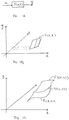
- FIG. 1A is a block diagram illustrating a signal model of a typical system.
- An input x is sent to system 100, which applies a function F to x to generate an output y. Since it is possible for the function to vary over time, F is also dependent on time t. In many systems, it is desirable for the system function F(x, t) to be linear.
- FIG. 1C is a 3-D diagram illustrating a typical nonlinear relationship.
- this nonlinear relationship changes over time, as illustrated by sample functions F1(x, t1), F2(x, t2), and F3(x, t3).
- the function y F(x, t) forms a nonlinear manifold. It is often useful to have filters that can implement this type of nonlinear functions. Many existing nonlinear filters, however, are complex, expensive, and unstable.
- US 2005/201457 A1 discloses systems and methods for very high throughput adaptive filtering using distributed arithmetic.
- a nonlinear adaptive filter includes interfaces for receiving an input signal and a target signal. It further includes an adaptive filter module that is configured to generate relative location information pertaining to a relative location of the input signal within a possible range of inputs.
- a thermometer code address generator is used to generate the relative location information.
- the relative location information is used to determine input dependent filter parameters.
- the relative location information includes a thermometer coded address vector, which is used to select input dependent filter parameters from a plurality of memory banks.
- the input dependent filter parameters include filter coefficients that are used to generate an output signal.
- a feedback signal is generated based at least in part on an output signal and the target signal. Stored input dependent filter parameters are adapted based on the feedback signal.
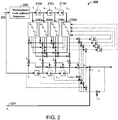
- FIG. 2 is a block diagram illustrating an embodiment of a nonlinear adaptive filter.
- the above nonlinear filter function has filter taps with coefficients ⁇ k that depend on the present input sample as well as previous input samples.
- each coefficient is implemented as a constant plus a nonlinear function of the signal.
- these coefficients are adaptable to achieve the desired filter response, such as a filter response that is a nonlinear function.
- nonlinear adaptive filter 200 includes a first input interface 202 on which an input digital signal x n is received, and a second input interface 204 on which the target signal ⁇ n is received.
- the filter adapts its coefficients so that its output ⁇ n tracks the target signal ⁇ n . In other words, the filter adapts until the difference between its output is ⁇ n and the target signal ⁇ n is within a predefined value.
- the values of filter coefficients ⁇ 0 , ⁇ 1 , ⁇ 2 , and ⁇ 3 each depend on the present input sample as well as past input samples (sometimes also referred to as delayed input samples or the input signal's history).
- the coefficient values are computed based at least in part on sums of selected, pre-stored values. In this example, the values are selected from appropriate storage locations within a plurality of memory banks.
- System 200 includes memory banks 206a, 206b, 206c, and 206d that correspond to filter taps 0, 1, 2, and 3, respectively. Although four memory banks are shown for purposes of example, the number of memory banks depends on the number of filter taps N and may vary in other embodiments.
- the memory banks may be implemented using one or more memory devices of any appropriate type, such as registers, buffers, DRAM, SRAM, etc.
- the memory banks represent the logical organization of memory used to store filter parameters.
- the memory banks are implemented using M physical memory devices where M does not necessarily correspond to N.
- all four memory banks shown in system 200 may be implemented using a single memory device such as a single EEPROM or RAM chip.
- Each set of values is implemented as a coefficient vector that includes S entries. The value of S depends on the granularity or precision of the nonlinear function being implemented.
- the nonlinear function is such that for all input values ⁇ min ⁇ x n-j ⁇ ⁇ 0 (where ⁇ min is the minimum expected input value, and ⁇ 0 is a predefined value), coefficient function ⁇ n-j ( x n-j ) maps to one set of vector values, and for all input values ⁇ 0 ⁇ x n-j ⁇ ⁇ max (where ⁇ max is the maximum expected input value), the coefficient function maps to another set of vector values, then the coefficient function is said to have a granularity of 2 and each set of coefficient vector includes two entries.
- ⁇ min is the minimum expected input value
- ⁇ 0 is a predefined value
- the possible inputs are divided into four subranges ⁇ min ⁇ x n-j ⁇ ⁇ 0 , ⁇ 0 ⁇ x n-j ⁇ ⁇ 1 , and ⁇ 1 ⁇ x n-j ⁇ ⁇ 2 , and ⁇ 2 ⁇ x n-j ⁇ ⁇ max , which map to four possible coefficient vectors ⁇ n-j ,0 , ⁇ n-j ,1 , ⁇ n-j, 2 , and ⁇ n - j ,3 , respectively.
- the coefficient function has a granularity of 4 and A memory bank therefore stores 4 coefficient vectors ⁇ n - j ,0 , ⁇ n-j ,1 , ⁇ n-j ,2 , and ⁇ n-j ,3 . More generally, if all the possible input values are divided into S subranges and each input subrange maps to a corresponding coefficient vector (i.e., a granularity of S), then each vector in the memory bank stores S entries.
- thermometer code address generator 208 is used to facilitate the selection of the appropriate coefficient vector from the memory banks.
- the thermometer code address generator indicates the relative location of the input signal within the range of possible input signals.
- the thermometer code address generator includes one or more comparators that compare the input with certain predefined subranges, and one or more multiplexers that map the output of the comparators to an appropriate address vector.
- the address vector indicates the relative location of the input signal within the possible input range. In some embodiments, the address vector has at most one sign change between any two adjacent entries.
- thermometer code address generator Based on the thermometer coder output, the set of values that corresponds to the fist positive location in vector x n-j is selected from the memory bank.
- the output of the thermometer code address generator is delayed by delay blocks 210b, 210c, and 210d. The delayed values are used to select the appropriate stored coefficient vectors from corresponding memory banks. At each filter tap n-j , selected values from the filter banks (the "sub-taps") are summed to generate the corresponding coefficient value ⁇ n-j .
- the thermometer code address generator directly determines which coefficient values in the memory bank should be selected.
- FIG. 3 is a diagram illustrating in greater detail an example implementation of memory banks 206a-206d of FIG. 2 .
- memory banks 206a-206d are implemented as four 4x4 matrices.
- Four rows of the matrices map to 4 input subranges, which are [-1, 0], (0, 1], (1, 2], and (2, 3].
- Each row is a vector with 4 entries.
- x n 1.2, which falls in the subrange of (1, 2], and corresponds to a thermometer code address generator output of [-1 -1 +1 +1].
- the second row of memory bank 206b ( ⁇ 1,1 ), the last row of memory bank 206c ( ⁇ 2,3 ), and the first row of memory bank 206d ( ⁇ 3,0 ) are selected accordingly.
- the corresponding entries from the selected rows are summed.
- the 0-th entries of the selected rows i.e., 11.3, 0.7, 2.0, 0.2
- 6.6, 1.4, 2.1, and 0.1 are the values selected and summed to generate coefficient ⁇ 1 , for tap 1, and so on.
- a target signal ⁇ n is received on interface 204. How the target signal is obtained depends on system configuration and is described in greater detail in FIGS. 10A-10C below.
- the output is subtracted from a target signal ⁇ n to obtain an error ⁇ n .
- the input signal is multiplied with the error as well as an update coefficient ⁇ , and the result is fed back to adapt the filter coefficients.
- the initial value of ⁇ is arbitrarily selected.
- ⁇ is continuously adjusted to adapt the filter coefficients and reduce output error, according to techniques such as least mean squared error (LMSE).
- LMSE least mean squared error
- the feedback loop for coefficients stored in memory bank 206d is illustrated in detail in FIG. 2 .
- input samples x n , x n-1 , x n-2 , and x n-3 are each multiplied with ⁇ ⁇ n .
- the results are delayed and added to the coefficient vector in memory bank 206d that is currently selected based on the current memory location of x n- 3 .
- the values in row [0.2 0.1 2.4 0.5] are updated based on the results of update function [6].
- the values in other selected rows of the other memory banks are also updated, although the feedback loops are omitted to keep the diagram clear.
- the feedback loops are sometimes omitted from the figures even though in practice the feedback loops are included and the same principles of feedback and update apply.
- a filter system similar to 200 is a cost effective way of implementing the theoretically optimal Volterra series expansion and as well as Weiner-Hammerstein models that include memory dispersion.
- ⁇ j,k ( x n-j ) can be expressed to arbitrary precision using an m th order polynomial of x n-j .
- a ⁇ k X n x n + x n 2 + x n 3 + x n 4 + x n 5 + x n ⁇ 1 + x n ⁇ 1 2 + x n ⁇ 1 3 + x n ⁇ 1 4 + x n ⁇ 1 5 + ⁇ x n ⁇ N + 1 + x n ⁇ N + 1 2 + x n ⁇ N + 1 3 + x n ⁇ N + 1 4 + x n ⁇ N + 1 5
- filter coefficient functions including construction functions such as Radial Basis Functions (RBF), cubic splines, or sinc functions are used to provide the coefficients.
- the construction functions include windowed interpolation functions that use weighting coefficients and distance from function origins to generate interpolation values.
- discrete sample values are summed to generate a smoothed approximation of a background function and values between sample points.
- the filter can be implemented using RBF components instead of implementing the polynomial of equation [7] as an actual polynomial structure or storing the coefficients in a lookup table.
- the number of centers L is chosen depending on the desired accuracy and the multiplication requirements.
- FIG. 4A is a block diagram illustrating another embodiment of a simplified adaptive nonlinear filter.
- each tap k corresponds to a polynomial function of the signal x n-j without multiplication with other cross terms.
- a ⁇ X n a ⁇ 0,0 x n a ⁇ 1,0 x n ⁇ 1 ⁇ a ⁇ N ⁇ 1,0 x n ⁇ N + 1
- each filter tap k implements a corresponding function ⁇ k of x n-k .
- Filter function [12] does not require any multiplication and is computationally inexpensive.
- Each input subrange k maps to a corresponding function ⁇ k ( x n-k ) .
- memory banks 406a-d in this example store functions that correspond to the subranges.
- thermometer code address generator 404 which generates an appropriate output vector according to equation [4].
- the vector is used to locate a value ⁇ 0.0 ( x n,j 0 ) in memory bank 406a that maps to the input, where j0 depends on the subrange in which the input is located.
- thermometer coded and delayed input samples are used to locate in memory banks 406b, 406c, and 406d function values ⁇ 1,0 ( x n -1, j 1 ), ⁇ 2,0 (x n- 2, j 2 ), and ⁇ 3,0 ( x n -3, j 3 ), respectively.
- FIG. 4B is a diagram illustrating in greater detail an example implementation of memory banks 406a-406d of FIG. 4A .
- memory banks 406a-406d are implemented as four 4x1 matrices. Values stored in rows that correspond to the thermometer coded input addresses are selected and summed.
- the selected values are summed to generate output ⁇ n . Since the function values are obtained by mapping the input to stored function values, multiplication is not required for generating the output. The output is subtracted from the target signal ⁇ n to obtain an error signal ⁇ n . The error signal is multiplied with update coefficient ⁇ , and the result is fed back to adapt the filter coefficients.
- FIG. 5 is a flowchart illustrating an embodiment of a process for operating an adaptive nonlinear filter.
- Process 500 may be implemented on an adaptive filter system such as 200 or 400, as well as other embodiments discussed below.
- an input signal and a target signal are received.
- a relative location of the input signal within a range of possible inputs is determined.
- a location vector is generated by the thermometer code address generator.
- the location vector indicates the relative location of the input signal, which corresponds to the subrange within which the input is located.
- one or more input dependent filter parameters are determined, using the relative location information of the input.
- filter coefficients are computed using vectors selected from memory banks, based on the relative location of the input.
- functions ⁇ k ( x n-k ) or their mapped values are selected from memory banks, based on the relative location of the input.
- an output signal is generated using the input dependent filter parameter.
- the output signal is generated by multiplying the filter coefficients with the input samples and summing the results.
- the output signal is generated by summing results of the functions selected from the memory banks.
- a feedback signal is generated and fed back to the system. The feedback signal is based at least in part on the output signal and the target signal.
- the feedback signal is used to update the coefficients stored in the memory banks.
- the feedback signal is used to update the functions or function values stored in the memory banks.
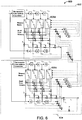
- FIG. 6 is a block diagram illustrating an embodiment of a cascaded nonlinear filter.
- Adaptive nonlinear filter 600 includes a first adaptive nonlinear filter 602, whose output is sent to the input of a second adaptive nonlinear filter 604.
- x n-j in equation [16] corresponds to vector ⁇ x n-j ⁇ x n-j-N +1 ⁇ , which has a length of N.
- the resulting cascaded filter function w n is a nonlinear function of [ x n ⁇ x n -2 N +1 ], which has a length of 2N-1.
- the cascaded filter of length 2N-1 requires less memory than a single uncascaded filter of length 2N.
- the input range is divided into S subranges, then 2NxS coefficients are required by a cascaded filter such as 600.
- a single uncascaded filter of length 2N would require 2Nx2NxS coefficient entries.
- the cascade filter comprising two length-N filters requires 1 ⁇ 2 of the amount of memory required by an uncascaded length-2N filter. More generally, a cascaded filters comprising L filter taps requires 1/L as much memory as an uncascaded filter of approximately the same length.
- the feedback loops of filters 602 and 604 are similar to the feedback loop shown in FIG. 2 . Only the feedback loops of memory banks 606d and 608d are illustrated in the diagram and the feedback loops of other memory banks are not shown.
- an adaptive nonlinear filter is configured to handle complex signals.
- FIG. 7 is a block diagram illustrating another embodiment of an adaptive nonlinear filter.
- adaptive nonlinear filter 700 includes a quadrature separator 702 that separates the signal into in-phase (I) and quadrature phase (Q) components.
- the adaptive nonlinear filter 700 further includes two adaptive filter modules in a parallel configuration for processing the I and Q components. I and Q components are sent to their respective respective thermometer code address generators.
- the coded output for signal x I n-j is used as a memory address for selecting a vector ⁇ I n-j ( x I n-j ) from memory banks 706a-d.
- the coded output for signal x Q n-j is used to select a vector ⁇ Q n-j ( x Q n-j ) from memory banks 708a-d.
- the outputs from I and Q branches ⁇ In and ⁇ Qn are combined by a quadrature combiner 704.
- ⁇ In and ⁇ Qn are subtracted from I and Q components of the target signal, ⁇ In and ⁇ Qn , respectively, to generate error signals ⁇ In and ⁇ Qn .
- the errors are fed back to update the stored coefficients.
- the feedback loops are similar to those of FIG. 2 and are not shown in the diagram.
- 2N multiplications are required to generate output term y I n and 2N additional multiplications are required for the updates associated with the memory banks storing the coefficients for the I component. Similarly, a total of 4N multiplications are also required to generate output term y Q n and to update the memory banks storing the coefficients for the Q component.
- the adaptive nonlinear filter is configured to handle even or odd harmonic distortions in the target signal. Whether a harmonic distortion is even or odd depends on the frequency location of the distortion relative to the desired signal, i.e. whether the distortion occurs at an even or an odd multiple of the desired frequency.
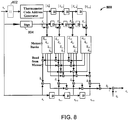
- FIGS. 8 and 9 are block diagrams illustrating embodiments of adaptive nonlinear filters that handle even and odd harmonic distortions, respectively.
- filters 800 and 900 each include an absolute value operator (802 and 902, respectively) coupled to their respective input terminals.
- Filters 800 and 900 further include sign operators 804 and 904, respectively.
- the sign operator extracts the sign of the input, outputting either -1 or 1.
- the sign of the input is multiplied with the thermometer code address, and the multiplication result is used as the address for selecting an appropriate coefficient vector from the corresponding memory bank.
- Delay elements and additional memory banks are included to provide coefficients for additional filter taps.
- selected values from the memory banks are summed to generate appropriate filter coefficients.
- odd harmonic filter 900 the selected values are multiplied with their corresponding sign values before they are summed to generate the filter coefficients.
- a converged output signal of 800 has even harmonics that are approximately equal to the even harmonics of the target signal, although its odd harmonics are not necessarily close to the odd harmonics of the target.
- the resulting output signal of 900 has odd harmonics that are approximately the same as the odd harmonics of the target signal, although its even harmonics are not necessarily the same as those of the target signal.
- an even harmonic filter and an odd harmonic filter are combined to form a composite filter that handles both even and odd harmonics.
- Components such as the absolute value operator, the thermometer code address generator, and the sign operator can be shared by the odd and even filter branches.
- Nonlinear adaptive filters are used in many applications.
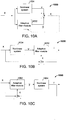
- FIGS. 10A-10C are block diagrams illustrating several example applications that employ nonlinear adaptive filters. Many other systems and configurations are possible.
- adaptive filter modules 1002, 1032, and 1062 may be implemented using any of the adaptive filter module embodiments described above. Modules 1002, 1032 and 1062 are coupled to nonlinear systems 1004, 1034, and 1064.
- the nonlinear systems can be any type of nonlinear system whose output signal y is a nonlinear function of input signal x, for example nonlinear channels such as communication channels with channel distortion, nonlinear components such as electrical and/or optical devices (e.g., amplifiers, transceivers) that process and/or propagate the input signals, or combinations thereof.
- nonlinear channels such as communication channels with channel distortion
- nonlinear components such as electrical and/or optical devices (e.g., amplifiers, transceivers) that process and/or propagate the input signals, or combinations thereof.
- one or more analog to digital converters and/or digital to analog converters are included with the nonlinear system to ensure compatibility between digital and analog components.
- the adaptive filter modules in the example systems and their corresponding feedback loops are configured differently depending on the functions performed.
- adaptive filter module 1002 performs a modeling function to model the function of nonlinear system 1004.
- input x of system 1004 is also sent to 1002 as the adaptive filter's input
- output y of system 1004 is sent to filter 1002 as the target signal.
- Adaptive filter module 1002 adapts its filter coefficients to drive its output ⁇ close to y, forming a filter whose filter function approximates the nonlinear function of system 1004.
- adaptive filter module 1002 continuously adapts its coefficients based on the feedback error signal ⁇ (which is the difference between nonlinear system 1004's output y and adaptive filter module 1002's output ⁇ ), until the error is less than or equal to a predetermined value ⁇ 0 .
- adaptive filter module 1032 performs post-distortion correction function to compensate for distortion previously introduced by nonlinear system 1034.
- the input signal of adaptive filter module 1032 is the output of system 1034, y .
- the target signal of adaptive filter module 1032 is the input to system 1034, x .
- Adaptive filter module 1032 adapts its coefficients, driving its output x ⁇ close to the target signal x .
- the filter function of adaptive filter module is approximately the inverse function of nonlinear system 1034, and distortions introduced by nonlinear system 1034 are corrected.
- adaptive filter module 1062 performs pre-distortion correction function to compensate for distortion that is later introduced by nonlinear system 1064.
- the input signal to adaptive filter module 1062 is the same as the input to the entire system, x .
- the output of the adaptive filter module is the input to nonlinear system 1064.
- the target signal to the adaptive filter module is the output of nonlinear system 1064, x ⁇ .
- Adaptive filter module 1062 adapts its coefficients to drive the output of nonlinear system 1064 x ⁇ close to the input signal x. Since the filter function of adaptive filter module is approximately the inverse of nonlinear system 1064's filter function, the output signal y is pre-compensated before it is sent to nonlinear system 1064, and distortions introduced by the nonlinear system are corrected.
- Adaptive nonlinear filtering has been described.
- the technique allows nonlinear filter functions to be implemented using relatively simple elements such as memory banks and/or arithmetic operators, and has relatively inexpensive computational requirements.
Landscapes
- Physics & Mathematics (AREA)
- Nonlinear Science (AREA)
- Filters That Use Time-Delay Elements (AREA)
Claims (16)
- Système de filtrage non linéaire adaptatif mettant en œuvre une fonction de filtre non linéaire ayant N prises de filtres, le système comprenant :une première interface (201) conçue pour recevoir un signal d'entrée ;une seconde interface (204) conçue pour recevoir un signal cible ;un module de filtre adaptatif comprenant :une pluralité de N banques de mémoire, chacune correspondant à une des N prises de filtres, chacune des banques de mémoire stockant un ensemble de vecteurs de coefficients qui comprend une pluralité de S entrées,un générateur d'adresses de code de thermomètre couplé à la première interface et conçu pour diviser une plage possible de valeurs du signal d'entrée en S sous-plages, le nombre de S sous-plages dépendant d'une granularité de la fonction non linéaire, etune boucle de rétroaction, la boucle de rétroaction et le générateur d'adresses de code de thermomètre sont tous les deux couplés aux banques de mémoire,le module de filtre adaptatif étant conçu pour :générer, par le générateur d'adresses de code de thermomètre, des informations de localisation relatives appartenant à une localisation relative d'une valeur du signal d'entrée au sein de ladite plage possible, les informations de localisation relatives étant utilisées pour sélectionner un vecteur de coefficient approprié à partir de chacune des banques de mémoire ;déterminer un paramètre de filtre dépendant de l'entrée basé au moins en partie sur les informations de localisation relatives ;générer, à l'aide du vecteur de coefficient approprié à partir des banques de mémoire, un signal de sortie basé au moins en partie sur le paramètre de filtre dépendant de l'entrée ; etretourner, par la boucle de rétroaction, un signal de rétroaction, en vue de mettre à jour les banques de mémoire, qui est généré sur la base, au moins en partie, du signal de sortie et du signal cible.
- Système selon la revendication 1, dans lequel le module de filtre adaptatif est conçu en outre pour :générer des informations de localisation relatives retardées appartenant à une localisation relative d'un signal d'entrée retardé dans une plage d'entrée ; etdans lequel le paramètre de filtre dépendant de l'entrée est déterminé sur la base en outre au moins en partie des informations de localisation relatives retardées.
- Système selon la revendication 1, dans lequel le paramètre de filtre dépendant de l'entrée comprend une valeur de coefficient de filtre.
- Système selon la revendication 1, dans lequel le module de filtre adaptatif est conçu en outre pour :générer des informations de localisation relatives retardées appartenant à une localisation relative d'un signal d'entrée retardé dans ladite plage possible ; etdans lequel déterminer le paramètre de filtre dépendant de l'entrée comprend :la sélection d'une première valeur à partir d'une première de la pluralité des N banques de mémoire à l'aide des informations de localisation relatives ;la sélection d'une seconde valeur à partir d'une seconde de la pluralité des N banques de mémoire à l'aide des informations de localisation relatives retardées ; etl'ajout de la première valeur et de la seconde valeur.
- Système selon la revendication 4, dans lequel le paramètre de filtre dépendant de l'entrée comprend un coefficient de filtre qui dépend au moins en partie d'une somme de la première valeur et de la seconde valeur.
- Système selon la revendication 4, dans lequel :le paramètre de filtre dépendant de l'entrée est un premier paramètre de filtre dépendant de l'entrée ;la détermination du premier paramètre de filtre dépendant de l'entrée comprend la sélection d'une première fonction à partir d'une première de la pluralité de banques de mémoire à l'aide des informations de localisation relatives ;le module de filtre adaptatif est conçu en outre pour :
déterminer un second paramètre de filtre dépendant de l'entrée, y compris en sélectionnant une seconde fonction à partir d'une seconde de la pluralité de banques de mémoire à l'aide des informations de localisation relatives retardées. - Système selon la revendication 6, dans lequel le signal de sortie est généré sur la base au moins en partie d'une somme des premier et second paramètres de filtre dépendant de l'entrée.
- Système selon la revendication 1, dans lequel le module de filtre adaptatif est un premier module de filtre adaptatif, et le système comprend en outre un second module de filtre adaptatif qui est couplé au premier module de filtre adaptatif dans une configuration en cascade.
- Système selon la revendication 1, dans lequel le signal d'entrée est une composante en phase (l) d'un signal reçu.
- Système selon la revendication 9, dans lequel le module de filtre adaptatif est un premier module de filtre adaptatif conçu pour traiter le composant l, et le système comprend en outre un second module de filtre adaptatif conçu en parallèle avec le premier module de filtre adaptatif pour traiter une composante de phase en quadrature (Q) du signal reçu.
- Système selon la revendication 1, dans lequel le module de filtre adaptatif comprend en outre un opérateur de valeur absolue couplé au générateur d'adresses de code de thermomètre, ou un opérateur de signe.
- Système selon la revendication 1, dans lequel le signal de sortie comprend des harmoniques impaires qui sont approximativement égales aux harmoniques impaires du signal cible, ou comprend des harmoniques paires qui sont approximativement égales aux harmoniques paires du signal cible.
- Système selon la revendication 1, dans lequel :le signal d'entrée est un signal d'entrée d'un système non linéaire ;le signal cible est un signal de sortie du système non linéaire ; etle système de filtrage non linéaire adaptatif est conçu pour modéliser le système non linéaire.
- Système selon la revendication 1, dans lequel :le signal d'entrée est un signal de sortie d'un système non linéaire ;le signal cible est un signal d'entrée du système non linéaire ; etle système de filtrage non linéaire adaptatif est conçu pour exécuter une correction post-distorsion sur le système non linéaire.
- Système selon la revendication 1, dans lequel :le signal de sortie est une entrée d'un système non linéaire ;le signal cible est une sortie du système non linéaire ; etle système de filtrage non linéaire adaptatif est conçu pour exécuter une correction de pré-distorsion sur le système non linéaire.
- Procédé de traitement de signal non linéaire adaptatif mettant en œuvre une fonction de filtre non linéaire ayant N prises de filtres, le procédé comprenant :la réception d'un signal d'entrée et d'un signal cible ;la génération, par un générateur d'adresses de code de thermomètre, d'informations de localisation relatives appartenant à une localisation relative du signal d'entrée dans une plage d'entrée en divisant la plage d'entrée en S sous-plages, le nombre de S sous-plages dépendant d'une granularité de la fonction non linéaire, et les informations de localisation relatives étant utilisées pour sélectionner un vecteur approprié parmi des vecteurs de coefficients à partir de chaque banque d'une pluralité de N banques de mémoire, chacune correspondant à une des N prises de filtres, chaque banque de mémoire stockant un ensemble de vecteurs de coefficients qui comprend une pluralité de S entrées ;la détermination d'un paramètre de filtre dépendant de l'entrée basée au moins en partie sur les informations de localisation relatives ;la génération, à l'aide des vecteurs de coefficients à partir des banques de mémoire, d'un signal de sortie basé au moins en partie sur le paramètre de filtre dépendant de l'entrée ; etle retour d'un signal de rétroaction, en vue de mettre à jour les banques de mémoire, qui est généré sur la base, au moins en partie, du signal de sortie et du signal cible.
Applications Claiming Priority (2)
| Application Number | Priority Date | Filing Date | Title |
|---|---|---|---|
| US99805707P | 2007-10-04 | 2007-10-04 | |
| PCT/US2008/011334 WO2009045414A1 (fr) | 2007-10-04 | 2008-09-30 | Système et procédé pour un filtrage non linéaire adaptatif |
Publications (3)
| Publication Number | Publication Date |
|---|---|
| EP2201675A1 EP2201675A1 (fr) | 2010-06-30 |
| EP2201675A4 EP2201675A4 (fr) | 2017-10-11 |
| EP2201675B1 true EP2201675B1 (fr) | 2020-01-08 |
Family
ID=40526525
Family Applications (1)
| Application Number | Title | Priority Date | Filing Date |
|---|---|---|---|
| EP08836359.3A Active EP2201675B1 (fr) | 2007-10-04 | 2008-09-30 | Système et procédé pour un filtrage non linéaire adaptatif |
Country Status (3)
| Country | Link |
|---|---|
| EP (1) | EP2201675B1 (fr) |
| CN (1) | CN101889389B (fr) |
| WO (1) | WO2009045414A1 (fr) |
Families Citing this family (2)
| Publication number | Priority date | Publication date | Assignee | Title |
|---|---|---|---|---|
| US9590668B1 (en) * | 2015-11-30 | 2017-03-07 | NanoSemi Technologies | Digital compensator |
| CN113078884B (zh) * | 2021-03-15 | 2023-06-20 | 武汉理工大学 | 添加非线性拟合的自适应算法 |
Family Cites Families (9)
| Publication number | Priority date | Publication date | Assignee | Title |
|---|---|---|---|---|
| JP3671426B2 (ja) * | 1993-07-23 | 2005-07-13 | ソニー株式会社 | 信号処理システムとその方法 |
| US5775293A (en) * | 1996-10-01 | 1998-07-07 | Cummins Engine Co., Inc. | Electronic throttle pedal nonlinear filter |
| US6934655B2 (en) * | 2001-03-16 | 2005-08-23 | Mindspeed Technologies, Inc. | Method and apparatus for transmission line analysis |
| US6856191B2 (en) * | 2003-02-21 | 2005-02-15 | Optichron, Inc. | Nonlinear filter |
| US6885323B2 (en) * | 2003-06-27 | 2005-04-26 | Optichron, Inc. | Analog to digital converter with distortion correction |
| US20050201457A1 (en) * | 2004-03-10 | 2005-09-15 | Allred Daniel J. | Distributed arithmetic adaptive filter and method |
| US20060061493A1 (en) * | 2004-09-22 | 2006-03-23 | Larson Lee A | Apparatus and method for assigning circuit card base addresses using thermometer codes |
| CA2540936A1 (fr) * | 2005-03-24 | 2006-09-24 | Hamid Shokrollah Timorabadi | Methode et systeme pour la synchronisation a gamme etendue en fonction de signaux de courant alternatif |
| CN100563225C (zh) * | 2005-05-27 | 2009-11-25 | 华为技术有限公司 | 对基带数字信号进行预失真处理的通用装置 |
-
2008
- 2008-09-30 CN CN200880114456.3A patent/CN101889389B/zh not_active Expired - Fee Related
- 2008-09-30 EP EP08836359.3A patent/EP2201675B1/fr active Active
- 2008-09-30 WO PCT/US2008/011334 patent/WO2009045414A1/fr not_active Ceased
Non-Patent Citations (1)
| Title |
|---|
| None * |
Also Published As
| Publication number | Publication date |
|---|---|
| EP2201675A4 (fr) | 2017-10-11 |
| EP2201675A1 (fr) | 2010-06-30 |
| CN101889389A (zh) | 2010-11-17 |
| WO2009045414A1 (fr) | 2009-04-09 |
| CN101889389B (zh) | 2014-04-02 |
| HK1147606A1 (en) | 2011-08-12 |
Similar Documents
| Publication | Publication Date | Title |
|---|---|---|
| Guo et al. | Two high-performance adaptive filter implementation schemes using distributed arithmetic | |
| US20050201457A1 (en) | Distributed arithmetic adaptive filter and method | |
| CN111108685B (zh) | 无线电传输器中的多相数字信号预失真 | |
| CN100544203C (zh) | 非线性滤波器 | |
| US5416799A (en) | Dynamically adaptive equalizer system and method | |
| US5255216A (en) | Reduced hardware look up table multiplier | |
| US8380773B2 (en) | System and method for adaptive nonlinear filtering | |
| US6590931B1 (en) | Reconfigurable FIR filter using CSD coefficient representation | |
| US7046723B2 (en) | Digital filter and method for performing a multiplication based on a look-up table | |
| US6574649B2 (en) | Efficient convolution method and apparatus | |
| EP2201675B1 (fr) | Système et procédé pour un filtrage non linéaire adaptatif | |
| US12250013B2 (en) | System and method for digital predistortion | |
| CN101061473B (zh) | 低复杂度非线性滤波器 | |
| US7450659B2 (en) | Digital modulator employing a polyphase up-converter structure | |
| JP5160712B2 (ja) | 適応フィルタリング方法及び装置 | |
| US20080225937A1 (en) | Method and system of providing a high speed tomlinson-harashima precoder | |
| Eskritt et al. | A 2-digit DBNS filter architecture | |
| HK1147606B (en) | System and method for adaptive nonlinear filtering | |
| Naik et al. | An efficient reconfigurable FIR digital filter using modified distribute arithmetic technique | |
| EP1956707A1 (fr) | Appareil et procédé d'interpolation d'un signal | |
| Bernocchi et al. | A hybrid RNS adaptive filter for channel equalization | |
| US7242326B1 (en) | Sample rate conversion combined with filter | |
| Chivapreecha et al. | Adaptive equalization architecture using distributed arithmetic for partial response channels | |
| Xu et al. | Polynomial implementation structure for Lagrange-type variable fractional delay filters | |
| Chivapreecha et al. | Distributed Arithmetic Adaptive Digital Filter Using FPGA |
Legal Events
| Date | Code | Title | Description |
|---|---|---|---|
| PUAI | Public reference made under article 153(3) epc to a published international application that has entered the european phase |
Free format text: ORIGINAL CODE: 0009012 |
|
| 17P | Request for examination filed |
Effective date: 20100427 |
|
| AK | Designated contracting states |
Kind code of ref document: A1 Designated state(s): AT BE BG CH CY CZ DE DK EE ES FI FR GB GR HR HU IE IS IT LI LT LU LV MC MT NL NO PL PT RO SE SI SK TR |
|
| AX | Request for extension of the european patent |
Extension state: AL BA MK RS |
|
| DAX | Request for extension of the european patent (deleted) | ||
| RAP1 | Party data changed (applicant data changed or rights of an application transferred) |
Owner name: NETLOGIC MICROSYSTEMS, INC. |
|
| RAP1 | Party data changed (applicant data changed or rights of an application transferred) |
Owner name: BROADCOM CORPORATION |
|
| REG | Reference to a national code |
Ref country code: DE Ref legal event code: R079 Ref document number: 602008061983 Country of ref document: DE Free format text: PREVIOUS MAIN CLASS: H03B0001000000 Ipc: H03H0021000000 |
|
| RAP1 | Party data changed (applicant data changed or rights of an application transferred) |
Owner name: AVAGO TECHNOLOGIES GENERAL IP (SINGAPORE) PTE. LTD |
|
| RA4 | Supplementary search report drawn up and despatched (corrected) |
Effective date: 20170908 |
|
| RIC1 | Information provided on ipc code assigned before grant |
Ipc: H03H 21/00 20060101AFI20170904BHEP |
|
| RAP1 | Party data changed (applicant data changed or rights of an application transferred) |
Owner name: AVAGO TECHNOLOGIES INTERNATIONAL SALES PTE. LIMITE |
|
| STAA | Information on the status of an ep patent application or granted ep patent |
Free format text: STATUS: EXAMINATION IS IN PROGRESS |
|
| 17Q | First examination report despatched |
Effective date: 20190104 |
|
| GRAP | Despatch of communication of intention to grant a patent |
Free format text: ORIGINAL CODE: EPIDOSNIGR1 |
|
| STAA | Information on the status of an ep patent application or granted ep patent |
Free format text: STATUS: GRANT OF PATENT IS INTENDED |
|
| INTG | Intention to grant announced |
Effective date: 20190701 |
|
| GRAS | Grant fee paid |
Free format text: ORIGINAL CODE: EPIDOSNIGR3 |
|
| GRAA | (expected) grant |
Free format text: ORIGINAL CODE: 0009210 |
|
| STAA | Information on the status of an ep patent application or granted ep patent |
Free format text: STATUS: THE PATENT HAS BEEN GRANTED |
|
| AK | Designated contracting states |
Kind code of ref document: B1 Designated state(s): AT BE BG CH CY CZ DE DK EE ES FI FR GB GR HR HU IE IS IT LI LT LU LV MC MT NL NO PL PT RO SE SI SK TR |
|
| REG | Reference to a national code |
Ref country code: GB Ref legal event code: FG4D |
|
| REG | Reference to a national code |
Ref country code: CH Ref legal event code: EP |
|
| REG | Reference to a national code |
Ref country code: DE Ref legal event code: R096 Ref document number: 602008061983 Country of ref document: DE |
|
| REG | Reference to a national code |
Ref country code: IE Ref legal event code: FG4D |
|
| REG | Reference to a national code |
Ref country code: AT Ref legal event code: REF Ref document number: 1223946 Country of ref document: AT Kind code of ref document: T Effective date: 20200215 |
|
| REG | Reference to a national code |
Ref country code: NL Ref legal event code: MP Effective date: 20200108 |
|
| REG | Reference to a national code |
Ref country code: LT Ref legal event code: MG4D |
|
| PG25 | Lapsed in a contracting state [announced via postgrant information from national office to epo] |
Ref country code: PT Free format text: LAPSE BECAUSE OF FAILURE TO SUBMIT A TRANSLATION OF THE DESCRIPTION OR TO PAY THE FEE WITHIN THE PRESCRIBED TIME-LIMIT Effective date: 20200531 Ref country code: NO Free format text: LAPSE BECAUSE OF FAILURE TO SUBMIT A TRANSLATION OF THE DESCRIPTION OR TO PAY THE FEE WITHIN THE PRESCRIBED TIME-LIMIT Effective date: 20200408 Ref country code: LT Free format text: LAPSE BECAUSE OF FAILURE TO SUBMIT A TRANSLATION OF THE DESCRIPTION OR TO PAY THE FEE WITHIN THE PRESCRIBED TIME-LIMIT Effective date: 20200108 Ref country code: FI Free format text: LAPSE BECAUSE OF FAILURE TO SUBMIT A TRANSLATION OF THE DESCRIPTION OR TO PAY THE FEE WITHIN THE PRESCRIBED TIME-LIMIT Effective date: 20200108 Ref country code: NL Free format text: LAPSE BECAUSE OF FAILURE TO SUBMIT A TRANSLATION OF THE DESCRIPTION OR TO PAY THE FEE WITHIN THE PRESCRIBED TIME-LIMIT Effective date: 20200108 |
|
| PG25 | Lapsed in a contracting state [announced via postgrant information from national office to epo] |
Ref country code: SE Free format text: LAPSE BECAUSE OF FAILURE TO SUBMIT A TRANSLATION OF THE DESCRIPTION OR TO PAY THE FEE WITHIN THE PRESCRIBED TIME-LIMIT Effective date: 20200108 Ref country code: LV Free format text: LAPSE BECAUSE OF FAILURE TO SUBMIT A TRANSLATION OF THE DESCRIPTION OR TO PAY THE FEE WITHIN THE PRESCRIBED TIME-LIMIT Effective date: 20200108 Ref country code: IS Free format text: LAPSE BECAUSE OF FAILURE TO SUBMIT A TRANSLATION OF THE DESCRIPTION OR TO PAY THE FEE WITHIN THE PRESCRIBED TIME-LIMIT Effective date: 20200508 Ref country code: HR Free format text: LAPSE BECAUSE OF FAILURE TO SUBMIT A TRANSLATION OF THE DESCRIPTION OR TO PAY THE FEE WITHIN THE PRESCRIBED TIME-LIMIT Effective date: 20200108 Ref country code: GR Free format text: LAPSE BECAUSE OF FAILURE TO SUBMIT A TRANSLATION OF THE DESCRIPTION OR TO PAY THE FEE WITHIN THE PRESCRIBED TIME-LIMIT Effective date: 20200409 Ref country code: BG Free format text: LAPSE BECAUSE OF FAILURE TO SUBMIT A TRANSLATION OF THE DESCRIPTION OR TO PAY THE FEE WITHIN THE PRESCRIBED TIME-LIMIT Effective date: 20200408 |
|
| REG | Reference to a national code |
Ref country code: DE Ref legal event code: R097 Ref document number: 602008061983 Country of ref document: DE |
|
| PG25 | Lapsed in a contracting state [announced via postgrant information from national office to epo] |
Ref country code: EE Free format text: LAPSE BECAUSE OF FAILURE TO SUBMIT A TRANSLATION OF THE DESCRIPTION OR TO PAY THE FEE WITHIN THE PRESCRIBED TIME-LIMIT Effective date: 20200108 Ref country code: RO Free format text: LAPSE BECAUSE OF FAILURE TO SUBMIT A TRANSLATION OF THE DESCRIPTION OR TO PAY THE FEE WITHIN THE PRESCRIBED TIME-LIMIT Effective date: 20200108 Ref country code: ES Free format text: LAPSE BECAUSE OF FAILURE TO SUBMIT A TRANSLATION OF THE DESCRIPTION OR TO PAY THE FEE WITHIN THE PRESCRIBED TIME-LIMIT Effective date: 20200108 Ref country code: CZ Free format text: LAPSE BECAUSE OF FAILURE TO SUBMIT A TRANSLATION OF THE DESCRIPTION OR TO PAY THE FEE WITHIN THE PRESCRIBED TIME-LIMIT Effective date: 20200108 Ref country code: SK Free format text: LAPSE BECAUSE OF FAILURE TO SUBMIT A TRANSLATION OF THE DESCRIPTION OR TO PAY THE FEE WITHIN THE PRESCRIBED TIME-LIMIT Effective date: 20200108 Ref country code: DK Free format text: LAPSE BECAUSE OF FAILURE TO SUBMIT A TRANSLATION OF THE DESCRIPTION OR TO PAY THE FEE WITHIN THE PRESCRIBED TIME-LIMIT Effective date: 20200108 |
|
| PLBE | No opposition filed within time limit |
Free format text: ORIGINAL CODE: 0009261 |
|
| STAA | Information on the status of an ep patent application or granted ep patent |
Free format text: STATUS: NO OPPOSITION FILED WITHIN TIME LIMIT |
|
| REG | Reference to a national code |
Ref country code: AT Ref legal event code: MK05 Ref document number: 1223946 Country of ref document: AT Kind code of ref document: T Effective date: 20200108 |
|
| 26N | No opposition filed |
Effective date: 20201009 |
|
| PG25 | Lapsed in a contracting state [announced via postgrant information from national office to epo] |
Ref country code: AT Free format text: LAPSE BECAUSE OF FAILURE TO SUBMIT A TRANSLATION OF THE DESCRIPTION OR TO PAY THE FEE WITHIN THE PRESCRIBED TIME-LIMIT Effective date: 20200108 Ref country code: IT Free format text: LAPSE BECAUSE OF FAILURE TO SUBMIT A TRANSLATION OF THE DESCRIPTION OR TO PAY THE FEE WITHIN THE PRESCRIBED TIME-LIMIT Effective date: 20200108 |
|
| PG25 | Lapsed in a contracting state [announced via postgrant information from national office to epo] |
Ref country code: SI Free format text: LAPSE BECAUSE OF FAILURE TO SUBMIT A TRANSLATION OF THE DESCRIPTION OR TO PAY THE FEE WITHIN THE PRESCRIBED TIME-LIMIT Effective date: 20200108 Ref country code: PL Free format text: LAPSE BECAUSE OF FAILURE TO SUBMIT A TRANSLATION OF THE DESCRIPTION OR TO PAY THE FEE WITHIN THE PRESCRIBED TIME-LIMIT Effective date: 20200108 |
|
| PG25 | Lapsed in a contracting state [announced via postgrant information from national office to epo] |
Ref country code: MC Free format text: LAPSE BECAUSE OF FAILURE TO SUBMIT A TRANSLATION OF THE DESCRIPTION OR TO PAY THE FEE WITHIN THE PRESCRIBED TIME-LIMIT Effective date: 20200108 |
|
| REG | Reference to a national code |
Ref country code: CH Ref legal event code: PL |
|
| GBPC | Gb: european patent ceased through non-payment of renewal fee |
Effective date: 20200930 |
|
| REG | Reference to a national code |
Ref country code: BE Ref legal event code: MM Effective date: 20200930 |
|
| PG25 | Lapsed in a contracting state [announced via postgrant information from national office to epo] |
Ref country code: LU Free format text: LAPSE BECAUSE OF NON-PAYMENT OF DUE FEES Effective date: 20200930 |
|
| PG25 | Lapsed in a contracting state [announced via postgrant information from national office to epo] |
Ref country code: FR Free format text: LAPSE BECAUSE OF NON-PAYMENT OF DUE FEES Effective date: 20200930 |
|
| PG25 | Lapsed in a contracting state [announced via postgrant information from national office to epo] |
Ref country code: GB Free format text: LAPSE BECAUSE OF NON-PAYMENT OF DUE FEES Effective date: 20200930 Ref country code: IE Free format text: LAPSE BECAUSE OF NON-PAYMENT OF DUE FEES Effective date: 20200930 Ref country code: LI Free format text: LAPSE BECAUSE OF NON-PAYMENT OF DUE FEES Effective date: 20200930 Ref country code: CH Free format text: LAPSE BECAUSE OF NON-PAYMENT OF DUE FEES Effective date: 20200930 Ref country code: BE Free format text: LAPSE BECAUSE OF NON-PAYMENT OF DUE FEES Effective date: 20200930 |
|
| PG25 | Lapsed in a contracting state [announced via postgrant information from national office to epo] |
Ref country code: TR Free format text: LAPSE BECAUSE OF FAILURE TO SUBMIT A TRANSLATION OF THE DESCRIPTION OR TO PAY THE FEE WITHIN THE PRESCRIBED TIME-LIMIT Effective date: 20200108 Ref country code: MT Free format text: LAPSE BECAUSE OF FAILURE TO SUBMIT A TRANSLATION OF THE DESCRIPTION OR TO PAY THE FEE WITHIN THE PRESCRIBED TIME-LIMIT Effective date: 20200108 Ref country code: CY Free format text: LAPSE BECAUSE OF FAILURE TO SUBMIT A TRANSLATION OF THE DESCRIPTION OR TO PAY THE FEE WITHIN THE PRESCRIBED TIME-LIMIT Effective date: 20200108 |
|
| PGFP | Annual fee paid to national office [announced via postgrant information from national office to epo] |
Ref country code: DE Payment date: 20250910 Year of fee payment: 18 |