EP2201689B1 - Quantisierer, analog-digital-umsetzer mit einem solchen quantisierer und einen solchen umsetzer integrierender ultrabreitbandempfänger - Google Patents
Quantisierer, analog-digital-umsetzer mit einem solchen quantisierer und einen solchen umsetzer integrierender ultrabreitbandempfänger Download PDFInfo
- Publication number
- EP2201689B1 EP2201689B1 EP08841432A EP08841432A EP2201689B1 EP 2201689 B1 EP2201689 B1 EP 2201689B1 EP 08841432 A EP08841432 A EP 08841432A EP 08841432 A EP08841432 A EP 08841432A EP 2201689 B1 EP2201689 B1 EP 2201689B1
- Authority
- EP
- European Patent Office
- Prior art keywords
- quantizer
- output
- amplifier
- input
- amplifier stage
- Prior art date
- Legal status (The legal status is an assumption and is not a legal conclusion. Google has not performed a legal analysis and makes no representation as to the accuracy of the status listed.)
- Not-in-force
Links
- 238000013139 quantization Methods 0.000 claims description 54
- 238000005070 sampling Methods 0.000 claims description 18
- 238000012545 processing Methods 0.000 claims description 13
- 238000001914 filtration Methods 0.000 claims description 11
- 230000006835 compression Effects 0.000 claims description 5
- 238000007906 compression Methods 0.000 claims description 5
- 230000003321 amplification Effects 0.000 description 25
- 238000003199 nucleic acid amplification method Methods 0.000 description 25
- 235000021183 entrée Nutrition 0.000 description 16
- 230000005540 biological transmission Effects 0.000 description 14
- 238000011002 quantification Methods 0.000 description 7
- 238000006243 chemical reaction Methods 0.000 description 5
- 230000003071 parasitic effect Effects 0.000 description 5
- 238000011084 recovery Methods 0.000 description 5
- 239000003990 capacitor Substances 0.000 description 4
- 238000013461 design Methods 0.000 description 4
- 238000001514 detection method Methods 0.000 description 4
- 230000004044 response Effects 0.000 description 4
- 230000001427 coherent effect Effects 0.000 description 3
- 230000001276 controlling effect Effects 0.000 description 3
- 230000001934 delay Effects 0.000 description 3
- 230000000694 effects Effects 0.000 description 3
- 239000011159 matrix material Substances 0.000 description 3
- 238000012546 transfer Methods 0.000 description 3
- 230000008901 benefit Effects 0.000 description 2
- 238000005265 energy consumption Methods 0.000 description 2
- 230000009467 reduction Effects 0.000 description 2
- 230000000630 rising effect Effects 0.000 description 2
- 229920006395 saturated elastomer Polymers 0.000 description 2
- 238000001228 spectrum Methods 0.000 description 2
- 230000001360 synchronised effect Effects 0.000 description 2
- 230000002123 temporal effect Effects 0.000 description 2
- 238000011144 upstream manufacturing Methods 0.000 description 2
- 101100322245 Caenorhabditis elegans des-2 gene Proteins 0.000 description 1
- 239000000872 buffer Substances 0.000 description 1
- 230000008859 change Effects 0.000 description 1
- 230000003111 delayed effect Effects 0.000 description 1
- 239000006185 dispersion Substances 0.000 description 1
- 238000000605 extraction Methods 0.000 description 1
- 230000004907 flux Effects 0.000 description 1
- 238000000034 method Methods 0.000 description 1
- 230000001105 regulatory effect Effects 0.000 description 1
Images


Classifications
-
- H—ELECTRICITY
- H03—ELECTRONIC CIRCUITRY
- H03M—CODING; DECODING; CODE CONVERSION IN GENERAL
- H03M1/00—Analogue/digital conversion; Digital/analogue conversion
- H03M1/12—Analogue/digital converters
- H03M1/34—Analogue value compared with reference values
-
- H—ELECTRICITY
- H03—ELECTRONIC CIRCUITRY
- H03M—CODING; DECODING; CODE CONVERSION IN GENERAL
- H03M1/00—Analogue/digital conversion; Digital/analogue conversion
- H03M1/12—Analogue/digital converters
- H03M1/1235—Non-linear conversion not otherwise provided for in subgroups of H03M1/12
-
- H—ELECTRICITY
- H03—ELECTRONIC CIRCUITRY
- H03M—CODING; DECODING; CODE CONVERSION IN GENERAL
- H03M1/00—Analogue/digital conversion; Digital/analogue conversion
- H03M1/12—Analogue/digital converters
- H03M1/124—Sampling or signal conditioning arrangements specially adapted for A/D converters
- H03M1/1245—Details of sampling arrangements or methods
- H03M1/125—Asynchronous, i.e. free-running operation within each conversion cycle
Definitions
- the present invention relates to the field of quantization of analog signals, and more particularly the high speed quantization of analog signals.
- the present application finds application in particular in the reception of data transmitted in the form of a radiofrequency wave, and particularly in a reception of ultra-wide band type.
- Some applications such as radiofrequency data transmission, require very high speed analog-to-digital conversion of up to several megabytes per second.
- analog-to-digital converters or ADCs
- flash type analog-to-digital converters, or ADCs
- the principle of such an ADC is to compare the signal to be converted to as many different voltages as there are no desired conversions.
- FIG. figure 1 An example of an N-bit flash ADC is schematically illustrated in FIG. figure 1 under the general reference 10.
- This CAN includes 2 N -1 voltage comparators VS 1 1 , VS 2 1 , VS 3 1 , ... , VS 2 NOT - 1 1 , an amplifier G 1 , and 2 N -2 resistors R 1 1 , R 2 1 , R 3 1 , ... , R 2 NOT - 1 1 connected in series between a reference voltage V ref and ground.
- the voltage amplifier G 1 receives an input and amplifies a voltage V in to be quantized and sampled, and is connected at the output to each of the positive inputs (+) of the comparators VS 1 1 , VS 2 1 , VS 3 1 , ... , VS 2 NOT - 1 1 to whom it delivers the amplified voltage V amp ⁇
- the 2 N -2 resistors R 1 1 , R 2 1 , R 3 1 , ... , R 2 NOT - 1 1 are of identical value R and form a voltage divider bridge defining 2 N -2 voltages V 2 , V 3 , ..., V 2 N -1 .
- the first comparator VS 1 1 has its negative (-) terminal connected to the voltage Vref and the other comparators VS 2 1 , VS 3 1 , ... , VS 2 NOT - 1 1 have their negative (-) terminal respectively connected to the voltages V 2 , V 3 , ..., V 2 N -1 .
- the outputs of the comparators VS 1 1 , VS 2 1 , VS 3 1 , ... , VS 2 NOT - 1 1 thus define the quantized binary values Q 1 , Q 2 , Q 3 , Q 2 N -1 of the flash ADC.
- comparators VS 1 1 , VS 2 1 , VS 3 1 , ... , VS 2 NOT - 1 1 are synchronous, that is to say they deliver the result of their comparison on the rising or falling edges of a sampling clock H.
- the flash CAN quantifies the signal V in with a constant quantization step while simultaneously sampling it at the frequency of the clock signal H.
- the signal V in needs to be amplified in amplitude in order to make the best use of the dynamic range of the ADC. There is thus biased amplification at each comparator. Indeed, considering this linear ADC, it can be considered that the amplification by the amplifier G 1 is equivalent to a reduction, by the gain of the amplifier G 1 , of all the threshold voltages V 1 , V 2 , V 3 , ..., V 2 N -1 .
- the amplification of the signal V in can thus be seen as included in the comparison function itself, that is to say a comparison including an amplification biased by the presence of the threshold voltages.
- the signal to be quantized V in also needs to be amplified in power, in order to load in parallel the 2 N -1 comparators.
- the amplifier C 1 must be powerful, linear, and low noise.
- a large amplification must be carried out in a single stage. All of these constraints make the design of the amplifier G 1 difficult and in the best case results in a large energy-consuming amplifier.
- the document US-A-760 730 discloses a synchronous quantizer comprising signal amplification stages arranged in series, the input of the first stage being able to receive the signal to be quantized, and comparators, a comparator being connected to the output of each amplifier stage and able to compare the value from this output to a predetermined threshold value. According to this document, the outputs of the comparators are provided to a latch latch register whose output defines the quantized bit value.
- the purpose of the present invention is to solve the aforementioned problems by proposing an energy-efficient quantizer, which allows a quantization comparable to that of the flash ADCs, in particular as regards the speed of quantization.
- the amplification being simultaneous with the quantization, it is not necessary to provide an amplification upstream of the quantizer to ensure that the dynamics of the quantizer is effectively fully exploited.
- its gain can be advantageously chosen between 1 and 2, knowing that amplifiers having such a gain are of simple design and reduced consumption.
- the quantizer comprises one or more of the following features.
- the absolute value of the gain of an amplifier stage is between about 1 and about 2. Thus, it is used low gain amplifiers that are energy efficient and simple to design.
- the gains of the amplifier stages are substantially identical. In such a case, a quantization with logarithmic compression is obtained, which is advantageous in the case of signals having a large dynamic.
- the absolute value of the gain of an amplifier stage, except the first, is substantially equal to i / (i-1) * G1, where G1 is the gain of the first amplifier stage and i the position of the amplifier stage in the series amplifier stages. It is thus obtained a quantization with constant pitch amplitudes between two consecutive amplifying stages. We thus find the quantization usually implemented in flash ADCs.
- the gain of the amplifier stages is negative. In this way, it is possible to perform, simultaneously with the quantization, a recovery of the signal to be quantized. In addition, it is possible to use inverters, which are components that are simple to design and that consume little energy.
- An amplifier stage is also arranged to filter the DC component of the signal to be quantized. This is particularly useful in the case where the signal to be quantified theoretically has a zero DC component. Thus, a filtering of a parasitic continuous shift is performed. This is for example achieved by means of the gain of the amplifier stage which is chosen to be substantially zero at low frequencies.
- Each amplifier stage is of the automatic gain control type. In this way, it is ensured that the quantization is done over the entire dynamics of the signal V in . This is particularly interesting in the case of an RF reception to adapt to the power of the received signal.
- the quantizer further comprises a digital processing module able to apply an "OR" function to each pair of consecutive outputs of the delay lines, the result of the "OR” function forming a quantized binary value.
- the quantizer thus simultaneously implements a quantization and a recovery.
- the last floor provides the sign of the signal to be quantized.
- the continuous value of the second impedance is substantially greater than the continuous value of the first impedance, so as to filter the DC component and ensure that a continuous offset, for example introduced by the components of the quantizer, does not propagate along the amplification chain.
- the first impedance is that defined between the drain and the source of a MOS transistor. It is thus possible to simply control the gain of the amplifier stage by controlling the voltage applied to the gate of the MOS transistor. It is then possible to provide means for automatically controlling the gain of the amplifier stage by appropriate control of this gate voltage.
- the threshold value can be unique for all comparators. It is thus possible to choose identical comparators for the quantizer and thus reduce the risks of dispersion of the characteristics of the quantizer components.
- the properties of the quantization quantization dynamics, logarithmic compression, constant pitch, etc. are mainly fixed by the choice of the gains of the amplifier stages
- the binary decision module comprises a hysteresis discriminator. In this way, the quantized values are correctly saturated.
- the quantizer may further comprise a filter module connected to the output of the binary decision module for eliminating pulses of less duration than a predetermined duration. This results in a noise reduction as well as a better behavior of the quantization at high frequencies.
- the quantizer comprises a delay line connected to the output of each comparator, the delay lines being arranged to deliver the output of the comparators substantially at the same time.
- each delay line comprises 2 N -1 -i substantially identical delay cells, where i is the position of the amplifier stage associated with the line in the series of amplifier stages.
- the quantizer may also comprise, at the beginning or at the end of the series of amplifier stages, an additional amplifier stage, and an additional comparator connected to the output of the additional amplifier stage, and able to compare the output thereof with the null value to determine the sign of the signal to be quantified.
- Another subject of the present invention is an N-bit analog-digital converter comprising a quantizer of the aforementioned type and a sampler connected to the quantizer, and capable of sampling the signals that it receives as input.
- the quantization function is dissociated from the sampling function, which results from the architecture of the quantizer which is inherently asynchronous. It is thus possible to apply everything Asynchronous digital processing deemed useful for the quantized signal before sampling.
- the converter has one or more of the following features.
- the converter may include a digital processing module connected between the quantizer and the sampler.
- the invention also relates to an ultra-wide band receiver comprising a converter of the aforementioned type.
- an N-bit voltage quantizer 20 comprises 2 N -1 quantization stages E 1 2 - E 2 NOT - 1 2 arranged in series.
- Voltage amplifiers BOY WUT 1 2 - BOY WUT 2 NOT - 1 2 are connected in series, the first BOY WUT 1 2 of them receiving a voltage to be quantized V in .
- the outputs of delay cells D 1 2 - D 2 NOT - 1 2 form the quantized binary values Q 1 -Q 2 NOT -1 of the quantizer 20 to N bits.
- Their delay is selected to compensate for the delay accumulating along the amplification chain formed by the amplifiers BOY WUT 1 2 - BOY WUT 2 NOT - 1 2 , so that the binary values Q 1 -Q 2 NOT -1 be temporally adjusted at the same time, and thus obtain temporal coherence for them.
- D 1 2 - D 2 NOT - 1 2 constituting the quantized bit values corresponding to the input signal with a time offset corresponding to the propagation time through the quantizer.
- last delay cell D 2 NOT - 1 2 is optional, as in the example relating to figure 23 hereinafter described.
- the quantizer 20 also comprises a stage 22 for determining the sign of the voltage V in .
- the stage 22 comprises an amplifier 24, arranged in series with the amplifier BOY WUT 2 NOT - 1 2 the last quantization stage E 2 NOT - 1 2 .
- the stage 22 further comprises a comparator 26, connected by its positive input (+) to the output of the amplifier 24, and receiving on its negative input (-) a zero voltage, the output of the comparator 26 thus giving the sign of the voltage V in .
- quantification with logarithmic compression is performed by choosing for the amplifiers gains BOY WUT 1 2 - BOY WUT 2 NOT - 1 2 a predetermined single value G.
- the voltage V in is quantified according to the scale of values V th BOY WUT 2 NOT - 1 ... V th BOY WUT 3 V th BOY WUT 2 V th BOY WUT .
- This variant is for example useful in an application to the quantization of a signal having a large dynamic.
- a quantization with a constant pitch amplitude is performed by choosing for each amplifier BOY WUT 2 2 - BOY WUT 2 NOT - 1 2 from the second position in the amplification chain a gain substantially equal to i i - 1 , where i is the position of the amplifier in this chain.
- the voltage V in is quantified according to the scale of values V th 2 NOT - 1 ⁇ BOY WUT 1 ... V th 3 ⁇ BOY WUT 1 V th 2 ⁇ BOY WUT 1 V th BOY WUT 1 , where G 1 is the gain of the first amplifier BOY WUT 1 2 in the amplification chain.
- the Figures 3 and 4 illustrate the quantification implemented by the classic CAN flash of the figure 1 .
- the time evolution of the amplified voltage G ⁇ V in at the output of the amplifier G 1 is represented, as well as the first four threshold voltages V 1 , V 2 , V 3 and V 4 .
- the figure 4 illustrates the corresponding temporal evolution of the first four quantized values Q 1 , Q 2 , Q 3 and Q 4 at the output of the first four comparators VS 1 1 , VS 2 1 , VS 3 1 , VS 4 1 .
- the Figures 5 and 6 illustrate the quantization with constant pitch amplitude implemented by the quantizer of the figure 2 also for the first four quantized values Q 1 , Q 2 , Q 3 and Q 4 .
- the gains of the amplifiers BOY WUT 1 2 - BOY WUT 2 NOT - 1 2 from the second amplifier BOY WUT 2 2 are strictly between 1 and 2.
- the gain of the first amplifier BOY WUT 1 2 can be equal to 1
- the gains of the amplifiers BOY WUT 1 2 - BOY WUT 2 NOT - 1 2 are selected according to the particular application for which the quantizer is intended.
- the amplifiers have a non-zero gain only in the expected frequency band of the voltage V in .
- the amplifiers gains BOY WUT 1 2 - BOY WUT 2 NOT - 1 2 are of the high-pass or band-pass type, so as to filter the low frequencies.
- a first embodiment 70 of an amplifier BOY WUT 1 2 - BOY WUT 2 NOT - 1 2 is illustrated at the figure 7 .
- the feedback by means of the impedance 74 has the effect of adjusting the gain of the amplifier 70 accurately. Indeed, the gain adjustment is more accurate using the passive component that is the impedance 74 with the help of an active component.
- the values Z 1 and Z 2 of the impedances 72 and 74 are furthermore selected to shape the frequency response of the amplifier 70, for example as a function of the frequency band of the voltage to be quantized V in , as has been mentioned above.
- the values Z 1 and Z 2 are also chosen so that the transfer function of the amplifier 70 is of the high-pass type, so as not to amplify a parasitic continuous offset V offset which can appear between the positive terminals (+ ) and negative (-) of the differential amplifier 72.
- V offset a parasitic continuous offset
- the value of Z 2 is substantially greater than the value of Z 1 .
- the impedance 76 is a resistor, and the impedance 74 is formed of a resistor in parallel with an inductor, or the impedance 74 is a resistor and the impedance 76 is formed of a series resistor with a capacitor.
- a resistor When a resistor is chosen for one and / or the other of the impedances 74 and 76, it is preferably implemented in the form of the resistance between the drain and the source of a MOS transistor. The value of this resistance, and therefore that of the gain of the amplifier 70, can thus be adjusted by the voltage applied to the gate of the MOS transistor.
- a gain control is also implemented by controlling this gate voltage.
- the figure 8 is a schematic view of a second embodiment 80 of an amplifier BOY WUT 1 2 - BOY WUT 2 NOT - 1 2 .
- the amplifier 80 comprises two identical amplification cells 82, 84 arranged in series.
- Each cell 82, 84 comprises an inverter 820, 840 of gain A, the output of which forms the latter.
- the cell 82, 84 also comprises a first impedance 822, 842 of value Z 1 , connected between the input and the output of the inverter 820, 840, and a second impedance 824, 844 of value Z 2 , connected to the one of its terminals to the input of the inverter 822, 842, and whose other terminal forms the input of the cell 82, 84.
- the values Z 1 and Z 2 of the impedances are selected in a manner analogous to the embodiment described in connection with the figure 7 .
- This second embodiment is advantageous because access to the inverted signal is here available, which makes it possible to have a comparison on the positive and negative half-waves of the signal without having to change either the comparators or the comparison thresholds.
- the inverter is indeed the simplest amplifier with inversion. An operational amplifier is therefore not justified particularly because of the filtering of the continuous. To do this, we can add a comparator at the output of each cell 82 or use a single inverting cell (82 or 84) for each amplifier.
- FIG 9 there is illustrated an embodiment 90 of a comparator VS 1 2 - VS 2 NOT - 1 2 of the quantifier of the figure 2 .
- the comparator 90 comprises a differential amplifier 92 of gain A, receiving on its positive (+) terminal the output of the amplifier BOY WUT 1 2 - BOY WUT 2 NOT - 1 2 , 24 to which it is associated, and on its negative (-) terminal the threshold voltage V th .
- the comparator 90 also comprises a hysteresis discriminator 94, connected at the output of the differential amplifier 92.
- the discriminator 94 makes the decision binary as to whether the voltage on the (+) terminal is greater than the voltage on the (-) terminal of the amplifier 92 by outputting a correctly saturated signal.
- the comparator 90 comprises a peak detector low-pass filter 96, connected at the output of the discriminator 94.
- This filter 96 comprises a delay cell 960, connected at the output of the discriminator 94, and applying a predetermined value delay T to the voltage it receives as input.
- the filter 96 also comprises logic "OR” gates 962 and logic “NAND” 964, each connected at the output of the discriminator 94 and the delay cell 960, and a low-level sensitive bistable RS flip-flop consisting of two NAND gates 966, 968 interconnected.
- the filter 96 thus eliminates the pulses of shorter duration than the delay ⁇ .
- the value of ⁇ is preferably chosen so that its inverse is greater than or equal to the Shannon frequency of the voltage V in to be quantized.
- the spurious pulses for example caused by interference of high frequencies, are substantially eliminated.
- the figure 10 is an exemplary embodiment 100 of the discriminator 94 and the figure 11 is a hysteresis implemented by this embodiment of the discriminator 94.
- the discriminator 100 comprises two logic inverters 102, 104 in series, a first resistor 106 of value R 1 connected in parallel with the two inverters 102, 104, and a second resistor 108 of value R 2 , connected at the input of the first inverter 102. . the free terminal of the second resistor 108 form the input E of the discriminator 100 and the output of the second inverter forms the output S thereof.
- the hysteresis voltage is substantially equal to V ⁇ R 1 R 2 , where V is the half amplitude of the bit result, where 2V is the supply voltage of the inverters 102, 104, that is to say also the amplitude at the output thereof.
- FIGS. 12 to 14 are schematic views of embodiments 120, 130 and 140 of delay cells D 1 2 - D 2 NOT - 1 2 .
- the gates of the second p-channel MOS transistor 1222 and the n-channel transistor 1224 of the first branch 122 are common and are connected to the input E of the cell 120.
- the gates of the second p-channel 1242 MOS transistor and the transistor n-channel 1244 of the second branch 122 are common and are connected to the output S of the cell 120.
- the delay cell 130 of the figure 13 is identical to that of the figure 12 with the difference that the first p-channel MOS transistor of the second branch is omitted.
- Cell 120 of the figure 12 delay both the rising and falling edges of a signal applied to the input E, while the cell 130 of the figure 13 only delays the falling fronts.
- the presence of the additional MOS transistor 1240 in the cell 120 has the effect of limiting the switching current of the transistors as a function of the control voltage Vcom.
- the delay cell 140 of the figure 14 comprises in turn two n-channel MOS transistors 1400, 1402, having their sources in common, two capacitors 1404, 1406 respectively connected between the drains of the transistors 1400, 1402 and the ground, and a current source 1408 connected between the sources of the transistors 1400, 1402 and ground.
- the input E of the cell 140 is connected to the gates of these transistors and the output S to the drains thereof.
- the value of the delay applied by the cell 140 is regulated by the value of the current I com of the current source 1408
- the cell 140 has a higher operating speed than the cells 120, 130 of the Figures 12 and 13 but permanently requires the bias current I com .
- the figure 15 is a schematic view of an analog-digital converter 150 incorporating a quantizer according to the invention.
- the CAN comprises a quantizer 1500 according to the invention, for example that of the figure 2 , and a sampler 1502, whose sampling frequency is that of a clock H.
- the sampler is for example formed of a register of 2 N -1 D flip-flops.
- the CAN 150 also comprises an asynchronous digital processing circuit 1504, arranged between the quantizer 1500 and the sampler 1502, and implementing any operation deemed useful on the quantized signal.
- the quantized values of the voltage V in are thus processed before sampling. This is made possible by the fact that the quantizer according to the invention is inherently asynchronous because of propagation delays of the signal along the amplification chain.
- the quantizer is directly connected to the sampler.
- the radio transmission of digital or analog information is usually carried out by modulating this information into a signal whose frequency domain consisting of one or more high frequency bands is compatible with radio frequency (RF) transmission.
- RF radio frequency
- This transmission is done without wired support, and in general in a transmission channel which is constituted by the environment (air or empty for example) located between the transmitter and the receiver of the RF signal.
- the RF signal is demodulated to retrieve the initial information in their frequency baseband.
- RF transmission There are at least two types of RF transmission, namely a modulated carrier transmission and a transmission by pulse signals, for example of the radar type.
- the RF signal is produced by the combination of one or more modulated sinusoidal signals, which have the distinction of being transmitted during a large part, or even the totality of the transmission duration. .
- the transmission of the RF signal is therefore carried out continuously.
- the RF signal is a modulated pulse, generally short-lived with respect to the total transmission time, but repeated regularly. The issue is therefore discontinuous.
- the short pulses occupying a very wide frequency spectrum, it is often referred to as Ultra Wide Pulse Band (UWB) type transmission.
- UWB Ultra Wide Pulse Band
- the figure 16 is a schematic view of a non-coherent UWB receiver 160 by energy detection.
- This receiver 160 includes a CAN according to the invention.
- This ADC solves both the problem of energy consumption and the problem of sampling at very high frequency by the use of a quantizer according to the invention, which is low in energy consumption and makes it possible to separate the quantization function from the sampling function.
- the UWB receiver 160 includes a conventional RF receiver antenna 1600 and a low noise amplifier 1602 .
- the receiver 160 further comprises a logarithmic compression quantizer 1604 according to the invention, as described in connection with the figure 2 .
- the quantizer 1604 is connected to the amplifier 1602 and quantizes the amplified RF signal at the output of the latter.
- the rectification implemented by the module 1606 consists, for example, in adjusting the sign of the quantized signal to 0.
- thermometric encoder 1610 connected to the sampler 1608, encodes the quantized values and sampled at the output thereof, according to a desired binary coding, such as a gray coding.
- the Figures 17 to 22 illustrate the different processing steps performed by the receiver 160 on an example of received pulses, here of the square root cosine type raised to a center frequency of 4.5 GHz and having a frequency band of 700 MHz.
- the sampling frequency here is 2 GHz.
- the figure 23 is another embodiment of the quantizer 1604, the 1606 low-pass rectifying and filtering module and the 1608 160- receiving receiver figure 16 .
- the quantizer here designated as 230, is formed of 2 N -1 quantization stages. E 1 23 - E 2 NOT - 1 23 arranged in series and a triangular matrix 232 of delay cells of value T.
- Each of these floors E 1 23 - E 2 NOT - 1 23 comprises a first CMOS inverter I1, whose output forms the output of the stage, an n-channel CMOS transistor M1 and a capacitor Cs, connected at one of its terminals to the input terminal of the inverter I1 and whose other terminals form the input of the quantization stage E 1 23 - E 2 NOT - 1 23 .
- the capacitor Cs performs the filtering of a parasitic continuous component of the signal V in to be quantized. Indeed, in the context of the UWB reception application, the signal has no DC component when it is not parasitized.
- the drain-source path of the transistor M1 is mounted in feedback on the first inverter I1, and the gate of the transistor M1 is connected to a control voltage Vgain.
- the value of the gate voltage Vgain of the transistor M1 sets the gain of the amplification performed by the amplification stage, which gain is negative here.
- Each quantization stage E 1 23 - E 2 NOT - 1 23 further comprises a second CMOS inverter 12, connected at the output of the first inverter I1.
- the second inverter I2 is chosen different from the first inverter I1 so that the inverter 12 amplifies the output of the first inverter I1 with a bias in predetermined voltage.
- This bias corresponds to the threshold voltage V th desired for the quantification implemented by the quantization stage E 1 23 - E 2 NOT - 1 23 . This is for example achieved by choosing transistors of different size for inverters I1 and I2.
- each quantization stage E 1 23 - E 2 NOT - 1 23 comprises a hysteresis discriminator H D , for example that described in connection with the figure 10 .
- the triangular matrix 232 comprises a series of consecutive delay cells for each quantization stage E 1 23 - E 2 NOT - 1 23 , the number of consecutive delay cells for the i th quantization stage being equal to 2 N -1-i, so as to compensate the propagation time in the stages E 1 23 - E 2 NOT - 1 23 .
- the quantizer 230 further comprises a filter 234.
- the filter 234 performs, in combination with the quantization stages. E 1 23 - E 2 NOT - 1 23 , a recovery function.
- the odd stages perform a quantization of the absolute value of the negative half-waves of the voltage V in while the even stages perform a quantization of the absolute value of the positive half-waves of the voltage V in . Interleaved quantization of the positive and negative half-waves of the voltage V in is thus obtained.
- the filter 234 also performs low pass filtering by peak detection. This filtering is performed by extending, by a predetermined duration ⁇ , each quantized value Q 1 -Q 2 NOT -1 at the output of the matrix 232. For each of the quantified values Q 1 -Q 2 NOT -1 , the filter 234 comprises for this purpose an "OR" gate 2340 through which the quantized value is combined with a value of itself delayed by means of a delay cell 2342 of value ⁇ .
- a sampler 236 is also provided for sampling quantized, elongated and rectified values at the output of the filter 234.
Landscapes
- Engineering & Computer Science (AREA)
- Theoretical Computer Science (AREA)
- Physics & Mathematics (AREA)
- Nonlinear Science (AREA)
- Analogue/Digital Conversion (AREA)
- Compression, Expansion, Code Conversion, And Decoders (AREA)
Claims (25)
- Asynchroner N-Bit-Quantisierer (20; 230; 232; 234), Folgendes umfassend:■ 2N-1 Signalverstärkerstufen (
 ■ 2N-1 Komparatoren (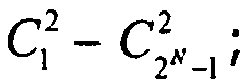
 ■ mindestens 2N-2 Verzögerungsleitungen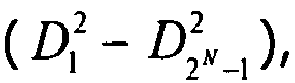

- Quantisierer nach Anspruch 1, dadurch gekennzeichnet, dass der Absolutwert der Verstärkung einer Verstärkerstufe (

- Quantisierer nach einem der Ansprüche 1 und 2, dadurch gekennzeichnet, dass die Verstärkung der Verstärkerstufen (

- Quantisierer nach einem der Ansprüche 1 und 2, dadurch gekennzeichnet, dass der Absolutwert der Verstärkung einer Verstärkerstufe (

- Quantisierer nach einem der Ansprüche 1 und 2, dadurch gekennzeichnet, dass die Verstärkung der Verstärkerstufen negativ ist.
- Quantisierer nach einem der vorhergehenden Ansprüche, dadurch gekennzeichnet, dass eine Verstärkerstufe (

- Quantisierer nach einem der vorhergehenden Ansprüche, dadurch gekennzeichnet, dass jede Verstärkerstufe (

- Quantisierer nach einem der vorhergehenden Ansprüche, dadurch gekennzeichnet, dass jede Verstärkerstufe
 ■ einen Differenzverstärker (72), von dem ein positiver Eingang den Eingang der Verstärkerstufe bildet;■ eine erste Impedanz (74), die zwischen einem negativen Eingang und einem Ausgang des Differenzverstärkers (72) zwischengeschaltet ist; und■ eine zweite Impedanz (76), die zwischen den negativen Eingang des Differenzverstärkers und Masse zwischengeschaltet ist.
 - Quantisierer nach einem der Ansprüche 1 bis 7, dadurch gekennzeichnet, dass jede Verstärkerstufe
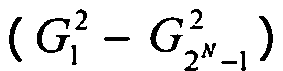 ■ einem Wechselrichter (820, 840), dessen Ausgang den Ausgang der Zelle (82, 84) bildet,■ einer ersten Impedanz (822, 842), die zwischen dem Eingang und dem Ausgang des Wechselrichters (820, 840) zwischengeschaltet ist, und■ einer zweiten Impedanz (824, 844), die mit dem einen ihrer Anschlüsse auf den Eingang des Wechselrichters (820, 840) aufgeschaltet ist, und deren anderer Anschluss den Eingang der Zelle (82, 84) bildet.
 - Quantisierer nach einem der Ansprüche 1 bis 7, dadurch gekennzeichnet, dass jede Verstärkerstufe (I1, Cs, M1) umfasst:■ einen Wechselrichter (I1), dessen Ausgang den Ausgang der Verstärkerstufe bildet,■ eine erste Impedanz (M1), die zwischen dem Eingang und dem Ausgang des Wechselrichters (I1) zwischengeschaltet ist, und■ eine zweite Impedanz (Cs), die mit dem einen ihrer Anschlüsse auf den Eingang des Wechselrichters aufgeschaltet ist, und deren anderer Anschluss den Eingang der Stufe bildet.
- Quantisierer nach Anspruch 5 oder 10, dadurch gekennzeichnet, dass er außerdem ein Modul (234) zur digitalen Verarbeitung umfasst, das ausgebildet ist, eine Funktion "ODER" auf jedes Paar von aufeinanderfolgenden Ausgängen der Verzögerungsleitungen und des letzten Komparators anzuwenden, wobei das Ergebnis der Funktion "ODER" einen quantisierten Binärwert bildet.
- Quantisierer nach Anspruch 8, 9, 10 oder 11, dadurch gekennzeichnet, dass der stetige Wert der zweiten Impedanz (76; 824; 844; Cs) wesentlich höher ist als der stetige Wert der ersten Impedanz (74; 822; 842; M1).
- Quantisierer nach Anspruch 8, 9, 10, 11 oder 12, dadurch gekennzeichnet, dass die erste Impedanz (M1) diejenige ist, die zwischen dem Drain und der Source eines MOS-Transistors gebildet ist.
- Quantisierer nach einem der vorhergehenden Ansprüche, dadurch gekennzeichnet, dass der Schwellenwert für die Gesamtheit der Komparatoren (

- Quantisierer nach einem der vorhergehenden Ansprüche, dadurch gekennzeichnet, dass jeder Komparator
 ■ einen Hochverstärkungsdifferenzverstärker (92), der an einem positiven Eingang den Ausgang der entsprechenden Verstärkerstufe und an einem negativen Eingang den entsprechenden Schwellenwert empfängt, und■ ein Binärentscheidungsfindungsmodul (94), das auf den Ausgang des Hochverstärkungsdifferenzverstärkers aufgeschaltet ist.
 - Quantisierer nach Anspruch 15, dadurch gekennzeichnet, dass das Binärentscheidungsfindungsmodul (94) einen Hysteresediskriminator (94) umfasst.
- Quantisierer nach Anspruch 15 oder 16, dadurch gekennzeichnet, dass er außerdem ein Filtermodul (96) umfasst, das am Ausgang des Binärentscheidungsfindungsmoduls (94) angeschlossen ist, um die Impulse mit einer Dauer, die kürzer ist als eine vorbestimmte Dauer, zu beseitigen.
- Quantisierer nach einem der vorhergehenden Ansprüche, dadurch gekennzeichnet, dass jede Verzögerungsleitung (232) 2N-1-i im Wesentlichen identische Verzögerungszellen umfasst, wobei i die Position der Verstärkerstufe (I1, M1, Cs) ist, die der Leitung in der Verstärkerstufenreihe zugeordnet ist.
- Quantisierer nach einem der vorhergehenden Ansprüche, dadurch gekennzeichnet, dass er außerdem am Anfang oder am Ende der Verstärkerstufenreihe eine zusätzliche Verstärkerstufe (22) und einen zusätzliche Komparator (26) umfasst, der auf den Ausgang der zusätzlichen Verstärkerstufe (22) aufgeschaltet ist und ausgebildet ist, deren Ausgang mit dem Nullwert zu vergleichen, um das Vorzeichen des zu quantisierenden Signals zu bestimmen.
- N-Bit-Analog/Digital-Wandler (150), der einen Quantisierer (1500) nach einem der vorhergehenden Ansprüche und einen Abtaster (1502) umfasst, der mit dem Quantisierer verbunden ist und ausgebildet ist, die Signale abzutasten, die er am Eingang empfängt.
- Analog/Digital-Wandler nach Anspruch 20, dadurch gekennzeichnet, dass er ein Modul (1504) zur digitalen Verarbeitung umfasst, das zwischen dem Quantisierer (1500) und dem Abtaster (1502) zwischengeschaltet ist.
- Funkfrequenzempfänger (160) der Art, die einen Wandler (1604, 1606, 1608) nach einem der Ansprüche 20 oder 21 integriert hat.
- Funkfrequenzempfänger nach Anspruch 22, dadurch gekennzeichnet, dass der Quantisierer eine Quantisierung mit logarithmischer Komprimierung einsetzt.
- Funkfrequenzempfänger nach Anspruch 22 oder 23, dadurch gekennzeichnet, dass er ausgebildet ist, Funkfrequenzsignale mit modulierter Trägerwelle zu empfangen.
- Funkfrequenzempfänger nach Anspruch 22 oder 23, dadurch gekennzeichnet, dass er ausgebildet ist, Ultrabreitband-Funkfrequenzsignale zu empfangen.
Applications Claiming Priority (2)
| Application Number | Priority Date | Filing Date | Title |
|---|---|---|---|
| FR0758284A FR2922388B1 (fr) | 2007-10-12 | 2007-10-12 | Quantificateur, convertisseur analogique-numerique comprenant un tel quantificateur, et recepteur ultra-large bande integrant un tel convertisseur |
| PCT/FR2008/051813 WO2009053607A1 (fr) | 2007-10-12 | 2008-10-07 | Quantificateur, convertisseur analogique-numerique comprenant un tel quantificateur, et recepteur ultra-large bande integrant un tel convertisseur |
Publications (2)
| Publication Number | Publication Date |
|---|---|
| EP2201689A1 EP2201689A1 (de) | 2010-06-30 |
| EP2201689B1 true EP2201689B1 (de) | 2012-02-29 |
Family
ID=39617099
Family Applications (1)
| Application Number | Title | Priority Date | Filing Date |
|---|---|---|---|
| EP08841432A Not-in-force EP2201689B1 (de) | 2007-10-12 | 2008-10-07 | Quantisierer, analog-digital-umsetzer mit einem solchen quantisierer und einen solchen umsetzer integrierender ultrabreitbandempfänger |
Country Status (5)
| Country | Link |
|---|---|
| US (1) | US8077068B2 (de) |
| EP (1) | EP2201689B1 (de) |
| AT (1) | ATE547843T1 (de) |
| FR (1) | FR2922388B1 (de) |
| WO (1) | WO2009053607A1 (de) |
Families Citing this family (9)
| Publication number | Priority date | Publication date | Assignee | Title |
|---|---|---|---|---|
| FR2959079B1 (fr) | 2010-04-20 | 2012-05-11 | Commissariat Energie Atomique | Dispositif de quantification, recepteur de signaux radiofrequence comprenant un tel dispositif et procede de quantification |
| EP2792097B1 (de) * | 2011-12-13 | 2025-03-05 | Northrop Grumman Guidance and Electronics Company, Inc. | SYSTEME UND VERFAHREN ZUR ADAPTIVEN AbtastwertQUANTIFIZIERUNG |
| GB2504961B (en) * | 2012-08-14 | 2015-01-07 | Broadcom Corp | Analogue to digital converter |
| FR3011701B1 (fr) | 2013-10-04 | 2017-07-28 | Commissariat Energie Atomique | Dispositif de quantification en temps continu, recepteur de signaux radiofrequence comprenant un tel dispositif et procede de quantification en temps continu |
| US11264832B2 (en) * | 2016-10-19 | 2022-03-01 | Sony Semiconductor Solutions Corporation | Signal processing device, signal processing method, and program |
| US9866179B1 (en) * | 2017-04-05 | 2018-01-09 | SiTune Corporation | Multipath linear low noise amplifier |
| CN109828253B (zh) * | 2019-04-15 | 2023-03-10 | 西安电子科技大学 | 一种多站雷达量化融合目标检测方法 |
| US10778267B1 (en) * | 2019-09-04 | 2020-09-15 | Realtek Semiconductor Corp. | Radio frequency signal detector and method thereof |
| FR3109851B1 (fr) * | 2020-05-04 | 2022-04-01 | Commissariat Energie Atomique | Méthode de réception d’un signal modulé en amplitude et récepteur associé |
Family Cites Families (14)
| Publication number | Priority date | Publication date | Assignee | Title |
|---|---|---|---|---|
| US4954831A (en) * | 1986-06-18 | 1990-09-04 | Ekins Robin K | Analog-to-digital converter |
| JP4098844B2 (ja) * | 1997-02-26 | 2008-06-11 | 富士通株式会社 | クロック位相引込み・追従装置 |
| US5894283A (en) * | 1997-04-03 | 1999-04-13 | Advanced Micro Devices, Inc. | Method and apparatus for converting analog signals into pulse signals with simultaneous analog signal compression |
| US5760730A (en) * | 1997-04-03 | 1998-06-02 | Advanced Micro Devices, Inc. | Method and system for analog-to-digital signal conversion with simultaneous analog signal compression |
| US6101376A (en) * | 1997-11-05 | 2000-08-08 | Advanced Micro Devices, Inc. | Squelch circuit and methodology for a multi-level quantizer |
| US6037891A (en) * | 1998-02-23 | 2000-03-14 | Motorola, Inc. | Low power serial analog-to-digital converter |
| JP2002271201A (ja) * | 2001-03-09 | 2002-09-20 | Fujitsu Ltd | A/d変換器 |
| US6621433B1 (en) * | 2001-06-22 | 2003-09-16 | Fonar Corporation | Adaptive dynamic range receiver for MRI |
| US7868665B2 (en) * | 2002-03-05 | 2011-01-11 | Nova R&D, Inc. | Integrated circuit and sensor for imaging |
| GB2397980B (en) * | 2003-01-28 | 2005-11-23 | Phyworks Ltd | Receiver |
| JP4234543B2 (ja) * | 2003-09-09 | 2009-03-04 | 富士通マイクロエレクトロニクス株式会社 | Ad変換器 |
| US7386074B1 (en) * | 2003-10-06 | 2008-06-10 | Redpine Signals, Inc. | Digital automatic gain control method and apparatus |
| JP4470995B2 (ja) * | 2007-12-19 | 2010-06-02 | セイコーエプソン株式会社 | A/d変換回路及び電子機器 |
| KR101445721B1 (ko) * | 2008-02-01 | 2014-09-26 | 삼성전자 주식회사 | 멀티 페이즈 클럭신호를 이용한 고속 다단 증폭기 및증폭기의 세틀링 방법 |
-
2007
- 2007-10-12 FR FR0758284A patent/FR2922388B1/fr not_active Expired - Fee Related
-
2008
- 2008-10-07 WO PCT/FR2008/051813 patent/WO2009053607A1/fr not_active Ceased
- 2008-10-07 AT AT08841432T patent/ATE547843T1/de active
- 2008-10-07 EP EP08841432A patent/EP2201689B1/de not_active Not-in-force
-
2010
- 2010-03-24 US US12/730,435 patent/US8077068B2/en not_active Expired - Fee Related
Also Published As
| Publication number | Publication date |
|---|---|
| EP2201689A1 (de) | 2010-06-30 |
| ATE547843T1 (de) | 2012-03-15 |
| US20100176982A1 (en) | 2010-07-15 |
| FR2922388B1 (fr) | 2013-03-29 |
| FR2922388A1 (fr) | 2009-04-17 |
| US8077068B2 (en) | 2011-12-13 |
| WO2009053607A1 (fr) | 2009-04-30 |
Similar Documents
| Publication | Publication Date | Title |
|---|---|---|
| EP2201689B1 (de) | Quantisierer, analog-digital-umsetzer mit einem solchen quantisierer und einen solchen umsetzer integrierender ultrabreitbandempfänger | |
| EP2157699A1 (de) | Analog-Digital-Wandler | |
| FR2642920A1 (fr) | Double convertisseur analogique-numerique avec un seul registre d'approximations successives et procede de conversion analogique-numerique | |
| FR2577366A1 (fr) | Reseau resistance | |
| EP3053274B1 (de) | Zeitkontinuierliche quantisierungsvorrichtung, funkfrequenzsignalempfänger mit einer derartigen vorrichtung und zeitkontinuierliches quantisierungsverfahren | |
| EP3276833A1 (de) | Sigma-delta-wandler mit hoher linearität | |
| EP1039643A1 (de) | Analog-Digital-Wandleranordnung mit konstanter differentieller nicht-linearität | |
| EP1811679B1 (de) | Empfangskette für Signale | |
| EP2216906A1 (de) | Pipeline Analog-Digital-Wandler in Verbindung mit einem Verstärker mit programmierbarer Verstärkung | |
| EP0463964A1 (de) | Anlage zur Erzeugung und zum Empfang von Ultraschall | |
| EP2383892B1 (de) | Quantifizierungsvorrichtung, Funksignalempfänger, der eine solche Vorrichtung umfasst, und Quantifizierungsverfahren | |
| EP3824549A1 (de) | Architektur für hf-funkfrequenzsender | |
| WO2003001689A2 (fr) | Systeme d'amplification d'un signal hertzien et decodeur de signaux de television comportant un tel systeme | |
| WO2018007752A1 (fr) | Systeme de suivi de la puissance crete d'un signal de telecommunication et procede de calcul de valeur de crete et de selection de tension d'alimentation associe | |
| EP3299991B1 (de) | Summierschaltung | |
| FR2797725A1 (fr) | Procede et dispositif de conversion d'un signal analogique en un signal numerique avec controle automatique de gain | |
| FR2973609A1 (fr) | Unite de codage a performance optimalisee pour amplificateur de puissance haute frequence, amplificateur de puissance haute frequence dote de ladite unite de codage, unite emettrice equipee dudit amplificateur, et procede de codage devolu a l'actionnement dudit amplificateur | |
| EP2391012B1 (de) | Verfahren und Vorrichtung zur Umsetzung der Analog-Digital-Kodierung von Hyperfrequenzsignalen mit sehr großer Dynamik, die eine große Bandbreite aufweisen | |
| EP2446534B1 (de) | Ultrahochpräzise vorrichtung zur messung der zeit eines signaleingangs | |
| EP0431435A1 (de) | Automatische Verstärkungsregelung in einem Demodulator eines digitalen Empfängers | |
| FR3128600A1 (fr) | Numériseur radiofréquence à dynamique augmentée | |
| WO2018083387A1 (fr) | Système de réception radio parallèle à mélangeurs-amplificateurs analogiques commandés numériquement. | |
| FR3150922A1 (fr) | Convertisseur tension-temps programmable | |
| EP2173030B1 (de) | Erweiterungsverfahren der Dynamik eines digitalen Speichers von Radiofrequenzen | |
| FR2875973A1 (fr) | Procede et dispositif de conversion analogique numerique d'un signal complexe |
Legal Events
| Date | Code | Title | Description |
|---|---|---|---|
| PUAI | Public reference made under article 153(3) epc to a published international application that has entered the european phase |
Free format text: ORIGINAL CODE: 0009012 |
|
| 17P | Request for examination filed |
Effective date: 20100326 |
|
| AK | Designated contracting states |
Kind code of ref document: A1 Designated state(s): AT BE BG CH CY CZ DE DK EE ES FI FR GB GR HR HU IE IS IT LI LT LU LV MC MT NL NO PL PT RO SE SI SK TR |
|
| AX | Request for extension of the european patent |
Extension state: AL BA MK RS |
|
| DAX | Request for extension of the european patent (deleted) | ||
| GRAP | Despatch of communication of intention to grant a patent |
Free format text: ORIGINAL CODE: EPIDOSNIGR1 |
|
| GRAS | Grant fee paid |
Free format text: ORIGINAL CODE: EPIDOSNIGR3 |
|
| GRAA | (expected) grant |
Free format text: ORIGINAL CODE: 0009210 |
|
| AK | Designated contracting states |
Kind code of ref document: B1 Designated state(s): AT BE BG CH CY CZ DE DK EE ES FI FR GB GR HR HU IE IS IT LI LT LU LV MC MT NL NO PL PT RO SE SI SK TR |
|
| REG | Reference to a national code |
Ref country code: GB Ref legal event code: FG4D Free format text: NOT ENGLISH Ref country code: CH Ref legal event code: EP |
|
| REG | Reference to a national code |
Ref country code: AT Ref legal event code: REF Ref document number: 547843 Country of ref document: AT Kind code of ref document: T Effective date: 20120315 |
|
| REG | Reference to a national code |
Ref country code: IE Ref legal event code: FG4D Free format text: LANGUAGE OF EP DOCUMENT: FRENCH |
|
| REG | Reference to a national code |
Ref country code: DE Ref legal event code: R096 Ref document number: 602008013828 Country of ref document: DE Effective date: 20120426 |
|
| REG | Reference to a national code |
Ref country code: NL Ref legal event code: VDEP Effective date: 20120229 |
|
| LTIE | Lt: invalidation of european patent or patent extension |
Effective date: 20120229 |
|
| PG25 | Lapsed in a contracting state [announced via postgrant information from national office to epo] |
Ref country code: NO Free format text: LAPSE BECAUSE OF FAILURE TO SUBMIT A TRANSLATION OF THE DESCRIPTION OR TO PAY THE FEE WITHIN THE PRESCRIBED TIME-LIMIT Effective date: 20120529 Ref country code: NL Free format text: LAPSE BECAUSE OF FAILURE TO SUBMIT A TRANSLATION OF THE DESCRIPTION OR TO PAY THE FEE WITHIN THE PRESCRIBED TIME-LIMIT Effective date: 20120229 Ref country code: IS Free format text: LAPSE BECAUSE OF FAILURE TO SUBMIT A TRANSLATION OF THE DESCRIPTION OR TO PAY THE FEE WITHIN THE PRESCRIBED TIME-LIMIT Effective date: 20120629 Ref country code: LT Free format text: LAPSE BECAUSE OF FAILURE TO SUBMIT A TRANSLATION OF THE DESCRIPTION OR TO PAY THE FEE WITHIN THE PRESCRIBED TIME-LIMIT Effective date: 20120229 Ref country code: HR Free format text: LAPSE BECAUSE OF FAILURE TO SUBMIT A TRANSLATION OF THE DESCRIPTION OR TO PAY THE FEE WITHIN THE PRESCRIBED TIME-LIMIT Effective date: 20120229 |
|
| PG25 | Lapsed in a contracting state [announced via postgrant information from national office to epo] |
Ref country code: PT Free format text: LAPSE BECAUSE OF FAILURE TO SUBMIT A TRANSLATION OF THE DESCRIPTION OR TO PAY THE FEE WITHIN THE PRESCRIBED TIME-LIMIT Effective date: 20120629 Ref country code: GR Free format text: LAPSE BECAUSE OF FAILURE TO SUBMIT A TRANSLATION OF THE DESCRIPTION OR TO PAY THE FEE WITHIN THE PRESCRIBED TIME-LIMIT Effective date: 20120530 Ref country code: FI Free format text: LAPSE BECAUSE OF FAILURE TO SUBMIT A TRANSLATION OF THE DESCRIPTION OR TO PAY THE FEE WITHIN THE PRESCRIBED TIME-LIMIT Effective date: 20120229 Ref country code: LV Free format text: LAPSE BECAUSE OF FAILURE TO SUBMIT A TRANSLATION OF THE DESCRIPTION OR TO PAY THE FEE WITHIN THE PRESCRIBED TIME-LIMIT Effective date: 20120229 |
|
| REG | Reference to a national code |
Ref country code: AT Ref legal event code: MK05 Ref document number: 547843 Country of ref document: AT Kind code of ref document: T Effective date: 20120229 |
|
| REG | Reference to a national code |
Ref country code: IE Ref legal event code: FD4D |
|
| PG25 | Lapsed in a contracting state [announced via postgrant information from national office to epo] |
Ref country code: CY Free format text: LAPSE BECAUSE OF FAILURE TO SUBMIT A TRANSLATION OF THE DESCRIPTION OR TO PAY THE FEE WITHIN THE PRESCRIBED TIME-LIMIT Effective date: 20120229 |
|
| PG25 | Lapsed in a contracting state [announced via postgrant information from national office to epo] |
Ref country code: RO Free format text: LAPSE BECAUSE OF FAILURE TO SUBMIT A TRANSLATION OF THE DESCRIPTION OR TO PAY THE FEE WITHIN THE PRESCRIBED TIME-LIMIT Effective date: 20120229 Ref country code: SE Free format text: LAPSE BECAUSE OF FAILURE TO SUBMIT A TRANSLATION OF THE DESCRIPTION OR TO PAY THE FEE WITHIN THE PRESCRIBED TIME-LIMIT Effective date: 20120229 Ref country code: CZ Free format text: LAPSE BECAUSE OF FAILURE TO SUBMIT A TRANSLATION OF THE DESCRIPTION OR TO PAY THE FEE WITHIN THE PRESCRIBED TIME-LIMIT Effective date: 20120229 Ref country code: PL Free format text: LAPSE BECAUSE OF FAILURE TO SUBMIT A TRANSLATION OF THE DESCRIPTION OR TO PAY THE FEE WITHIN THE PRESCRIBED TIME-LIMIT Effective date: 20120229 Ref country code: SI Free format text: LAPSE BECAUSE OF FAILURE TO SUBMIT A TRANSLATION OF THE DESCRIPTION OR TO PAY THE FEE WITHIN THE PRESCRIBED TIME-LIMIT Effective date: 20120229 Ref country code: DK Free format text: LAPSE BECAUSE OF FAILURE TO SUBMIT A TRANSLATION OF THE DESCRIPTION OR TO PAY THE FEE WITHIN THE PRESCRIBED TIME-LIMIT Effective date: 20120229 Ref country code: EE Free format text: LAPSE BECAUSE OF FAILURE TO SUBMIT A TRANSLATION OF THE DESCRIPTION OR TO PAY THE FEE WITHIN THE PRESCRIBED TIME-LIMIT Effective date: 20120229 Ref country code: IE Free format text: LAPSE BECAUSE OF FAILURE TO SUBMIT A TRANSLATION OF THE DESCRIPTION OR TO PAY THE FEE WITHIN THE PRESCRIBED TIME-LIMIT Effective date: 20120229 |
|
| PG25 | Lapsed in a contracting state [announced via postgrant information from national office to epo] |
Ref country code: SK Free format text: LAPSE BECAUSE OF FAILURE TO SUBMIT A TRANSLATION OF THE DESCRIPTION OR TO PAY THE FEE WITHIN THE PRESCRIBED TIME-LIMIT Effective date: 20120229 |
|
| PLBE | No opposition filed within time limit |
Free format text: ORIGINAL CODE: 0009261 |
|
| STAA | Information on the status of an ep patent application or granted ep patent |
Free format text: STATUS: NO OPPOSITION FILED WITHIN TIME LIMIT |
|
| PG25 | Lapsed in a contracting state [announced via postgrant information from national office to epo] |
Ref country code: AT Free format text: LAPSE BECAUSE OF FAILURE TO SUBMIT A TRANSLATION OF THE DESCRIPTION OR TO PAY THE FEE WITHIN THE PRESCRIBED TIME-LIMIT Effective date: 20120229 |
|
| 26N | No opposition filed |
Effective date: 20121130 |
|
| REG | Reference to a national code |
Ref country code: DE Ref legal event code: R097 Ref document number: 602008013828 Country of ref document: DE Effective date: 20121130 |
|
| BERE | Be: lapsed |
Owner name: COMMISSARIAT A L'ENERGIE ATOMIQUE ET AUX ENERGIES Effective date: 20121031 |
|
| PG25 | Lapsed in a contracting state [announced via postgrant information from national office to epo] |
Ref country code: ES Free format text: LAPSE BECAUSE OF FAILURE TO SUBMIT A TRANSLATION OF THE DESCRIPTION OR TO PAY THE FEE WITHIN THE PRESCRIBED TIME-LIMIT Effective date: 20120609 |
|
| PG25 | Lapsed in a contracting state [announced via postgrant information from national office to epo] |
Ref country code: MC Free format text: LAPSE BECAUSE OF NON-PAYMENT OF DUE FEES Effective date: 20121031 |
|
| REG | Reference to a national code |
Ref country code: CH Ref legal event code: PL |
|
| PG25 | Lapsed in a contracting state [announced via postgrant information from national office to epo] |
Ref country code: LI Free format text: LAPSE BECAUSE OF NON-PAYMENT OF DUE FEES Effective date: 20121031 Ref country code: BE Free format text: LAPSE BECAUSE OF NON-PAYMENT OF DUE FEES Effective date: 20121031 Ref country code: BG Free format text: LAPSE BECAUSE OF FAILURE TO SUBMIT A TRANSLATION OF THE DESCRIPTION OR TO PAY THE FEE WITHIN THE PRESCRIBED TIME-LIMIT Effective date: 20120529 Ref country code: CH Free format text: LAPSE BECAUSE OF NON-PAYMENT OF DUE FEES Effective date: 20121031 |
|
| PG25 | Lapsed in a contracting state [announced via postgrant information from national office to epo] |
Ref country code: MT Free format text: LAPSE BECAUSE OF FAILURE TO SUBMIT A TRANSLATION OF THE DESCRIPTION OR TO PAY THE FEE WITHIN THE PRESCRIBED TIME-LIMIT Effective date: 20120229 |
|
| PG25 | Lapsed in a contracting state [announced via postgrant information from national office to epo] |
Ref country code: TR Free format text: LAPSE BECAUSE OF FAILURE TO SUBMIT A TRANSLATION OF THE DESCRIPTION OR TO PAY THE FEE WITHIN THE PRESCRIBED TIME-LIMIT Effective date: 20120229 |
|
| PG25 | Lapsed in a contracting state [announced via postgrant information from national office to epo] |
Ref country code: LU Free format text: LAPSE BECAUSE OF NON-PAYMENT OF DUE FEES Effective date: 20121007 |
|
| PG25 | Lapsed in a contracting state [announced via postgrant information from national office to epo] |
Ref country code: HU Free format text: LAPSE BECAUSE OF FAILURE TO SUBMIT A TRANSLATION OF THE DESCRIPTION OR TO PAY THE FEE WITHIN THE PRESCRIBED TIME-LIMIT Effective date: 20081007 |
|
| PGFP | Annual fee paid to national office [announced via postgrant information from national office to epo] |
Ref country code: IT Payment date: 20141020 Year of fee payment: 7 |
|
| REG | Reference to a national code |
Ref country code: FR Ref legal event code: PLFP Year of fee payment: 8 |
|
| PG25 | Lapsed in a contracting state [announced via postgrant information from national office to epo] |
Ref country code: IT Free format text: LAPSE BECAUSE OF NON-PAYMENT OF DUE FEES Effective date: 20151007 |
|
| REG | Reference to a national code |
Ref country code: FR Ref legal event code: PLFP Year of fee payment: 9 |
|
| PGFP | Annual fee paid to national office [announced via postgrant information from national office to epo] |
Ref country code: DE Payment date: 20161013 Year of fee payment: 9 Ref country code: GB Payment date: 20161014 Year of fee payment: 9 Ref country code: FR Payment date: 20161028 Year of fee payment: 9 |
|
| REG | Reference to a national code |
Ref country code: DE Ref legal event code: R119 Ref document number: 602008013828 Country of ref document: DE |
|
| GBPC | Gb: european patent ceased through non-payment of renewal fee |
Effective date: 20171007 |
|
| REG | Reference to a national code |
Ref country code: FR Ref legal event code: ST Effective date: 20180629 |
|
| PG25 | Lapsed in a contracting state [announced via postgrant information from national office to epo] |
Ref country code: DE Free format text: LAPSE BECAUSE OF NON-PAYMENT OF DUE FEES Effective date: 20180501 Ref country code: GB Free format text: LAPSE BECAUSE OF NON-PAYMENT OF DUE FEES Effective date: 20171007 |
|
| PG25 | Lapsed in a contracting state [announced via postgrant information from national office to epo] |
Ref country code: FR Free format text: LAPSE BECAUSE OF NON-PAYMENT OF DUE FEES Effective date: 20171031 |