EP2201690B1 - Bitzählwertbestimmung zur iterativen signalcodierung - Google Patents
Bitzählwertbestimmung zur iterativen signalcodierung Download PDFInfo
- Publication number
- EP2201690B1 EP2201690B1 EP08788774A EP08788774A EP2201690B1 EP 2201690 B1 EP2201690 B1 EP 2201690B1 EP 08788774 A EP08788774 A EP 08788774A EP 08788774 A EP08788774 A EP 08788774A EP 2201690 B1 EP2201690 B1 EP 2201690B1
- Authority
- EP
- European Patent Office
- Prior art keywords
- bit count
- output bit
- quantised
- values
- samples
- Prior art date
- Legal status (The legal status is an assumption and is not a legal conclusion. Google has not performed a legal analysis and makes no representation as to the accuracy of the status listed.)
- Not-in-force
Links
- 238000000034 method Methods 0.000 claims abstract description 49
- 230000005236 sound signal Effects 0.000 claims description 3
- 238000010586 diagram Methods 0.000 description 7
- 239000008187 granular material Substances 0.000 description 5
- 230000000694 effects Effects 0.000 description 4
- 238000004364 calculation method Methods 0.000 description 3
- 230000006835 compression Effects 0.000 description 3
- 238000007906 compression Methods 0.000 description 3
- 230000001419 dependent effect Effects 0.000 description 3
- 230000006870 function Effects 0.000 description 3
- CNQCVBJFEGMYDW-UHFFFAOYSA-N lawrencium atom Chemical compound [Lr] CNQCVBJFEGMYDW-UHFFFAOYSA-N 0.000 description 3
- 238000010606 normalization Methods 0.000 description 3
- 230000008569 process Effects 0.000 description 3
- 230000009286 beneficial effect Effects 0.000 description 2
- 230000008901 benefit Effects 0.000 description 2
- 230000003321 amplification Effects 0.000 description 1
- 238000004458 analytical method Methods 0.000 description 1
- 230000008859 change Effects 0.000 description 1
- 238000006243 chemical reaction Methods 0.000 description 1
- 238000009499 grossing Methods 0.000 description 1
- 230000003116 impacting effect Effects 0.000 description 1
- 238000012804 iterative process Methods 0.000 description 1
- 238000012986 modification Methods 0.000 description 1
- 230000004048 modification Effects 0.000 description 1
- 238000003199 nucleic acid amplification method Methods 0.000 description 1
- 238000001228 spectrum Methods 0.000 description 1
Images


Classifications
-
- G—PHYSICS
- G10—MUSICAL INSTRUMENTS; ACOUSTICS
- G10L—SPEECH ANALYSIS TECHNIQUES OR SPEECH SYNTHESIS; SPEECH RECOGNITION; SPEECH OR VOICE PROCESSING TECHNIQUES; SPEECH OR AUDIO CODING OR DECODING
- G10L19/00—Speech or audio signals analysis-synthesis techniques for redundancy reduction, e.g. in vocoders; Coding or decoding of speech or audio signals, using source filter models or psychoacoustic analysis
- G10L19/02—Speech or audio signals analysis-synthesis techniques for redundancy reduction, e.g. in vocoders; Coding or decoding of speech or audio signals, using source filter models or psychoacoustic analysis using spectral analysis, e.g. transform vocoders or subband vocoders
- G10L19/032—Quantisation or dequantisation of spectral components
- G10L19/035—Scalar quantisation
-
- H—ELECTRICITY
- H03—ELECTRONIC CIRCUITRY
- H03M—CODING; DECODING; CODE CONVERSION IN GENERAL
- H03M7/00—Conversion of a code where information is represented by a given sequence or number of digits to a code where the same, similar or subset of information is represented by a different sequence or number of digits
- H03M7/30—Compression; Expansion; Suppression of unnecessary data, e.g. redundancy reduction
-
- H—ELECTRICITY
- H03—ELECTRONIC CIRCUITRY
- H03M—CODING; DECODING; CODE CONVERSION IN GENERAL
- H03M7/00—Conversion of a code where information is represented by a given sequence or number of digits to a code where the same, similar or subset of information is represented by a different sequence or number of digits
- H03M7/30—Compression; Expansion; Suppression of unnecessary data, e.g. redundancy reduction
- H03M7/40—Conversion to or from variable length codes, e.g. Shannon-Fano code, Huffman code, Morse code
-
- H—ELECTRICITY
- H04—ELECTRIC COMMUNICATION TECHNIQUE
- H04N—PICTORIAL COMMUNICATION, e.g. TELEVISION
- H04N19/00—Methods or arrangements for coding, decoding, compressing or decompressing digital video signals
- H04N19/10—Methods or arrangements for coding, decoding, compressing or decompressing digital video signals using adaptive coding
- H04N19/102—Methods or arrangements for coding, decoding, compressing or decompressing digital video signals using adaptive coding characterised by the element, parameter or selection affected or controlled by the adaptive coding
- H04N19/124—Quantisation
-
- H—ELECTRICITY
- H04—ELECTRIC COMMUNICATION TECHNIQUE
- H04N—PICTORIAL COMMUNICATION, e.g. TELEVISION
- H04N19/00—Methods or arrangements for coding, decoding, compressing or decompressing digital video signals
- H04N19/10—Methods or arrangements for coding, decoding, compressing or decompressing digital video signals using adaptive coding
- H04N19/134—Methods or arrangements for coding, decoding, compressing or decompressing digital video signals using adaptive coding characterised by the element, parameter or criterion affecting or controlling the adaptive coding
- H04N19/146—Data rate or code amount at the encoder output
-
- H—ELECTRICITY
- H04—ELECTRIC COMMUNICATION TECHNIQUE
- H04N—PICTORIAL COMMUNICATION, e.g. TELEVISION
- H04N19/00—Methods or arrangements for coding, decoding, compressing or decompressing digital video signals
- H04N19/10—Methods or arrangements for coding, decoding, compressing or decompressing digital video signals using adaptive coding
- H04N19/134—Methods or arrangements for coding, decoding, compressing or decompressing digital video signals using adaptive coding characterised by the element, parameter or criterion affecting or controlling the adaptive coding
- H04N19/154—Measured or subjectively estimated visual quality after decoding, e.g. measurement of distortion
-
- H—ELECTRICITY
- H04—ELECTRIC COMMUNICATION TECHNIQUE
- H04N—PICTORIAL COMMUNICATION, e.g. TELEVISION
- H04N19/00—Methods or arrangements for coding, decoding, compressing or decompressing digital video signals
- H04N19/10—Methods or arrangements for coding, decoding, compressing or decompressing digital video signals using adaptive coding
- H04N19/189—Methods or arrangements for coding, decoding, compressing or decompressing digital video signals using adaptive coding characterised by the adaptation method, adaptation tool or adaptation type used for the adaptive coding
- H04N19/192—Methods or arrangements for coding, decoding, compressing or decompressing digital video signals using adaptive coding characterised by the adaptation method, adaptation tool or adaptation type used for the adaptive coding the adaptation method, adaptation tool or adaptation type being iterative or recursive
-
- H—ELECTRICITY
- H04—ELECTRIC COMMUNICATION TECHNIQUE
- H04N—PICTORIAL COMMUNICATION, e.g. TELEVISION
- H04N19/00—Methods or arrangements for coding, decoding, compressing or decompressing digital video signals
- H04N19/90—Methods or arrangements for coding, decoding, compressing or decompressing digital video signals using coding techniques not provided for in groups H04N19/10-H04N19/85, e.g. fractals
- H04N19/91—Entropy coding, e.g. variable length coding [VLC] or arithmetic coding
-
- G—PHYSICS
- G10—MUSICAL INSTRUMENTS; ACOUSTICS
- G10L—SPEECH ANALYSIS TECHNIQUES OR SPEECH SYNTHESIS; SPEECH RECOGNITION; SPEECH OR VOICE PROCESSING TECHNIQUES; SPEECH OR AUDIO CODING OR DECODING
- G10L19/00—Speech or audio signals analysis-synthesis techniques for redundancy reduction, e.g. in vocoders; Coding or decoding of speech or audio signals, using source filter models or psychoacoustic analysis
- G10L19/002—Dynamic bit allocation
Definitions
- Constant bitrate (CBR) encoding provides a constant rate output from a codec, i.e. a CBR encoder uses the same frame size for every frame. This may be beneficial when audio files are to be streamed across a medium of fixed bandwidth (e.g. over a wireless channel) because an audio file can be encoded at a bitrate which matches the available bandwidth.
- CBR coding techniques use more bits than are required for simple passages whilst being limited in bit allocation for complex passages. Where a particular frame has a complex sound in it, the encoder reduces the quality of the signal until it can be encoded in the available number of bits.
- VBR Variable bitrate
- a compromise between CBR and VBR is average bitrate encoding (ABR).
- ABR average bitrate encoding
- the encoder has flexibility in allocating bits to frames dependent on the complexity of the signal in any particular frame whilst maintaining a target average bitrate over a defined time period. This results in a higher quality signal than CBR and a more predictable bitrate than VBR.
- some form of bit rate adjustment is usually required in order to ensure that the target average bitrate is achieved.
- document US2002/0150157 A1 discloses a solution for estimating a bit count using a polynomial approximation based on the magnitudes of the quantized values.
- Another document US6,601,032 B1 discloses estimating the bit count using a code length table.
- Methods and apparatus for iteratively encoding a portion of a signal are described in which the portion of the signal is quantised and an output bit count is estimated based on the sum of logarithms to base n of values of each sample in the plurality of quantised samples and the total number of samples.
- the output bit count corresponds to an estimate of the output bit count for the portion of the signal once encoded using a code, such as a Huffman code.
- a first aspect provides a method of iteratively encoding a portion of a signal comprising: quantising the portion of the signal to produce a plurality of quantised samples; and estimating an output bit count corresponding to the plurality of quantised samples encoded using a prefix free the estimated output bit count being based on a weighted sum of logarithms to base n of values of each quantised sample and the total number of samples.
- the combination of logarithms to base n of values of each quantised sample may comprise a sum of logarithms to base n of values of each quantised sample.
- the method may further comprise: comparing the output bit count to target bit count criteria; and if the output bit count does not meet the target bit count criteria, adjusting a quantisation parameter; and repeating the quantising and estimating steps.
- n 2.
- the step of estimating an output bit count corresponding to the plurality of quantised samples encoded using a code, based on a sum of logarithms to base n of values of each sample in the plurality of quantised samples may comprise estimating an output bit count using: a 1 ⁇ i log 2 2 x i + a 2 where a 1 and a 2 are predefined parameters and x i are values of each quantised sample.
- the estimating step may be implemented using an instruction for detecting a number of sign bits of a number.
- the estimating step may comprise estimating an output bit count using: b 1 ⁇ i SIGNDET x i + N ⁇ b 2 where N is the total number of samples, b 1 and b 2 are predefined parameters and SIGNDET represents the instruction for detecting the number of sign bits of a number.
- the predefined parameters b 1 and b 2 may be selected according to one or more characteristics of the signal and / or according to the coding type.
- the method may further comprise: comparing the output bit count to target bit count criteria; and if the output bit count meets the target bit count criteria, calculating an exact output bit count and adjusting values of b 1 and b 2 according to a difference between the output bit count and the calculated exact output bit count.
- the values, x i , of each quantised sample may comprise quantised MDCT values.
- the signal may comprise an audio signal, such as one to be MP3 encoded, or a video signal.
- the code may comprise a Huffman code.
- a second aspect provides an encoder comprising: a quantiser arranged to quantise a portion of a signal to produce a plurality of quantised samples; and means for estimating an output bit count corresponding to the plurality of quantised samples encoded using a prefix free, the output bit count being based on a weighted sum of logarithms to base n of values of each quantised sample and a total number of samples.
- the combination of logarithms to base n of values of each quantised sample may comprise a sum of logarithms to base n of values of each quantised sample.
- the encoder may further comprise: means for comparing the output bit count to target bit count criteria; wherein if the output bit count does not meet the target bit count criteria, the encoder is arranged to adjust a quantisation parameter and repeat the quantisation and output bit count estimation.
- n 2.
- the means for estimating an output bit count may be arranged to estimate the output bit count using: a 1 ⁇ i log 2 2 x i + a 2 where a 1 and a 2 are predefined parameters and x i are values of each quantised sample.
- the means for estimating an output bit count may be arranged to estimate the output bit count using an instruction for detecting the number of sign bits of a number.
- the means for estimating an output bit count may be arranged to perform: b 1 ⁇ i SIGNDET x i + N ⁇ b 2 where N is the total number of samples, b 1 and b 2 are predefined parameters and SIGNDET represents the instruction for detecting the number of sign bits of a number.
- the predefined parameters b 1 and b 2 are selected according to one or more characteristics of the signal.
- the values, x i , of each quantised sample may comprise quantised MDCT values.
- the signal may comprise an audio signal (such as one to be MP3 encoded) or a video signal.
- the code may comprise a Huffman code.
- the methods described herein may be performed by firmware or software in machine readable form on a tangible storage medium.
- the software can be suitable for execution on a parallel processor or a serial processor such that the method steps may be carried out in any suitable order, or simultaneously.
- Embodiments of the present invention are described below by way of example only. These examples represent the best ways of putting the invention into practice that are currently known to the Applicant although they are not the only ways in which this could be achieved.
- the description sets forth the functions of the example and the sequence of steps for constructing and operating the example. However, the same or equivalent functions and sequences may be accomplished by different examples.
- a perceptual encoder which may be used to encode an MP3 file, uses a psychoacoustic model to discard parts of the signal which are not perceptible to human hearing.
- Figure 1 shows a schematic diagram of an MP3 encoder in which the input passes substantially simultaneously through a filter bank 101 and the psychoacoustic model 102.
- the psychoacoustic model 102 outputs a set of parameters including the quantisation levels used in quantisation and bit allocation (element 103), which outputs quantised samples.
- quantised samples are then input to the bitstream formatting element 104 where they are formatted, for example by being coded using a Huffman code.
- a psychoacoustic model enables the encoder to achieve high levels of compression without impacting the perceived signal quality.
- the signal frames are iteratively encoded (e.g. through adjusting the quantisation step size) and the result bitrate determined until the target bitrate is achieved. This iteration may occur within element 103 and may also occur within element 104 or on a broader scale within the encoder. There may be multiple nested iterative loops to achieve the desired result, for example iterating the quantisation step size and scaling factors.
- figure 1 shows the functional elements within an example MP3 encoder and there may be additional or fewer elements. Furthermore the elements may be combined in different ways without losing the overall effect and they may all be implemented, for example, within a single chip.
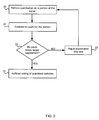
- Figure 2 shows a flow diagram of an example method of encoding an audio or video signal. Whilst the following examples are described in terms of MP3 (MPEG-1 Audio Layer 3), the methods described herein are applicable to other audio / video encoding formats, including, but not limited to, AAC (Advanced Audio Coding), WMA (Windows Media Audio).
- AAC Advanced Audio Coding
- WMA Windows Media Audio
- a portion of the audio / video signal is quantised (block 20) and the bit count for the portion (i.e. the number of output bits required) is estimated (block 21) rather than being accurately calculated.
- This estimation step is described in more detail below.
- the bit count is then compared to the target value (which may be a single value, a range of values or of any other form) and if the bit count does not meet the target value ('No' in block 22), the method is then iterated, e.g. by changing the quantisation step size or other parameter (in block 20), until the bit count matches the target value ('Yes' in block 22).
- the quantised values may be coded (block 24) using a particular code table, for example using a Huffman code table.
- FIG. 2 shows only a subset of the operations which occur within an encoder, such as the one shown in figure 1 .
- Method blocks 20-23 may occur within the bit allocation and quantisation element 103 which may perform other functions including, but not limited to, one or more of: performing distortion calculations for critical bands, amplification of critical bands, etc.
- Method block 24 may be performed within the bitstream formatting element 104.
- algorithm (1) was derived for quantised MDCT (modified discrete cosine transform) values, as used in perceptual audio codecs such as MP3, encoded using a Huffman code (such that / is the approximate length of a Huffman code for a signed sample value x), it is also more widely applicable to prefix-free codes and any codes which are established such that small numbers occur more frequently than large numbers.
- Other frequency analysis methods other than MDCT may be used, such as FFT (fast Fourier transform).
- the parameters a 1 and a 2 may vary dependent upon the type of signal which is quantised and the codes used.
- This algorithm may be implemented within a DSP (digital signal processor) using an instruction which is designed to detect the number of sign bits of a number (e.g. for use in normalisation of a number or in fixed-point to floating-point conversion).
- the number of sign bits of a number may be defined as the number of positions by which the number is shifted in normalisation (this can alternatively be considered to be the number of positions by which the decimal position is moved) or the exponent of a normalised floating-point number.
- Examples of such an instruction include 'SIGNDET' (as used by CSR plc) and 'EXP' (as used by Analog Devices) and 'NORM' (as used by Texas Instruments).
- b 1 and b 2 are predefined parameters (e.g. constants).
- the values of b 1 and b 2 may be set such that the average error over the portion (in this case, a granule) is zero (or close to zero). These values of b 1 and b 2 can be determined based on one or more test samples by performing the estimation (using equation (2) or (4)) for one or many signals (and therefore many portions of a signal) and comparing the estimated values to the exact values calculated using a known method. The values of b 1 and b 2 may then be adjusted and the estimation repeated until the average error is small or zero. Different pairs of values of b 1 and b 2 may be used dependent upon the type of codes used, (referred to herein as the 'coding type'). An example of a coding type is Huffman coding.
- the values of b 1 and b 2 used in a particular estimation may be selected from a set of possible parameter pairs based on the type of media signal, such as audio / video, speech / music, music genre (e.g. jazz, pop, classical) etc, where, for example, the values of b 1 and b 2 have been generated based on particular types of test samples or a single pair of values may be provided (e.g. where an encoder is only used for a single type of media signal, such as an MP3 encoder). Where the values are selected, this may be performed manually by a user (e.g. as a set-up parameter for the encoder) or may be performed automatically (e.g. based on metadata or tags associated with the media signal).
- bit count estimation Whilst the examples given above perform the bit count estimation on a per frame basis, this is by way of example only. The bit count estimation may be performed over any portion of the signal or over an entire file.
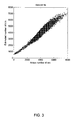
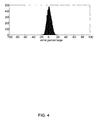
- Figure 3 shows a scattergram of estimated versus actual number of bits at a nominal bitrate of 160 kbps whilst figure 4 shows a histogram of the error percentage between the estimated value and the actual bits per frame over 16,118 MP3 frames (approximately 7 minutes of audio).
- Use of the method shown in figure 2 reduces the computational requirements of an encoder compared to performing the exact calculation (instead of block 21). This reduces the power consumption of the encoder which may be particularly beneficial in embedded devices and other battery powered applications. Additionally, or instead, it allows additional processing power for the encoding step (block 20), enabling the use of more sophisticated encoding methods which give a higher quality compressed signal. In an example, it may allow use of a larger number of finer iterative steps (e.g. smaller changes in quantisation levels) without increasing the overall number of MIPS used for the overall encoding process.
- Figure 5 shows a flow diagram of a second example method of encoding an audio or video signal in which the values of b 1 and b 2 are tuned during the encoding process. This enables the values of b 1 and b 2 to be tuned to the particular characteristics of the media file being encoded.
- a portion of the audio / video signal is quantised (block 50) and the bit count for the portion (i.e. the number of output bits required) is estimated (block 51).
- This estimation may be performed using the methods described above. If the estimated bit count does not match the target value ('No' in block 52) the encoding and estimation steps (blocks 50 and 51) are iteratively repeated until the target value is achieved, e.g. through adjustment of the quantisation step size (block 53). Once the bit count matches the target value ('Yes' in block 52), e.g. to within a defined margin, the quantised samples are encoded (block 54) and the exact bit count is calculated (block 55). This exact bit count value can be compared to the earlier estimated value (from block 51) and the parameters b 1 and b 2 tuned accordingly (block 56).
- the initial values of b 1 and b 2 used in the initial estimation step(s) (block 51) may be initial generic values or values based on the signal type, as described above. Smoothing factors and / or limits to the amount of change made to the parameters b 1 and b 2 may be applied (in block 55) to ensure that the parameters are tuned based on longer term rather than instantaneously observed effects.
- equations (2), (4) and (6) use a sum to combine the logarithms, in other examples the logarithms may be combined in different ways.
- the methods are described above in terms of audio / video encoding, the methods may be applicable to encoding of other data types and to applications where data is compressed through an iterative process to reach a target data size / data rate or where multiple compression techniques need to be compared quickly and simply.
- the algorithms are particularly applicable where the signal distribution is similar to encoded audio, such that smaller numbers occur more often than larger numbers.
Landscapes
- Engineering & Computer Science (AREA)
- Multimedia (AREA)
- Signal Processing (AREA)
- Physics & Mathematics (AREA)
- Spectroscopy & Molecular Physics (AREA)
- Theoretical Computer Science (AREA)
- Computational Linguistics (AREA)
- Health & Medical Sciences (AREA)
- Audiology, Speech & Language Pathology (AREA)
- Human Computer Interaction (AREA)
- Acoustics & Sound (AREA)
- Compression, Expansion, Code Conversion, And Decoders (AREA)
- Compression Or Coding Systems Of Tv Signals (AREA)
- Detection And Correction Of Errors (AREA)
- Dc Digital Transmission (AREA)
Claims (15)
- Verfahren zum iterativen Codieren eines Teils eines Audio- oder Videosignals, mit den folgenden Schritten:Quantisieren des Teils des Signals, um mehrere quantisierte Abtastwerte zu produzieren (20, 50);Schätzen eines Ausgangsbitzählwerts, der den mehreren quantisierten Abtastwerten entspricht, die unter Verwendung eines präfixfreien Codes codiert werden, wobei der geschätzte Ausgangsbitzählwert auf einer gewichteten Summe von Logarithmen zur Basis n von Werten jedes quantisierten Abtastwerts und der Gesamtzahl von Abtastwerten des Teils basiert (21, 51).
- Verfahren nach Anspruch 1, ferner mit den folgenden Schritten:Vergleichen des Ausgangsbitzählwerts mit Zielbitzählwertkriterien (22, 52); undwenn der Ausgangsbitzählwert nicht die Zielbitzählwertkriterien erfüllt, Justieren eines Quantisierungsparameters (23, 53); und Wiederholen der Schritte des Quantisierens und Schätzens.
- Verfahren nach einem der vorhergehenden Ansprüche, wobei n=2 ist.
- Verfahren nach Anspruch 3, wobei das Schätzen eines Ausgangsbitzählwerts, der den mehreren quantisierten Abtastwerten entspricht, die unter Verwendung eines präfixfreien Codes codiert werden, auf der Basis einer gewichteten Summe von Logarithmen zur Basis n von Werten jedes Abtastwerts der mehreren quantisierten Abtastwerte Folgendes umfasst:Schätzen eines Ausgangsbitzählwerts unter Verwendung von

wobei a1 und a2 vordefinierte Parameter und xi Werte jedes quantisierten Abtastwerts sind. - Verfahren nach Anspruch 3 oder 4, wobei der Schritt des Schätzens unter Verwendung einer Anweisung zum Detektieren einer Anzahl von Vorzeichenbit einer Zahl implementiert wird.
- Verfahren nach Anspruch 5, wobei der Schritt des Schätzens Folgendes umfasst:Schätzen eines Ausgangsbitzählwerts unter Verwendung von:

wobei N die Gesamtzahl von Abtastwerten ist, b1 und b2 vordefinierte Parameter sind und SIGNDET die Anweisung zum Detektieren der Anzahl von Vorzeichenbit einer Zahl repräsentiert. - Verfahren nach Anspruch 6, wobei b1 und b2 gemäß einer oder mehreren Kenngrößen des Signals ausgewählt werden.
- Verfahren nach Anspruch 6 oder 7, wobei b1 und b2 gemäß dem Codierungstyp ausgewählt werden.
- Verfahren nach einem der Ansprüche 6-8, ferner mit den folgenden Schritten:Vergleichen des Ausgangsbitzählwerts mit Zielbitzählwertkriterien (22, 52); undwenn der Ausgangsbitzählwert die Zielbitzählwertkriterien erfüllt, Berechnen eines exakten Ausgangsbitzählwerts (54) und Justieren von Werten von b1 und b2 gemäß einer Differenz zwischen dem Ausgangsbitzählwert und dem berechneten exakten Ausgangsbitzählwert (55).
- Verfahren nach einem der Ansprüche 4 und 6-9, wobei die Werte xi jedes quantisierten Abtastwerts quantisierte MDCT-Werte sind.
- Verfahren nach einem der vorhergehenden Ansprüche, wobei das Signal ein Audiosignal oder ein Videosignal umfasst.
- Verfahren nach einem der vorhergehenden Ansprüche, wobei der präfixfreie Code einen Huffman-Code umfasst.
- Codierer, umfassend:einen Quantisierer, der dafür ausgelegt ist, einen Teil eines Audio- oder Videosignals zu quantisieren, um mehrere quantisierte Abtastwerte zu produzieren; undMittel zum Schätzen eines Ausgangsbitzählwerts, der den mehreren quantisierten Abtastwerten entspricht, die unter Verwendung eines präfixfreien Codes codiert werden, wobei der geschätzte Ausgangsbitzählwert auf einer gewichteten Summe von Logarithmen zur Basis n von Werten jedes quantisierten Abtastwerts und der Gesamtzahl von Abtastwerten des Teils basiert.
- Codierer nach Anspruch 13, ferner umfassend:Mittel zum Vergleichen des Ausgangsbitzählwerts mit Zielbitzählwertkriterien; undwobei, wenn der Ausgangsbitzählwert nicht die Zielbitzählwertkriterien erfüllt, der Codierer dafür ausgelegt ist, einen Quantisierungsparameter zu justieren und die Quantisierung und Ausgangsbitzählwertschätzung zu wiederholen.
- Codierer nach Anspruch 13 oder 14, wobei n=2 ist.
Applications Claiming Priority (2)
| Application Number | Priority Date | Filing Date | Title |
|---|---|---|---|
| GB0720861A GB2454168A (en) | 2007-10-24 | 2007-10-24 | Estimating the number of bits required to compress a plurality of samples using a given quantisation parameter by calculating logarithms of quantised samples |
| PCT/GB2008/050805 WO2009053728A1 (en) | 2007-10-24 | 2008-09-09 | Bitcount determination for iterative signal coding |
Publications (2)
| Publication Number | Publication Date |
|---|---|
| EP2201690A1 EP2201690A1 (de) | 2010-06-30 |
| EP2201690B1 true EP2201690B1 (de) | 2011-03-16 |
Family
ID=38829861
Family Applications (1)
| Application Number | Title | Priority Date | Filing Date |
|---|---|---|---|
| EP08788774A Not-in-force EP2201690B1 (de) | 2007-10-24 | 2008-09-09 | Bitzählwertbestimmung zur iterativen signalcodierung |
Country Status (7)
| Country | Link |
|---|---|
| US (1) | US8217811B2 (de) |
| EP (1) | EP2201690B1 (de) |
| JP (1) | JP2011504667A (de) |
| AT (1) | ATE502442T1 (de) |
| DE (1) | DE602008005628D1 (de) |
| GB (1) | GB2454168A (de) |
| WO (1) | WO2009053728A1 (de) |
Families Citing this family (2)
| Publication number | Priority date | Publication date | Assignee | Title |
|---|---|---|---|---|
| US8204744B2 (en) * | 2008-12-01 | 2012-06-19 | Research In Motion Limited | Optimization of MP3 audio encoding by scale factors and global quantization step size |
| KR101854469B1 (ko) * | 2011-11-30 | 2018-05-04 | 삼성전자주식회사 | 오디오 컨텐츠의 비트레이트 판단장치 및 방법 |
Family Cites Families (16)
| Publication number | Priority date | Publication date | Assignee | Title |
|---|---|---|---|---|
| US4455649A (en) * | 1982-01-15 | 1984-06-19 | International Business Machines Corporation | Method and apparatus for efficient statistical multiplexing of voice and data signals |
| US6037985A (en) * | 1996-10-31 | 2000-03-14 | Texas Instruments Incorporated | Video compression |
| US6668015B1 (en) * | 1996-12-18 | 2003-12-23 | Thomson Licensing S.A. | Efficient fixed-length block compression and decompression |
| JPH1188698A (ja) * | 1997-09-02 | 1999-03-30 | Mitsubishi Electric Corp | 符号量制御方法 |
| JP3356663B2 (ja) * | 1997-10-22 | 2002-12-16 | 松下電器産業株式会社 | 画像符号化装置、画像符号化方法および画像符号化プログラムを記録した記録媒体 |
| GB2346282B (en) * | 1999-01-28 | 2003-02-19 | Snell & Wilcox Ltd | Bit rate control in compression encoding |
| US6639942B1 (en) * | 1999-10-21 | 2003-10-28 | Toshiba America Electronic Components, Inc. | Method and apparatus for estimating and controlling the number of bits |
| US6601032B1 (en) * | 2000-06-14 | 2003-07-29 | Intervideo, Inc. | Fast code length search method for MPEG audio encoding |
| US6847656B1 (en) * | 2000-09-25 | 2005-01-25 | General Instrument Corporation | Statistical remultiplexing with bandwidth allocation among different transcoding channels |
| US6628709B2 (en) * | 2000-12-21 | 2003-09-30 | Matsushita Electric Corporation Of America | Bit number prediction for VLC coded DCT coefficients and its application in DV encoding/transcoding |
| US6732071B2 (en) * | 2001-09-27 | 2004-05-04 | Intel Corporation | Method, apparatus, and system for efficient rate control in audio encoding |
| US7027982B2 (en) * | 2001-12-14 | 2006-04-11 | Microsoft Corporation | Quality and rate control strategy for digital audio |
| US20060176953A1 (en) * | 2005-02-04 | 2006-08-10 | Nader Mohsenian | Method and system for video encoding with rate control |
| JP4828925B2 (ja) * | 2005-11-30 | 2011-11-30 | パナソニック株式会社 | 符号化装置 |
| JP2007166039A (ja) * | 2005-12-09 | 2007-06-28 | Matsushita Electric Ind Co Ltd | 画像符号化装置 |
| JP4823001B2 (ja) * | 2006-09-27 | 2011-11-24 | 富士通セミコンダクター株式会社 | オーディオ符号化装置 |
-
2007
- 2007-10-24 GB GB0720861A patent/GB2454168A/en not_active Withdrawn
-
2008
- 2008-09-09 US US12/679,719 patent/US8217811B2/en not_active Expired - Fee Related
- 2008-09-09 AT AT08788774T patent/ATE502442T1/de not_active IP Right Cessation
- 2008-09-09 DE DE602008005628T patent/DE602008005628D1/de active Active
- 2008-09-09 EP EP08788774A patent/EP2201690B1/de not_active Not-in-force
- 2008-09-09 WO PCT/GB2008/050805 patent/WO2009053728A1/en not_active Ceased
- 2008-09-09 JP JP2010530557A patent/JP2011504667A/ja active Pending
Also Published As
| Publication number | Publication date |
|---|---|
| GB2454168A (en) | 2009-05-06 |
| US8217811B2 (en) | 2012-07-10 |
| GB0720861D0 (en) | 2007-12-05 |
| DE602008005628D1 (de) | 2011-04-28 |
| WO2009053728A1 (en) | 2009-04-30 |
| JP2011504667A (ja) | 2011-02-10 |
| EP2201690A1 (de) | 2010-06-30 |
| US20100201549A1 (en) | 2010-08-12 |
| ATE502442T1 (de) | 2011-04-15 |
Similar Documents
| Publication | Publication Date | Title |
|---|---|---|
| KR101953648B1 (ko) | 오디오 신호 디코딩 또는 인코딩을 위한 시간 도메인 레벨 조정 | |
| EP2346029B1 (de) | Vorrichtung und Verfahren zur Audiokodierung und korrespondierendes Computerprogramm | |
| TWI397903B (zh) | 編碼音訊之節約音量測量技術 | |
| TWI380602B (en) | Apparatus and method for encoding an information signal | |
| CN101292286A (zh) | 音频编码 | |
| Huang et al. | Lossless audio compression in the new IEEE standard for advanced audio coding | |
| CN1938758B (zh) | 确定估计值的方法和装置 | |
| IL176688A (en) | A device and method for determining a quantizer phase degree | |
| AU2020294839B2 (en) | Audio encoder with a signal-dependent number and precision control, audio decoder, and related methods and computer programs | |
| EP2203917B1 (de) | Schnelle spektrale partitionierung zur effizienten codierung | |
| EP2557566B1 (de) | Verfahren und vorrichtung zur verarbeitung eines tonsignals | |
| US8086446B2 (en) | Method and apparatus for non-overlapped transforming of an audio signal, method and apparatus for adaptively encoding audio signal with the transforming, method and apparatus for inverse non-overlapped transforming of an audio signal, and method and apparatus for adaptively decoding audio signal with the inverse transforming | |
| EP3826011A1 (de) | Verfahren zur schätzung des rauschens in einem audiosignal, rauschschätzer, audiocodierer, audiodecodierer und system zur übertragung von audiosignalen | |
| EP2201690B1 (de) | Bitzählwertbestimmung zur iterativen signalcodierung | |
| JP5379871B2 (ja) | オーディオ符号化のための量子化 | |
| WO2007095247A2 (en) | Perceptual quality based automatic parameter selection for data compression | |
| US7181079B2 (en) | Time signal analysis and derivation of scale factors | |
| JP2003233397A (ja) | オーディオ符号化装置、オーディオ符号化プログラム及びオーディオ符号化データ伝送装置 | |
| HK1127434B (en) | Device and method of emitting an estimated value | |
| MXPA06009934A (es) | Metodo y aparato para determinar un estimado |
Legal Events
| Date | Code | Title | Description |
|---|---|---|---|
| PUAI | Public reference made under article 153(3) epc to a published international application that has entered the european phase |
Free format text: ORIGINAL CODE: 0009012 |
|
| 17P | Request for examination filed |
Effective date: 20100316 |
|
| AK | Designated contracting states |
Kind code of ref document: A1 Designated state(s): AT BE BG CH CY CZ DE DK EE ES FI FR GB GR HR HU IE IS IT LI LT LU LV MC MT NL NO PL PT RO SE SI SK TR |
|
| AX | Request for extension of the european patent |
Extension state: AL BA MK RS |
|
| GRAP | Despatch of communication of intention to grant a patent |
Free format text: ORIGINAL CODE: EPIDOSNIGR1 |
|
| DAX | Request for extension of the european patent (deleted) | ||
| GRAS | Grant fee paid |
Free format text: ORIGINAL CODE: EPIDOSNIGR3 |
|
| GRAA | (expected) grant |
Free format text: ORIGINAL CODE: 0009210 |
|
| AK | Designated contracting states |
Kind code of ref document: B1 Designated state(s): AT BE BG CH CY CZ DE DK EE ES FI FR GB GR HR HU IE IS IT LI LT LU LV MC MT NL NO PL PT RO SE SI SK TR |
|
| REG | Reference to a national code |
Ref country code: GB Ref legal event code: FG4D |
|
| REG | Reference to a national code |
Ref country code: CH Ref legal event code: EP |
|
| REG | Reference to a national code |
Ref country code: IE Ref legal event code: FG4D |
|
| REF | Corresponds to: |
Ref document number: 602008005628 Country of ref document: DE Date of ref document: 20110428 Kind code of ref document: P |
|
| REG | Reference to a national code |
Ref country code: DE Ref legal event code: R096 Ref document number: 602008005628 Country of ref document: DE Effective date: 20110428 |
|
| REG | Reference to a national code |
Ref country code: NL Ref legal event code: T3 |
|
| PG25 | Lapsed in a contracting state [announced via postgrant information from national office to epo] |
Ref country code: GR Free format text: LAPSE BECAUSE OF FAILURE TO SUBMIT A TRANSLATION OF THE DESCRIPTION OR TO PAY THE FEE WITHIN THE PRESCRIBED TIME-LIMIT Effective date: 20110617 Ref country code: HR Free format text: LAPSE BECAUSE OF FAILURE TO SUBMIT A TRANSLATION OF THE DESCRIPTION OR TO PAY THE FEE WITHIN THE PRESCRIBED TIME-LIMIT Effective date: 20110316 Ref country code: ES Free format text: LAPSE BECAUSE OF FAILURE TO SUBMIT A TRANSLATION OF THE DESCRIPTION OR TO PAY THE FEE WITHIN THE PRESCRIBED TIME-LIMIT Effective date: 20110627 Ref country code: LV Free format text: LAPSE BECAUSE OF FAILURE TO SUBMIT A TRANSLATION OF THE DESCRIPTION OR TO PAY THE FEE WITHIN THE PRESCRIBED TIME-LIMIT Effective date: 20110316 Ref country code: NO Free format text: LAPSE BECAUSE OF FAILURE TO SUBMIT A TRANSLATION OF THE DESCRIPTION OR TO PAY THE FEE WITHIN THE PRESCRIBED TIME-LIMIT Effective date: 20110616 Ref country code: LT Free format text: LAPSE BECAUSE OF FAILURE TO SUBMIT A TRANSLATION OF THE DESCRIPTION OR TO PAY THE FEE WITHIN THE PRESCRIBED TIME-LIMIT Effective date: 20110316 Ref country code: SE Free format text: LAPSE BECAUSE OF FAILURE TO SUBMIT A TRANSLATION OF THE DESCRIPTION OR TO PAY THE FEE WITHIN THE PRESCRIBED TIME-LIMIT Effective date: 20110316 |
|
| LTIE | Lt: invalidation of european patent or patent extension |
Effective date: 20110316 |
|
| PG25 | Lapsed in a contracting state [announced via postgrant information from national office to epo] |
Ref country code: CY Free format text: LAPSE BECAUSE OF FAILURE TO SUBMIT A TRANSLATION OF THE DESCRIPTION OR TO PAY THE FEE WITHIN THE PRESCRIBED TIME-LIMIT Effective date: 20110316 Ref country code: AT Free format text: LAPSE BECAUSE OF FAILURE TO SUBMIT A TRANSLATION OF THE DESCRIPTION OR TO PAY THE FEE WITHIN THE PRESCRIBED TIME-LIMIT Effective date: 20110316 Ref country code: FI Free format text: LAPSE BECAUSE OF FAILURE TO SUBMIT A TRANSLATION OF THE DESCRIPTION OR TO PAY THE FEE WITHIN THE PRESCRIBED TIME-LIMIT Effective date: 20110316 Ref country code: SI Free format text: LAPSE BECAUSE OF FAILURE TO SUBMIT A TRANSLATION OF THE DESCRIPTION OR TO PAY THE FEE WITHIN THE PRESCRIBED TIME-LIMIT Effective date: 20110316 Ref country code: BG Free format text: LAPSE BECAUSE OF FAILURE TO SUBMIT A TRANSLATION OF THE DESCRIPTION OR TO PAY THE FEE WITHIN THE PRESCRIBED TIME-LIMIT Effective date: 20110616 |
|
| PG25 | Lapsed in a contracting state [announced via postgrant information from national office to epo] |
Ref country code: BE Free format text: LAPSE BECAUSE OF FAILURE TO SUBMIT A TRANSLATION OF THE DESCRIPTION OR TO PAY THE FEE WITHIN THE PRESCRIBED TIME-LIMIT Effective date: 20110316 |
|
| PG25 | Lapsed in a contracting state [announced via postgrant information from national office to epo] |
Ref country code: EE Free format text: LAPSE BECAUSE OF FAILURE TO SUBMIT A TRANSLATION OF THE DESCRIPTION OR TO PAY THE FEE WITHIN THE PRESCRIBED TIME-LIMIT Effective date: 20110316 Ref country code: PT Free format text: LAPSE BECAUSE OF FAILURE TO SUBMIT A TRANSLATION OF THE DESCRIPTION OR TO PAY THE FEE WITHIN THE PRESCRIBED TIME-LIMIT Effective date: 20110718 |
|
| PG25 | Lapsed in a contracting state [announced via postgrant information from national office to epo] |
Ref country code: SK Free format text: LAPSE BECAUSE OF FAILURE TO SUBMIT A TRANSLATION OF THE DESCRIPTION OR TO PAY THE FEE WITHIN THE PRESCRIBED TIME-LIMIT Effective date: 20110316 Ref country code: RO Free format text: LAPSE BECAUSE OF FAILURE TO SUBMIT A TRANSLATION OF THE DESCRIPTION OR TO PAY THE FEE WITHIN THE PRESCRIBED TIME-LIMIT Effective date: 20110316 Ref country code: IS Free format text: LAPSE BECAUSE OF FAILURE TO SUBMIT A TRANSLATION OF THE DESCRIPTION OR TO PAY THE FEE WITHIN THE PRESCRIBED TIME-LIMIT Effective date: 20110716 Ref country code: CZ Free format text: LAPSE BECAUSE OF FAILURE TO SUBMIT A TRANSLATION OF THE DESCRIPTION OR TO PAY THE FEE WITHIN THE PRESCRIBED TIME-LIMIT Effective date: 20110316 |
|
| PLBE | No opposition filed within time limit |
Free format text: ORIGINAL CODE: 0009261 |
|
| STAA | Information on the status of an ep patent application or granted ep patent |
Free format text: STATUS: NO OPPOSITION FILED WITHIN TIME LIMIT |
|
| 26N | No opposition filed |
Effective date: 20111219 |
|
| PG25 | Lapsed in a contracting state [announced via postgrant information from national office to epo] |
Ref country code: DK Free format text: LAPSE BECAUSE OF FAILURE TO SUBMIT A TRANSLATION OF THE DESCRIPTION OR TO PAY THE FEE WITHIN THE PRESCRIBED TIME-LIMIT Effective date: 20110316 Ref country code: PL Free format text: LAPSE BECAUSE OF FAILURE TO SUBMIT A TRANSLATION OF THE DESCRIPTION OR TO PAY THE FEE WITHIN THE PRESCRIBED TIME-LIMIT Effective date: 20110316 |
|
| REG | Reference to a national code |
Ref country code: DE Ref legal event code: R097 Ref document number: 602008005628 Country of ref document: DE Effective date: 20111219 |
|
| PG25 | Lapsed in a contracting state [announced via postgrant information from national office to epo] |
Ref country code: MC Free format text: LAPSE BECAUSE OF NON-PAYMENT OF DUE FEES Effective date: 20110930 |
|
| PG25 | Lapsed in a contracting state [announced via postgrant information from national office to epo] |
Ref country code: IT Free format text: LAPSE BECAUSE OF FAILURE TO SUBMIT A TRANSLATION OF THE DESCRIPTION OR TO PAY THE FEE WITHIN THE PRESCRIBED TIME-LIMIT Effective date: 20110316 |
|
| REG | Reference to a national code |
Ref country code: IE Ref legal event code: MM4A |
|
| PG25 | Lapsed in a contracting state [announced via postgrant information from national office to epo] |
Ref country code: IE Free format text: LAPSE BECAUSE OF NON-PAYMENT OF DUE FEES Effective date: 20110909 |
|
| PG25 | Lapsed in a contracting state [announced via postgrant information from national office to epo] |
Ref country code: MT Free format text: LAPSE BECAUSE OF FAILURE TO SUBMIT A TRANSLATION OF THE DESCRIPTION OR TO PAY THE FEE WITHIN THE PRESCRIBED TIME-LIMIT Effective date: 20110316 |
|
| PGFP | Annual fee paid to national office [announced via postgrant information from national office to epo] |
Ref country code: NL Payment date: 20120924 Year of fee payment: 5 |
|
| REG | Reference to a national code |
Ref country code: CH Ref legal event code: PL |
|
| PG25 | Lapsed in a contracting state [announced via postgrant information from national office to epo] |
Ref country code: LU Free format text: LAPSE BECAUSE OF NON-PAYMENT OF DUE FEES Effective date: 20110909 |
|
| PG25 | Lapsed in a contracting state [announced via postgrant information from national office to epo] |
Ref country code: CH Free format text: LAPSE BECAUSE OF NON-PAYMENT OF DUE FEES Effective date: 20120930 Ref country code: LI Free format text: LAPSE BECAUSE OF NON-PAYMENT OF DUE FEES Effective date: 20120930 |
|
| PG25 | Lapsed in a contracting state [announced via postgrant information from national office to epo] |
Ref country code: TR Free format text: LAPSE BECAUSE OF FAILURE TO SUBMIT A TRANSLATION OF THE DESCRIPTION OR TO PAY THE FEE WITHIN THE PRESCRIBED TIME-LIMIT Effective date: 20110316 |
|
| PG25 | Lapsed in a contracting state [announced via postgrant information from national office to epo] |
Ref country code: HU Free format text: LAPSE BECAUSE OF FAILURE TO SUBMIT A TRANSLATION OF THE DESCRIPTION OR TO PAY THE FEE WITHIN THE PRESCRIBED TIME-LIMIT Effective date: 20110316 |
|
| REG | Reference to a national code |
Ref country code: NL Ref legal event code: V1 Effective date: 20140401 |
|
| PG25 | Lapsed in a contracting state [announced via postgrant information from national office to epo] |
Ref country code: NL Free format text: LAPSE BECAUSE OF NON-PAYMENT OF DUE FEES Effective date: 20140401 |
|
| REG | Reference to a national code |
Ref country code: FR Ref legal event code: PLFP Year of fee payment: 8 |
|
| REG | Reference to a national code |
Ref country code: FR Ref legal event code: CD Owner name: QUALCOMM TECHNOLOGIES INTERNATIONAL, LTD., GB Effective date: 20160405 Ref country code: FR Ref legal event code: CA Effective date: 20160405 |
|
| REG | Reference to a national code |
Ref country code: FR Ref legal event code: PLFP Year of fee payment: 9 |
|
| REG | Reference to a national code |
Ref country code: DE Ref legal event code: R081 Ref document number: 602008005628 Country of ref document: DE Owner name: QUALCOMM TECHNOLOGIES INTERNATIONAL, LTD., GB Free format text: FORMER OWNER: CAMBRIDGE SILICON RADIO LTD., CAMBRIDGE, CAMBRIDGESHIRE, GB |
|
| REG | Reference to a national code |
Ref country code: DE Ref legal event code: R082 Ref document number: 602008005628 Country of ref document: DE Representative=s name: MAUCHER JENKINS, DE Ref country code: DE Ref legal event code: R082 Ref document number: 602008005628 Country of ref document: DE Representative=s name: MAUCHER JENKINS PATENTANWAELTE & RECHTSANWAELT, DE |
|
| REG | Reference to a national code |
Ref country code: FR Ref legal event code: PLFP Year of fee payment: 10 |
|
| PGFP | Annual fee paid to national office [announced via postgrant information from national office to epo] |
Ref country code: GB Payment date: 20170829 Year of fee payment: 10 Ref country code: FR Payment date: 20170823 Year of fee payment: 10 |
|
| PGFP | Annual fee paid to national office [announced via postgrant information from national office to epo] |
Ref country code: DE Payment date: 20170928 Year of fee payment: 10 |
|
| REG | Reference to a national code |
Ref country code: DE Ref legal event code: R119 Ref document number: 602008005628 Country of ref document: DE |
|
| GBPC | Gb: european patent ceased through non-payment of renewal fee |
Effective date: 20180909 |
|
| PG25 | Lapsed in a contracting state [announced via postgrant information from national office to epo] |
Ref country code: DE Free format text: LAPSE BECAUSE OF NON-PAYMENT OF DUE FEES Effective date: 20190402 |
|
| PG25 | Lapsed in a contracting state [announced via postgrant information from national office to epo] |
Ref country code: FR Free format text: LAPSE BECAUSE OF NON-PAYMENT OF DUE FEES Effective date: 20180930 |
|
| PG25 | Lapsed in a contracting state [announced via postgrant information from national office to epo] |
Ref country code: GB Free format text: LAPSE BECAUSE OF NON-PAYMENT OF DUE FEES Effective date: 20180909 |