EP2201835A1 - Installation pour l'élevage d'animaux d'étable - Google Patents
Installation pour l'élevage d'animaux d'étable Download PDFInfo
- Publication number
- EP2201835A1 EP2201835A1 EP08839680A EP08839680A EP2201835A1 EP 2201835 A1 EP2201835 A1 EP 2201835A1 EP 08839680 A EP08839680 A EP 08839680A EP 08839680 A EP08839680 A EP 08839680A EP 2201835 A1 EP2201835 A1 EP 2201835A1
- Authority
- EP
- European Patent Office
- Prior art keywords
- feed
- modules
- facility
- confinement
- channels
- Prior art date
- Legal status (The legal status is an assumption and is not a legal conclusion. Google has not performed a legal analysis and makes no representation as to the accuracy of the status listed.)
- Withdrawn
Links
Images

Classifications
-
- A—HUMAN NECESSITIES
- A01—AGRICULTURE; FORESTRY; ANIMAL HUSBANDRY; HUNTING; TRAPPING; FISHING
- A01K—ANIMAL HUSBANDRY; AVICULTURE; APICULTURE; PISCICULTURE; FISHING; REARING OR BREEDING ANIMALS, NOT OTHERWISE PROVIDED FOR; NEW BREEDS OF ANIMALS
- A01K1/00—Housing animals; Equipment therefor
-
- A—HUMAN NECESSITIES
- A01—AGRICULTURE; FORESTRY; ANIMAL HUSBANDRY; HUNTING; TRAPPING; FISHING
- A01K—ANIMAL HUSBANDRY; AVICULTURE; APICULTURE; PISCICULTURE; FISHING; REARING OR BREEDING ANIMALS, NOT OTHERWISE PROVIDED FOR; NEW BREEDS OF ANIMALS
- A01K1/00—Housing animals; Equipment therefor
- A01K1/0041—Rotary, round or circular animal barns
-
- A—HUMAN NECESSITIES
- A01—AGRICULTURE; FORESTRY; ANIMAL HUSBANDRY; HUNTING; TRAPPING; FISHING
- A01K—ANIMAL HUSBANDRY; AVICULTURE; APICULTURE; PISCICULTURE; FISHING; REARING OR BREEDING ANIMALS, NOT OTHERWISE PROVIDED FOR; NEW BREEDS OF ANIMALS
- A01K1/00—Housing animals; Equipment therefor
- A01K1/02—Pigsties; Dog-kennels; Rabbit-hutches or the like
Definitions
- the presented invention refers to facilities for livestock rearing, specifically to pig rearing.
- the actual confinement pattern presents a series of modules, which are oriented in a specific manner and at an equal distance, thus favouring the spread of diseases and rising the maintenance cost of feeding facilities, as generally the feedstuff is supplied through one main channel with branches in each module, or requires an individual facility in each module.
- the length of main channel causes considerable losses and clogging of its initial or middle parts disables supply for all further modules beyond the plugged part. It is worth saying that sometimes this module distribution requires individual facilities for air treatment.
- pig rearing As a facility for farm animal rearing, pig rearing in particular, it is an object of the present invention to include plural modules of confinement, which are covered and equipped with feeders; the means of preparing the feedstuff; and a system of supply of feedstuff from the mentioned preparation means to the feeders.
- the facility is characteristic because confinement modules are distributed radially around the central covered part, which contains the means of preparing the feedstuff and is provided by at least one perimetral biosanitary corridor for movement of the animals with access to the confinement modules; and because the system of feedstuff supply includes a series of radial channels for transportation of feed from the described central area to the feeders of each respective module of confinement, and feed selection and distribution valves to the channels.
- this particular layout of independent confinement modules guarantees that the animals are conveniently isolated from one another in order to avoid massive infection in case of a disease spread or similar situation, and it also reduces the distance of movement necessary to take an animal from one module to another.
- the transportation system includes perimetral channels, connected between two radial channels associated to two different (not necessarily adjacent) modules, and provided by means of feed supply to feeders of modules located along its route.
- the confinement modules are provided with means for air and gas channelling in direction of the central area, in which a central air collector is located, connected to an air treatment unit.
- the confinement modules and the free space between them are covered with a layer of isolating material.
- the layer of isolating material includes a substrate of soil, which preferably can be used for growing of plants.
- air supply channels for the interior of the module are located, following a coil-shaped path.
- Facility 1 for farm animals rearing represented in Fig.1 is especially suitable for pig production.
- the facility 1 includes ten confinement modules 2 for the animals, covered and provided with respective feeders 51 to 60 (not visible in Fig.1 ), distributed in a radial way around the central part 5, also covered, in which means for feed preparation 3 are located (not visible in Fig.1 ).
- facility 1 includes a transportation system 4, presented as a scheme in Fig.2 , for transportation of the feed from preparation means 3 to the feeders 51 to 60.
- the central area 5 is provided with a perimetral biosanitary corridor 7 for movement of the animals (not visible in Fig.1 ), with access to the confinement modules 2.
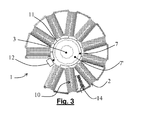
- Same central area 5 may be provided with two co-centred perimetral biosanitary corridors 7 and 7', as presented in the example in Fig.3 .
- facility 1 can become a so-called facility 1 of closed cycle, inside which all of the animals can be confined without introducing the animals from the outside.
- Each confinement module 2 is provided with means for air and gas channelling 10, which are generated inside towards the central area 5, see Fig.1 .
- central area 5 in central area 5, as seen in Fig.3 , there is a central air collector 11 connected to an air treatment unit 12.
- the means for air and gas conduct 10 work with negative pressure in order to guarantee the evacuation of all the air and gases generated inside the confinement modules 2 in a non-forced way towards the mentioned unit of air treatment 12, which is provided with appropriate filters.
- entries for outdoor air are previewed through air supply channels 14, which are presented as a scheme in Fig.3 . and detailed more specifically further. Even so, in other realizations, which are not presented, the ventilation can be forced through usage of extractor fans, for example.
- the means of air and gas channelling 10 of this facility follow a similar distribution of the feed transportation system 3, which will be described further, leaving the means of air and gas channelling 10 distributed in a radial manner around a perimetral channel, which acts as a central air collector 11. This is how the recovery of gases produced in each confinement module 2 is optimized, in order for them to be treated before releasing into the atmosphere.
- each confinement module 2 With the aim of favouring natural air circulation within each confinement module 2, these are provided with an arched convex cover, which has a fluting in its upper part, preferably in a shape of an inverted U, as a guide in order for the gases to circulate in the direction of central area 5. These flutings are covered with translucent material at least in their upper part in order to allow natural light entrance inside their corresponding modules 2.
- the layer of isolating material 20 is formed by substrate of soil which serves as base for plants and contributes to maintenance of optimal temperature.
- the system of feed transportation 4 for the facility 1, represented as a scheme in Fig.2 includes a series of radial channels 41, 42, 43, 44, 45, 46, 47 and 48, see Fig.2 , for the transportation of feed from central area 5, where the means for preparing the feed 3 are located, to the feeders from 51 to 60 of correspondent modules of confinement 2, and the valves 32 for selective distribution of feed through mentioned channels.
- the transportation system 4 supplies feed in an independent manner to two feeders 51 and 52 for gestating sows, two feeders 59 and 60 for weaning sows, three feeders 56, 57 and 58 for finishers and three feeders 53, 54 and 55 for fattening pigs.
- the system of transportation 4 includes perimetral channels 49a, 49b, and 49c, connected between two radial channels 41 and 42, 43 and 44, 45 and 46 respectively, associated to two confinement modules 2 not necessarily adjacent.
- Each module of confinement 2 is provided by means of feed dispensation to feeders 51 to 60 located along its route.
- this particular distribution of feed transportation system 3 allows it to be much more durable, and that in case any maintenance, exchange or repair task is needed, as to channels, valves or of any other element of the feed transportation system 3, this task can be carried out safely, fast and efficiently without affecting overall functioning of the facility 1.
- FIG.2 there are tree confinement modules 2 adapted for fattening pigs, to which the feed is supplied through radial channel 43, which is connected to central area 5, and the feed is distributed to feeders 53, 54 and 55 through perimetral channel 49b, to later return the extra feed through radial channel 44 back again.
- These feed channels are not affected by the rest of the feeding of the rest of the population of the facility, as for example feeders 56, 57 and 58 of the finisher pigs are supplied through correspondent radial channels 45 and 46, and perimetral channel 49c.
- This feed transportation system 3 reduced significantly the length of feed supply channels compared to facilities that do not have a radial distribution, and in case that the feed is liquid, it makes the cleaning of the channels easier, without the usual waste of water which takes place in conventional farming facilities.
- hydroponic green fodder which is the result of germination of cereal seeds, such as barley, wheat, oats and corn.
- the germination process takes place during a short period of time, between 10 and 12 days, capturing sun's energy and absorbing the minerals, which the nutritious solution contents.
- hydroponic green fodder is ideal for this facility 1 as it does not require bit land surface or long production time, nor expensive forms of preserving or storing.
- Hydroponic green fodder is produced in central area 5 of the facility 1 in plastic trays, placed on metal shelves. For instance, one kilogram of barley seeds after eleven days becomes six kilogram of hydroponic green fodder, which can be consumed in its totality (roots, stems, leaves and rest of the seeds), providing a complex formula of proteins, energy, vitamins and minerals.
- This crop is produced inside the central area 5, which acts as a greenhouse thanks to its translucent ceiling, which allows crop's protection from low temperatures, and permits direct expose to sunshine.
- hydroponic green fodder can be located in the perimetral corridor 7' of the central area 5.
- a kitchen equipped with means of feed preparation 3, from produced fodder the feed is prepared in order to feed the livestock through feed transportation system 4, which distributes the feed to correspondent feeders.
- terrace 40 delimited and without a ceiling (see Fig.1 ), so that the animals can wander around, but under control.
- These terraces 40 are also useful in case maintenance tasks have to be carried out in any of the modules, and it is necessary for the animals to be out of them. In these cases, the animals can be placed outside on the terrace while these tasks are being fulfilled.
- facility 1 is an autonomous facility, which provides a significant reduction of usual excessive consumption of water and feed in conventional linear facilities. Besides, at the level of visual impact, facility 1 resembles a flower with its petals, confinement modules 2, thus integrating easily in the natural environment.
- an advantage of the facility 1 is that a whole family can subsist thanks to it, which is a contribution of this facility, with this particular confinement and feeding method, to stop depopulation of rural areas and create quality meat.
Landscapes
- Life Sciences & Earth Sciences (AREA)
- Environmental Sciences (AREA)
- Zoology (AREA)
- Animal Husbandry (AREA)
- Biodiversity & Conservation Biology (AREA)
- Housing For Livestock And Birds (AREA)
- Fodder In General (AREA)
- Feed For Specific Animals (AREA)
Applications Claiming Priority (2)
| Application Number | Priority Date | Filing Date | Title |
|---|---|---|---|
| ES200702701A ES2320079B1 (es) | 2007-10-16 | 2007-10-16 | Instalacion para la cria de animales de establo. |
| PCT/ES2008/000627 WO2009050313A1 (fr) | 2007-10-16 | 2008-10-07 | Installation pour l'élevage d'animaux d'étable |
Publications (2)
| Publication Number | Publication Date |
|---|---|
| EP2201835A1 true EP2201835A1 (fr) | 2010-06-30 |
| EP2201835A4 EP2201835A4 (fr) | 2012-07-18 |
Family
ID=40567043
Family Applications (1)
| Application Number | Title | Priority Date | Filing Date |
|---|---|---|---|
| EP08839680A Withdrawn EP2201835A4 (fr) | 2007-10-16 | 2008-10-07 | Installation pour l'élevage d'animaux d'étable |
Country Status (3)
| Country | Link |
|---|---|
| EP (1) | EP2201835A4 (fr) |
| ES (1) | ES2320079B1 (fr) |
| WO (1) | WO2009050313A1 (fr) |
Families Citing this family (1)
| Publication number | Priority date | Publication date | Assignee | Title |
|---|---|---|---|---|
| DE102014107233A1 (de) * | 2014-05-22 | 2015-11-26 | Gea Farm Technologies Gmbh | Vorrichtung zum gelenkten Tierverkehr |
Family Cites Families (9)
| Publication number | Priority date | Publication date | Assignee | Title |
|---|---|---|---|---|
| US2039562A (en) * | 1933-05-22 | 1936-05-05 | James Mfg Co | Round ended building |
| GB956451A (en) * | 1958-12-10 | 1964-04-29 | Donald Frederick Galloway | Housing of animals |
| FR1290478A (fr) * | 1961-04-27 | 1962-04-13 | Installation pour l'élevage des porcs et similaires | |
| GB1030774A (en) * | 1963-05-31 | 1966-05-25 | Franco Cremaschini | Cattle stall assembly |
| ES346556A1 (es) * | 1967-10-28 | 1968-04-01 | Talleres Alju S L | Instalacion para el alojamiento y cebado de ganado porcino. |
| US3802390A (en) * | 1969-11-24 | 1974-04-09 | Int Farm Systems | System for feeding and maintaining animals in a confined environment |
| BE759288A (fr) * | 1969-11-24 | 1971-05-24 | Int Farm Systems | Installation pour cantonner et elever des animaux en milieu ferme |
| US3749060A (en) * | 1971-09-24 | 1973-07-31 | J Wagner | Circular pen for brood sow with piglets |
| EP0386160A1 (fr) * | 1988-03-22 | 1990-09-12 | Alisca Patent Szellemitermek Hasznosito Kft. | Enceinte d'elevage, notamment etable pour porcs a l'engrais |
-
2007
- 2007-10-16 ES ES200702701A patent/ES2320079B1/es not_active Expired - Fee Related
-
2008
- 2008-10-07 EP EP08839680A patent/EP2201835A4/fr not_active Withdrawn
- 2008-10-07 WO PCT/ES2008/000627 patent/WO2009050313A1/fr not_active Ceased
Also Published As
| Publication number | Publication date |
|---|---|
| ES2320079A1 (es) | 2009-05-18 |
| EP2201835A4 (fr) | 2012-07-18 |
| ES2320079B1 (es) | 2010-02-26 |
| WO2009050313A1 (fr) | 2009-04-23 |
Similar Documents
| Publication | Publication Date | Title |
|---|---|---|
| Shit | Hydroponic fodder production: an alternative technology for sustainable livestock production in India. | |
| Hermansen et al. | Integration of organic animal production into land use with special reference to swine and poultry | |
| Rakocy et al. | Pond culture of tilapia. | |
| CN104115756A (zh) | 一种光伏设施规模化标准化养殖肉牛羊的方法 | |
| CN107047260A (zh) | 小白菜无土栽培的方法 | |
| CN107494405A (zh) | 一种迷你型香肉黑猪养殖方法 | |
| Naik | Hydroponics green fodder for dairy animals | |
| Barash et al. | Integration of duck and fish farming: experimental results | |
| CN106982783A (zh) | 一种果子狸的高产养殖方法 | |
| KR20160136923A (ko) | 이동식 청사료 및 식물 수경재배 시스템 | |
| Walia et al. | Basics of integrated farming systems | |
| CN107466958A (zh) | 一种牛的养殖方法 | |
| Mogensen et al. | Production of organic beef from dairy bull calves in Denmark-Effect of different production strategies on productivity, carbon footprint and biodiversity estimated by modelling | |
| CN105613414A (zh) | 一种圈养波尔山羊的方法 | |
| ES2320079B1 (es) | Instalacion para la cria de animales de establo. | |
| Pankaj et al. | Climate resilient small ruminant production in drylands | |
| Sossidou et al. | Options for managing livestock production systems to adapt to climate change | |
| Früh et al. | Welfare and environmental impact of organic pig production | |
| Ogle | Suggestions for intensive livestock-based smallholder systems in semi-arid areas of Tanzania | |
| CN106376518A (zh) | 一种林下生态鸡的饲养方法 | |
| KR20150042004A (ko) | 조사료 재배기 | |
| Safa | Hydroponic Forage Production and Water Use Efficiency of Some Forage Crops under Palestinian Conditions | |
| Danko | Raising Broilers | |
| Maksimović et al. | Goats and climate resilience | |
| DK202430445A1 (da) | Mobilt staldsystem samt fremgangsmåde til svineproduktion |
Legal Events
| Date | Code | Title | Description |
|---|---|---|---|
| PUAI | Public reference made under article 153(3) epc to a published international application that has entered the european phase |
Free format text: ORIGINAL CODE: 0009012 |
|
| 17P | Request for examination filed |
Effective date: 20100325 |
|
| AK | Designated contracting states |
Kind code of ref document: A1 Designated state(s): AT BE BG CH CY CZ DE DK EE ES FI FR GB GR HR HU IE IS IT LI LT LU LV MC MT NL NO PL PT RO SE SI SK TR |
|
| AX | Request for extension of the european patent |
Extension state: AL BA MK RS |
|
| DAX | Request for extension of the european patent (deleted) | ||
| A4 | Supplementary search report drawn up and despatched |
Effective date: 20120620 |
|
| RIC1 | Information provided on ipc code assigned before grant |
Ipc: A01K 1/00 20060101AFI20120614BHEP |
|
| GRAP | Despatch of communication of intention to grant a patent |
Free format text: ORIGINAL CODE: EPIDOSNIGR1 |
|
| RIC1 | Information provided on ipc code assigned before grant |
Ipc: A01K 1/00 20060101AFI20121002BHEP |
|
| RIN1 | Information on inventor provided before grant (corrected) |
Inventor name: VELEZ CAMPILLO, JAVIER |
|
| STAA | Information on the status of an ep patent application or granted ep patent |
Free format text: STATUS: THE APPLICATION IS DEEMED TO BE WITHDRAWN |
|
| 18D | Application deemed to be withdrawn |
Effective date: 20130301 |