EP2202009A1 - Reinigungsvorrichtung - Google Patents
Reinigungsvorrichtung Download PDFInfo
- Publication number
- EP2202009A1 EP2202009A1 EP09252712A EP09252712A EP2202009A1 EP 2202009 A1 EP2202009 A1 EP 2202009A1 EP 09252712 A EP09252712 A EP 09252712A EP 09252712 A EP09252712 A EP 09252712A EP 2202009 A1 EP2202009 A1 EP 2202009A1
- Authority
- EP
- European Patent Office
- Prior art keywords
- carbon dioxide
- cleaning liquid
- cleaning
- unit
- washing tank
- Prior art date
- Legal status (The legal status is an assumption and is not a legal conclusion. Google has not performed a legal analysis and makes no representation as to the accuracy of the status listed.)
- Granted
Links
- 238000004140 cleaning Methods 0.000 title claims abstract description 235
- CURLTUGMZLYLDI-UHFFFAOYSA-N Carbon dioxide Chemical compound O=C=O CURLTUGMZLYLDI-UHFFFAOYSA-N 0.000 claims abstract description 469
- 229910002092 carbon dioxide Inorganic materials 0.000 claims abstract description 234
- 239000001569 carbon dioxide Substances 0.000 claims abstract description 233
- 239000007788 liquid Substances 0.000 claims abstract description 171
- 238000005406 washing Methods 0.000 claims abstract description 116
- 230000005587 bubbling Effects 0.000 claims abstract description 56
- 239000004094 surface-active agent Substances 0.000 claims abstract description 47
- 230000006837 decompression Effects 0.000 claims abstract description 35
- XLYOFNOQVPJJNP-UHFFFAOYSA-N water Substances O XLYOFNOQVPJJNP-UHFFFAOYSA-N 0.000 claims abstract description 30
- 238000007781 pre-processing Methods 0.000 claims description 10
- 239000004744 fabric Substances 0.000 abstract description 72
- 229960004424 carbon dioxide Drugs 0.000 description 209
- 239000007789 gas Substances 0.000 description 48
- 239000002689 soil Substances 0.000 description 34
- 239000012530 fluid Substances 0.000 description 16
- 239000003599 detergent Substances 0.000 description 12
- IJGRMHOSHXDMSA-UHFFFAOYSA-N Atomic nitrogen Chemical compound N#N IJGRMHOSHXDMSA-UHFFFAOYSA-N 0.000 description 10
- 238000000926 separation method Methods 0.000 description 8
- 238000000034 method Methods 0.000 description 7
- QVGXLLKOCUKJST-UHFFFAOYSA-N atomic oxygen Chemical compound [O] QVGXLLKOCUKJST-UHFFFAOYSA-N 0.000 description 5
- 229910052757 nitrogen Inorganic materials 0.000 description 5
- 239000001301 oxygen Substances 0.000 description 5
- 229910052760 oxygen Inorganic materials 0.000 description 5
- 239000000654 additive Substances 0.000 description 4
- 230000000996 additive effect Effects 0.000 description 4
- 238000013019 agitation Methods 0.000 description 4
- 102000004169 proteins and genes Human genes 0.000 description 4
- 108090000623 proteins and genes Proteins 0.000 description 4
- 239000007787 solid Substances 0.000 description 3
- 235000011089 carbon dioxide Nutrition 0.000 description 2
- 239000000356 contaminant Substances 0.000 description 2
- 238000011109 contamination Methods 0.000 description 2
- 238000010586 diagram Methods 0.000 description 2
- 238000007599 discharging Methods 0.000 description 2
- 238000001035 drying Methods 0.000 description 2
- 230000000694 effects Effects 0.000 description 2
- 238000010438 heat treatment Methods 0.000 description 2
- 239000002352 surface water Substances 0.000 description 2
- IAYPIBMASNFSPL-UHFFFAOYSA-N Ethylene oxide Chemical compound C1CO1 IAYPIBMASNFSPL-UHFFFAOYSA-N 0.000 description 1
- 230000002411 adverse Effects 0.000 description 1
- 239000007864 aqueous solution Substances 0.000 description 1
- 238000004061 bleaching Methods 0.000 description 1
- 238000004891 communication Methods 0.000 description 1
- 230000003247 decreasing effect Effects 0.000 description 1
- 230000018044 dehydration Effects 0.000 description 1
- 238000006297 dehydration reaction Methods 0.000 description 1
- 238000004090 dissolution Methods 0.000 description 1
- 238000004299 exfoliation Methods 0.000 description 1
- 238000002474 experimental method Methods 0.000 description 1
- 238000009413 insulation Methods 0.000 description 1
- 238000005259 measurement Methods 0.000 description 1
- 239000002245 particle Substances 0.000 description 1
- 230000001737 promoting effect Effects 0.000 description 1
Images
Classifications
-
- B—PERFORMING OPERATIONS; TRANSPORTING
- B08—CLEANING
- B08B—CLEANING IN GENERAL; PREVENTION OF FOULING IN GENERAL
- B08B3/00—Cleaning by methods involving the use or presence of liquid or steam
- B08B3/04—Cleaning involving contact with liquid
- B08B3/10—Cleaning involving contact with liquid with additional treatment of the liquid or of the object being cleaned, e.g. by heat, by electricity or by vibration
- B08B3/102—Cleaning involving contact with liquid with additional treatment of the liquid or of the object being cleaned, e.g. by heat, by electricity or by vibration with means for agitating the liquid
-
- B—PERFORMING OPERATIONS; TRANSPORTING
- B08—CLEANING
- B08B—CLEANING IN GENERAL; PREVENTION OF FOULING IN GENERAL
- B08B3/00—Cleaning by methods involving the use or presence of liquid or steam
- B08B3/04—Cleaning involving contact with liquid
- B08B3/08—Cleaning involving contact with liquid the liquid having chemical or dissolving effect
Definitions
- the present invention relates to a cleaning apparatus.
- a to-be-cleaned object is cleaned through forcedly exfoliating and forcedly dissolving a contaminant by utilizing flowing action and bubbling action obtained when intense agitation and a large amount of bubbles are generated on a surface of the contaminant by rapidly decompressing supercritical and subcritical fluids with an entrainer added.
- Japanese Patent Application Laid-Open Publication No. 59-232581 discloses a household washing machine in which pressurized air is supplied into water in a washing tank from a lower part of the washing tank and the pressurized air on a surface of the water in the washing tank is caused to periodically discharge a pressure.
- this washing machine upon discharging the pressure in the washing tank, air bubbles are blown up from a bottom part of the washing tank and laundry is efficiently moved, thereby avoiding a nonuniform soil removal.
- large and small bubbles included in fabric of the laundry are contracted and expanded by periodically repeating the pressurization and the pressure discharge in the washing tank, thereby promoting a dissolution of the soil.
- an object of the present invention is to provide a cleaning apparatus which has a simple configuration and is capable of efficiently cleaning a to-be-cleaned object.
- a cleaning apparatus comprises: a first carbon dioxide supply unit, a pressurization unit, a decompression unit, and a washing tank.
- the first carbon dioxide supply unit supplies carbon dioxide in a gas state to a cleaning liquid containing water and a surface-active agent.
- the pressurization unit pressurizes the cleaning liquid having the carbon dioxide in the gas state supplied thereto so as to cause at least a part of the carbon dioxide in the gas state to be dissolved in the cleaning liquid, the carbon dioxide supplied by the first carbon dioxide supply unit.
- the decompression unit causes the carbon dioxide dissolved in the cleaning liquid to bubble by decompressing the cleaning liquid pressurized by the pressurization unit.
- the washing tank cleans a to-be-cleaned object by the cleaning liquid containing the carbon dioxide decompressed by the decompression unit and thereby caused to be bubbling.
- the carbon dioxide in the gas state is supplied to the cleaning liquid containing the water and the surface-active agent by the first carbon dioxide supply unit, and the pressurization is performed by the pressurization unit, thereby causing said at least a part of the carbon dioxide in the gas state to be dissolved in the cleaning liquid.
- the cleaning liquid in which the carbon dioxide has been dissolved is decompressed by the decompression unit, thereby causing the carbon dioxide dissolved in the cleaning liquid to bubble.
- the to-be-cleaned object By cleaning the to-be-cleaned object by the cleaning liquid containing the bubbling carbon dioxide, the to-be-cleaned object can be effectively cleaned, as compared with a case where the to-be-cleaned object is cleaned by only a cleaning liquid.
- time required for the pressurization by the pressurization unit and the decompression by the decompression unit can be shortened, as compared with the case where the fluid in the supercritical or subcritical state is used to be caused to bubble.
- a high-performance pressurization pump is not required to be provided.
- the to-be-cleaned object can be caused to contact the cleaning liquid, thereby allowing the to-be-cleaned object to be cleaned. Since the to-be-cleaned object can be cleaned by using a very small amount of the water, an amount of the water used in the washing machine can be saved. In addition, since the amount of the water used for cleaning the to-be-cleaned object is small, dewatering and drying can be easily performed after having cleaned the to-be-cleaned object.
- the carbon dioxide is easily dissolved in the water, as compared with other gases contained in the air, that is, nitrogen and oxygen. Therefore, by using the carbon dioxide as a gas to be dissolved in the cleaning liquid, an increased amount of the gas can be dissolved, as compared with a case where the nitrogen, the oxygen, or the air is dissolved in the cleaning liquid. As mentioned above, by dissolving the increased amount of the gas therein, an increased amount of the bubbles can be generated when the pressurized cleaning liquid is decompressed.
- the cleaning apparatus which has the simple configuration and is capable of efficiently cleaning the to-be-cleaned object can be provided.
- the cleaning apparatus comprises a preprocessing tank, the first carbon dioxide supply unit supplies the carbon dioxide in the gas state to the cleaning liquid containing the water and the surface-active agent, the cleaning liquid contained in the preprocessing tank, and the pressurization unit pressurizes and the decompression unit decompresses, in the preprocessing tank, the cleaning liquid having the carbon dioxide supplied thereto.
- the carbon dioxide in the gas state is supplied to the cleaning liquid and is pressurized and decompressed. At least a part of the carbon dioxide in the gas state is dissolved in the cleaning liquid in the preprocessing tank and thereafter, bubbles.
- the cleaning liquid caused to be bubbling in the preprocessing tank and contains the carbon dioxide can be used for cleaning the to-be-cleaned object, thereby reducing the nonuniformity of the cleaning of the to-be-cleaned object.
- the pressurization unit pressurizes the cleaning liquid having the carbon dioxide supplied thereto such that a pressure of the cleaning comes to greater than or equal to 0.4 MPa.
- the carbon dioxide can be caused to bubble in an ensured manner.
- the cleaning apparatus comprises a second carbon dioxide supply unit and a controller.
- the second carbon dioxide supply unit supplies carbon dioxide in a supercritical or subcritical state to the to-be-cleaned object contained in the washing tank.
- the controller controls the first carbon dioxide supply unit, the pressurization unit, the decompression unit, and the second carbon dioxide supply unit.
- the controller controls the first carbon dioxide supply unit, the pressurization unit, the decompression unit, and the second carbon dioxide supply unit such that a first cleaning step in which the to-be-cleaned object is cleaned in the washing tank by the cleaning liquid containing the carbon dioxide having bubbled is performed and after the first cleaning step, a second cleaning step in which the carbon dioxide in the supercritical or subcritical state is supplied to the washing tank and the to-be-cleaned object is cleaned is performed.
- the cleaning liquid containing the water and the surface-active agent By using the cleaning liquid containing the water and the surface-active agent, water-soluble soil and soil caused by proteins can be removed well from the to-be-cleaned object.
- the cleaning liquid containing the bubbling carbon dioxide soil which cannot be removed only by a cleaning liquid not containing the bubbling carbon dioxide can be easily removed.
- the cleaning apparatus comprises the second carbon dioxide supply unit for supplying the carbon dioxide in the supercritical or subcritical state to the washing tank and the controller, and the controller controls the first carbon dioxide supply unit, the pressurization unit, the decompression unit, and the second carbon dioxide supply unit such that the first cleaning step and the second cleaning step are performed.
- the to-be-cleaned object is cleaned by the cleaning liquid containing the bubbling carbon dioxide in the washing tank, whereby the water-soluble soil and the soil caused by the proteins are removed from the to-be-cleaned object.
- the carbon dioxide in the supercritical or subcritical state is supplied to the washing tank and the to-be-cleaned object is cleaned, whereby the oil-soluble soil is removed from the to-be-cleaned object.
- the soil which is hardly removed from the to-be-cleaned object only by the cleaning liquid containing the bubbling carbon dioxide can be removed.
- an additive such as the surface-active agent can be efficiently applied to the to-be-cleaned object together with the carbon dioxide in the supercritical or subcritical state.
- the cleaning apparatus which has the simple configuration and is capable of efficiently cleaning the to-be-cleaned object can be provided.
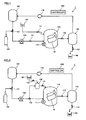
- a washing machine 1 as a cleaning apparatus mainly comprises: a washing tank 110, a carbon dioxide cylinder 120, a pump 130, a detergent input unit 140, a gas-liquid separation tank 150, a soil receptacle 160, a compressor 170, a liquid carbon dioxide tank 180, and a controller 200.
- a fabric structure 10 such as clothing is contained in the washing tank 110.
- the washing tank 110 is provided with a temperature controller 111.
- the temperature controller 111 for example, a heater is used.
- an agitation unit (not shown) for causing the fabric structure 10 contained in the washing tank 110 to contact the fluid is placed.
- a unit of the pump 130, an on-off valve 131, and an on-off valve 112 is one example of a pressurization unit.
- a unit of the on-off valve 112 and the compressor 170 is one example of a decompression unit.
- a unit of the carbon dioxide cylinder 120, the liquid carbon dioxide tank 180, the three-way valve 121, the pump 130, and the on-off valve 131 is one example of a first carbon dioxide supply unit.
- a unit of the liquid carbon dioxide tank 180, the three-way valve 121, the pump 130, and the on-off valve 131 is one example of a second carbon dioxide supply unit.
- the liquid carbon dioxide tank 180, the carbon dioxide cylinder 120, and the pump 130 are connected by a pipe in which the three-way valve 121 is placed.
- the pump 130 and the washing tank 110 are connected by a pipe in which the on-off valve 131 is placed.
- an on-off valve 141 is placed in a pipe by which the washing tank 110 and the detergent input unit 140 are connected.
- the on-off valve 112 is placed in a pipe by which the washing tank 110 and the gas-liquid separation tank 150 are connected.
- an on-off valve 151 is placed in a pipe for discharging soil from the gas-liquid separation tank 150 to the soil receptacle 160.
- the valves placed in the pipes are appropriately opened and closed. Opening and closing of the valves are performed by the controller 200 as described later.
- carbon dioxide in a liquid state is pooled in the carbon dioxide cylinder 120.
- the carbon dioxide cylinder 120 may be a cylinder which is filled with carbon dioxide in a gas state so as to be at a pressure greater than or equal to an atmospheric pressure.
- the temperature controller 111 adjusts a temperature inside the washing tank 110.
- the pump 130 sends the carbon dioxide in the carbon dioxide cylinder 120 or the liquid carbon dioxide tank 180 to the washing tank 110.
- the compressor 170 compresses and liquefies the carbon dioxide in the gas state, discharged from the gas-liquid separation tank 150, and sends it to the liquid carbon dioxide tank 180.
- the controller 200 controls driving of the pump 130, the compressor 170, and the temperature controller 111. In addition, the controller 200 controls the opening and closing of the on-off valve 112, the on-off valve 131, the on-off valve 141, and the on-off valve 151 and controls switching of the three-way valve 121.
- a user causes the fabric structure 10 to be contained in the washing tank 110.
- a cleaning liquid containing a surface-active agent and water is contained in the detergent input unit 140.
- the user operates an operation unit (not shown) of the washing machine 1 and causes the washing machine 1 to start washing.
- a first cleaning step is performed.
- the controller 200 controls the on-off valve 141 such that the on-off valve 141 is opened for a predetermined period of time.
- the cleaning liquid is supplied from the detergent input unit 140 to the washing tank 110.
- the controller 200 switches the three-way valve 121 and opens the on-off valve 131 so as to allow the carbon dioxide in the gas state to be supplied from the carbon dioxide cylinder 120 to the washing tank 110.
- the carbon dioxide in a highly-pressurized state is contained.
- an internal pressure of the carbon dioxide cylinder 120 which is generally used and filled with the carbon dioxide in the liquid state, is approximately 4 MPa through 7 MPa in the vicinity of ordinary temperatures. Therefore, even when the pump 130 is not driven, the carbon dioxide can be supplied into the washing tank 110.
- the carbon dioxide may be supplied from the liquid carbon dioxide tank 180 to the washing tank 110.
- the controller 200 supplies the carbon dioxide into the washing tank 110 such that a pressure inside the washing tank 110 comes to 0.4 MPa (gauge pressure). As described above, the carbon dioxide in the gas state is supplied into the washing tank 110.
- a pressure inside the washing tank 110 may be controlled by detecting a pressure inside the washing tank 110.
- a pressure inside the washing tank 110 may be controlled in accordance with time at which the three-way valve 121 is switched and time at which the on-off valve 131 is opened so as to supply the carbon dioxide into the washing tank 110.
- the carbon dioxide in the gas state is dissolved in the water contained in the cleaning liquid.
- the carbon dioxide in the gas state is very easily dissolved in the water, as compared with other gases in the air, that is, nitrogen and oxygen.
- a pressure inside the washing tank 110 a dissolved amount of the carbon dioxide in the gas state with respect to the water can be increased.
- the controller 200 supplies the carbon dioxide into the washing tank 110 by controlling the three-way valve 121, the pump 130, the on-off valve 131, and the on-off valve 112 such that the pressure inside the washing tank 110 comes to 0.4 MPa, whereby in the washing tank 110, at least a part of the carbon dioxide in the gas state is dissolved in the cleaning liquid.
- the controller 200 opens the on-off valve 112 and drives the compressor 170, whereby a pressure inside the washing tank 110 is decompressed so as to come to the vicinity of 0 MPa (gauge pressure).
- the decompression inside the washing tank 110 may be performed by opening an inside of the washing tank 110 such that a pressure inside the washing tank 110 comes to an atmospheric pressure.
- the amount of the cleaning liquid, which allows the fabric structure 10 not to be immersed therein, is contained inside the washing tank 110.
- the cleaning liquid bubbles a volume of the cleaning liquid in the washing tank 110 is increased and the fabric structure 10 contacts the bubbling cleaning liquid.
- the fabric structure 10 contacts the cleaning liquid, the fabric structure 10 is cleaned.
- the bubbles in the bubbling cleaning liquid disappear, components of the cleaning liquid are released into the gas and adhere to the fabric structure 10.
- the cleaning liquid in a case where an amount of the soil is small and an amount of the cleaning liquid is sufficiently large, the cleaning liquid can be removed by dripping the cleaning liquid as a liquid from the fabric structure 10 or dewatering may be performed through centrifugal dehydration or the like.
- the cleaning liquid may be caused to contain a component, such as a bleaching component, which decomposes the soil, whereby the soil may be decomposed.
- a component such as a bleaching component
- the cleaning liquid by causing the components of the cleaning liquid to adhere to the fabric structure 10, the soil of the fabric structure 10 is removed.
- the later-described second cleaning step is performed.
- the fabric structure 10 is cleaned by the cleaning liquid containing the bubbling carbon dioxide.
- the second cleaning step is performed in the washing machine 1.
- the controller 200 controls the three-way valve 121 and the on-off valve 131 so as to supply the carbon dioxide again from the carbon dioxide cylinder 120 to the washing tank 110.
- the controller 200 controls the temperature controller 111 of the washing tank 110 so as to render the carbon dioxide in the washing tank 110 to be in the supercritical or subcritical state.
- the fabric structure 10 is agitated.
- the fabric structure 10 is cleaned by the carbon dioxide in the supercritical or subcritical state.
- the controller 200 controls the on-off valve 112 such that the on-off valve 112 is opened and the fluid inside the washing tank 110 is sent to the gas-liquid separation tank 150.
- the carbon dioxide in the gas state and components of the soil removed from the fabric structure 10 in liquid and solid states are separated from each other.
- the carbon dioxide in the gas state flows from the gas-liquid separation tank 150 to the compressor 170 and is compressed and liquefied by the compressor 170.
- the carbon dioxide liquefied by the compressor 170 is pooled in the liquid carbon dioxide tank 180.
- the carbon dioxide pooled in the liquid carbon dioxide tank 180 is reused for cleaning the fabric structure 10.
- the liquid components and the solid components which have been separated from the carbon dioxide in the gas state in the gas-liquid separation tank 150, are discharged to the soil receptacle 160 when the controller 200 controls the on-off valve 151 so as to open the on-off valve 151.
- the second cleaning step is performed as described above.
- the first cleaning step in which the fabric structure 10 is cleaned by the cleaning liquid containing the bubbling carbon dioxide is performed and thereafter, the second cleaning step in which the fabric structure 10 is cleaned by the carbon dioxide in the supercritical or subcritical state is performed, thereby allowing the surface-active agent and water remaining in the fabric structure 10 to be removed.
- water-soluble soil which can be hardly removed by the carbon dioxide in the supercritical or subcritical state is removed in the first cleaning step and oil-soluble soil which can be hardly removed by a cleaning liquid is removed in the second cleaning step.
- the surface-active agent acts, as an additive for cleaning the fabric structure 10, in an aqueous solution as well as the carbon dioxide in the supercritical or subcritical state. Therefore, when after the first cleaning step, the surface-active agent contained in the cleaning liquid remains in the fabric structure 10, the surface-active agent can enhance a cleaning effect, exhibited by the carbon dioxide in the supercritical or subcritical state, in the second cleaning step.
- a nonionic surface-active agent As an additive (surface-active agent) which acts in such a manner, it is preferable to use a nonionic surface-active agent. This is because an ionic surface-active agent hardly acts in the carbon dioxide. In particular, since a nonionic surface-active agent, such as polyoxyethylene-(4)-lauryl-ether, whose mole number of added ethylene oxide is less than or equal to 10 has a high affinity for the carbon dioxide, the nonionic surface-active agent acts even in the carbon dioxide and also has an affinity for water, thereby allowing a cleaning liquid containing the water to be prepared. Hence, it is preferable to use such a surface-active agent.
- the method in which the first cleaning step in which the fabric structure 10 is cleaned by the cleaning liquid containing the surface-active agent is performed and thereafter, the second cleaning step in which the fabric structure 10 is cleaned by the carbon dioxide in the supercritical or subcritical state is performed, thereby causing the surface-active agent to act in the carbon dioxide in the supercritical or subcritical state, is easier than other method for adding the surface-active agent to the carbon dioxide in the supercritical or subcritical state and more effective in utilizing the surface-active agent than the other method.
- the pump for adding the surface-active agent to the carbon dioxide is not required.
- the surface-active agent is added to the carbon dioxide as mentioned above, the surface-active agent is dispersed in the whole carbon dioxide in the supercritical or subcritical state.
- the surface-active agent does not contact the fabric structure 10, thereby causing inefficiency
- the first cleaning step in which the fabric structure 10 is cleaned by the cleaning liquid containing the surface-active agent
- the components of the cleaning liquid such as the surface-active agent
- the washing machine 1 of the first embodiment comprises: the carbon dioxide cylinder 120, the three-way valve 121, the pump 130, the on-off valve 131, the pressurization unit, the decompression unit, and the washing tank 110.
- the carbon dioxide cylinder 120, the three-way valve 121, the pump 130, and the on-off valve 131 supply the carbon dioxide in the gas state to the cleaning liquid containing the water and the surface-active agent.
- the pressurization unit pressurizes the cleaning liquid, to which the carbon dioxide in the gas state has been supplied, so as to dissolve, in the cleaning liquid, at least a part of the carbon dioxide in the gas state, supplied by the carbon dioxide cylinder 120, the three-way valve 121, the pump 130, and the on-off valve 131.
- the decompression unit decompresses the cleaning liquid pressurized by the pressurization unit, thereby causing the carbon dioxide dissolved in the cleaning liquid to bubble.
- the washing tank 110 cleans the fabric structure 10 by the cleaning liquid containing the carbon dioxide bubbling due to the decompression by the decompression unit.
- the carbon dioxide in the gas state is supplied to the cleaning liquid containing the water and the surface-active agent by the carbon dioxide cylinder 120, the three-way valve 121, the pump 130, and the on-off valve 131, and the pressurization is performed by the pressurization unit, thereby causing said at least a part of the carbon dioxide in the gas state to be dissolved in the cleaning liquid.
- the cleaning liquid in which the carbon dioxide has been dissolved is decompressed by the decompression unit, thereby causing the carbon dioxide dissolved in the cleaning liquid to bubble.
- the fabric structure 10 By cleaning the fabric structure 10 by the cleaning liquid containing the bubbling carbon dioxide, the fabric structure 10 can be effectively cleaned, as compared with a case where the fabric structure 10 is cleaned by only a cleaning liquid.
- time required for the pressurization by the pressurization unit and the decompression by the decompression unit can be shortened, as compared with the case where the fluid in the supercritical or subcritical state is used to be caused to bubble.
- a high-performance pressurization pump is not required to be provided.
- the fabric structure 10 can be caused to contact the cleaning liquid, thereby allowing the fabric structure 10 to be cleaned. Since the fabric structure 10 can be cleaned by using a very small amount of the water, an amount of the water used in the washing machine 1 can be saved. In addition, since the amount of the water used for cleaning the fabric structure 10 is small, dewatering and drying can be easily performed after having cleaned the fabric structure 10.
- the carbon dioxide is easily dissolved in the water, as compared with the other gases contained in the air, that is, the nitrogen and the oxygen.
- an amount of a gas dissolved in the water is large under a condition of a high pressure rather than a low pressure.
- a difference between an amount of the carbon dioxide dissolved in the water under a condition of a low pressure and an amount of the carbon dioxide dissolved in the water under a condition of a high pressure is large.
- an amount of the gas which can be dissolved therein can be increased and an amount of the bubbles which can be generated when the pressurized cleaning liquid is decompressed can be increased, as compared with a case where the nitrogen, the oxygen, or the air is dissolved in the cleaning liquid.
- the washing machine 1 which has a simple configuration and is capable of efficiently cleaning the fabric structure 10 can be provided.
- the pressurization unit pressurizes the cleaning liquid, to which the carbon dioxide in the gas state has been supplied, at a pressure greater than or equal to 0.4 MPa.
- the carbon dioxide can be caused to bubble in an ensured manner.
- the washing machine 1 of the first embodiment comprises: the liquid carbon dioxide tank 180, the three-way valve 121, the pump 130, the on-off valve 131, and the controller 200.
- the liquid carbon dioxide tank 180, the three-way valve 121, the pump 130, and the on-off valve 131 supply the carbon dioxide in the supercritical or subcritical state to the fabric structure 10 contained in the washing tank 110.
- the controller 200 controls the carbon dioxide cylinder 120, the three-way valve 121, the pump 130, the on-off valve 131, the pressurization unit, the decompression unit, the liquid carbon dioxide tank 180, the three-way valve 121, the pump 130, and the on-offvalve 131.
- the controller 200 controls the pressurization unit, the decompression unit, the three-way valve 121, the pump 130, and the on-off valve 131 such that the first cleaning step in which the fabric structure 10 is cleaned by the cleaning liquid containing the bubbling carbon dioxide in the washing tank 110 is performed and after the first cleaning step, the second cleaning step in which the carbon dioxide in the supercritical or subcritical state is supplied to the washing tank 110 and the fabric structure 10 is cleaned is performed.
- the cleaning liquid containing the water and the surface-active agent By using the cleaning liquid containing the water and the surface-active agent, water-soluble soil and soil caused by proteins can be removed well from the fabric structure 10.
- the cleaning liquid containing the bubbling carbon dioxide soil which cannot be removed only by a cleaning liquid not containing the bubbling carbon dioxide can be easily removed.
- the washing machine 1 comprises: the liquid carbon dioxide tank 180 for supplying the carbon dioxide in the supercritical or subcritical state to the washing tank 110, the three-way valve 121, the pump 130, the on-off valve 131, and the controller 200, and the controller 200 controls the carbon dioxide cylinder 120, the three-way valve 121, the pump 130, the on-off valve 131, the pressurization unit, the decompression unit, the liquid carbon dioxide tank 180, the three-way valve 121, the pump 130, and the on-off valve 131 such that the first cleaning step and the second cleaning step are performed.
- the fabric structure 10 is cleaned by the cleaning liquid containing the bubbling carbon dioxide in the washing tank 110, whereby the water-soluble soil and the soil caused by the proteins are removed from the fabric structure 10.
- the carbon dioxide in the supercritical or subcritical state is supplied to the washing tank 110 and the fabric structure 10 is cleaned, whereby the oil-soluble soil is removed from the fabric structure 10.
- the additive such as the surface-active agent can be efficiently applied to the fabric structure 10 together with the carbon dioxide in the supercritical or subcritical state.
- a washing machine 2 as a cleaning apparatus is different from the washing machine 1 of the first embodiment in that the washing machine 2 comprises an bubbling container 190 as a preprocessing tank.
- a detergent input unit 140 is connected to the bubbling container 190 by a pipe in which an on-off valve 142 is placed.
- the bubbling container 190 is connected to a washing tank 110 by a pipe in which an on-off valve 191 is placed.
- a three-way valve 132 is placed, instead of the on-off valve 131 ( Fig. 1 ).
- a pipe on a downstream side of the pump 130 is connected by the three-way valve 132 to a pipe connected to the washing tank 110 and a pipe connected to the bubbling container 190.
- a unit of a carbon dioxide cylinder 120, a liquid carbon dioxide tank 180, a three-way valve 121, the pump 130, and the three-way valve 132 is one example of a first carbon dioxide supply unit.
- a unit of the three-way valve 132 and the on-off valve 191 is one example of a pressurization unit.
- the on-off valve 191 is one example of a decompression unit.
- a unit of the liquid carbon dioxide tank 180, the three-way valve 121, the pump 130, and the three-way valve 132 is one example of a second carbon dioxide supply unit.
- a first cleaning step and a second cleaning step are performed in order.
- a controller 200 closes the on-off valve 191 and opens the on-off valve 142 such that a cleaning liquid is supplied from the detergent input unit 140 to the bubbling container 190.
- the controller 200 controls the three-way valve 121 and the three-way valve 132 to supply carbon dioxide from the carbon dioxide cylinder 120 to the bubbling container 190, thereby causing a pressure in the bubbling container 190 to come to 0.4 MPa (gauge pressure).
- the controller 200 closes the three-way valve 132.
- the carbon dioxide in a gas state contacts the cleaning liquid in the bubbling container 190 and at least a part of the carbon dioxide in the gas state is dissolved in the cleaning liquid.
- the controller 200 opens the on-off valve 191.
- the on-off valve 191 is opened, an inside of the bubbling container 190 is decompressed.
- the inside of the bubbling container 190 is decompressed, the carbon dioxide dissolved in the cleaning liquid bubbles. Since the carbon dioxide bubbles and thereby, a volume of the cleaning liquid is markedly increased, the cleaning liquid in the bubbling container 190 flows into the washing tank 110.
- a fabric structure 10 is agitated by an agitation unit (not shown), whereby the cleaning liquid containing the bubbling carbon dioxide can be caused to contact the whole fabric structure 10. In this way, the fabric structure 10 can be cleaned.
- the cleaning liquid containing the bubbling carbon dioxide is supplied to an inside of the washing tank 110 from above the washing tank 110, and also in the washing tank 110, as in the washing machine 1 of the first embodiment, the carbon dioxide and the cleaning liquid are pressurized and decompressed, thereby allowing the carbon dioxide to be caused to bubble. In this way, by causing bubbles to act from above and below the fabric structure 10, the bubbles can be caused to evenly contact the whole fabric structure 10.
- the other parts of the cleaning steps in the washing machine 2 of the second embodiment are the same as those in the washing machine 1 of the first embodiment.
- the bubbling container 190 is connected to the washing tank 110 by a bypass from the three-way valve 132.
- the second cleaning step is performed, carbon dioxide in a supercritical or subcritical state is supplied to the washing tank 110.
- the bubbling container 190 is placed on a channel through which the carbon dioxide in the supercritical or subcritical state flows, it is required to configure the bubbling container 190 and the detergent input unit 140 so as to be resistant to a high pressure of several MPa.
- it is required to configure the detergent input unit 140 so as to have a mechanism which allows a detergent to be easily inputted externally for example, by making a configuration thereof which allows easy opening and closing, it is difficult to realize specifications which achieve a high-pressure-resistance.
- bypass channel when the carbon dioxide in the supercritical or subcritical state is used, a channel which does not communicate with the bubbling container 190 and the detergent input unit 140 is used; and by avoiding the communication with a side of the bubbling container 190, pressure resistance capabilities which are required of the detergent input unit 140 and the bubbling container 190 can be made low.
- the washing machine 2 of the second embodiment comprises the bubbling container 190; the carbon dioxide cylinder 120, the liquid carbon dioxide tank 180, the three-way valve 121, the pump 130, and the three-way valve 132 supply the carbon dioxide in the gas state to the cleaning liquid contained in the bubbling container 190 and containing the water and the surface-active agent; the three-way valve 132 and the on-off valve 191 pressurize and decompress the cleaning liquid, to which the carbon dioxide has been supplied, in the bubbling container 190.
- the carbon dioxide in the gas state is supplied to the cleaning liquid and is pressurized and decompressed. At least a part of the carbon dioxide in the gas state is dissolved in the cleaning liquid in the bubbling container 190 and thereafter, bubbles.
- the cleaning liquid caused to be bubbling in the bubbling container 190 and contains the carbon dioxide can be used for cleaning the fabric structure 10, thereby reducing the nonuniformity of the cleaning of the fabric structure 10.
- a cloth, manufactured by Yagi Co., Ltd., which has been soiled with a water-soluble contamination was put into the washing tank 110 of the washing machine 1 ( Fig. 1 ) of the first embodiment.
- the cleaning liquid containing the surface-active agent and the water was contained in the detergent input unit 140, and the first cleaning step in the first embodiment was performed.
- the first cleaning step was performed by changing a pressure of the carbon dioxide in the washing tank 110. Cleaning ratios obtained when the carbon dioxide was at respective pressures are shown in Table 1. Measurement of the cleaning ratios was conducted by employing a JIS C9811 method, and the cloth, manufactured by Yagi Co., Ltd., which has been soiled with the water-soluble contamination was used, instead of an artificial contaminated cloth specified in the above-mentioned method.
- Table 1 CO 2 Pressure (MPa) Bubbled/Not Bubbled Cleaning Ratio 0.1 Not Bubbled 0.00 0.2 Not Bubbled 0.00 0.3 Not Bubbled 0.00 0.4 Bubbled 0.12 1.3 Bubbled 0.27 6 Bubbled 0.27 20 Bubbled 0.35
Landscapes
- Chemical & Material Sciences (AREA)
- Chemical Kinetics & Catalysis (AREA)
- General Chemical & Material Sciences (AREA)
- Accessory Of Washing/Drying Machine, Commercial Washing/Drying Machine, Other Washing/Drying Machine (AREA)
- Cleaning By Liquid Or Steam (AREA)
Applications Claiming Priority (1)
| Application Number | Priority Date | Filing Date | Title |
|---|---|---|---|
| JP2008329186A JP2010148632A (ja) | 2008-12-25 | 2008-12-25 | 洗浄装置 |
Publications (2)
| Publication Number | Publication Date |
|---|---|
| EP2202009A1 true EP2202009A1 (de) | 2010-06-30 |
| EP2202009B1 EP2202009B1 (de) | 2011-08-31 |
Family
ID=42009853
Family Applications (1)
| Application Number | Title | Priority Date | Filing Date |
|---|---|---|---|
| EP09252712A Not-in-force EP2202009B1 (de) | 2008-12-25 | 2009-12-01 | Reinigungsvorrichtung |
Country Status (4)
| Country | Link |
|---|---|
| US (1) | US20100163081A1 (de) |
| EP (1) | EP2202009B1 (de) |
| JP (1) | JP2010148632A (de) |
| AT (1) | ATE522285T1 (de) |
Cited By (3)
| Publication number | Priority date | Publication date | Assignee | Title |
|---|---|---|---|---|
| CN106544721A (zh) * | 2015-09-18 | 2017-03-29 | 通用电气公司 | 用于处理内部通道的超临界水方法 |
| IT201600074797A1 (it) * | 2016-07-18 | 2018-01-18 | Alessio Pecorella | Lavatrice ad acqua gasata |
| WO2022146383A3 (en) * | 2020-12-31 | 2023-08-10 | Yagcilar Ali | Adjusting the gas concentration in the washing machine |
Families Citing this family (5)
| Publication number | Priority date | Publication date | Assignee | Title |
|---|---|---|---|---|
| JP6259589B2 (ja) * | 2013-06-07 | 2018-01-10 | 昭和電工ガスプロダクツ株式会社 | 超臨界処理装置 |
| KR102472994B1 (ko) * | 2021-01-25 | 2022-12-01 | 엘지전자 주식회사 | 의류처리장치 |
| KR102536873B1 (ko) * | 2021-01-25 | 2023-05-26 | 엘지전자 주식회사 | 세탁기 |
| KR102594903B1 (ko) * | 2021-01-25 | 2023-10-27 | 엘지전자 주식회사 | 의류처리장치 및 그 제어방법 |
| KR20220107553A (ko) | 2021-01-25 | 2022-08-02 | 엘지전자 주식회사 | 의류처리장치 |
Citations (6)
| Publication number | Priority date | Publication date | Assignee | Title |
|---|---|---|---|---|
| JPS59232581A (ja) | 1983-06-17 | 1984-12-27 | 工藤 隆 | 家庭用洗濯機 |
| JPH08290128A (ja) | 1995-04-20 | 1996-11-05 | Shiyuuzu Rifuretsushiyaa Kaihatsu Kyodo Kumiai | 超臨界および亜臨界流体を用いた洗浄方法 |
| US5814161A (en) * | 1992-11-30 | 1998-09-29 | Massachusetts Institute Of Technology | Ceramic mold finishing techniques for removing powder |
| US5858107A (en) * | 1998-01-07 | 1999-01-12 | Raytheon Company | Liquid carbon dioxide cleaning using jet edge sonic whistles at low temperature |
| US20070107748A1 (en) * | 2005-11-16 | 2007-05-17 | Donald Gray | Vacuum cavitational streaming |
| WO2007120735A2 (en) * | 2006-04-11 | 2007-10-25 | University Of Utah Research Foundation | Pressurizing-depressurizing cycles for removal of contaminants in environmental samples |
Family Cites Families (16)
| Publication number | Priority date | Publication date | Assignee | Title |
|---|---|---|---|---|
| JPH0568955A (ja) * | 1991-09-12 | 1993-03-23 | Mitsubishi Heavy Ind Ltd | 洗浄・脱水方法 |
| US5467492A (en) * | 1994-04-29 | 1995-11-21 | Hughes Aircraft Company | Dry-cleaning of garments using liquid carbon dioxide under agitation as cleaning medium |
| JPH08291395A (ja) * | 1995-02-22 | 1996-11-05 | Toyota Motor Corp | 金属成型物の洗浄方法及び洗浄装置 |
| US6287435B1 (en) * | 1998-05-06 | 2001-09-11 | Tokyo Electron Limited | Method and apparatus for ionized physical vapor deposition |
| JP2000100895A (ja) * | 1998-09-18 | 2000-04-07 | Nikon Corp | 基板の搬送装置、基板の保持装置、及び基板処理装置 |
| US6497239B2 (en) * | 1999-08-05 | 2002-12-24 | S. C. Fluids, Inc. | Inverted pressure vessel with shielded closure mechanism |
| JP2001087587A (ja) * | 1999-09-20 | 2001-04-03 | Sanyo Electric Co Ltd | 洗濯機 |
| US20040003831A1 (en) * | 2000-04-18 | 2004-01-08 | Mount David J. | Supercritical fluid cleaning process for precision surfaces |
| US6666928B2 (en) * | 2001-09-13 | 2003-12-23 | Micell Technologies, Inc. | Methods and apparatus for holding a substrate in a pressure chamber |
| JP2003135891A (ja) * | 2001-11-05 | 2003-05-13 | Mitsubishi Heavy Ind Ltd | 二酸化炭素による洗浄方法及びその装置 |
| JP3674866B2 (ja) * | 2002-04-15 | 2005-07-27 | 久光 塚原 | 穀類および豆類の洗浄方法、洗浄浸漬方法および加工方法 |
| JP4037179B2 (ja) * | 2002-06-04 | 2008-01-23 | 東京エレクトロン株式会社 | 洗浄方法、洗浄装置 |
| US6846380B2 (en) * | 2002-06-13 | 2005-01-25 | The Boc Group, Inc. | Substrate processing apparatus and related systems and methods |
| JP2005033135A (ja) * | 2003-07-11 | 2005-02-03 | Kobe Steel Ltd | 微細構造体の洗浄装置 |
| WO2006071985A2 (en) * | 2004-12-29 | 2006-07-06 | Alert Logic, Inc. | Threat scoring system and method for intrusion detection security networks |
| JP5072062B2 (ja) * | 2006-03-13 | 2012-11-14 | 栗田工業株式会社 | 水素ガス溶解洗浄水の製造方法、製造装置及び洗浄装置 |
-
2008
- 2008-12-25 JP JP2008329186A patent/JP2010148632A/ja active Pending
-
2009
- 2009-12-01 AT AT09252712T patent/ATE522285T1/de not_active IP Right Cessation
- 2009-12-01 US US12/628,328 patent/US20100163081A1/en not_active Abandoned
- 2009-12-01 EP EP09252712A patent/EP2202009B1/de not_active Not-in-force
Patent Citations (6)
| Publication number | Priority date | Publication date | Assignee | Title |
|---|---|---|---|---|
| JPS59232581A (ja) | 1983-06-17 | 1984-12-27 | 工藤 隆 | 家庭用洗濯機 |
| US5814161A (en) * | 1992-11-30 | 1998-09-29 | Massachusetts Institute Of Technology | Ceramic mold finishing techniques for removing powder |
| JPH08290128A (ja) | 1995-04-20 | 1996-11-05 | Shiyuuzu Rifuretsushiyaa Kaihatsu Kyodo Kumiai | 超臨界および亜臨界流体を用いた洗浄方法 |
| US5858107A (en) * | 1998-01-07 | 1999-01-12 | Raytheon Company | Liquid carbon dioxide cleaning using jet edge sonic whistles at low temperature |
| US20070107748A1 (en) * | 2005-11-16 | 2007-05-17 | Donald Gray | Vacuum cavitational streaming |
| WO2007120735A2 (en) * | 2006-04-11 | 2007-10-25 | University Of Utah Research Foundation | Pressurizing-depressurizing cycles for removal of contaminants in environmental samples |
Cited By (4)
| Publication number | Priority date | Publication date | Assignee | Title |
|---|---|---|---|---|
| CN106544721A (zh) * | 2015-09-18 | 2017-03-29 | 通用电气公司 | 用于处理内部通道的超临界水方法 |
| US10221488B2 (en) | 2015-09-18 | 2019-03-05 | General Electric Company | Supercritical water method for treating internal passages |
| IT201600074797A1 (it) * | 2016-07-18 | 2018-01-18 | Alessio Pecorella | Lavatrice ad acqua gasata |
| WO2022146383A3 (en) * | 2020-12-31 | 2023-08-10 | Yagcilar Ali | Adjusting the gas concentration in the washing machine |
Also Published As
| Publication number | Publication date |
|---|---|
| ATE522285T1 (de) | 2011-09-15 |
| EP2202009B1 (de) | 2011-08-31 |
| JP2010148632A (ja) | 2010-07-08 |
| US20100163081A1 (en) | 2010-07-01 |
Similar Documents
| Publication | Publication Date | Title |
|---|---|---|
| EP2202009B1 (de) | Reinigungsvorrichtung | |
| JP4880427B2 (ja) | 洗浄方法および洗浄装置 | |
| KR101093323B1 (ko) | 기판처리장치 및 기판처리방법 | |
| US7361231B2 (en) | System and method for mid-pressure dense phase gas and ultrasonic cleaning | |
| JP4841484B2 (ja) | 基板処理装置 | |
| KR100935975B1 (ko) | 기판처리장치 | |
| US7506457B2 (en) | Substrate treating apparatus | |
| KR20190002060A (ko) | 기판처리장치 및 기판처리방법 | |
| JP2009279117A (ja) | 洗浄装置 | |
| JP2009273483A (ja) | 洗浄装置 | |
| WO1999034937A1 (en) | Liquid carbon dioxide additive system | |
| KR100835752B1 (ko) | 기판 제조용 초임계 유체 공급 장치 | |
| KR102789694B1 (ko) | 기판처리방법 | |
| JP2000308862A (ja) | 超臨界又は亜臨界流体を用いた洗浄方法及びその装置 | |
| JPH1094767A (ja) | 超臨界流体洗浄装置 | |
| JP2001123961A (ja) | 加圧供給方法及び装置 | |
| JP6104109B2 (ja) | 洗浄方法および洗浄装置 | |
| JP2003117510A (ja) | 洗浄装置 | |
| JP7711990B1 (ja) | バブル水生成装置 | |
| KR102824215B1 (ko) | 기판처리장치 및 기판처리방법 | |
| JPH09143773A (ja) | 機械加工物の洗浄装置 | |
| JP2009027078A (ja) | 基板処理装置 | |
| JPH0568955A (ja) | 洗浄・脱水方法 | |
| JP4767205B2 (ja) | 基板処理装置 | |
| JPH0821564B2 (ja) | 洗浄装置 |
Legal Events
| Date | Code | Title | Description |
|---|---|---|---|
| PUAI | Public reference made under article 153(3) epc to a published international application that has entered the european phase |
Free format text: ORIGINAL CODE: 0009012 |
|
| AK | Designated contracting states |
Kind code of ref document: A1 Designated state(s): AT BE BG CH CY CZ DE DK EE ES FI FR GB GR HR HU IE IS IT LI LT LU LV MC MK MT NL NO PL PT RO SE SI SK SM TR |
|
| AX | Request for extension of the european patent |
Extension state: AL BA RS |
|
| 17P | Request for examination filed |
Effective date: 20101223 |
|
| GRAP | Despatch of communication of intention to grant a patent |
Free format text: ORIGINAL CODE: EPIDOSNIGR1 |
|
| RIC1 | Information provided on ipc code assigned before grant |
Ipc: B08B 3/08 20060101ALI20110217BHEP Ipc: B08B 3/10 20060101AFI20110217BHEP |
|
| GRAS | Grant fee paid |
Free format text: ORIGINAL CODE: EPIDOSNIGR3 |
|
| GRAA | (expected) grant |
Free format text: ORIGINAL CODE: 0009210 |
|
| AK | Designated contracting states |
Kind code of ref document: B1 Designated state(s): AT BE BG CH CY CZ DE DK EE ES FI FR GB GR HR HU IE IS IT LI LT LU LV MC MK MT NL NO PL PT RO SE SI SK SM TR |
|
| REG | Reference to a national code |
Ref country code: CH Ref legal event code: EP Ref country code: GB Ref legal event code: FG4D |
|
| REG | Reference to a national code |
Ref country code: IE Ref legal event code: FG4D |
|
| REG | Reference to a national code |
Ref country code: DE Ref legal event code: R096 Ref document number: 602009002392 Country of ref document: DE Effective date: 20111110 |
|
| REG | Reference to a national code |
Ref country code: NL Ref legal event code: VDEP Effective date: 20110831 |
|
| LTIE | Lt: invalidation of european patent or patent extension |
Effective date: 20110831 |
|
| PG25 | Lapsed in a contracting state [announced via postgrant information from national office to epo] |
Ref country code: HR Free format text: LAPSE BECAUSE OF FAILURE TO SUBMIT A TRANSLATION OF THE DESCRIPTION OR TO PAY THE FEE WITHIN THE PRESCRIBED TIME-LIMIT Effective date: 20110831 Ref country code: NO Free format text: LAPSE BECAUSE OF FAILURE TO SUBMIT A TRANSLATION OF THE DESCRIPTION OR TO PAY THE FEE WITHIN THE PRESCRIBED TIME-LIMIT Effective date: 20111130 Ref country code: SE Free format text: LAPSE BECAUSE OF FAILURE TO SUBMIT A TRANSLATION OF THE DESCRIPTION OR TO PAY THE FEE WITHIN THE PRESCRIBED TIME-LIMIT Effective date: 20110831 Ref country code: FI Free format text: LAPSE BECAUSE OF FAILURE TO SUBMIT A TRANSLATION OF THE DESCRIPTION OR TO PAY THE FEE WITHIN THE PRESCRIBED TIME-LIMIT Effective date: 20110831 Ref country code: LT Free format text: LAPSE BECAUSE OF FAILURE TO SUBMIT A TRANSLATION OF THE DESCRIPTION OR TO PAY THE FEE WITHIN THE PRESCRIBED TIME-LIMIT Effective date: 20110831 Ref country code: NL Free format text: LAPSE BECAUSE OF FAILURE TO SUBMIT A TRANSLATION OF THE DESCRIPTION OR TO PAY THE FEE WITHIN THE PRESCRIBED TIME-LIMIT Effective date: 20110831 Ref country code: IS Free format text: LAPSE BECAUSE OF FAILURE TO SUBMIT A TRANSLATION OF THE DESCRIPTION OR TO PAY THE FEE WITHIN THE PRESCRIBED TIME-LIMIT Effective date: 20111231 |
|
| REG | Reference to a national code |
Ref country code: AT Ref legal event code: MK05 Ref document number: 522285 Country of ref document: AT Kind code of ref document: T Effective date: 20110831 |
|
| PG25 | Lapsed in a contracting state [announced via postgrant information from national office to epo] |
Ref country code: CY Free format text: LAPSE BECAUSE OF FAILURE TO SUBMIT A TRANSLATION OF THE DESCRIPTION OR TO PAY THE FEE WITHIN THE PRESCRIBED TIME-LIMIT Effective date: 20110831 Ref country code: SI Free format text: LAPSE BECAUSE OF FAILURE TO SUBMIT A TRANSLATION OF THE DESCRIPTION OR TO PAY THE FEE WITHIN THE PRESCRIBED TIME-LIMIT Effective date: 20110831 Ref country code: LV Free format text: LAPSE BECAUSE OF FAILURE TO SUBMIT A TRANSLATION OF THE DESCRIPTION OR TO PAY THE FEE WITHIN THE PRESCRIBED TIME-LIMIT Effective date: 20110831 Ref country code: GR Free format text: LAPSE BECAUSE OF FAILURE TO SUBMIT A TRANSLATION OF THE DESCRIPTION OR TO PAY THE FEE WITHIN THE PRESCRIBED TIME-LIMIT Effective date: 20111201 Ref country code: AT Free format text: LAPSE BECAUSE OF FAILURE TO SUBMIT A TRANSLATION OF THE DESCRIPTION OR TO PAY THE FEE WITHIN THE PRESCRIBED TIME-LIMIT Effective date: 20110831 |
|
| PG25 | Lapsed in a contracting state [announced via postgrant information from national office to epo] |
Ref country code: BE Free format text: LAPSE BECAUSE OF FAILURE TO SUBMIT A TRANSLATION OF THE DESCRIPTION OR TO PAY THE FEE WITHIN THE PRESCRIBED TIME-LIMIT Effective date: 20110831 |
|
| PG25 | Lapsed in a contracting state [announced via postgrant information from national office to epo] |
Ref country code: SK Free format text: LAPSE BECAUSE OF FAILURE TO SUBMIT A TRANSLATION OF THE DESCRIPTION OR TO PAY THE FEE WITHIN THE PRESCRIBED TIME-LIMIT Effective date: 20110831 Ref country code: CZ Free format text: LAPSE BECAUSE OF FAILURE TO SUBMIT A TRANSLATION OF THE DESCRIPTION OR TO PAY THE FEE WITHIN THE PRESCRIBED TIME-LIMIT Effective date: 20110831 |
|
| PG25 | Lapsed in a contracting state [announced via postgrant information from national office to epo] |
Ref country code: IT Free format text: LAPSE BECAUSE OF FAILURE TO SUBMIT A TRANSLATION OF THE DESCRIPTION OR TO PAY THE FEE WITHIN THE PRESCRIBED TIME-LIMIT Effective date: 20110831 Ref country code: PL Free format text: LAPSE BECAUSE OF FAILURE TO SUBMIT A TRANSLATION OF THE DESCRIPTION OR TO PAY THE FEE WITHIN THE PRESCRIBED TIME-LIMIT Effective date: 20110831 Ref country code: RO Free format text: LAPSE BECAUSE OF FAILURE TO SUBMIT A TRANSLATION OF THE DESCRIPTION OR TO PAY THE FEE WITHIN THE PRESCRIBED TIME-LIMIT Effective date: 20110831 Ref country code: EE Free format text: LAPSE BECAUSE OF FAILURE TO SUBMIT A TRANSLATION OF THE DESCRIPTION OR TO PAY THE FEE WITHIN THE PRESCRIBED TIME-LIMIT Effective date: 20110831 Ref country code: PT Free format text: LAPSE BECAUSE OF FAILURE TO SUBMIT A TRANSLATION OF THE DESCRIPTION OR TO PAY THE FEE WITHIN THE PRESCRIBED TIME-LIMIT Effective date: 20120102 |
|
| PG25 | Lapsed in a contracting state [announced via postgrant information from national office to epo] |
Ref country code: DK Free format text: LAPSE BECAUSE OF FAILURE TO SUBMIT A TRANSLATION OF THE DESCRIPTION OR TO PAY THE FEE WITHIN THE PRESCRIBED TIME-LIMIT Effective date: 20110831 |
|
| PLBE | No opposition filed within time limit |
Free format text: ORIGINAL CODE: 0009261 |
|
| STAA | Information on the status of an ep patent application or granted ep patent |
Free format text: STATUS: NO OPPOSITION FILED WITHIN TIME LIMIT |
|
| PG25 | Lapsed in a contracting state [announced via postgrant information from national office to epo] |
Ref country code: MC Free format text: LAPSE BECAUSE OF NON-PAYMENT OF DUE FEES Effective date: 20111231 |
|
| 26N | No opposition filed |
Effective date: 20120601 |
|
| REG | Reference to a national code |
Ref country code: FR Ref legal event code: ST Effective date: 20120831 |
|
| REG | Reference to a national code |
Ref country code: IE Ref legal event code: MM4A |
|
| REG | Reference to a national code |
Ref country code: DE Ref legal event code: R097 Ref document number: 602009002392 Country of ref document: DE Effective date: 20120601 |
|
| PG25 | Lapsed in a contracting state [announced via postgrant information from national office to epo] |
Ref country code: IE Free format text: LAPSE BECAUSE OF NON-PAYMENT OF DUE FEES Effective date: 20111201 |
|
| PG25 | Lapsed in a contracting state [announced via postgrant information from national office to epo] |
Ref country code: MK Free format text: LAPSE BECAUSE OF FAILURE TO SUBMIT A TRANSLATION OF THE DESCRIPTION OR TO PAY THE FEE WITHIN THE PRESCRIBED TIME-LIMIT Effective date: 20110831 Ref country code: MT Free format text: LAPSE BECAUSE OF FAILURE TO SUBMIT A TRANSLATION OF THE DESCRIPTION OR TO PAY THE FEE WITHIN THE PRESCRIBED TIME-LIMIT Effective date: 20110831 |
|
| PG25 | Lapsed in a contracting state [announced via postgrant information from national office to epo] |
Ref country code: ES Free format text: LAPSE BECAUSE OF FAILURE TO SUBMIT A TRANSLATION OF THE DESCRIPTION OR TO PAY THE FEE WITHIN THE PRESCRIBED TIME-LIMIT Effective date: 20111211 Ref country code: FR Free format text: LAPSE BECAUSE OF NON-PAYMENT OF DUE FEES Effective date: 20120102 Ref country code: SM Free format text: LAPSE BECAUSE OF FAILURE TO SUBMIT A TRANSLATION OF THE DESCRIPTION OR TO PAY THE FEE WITHIN THE PRESCRIBED TIME-LIMIT Effective date: 20110831 |
|
| PG25 | Lapsed in a contracting state [announced via postgrant information from national office to epo] |
Ref country code: LU Free format text: LAPSE BECAUSE OF NON-PAYMENT OF DUE FEES Effective date: 20111201 |
|
| PG25 | Lapsed in a contracting state [announced via postgrant information from national office to epo] |
Ref country code: BG Free format text: LAPSE BECAUSE OF FAILURE TO SUBMIT A TRANSLATION OF THE DESCRIPTION OR TO PAY THE FEE WITHIN THE PRESCRIBED TIME-LIMIT Effective date: 20111130 |
|
| PG25 | Lapsed in a contracting state [announced via postgrant information from national office to epo] |
Ref country code: TR Free format text: LAPSE BECAUSE OF FAILURE TO SUBMIT A TRANSLATION OF THE DESCRIPTION OR TO PAY THE FEE WITHIN THE PRESCRIBED TIME-LIMIT Effective date: 20110831 |
|
| PG25 | Lapsed in a contracting state [announced via postgrant information from national office to epo] |
Ref country code: HU Free format text: LAPSE BECAUSE OF FAILURE TO SUBMIT A TRANSLATION OF THE DESCRIPTION OR TO PAY THE FEE WITHIN THE PRESCRIBED TIME-LIMIT Effective date: 20110831 |
|
| REG | Reference to a national code |
Ref country code: CH Ref legal event code: PL |
|
| GBPC | Gb: european patent ceased through non-payment of renewal fee |
Effective date: 20131201 |
|
| REG | Reference to a national code |
Ref country code: DE Ref legal event code: R084 Ref document number: 602009002392 Country of ref document: DE |
|
| PG25 | Lapsed in a contracting state [announced via postgrant information from national office to epo] |
Ref country code: CH Free format text: LAPSE BECAUSE OF NON-PAYMENT OF DUE FEES Effective date: 20131231 Ref country code: LI Free format text: LAPSE BECAUSE OF NON-PAYMENT OF DUE FEES Effective date: 20131231 |
|
| REG | Reference to a national code |
Ref country code: DE Ref legal event code: R084 Ref document number: 602009002392 Country of ref document: DE Effective date: 20141002 |
|
| PG25 | Lapsed in a contracting state [announced via postgrant information from national office to epo] |
Ref country code: GB Free format text: LAPSE BECAUSE OF NON-PAYMENT OF DUE FEES Effective date: 20131201 |
|
| PGFP | Annual fee paid to national office [announced via postgrant information from national office to epo] |
Ref country code: DE Payment date: 20141211 Year of fee payment: 6 |
|
| REG | Reference to a national code |
Ref country code: DE Ref legal event code: R119 Ref document number: 602009002392 Country of ref document: DE |
|
| PG25 | Lapsed in a contracting state [announced via postgrant information from national office to epo] |
Ref country code: DE Free format text: LAPSE BECAUSE OF NON-PAYMENT OF DUE FEES Effective date: 20160701 |