EP2202260A1 - Inhärent stabilisiertes Polyamid-Elastomer sowie Verfahren zu dessen Herstellung - Google Patents
Inhärent stabilisiertes Polyamid-Elastomer sowie Verfahren zu dessen Herstellung Download PDFInfo
- Publication number
- EP2202260A1 EP2202260A1 EP08022424A EP08022424A EP2202260A1 EP 2202260 A1 EP2202260 A1 EP 2202260A1 EP 08022424 A EP08022424 A EP 08022424A EP 08022424 A EP08022424 A EP 08022424A EP 2202260 A1 EP2202260 A1 EP 2202260A1
- Authority
- EP
- European Patent Office
- Prior art keywords
- polyamide
- mol
- bifunctional
- polyamide elastomer
- acid
- Prior art date
- Legal status (The legal status is an assumption and is not a legal conclusion. Google has not performed a legal analysis and makes no representation as to the accuracy of the status listed.)
- Granted
Links
Classifications
-
- C—CHEMISTRY; METALLURGY
- C08—ORGANIC MACROMOLECULAR COMPOUNDS; THEIR PREPARATION OR CHEMICAL WORKING-UP; COMPOSITIONS BASED THEREON
- C08L—COMPOSITIONS OF MACROMOLECULAR COMPOUNDS
- C08L77/00—Compositions of polyamides obtained by reactions forming a carboxylic amide link in the main chain; Compositions of derivatives of such polymers
- C08L77/06—Polyamides derived from polyamines and polycarboxylic acids
-
- C—CHEMISTRY; METALLURGY
- C08—ORGANIC MACROMOLECULAR COMPOUNDS; THEIR PREPARATION OR CHEMICAL WORKING-UP; COMPOSITIONS BASED THEREON
- C08G—MACROMOLECULAR COMPOUNDS OBTAINED OTHERWISE THAN BY REACTIONS ONLY INVOLVING UNSATURATED CARBON-TO-CARBON BONDS
- C08G69/00—Macromolecular compounds obtained by reactions forming a carboxylic amide link in the main chain of the macromolecule
- C08G69/02—Polyamides derived from amino-carboxylic acids or from polyamines and polycarboxylic acids
- C08G69/26—Polyamides derived from amino-carboxylic acids or from polyamines and polycarboxylic acids derived from polyamines and polycarboxylic acids
- C08G69/34—Polyamides derived from amino-carboxylic acids or from polyamines and polycarboxylic acids derived from polyamines and polycarboxylic acids using polymerised unsaturated fatty acids
-
- C—CHEMISTRY; METALLURGY
- C08—ORGANIC MACROMOLECULAR COMPOUNDS; THEIR PREPARATION OR CHEMICAL WORKING-UP; COMPOSITIONS BASED THEREON
- C08G—MACROMOLECULAR COMPOUNDS OBTAINED OTHERWISE THAN BY REACTIONS ONLY INVOLVING UNSATURATED CARBON-TO-CARBON BONDS
- C08G69/00—Macromolecular compounds obtained by reactions forming a carboxylic amide link in the main chain of the macromolecule
- C08G69/02—Polyamides derived from amino-carboxylic acids or from polyamines and polycarboxylic acids
- C08G69/36—Polyamides derived from amino-carboxylic acids or from polyamines and polycarboxylic acids derived from amino acids, polyamines and polycarboxylic acids
-
- C—CHEMISTRY; METALLURGY
- C08—ORGANIC MACROMOLECULAR COMPOUNDS; THEIR PREPARATION OR CHEMICAL WORKING-UP; COMPOSITIONS BASED THEREON
- C08G—MACROMOLECULAR COMPOUNDS OBTAINED OTHERWISE THAN BY REACTIONS ONLY INVOLVING UNSATURATED CARBON-TO-CARBON BONDS
- C08G69/00—Macromolecular compounds obtained by reactions forming a carboxylic amide link in the main chain of the macromolecule
- C08G69/40—Polyamides containing oxygen in the form of ether groups
-
- C—CHEMISTRY; METALLURGY
- C08—ORGANIC MACROMOLECULAR COMPOUNDS; THEIR PREPARATION OR CHEMICAL WORKING-UP; COMPOSITIONS BASED THEREON
- C08G—MACROMOLECULAR COMPOUNDS OBTAINED OTHERWISE THAN BY REACTIONS ONLY INVOLVING UNSATURATED CARBON-TO-CARBON BONDS
- C08G69/00—Macromolecular compounds obtained by reactions forming a carboxylic amide link in the main chain of the macromolecule
- C08G69/48—Polymers modified by chemical after-treatment
-
- C—CHEMISTRY; METALLURGY
- C08—ORGANIC MACROMOLECULAR COMPOUNDS; THEIR PREPARATION OR CHEMICAL WORKING-UP; COMPOSITIONS BASED THEREON
- C08G—MACROMOLECULAR COMPOUNDS OBTAINED OTHERWISE THAN BY REACTIONS ONLY INVOLVING UNSATURATED CARBON-TO-CARBON BONDS
- C08G81/00—Macromolecular compounds obtained by interreacting polymers in the absence of monomers, e.g. block polymers
- C08G81/02—Macromolecular compounds obtained by interreacting polymers in the absence of monomers, e.g. block polymers at least one of the polymers being obtained by reactions involving only carbon-to-carbon unsaturated bonds
- C08G81/024—Block or graft polymers containing sequences of polymers of C08C or C08F and of polymers of C08G
- C08G81/025—Block or graft polymers containing sequences of polymers of C08C or C08F and of polymers of C08G containing polyether sequences
-
- C—CHEMISTRY; METALLURGY
- C08—ORGANIC MACROMOLECULAR COMPOUNDS; THEIR PREPARATION OR CHEMICAL WORKING-UP; COMPOSITIONS BASED THEREON
- C08G—MACROMOLECULAR COMPOUNDS OBTAINED OTHERWISE THAN BY REACTIONS ONLY INVOLVING UNSATURATED CARBON-TO-CARBON BONDS
- C08G81/00—Macromolecular compounds obtained by interreacting polymers in the absence of monomers, e.g. block polymers
- C08G81/02—Macromolecular compounds obtained by interreacting polymers in the absence of monomers, e.g. block polymers at least one of the polymers being obtained by reactions involving only carbon-to-carbon unsaturated bonds
- C08G81/024—Block or graft polymers containing sequences of polymers of C08C or C08F and of polymers of C08G
- C08G81/028—Block or graft polymers containing sequences of polymers of C08C or C08F and of polymers of C08G containing polyamide sequences
-
- C—CHEMISTRY; METALLURGY
- C08—ORGANIC MACROMOLECULAR COMPOUNDS; THEIR PREPARATION OR CHEMICAL WORKING-UP; COMPOSITIONS BASED THEREON
- C08K—Use of inorganic or non-macromolecular organic substances as compounding ingredients
- C08K5/00—Use of organic ingredients
- C08K5/0008—Organic ingredients according to more than one of the "one dot" groups of C08K5/01 - C08K5/59
- C08K5/005—Stabilisers against oxidation, heat, light, ozone
Definitions
- the present invention relates to an inherently stabilized polyamide elastomer having at least one bifunctional polyamide segment and at least one bifunctional soft segment.
- the polyamide essentially forms the hard phase, the soft segment substantially the soft phase of a thermoplastic elastomer.
- these are segmented block copolymers which combine the properties of elastomers and thermoplastics, ie they have elastic properties over a wide temperature range and can be processed thermoplastically.
- the polyamide elastomers according to the invention are characterized in that they contain at least one chemically bonded stabilizer contained, which significantly increases the heat resistance and / or the light stability of the polyamide elastomer according to the invention.
- reactive stabilization is also known in the literature, in which case sterically hindered phenols or aromatic amines are used which are resistant to the functional groups of the polyamide-forming monomers, ie, amino or acid functionalities , Reactivity and thus chemically bind to the polyamide chains.
- these are the applications EP 0 759 953 .
- EP 0 822 275 EP 1 053 272 .
- EP 1 070 093 . WO 95/28443 or the EP 0 818 491 with this principle of reactive stabilization of homopolyamides.
- radicals or groups A 1 , A 2 and B 1 , B 2 and X 1 -X 7 and Z 1 and Z 2 as well as Z 3 and Z 4 may each be the same or different.
- At least one stabilizing radical is chemically bound in the polyamide elastomer and a specific weight ratio between the bifunctional polyamide segments (A) and the bifunctional soft segments (B) is maintained.
- at least one reactive stabilizer (Z 1 or Z 2 ) per molecule of the polyamide elastomer according to the formula I is chemically bound via an ester or amide bond to its terminus or within the molecule.
- both termini of the polyamide elastomer are provided with a chemically bound stabilizer residue.
- the radicals B 1 and B 2 are oligomers or polymers based on linear or branched, substituted or unsubstituted C 2 -C 36 -alkylenes, Oligomers or polymers based on C 6 -C 36 -cycloalkylenes, C 6 -C 20 -aryls, polycaprolactones, polyesters based on aliphatic or cycloaliphatic dicarboxylic acids and diols, aliphatic polycarbonates, C 2 -C 4 -polyoxyalkylenes and copolymers and mixtures of these elements are.
- the oligomers or polymers are prepared in-situ during the polymerization of the polyamide elastomer from those mentioned above Monomers.
- radicals X 1 to X 7 are amide bonds (-CON (H) -)
- radicals B 1 and B 2 are given as oligomer or polymer based on C 2 -C 4 -polyoxyalkylenes, Polyolefins, polysiloxanes with number average molecular weight in the range of 200 to 3000 g / mol (preferably 300 to 2500 g / mol) and copolymers and mixtures of these elements.
- radicals Z 1 and / or Z 2 that is the antibody bound to the molecule stabilizer of the formula I given above, independently of one another selected from the group consisting of hydrogen or the radicals of the following formulas II to IV
- Preferred radicals Z 3 and / or Z 4 are selected from the radicals according to general formulas V and VI:
- the preferred reactive stabilizers which are bound according to the invention on the polyamide elastomer are thus sterically hindered amines (eg piperidine derivatives) or sterically hindered phenols.
- the specific reactive stabilizers used in the synthesis of the polyamide elastomers of the invention are listed below.
- the abovementioned radicals of the formulas II to VI are thus derived from these compounds.
- the binding according to the invention or incorporation of the reactive stabilizers takes place according to formula I either via an amide or an ester bond.
- the weight fraction of the sum of the bifunctional polyamide segments A 1 and A 2 relative to the sum of the bifunctional soft segments B 1 and B 2 is between 5:95 and 95: 5, preferably 40:60 and 90:10, more preferably between 50 : 50 and 90:10, and more preferably between 50:50 and 85:15.
- the number average molecular weight M n of the bifunctional polyamide segments A 1 and A 2 is independently (for b> 1) between 200 and 5000 g / mol, preferably between 700 and 4000 g / mol, particularly preferably between 750 and 3000 g / mol, and / or the number average molecular weight M n of the bifunctional soft segments B 1 and B 2 independently of one another (for b> 1) between 200 and 5000 g / mol, preferably between 200 and 3000 g / mol, particularly preferably between 300 and 2500 g / mol.
- polyamide segments A 1 and A 2 fall several possibilities, which are carried out in the following in particular and are all to be included in the invention.
- the following structural starting materials are preferred: transparent polyesteramide, polyamide elastomer based on renewable raw materials, polyetheramide or polyetheresteramide based on at least one polyamide segment A and based on at least one soft segment B (eg polyester and / or ester - And / or polyether), wherein the polyamide A based on dicarboxylic acids and alkyl-substituted bis (aminocyclohexyl) methane and optionally further diamines, and / or lactams and / or aminocarboxylic acids may be formed and the soft segment B (eg the polyester and / or Ester fraction) based on a diol and a dicarboxylic acid and / or a hydroxycarboxylic acid and the polyether portion based on a polyether diamine.
- the soft segment B eg the polyester and / or Ester fraction
- Decisive is always the inventive inherent stabilization by chemical bonding of a reactive stabilizer.
- Diamine selected from the group of branched or unbranched C 4 -C 18 aliphatic diamines, cycloaliphatic C 8 -C 20 diamines, aromatic core diamines and mixtures and combinations thereof.
- linear or branched, aliphatic diamines are 1,4-butanediamine, 1,5-pentanediamine, 2-methyl-1,5-pentanediamine (MPMD), 1,6-hexanediamine, 1,7-heptanediamine, 1,8- Octanediamine (OMDA), 1,9-nonanediamine (NMDA), 1,10-decanediamine, 2-methyl-1,8-octanediamine (MODA), 2,2,4-trimethylhexamethylenediamine (TMHMD), 2,4,4- Trimethylhexamethylenediamine (TMHMD), 5-methyl-1,9-nonanediamine, 1,11-undecanediamine, 2-butyl-2-ethyl-1,5-pentanediamine, 1,12-dodecanediamine
- cycloaliphatic diamines which may be mentioned are cyclohexanediamine, 1,3-bis- (aminomethyl) -cyclohexane (BAC), isophoronediamine, norboranediamine, norboranedimethylamine, bis (aminomethyl) norboron, 4,4'-diaminodicyclohexylmethane (PACM), 2,2- ( 4,4'-diaminodicyclohexyl) propane (PACP) and 3,3'-dimethyl-4,4'-diaminodicyclohexylmethane (MACM).
- PAM 4,4'-diaminodicyclohexylmethane
- PCP 2,2- ( 4,4'-diaminodicyclohexyl) propane
- ACM 3,3'-dimethyl-4,4'-diaminodicyclohexylmethane
- MXDA m-xylylenediamine
- Dicarboxylic acid (both for the polyamide segments A 1 and A 2 (Component (b)) as well as for the soft segments B 1 and B 2 , i. e. e.g. Polyester content):
- the at least one dicarboxylic acid can be selected from the following group: aliphatic C 4 -C 44 diacid, cycloaliphatic C 8 -C 36 diacid, aromatic diacid (preferably TPS, IPS, NDS), as well as mixtures and combinations thereof.
- the at least one dicarboxylic acid is preferably selected from adipic acid, sebacic acid, dodecanedioic acid, terephthalic acid, isophthalic acid, cyclohexanedicarboxylic acid and mixtures thereof, particularly preferably succinic acid, glutaric acid, adipic acid, pimelic acid, suberic acid, azelaic acid, sebacic acid, undecanedioic acid, dodecanedioic acid, brassylic acid, tetradecanedioic acid, pentadecanedioic acid , Hexadecanedioic acid, heptadecanedioic acid, octadecanedioic acid, nonadecanedioic acid, eicosanedioic acid, japanoic acid, cyclohexanedicarboxylic acid, in particular cis- and / or trans-cyclohe
- the lactam or the aminocarboxylic acid is preferably selected from the group caprolactam, laurolactam, aminocaproic acid, aminolauric acid, aminoundecanoic acid.
- lactams are lactams or ⁇ , ⁇ -amino acids having 4, 6, 7, 8, 11 or 12 C atoms. These are the lactams pyrrolidin-2-one (4 C-atoms), ⁇ -caprolactam (6 C-atoms), enanthlactam (7 C-atoms), capryllactam (8 C-atoms), laurolactam (12 C-atoms) resp the ⁇ , ⁇ -amino acids 1,4-aminobutanoic acid, 1,6-aminohexanoic acid, 1,7-aminoheptanoic acid, 1,8-aminooctanoic acid, 1,11-aminoundecanoic acid and 1,12-aminododecanoic acid.
- Preferred soft segments B 1 and B 2 and starting materials on which this segment is based are shown below:
- Diol selected from the group of C 2 -C 36 aliphatic diols, C 6 -C 36 cycloaliphatic diols, aromatic C 8 -C 36 diols, diols containing ether groups, polycaprolactone diols or combinations thereof.
- the diol is preferably selected from the group of ethanediol, propanediol, butanediol, pentanediol, hexanediol, neopentyl glycol, cyclohexanedimethanol, C 36 -dimer fatty diol, polyoxyalkylenediols (linear or branched C 2 -C 5 -alkylenes) (in particular having a number-average molar mass in the range of 200 to 2000 g / mol), polycaprolactone diol having a number average molecular weight in the range of 500 to 3000 g / mol, particularly preferably 750 to 2000 g / mol, and combinations thereof.
- Polyether segment (amino- or hydroxy- or carboxyl-terminated, providing B 1 and B 2 ):
- radicals B 1 and / or B 2 according to the general formula I are preferably derived from the starting materials of the following compounds.
- the corresponding functionalities (amino, hydroxy and carboxylic acid functionality) occur in the corresponding amide or ester bonds X 4 to X 7 .
- Particularly included are polyether derivatives of the form AXYZB, where A, B independently of one another represent amine or alcohol radical or carboxylic acid, X, Y, Z independently of one another mono-, oligo- or polymeric units of oxyethylene, oxypropylene or oxytetramethylene.
- Such polyether segments are sold for example by the company Huntsman under the name elastamine.
- the polyamide elastomer of the invention is transparent.
- transparent polyamide elastomer, or transparent molding composition, as used in this document is intended to denote polyamide elastomers or molding compositions thereof, the light transmission is at least 70%, when the polyamide elastomer or the molding material (in pure form, ie without the further constituents of the molding composition according to the invention specified above) in the form of a thin platelet of 2 mm thickness.
- the measurement of the light transmission is carried out with a Haze Gard Plus device from BYK-Gardner on plates of dimension 2 x 60 x 60 mm according to ASTM D 1003.
- the plates are produced on an Arburg injection molding machine using a polished tool, with the cylinder temperature between 200 and 340 ° C and the mold temperature between 20 and 140 ° C.
- the polyamide elastomer and / or the molding compound thus preferably have a transmission of at least 70%, preferably of at least 80%, particularly preferably of greater than 85%.
- the polyamide elastomer and / or the molding composition have a haze (haze) of at most 20%, preferably at most 15%, particularly preferably at most 10% (ASTM 1003, layer thickness: 2 mm).
- the transparent polyamide elastomer is preferably a polyesteramide or a polyetheresteramide based on a polyester and / or ester fraction with a polyester of a C 36 -diol and one or more dicarboxylic acids selected from the group adipic acid, Sebacic acid, dodecanedioic acid, C 36 -dimer fatty acid, isophthalic acid and terephthalic acid, or a polyether amide.
- Transparent polyetheresteramides can also be prepared with an OH-terminated polyether.
- polyamide elastomers containing amorphous or microcrystalline polyamide hard segments A 1 and A 2 are especially preferred.
- the amorphous or microcrystalline polyamide hard segments A 1 and A 2 of the polyesteramides, polyetheramides or polyetheresteramides according to the invention have a number-average molecular weight in the range from 200 to 5000 g / mol, preferably in the range from 700 to 4000 g / mol and very particularly preferably in the range from 750 to 3000 g / mol.
- microcrystalline polyamide hard segment, or copolyamide hard segment has a melting enthalpy in the range of 4-40 J / g, in particular in the range of 4 to 25 J / g (measured by Differential Scanning Calorimetry, DSC).
- microcrystalline polyamide / copolyamide hard segment compositions are polyamide systems which, when processed in high molecular weight and without further constituents, give transparent moldings. That the dimension of the crystallites is below the wavelength of the visible light.
- the microcrystalline polyamide hard segment preferably has a melting temperature of at least 120 ° C., preferably of at least 135 ° C. and in particular of at least 150 ° C.
- the preferably microcrystalline polyamide and / or copolyamide hard segment is based on alkyl-substituted Bis (aminocyclohexyl) methane or bis (aminocyclohexyl) propane and optionally other cycloaliphatic diamines (eg PACM, IPD, BAC) and / or aliphatic C 4 -C 18 diamines and / or diamines with aromatic nucleus (eg MXDA or PXDA).
- this is based on MACM and aliphatic dicarboxylic acids having 10 to 36 carbon atoms, wherein it is the other cycloaliphatic diamine preferably PACM and / or IPD (isophorone diamine) with or without additional substituents, and more preferably a copolyamide of the type MACM / PACM each with aliphatic dicarboxylic acids having 10 to 36 carbon atoms, such as MACM12 / PACM12, acts.
- the PACM concentration is preferably more than 40 mol%, particularly preferably more than 55 mol%.
- the polyamide segment A is based on at least 20 mol%, preferably at least 30 mol%, particularly preferably at least 40 mol% and particularly preferably entirely on alkyl-substituted bis (aminocyclohexyl) methane.
- the alkyl-substituted bis (aminocyclohexyl) methane is bis (4-amino-3-methyl-cyclohexyl) -methane (MACM).
- Preferred molar masses of such a polyamide segment A are in the range from 500 to 5,000 g / mol, preferably in the range from 700 to 4,000 g / mol and more preferably in the range from 750 to 3,000 g / mol.
- MACM stands for the ISO designation bis- (4-amino-3-methyl-cyclohexyl) -methane, which is sold under the trade name 3,3'-dimethyl-4-4'-diaminodicyclohexylmethane as the Laromin C260 type (CAS no 6864-37-5) is commercially available.
- MACM stands for an aliphatic linear dicarboxylic acid (C 12 eg DDS, dodecanedioic acid), with which the diamine MACM is polymerized.
- PACM stands for the ISO designation bis- (4-aminocyclohexyl) -methane, which is commercially available under the trade name 4,4'-diaminodicyclohexylmethane as dicykanype (CAS No. 1761-71-3).
- the polyamide hard segment may be an amorphous polyamide and / or copolyamide, then preferably with a melting enthalpy of less than 4 J / g (measured by differential scanning calorimetry, DSC).
- the amorphous polyamide hard segment A has a glass transition temperature above at least 50 ° C, preferably greater than 80 ° C, and more preferably greater than 100 ° C.
- the segment may well have a Tg below 50 ° C.
- polyamide elastomers in which the polyamide segment A is based on bis (4-amino-3-methylcyclohexyl) methane (MACM) and isophthalic acid and / or terephthalic acid and / or an aliphatic C 4 -C 36 -, preferably one C 12 is dicarboxylic acid and / or cycloaliphatic C 8 -C 36 dicarboxylic acid.
- MCM bis (4-amino-3-methylcyclohexyl) methane
- the transparent polyamide elastomer is, as already mentioned, preferably a polyetheramide or polyetheresteramide or polyesteramide, preferably based on a polyamide system selected from the group MACM12, MACM14, MACM18, MACM12 / PACM12, MACM14 / PACM14, MACM18 / PACM18, copolyamides including 6T, 9T, 10T, and / or 12T Units, and mixtures and / or combinations thereof, wherein polyamides are also included with isophthalic acid as starting material.
- a polyetheramide or polyetheresteramide or polyesteramide preferably based on a polyamide system selected from the group MACM12, MACM14, MACM18, MACM12 / PACM12, MACM14 / PACM14, MACM18 / PACM18, copolyamides including 6T, 9T, 10T, and / or 12T Units, and mixtures and / or combinations thereof, wherein polyamides are also included with isophthalic acid
- the amorphous polyamide and / or copolyamide hard segment A is based on MACM, aliphatic and / or other cycloaliphatic diamines, preference is given to amorphous polyamides of the type MACMI, MACMI / MACMT, MACMI / MACMT / 12, MACMI / 12, MACMT / 12, wherein the content of laurolactam in this case is preferably less than 50 mol%, especially less than 35 mol%.
- I is isophthalic acid.
- the polyamide hard segment is based on aromatic dicarboxylic acids having 10 to 18 carbon atoms or aliphatic dicarboxylic acids having 6 to 36 carbon atoms or a mixture of such homopolyamides and / or copolyamides, preferably based on lactams and / or aminocarboxylic acids, wherein in the case of the aromatic dicarboxylic acids, for example TPS (terephthalic acid) and / or IPS (isophthalic acid).
- aromatic dicarboxylic acids for example TPS (terephthalic acid) and / or IPS (isophthalic acid).
- the homopolyamide and / or copolyamide hard segment A can advantageously be a polyamide selected from the group: 6I / MACMI / MACMT, 6I / 6T / MACMI, MACMI / MACM36, lactam-containing polyamides, such as 12 / MACMI, 12 / MACMT, 12 / MACM6-18 or a mixture thereof.
- Other possible systems are: MACM6-18, MACM6-18 / PACM6-18 or mixtures formed therefrom.
- Biopolyamide elastomers based on renewable raw materials
- polyamide-forming monomers can be used, which were obtained from biogenic (both vegetable and animal origin) raw materials, such as in particular from castor oil. Despite the biological origin of such monomers, they form stable polymers by incorporation into the polyamide molecular chains, which are in no way inferior to the polyamides or polyamide elastomers of purely synthetic monomers in terms of their durability and technical applications.
- the proportion of biofuel according to ASTM D6866-06a of the hard and soft segments according to the general formula I of the polyamide elastomer is preferably at least 50% by weight.
- the entire polyamide elastomer including any other components present such a high bio-fraction.
- Other components could be, for example, other incorporated comonomers or blended blend components.
- Significant and essential to the invention is also in biopolyamide elastomers stabilization by binding at least one stabilizer according to formula I.
- the hard and soft segments (A 1 , A 2 and B 1 , B 2 ) are preferably formed exclusively from constituents (a1) to (a6) and (b1) to (b4).
- the sum of components (a1) to (a6) and (b1) to (b4) together is substantially 100% by weight, based on A 1 , A 2 or B 1 and B 2 , results.
- the sum of the components (a1) to (a3), based on A 1 , A 2 , and (b1) and (b2), based on B 1 , B 2 greater than 50 wt .-% is.
- the sum of components (a1) to (a3) or (b1) and (b2) is greater than 70% by weight, preferably greater than 80% by weight.
- the sum of the components (a1) to (a3) and (b1) and (b2) is essentially 100% by weight, based on A 1 , A 2 or B 1 , B 2 .
- the proportion of (b2) is equal to zero.
- a further preferred embodiment is characterized in that the sum of components (a2), (a3), (b1) and (b2) is essentially 100% by weight, and that (a2) is sebacic acid and / or C 36 is Dimer fatty acid is selected and (a3) as decandiamine.
- a further preferred embodiment is characterized in that the sum of components (a2), (a3) and (b1) is substantially 100% by weight, and (a2) is selected as sebacic acid and (a3) as decanediamine.
- the ratio of the sum of (b1) and (b2) to the sum formed from (b1) to (b4) is greater than or equal to 0.1, particularly preferably greater than or equal to 0.2.
- the polyamide elastomer contains substantially exclusively the components A 1 and A 2 and B 1 and B 2 , and the hard segment units A 1 and A 2 make 5:95 and 95: 5, preferably 40:60 and 90:10, more preferably 50:50 and 85, relative to the soft segments B 1 and B 2 : 15 off.
- the hard segment units are partially crystalline and have melting points above 130 ° C., preferably in the range from 140 to 240 ° C., particularly preferably in the range from 145 to 200 ° C.
- the hard segment units are bifunctional and preferably have COOH end groups. In this case, an end group concentration in the range from 200 to 4000 mmol / kg, more preferably in the range from 400 to 3000 mmol / kg, is preferably present.
- a further preferred embodiment is characterized in that exclusively diacids of group (a2) are used for the regulation of the molar mass of the hard segment units, preferably selected from sebacic acid and / or C 36 -dimetic fatty acid, in particular selected exclusively as sebacic acid.
- the relative solution viscosity ( ⁇ rel ) in m-cresol, 0.5 wt .-%, at 20 ° C for the polyamide elastomer in the range of 1.3 to 2.6, particularly preferably in the range of 1.4 to 2.2, more preferably in the range of 1.5 to 2.0.
- the hard segment units (A) are preferably formed exclusively on the basis of PA1010, optionally regulated by sebacic acid and / or C 36 -dimer fatty acid, and the soft segment units exclusively of C 36 -dimerdiol.
- the polyamide elastomer is preferably based more than 50%, preferably substantially completely, on renewable raw materials. This is achieved by using mainly or even exclusively monomers, such as azelaic acid, sebacic acid, C 36 -dimer fatty acid, aminoundecanoic acid, nonanediamine, decanediamine and C 36 -dimerdiol, which are obtained from various vegetable oils.
- the castor oil is extracted from the seeds of the African miracle tree (Castor Communis).
- the castor oil consists of 80 to 90% of the triglyceride of ricinoleic acid and other glycerides of various C 18 fatty acids.
- Castor oil has been used as a remedy for thousands of years, but has long been used in technical oils, cosmetics, coatings and hydraulic oils.
- the sebacic acid is obtained by alkaline cleavage of castor oil at high temperatures and subsequent treatment with hydrochloric acid.
- Heptaldehyde and methyl-10 undecenoic acid ester are obtained from the methyl ester of castor acid by pyrolytic decomposition, the latter being converted into the 11-aminoundecanoic acid via several reaction stages.
- Azelaic acid and brassilic acid are also based on natural raw materials, they are produced by ozonolysis of the oil or erucic acid. Erucic acid is extracted from the seeds of rapeseed, mustard, gold varnish or cress.
- the C 36 dimer acids and the C 36 dimer diols are prepared by thermal dimerization of unsaturated C 18 carboxylic acids or their esters.
- Starting materials are, for example, tall oil fatty acids and the oil or Linolenic acid.
- Nonanediamine, decanediamine and tridecanediamine are also based on natural raw materials since they are made from the corresponding dicarboxylic acids via the dinitrile route.
- the polyamide elastomer is therefore preferably characterized in that it has a bio fraction according to ASTM D6866-06a of at least 70% by weight or of at least 75% by weight. Particularly preferred is a bio fraction of at least 80 wt .-% or of at least 85 wt .-%, in particular of at least 95 wt .-%. Even possible is a proportion in the range of 98 to 100 wt .-%.
- the polyamide segment is at least 20 mol%, preferably at least 30 mol%, more preferably at least 40 mol% of alkyl-substituted bis (aminocyclohexyl) methane and / or alkyl-substituted bis (aminocyclohexyl) propane, ie in the polyamide segment is a copolyamide, or it is even based entirely on alkyl-substituted bis (aminocyclohexyl) methane or bis (aminocyclohexyl) propane (homo- or copolyamides).
- Suitable alkyl substituents are linear and / or branched C 1 -C 6 -, preferably C 1 -C 4 -alkyl groups, in particular methyl, ethyl, propyl, isopropyl or butyl groups, particularly preferably methyl groups.
- the alkyl-substituted bis (aminocyclohexyl) methane used is MACM (bis (4-amino-3-methylcyclohexyl) methane).
- the number average molar mass M n of the polyamide segment for example by an excess of dicarboxylic acid or diamine, preferably to 500 to 5000 g / mol, preferably to 700 to 4000 g / mol and more preferably to 750 to 3000 g / mol is set.
- dicarboxylic acid or diamine preferably to 500 to 5000 g / mol, preferably to 700 to 4000 g / mol and more preferably to 750 to 3000 g / mol.
- structurally different dicarboxylic acids or diamines can also be used, as will be described in more detail later.
- the relative viscosity or the flowability or the MVR monofunctional regulators in the form of monocarboxylic acids or monoamines can be added to the approach of the polyamide segment and / or the approach of the polyamide elastomer in addition to said dicarboxylic acids or diamines.
- Suitable regulators, aliphatic, cycloaliphatic or aromatic monocarboxylic acids or monoamines are acetic acid, propionic acid, butyric acid, valeric acid, caproic acid, lauric acid, stearic acid, 2-ethylhexanoic acid, cyclohexanoic acid, benzoic acid, butylamine, pentylamine, hexylamine, 2-ethylhexylamine, n-octylamine, n Dodecylamine, n-tetradecylamine, n-hexadecylamine, stearylamine, cyclohexylamine, 3- (cyclohexylamino) -propylamine, methylcyclohexylamine, dimethylcyclohexylamine, benzylamine, 2-phenylethylamine, among others.
- the controllers can be used individually or in combination.
- Other monofunctional compounds which can react with an amino or acid group such as anhydrides, isocyanates, acid halides or esters, can also be used as regulators.
- the usual amount of regulator used is between 10 and 200 mmol per kg of polymer.
- the polyamide elastomer preferably has, according to another embodiment, at least one amorphous phase which is preferably derived from the soft segment unit, e.g. from the ether and / or ester content.
- the glass transition temperature or the glass transition point of this amorphous phase is according to a preferred embodiment, at most 20 ° C.
- This amorphous phase of the transparent polyester amides preferably has a glass transition point of less than 0 ° C, preferably less than -20 ° C.
- the soft segments also have crystalline or preferably microcrystalline region.
- Preferred examples which may represent the soft segment B are selected from the group consisting of polyethers, polyesters, polyolefins, polysiloxanes, polycarbonates, polycarbamates and / or polycaprolactones.
- the polyamide elastomer is at least one, or the only existing polyesteramide, polyetheramide or polyetheresteramide, which is composed of the polyamide portions A 1 and A 2 and the soft segments B 1 and B 2 , wherein the weight fraction of the polyamide segments A 1 and A 2 relative to the soft segments B 1 and B 2 is between 0.05: 1 and 20: 1.
- the polyamides and soft segments can be arranged as repeating units in the polyamide elastomer randomly, alternately or in blocks. In a preferred embodiment, the weight ratio of the polyamide segments A 1 and A 2 relative to the soft segments B 1 and B 2 is between 10: 1 and 1: 6.
- the inherently stabilized polyamide elastomer of the formula I has a solution viscosity ( ⁇ rel ), measured in m-cresol as a 0.5% by weight solution, at a temperature of 20 ° C., between 1.3 and 3.0 , more preferably between 1.4 and 2.5. Furthermore, it is preferred if the polyamide elastomer has a tensile modulus of less than 1000 MPa, preferably less than 800 MPa, more preferably less than 600 MPa.
- a molding composition containing the polyamide elastomer of the formula I according to the invention may contain the customary additives in the usually low proportions (less than 10% by weight, preferably less than 5% by weight, particularly preferably less than 3% by weight. ) exhibit.
- the additives mentioned may be additional stabilizers, such as UV stabilizers, UV absorbers, heat stabilizers, free-radical scavengers and / or processing aids, plasticizers, other polymers and / or functional additives, preferably for influencing optical properties, in particular the refractive index or to act combinations or mixtures thereof.
- the molding compositions nanoscale fillers and / or functional substances, such as layered minerals (layered silicates) or metal oxides (which, inter alia, the refractive index increase) or photochromic dyes.
- the molding compositions may also contain fillers and / or additives known to the person skilled in the art, for example glass fibers, glass beads, carbon fibers, carbon black, graphite, flame retardants, minerals such as calcium carbonate or barium sulfate, or impact modifiers such as functionalized polyolefins.
- fillers and / or additives known to the person skilled in the art, for example glass fibers, glass beads, carbon fibers, carbon black, graphite, flame retardants, minerals such as calcium carbonate or barium sulfate, or impact modifiers such as functionalized polyolefins.
- phyllosilicates are preferable to the glass fibers, because the appearance of phyllosilicates is significantly less affected by phyllosilicates. Even under mechanical stress, e.g. By bending (as it occurs on a shoe sole), the appearance of a phyllosilicate-reinforced polyamide elastomer remains good in use. Phyllosilicates also have a good UV barrier effect. This effect can be used in particular with transparent polyamide elastomers, so that the UV barrier increases to the existing stabilization according to the invention, without the transparency is significantly impaired by the layered silicates.
- the preparation of the polyamide elastomers thus takes place in a one- or two-stage polycondensation process.
- the polyamide-forming components are mixed together with the soft component, for example the ester or polyester and / or the polyether component in the most equimolar ratio of the end groups of the individual components and at temperatures ranging from 180 to 300 ° C to Polycondensed reaching the desired viscosity.
- the soft component for example the ester or polyester and / or the polyether component in the most equimolar ratio of the end groups of the individual components and at temperatures ranging from 180 to 300 ° C to Polycondensed reaching the desired viscosity.
- the two-stage process is advantageously used.
- the carboxy- or amino-terminated polyamide units from components a), b) and c) are first heated at temperatures of from 180 to 320 ° C. and at pressures of 0 formed to 20 bar, which are then subsequently polycondensed with the soft segment units under atmospheric pressure or reduced pressure (vacuum) at temperatures ranging from 180 to 280 ° C to high molecular weight copolymers.
- soft segment units having hydroxyl end groups are used, advantageously esterification catalysts known to the person skilled in the art, for example tin compounds, organic titanates or zirconates, are used to accelerate the reaction.
- the invention relates to molding compositions and articles of such a polyamide elastomer and a molding composition containing this at least as essential ingredient and similarly corresponding semi-finished products, such as granules, etc.
- a transparent (transparent in the definition as stated above) preferably haze-free article having at least one portion or layer of a polyamide elastomer as described above.
- such an article has a transmission of more than 70%, preferably more than 85%, in the wavelength range of 500-700 nm and / or a haze of at most 20 %, preferably at most 15%, particularly preferably at most 10%.
- the article may be any desired shaped part such as a foil, a profile, a tube, a tube, a hollow body or an injection-molded part.
- Specific articles are: an optically variable filter or an optical lens, preferably an ophthalmic lens, in particular in the additional presence of a dye, for example a photochromic dye, or an element with a spectral filter effect, such as spectacle lens, sun lens, correction lens, optical filter and as a switching unit for optical signal processing, ski goggles, visor, goggles, photo recording, display or optical data storage.
- a decorative element or structural element such as spectacle frame, toys, cover, especially as a mobile phone housing, part of electronic devices or household appliances, coating, especially of packaging or decorative items, sports equipment, parts of sports or leisure equipment, handles , Shoe soles, linings, preferably in the automotive sector, brushing, preferably in the cosmetics and hygiene sector, hoses, preferably in the medical field.
- the present invention relates to a process for producing such an article, wherein a polyamide elastomer as described above is formed into an article in an extrusion process, an injection molding process or by injection molding.
- polyamide elastomer can be found, for example, for a film, a profile, a tube, a tube or a hollow body, or especially for an optically variable filter or an optical lens, preferably an ophthalmic lens, more preferably an element with spectral Filter effect, such as, for example, as a spectacle lens, solar lens, correction lens, optical filter and as a switching unit for optical signal processing, goggles, visor, goggles, photo recording, display or optical data storage, or to a decorative element or a structural element, such as eyeglass frame, toys, cover, in particular as a mobile phone housing, part of electronic devices or household appliances, coating in particular of packaging or decorative items, sports equipment, parts of sports or leisure equipment, handles, soles, linings, preferably in the automotive field.
- an optically variable filter or an optical lens preferably an ophthalmic lens, more preferably an element with spectral Filter effect, such as, for example, as a spectacle lens, solar lens, correction lens, optical filter and as a switching
- the polyamide elastomers B1 and B2 as well as VB1 and VB2 were prepared by a polycondensation process.
- the corresponding compositions and properties measured on the polymerized material are summarized in the following table: VB1 B1 VB2 B2 composition laurolactam 83.49 83.49 38.48 38.48 dodecanedioic 12:44 12:44 - - C 36 dimer acid - - 14:18 14:18 triacetondiamine - 12:22 - 12:15 Terathane 1000 53.80 53.80 - - Elastamine RP-2009 - - 46.80 46.80 Jeffamine T403 - - 12:37 12:37 octoate 12:30 12:30 - - H 3 PO 3 - - 12:02 12:02 properties Modulus of elasticity / MPa 178 177 82 87 Elongation at break /% 520 540 460 460 RV 1.94 1.96 1.80
- the starting materials were prepared using the above materials in a stirred tank as follows:
- the polyamide hard segment is first polycondensed.
- the polyamide-forming monomers (laurolactam, dodecanedioic acid, etc.) are introduced into the reactor and rendered inert with nitrogen.
- the reactor is then heated to 270 ° C and the reaction mixture stirred for 4 hours under elevated pressure, then the pressure was reduced and stirred for 3 h under nitrogen (barotentung) at a product temperature of 260 ° C.
- the carboxyl-terminated polyamide hard segments are reacted with hydroxyl-terminated polyethers in a second step.
- a mixture consisting of hydroxyl-terminated polyethers and esterification catalyst to melt the polyamide hard segments (product temperature: 230-260 ° C) is added.
- the caboxyl-terminated polyamide hard segment is reacted with the polyether diamine in a second step.
- the pressure in the reactor is reduced to 200 mbar within 60 minutes. After the reaction mixture has been stirred for 30 minutes at this pressure, the pressure is lowered within 60 minutes to a final pressure of less than 20 mbar. As soon as the desired torque is reached, the vacuum becomes broken, the polymer melt is charged with nitrogen of 5 bar and discharged through nozzles in a water bath. The withdrawn strands are granulated and the granules are dried for 24 h at 80 ° C.
- the relative viscosity ( ⁇ rel ) was determined according to DIN EN ISO 307, in 0.5% strength by weight m-cresol solution at a temperature of 20 ° C.
- the glass transition temperature (Tg), the melting point (Tm) and the heat of fusion (Hm) were determined according to ISO 11357-1 / 2. Differential scanning calorimetry (DSC) was performed at a rate of 20K / min.
- Haze and transmission were determined at 23 ° C. with a Haze-Gard Plus from Byk-Gardener in accordance with ASTM D-1003 (illuminant C) on round plates 70 ⁇ 2 mm.
- Tensile modulus, ultimate tensile strength and elongation at break were determined according to ISO 527 at a pulling speed of 1 mm / min on the ISO tension rod, standard: ISO / CD 3167, type A1, 170 x 20/10 x 4 mm at a temperature of 23 ° C ,
- Charpy impact strength and notched impact strength were measured according to ISO 179 / * eU on the ISO test rod, standard: ISO / CD 3167, type B1, 80 x 10 x 4 mm at a temperature of 23 ° C.
- the weathering was carried out according to ISO 4892-2 "Artificial Weathering with Xenon Lamps"("FloridaClimate”). This was weathered with a Weather O Meter Ci 4000.
- the radiation at 340 nm measured 0.5 W / m 2 (It is exposed with the whole spectrum of sunlight but measured at 340 nm) with the following cycle 102 minutes dry / 18 minutes irrigation (during the "dry phase", however, the humidity is kept at 65%).
- the black standard temperature (black panel) was 65 ° C +/- 3 ° C.
- the polyamide elastomers B3 and VB3 were prepared by a polycondensation process as described above.
- VB3 was stabilized by the classical method of compounding light stabilizers (VB4).
- the corresponding compositions and properties measured on the material are summarized in the following table: VB3 B3 VB4 composition laurolactam 59.91 59.91 dodecanedioic 16:17 16:17 triacetondiamine - 12:15 Elastamine RP-409 15.74 15.74 H 3 PO 3 12:36 12:36 VB3 99.6 TINUVIN 312 0.3 TINUVIN 770DF 0.1 properties Modulus of elasticity / MPa 560 580 590 Elongation at break /% 240 230 220 RV 1.96 1.96 1.94 Transparency 93 94 89 Haze (Byk-Gardner) 2 2 13 Clarity 99 99 99 88
- the polyamide elastomers B4 to B6 were prepared by a polycondensation process.
- the corresponding compositions and properties measured on the polymerized material are summarized in the table: unit B4 B5 composition sebacic Wt .-% 14.7 1010 Salt Wt .-% 42.8 Pripol 2033 Wt .-% 42.5 42.4 terephthalic acid Wt .-% 12.8 laurolactam Wt .-% 44.8 triacetondiamine Wt .-% 0.2 0.2 Tyzor NPZ Wt .-% 0.1 0.1 properties melting point ° C 180 134
- the starting materials were prepared by presenting the above materials in a stirred tank as follows:
- the polyamide hard segment is first polycondensed.
- the polyamide-forming monomers (1010 salt, ie salt of sebacic acid and decanediamine, sebacic acid) are introduced into the reactor and rendered inert with nitrogen.
- the reactor is then heated to 270 ° C and the reaction mixture for 4 hours under nitrogen (Baroentgasung) at a product temperature stirred at 260 ° C.
- the carboxyl-terminated polyamide hard segments are reacted with diols and / or hydroxyl-terminated polyesters in a second step.
- a mixture consisting of diol, polyester and esterification catalyst to melt the polyamide hard segments product temperature: 230-260 ° C
- the pressure in the reactor is reduced to 200 mbar within 60 minutes. After the reaction mixture has been stirred for 30 minutes at this pressure, the pressure is lowered within 60 minutes to a final pressure of less than 20 mbar. Once the desired torque is reached, the vacuum is broken, the polymer melt is charged with nitrogen of 5 bar and discharged through nozzles in a water bath. The withdrawn strands are granulated and the granules are dried for 24 h at 80 ° C,
- blends were processed on an Arburg Allrounder 350-90-220D injection molding machine into various test specimens, with cylinder temperatures between 180-260 ° C and mold temperature between 20 and 60 ° C.
- the screw speed was 150-400 rpm.
Landscapes
- Chemical & Material Sciences (AREA)
- Health & Medical Sciences (AREA)
- Chemical Kinetics & Catalysis (AREA)
- Medicinal Chemistry (AREA)
- Polymers & Plastics (AREA)
- Organic Chemistry (AREA)
- Life Sciences & Earth Sciences (AREA)
- Proteomics, Peptides & Aminoacids (AREA)
- General Chemical & Material Sciences (AREA)
- Polyamides (AREA)
Abstract
Description
- Die vorliegende Erfindung betrifft ein inhärent stabilisiertes Polyamid-Elastomer, das mindestens ein bifunktionelles Polyamidsegment sowie mindestens ein bifunktionelles Weichsegment aufweist. Dabei bildet das Polyamid im wesentlichen die Hartphase, das Weichsegment im wesentlichen die Weichphase eines thermoplastischen Elastomers. Es handelt sich somit in der Regel um segmentierte Blockcopolymere, die Eigenschaften von Elastomeren und Thermoplasten miteinander vereinen, d.h. sie weisen in einem breiten Temperaturbereich elastische Eigenschaften auf und sind thermoplastisch zu verarbeiten. Die erfindungsgemäßen Polyamid-Elastomere zeichnen sich dadurch aus, dass sie mindestens einen chemisch gebundenen Stabilisator enthalten, der die Hitzebeständigkeit und/oder die Lichtstabilität des erfindungsgemäßen Polyamid-Elastomers deutlich erhöht.
- Aus dem Stand der Technik ist seit langem die Stabilisierung von Polyetherblockamiden durch Zucompoundieren nicht reaktiver Stabilisatoren, wie beispielsweise UV-Absorber bzw. Oxidationsinhibitoren, bekannt, um den Polyetherblockamiden auch bei erhöhten Temperaturen Wärme- und Licht-stabilisierte Eigenschaften zu verleihen. Tatsächlich ist eine Stabilisierung bei Polyetherblockamiden unerlässlich, so sind beispielsweise PEBA-Formmassen (PEBA=Polyetherblockamide) ohne Antioxidantien nicht bekannt (Technische Thermoplaste-Polyamide, Kunststoffhandbuch, Hrsg. von Ludwig Bottenbruch, S. 865). Eine vorteilhafte Ausführung der Stabilisierung von Polyamid-Elastomeren beschreibt auch
US 2007/0066725 A1 . - Weiterhin ist in der Literatur neben der Verwendung von nicht reaktiven Stabilisatoren für den Fall von Homopolyamiden auch die Reaktivstabilisierung bekannt, wobei zumeist sterisch gehinderte Phenole oder aromatische Amine eingesetzt werden, die gegenüber den funktionellen Gruppen der Polyamid-bildenden Monomere, also Amino- bzw. Säurefunktionalitäten, Reaktivität aufweisen und sich somit chemisch an die Polyamidketten binden. Beispielsweise beschäftigen sich hierbei die Anmeldungen
EP 0 759 953 ,EP 1 099 727 ,EP 1 376 156 ,DE 195 37 614 ,DE 26 42 461 ,EP 0 822 275 ,EP 1 053 272 ,EP 1 070 093 ,WO 95/28443 EP 0 818 491 mit diesem Prinzip der Reaktivstabilisierung von Homopolyamiden. - Nachteilig bei den oben genannten stabilisierten Polyamid-Elastomeren, die lediglich eine Zucompoundierung des jeweiligen Stabilisators aufweisen, ist, dass bei derartigen inerten und nur physikalisch eingebundenen Stabilisatoren mit Alterung des Polyamid-Elastomers beispielsweise durch permanente äußere Einflüsse, wie Einwirkung von Lösungsmitteln oder Witterungseinflüssen, es zu einem Auswaschen des zucompoundierten Stabilisators kommen kann. Mit zunehmendem Alter des Polyamid-Elastomers findet somit ein immer schneller verlaufender Abbau statt.
- Weiterhin ist bei transparenten Polyamid-Elastomeren nachteilig, dass durch Zucompoundierung von Stabilisatoren der Haze der Polyamid-Elastomere verschlechtert wird, d.h. eine Trübung eintritt. Dies kann einerseits durch nukleierende Effekte oder Verunreinigungen oder schlecht dispergierte Additive erklärt werden.
- Es ist daher Aufgabe der vorliegenden Erfindung, ein inhärent stabilisiertes Polyamid-Elastomer anzugeben, das eine größere Stabilität und somit längere Lebensdauer aufweist und bei dem gleichzeitig die den Polyamid-Elastomeren eigenen vorteilhaften Eigenschaften zu tragen kommen. Ebenso ist es Aufgabe der vorliegenden Erfindung, ein entsprechendes Verfahren zur Herstellung eines derartigen inhärent stabilisierten Polyamid-Elastomers sowie Verwendungszwecke anzugeben.
- Diese Aufgabe wird bezüglich des inhärent stabilisierten Polyamid-Elastomers mit den Merkmalen des Patentanspruchs 1 und bezüglich des Verfahrens zu seiner Herstellung mit den Merkmalen des Patentanspruchs 11 gelöst. Mit Patentanspruch 15 wird eine Formmasse angegeben, die ein erfindungsgemäßes Polyamid-Elastomer enthält. Schließlich gibt Patentanspruch 16 die Verwendung einer derartigen Formmasse an und Patentanspruch 18 betrifft Formteile. Die jeweiligen abhängigen Ansprüche stellen dabei vorteilhafte Weiterbildungen dar.
- Erfindungsgemäß wird somit ein inhärent stabilisiertes Polyamid-Elastomer gemäß folgender Formel I bereitgestellt:

- Dabei bedeuten
- A1 und A2 = bifunktionelle Polyamid- und/oder Copolyamidsegmente,
- B1 und B2 = bifunktionelle Weichsegmente,
- X1 bis X7 = unabhängig voneinander eine Amid-(-CON(H)-) oder Esterbindung (-COO-),
- b = 1 bis 100'000, bevorzugt 1 bis 10'000, besonders bevorzugt 1 bis 1000, ganz besonders bevorzugt 1 bis 100,
- n und m = unabhängig voneinander 0 oder 1,
- Z1 und Z2 unabhängig voneinander Wasserstoff, ein monofunktioneller Regler und/oder ein chemisch gebundener Reaktivstabilisator ausgewählt aus der Gruppe bestehend aus sterisch gehinderten Aminen und/oder sterisch gehinderten Phenolen sind,
- und wobei Z3 und Z4 unabhängig voneinander ein bifunktioneller Regler mit oder ohne chemisch gebundenem Reaktivstabilisator ausgewählt aus der Gruppe bestehend aus sterisch gehinderten Aminen, sterisch gehinderten Phenolen sind, mit der Maßgabe, dass für den Fall, dass m=n=0 zumindest ein Z1 oder Z2 ein chemisch gebundener Reaktivstabilisator ist, der chemisch an die Polymerkette gebunden ist, und der Gewichtsanteil des bifunktionellen Polyamid- und/oder Copolyamidsegments relativ zum bifunktionellen Weichsegment zwischen 0,05:1 und 20:1 beträgt.
- Die Reste bzw. Gruppen A1, A2 sowie B1, B2 und X1-X7 sowie Z1 und Z2 sowie Z3 und Z4 können dabei jeweils gleich oder verschieden sein.
- Erfindungswesentlich ist somit, dass im Polyamid-Elastomer zumindest ein stabilisierender Rest chemisch gebunden ist und ein spezielles Gewichtsverhältnis zwischen den bifunktionellen Polyamidsegmenten (A) und den bifunktionellen Weichsegmenten (B) eingehalten wird. Pro Molekül des Polyamid-Elastomers gemäß der Formel I ist somit mindestens ein Reaktivstabilisator (Z1 oder Z2) chemisch über eine Ester- oder Amidbindung an dessen Terminus oder innerhalb des Moleküls gebunden. Erfindungsgemäß ist jedoch ebenso möglich, dass beide Termini des Polyamid-Elastomers mit einem chemisch gebundenen Stabilisatorrest versehen sind.
- Die erfindungsgemäßen Polyamid-Elastomere enthalten Polyamid- (= Hartsegmente) sowie Weichsegment-Einheiten, z.B. Polyether- und/oder Polyester-Einheiten, und werden z.B. durch Polykondensation der jeweils mit reaktiven Endgruppen versehenen Einheiten gebildet. Dabei können die Polyamid-Einheiten (Polyamidsegment A) carboxyl- und/oder aminterminiert sein, sei es lediglich an einem Terminus des Segmentes A oder an beiden Termini. Die Weichsegmente B sind beispielsweise je nach Struktur amin-, carboxyl- oder hydroxylterminiert. Die bevorzugten Weichsegment-Einheiten sind Ester- bzw. Polyester- und Polyether-Einheiten. Die Ester- oder Polyester-Einheiten sind bevorzugt carboxyl- oder hydroxylterminiert, während die Polyether-Einheiten vorzugsweise Hydroxyl-, Carboxyl- oder Aminoendgruppen tragen. Damit ergeben sich bevorzugt folgende Kombinationsmöglichkeiten für die Verknüpfung des Hartsegmentes A und dem Weichsegment B.
- (1) Die Polyamid-Einheit ist carboxyl- und die Ester- oder Polyester-Einheit ist hydroxylterminiert. Das gebildete Copolymer ist dann ein Polyesteramid.
- (2) Die Polyamid-Einheit ist carboxyl- und das Weichsegment ist aminterminiert. Das gebildete Copolymer ist dann ein Polyetheramid, für den beispielhaften Fall, dass das Weichsegment ein Polyether ist.
- (3) Die Polyamid-Einheit ist carboxyl- und das Weichsegment ist hydroxylterminiert. Das gebildete Copolymer ist dann ein Polyetheresteramid, für den beispielhaften Fall, dass das Weichsegment ein Polyether ist.
- (4) Die Polyamid-Einheit ist carboxyl- und das Weichsegment amino- und ein weiteres vorhandenes Weichsegment ist hydroxylterminiert. Das gebildete Copolymer ist ein Blockcopolyetheresteretheramid, für den beispielhaften Fall, dass das Weichsegment ein Polyether ist.
- (5) Die Polyamid-Einheit ist amin- und das Weichsegment ist carboxylterminiert. Das gebildete Copolymer ist dann ein Polyetheramid, für den beispielhaften Fall, dass das Weichsegment ein Polyether ist.
- (6) Die Polyamid-Einheit ist amin- und das Weichsegment und eine weitere Polyester-Einheit sind carboxylterminiert. Das gebildete Copolymer ist ein Polyetheresteresteramid, für den beispielhaften Fall, dass das Weichsegment ein Polyether ist.
- (7) Die Polyamid-Einheit ist amin- und das Weichsegment ist carboxylterminiert. Das gebildete Copolymer ist ein Polyetheramid, für den beispielhaften Fall, dass das Weichsegment ein Polyether ist.
- Die zuvor genannten Möglichkeiten sind jedoch lediglich beispielhaft und nicht abschließend oder limitierend auf vorliegende Erfindung zu verstehen.
- Bevorzugt ist dabei, dass, wenn die Reste X1 bis X7 Esterbindungen (-COO-) sind, die Reste B1 und B2 Oligomere oder Polymer auf Basis von linearen oder verzweigten, substituierten oder unsubstituierten C2-C36-Alkylenen, Oligomeren oder Polymeren auf Basis von C6-C36-Cycloalkylenen, C6-C20-Arylen, Polycaprolactonen, Polyestern auf Basis aliphatischer oder cycloaliphatischer Dicarbonsäuren und Diolen, aliphatische Polycarbonate, C2-C4-Polyoxyalkylenen sowie Copolymere und Mischungen dieser Elemente sind. In einer besonderen Ausführungsform werden die Oligomere oder Polymere in-situ während der Polymerisation des Polyamidelastomeren hergestellt aus den oben genannten Monomeren.
- Ebenfalls bevorzugt ist dabei, dass, wenn die Reste X1 bis X7 Amidbindungen (-CON(H)-) sind, die Reste B1 und B2 gegeben sind als Oligomer oder Polymer auf Basis von C2-C4-Polyoxyalkylenen, Polyolefinen, Polysiloxanen mit zahlenmittlerer Molmasse im Bereich von 200 bis 3000 g/mol (bevorzugt 300 bis 2500 g/mol) sowie Copolymere und Mischungen dieser Elemente.
- In einer bevorzugten Ausführungsform sind die Reste Z1 und/oder Z2, d.h. der an das Molekül gebundene Stabilisator der oben angegebenen Formel I dabei unabhängig voneinander ausgewählt aus der Gruppe bestehend aus Wasserstoff oder den Resten der folgenden Formeln II bis IV

- Dabei bedeuten:
- R1 = H oder ein linearer oder verzweigter C1-C20 Alkylrest,
- R2 = unabhängig voneinander H oder ein linearer oder verzweigter C1-C20 Alkylrest,
- R3 = H oder ein linearer oder verzweigter C1-C20-Alkylrest,
- D = eine lineare oder verzweigte C1-C20-Alkylenkette, die auch von den Heterogruppierungen -NR1-, -O- und/oder -S- unterbrochen sein kann, wobei R1 die oben angegebene Bedeutung hat,
- n = 0 oder 1, sowie
- a = 1, 2 oder 3.
- Bevorzugte Reste Z3 und/oder Z4 sind dabei ausgewählt aus den Resten gemäß der allgemeinen Formeln V und VI:

- Dabei bedeuten:
- R1 bis R3 wie oben angegeben und
- E = eine linearer oder verzweigter C1-C20-Alkylen- oder Arylen-Rest, der auch von den Heterogruppierungen -NR1-, -O- und/oder -S- unterbrochen sein kann.
- In einer bevorzugten Ausführungsform wird für Z1 und/oder Z2 ein Rest der allgemeinen Formel II mit R1 = H verwendet, in diesem Fall kann zumindest auch ein Teil der Reste durch Z3 und/oder Z4 ersetzt sein.
- Die bevorzugten Reaktivstabilisatoren, die erfindungsgemäß am Polyamid-Elastomer gebunden sind, sind somit sterisch gehinderte Amine (z.B. Piperidin-Derivate) oder sterisch gehinderte Phenole. Die speziellen Reaktivstabilisatoren, die bei der Synthese der erfindungsgemäßen Polyamid-Elastomere verwendet werden, sind weiter unten stehend angeführt. Die oben genannten Reste der Formeln II bis VI leiten sich somit von diesen Verbindungen ab. Die erfindungsgemäße Anbindung bzw. Einbindung der Reaktivstabilisatoren erfolgt gemäß der Formel I entweder über eine Amid- oder eine Esterbindung.
- In einer vorteilhaften Ausführungsform beträgt der Gewichtsanteil der Summe der bifunktionellen Polyamidsegmente A1 und A2 relativ zur Summe der bifunktionellen Weichsegmente B1 und B2 zwischen 5:95 und 95:5, bevorzugt 40:60 und 90:10, weiter bevorzugt zwischen 50:50 und 90:10, und insbesondere bevorzugt zwischen 50:50 und 85:15.
- In einer weiteren vorteilhaften Ausführungsform beträgt das zahlenmittlere Molekulargewicht Mn der bifunktionellen Polyamidsegmente A1 und A2 unabhängig voneinander (für b > 1) zwischen 200 und 5000 g/mol, bevorzugt zwischen 700 und 4000 g/mol, besonders bevorzugt zwischen 750 und 3000 g/mol, und/oder das zahlenmittlere Molekulargewicht Mn der bifunktionellen Weichsegmente B1 und B2 unabhängig voneinander (für b > 1) zwischen 200 und 5000 g/mol, bevorzugt zwischen 200 und3000 g/mol, besonders bevorzugt zwischen 300 und 2500 g/mol.
- Ebenso ist es bevorzugt, wenn die Polyamidsegmente A1 und A2 unabhängig voneinander ein Polykondensat aus
- a) mindestens einem Diamin, insbesondere einem aliphatischen und/oder cycloaliphatischen Diamin mit 2 bis 26 Kohlenstoffatomen und/oder einem arylaliphatischen Diamin mit 6 bis 36 Kohlenstoffatomen, sowie
- b) mindestens einer aliphatischen und/oder cycloaliphatischen Dicarbonsäure mit 2 bis 36 Kohlenstoffatomen und/oder einer aromatischen Dicarbonsäure mit 6 bis 36 Kohlenstoffatomen, und/oder
- c) mindestens einem Lactam und/oder mindestens einer Aminocarbonsäure, jeweils mit 2 bis 36 Kohlenstoffatomen
- Unter die bevorzugten Ausführungsformen der Polyamidsegmente A1 und A2 fallen mehrere Möglichkeiten, die im Folgenden im speziellen ausgeführt werden und alle zur Erfindung zu zählen sind.
- In Bezug auf das Polyamid-Elastomer werden folgende strukturelle Ausgangsmaterialien bevorzugt: transparentes Polyesteramid, Polyamid-Elastomer auf Basis nachwachsender Rohstoffe, Polyetheramid oder Polyetheresteramid auf Basis von wenigstens einem Polyamidsegment A und auf Basis von wenigstens einem Weichsegment B (z.B. Polyester- und/oder Ester- und/oder Polyetheranteil), wobei das Polyamid A auf Basis von Dicarbonsäuren und alkylsubsituiertem Bis(aminocyclohexyl)methan und gegebenenfalls weiteren Diaminen, und/oder Lactamen und/oder Aminocarbonsäuren ausgebildet sein kann und das Weichsegment B (z.B. der Polyester- und/oder Esteranteil) auf Basis eines Diols und einer Dicarbonsäure und/oder einer Hydroxycarbonsäure sowie der Polyetheranteil auf Basis eines Polyetherdiamins. Maßgeblich ist dabei stets die erfindungsgemäße inhärente Stabilisierung durch chemisches Anbinden eines Reaktivstabilisators.
- Bevorzugte Ausgangsstoffe sind im Folgenden aufgelistet:
- Diamin (für Polyamid-Anteile A 1 und A 2 ) (Bestandteil (a)) :
- Diamin ausgewählt aus der Gruppe der verzweigten oder unverzweigten aliphatischen C4-C18-Diamine, cycloaliphatischen C8-C20-Diamine, Diamine mit aromatischem Kern sowie Mischungen und Kombinationen davon. Beispiele für lineare oder verzweigte, aliphatische Diamine sind 1,4-Butandiamin, 1,5-Pentandiamin, 2-Methyl-1,5-pentandiamin (MPMD), 1,6-Hexandiamin, 1,7-Heptandiamin, 1,8-Octandiamin (OMDA), 1,9-Nonandiamin (NMDA), 1,10-Decandiamin, 2-Methyl-1,8-octandiamin (MODA), 2,2,4-Trimethylhexamethylendiamin (TMHMD), 2,4,4-Trimethylhexamethylendiamin (TMHMD), 5-Methyl-1,9-nonandiamin, 1,11-Undecandiamin, 2-Butyl-2-ethyl-1,5-pentandiamin, 1,12-Dodecandiamin, 1,13-Tridecandiamin, 1,14-Tetradecandiamin, 1,16-Hexadecandiamin, und 1,18-Octadecandiamin. Als cycloaliphatische Diamine können beispielsweise Cyclohexandiamin, 1,3-Bis-(aminomethyl)-cyclohexan (BAC), Isophorondiamin, Norbonandiamin, Norbonandimethylamin, Bis(aminomethyl)-norbonan, 4,4'-Diaminodicyclohexylmethan (PACM), 2,2-(4,4'-Diaminodicyclohexyl)propan (PACP) und 3,3'-Dimethyl-4,4'-diaminodicyclohexylmethan (MACM) verwendet werden. Als arylaliphatisches Diamin sei m-Xylylendiamin (MXDA) und p-Xylylendiamin (PXDA) erwähnt.
- Die wenigstens eine Dicarbonsäure kann ausgewählt sein aus der folgenden Gruppe: aliphatische C4-C44-Disäure, cycloaliphatische C8-C36-Disäure, aromatische Disäure (bevorzugt TPS, IPS, NDS), sowie Mischungen und Kombinationen davon. Bevorzugt ist die wenigstens eine Dicarbonsäure ausgewählt aus der Gruppe Adipinsäure, Sebazinsäure, Dodecandisäure, Terephthalsäure, Isophthalsäure, Cyclohexandicarbonsäure und Mischungen davon, besonders bevorzugt Bernsteinsäure, Glutarsäure, Adipinsäure, Pimelinsäure, Korksäure, Azelainsäure, Sebazinsäure, Undecandisäure, Dodecandisäure, Brassylsäure, Tetradecandisäure, Pentadecandisäure, Hexadecandisäure, Heptadecandisäure, Octadecandisäure, Nonadecandisäure, Eicosandisäure, Japansäure, Cyclohexandicarbonsäure, insbesondere cis- und/oder trans-Cyclohexan-1,4-dicarbonsäure und/oder cis- und/oder trans-Cyclohexan-1,3-dicarbonsäure (CHDA), Dimerfettsäure mit 36 oder 44 C-Atomen, Isophthalsäure, Terephthalsäure, Naphthalindicarbonsäure.
- Das Lactam respektive die Aminocarbonsäure ist bevorzugt ausgewählt aus der Gruppe Caprolactam, Laurinlactam, Aminocapronsäure, Aminolaurinsäure, Aminoundecansäure.
- Besonders bevorzugte Lactame sind Lactame bzw. α,ω-Aminosäuren mit 4, 6, 7, 8, 11 oder 12 C-Atomen. Dies sind die Lactame Pyrrolidin-2-on (4 C-Atome), ε-Caprolactam (6 C-Atome), Önanthlactam (7 C-Atome), Capryllactam (8 C-Atome), Laurinlactam (12 C-Atome) bzw. die α,ω-Aminosäuren 1,4-Aminobutansäure, 1,6-Aminohexansäure, 1,7-Aminoheptansäure, 1,8-Aminooctansäure, 1,11-Aminoundecansäure und 1,12-Aminododecansäure.
- Bevorzugte Weichsegmente B1 und B2 sowie diesem Segment zugrunde liegende Ausgangsmaterialien sind im Folgenden dargestellt:
- Diol ausgewählt aus der Gruppe der aliphatischen C2-C36-Diole, cycloaliphatischen C6-C36-Diole, C8-C36-Diole mit aromatischem Kern, ethergruppenhaltigen Diole, Polycaprolacton-Diole oder Kombinationen davon. Bevorzugt ist das Diol ausgewählt aus der Gruppe Ethandiol, Propandiol, Butandiol, Pentandiol, Hexandiol, Neopentylglykol, Cyclohexandimethanol, C36-Dimerfettdiol, Polyoxyalkylendiole (lineare oder verzweigte C2-C5-Alkylene) (insbesondere mit einer zahlenmittleren Molmasse im Bereich von 200 bis 2000 g/mol), Polycaprolacton-Diol mit einer zahlenmittleren Molmasse im Bereich von 500 bis 3000 g/mol, besonders bevorzugt 750 bis 2000 g/mol, sowie Kombinationen davon.
- Die Reste B1 und/oder B2 nach der allgemeinen Formel I leiten sich bevorzugt von den Edukten der nachfolgenden Verbindungen ab. Die entsprechenden Funktionalitäten (Amino-, Hydroxy- und Carbonsäurefunktionalität) gehen in den entsprechenden Amid- oder Esterbindungen X4 bis X7 auf.
- Polyoxyethylendiamin, Polyoxyethylendicarbonsäure, Polyoxypropylendiamin, Polyoxypropylendicarbonsäure, Polyoxytetramethylendiamin, Polyoxytetramethylendicarbonsäure mit einer zahlenmittleren Molmasse im Bereich von 200 bis 3000 g/mol, deren Copolymere oder Mischungen sowie Copolymere mit den oben aufgeführten Diolen. Insbesondere miteingeschlossen sind Polyetherderivate der Form A-X-Y-Z-B, wobei A, B unabhängig voneinander Amin oder Alkohol-Rest oder Carbonsäure, X,Y,Z unabhängig voneinander mono-, oligo- oder polymere Einheiten aus Oxyethylen, Oxypropylen oder Oxytetramethylen darstellen.
- Solche Polyethersegmente werden beispielsweise von der Firma Huntsman unter der Bezeichnung Elastamine vertrieben.
- In einer bevorzugten Ausführungsform ist das erfindungsgemäße Polyamid-Elastomer transparent. Der Begriff transparentes Polyamid-Elastomer, respektive transparente Formmasse, wie er in diesem Dokument verwendet wird, soll Polyamid-Elastomere oder daraus gebildete Formmassen bezeichnen, deren Lichttransmission wenigstens 70 % beträgt, wenn das Polyamid-Elastomer oder die Formmasse (in reiner Form, d.h. ohne die oben angegebenen weiteren Bestandteile der erfindungsgemäßen Formmasse) in Form eines dünnen Plättchens von 2 mm Dicke vorliegt. Die Messung der Lichttransmission wird dabei mit einem Haze Gard Plus Gerät der Firma BYK-Gardner an Platten der Dimension 2 x 60 x 60 mm gemäss ASTM D 1003 durchgeführt. Die Platten werden z.B. dafür auf einer Arburg Spritzgussmaschine im polierten Werkzeug hergestellt, wobei die Zylindertemperatur zwischen 200 und 340 °C und die Werkzeugtemperatur zwischen 20 und 140 °C liegt.
- Bevorzugt verfügen das Polyamid-Elastomer und/oder die Formmasse also über eine Transmission von wenigstens 70 %, bevorzugt von wenigstens 80 %, besonders bevorzugt von größer als 85 %.
- Überraschend wurde dabei festgestellt, dass derartige transparente Polyamid-Elastomere durch Compoundierung an Transparenz verlieren. Dem Stand der Technik ist dieser Nachteil der konventionellen Stabilisierung durch Eincompoundierung von Stabilisatoren nicht zu entnehmen. Auch die zitierten Vorveröffentlichungen zur Reaktivstabilisierung von Homopolyamiden helfen dem Fachmann nicht, da für kristalline Polyamide derartige Nachteile durch Compoundierung nicht beobachtet wurden. Die erfindungsgemässe Verwendung von Reaktivstabilisatoren stellt also dem Fachmann eine Lehre zur Verfügung, besonders transparente Polyamid-Elastomere zu erhalten.
- Für optisch weniger hochwertige Bauteile oder für Bauteile, bei welchen nur das Reflexionsverhalten relevant ist (beispielsweise Dekorationsartikel), ist auch eine niedrigere Transparenz und sogar eine leichte Trübung tolerierbar.
- Weiterhin ist es bevorzugt, wenn das Polyamid-Elastomer und/oder die Formmasse einen Haze (Trübung) von höchstens 20 %, bevorzugt höchstens 15 %, besonders bevorzugt höchstens 10 % aufweisen (ASTM 1003, Schichtdicke: 2 mm).
- Das transparente Polyamid-Elastomer ist bevorzugt ein Polyesteramid oder ein Polyetheresteramid auf Basis eines Polyester- und/oder Esteranteils mit einem Polyester aus einem C36-Diol und einer oder mehrerer Dicarbonsäuren ausgewählt aus der Gruppe Adipinsäure, Sebazinsäure, Dodecandisäure, C36-Dimerfettsäure, Isophthalsäure und Terephthalsäure, oder ein Polyetheramid. Transparente Polyetheresteramide können dabei auch mit einem OH-terminierten Polyether hergestellt werden.
- Insbesondere bevorzugt sind Polyamid-Elastomere, die amorphe oder mikrokristalline Polyamid-Hartsegmente A1 und A2 enthalten. Die amorphen oder mikrokristallinen Polyamid-Hartsegmente A1 und A2 der erfindungsgemäßen Polyesteramide, Polyetheramide oder Polyetheresteramide besitzen eine zahlenmittlere Molmasse im Bereich von 200 bis 5000 g/mol, bevorzugt im Bereich von 700 bis 4000 g/mol und ganz besonders bevorzugt im Bereich von 750 bis 3000 g/mol.
- Wenn ein mikrokristallines Polyamid-Hartsegment, respektive Copolyamid-Hartsegment, enthalten ist, so ist es bevorzugt, dass dieses mikrokristalline Polyamid-Hartsegment und/oder Copolyamid-Hartsegment eine Schmelzenthalpie im Bereich von 4-40 J/g, insbesondere im Bereich von 4 bis 25 J/g aufweist (gemessen mit Differential Scanning Calorimetry, DSC). Bevorzugtermassen handelt es sich bei mikrokristallinen Polyamid-/Copolyamid-Hartsegment-Zusammensetzungen um Polyamid-Systeme, welche, in hochmolekularer Form und ohne weitere Bestandteile verarbeitet, transparente Formteile ergeben. D.h. die Dimension der Kristallite ist unterhalb der Wellenlänge des sichtbaren Lichtes. Bevorzugt verfügt das mikrokristalline Polyamid-Hartsegment über eine Schmelztemperatur von wenigstens 120 °C, bevorzugt von wenigstens 135 °C und insbesondere von wenigstens 150 °C.
- Das vorzugsweise mikrokristalline Polyamid und/oder Copolyamid-Hartsegment basiert auf alkyl-substituiertem Bis(aminocyclohexyl)methan oder Bis(aminocyclohexyl)propan sowie gegebenenfalls anderen cycloaliphatischen Diaminen (z.B. PACM, IPD, BAC) und/oder aliphatischen C4-C18-Diaminen und/oder Diaminen mit aromatischem Kern (z.B. MXDA oder PXDA).
- Bevorzugt wird dabei, dass dieses auf Basis von MACM und aliphatischen Dicarbonsäuren mit 10 bis 36 Kohlenstoffatomen aufgebaut ist, wobei es sich beim anderen cycloaliphatischen Diamin bevorzugt um PACM und/oder IPD (Isophorondiamin) mit oder ohne zusätzliche Substituenten, und besonders bevorzugt um ein Copolyamid des Typs MACM/PACM jeweils mit aliphatischen Dicarbonsäuren mit 10 bis 36 Kohlenstoffatomen, wie z.B. MACM12/PACM12, handelt. Dabei beträgt die PACM-Konzentration vorzugsweise mehr als 40 mol-%, besonders bevorzugt mehr als 55 mol-%.
- Ebenso ist es bevorzugt, wenn das Polyamidsegment A zu wenigstens 20 mol-%, bevorzugt zumindest 30 mol-%, insbesondere bevorzugt zumindest 40 mol-% und besonders bevorzugt zur Gänze auf alkylsubstituiertem Bis(aminocyclohexyl)methan beruht. Vorzugsweise handelt es sich beim alkylsubstituierten Bis(aminocyclohexyl)methan um Bis-(4-amino-3-methyl-cyclohexyl)-methan (MACM). Bevorzugte Molmassen eines derartigen Polyamidsegments A (zahlengemittelt) liegen dabei im Bereich von 500 bis 5.000 g/mol, bevorzugt im Bereich von 700 bis 4.000 g/mol und besonders bevorzugt im Bereich von 750 bis 3.000 g/mol.
- Generell steht MACM für die ISO-Bezeichnung Bis-(4-amino-3-methyl-cyclohexyl)-methan, welches unter dem-Handelsnamen 3,3'-Dimethyl-4-4'-diaminodicyclohexylmethan als Laromin C260-Typ (CAS Nr. 6864-37-5) kommerziell erhältlich ist. Die Ziffer nach dem Begriff MACM steht jeweils für eine aliphatische lineare Dicarbonsäure (C12 z.B. DDS, Dodecandisäure), mit welcher das Diamin MACM polymerisiert ist.
- PACM steht für die ISO-Bezeichnung Bis-(4-aminocyclohexyl)-methan, welches unter dem Handelsnamen 4,4'-Diaminodicyclohexylmethan als Dicykan-Typ (CAS Nr. 1761-71-3) kommerziell erhältlich ist.
- Alternativ oder zusätzlich kann es sich, wie bereits erläutert, beim Polyamid-Hartsegment um ein amorphes Polyamid und/oder Copolyamid handeln, dann vorzugsweise mit einer Schmelzenthalpie von weniger als 4 J/g (gemessen mit Differential Scanning Calorimetry, DSC).
- Gemäß einer bevorzugten Ausführungsform verfügt das amorphe Polyamid-Hartsegment A über eine Glasübergangstemperatur oberhalb von wenigstens 50 °C, bevorzugt von mehr als 80 °C und besonders bevorzugt von mehr als 100 °C.
- Bei Verwendung kurzkettiger Segmente, insbesondere nach Konditionierung und insbesondere bei mikrokristallinen Phasen, kann dabei das Segment jedoch durchaus einen Tg unter 50°C aufweisen.
- Bevorzugt sind Polyamid-Elastomere, bei denen das Polyamidsegment A auf Basis von Bis-(4-amino-3-methylcyclohexyl)-methan (MACM) und Isophthalsäure und/oder Terephthalsäure und/oder einer aliphatischen C4-C36-, bevorzugt einer C12-Dicarbonsäure und/oder cycloaliphatischen C8-C36-Dicarbonsäure ist.
- Das transparente Polyamid-Elastomer ist, wie bereits erwähnt, bevorzugt ein Polyetheramid oder Polyetheresteramid oder Polyesteramid, bevorzugt auf Basis eines Polyamid-Systems ausgewählt aus der Gruppe MACM12, MACM14, MACM18, MACM12/PACM12, MACM14/PACM14, MACM18/PACM18, Copolyamide unter Einbezug von 6T-, 9T-, 10T-, und/oder 12T-Einheiten, sowie Mischungen und/oder Kombinationen davon, wobei auch Polyamide mit Isophthalsäure als Edukt eingeschlossen sind.
- In einer weiteren bevorzugten Ausführungsform ist das amorphe Polyamid- und/oder Copolyamid-Hartsegment A auf Basis von MACM, aliphatischen und/oder anderen cycloaliphatischen Diaminen, bevorzugt werden amorphe Polyamide des Typs MACMI, MACMI/MACMT, MACMI/MACMT/12, MACMI/12, MACMT/12, wobei der Gehalt an Laurinlactam in diesem Fall bevorzugt kleiner als 50 mol-%, insbesondere kleiner 35 mol-% ist. Dabei steht I für Isophthalsäure.
- In einer weiteren Ausführungsform beruht das Polyamid-Hartsegment auf aromatischen Dicarbonsäuren mit 10 bis 18 Kohlenstoffatomen oder aliphatischen Dicarbonsäuren mit 6 bis 36 C-Atomen oder einer Mischung solcher Homopolyamide und/oder Copolyamide, bevorzugt auf Basis von Lactamen und/oder Aminocarbonsäuren, wobei es sich bei den aromatischen Dicarbonsäuren z.B. um TPS (Terephthalsäure) und/oder IPS (Isophthalsäure) handelt. Das Homopolyamid- und/oder Copolyamid-Hartsegment A kann vorteilhafterweise ein Polyamid sein ausgewählt aus der Gruppe: 6I/MACMI/MACMT, 6I/6T/MACMI, MACMI/MACM36, lactamhaltige Polyamide, wie 12/MACMI, 12/MACMT, 12/MACM6-18 oder einer Mischung davon. Weitere mögliche Systeme sind: MACM6-18, MACM6-18/PACM6-18 oder daraus gebildete Mischungen.
- Darunter ist zu verstehen, dass bei der vorliegenden Erfindung zumindest teilweise solche Polyamid-bildenden Monomere eingesetzt werden können, die aus biogenen (sowohl pflanzlichen als auch tierischen Ursprungs) Rohstoffen, wie insbesondere aus Rizinusöl, gewonnen wurden. Trotz des biologischen Ursprungs solcher Monomere bilden diese durch den Einbau in die Polyamid-Molekülketten stabile Polymere, die den Polyamiden bzw. Polyamid-Elastomeren aus rein synthetischen Monomeren in der Beständigkeit und den technischen Anwendungsmöglichkeiten in nichts nachstehen.
- Die hier offengelegte Lehre unterstützt den Fachmann auch insofern, dass durch den erfindungsgemäßen Einsatz reaktiver Stabilisatoren eine weitere Compoundierung des Polyamid-Elastomers zum Einbringen konventioneller Stabilisatoren entfallen kann. Dadurch wird der Energie- und Wassereinsatz reduziert.
- Dabei ist es vorteilhaft, wenn die Hartsegmenteinheiten A1 und A2 35 bis 95 Gew.-% relativ zu den Weichsegmenten B1 und B2 ausmachen und aufgebaut sind aus
- (a1) Aminoundecansäure und/oder
- (a2) Azelainsäure und/oder Sebacinsäure und/oder C36-Dimerfettsäure
und/oder - (a3) Nonandiamin und/oder Decandiamin und/oder
- (a4) Caprolactam und/oder Aminocapronsäure und/oder Laurinlactam und/oder Aminolaurinsäure und/oder
- (a5) aliphatische C6-C8- und/oder C11-C18-Disäure und/oder Terephthalsäure und/oder Isophthalsäure und/oder
- (a6) aliphatisches C4-C8- und/oder C11-C18-Diamin und/oder m-Xylylendiamin (MXD)
- Bevorzugt machen die Weichsegmenteinheiten B1, B2 5 bis 65 Gew.-% relativer Gewichtsanteil zu den Hartsegmenten A aus und sind aufgebaut aus jeweils wenigstens einem
- (b1) C36-Dimerdiol und/oder
- (b2) Polyesterdiol auf Basis von C36-Dimerfettsäure und/oder von C36-Dimerdiol
- (b3) Polyetherdiol auf Basis von Ethylenoxid und/oder Propylenoxid und/oder Tetrahydrofuran und/oder
- (b4) Polyetherdiamin auf Basis von Ethylenoxid und/oder Propylenoxid und/oder Tetrahydrofuran
- Dabei beträgt bevorzugt der Bioanteil nach ASTM D6866-06a der Hart- und Weichsegmente nach der allgemeinen Formel I des Polyamid-Elastomers mindestens 50 Gew.-%. Bevorzugt verfügt das gesamte Polyamid-Elastomer einschließlich gegebenenfalls vorhandener weiterer Komponenten über einen derart hohen Bioanteil. Weitere Komponenten könnten zum Beispiel weitere eingebaute Comonomere oder zugemischte Blendkomponenten sein. Maßgeblich und erfindungswesentlich ist auch bei Biopolyamid-Elastomeren die Stabilisierung durch Anbinden wenigstens eines Stabilisators gemäß Formel I.
- Bevorzugt sind die Hart- und Weichsegmente (A1, A2 und B1, B2) ausschließlich aus den Bestandteilen (a1) bis (a6) sowie (b1) bis (b4) gebildet. Mit anderen Worten ist bevorzugt, dass die Summe der Komponenten (a1) bis (a6) und (b1) bis (b4) zusammen im wesentlichen 100 Gew.-%, bezogen auf A1, A2 bzw. B1 und B2, ergibt. Bevorzugt ist weiter, dass die Summe der Komponenten (a1) bis (a3), bezogen auf A1, A2, und (b1) und (b2), bezogen auf B1, B2, größer als 50 Gew.-% ist.
- Insbesondere ist es bevorzugt, wenn die Summe der Komponenten (a1) bis (a3) bzw. (b1) und (b2) größer als 70 Gew.-%, bevorzugt größer als 80 Gew.-% ist. Ganz besonders bevorzugt ist die Summe der Komponenten (a1) bis (a3) und (b1) und (b2) im Wesentlichen 100 Gew.-%, bezogen auf A1, A2 bzw. B1, B2. Weiterhin ist es auch möglich, dass der Anteil an (b2) gleich null ist.
- Weiterhin wird bevorzugt, wenn die Summe der Komponenten (a2), (a3) und (b1) im Wesentlichen 100 Gew.-% ist.
- Eine weitere bevorzugte Ausführungsform ist dadurch gekennzeichnet, dass die Summe der Komponenten (a2), (a3), (b1) und (b2) im Wesentlichen 100 Gew.-% ist, und dass (a2) als Sebacinsäure und/oder C36-Dimerfettsäure ausgewählt ist und (a3) als Decandiamin.
- Eine weitere bevorzugte Ausführungsform ist dadurch gekennzeichnet, dass die Summe der Komponenten (a2), (a3) und (b1) im Wesentlichen 100 Gew.-% ist, und dass (a2) als Sebacinsäure ausgewählt ist und (a3) als Decandiamin.
- Weiterhin ist bevorzugt, wenn das Verhältnis der Summe von (b1) und (b2) zur Summe gebildet aus (b1) bis (b4) größer oder gleich 0,1, besonders bevorzugt größer oder gleich 0,2 ist.
- Vorzugsweise enthält das Polyamid-Elastomer im Wesentlichen ausschließlich die Komponenten A1 und A2 und B1 und B2, und die Hartsegmenteinheiten A1 und A2 machen relativ zu den Weichsegmenten B1 und B2 5:95 und 95:5, bevorzugt 40:60 und 90:10, besonders bevorzugt 50:50 und 85:15 aus.
- Besonders gute Eigenschaften werden erreicht, wenn die Hartsegmenteinheiten teilkristallin sind und Schmelzpunkte oberhalb von 130 °C aufweisen, bevorzugt im Bereich von 140 bis 240 °C, besonders bevorzugt im Bereich von 145 bis 200°C. Die Hartsegmenteinheiten sind bifunktionell und weisen bevorzugt COOH-Endgruppen auf. Dabei liegt bevorzugt eine Endgruppenkonzentration im Bereich von 200 bis 4000 mmol/kg, besonders bevorzugt im Bereich von 400 bis 3000 mmol/kg vor.
- Eine weitere bevorzugte Ausführungsform ist dadurch gekennzeichnet, dass für die Regelung der Molmasse der Hartsegmenteinheiten ausschließlich Disäuren der Gruppe (a2) verwendet sind, bevorzugt ausgewählt aus Sebacinsäure und/oder C36-Dimerfettsäure, insbesondere ausgewählt ausschließlich als Sebacinsäure.
- Bevorzugt liegt die relative Lösungsviskosität (ηrel) in m-Kresol, 0,5 Gew.-%, bei 20 °C für das Polyamid-Elastomer im Bereich von 1,3 bis 2,6, besonders bevorzugt im Bereich von 1,4 bis 2,2, ganz bevorzugt im Bereich von 1,5 bis 2,0.
- Bevorzugt werden die Hartsegmenteinheiten (A) ausschließlich auf Basis von PA1010, gegebenenfalls geregelt durch Sebacinsäure und/oder C36-Dimerfettsäure, gebildet und die Weichsegmenteinheiten ausschließlich aus C36-Dimerdiol.
- Vorzugsweise beruht das Polyamid-Elastomer zu mehr als 50 %, bevorzugt im Wesentlichen vollständig auf nachwachsenden Rohstoffen. Dies wird erreicht, indem hauptsächlich oder sogar ausschließlich Monomere, wie z.B. Azelainsäure, Sebacinsäure, C36-Dimerfettsäure, Aminoundecansäure, Nonandiamin, Decandiamin und C36-Dimerdiol, zum Einsatz kommen, die aus diversen Pflanzenölen gewonnen werden.
- Ein für die Monomerherstellung wichtiges Pflanzenöl ist das Rizinusöl, das aus dem Samen des afrikanischen Wunderbaumes (Rizinus Communis) gewonnen wird. Das Rizinusöl besteht zu 80 bis 90 % aus dem Triglyzerid der Rizinolsäure sowie aus weiteren Glyceriden verschiedener C18-Fettsäuren. Seit Jahrtausenden wird Rizinusöl bereits als Heilmittel verwendet, es findet aber auch seit langem bei technischen Ölen, Kosmetika, Beschichtungen und Hydraulikölen Einsatz. Die Sebacinsäure wird durch alkalische Spaltung von Rizinusöl bei hohen Temperaturen und nachfolgender Behandlung mit Salzsäure erhalten. Aus dem Methylester der Rizinussäure wird durch pyrolytische Zersetzung Heptaldehyd und Methyl-10-undecensäureester gewonnen, wobei letzterer über mehrere Reaktionsstufen in die 11-Aminoundecansäure überführt wird.
- Azelainsäure und Brassilsäure basieren ebenfalls auf natürlichen Rohstoffen, sie werden durch Ozonolyse der Öl- bzw. Erucasäure hergestellt. Die Erucasäure wird aus dem Samen von Raps, Senf, Goldlack oder Kresse gewonnen.
- Die C36-Dimersäuren und die C36-Dimerdiole werden durch thermische Dimerisierung von ungesättigten C18-Carbonsäuren oder deren Ester hergestellt. Ausgangsstoffe sind z.B. Tallölfettsäuren sowie die Öl- oder Linolensäure.
- Nonandiamin, Decandiamin und Tridecandiamin beruhen ebenfalls auf natürlichen Rohstoffen, da sie aus den entsprechenden Dicarbonsäuren über die Dinitrilroute hergestellt werden.
- Weitere Rohstoffe, beispielsweise gewonnen durch mikrobiologische Fermentation, befinden sich im industriellen Aufbau, und können ebenfalls eingesetzt werden.
- Das Polyamid-Elastomer ist also bevorzugt dadurch gekennzeichnet, dass es einen Bioanteil nach ASTM D6866-06a von mindestens 70 Gew.-% oder von mindestens 75 Gew.-% aufweist. Besonders bevorzugt ist ein Bioanteil von mindestens 80 Gew.-% oder von mindestens 85 Gew.-%, insbesondere von wenigstens 95 Gew.-%. Möglich ist sogar ein Anteil im Bereich von 98 bis 100 Gew.-%.
- In einer anderen Ausführungsform ist es bevorzugt, wenn das Polyamid-Elastomer dem folgenden Aufbau genügt:
- Gemäß einer bevorzugten Ausführungsform beruht das Polyamid-Segment zu wenigstens 20 mol-%, bevorzugt zu mindestens 30 mol-%, besonderes bevorzugt zu mindestens 40 mol-% auf alkylsubstituiertem Bis(aminocyclohexyl)methan und/oder alkylsubstituiertem Bis(aminocyclohexyl)propan, d.h. beim Polyamid-Segment handelt es sich um ein Copolyamid, oder aber es beruht sogar vollständig auf alkylsubstituiertem Bis(aminocyclohexyl)methan oder Bis(aminocyclohexyl)propan (Homo- oder Copolyamide). Als Alkylsubstituenten werden lineare und/oder verzweigte C1-C6-, bevorzugt C1-C4-Alkylgruppen, insbesondere Methyl-, Ethyl-, Propyl-, Isopropyl- oder Butyl-Gruppen, besonders bevorzugt Methylgruppen bevorzugt. In einer besonders bevorzugten Ausführungsform wird als alkylsubstituiertes Bis(aminocyclohexyl)methan MACM (Bis(4-amino-3-methylcyclohexyl)methan) eingesetzt.
- Für diesen Fall ist es bevorzugt, wenn die zahlenmittlere Molmasse Mn des Polyamid-Segmentes z.B. durch einen Überschuss an Dicarbonsäure oder Diamin bevorzugt auf 500 bis 5000 g/mol, bevorzugt auf 700 bis 4000 g/mol und besonders bevorzugt auf 750 bis 3000 g/mol eingestellt wird. Zur Regelung der Molmasse werden bevorzugt diejenigen Dicarbonsäuren oder Diamine eingesetzt, die auch zum Aufbau der Polyamidsegmente verwendet werden. Es können jedoch auch strukturell andere Dicarbonsäuren oder Diamine eingesetzt werden, wie sie später näher beschrieben werden.
- Zur Regelung der Molmasse, der relativen Viskosität bzw. der Fließfähigkeit oder des MVR können dem Ansatz des Polyamidsegmentes und/oder dem Ansatz des Polyamid-Elastomeren zusätzlich zu den genannten Dicarbonsäuren oder Diaminen monofunktionelle Regler in Form von Monocarbonsäuren oder Monoaminen zugesetzt werden. Als Regler geeignete, aliphatische, cycloaliphatische oder aromatische Monocarbonsäuren oder Monoamine sind Essigsäure, Propionsäure, Buttersäure, Valeriansäure, Capronsäure, Laurinsäure, Stearinsäure, 2-Ethylhexansäure, Cyclohexansäure, Benzoesäure, Butylamin, Pentylamin, Hexylamin, 2-Ethylhexylamin, n-Octylamin, n-Dodecylamin, n-Tetradecylamin, n-Hexadecylamin, Stearylamin, Cyclohexylamin, 3-(Cyclohexylamino)-propylamin, Methylcyclohexylamin, Dimethylcyclohexylamin, Benzylamin, 2-Phenylethylamin, u.a.. Die Regler können einzeln oder in Kombination benutzt werden. Es können auch andere monofunktionelle Verbindungen als Regler eingesetzt werden, die mit einer Amino- oder Säuregruppe reagieren können, wie Anhydride, Isocyanate, Säurehalogenide oder Ester. Die übliche Einsatzmenge der Regler liegt zwischen 10 und 200 mmol pro kg Polymer.
- Das Polyamid-Elastomer verfügt vorzugsweise gemäß einer weiteren Ausführungsform mindestens über eine amorphe Phase, welche bevorzugt von der Weichsegment-Einheit, wie z.B. vom Ether- und/oder Esteranteil, herrührt. Die Glasübergangstemperatur respektive der Glasübergangspunkt dieser amorphen Phase beträgt gemäß einer bevorzugten Ausführungsform höchstens 20 °C. Diese amorphe Phase der transparenten Polyesteramide verfügt bevorzugt über einen Glasübergangspunkt von weniger als 0 °C, bevorzugt von weniger als - 20 °C.
- Es widerspricht jedoch nicht der Erfindung, wenn die Weichsegmente ebenfalls kristalline bzw. bevorzugt mikrokristalline Bereich aufweist.
- Bevorzugte Beispiele, die das Weichsegment B repräsentieren können, sind dabei ausgewählt aus der Gruppe bestehend aus Polyethern, Polyestern, Polyolefinen, Polysiloxanen, Polycarbonaten, Polycarbamaten und/oder Polycaprolactonen.
- Gemäß einer weiter bevorzugten Ausführungsform ist das Polyamid-Elastomer wenigstens ein, respektive das einzige vorhandene Polyesteramid, Polyetheramid oder Polyetheresteramid, das sich aus den Polyamid-Anteilen A1 und A2 und den Weichsegmenten B1 und B2 zusammensetzt, wobei der Gewichtsanteil der Polyamidsegmente A1 und A2 relativ zu den Weichsegmenten B1 und B2 zwischen 0,05:1 und 20:1 liegt. Dabei können die Polyamide und Weichsegmente als Wiederholungseinheiten im Polyamid-Elastomer statistisch, alternierend oder blockweise angeordnet sein. In einer bevorzugten Ausführungsform liegt das Gewichtsverhältnis der Polyamidsegmente A1 und A2 relativ zu den Weichsegmenten B1 und B2 zwischen 10:1 und 1:6.
- In einer weiteren bevorzugten Ausführungsform weist das inhärent stabilisierte Polyamid-Elastomer gemäß Formel I eine Lösungsviskosität (ηrel), gemessen in m-Kresol als 0,5 Gew.-%-Lösung, bei einer Temperatur von 20 °C, zwischen 1.3 und 3.0, besonders bevorzugt zwischen 1.4 und 2.5 auf. Weiterhin ist es bevorzugt, wenn das Polyamid-Elastomer einen Zug-E-Modul von weniger als 1000 MPa, bevorzugt von weniger als 800 MPa, besonders bevorzugt von weniger als 600 MPa aufweist.
- Eine Formmasse, die das erfindungsgemäße Polyamid-Elastomer gemäß Formel I enthält, kann die üblichen Additive in den üblicherweise geringen Anteilen (weniger als 10 Gew.-%, bevorzugt weniger als 5 Gew.-%, besonders bevorzugt weniger als 3 Gew.-%) aufweisen. Bei den genannten Additiven kann es sich um zusätzliche Stabilisatoren, wie UV-Stabilisatoren, UV-Absorber, Hitzestabilisatoren, Radikalfänger und/oder um Verarbeitungshilfsstoffe, Weichmacher, weitere Polymere und/oder um funktionelle Additive, bevorzugt zur Beeinflussung optischer Eigenschaften, wie insbesondere des Brechungsindexes oder um Kombinationen oder Mischungen davon handeln. Des Weiteren können die Formmassen nanoskalige Füll- und/oder Funktionsstoffe, wie zum Beispiel Schichtmineralien (Schichtsilikate) oder Metalloxide (die unter anderem den Brechungsindex erhöhen) oder photochrome Farbstoffe beinhalten.
- Im Sinne der Erfindung können die Formmassen außerdem dem Fachmann geläufige Füll- und/oder Zuschlagstoffe, beispielsweise Glasfasern, Glaskugeln, Carbonfasern, Ruß, Graphit, Flammschutzmittel, Mineral, wie zum Beispiel Calciumcarbonat oder Bariumsulfat, oder beispielsweise Schlagzähmodifikatoren, wie funktionalisierte Polyolefine enthalten.
- Wenn eine mechanische Verstärkung erwünscht oder erforderlich ist, sind bei transparenten Polyamid-Elastomeren Schichtsilikate den Glasfasern vorzuziehen, weil das optische Erscheinungsbild durch Schichtsilikate deutlich weniger beeinträchtigt wird. Auch bei mechanischer Beanspruchung z.B. durch Biegung (wie sie an einer Schuhsohle auftritt) bleibt das Aussehen eines mit Schichtsilikat verstärkten Polyamid-Elastomers im Gebrauch unverändert gut. Schichtsilikate besitzen darüber hinaus auch eine gute UV Barriere Wirkung. Dieser Effekt kann insbesondere bei transparenten Polyamid-Elastomeren genutzt werden, so dass sich zu der bereits vorhandenen erfindungsgemässen Stabilisierung die UV-Barriere erhöht, ohne dass durch die Schichtsilikate die Transparenz wesentlich beeinträchtigt wird.
- Erfindungsgemäß wird ebenso ein Verfahren zur Herstellung eines erfindungsgemäßen hitze- und/oder lichtstabilisierten Polyamid-Elastomers bereitgestellt, bei dem
- a) mindestens ein bifunktionelles, an den Kettenenden jeweils eine reaktive Funktionalität aufweisendes Polyamid- und/oder Copolyamidsegment mit
- b) mindestens einem bifunktionellen, an den Kettenenden jeweils eine, gegenüber den reaktiven Funktionalitäten des Polyamidsegments reaktive Funktionalität aufweisendes Weichsegment
- Die Herstellung der Polyamid-Elastomere erfolgt somit in einem ein- oder zweistufigen Polykondensationsverfahren. Im einstufigen Verfahren werden die Polyamid bildenden Komponenten zusammen mit der Weichkomponente, z.B. der Ester- bzw. Polyester- und/oder der Polyether-Komponente in möglichst äquimolarem Verhältnis der Endgruppen der Einzelkomponenten gemischt und bei Temperaturen im Bereich von 180 bis 300 °C bis zum Erreichen der gewünschten Viskosität polykondensiert. Wird ein gezielter blockweiser Aufbau, insbesondere betreffend der Polyamid-Einheit angestrebt, oder werden Lactame als Rohstoff mit verwendet, kommt vorteilhaft das zweistufige Verfahren zum Einsatz. Hierbei werden in einer ersten Stufe zunächst die mit Carboxy- oder Amino-Endgruppen versehenen Polyamid-Einheiten aus den Komponenten a), b) und c) bei Temperaturen von 180 bis 320 °C und bei Drücken von 0 bis 20 bar gebildet, die dann nachfolgend mit den Weichsegment-Einheiten unter Atmosphärendruck oder reduziertem Druck (Vakuum) bei Temperaturen im Bereich von 180 bis 280 °C zum hochmolekularen Copolymeren polykondensiert werden. Werden Weichsegment-Einheiten mit Hydroxylendgruppen eingesetzt, werden vorteilhafterweise dem Fachmann bekannte Veresterungskatalysatoren, wie z.B. Zinnverbindungen, organische Titanate oder Zirkonate, zur Reaktionsbeschleunigung eingesetzt.
- In einer bevorzugten Ausführungsform ist dabei der zum Einsatz kommende Reaktivstabilisator ausgewählt aus der Gruppe bestehend aus

- R1 = H oder einem linearen oder verzweigten C1-C20 Alkylrest,
- R2 = unabhängig voneinander H oder einem linearen oder verzweigten C1-C20 Alkylrest, sowie
- Y = -NHR1, -OH oder -COX, mit X = -OR1 oder Halogenen, und/oder
-

- R3 = H oder einem linearen oder verzweigten C1-C20-Alkylrest,
- D = einer linearen oder verzweigten C1-C20-Alkylenkette, die auch von den Heterogruppierungen -NR1-, -O- und/oder -S- unterbrochen sein kann, wobei R1 die oben angegebene Bedeutung hat,
- n = 0 oder 1,
- a = 1, 2 oder 3, wobei
- R1 und Y wie oben definiert sind.
- Besonders bevorzugte, zum Einsatz kommende Verbindungen sind nachfolgend angegeben:


3-(3,5-di-tert-butyl-4-hydroxyphenyl)propanoic acid 4-amino-2,6-di-tert-butylphenol 3,5-di-tert-butyl-4-hydroxybenzoic acid 


3-(3-tert-butyl-4-hydroxy-5-methylphenyl)propanoic acid 2,2,6,6-tetramethylpiperidin-4-amine 1,2,2,6,6-pentamethylpiperidin-4-amine 


2-(3,5-di-tert-butyl-4-hydroxybenzylthio)acetic acid 3,3-bis(3-tert-butyl-4-hydroxyphenyl)butanoic acid N 1,N 3-bis(2,2,6,6-tetramethylpiperidin-4-yl)isophthalamide 


bis(1,2,2,6,6-pentamethylpiperidin-4-yl) 2-butyl-2-(3,5-di-tert-butyl-4-hydroxybenzyl)malonate 2-butyl-2-(3,5-di-tert-butyl-4-hydroxybenzyl)malonic acid N 1,N 3-bis(1,2,2,6,6-pentamethylpiperidin-4-yl)isophthalamide 
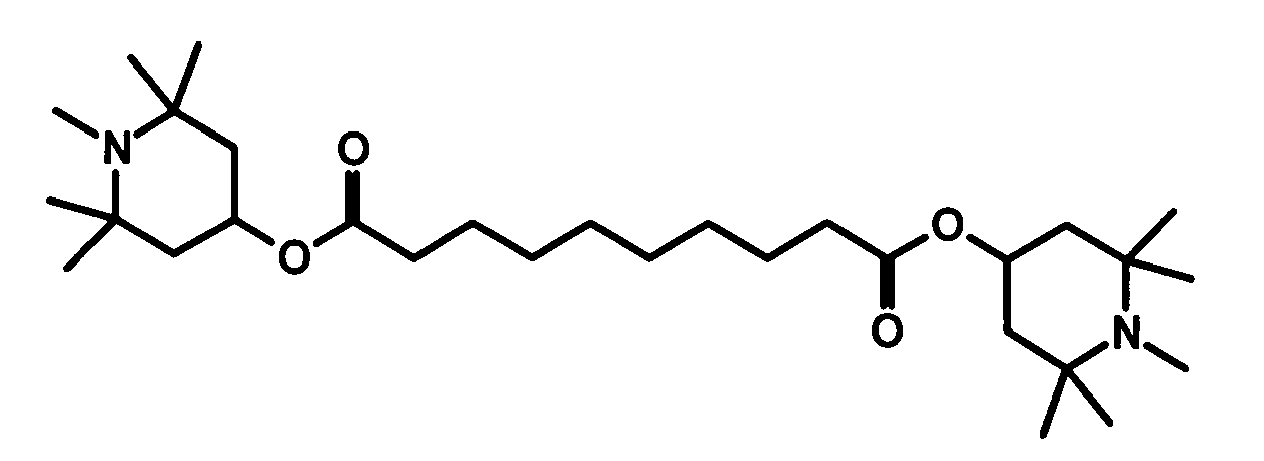
bis(2,2,6,6-tetramethylpiperidin-4-yl) decanedioate bis(1,2,2,6,6-pentamethylpiperidin-4-yl) decanedioate 

N 1,N 10-bis(2,2,6,6-tetramethylpiperidin-4-yl)decanediamide N 1,N 10-bis(1,2,2,6,6-pentamethylpiperidin-4-yl)decanediamide - Desweiteren betrifft die Erfindung Formmassen und Gegenstände aus einem derartigen Polyamid-Elastomer sowie einer dieses wenigstens als wesentlichen Bestandteil enthaltenden Formmasse und gleichermaßen entsprechendes Halbzeug, wie beispielsweise Granulat, etc. So betrifft sie beispielsweise auch einen transparenten (transparent in der Definition wie oben angegeben), bevorzugt trübungsfreien Gegenstand mit wenigstens einem Bereich oder einer Schicht aus einem Polyamid-Elastomer, wie es oben beschrieben wurde.
- Ein solcher Gegenstand weist mit anderen Worten bei einer Schichtdicke der Schicht aus der Polyamid-Elastomere von 2 mm eine Transmission von mehr als 70 %, bevorzugt von mehr als 85 %, im Wellenlängenbereich von 500-700 nm und/oder einen Haze von höchstens 20 %, bevorzugt höchstens 15 %, besonders bevorzugt höchstens 10 %, auf.
- Beim Gegenstand kann es sich gemäß verschiedenen Ausführungsformen um ein beliebiges Formteil wie eine Folie, ein Profil, ein Rohr, einen Schlauch, einen Hohlkörper oder ein Spritzgussteil handeln. Spezielle Artikel sind: ein optisch variabler Filter oder eine optische Linse, bevorzugt eine ophthalmische Linse, insbesondere bei zusätzlicher Anwesenheit eines Farbstoffes, beispielsweise eines photochromen Farbstoffes, oder ein Element mit spektraler Filterwirkung, wie beispielsweise als Brillenglas, Sonnenlinse, Korrekturlinse, optischer Filter und als Schaltaggregat zur optischen Signalverarbeitung, Skibrille, Visier, Schutzbrille, Fotorecording, Display oder optischer Datenspeicher. Als weitere Verwendungsmöglichkeit sind zu nennen: Als Dekorationselement oder Strukturelement, wie beispielsweise als Brillenfassung, Spielzeug, Abdeckung, insbesondere als Mobiltelefongehäuse, Teil von elektronischen Geräten oder Haushaltgeräten, Beschichtung, insbesondere von Verpackungen oder Dekorationsartikeln, Sportgeräte, Teile von Sport- oder Freizeitgeräten, Griffe, Schuhsohlen, Verkleidungen, bevorzugt im Automobilbereich, Bürsten, bevorzugt im Kosmetik- bzw. Hygienebereich, Schläuche, bevorzugt im Medizinalbereich.
- Zudem betrifft die vorliegende Erfindung ein Verfahren zur Herstellung eines solchen Gegenstandes, wobei ein Polyamid-Elastomer, wie es oben beschrieben wird, in einem Extrusionsverfahren, einem Spritzgussverfahren oder durch Hinterspritzen zum Gegenstand geformt wird.
- Verwendungsmöglichkeiten des erfindungsgemäßen Polyamid-Elastomers finden sich z.B. für eine Folie, ein Profil, ein Rohr, einen Schlauch oder einen Hohlkörper, oder speziell für einen optisch variablen Filter oder eine optische Linse, bevorzugt um eine ophthalmische Linse, besonders bevorzugt um ein Element mit spektraler Filterwirkung, wie beispielsweise als Brillenglas, Sonnenlinse, Korrekturlinse, optischer Filter und als Schaltaggregat zur optischen Signalverarbeitung, Skibrille, Visier, Schutzbrille, Fotorecording, Display oder optischer Datenspeicher, oder um ein Dekorationselement oder ein Strukturelement, wie beispielsweise als Brillenfassung, Spielzeug, Abdeckung, insbesondere als Mobiltelefongehäuse, Teil von elektronischen Geräten oder Haushaltgeräten, Beschichtung insbesondere von Verpackungen oder Dekorationsartikeln, Sportgeräte, Teile von Sport- oder Freizeitgeräten, Griffe, Schuhsohlen, Verkleidungen, bevorzugt im Automobilbereich.
- Die vorliegende Erfindung wird anhand der nachfolgenden Beispiele näher erläutert, ohne die Erfindung auf die angegebenen Substanzen/Parameter zu beschränken.
- Dabei werden folgende Materialien eingesetzt:
- DDS Dodekandisäure
- MACM Bis-(4-amino-3-methyl-cyclohexyl)-methan Lc12
- Pripol 2033 ist ein C36-Diol (CAS-Nr. 147853-32-5), erhältlich von Uniqema
- Priplast 3197 ist ein Dimerdioldimerat (CAS-Nr. 177591-08-1), hergestellt aus Dimerdiol, wie z.B. Pripol 2033, und der C36- Dimerfettsäure, erhältlich von Uniqema
- Tyzor NPZ Tetra-(n-propyl)-zirkonat, erhältlich von Dupont.
- Elastamine RP-409 ist ein Polyetherdiamin mit einem Molekulargewicht von circa 440 g/mol und ist erhältlich von Huntsman.
- Elastamine RP-2009 ist ein Polyetherdiamin mit einem Molekulargewicht von circa 2000 g/mol und ist erhältlich von Huntsman.
- Empol 1062 ist eine partiell hydrierte C36-Dimersäure (CAS-Nr. 61788-89-4), erhältlich von Cognis.
- Die Polyamid-Elastomere B1 und B2 sowie VB1 und VB2 wurden mittels eines Polykondensationprozesses hergestellt. Die entsprechenden Zusammensetzungen und am polymerisierten Material gemessenen Eigenschaften sind in der folgenden Tabelle zusammengefasst:
VB1 B1 VB2 B2 Zusammensetzung Laurinlactam 83.49 83.49 38.48 38.48 Dodecandisäure 12.44 12.44 - - C36-Dimersäure - - 14.18 14.18 Triacetondiamin - 0.22 - 0.15 Terathane 1000 53.80 53.80 - - Elastamine RP-2009 - - 46.80 46.80 Jeffamine T403 - - 0.37 0.37 Zinnoctoat 0.30 0.30 - - H3PO3 - - 0.02 0.02 Eigenschaften E-Modul /MPa 178 177 82 87 Reißdehnung /% 520 540 460 460 RV 1.94 1.96 1.80 1.84 Bewitterung Schlagzugzähigkeit [kJ/m2] 0 h 3540 2840 104 780 200 h 95 1960 300 800 720 h - 480 - 33 1440 h - 110 - - - Die Ausgangsmaterialien wurden unter Vorlegung der oben angegebenen Materialien in einem Rührkessel wie folgt hergestellt:
- In einer ersten Stufe wird zunächst das Polyamid-Hartsegment polykondensiert. Dazu werden die polyamidbildenden Monomere (Laurinlactam, Dodekandisäure, etc.) in den Reaktor vorgelegt und mit Stickstoff inertisiert. Der Reaktor wird anschließend auf 270°C aufgeheizt und die Reaktionsmischung für 4 Stunden unter erhöhtem Druck gerührt, anschließend wurde Druck reduziert und für 3 h unter Stickstoffbeschleierung (Baroentgasung) bei einer Produkttemperatur von 260°C gerührt.
- Bei den Beispielen B1 sowie VB1 werden in einer zweiten Stufe die carboxylterminierten Polyamid-Hartsegmente mit hydroxylterminierten Polyethern umgesetzt. Hierzu wird eine Mischung bestehend aus hydroxylterminierten Polyethern und Veresterungskatalysator zur Schmelze der Polyamid-Hartsegmente (Produkttemperatur: 230-260°C) hinzugesetzt.
- Bei den Beispielen B2 sowie VB2 werden in einer zweiten Stufe das caboxylterminierte Polyamid-Hartsegment mit dem Polyetherdiamin umgesetzt. Hierzu wird das auf 150°C vorgewärmte Polyetherdiamin, gegebenenfalls zusammen mit zusätzlichen Stabilisatoren und Kondensationsbeschleunigern, zur Schmelze der Polyamid-Hartsegmente, die eine Produkttemperatur von 230 bis 260°C aufweist, hinzugesetzt.
- Dann wird der Druck im Reaktor innerhalb von 60 Minuten auf 200 mbar reduziert. Nachdem die Reaktionsmischung 30 Minuten bei diesem Druck gerührt wurde, wird der Druck innerhalb von 60 Minuten bis zu einem Enddruck von kleiner 20 mbar gesenkt. Sobald das gewünschte Drehmoment erreicht wird, wird das Vakuum gebrochen, die Polymerschmelze mit Stickstoff von 5 bar beaufschlagt und durch Düsen in ein Wasserbad ausgetragen. Die abgezogenen Stränge werden granuliert und das Granulat 24h bei 80°C getrocknet.
- Die relative Viskosität (ηrel) wurde bestimmt nach DIN EN ISO 307, in 0,5 Gew.-%iger m-Kresollösung bei einer Temperatur von 20°C.
- Die Glasumwandlungstemperatur (Tg), der Schmelzpunkt (Tm) und die Schmelzwärme (Hm) wurden bestimmt nach ISO 11357-1/2. Die Differential scanning calorimetry (DSC) wurde mit einer Aufheizrate von 20K/min durchgeführt.
- Der Haze und die Transmission wurden bei 23°C mit einem Haze-Gard Plus der Firma Byk-Gardener nach ASTM D-1003 (Lichtart C) an Rundplatten 70x2 mm bestimmt.
- Zug-E-Modul, Reißfestigkeit und Reißdehnung wurden nach ISO 527 mit einer Zuggeschwindigkeit von 1 mm/min am ISO-Zugstab , Norm: ISO/CD 3167, Typ A1, 170 x 20/10 x 4 mm bei Temperatur 23 °C bestimmt.
- Schlagzähigkeit und Kerbschlagzähigkeit nach Charpy wurden nach ISO 179/*eU am ISO-Prüfstab, Norm: ISO/CD 3167, Typ B1, 80 x 10 x 4 mm bei Temperatur 23 °C gemessen.
- Die Bewitterung wurde nach ISO 4892-2 "Künstliche Bewitterung mit Xenonlampen" ("Florida Klima") durchgeführt. Hierfür wurde mit einem Weather O Meter Ci 4000 bewittert. Die Strahlung bei 340 nm gemessen 0,5 W/m2 (Es wird mit dem ganzen Spektrum des Sonnenlichtes belichtet aber bei 340 nm gemessen) mit folgendem Zyklus 102 Minuten trocken/18 Minuten Beregnung (während der "Trockenphase" wird die Feuchte allerdings bei 65 % gehalten). Die Black Standard Temperatur (Schwarztafel) lag bei 65°C +/- 3°C.
- Die Polyamid-Elastomere B3 sowie VB3 wurden mittels eines Polykondensationsprozesses wie oben beschrieben wurde hergestellt. Zusätzlich wurde VB3 über die klassische Methode des Zucompoundierens von Lichtschutzmitteln stabilisiert (VB4). Die entsprechenden Zusammensetzungen und am Material gemessenen Eigenschaften sind in der folgenden Tabelle zusammengefasst:
VB3 B3 VB4 Zusammensetzung Laurinlactam 59.91 59.91 Dodecandisäure 16.17 16.17 Triacetondiamin - 0.15 Elastamin RP-409 15.74 15.74 H3PO3 0.36 0.36 VB3 99.6 TINUVIN 312 0.3 TINUVIN 770DF 0.1 Eigenschaften E-Modul /MPa 560 580 590 Reißdehnung /% 240 230 220 RV 1.96 1.96 1.94 Transparency 93 94 89 Haze (Byk-Gardner) 2 2 13 Clarity 99 99 88 - Die Polyamid-Elastomere B4 bis B6 wurden mittels eines Polykondensationsprozesses hergestellt. Die entsprechenden Zusammensetzungen und am polymerisierten Material gemessenen Eigenschaften sind in der Tabelle zusammengefasst:
Einheit B4 B5 Zusammensetzung Sebacinsäure Gew.-% 14.7 1010-Salz Gew.-% 42.8 Pripol 2033 Gew.-% 42.5 42.4 Terephthalsäure Gew.-% 12.8 Laurinlactam Gew.-% 44.8 Triacetondiamin Gew.-% 0.2 0.2 Tyzor NPZ Gew.-% 0.1 0.1 Eigenschaften Schmelzpunkt °C 180 134 Zug-E-Modul MPa 125 80 Reißdehnung % 540 430 Kerbschlagzähigkeit Charpy 23°C kJ/m2 o.B. o.B. Kerbschlagzähigkeit Charpy -30°C kJ/m2 15 5 - Die Ausgangsmaterialien wurden unter Vorlegung der oben angegebenen Materialien in einem Rührkessel wie folgt hergestellt:
- In einer ersten Stufe wird zunächst das Polyamid-Hartsegment polykondensiert. Dazu werden die polyamidbildenden Monomere (1010-Salz, d.h. Salz aus Sebacinsäure und Decandiamin, Sebacinsäure) in den Reaktor vorgelegt und mit Stickstoff inertisiert. Der Reaktor wird anschließend auf 270°C aufgeheizt und die Reaktionsmischung für 4 Stunden unter Stickstoffbeschleierung (Baroentgasung) bei einer Produkttemperatur von 260°C gerührt.
- Bei den Beispielen werden in einer zweiten Stufe die carboxylterminierten Polyamid-Hartsegmente mit Diolen und/oder hydroxylterminierten Polyestern umgesetzt. Hierzu wird eine Mischung bestehend aus Diol, Polyester und Veresterungskatalysator zur Schmelze der Polyamid-Hartsegmente (Produkttemperatur: 230-260°C)
- Dann wird der Druck im Reaktor innerhalb von 60 Minuten auf 200 mbar reduziert. Nachdem die Reaktionsmischung 30 Minuten bei diesem Druck gerührt wurde, wird der Druck innerhalb von 60 Minuten bis zu einem Enddruck von kleiner 20 mbar gesenkt. Sobald das gewünschte Drehmoment erreicht wird, wird das Vakuum gebrochen, die Polymerschmelze mit Stickstoff von 5 bar beaufschlagt und durch Düsen in ein Wasserbad ausgetragen. Die abgezogenen Stränge werden granuliert und das Granulat 24h bei 80°C getrocknet,
- Anschließend wurden diese Mischungen auf einer Arburg Allrounder 350-90-220D Spritzgussmaschine zu verschiedenen Probekörpern verarbeitet, wobei die Zylindertemperaturen zwischen 180-260°C und die Formtemperatur zwischen 20 und 60 °C lagen. Die Schneckendrehzahl betrug 150-400 Upm.
wobei vor und/oder während der Polykondensationsreaktion mindestens ein Reaktivstabilisator ausgewählt aus der Gruppe bestehend aus sterisch gehinderten Aminen, sterisch gehinderten Phenolen und Stabilisatoren, die im gleichen Molekül beide sterisch gehinderten Gruppen aufweisen, mit mindestens einer gegenüber dem mindestens einen Polyamidsegment und/oder dem mindestens einen Weichsegment reaktiven Funktionalität zugesetzt und chemisch mit dem entstehenden Polyamid-Elastomer verbunden wird.
Claims (18)
- Inhärent stabilisiertes Polyamid-Elastomer gemäß folgender Formel I:
 A1 und A2 = bifunktionelle Polyamid- und/oder CopolyamidsegmenteB1 und B2 = bifunktionelle WeichsegmenteX1 bis X7 = unabhängig voneinander eine Amid-(-CON(H)-) oder Esterbindung (-COO-)b = 1 bis 100'000,n und m = unabhängig voneinander 0 oder 1,dadurch gekennzeichnet, dass
Z1 und Z2 unabhängig voneinander Wasserstoff, ein monofunktioneller Regler und/oder ein chemisch gebundener Reaktivstabilisator ausgewählt aus der Gruppe bestehend aus sterisch gehinderten Aminen und/oder sterisch gehinderten Phenolen sind,
und wobei Z3 und Z4 unabhängig voneinander ein bifunktioneller Regler mit oder ohne chemisch gebundenem Reaktivstabilisator ausgewählt aus der Gruppe bestehend aus sterisch gehinderten Aminen, sterisch gehinderten Phenolen sind, mit der Maßgabe, dass für den Fall, dass m=n=0 zumindest ein Z1 oder Z2 ein chemisch gebundener Reaktivstabilisator ist, der chemisch an die Polymerkette gebunden ist, und der Gewichtsanteil des bifunktionellen Polyamid- und/oder Copolyamidsegments relativ zum bifunktionellen Weichsegment zwischen 0,05:1 und 20:1 beträgt, und die Reste bzw. Gruppen A1, A2 sowie B1 und B2 und X1 bis X7 sowie Z1 und Z2 sowie Z3 und Z4 können dabei gleich oder verschieden sein. - Polyamid-Elastomer nach vorhergehendem Anspruch, dadurch gekennzeichnet, dass Z1 und/oder Z2 unabhängig voneinander ausgewählt sind aus der Gruppe bestehend aus Wasserstoff oder den Resten der folgenden Formeln II bis IV
 R1 = H oder einem linearen oder verzweigten C1-C20 Alkylrest,R2 = unabhängig voneinander H oder einem linearen oder verzweigten C1-C20 Alkylrest,R3 = H oder einem linearen oder verzweigten C1-C20-Alkylrest,D = einer linearen oder verzweigten C1-C20-Alkylenkette, die auch von den Heterogruppierungen -NR1-, -O- und/oder -S- unterbrochen sein kann, wobei R1 die oben angegebene Bedeutung hat,n = 0 oder 1, sowiea = 1, 2 oder 3und/oder Z2 und/oder Z3 ausgewählt sind aus der Gruppe bestehend aus Resten gemäß den allgemeinen Formeln V und VI
- Polyamid-Elastomer nach einem der beiden vorhergehenden Ansprüche, dadurch gekennzeichnet, dass der Gewichtsanteil der Gewichtssumme der bifunktionellen Polyamidsegmente A1, A2 relativ zur Gewichtssumme der bifunktionellen Weichsegmente B1, B2 zwischen 5:95 und 95:5, bevorzugt zwischen 40:60 und 90:10, besonders bevorzugt zwischen 50:50 und 85:15, beträgt.
- Polyamid-Elastomer nach einem der vorhergehenden Ansprüche, dadurch gekennzeichnet dass das zahlenmittlere Molekulargewicht Mn der bifunktionellen Polyamidsegmente A1 und A2 unabhängig voneinander zwischen 200 und 5000 g/mol, bevorzugt zwischen 700 und 4000 g/mol, besonders bevorzugt zwischen 750 und 3000 g/mol beträgt, und/oder das zahlenmittlere Molekulargewicht Mn der bifunktionellen Weichsegmente B1 und B2 unabhängig voneinander zwischen 200 und 5000 g/mol, bevorzugt zwischen 200 und 3000 g/mol, besonders bevorzugt zwischen 300 und 2500 g/mol beträgt.
- Polyamid-Elastomer nach einem der Ansprüche 1 bis 4, dadurch gekennzeichnet, dass die Polyamidsegmente A1 und A2 unabhängig voneinander ein Polykondensat ausa) mindestens einem Diamin, insbesondere einem aliphatischen und/oder cycloaliphatischen Diamin mit 2 bis 26 Kohlenstoffatomen und/oder einem arylaliphatischen Diamin mit 6 bis 36 Kohlenstoffatomen, sowieb) mindestens einer aliphatischen und/oder cycloaliphatischen Dicarbonsäure mit 2 bis 36 Kohlenstoffatomen und/oder einer aromatischen Dicarbonsäure mit 6 bis 36 Kohlenstoffatomen, und/oderc) mindestens einem Lactam und/oder mindestens einer Aminocarbonsäure, jeweils mit 2 bis 36 Kohlenstoffatomen sind.
- Polyamid-Elastomer nach einem der Ansprüche 1 bis 5, dadurch gekennzeichnet, dass das Weichsegment B1 und/oder B2 ausgewählt ist aus der Gruppe bestehend aus Polyethern, Polyestern, Polyolefinen, Polysiloxanen, Polycarbonaten, Polycarbamaten und/oder Polycaprolactonen.
- Polyamid-Elastomer nach einem der Ansprüche 1 bis 6, gekennzeichnet durch ein gewichtsgemitteltes Molekulargewicht M zwischen 2000 und 60000, bevorzugt zwischen 4000 und 30000 g/mol.
- Polyamid-Elastomer nach einem der vorhergehenden Ansprüche, dadurch gekennzeichnet, dass es zumindest teilweise auf Monomeren basiert, die aus nachwachsenden Rohstoffen gewonnen wurden.
- Polyamid-Elastomer nach einem der Ansprüche 1 bis 8, gekennzeichnet durch einen E-Modul < 1.000 MPa, bevorzugt < 800 MPa, besonders bevorzugt < 600 MPa.
- Polyamid-Elastomer nach einem der Ansprüche 1 bis 9, gekennzeichnet durch einen Haze (Trübung) von höchstens 20 %, bevorzugt höchstens 15 %, besonders bevorzugt höchstens 10 %, gemessen nach ASTM 1003 bei einer Schichtdicke von 2 mm.
- Verfahren zur Herstellung eines hitze- und/oder lichtstabilisierten Polyamid-Elastomers nach einem der vorhergehenden Ansprüche, bei dema) mindestens ein bifunktionelles, an den Kettenenden jeweils eine reaktive Funktionalität aufweisendes Polyamidsegment mitb) mindestens einem bifunktionellen, an den Kettenenden jeweils eine, gegenüber den reaktiven Funktionalitäten des Polyamidsegments reaktive Funktionalität aufweisendes Weichsegment in einem Gewichtsverhältnis der Komponenten a) und b) von 0,1 bis 0,95 vermischt und polykondensiert wird,dadurch gekennzeichnet,
dass vor und/oder während der Polykondensationsreaktion mindestens ein Reaktivstabilisator ausgewählt aus der Gruppe bestehend aus sterisch gehinderten Aminen, sterisch gehinderten Phenolen, und/oder Stabilisatoren, die im gleichen Molekül beide sterisch gehinderte Gruppen aufweisen, mit mindestens einer gegenüber dem mindestens einen Polyamidsegment und/oder dem mindestens einen Weichsegment reaktiven Funktionalität zugesetzt und chemisch mit dem entstehenden Polyamid-Elastomer verbunden wird. - Verfahren nach vorhergehendem Anspruch, dadurch gekennzeichnet, dass der Reaktivstabilisator ausgewählt ist aus der Gruppe bestehend ausa) sterisch gehinderten Aminen der allgemeinen Formeln VII und/oder VII
 R1 = H oder einem linearen oder verzweigten C1-C20 Alkylrest,R2 = unabhängig voneinander H oder einem linearen oder verzweigten C1-C20 Alkylrest, sowieY = -NHR1, -OH oder -COX, mit X = -OR1 oder Halogenen, und/oderb) sterisch gehinderten Phenolen der allgemeinen Formeln IX und/oder X
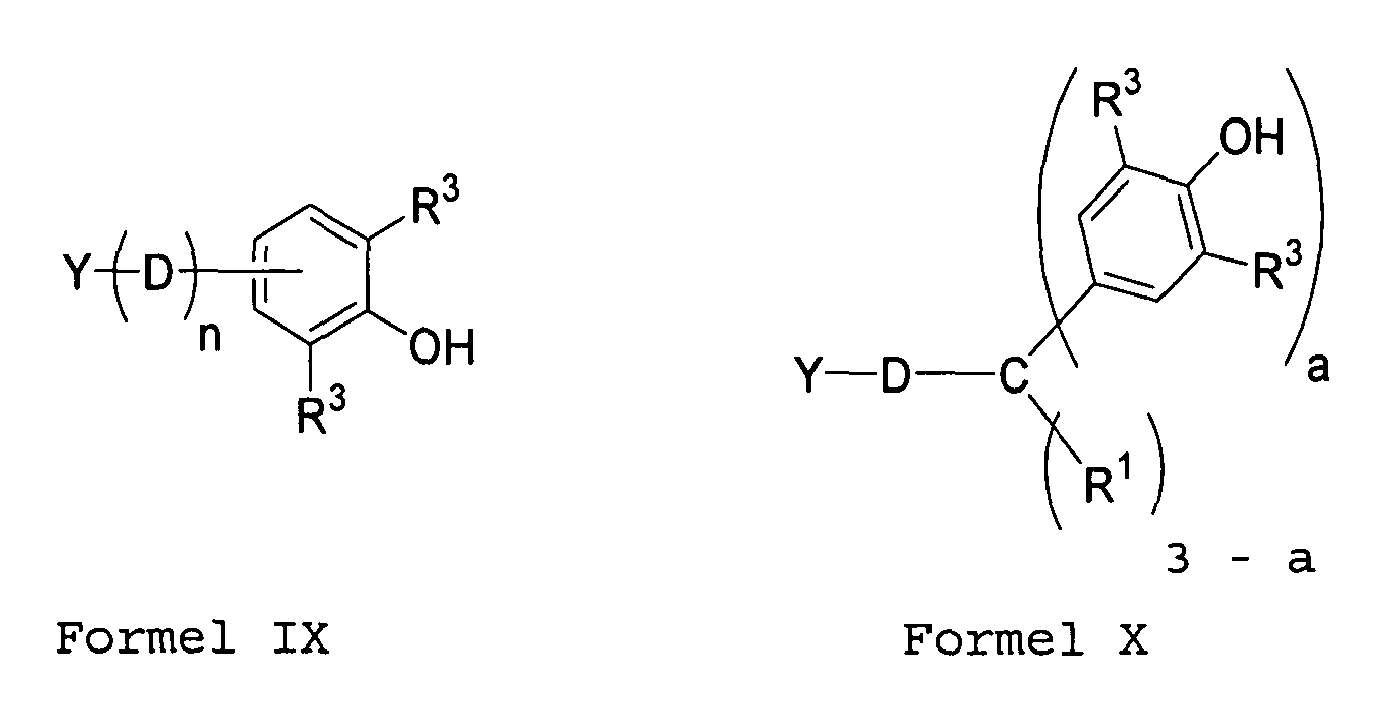 R3 = H oder einem linearen oder verzweigten C1-C20-Alkylrest,D = einer linearen oder verzweigten C1-C20-Alkylenkette, die auch von den Heterogruppierungen -NR1-, -O- und/oder -S-unterbrochen sein kann, wobei R1 die oben angegebene Bedeutung hat,n = 0 oder 1,a = 1, 2 oder 3, wobeiR1 und Y wie oben definiert sind.
 - Verfahren nach einem der vorhergehenden Ansprüche, dadurch gekennzeichnet, dass das gewichtsgemittelte Molekulargewicht Mna) des mindestens einen reaktiven Polyamidsegments jeweils unabhängig voneinander zwischen 200 und 5000 g/mol, bevorzugt zwischen 700 und 4000 g/mol, besonders bevorzugt zwischen 750 und 3000 g/mol beträgt und/oderb) des mindestens einen reaktiven Polyamidsegments jeweils unabhängig voneinander zwischen 200 und 5000 g/mol, bevorzugt zwischen 2000 und 3000 g/mol, besonders bevorzugt zwischen 300 und 2500 g/mol beträgt.
- Verfahren nach einem der vorhergehenden Ansprüche, dadurch gekennzeichnet, dass das Gewichtsverhältnis des mindestens ein reaktiven Polyamidsegments zum mindestens einen, gegenüber dem Polyamidsegment reaktiven Weichsegment zwischen 5:95 und 95:5, bevorzugt zwischen 40:60 und 90:10, besonders bevorzugt zwischen 50:50 und 85:15, eingestellt wird.
- Formmasse, enthaltend ein Polyamid-Elastomer nach einem der Ansprüche 1 bis 10.
- Verwendung einer Formmasse nach vorhergehendem Anspruch für eine Folie, ein Profil, ein Rohr, einen Schlauch oder einen Hohlkörper, oder speziell für einen optisch variablen Filter oder eine optische Linse, bevorzugt um eine ophthalmische Linse, besonders bevorzugt um ein Element mit spektraler Filterwirkung, wie beispielsweise als Brillenglas, Sonnenlinse, Korrekturlinse, optischer Filter und als Schaltaggregat zur optischen Signalverarbeitung, Skibrille, Visier, Schutzbrille, Fotorecording, Display oder optischer Datenspeicher, oder um ein Dekorationselement oder ein Strukturelement, wie beispielsweise als Brillenfassung, Spielzeug, Abdeckung, insbesondere als Mobiltelefongehäuse, Teil von elektronischen Geräten oder Haushaltgeräten, Beschichtung insbesondere von Verpackungen oder Dekorationsartikeln, Sportgeräte, Teile von Sport- oder Freizeitgeräten, Griffe, Schuhsohlen, Verkleidungen, bevorzugt im Automobilbereich, Bürsten, bevorzugt im Kosmetik- bzw. Hygienebereich, Schläuche, bevorzugt im Medizinbereich.
- Formteil herstellbar aus einem Polyamid-Elastomer nach mindestens einem der Ansprüche 1 bis 10.
- Formteil nach Anspruch 17,
dadurch gekennzeichnet, dass es transparent ist und eine Transmission in einem Wellenlängenbereich von 500 bis 700 nm von mindestens 70 %, bevorzugt mindestens 80 %, besonders bevorzugt mindestens 85 % bei einer Schichtdicke eines Prüfkörpers von 2 mm aufweist.
Priority Applications (2)
| Application Number | Priority Date | Filing Date | Title |
|---|---|---|---|
| EP20080022424 EP2202260B1 (de) | 2008-12-23 | 2008-12-23 | Inhärent stabilisiertes Polyamid-Elastomer sowie Verfahren zu dessen Herstellung |
| PCT/EP2009/009183 WO2010072392A2 (de) | 2008-12-23 | 2009-12-21 | Inhärent stabilisiertes polyamid-elastomer sowie verfahren zu dessen herstellung |
Applications Claiming Priority (1)
| Application Number | Priority Date | Filing Date | Title |
|---|---|---|---|
| EP20080022424 EP2202260B1 (de) | 2008-12-23 | 2008-12-23 | Inhärent stabilisiertes Polyamid-Elastomer sowie Verfahren zu dessen Herstellung |
Publications (2)
| Publication Number | Publication Date |
|---|---|
| EP2202260A1 true EP2202260A1 (de) | 2010-06-30 |
| EP2202260B1 EP2202260B1 (de) | 2012-12-12 |
Family
ID=40419216
Family Applications (1)
| Application Number | Title | Priority Date | Filing Date |
|---|---|---|---|
| EP20080022424 Active EP2202260B1 (de) | 2008-12-23 | 2008-12-23 | Inhärent stabilisiertes Polyamid-Elastomer sowie Verfahren zu dessen Herstellung |
Country Status (2)
| Country | Link |
|---|---|
| EP (1) | EP2202260B1 (de) |
| WO (1) | WO2010072392A2 (de) |
Families Citing this family (6)
| Publication number | Priority date | Publication date | Assignee | Title |
|---|---|---|---|---|
| CN103289081B (zh) * | 2013-06-04 | 2015-10-21 | 武汉森大科技研究发展中心 | 聚酰胺聚合生产工艺及所用设备 |
| CN109206625A (zh) * | 2017-06-30 | 2019-01-15 | 翁秋梅 | 一种物理分相超分子动态聚合物及其应用 |
| WO2019147458A1 (en) | 2018-01-23 | 2019-08-01 | Eastman Chemical Company | Novel polyesteramides, processes for the preparation thereof, and polyesteramide compositions |
| EP4029407A1 (de) * | 2021-01-18 | 2022-07-20 | Evonik Operations GmbH | Einfach rezyklierbare borstenware |
| CN120775185B (zh) * | 2025-09-05 | 2025-12-02 | 山东广垠新材料有限公司 | 聚酰胺弹性体及一锅法制备聚酰胺弹性体的方法 |
| CN120865540A (zh) * | 2025-09-26 | 2025-10-31 | 华东理工大学 | 一种生物基耐低温超韧聚酰胺弹性体及其制备方法 |
Citations (11)
| Publication number | Priority date | Publication date | Assignee | Title |
|---|---|---|---|---|
| DE2642461A1 (de) | 1976-09-21 | 1978-03-30 | Bayer Ag | Permanent stabilisierte polymere |
| DE4413177A1 (de) * | 1994-04-15 | 1995-10-19 | Basf Ag | Inhärent hitzestabilisierte Polyamide |
| WO1995028443A1 (de) | 1994-04-15 | 1995-10-26 | Basf Aktiengesellschaft | Inhärent licht- und hitzestabilisierte polyamide |
| DE19537614A1 (de) | 1995-10-09 | 1997-04-10 | Inventa Ag | Polycaprolactam mit neuartiger Kettenregelung |
| EP0818491A2 (de) | 1996-07-09 | 1998-01-14 | Ems-Inventa Ag | Witterungsstabile Polyamide und Verfahren zu deren Herstellung |
| EP0822275A2 (de) | 1996-07-31 | 1998-02-04 | Basf Corporation | Photochemisch stabilisierte Polyamidzusammensetzungen |
| DE19812135A1 (de) * | 1998-03-20 | 1999-09-23 | Basf Ag | Inhärent licht- und hitzestabilisierte Polyamide mit verbesserter Naßechtheit |
| EP1053272A1 (de) | 1998-02-13 | 2000-11-22 | Basf Aktiengesellschaft | Inhärent licht- und hitzestabilisiertes polyamid und methode seiner herstellung |
| EP1099727A2 (de) | 1999-11-09 | 2001-05-16 | Basf Aktiengesellschaft | Fliessfähige Polyamide |
| EP1376156A2 (de) | 2002-06-26 | 2004-01-02 | Degussa AG | Kunststoff-Lichtwellenleiter |
| US20070066725A1 (en) | 2005-09-16 | 2007-03-22 | Frederic Malet | Aging-resistant copolymers comprising polyamide blocks and polyether blocks |
-
2008
- 2008-12-23 EP EP20080022424 patent/EP2202260B1/de active Active
-
2009
- 2009-12-21 WO PCT/EP2009/009183 patent/WO2010072392A2/de not_active Ceased
Patent Citations (13)
| Publication number | Priority date | Publication date | Assignee | Title |
|---|---|---|---|---|
| DE2642461A1 (de) | 1976-09-21 | 1978-03-30 | Bayer Ag | Permanent stabilisierte polymere |
| DE4413177A1 (de) * | 1994-04-15 | 1995-10-19 | Basf Ag | Inhärent hitzestabilisierte Polyamide |
| WO1995028443A1 (de) | 1994-04-15 | 1995-10-26 | Basf Aktiengesellschaft | Inhärent licht- und hitzestabilisierte polyamide |
| EP0759953A1 (de) | 1994-04-15 | 1997-03-05 | Basf Aktiengesellschaft | Inhärent licht- und hitzestabilisierte polyamide |
| DE19537614A1 (de) | 1995-10-09 | 1997-04-10 | Inventa Ag | Polycaprolactam mit neuartiger Kettenregelung |
| EP0818491A2 (de) | 1996-07-09 | 1998-01-14 | Ems-Inventa Ag | Witterungsstabile Polyamide und Verfahren zu deren Herstellung |
| EP0822275A2 (de) | 1996-07-31 | 1998-02-04 | Basf Corporation | Photochemisch stabilisierte Polyamidzusammensetzungen |
| EP1053272A1 (de) | 1998-02-13 | 2000-11-22 | Basf Aktiengesellschaft | Inhärent licht- und hitzestabilisiertes polyamid und methode seiner herstellung |
| DE19812135A1 (de) * | 1998-03-20 | 1999-09-23 | Basf Ag | Inhärent licht- und hitzestabilisierte Polyamide mit verbesserter Naßechtheit |
| EP1070093A1 (de) | 1998-03-20 | 2001-01-24 | Basf Aktiengesellschaft | Inhärent licht- und hitzestabilisierte polyamide mit verbesserter nassechtheit |
| EP1099727A2 (de) | 1999-11-09 | 2001-05-16 | Basf Aktiengesellschaft | Fliessfähige Polyamide |
| EP1376156A2 (de) | 2002-06-26 | 2004-01-02 | Degussa AG | Kunststoff-Lichtwellenleiter |
| US20070066725A1 (en) | 2005-09-16 | 2007-03-22 | Frederic Malet | Aging-resistant copolymers comprising polyamide blocks and polyether blocks |
Non-Patent Citations (1)
| Title |
|---|
| "Kunststoffhandbuch", article "Technische Thermoplaste-Polyamide", pages: 865 |
Also Published As
| Publication number | Publication date |
|---|---|
| WO2010072392A2 (de) | 2010-07-01 |
| WO2010072392A3 (de) | 2011-02-24 |
| EP2202260B1 (de) | 2012-12-12 |
Similar Documents
| Publication | Publication Date | Title |
|---|---|---|
| EP2022810B1 (de) | Transparente Polyamid-Elastomere | |
| EP2291457B1 (de) | Polyamidformmassen, enthaltend teilkristalline, transparente copolyamide, zur herstellung von transparenten formteilen mit hoher flexibilität, hoher kerbschlagzähigkeit, niedriger wasseraufnahme und ausgezeichneter chemikalienbeständigkeit | |
| DE69622749T3 (de) | Polyamid enthaltende zusammensetzung und verfahren zu ihrer herstellung | |
| JP5682900B2 (ja) | 透明なポリアミド成型組成物 | |
| EP2022820B1 (de) | Photochrome formmassen und daraus hergestellte gegenstände | |
| DE2642244C2 (de) | Verfahren zur Herstellung von glasklar durchsichtigen Copolyamiden und deren Verwendung zur Herstellung von Formkörpern | |
| WO2009132989A2 (de) | Polyamidformmassen, enthaltend copolyamide zur herstellung von transparenten formteilen mit geringem verzug im klimatest | |
| DE10057455C2 (de) | Polyamid-Formmassen mit verbesserten Eigenschaften | |
| EP2666803A1 (de) | Kratzfeste, transparente und zähe Copolyamidformmassen, hieraus hergestellte Formkörper und deren Verwendung | |
| EP0469435B1 (de) | Copolyamide, Verfahren zu ihrer Herstellung und ihre Verwendung | |
| EP2202260B1 (de) | Inhärent stabilisiertes Polyamid-Elastomer sowie Verfahren zu dessen Herstellung | |
| EP2252647B1 (de) | Polyamid-elastomer | |
| EP2123694B1 (de) | Copolyamide | |
| DE3717928C2 (de) | ||
| DE10251294A1 (de) | Polyamidformmasse, daraus herstellbare Formteile und deren Verwendung | |
| EP2708569A1 (de) | Transparente Polyamidimide | |
| WO2019121041A1 (de) | Polyamid-formmasse | |
| EP3670576B1 (de) | Polyamid-formmassen für glasverbunde | |
| DE3200020A1 (de) | Elastomere blockcopolyamide |
Legal Events
| Date | Code | Title | Description |
|---|---|---|---|
| PUAI | Public reference made under article 153(3) epc to a published international application that has entered the european phase |
Free format text: ORIGINAL CODE: 0009012 |
|
| AK | Designated contracting states |
Kind code of ref document: A1 Designated state(s): AT BE BG CH CY CZ DE DK EE ES FI FR GB GR HR HU IE IS IT LI LT LU LV MC MT NL NO PL PT RO SE SI SK TR |
|
| AX | Request for extension of the european patent |
Extension state: AL BA MK RS |
|
| 17P | Request for examination filed |
Effective date: 20100909 |
|
| 17Q | First examination report despatched |
Effective date: 20110202 |
|
| AKX | Designation fees paid |
Designated state(s): AT BE BG CH CY CZ DE DK EE ES FI FR GB GR HR HU IE IS IT LI LT LU LV MC MT NL NO PL PT RO SE SI SK TR |
|
| REG | Reference to a national code |
Ref country code: DE Ref legal event code: R079 Ref document number: 502008008859 Country of ref document: DE Free format text: PREVIOUS MAIN CLASS: C08G0069040000 Ipc: C08G0069340000 |
|
| RIC1 | Information provided on ipc code assigned before grant |
Ipc: C08G 69/16 20060101ALI20120425BHEP Ipc: C08L 77/06 20060101ALI20120425BHEP Ipc: C08G 69/48 20060101ALI20120425BHEP Ipc: C08G 69/44 20060101ALI20120425BHEP Ipc: C08K 5/00 20060101ALI20120425BHEP Ipc: C08G 69/04 20060101ALI20120425BHEP Ipc: C08G 69/36 20060101ALI20120425BHEP Ipc: C08G 69/28 20060101ALI20120425BHEP Ipc: C08K 5/3435 20060101ALI20120425BHEP Ipc: C08G 81/02 20060101ALI20120425BHEP Ipc: C08G 69/40 20060101ALI20120425BHEP Ipc: C08G 69/34 20060101AFI20120425BHEP |
|
| GRAP | Despatch of communication of intention to grant a patent |
Free format text: ORIGINAL CODE: EPIDOSNIGR1 |
|
| GRAS | Grant fee paid |
Free format text: ORIGINAL CODE: EPIDOSNIGR3 |
|
| GRAA | (expected) grant |
Free format text: ORIGINAL CODE: 0009210 |
|
| RIN1 | Information on inventor provided before grant (corrected) |
Inventor name: LIEDLOFF, HANNS-JOERG, DR. Inventor name: HOFFMANN, BOTHO, DR. Inventor name: BAYER, ANDREAS, DR. Inventor name: PFLEGHAR, MARK, DIPL.-ING. |
|
| AK | Designated contracting states |
Kind code of ref document: B1 Designated state(s): AT BE BG CH CY CZ DE DK EE ES FI FR GB GR HR HU IE IS IT LI LT LU LV MC MT NL NO PL PT RO SE SI SK TR |
|
| REG | Reference to a national code |
Ref country code: GB Ref legal event code: FG4D Free format text: NOT ENGLISH |
|
| REG | Reference to a national code |
Ref country code: CH Ref legal event code: EP |
|
| REG | Reference to a national code |
Ref country code: AT Ref legal event code: REF Ref document number: 588318 Country of ref document: AT Kind code of ref document: T Effective date: 20121215 |
|
| REG | Reference to a national code |
Ref country code: IE Ref legal event code: FG4D Free format text: LANGUAGE OF EP DOCUMENT: GERMAN |
|
| REG | Reference to a national code |
Ref country code: DE Ref legal event code: R096 Ref document number: 502008008859 Country of ref document: DE Effective date: 20130207 |
|
| PG25 | Lapsed in a contracting state [announced via postgrant information from national office to epo] |
Ref country code: FI Free format text: LAPSE BECAUSE OF FAILURE TO SUBMIT A TRANSLATION OF THE DESCRIPTION OR TO PAY THE FEE WITHIN THE PRESCRIBED TIME-LIMIT Effective date: 20121212 Ref country code: SE Free format text: LAPSE BECAUSE OF FAILURE TO SUBMIT A TRANSLATION OF THE DESCRIPTION OR TO PAY THE FEE WITHIN THE PRESCRIBED TIME-LIMIT Effective date: 20121212 Ref country code: LT Free format text: LAPSE BECAUSE OF FAILURE TO SUBMIT A TRANSLATION OF THE DESCRIPTION OR TO PAY THE FEE WITHIN THE PRESCRIBED TIME-LIMIT Effective date: 20121212 Ref country code: NO Free format text: LAPSE BECAUSE OF FAILURE TO SUBMIT A TRANSLATION OF THE DESCRIPTION OR TO PAY THE FEE WITHIN THE PRESCRIBED TIME-LIMIT Effective date: 20130312 Ref country code: ES Free format text: LAPSE BECAUSE OF FAILURE TO SUBMIT A TRANSLATION OF THE DESCRIPTION OR TO PAY THE FEE WITHIN THE PRESCRIBED TIME-LIMIT Effective date: 20130323 |
|
| REG | Reference to a national code |
Ref country code: NL Ref legal event code: VDEP Effective date: 20121212 |
|
| REG | Reference to a national code |
Ref country code: LT Ref legal event code: MG4D |
|
| PG25 | Lapsed in a contracting state [announced via postgrant information from national office to epo] |
Ref country code: SI Free format text: LAPSE BECAUSE OF FAILURE TO SUBMIT A TRANSLATION OF THE DESCRIPTION OR TO PAY THE FEE WITHIN THE PRESCRIBED TIME-LIMIT Effective date: 20121212 Ref country code: GR Free format text: LAPSE BECAUSE OF FAILURE TO SUBMIT A TRANSLATION OF THE DESCRIPTION OR TO PAY THE FEE WITHIN THE PRESCRIBED TIME-LIMIT Effective date: 20130313 Ref country code: LV Free format text: LAPSE BECAUSE OF FAILURE TO SUBMIT A TRANSLATION OF THE DESCRIPTION OR TO PAY THE FEE WITHIN THE PRESCRIBED TIME-LIMIT Effective date: 20121212 |
|
| BERE | Be: lapsed |
Owner name: EMS-PATENT A.G. Effective date: 20121231 |
|
| PG25 | Lapsed in a contracting state [announced via postgrant information from national office to epo] |
Ref country code: MC Free format text: LAPSE BECAUSE OF NON-PAYMENT OF DUE FEES Effective date: 20121231 Ref country code: CZ Free format text: LAPSE BECAUSE OF FAILURE TO SUBMIT A TRANSLATION OF THE DESCRIPTION OR TO PAY THE FEE WITHIN THE PRESCRIBED TIME-LIMIT Effective date: 20121212 Ref country code: EE Free format text: LAPSE BECAUSE OF FAILURE TO SUBMIT A TRANSLATION OF THE DESCRIPTION OR TO PAY THE FEE WITHIN THE PRESCRIBED TIME-LIMIT Effective date: 20121212 Ref country code: SK Free format text: LAPSE BECAUSE OF FAILURE TO SUBMIT A TRANSLATION OF THE DESCRIPTION OR TO PAY THE FEE WITHIN THE PRESCRIBED TIME-LIMIT Effective date: 20121212 Ref country code: IS Free format text: LAPSE BECAUSE OF FAILURE TO SUBMIT A TRANSLATION OF THE DESCRIPTION OR TO PAY THE FEE WITHIN THE PRESCRIBED TIME-LIMIT Effective date: 20130412 Ref country code: BG Free format text: LAPSE BECAUSE OF FAILURE TO SUBMIT A TRANSLATION OF THE DESCRIPTION OR TO PAY THE FEE WITHIN THE PRESCRIBED TIME-LIMIT Effective date: 20130312 |
|
| REG | Reference to a national code |
Ref country code: CH Ref legal event code: PL |
|
| PG25 | Lapsed in a contracting state [announced via postgrant information from national office to epo] |
Ref country code: PT Free format text: LAPSE BECAUSE OF FAILURE TO SUBMIT A TRANSLATION OF THE DESCRIPTION OR TO PAY THE FEE WITHIN THE PRESCRIBED TIME-LIMIT Effective date: 20130412 Ref country code: PL Free format text: LAPSE BECAUSE OF FAILURE TO SUBMIT A TRANSLATION OF THE DESCRIPTION OR TO PAY THE FEE WITHIN THE PRESCRIBED TIME-LIMIT Effective date: 20121212 Ref country code: NL Free format text: LAPSE BECAUSE OF FAILURE TO SUBMIT A TRANSLATION OF THE DESCRIPTION OR TO PAY THE FEE WITHIN THE PRESCRIBED TIME-LIMIT Effective date: 20121212 Ref country code: RO Free format text: LAPSE BECAUSE OF FAILURE TO SUBMIT A TRANSLATION OF THE DESCRIPTION OR TO PAY THE FEE WITHIN THE PRESCRIBED TIME-LIMIT Effective date: 20121212 |
|
| REG | Reference to a national code |
Ref country code: IE Ref legal event code: MM4A |
|
| PG25 | Lapsed in a contracting state [announced via postgrant information from national office to epo] |
Ref country code: BE Free format text: LAPSE BECAUSE OF NON-PAYMENT OF DUE FEES Effective date: 20121231 |
|
| PLBE | No opposition filed within time limit |
Free format text: ORIGINAL CODE: 0009261 |
|
| STAA | Information on the status of an ep patent application or granted ep patent |
Free format text: STATUS: NO OPPOSITION FILED WITHIN TIME LIMIT |
|
| PG25 | Lapsed in a contracting state [announced via postgrant information from national office to epo] |
Ref country code: CH Free format text: LAPSE BECAUSE OF NON-PAYMENT OF DUE FEES Effective date: 20121231 Ref country code: IE Free format text: LAPSE BECAUSE OF NON-PAYMENT OF DUE FEES Effective date: 20121223 Ref country code: DK Free format text: LAPSE BECAUSE OF FAILURE TO SUBMIT A TRANSLATION OF THE DESCRIPTION OR TO PAY THE FEE WITHIN THE PRESCRIBED TIME-LIMIT Effective date: 20121212 Ref country code: LI Free format text: LAPSE BECAUSE OF NON-PAYMENT OF DUE FEES Effective date: 20121231 |
|
| 26N | No opposition filed |
Effective date: 20130913 |
|
| PG25 | Lapsed in a contracting state [announced via postgrant information from national office to epo] |
Ref country code: MT Free format text: LAPSE BECAUSE OF FAILURE TO SUBMIT A TRANSLATION OF THE DESCRIPTION OR TO PAY THE FEE WITHIN THE PRESCRIBED TIME-LIMIT Effective date: 20121212 Ref country code: CY Free format text: LAPSE BECAUSE OF FAILURE TO SUBMIT A TRANSLATION OF THE DESCRIPTION OR TO PAY THE FEE WITHIN THE PRESCRIBED TIME-LIMIT Effective date: 20121212 Ref country code: HR Free format text: LAPSE BECAUSE OF FAILURE TO SUBMIT A TRANSLATION OF THE DESCRIPTION OR TO PAY THE FEE WITHIN THE PRESCRIBED TIME-LIMIT Effective date: 20121212 |
|
| PG25 | Lapsed in a contracting state [announced via postgrant information from national office to epo] |
Ref country code: IT Free format text: LAPSE BECAUSE OF FAILURE TO SUBMIT A TRANSLATION OF THE DESCRIPTION OR TO PAY THE FEE WITHIN THE PRESCRIBED TIME-LIMIT Effective date: 20121212 |
|
| REG | Reference to a national code |
Ref country code: DE Ref legal event code: R097 Ref document number: 502008008859 Country of ref document: DE Effective date: 20130913 |
|
| PG25 | Lapsed in a contracting state [announced via postgrant information from national office to epo] |
Ref country code: TR Free format text: LAPSE BECAUSE OF FAILURE TO SUBMIT A TRANSLATION OF THE DESCRIPTION OR TO PAY THE FEE WITHIN THE PRESCRIBED TIME-LIMIT Effective date: 20121212 |
|
| PG25 | Lapsed in a contracting state [announced via postgrant information from national office to epo] |
Ref country code: LU Free format text: LAPSE BECAUSE OF NON-PAYMENT OF DUE FEES Effective date: 20121223 |
|
| PG25 | Lapsed in a contracting state [announced via postgrant information from national office to epo] |
Ref country code: HU Free format text: LAPSE BECAUSE OF FAILURE TO SUBMIT A TRANSLATION OF THE DESCRIPTION OR TO PAY THE FEE WITHIN THE PRESCRIBED TIME-LIMIT Effective date: 20081223 |
|
| REG | Reference to a national code |
Ref country code: AT Ref legal event code: MM01 Ref document number: 588318 Country of ref document: AT Kind code of ref document: T Effective date: 20131223 |
|
| PG25 | Lapsed in a contracting state [announced via postgrant information from national office to epo] |
Ref country code: AT Free format text: LAPSE BECAUSE OF NON-PAYMENT OF DUE FEES Effective date: 20131223 |
|
| REG | Reference to a national code |
Ref country code: FR Ref legal event code: PLFP Year of fee payment: 8 |
|
| REG | Reference to a national code |
Ref country code: FR Ref legal event code: PLFP Year of fee payment: 9 |
|
| REG | Reference to a national code |
Ref country code: FR Ref legal event code: PLFP Year of fee payment: 10 |
|
| REG | Reference to a national code |
Ref country code: DE Ref legal event code: R082 Ref document number: 502008008859 Country of ref document: DE Representative=s name: PFENNING, MEINIG & PARTNER MBB PATENTANWAELTE, DE Ref country code: DE Ref legal event code: R081 Ref document number: 502008008859 Country of ref document: DE Owner name: EMS-CHEMIE AG, CH Free format text: FORMER OWNER: EMS-PATENT AG, DOMAT, CH |
|
| PGFP | Annual fee paid to national office [announced via postgrant information from national office to epo] |
Ref country code: GB Payment date: 20221223 Year of fee payment: 15 |
|
| GBPC | Gb: european patent ceased through non-payment of renewal fee |
Effective date: 20231223 |
|
| PG25 | Lapsed in a contracting state [announced via postgrant information from national office to epo] |
Ref country code: GB Free format text: LAPSE BECAUSE OF NON-PAYMENT OF DUE FEES Effective date: 20231223 |
|
| PG25 | Lapsed in a contracting state [announced via postgrant information from national office to epo] |
Ref country code: GB Free format text: LAPSE BECAUSE OF NON-PAYMENT OF DUE FEES Effective date: 20231223 |
|
| PGFP | Annual fee paid to national office [announced via postgrant information from national office to epo] |
Ref country code: DE Payment date: 20251211 Year of fee payment: 18 |
|
| PGFP | Annual fee paid to national office [announced via postgrant information from national office to epo] |
Ref country code: FR Payment date: 20251222 Year of fee payment: 18 |