EP2202472A1 - Gefriertrockner-Überwachungsvorrichtung - Google Patents
Gefriertrockner-Überwachungsvorrichtung Download PDFInfo
- Publication number
- EP2202472A1 EP2202472A1 EP08022515A EP08022515A EP2202472A1 EP 2202472 A1 EP2202472 A1 EP 2202472A1 EP 08022515 A EP08022515 A EP 08022515A EP 08022515 A EP08022515 A EP 08022515A EP 2202472 A1 EP2202472 A1 EP 2202472A1
- Authority
- EP
- European Patent Office
- Prior art keywords
- sensing
- fiber
- freeze dryer
- monitoring device
- temperature
- Prior art date
- Legal status (The legal status is an assumption and is not a legal conclusion. Google has not performed a legal analysis and makes no representation as to the accuracy of the status listed.)
- Withdrawn
Links
- 238000012806 monitoring device Methods 0.000 title claims abstract description 25
- 239000000835 fiber Substances 0.000 claims abstract description 118
- 238000012544 monitoring process Methods 0.000 claims description 7
- 238000001035 drying Methods 0.000 description 25
- 238000000034 method Methods 0.000 description 20
- 230000008569 process Effects 0.000 description 16
- 239000000463 material Substances 0.000 description 14
- 238000004108 freeze drying Methods 0.000 description 12
- 239000000523 sample Substances 0.000 description 11
- 238000009529 body temperature measurement Methods 0.000 description 8
- 238000005259 measurement Methods 0.000 description 7
- 230000008014 freezing Effects 0.000 description 6
- 238000007710 freezing Methods 0.000 description 6
- 238000004519 manufacturing process Methods 0.000 description 6
- 230000008859 change Effects 0.000 description 5
- 230000035945 sensitivity Effects 0.000 description 5
- 239000013078 crystal Substances 0.000 description 3
- 238000009472 formulation Methods 0.000 description 3
- 239000000203 mixture Substances 0.000 description 3
- 239000013307 optical fiber Substances 0.000 description 3
- 230000000737 periodic effect Effects 0.000 description 3
- 238000002310 reflectometry Methods 0.000 description 3
- 238000005070 sampling Methods 0.000 description 3
- XLYOFNOQVPJJNP-UHFFFAOYSA-N water Substances O XLYOFNOQVPJJNP-UHFFFAOYSA-N 0.000 description 3
- 238000013459 approach Methods 0.000 description 2
- 238000002425 crystallisation Methods 0.000 description 2
- 230000008025 crystallization Effects 0.000 description 2
- 239000006185 dispersion Substances 0.000 description 2
- 230000000694 effects Effects 0.000 description 2
- 230000003287 optical effect Effects 0.000 description 2
- 238000000275 quality assurance Methods 0.000 description 2
- 238000004781 supercooling Methods 0.000 description 2
- 230000001629 suppression Effects 0.000 description 2
- 238000004497 NIR spectroscopy Methods 0.000 description 1
- 238000001069 Raman spectroscopy Methods 0.000 description 1
- 239000000654 additive Substances 0.000 description 1
- 230000000996 additive effect Effects 0.000 description 1
- 238000004458 analytical method Methods 0.000 description 1
- 238000005452 bending Methods 0.000 description 1
- 230000015572 biosynthetic process Effects 0.000 description 1
- 230000001427 coherent effect Effects 0.000 description 1
- 150000001875 compounds Chemical class 0.000 description 1
- 230000001934 delay Effects 0.000 description 1
- 238000003795 desorption Methods 0.000 description 1
- 238000011161 development Methods 0.000 description 1
- 230000009189 diving Effects 0.000 description 1
- 239000007789 gas Substances 0.000 description 1
- 230000009477 glass transition Effects 0.000 description 1
- 230000006872 improvement Effects 0.000 description 1
- 238000009434 installation Methods 0.000 description 1
- 239000002502 liposome Substances 0.000 description 1
- 239000007788 liquid Substances 0.000 description 1
- 238000004949 mass spectrometry Methods 0.000 description 1
- 238000000691 measurement method Methods 0.000 description 1
- 239000002105 nanoparticle Substances 0.000 description 1
- 230000006911 nucleation Effects 0.000 description 1
- 238000010899 nucleation Methods 0.000 description 1
- 239000000546 pharmaceutical excipient Substances 0.000 description 1
- 239000000825 pharmaceutical preparation Substances 0.000 description 1
- 229940127557 pharmaceutical product Drugs 0.000 description 1
- 230000010363 phase shift Effects 0.000 description 1
- 230000010287 polarization Effects 0.000 description 1
- 238000004886 process control Methods 0.000 description 1
- 238000011165 process development Methods 0.000 description 1
- 102000004196 processed proteins & peptides Human genes 0.000 description 1
- 108090000765 processed proteins & peptides Proteins 0.000 description 1
- 238000012545 processing Methods 0.000 description 1
- 239000000047 product Substances 0.000 description 1
- 102000004169 proteins and genes Human genes 0.000 description 1
- 108090000623 proteins and genes Proteins 0.000 description 1
- 239000002356 single layer Substances 0.000 description 1
- 238000004611 spectroscopical analysis Methods 0.000 description 1
- 238000001228 spectrum Methods 0.000 description 1
- 238000000859 sublimation Methods 0.000 description 1
- 230000008022 sublimation Effects 0.000 description 1
- 238000000041 tunable diode laser absorption spectroscopy Methods 0.000 description 1
- 238000001291 vacuum drying Methods 0.000 description 1
Images


Classifications
-
- F—MECHANICAL ENGINEERING; LIGHTING; HEATING; WEAPONS; BLASTING
- F26—DRYING
- F26B—DRYING SOLID MATERIALS OR OBJECTS BY REMOVING LIQUID THEREFROM
- F26B5/00—Drying solid materials or objects by processes not involving the application of heat
- F26B5/04—Drying solid materials or objects by processes not involving the application of heat by evaporation or sublimation of moisture under reduced pressure, e.g. in a vacuum
- F26B5/06—Drying solid materials or objects by processes not involving the application of heat by evaporation or sublimation of moisture under reduced pressure, e.g. in a vacuum the process involving freezing
Definitions
- the invention relates to a freeze dryer monitoring device including a means for sensing a temperature at a vial, container or the like of the respective freeze dryer. Further the invention relates to a freeze dryer including such a freeze dryer monitoring device, and to a sensing means including a sensing fiber.
- Freeze drying and other methods of drying are standard operations in pharmaceutical processing. They allow the gentle manufacturing of dry products especially for parenteral products under aseptic conditions. Freeze drying, however, is a complex process usually consisting of three major steps: freezing, primary drying and secondary drying. During freezing, the water will form ice crystals, and solutes will be confined to the interstitial region in a liquid, glassy or crystalline state. In the course of primary drying, the pressure on the product is reduced and applied heat results in the sublimation of the ice. Primary drying is complete when the ice crystals have been removed. At this stage, water is still absorbed onto the surface of a cake resulting from the solutes. In many cases the moisture level is too high and final products may not have the desired stability. Therefore the moisture desorption is usually accomplished in a secondary drying step by increasing the temperature and reducing the pressure.
- Batch methods comprise pressure rise analysis, spectroscopy based measurements like tunable diode laser absorption spectroscopy, mass spectrometry to determine the relative amounts of the compounds in the freeze-dryer atmosphere, electric moisture sensors, pirani/capacitance manometry.
- Single vial measurement methods comprise temperature probes, conductivity probes, microbalances, NIR-spectroscopy, Raman-spectroscopy and offline analytics after sampling
- a freeze dryer monitoring device including a means for sensing a temperature at a vial, container or the like of the respective freeze dryer, wherein said means includes a sensing fiber having at least one fiber Bragg grating.
- the object is solved with any other drying equipment, in particular for the food industry, including a means for sensing a temperature at a vial, container or the like of the respective drying equipment, wherein said means includes a sensing fiber having at least one fiber Bragg grating.
- the solution according to the invention is in particular useful for drying of proteins, peptides, nano particles and/or liposomes.
- the invention is based on the understanding that the product temperature profile is one of the most critical parameters in drying, in particular freeze-drying.
- the collapse temperature or glass transition temperature of the formulation at different stages of the process at different water content may reflect an upper acceptable limit of the product temperature.
- the product temperature also defines the endpoints of primary and secondary drying.
- the product temperature is affected by various different parameters such as resistance of the material to heat and vapour flow, the formulation or the position in the freeze-dryer.
- Product temperature monitoring during a freeze-drying cycle is traditionally performed using either thin wire thermocouples or resistance thermal detectors.
- the invasive product temperature measurements performed with these detectors in a single vial are not representative for the entire batch due to variations in the nucleation and freezing behaviour of the solution containing the probe.
- the vials tend to show a lower degree of supercooling than the surrounding vials and therefore form fewer and larger ice crystals which finally results in lower product resistance and shorter drying time relative to the rest of the batch. While these difference may be inconsequential in the laboratory, the sterile and particle-free environment in manufacturing leads to substantially higher supercooling of the solution, resulting in larger differences between vials with and vials without temperature sensors.
- the existing temperature sensors have a substantial impact on the structure and the drying behaviour of the products as they strongly impact the ice formation process. Therefore, the information gained from known temperature sensors is limited in its usefulness for process development and control. Due to individual wiring of each sensor as a parallel connection handling with numerous wires can become difficult and container closure can be negatively affected. Furthermore, in samples of limited space or volume they cannot be applied and multiple measuring points in one sample or vial can hardly be achieved. Overall sensitivity and precision of these standard temperature sensors are rather limited.
- the monitoring of these devices uses at least one fiber Bragg grating for monitoring the temperature of a at least one content of a vial, i.e. a material to be frozen and dried.
- Bragg gratings are made by illuminating the core of a suitable optical fiber with a spatially-varying pattern of intense UV laser light. Short-wavelength ( ⁇ 300 nm) UV photons have sufficient energy to break highly stable silicon-oxygen bonds of such fibers, damaging the structure of the fiber and increasing its refractive index slightly.
- This modified fiber serves a s a wavelength selective mirror: light travelling down the fiber is partially reflected at each of the tiny index variations, but these reflections interfere destructively at most wavelengths and the light continues to propagate down the fiber uninterrupted. However, at one particular narrow range of wavelengths, constructive interference occurs and light is returned down the fiber.
- the fiber Bragg grating has certain useful characteristics:
- the sensor is a modified fiber. It has the same size as the original fiber and can have virtually the same high strength.
- fiber Bragg gratings are immune to drifts and have no down-lead sensitivity.
- the responses to strain and temperature are linear and additive and the fiber Bragg grating itself requires no on-site calibration.
- Multiple gratings can be combined in a single fiber by taking advantages of multiplexing techniques inspired by the telecommunications industry. This gives fiber Bragg grating sensor systems the important property of being able to simultaneously read large numbers of sensors on a very few fibers, leading to reduced cabling requirements and easier installation.
- the fiber and the sensor is immune to any EMI.
- a fiber Bragg grating was implemented into a lyophilizer to monitor drying professes. Surprisingly the results obtained with the fiber Bragg grating were far superior to the standard thermocouple temperature measurements. Thus, using a fiber Bragg grating made it possible to make product temperature profile to be a very important, even the leading parameter in the freeze-drying process. According to the invention, freeze-drying processes can be monitored at higher sensitivity and sampling rate. Additional processes in the sample during freezing such as crystallization can be monitored. Processes in the samples can be monitored without contact to the sample. The sensors according to the invention are much easier to handle due to smaller size, less cables and the possibility of multiple measurements points on one fiber line.
- said means includes a sensing rod, the sensing rod including said sensing fiber such that said at least one fiber Bragg grating being located at or near the end of the sensing rod.
- the sensing rod allows measuring in particular into a vial by means of a very small sized sensor.
- the sensing fiber is curved at the end of the sensing rod over an angular range of at least 180°.
- the curved range of the sensing fiber forms a kind of sensor tip which might get in contact with the material to be frozen or the content of the respective vial.
- the sensing fiber is directed through at least two sensing rods.
- a single sensing fiber may include several sensors or sensing rods being located in serial connection. Additionally or alternatively, several sensing fibers may be combined to a bundle of fibers.
- said means includes a sensing helix, the sensing helix including said sensing fiber such that at least two fiber Bragg gratings of the sensing fiber are located at different axial dimensions of the sensing helix.
- the helix forms a kind of coil or screw, reaching into the respective probe space and providing measuring points in three dimensions.
- said means includes a sensing spiral, the sensing spiral including said sensing fiber such that at least two fiber Bragg gratings of the sensing fiber are located at different radial dimensions of the sensing spiral.
- the sensing spiral provides several sensing points in a single layer or level of the respective vial.
- the sensing fiber is located in a tubular holder at least at the range at which the at least one fiber Bragg grating is located.
- the tubular holder enables to form and stabilize the fiber in a preferred form, such as the helix and/or spiral mentioned above. Further, the tubular holder forms a kind of tunnel in which the fiber may move or slide, thus being able to elongate and detect the respective temperature.
- a freeze dryer including a freeze dryer monitoring device according to the invention.
- the object is solved by use of a fiber Bragg grating for monitoring a temperature at a freeze dryer, in particular of a material to be freeze dried.
- a sensing means including a sensing rod, the sensing rod including a sensing fiber having at least one fiber Bragg grating located at or near the end of the sensing rod.
- the sensing fiber is curved at the end of the sensing rod over an angular range of at least 180°.
- the curved range forms said sensor tip which might reach into the vial and even into the material to be frozen.
- the sensing fiber is directed through at least two sensing rods.
- a sensing means including a sensing helix, the sensing helix including a sensing fiber having at least two fiber Bragg gratings located at different axial dimensions of the sensing helix.
- a sensing means including a sensing spiral, the sensing spiral including a sensing fiber having at least two fiber Bragg gratings located at different radial dimensions of the sensing spiral.
- the sensing fiber is located in a tubular holder at least at the range at which the at least one fiber Bragg grating is located.
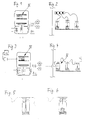
- a freeze dryer 10 according to prior art is shown, including a drying chamber 12 having a compressor 14 and an ice condensor 16 associated therewith.
- the drying chamber 10 is closed by means of a door 18, behind which several vials 20 are located on a shelf or rack 22.
- the vials 20 contain a probe, product or material 24 to be freeze dried.
- each vial 20 further contains temperature sensing means in the form of a thermocouple 26 being conductively connected to a temperature measuring device 28 via wires or electrical conducts 30.
- the temperature measuring device 28 allows at least a rough supervision of the temperature during the process of freeze drying. Therefore, the thermocouples 26 have to be in direct contact with the material 24.
- Fig. 3 to Fig. 5 show an embodiment of a freeze dryer 10 which includes at its drying chamber 12 a freeze dryer monitoring device 32 according to the invention.
- the freeze dryer monitoring device 32 includes a computer 34 having an interrogator 36 coupled therewith.
- the interrogator 36 has a number of n fiber optics or optical fibers 38 (of which only one is shown in Fig. 3 to 5 ) connected therewith.
- the fibers 38 are each guided through a flange 40 into the interior of the drying chamber 12.
- each fiber 40 is further guided through a number of n sensing means 42.
- the sensing means 42 are thus provided in serial on the respective fiber 40.
- Each sensing means 42 is formed as a sensing rod 44 having the fiber 40 bent in a curved form a the lower end of the sensing rod 44 over an angular range of nearly 360°, thus providing a fiber circle, fiber ellipse or fiber loop 46 which is hanging in the gas over the material 24, directed towards the material 24 and having the material 24 underneath. In an embodiment not shown, the loop 46 is diving into the material 24.
- the fiber loop 46 is made of a tube or tubular holder (not shown in detail) in which the respective fiber 38 is lying moveably, the fiber 38 may slide a very little within the tubular holder.
- the fiber 38 was bent into the loop form by introducing it in the tubular holder in nearly straight form and bending the tubular holder thereafter.
- the fiber 38 includes a fiber Bragg grating (not shown in detail).
- a fiber Bragg grating is a type of distributed Bragg reflector constructed in a short segment of the fiber 38 that reflects particular wavelengths of light and transmits all others. This is achieved by adding a periodic variation to the refractive index of the fiber core, which generates a wavelength specific dielectric mirror.
- a fiber Bragg grating can therefore be used as a wavelength-specific reflector.
- the fundamental principle behind the operation of a FBG is Fresnel reflection. Where light traveling between media of different refractive indices may both reflect and refract at the interface.
- the grating will typically have a sinusoidal refractive index variation over a defined length.
- the peak reflection (P B ( ⁇ B )) is approximately given by, P B ⁇ B ⁇ tanh 2 N ⁇ V ⁇ ⁇ ⁇ n 0 n , where N is the number of periodic variations.
- the structure of the FBG can vary via the refractive index, or the grating period.
- the grating period can be uniform or graded, and either localised or distributed in a superstructure.
- the refractive index has two primary characteristics, the refractive index profile, and the offset.
- the refractive index profile can be uniform or apodized, and the refractive index offset is positive or zero.
- FBGs There are six common structures for the FBGs provided for the fiber 38: uniform positive-only index change, Gaussian apodized, raised-cosine apodized, chirped, discrete phase shift, and superstructure.
- a third quantity can be varied to help with side-lobe suppression.
- This is apodization of the refractive index change.
- the term appodization refers to the grading of the refractive index to approach zero at the end on the grating.
- Apodized gratings offer significant improvement is side-lobe suppression while maintaining reflectivity and a narrow bandwidth.
- the two functions typically used to apodize a FBG are Gaussian and raised-cosine.
- the refractive index profile of the grating may be modified to add other features, such as a linear variation in the grating period, called a chirp.
- the chirp had the effect of broadening the reflected spectrum.
- the reflected wavelength given by equation (1), will change relative to any change in the grating period.
- a grating possessing a chirp has the property of adding dispersion - namely, different wavelengths reflected from the grating will be subject to different delays. This property has been used in the development of phased-array antenna systems and polarization mode dispersion compensaiton, as well.
- the grating or variation of the refractive index is along the length of the fiber (the optical axis), and is typically uniform across the width of the fiber.
- the variation of the refractive index is at an angle to the optical axis. The angle of tilt in a TFBG has an effect on the reflected wavelength, and bandwidth.
- the grating period is the same size as the Bragg wavelength, as defined in equation (1). So for a grating that reflects at 1500nm, the grating period is 500nm, using a refractive index of 1.5. Longer periods can be used to achieve much broader responses than are possible with a standard FBG. These gratings are called long-period fiber grating. They typically have grating periods on the order of 100 micrometers, to a millimeter, and are therefore much easier to manufacture.
- the Bragg wavelength is also sensitive to temperature.
- the measurand causes a shift in the Bragg wavelength, ⁇ B .
- C S is the coefficient of strain, which is related to the strain optic coefficient pe.
- C T is the coefficient of temperature, which is made up of the thermal expansion coefficient of the optical fiber, ⁇ ⁇ , and the thermo-optic coefficient, ⁇ .
- a sensor having at least one fiber Bragg grating was placed in a vial into the solution material filled in the vial.
- Several sensors were placed in different vials in a row using the same fiber.
- the vials were placed inside a freeze drying chamber and a conventional freeze drying cycle was performed composing of a freezing step, the primary drying and secondary drying step. During the process the temperature was measured surprisingly very precise.
- a sensing mean 42 is shown at which the fiber 38 is formed as a sensing helix 48.
- the fiber 3 is formed as a sensing spiral.
- the sensing helix 48 and the sensing spiral do both also include a tubular holder, now formed as a helix or spiral, respectively.
- the tubular holder again contains the corresponding part of the fiber 38 in a movable manner.
- there is not only one FBG provided within the region of the tubular holder but there are several FBGs, one after the other, thus providing a pattern of measuring points in the interior of the corrsponding vial 20 which extends into two or even three dimensions.
- the FBGs are located at different axial dimensions of the sensing helix 48 and/or at different radial dimensions of the sensing spiral.
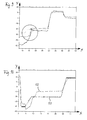
- Fig. 7 through 11 show charts of the temperature in Kelvin (K) on the y-axis (axis of ordinates) along the time in seconds (s) on the x-axis (axis of abscissae).
- K Kelvin
- Fig. 7 to 9 processes can be monitored at very high sensitivity and sampling rate.
- Fig. 7 shows temperature profiles measured and monitored using the sensor technique according to the invention.
- Fig. 8 temperature profiles allow monitoring additional processes during freezing, such as crystallization of excipients.
- Fig. 9 shows the end of primary drying and the sensitivity measured.
- these processes in the probe or sample can be monitored by the temperature measurement of sensing means 42 without contact to the sample (see Fig. 4 ).
- the sensor means 42 are much easier to handle due to its smaler size, and due to the handling flexibility, e.g. with less cables, multiple measurement points on one fiber line (see Fig. 4 ), the mulitplex capacity (see Fig. 3 ) and the multiple measurement points in one vial (see Fig. 6 )
- Fig. 10 and 11 show measurement of the thermocouples 26, once at the rack 22 (curves 50) and once at the material 24 (curve 52).
Landscapes
- Engineering & Computer Science (AREA)
- Mechanical Engineering (AREA)
- General Engineering & Computer Science (AREA)
- Health & Medical Sciences (AREA)
- Life Sciences & Earth Sciences (AREA)
- Molecular Biology (AREA)
- Investigating Or Analysing Materials By Optical Means (AREA)
- Drying Of Solid Materials (AREA)
Priority Applications (5)
| Application Number | Priority Date | Filing Date | Title |
|---|---|---|---|
| EP08022515A EP2202472A1 (de) | 2008-12-29 | 2008-12-29 | Gefriertrockner-Überwachungsvorrichtung |
| PCT/EP2009/009303 WO2010076014A1 (en) | 2008-12-29 | 2009-12-29 | Monitoring device for a dryer |
| EP09801417.8A EP2382432B1 (de) | 2008-12-29 | 2009-12-29 | Gefriertrocknerüberwachungsvorrichtung |
| US13/139,927 US8919007B2 (en) | 2008-12-29 | 2009-12-29 | Dryer with monitoring device |
| US14/576,888 US9500406B2 (en) | 2008-12-29 | 2014-12-19 | Dryer with monitoring device |
Applications Claiming Priority (1)
| Application Number | Priority Date | Filing Date | Title |
|---|---|---|---|
| EP08022515A EP2202472A1 (de) | 2008-12-29 | 2008-12-29 | Gefriertrockner-Überwachungsvorrichtung |
Publications (1)
| Publication Number | Publication Date |
|---|---|
| EP2202472A1 true EP2202472A1 (de) | 2010-06-30 |
Family
ID=40676522
Family Applications (2)
| Application Number | Title | Priority Date | Filing Date |
|---|---|---|---|
| EP08022515A Withdrawn EP2202472A1 (de) | 2008-12-29 | 2008-12-29 | Gefriertrockner-Überwachungsvorrichtung |
| EP09801417.8A Not-in-force EP2382432B1 (de) | 2008-12-29 | 2009-12-29 | Gefriertrocknerüberwachungsvorrichtung |
Family Applications After (1)
| Application Number | Title | Priority Date | Filing Date |
|---|---|---|---|
| EP09801417.8A Not-in-force EP2382432B1 (de) | 2008-12-29 | 2009-12-29 | Gefriertrocknerüberwachungsvorrichtung |
Country Status (3)
| Country | Link |
|---|---|
| US (2) | US8919007B2 (de) |
| EP (2) | EP2202472A1 (de) |
| WO (1) | WO2010076014A1 (de) |
Cited By (2)
| Publication number | Priority date | Publication date | Assignee | Title |
|---|---|---|---|---|
| US20150101208A1 (en) * | 2008-12-29 | 2015-04-16 | Wolfgang Friess | Dryer with monitoring device |
| CN116045622A (zh) * | 2022-12-29 | 2023-05-02 | 贵州金泽新能源科技有限公司 | 一种工业热风干燥系统各设备安全联锁控制设置 |
Families Citing this family (24)
| Publication number | Priority date | Publication date | Assignee | Title |
|---|---|---|---|---|
| SE535329C2 (sv) * | 2010-11-29 | 2012-06-26 | Andritz Tech & Asset Man Gmbh | Metod för att torka en massabana och en massatork innefattande en inspektionsanordning för analysering av massabanans position eller förekomst av massarester |
| DK3222952T3 (en) * | 2011-09-06 | 2019-04-08 | Rv Holding B V | Method and system for freeze-drying injectable compositions, in particular pharmaceutical compositions |
| CN104364646B (zh) * | 2011-12-20 | 2020-06-09 | 百瑞空气工程(亚洲)有限公司 | 用于水分确定和控制的方法和装置 |
| US9180145B2 (en) * | 2012-10-12 | 2015-11-10 | Mimedx Group, Inc. | Compositions and methods for recruiting and localizing stem cells |
| JP6173495B2 (ja) * | 2013-05-29 | 2017-08-02 | ゲア・プロセス・エンジニアリング・アクティーゼルスカブ | トロリに収容されたトレイ内の製品の直列滅菌凍結乾燥を実現する方法、方法を実施するためのシステム、および方法の使用 |
| US9121637B2 (en) | 2013-06-25 | 2015-09-01 | Millrock Technology Inc. | Using surface heat flux measurement to monitor and control a freeze drying process |
| US10217615B2 (en) | 2013-12-16 | 2019-02-26 | Lam Research Corporation | Plasma processing apparatus and component thereof including an optical fiber for determining a temperature thereof |
| CN106461327B (zh) * | 2014-06-09 | 2019-12-13 | 泰尔茂比司特公司 | 冻干法 |
| ES2824577T3 (es) * | 2015-01-28 | 2021-05-12 | Ima Life North America Inc | Supervisión y control de procesos usando detección de estado de un producto inalámbrica multipunto sin batería |
| EP3250869B1 (de) | 2015-01-28 | 2019-05-08 | IMA Life North America Inc. | Prozesssteuerung mit nichtinvasiven druckproduktsensoren |
| US9739532B2 (en) * | 2015-02-04 | 2017-08-22 | Steven F. Baugh | Botanical freeze drying system and method |
| EP3070425B1 (de) * | 2015-03-16 | 2018-08-15 | Martin Christ Gefriertrocknungsanlagen GmbH | Gefriertrockner mit einem sichtfenster |
| CN107923706B (zh) | 2015-08-03 | 2020-10-02 | 简·探针公司 | 用于维持受控环境的设备 |
| US11781811B2 (en) | 2015-08-03 | 2023-10-10 | Gen-Probe Incorporated | Apparatus for maintaining a controlled environment |
| US10605527B2 (en) | 2015-09-22 | 2020-03-31 | Millrock Technology, Inc. | Apparatus and method for developing freeze drying protocols using small batches of product |
| US10113797B2 (en) * | 2016-09-09 | 2018-10-30 | Sp Industries, Inc. | Energy recovery in a freeze-drying system |
| GB2564481B (en) * | 2017-07-14 | 2019-10-23 | 4D Pharma Leon S L U | Process |
| US10989865B2 (en) * | 2018-02-05 | 2021-04-27 | University Of Georgia Research Foundation, Inc | Stretchable fiber optic sensor |
| US10639340B2 (en) | 2018-06-18 | 2020-05-05 | Eric Young | Method of drying botanicals |
| FR3086739B1 (fr) * | 2018-09-27 | 2021-02-12 | Maat Pharma | Recipient de lyophilisation |
| US11243028B2 (en) * | 2018-12-14 | 2022-02-08 | Fortunata, LLC | Systems and methods of cryo-curing |
| JP6667884B1 (ja) * | 2019-07-17 | 2020-03-18 | 株式会社松井製作所 | 粉粒体材料の乾燥装置及び粉粒体材料の乾燥方法 |
| US20250060160A1 (en) * | 2023-08-14 | 2025-02-20 | Sp Industries, Inc. | Real-time measurement of desublimation in a freeze-drying system |
| WO2025094216A1 (en) * | 2023-11-02 | 2025-05-08 | Resontech S.R.L. | Lyophilization afferent system |
Citations (8)
| Publication number | Priority date | Publication date | Assignee | Title |
|---|---|---|---|---|
| US5367786A (en) * | 1990-11-06 | 1994-11-29 | Jennings; Thomas A. | Method and apparatus for monitoring the processing of a material |
| US6125216A (en) * | 1997-06-19 | 2000-09-26 | British Aerospace Public Limited Company | Strain isolated optical fibre bragg grating sensor |
| US20020147394A1 (en) * | 1999-09-09 | 2002-10-10 | Reinold Ellingsen | Fiber optic probe for temperature measurements in biological media |
| US20030116027A1 (en) * | 2000-04-19 | 2003-06-26 | Brulls Mikael Johan Alvin | Method of monitoring a freeze drying process |
| DE102004031324A1 (de) * | 2004-06-29 | 2006-01-19 | Bayer Technology Services Gmbh | Temperaturprofilmessung in Reaktoren mit Faser-Bragg-Gittern |
| US20060239331A1 (en) * | 2005-04-26 | 2006-10-26 | Schwegman John J | Wireless temperature sensing system for lyophilization processes |
| DE102006025700A1 (de) * | 2006-06-01 | 2007-12-06 | Siemens Ag | Optische Messeinrichtung zur Temperaturbestimmung in einer kryogenen Umgebung und temperaturüberwachbare Wickelanordnung |
| US20080025668A1 (en) * | 2006-07-27 | 2008-01-31 | Litton Systems, Inc. | Transducer mandrel with attachment for holding fiber bragg grating mounting collar |
Family Cites Families (23)
| Publication number | Priority date | Publication date | Assignee | Title |
|---|---|---|---|---|
| US4016761A (en) * | 1974-04-18 | 1977-04-12 | The United States Of America As Represented By The Secretary Of The Navy | Optical temperature probe |
| US4245507A (en) * | 1979-09-10 | 1981-01-20 | Samulski Thaddeus V | Temperature probe |
| US4626110A (en) * | 1985-05-03 | 1986-12-02 | Luxtron Corporation | Technique for optically measuring the temperature of an ultrasonically heated object |
| US4996419A (en) * | 1989-12-26 | 1991-02-26 | United Technologies Corporation | Distributed multiplexed optical fiber Bragg grating sensor arrangeement |
| US5355423A (en) * | 1992-07-16 | 1994-10-11 | Rosemount Inc. | Optical temperature probe assembly |
| DE4233978C1 (de) * | 1992-10-08 | 1994-04-21 | Leibinger Gmbh | Vorrichtung zum Markieren von Körperstellen für medizinische Untersuchungen |
| US5513913A (en) * | 1993-01-29 | 1996-05-07 | United Technologies Corporation | Active multipoint fiber laser sensor |
| IT1264284B1 (it) * | 1993-12-03 | 1996-09-23 | Gd Spa | Metodo e apparecchiatura per il rilevamento della densita' di un flusso di materiale fibroso in una macchina per la produzione di |
| DE19531117C2 (de) * | 1995-08-24 | 1999-05-12 | Daum Gmbh | Verwendung einer Titanlegierung für Instrumente zur interventionellen Kernspintomographie und Verfahren zur Behandlung solcher Instrumente |
| US6039730A (en) * | 1996-06-24 | 2000-03-21 | Allegheny-Singer Research Institute | Method and apparatus for cryosurgery |
| CA2506207A1 (en) * | 2002-11-18 | 2004-06-03 | Virginia Tech Intellectual Properties, Inc. | System, device, and method for detecting perturbations |
| US7196317B1 (en) * | 2005-03-25 | 2007-03-27 | Virginia Tech Intellectual Properties, Inc. | System, device, and method for detecting perturbations |
| EP1869413A1 (de) * | 2005-04-05 | 2007-12-26 | Agency for Science, Technology and Research | Faser-bragg-gitter-sensor |
| US7717618B2 (en) * | 2005-12-30 | 2010-05-18 | Optech Ventures, Llc | Apparatus and method for high resolution temperature measurement and for hyperthermia therapy |
| US7793559B2 (en) * | 2007-02-02 | 2010-09-14 | Board Of Regents Of The Nevada System Of Higher Education, On Behalf Of The Desert Research Institute | Monitoring probes and methods of use |
| US8123399B2 (en) * | 2007-05-08 | 2012-02-28 | The United States of America as represented by the National Institute of Standards and Technology | Dielectric resonator thermometer and a method of using the same |
| DE102007053664A1 (de) * | 2007-11-08 | 2009-05-14 | Friedrich-Schiller-Universität Jena | Optische Sensoren zur Detektion von Ionen, Gasen und Biomolekülen sowie Verfahren zu deren Herstellung und Verwendung |
| EP2159580B1 (de) * | 2008-08-26 | 2015-10-07 | Lake Shore Cryotronics, Inc. | Sondenspitze |
| CN102203576B (zh) * | 2008-09-23 | 2013-07-31 | 沃依特专利有限责任公司 | 设有光学辊筒套传感器系统的工业辊筒 |
| EP2202472A1 (de) * | 2008-12-29 | 2010-06-30 | Ludwig-Maximilians-Universität München | Gefriertrockner-Überwachungsvorrichtung |
| US8135247B2 (en) * | 2009-03-30 | 2012-03-13 | General Electric Company | Packaged sensors and harsh environment systems with packaged sensors |
| US8085397B2 (en) * | 2009-07-10 | 2011-12-27 | Honeywell Asca Inc. | Fiber optic sensor utilizing broadband sources |
| US9463243B2 (en) * | 2012-02-13 | 2016-10-11 | Imra America, Inc. | Amorphous medicinal fine particles produced by pulsed laser ablation in liquid and the production method thereof |
-
2008
- 2008-12-29 EP EP08022515A patent/EP2202472A1/de not_active Withdrawn
-
2009
- 2009-12-29 EP EP09801417.8A patent/EP2382432B1/de not_active Not-in-force
- 2009-12-29 WO PCT/EP2009/009303 patent/WO2010076014A1/en not_active Ceased
- 2009-12-29 US US13/139,927 patent/US8919007B2/en active Active
-
2014
- 2014-12-19 US US14/576,888 patent/US9500406B2/en not_active Expired - Fee Related
Patent Citations (8)
| Publication number | Priority date | Publication date | Assignee | Title |
|---|---|---|---|---|
| US5367786A (en) * | 1990-11-06 | 1994-11-29 | Jennings; Thomas A. | Method and apparatus for monitoring the processing of a material |
| US6125216A (en) * | 1997-06-19 | 2000-09-26 | British Aerospace Public Limited Company | Strain isolated optical fibre bragg grating sensor |
| US20020147394A1 (en) * | 1999-09-09 | 2002-10-10 | Reinold Ellingsen | Fiber optic probe for temperature measurements in biological media |
| US20030116027A1 (en) * | 2000-04-19 | 2003-06-26 | Brulls Mikael Johan Alvin | Method of monitoring a freeze drying process |
| DE102004031324A1 (de) * | 2004-06-29 | 2006-01-19 | Bayer Technology Services Gmbh | Temperaturprofilmessung in Reaktoren mit Faser-Bragg-Gittern |
| US20060239331A1 (en) * | 2005-04-26 | 2006-10-26 | Schwegman John J | Wireless temperature sensing system for lyophilization processes |
| DE102006025700A1 (de) * | 2006-06-01 | 2007-12-06 | Siemens Ag | Optische Messeinrichtung zur Temperaturbestimmung in einer kryogenen Umgebung und temperaturüberwachbare Wickelanordnung |
| US20080025668A1 (en) * | 2006-07-27 | 2008-01-31 | Litton Systems, Inc. | Transducer mandrel with attachment for holding fiber bragg grating mounting collar |
Cited By (3)
| Publication number | Priority date | Publication date | Assignee | Title |
|---|---|---|---|---|
| US20150101208A1 (en) * | 2008-12-29 | 2015-04-16 | Wolfgang Friess | Dryer with monitoring device |
| US9500406B2 (en) * | 2008-12-29 | 2016-11-22 | Wolfgang Friess | Dryer with monitoring device |
| CN116045622A (zh) * | 2022-12-29 | 2023-05-02 | 贵州金泽新能源科技有限公司 | 一种工业热风干燥系统各设备安全联锁控制设置 |
Also Published As
| Publication number | Publication date |
|---|---|
| WO2010076014A1 (en) | 2010-07-08 |
| EP2382432A1 (de) | 2011-11-02 |
| US9500406B2 (en) | 2016-11-22 |
| US20110247234A1 (en) | 2011-10-13 |
| EP2382432B1 (de) | 2017-12-13 |
| US8919007B2 (en) | 2014-12-30 |
| US20150101208A1 (en) | 2015-04-16 |
Similar Documents
| Publication | Publication Date | Title |
|---|---|---|
| EP2202472A1 (de) | Gefriertrockner-Überwachungsvorrichtung | |
| Kasper et al. | Implementation and evaluation of an optical fiber system as novel process monitoring tool during lyophilization | |
| Belay et al. | Concentration, wavelength and temperature dependent refractive index of sugar solutions and methods of determination contents of sugar in soft drink beverages using laser lights | |
| Ho et al. | Application of white light-emitting diode to surface plasmon resonance sensors | |
| US8547542B2 (en) | Device for measuring the focal distance of a thermal lens | |
| JPS62500052A (ja) | 光ファイバ内に格子を形成する方法 | |
| Caucheteur et al. | Autocorrelation demodulation technique for fiber Bragg grating sensor | |
| CN115979422B (zh) | 一种缺陷散射计算重构光谱探测装置及方法 | |
| GB2340231A (en) | Optical transducers based on liquid crystalline phases | |
| Zhou et al. | Temperature insensitive fiber optical refractive index probe with large dynamic range at 1,550 nm | |
| AU2012380733B2 (en) | Optical spectrometer | |
| Moreno-Hernández et al. | Contactless optical fiber interferometric sensor to monitor water content in ethanol | |
| US7324199B2 (en) | System and deconvolution process for an optical filtering device based on WGM resonance | |
| Wang et al. | Line by line inscribed small period long period grating for wide range refractive index sensing | |
| JP4955966B2 (ja) | 導波路、それを用いた装置及び検出方法 | |
| Sabatyan et al. | Determination of refractive indices of liquids by Fresnel diffraction | |
| CA2972641C (en) | Birefringent multi-peak optical reference element and birefringent sensor system | |
| JP2007057376A (ja) | ファブリ・ペロー干渉計を用いた屈折率測定装置 | |
| JP5256808B2 (ja) | 導波モード共鳴格子を用いた屈折率測定方法及び屈折率測定装置 | |
| Hribar et al. | Fiber-optic boiling point sensor for characterization of liquids | |
| EP3479099A1 (de) | Systeme und verfahren zur abfrage von parametern an mehreren orten in einer probe | |
| Niu et al. | Surface tension coefficient of liquid sensor based on FBG | |
| Fröjdh et al. | Strain and temperature measurement using a 9.5-m continuous chirped fiber Bragg grating with millimeter resolution | |
| Tian et al. | Investigation on Peak Wavelength Tracking in FBG Sensor | |
| Kamikawachi et al. | Thermal characterization of etched FBG for applications in oil and gas sector |
Legal Events
| Date | Code | Title | Description |
|---|---|---|---|
| PUAI | Public reference made under article 153(3) epc to a published international application that has entered the european phase |
Free format text: ORIGINAL CODE: 0009012 |
|
| AK | Designated contracting states |
Kind code of ref document: A1 Designated state(s): AT BE BG CH CY CZ DE DK EE ES FI FR GB GR HR HU IE IS IT LI LT LU LV MC MT NL NO PL PT RO SE SI SK TR |
|
| AX | Request for extension of the european patent |
Extension state: AL BA MK RS |
|
| AKY | No designation fees paid | ||
| REG | Reference to a national code |
Ref country code: DE Ref legal event code: R108 Effective date: 20110208 Ref country code: DE Ref legal event code: 8566 |
|
| STAA | Information on the status of an ep patent application or granted ep patent |
Free format text: STATUS: THE APPLICATION IS DEEMED TO BE WITHDRAWN |
|
| 18D | Application deemed to be withdrawn |
Effective date: 20101231 |