EP2203006A1 - Approvisionnement d'un service de réseau basé sur un dispositif - Google Patents
Approvisionnement d'un service de réseau basé sur un dispositif Download PDFInfo
- Publication number
- EP2203006A1 EP2203006A1 EP09180835A EP09180835A EP2203006A1 EP 2203006 A1 EP2203006 A1 EP 2203006A1 EP 09180835 A EP09180835 A EP 09180835A EP 09180835 A EP09180835 A EP 09180835A EP 2203006 A1 EP2203006 A1 EP 2203006A1
- Authority
- EP
- European Patent Office
- Prior art keywords
- provisioning
- services
- service provider
- wireless
- wireless communication
- Prior art date
- Legal status (The legal status is an assumption and is not a legal conclusion. Google has not performed a legal analysis and makes no representation as to the accuracy of the status listed.)
- Ceased
Links
- 238000004891 communication Methods 0.000 claims abstract description 137
- 238000000034 method Methods 0.000 claims description 30
- 238000012986 modification Methods 0.000 claims description 9
- 230000004048 modification Effects 0.000 claims description 9
- 230000004044 response Effects 0.000 claims description 9
- 230000004913 activation Effects 0.000 claims description 6
- 230000003213 activating effect Effects 0.000 abstract 1
- 239000003795 chemical substances by application Substances 0.000 description 39
- 230000006870 function Effects 0.000 description 19
- 238000010586 diagram Methods 0.000 description 9
- 238000012545 processing Methods 0.000 description 6
- 238000012384 transportation and delivery Methods 0.000 description 6
- 230000009471 action Effects 0.000 description 5
- 238000013459 approach Methods 0.000 description 5
- 230000001413 cellular effect Effects 0.000 description 5
- 238000006243 chemical reaction Methods 0.000 description 5
- 230000000977 initiatory effect Effects 0.000 description 5
- 230000005540 biological transmission Effects 0.000 description 4
- 238000003860 storage Methods 0.000 description 4
- 239000008186 active pharmaceutical agent Substances 0.000 description 3
- 238000005516 engineering process Methods 0.000 description 3
- 238000004519 manufacturing process Methods 0.000 description 3
- 230000002688 persistence Effects 0.000 description 3
- 230000008569 process Effects 0.000 description 3
- 230000003321 amplification Effects 0.000 description 2
- 230000006399 behavior Effects 0.000 description 2
- 238000009826 distribution Methods 0.000 description 2
- 230000000694 effects Effects 0.000 description 2
- 238000001914 filtration Methods 0.000 description 2
- 238000007726 management method Methods 0.000 description 2
- 238000003199 nucleic acid amplification method Methods 0.000 description 2
- 230000002085 persistent effect Effects 0.000 description 2
- 238000013475 authorization Methods 0.000 description 1
- 230000009286 beneficial effect Effects 0.000 description 1
- 230000008859 change Effects 0.000 description 1
- 230000002860 competitive effect Effects 0.000 description 1
- 238000004590 computer program Methods 0.000 description 1
- 238000013481 data capture Methods 0.000 description 1
- 238000012217 deletion Methods 0.000 description 1
- 230000037430 deletion Effects 0.000 description 1
- 238000013461 design Methods 0.000 description 1
- 238000009434 installation Methods 0.000 description 1
- 238000012423 maintenance Methods 0.000 description 1
- 230000007246 mechanism Effects 0.000 description 1
- 230000006855 networking Effects 0.000 description 1
- 230000007935 neutral effect Effects 0.000 description 1
- 238000013439 planning Methods 0.000 description 1
- 230000011664 signaling Effects 0.000 description 1
- 239000000344 soap Substances 0.000 description 1
- 230000005236 sound signal Effects 0.000 description 1
- 230000001360 synchronised effect Effects 0.000 description 1
- 210000003813 thumb Anatomy 0.000 description 1
- 230000000007 visual effect Effects 0.000 description 1
Images


Classifications
-
- H—ELECTRICITY
- H04—ELECTRIC COMMUNICATION TECHNIQUE
- H04W—WIRELESS COMMUNICATION NETWORKS
- H04W8/00—Network data management
- H04W8/18—Processing of user or subscriber data, e.g. subscribed services, user preferences or user profiles; Transfer of user or subscriber data
- H04W8/183—Processing at user equipment or user record carrier
-
- H—ELECTRICITY
- H04—ELECTRIC COMMUNICATION TECHNIQUE
- H04W—WIRELESS COMMUNICATION NETWORKS
- H04W8/00—Network data management
- H04W8/22—Processing or transfer of terminal data, e.g. status or physical capabilities
- H04W8/24—Transfer of terminal data
- H04W8/245—Transfer of terminal data from a network towards a terminal
Definitions
- the present relates generally to wireless communication networks and devices and, more particularly, to device-based network service provisioning to enable a wireless device for wireless services.
- Wireless communication devices such as mobile devices providing wireless communication services such as voice communication, data communication or both via a wireless communication network are increasingly prevalent in modern society. Such devices may also provide additional personal digital assistant (PDA) functions such as a calendar, alarm, contact lists, calculators, etc.
- PDA personal digital assistant
- Wireless communication services are typically provided on a service contract basis where a subscriber (i.e. a wireless device user or someone on behalf of the ultimate user) enters a service contract with a wireless carrier to have primary wireless services provided to the subscriber's equipment: the wireless communication device.
- the carrier's wireless communication system is configured with subscriber data such as, but not limited to, subscriber name and billing information, wireless service plan, subscriber's equipment type, and any required information to identify the subscriber's equipment to facilitate wireless communication.
- subscriber data such as, but not limited to, subscriber name and billing information, wireless service plan, subscriber's equipment type, and any required information to identify the subscriber's equipment to facilitate wireless communication.
- the activity of configuring the wireless communication network with such information to enable services is sometimes referred to as network service provisioning.
- Configuring a wireless device with device enabling information is sometimes referred to as device provisioning.
- enrolling or signing-up subscribers is a major focus of carrier activities. Often one or more networks of re-sellers or contract agents are employed on behalf of the carrier to enroll customers.
- One aspect of the enrollment procedure is the obtaining of subscriber information by a customer service representative (CSR) of the carrier or re-seller typically operating in a retail store location. The CSR then provides the information to the carrier to activate the subscriber's account and enable the wireless services.
- the CSR may provide the information via a telephone interface to the carrier or electronically through a Web-based interface.
- some subscriber's prefer different approaches to obtaining wireless services and wish to perform aspects of the enrollment themselves.
- a CSR-centered approach which requires a trip to a retail location or a telephone call to a CSR can be annoying for some subscribers and is an expensive way of providing such services.
- the present relates to device-based wireless service provisioning.
- a wireless device configured for network service provisioning
- a service provider e.g. carrier or VASP
- VASP service provider
- Service amendments may also be requested and provisioned in a similar manner.
- Provisioning components of a wireless device interface may be defined and provided by (or on behalf of) a service provider during a provisioning session to permit the provider to maintain branding, look and feel and other control over a subscriber's experience. These provisioning components may be dynamically generated to capture current services and subscriber plans and to suit a particular wireless device.
- service provider-side components define a service-oriented interface (e.g. Web services) for receiving a subscriber's provisioning information.
- Wireless device-side components define a mechanism to request and receive provisioning components to facilitate a subscriber to provide provisioning information to the service-oriented interface.
- a gateway may be interposed between the wireless device and service-oriented interface to provide the provisioning components to the wireless device and handle provisioning session communications between the wireless device and the service-oriented interface.
- a method of provisioning a wireless device for services in a wireless communication network comprises communicating via the wireless communication network to receive a provisioning profile from a service provider provisioning system configured for automatically provisioning services to wireless devices; generating a customized subscriber interface in accordance with the provisioning profile to receive provisioning information with which to define said services; receiving the provisioning information via the customized subscriber interface; communicating the provisioning information to the service provider provisioning system via the wireless communication network to activate the services for the wireless device; and receiving the services.
- a wireless communication network for providing services to wireless devices.
- a plurality of wireless devices is configured for wireless communication via wireless communication network infrastructure, each wireless device comprising device-side components: defining an interface for requesting and receiving a provisioning profile via the wireless communication network infrastructure for provisioning services of a service provider; defining a run-time environment for generating a customized subscriber interface in accordance with the provisioning profile to receive provisioning information with which to define said services; and defining an interface for communicating the provisioning information via the wireless communication network infrastructure to a service provider provisioning system for automatically provisioning the services to the wireless device in accordance with the provisioning information.
- the service provider provisioning system is coupled via wireless communication network infrastructure for wireless communication with respective ones of the plurality of wireless devices.
- the service provider provisioning system comprises server-side components: defining an interface for receiving respective requests from the wireless devices and providing respective provisioning profiles in response; and defining an interface for receiving respective provisioning information from the wireless devices to automatically provision the services to the respective wireless.
- a service provider provisioning system for provisioning services to a plurality of wireless devices for communication via a wireless communication network, said system comprising server-side components defining an interface for receiving respective requests from the wireless devices and providing respective dynamically generated provisioning profiles in response, each provisioning profile configured for generating a customized subscriber interface by a run-time environment of the wireless devices to receive provisioning information with which to define said services; and defining an interface for receiving respective provisioning information from the wireless devices to automatically provision the services to the respective wireless devices.
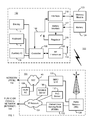
- Fig. 1 is a block diagram of a communication system 100 which includes a mobile device 102 which communicates through a wireless communication network 104.
- Mobile device 102 preferably includes a visual display 112, a keyboard 114, and perhaps one or more auxiliary input/output (I/O) interfaces 116 (e.g. a track ball, a thumb wheel, a touch sensitive screen (which may be clickable) a GPS, one or more accelerometers, etc.), each of which is coupled to a controller 106.
- Controller 106 is also coupled to radio frequency (RF) transceiver circuitry 108 and an antenna 110.
- RF radio frequency
- controller 106 is embodied as a central processing unit (CPU) which runs operating system software in a memory component (not shown). Controller 106 will normally control overall operation of mobile device 102, whereas signal processing operations associated with communication functions are typically performed in RF transceiver circuitry 108. Controller 106 interfaces with device display 112 to display received information, stored information, user inputs, and the like. Keyboard 114, which may be a telephone type keypad or full alphanumeric keyboard, is normally provided for entering data for storage in mobile device 102, information for transmission to network 104, a telephone number to place a telephone call, commands to be executed on mobile device 102, and possibly other or different user inputs.
- CPU central processing unit
- memory component not shown
- Controller 106 will normally control overall operation of mobile device 102, whereas signal processing operations associated with communication functions are typically performed in RF transceiver circuitry 108. Controller 106 interfaces with device display 112 to display received information, stored information, user inputs, and the like.
- Keyboard 114 which
- Mobile device 102 sends communication signals to and receives communication signals from network 104 over a wireless link via antenna 110.
- RF transceiver circuitry 108 performs functions similar to those of a radio network (RN) 128, including for example modulation/demodulation and possibly encoding/decoding and encryption/decryption. It is also contemplated that RF transceiver circuitry 108 may perform certain functions in addition to those performed by RN 128. It will be apparent to those skilled in the art that RF transceiver circuitry 108 will be adapted to particular wireless network or networks in which mobile device 102 is intended to operate.
- RN radio network
- Mobile device 102 includes a battery interface 122 for receiving one or more rechargeable batteries 124.
- Battery 124 provides electrical power to electrical circuitry in mobile device 102, and battery interface 122 provides for a mechanical and electrical connection for battery 124.
- Battery interface 122 is coupled to a regulator 126 which regulates power to the device.
- an RF transmitter of RF transceiver circuitry 108 is typically turned on only when it is sending to network, and is otherwise turned off to conserve resources.
- an RF receiver of RF transceiver circuitry 108 is typically periodically turned off to conserve power until it is needed to receive signals or information (if at all) during designated time periods.
- Mobile device 102 operates using a memory module 120, such as a Subscriber Identity Module (SIM) or a Removable User Identity Module (R-UIM), which is connected to or inserted in mobile device 102 at an interface 118.
- SIM Subscriber Identity Module
- R-UIM Removable User Identity Module
- mobile device 102 may operate based on configuration data programmed by a service provider into an internal memory which is a non-volatile memory.
- Mobile device 102 may consist of a single unit, such as a data communication device, a cellular telephone, a multiple-function communication device with data and voice communication capabilities, a personal digital assistant (PDA) enabled for wireless communication, or a computer incorporating an internal modem.
- PDA personal digital assistant
- mobile device 102 may be a multiple-module unit comprising a plurality of separate components, including but in no way limited to a computer or other device connected to a wireless modem.
- RF transceiver circuitry 108 and antenna 110 may be implemented as a radio modem unit that may be inserted into a port on a laptop computer.
- the laptop computer would include display 112, keyboard 114, and one or more auxiliary I/O interfaces 116, and controller 106 may remain within the radio modem unit that communicates with the computer's CPU or be embodied as the computer's CPU.
- a computer or other equipment not normally capable of wireless communication may be adapted to connect to and effectively assume control of RF transceiver circuitry 108 and antenna 110 of a single-unit device such as one of those described above.
- a mobile device 102 may have a more particular implementation as described later in relation to mobile device 202 of Fig. 2 .
- Wireless network 104 is a Third Generation (3G) supported network based on Code Division Multiple Access (CDMA) technologies.
- CDMA Code Division Multiple Access
- wireless network 104 is a CDMA2000 network which includes fixed network components coupled as shown in Fig. 1 .
- Wireless network 104 of the CDMA2000-type includes a Radio Network (RN) 128, a Mobile Switching Center (MSC) 130, a Signaling System 7 (SS7) network 140, a Home Location Register/Authentication Center (HLR/AC) 138, a Packet Data Serving Node (PDSN) 132, an IP network 134, and a Remote Authentication Dial-In User Service (RADIUS) server 136.
- RN Radio Network
- MSC Mobile Switching Center
- SS7 Signaling System 7
- HLR/AC Home Location Register/Authentication Center
- PDSN Packet Data Serving Node
- IP network 134 IP network 134
- RADIUS Remote Authentication Dial-In User Service
- SS7 network 140 is communicatively coupled to a network 142 (such as a Public Switched Telephone Network or PSTN), whereas IP network is communicatively coupled to a network 144 (such as the Internet).
- a network 142 such as a Public Switched Telephone Network or PSTN
- IP network is communicatively coupled to a network 144 (such as the Internet).
- Wireless network 104 is exemplary and persons of ordinary skill in the art will appreciate that other wireless network architectures and standards may be used.
- RN 128 which performs functions such as call-setup, call processing, and mobility management.
- RN 128 includes a plurality of base station transceiver systems that provide wireless network coverage for a particular coverage area commonly referred to as a "cell".
- a given base station transceiver system of RN 128, such as the one shown in Fig. 1 transmits communication signals to and receives communication signals from mobile devices within its cell.
- the base station transceiver system normally performs such functions as modulation and possibly encoding and/or encryption of signals to be transmitted to the mobile device in accordance with particular, usually predetermined, communication protocols and parameters, under control of its controller.
- the base station transceiver system similarly demodulates and possibly decodes and decrypts, if necessary, any communication signals received from mobile device 102 within its cell.
- Communication protocols and parameters may vary between different networks. For example, one network may employ a different modulation scheme and operate at different frequencies than other networks. The underlying services may also differ based on its particular protocol revision.
- the wireless link shown in communication system 100 of Fig. 1 represents one or more different channels, typically different radio frequency (RF) channels, and associated protocols used between wireless network 104 and mobile device 102.
- An RF channel is a limited resource that must be conserved, typically due to limits in overall bandwidth and a limited battery power of mobile device 102.
- RF channel is a limited resource that must be conserved, typically due to limits in overall bandwidth and a limited battery power of mobile device 102.
- HLR/AC 138 For all mobile devices 102 registered with a network operator, permanent data (such as mobile device 102 user's profile) as well as temporary data (such as a mobile device's 102 current location) are stored in a HLR/AC 138. In case of a voice call to mobile device 102, HLR/AC 138 is queried to determine the current location of mobile device 102.
- a Visitor Location Register (VLR) of MSC 130 is responsible for a group of location areas and stores the data of those mobile devices that are currently in its area of responsibility. This includes parts of the permanent mobile device data that have been transmitted from HLR/AC 138 to the VLR for faster access. However, the VLR of MSC 130 may also assign and store local data, such as temporary identifications.
- Mobile device 102 is also authenticated on system access by HLR/AC 138.
- RN 128 communicates with PDSN 132.
- PDSN 132 provides access to the Internet 144 (or intranets, Wireless Application Protocol (WAP) servers, etc.) through IP network 134.
- WAP Wireless Application Protocol
- PDSN 132 also provides foreign agent (FA) functionality in mobile IP networks as well as packet transport for virtual private networking.
- PDSN 132 has a range of IP addresses and performs IP address management, session maintenance, and optional caching.
- RADIUS server 136 is responsible for performing functions related to authentication, authorization, and accounting (AAA) of packet data services, and may be referred to as an AAA server.
- AAA authentication, authorization, and accounting
- Wireless communication network 104 also includes a Push-to-talk over Cellular (PoC) server 137 which may be coupled to IP network 134.
- PoC server 137 operates to facilitate PoC individual and group communication sessions between mobile devices within network 104.
- a conventional PoC communication session involves a session connection between end users of mobile devices, referred to as session "participants", who communicate one at a time in a half-duplex manner much like conventional walkie-talkies or two-way radios.
- wireless network 104 may be connected to other systems, possibly including other networks, not explicitly shown in Fig. 1 .
- a network will normally be transmitting at the very least some sort of paging and system information on an ongoing basis, even if there is no actual packet data exchanged. Although the network consists of many parts, these parts all work together to result in certain behaviors at the wireless link.
- CDMA wireless network 104 is described, network 104 may conform to any of the wireless network technologies and protocols including cellular, wide-area network, GSM, GPRS, CDMA, iDENTM, MobitexTM, etc.
- Fig. 2 is a detailed block diagram of a preferred mobile device 202.
- Mobile device 202 is preferably a two-way communication device having at least voice and advanced data communication capabilities, including the capability to communicate with other computer systems. Depending on the functionality provided by mobile device 202, it may be referred to as a data messaging device, a two-way pager, a cellular telephone with data messaging capabilities, a wireless Internet appliance, or a data communication device (with or without telephony capabilities). Mobile device 202 may communicate with any one of a plurality of base station transceiver systems 200 within its geographic coverage area.
- Mobile device 202 will normally incorporate a communication subsystem 211, which includes a receiver 212, a transmitter 214, and associated components, such as one or more (preferably embedded or internal) antenna elements 216 and 218, local oscillators (LOs) 213, and a processing module such as a digital signal processor (DSP) 220.
- Communication subsystem 211 is analogous to RF transceiver circuitry 108 and antenna 110 shown in Fig. 1 . As will be apparent to those skilled in the field of communications, particular design of communication subsystem 211 depends on the communication network in which mobile device 202 is intended to operate.
- Mobile device 202 may send and receive communication signals over the network after required network registration or activation procedures have been completed.
- Signals received by antenna 216 through the network are input to receiver 212, which may perform such common receiver functions as signal amplification, frequency down conversion, filtering, channel selection, and like, and in example shown in Fig. 2 , analog-to-digital (A/D) conversion.
- A/D conversion of a received signal allows more complex communication functions such as demodulation and decoding to be performed in DSP 220.
- signals to be transmitted are processed, including modulation and encoding, for example, by DSP 220.
- DSP-processed signals are input to transmitter 214 for digital-to-analog (D/A) conversion, frequency up conversion, filtering, amplification and transmission over communication network via antenna 218.
- DSP 220 not only processes communication signals, but also provides for receiver and transmitter control. For example, the gains applied to communication signals in receiver 212 and transmitter 214 may be adaptively controlled through automatic gain control algorithms implemented in DSP 220.
- mobile device 202 comprises a memory module 262, such as a Subscriber Identity Module or "SIM” card or a Removable User Identity Module (R-UIM), to be inserted in or connected to an interface 264 of mobile device 202 in order to operate in the network.
- memory module 262 may be a non-volatile memory which is programmed with configuration data by a service provider so that mobile device 202 may operate in the network. Since mobile device 202 is a mobile battery-powered device, it also includes a battery interface 254 for receiving one or more (rechargeable batteries 256.
- Such a battery 256 provides electrical power to most if not all electrical circuitry in mobile device 202, and battery interface 254 provides for a mechanical and electrical connection for it.
- the battery interface 254 is coupled to a regulator (not shown in Fig. 2 ) which provides power V+ to all of the circuitry.
- Mobile device 202 includes a microprocessor 238 (which is one implementation of controller 106 of Fig. 1 ) which controls overall operation of mobile device 202. This control includes network selection techniques of the present application. Communication functions, including at least data and voice communications, are performed through communication subsystem 211. Microprocessor 238 also interacts with additional device subsystems such as a display 222, a flash memory 224, a random access memory (RAM) 226, auxiliary input/output (I/O) subsystems 228, a serial port 230, a keyboard 232, a speaker 234, a microphone 236, a short-range communications subsystem 240, and any other device subsystems generally designated at 242. Some of the subsystems shown in Fig.
- microprocessor 238 performs communication-related functions, whereas other subsystems may provide "resident" or on-device functions. Notably, some subsystems, such as keyboard 232 and display 222, for example, may be used for both communication-related functions, such as entering a text message for transmission over a communication network, and device-resident functions such as a calculator or task list.
- Operating system software used by microprocessor 238 is preferably stored in a persistent store such as flash memory 224, which may alternatively be a read-only memory (ROM) or similar storage element (not shown).
- ROM read-only memory
- a preferred application that may be loaded onto mobile device 202 may be a personal information manager (PIM) application having the ability to organize and manage data items relating to user such as, but not limited to, e-mail, calendar events, voice mails, appointments, and task items.
- PIM personal information manager
- one or more memory stores are available on mobile device 202 and SIM 262 to facilitate storage of PIM data items and other information such as described further herein with reference to Fig. 14.
- the PIM application preferably has the ability to send and receive data items via the wireless network.
- PIM data items are seamlessly integrated, synchronized, and updated via the wireless network, with the mobile device user's corresponding data items stored and/or associated with a host computer system (not shown) thereby creating a mirrored host computer on mobile device 202 with respect to such items. This is especially advantageous where the host computer system is the mobile device user's office computer system.
- Additional applications may also be loaded onto mobile device 202 through network, an auxiliary I/O subsystem 228, serial port 230, short-range communications subsystem 240, or any other suitable subsystem 242, and installed by a user in RAM 226 or preferably a non-volatile store such as flash memory 224 for execution by microprocessor 238.
- auxiliary I/O subsystem 228, serial port 230, short-range communications subsystem 240, or any other suitable subsystem 242 and installed by a user in RAM 226 or preferably a non-volatile store such as flash memory 224 for execution by microprocessor 238.
- Such flexibility in application installation increases the functionality of mobile device 202 and may provide enhanced on-device functions, communication-related functions, or both.
- secure communication applications may enable electronic commerce functions and other such financial transactions to be performed using mobile device 202.
- a received signal such as a text message, an e-mail message, or Web page download will be processed by communication subsystem 211 and input to microprocessor 238.
- Microprocessor 238 will preferably further process the signal for output to display 222 or alternatively to auxiliary I/O device 228.
- a user of mobile device 202 may also compose data items, such as e-mail messages, for example, using keyboard 232 in conjunction with display 222 and possibly auxiliary I/O device 228.
- Keyboard 232 is preferably a complete alphanumeric keyboard and/or telephone-type keypad. These composed items may be transmitted over a communication network through communication subsystem 211.
- mobile device 202 For voice communications, the overall operation of mobile device 202 is substantially similar, except that the received signals are output to speaker 234 and signals for transmission would be generated by microphone 236.
- Alternative voice or audio I/O subsystems such as a voice message recording subsystem, may also be implemented on mobile device 202.
- voice or audio signal output is preferably accomplished primarily through speaker 234, display 222 may also be used to provide an indication of the identity of a calling party, duration of a voice call, or other voice call-related information, as some examples.
- Serial port 230 in Fig. 2 is normally implemented in a personal digital assistant (PDA)-type communication device for which synchronization with a user's desktop computer is a desirable, albeit optional, component.
- Serial port 230 enables a user to set preferences through an external device or software application and extends the capabilities of mobile device 202 by providing for information or software downloads to mobile device 202 other than through a wireless communication network.
- the alternate download path may, for example, be used to load an encryption key onto mobile device 202 through a direct and thus reliable and trusted connection to thereby provide secure device communication.
- Short-range communications subsystem 240 of Fig. 2 is an additional optional component which provides for communication between mobile device 202 and different systems or devices, which need not necessarily be similar devices.
- subsystem 240 may include an infrared device and associated circuits and components, or a Bluetooth TM communication module to provide for communication with similarly-enabled systems and devices.
- Bluetooth TM is a registered trademark of Bluetooth SIG, Inc.
- mobile device 202 is a multi-tasking wireless communications device configured for sending and receiving data such as electronic mail, instant messages, SMS messages, and other data messages and for making and receiving voice calls.
- an operating system (not shown) resident on device 202 provides a user interface such as a graphical user interface (GUI) having a main screen and a plurality of sub-screens navigable from the main screen.
- GUI graphical user interface
- device 202 and various network component(s) may be adapted to provide for device-based network service provisioning.
- Fig. 3 illustrates a block diagram of a wireless network system 300 in which components thereof are adapted.
- Wireless network system 300 comprises a wireless device 302, wireless network equipment 304, gateway 305, carrier provisioning system 306, provisioning configuration system 308, carrier billing and ERP system 310 and network service control system 312.
- Device 302 may comprise a mobile device such as station 202 described with reference to Fig. 2 .
- Device 302 comprises at least a minimal amount of logic (typically pre-provisioned software instructions and corresponding data) described further below, to initiate provisioning operations with carrier provisioning system 306 via gateway 305 such as upon a start-up of device 302 and upon establishing basic communication with wireless network equipment 304 symbolized by a base station.
- logic typically pre-provisioned software instructions and corresponding data
- Wireless network equipment 304 includes infrastructure such as radio network 128 and packet data serving node 132 providing gateway services to bridge wire line and wireless communication networks. Wireless network equipment 304 communicates (data) wirelessly with device 302 and over a wire line network (public or private) with other components, particularly gateway 305 to carrier provisioning system 306. A specific embodiment of a gateway 305 is described below with reference to Fig. 7 .
- Gateway 305 comprises a server for proxying communications between device 302 and services such as CPS 308.
- Gateway 305 may be physically located with CPS 308 (e.g. as carrier equipment) or separately located at another location such as when offered by a third party service provider.
- Carrier provisioning system 306 comprises one or more servers coupled for communication with device 302.
- Carrier provisioning system 306 is further coupled for communication with carrier infrastructure such as a provisioning configuration system 308, billing and ERP system 310 and network service control system 312.
- Carrier provisioning system 306 is configured via software to provide provisioning profile information (e.g. in the form of a profile) to device 302 dynamically based on properties of device 302 and the current configuration of system 306 as determined by provisioning configuration system 308.
- provisioning profile enables device 302 to present an interface to a subscriber to provide provisioning information to the carrier provisioning system.
- Provisioning configuration system 308 comprises a computer system configured for creating provisioning profiles for providing to various types of subscriber equipment to enable such equipment to define provisioning information (e.g. selecting desired services and billing options and inputting subscriber information, etc.) in accordance with various services and service plans and contracts offered by a carrier.
- Provisioning profiles include instructions and data for configuring a subscriber's equipment and vary in accordance with the different types of subscriber equipment supported by a carrier. The profiles may also vary for other reasons. For example, a profile may be defined for a group of enterprise users and for a particular type of subscriber equipment.
- Such a profile may restrict the services offered to such equipment via a typical profile for this type of equipment or such a profile may direct the provisioning of certain services, reducing options, and pre-populating certain subscriber information, etc.
- the elements of the services offered may be tailored based on criteria.
- Provisioning configuration system 308 provides the profiles (and/or instructions with which to generate the profiles) to carrier provisioning system 306 (e.g. by communicating with and configuring carrier provisioning system 306 accordingly) for providing in turn to subscriber equipment during network service provisioning operations.
- the provisioning profile is hosted by the carrier provisioning system 306.
- the provisioning profile is hosted by the provisioning configuration system 308.
- an interface may be provide to the carrier provisioning system 306 to request the profile from the provisioning configuration system 308 as needed (e.g. in real-time in response to a provisioning session with a device).
- carrier provisioning system 306 receives provisioning information from subscriber equipment and, in accordance with business logic defined for the services to which a subscriber desires to subscribe and the plans offered etc., configures carrier infrastructure equipment such as billing and ERP system 310 and network service control system 312 to enroll a subscriber (or make requested and permitted changes) and initiate (or otherwise manage) network services for a subscriber.
- carrier infrastructure equipment such as billing and ERP system 310 and network service control system 312 to enroll a subscriber (or make requested and permitted changes) and initiate (or otherwise manage) network services for a subscriber.
- ERP systems assist a business enterprise with its planning and organizing of business functions, helping companies manage sales, marketing, human resources, etc. to service subscribers, for example.
- Fig. 4 illustrates message and operational flow 400 between components of network 300 in accordance with an embodiment of network service provisioning operations.
- Flow 401 denotes the configuration of carrier provisioning system 306 by provisioning configuration system 308 with a provisioning profile compatible with subscriber device 302. Other profiles may also be provisioned.
- the provisioning profile comprises sufficient instructions and data for defining logic and a user interface to control device 302 and enable a provisioning session to provide provisioning information.
- carrier provisioning system 306 awaits initiation of a provisioning session by a device 302 of a suitable type and which is adapted to engage in a provisioning session.
- a subscriber activates device 302 and initiates the provisioning session communicating over a preferably limited and controlled communication channel to carrier provisioning system 306 via base station 304 and gateway 305.
- device 302 e.g. SIM memory module 262 thereof
- network services e.g. voice and/or data communications
- device 302 has not been provisioned with service books for controlling particular operations of the device such as access to a service provider's voice and/or data communication network for cellular or other voice calling, Internet access, email, etc.
- device 302 may be configured to prevent the storage of such service books (e.g. until authorized).
- device 302 is sufficiently configured such as through a provisioning application stored to a memory device coupled to device 302 to communicate via base station 304 and gateway 305 to initiate a provisioning session.
- Flows 402 denotes the communication of a predetermined initiation provisioning packet from device 302 to gateway 305 and flow 403 denotes the routing of the packet from gateway 305 to carrier provisioning system 306.
- No other network traffic (service) is preferably allowed to be undertaken by device 302 at this point.
- the initiation packet preferably comprises information sufficient to identify the device type, operating system version and provisioning application version (as applicable) particularly when more than one type and respective version is supported, as well as source (e.g. PIN) and destination routing information, etc.
- a carrier does not support device-based network provisioning or carrier provisioning system 306 is temporarily unavailable, the initiation packet will not reach its intended destination or is otherwise ignored and the provisioning application on device 302 may go dormant. Network service provisioning may proceed in accordance with other approaches (not shown) or be re-tried.
- carrier provisioning system 304 sends a provisioning profile to device 302 for use by the provisioning application. Communication of such is denoted by flows 404 and 405.
- Carrier provisioning system 304 may dynamically generate (denoted between flow 403, 404) a provisioning profile (e.g. a XML document) for the device 302 based on known properties of device 302 (e.g. display screen type, fonts, input/output devices etc.), provisioning application version and the current configuration of system 306 (i.e. services payment plans, etc.) which may be facilitated or assisted by provisioning configuration system 308.
- a public key for encrypting communications during the provisioning session is also provided to device 302.
- the provisioning configuration system 308 may configure service on the carrier provisioning system (e.g. via Web service interface) and the provisioning system may host the provisioning profile (i.e. the document). In another embodiment, the carrier system may host the profile.
- the provisioning application on device 302 accepts the profile and (denoted between flow 405-406) presents the subscriber with an interface generated therefrom to receive input to select services, plans etc. generating provisioning information.
- the entire user experience may be custom tailored using the profile, including carrier branding, how information is presented, requested, formatted, etc.
- the provisioning application may be configured to operate in an out-of-coverage mode, communicating the provisioning information upon the resumption of coverage, if possible. Should coverage be lost for a particular length of time, it may be beneficial to require a re-initializing of the provisioning session to obtain a current profile.
- Flows 406 and 407 denote the (encrypted) communication of provisioning information transactions to carrier provisioning system 306. While a single end-to-end flow is shown between device 302 and carrier provisioning system 306 for this purpose, more than one flow to carrier provisioning system 306 and from carrier provisioning system 306 may be involved. These transactions include service selection, payment options, personal information etc. as discussed and are transmitted securely (e.g. using Public Key Cryptography techniques).
- Carrier provisioning system 306 interfaces with carrier infrastructure equipment 310 (e.g. via flows 408 and 409) and carrier infrastructure equipment 312 (e.g. flows 410 and 411) to complete service activation and billing set-up.
- carrier infrastructure equipment 310 e.g. via flows 408 and 409
- carrier infrastructure equipment 312 e.g. flows 410 and 411
- business logic associated with such flows may dictate that activation cannot be completed as desired by a subscriber. Transactions may be repeated to try again or a session ended without activation.
- Fig. 5 illustrates an embodiment 500 of network 300 adapted for device-based network service provisioning of value added services.
- Network 500 comprises subscriber's wireless device 302, base station and gateway 304, carrier provisioning system 306 and provisioning configuration system 308 as described earlier and further comprises value added service provider (VASP) provisioning system 506.
- VASP value added service provider
- a person of ordinary skill in the art will appreciate the additional components may be coupled to the network 500 such as VASP infrastructure (not shown) or carrier infrastructure 310 and 312 of Fig 3 .
- subscriber's device 302 may be configured for providing VASP provisioning information to provision value added network services offered by a third party service provider for example.
- VASP services typically use or depend on basic network services offered by a carrier.
- the method and systems described herein permit a carrier to maintain control of the look and feel of the provisioning experience, if desired.
- Fig. 6 illustrates message and operational flow 600 between components of network 500 in accordance with an embodiment of VASP network service provisioning operations.
- Flow 601 denotes the configuration of carrier provisioning system 306 by provisioning configuration system 308 with a provisioning profile for VASP services compatible with subscriber device 302. Other profiles may also be provisioned.
- the provisioning profile comprises sufficient instructions and data for defining logic and a user interface to control device 302 and enable a provisioning session to provide VASP provisioning information.
- carrier and VASP provisioning profiles may be combined in a single profile or separated into two separate (or more) profiles.
- a provisioning configuration system may facilitate or assist with the provision of a profile during a provisioning session for VASP services with a device 302.
- the device's provisioning application can be activated for VASP provisioning purposes by the subscriber or by and event initiated by the carrier.
- Flows 602 and 603 represent carrier initiated activation with the communication of a VASP provisioning profile to device 302.
- VASP provisioning One feature of VASP provisioning is how VASP provisioning transactions are communicated through network 500.
- a carrier can control via VASP provisioning profiles whether VASP provisioning can be accessed directly from device 302 communicating to VASP provisioning system 506 (as denoted by dashed line in Fig. 5 ) or through carrier provisioning system 306. for VASP provisioning transaction which flow through carrier provisioning system 306, this system 306 may communicate to a VASP provisioning system in accordance with Web Services protocols or other protocols for conducting service transactions electronically.
- carrier provision system 306 may provide a front end device-based provisioning interface to device 306 and have a back-end interface to various VASP systems.
- Flows 604 and 605 represent transactions communicated to carrier provisioning system 306 using public key encryption techniques.
- the transactions may include changes to carrier network services or the addition of value added services to be routed to VASP provisioning system 506.
- Flow exchange 606 and 607 indicates back-end transactions facilitated by carrier provisioning system 306 with VASP provisioning system 506 on behalf of device 302.
- Flows 608 and 609 provide acknowledgement, if necessary, or additional device provisioning, if applicable in response.
- VASP provisioning server 506 supports a device-based provisioning interface. Such may be configured via a provisioning configuration system for VASP system 506 (not shown).
- VASP provisioning is illustrated under at least partial control of a carrier (e.g. through the definition of and distribution of provisioning profiles and the restriction of particular channels of communication) persons of ordinary skill in the art will appreciate that VASP provisioning may be conducted in a similar manner to carrier provisioning discussed with reference to Figs. 3 and 4 . That is, a VASP provisioning system may be configured to provide provisioning profiles to a wireless device directly (i.e. independently) of carrier control. Provisioning profiles and the model may be used to provision initial network services as well as to add to or modify services as shown. It is also understood that VASP and carrier control may be reversed. A VASP could provide profiles to define an interface to a device and have a backend to a carrier provisioning service.
- the above embodiments thus illustrate a device-based provisioning model for managing the provisioning requirements of services for a wireless data device directly on the device.
- the model is based on a set of standard interfaces implemented by the components and systems participating in the provisioning operations.
- Such interfaces comprise: (a) a device-side interface for receiving provisioning profile information from a service provider such as a carrier service provider or a VASP; (ii) device-side interface for translating provisioning profile information into a customized user interface (iii) device-side interface for sending provisioning information to a service provider (iv) service provider-side interface for creating and managing a provisioning profile; and, optionally, (v) service provider-side interface for communicating provisioning transactions between service providers when one service provider fronts another.
- the model may be configured to be device or service technology neutral, meaning a service provider may employ the model to provision multiple device types and for different services as long as the device types and service infrastructure support the standard interfaces.
- Fig. 7 illustrates a communication network 700 comprising a component application-based embodiment for device-based network service provisioning of service provider equipment.
- Mobile device 302 is adapted via software to provide a component application framework to support component applications for, among other things, engaging in service-oriented communications within the wireless communication network as described further below.
- One or more component applications may be pre-loaded and enabled during a manufacturing/distribution step prior to delivery to a subscriber and be provisioned in accordance with over the air techniques.
- a pre-loaded and enabled (i.e. provisioned) component application may be useful for configuring device 302 for device-based network service provisioning.
- Device 302 in Fig. 7 comprises a memory 700 for storing an operating system 702, applications (i.e. non-component based) 704, a container runtime environment 706 within which to run component applications such as a provisioning component application 708, a discovery component application 710 and a device agent component application 712 for provisioning services.
- Provisioning component application 708 may assist with the provisioning of component applications such as those discovered using discovery component application 710.
- Provisioning component application 708 may be configured to provide provisioning services for device agent component application 712. Service provisioning may be controlled using device agent component application 712.
- the device agent component application 712 maybe configured such that its operation is transparent (invisible) to the end user and such that it has no end-user interface.
- the component application 712 is preferably installed as part of the runtime environment 706 during manufacturing exclusively for the purpose of receiving service profile data from the carrier or other service provisioning system 740.
- the device agent component application 712 may make use of a device agent Java service to communicate with other applications 704 on device 302.
- the device agent component application 712 as well as container environment 706 may be updated automatically (e.g. by system 740) based on the type of device 302, the version of the component application 712 and the O/S/runtime version such as at device 302 start-up and initial registration with system 740.
- a device agent Java service 714 provides a set of APIs to the device applications (e.g. 704) to subscribe for notifications and update relevant device agent data (stored in a store 716).
- the Java service similarly provides APIs to the device agent component application 712 for purposes of updating device agent data and receiving notifications and system events.
- Store 716 is a secure repository of persistent data that exists within the device application environment. This store of data captures the device service profile data to be referenced, updated and accessed by applications on the device to turn features on or off and manage configuration.
- Runtime environment 706 is a (subscriber equipment or client-resident) container within which component applications are executed on the device 302.
- the container manages the component application lifecycle on the device (provisioning, execution, deletion, etc.) and is responsible for translating data (e.g. XML) representing the component application into an efficient executable form on the device.
- the container 706 provides a set of services to the component application (incl. support for optional JavaScript).
- the container services include support for UI control, data persistence, asynchronous client-server messaging, etc.
- a component application is an application defined generally by a structured set of components, including data components, message components, presentation components and workflow components. In some instances of a component application, one or more of these components (e.g. presentation component or workflow component) may not be present.
- a component application may comprise a data component and a message component, for example.
- the components are defined using a structured language and executed on a client device by an intelligent runtime container (e.g. environment 706).
- Data components define data entities that are used by the component application program. Examples of data entities include orders, users, and financial transactions. Data components define what information is required to describe the data entities, and in what format the information is expressed. For example, the data component may define an order comprising a unique identifier for the order, which is formatted as a number; a list of items, which are formatted as strings; the time the order was created, which has a date-time format; the status of the order, which is formatted as a string; and a user who placed the order, which is formatted according to the definition of another one of the data components. Since data elements are usually transferred by a message or messages, there is often persistence of data components in a database. Data components may be dynamically generated or defined by the application designer.
- Message components define the format of messages used by the component application program to communicate with external systems such as a Web service.
- one of the message components may describe a message for placing an order, which includes a unique identifier for the order, a status of the order, and notes associated with the order.
- Presentation components (sometimes called screen components) define the appearance and behaviour of the component application program as it displayed to a user via a user interface.
- the presentation components can specify graphical user interface (GUI) screens and controls and actions to be executed when the user interacts with the component application.
- GUI graphical user interface
- the presentation components may define screens, labels, edit boxes, buttons and menus, and actions to be taken when the user types in an edit box or pushes a button.
- Presentation components may be absent or minimal when the component application does not need to interact with a user.
- Workflow components of the component application program define processing that occurs when an action is to be performed, such as an action specified by a presentation component as described above, or an action to be performed when messages arrive.
- Presentation workflow and message processing are defined by the workflow components.
- the workflow components are written as a series of instructions in either metadata or a programming language or a scripting language.
- the workflow component supports a correlation between message components and defines application flow as a set of rules for operations on other components.
- PCT/CA2003/001976 entitled, “System and Method for Building and Execution of Platform-Neutral Generic Services Client Applications” and published as W02004059938
- PCT/CA2003/001980 entitled, “System and Method of Building Wireless Component Applications” and published as W02004059957
- PCT/CA2003/001981 entitled, "System and Method of Creating and Communicating with Component Based Wireless Applications” and published as W02004059939 , each of which is assigned to the owner of the present application.
- Device 302 communicates within the wireless network via a base station 720 and through an application gateway system 725 (e.g. proxy 730, gateway 732 and component application data store 734).
- the application gateway system 725 mediates messaging between the client runtime on the device and a backend server (e.g. a web service). It transforms data messages to and from a wireless-friendly compact message format and provides the capability for truly asynchronous messaging.
- the gateway integrates and communicates with various backend systems such as a service provider provisioning system 740.
- the application gateway system 725 comprises a component application provisioning server (not separately illustrated) that provides the infrastructure for optimized over-the-air provisioning of component applications on the subscriber equipment (e.g. 302), particularly those that have not been pre-loaded.
- the component application provisioning server is a component of the component application service and should not be confused with a service provider provisioning system (e.g. 740) to provision network services.
- the component application provisioning server interfaces to an application repository (e.g. data store 734) storing component application definitions which may be communicated to wireless devices.
- the application gateway system 725 comprises a component application discovery server (not separately illustrated) that provides the infrastructure for optimized over-the-air discovery of component applications (i.e. component applications which may be provisioned after network services are enabled).
- component applications i.e. component applications which may be provisioned after network services are enabled.
- network service provisioning components can be divided into three areas: device components, application gateway components and Web service components.
- Device components deployed within the runtime environment 706 may include the component application 712 to implement the features of the service profile provisioning application, to obtain one or more profiles, as discussed above with reference to Figs. 3-6 .
- This component 712 may interact with the application infrastructure on the device to respond to system events, acknowledge and process messages originating from the application gateway and deliver notifications as necessary and generally in accordance with the flow and operations described with reference to Figs. 4 and 6 .
- Network service provisioning may be implemented by the service provider in accordance with Web service techniques as such a service provider provisioning system 740 may include Web service components 742 for providing a service-oriented interface for provisioning.
- This service (schema) may be defined in accordance with standardized description language such as Web Service Description Language (WSDL).
- WSDL Web Service Description Language
- the provisioning web service 742 residing within the provisioning system 740 is configured for the purpose of managing device service profile subscriptions.
- This Web Service may be configured to push down service profile data through the provisioning gateway system 725 to be received and processed by the Device Agent component application 712.
- the provisioning web service 742 will also receive acknowledgements and notifications from the Device Agent component application 712.
- service provisioning may be accomplished by obtaining an storing an appropriate service book or profile.
- the provisioning system 740 selects the appropriate carrier profile and executes service provisioning and access control logic to determine the service profile of the individual subscriber.
- a device agent data message is constructed based on the subscriber's profile and delivered to the provisioning application gateway system 725 to be proxied to the Device Agent component application 712.
- the provisioning application gateway encrypts the message and sends it to the device 302 using the provisioning proxy.
- the device agent component application 712 receives the device agent data message and informs the device agent Java service 714.
- the device agent Java service persists the device agent data to store 716 and notifies all applications (704) subscribed to its listener interface.
- service profile delivery is acknowledged to service 742 (by device 302) upon successful persistence to store 716.
- An encrypted acknowledgement notification may be returned by component application 712 for receipt, decryption and forwarding by gateway system 725 to service 742. If delivery of the acknowledgement fails (for example device 302 goes out of coverage).
- the device agent data will maintain an unacknowledged state.
- a system event (radio on, PDP context, etc.) may be used to trigger delivery (e.g. retry) of any pending acknowledgement notifications.
- a service profile on a device 302 may be updated, for example, to receive updates implemented by the service provider or in response to input from a subscriber using the device 302.
- a carrier initiates a service change for one or more subscribers using APIs of the provisioning system 740 (e.g. via XML/SOAP/Web).
- a device agent data message is constructed, based on the subscribers profile, to incorporate a modification to the device agent data.
- the message is delivered to the provisioning application gateway system 725 to be proxied to the device agent component application 712.
- the provisioning application gateway encrypts the message and sends it to the device using the provisioning proxy.
- the device agent component application receives the device agent data message and informs the device agent Java service 714.
- Device agent Java service 714 persists (stores) the device agent data 716 modification and notifies all applications 704 subscribed to the listener interface.
- acknowledgement message is returned to the service provider provisioning system 740. If delivery of the acknowledgement fails (for example device goes out of coverage).
- the device agent data in store 716 will maintain an unacknowledged state.
- a system event (radio on, PDP context, etc.) may be used to trigger delivery of any pending acknowledgement notifications.
- applications 704 on the device use the device agent Java service 714 to alter the state of the device agent data 716, providing a device agent data notification message to be delivered to the Web Service to inform the service of the modification.
- the device agent Java service alerts the device agent component application 712 to send the notification back to the Web Service.
- the provisioning application gateway will decrypt the notification and proxy the modification data to the device agent Web Service on the provisioning system 740.
- End-to-end security may be achieved by supporting encryption between the device 302 and application gateway system 725 and by allowing for a dedicated gateway 732 coupled with the provisioning Web Service which is only accessible through the gateway 732.
- the application gateway system 725 may deploy and host a dedicated 732 within secured infrastructure.
- the dedicated gateway 732 may be associated with a specific device agent component application 712. In this way the transmitted data has no exposure in its unencrypted form to an intermediary.
- gateway system 305, 725, the service provider provisioning system 306, 506, 740, and the provisioning configuration system 308 may be implemented using one or more computing systems such as one or more software configured desktops, laptops or servers.
Landscapes
- Engineering & Computer Science (AREA)
- Databases & Information Systems (AREA)
- Computer Networks & Wireless Communication (AREA)
- Signal Processing (AREA)
- Mobile Radio Communication Systems (AREA)
Applications Claiming Priority (1)
| Application Number | Priority Date | Filing Date | Title |
|---|---|---|---|
| US14110108P | 2008-12-29 | 2008-12-29 |
Publications (1)
| Publication Number | Publication Date |
|---|---|
| EP2203006A1 true EP2203006A1 (fr) | 2010-06-30 |
Family
ID=41818755
Family Applications (1)
| Application Number | Title | Priority Date | Filing Date |
|---|---|---|---|
| EP09180835A Ceased EP2203006A1 (fr) | 2008-12-29 | 2009-12-29 | Approvisionnement d'un service de réseau basé sur un dispositif |
Country Status (3)
| Country | Link |
|---|---|
| US (1) | US8948726B2 (fr) |
| EP (1) | EP2203006A1 (fr) |
| CA (1) | CA2689247C (fr) |
Families Citing this family (116)
| Publication number | Priority date | Publication date | Assignee | Title |
|---|---|---|---|---|
| US8391834B2 (en) | 2009-01-28 | 2013-03-05 | Headwater Partners I Llc | Security techniques for device assisted services |
| US8340634B2 (en) | 2009-01-28 | 2012-12-25 | Headwater Partners I, Llc | Enhanced roaming services and converged carrier networks with device assisted services and a proxy |
| US8589541B2 (en) | 2009-01-28 | 2013-11-19 | Headwater Partners I Llc | Device-assisted services for protecting network capacity |
| US8725123B2 (en) | 2008-06-05 | 2014-05-13 | Headwater Partners I Llc | Communications device with secure data path processing agents |
| US8548428B2 (en) | 2009-01-28 | 2013-10-01 | Headwater Partners I Llc | Device group partitions and settlement platform |
| US8023425B2 (en) | 2009-01-28 | 2011-09-20 | Headwater Partners I | Verifiable service billing for intermediate networking devices |
| US8832777B2 (en) | 2009-03-02 | 2014-09-09 | Headwater Partners I Llc | Adapting network policies based on device service processor configuration |
| US8898293B2 (en) | 2009-01-28 | 2014-11-25 | Headwater Partners I Llc | Service offer set publishing to device agent with on-device service selection |
| US8635335B2 (en) | 2009-01-28 | 2014-01-21 | Headwater Partners I Llc | System and method for wireless network offloading |
| US8924543B2 (en) | 2009-01-28 | 2014-12-30 | Headwater Partners I Llc | Service design center for device assisted services |
| US8626115B2 (en) | 2009-01-28 | 2014-01-07 | Headwater Partners I Llc | Wireless network service interfaces |
| US8402111B2 (en) | 2009-01-28 | 2013-03-19 | Headwater Partners I, Llc | Device assisted services install |
| US8924469B2 (en) | 2008-12-18 | 2014-12-30 | Headwater Partners I Llc | Enterprise access control and accounting allocation for access networks |
| US8275830B2 (en) | 2009-01-28 | 2012-09-25 | Headwater Partners I Llc | Device assisted CDR creation, aggregation, mediation and billing |
| US8406748B2 (en) | 2009-01-28 | 2013-03-26 | Headwater Partners I Llc | Adaptive ambient services |
| US8346225B2 (en) | 2009-01-28 | 2013-01-01 | Headwater Partners I, Llc | Quality of service for device assisted services |
| US9170870B1 (en) | 2013-08-27 | 2015-10-27 | Sprint Communications Company L.P. | Development and testing of payload receipt by a portable electronic device |
| US12166596B2 (en) | 2009-01-28 | 2024-12-10 | Disney Enterprises, Inc. | Device-assisted services for protecting network capacity |
| US9270559B2 (en) | 2009-01-28 | 2016-02-23 | Headwater Partners I Llc | Service policy implementation for an end-user device having a control application or a proxy agent for routing an application traffic flow |
| US9954975B2 (en) | 2009-01-28 | 2018-04-24 | Headwater Research Llc | Enhanced curfew and protection associated with a device group |
| US10492102B2 (en) | 2009-01-28 | 2019-11-26 | Headwater Research Llc | Intermediate networking devices |
| US10237757B2 (en) | 2009-01-28 | 2019-03-19 | Headwater Research Llc | System and method for wireless network offloading |
| US9565707B2 (en) | 2009-01-28 | 2017-02-07 | Headwater Partners I Llc | Wireless end-user device with wireless data attribution to multiple personas |
| US8893009B2 (en) | 2009-01-28 | 2014-11-18 | Headwater Partners I Llc | End user device that secures an association of application to service policy with an application certificate check |
| US9557889B2 (en) | 2009-01-28 | 2017-01-31 | Headwater Partners I Llc | Service plan design, user interfaces, application programming interfaces, and device management |
| US11973804B2 (en) | 2009-01-28 | 2024-04-30 | Headwater Research Llc | Network service plan design |
| US12452377B2 (en) | 2009-01-28 | 2025-10-21 | Headwater Research Llc | Service design center for device assisted services |
| US9706061B2 (en) | 2009-01-28 | 2017-07-11 | Headwater Partners I Llc | Service design center for device assisted services |
| US11218854B2 (en) | 2009-01-28 | 2022-01-04 | Headwater Research Llc | Service plan design, user interfaces, application programming interfaces, and device management |
| US9955332B2 (en) | 2009-01-28 | 2018-04-24 | Headwater Research Llc | Method for child wireless device activation to subscriber account of a master wireless device |
| US10248996B2 (en) | 2009-01-28 | 2019-04-02 | Headwater Research Llc | Method for operating a wireless end-user device mobile payment agent |
| US9571559B2 (en) | 2009-01-28 | 2017-02-14 | Headwater Partners I Llc | Enhanced curfew and protection associated with a device group |
| US10484858B2 (en) | 2009-01-28 | 2019-11-19 | Headwater Research Llc | Enhanced roaming services and converged carrier networks with device assisted services and a proxy |
| US10715342B2 (en) | 2009-01-28 | 2020-07-14 | Headwater Research Llc | Managing service user discovery and service launch object placement on a device |
| US10057775B2 (en) | 2009-01-28 | 2018-08-21 | Headwater Research Llc | Virtualized policy and charging system |
| US9578182B2 (en) | 2009-01-28 | 2017-02-21 | Headwater Partners I Llc | Mobile device and service management |
| US10783581B2 (en) | 2009-01-28 | 2020-09-22 | Headwater Research Llc | Wireless end-user device providing ambient or sponsored services |
| US10264138B2 (en) | 2009-01-28 | 2019-04-16 | Headwater Research Llc | Mobile device and service management |
| US9647918B2 (en) | 2009-01-28 | 2017-05-09 | Headwater Research Llc | Mobile device and method attributing media services network usage to requesting application |
| US9755842B2 (en) | 2009-01-28 | 2017-09-05 | Headwater Research Llc | Managing service user discovery and service launch object placement on a device |
| US8793758B2 (en) | 2009-01-28 | 2014-07-29 | Headwater Partners I Llc | Security, fraud detection, and fraud mitigation in device-assisted services systems |
| US9858559B2 (en) | 2009-01-28 | 2018-01-02 | Headwater Research Llc | Network service plan design |
| US12432130B2 (en) | 2009-01-28 | 2025-09-30 | Headwater Research Llc | Flow tagging for service policy implementation |
| US8745191B2 (en) | 2009-01-28 | 2014-06-03 | Headwater Partners I Llc | System and method for providing user notifications |
| US9572019B2 (en) | 2009-01-28 | 2017-02-14 | Headwater Partners LLC | Service selection set published to device agent with on-device service selection |
| US10326800B2 (en) | 2009-01-28 | 2019-06-18 | Headwater Research Llc | Wireless network service interfaces |
| US9392462B2 (en) | 2009-01-28 | 2016-07-12 | Headwater Partners I Llc | Mobile end-user device with agent limiting wireless data communication for specified background applications based on a stored policy |
| US10841839B2 (en) | 2009-01-28 | 2020-11-17 | Headwater Research Llc | Security, fraud detection, and fraud mitigation in device-assisted services systems |
| US12389218B2 (en) | 2009-01-28 | 2025-08-12 | Headwater Research Llc | Service selection set publishing to device agent with on-device service selection |
| US9980146B2 (en) | 2009-01-28 | 2018-05-22 | Headwater Research Llc | Communications device with secure data path processing agents |
| US10779177B2 (en) | 2009-01-28 | 2020-09-15 | Headwater Research Llc | Device group partitions and settlement platform |
| US10064055B2 (en) | 2009-01-28 | 2018-08-28 | Headwater Research Llc | Security, fraud detection, and fraud mitigation in device-assisted services systems |
| US9351193B2 (en) | 2009-01-28 | 2016-05-24 | Headwater Partners I Llc | Intermediate networking devices |
| US10798252B2 (en) | 2009-01-28 | 2020-10-06 | Headwater Research Llc | System and method for providing user notifications |
| US12543031B2 (en) | 2009-01-28 | 2026-02-03 | Headwater Research Llc | Adapting network policies based on device service processor configuration |
| US10200541B2 (en) | 2009-01-28 | 2019-02-05 | Headwater Research Llc | Wireless end-user device with divided user space/kernel space traffic policy system |
| US11985155B2 (en) | 2009-01-28 | 2024-05-14 | Headwater Research Llc | Communications device with secure data path processing agents |
| US9253663B2 (en) | 2009-01-28 | 2016-02-02 | Headwater Partners I Llc | Controlling mobile device communications on a roaming network based on device state |
| US12388810B2 (en) | 2009-01-28 | 2025-08-12 | Headwater Research Llc | End user device that secures an association of application to service policy with an application certificate check |
| US8331923B2 (en) * | 2009-07-20 | 2012-12-11 | Qualcomm Incorporated | Wireless provisioning solution for target devices |
| US8645854B2 (en) * | 2010-01-19 | 2014-02-04 | Verizon Patent And Licensing Inc. | Provisioning workflow management methods and systems |
| US9621716B2 (en) | 2010-06-10 | 2017-04-11 | Blackberry Limited | Method and system for secure provisioning of a wireless device |
| US8958780B2 (en) * | 2010-10-07 | 2015-02-17 | Blackberry Limited | Provisioning based on application and device capability |
| US8260281B2 (en) | 2010-12-07 | 2012-09-04 | Sprint Communications Company L.P. | System and method of wireless communication |
| US9154826B2 (en) | 2011-04-06 | 2015-10-06 | Headwater Partners Ii Llc | Distributing content and service launch objects to mobile devices |
| US8612967B1 (en) | 2011-05-31 | 2013-12-17 | Sprint Communications Company L.P. | Loading branded media outside system partition |
| US8666383B1 (en) | 2011-12-23 | 2014-03-04 | Sprint Communications Company L.P. | Automated branding of generic applications |
| US8857705B2 (en) | 2012-01-13 | 2014-10-14 | Logic PD, Inc. | Methods for embedding device-specific data to enable remote identification and provisioning of specific devices |
| US8857704B2 (en) | 2012-01-13 | 2014-10-14 | Logic PD, Inc. | Methods for embedding device-specific data to enable remote access to real time device data |
| US9313099B2 (en) | 2012-01-13 | 2016-04-12 | Logic PD, Inc. | Systems, devices and methods for provisioning, pairing and activating a newly manufactured device for automatic joining of customer's network |
| US10455071B2 (en) | 2012-05-09 | 2019-10-22 | Sprint Communications Company L.P. | Self-identification of brand and branded firmware installation in a generic electronic device |
| US20140032743A1 (en) * | 2012-07-30 | 2014-01-30 | James S. Hiscock | Selecting equipment associated with provider entities for a client request |
| US9198027B2 (en) | 2012-09-18 | 2015-11-24 | Sprint Communications Company L.P. | Generic mobile devices customization framework |
| US9451446B2 (en) | 2013-01-18 | 2016-09-20 | Sprint Communications Company L.P. | SIM profile brokering system |
| US8909291B1 (en) | 2013-01-18 | 2014-12-09 | Sprint Communications Company L.P. | Dynamic remotely managed SIM profile |
| US9549009B1 (en) | 2013-02-08 | 2017-01-17 | Sprint Communications Company L.P. | Electronic fixed brand labeling |
| US9100769B2 (en) | 2013-02-08 | 2015-08-04 | Sprint Communications Company L.P. | System and method of storing service brand packages on a mobile device |
| US9100819B2 (en) | 2013-02-08 | 2015-08-04 | Sprint-Communications Company L.P. | System and method of provisioning and reprovisioning a mobile device based on self-locating |
| WO2014159862A1 (fr) | 2013-03-14 | 2014-10-02 | Headwater Partners I Llc | Portage de justificatif d'identité automatisé pour des dispositifs mobiles |
| US9026105B2 (en) | 2013-03-14 | 2015-05-05 | Sprint Communications Company L.P. | System for activating and customizing a mobile device via near field communication |
| US9204286B1 (en) | 2013-03-15 | 2015-12-01 | Sprint Communications Company L.P. | System and method of branding and labeling a mobile device |
| US9042877B1 (en) | 2013-05-21 | 2015-05-26 | Sprint Communications Company L.P. | System and method for retrofitting a branding framework into a mobile communication device |
| US9280483B1 (en) | 2013-05-22 | 2016-03-08 | Sprint Communications Company L.P. | Rebranding a portable electronic device while maintaining user data |
| US9532211B1 (en) | 2013-08-15 | 2016-12-27 | Sprint Communications Company L.P. | Directing server connection based on location identifier |
| US9161209B1 (en) | 2013-08-21 | 2015-10-13 | Sprint Communications Company L.P. | Multi-step mobile device initiation with intermediate partial reset |
| US9125037B2 (en) | 2013-08-27 | 2015-09-01 | Sprint Communications Company L.P. | System and methods for deferred and remote device branding |
| US9143924B1 (en) | 2013-08-27 | 2015-09-22 | Sprint Communications Company L.P. | Segmented customization payload delivery |
| US9204239B1 (en) | 2013-08-27 | 2015-12-01 | Sprint Communications Company L.P. | Segmented customization package within distributed server architecture |
| US9253617B2 (en) * | 2013-09-30 | 2016-02-02 | Google Inc. | Methods and systems for carrier activation using information from an existing profile |
| US10506398B2 (en) | 2013-10-23 | 2019-12-10 | Sprint Communications Company Lp. | Implementation of remotely hosted branding content and customizations |
| US9743271B2 (en) | 2013-10-23 | 2017-08-22 | Sprint Communications Company L.P. | Delivery of branding content and customizations to a mobile communication device |
| US9301081B1 (en) | 2013-11-06 | 2016-03-29 | Sprint Communications Company L.P. | Delivery of oversized branding elements for customization |
| US9363622B1 (en) | 2013-11-08 | 2016-06-07 | Sprint Communications Company L.P. | Separation of client identification composition from customization payload to original equipment manufacturer layer |
| US9161325B1 (en) | 2013-11-20 | 2015-10-13 | Sprint Communications Company L.P. | Subscriber identity module virtualization |
| EP2879417B1 (fr) * | 2013-11-29 | 2018-10-31 | Comptel Corporation | Activation et fourniture de services dans un réseau de télécommunication |
| US9392395B1 (en) | 2014-01-16 | 2016-07-12 | Sprint Communications Company L.P. | Background delivery of device configuration and branding |
| US9603009B1 (en) | 2014-01-24 | 2017-03-21 | Sprint Communications Company L.P. | System and method of branding a device independent of device activation |
| US9420496B1 (en) | 2014-01-24 | 2016-08-16 | Sprint Communications Company L.P. | Activation sequence using permission based connection to network |
| US9681251B1 (en) | 2014-03-31 | 2017-06-13 | Sprint Communications Company L.P. | Customization for preloaded applications |
| US9721021B2 (en) * | 2014-05-27 | 2017-08-01 | Quixey, Inc. | Personalized search results |
| FR3021835B1 (fr) * | 2014-05-27 | 2016-06-17 | Oberthur Technologies | Procede et serveur de gestion de profils |
| US9426641B1 (en) | 2014-06-05 | 2016-08-23 | Sprint Communications Company L.P. | Multiple carrier partition dynamic access on a mobile device |
| US9307400B1 (en) | 2014-09-02 | 2016-04-05 | Sprint Communications Company L.P. | System and method of efficient mobile device network brand customization |
| US9992326B1 (en) | 2014-10-31 | 2018-06-05 | Sprint Communications Company L.P. | Out of the box experience (OOBE) country choice using Wi-Fi layer transmission |
| US9667484B2 (en) * | 2015-01-07 | 2017-05-30 | Verizon Patent And Licensing Inc. | Delayed incremental and adaptive provisioning of wireless services |
| US9357378B1 (en) | 2015-03-04 | 2016-05-31 | Sprint Communications Company L.P. | Subscriber identity module (SIM) card initiation of custom application launcher installation on a mobile communication device |
| US9398462B1 (en) | 2015-03-04 | 2016-07-19 | Sprint Communications Company L.P. | Network access tiered based on application launcher installation |
| US9838533B2 (en) | 2015-07-14 | 2017-12-05 | Ujet, Inc. | Customer communication system including scheduling |
| US11228906B2 (en) | 2015-07-14 | 2022-01-18 | Ujet, Inc. | Customer communication system |
| CN106550410B (zh) * | 2015-09-17 | 2020-07-07 | 华为技术有限公司 | 一种通信控制方法和控制器、用户设备、相关装置 |
| JP6680022B2 (ja) * | 2016-03-18 | 2020-04-15 | 株式会社リコー | 情報処理装置、情報処理システム、情報処理方法及びプログラム |
| US9913132B1 (en) | 2016-09-14 | 2018-03-06 | Sprint Communications Company L.P. | System and method of mobile phone customization based on universal manifest |
| US10021240B1 (en) | 2016-09-16 | 2018-07-10 | Sprint Communications Company L.P. | System and method of mobile phone customization based on universal manifest with feature override |
| US10306433B1 (en) | 2017-05-01 | 2019-05-28 | Sprint Communications Company L.P. | Mobile phone differentiated user set-up |
| US10667125B1 (en) | 2019-01-24 | 2020-05-26 | At&T Intellectual Property, L.P. | On-device activation of mobile computing devices |
| US11991525B2 (en) | 2021-12-02 | 2024-05-21 | T-Mobile Usa, Inc. | Wireless device access and subsidy control |
Citations (7)
| Publication number | Priority date | Publication date | Assignee | Title |
|---|---|---|---|---|
| EP1009175A2 (fr) * | 1998-12-10 | 2000-06-14 | Nortel Networks Corporation | Procédé et système pour accéder au enregistreur de localisations domestiques (HLR) par voie d'un réseau IP |
| US20020187775A1 (en) * | 1999-12-13 | 2002-12-12 | Louis Corrigan | WAP service personalisation, management and billing object oriented platform |
| EP1482702A1 (fr) * | 2003-05-30 | 2004-12-01 | Research In Motion Limited | Système et procédé pour la fourniture de services à un appareil de communication |
| EP1675308A1 (fr) * | 2004-12-23 | 2006-06-28 | Microsoft Corporation | Détection et vérification automatique des nouvelles connexions réseau |
| EP1780981A1 (fr) * | 2005-10-28 | 2007-05-02 | Research In Motion Limited | Procédé et système pour la fourniture de service radio |
| US20070178895A1 (en) * | 2006-01-31 | 2007-08-02 | Nokia Corporation | Method, network entity, system, mobile device and computer program product for automatic provisioning of a service |
| US7353017B2 (en) * | 2004-11-30 | 2008-04-01 | Microsoft Corporation | Method and system for provisioning a wireless device |
Family Cites Families (20)
| Publication number | Priority date | Publication date | Assignee | Title |
|---|---|---|---|---|
| US5956636A (en) | 1996-07-16 | 1999-09-21 | At&T Wireless Services Inc. | Method and system for automatic activation of a wireless device |
| US6223028B1 (en) | 1997-03-17 | 2001-04-24 | Nortel Networks Ltd | Enhanced method and system for programming a mobile telephone over the air within a mobile telephone communication network |
| US6499017B1 (en) | 1999-01-29 | 2002-12-24 | Harris Corporation | Method for provisioning communications devices and system for provisioning same |
| US6647260B2 (en) | 1999-04-09 | 2003-11-11 | Openwave Systems Inc. | Method and system facilitating web based provisioning of two-way mobile communications devices |
| US6487403B2 (en) * | 1999-08-19 | 2002-11-26 | Verizon Laboratories Inc. | Wireless universal provisioning device |
| US6622016B1 (en) * | 1999-10-04 | 2003-09-16 | Sprint Spectrum L.P. | System for controlled provisioning of telecommunications services |
| US7266371B1 (en) | 2000-02-22 | 2007-09-04 | Cingular Wireless Ii, Llc | Activation and remote modification of wireless services in a packet network context |
| US6549770B1 (en) | 2000-05-26 | 2003-04-15 | Cellco Partnership | Over the air programming and/or service activation |
| US20020024536A1 (en) * | 2000-08-25 | 2002-02-28 | Michal Kahan | Method and apparatus for information aggregation and personalized display of the aggregated information |
| US7295522B2 (en) | 2001-06-29 | 2007-11-13 | Microsoft Corporation | System and method for continuously provisioning a mobile device |
| US7194503B2 (en) | 2001-06-29 | 2007-03-20 | Microsoft Corporation | System and method to query settings on a mobile device |
| US6628934B2 (en) * | 2001-07-12 | 2003-09-30 | Earthlink, Inc. | Systems and methods for automatically provisioning wireless services on a wireless device |
| CA2356823C (fr) * | 2001-09-10 | 2010-05-11 | Research In Motion Limited | Systeme et methode d'auto-approvisionnement en temps reel pour dispositif de communication |
| CA2365685A1 (fr) * | 2001-12-19 | 2003-06-19 | Alcatel Canada Inc. | Systeme et methode de fourniture de services d'abonne dans un reseau de communications |
| US7043263B2 (en) | 2002-04-11 | 2006-05-09 | Kyocera Wireless Corp. | System and method for mobile configuration |
| US7035630B2 (en) | 2003-09-16 | 2006-04-25 | Research In Motion Limited | Demand-based provisioning for a mobile communication device |
| US7239877B2 (en) | 2003-10-07 | 2007-07-03 | Accenture Global Services Gmbh | Mobile provisioning tool system |
| US7260382B1 (en) | 2004-09-21 | 2007-08-21 | Sprint Spectrum L.P. | Method and system for customizing a wireless device's user-interface based on which vendor distributed the wireless device |
| US8107953B2 (en) * | 2007-08-31 | 2012-01-31 | Tracfone Wireless, Inc. | System and method for activating services on a wireless device |
| US20090247124A1 (en) * | 2008-03-04 | 2009-10-01 | Apple Inc. | Provisioning mobile devices based on a carrier profile |
-
2009
- 2009-12-29 CA CA2689247A patent/CA2689247C/fr active Active
- 2009-12-29 US US12/648,411 patent/US8948726B2/en active Active
- 2009-12-29 EP EP09180835A patent/EP2203006A1/fr not_active Ceased
Patent Citations (7)
| Publication number | Priority date | Publication date | Assignee | Title |
|---|---|---|---|---|
| EP1009175A2 (fr) * | 1998-12-10 | 2000-06-14 | Nortel Networks Corporation | Procédé et système pour accéder au enregistreur de localisations domestiques (HLR) par voie d'un réseau IP |
| US20020187775A1 (en) * | 1999-12-13 | 2002-12-12 | Louis Corrigan | WAP service personalisation, management and billing object oriented platform |
| EP1482702A1 (fr) * | 2003-05-30 | 2004-12-01 | Research In Motion Limited | Système et procédé pour la fourniture de services à un appareil de communication |
| US7353017B2 (en) * | 2004-11-30 | 2008-04-01 | Microsoft Corporation | Method and system for provisioning a wireless device |
| EP1675308A1 (fr) * | 2004-12-23 | 2006-06-28 | Microsoft Corporation | Détection et vérification automatique des nouvelles connexions réseau |
| EP1780981A1 (fr) * | 2005-10-28 | 2007-05-02 | Research In Motion Limited | Procédé et système pour la fourniture de service radio |
| US20070178895A1 (en) * | 2006-01-31 | 2007-08-02 | Nokia Corporation | Method, network entity, system, mobile device and computer program product for automatic provisioning of a service |
Also Published As
| Publication number | Publication date |
|---|---|
| US20100167696A1 (en) | 2010-07-01 |
| CA2689247A1 (fr) | 2010-06-29 |
| US8948726B2 (en) | 2015-02-03 |
| CA2689247C (fr) | 2016-05-10 |
Similar Documents
| Publication | Publication Date | Title |
|---|---|---|
| US8948726B2 (en) | Device-based network service provisioning | |
| CN109391648B (zh) | 一种应用与网络切片的关联方法、装置和通信系统 | |
| US10424373B2 (en) | System and method for provisioning a remote resource for an electronic device | |
| US7716276B1 (en) | Network that supports user-initiated device management | |
| AU2018220050B2 (en) | Enforcing policies based on information received from external systems | |
| US7672663B2 (en) | Method and apparatus for dynamic session placeholder for message collection user interface | |
| US8209454B2 (en) | System and method for provisioning a remote library for an electronic device | |
| US8612549B2 (en) | Mashup service device and system, and method for establishing and using mashup service | |
| US8214471B2 (en) | Synchronizing information through profile management between a host system and a mobile device | |
| US11190933B2 (en) | ESIM management platform configured to be polled by an eSIM card | |
| US20100223359A1 (en) | Device-to-device transfer | |
| CN105141650A (zh) | Sms代理 | |
| US20110060816A1 (en) | Parameter management in a personal distributed network | |
| US20100211679A1 (en) | System for distributed personal device management | |
| KR20130085509A (ko) | 어플리케이션 사용자 인증 장치 및 방법 | |
| CN109391476A (zh) | 网络通话方法、装置及系统 | |
| EP2653977B1 (fr) | Procédé et appareil permettant de partager automatiquement une application entre une pluralité de clients | |
| US20040040022A1 (en) | Method and apparatus for just-in-time provisioning application-related information at a communication device | |
| CN1947404B (zh) | 聚合网络服务的装置和方法 | |
| CN102970207A (zh) | 一种即时通信方法、客户端装置和即时通信系统 | |
| US20040214609A1 (en) | Mobile station and method for managing multiple messaging contexts | |
| US20080063201A1 (en) | Virtual im buddy in an instant messaging system to provide authentic information | |
| EP2224685B1 (fr) | Utilisation de dispositif mobile subventionné | |
| CA2601075C (fr) | Dispositif virtuel d'images instantanees de systeme de messagerie instantanee pour fournir une information authentique | |
| JP2000353178A (ja) | 端末ユーザへサービス選択を提供する方法、対応する端末、及び管理センター |
Legal Events
| Date | Code | Title | Description |
|---|---|---|---|
| PUAI | Public reference made under article 153(3) epc to a published international application that has entered the european phase |
Free format text: ORIGINAL CODE: 0009012 |
|
| 17P | Request for examination filed |
Effective date: 20091229 |
|
| AK | Designated contracting states |
Kind code of ref document: A1 Designated state(s): AT BE BG CH CY CZ DE DK EE ES FI FR GB GR HR HU IE IS IT LI LT LU LV MC MK MT NL NO PL PT RO SE SI SK SM TR |
|
| AX | Request for extension of the european patent |
Extension state: AL BA RS |
|
| RAP1 | Party data changed (applicant data changed or rights of an application transferred) |
Owner name: RESEARCH IN MOTION LIMITED |
|
| 17Q | First examination report despatched |
Effective date: 20111027 |
|
| RAP1 | Party data changed (applicant data changed or rights of an application transferred) |
Owner name: BLACKBERRY LIMITED |
|
| RAP1 | Party data changed (applicant data changed or rights of an application transferred) |
Owner name: BLACKBERRY LIMITED |
|
| STAA | Information on the status of an ep patent application or granted ep patent |
Free format text: STATUS: THE APPLICATION HAS BEEN REFUSED |
|
| 18R | Application refused |
Effective date: 20150211 |