EP2203538B1 - Compositions de fluide de traitement de puits et procédés d'utilisation qui comprennent une formulation de percarbonate à libération retardée - Google Patents
Compositions de fluide de traitement de puits et procédés d'utilisation qui comprennent une formulation de percarbonate à libération retardée Download PDFInfo
- Publication number
- EP2203538B1 EP2203538B1 EP08839924A EP08839924A EP2203538B1 EP 2203538 B1 EP2203538 B1 EP 2203538B1 EP 08839924 A EP08839924 A EP 08839924A EP 08839924 A EP08839924 A EP 08839924A EP 2203538 B1 EP2203538 B1 EP 2203538B1
- Authority
- EP
- European Patent Office
- Prior art keywords
- sodium percarbonate
- viscosity
- fluid
- delayed release
- well treatment
- Prior art date
- Legal status (The legal status is an assumption and is not a legal conclusion. Google has not performed a legal analysis and makes no representation as to the accuracy of the status listed.)
- Not-in-force
Links
- 230000003111 delayed effect Effects 0.000 title claims abstract description 38
- 239000003180 well treatment fluid Substances 0.000 title claims abstract description 30
- 239000000203 mixture Substances 0.000 title claims abstract description 21
- 238000000034 method Methods 0.000 title claims abstract description 20
- MWNQXXOSWHCCOZ-UHFFFAOYSA-L sodium;oxido carbonate Chemical compound [Na+].[O-]OC([O-])=O MWNQXXOSWHCCOZ-UHFFFAOYSA-L 0.000 title abstract description 12
- 238000009472 formulation Methods 0.000 title abstract description 6
- 239000012530 fluid Substances 0.000 claims abstract description 91
- 229920000642 polymer Polymers 0.000 claims abstract description 56
- 230000015572 biosynthetic process Effects 0.000 claims abstract description 38
- XLYOFNOQVPJJNP-UHFFFAOYSA-N water Substances O XLYOFNOQVPJJNP-UHFFFAOYSA-N 0.000 claims abstract description 37
- 230000008569 process Effects 0.000 claims abstract description 13
- VTIIJXUACCWYHX-UHFFFAOYSA-L disodium;carboxylatooxy carbonate Chemical compound [Na+].[Na+].[O-]C(=O)OOC([O-])=O VTIIJXUACCWYHX-UHFFFAOYSA-L 0.000 claims description 102
- 229940045872 sodium percarbonate Drugs 0.000 claims description 102
- 238000000576 coating method Methods 0.000 claims description 62
- 239000011248 coating agent Substances 0.000 claims description 55
- 239000008187 granular material Substances 0.000 claims description 45
- 229910052910 alkali metal silicate Inorganic materials 0.000 claims description 15
- 239000004971 Cross linker Substances 0.000 claims description 6
- RTAQQCXQSZGOHL-UHFFFAOYSA-N Titanium Chemical compound [Ti] RTAQQCXQSZGOHL-UHFFFAOYSA-N 0.000 claims description 5
- 150000001875 compounds Chemical class 0.000 claims description 4
- 150000004676 glycans Chemical class 0.000 claims description 4
- 229920001282 polysaccharide Polymers 0.000 claims description 4
- 239000005017 polysaccharide Substances 0.000 claims description 4
- 229910052726 zirconium Inorganic materials 0.000 claims description 4
- BTBUEUYNUDRHOZ-UHFFFAOYSA-N Borate Chemical compound [O-]B([O-])[O-] BTBUEUYNUDRHOZ-UHFFFAOYSA-N 0.000 claims description 3
- 239000004372 Polyvinyl alcohol Substances 0.000 claims description 3
- PMZURENOXWZQFD-UHFFFAOYSA-L Sodium Sulfate Chemical compound [Na+].[Na+].[O-]S([O-])(=O)=O PMZURENOXWZQFD-UHFFFAOYSA-L 0.000 claims description 3
- QCWXUUIWCKQGHC-UHFFFAOYSA-N Zirconium Chemical compound [Zr] QCWXUUIWCKQGHC-UHFFFAOYSA-N 0.000 claims description 3
- 229920002401 polyacrylamide Polymers 0.000 claims description 3
- 229920002451 polyvinyl alcohol Polymers 0.000 claims description 3
- 229910052938 sodium sulfate Inorganic materials 0.000 claims description 3
- 235000011152 sodium sulphate Nutrition 0.000 claims description 3
- ZNZYKNKBJPZETN-WELNAUFTSA-N Dialdehyde 11678 Chemical compound N1C2=CC=CC=C2C2=C1[C@H](C[C@H](/C(=C/O)C(=O)OC)[C@@H](C=C)C=O)NCC2 ZNZYKNKBJPZETN-WELNAUFTSA-N 0.000 claims 2
- 235000019422 polyvinyl alcohol Nutrition 0.000 claims 2
- 239000003431 cross linking reagent Substances 0.000 abstract description 15
- 244000303965 Cyamopsis psoralioides Species 0.000 description 31
- 238000005755 formation reaction Methods 0.000 description 31
- 238000011282 treatment Methods 0.000 description 29
- 229910052911 sodium silicate Inorganic materials 0.000 description 27
- 239000004115 Sodium Silicate Substances 0.000 description 21
- 239000000499 gel Substances 0.000 description 21
- NTHWMYGWWRZVTN-UHFFFAOYSA-N sodium silicate Chemical compound [Na+].[Na+].[O-][Si]([O-])=O NTHWMYGWWRZVTN-UHFFFAOYSA-N 0.000 description 21
- 239000000243 solution Substances 0.000 description 21
- 206010017076 Fracture Diseases 0.000 description 18
- 239000000523 sample Substances 0.000 description 17
- 238000004090 dissolution Methods 0.000 description 15
- 229910010272 inorganic material Inorganic materials 0.000 description 15
- 239000011147 inorganic material Substances 0.000 description 15
- BPQQTUXANYXVAA-UHFFFAOYSA-N Orthosilicate Chemical compound [O-][Si]([O-])([O-])[O-] BPQQTUXANYXVAA-UHFFFAOYSA-N 0.000 description 12
- 208000010392 Bone Fractures Diseases 0.000 description 11
- 239000000463 material Substances 0.000 description 9
- QVGXLLKOCUKJST-UHFFFAOYSA-N atomic oxygen Chemical compound [O] QVGXLLKOCUKJST-UHFFFAOYSA-N 0.000 description 7
- 239000001301 oxygen Substances 0.000 description 7
- 229910052760 oxygen Inorganic materials 0.000 description 7
- 239000004576 sand Substances 0.000 description 7
- 238000012360 testing method Methods 0.000 description 7
- 229920002907 Guar gum Polymers 0.000 description 6
- 230000015556 catabolic process Effects 0.000 description 6
- 239000008367 deionised water Substances 0.000 description 6
- 229910021641 deionized water Inorganic materials 0.000 description 6
- 239000000665 guar gum Substances 0.000 description 6
- 235000010417 guar gum Nutrition 0.000 description 6
- 229960002154 guar gum Drugs 0.000 description 6
- 238000004519 manufacturing process Methods 0.000 description 6
- 230000009467 reduction Effects 0.000 description 6
- MHAJPDPJQMAIIY-UHFFFAOYSA-N Hydrogen peroxide Chemical compound OO MHAJPDPJQMAIIY-UHFFFAOYSA-N 0.000 description 5
- CQEYYJKEWSMYFG-UHFFFAOYSA-N butyl acrylate Chemical compound CCCCOC(=O)C=C CQEYYJKEWSMYFG-UHFFFAOYSA-N 0.000 description 5
- 239000003795 chemical substances by application Substances 0.000 description 5
- 238000006731 degradation reaction Methods 0.000 description 5
- 238000012856 packing Methods 0.000 description 5
- -1 zirconium ions Chemical class 0.000 description 5
- NJVOHKFLBKQLIZ-UHFFFAOYSA-N (2-ethenylphenyl) prop-2-enoate Chemical compound C=CC(=O)OC1=CC=CC=C1C=C NJVOHKFLBKQLIZ-UHFFFAOYSA-N 0.000 description 4
- ZOXJGFHDIHLPTG-UHFFFAOYSA-N Boron Chemical compound [B] ZOXJGFHDIHLPTG-UHFFFAOYSA-N 0.000 description 4
- CDBYLPFSWZWCQE-UHFFFAOYSA-L Sodium Carbonate Chemical compound [Na+].[Na+].[O-]C([O-])=O CDBYLPFSWZWCQE-UHFFFAOYSA-L 0.000 description 4
- 239000000654 additive Substances 0.000 description 4
- 229910052796 boron Inorganic materials 0.000 description 4
- 230000000694 effects Effects 0.000 description 4
- 239000003112 inhibitor Substances 0.000 description 4
- 239000003921 oil Substances 0.000 description 4
- 239000003129 oil well Substances 0.000 description 4
- 239000007800 oxidant agent Substances 0.000 description 4
- 239000008188 pellet Substances 0.000 description 4
- 238000005086 pumping Methods 0.000 description 4
- 238000011084 recovery Methods 0.000 description 4
- 239000011550 stock solution Substances 0.000 description 4
- KWYUFKZDYYNOTN-UHFFFAOYSA-M Potassium hydroxide Chemical compound [OH-].[K+] KWYUFKZDYYNOTN-UHFFFAOYSA-M 0.000 description 3
- HEMHJVSKTPXQMS-UHFFFAOYSA-M Sodium hydroxide Chemical compound [OH-].[Na+] HEMHJVSKTPXQMS-UHFFFAOYSA-M 0.000 description 3
- 239000002253 acid Substances 0.000 description 3
- 239000002585 base Substances 0.000 description 3
- 238000006243 chemical reaction Methods 0.000 description 3
- 229920001577 copolymer Polymers 0.000 description 3
- 238000004132 cross linking Methods 0.000 description 3
- 238000000354 decomposition reaction Methods 0.000 description 3
- 238000005553 drilling Methods 0.000 description 3
- 229930195733 hydrocarbon Natural products 0.000 description 3
- 150000002430 hydrocarbons Chemical class 0.000 description 3
- 229910052751 metal Inorganic materials 0.000 description 3
- 239000002184 metal Substances 0.000 description 3
- 230000007935 neutral effect Effects 0.000 description 3
- 239000002245 particle Substances 0.000 description 3
- 230000002028 premature Effects 0.000 description 3
- 150000003839 salts Chemical class 0.000 description 3
- 238000010008 shearing Methods 0.000 description 3
- 239000002002 slurry Substances 0.000 description 3
- SMZOUWXMTYCWNB-UHFFFAOYSA-N 2-(2-methoxy-5-methylphenyl)ethanamine Chemical compound COC1=CC=C(C)C=C1CCN SMZOUWXMTYCWNB-UHFFFAOYSA-N 0.000 description 2
- NIXOWILDQLNWCW-UHFFFAOYSA-N 2-Propenoic acid Natural products OC(=O)C=C NIXOWILDQLNWCW-UHFFFAOYSA-N 0.000 description 2
- HRPVXLWXLXDGHG-UHFFFAOYSA-N Acrylamide Chemical compound NC(=O)C=C HRPVXLWXLXDGHG-UHFFFAOYSA-N 0.000 description 2
- 239000004215 Carbon black (E152) Substances 0.000 description 2
- CURLTUGMZLYLDI-UHFFFAOYSA-N Carbon dioxide Chemical compound O=C=O CURLTUGMZLYLDI-UHFFFAOYSA-N 0.000 description 2
- 208000005156 Dehydration Diseases 0.000 description 2
- 229920000926 Galactomannan Polymers 0.000 description 2
- CSNNHWWHGAXBCP-UHFFFAOYSA-L Magnesium sulfate Chemical compound [Mg+2].[O-][S+2]([O-])([O-])[O-] CSNNHWWHGAXBCP-UHFFFAOYSA-L 0.000 description 2
- PPBRXRYQALVLMV-UHFFFAOYSA-N Styrene Chemical compound C=CC1=CC=CC=C1 PPBRXRYQALVLMV-UHFFFAOYSA-N 0.000 description 2
- QAOWNCQODCNURD-UHFFFAOYSA-N Sulfuric acid Chemical compound OS(O)(=O)=O QAOWNCQODCNURD-UHFFFAOYSA-N 0.000 description 2
- 150000007513 acids Chemical class 0.000 description 2
- 230000032683 aging Effects 0.000 description 2
- 239000000872 buffer Substances 0.000 description 2
- 239000002738 chelating agent Substances 0.000 description 2
- 239000011162 core material Substances 0.000 description 2
- 230000003247 decreasing effect Effects 0.000 description 2
- 239000012528 membrane Substances 0.000 description 2
- 230000001590 oxidative effect Effects 0.000 description 2
- 239000003002 pH adjusting agent Substances 0.000 description 2
- BWHMMNNQKKPAPP-UHFFFAOYSA-L potassium carbonate Chemical compound [K+].[K+].[O-]C([O-])=O BWHMMNNQKKPAPP-UHFFFAOYSA-L 0.000 description 2
- 239000012286 potassium permanganate Substances 0.000 description 2
- 229910000029 sodium carbonate Inorganic materials 0.000 description 2
- 239000003381 stabilizer Substances 0.000 description 2
- 238000003756 stirring Methods 0.000 description 2
- 238000003860 storage Methods 0.000 description 2
- 239000000126 substance Substances 0.000 description 2
- 229920001059 synthetic polymer Polymers 0.000 description 2
- 229910052719 titanium Inorganic materials 0.000 description 2
- 239000010936 titanium Substances 0.000 description 2
- 229920003169 water-soluble polymer Polymers 0.000 description 2
- OMDQUFIYNPYJFM-XKDAHURESA-N (2r,3r,4s,5r,6s)-2-(hydroxymethyl)-6-[[(2r,3s,4r,5s,6r)-4,5,6-trihydroxy-3-[(2s,3s,4s,5s,6r)-3,4,5-trihydroxy-6-(hydroxymethyl)oxan-2-yl]oxyoxan-2-yl]methoxy]oxane-3,4,5-triol Chemical compound O[C@@H]1[C@@H](O)[C@@H](O)[C@@H](CO)O[C@@H]1OC[C@@H]1[C@@H](O[C@H]2[C@H]([C@@H](O)[C@H](O)[C@@H](CO)O2)O)[C@H](O)[C@H](O)[C@H](O)O1 OMDQUFIYNPYJFM-XKDAHURESA-N 0.000 description 1
- 238000005160 1H NMR spectroscopy Methods 0.000 description 1
- FEBUJFMRSBAMES-UHFFFAOYSA-N 2-[(2-{[3,5-dihydroxy-2-(hydroxymethyl)-6-phosphanyloxan-4-yl]oxy}-3,5-dihydroxy-6-({[3,4,5-trihydroxy-6-(hydroxymethyl)oxan-2-yl]oxy}methyl)oxan-4-yl)oxy]-3,5-dihydroxy-6-(hydroxymethyl)oxan-4-yl phosphinite Chemical compound OC1C(O)C(O)C(CO)OC1OCC1C(O)C(OC2C(C(OP)C(O)C(CO)O2)O)C(O)C(OC2C(C(CO)OC(P)C2O)O)O1 FEBUJFMRSBAMES-UHFFFAOYSA-N 0.000 description 1
- GJCOSYZMQJWQCA-UHFFFAOYSA-N 9H-xanthene Chemical compound C1=CC=C2CC3=CC=CC=C3OC2=C1 GJCOSYZMQJWQCA-UHFFFAOYSA-N 0.000 description 1
- IJGRMHOSHXDMSA-UHFFFAOYSA-N Atomic nitrogen Chemical compound N#N IJGRMHOSHXDMSA-UHFFFAOYSA-N 0.000 description 1
- 241000894006 Bacteria Species 0.000 description 1
- 102000004190 Enzymes Human genes 0.000 description 1
- 108090000790 Enzymes Proteins 0.000 description 1
- LFQSCWFLJHTTHZ-UHFFFAOYSA-N Ethanol Chemical compound CCO LFQSCWFLJHTTHZ-UHFFFAOYSA-N 0.000 description 1
- 239000001856 Ethyl cellulose Substances 0.000 description 1
- ZZSNKZQZMQGXPY-UHFFFAOYSA-N Ethyl cellulose Chemical compound CCOCC1OC(OC)C(OCC)C(OCC)C1OC1C(O)C(O)C(OC)C(CO)O1 ZZSNKZQZMQGXPY-UHFFFAOYSA-N 0.000 description 1
- 229920000569 Gum karaya Polymers 0.000 description 1
- DGAQECJNVWCQMB-PUAWFVPOSA-M Ilexoside XXIX Chemical group C[C@@H]1CC[C@@]2(CC[C@@]3(C(=CC[C@H]4[C@]3(CC[C@@H]5[C@@]4(CC[C@@H](C5(C)C)OS(=O)(=O)[O-])C)C)[C@@H]2[C@]1(C)O)C)C(=O)O[C@H]6[C@@H]([C@H]([C@@H]([C@H](O6)CO)O)O)O.[Na+] DGAQECJNVWCQMB-PUAWFVPOSA-M 0.000 description 1
- 229920000161 Locust bean gum Polymers 0.000 description 1
- 239000004677 Nylon Substances 0.000 description 1
- 208000002565 Open Fractures Diseases 0.000 description 1
- 239000004952 Polyamide Substances 0.000 description 1
- 229920002305 Schizophyllan Polymers 0.000 description 1
- UIIMBOGNXHQVGW-DEQYMQKBSA-M Sodium bicarbonate-14C Chemical compound [Na+].O[14C]([O-])=O UIIMBOGNXHQVGW-DEQYMQKBSA-M 0.000 description 1
- 241000934878 Sterculia Species 0.000 description 1
- 241000282887 Suidae Species 0.000 description 1
- HCHKCACWOHOZIP-UHFFFAOYSA-N Zinc Chemical compound [Zn] HCHKCACWOHOZIP-UHFFFAOYSA-N 0.000 description 1
- 239000003929 acidic solution Substances 0.000 description 1
- 239000012190 activator Substances 0.000 description 1
- 150000001340 alkali metals Chemical class 0.000 description 1
- 229910052915 alkaline earth metal silicate Inorganic materials 0.000 description 1
- 229910052782 aluminium Inorganic materials 0.000 description 1
- XAGFODPZIPBFFR-UHFFFAOYSA-N aluminium Chemical compound [Al] XAGFODPZIPBFFR-UHFFFAOYSA-N 0.000 description 1
- 238000004458 analytical method Methods 0.000 description 1
- 239000003963 antioxidant agent Substances 0.000 description 1
- 239000008365 aqueous carrier Substances 0.000 description 1
- 239000011230 binding agent Substances 0.000 description 1
- 239000003139 biocide Substances 0.000 description 1
- 229910021538 borax Inorganic materials 0.000 description 1
- KGBXLFKZBHKPEV-UHFFFAOYSA-N boric acid Chemical compound OB(O)O KGBXLFKZBHKPEV-UHFFFAOYSA-N 0.000 description 1
- 239000004327 boric acid Substances 0.000 description 1
- 150000001642 boronic acid derivatives Chemical class 0.000 description 1
- 239000012267 brine Substances 0.000 description 1
- 239000001569 carbon dioxide Substances 0.000 description 1
- 229910002092 carbon dioxide Inorganic materials 0.000 description 1
- 230000008859 change Effects 0.000 description 1
- 239000013522 chelant Substances 0.000 description 1
- 239000013043 chemical agent Substances 0.000 description 1
- 238000010382 chemical cross-linking Methods 0.000 description 1
- 239000004927 clay Substances 0.000 description 1
- 238000004140 cleaning Methods 0.000 description 1
- 239000007931 coated granule Substances 0.000 description 1
- 239000011247 coating layer Substances 0.000 description 1
- 238000007596 consolidation process Methods 0.000 description 1
- 239000000470 constituent Substances 0.000 description 1
- 239000013068 control sample Substances 0.000 description 1
- 238000005260 corrosion Methods 0.000 description 1
- 230000007797 corrosion Effects 0.000 description 1
- 238000005336 cracking Methods 0.000 description 1
- 230000000593 degrading effect Effects 0.000 description 1
- 230000001934 delay Effects 0.000 description 1
- 238000013461 design Methods 0.000 description 1
- 239000003599 detergent Substances 0.000 description 1
- UQGFMSUEHSUPRD-UHFFFAOYSA-N disodium;3,7-dioxido-2,4,6,8,9-pentaoxa-1,3,5,7-tetraborabicyclo[3.3.1]nonane Chemical compound [Na+].[Na+].O1B([O-])OB2OB([O-])OB1O2 UQGFMSUEHSUPRD-UHFFFAOYSA-N 0.000 description 1
- 238000009826 distribution Methods 0.000 description 1
- 238000005516 engineering process Methods 0.000 description 1
- 230000002255 enzymatic effect Effects 0.000 description 1
- 150000002148 esters Chemical class 0.000 description 1
- 235000019325 ethyl cellulose Nutrition 0.000 description 1
- 229920001249 ethyl cellulose Polymers 0.000 description 1
- LYCAIKOWRPUZTN-UHFFFAOYSA-N ethylene glycol Natural products OCCO LYCAIKOWRPUZTN-UHFFFAOYSA-N 0.000 description 1
- 238000002474 experimental method Methods 0.000 description 1
- 239000004088 foaming agent Substances 0.000 description 1
- 239000007789 gas Substances 0.000 description 1
- 239000004519 grease Substances 0.000 description 1
- WGCNASOHLSPBMP-UHFFFAOYSA-N hydroxyacetaldehyde Natural products OCC=O WGCNASOHLSPBMP-UHFFFAOYSA-N 0.000 description 1
- 238000002347 injection Methods 0.000 description 1
- 239000007924 injection Substances 0.000 description 1
- 230000001788 irregular Effects 0.000 description 1
- 239000000231 karaya gum Substances 0.000 description 1
- 235000010494 karaya gum Nutrition 0.000 description 1
- 229940039371 karaya gum Drugs 0.000 description 1
- 238000011068 loading method Methods 0.000 description 1
- 239000000711 locust bean gum Substances 0.000 description 1
- 235000010420 locust bean gum Nutrition 0.000 description 1
- 229910052943 magnesium sulfate Inorganic materials 0.000 description 1
- 235000019341 magnesium sulphate Nutrition 0.000 description 1
- 238000005259 measurement Methods 0.000 description 1
- 230000007246 mechanism Effects 0.000 description 1
- 229910021645 metal ion Inorganic materials 0.000 description 1
- 150000002739 metals Chemical class 0.000 description 1
- 239000003607 modifier Substances 0.000 description 1
- 238000012544 monitoring process Methods 0.000 description 1
- JCXJVPUVTGWSNB-UHFFFAOYSA-N nitrogen dioxide Inorganic materials O=[N]=O JCXJVPUVTGWSNB-UHFFFAOYSA-N 0.000 description 1
- 229920001778 nylon Polymers 0.000 description 1
- 238000010525 oxidative degradation reaction Methods 0.000 description 1
- 239000003973 paint Substances 0.000 description 1
- 238000003359 percent control normalization Methods 0.000 description 1
- 230000035699 permeability Effects 0.000 description 1
- 150000002978 peroxides Chemical class 0.000 description 1
- 125000005342 perphosphate group Chemical group 0.000 description 1
- 229920000058 polyacrylate Polymers 0.000 description 1
- 229920002647 polyamide Polymers 0.000 description 1
- 238000012667 polymer degradation Methods 0.000 description 1
- 230000008092 positive effect Effects 0.000 description 1
- 229910000027 potassium carbonate Inorganic materials 0.000 description 1
- 238000001556 precipitation Methods 0.000 description 1
- 238000000425 proton nuclear magnetic resonance spectrum Methods 0.000 description 1
- 239000002455 scale inhibitor Substances 0.000 description 1
- 239000013535 sea water Substances 0.000 description 1
- 238000004088 simulation Methods 0.000 description 1
- 239000011734 sodium Substances 0.000 description 1
- 229910052708 sodium Inorganic materials 0.000 description 1
- NVIFVTYDZMXWGX-UHFFFAOYSA-N sodium metaborate Chemical compound [Na+].[O-]B=O NVIFVTYDZMXWGX-UHFFFAOYSA-N 0.000 description 1
- 239000004328 sodium tetraborate Substances 0.000 description 1
- 235000010339 sodium tetraborate Nutrition 0.000 description 1
- HPALAKNZSZLMCH-UHFFFAOYSA-M sodium;chloride;hydrate Chemical compound O.[Na+].[Cl-] HPALAKNZSZLMCH-UHFFFAOYSA-M 0.000 description 1
- 239000002904 solvent Substances 0.000 description 1
- 239000012798 spherical particle Substances 0.000 description 1
- 238000005507 spraying Methods 0.000 description 1
- 230000000638 stimulation Effects 0.000 description 1
- 150000003467 sulfuric acid derivatives Chemical class 0.000 description 1
- 239000001117 sulphuric acid Substances 0.000 description 1
- 235000011149 sulphuric acid Nutrition 0.000 description 1
- 239000004094 surface-active agent Substances 0.000 description 1
- 230000002195 synergetic effect Effects 0.000 description 1
- YBRBMKDOPFTVDT-UHFFFAOYSA-N tert-butylamine Chemical compound CC(C)(C)N YBRBMKDOPFTVDT-UHFFFAOYSA-N 0.000 description 1
- 238000004448 titration Methods 0.000 description 1
- 239000000080 wetting agent Substances 0.000 description 1
- 229920001285 xanthan gum Polymers 0.000 description 1
- 150000003751 zinc Chemical class 0.000 description 1
- 229910052725 zinc Inorganic materials 0.000 description 1
- 239000011701 zinc Substances 0.000 description 1
Images


Classifications
-
- C—CHEMISTRY; METALLURGY
- C09—DYES; PAINTS; POLISHES; NATURAL RESINS; ADHESIVES; COMPOSITIONS NOT OTHERWISE PROVIDED FOR; APPLICATIONS OF MATERIALS NOT OTHERWISE PROVIDED FOR
- C09K—MATERIALS FOR MISCELLANEOUS APPLICATIONS, NOT PROVIDED FOR ELSEWHERE
- C09K8/00—Compositions for drilling of boreholes or wells; Compositions for treating boreholes or wells, e.g. for completion or for remedial operations
- C09K8/60—Compositions for stimulating production by acting on the underground formation
- C09K8/62—Compositions for forming crevices or fractures
- C09K8/66—Compositions based on water or polar solvents
- C09K8/68—Compositions based on water or polar solvents containing organic compounds
- C09K8/685—Compositions based on water or polar solvents containing organic compounds containing cross-linking agents
-
- C—CHEMISTRY; METALLURGY
- C01—INORGANIC CHEMISTRY
- C01B—NON-METALLIC ELEMENTS; COMPOUNDS THEREOF; METALLOIDS OR COMPOUNDS THEREOF NOT COVERED BY SUBCLASS C01C
- C01B15/00—Peroxides; Peroxyhydrates; Peroxyacids or salts thereof; Superoxides; Ozonides
- C01B15/055—Peroxyhydrates; Peroxyacids or salts thereof
- C01B15/10—Peroxyhydrates; Peroxyacids or salts thereof containing carbon
- C01B15/103—Peroxyhydrates; Peroxyacids or salts thereof containing carbon containing only alkali metals as metals
-
- C—CHEMISTRY; METALLURGY
- C01—INORGANIC CHEMISTRY
- C01B—NON-METALLIC ELEMENTS; COMPOUNDS THEREOF; METALLOIDS OR COMPOUNDS THEREOF NOT COVERED BY SUBCLASS C01C
- C01B15/00—Peroxides; Peroxyhydrates; Peroxyacids or salts thereof; Superoxides; Ozonides
- C01B15/055—Peroxyhydrates; Peroxyacids or salts thereof
- C01B15/10—Peroxyhydrates; Peroxyacids or salts thereof containing carbon
- C01B15/106—Stabilisation of the solid compounds, subsequent to the preparation or to the crystallisation, by additives or by coating
-
- C—CHEMISTRY; METALLURGY
- C09—DYES; PAINTS; POLISHES; NATURAL RESINS; ADHESIVES; COMPOSITIONS NOT OTHERWISE PROVIDED FOR; APPLICATIONS OF MATERIALS NOT OTHERWISE PROVIDED FOR
- C09K—MATERIALS FOR MISCELLANEOUS APPLICATIONS, NOT PROVIDED FOR ELSEWHERE
- C09K8/00—Compositions for drilling of boreholes or wells; Compositions for treating boreholes or wells, e.g. for completion or for remedial operations
- C09K8/60—Compositions for stimulating production by acting on the underground formation
- C09K8/62—Compositions for forming crevices or fractures
- C09K8/66—Compositions based on water or polar solvents
- C09K8/68—Compositions based on water or polar solvents containing organic compounds
-
- C—CHEMISTRY; METALLURGY
- C09—DYES; PAINTS; POLISHES; NATURAL RESINS; ADHESIVES; COMPOSITIONS NOT OTHERWISE PROVIDED FOR; APPLICATIONS OF MATERIALS NOT OTHERWISE PROVIDED FOR
- C09K—MATERIALS FOR MISCELLANEOUS APPLICATIONS, NOT PROVIDED FOR ELSEWHERE
- C09K8/00—Compositions for drilling of boreholes or wells; Compositions for treating boreholes or wells, e.g. for completion or for remedial operations
- C09K8/60—Compositions for stimulating production by acting on the underground formation
- C09K8/62—Compositions for forming crevices or fractures
- C09K8/70—Compositions for forming crevices or fractures characterised by their form or by the form of their components, e.g. foams
- C09K8/706—Encapsulated breakers
-
- C—CHEMISTRY; METALLURGY
- C09—DYES; PAINTS; POLISHES; NATURAL RESINS; ADHESIVES; COMPOSITIONS NOT OTHERWISE PROVIDED FOR; APPLICATIONS OF MATERIALS NOT OTHERWISE PROVIDED FOR
- C09K—MATERIALS FOR MISCELLANEOUS APPLICATIONS, NOT PROVIDED FOR ELSEWHERE
- C09K8/00—Compositions for drilling of boreholes or wells; Compositions for treating boreholes or wells, e.g. for completion or for remedial operations
- C09K8/60—Compositions for stimulating production by acting on the underground formation
- C09K8/80—Compositions for reinforcing fractures, e.g. compositions of proppants used to keep the fractures open
-
- C—CHEMISTRY; METALLURGY
- C09—DYES; PAINTS; POLISHES; NATURAL RESINS; ADHESIVES; COMPOSITIONS NOT OTHERWISE PROVIDED FOR; APPLICATIONS OF MATERIALS NOT OTHERWISE PROVIDED FOR
- C09K—MATERIALS FOR MISCELLANEOUS APPLICATIONS, NOT PROVIDED FOR ELSEWHERE
- C09K8/00—Compositions for drilling of boreholes or wells; Compositions for treating boreholes or wells, e.g. for completion or for remedial operations
- C09K8/60—Compositions for stimulating production by acting on the underground formation
- C09K8/92—Compositions for stimulating production by acting on the underground formation characterised by their form or by the form of their components, e.g. encapsulated material
-
- C—CHEMISTRY; METALLURGY
- C02—TREATMENT OF WATER, WASTE WATER, SEWAGE, OR SLUDGE
- C02F—TREATMENT OF WATER, WASTE WATER, SEWAGE, OR SLUDGE
- C02F1/00—Treatment of water, waste water, or sewage
- C02F1/72—Treatment of water, waste water, or sewage by oxidation
- C02F1/722—Oxidation by peroxides
-
- C—CHEMISTRY; METALLURGY
- C02—TREATMENT OF WATER, WASTE WATER, SEWAGE, OR SLUDGE
- C02F—TREATMENT OF WATER, WASTE WATER, SEWAGE, OR SLUDGE
- C02F2103/00—Nature of the water, waste water, sewage or sludge to be treated
- C02F2103/10—Nature of the water, waste water, sewage or sludge to be treated from quarries or from mining activities
-
- C—CHEMISTRY; METALLURGY
- C02—TREATMENT OF WATER, WASTE WATER, SEWAGE, OR SLUDGE
- C02F—TREATMENT OF WATER, WASTE WATER, SEWAGE, OR SLUDGE
- C02F2209/00—Controlling or monitoring parameters in water treatment
- C02F2209/09—Viscosity
-
- C—CHEMISTRY; METALLURGY
- C02—TREATMENT OF WATER, WASTE WATER, SEWAGE, OR SLUDGE
- C02F—TREATMENT OF WATER, WASTE WATER, SEWAGE, OR SLUDGE
- C02F2305/00—Use of specific compounds during water treatment
- C02F2305/14—Additives which dissolves or releases substances when predefined environmental conditions are reached, e.g. pH or temperature
-
- C—CHEMISTRY; METALLURGY
- C09—DYES; PAINTS; POLISHES; NATURAL RESINS; ADHESIVES; COMPOSITIONS NOT OTHERWISE PROVIDED FOR; APPLICATIONS OF MATERIALS NOT OTHERWISE PROVIDED FOR
- C09K—MATERIALS FOR MISCELLANEOUS APPLICATIONS, NOT PROVIDED FOR ELSEWHERE
- C09K2208/00—Aspects relating to compositions of drilling or well treatment fluids
- C09K2208/26—Gel breakers other than bacteria or enzymes
-
- Y—GENERAL TAGGING OF NEW TECHNOLOGICAL DEVELOPMENTS; GENERAL TAGGING OF CROSS-SECTIONAL TECHNOLOGIES SPANNING OVER SEVERAL SECTIONS OF THE IPC; TECHNICAL SUBJECTS COVERED BY FORMER USPC CROSS-REFERENCE ART COLLECTIONS [XRACs] AND DIGESTS
- Y10—TECHNICAL SUBJECTS COVERED BY FORMER USPC
- Y10T—TECHNICAL SUBJECTS COVERED BY FORMER US CLASSIFICATION
- Y10T428/00—Stock material or miscellaneous articles
- Y10T428/29—Coated or structually defined flake, particle, cell, strand, strand portion, rod, filament, macroscopic fiber or mass thereof
- Y10T428/2982—Particulate matter [e.g., sphere, flake, etc.]
- Y10T428/2991—Coated
-
- Y—GENERAL TAGGING OF NEW TECHNOLOGICAL DEVELOPMENTS; GENERAL TAGGING OF CROSS-SECTIONAL TECHNOLOGIES SPANNING OVER SEVERAL SECTIONS OF THE IPC; TECHNICAL SUBJECTS COVERED BY FORMER USPC CROSS-REFERENCE ART COLLECTIONS [XRACs] AND DIGESTS
- Y10—TECHNICAL SUBJECTS COVERED BY FORMER USPC
- Y10T—TECHNICAL SUBJECTS COVERED BY FORMER US CLASSIFICATION
- Y10T428/00—Stock material or miscellaneous articles
- Y10T428/29—Coated or structually defined flake, particle, cell, strand, strand portion, rod, filament, macroscopic fiber or mass thereof
- Y10T428/2982—Particulate matter [e.g., sphere, flake, etc.]
- Y10T428/2991—Coated
- Y10T428/2993—Silicic or refractory material containing [e.g., tungsten oxide, glass, cement, etc.]
Definitions
- the present disclosure generally relates to well treatment fluid compositions and methods of use, and more particularly, to well treatment fluids and methods that include a delayed release percarbonate formulation.
- viscous well treatment fluids are commonly used in the drilling, completion, and treatment of subterranean formations penetrated by wellbores.
- hydraulic fracturing is often practiced as a means to enhance recovery.
- a viscous well treatment fluid is injected into a well bore under high pressure. Once the natural reservoir pressures are exceeded, the fracturing fluid initiates a fracture in the formation that generally continues to grow during pumping.
- a proppant e.g., sand grains, aluminum pellets, or other material
- the proppant remains in the produced fracture to prevent closure of the fracture and to form a conductive channel extending from the well bore into the formation being treated once the fracturing fluid is recovered.
- the treatment design generally requires the well treatment fluid to reach a maximum viscosity as it enters the fracture that affects the fracture length and width.
- the viscosity of most fracturing fluids is generated from water-soluble polysaccharides, such as galactomannans or derivatives thereof.
- Crosslinking agents such as borate, titanate, or zirconium ions, are commonly added to increase the fluid viscosity.
- the recovery of the fracturing fluid is accomplished by reducing the viscosity of the fluid to a lower value such that it flows naturally from the formation.
- Incorporating chemical agents, referred to as breakers or breaking agents, into the fluid can accomplish this viscosity reduction or conversion. Typically, these agents are either oxidants or enzymes that operate to degrade the polymeric gel structure.
- Treatment fluids are also utilized in sand control treatments, such as gravel packing.
- a treatment fluid suspends particulates (commonly referred to as "gravel particulates") for delivery to a desired area in a well bore, e.g., near unconsolidated or weakly-consolidated formation zones, to form a gravel pack to enhance sand control.
- particulates commonly referred to as "gravel particulates”
- One common type of gravel-packing operation involves placing a sand control screen in the well bore and packing the annulus between the screen and the well bore with the gravel particulates of a specific size to prevent the passage of formation sand.
- the gravel particulates act to prevent the formation particulates from occluding the screen or migrating with the produced hydrocarbons, and the screen acts to prevent the particulates from entering the production tubing.
- the viscosity of the treatment fluid may be reduced to allow it to be recovered.
- frac pack operations
- the treatments are generally completed with a gravel pack screen assembly in place with the hydraulic fracturing treatment being pumped through the annular space between the casing and screen.
- the hydraulic fracturing treatment may end in a tip screen-out condition.
- the fracturing treatment may be performed prior to installing the screen and placing a gravel pack.
- Maintaining sufficient viscosity in these treatment fluids is important for a number of reasons. Maintaining sufficient viscosity is important in fracturing and sand control treatments for particulate transport and/or to create or enhance fracture width. Also, maintaining sufficient viscosity may be important to control and/or reduce fluid-loss into the formation. Moreover, a treatment fluid of a sufficient viscosity may be used to divert the flow of fluids present within a subterranean formation (e.g., formation fluids, other treatment fluids) to other portions of the formation, for example, by "plugging" an open space within the formation.
- a subterranean formation e.g., formation fluids, other treatment fluids
- the viscosity of the treatment fluid may be desirable to maintain the viscosity of the treatment fluid in such a way that the viscosity may be reduced at a particular time for subsequent recovery of the fluid from the formation. Additionally, the viscosity also may help determine the open fracture width.
- a suitable breaker In choosing a suitable breaker, one may consider the onset of the viscosity reduction, i.e., breakage. Viscous well treatment fluids that break prematurely can cause suspended proppant material to settle out before being introduced a sufficient distance into the produced fracture. Moreover, premature breaking can result in a less than desirable fracture width in the formation causing excessive injection pressures and premature termination of the treatment.
- viscous well treatment fluids that break too slowly can cause slow recovery of the fracturing fluid from the produced fracture, which delays hydrocarbon production.
- the proppant can dislodge from the fracture, resulting in at least partial closing and decreased efficiency of the fracturing operation.
- the fracturing gel should begin to break when the pumping operations are concluded.
- the gel preferably should be completely broken within about 24 hours after completion of the fracturing treatment.
- US5624886 discloses a fracturing fluid comprising a hydratable polymer, a breaker and a crosslinking agent which are combined in an aqueous carrier to form a gel.
- the breaker is comprised of a substantially insoluble oxidant such as an alkaline earth and zinc salt of peroxide, perphosphate, perborate, and percarbonate.
- the oxidant is granulated and formed into a pellet or prill with a suitable binder such as sodium silicate.
- the pellet formed can also contain a chelating agent and an activator in order to enhance the rate of breaking. The formed pellets are not coated further.
- US5164099 discloses a method for fracturing subterranean formation using treatment fluids. These fluids comprise water, a hydratable polymer and a percarbonate breaker which is optionally encased in a permeable membrane controlling the release rate.
- Polyamide such as nylon or cellulosic material such as ethylcellulose are used as membranes.
- US2006/264334 discloses a non-aqueous well treatment fluid.
- This fluid contains a glycol-soluble polymer such as guar in an alkylene glycol or alkylene glycol ether solvent.
- a method is provided for utilizing such a slurry to prepare a water-based well treatment fluid, the method including loading a water-soluble polymer into the slurry, then metering the loaded slurry into water.
- WO01/42411 discloses compositions including ether-capped poly(oxyalkylated) alcohol surfactants having superior grease cleaning abilities. It further discusses percarbonate particles for use as beaching components in detergent compositions. These particles can optionally be coated with silicate.
- enzymatic breaking agents are often used, but they are relatively expensive in comparison to oxizidizing breaking agents.
- percarbonates are often used, but as the drilling gets deeper percarbonates provide premature breaking and are less preferred.
- a well treatment fluid comprises water; at least one hydratable polymer; and sodium percarbonate granules having a delayed release coating, wherein the delayed release coating is an inorganic material.
- a process for fracturing a subterranean formation comprises injecting under pressure an aqueous hydraulic fluid having a first viscosity into a well bore, wherein the aqueous hydraulic fluid comprises water; at least one at least one hydratable polymer; and sodium percarbonate granules having a delayed release coating of an inorganic material; forming fractures in the subterranean formation with the hydraulic fluid at the first viscosity and dissolving the delayed release coating to expose the sodium percarbonate to the water after a period of time; reacting the sodium percarbonate with the at least one hydratable polymer to decrease the first viscosity to a second viscosity; and recovering at least a portion of the hydraulic fluid having the second viscosity.
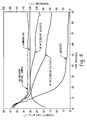
- Figure 1 graphically illustrates fluid viscosity at 24°C (75 °F) as a function of time for various silicate coated and uncoated sodium percarbonate granules, wherein the fluid included crosslinked guar;
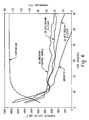
- Figure 2 graphically illustrates viscosity at 56°C (133 °F) as a function of time comparing silicate coated sodium percarbonate granules and uncoated sodium percarbonate granules, wherein the fluid included crosslinked guar;
- Figure 3 graphically illustrates fluid viscosity at 88°C (190 °F) as a function of time for various concentrations of silicate coated sodium percarbonate granules and uncoated sodium percarbonate granules, wherein the fluid included crosslinked guar;
- Figure 4 graphically illustrates fluid viscosity at 24°C (75°F) as a function of time for silicate coated sodium percarbonate granules and uncoated sodium percarbonate granules, wherein the fluid included a copolymer of acrylic acid and acrylamide;
- Figure 5 graphically illustrates fluid viscosity at 49°C (120°F) as a function of time for silicate coated sodium percarbonate granules and uncoated sodium percarbonate granules, wherein the fluid included a linear (uncrosslinked)guar gel;
- Figure 6 graphically illustrates fluid viscosity at 66°C (150°F) as a function of time for silicate coated sodium percarbonate granules and uncoated sodium percarbonate granules, wherein the fluid included a boron crosslinked guar gel.
- the present disclosure is generally directed to well treatment fluids containing a delayed release sodium percarbonate formulation for use in oil field applications.
- delayed release refers to a dissolution profile that retards the release of oxidizing agent into the well treatment fluid.
- the delayed release coatings of the sodium percarbonate granules could provide dissolution times of on the order of a few minutes up to about 5 hours at neutral pHs (i.e., pHs at about 6 to about 8) depending on the intended application.
- the delayed release sodium percarbonate can be used in the drilling, completion, treatment of subterranean formations penetrated by wellbores, and the like, at operating temperatures of -18°C (0°F) to about 204°C (400°F).
- the well treatment fluid is an aqueous fluid comprising at least one hydratable polymer, an optional crosslinking agent, and the delayed release sodium percarbonate formulation.
- an optional proppant can be added to the fluid depending on the intended oil field application.
- the fluid is pumped into a subterranean formation at a first viscosity and then allowed to break (i.e., effect a reduction in viscosity) as the dissolution of the delayed release coating thereabout the sodium percarbonate granule.
- the well treatment fluid with the reduced viscosity may then be recovered as may be desired.
- the intended end use will dictate the viscosities needed for the fluid, e.g., gel pigs may require a higher viscosity whereas a fracturing fluid may require a relatively lower viscosity.
- the aqueous base used in the well treatment fluids are not intended to be limited and may include water, salt water, brine, sea water, and the like. Generally, the water can be from any source, treated or untreated, provided it does not contain components that may affect the stability of any of the other components in the well treatment fluid.
- the pH of the aqueous fluid can be adjusted to render the fluid compatible with the crosslinking agent.
- a pH adjusting material is added to the aqueous fluid after the addition of the water-soluble polymer to the aqueous fluid.
- Typical materials for adjusting the pH are bases, acids, and buffers. For example, sodium bicarbonate, potassium carbonate, sodium hydroxide, potassium hydroxide, and sodium carbonate are typical pH adjusting agents.
- pH values for the fluid may range from about 5 to about 14. In other embodiments, the pH is from about 7 to about 14, and in still other embodiments, the pH is between about 8 to about 12.
- Suitable hydratable polymers include those that are capable of forming a gel in the presence of a crosslinking agent.
- Suitable hydratable polysaccharides include, but are not limited to, galactomannan gums, guars, derived guars, xanthan, diutan, scleroglucan, and derivatives thereof. Specific examples are guar gum, guar gum derivatives, locust bean gum, Karaya gum, and the like.
- Suitable hydratable polymers may also include synthetic polymers, such as polyvinyl alcohol, polyacrylamides, poly-2-amino-2-methyl propane sulfonic acid, and various other synthetic polymers and copolymers. Other suitable polymers are known to those skilled in the art. Mixtures of polymers are also contemplated.
- the amount of hydratable polymer in the fluid is not intended to be limited. Generally, the hydratable polymer may be present in the fluid at concentrations ranging from about 0.10% to about 5.0% by weight of the aqueous fluid. A preferred range for the hydratable polymer is about 0. 20% to about 0.80% by weight.
- a suitable crosslinking agent can be any compound that increases the viscosity of the fluid by chemical crosslinking, physical crosslinking, or any other mechanisms.
- crosslinking generally refers to the formation of a bond between two molecules.
- suitable crosslinking agents include borates such as boric acid, sodium metaborate, sodium tetraborate and the like; titanites such as titanium chelate esters; dialdehydes; zirconium containing compounds; zinc; various mixtures thereof; and the like.
- Other suitable crosslinking agents will be well within the skill of those in the art. The selection of an appropriate crosslinking agent generally depends upon the type of treatment to be performed and the hydratable polymer to be used.
- the amount of the crosslinking agent used also depends upon the well conditions and the type of treatment to be effected, but is generally in the range of from about 10 parts per million (ppm) to about 1000 ppm of metal ion of the crosslinking agent in the hydratable polymer fluid.
- the aqueous polymer solution is crosslinked immediately upon addition of the crosslinking agent to form a highly viscous gel.
- the reaction of the crosslinking agent can be retarded so that viscous gel formation does not occur until the desired time.
- the hydratable polymer independently or in combination with the crosslinking agent, is present in the fluid at concentrations effective to provide a first viscosity greater than 1,000 cP at 3.77 sec -1 .
- the delayed release sodium percarbonate formulation is formed from sodium percarbonate granules.
- the granules are substantially spherical particles with a typical size distribution in the range of 0.3 to 1.5 millimeters (mm) with a core of sodium percarbonate (Na 2 CO 3 : 1.5 H 2 O 2 ) and a delayed release coating. Mesh screens can be used to isolate particular sizes as may be desired for different applications.
- the sodium percarbonate granules can be coated with an inorganic material or a polymeric material depending on the intended application. Suitable inorganic materials include alkali metal and/or alkaline earth metal silicates.
- the sodium percarbonate granules may first be coated with sulfate salt, e.g., sodium sulfate, magnesium sulfate, and the like.
- sulfate salt e.g., sodium sulfate, magnesium sulfate, and the like.
- the coating themselves are preferably uniform and homogenous about the sodium percarbonate granules.
- the function of the coating layer is to protect the sodium percarbonate from contact with humidity and/or water present in the environment, which enhances the decomposition of the core material.
- the inorganic material is an alkali metal silicate. coated at an amount of 15 to 37 wt. % relative to the sodium percarbonate granules, and in still other embodiments, at 22 to 37 wt. %. It has been found that at amounts less than 15 wt. %, the delay in percarbonate dissolution in a well treatment fluid is minimal at temperatures up to 66°C (150°F). A similar result is observed at a silicate wt. % less of than 22 at temperatures of 66°C (150) to 82°C (180°F). At amounts greater than 37 wt. %, the particles tend to agglomerate and form clusters.
- the coating has a tendency to break symmetrically during well treatment, thereby prematurely exposing the hydratable polymer to sodium percarbonate leading to oxidative degradation of the polymer and a reduction in viscosity. Because of this, the dissolution profile is very difficult to predict and oftentimes irregular.
- An exemplary alkali metal silicate is sodium (Na 2 SiO 3 ).
- Coating the sodium percarbonate granules generally includes spraying the sodium percarbonate granules with the desired coating material in a fluidized bed.
- a typical silicate based coating would be performed with an ingoing airflow of 120 to 155 cubic meters per hour (m 2 /h) at a temperature of 110 to 135°C.
- a percarbonate bed of 2 to 3 kilograms (kg) at a temperature of 80 to 105°C was sprayed at a rate of 0.5 to 2.5 kilograms per hour (kg/h) with a solution of the coating diluted to about 30 to about 40 % by weight.
- Typical polymer coatings can be performed with an ingoing airflow of 125 to 140 m 3 /h at a temperature of 0 to 70°C.
- a percarbonate bed of about 3 kg at a temperature of 19 to 55°C was sprayed with a polymer solution at a rate of 0.2 to 0.7 kg/h.
- Coating of the sodium percarbonate granules can be performed in a AGT 150 fluidized bed system commercially available from Glatt (Germany).
- the internal stability of sodium percarbonate granules can be followed by analyzing the active oxygen content at intervals by measuring the TAM (Thermal Activity Monitoring) value, wherein the stability increases with decreasing TAM value. A good storage life is indicated by a low TAM value.
- the TAM value should preferably be below about 15 ⁇ W/g and in particular below about 10 ⁇ W/g for sodium percarbonate.
- the TAM value is a microcalorimetric analysis of the energy released during storage, measured by means of the TAMP® Thermal Activity Monitor from Thermometric AB (Sweden). As the sodium percarbonate degrades, it gives off heat. The flow of this heat is measured as a TAM value in ⁇ W/g.
- Well stimulation and completion (treatment) fluid compositions of the present disclosure can further comprise other additives.
- Additives are generally included to enhance the stability of the fluid composition itself to prevent breakdown caused by exposure to oxygen, temperature change, trace metals, constituents of water added to the fluid composition, to prevent non-optimal cross linking reaction kinetics, to protect oilfield equipment, and to prevent the growth of bacteria.
- the choice of components used in fluid compositions is dictated to a large extent by the properties of the hydrocarbon-bearing formation on which they are to be used.
- Such additives can be selected from the group including oils, salts (including organic salts), biocides, corrosion inhibitors and dissolvers, pH modifiers (e.g., acids and bases), metal chelators, metal complexors, antioxidants, wetting agents, polymer stabilizers, clay stabilizers, scale inhibitors and dissolvers, wax inhibitors and dissolvers, asphaltene precipitation inhibitors, water flow inhibitors, fluid loss additives, chemical grouts, diverters, sand consolidation chemicals, proppants, permeability modifiers, viscoelastic fluids, gases (e.g., nitrogen and carbon dioxide), foaming agents, and the like.
- the well treatment fluids according to some embodiments of the invention are described below with the aid of the following numbered clauses 1-4:
- sodium percarbonate was commercially obtained from Kemira Kemi AB under the tradename Ecox.
- Sodium silicate was commercially obtained at a molar ratio of 3.28 from Askania (Sweden).
- Styrene acrylate polymer and butyl acrylate/styrene polymer was obtained from commercial paint manufacturer Beckers (Sweden).
- Stability was determined by analyzing the active oxygen content of a freshly prepared sample and comparing it with active oxygen content after 2 months.
- the active oxygen or hydrogen peroxide content was determined by titration with potassium permanganate (0.2 N) in acidic solution (10 % sulphuric acid).
- a sample of 5 grams (g) was dissolved in 75 milliliters (ml) of 10% H 2 SO 4 solution. Of this sample, 3 g of the solution was titrated with KMnO 4 solution using a combined Pt-electrode; a Metrohm 794 Basic Titrino and Metrohm 665 Dosimat.
- Dissolution time was analyzed by conductivity, measured with a Cond 340i, WTW on 2 g sample in 1 liter (L) of deionized water at 20°C. The sample was stirred at approximately 750 revolutions per minute (rpm) throughout the measurement. The rate of dissolution is given graphically as the time (in minutes) at which 90% of maximum conductivity was obtained.
- Na 2 SiO 3 -coated percarbonate was analyzed by 1 H-NMR. 1 H-NMR spectra were recorded on a Bruker Avance 500 spectrometer in D 2 O solutions at ambient temperature. The dissolution time of the sodium silicate coating was measured by the growth of the peak at 4.8 ppm, which corresponded to water formed by decomposition of hydrogen peroxide (H 2 O 2 ) as it was released from the coating.
- the active oxygen values provided means for comparing the relative stability between samples.
- the 24-hour value is a standard uncoated sodium percarbonate reference value as the uncoated sodium percarbonate granules typically reach a stable value after this period of time.
- Table 1 Sample # Coating Calculated coating (analyzed %) Dissolution (min) Initial AO % AO 2 month % Control Uncoated (ref) 68 (sec) 32 - Control Uncoated (ref) 51 (sec) 31 - 1 Na 2 SiO 3 10% 33 28 28 2 Na 2 SiO 3 30% 180 21 21 3 Styrene acrylate 0.9% 23 31 30 4 Styrene acrylate 1.7% 68 30 30 5 Butyl acrylate 8% 12 28 26 6 Butyl acrylate 30 % 26 21 21 7 Styrene acrylate 2 % + butyl acrylate 3 % 175 30 30 30
- the dissolution time units for the controls were seconds.
- the results indicate that dissolution time of sodium percarbonate is extended by applying a coating of a polymeric material or an inorganic material.
- the silicate-coated sodium percarbonate granules exhibited a very good effect on dissolution time at room temperature and also gave a very stable product.
- the coatings with one type of polymer, butyl acrylate were generally less effective, the combination of polymers seemed to have a synergistic effect and was very efficient even with rather thin coatings.
- the polymer coatings appeared to have a positive effect on the stability as well.
- coating stability of sodium silicate-coated sodium percarbonate and its degradation capability of guar was analyzed during for an oil well pumping simulation.
- 1000.0 g of deionized water was added to 10.0 g of an anionic carboxymethyl hydroxypropyl guar commercially obtained from Hercules, Incorporated under the tradename Aqualon Galactasol 651 and stirred for about 30 min at 3000 rpm to form a stock solution.
- an anionic carboxymethyl hydroxypropyl guar commercially obtained from Hercules, Incorporated under the tradename Aqualon Galactasol 651
- To 175.0 g of the stock solution 0.8 g of a titanium based crosslinker commercially available from E.I.
- Tyzor ® 131 du Pont de Nemours and Company under the tradename Tyzor ® 131 was added, stirred at 1500 rpm for about 2 minutes and allowed to gel for about 30 minutes.
- Tyzor ® 131 was added, stirred at 1500 rpm for about 2 minutes and allowed to gel for about 30 minutes.
- the gel was presheared at 75.4 s -1 at a predefined temperature for 30 min and then sheared for 30 s at 3.77 s -1 to measure the initial gel viscosity.
- FIGS. 1-3 graphically illustrate viscosity as a function of time with all of the data for the above samples normalized as a percentage of initial viscosity.
- the room-temperature data as presented in FIG. 1 shows that both silicate-coated samples provided excellent stability relative to uncoated sodium percarbonate monitored at the same temperature.
- the 30 wt% sodium silicate-coated sodium percarbonate granules exhibited less release as a function of time than did the 10% sodium silicate-coated sodium percarbonate granules.
- the percarbonate released more rapidly into the gel as evidenced by the quicker reduction in viscosity and, when evaluated at 88°C (190 °F), there is little difference between coated and uncoated samples.
- guar polymer degradation in the absence of shear was studied for various coated and uncoated sodium percarbonate granules.
- 1,500.0 g deionized water was added to 15.0 g Aqualon Galactasol 651 guar polymer and stirred for 30 minutes at 3000 rpm to form a stock solution of the guar polymer.
- the guar polymer was not crosslinked.
- a 300.0 g portion of the stock solution was poured into a 400-mL vessel. Half of this (150.0 mL) was poured into a pressurizable aging cell commercially available by Fann Instrument Company and various amounts of coated and uncoated sodium percarbonate were added as shown in Table 3.
- guar polymer solution 150.0 mL was added to the cell, which was then sealed and pressurized.
- the aging cell was shaken three times to disperse the sodium percarbonate granules and placed in an oven for a period of time as defined in Table 4. Afterward, viscosity was measured at 3.77 s -1 at 24°C (75 °F) on a Grace M3500a viscometer equipped with an R1 rotor and a B2 bob. The temperatures and pressures used were chosen to simulate depths varying between 150 m (500) and 760 m (2500 feet), and the time was varied between 4 and 28 hours.
- Table 3 The temperature and pressures used to simulate different oil well depths are provided in Table 3, while Table 4 provides the experimental conditions and results for each sample. Table 3.
- the coated sodium silicate coated percarbonate showed much slower degradation than the uncoated sodium percarbonate, but at deeper conditions and longer times it degrades guar as well as uncoated sodium percarbonate.
- the greater speed of guar degradation results from the increased rate of sodium percarbonate decomposition at elevated temperatures. This causes pressure to rapidly rise inside the coating, eventually cracking it from the inside and allowing sodium percarbonate to escape into the guar before the coating is dissolved.
- the temperature of the guar only slowly rises from the surface temperature as it is pumped down hole and subsequently heated at the bottom of a well.
- breakers were evaluated in a 1,8 kg (4 pounds) per 4005 liters (1000 gallons) polymer solution kg/l (1b/Mgal) at 24°C (75"F): a control without breaker; uncoated sodium percarbonate; sodium percarbonate coated with 22 wt % sodium silicate; and sodium percarbonate coated with 28 wt % sodium silicate were evaluated.
- the polymer solution was prepared by adding 0.441 grams (g) of an ultrahigh molecular weight copolymer of acrylic acid and acrylamide commercially available under the trade name Callaway A-4330 to 1000 g of deionized water. The solution was mixed for 30 minutes at 600 rpm. The polymer solution (175 g) was poured into a sample cup and placed under a Grace 3500 viscometer equipped with an R1 rotor and B1 bob. The rotor began shearing the fluid at 100 s -1 and the breaker (0.012 ⁇ 0.004 g) was immediately added. Viscosity was measured as a function of time for 90 minutes.
- breakers were evaluated in a 18 kg 40 pounds per 4005 liters (1000 gallons) kg/l (lb/Mgal) linear guar gel solution at 49°C (120°F): a control without breaker: uncoated sodium percarbonate; sodium percarbonate coated with 22 wt % sodium silicate; and sodium percarbonate coated with 28 wt % sodium silicate were evaluated.
- the linear guar gel was prepared using a Waring blender attached to a rheostat set to 55%. Deionized water (800.0 g) was added to the blender, and then the blender was run on low speed. Next, guar (3.841 g) commercially available under trade name HR71-51D from Benchmark Performance Group was added while the blender was stirring and the solution was blended on low speed for 30 minutes. Finally, the solution was allowed to rest for 30 minutes in the absence of shear.
- the tests were performed on a Grace 3500 viscometer equipped with an R1 rotor and B1 bob.
- a portion (175.0 g) of the guar solution was poured into the sample cup, which was placed under the viscometer.
- the breaker (0.104 ⁇ 0.003 g) was added, and then the rotor began shearing the sample at 511 s -1 while the temperature ramped to 120 °F.
- the viscosity was measured as a function of time for 90 minutes.
- Figure 5 illustrates the results.
- the uncoated sodium percarbonate causes an immediate and rapid drop in the viscosity of the guar, while the two coated samples degrade the viscosity more slowly.
- the sample with 28 wt% sodium silicate coating degrades the guar more slowly than the production sample with the 22 wt% sodium silicate coating.
- the time release coating significantly slows the degradation of the linear guar gels relative to the degradation caused by uncoated sodium percarbonate.
- thicker coatings appear to correlate with slower releases of sodium percarbonate into the fluid.
- breakers were evaluated in 18 kg 40 pounds per 4005 liters (1000 gallons) kg/l (1b/Mgal) boron crosslinked linear guar gel solution at 66°C (150°F): a control without breaker; uncoated sodium percarbonate; sodium percarbonate coated with 22 wt % sodium silicate; and sodium percarbonate coated with 28 wt % sodium silicate were evaluated.
- the boron crosslinked guar gel was prepared using a Waring blender attached to a rheostat set to 55%. Deionized water (800.0 g) was added to the blender, and then the blender was run on low speed. Next, guar (3.8425 g) commercially available under the trade name HR71-51D from Benchmark Performance Group was added while the blender was stirring and the solution was blended on low speed for 30 minutes. Next, a buffer (0.5 mL) commercially available under the trade name S-166 and a boron crosslinker (2.4 mL) commercially available under the trade name BX- 1 from Benchmark Performance Group were added and the blender was run for I minute. The solution was then allowed to rest for 30 minutes in the absence of shear.
- the uncoated sodium percarbonate rapidly degraded the viscosity, and caused a total break after 48 minutes.
- the sodium percarbonate with the 28 wt% sodium silicate coating caused a small decrease in the viscosity after 60 minutes, while the production 22 wt% sodium silicate coating resulted in a slightly larger drop in the crosslinked gel's viscosity over the testing period.
- encapsulating the sodium percarbonate with sodium silicate has been shown to slow the rate of viscosity loss.
Landscapes
- Chemical & Material Sciences (AREA)
- Organic Chemistry (AREA)
- Life Sciences & Earth Sciences (AREA)
- General Life Sciences & Earth Sciences (AREA)
- Engineering & Computer Science (AREA)
- Materials Engineering (AREA)
- Inorganic Chemistry (AREA)
- Detergent Compositions (AREA)
- Glanulating (AREA)
- Compositions Of Macromolecular Compounds (AREA)
- Paints Or Removers (AREA)
- Silicon Compounds (AREA)
- Medicinal Preparation (AREA)
- Lubricants (AREA)
Abstract
Claims (12)
- Fluide de traitement de puits comprenant :de l' eau ;au moins un polymère hydratable ; etdes granules de percarbonate de sodium ayant un revêtement à libération retardée, où le revêtement à libération retardée est un silicate de métal alcalin.
- Fluide de traitement de puits selon la revendication 1 comprenant en outre une couche intermédiaire de sulfate de sodium entre le percarbonate de sodium et le silicate de métal alcalin.
- Fluide de traitement de puits selon la revendication 1 où le silicate de métal alcalin est en une quantité de 15 à 37 % en poids par rapport à un poids total desdits granules de percarbonate de sodium.
- Fluide de traitement de puits selon la revendication 1 où au moins un polymère hydratable comprend un polysaccharide, un polyacrylamide, un poly(alcool vinylique) et leurs mélanges.
- Fluide de traitement de puits selon la revendication 1 comprenant en outre un réticulant, où le réticulant comprend un titanate, un borate, un composé contenant du zirconium, un dialdéhyde, et leurs mélanges.
- Fluide de traitement de puits selon la revendication 1 où le fluide a un pH de 5 à 12.
- Procédé pour fracturer une formation souterraine comprenant :l'injection sous pression d'un fluide hydraulique aqueux ayant une première viscosité dans un forage de puits, où le fluide hydraulique aqueux comprend de l'eau ; au moins un polymère hydratable ; et des granules de percarbonate de sodium ayant un revêtement à libération retardée d'un silicate de métal alcalin ;la formation de fractures dans la formation souterraine avec le fluide hydraulique à la première viscosité et la dissolution du revêtement à libération retardée pour exposer le percarbonate de sodium à l'eau après une durée ;la réaction du percarbonate de sodium avec le au moins un polymère hydratable pour abaisser la première viscosité à une seconde viscosité ; etla récupération d'au moins une partie du fluide hydraulique ayant la seconde viscosité.
- Procédé pour fracturer la formation souterraine selon la revendication 7 où le fluide hydraulique aqueux comprend en outre un réticulant pour ajuster la première viscosité du fluide.
- Procédé pour fracturer la formation souterraine selon la revendication 7 où le au moins un polymère hydratable comprend un polysaccharide, un poly(alcool vinylique), un polyacrylamide, et leurs mélanges.
- Procédé pour fracturer la formation souterraine selon la revendication 8 où le réticulant comprend un titanate, un borate, un composé contenant du zirconium, un dialdéhyde, et leurs mélanges.
- Procédé selon la revendication 9 où le silicate de métal alcalin est en une quantité de 15 à 37 % en poids par rapport à un poids total desdits granules de percarbonate de sodium.
- Procédé pour fracturer la formation souterraine selon la revendication 9 comprenant en outre une couche intermédiaire de sulfate de sodium entre le percarbonate de sodium et le silicate de métal alcalin.
Priority Applications (1)
| Application Number | Priority Date | Filing Date | Title |
|---|---|---|---|
| PL08839924T PL2203538T3 (pl) | 2007-10-15 | 2008-10-15 | Kompozycje płynu do obróbki odwiertów i sposoby jego wykorzystywania obejmujące stosowanie formulacji preoksowęglanu o opóźnionym uwalnianiu |
Applications Claiming Priority (2)
| Application Number | Priority Date | Filing Date | Title |
|---|---|---|---|
| US97997507P | 2007-10-15 | 2007-10-15 | |
| PCT/US2008/079932 WO2009052142A1 (fr) | 2007-10-15 | 2008-10-15 | Compositions de fluide de traitement de puits et procédés d'utilisation qui comprennent une formulation de percarbonate à libération retardée |
Publications (2)
| Publication Number | Publication Date |
|---|---|
| EP2203538A1 EP2203538A1 (fr) | 2010-07-07 |
| EP2203538B1 true EP2203538B1 (fr) | 2012-08-01 |
Family
ID=40084350
Family Applications (2)
| Application Number | Title | Priority Date | Filing Date |
|---|---|---|---|
| EP08839924A Not-in-force EP2203538B1 (fr) | 2007-10-15 | 2008-10-15 | Compositions de fluide de traitement de puits et procédés d'utilisation qui comprennent une formulation de percarbonate à libération retardée |
| EP08840268A Withdrawn EP2197978A2 (fr) | 2007-10-15 | 2008-10-15 | Procédé de fabrication d'un granule à partir d'un composé oxydant enrobé, granule et utilisations du granule |
Family Applications After (1)
| Application Number | Title | Priority Date | Filing Date |
|---|---|---|---|
| EP08840268A Withdrawn EP2197978A2 (fr) | 2007-10-15 | 2008-10-15 | Procédé de fabrication d'un granule à partir d'un composé oxydant enrobé, granule et utilisations du granule |
Country Status (10)
| Country | Link |
|---|---|
| US (4) | US8338341B2 (fr) |
| EP (2) | EP2203538B1 (fr) |
| AR (1) | AR068867A1 (fr) |
| BR (1) | BRPI0818073A2 (fr) |
| CA (2) | CA2702931C (fr) |
| CL (1) | CL2008003040A1 (fr) |
| MX (1) | MX2010003705A (fr) |
| PL (1) | PL2203538T3 (fr) |
| RU (2) | RU2471848C2 (fr) |
| WO (2) | WO2009052142A1 (fr) |
Families Citing this family (21)
| Publication number | Priority date | Publication date | Assignee | Title |
|---|---|---|---|---|
| CL2008003040A1 (es) | 2007-10-15 | 2009-10-30 | Kemira Chemicals Inc | Fluido de tratamiento de pozos que comprende agua, al menos un polimero hidratable y percarbonato de sodio granulado con un revestimiento de liberacion retardada, cuyo revestimiento es un silicato de metal alcalino o una mezcla de acrilato de estireno y acrilato de butilo; y proceso de fracturacion de una formacion subterranea. |
| CN102686827B (zh) | 2009-12-11 | 2016-02-24 | 阿科玛股份有限公司 | 石油和天然气刺激操作中的自由基捕获剂 |
| US9194223B2 (en) * | 2009-12-18 | 2015-11-24 | Baker Hughes Incorporated | Method of fracturing subterranean formations with crosslinked fluid |
| US8371383B2 (en) * | 2009-12-18 | 2013-02-12 | Baker Hughes Incorporated | Method of fracturing subterranean formations with crosslinked fluid |
| EP2390408B1 (fr) | 2010-05-31 | 2013-03-27 | Kemira Oyj | Contrôle d'enzymes pour la production de pâte |
| US8393390B2 (en) | 2010-07-23 | 2013-03-12 | Baker Hughes Incorporated | Polymer hydration method |
| US9567242B2 (en) * | 2010-11-15 | 2017-02-14 | United Laboratories International, Llc | Process for decontamination of hazardous sulfur compounds in oilfield produced waters |
| US20140196904A1 (en) * | 2013-01-15 | 2014-07-17 | Halliburton Energy Services, Inc. | Methods of Controlled Release pH Adjustment for Oilwell Stimulation |
| CN103059821B (zh) * | 2013-01-25 | 2014-09-10 | 大庆合正化工有限公司 | 钻井液稀释剂复合甲基硅酸盐的制备方法 |
| JP2016517462A (ja) | 2013-03-15 | 2016-06-16 | ビーエーエスエフ ソシエタス・ヨーロピアBasf Se | プロパント |
| EP2970756A1 (fr) * | 2013-03-15 | 2016-01-20 | Basf Se | Agent de soutènement de fissures |
| MY179598A (en) | 2013-03-15 | 2020-11-11 | Basf Se | A proppant |
| US9856414B2 (en) | 2013-06-10 | 2018-01-02 | Dober Chemical Corp. | Compositions, systems and methods of making coated additive components |
| US9394476B2 (en) * | 2014-02-24 | 2016-07-19 | Baker Hughes Incorporated | Well treatment methods and fluids |
| CN106746368A (zh) * | 2017-02-20 | 2017-05-31 | 中国石油集团川庆钻探工程有限公司 | 一种压裂返排液循环利用处理方法 |
| RU2699420C2 (ru) * | 2017-11-21 | 2019-09-05 | Андрей Васильевич Попов | Капсулированный деструктор на основе персульфата аммония для жидкостей разгеливания нефтяных скважин после гидроразрыва пласта и способ его получения |
| US12054669B2 (en) | 2018-06-08 | 2024-08-06 | Sunita Hydrocolloids Inc. | Friction reducers, fluid compositions and uses thereof |
| US11746282B2 (en) | 2018-06-08 | 2023-09-05 | Sunita Hydrocolloids Inc. | Friction reducers, fracturing fluid compositions and uses thereof |
| US11274243B2 (en) | 2018-06-08 | 2022-03-15 | Sunita Hydrocolloids Inc. | Friction reducers, fracturing fluid compositions and uses thereof |
| CN110316809B (zh) * | 2019-07-30 | 2021-08-13 | 中国环境科学研究院 | 可注入型缓释凝胶及其前驱组合物、制备方法和应用 |
| CN111943447B (zh) * | 2020-08-21 | 2022-03-11 | 诸暨市蓝欣环保科技有限公司 | 一种印染废水的处理工艺 |
Family Cites Families (34)
| Publication number | Priority date | Publication date | Assignee | Title |
|---|---|---|---|---|
| US3951838A (en) | 1973-10-10 | 1976-04-20 | E. I. Du Pont De Nemours And Company | Silica sol stabilizers for improving the stability of sodium percarbonate in solid bleaches and detergents |
| LU72575A1 (fr) * | 1975-05-23 | 1977-02-10 | ||
| US4107057A (en) * | 1977-01-19 | 1978-08-15 | Halliburton Company | Method of preparing and using acidizing and fracturing compositions, and fluid loss additives for use therein |
| US4552674A (en) | 1983-08-19 | 1985-11-12 | Fmc Corporation | Composition and method for treating a subterranean formation |
| US5054552A (en) | 1990-08-31 | 1991-10-08 | The Western Company Of North America | Breaker system for aqueous fluids containing xanthan gums |
| US5164099A (en) * | 1990-12-06 | 1992-11-17 | The Western Company Of North America | Encapsulations for treating subterranean formations and methods for the use thereof |
| US5624886A (en) * | 1992-07-29 | 1997-04-29 | Bj Services Company | Controlled degradation of polysaccharides |
| EP0623553B1 (fr) | 1993-05-06 | 1997-07-30 | Mitsubishi Gas Chemical Company, Inc. | Particule de percarbonate de sodium stabilisé |
| DE69328679T2 (de) | 1993-07-16 | 2001-01-11 | The Procter & Gamble Company, Cincinnati | Waschmittelzusammensetzungen für Geschirrspülmaschinen |
| US5373901A (en) * | 1993-07-27 | 1994-12-20 | Halliburton Company | Encapsulated breakers and method for use in treating subterranean formations |
| CZ285638B6 (cs) | 1994-10-07 | 1999-10-13 | Eka Chemicals Ab | Částice obsahující peroxysloučeninu a prostředek, který je obsahuje |
| DE19603849C1 (de) | 1996-02-05 | 1997-08-21 | Glatt Ingtech Gmbh | Verfahren zur Herstellung von Natriumpercarbonat in Granulatform |
| CA2250057C (fr) * | 1996-03-27 | 2008-10-21 | Solvay Interox (Societe Anonyme) | Procede de fabrication d'un percarbonate |
| JPH11158016A (ja) | 1997-11-25 | 1999-06-15 | Mitsubishi Gas Chem Co Inc | 過炭酸ソーダ含有組成物 |
| EP0962424A1 (fr) * | 1998-06-05 | 1999-12-08 | SOLVAY (Société Anonyme) | Particules enrobées de percarbonate de sodium, leur procédé de fabrication, leur utilisation dans des compositions détergentes et des compositions détergentes les contenant |
| EP0992575A1 (fr) | 1998-10-09 | 2000-04-12 | Akzo Nobel N.V. | Agent de blanchiment |
| GB9906484D0 (en) * | 1999-03-19 | 1999-05-12 | Cleansorb Ltd | Method for treatment of underground reservoirs |
| AU5403500A (en) | 1999-06-23 | 2001-01-31 | Breel, Greta J. | Bleaching detergent compositions |
| US20040147423A1 (en) * | 1999-06-28 | 2004-07-29 | The Procter & Gamble Company | Dual-compartment laundry composition containing peroxyacids |
| EP1235892A1 (fr) | 1999-12-08 | 2002-09-04 | The Procter & Gamble Company | Compositions comprenant des surfactants a alcool poly(oxyalkyle) coiffe d'ether |
| KR100366556B1 (ko) | 2000-04-26 | 2003-01-09 | 동양화학공업주식회사 | 세제용 입상 코티드 과탄산나트륨과 이의 제조방법 |
| US6793018B2 (en) | 2001-01-09 | 2004-09-21 | Bj Services Company | Fracturing using gel with ester delayed breaking |
| US6908888B2 (en) * | 2001-04-04 | 2005-06-21 | Schlumberger Technology Corporation | Viscosity reduction of viscoelastic surfactant based fluids |
| CA2431936C (fr) * | 2001-05-17 | 2010-02-09 | Unilever Plc | Composition de lessive |
| DE10140838A1 (de) * | 2001-08-21 | 2003-03-06 | Degussa | Verfahren zur Herstellung von Natriumpercarbonat |
| CA2478919A1 (fr) * | 2002-03-26 | 2003-10-09 | U.S. Environmental Protection Agency | Procede de biodegradation d'hydrocarbures et d'ethers dans la couche inferieure d'un sol par introduction d'une source solide d'oxygene par fracturation hydraulique |
| EP1572852B1 (fr) * | 2002-12-20 | 2006-10-11 | Degussa AG | Composes peroxygenes enrobes, a liberation lente, leur procede de preparation et d'utilisation |
| GB2412391A (en) * | 2004-03-27 | 2005-09-28 | Cleansorb Ltd | Process for disruption of filter cakes |
| US7244698B2 (en) * | 2004-07-30 | 2007-07-17 | Nalco Company | Viscoelastic surfactant composition having improved rheological properties and method of using for treating subterranean formations |
| US7268100B2 (en) * | 2004-11-29 | 2007-09-11 | Clearwater International, Llc | Shale inhibition additive for oil/gas down hole fluids and methods for making and using same |
| GB0508622D0 (en) | 2005-04-28 | 2005-06-08 | Probe Ind Ltd | Method for treating effluent |
| US20060264334A1 (en) | 2005-05-18 | 2006-11-23 | Bj Services Company | Non-damaging fracturing fluids and methods for their use |
| US20070181510A1 (en) | 2006-02-03 | 2007-08-09 | Harvey Michael S | Algaecidal compositions for water treatment and method of use thereof |
| CL2008003040A1 (es) * | 2007-10-15 | 2009-10-30 | Kemira Chemicals Inc | Fluido de tratamiento de pozos que comprende agua, al menos un polimero hidratable y percarbonato de sodio granulado con un revestimiento de liberacion retardada, cuyo revestimiento es un silicato de metal alcalino o una mezcla de acrilato de estireno y acrilato de butilo; y proceso de fracturacion de una formacion subterranea. |
-
2008
- 2008-10-14 CL CL2008003040A patent/CL2008003040A1/es unknown
- 2008-10-14 AR ARP080104478A patent/AR068867A1/es not_active Application Discontinuation
- 2008-10-15 EP EP08839924A patent/EP2203538B1/fr not_active Not-in-force
- 2008-10-15 RU RU2010117343/03A patent/RU2471848C2/ru not_active IP Right Cessation
- 2008-10-15 RU RU2010119509/03A patent/RU2456325C2/ru not_active IP Right Cessation
- 2008-10-15 US US12/738,120 patent/US8338341B2/en not_active Expired - Fee Related
- 2008-10-15 CA CA2702931A patent/CA2702931C/fr not_active Expired - Fee Related
- 2008-10-15 EP EP08840268A patent/EP2197978A2/fr not_active Withdrawn
- 2008-10-15 WO PCT/US2008/079932 patent/WO2009052142A1/fr not_active Ceased
- 2008-10-15 CA CA2699797A patent/CA2699797C/fr not_active Expired - Fee Related
- 2008-10-15 WO PCT/EP2008/063854 patent/WO2009050191A2/fr not_active Ceased
- 2008-10-15 PL PL08839924T patent/PL2203538T3/pl unknown
- 2008-10-15 MX MX2010003705A patent/MX2010003705A/es active IP Right Grant
- 2008-10-15 BR BRPI0818073 patent/BRPI0818073A2/pt not_active Application Discontinuation
- 2008-10-15 US US12/251,479 patent/US8501670B2/en not_active Expired - Fee Related
-
2011
- 2011-07-28 US US13/192,570 patent/US20110278008A1/en not_active Abandoned
-
2013
- 2013-02-22 US US13/773,764 patent/US9150779B2/en not_active Expired - Fee Related
Also Published As
| Publication number | Publication date |
|---|---|
| US9150779B2 (en) | 2015-10-06 |
| US20100248998A1 (en) | 2010-09-30 |
| MX2010003705A (es) | 2010-04-21 |
| WO2009052142A1 (fr) | 2009-04-23 |
| WO2009050191A3 (fr) | 2009-06-25 |
| US20130165352A1 (en) | 2013-06-27 |
| RU2010117343A (ru) | 2011-11-27 |
| EP2197978A2 (fr) | 2010-06-23 |
| CA2699797A1 (fr) | 2009-04-23 |
| RU2010119509A (ru) | 2011-11-27 |
| CL2008003040A1 (es) | 2009-10-30 |
| US8338341B2 (en) | 2012-12-25 |
| WO2009050191A2 (fr) | 2009-04-23 |
| US20110278008A1 (en) | 2011-11-17 |
| RU2471848C2 (ru) | 2013-01-10 |
| BRPI0818073A2 (pt) | 2015-03-31 |
| CA2699797C (fr) | 2017-08-22 |
| US8501670B2 (en) | 2013-08-06 |
| EP2203538A1 (fr) | 2010-07-07 |
| PL2203538T3 (pl) | 2013-02-28 |
| CA2702931C (fr) | 2016-05-10 |
| RU2456325C2 (ru) | 2012-07-20 |
| US20090095472A1 (en) | 2009-04-16 |
| CA2702931A1 (fr) | 2009-04-23 |
| AR068867A1 (es) | 2009-12-09 |
Similar Documents
| Publication | Publication Date | Title |
|---|---|---|
| CA2699797C (fr) | Compositions de fluide de traitement de puits et procedes d'utilisation qui comprennent une formulation de percarbonate a liberation retardee | |
| CN101595199B (zh) | 用于井下用途的使增粘聚合物在极低温度破胶的组合物和方法 | |
| CA2829116C (fr) | Agents de reticulation pour fluide de fracturation hydraulique | |
| US6165947A (en) | Method and composition for controlling fluid loss in high permeability hydrocarbon bearing formations | |
| AU2008202070B2 (en) | Apparatus, Compositions, and Methods of Breaking Fracturing Fluids | |
| US8622134B2 (en) | Organic acid compositions and methods of use in subterranean operations | |
| US8361936B2 (en) | Treatment fluid with non-symmetrical peroxide breaker and method | |
| US10870791B2 (en) | Compositions and methods for cross-linking hydratable polymers using produced water | |
| US20100276151A1 (en) | Dual Functional Components and Associated Methods | |
| WO2005028588A1 (fr) | Procedes et compositions destines a traiter des zones souterraines | |
| WO2012072985A1 (fr) | Procédés de prévention de la perte d'un fluide ou de déviation d'un fluide | |
| US20110214859A1 (en) | Clean Viscosified Treatment Fluids and Associated Methods | |
| WO2009153686A2 (fr) | Fluide et procédé de traitement d'eau de nappe | |
| CN104508239A (zh) | 压裂流体和处理含烃地层的方法 | |
| US20160032174A1 (en) | Methods for altering fluid rheology | |
| CA2675298C (fr) | Compositions et procedes destines a rompre un polymere de viscosite croissante a tres basse temperature, utilises dans des applications en fond de puits de forage | |
| US7225874B2 (en) | Methods and compositions for reducing the viscosity of treatment fluids used in subterranean operations | |
| CA2922861A1 (fr) | Systeme a double composition de rupture permettant de reduire des degats de la formation durant la fracturation | |
| US7093659B2 (en) | Controlling chlorite or hypochlorite break rate of well treatment fluids using magnesium or calcium ions | |
| CA2677577C (fr) | Acides reticules comprenant du xanthane derive et applications d'acidification souterraines |
Legal Events
| Date | Code | Title | Description |
|---|---|---|---|
| PUAI | Public reference made under article 153(3) epc to a published international application that has entered the european phase |
Free format text: ORIGINAL CODE: 0009012 |
|
| 17P | Request for examination filed |
Effective date: 20100413 |
|
| AK | Designated contracting states |
Kind code of ref document: A1 Designated state(s): AT BE BG CH CY CZ DE DK EE ES FI FR GB GR HR HU IE IS IT LI LT LU LV MC MT NL NO PL PT RO SE SI SK TR |
|
| AX | Request for extension of the european patent |
Extension state: AL BA MK RS |
|
| 17Q | First examination report despatched |
Effective date: 20100924 |
|
| DAX | Request for extension of the european patent (deleted) | ||
| GRAP | Despatch of communication of intention to grant a patent |
Free format text: ORIGINAL CODE: EPIDOSNIGR1 |
|
| RIC1 | Information provided on ipc code assigned before grant |
Ipc: C11D 3/00 20060101ALI20120307BHEP Ipc: C01B 15/10 20060101ALI20120307BHEP Ipc: C02F 1/72 20060101ALI20120307BHEP Ipc: C09K 8/575 20060101ALI20120307BHEP Ipc: C09K 8/70 20060101ALI20120307BHEP Ipc: C09K 8/68 20060101AFI20120307BHEP Ipc: C09K 8/92 20060101ALI20120307BHEP Ipc: C09K 8/80 20060101ALI20120307BHEP Ipc: C01B 15/00 20060101ALI20120307BHEP |
|
| GRAS | Grant fee paid |
Free format text: ORIGINAL CODE: EPIDOSNIGR3 |
|
| GRAA | (expected) grant |
Free format text: ORIGINAL CODE: 0009210 |
|
| AK | Designated contracting states |
Kind code of ref document: B1 Designated state(s): AT BE BG CH CY CZ DE DK EE ES FI FR GB GR HR HU IE IS IT LI LT LU LV MC MT NL NO PL PT RO SE SI SK TR |
|
| REG | Reference to a national code |
Ref country code: GB Ref legal event code: FG4D |
|
| REG | Reference to a national code |
Ref country code: AT Ref legal event code: REF Ref document number: 568719 Country of ref document: AT Kind code of ref document: T Effective date: 20120815 Ref country code: CH Ref legal event code: EP |
|
| REG | Reference to a national code |
Ref country code: IE Ref legal event code: FG4D |
|
| REG | Reference to a national code |
Ref country code: DE Ref legal event code: R096 Ref document number: 602008017677 Country of ref document: DE Effective date: 20120927 |
|
| REG | Reference to a national code |
Ref country code: RO Ref legal event code: EPE |
|
| REG | Reference to a national code |
Ref country code: SE Ref legal event code: TRGR |
|
| REG | Reference to a national code |
Ref country code: NL Ref legal event code: T3 |
|
| REG | Reference to a national code |
Ref country code: LT Ref legal event code: MG4D Effective date: 20120801 |
|
| PG25 | Lapsed in a contracting state [announced via postgrant information from national office to epo] |
Ref country code: FI Free format text: LAPSE BECAUSE OF FAILURE TO SUBMIT A TRANSLATION OF THE DESCRIPTION OR TO PAY THE FEE WITHIN THE PRESCRIBED TIME-LIMIT Effective date: 20120801 Ref country code: HR Free format text: LAPSE BECAUSE OF FAILURE TO SUBMIT A TRANSLATION OF THE DESCRIPTION OR TO PAY THE FEE WITHIN THE PRESCRIBED TIME-LIMIT Effective date: 20120801 Ref country code: CY Free format text: LAPSE BECAUSE OF FAILURE TO SUBMIT A TRANSLATION OF THE DESCRIPTION OR TO PAY THE FEE WITHIN THE PRESCRIBED TIME-LIMIT Effective date: 20120801 Ref country code: NO Free format text: LAPSE BECAUSE OF FAILURE TO SUBMIT A TRANSLATION OF THE DESCRIPTION OR TO PAY THE FEE WITHIN THE PRESCRIBED TIME-LIMIT Effective date: 20121101 Ref country code: LT Free format text: LAPSE BECAUSE OF FAILURE TO SUBMIT A TRANSLATION OF THE DESCRIPTION OR TO PAY THE FEE WITHIN THE PRESCRIBED TIME-LIMIT Effective date: 20120801 Ref country code: IS Free format text: LAPSE BECAUSE OF FAILURE TO SUBMIT A TRANSLATION OF THE DESCRIPTION OR TO PAY THE FEE WITHIN THE PRESCRIBED TIME-LIMIT Effective date: 20121201 |
|
| PG25 | Lapsed in a contracting state [announced via postgrant information from national office to epo] |
Ref country code: SI Free format text: LAPSE BECAUSE OF FAILURE TO SUBMIT A TRANSLATION OF THE DESCRIPTION OR TO PAY THE FEE WITHIN THE PRESCRIBED TIME-LIMIT Effective date: 20120801 Ref country code: LV Free format text: LAPSE BECAUSE OF FAILURE TO SUBMIT A TRANSLATION OF THE DESCRIPTION OR TO PAY THE FEE WITHIN THE PRESCRIBED TIME-LIMIT Effective date: 20120801 Ref country code: PT Free format text: LAPSE BECAUSE OF FAILURE TO SUBMIT A TRANSLATION OF THE DESCRIPTION OR TO PAY THE FEE WITHIN THE PRESCRIBED TIME-LIMIT Effective date: 20121203 Ref country code: GR Free format text: LAPSE BECAUSE OF FAILURE TO SUBMIT A TRANSLATION OF THE DESCRIPTION OR TO PAY THE FEE WITHIN THE PRESCRIBED TIME-LIMIT Effective date: 20121102 Ref country code: BE Free format text: LAPSE BECAUSE OF FAILURE TO SUBMIT A TRANSLATION OF THE DESCRIPTION OR TO PAY THE FEE WITHIN THE PRESCRIBED TIME-LIMIT Effective date: 20120801 |
|
| REG | Reference to a national code |
Ref country code: PL Ref legal event code: T3 |
|
| PG25 | Lapsed in a contracting state [announced via postgrant information from national office to epo] |
Ref country code: CZ Free format text: LAPSE BECAUSE OF FAILURE TO SUBMIT A TRANSLATION OF THE DESCRIPTION OR TO PAY THE FEE WITHIN THE PRESCRIBED TIME-LIMIT Effective date: 20120801 Ref country code: EE Free format text: LAPSE BECAUSE OF FAILURE TO SUBMIT A TRANSLATION OF THE DESCRIPTION OR TO PAY THE FEE WITHIN THE PRESCRIBED TIME-LIMIT Effective date: 20120801 Ref country code: ES Free format text: LAPSE BECAUSE OF FAILURE TO SUBMIT A TRANSLATION OF THE DESCRIPTION OR TO PAY THE FEE WITHIN THE PRESCRIBED TIME-LIMIT Effective date: 20121112 Ref country code: DK Free format text: LAPSE BECAUSE OF FAILURE TO SUBMIT A TRANSLATION OF THE DESCRIPTION OR TO PAY THE FEE WITHIN THE PRESCRIBED TIME-LIMIT Effective date: 20120801 |
|
| PG25 | Lapsed in a contracting state [announced via postgrant information from national office to epo] |
Ref country code: MC Free format text: LAPSE BECAUSE OF NON-PAYMENT OF DUE FEES Effective date: 20121031 Ref country code: IT Free format text: LAPSE BECAUSE OF FAILURE TO SUBMIT A TRANSLATION OF THE DESCRIPTION OR TO PAY THE FEE WITHIN THE PRESCRIBED TIME-LIMIT Effective date: 20120801 Ref country code: SK Free format text: LAPSE BECAUSE OF FAILURE TO SUBMIT A TRANSLATION OF THE DESCRIPTION OR TO PAY THE FEE WITHIN THE PRESCRIBED TIME-LIMIT Effective date: 20120801 |
|
| REG | Reference to a national code |
Ref country code: CH Ref legal event code: PL |
|
| PLBE | No opposition filed within time limit |
Free format text: ORIGINAL CODE: 0009261 |
|
| STAA | Information on the status of an ep patent application or granted ep patent |
Free format text: STATUS: NO OPPOSITION FILED WITHIN TIME LIMIT |
|
| 26N | No opposition filed |
Effective date: 20130503 |
|
| PG25 | Lapsed in a contracting state [announced via postgrant information from national office to epo] |
Ref country code: CH Free format text: LAPSE BECAUSE OF NON-PAYMENT OF DUE FEES Effective date: 20121031 Ref country code: LI Free format text: LAPSE BECAUSE OF NON-PAYMENT OF DUE FEES Effective date: 20121031 |
|
| REG | Reference to a national code |
Ref country code: DE Ref legal event code: R097 Ref document number: 602008017677 Country of ref document: DE Effective date: 20130503 |
|
| REG | Reference to a national code |
Ref country code: HU Ref legal event code: AG4A Ref document number: E016658 Country of ref document: HU |
|
| PG25 | Lapsed in a contracting state [announced via postgrant information from national office to epo] |
Ref country code: MT Free format text: LAPSE BECAUSE OF FAILURE TO SUBMIT A TRANSLATION OF THE DESCRIPTION OR TO PAY THE FEE WITHIN THE PRESCRIBED TIME-LIMIT Effective date: 20120801 |
|
| PG25 | Lapsed in a contracting state [announced via postgrant information from national office to epo] |
Ref country code: TR Free format text: LAPSE BECAUSE OF FAILURE TO SUBMIT A TRANSLATION OF THE DESCRIPTION OR TO PAY THE FEE WITHIN THE PRESCRIBED TIME-LIMIT Effective date: 20120801 |
|
| PG25 | Lapsed in a contracting state [announced via postgrant information from national office to epo] |
Ref country code: LU Free format text: LAPSE BECAUSE OF NON-PAYMENT OF DUE FEES Effective date: 20121015 |
|
| REG | Reference to a national code |
Ref country code: FR Ref legal event code: PLFP Year of fee payment: 8 |
|
| REG | Reference to a national code |
Ref country code: FR Ref legal event code: PLFP Year of fee payment: 9 |
|
| REG | Reference to a national code |
Ref country code: FR Ref legal event code: PLFP Year of fee payment: 10 |
|
| PGFP | Annual fee paid to national office [announced via postgrant information from national office to epo] |
Ref country code: RO Payment date: 20170926 Year of fee payment: 10 |
|
| PGFP | Annual fee paid to national office [announced via postgrant information from national office to epo] |
Ref country code: DE Payment date: 20171019 Year of fee payment: 10 Ref country code: FR Payment date: 20171024 Year of fee payment: 10 Ref country code: HU Payment date: 20171016 Year of fee payment: 10 |
|
| PGFP | Annual fee paid to national office [announced via postgrant information from national office to epo] |
Ref country code: GB Payment date: 20171019 Year of fee payment: 10 Ref country code: AT Payment date: 20171020 Year of fee payment: 10 Ref country code: IE Payment date: 20171025 Year of fee payment: 10 Ref country code: NL Payment date: 20171019 Year of fee payment: 10 Ref country code: BG Payment date: 20171027 Year of fee payment: 10 Ref country code: SE Payment date: 20171019 Year of fee payment: 10 Ref country code: PL Payment date: 20171012 Year of fee payment: 10 |
|
| REG | Reference to a national code |
Ref country code: DE Ref legal event code: R119 Ref document number: 602008017677 Country of ref document: DE |
|
| REG | Reference to a national code |
Ref country code: SE Ref legal event code: EUG |
|
| REG | Reference to a national code |
Ref country code: NL Ref legal event code: MM Effective date: 20181101 |
|
| REG | Reference to a national code |
Ref country code: AT Ref legal event code: MM01 Ref document number: 568719 Country of ref document: AT Kind code of ref document: T Effective date: 20181015 |
|
| GBPC | Gb: european patent ceased through non-payment of renewal fee |
Effective date: 20181015 |
|
| REG | Reference to a national code |
Ref country code: IE Ref legal event code: MM4A |
|
| PG25 | Lapsed in a contracting state [announced via postgrant information from national office to epo] |
Ref country code: NL Free format text: LAPSE BECAUSE OF NON-PAYMENT OF DUE FEES Effective date: 20181101 Ref country code: DE Free format text: LAPSE BECAUSE OF NON-PAYMENT OF DUE FEES Effective date: 20190501 Ref country code: SE Free format text: LAPSE BECAUSE OF NON-PAYMENT OF DUE FEES Effective date: 20181016 |
|
| PG25 | Lapsed in a contracting state [announced via postgrant information from national office to epo] |
Ref country code: RO Free format text: LAPSE BECAUSE OF NON-PAYMENT OF DUE FEES Effective date: 20181015 Ref country code: HU Free format text: LAPSE BECAUSE OF NON-PAYMENT OF DUE FEES Effective date: 20181016 Ref country code: BG Free format text: LAPSE BECAUSE OF NON-PAYMENT OF DUE FEES Effective date: 20190430 |
|
| PG25 | Lapsed in a contracting state [announced via postgrant information from national office to epo] |
Ref country code: GB Free format text: LAPSE BECAUSE OF NON-PAYMENT OF DUE FEES Effective date: 20181015 Ref country code: IE Free format text: LAPSE BECAUSE OF NON-PAYMENT OF DUE FEES Effective date: 20181015 Ref country code: AT Free format text: LAPSE BECAUSE OF NON-PAYMENT OF DUE FEES Effective date: 20181015 Ref country code: FR Free format text: LAPSE BECAUSE OF NON-PAYMENT OF DUE FEES Effective date: 20181031 |
|
| PG25 | Lapsed in a contracting state [announced via postgrant information from national office to epo] |
Ref country code: PL Free format text: LAPSE BECAUSE OF NON-PAYMENT OF DUE FEES Effective date: 20181015 |