EP2204149A2 - Dispositif d'occupation du volume intragastrique autogonflant - Google Patents
Dispositif d'occupation du volume intragastrique autogonflant Download PDFInfo
- Publication number
- EP2204149A2 EP2204149A2 EP10004281A EP10004281A EP2204149A2 EP 2204149 A2 EP2204149 A2 EP 2204149A2 EP 10004281 A EP10004281 A EP 10004281A EP 10004281 A EP10004281 A EP 10004281A EP 2204149 A2 EP2204149 A2 EP 2204149A2
- Authority
- EP
- European Patent Office
- Prior art keywords
- self
- balloon
- vessel
- medical device
- inflating intragastric
- Prior art date
- Legal status (The legal status is an assumption and is not a legal conclusion. Google has not performed a legal analysis and makes no representation as to the accuracy of the status listed.)
- Withdrawn
Links
Images




Classifications
-
- A—HUMAN NECESSITIES
- A61—MEDICAL OR VETERINARY SCIENCE; HYGIENE
- A61F—FILTERS IMPLANTABLE INTO BLOOD VESSELS; PROSTHESES; DEVICES PROVIDING PATENCY TO, OR PREVENTING COLLAPSING OF, TUBULAR STRUCTURES OF THE BODY, e.g. STENTS; ORTHOPAEDIC, NURSING OR CONTRACEPTIVE DEVICES; FOMENTATION; TREATMENT OR PROTECTION OF EYES OR EARS; BANDAGES, DRESSINGS OR ABSORBENT PADS; FIRST-AID KITS
- A61F2/00—Filters implantable into blood vessels; Prostheses, i.e. artificial substitutes or replacements for parts of the body; Appliances for connecting them with the body; Devices providing patency to, or preventing collapsing of, tubular structures of the body, e.g. stents
-
- A—HUMAN NECESSITIES
- A61—MEDICAL OR VETERINARY SCIENCE; HYGIENE
- A61F—FILTERS IMPLANTABLE INTO BLOOD VESSELS; PROSTHESES; DEVICES PROVIDING PATENCY TO, OR PREVENTING COLLAPSING OF, TUBULAR STRUCTURES OF THE BODY, e.g. STENTS; ORTHOPAEDIC, NURSING OR CONTRACEPTIVE DEVICES; FOMENTATION; TREATMENT OR PROTECTION OF EYES OR EARS; BANDAGES, DRESSINGS OR ABSORBENT PADS; FIRST-AID KITS
- A61F5/00—Orthopaedic methods or devices for non-surgical treatment of bones or joints; Nursing devices ; Anti-rape devices
- A61F5/0003—Apparatus for the treatment of obesity; Anti-eating devices
- A61F5/0013—Implantable devices or invasive measures
- A61F5/003—Implantable devices or invasive measures inflatable
-
- A—HUMAN NECESSITIES
- A61—MEDICAL OR VETERINARY SCIENCE; HYGIENE
- A61F—FILTERS IMPLANTABLE INTO BLOOD VESSELS; PROSTHESES; DEVICES PROVIDING PATENCY TO, OR PREVENTING COLLAPSING OF, TUBULAR STRUCTURES OF THE BODY, e.g. STENTS; ORTHOPAEDIC, NURSING OR CONTRACEPTIVE DEVICES; FOMENTATION; TREATMENT OR PROTECTION OF EYES OR EARS; BANDAGES, DRESSINGS OR ABSORBENT PADS; FIRST-AID KITS
- A61F5/00—Orthopaedic methods or devices for non-surgical treatment of bones or joints; Nursing devices ; Anti-rape devices
- A61F5/0003—Apparatus for the treatment of obesity; Anti-eating devices
- A61F5/0013—Implantable devices or invasive measures
- A61F5/0036—Intragastrical devices
-
- A—HUMAN NECESSITIES
- A61—MEDICAL OR VETERINARY SCIENCE; HYGIENE
- A61M—DEVICES FOR INTRODUCING MEDIA INTO, OR ONTO, THE BODY; DEVICES FOR TRANSDUCING BODY MEDIA OR FOR TAKING MEDIA FROM THE BODY; DEVICES FOR PRODUCING OR ENDING SLEEP OR STUPOR
- A61M25/00—Catheters; Hollow probes
- A61M25/10—Balloon catheters
-
- A—HUMAN NECESSITIES
- A61—MEDICAL OR VETERINARY SCIENCE; HYGIENE
- A61M—DEVICES FOR INTRODUCING MEDIA INTO, OR ONTO, THE BODY; DEVICES FOR TRANSDUCING BODY MEDIA OR FOR TAKING MEDIA FROM THE BODY; DEVICES FOR PRODUCING OR ENDING SLEEP OR STUPOR
- A61M29/00—Dilators with or without means for introducing media, e.g. remedies
-
- A—HUMAN NECESSITIES
- A61—MEDICAL OR VETERINARY SCIENCE; HYGIENE
- A61M—DEVICES FOR INTRODUCING MEDIA INTO, OR ONTO, THE BODY; DEVICES FOR TRANSDUCING BODY MEDIA OR FOR TAKING MEDIA FROM THE BODY; DEVICES FOR PRODUCING OR ENDING SLEEP OR STUPOR
- A61M31/00—Devices for introducing or retaining media, e.g. remedies, in cavities of the body
-
- A—HUMAN NECESSITIES
- A61—MEDICAL OR VETERINARY SCIENCE; HYGIENE
- A61M—DEVICES FOR INTRODUCING MEDIA INTO, OR ONTO, THE BODY; DEVICES FOR TRANSDUCING BODY MEDIA OR FOR TAKING MEDIA FROM THE BODY; DEVICES FOR PRODUCING OR ENDING SLEEP OR STUPOR
- A61M2205/00—General characteristics of the apparatus
- A61M2205/82—Internal energy supply devices
- A61M2205/8218—Gas operated
- A61M2205/8225—Gas operated using incorporated gas cartridges for the driving gas
-
- A—HUMAN NECESSITIES
- A61—MEDICAL OR VETERINARY SCIENCE; HYGIENE
- A61M—DEVICES FOR INTRODUCING MEDIA INTO, OR ONTO, THE BODY; DEVICES FOR TRANSDUCING BODY MEDIA OR FOR TAKING MEDIA FROM THE BODY; DEVICES FOR PRODUCING OR ENDING SLEEP OR STUPOR
- A61M2210/00—Anatomical parts of the body
- A61M2210/10—Trunk
- A61M2210/1042—Alimentary tract
- A61M2210/1053—Stomach
-
- A—HUMAN NECESSITIES
- A61—MEDICAL OR VETERINARY SCIENCE; HYGIENE
- A61M—DEVICES FOR INTRODUCING MEDIA INTO, OR ONTO, THE BODY; DEVICES FOR TRANSDUCING BODY MEDIA OR FOR TAKING MEDIA FROM THE BODY; DEVICES FOR PRODUCING OR ENDING SLEEP OR STUPOR
- A61M29/00—Dilators with or without means for introducing media, e.g. remedies
- A61M29/02—Dilators made of swellable material
Definitions
- the present invention relates to medical devices for curbing appetite and, more particularly, to intragastric balloons
- Obesity is a major health problem in developed countries. In the United States, the complications of obesity affect nearly one in five individuals at an annual cost of approximately $40 billion. Except for rare pathological conditions, weight gain is directly correlated to overeating.
- Noninvasive methods for reducing weight include either increasing metabolic activity to burn calories or reducing caloric intake, either by modifying behavior or with pharmacological intervention to reduce the desire to eat.
- Other methods include surgery to reduce the stomach's volume, banding to limit the size of the stoma, and intragastric devices that reduce the desire to eat by occupying space in the stomach.
- Intragastric volume-occupying devices provide the patient a feeling of satiety after having eaten only small amounts of food. Thus, the caloric intake is diminished while the subject is satisfied with a feeling of fullness.
- Currently available volume-occupying devices have many shortcomings. For example, complex gastrotomy procedures are required to insert some devices.
- U.S. Patent No. 4,133,315 discloses an apparatus for reducing obesity comprising an inflatable, elastomeric bag and tube combination.
- the bag can be inserted into the patient's stomach by swallowing. The end of the attached tube distal to the bag remains in the patient's mouth. A second tube is snaked through the nasal cavity and into the patient's mouth. The tube ends located in the patient's mouth are connected to form a continuous tube for fluid communication through the patient's nose to the bag.
- the bag can be implanted by a gastronomy procedure. The bag is inflated through the tube to a desired degree before the patient eats so that the desire for food is reduced. After the patient has eaten, the bag is deflated.
- the tube extends out of the patient's nose or abdominal cavity throughout the course of treatment.
- U.S. Patents Nos. 5,259,399 , 5,234,454 and 6,454,785 disclose intragastric volume-occupying devices for weight control that must be implanted surgically.
- U.S. Patents Nos. 4,416,267 ; 4,485,805 ; 4, 607,618 ; 4,694,827 , 4,723,547 ; 4,739,758 ; 4,899,747 and European Patent No. 246,999 relate to intragastric, volume-occupying devices for weight control that can be inserted endoscopically.
- U.S. Patents Nos. 4,416,267 ; 4,694,827 ; 4,739,758 and 4,899,747 relate to balloons whose surface is contoured in a certain way to achieve a desired end.
- the balloon is torus-shaped with a flared central opening to facilitate passage of solids and liquids through the stomach cavity.
- the balloon of the '827 patent has a plurality of smooth-surfaced convex protrusions.
- the protrusions reduce the amount of surface area which contacts the stomach wall, thereby reducing the deleterious effects resulting from excessive contact with the gastric mucosa.
- the protrusions also define channels between the balloon and stomach wall through which solids and liquids may pass.
- the balloon of the '758 patent has blisters on its periphery that prevent it from seating tightly against the cardia or pylorus.
- the balloons of the '747 and '827 patents are inserted by pushing the deflated balloon and releasably attached tubing down a gastric tube.
- the '547 patent discloses a specially adapted insertion catheter for positioning its balloon.
- the filler tube effects insertion of the balloon.
- U.S. Patent No. 4,485,805 the balloon is inserted into a finger cot that is attached by string to the end of a conventional gastric tube that is inserted down the patient's throat.
- the balloon of the EP '999 patent is inserted using a gastroscope with integral forceps.
- the balloon is inflated with a fluid from a tube extending down from the patient's mouth.
- the balloon also is provided with a self-sealing hole ('827), injection site ('267, '747), self-sealing fill valve ('805), self-closing valve (EP '999) or duck-billed valve ('758).
- the '547 patent uses an elongated thick plug and the balloon is filled by inserting a needle attached to an air source through the plug.
- U.S. Patent No. 4,607,618 describes a collapsible appliance formed of semi-rigid skeleton members joined to form a collapsible hollow structure.
- the appliance is not inflatable. It is endoscopically inserted into the stomach using an especially adapted bougie having an ejector rod to release the collapsed appliance. Once released, the appliance returns to its greater relaxed size and shape.
- None of the foregoing patents discloses a free-floating, intragastric, volume-occupying device that can be inserted into the stomach simply by the patient swallowing it and letting peristalsis deliver it into the stomach in the same manner that food is delivered.
- U.S. Patent No. 5,129,915 relates to an intragastric balloon that is intended to be swallowed and that inflates automatically under the effect of temperature.
- the '915 patent discusses three ways that an intragastric balloon might be inflated by a change in temperature.
- a composition comprising a solid acid and non-toxic carbonate or bicarbonate is separated from water by a coating of chocolate, cocoa paste or cocoa butter that melts at body temperature.
- citric acid and an alkaline bicarbonate coated with non-toxic vegetable or animal fat melting at body temperature and which placed in the presence of water, would produce the same result.
- the present invention provides a self-inflating intra-gastric device that is useful for curbing appetite and engorging the stomach attendant to a medical procedure.
- the device includes a substantially liquid-impermeable balloon that contains an emissive substance that gives off a gas when contacted with an acidic liquid and contains a vessel enclosing a space isolated from the emissive substance. Fluid communication from outside the balloon to the vessel is enabled by a self-sealing valve.
- the device self-inflates at an approximately pre-determined time after activation.
- the device is activated by communicating an activating liquid from outside of the balloon into the vessel.
- the vessel is made, at least in part, of a soluble barrier material, that is breached by the activating liquid after an approximately predetermined delay time period.
- the device is administered to the subject during this time period. Breach of the vessel causes mixing of acid and the emissive substance resulting in emission of gas and inflation of the balloon.
- the device is sized and shaped so that it can be swallowed by the subject to whom it is administered.
- the device can be administered using endoscopic equipment known to those in the medical arts.
- the device can be supplied as part of a kit to medical personnel who will administer the device in a non-toxic container that is sized to pass down the esophagus of the subject to whom it will be administered.
- the kit may further contain a pre-filled syringe or other container of activating liquid.
- the invention further relates to the treatment of obesity and the performance of medical procedures on the abdomen using one or more of the medical devices of the invention.
- the invention provides a self-inflating and self-deflating intragastric medical device.
- Medical devices conforming to this aspect of the invention include at least one portion of the device fabricated of an acid or pepsin degradable material. Such portions include the bladder portion of the balloon, the self-sealing valve, and a clamp that may be provided to hold the self-sealing valve in fluid-tight engagement with the bladder.
- the present invention provides a self-inflating intragastric medical device useful for curbing appetite for the purpose of promoting weight loss.
- the device also is useful for engorging the stomach attendant to a medical procedure.
- intragastric balloons can be useful in the performance of a percutaneous gastrostomy. VanSonnenberg, Eric et al. Radiology 1984, 152, 531 .
- the medical device includes a volume-occupying balloon and means to inflate the balloon once an approximately pre-deterniined time period has passed after activation.
- the device includes a balloon whose size is determined by the pressure of a fluid, in this case a gas, inside the lumen of the balloon.
- gas pressure inside the balloon causes it to occupy a volume substantially greater than the volume it occupies when the gas pressure inside the balloon is the same or less than the ambient pressure outside the balloon.
- the balloon of this medical device occupies a substantial volume when inflated, preferably from about 200 cm 3 to about 800 cm 3 so as to significantly contribute to the attainment of a feeling of satiety when the device is used to curb appetite or to significantly engorge the stomach when it is used attendant to a medical procedure.
- the invention it is within the contemplation of the invention to insert one, two, several or more balloons in the stomach of the subject to whom the device is administered. While the uses with which the invention are most immediately concerned relate to human beings and medical treatment that is appropriate for them, the invention has veterinary applications as well, particularly for mammals. A balloon of a different size may be appropriate for a veterinary application.
- the self-inflating intragastric medical device is sized to pass through the esophagus.
- the balloon must be in an uninflated condition to allow passage through the esophagus. In the uninflated condition, the size of the balloon's lumen is minimized.
- the balloon prior to administration, and preferably during manufacture, the balloon is sealed at ambient or reduced pressure relative to the pressure outside of the balloon.
- the device may be positioned in the stomach of a patient by inserting it down the throat while the patient is under sedation using well known medical instruments. Preferably, however, the device is swallowed by the patient and transported to the stomach by peristalsis.
- the balloon self-inflates in the subject's stomach without an external source like a syringe or pump delivering fluid to it as it is inflating. Accordingly, it does not require attached feedlines running out of the subject's mouth or through the stomach wall to provide inflation fluid from an outside source.
- self-inflation is achieved by the reaction of an acid with an emissive substance in the lumen of the balloon resulting in the generation of gas. Inflation occurs because of the substantial fluid-impermeability of the balloon and the greater volume occupied by molecules of a gas than the same number of solid molecules at the same temperature and pressure.
- Acids useful in the device include acetic acid, citric acid and solutions thereof and solutions of hydrochloric acid.
- a preferred solvent for preparing solutions is water although the acid may be sufficiently soluble in another solvent, like ethanol, that substitution of another solvent is acceptable, provided the alternative solvent does not cause the subject to experience adverse side effects.
- the emissive substance liberates gas when contacted with a solution of citric acid, acetic acid or solution thereof, or a solution of hydrochloric acid (although other acids may be used, an emissive substance that liberates gas upon contact with them will also, as a general matter, liberate gas when contacted with the preferred acids of the invention).
- Preferred emissive substances are alkaline metal carbonates and bicarbonates and solutions, preferably aqueous solutions, thereof.
- Especially preferred emissive substances are sodium bicarbonate (NaHCO 3 ) and potassium bicarbonate (KHCO 3 ) which liberate carbon dioxide when they react with acid.
- the balloon encloses a vessel that defines a space separate and isolated from the rest of the lumen of the balloon.
- the vessel is formed, at least in part, of a soluble barrier material.
- Soluble barrier materials are thermally resilient rigid materials that melt above 30°C more preferably above 50°C. Soluble barrier materials dissolve in water, organic acids that are liquid at room temperature or solutions of mineral or organic acids. Soluble barrier materials meeting these criteria include, but are not necessarily limited to gelatin, xanthan gum and cellulose derivatives and compositions described in U.S. Patent No. 5,431,9917 and Japanese Patent Laid-Open Nos. 61-100519 and 62-26606 , and the like, with gelatin being the most preferred soluble barrier material.
- the acid and emissive substance are isolated from each other until the balloon is inserted into the subject's stomach.
- a solid acid and solid emissive substance can be in physical proximity or even contact in the lumen of the balloon and yet be isolated chemically because they are both in a solid state in which they are unable to react and generate gas.
- they can be isolated physically by positioning one in the vessel and the other in the lumen of the balloon. Accordingly, as used in this disclosure the term "isolated" means physical separation by a barrier and chemical separation due to the solid physical state of the acid and emissive substance.
- the self-inflating intragastric device includes an uninflated balloon containing an emissive substance and an empty vessel in its lumen.
- the balloon also contains a solid acid, in which case the device may conform to any one of the following embodiments: (1) the solid acid is located within the vessel and the emissive substance is located in the lumen of the balloon, (2) the solid acid and the emissive substance are both located in the lumen and the vessel is empty and (3) the solid acid is located in the lumen and the emissive substance is located in the vessel.
- a preferred solid acid for these embodiments is citric acid.
- the self-inflating intragastric device of the present invention may be supplied to appropriately trained medical personnel as part of a kit.
- a container such as a vial, ampule or pre-filled syringe containing an activating liquid is also supplied as part of the kit.
- the nature of the activating liquid depends upon whether the balloon is provided with a solid acid.
- the activating liquid is either an organic acid that is liquid at room temperature or a solution of a mineral or organic acid.
- the activating liquid can be essentially any aqueous solution whose solutes do not interfere with inflation of the balloon, the preferred activating liquid in such embodiments being substantially pure water .
- Textual materials containing instructions on how to activate, administer, use and/or cease using the device also may be supplied as part of the kit.
- the acid and emissive substance are caused to react after an approximately predetermined delay time period by activating the device prior to administration to the patient, preferably within a minute prior to administration.
- the activating liquid is communicated into the vessel. Communication of the activating liquid into the vessel commences dissolution of the vessel, or soluble portion thereof, leading to a breach of the vessel wall. After breach occurs, the acid and the emissive substance cease to be isolated; they react liberating gas and causing the balloon to inflate. This should occur only after the device is in the patient's stomach.
- the activating liquid and soluble material from which the vessel is formed are selected with a view to controlling the time period between activation of the device and the moment when inflation begins.
- a delay time period of from about 1 min. to about 10 min. is optimal, although it may vary depending upon the patient.
- the balloon contains the emissive substance in the lumen and an empty vessel, without a solid acid.
- a preferred soluble barrier material from which to fabricate at least a portion of the vessel is gelatin.
- Preferred activating liquids for this embodiment are mixtures of from about 25% to about 50% (v/v) acetic acid and from about 50% to about 75% (v/v) water, more preferably about 33% acetic acid and 67% (v/v) water.
- the balloon contains the emissive substance in the lumen of the balloon and a solid acid, like citric acid, in the vessel.
- the preferred activating liquid is water.
- the water dissolves the solid acid and dissolves the vessel, such that upon breach of the vessel wall a solution of the acid contacts the emissive substance, whereupon they can react to liberate gas and inflate the balloon.
- the balloon contains both the solid acid and the emissive substance in the lumen and the vessel is empty.
- the preferred activating liquid is water. Upon communication into the vessel, the water dissolves at least a portion of the vessel and upon breach of the vessel enters the lumen of the balloon, where it dissolves the solid acid and emissive substance causing them to cease being chemically isolated and able to react to produce gas.
- the activating liquid is communicated from outside of the balloon (which must be substantially liquid impenetrable afterwards) to the vessel, preferably by means of a self-sealing valve.
- a self-sealing valve is used broadly to include any portal that can be opened to allow fluid communication from one side of the portal to the other side and that closes or seals itself without cumbersome mechanical manipulations.
- the sorts of articles encompassed by the term include a septum and a duck billed valve, such as those of U.S. Patent No. 4,739,758 .
- a septum is an elastomer body or segment that yields to a hollow needle and that deforms to close the hole left by the needle after it is withdrawn.
- valves of the type that have rotating or sliding cores mated to a valve seat are not preferred for this application because they are typically too large for convenient oral administration and, if sized for easy administration, would be cumbersome to operate, delicate and/or likely to cause discomfort while in the patient's body.
- valves are appropriately used on equipment used in conjunction with the device such as a syringe if so desired so long as they are not non-releasably connected to the device.
- the self-sealing valve is a septum.
- the septum may be discrete part of the balloon attached to a bladder component of the balloon with a substantially liquid-impermeable seal or it may be a segment of a balloon formed of self-sealing material that is identified, e . g . by markings on the exterior surface of the balloon.
- the vessel may be connected to the self-sealing valve by a conduit through which the activating liquid passes to reach the vessel.
- the self-sealing valve is a septum and the side of the septum facing the interior of the balloon forms a wall of the vessel.
- the vessel is formed of and defined by attachment of a receptacle fabricated of soluble barrier material having a mouth to the interior side of the septum.
- the combination of the septum and the receptacle define the size and shape of the vessel and the space that it encloses.
- the activating liquid is communicated directly to the vessel by inserting the tip of the needle of a syringe containing the activating liquid through the septum and advancing the plunger.
- the plunger may then be withdrawn and advanced again one or more times to allow air to escape from the vessel.
- the vessel may be vented by inserting the tip of a second hollow needle (which need not be attached to a syringe) through the septum through which air can escape.
- a second hollow needle which need not be attached to a syringe
- evacuate the vessel which may be accomplished coincident with evacuating the balloon, if so desired, during fabrication.
- the device After the device has been activated, the device is administered to the patient. Although the length of the approximately pre-determined delay time until inflation will affect the speed with which the activated device should be administered, administration should occur promptly after activation, preferably within about a minute thereafter.
- the device can be administered using well known techniques of gastric endoscopy known in the art, the device preferably is administered orally as one would administer a capsule or tablet, by the patient swallowing the device.
- the device may further comprise a container.
- the container should be made of a material that dissolves in gastric fluid more rapidly than the vessel, or soluble portion thereof, dissolves in the activating fluid.
- the uninflated or evacuated balloon is compacted, such as by rolling, folding or wadding into a mass small enough to be inserted into the container. While compacting, care should be taken that the self-sealing valve is exposed on the surface of the compacted balloon.
- the container is preferably transparent, semitransparent or is marked to facilitate identification of the self-sealing valve after the balloon has been compacted.
- the device can be activated while in the container by simply piercing the container with the needle used to inject the acid. This does not affect the delay until inflation as that is controlled by the degradation rate of the inner vessel.
- Hard gelatin capsules are apt containers to ease swallowing of the device by the patient. Swallowing can, of course, be further eased and the device may reach the stomach more rapidly if the patient swallows the device with a gulp of water.
- the volume that the balloon must occupy when inflated affects the quantity of the emissive substance and optional solid acid that is required as well as the amount of film or fabric material that is used to make balloon. These factors affect the balloon's size after it is compacted.
- the largest standard sized hard gelatin capsule designed for oral administration to humans is the 000 size capsule.
- Large balloons of this invention which can inflate to 600-800 ml will not necessarily compact to that size.
- Containers for 600-800 ml balloons preferably measure from about 2 cm to about 6 cm by about 0.5 cm to about 2 cm by about 0.5 cm to about 2 cm. More preferably the container for such balloons are about 4 x 1 x 1 cm.
- veterinary capsules Two piece hard gelatin capsules with these dimensions can be readily produced using techniques described below for making a receptacle and which also are well known in the art.
- a veterinary capsule is a viable alternative. Although not intended for routine drug administration to humans due to their large size, many of the smaller veterinary sizes can be swallowed by full grown adults without undue risk.
- Preferred veterinary size capsules for the container are standard sizes 13, 12, 11, 12el and 10, which are available for instance from Torpac, Inc. (Fairfield, NJ), with size 12el measuring 6x1.3 cm being especially preferred.
- the veterinary capsules may be used as received from a supplier. Alternatively, they may be modified by cutting, reshaping and resealing to obtain a container of the desired volume.
- an about 4 x 1 x 1 cm container can be made by cutting off the open ends of size 12el half-capsules at a point that allows the remaining portions of the half-capsules to be pressed together to a length of no greater than about 4 cm. Further, a longitudinal segment may be removed from the half-capsules, and the edges resealed to reduce the cross-sectional dimensions of the capsule. When a plurality of self-inflating balloons of smaller volume are used, the device may be sized to fit into a 000 or even smaller capsule designed for routine oral administration of drugs to humans.
- device 1 includes bladder 2.
- Bladder 2 can assume any shape upon inflation, e.g. spherical, oblong, drum or elongated.
- the balloon can have a contoured surface to facilitate transport of food from the cardia to the pylorus or to minimize contact between the balloon and the stomach wall as taught in U.S. Patents Nos. 4,416,267 ; 4,694,827 ; 4,739,758 and 4,899,747 or it can have other surface contours.
- bladder 2 assumes a generally spherical shape upon inflation.
- Bladder 2 can be made of any.substantially liquid-impermeable material.
- the material may be non-elastic or semi-elastic, such as Dacron ® , Nylon ® and the like, with Nylon ® being preferred.
- the material may be highly elastic, such as rubber, latex and the like.
- the bladder may have a mono-layer, bilayer or multi-layer construction.
- a bladder may have an inner layer of Nylon ® or ethyl vinyl acetate and an outer layer of silicone for better biocompatibility.
- the substantially liquid-impermeable material could contain a radiopaque substance to enable visualization of the balloon in the patient's stomach.
- the balloon could have band of radiopaque material like a metal foil around its circumference to enable visualization.
- the uninflated balloon is elongate and has one open end.
- a septum 3 is positioned in the opening of bladder 2 and is in fluid-tight engagement with the interior surface of the bladder.
- the septum and bladder may be adhered by any adhesive that forms a fluid-tight seal between the septum and bladder. They also may be engaged by clamping means 4 that encircles the open end of the balloon around the septum.
- a rigid sleeve 5 may encircle septum 3 and mediate the fluid-tight seal between septum 3 and bladder 2.
- the exemplary device of FIG. 1(a) further has a receptacle 6 formed of soluble barrier material.
- receptacle 6 is generally cylindrically shaped and has an open end, or mouth, and a closed end, like half of a gelatin capsule.
- An especially preferred receptacle is made of gelatin and has an inner volume of from about 1 cm 3 to about 3 cm 3 , more preferably from about 1 cm 3 to about 2 cm 3 , and most preferably about 1.7 cm 3 .
- a gelatin receptacle can be made using well known techniques in the art. A solution of gelatin in water is prepared. A stainless steel pin is dipped into the solution and then withdrawn.
- a film of gelatin that adheres to the end of the pin is dried with heat and/or circulating air. Once dried, the hardened gelatin can be slid off the end of the pin and, if necessary, its edges can be trimmed to produce a smooth mouth surface.
- the thickness of the receptacle wall can be adjusted by varying the viscosity of the gelatin solution and thereby control the length of time between activation and inflation.
- a receptacle of nearly any desired size also can be made from commercially available gelatin capsules. Commercial capsules consist of two half-capsules. If neither of the half-capsules of a standard size has the desired volume, then the half-capsule that fits over the other can be used to increase the volume of the smaller half-capsule.
- the closed end is cut off of the larger half-capsule.
- the tubular segment from the larger half capsule is slid over the smaller half capsule and positioned so that the modified half-capsule has the desired inner volume.
- a viscous gelatin solution can be painted along the edge of the tubular segment that encircles the smaller half-capsule to make it fluid-tight after it dries.
- the mouth of receptacle 6 should be smooth so that it will bond to the surface of the septum facing the interior with a fluid-tight seal.
- the seal can be effected with any non-toxic adhesive that will produce a fluid- tight seal.
- the seal also can be effected by moistening the mouth of the receptacle causing the soluble barrier material to soften and then pressing the mouth against the septum until it has dried and rehardened.
- an emissive substance 7 is contained within the lumen of bladder 2.
- a liquid organic acid or solution of mineral or organic acid is injected through the septum 3 into vessel 10.
- the lumen of bladder 2 contains in addition to the emissive substance 7 (indicated by “o”s), a solid acid 8 (indicated by "x”s).
- an aqueous solution preferably substantially pure water is injected through septum 3 into vessel 10.
- the emissive substance 7 is contained in the lumen of bladder 2 and a solid acid 8 is contained in the vessel.
- an aqueous solution preferably substantially pure water is injected through septum 3 into vessel 10.
- the emissive substance 7 is contained within the vessel and a solid acid 8 is contained in the lumen.
- a non-acidic aqueous solution preferably substantially pure water is injected through septum 3 into vessel 10.
- FIG. 1(d) also illustrates another construction.
- the balloon is made of a self sealing material. Septum 3 is integral to the balloon and constitutes a thickened portion of the balloon wall formed during molding.
- the choice of location of the emissive substance 7 and optional solid acid 8 can be made independently of the construction details of the device.
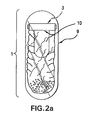
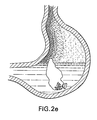
- FIG. 2 illustrates use of the device.
- the device of FIG. 1(a) has been compacted and encapsulated in container 9, in this case a 12el hard gelatin capsule that has been shortened as previously described.
- FIG. 2(b) shows injection of acid into the vessel 10 defined by receptacle 6 and interior-face of septum 3.
- the device 1 travels down the esophagus ( FIG. 2(c) ) and reaches the stomach.
- the container degrades under the action of gastric fluid and, thereafter, the vessel wall is breached allowing contact between the acid and emissive substance ( FIG 2(d) ). Emission of gas inflates the balloon ( FIG.
- the balloon should be inflated to a volume ( FIG. 2(f) ) approximately predetermined and controlled by the quantity of emissive substance present in the balloon.
- the quantity of emissive substance can be determined by routine experimentation or from knowledge of the stoichiometry of the gas generating reaction, the formula weight of the emissive substance, the desired pressure within the balloon and the ideal gas law.
- amount of emissive substance used will typically be in the range of from about 1 g to about 8 g.
- Another aspect of the present invention is the providing of an intragastric, volume-occupying device that self-deflates after an approximately pre-determined, prolonged period of time.
- the device will reside in the subject's stomach for the entire period between inflation and deflation.
- the balloon remains inflated for from about 20 days to about 60 days.
- the device After deflation, the device can pass through the pylorus and the rest of the digestive system without injury.
- Self-deflation is achieved in the self-deflating device of the present invention by using slowly biodegradable, acid degradable or pepsin degradable materials (hereafter “degradable materials”) in its construction.
- degradable materials slowly biodegradable, acid degradable or pepsin degradable materials
- sleeve 5 can be made using a material that degrades in the stomach.
- the clamping means can be made of degradable materials.
- Prefered biodegradable materials from which to make a degrading sleeve or clamp are polyglycolide (Dexon ® ), poly(1-lactide), poly(d, 1-lactide), poly(lactide-co-glycolide), poly( ⁇ -caprolactone), poly(dioxanone), poly(glycolide-co-trimethylene carbonate), poly(hydroxybutyrate-co-hydroxyvalerate), polyglyconate (Maxon ® ) polyanhydrides or polyorthesters, Yet more preferred biodegradable materials are polydioxanone, Monocryl ® (poliglecaprone) and Vicryl ® .
- biodegradable suture material more particularly suture material made from polyglyconate (Maxon ® ), polyglycolide (Dexon ® ), poly( ⁇ -caprolactone) which is commercially available from Ethicon, Inc. (Somerville, NJ) under the tradename hlonacryl ® and poly(dioxanone), also available from Ethicon.
- Combinations of polymeric material also may be used. These could be used where the properties of combined polymers contribute to better functioning of the device. For example, a more resorbable polymer can be blended with a more rigid, less rapidly degrading polymer to attain the qualities of rapid initial degradation of most of the structure while maintaining a rigid frame for longer periods of time.
- the bladder could be made of Vicryl ® (Ethicon) or PDS ® .
- Self-deflating devices in accordance with this invention should be packaged and stored under drying conditions to:prevent possible pre-mature degradation.
Landscapes
- Health & Medical Sciences (AREA)
- Heart & Thoracic Surgery (AREA)
- Life Sciences & Earth Sciences (AREA)
- Public Health (AREA)
- General Health & Medical Sciences (AREA)
- Engineering & Computer Science (AREA)
- Biomedical Technology (AREA)
- Veterinary Medicine (AREA)
- Animal Behavior & Ethology (AREA)
- Child & Adolescent Psychology (AREA)
- Vascular Medicine (AREA)
- Anesthesiology (AREA)
- Nursing (AREA)
- Hematology (AREA)
- Obesity (AREA)
- Orthopedic Medicine & Surgery (AREA)
- Pulmonology (AREA)
- Biophysics (AREA)
- Oral & Maxillofacial Surgery (AREA)
- Transplantation (AREA)
- Cardiology (AREA)
- Surgical Instruments (AREA)
- Infusion, Injection, And Reservoir Apparatuses (AREA)
- Acyclic And Carbocyclic Compounds In Medicinal Compositions (AREA)
- Read Only Memory (AREA)
- Media Introduction/Drainage Providing Device (AREA)
- Materials For Medical Uses (AREA)
Applications Claiming Priority (2)
| Application Number | Priority Date | Filing Date | Title |
|---|---|---|---|
| US10/390,902 US6981980B2 (en) | 2003-03-19 | 2003-03-19 | Self-inflating intragastric volume-occupying device |
| EP04757774A EP1610737B1 (fr) | 2003-03-19 | 2004-03-17 | Dispositif occupant du volume intragastrique auto-gonflable |
Related Parent Applications (1)
| Application Number | Title | Priority Date | Filing Date |
|---|---|---|---|
| EP04757774.7 Division | 2004-03-17 |
Publications (2)
| Publication Number | Publication Date |
|---|---|
| EP2204149A2 true EP2204149A2 (fr) | 2010-07-07 |
| EP2204149A3 EP2204149A3 (fr) | 2010-07-21 |
Family
ID=32987597
Family Applications (2)
| Application Number | Title | Priority Date | Filing Date |
|---|---|---|---|
| EP04757774A Expired - Lifetime EP1610737B1 (fr) | 2003-03-19 | 2004-03-17 | Dispositif occupant du volume intragastrique auto-gonflable |
| EP10004281A Withdrawn EP2204149A3 (fr) | 2003-03-19 | 2004-03-17 | Dispositif d'occupation du volume intragastrique autogonflant |
Family Applications Before (1)
| Application Number | Title | Priority Date | Filing Date |
|---|---|---|---|
| EP04757774A Expired - Lifetime EP1610737B1 (fr) | 2003-03-19 | 2004-03-17 | Dispositif occupant du volume intragastrique auto-gonflable |
Country Status (20)
| Country | Link |
|---|---|
| US (1) | US6981980B2 (fr) |
| EP (2) | EP1610737B1 (fr) |
| JP (1) | JP4477624B2 (fr) |
| KR (1) | KR20050105284A (fr) |
| CN (1) | CN1802181B (fr) |
| AT (1) | ATE465703T1 (fr) |
| AU (1) | AU2004224409B2 (fr) |
| BR (1) | BRPI0408471A (fr) |
| CA (1) | CA2519518C (fr) |
| CY (1) | CY1111134T1 (fr) |
| DE (1) | DE602004026845D1 (fr) |
| DK (1) | DK1610737T3 (fr) |
| ES (1) | ES2343118T3 (fr) |
| MX (1) | MXPA05009980A (fr) |
| NZ (1) | NZ542854A (fr) |
| PL (1) | PL1610737T3 (fr) |
| PT (1) | PT1610737E (fr) |
| RU (1) | RU2005132225A (fr) |
| SI (1) | SI1610737T1 (fr) |
| WO (1) | WO2004084763A2 (fr) |
Families Citing this family (154)
| Publication number | Priority date | Publication date | Assignee | Title |
|---|---|---|---|---|
| US7220266B2 (en) | 2000-05-19 | 2007-05-22 | C. R. Bard, Inc. | Tissue capturing and suturing device and method |
| CA2417129A1 (fr) | 2000-08-11 | 2002-02-21 | Temple University Of The Commonwealth System Of Higher Education | Procede de regulation de l'obesite |
| US7737109B2 (en) | 2000-08-11 | 2010-06-15 | Temple University Of The Commonwealth System Of Higher Education | Obesity controlling method |
| CA2447377C (fr) * | 2001-05-17 | 2008-11-25 | Kiyoshi Hashiba | Dispositif intragastrique destine au traitement de l'obesite |
| US6675809B2 (en) | 2001-08-27 | 2004-01-13 | Richard S. Stack | Satiation devices and methods |
| CN101810521B (zh) | 2001-08-27 | 2015-05-13 | 辛尼科有限责任公司 | 饱满装置和方法 |
| US7097665B2 (en) * | 2003-01-16 | 2006-08-29 | Synecor, Llc | Positioning tools and methods for implanting medical devices |
| US7146984B2 (en) * | 2002-04-08 | 2006-12-12 | Synecor, Llc | Method and apparatus for modifying the exit orifice of a satiation pouch |
| US8845672B2 (en) | 2002-05-09 | 2014-09-30 | Reshape Medical, Inc. | Balloon system and methods for treating obesity |
| US20040143342A1 (en) | 2003-01-16 | 2004-07-22 | Stack Richard S. | Satiation pouches and methods of use |
| US20060058829A1 (en) * | 2003-03-19 | 2006-03-16 | Sampson Douglas C | Intragastric volume-occupying device |
| CN1822794B (zh) | 2003-05-16 | 2010-05-26 | C.R.巴德有限公司 | 单插管、多缝针的内窥镜缝合系统 |
| US7632291B2 (en) * | 2003-06-13 | 2009-12-15 | Trivascular2, Inc. | Inflatable implant |
| US8206456B2 (en) | 2003-10-10 | 2012-06-26 | Barosense, Inc. | Restrictive and/or obstructive implant system for inducing weight loss |
| US20050247320A1 (en) | 2003-10-10 | 2005-11-10 | Stack Richard S | Devices and methods for retaining a gastro-esophageal implant |
| US20080089933A1 (en) * | 2006-10-16 | 2008-04-17 | Amir Alon | Device and method for reducing calorie intake |
| US7883491B2 (en) * | 2004-04-01 | 2011-02-08 | Shah Tilak M | Extrusion laminate polymeric film article and gastric occlusive device comprising same |
| US7717843B2 (en) * | 2004-04-26 | 2010-05-18 | Barosense, Inc. | Restrictive and/or obstructive implant for inducing weight loss |
| US20050267596A1 (en) * | 2004-05-03 | 2005-12-01 | Fulfillium, Inc. A Delaware Corporation | Devices and systems for gastric volume control |
| US20070078476A1 (en) * | 2004-10-12 | 2007-04-05 | Hull Wendell C Sr | Overweight control apparatuses for insertion into the stomach |
| US9456915B2 (en) | 2004-11-19 | 2016-10-04 | Fulfilium, Inc. | Methods, devices, and systems for obesity treatment |
| US8070807B2 (en) | 2004-11-19 | 2011-12-06 | Fulfillium, Inc. | Wireless breach detection |
| AU2005319399B2 (en) | 2004-12-21 | 2011-05-12 | Davol Inc. | Anastomotic outlet revision |
| IL167194A (en) | 2005-03-01 | 2011-08-31 | Tulip Medical Ltd | Biodegradable self-inflating intragastric implants and method of curbing appetite by the same |
| US7785291B2 (en) * | 2005-03-01 | 2010-08-31 | Tulip Medical Ltd. | Bioerodible self-deployable intragastric implants |
| US7699863B2 (en) * | 2005-03-01 | 2010-04-20 | Tulip Medical Ltd. | Bioerodible self-deployable intragastric implants |
| US9345604B2 (en) * | 2005-05-02 | 2016-05-24 | Almuhannad Alfrhan | Percutaneous intragastric balloon device and method |
| EP1893142B1 (fr) * | 2005-05-09 | 2013-04-24 | Cook Medical Technologies LLC | Dispositif intragastrique pour traiter l'obesite |
| AU2006258010B2 (en) | 2005-06-10 | 2012-09-13 | Cook Medical Technologies Llc | Cautery catheter |
| JP4777017B2 (ja) * | 2005-08-24 | 2011-09-21 | オリンパスメディカルシステムズ株式会社 | 胃内留置用バルーン及びバルーン用媒体 |
| US20080190989A1 (en) * | 2005-10-03 | 2008-08-14 | Crews Samuel T | Endoscopic plication device and method |
| US9055942B2 (en) | 2005-10-03 | 2015-06-16 | Boston Scienctific Scimed, Inc. | Endoscopic plication devices and methods |
| US20070100368A1 (en) * | 2005-10-31 | 2007-05-03 | Quijano Rodolfo C | Intragastric space filler |
| US20070100369A1 (en) * | 2005-10-31 | 2007-05-03 | Cragg Andrew H | Intragastric space filler |
| EP1948077B1 (fr) * | 2005-10-31 | 2015-12-23 | ReShape Medical Corporation | Lest intragastrique |
| US8216268B2 (en) * | 2005-12-22 | 2012-07-10 | Cook Medical Technologies Llc | Intragastric bag for treating obesity |
| WO2007075978A2 (fr) * | 2005-12-22 | 2007-07-05 | Wilson-Cook Medical Inc. | Membre intragastrique en spirale pour le traitement de l’obesite |
| US20070207199A1 (en) * | 2005-12-28 | 2007-09-06 | Sogin Stephen J | Appetite suppression device |
| WO2007136735A2 (fr) * | 2006-05-18 | 2007-11-29 | Tulip Medical Ltd. | Implants intragastriques et non gastriques, bioérodables et auto-déployables |
| US20080109027A1 (en) * | 2006-08-01 | 2008-05-08 | Fulfillium, Inc. | Method and system for gastric volume control |
| EP2061397B1 (fr) | 2006-09-02 | 2015-01-07 | Barosense, Inc. | Manchons intestinaux et systèmes de déploiement associés |
| US20090125040A1 (en) * | 2006-09-13 | 2009-05-14 | Hambly Pablo R | Tissue acquisition devices and methods |
| EP2068719B1 (fr) * | 2006-09-15 | 2017-10-25 | Boston Scientific Scimed, Inc. | Système d'ancrage d'un implant dans l'estomac |
| US20080086082A1 (en) * | 2006-10-06 | 2008-04-10 | Brooks Jeffrey S | Radiopaque marking to detect balloon deflation |
| US9381334B2 (en) | 2007-01-16 | 2016-07-05 | Radiadyne Llc | Endorectal balloon with gas release lumen |
| US9707379B2 (en) | 2007-01-16 | 2017-07-18 | Radiadyne Llc | Rectal balloon with locking stopper |
| US8500771B2 (en) * | 2007-01-16 | 2013-08-06 | Radiadyne, Llc | Rectal balloon apparatus with pressure relieving lumen and sensors |
| US20080172080A1 (en) * | 2007-01-16 | 2008-07-17 | Isham John | Minimally invasive rectal balloon apparatus |
| US20080183039A1 (en) * | 2007-01-26 | 2008-07-31 | Ethicon Endo-Surgery, Inc. | Balloon Positioning System for Endoscopic Access |
| US20090082644A1 (en) * | 2007-03-15 | 2009-03-26 | Jiayi Li | Devices, Systems, Kits and Methods for Treatment of Obesity |
| EP2124831B1 (fr) | 2007-03-15 | 2016-07-06 | Ortho-Space Ltd. | Dispositifs prothétiques |
| US8226602B2 (en) * | 2007-03-30 | 2012-07-24 | Reshape Medical, Inc. | Intragastric balloon system and therapeutic processes and products |
| US8007507B2 (en) * | 2007-05-10 | 2011-08-30 | Cook Medical Technologies Llc | Intragastric bag apparatus and method of delivery for treating obesity |
| US20080294179A1 (en) * | 2007-05-12 | 2008-11-27 | Balbierz Daniel J | Devices and methods for stomach partitioning |
| US20080306506A1 (en) * | 2007-06-11 | 2008-12-11 | Leatherman Dennis A | Self-inflating and deflating intragastric balloon implant device |
| US8142469B2 (en) | 2007-06-25 | 2012-03-27 | Reshape Medical, Inc. | Gastric space filler device, delivery system, and related methods |
| WO2009011881A1 (fr) | 2007-07-18 | 2009-01-22 | Barosense, Inc. | Introducteur d'enveloppe de tube pour utilisation en chirurgie bariatrique endoscopique |
| EP2178447B1 (fr) | 2007-07-18 | 2017-10-25 | Boston Scientific Scimed, Inc. | Système d'implant endoscopique et procédé associé |
| US7976497B2 (en) | 2007-09-25 | 2011-07-12 | Polyzen Inc. | Multi-layer film welded articulated balloon |
| US20090149879A1 (en) * | 2007-12-10 | 2009-06-11 | Dillon Travis E | Dynamic volume displacement weight loss device |
| WO2009086119A2 (fr) * | 2007-12-20 | 2009-07-09 | 7L, Llc | Dispositif autodilatable à avaler occupant l'espace gastrique |
| US7883524B2 (en) * | 2007-12-21 | 2011-02-08 | Wilson-Cook Medical Inc. | Method of delivering an intragastric device for treating obesity |
| US8016851B2 (en) * | 2007-12-27 | 2011-09-13 | Cook Medical Technologies Llc | Delivery system and method of delivery for treating obesity |
| US20090171383A1 (en) * | 2007-12-31 | 2009-07-02 | David Cole | Gastric space occupier systems and methods of use |
| EP3434230A1 (fr) * | 2008-01-29 | 2019-01-30 | Kirk Promotion LTD. | Dispositif de traitement de l'obésité |
| US8020741B2 (en) * | 2008-03-18 | 2011-09-20 | Barosense, Inc. | Endoscopic stapling devices and methods |
| US9066877B2 (en) * | 2008-04-28 | 2015-06-30 | Eat Little Inc. | Bezoar-forming units for weight control |
| US9072583B2 (en) | 2008-10-16 | 2015-07-07 | Obalon Therapeutics, Inc. | Intragastric volume-occupying device and method for fabricating same |
| US7934631B2 (en) | 2008-11-10 | 2011-05-03 | Barosense, Inc. | Multi-fire stapling systems and methods for delivering arrays of staples |
| US20100125242A1 (en) * | 2008-11-15 | 2010-05-20 | Pharmstar Pharmaceuticals, Inc. | Emergency dose medication administration device |
| WO2010075482A2 (fr) * | 2008-12-27 | 2010-07-01 | John Hancock | Dispositif intragastrique à densité spécifique élevée |
| US9174031B2 (en) * | 2009-03-13 | 2015-11-03 | Reshape Medical, Inc. | Device and method for deflation and removal of implantable and inflatable devices |
| CA2757547A1 (fr) * | 2009-04-03 | 2010-10-07 | Reshape Medical, Inc. | Charges ameliorees de l'espace intragastrique et procedes de preparation, comprenant des tests in vitro |
| US20100276469A1 (en) * | 2009-05-01 | 2010-11-04 | Barosense, Inc. | Plication tagging device and method |
| US8961539B2 (en) * | 2009-05-04 | 2015-02-24 | Boston Scientific Scimed, Inc. | Endoscopic implant system and method |
| EP2456507A4 (fr) | 2009-07-22 | 2013-07-03 | Reshape Medical Inc | Mécanismes de retrait pour dispositifs médicaux implantables |
| EP2456487A4 (fr) | 2009-07-23 | 2017-05-17 | ReShape Medical, Inc. | Mécanismes de gonflage et de dégonflage pour dispositifs médicaux gonflables |
| US9050174B2 (en) | 2009-07-23 | 2015-06-09 | Reshape Medical, Inc. | Deflation and removal of implantable medical devices |
| US20110048429A1 (en) * | 2009-09-02 | 2011-03-03 | Tyco Healthcare Group Lp | Patient Positioning Apparatus |
| EP2480279A4 (fr) | 2009-09-24 | 2017-11-15 | Reshape Medical, Inc. | Normalisation et stabilisation de surfaces de ballonnet pour dégonflement |
| US9532892B2 (en) | 2009-10-21 | 2017-01-03 | Apollo Endosurgery, Inc. | Bariatric device and method for weight loss |
| EP2533846B1 (fr) | 2010-02-08 | 2018-08-22 | ReShape Medical LLC | Matériaux et procédés pour dispositifs améliorés à ballon intragastrique |
| US9622896B2 (en) | 2010-02-08 | 2017-04-18 | Reshape Medical, Inc. | Enhanced aspiration processes and mechanisms for instragastric devices |
| US9681973B2 (en) | 2010-02-25 | 2017-06-20 | Reshape Medical, Inc. | Enhanced explant processes and mechanisms for intragastric devices |
| WO2011109520A1 (fr) * | 2010-03-03 | 2011-09-09 | Gavin Braithwaite | Produit de synthèse remplissant le volume gastrique |
| EP2547286B1 (fr) | 2010-03-15 | 2015-02-25 | Apollo Endosurgery, Inc. | Dispositif bariatrique et méthode pour perdre du poids |
| EP2555705A4 (fr) | 2010-04-06 | 2014-01-15 | Reshape Medical Inc | Dispositifs de gonflage pour des dispositifs intragastriques à une fixation et un détachement améliorés et systèmes et procédés associés |
| WO2011146853A2 (fr) | 2010-05-21 | 2011-11-24 | Barosense, Inc. | Dispositifs et procédés d'acquisition et de fixation de tissu |
| CA2800255C (fr) * | 2010-05-27 | 2018-07-10 | The Regents Of The University Of Michigan | Dispositif pour la reduction du volume gastrique afin de faciliter la perte de poids |
| US9962275B2 (en) | 2010-10-07 | 2018-05-08 | Randy Louis Werneth | Temporary gastric device (TGD) and method of use |
| US9463107B2 (en) | 2010-10-18 | 2016-10-11 | Apollo Endosurgery, Inc. | Variable size intragastric implant devices |
| ES2566498T3 (es) | 2010-10-18 | 2016-04-13 | Apollo Endosurgery, Inc. | Implantes intragástricos con anclajes duodenales |
| WO2012054519A2 (fr) | 2010-10-18 | 2012-04-26 | Allergan, Inc. | Implants intra-gastriques réactifs |
| US8870966B2 (en) | 2010-10-18 | 2014-10-28 | Apollo Endosurgery, Inc. | Intragastric balloon for treating obesity |
| US9233016B2 (en) | 2010-10-18 | 2016-01-12 | Apollo Endosurgery, Inc. | Elevating stomach stimulation device |
| US8920447B2 (en) | 2010-10-19 | 2014-12-30 | Apollo Endosurgery, Inc. | Articulated gastric implant clip |
| ES2593753T3 (es) | 2010-10-19 | 2016-12-13 | Apollo Endosurgery, Inc. | Manga duodenal con anclaje sin perforación |
| US9398969B2 (en) | 2010-10-19 | 2016-07-26 | Apollo Endosurgery, Inc. | Upper stomach gastric implants |
| US9198790B2 (en) | 2010-10-19 | 2015-12-01 | Apollo Endosurgery, Inc. | Upper stomach gastric implants |
| US9095405B2 (en) | 2010-10-19 | 2015-08-04 | Apollo Endosurgery, Inc. | Space-filling intragastric implants with fluid flow |
| US8864840B2 (en) | 2010-10-19 | 2014-10-21 | Apollo Endosurgery, Inc. | Intragastric implants with collapsible frames |
| US9498365B2 (en) | 2010-10-19 | 2016-11-22 | Apollo Endosurgery, Inc. | Intragastric implants with multiple fluid chambers |
| US8963708B2 (en) | 2011-01-13 | 2015-02-24 | Sensurtec, Inc. | Breach detection in solid structures |
| DK2665512T3 (en) | 2011-01-21 | 2016-10-10 | Obalon Therapeutics Inc | Intragastric device |
| US8202291B1 (en) | 2011-01-21 | 2012-06-19 | Obalon Therapeutics, Inc. | Intragastric device |
| DK2665511T3 (en) * | 2011-01-21 | 2016-11-14 | Obalon Therapeutics Inc | Intragastric device |
| WO2014143062A1 (fr) * | 2013-03-15 | 2014-09-18 | Obalon Therapeutics, Inc. | Dispositif intragastrique |
| US8292911B2 (en) | 2011-01-21 | 2012-10-23 | Obalon Therapeutics, Inc. | Intragastric device |
| US8647358B2 (en) | 2011-01-21 | 2014-02-11 | Obalon Therapeutics Inc. | Intragastric device |
| US8722066B2 (en) | 2011-03-29 | 2014-05-13 | Primigenia, LLC | Devices and methods for weight control and weight loss |
| US20120296365A1 (en) * | 2011-05-17 | 2012-11-22 | Endobese, Inc. | Method and Apparatus for Buoyant Gastric Implant |
| AT511671A1 (de) * | 2011-07-13 | 2013-01-15 | Bischof Georg Dr | Zusammensetzung zur erzeugung einer vorübergehenden okklusion des darms eines säugetiers |
| US9370647B2 (en) | 2011-07-14 | 2016-06-21 | W. L. Gore & Associates, Inc. | Expandable medical devices |
| US9289307B2 (en) | 2011-10-18 | 2016-03-22 | Ortho-Space Ltd. | Prosthetic devices and methods for using same |
| IN2014DN07768A (fr) | 2012-02-21 | 2015-05-15 | Allurion Technologies Inc | |
| US10182932B2 (en) | 2012-02-21 | 2019-01-22 | Allurion Technologies, Inc. | Methods and devices for deploying and releasing a temporary implant within the body |
| US8979887B2 (en) | 2012-02-24 | 2015-03-17 | Elwha Llc | Devices, systems, and methods to control stomach volume |
| US10507127B2 (en) | 2012-06-07 | 2019-12-17 | Epitomee Medical Ltd. | Expandable device |
| US9456916B2 (en) | 2013-03-12 | 2016-10-04 | Medibotics Llc | Device for selectively reducing absorption of unhealthy food |
| EA029876B1 (ru) * | 2012-08-17 | 2018-05-31 | Симпл Медикал Инновэйшнс Пти Лтд | Внутрижелудочный баллон |
| US10137023B2 (en) | 2012-09-14 | 2018-11-27 | Medibotics Llc | Colonnade (TM) expandable intragastric food flow lumen device |
| US9067070B2 (en) | 2013-03-12 | 2015-06-30 | Medibotics Llc | Dysgeusia-inducing neurostimulation for modifying consumption of a selected nutrient type |
| US9011365B2 (en) | 2013-03-12 | 2015-04-21 | Medibotics Llc | Adjustable gastrointestinal bifurcation (AGB) for reduced absorption of unhealthy food |
| KR20160094397A (ko) | 2013-12-04 | 2016-08-09 | 오발론 테라퓨틱스 인코퍼레이티드 | 위 내 장치를 위치시키고 및/또는 특징화하는 시스템 및 방법 |
| WO2015083171A1 (fr) | 2013-12-05 | 2015-06-11 | Tulip Medical Ltd. | Dispositifs et systèmes de rétention pour la libération in-situ d'agents pharmaceutiques actifs |
| US10405866B2 (en) * | 2014-04-25 | 2019-09-10 | Flow MedTech, Inc | Left atrial appendage occlusion device |
| CN104000628B (zh) * | 2014-05-10 | 2018-05-22 | 中南大学湘雅三医院 | 胃部急救胶囊止血器及止血方法 |
| US10856881B2 (en) | 2014-09-19 | 2020-12-08 | Flow Medtech, Inc. | Left atrial appendage occlusion device delivery system |
| WO2016057716A1 (fr) | 2014-10-09 | 2016-04-14 | Obalon Therapeutics, Inc. | Systèmes et procédés ultrasonores pour la localisation et/ou la caractérisation de dispositifs intragastriques |
| MX2017015930A (es) * | 2015-06-11 | 2018-04-18 | Obalon Therapeutics Inc | Sistema de dispositivo intragastrico. |
| WO2017046647A1 (fr) | 2015-09-18 | 2017-03-23 | Ortho-Space Ltd. | Écarteurs sous-acromiaux fixés de manière intramédullaire |
| US10335303B2 (en) | 2015-12-07 | 2019-07-02 | Obalon Therapeutics, Inc. | Intragastric device |
| US10537453B2 (en) | 2015-12-16 | 2020-01-21 | Obalon Therapeutics, Inc. | Intragastric device with expandable portions |
| JP6542702B2 (ja) * | 2016-03-31 | 2019-07-10 | 英敏 太田 | 胃空間充填装置 |
| US10350100B2 (en) | 2016-04-12 | 2019-07-16 | Obalon Therapeutics, Inc. | System for detecting an intragastric balloon |
| WO2018085079A1 (fr) | 2016-11-04 | 2018-05-11 | Obalon Therapeutics, Inc. | Système de commande de pression pour dispositif intragastrique |
| CN106511372A (zh) * | 2016-11-23 | 2017-03-22 | 邹立新 | 一种胃内自膨胀减肥药品 |
| US11045981B2 (en) | 2017-01-30 | 2021-06-29 | Ortho-Space Ltd. | Processing machine and methods for processing dip-molded articles |
| JP6767084B2 (ja) * | 2017-02-14 | 2020-10-14 | 英敏 太田 | 体内流体制御装置及び体内流体制御システム |
| JP7134229B2 (ja) | 2017-07-06 | 2022-09-09 | ラグビア バスデ, | 組織把持デバイスおよび関連方法 |
| CN111727010A (zh) | 2017-07-24 | 2020-09-29 | 奥巴隆治疗公司 | 用于定位和/或表征胃内设备的系统和方法 |
| US10918511B2 (en) * | 2017-07-26 | 2021-02-16 | Verily Life Sciences Llc | Ingestible intragastric balloon |
| US10238516B1 (en) * | 2017-11-01 | 2019-03-26 | Barix Medical Corp. | Simplified implantable gastric balloon system with self deflating timer |
| ES3068095T3 (es) | 2018-02-26 | 2026-05-27 | Allurion Tech Llc | Sistema de catéter de llenado de globo de sellado automático |
| CN114376777B (zh) * | 2018-07-06 | 2024-02-02 | 安瑞仁科技公司 | 二元流体控制阀系统 |
| US12128133B2 (en) | 2018-09-25 | 2024-10-29 | Rani Therapeutics, Llc | Ingestible device with expandable enclosure |
| US11497900B2 (en) | 2018-12-13 | 2022-11-15 | Allurion Technologies, Inc. | Enhanced fluid delivery system |
| KR20230142702A (ko) | 2020-12-07 | 2023-10-11 | 이피토미 메디칼 엘티디 | 위내 확장형 장치 |
| CN114145893A (zh) * | 2021-12-03 | 2022-03-08 | 杭州糖吉医疗科技有限公司 | 可吞咽胃内水球及其制备方法和套装 |
| WO2023200754A1 (fr) * | 2022-04-11 | 2023-10-19 | Ag Ip Holding, Llc | Pompe pilote sous vide |
| US12245962B2 (en) | 2023-04-12 | 2025-03-11 | Allurion Technologies, Inc. | Balloon sealing and fill valve |
| US12246163B2 (en) | 2023-04-12 | 2025-03-11 | Allurion Technologies, Inc. | Automatic-sealing balloon-filling catheter system |
| CN116602807B (zh) * | 2023-05-22 | 2024-05-28 | 张勤生 | 一种胶囊式自产气胃减容减重气囊 |
| CN119257811B (zh) * | 2024-10-08 | 2025-10-03 | 杭州糖吉医疗科技有限公司 | 自膨胀胃内球囊及其应用 |
Citations (16)
| Publication number | Priority date | Publication date | Assignee | Title |
|---|---|---|---|---|
| US4133315A (en) | 1976-12-27 | 1979-01-09 | Berman Edward J | Method and apparatus for reducing obesity |
| US4416267A (en) | 1981-12-10 | 1983-11-22 | Garren Lloyd R | Method and apparatus for treating obesity |
| US4485805A (en) | 1982-08-24 | 1984-12-04 | Gunther Pacific Limited Of Hong Kong | Weight loss device and method |
| JPS61100519A (ja) | 1984-10-23 | 1986-05-19 | Shin Etsu Chem Co Ltd | 医薬用硬質カプセル |
| US4607618A (en) | 1983-02-23 | 1986-08-26 | Angelchik Jean P | Method for treatment of morbid obesity |
| JPS6226606A (ja) | 1985-07-26 | 1987-02-04 | Sony Corp | 記録方法 |
| US4694827A (en) | 1986-01-14 | 1987-09-22 | Weiner Brian C | Inflatable gastric device for treating obesity and method of using the same |
| EP0246999A1 (fr) | 1986-05-23 | 1987-11-25 | Omikron Scientific Ltd. | Appareil pour le traitement d'un patient obèse et procédé de traitement |
| US4723547A (en) | 1985-05-07 | 1988-02-09 | C. R. Bard, Inc. | Anti-obesity balloon placement system |
| US4739758A (en) | 1986-05-19 | 1988-04-26 | Criticare Systems, Inc. | Apparatus for stomach cavity reduction |
| US4899747A (en) | 1981-12-10 | 1990-02-13 | Garren Lloyd R | Method and appartus for treating obesity |
| US5129915A (en) | 1988-07-05 | 1992-07-14 | Jose Cantenys | Intragastric balloon |
| US5234454A (en) | 1991-08-05 | 1993-08-10 | Akron City Hospital | Percutaneous intragastric balloon catheter and method for controlling body weight therewith |
| US5259399A (en) | 1992-03-02 | 1993-11-09 | Alan Brown | Device and method of causing weight loss using removable variable volume intragastric bladder |
| US5439917A (en) | 1991-03-27 | 1995-08-08 | Aktiebolaget Astra | Active compounds |
| US6454785B2 (en) | 2000-02-24 | 2002-09-24 | DE HOYOS GARZA ANDRéS | Percutaneous intragastric balloon catheter for the treatment of obesity |
Family Cites Families (17)
| Publication number | Priority date | Publication date | Assignee | Title |
|---|---|---|---|---|
| US4246893A (en) | 1978-07-05 | 1981-01-27 | Daniel Berson | Inflatable gastric device for treating obesity |
| US4235454A (en) * | 1978-11-03 | 1980-11-25 | General Electric Company | Stabilization system for a medical diagnostic device |
| US4234454A (en) | 1979-07-27 | 1980-11-18 | Phillips Petroleum Company | Diolefin dimerization catalyst and method for producing nitrosyl halides of iron triad metals |
| EP0103481A1 (fr) * | 1982-09-14 | 1984-03-21 | Ainsworth Nominees Proprietary Limited | Traitement et réduction de l'obésité humaine |
| GB8517092D0 (en) * | 1985-07-05 | 1985-08-14 | Taylor T V | Artificial bezoar |
| US4857029A (en) | 1987-07-07 | 1989-08-15 | Enviro-Spray Systems, Inc. | Balloon storage and inflation assembly |
| US4925446A (en) | 1988-07-06 | 1990-05-15 | Transpharm Group Inc. | Removable inflatable intragastrointestinal device for delivering beneficial agents |
| US5049106A (en) | 1990-06-04 | 1991-09-17 | Sunyong Kim | Self-contained, self-inflating novelty balloon |
| US5431917A (en) | 1992-10-08 | 1995-07-11 | Japan Elanco Company, Ltd. | Hard capsule for pharmaceutical drugs and method for producing the same |
| US5852889A (en) | 1994-08-31 | 1998-12-29 | Rinaldi; Robert | Greeting card with self-inflating balloon |
| US5868141A (en) | 1997-05-14 | 1999-02-09 | Ellias; Yakub A. | Endoscopic stomach insert for treating obesity and method for use |
| US6427089B1 (en) | 1999-02-19 | 2002-07-30 | Edward W. Knowlton | Stomach treatment apparatus and method |
| FR2805986B1 (fr) | 2000-03-13 | 2002-10-11 | Districlass Madical | Dispositif intra-gastrique a volume variable |
| CN2433933Y (zh) * | 2000-05-29 | 2001-06-13 | 张汝建 | 胃内减肥气囊 |
| WO2002016001A2 (fr) * | 2000-08-21 | 2002-02-28 | Jerry White | Objet gonflable et procede de gonflage |
| CA2447377C (fr) * | 2001-05-17 | 2008-11-25 | Kiyoshi Hashiba | Dispositif intragastrique destine au traitement de l'obesite |
| US6627206B2 (en) * | 2001-07-25 | 2003-09-30 | Greg A. Lloyd | Method and apparatus for treating obesity and for delivering time-released medicaments |
-
2003
- 2003-03-19 US US10/390,902 patent/US6981980B2/en not_active Expired - Lifetime
-
2004
- 2004-03-17 MX MXPA05009980A patent/MXPA05009980A/es active IP Right Grant
- 2004-03-17 SI SI200431469T patent/SI1610737T1/sl unknown
- 2004-03-17 PT PT04757774T patent/PT1610737E/pt unknown
- 2004-03-17 NZ NZ542854A patent/NZ542854A/en not_active IP Right Cessation
- 2004-03-17 WO PCT/US2004/008178 patent/WO2004084763A2/fr not_active Ceased
- 2004-03-17 ES ES04757774T patent/ES2343118T3/es not_active Expired - Lifetime
- 2004-03-17 PL PL04757774T patent/PL1610737T3/pl unknown
- 2004-03-17 AU AU2004224409A patent/AU2004224409B2/en not_active Ceased
- 2004-03-17 AT AT04757774T patent/ATE465703T1/de active
- 2004-03-17 BR BRPI0408471-3A patent/BRPI0408471A/pt not_active IP Right Cessation
- 2004-03-17 CN CN2004800135183A patent/CN1802181B/zh not_active Expired - Fee Related
- 2004-03-17 JP JP2006507282A patent/JP4477624B2/ja not_active Expired - Fee Related
- 2004-03-17 EP EP04757774A patent/EP1610737B1/fr not_active Expired - Lifetime
- 2004-03-17 RU RU2005132225/14A patent/RU2005132225A/ru not_active Application Discontinuation
- 2004-03-17 DE DE602004026845T patent/DE602004026845D1/de not_active Expired - Lifetime
- 2004-03-17 CA CA2519518A patent/CA2519518C/fr not_active Expired - Fee Related
- 2004-03-17 KR KR1020057017555A patent/KR20050105284A/ko not_active Ceased
- 2004-03-17 EP EP10004281A patent/EP2204149A3/fr not_active Withdrawn
- 2004-03-17 DK DK04757774.7T patent/DK1610737T3/da active
-
2010
- 2010-07-13 CY CY20101100654T patent/CY1111134T1/el unknown
Patent Citations (16)
| Publication number | Priority date | Publication date | Assignee | Title |
|---|---|---|---|---|
| US4133315A (en) | 1976-12-27 | 1979-01-09 | Berman Edward J | Method and apparatus for reducing obesity |
| US4416267A (en) | 1981-12-10 | 1983-11-22 | Garren Lloyd R | Method and apparatus for treating obesity |
| US4899747A (en) | 1981-12-10 | 1990-02-13 | Garren Lloyd R | Method and appartus for treating obesity |
| US4485805A (en) | 1982-08-24 | 1984-12-04 | Gunther Pacific Limited Of Hong Kong | Weight loss device and method |
| US4607618A (en) | 1983-02-23 | 1986-08-26 | Angelchik Jean P | Method for treatment of morbid obesity |
| JPS61100519A (ja) | 1984-10-23 | 1986-05-19 | Shin Etsu Chem Co Ltd | 医薬用硬質カプセル |
| US4723547A (en) | 1985-05-07 | 1988-02-09 | C. R. Bard, Inc. | Anti-obesity balloon placement system |
| JPS6226606A (ja) | 1985-07-26 | 1987-02-04 | Sony Corp | 記録方法 |
| US4694827A (en) | 1986-01-14 | 1987-09-22 | Weiner Brian C | Inflatable gastric device for treating obesity and method of using the same |
| US4739758A (en) | 1986-05-19 | 1988-04-26 | Criticare Systems, Inc. | Apparatus for stomach cavity reduction |
| EP0246999A1 (fr) | 1986-05-23 | 1987-11-25 | Omikron Scientific Ltd. | Appareil pour le traitement d'un patient obèse et procédé de traitement |
| US5129915A (en) | 1988-07-05 | 1992-07-14 | Jose Cantenys | Intragastric balloon |
| US5439917A (en) | 1991-03-27 | 1995-08-08 | Aktiebolaget Astra | Active compounds |
| US5234454A (en) | 1991-08-05 | 1993-08-10 | Akron City Hospital | Percutaneous intragastric balloon catheter and method for controlling body weight therewith |
| US5259399A (en) | 1992-03-02 | 1993-11-09 | Alan Brown | Device and method of causing weight loss using removable variable volume intragastric bladder |
| US6454785B2 (en) | 2000-02-24 | 2002-09-24 | DE HOYOS GARZA ANDRéS | Percutaneous intragastric balloon catheter for the treatment of obesity |
Non-Patent Citations (1)
| Title |
|---|
| VANSONNENBERG, ERIC ET AL., RADIOLOGY, vol. 152, 1984, pages 531 |
Also Published As
| Publication number | Publication date |
|---|---|
| PL1610737T3 (pl) | 2010-10-29 |
| AU2004224409A1 (en) | 2004-10-07 |
| PT1610737E (pt) | 2010-07-27 |
| EP1610737A2 (fr) | 2006-01-04 |
| EP1610737A4 (fr) | 2008-04-02 |
| ES2343118T3 (es) | 2010-07-23 |
| JP2006522643A (ja) | 2006-10-05 |
| EP1610737B1 (fr) | 2010-04-28 |
| CY1111134T1 (el) | 2015-06-11 |
| CN1802181B (zh) | 2011-11-16 |
| JP4477624B2 (ja) | 2010-06-09 |
| BRPI0408471A (pt) | 2006-04-04 |
| US6981980B2 (en) | 2006-01-03 |
| WO2004084763A3 (fr) | 2006-01-26 |
| KR20050105284A (ko) | 2005-11-03 |
| MXPA05009980A (es) | 2006-05-25 |
| WO2004084763A2 (fr) | 2004-10-07 |
| RU2005132225A (ru) | 2006-05-10 |
| SI1610737T1 (sl) | 2010-09-30 |
| NZ542854A (en) | 2007-03-30 |
| DE602004026845D1 (de) | 2010-06-10 |
| EP2204149A3 (fr) | 2010-07-21 |
| CN1802181A (zh) | 2006-07-12 |
| US20040186502A1 (en) | 2004-09-23 |
| ATE465703T1 (de) | 2010-05-15 |
| CA2519518C (fr) | 2013-05-14 |
| CA2519518A1 (fr) | 2004-10-07 |
| AU2004224409B2 (en) | 2009-03-19 |
| DK1610737T3 (da) | 2010-08-09 |
Similar Documents
| Publication | Publication Date | Title |
|---|---|---|
| US6981980B2 (en) | Self-inflating intragastric volume-occupying device | |
| DK1814622T3 (en) | Intragastric volume-receiving device | |
| US12090075B2 (en) | Intragastric device | |
| US20060058829A1 (en) | Intragastric volume-occupying device | |
| CN107913125B (zh) | 胃内装置 | |
| US20190298561A1 (en) | Intragastric device | |
| CN104703562A (zh) | 胃内球囊 | |
| JP6285067B2 (ja) | 胃内デバイス | |
| EP2916904B1 (fr) | Systèmes d'administration par voie orale adaptés d'un point de vue anatomique | |
| HK1248094A1 (zh) | 胃内装置 | |
| HK1215549B (en) | Intragastric device |
Legal Events
| Date | Code | Title | Description |
|---|---|---|---|
| PUAI | Public reference made under article 153(3) epc to a published international application that has entered the european phase |
Free format text: ORIGINAL CODE: 0009012 |
|
| PUAL | Search report despatched |
Free format text: ORIGINAL CODE: 0009013 |
|
| AC | Divisional application: reference to earlier application |
Ref document number: 1610737 Country of ref document: EP Kind code of ref document: P |
|
| AK | Designated contracting states |
Kind code of ref document: A2 Designated state(s): AT BE BG CH CY CZ DE DK EE ES FI FR GB GR HU IE IT LI LU MC NL PL PT RO SE SI SK TR |
|
| AK | Designated contracting states |
Kind code of ref document: A3 Designated state(s): AT BE BG CH CY CZ DE DK EE ES FI FR GB GR HU IE IT LI LU MC NL PL PT RO SE SI SK TR |
|
| RIN1 | Information on inventor provided before grant (corrected) |
Inventor name: SAMPSON, DOUGLAS, C. Inventor name: ZANAKIS, MICHAEL |
|
| STAA | Information on the status of an ep patent application or granted ep patent |
Free format text: STATUS: THE APPLICATION IS DEEMED TO BE WITHDRAWN |
|
| 18D | Application deemed to be withdrawn |
Effective date: 20110122 |