EP2204276A2 - Matière en couche multiple et procédé pour sa fabrication - Google Patents
Matière en couche multiple et procédé pour sa fabrication Download PDFInfo
- Publication number
- EP2204276A2 EP2204276A2 EP09011416A EP09011416A EP2204276A2 EP 2204276 A2 EP2204276 A2 EP 2204276A2 EP 09011416 A EP09011416 A EP 09011416A EP 09011416 A EP09011416 A EP 09011416A EP 2204276 A2 EP2204276 A2 EP 2204276A2
- Authority
- EP
- European Patent Office
- Prior art keywords
- connecting elements
- core
- composite material
- material according
- fiber
- Prior art date
- Legal status (The legal status is an assumption and is not a legal conclusion. Google has not performed a legal analysis and makes no representation as to the accuracy of the status listed.)
- Ceased
Links
Images







Classifications
-
- B—PERFORMING OPERATIONS; TRANSPORTING
- B32—LAYERED PRODUCTS
- B32B—LAYERED PRODUCTS, i.e. PRODUCTS BUILT-UP OF STRATA OF FLAT OR NON-FLAT, e.g. CELLULAR OR HONEYCOMB, FORM
- B32B7/00—Layered products characterised by the relation between layers; Layered products characterised by the relative orientation of features between layers, or by the relative values of a measurable parameter between layers, i.e. products comprising layers having different physical, chemical or physicochemical properties; Layered products characterised by the interconnection of layers
- B32B7/04—Interconnection of layers
- B32B7/08—Interconnection of layers by mechanical means
-
- B—PERFORMING OPERATIONS; TRANSPORTING
- B29—WORKING OF PLASTICS; WORKING OF SUBSTANCES IN A PLASTIC STATE IN GENERAL
- B29C—SHAPING OR JOINING OF PLASTICS; SHAPING OF MATERIAL IN A PLASTIC STATE, NOT OTHERWISE PROVIDED FOR; AFTER-TREATMENT OF THE SHAPED PRODUCTS, e.g. REPAIRING
- B29C70/00—Shaping composites, i.e. plastics material comprising reinforcements, fillers or preformed parts, e.g. inserts
- B29C70/04—Shaping composites, i.e. plastics material comprising reinforcements, fillers or preformed parts, e.g. inserts comprising reinforcements only, e.g. self-reinforcing plastics
- B29C70/06—Fibrous reinforcements only
- B29C70/10—Fibrous reinforcements only characterised by the structure of fibrous reinforcements, e.g. hollow fibres
- B29C70/16—Fibrous reinforcements only characterised by the structure of fibrous reinforcements, e.g. hollow fibres using fibres of substantial or continuous length
- B29C70/24—Fibrous reinforcements only characterised by the structure of fibrous reinforcements, e.g. hollow fibres using fibres of substantial or continuous length oriented in at least three directions forming a three-dimensional [3D] structure
-
- A—HUMAN NECESSITIES
- A63—SPORTS; GAMES; AMUSEMENTS
- A63C—SKATES; SKIS; ROLLER SKATES; DESIGN OR LAYOUT OF COURTS, RINKS OR THE LIKE
- A63C5/00—Skis or snowboards
- A63C5/12—Making thereof; Selection of particular materials
-
- A—HUMAN NECESSITIES
- A63—SPORTS; GAMES; AMUSEMENTS
- A63C—SKATES; SKIS; ROLLER SKATES; DESIGN OR LAYOUT OF COURTS, RINKS OR THE LIKE
- A63C5/00—Skis or snowboards
- A63C5/12—Making thereof; Selection of particular materials
- A63C5/126—Structure of the core
-
- B—PERFORMING OPERATIONS; TRANSPORTING
- B32—LAYERED PRODUCTS
- B32B—LAYERED PRODUCTS, i.e. PRODUCTS BUILT-UP OF STRATA OF FLAT OR NON-FLAT, e.g. CELLULAR OR HONEYCOMB, FORM
- B32B15/00—Layered products comprising a layer of metal
- B32B15/14—Layered products comprising a layer of metal next to a fibrous or filamentary layer
-
- B—PERFORMING OPERATIONS; TRANSPORTING
- B32—LAYERED PRODUCTS
- B32B—LAYERED PRODUCTS, i.e. PRODUCTS BUILT-UP OF STRATA OF FLAT OR NON-FLAT, e.g. CELLULAR OR HONEYCOMB, FORM
- B32B15/00—Layered products comprising a layer of metal
- B32B15/20—Layered products comprising a layer of metal comprising aluminium or copper
-
- B—PERFORMING OPERATIONS; TRANSPORTING
- B32—LAYERED PRODUCTS
- B32B—LAYERED PRODUCTS, i.e. PRODUCTS BUILT-UP OF STRATA OF FLAT OR NON-FLAT, e.g. CELLULAR OR HONEYCOMB, FORM
- B32B21/00—Layered products comprising a layer of wood, e.g. wood board, veneer, wood particle board
- B32B21/10—Next to a fibrous or filamentary layer
-
- B—PERFORMING OPERATIONS; TRANSPORTING
- B32—LAYERED PRODUCTS
- B32B—LAYERED PRODUCTS, i.e. PRODUCTS BUILT-UP OF STRATA OF FLAT OR NON-FLAT, e.g. CELLULAR OR HONEYCOMB, FORM
- B32B27/00—Layered products comprising a layer of synthetic resin
- B32B27/12—Layered products comprising a layer of synthetic resin next to a fibrous or filamentary layer
-
- B—PERFORMING OPERATIONS; TRANSPORTING
- B32—LAYERED PRODUCTS
- B32B—LAYERED PRODUCTS, i.e. PRODUCTS BUILT-UP OF STRATA OF FLAT OR NON-FLAT, e.g. CELLULAR OR HONEYCOMB, FORM
- B32B3/00—Layered products comprising a layer with external or internal discontinuities or unevennesses, or a layer of non-planar shape; Layered products comprising a layer having particular features of form
- B32B3/02—Layered products comprising a layer with external or internal discontinuities or unevennesses, or a layer of non-planar shape; Layered products comprising a layer having particular features of form characterised by features of form at particular places, e.g. in edge regions
-
- B—PERFORMING OPERATIONS; TRANSPORTING
- B32—LAYERED PRODUCTS
- B32B—LAYERED PRODUCTS, i.e. PRODUCTS BUILT-UP OF STRATA OF FLAT OR NON-FLAT, e.g. CELLULAR OR HONEYCOMB, FORM
- B32B3/00—Layered products comprising a layer with external or internal discontinuities or unevennesses, or a layer of non-planar shape; Layered products comprising a layer having particular features of form
- B32B3/02—Layered products comprising a layer with external or internal discontinuities or unevennesses, or a layer of non-planar shape; Layered products comprising a layer having particular features of form characterised by features of form at particular places, e.g. in edge regions
- B32B3/08—Layered products comprising a layer with external or internal discontinuities or unevennesses, or a layer of non-planar shape; Layered products comprising a layer having particular features of form characterised by features of form at particular places, e.g. in edge regions characterised by added members at particular parts
-
- B—PERFORMING OPERATIONS; TRANSPORTING
- B32—LAYERED PRODUCTS
- B32B—LAYERED PRODUCTS, i.e. PRODUCTS BUILT-UP OF STRATA OF FLAT OR NON-FLAT, e.g. CELLULAR OR HONEYCOMB, FORM
- B32B3/00—Layered products comprising a layer with external or internal discontinuities or unevennesses, or a layer of non-planar shape; Layered products comprising a layer having particular features of form
- B32B3/10—Layered products comprising a layer with external or internal discontinuities or unevennesses, or a layer of non-planar shape; Layered products comprising a layer having particular features of form characterised by a discontinuous layer, i.e. formed of separate pieces of material
- B32B3/12—Layered products comprising a layer with external or internal discontinuities or unevennesses, or a layer of non-planar shape; Layered products comprising a layer having particular features of form characterised by a discontinuous layer, i.e. formed of separate pieces of material characterised by a layer of regularly- arranged cells, e.g. a honeycomb structure
-
- B—PERFORMING OPERATIONS; TRANSPORTING
- B32—LAYERED PRODUCTS
- B32B—LAYERED PRODUCTS, i.e. PRODUCTS BUILT-UP OF STRATA OF FLAT OR NON-FLAT, e.g. CELLULAR OR HONEYCOMB, FORM
- B32B3/00—Layered products comprising a layer with external or internal discontinuities or unevennesses, or a layer of non-planar shape; Layered products comprising a layer having particular features of form
- B32B3/26—Layered products comprising a layer with external or internal discontinuities or unevennesses, or a layer of non-planar shape; Layered products comprising a layer having particular features of form characterised by a particular shape of the outline of the cross-section of a continuous layer; characterised by a layer with cavities or internal voids ; characterised by an apertured layer
- B32B3/266—Layered products comprising a layer with external or internal discontinuities or unevennesses, or a layer of non-planar shape; Layered products comprising a layer having particular features of form characterised by a particular shape of the outline of the cross-section of a continuous layer; characterised by a layer with cavities or internal voids ; characterised by an apertured layer characterised by an apertured layer, the apertures going through the whole thickness of the layer, e.g. expanded metal, perforated layer, slit layer regular cells B32B3/12
-
- B—PERFORMING OPERATIONS; TRANSPORTING
- B32—LAYERED PRODUCTS
- B32B—LAYERED PRODUCTS, i.e. PRODUCTS BUILT-UP OF STRATA OF FLAT OR NON-FLAT, e.g. CELLULAR OR HONEYCOMB, FORM
- B32B5/00—Layered products characterised by the non- homogeneity or physical structure, i.e. comprising a fibrous, filamentary, particulate or foam layer; Layered products characterised by having a layer differing constitutionally or physically in different parts
- B32B5/02—Layered products characterised by the non- homogeneity or physical structure, i.e. comprising a fibrous, filamentary, particulate or foam layer; Layered products characterised by having a layer differing constitutionally or physically in different parts characterised by structural features of a fibrous or filamentary layer
- B32B5/024—Woven fabric
-
- B—PERFORMING OPERATIONS; TRANSPORTING
- B32—LAYERED PRODUCTS
- B32B—LAYERED PRODUCTS, i.e. PRODUCTS BUILT-UP OF STRATA OF FLAT OR NON-FLAT, e.g. CELLULAR OR HONEYCOMB, FORM
- B32B5/00—Layered products characterised by the non- homogeneity or physical structure, i.e. comprising a fibrous, filamentary, particulate or foam layer; Layered products characterised by having a layer differing constitutionally or physically in different parts
- B32B5/02—Layered products characterised by the non- homogeneity or physical structure, i.e. comprising a fibrous, filamentary, particulate or foam layer; Layered products characterised by having a layer differing constitutionally or physically in different parts characterised by structural features of a fibrous or filamentary layer
- B32B5/06—Layered products characterised by the non- homogeneity or physical structure, i.e. comprising a fibrous, filamentary, particulate or foam layer; Layered products characterised by having a layer differing constitutionally or physically in different parts characterised by structural features of a fibrous or filamentary layer characterised by a fibrous or filamentary layer mechanically connected, e.g. by needling to another layer, e.g. of fibres, of paper
-
- B—PERFORMING OPERATIONS; TRANSPORTING
- B32—LAYERED PRODUCTS
- B32B—LAYERED PRODUCTS, i.e. PRODUCTS BUILT-UP OF STRATA OF FLAT OR NON-FLAT, e.g. CELLULAR OR HONEYCOMB, FORM
- B32B5/00—Layered products characterised by the non- homogeneity or physical structure, i.e. comprising a fibrous, filamentary, particulate or foam layer; Layered products characterised by having a layer differing constitutionally or physically in different parts
- B32B5/18—Layered products characterised by the non- homogeneity or physical structure, i.e. comprising a fibrous, filamentary, particulate or foam layer; Layered products characterised by having a layer differing constitutionally or physically in different parts characterised by features of a layer of foamed material
-
- B—PERFORMING OPERATIONS; TRANSPORTING
- B32—LAYERED PRODUCTS
- B32B—LAYERED PRODUCTS, i.e. PRODUCTS BUILT-UP OF STRATA OF FLAT OR NON-FLAT, e.g. CELLULAR OR HONEYCOMB, FORM
- B32B5/00—Layered products characterised by the non- homogeneity or physical structure, i.e. comprising a fibrous, filamentary, particulate or foam layer; Layered products characterised by having a layer differing constitutionally or physically in different parts
- B32B5/22—Layered products characterised by the non- homogeneity or physical structure, i.e. comprising a fibrous, filamentary, particulate or foam layer; Layered products characterised by having a layer differing constitutionally or physically in different parts characterised by the presence of two or more layers which are next to each other and are fibrous, filamentary, formed of particles or foamed
-
- B—PERFORMING OPERATIONS; TRANSPORTING
- B32—LAYERED PRODUCTS
- B32B—LAYERED PRODUCTS, i.e. PRODUCTS BUILT-UP OF STRATA OF FLAT OR NON-FLAT, e.g. CELLULAR OR HONEYCOMB, FORM
- B32B5/00—Layered products characterised by the non- homogeneity or physical structure, i.e. comprising a fibrous, filamentary, particulate or foam layer; Layered products characterised by having a layer differing constitutionally or physically in different parts
- B32B5/22—Layered products characterised by the non- homogeneity or physical structure, i.e. comprising a fibrous, filamentary, particulate or foam layer; Layered products characterised by having a layer differing constitutionally or physically in different parts characterised by the presence of two or more layers which are next to each other and are fibrous, filamentary, formed of particles or foamed
- B32B5/24—Layered products characterised by the non- homogeneity or physical structure, i.e. comprising a fibrous, filamentary, particulate or foam layer; Layered products characterised by having a layer differing constitutionally or physically in different parts characterised by the presence of two or more layers which are next to each other and are fibrous, filamentary, formed of particles or foamed one layer being a fibrous or filamentary layer
- B32B5/245—Layered products characterised by the non- homogeneity or physical structure, i.e. comprising a fibrous, filamentary, particulate or foam layer; Layered products characterised by having a layer differing constitutionally or physically in different parts characterised by the presence of two or more layers which are next to each other and are fibrous, filamentary, formed of particles or foamed one layer being a fibrous or filamentary layer another layer next to it being a foam layer
-
- B—PERFORMING OPERATIONS; TRANSPORTING
- B32—LAYERED PRODUCTS
- B32B—LAYERED PRODUCTS, i.e. PRODUCTS BUILT-UP OF STRATA OF FLAT OR NON-FLAT, e.g. CELLULAR OR HONEYCOMB, FORM
- B32B5/00—Layered products characterised by the non- homogeneity or physical structure, i.e. comprising a fibrous, filamentary, particulate or foam layer; Layered products characterised by having a layer differing constitutionally or physically in different parts
- B32B5/22—Layered products characterised by the non- homogeneity or physical structure, i.e. comprising a fibrous, filamentary, particulate or foam layer; Layered products characterised by having a layer differing constitutionally or physically in different parts characterised by the presence of two or more layers which are next to each other and are fibrous, filamentary, formed of particles or foamed
- B32B5/24—Layered products characterised by the non- homogeneity or physical structure, i.e. comprising a fibrous, filamentary, particulate or foam layer; Layered products characterised by having a layer differing constitutionally or physically in different parts characterised by the presence of two or more layers which are next to each other and are fibrous, filamentary, formed of particles or foamed one layer being a fibrous or filamentary layer
- B32B5/26—Layered products characterised by the non- homogeneity or physical structure, i.e. comprising a fibrous, filamentary, particulate or foam layer; Layered products characterised by having a layer differing constitutionally or physically in different parts characterised by the presence of two or more layers which are next to each other and are fibrous, filamentary, formed of particles or foamed one layer being a fibrous or filamentary layer another layer next to it also being fibrous or filamentary
-
- B—PERFORMING OPERATIONS; TRANSPORTING
- B32—LAYERED PRODUCTS
- B32B—LAYERED PRODUCTS, i.e. PRODUCTS BUILT-UP OF STRATA OF FLAT OR NON-FLAT, e.g. CELLULAR OR HONEYCOMB, FORM
- B32B2260/00—Layered product comprising an impregnated, embedded, or bonded layer wherein the layer comprises an impregnation, embedding, or binder material
- B32B2260/02—Composition of the impregnated, bonded or embedded layer
- B32B2260/021—Fibrous or filamentary layer
-
- B—PERFORMING OPERATIONS; TRANSPORTING
- B32—LAYERED PRODUCTS
- B32B—LAYERED PRODUCTS, i.e. PRODUCTS BUILT-UP OF STRATA OF FLAT OR NON-FLAT, e.g. CELLULAR OR HONEYCOMB, FORM
- B32B2260/00—Layered product comprising an impregnated, embedded, or bonded layer wherein the layer comprises an impregnation, embedding, or binder material
- B32B2260/02—Composition of the impregnated, bonded or embedded layer
- B32B2260/026—Wood layer
-
- B—PERFORMING OPERATIONS; TRANSPORTING
- B32—LAYERED PRODUCTS
- B32B—LAYERED PRODUCTS, i.e. PRODUCTS BUILT-UP OF STRATA OF FLAT OR NON-FLAT, e.g. CELLULAR OR HONEYCOMB, FORM
- B32B2260/00—Layered product comprising an impregnated, embedded, or bonded layer wherein the layer comprises an impregnation, embedding, or binder material
- B32B2260/04—Impregnation, embedding, or binder material
- B32B2260/046—Synthetic resin
-
- B—PERFORMING OPERATIONS; TRANSPORTING
- B32—LAYERED PRODUCTS
- B32B—LAYERED PRODUCTS, i.e. PRODUCTS BUILT-UP OF STRATA OF FLAT OR NON-FLAT, e.g. CELLULAR OR HONEYCOMB, FORM
- B32B2262/00—Composition or structural features of fibres which form a fibrous or filamentary layer or are present as additives
- B32B2262/06—Vegetal fibres
-
- B—PERFORMING OPERATIONS; TRANSPORTING
- B32—LAYERED PRODUCTS
- B32B—LAYERED PRODUCTS, i.e. PRODUCTS BUILT-UP OF STRATA OF FLAT OR NON-FLAT, e.g. CELLULAR OR HONEYCOMB, FORM
- B32B2262/00—Composition or structural features of fibres which form a fibrous or filamentary layer or are present as additives
- B32B2262/08—Animal fibres, e.g. hair, wool, silk
-
- B—PERFORMING OPERATIONS; TRANSPORTING
- B32—LAYERED PRODUCTS
- B32B—LAYERED PRODUCTS, i.e. PRODUCTS BUILT-UP OF STRATA OF FLAT OR NON-FLAT, e.g. CELLULAR OR HONEYCOMB, FORM
- B32B2262/00—Composition or structural features of fibres which form a fibrous or filamentary layer or are present as additives
- B32B2262/10—Inorganic fibres
- B32B2262/101—Glass fibres
-
- B—PERFORMING OPERATIONS; TRANSPORTING
- B32—LAYERED PRODUCTS
- B32B—LAYERED PRODUCTS, i.e. PRODUCTS BUILT-UP OF STRATA OF FLAT OR NON-FLAT, e.g. CELLULAR OR HONEYCOMB, FORM
- B32B2262/00—Composition or structural features of fibres which form a fibrous or filamentary layer or are present as additives
- B32B2262/10—Inorganic fibres
- B32B2262/106—Carbon fibres, e.g. graphite fibres
-
- B—PERFORMING OPERATIONS; TRANSPORTING
- B32—LAYERED PRODUCTS
- B32B—LAYERED PRODUCTS, i.e. PRODUCTS BUILT-UP OF STRATA OF FLAT OR NON-FLAT, e.g. CELLULAR OR HONEYCOMB, FORM
- B32B2262/00—Composition or structural features of fibres which form a fibrous or filamentary layer or are present as additives
- B32B2262/14—Mixture of at least two fibres made of different materials
-
- B—PERFORMING OPERATIONS; TRANSPORTING
- B32—LAYERED PRODUCTS
- B32B—LAYERED PRODUCTS, i.e. PRODUCTS BUILT-UP OF STRATA OF FLAT OR NON-FLAT, e.g. CELLULAR OR HONEYCOMB, FORM
- B32B2307/00—Properties of the layers or laminate
- B32B2307/50—Properties of the layers or laminate having particular mechanical properties
-
- B—PERFORMING OPERATIONS; TRANSPORTING
- B32—LAYERED PRODUCTS
- B32B—LAYERED PRODUCTS, i.e. PRODUCTS BUILT-UP OF STRATA OF FLAT OR NON-FLAT, e.g. CELLULAR OR HONEYCOMB, FORM
- B32B2307/00—Properties of the layers or laminate
- B32B2307/70—Other properties
- B32B2307/724—Permeability to gases, adsorption
- B32B2307/7242—Non-permeable
- B32B2307/7246—Water vapor barrier
-
- B—PERFORMING OPERATIONS; TRANSPORTING
- B32—LAYERED PRODUCTS
- B32B—LAYERED PRODUCTS, i.e. PRODUCTS BUILT-UP OF STRATA OF FLAT OR NON-FLAT, e.g. CELLULAR OR HONEYCOMB, FORM
- B32B2307/00—Properties of the layers or laminate
- B32B2307/70—Other properties
- B32B2307/726—Permeability to liquids, absorption
- B32B2307/7265—Non-permeable
Definitions
- the invention relates to a multilayer composite material as semi-finished or finished product, in particular for the production of sports equipment, such as gliding boards, snowboards, skis or surfboards and as a component, in particular as semi-finished for the production of loading racks of commercial vehicles or sports floors, such as tennis, badminton , Squash sports floors, with specially arranged connecting elements between the components upper and lower belt and the core to increase the resistance to force, especially in extreme stochastic load cases.
- the invention relates to a method for producing a multilayer composite material and its use.
- the generic, multilayer coating materials should have a defined elasticity due to their intended use.
- the continuous linking of glass or carbon filaments as in the EP 0 846 479 B1 , also has the disadvantage that the core of the multilayer composite material is weakened by the large number of necessary breakthroughs for the implementation of the filaments. Also, the tearing off of the upper and lower chords of the core is not avoided because they are not positively connected with each other, but the resin-impregnated fasteners the core and the adjacent upper or lower chords only stick together. In addition, the production of this variant is very expensive.
- Another way of making multilayer coating materials more resistant to stochastic force effects is to make the upper and lower chords multi-layered.
- the number of layers is z.
- a disadvantage here is the unwanted stiffening of the coating material and the deterioration of its suspension and damping properties.
- the object of the invention is to eliminate the disadvantages of the known prior art and a multilayer composite material as semi-finished or finished product for the production of sports equipment, in particular sliding boards, such as snowboards, skis or surfboards and as a component, in particular as a semi-finished product for the production of Loading platforms of commercial vehicles or sports floors, as proposed by tennis, badminton or squash sports floors, which has a higher resistance to normal force, in particular stochastic, elastic deformations and has a higher normative service life compared to known multilayer coating materials.
- Another object is to design the multilayer coating material in such a way that it can be adapted individually with little effort to the expected individual load situations.
- the multilayer composite material according to the invention consists of a core with at least one support layer arranged above and / or below it. If several base layers are applied to the top and bottom of the core, they each form a base layer package. These upper and lower support layer packages are interconnected by means of a plurality of spaced-apart individual connection elements, in particular fibers which extend substantially vertically through the core, in order to prevent the tearing off of these support layers from the core.
- the single- or multi-layer support layers are preferably made of glass fiber laminates, carbon laminates, natural fiber laminates or a mixture of these materials. Below the lower support layer optionally a base layer is arranged, which is designed differently depending on the use of the multilayer composite material.
- the base layer of a gliding board forms the tread, which consists of a layer material or a single or multi-layer coating of a material with a low coefficient of friction.
- an optional cover layer is arranged, the properties of which also depend on the use of the multilayer coating material be determined.
- the top layer of a gliding board consists of a thin-walled or film-like, elastic layer which prevents the ingress of water.
- the core has a closed or open structure, preferably a honeycomb structure, or is preferably designed as a laminate or as a solid or foam core.
- the core consists of known construction materials, such as plastic, textile fabric or aluminum.
- the core can also be designed as a wood core or as a sheet-shaped hybrid core of the materials mentioned.
- materials having a honeycomb-shaped structure are used as core materials, since the vertical connecting elements can be guided through the existing openings or channels.
- the essentially vertical connecting elements can be firmly integrated into the core during the production of the core.
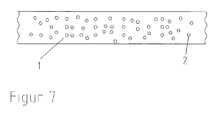
- the core has a number of spaced penetrations (bores, channels, honeycomb open honeycomb). Through these penetrations extend the connecting elements whose ends are connected outside the core with the base layer and the cover layer. The number, the local arrangement of the penetrations and their distances from each other are determined by the individual load of the multilayer composite material.
- the multilayer coating material has a geometrically determined, regular arrangement of the equidistant penetrations with the connecting elements arranged therein.
- a layer material formed in this way can advantageously be used with a uniform load (bending, torsion) in all areas of the future construction part. Another advantage is the reduced production costs, since the multilayer coating materials formed in this way can be produced inexpensively in larger quantities or batch sizes or prefabricated as semi-finished products.
- Another advantage is that a multi-layered laminate with geometrically-determined, regular arrangement of equidistant penetrations can be used for lower loads in modified form. Not all penetrations also have connecting elements which connect the base layers to one another. Thus, at lower forces and moments and uniform load only every second or third penetration can be provided with a connecting element.
- a decisive advantage of the innovative multi-layer coating material is that with different load cases in the individual areas of the future construction part, the number of connecting elements, their distances from one another and the geometric distribution can be individually adapted to the voltages to be absorbed.
- the outer edge zones of the board are loaded by extreme bending cycle stress.
- the pressure forces and moments must be transferred from the driver's standing position to the heavily loaded edge zones. This is done according to the prior art by laminating horizontally extending ribs that extend from the footprint of the driver to the edge zones.
- a major disadvantage of this solution is that the intermediate middle area of the board is stiffened. As a result, the board loses the desired flexibility / softness, which is a prerequisite for driving in deep snow.
- Another disadvantage is that the fracture tendency and the risk of tearing off the adjacent base layers are significantly increased by the horizontally extending ribs.
- the number and distribution of the essentially vertically extending connecting elements can advantageously be individually adapted to the load situation. So the single or small series manufacturer of sports equipment can fall back on prefabricated semi-finished products, in which core and base layers a geometrically equally distributed arrangement of Having penetrations with loosely arranged, vertically extending connecting elements.
- core and base layers a geometrically equally distributed arrangement of Having penetrations with loosely arranged, vertically extending connecting elements.
- individual fasteners can be removed to achieve the desired softness / flexibility of the board.
- the installation voltage of the connecting elements in individual areas of the board can be increased by suitable means.
- the number, distribution and amount of bias of the fasteners may be individually adjusted to the particular load situation (force application points from the frame / chassis, different spring durations at sports floors in the impact area or at the net).
- individual fibers or fiber bundles are used as connecting elements whose projecting ends are frayed and spread on the core surface.
- the individual fibers of the fiber bundles are optionally spliced or twisted.
- the fiberized ends of the fibers are then soaked in resin.
- the inner surfaces of the upper and lower support layers are also soaked in resin, placed on the core surface and bonded together under pressure and high temperatures.
- the joining area between the connecting elements and the supporting layer lying thereon is increased.
- all but the outermost base layer are formed with mutually aligned penetrations, in particular holes or channels, at the same positions as at the core, through which the connecting elements are guided.
- ends of the fasteners are positioned between the outermost support layer and the underlying support layer to interconnect these layers. If fibers or fiber bundles are used as connecting elements, the ends of the frayed connecting elements and the support layer surfaces are also soaked in resin, placed on the core and then connected the overall composite with each other under increased pressure and elevated temperature. This ensures optimal cohesion.
- single fibers or fiber bundles made of glass fiber, carbon fiber or textile fiber are preferably used.
- the individual fibers have an abrasion-resistant sheath.
- the fibers or fiber bundles in the region of the penetrations (2) are connected in a completely cohesive manner to the adjacent wall of the penetration (2).
- the fibers or fiber bundles are impregnated with a suitable resin before being introduced into the penetrations (2) and then filled with remaining cavities.
- the projecting ends (3o, 3u) of the connecting elements (3) are preferably frayed or dish-shaped.
- the connection of the projecting ends of the connecting elements (3) takes place cohesively by gluing, by thermal melting of the fiber ends or by mechanical means, for. B. by brackets.
- the ends of the connecting elements (3) are glued directly to the surface of the support layer (4).
- the projecting ends of the connecting elements (3) are preferably fixed on the supporting layer (4) or on their side surface by mechanical connecting means (eg brackets).
- Another advantageous and likewise preferred possibility is the incorporation of the loose ends of the connecting elements (3) in flexible clamping mechanisms or closures.
- the connecting elements (3) can be stretched, re-tensioned or relieved depending on the condition of use. It is still possible that the Connecting elements (3) guided by other reinforcing elements and bonded to these either or mechanical (knotting, sewing) are connected
- connection elements (3) On the connecting elements (3) additional coating materials can be applied. Before coating, unevenness caused by the connecting elements can be leveled out with compensating masses. In certain applications, such as the manufacture of end walls for trucks, the differences in height caused by the connecting elements (3), must not be equalized.
- An essential advantage of the innovative, multilayer coating material is that the coating material can be individually adapted to the existing load situation of the application. Thus, it is possible to tune the number of substantially vertically extending connecting elements (3) and the distance and the distribution of the connecting elements (3) with each other on the load situation.
- honeycomb cores the already existing, vertical cavities can be used as penetrations (2) for laying the preferably fibrous connecting elements (3).
- the penetrations can be made by mechanical means, laser or water jet machining.
- cores with honeycomb structure or foamed cores offer the advantage of a significant weight reduction.
- the fuel consumption of the vehicles is significantly reduced by the lightweight construction.
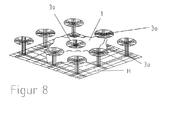
- the projecting ends of the connecting elements (3) are connected to one another in a network or matrix-like manner at least on one side.
- the stresses are transmitted uniformly on the surface of the respective support layer.
- a defined axial preload can be introduced into the component via the horizontally arranged network or matrix-shaped structures.
- sensors (Y) are arranged on or in the substantially vertically extending connecting elements (3) or the elastic fibers or fiber bundles of the horizontal, network or matrix-shaped structure (H).
- sensors (Y) strain gauges can be used in the simplest case, the changes in length at the penetrations (2), the connecting elements (3) or the horizontally extending fibers of the network structure (H) detect and transmit this information to a data acquisition system. This means that critical load situations can be detected and documented in good time for safety-relevant modules.
- the multilayer coating material is preferably used as a finished product or as a semi-finished product for the production of sports equipment.
- the innovative composite material preferably offers the possibility of adapting the design of the sports equipment to the specific stress situation of a particular sport, in particular trend sports, and at the same time to the individual conditions of the user (height, body weight, posture, driving style) ,
- the innovative composite material for vehicle construction for the production of dynamically highly stressed assemblies, such as rotor blades of wind turbines, in particular in the offshore sector, for vehicle, ship and aircraft construction.
- a multilayer composite material is produced in which - depending on the expected or predicted load situation - the number and determines the position of the numerically determined connecting elements (3) and introduced by known technological methods (drilling, laser processing), the penetrations (2) in the core and the underlying or underlying support layers.
- the fibers or fiber bundles preferably provided with an abrasion-resistant sheathing, are positioned in the penetrations (2) and the protruding ends of the connecting elements (3) are detachable or inseparable from the surface of the respective support layer and / or with an optional, horizontally extending net - or matrix-shaped structure (H) of fibers or fiber bundles connected.
- the connecting elements (3) and the horizontally extending network or matrix-shaped structural elements (H) are preimpregnated (PREPEG) and applied after installation with thermal energy and thus realized a secure bonding.
- PREPEG preimpregnated
- the layer material in a likewise preferred development on a lateral protection.
- the protective side walls are integrated. They run laterally on the sliding board in its longitudinal direction.
- the side cheeks direct the forces from the top chord to the respective edge or bottom chord.
- the side cheeks are preferably made in two parts and articulated (positive fit) and waterproof connected to each other.
- the complex composition of layer cores made of different materials is therefore no longer necessary.
- the durability and load of the sliding board also increases considerably.
- the ability to determine the number and the spatial arrangement of the vertical fasteners and their material properties (strength, modulus of elasticity) depending on the load situation, the desired performance of the sliding board (softness / flexibility) at the same time excellent resistance to breakage or the shearing of individual layers of the coating material on the one hand on the stringer cheek frame or on the locally different bias of the connecting elements can be realized.
- the use of the innovative multilayer coating material as a loading floor for commercial vehicles advantageously offers the possibility of also connecting the vertical reinforcing elements directly to parts of the vehicle frame. This makes the overall construction more resilient and less susceptible to twisting or jerking loads, such as when driving off-road or when driving over obstacles such as walkway fasteners or curbs.
- sports floor is a multi-part floor system to understand that usually consists of damping elements, a slatted substructure and a coated tread (for example, a linoleum-coated wood material).
- a coated tread for example, a linoleum-coated wood material.
- the flexibility is realized over the entire system.
- the relatively stiff elements of a sports floor often break under dynamic load.
- the innovative sports floor panel can be stretched due to the horizontal and vertical fiber strands and is therefore movable within defined limits.
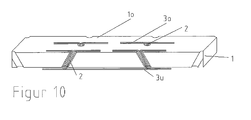
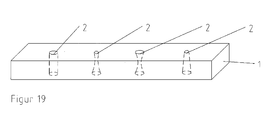
- the core 1 made of wood laminate is first provided with holes 2. Through these holes 2 glass fibers 3 are guided, the ends 3o and 3u protrude from the core 1. These ends 3o and 3u are frayed and spread over the upper and lower core surfaces 1o and 1u to increase the bonding area of the respective fiber with the supporting layer (upper and lower chords) 4o and 4u thereon.
- the upper support layer (top chord) 4o consisting of glass fiber, and the ends 3o of the glass fibers (connecting elements) are soaked in resin.
- the same steps are carried out with the lower support layer (lower flange) 4u, which is also made of fiberglass.
- the core 1 is connected to the upper and lower belt 4o and 4u under pressure and elevated temperatures (80 - 100 ° C) over a period of 25 min. Furthermore, the cover layer D on the outer surface the upper belt A4o and the sliding coating G glued to the outer surface of the lower flange A4u.
- the production of the snowboard with honeycomb core 1 is analogous to the production of the snowboard with a laminated wood core 1.
- no holes 2 are necessary because the required for the connecting elements 3 penetrations 2 already exist through the honeycomb structure.
- glass fibers 3 are guided whose ends 3o and 3u project out of the core 1.
- the upper support layers (top flange) 4o, 5o and 6o consist of the 3 glass-fiber laminates, the middle 5o and directed to the core 1 support layer 4o are provided with holes B through which the connecting elements 3, which protrude from the core 1, be guided.
- the end 3o of the connecting member is frayed between the middle 50 and the outer supporting layer 6o and spread over the surface to increase the bonding area of the respective fiber with the supporting layer 6o thereon.
- the fiberized end 3o of the glass fiber (connecting element) 3 is soaked in resin.
- the surfaces between the individual support layers and the surface of the core 1o are soaked in resin.
- the same steps are carried out with the lower support layers (lower chord U) 4u, 5u and 6u, which also consist of 3 glass fiber laminates.
- the core 1 is connected to the upper and lower belt O and U under pressure and high temperatures (80 -100 ° C) over a period of 25 min.
- the middle support layers 5o and 5u and the core 1 directed to the support layers 4o and 4u are firmly connected to the core 1.
- the cover layer D is adhered to the outer surface of the upper flange O and the sliding layer G on the outer surface of the lower flange U.
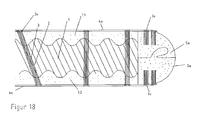
- glass fibers are integrated as a connecting element 3 in the production of the foam core. These protrude with their ends 3o and 3u out of the foam core 1.
- the ends 3o and 3u of the glass fibers 3 are frayed and spread over the upper and lower core surfaces 1o and 1u to the connecting surface of the respective fiber with the supporting layer thereon ( Upper and lower belt) 4o and 4u increase.
- the upper support layer (top chord) 4o made of glass fiber and the ends 3o of the glass fibers (connecting elements) are soaked in resin.
- the same steps are carried out with the lower support layer (lower flange) 4u, which is also made of fiberglass.
- two-part side cheeks S (upper and lower side cheeks So, Su) and edges K are attached to the longitudinal sides of the snowboard or the core 1.
- the sidewalls So and Su are articulated and waterproof.
- the core 1 is connected to the upper and lower belt 4o and 4u, the side cheeks S and the edges K under pressure and elevated temperatures (80 - 100 ° C) over a period of 25 min.
- the cover layer D is adhered to the outer surface of the upper belt A4o and the sliding coating G on the outer surface of the lower belt A4u.
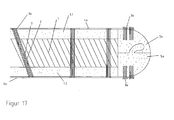
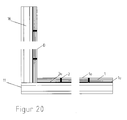
- FIG. 20 shows a schematic representation of the vehicle frame (11) of a truck with end wall (16).
- a number of inventive, multi-layer vehicle panels are mounted, which consist of a number of glued veneers.
- the plate thickness is preferably 21 mm.
- the plate surfaces are coated with a cover layer (D) for their protection.
- the narrow surfaces of the plates are provided with a liquid system and the other plate surfaces with phenol-impregnated kraft paper.
- the innovative solution counteracts the roller thrust that is caused by forklift trucks when driving on the loading surface.
- sports floor is to be understood as a floor system. This usually consists of damping elements, a slatted substructure and a coated tread (for example, a linoleum-coated wood material). In the case of conventional sports floors flexibility is realized via the system. At present, the relatively stiff elements of a sports floor (tread material and slatted substructure) often break under dynamic load.
- the core (1) of the multilayer plate forms a chipboard. It is glued as the upper surface layer of an elastic flooring over the entire surface.
- the innovative sports floor panel can be stretched defined on the basis of the horizontally extending network or matrix-shaped structures (H) and the vertically arranged connecting elements (3).
- the material according to the invention is movable within limits.
- the innovative stage floor is multi-layered.
- the middle zone which forms the core (1), consists of plywood.
- solid wood slats (15) are glued, which form the base layer and the top layer.
- the nominal thickness is 45 mm.
- sensors (Y) for detecting material characteristic values are preferably arranged on or in the connecting elements (3), which are connected to a data acquisition system in FIG Connection stand.
Landscapes
- Engineering & Computer Science (AREA)
- Mechanical Engineering (AREA)
- Textile Engineering (AREA)
- Life Sciences & Earth Sciences (AREA)
- Wood Science & Technology (AREA)
- Chemical & Material Sciences (AREA)
- Composite Materials (AREA)
- Laminated Bodies (AREA)
Applications Claiming Priority (1)
| Application Number | Priority Date | Filing Date | Title |
|---|---|---|---|
| DE102008047408A DE102008047408B4 (de) | 2008-09-05 | 2008-09-05 | Gleitbrett |
Publications (2)
| Publication Number | Publication Date |
|---|---|
| EP2204276A2 true EP2204276A2 (fr) | 2010-07-07 |
| EP2204276A3 EP2204276A3 (fr) | 2011-08-03 |
Family
ID=41650885
Family Applications (1)
| Application Number | Title | Priority Date | Filing Date |
|---|---|---|---|
| EP09011416A Ceased EP2204276A3 (fr) | 2008-09-05 | 2009-09-04 | Matière en couche multiple et procédé pour sa fabrication |
Country Status (2)
| Country | Link |
|---|---|
| EP (1) | EP2204276A3 (fr) |
| DE (1) | DE102008047408B4 (fr) |
Cited By (3)
| Publication number | Priority date | Publication date | Assignee | Title |
|---|---|---|---|---|
| EP2450086A1 (fr) | 2010-11-08 | 2012-05-09 | Skis Rossignol | Planche de glisse comportant un noyau allege |
| CN106273826A (zh) * | 2016-08-06 | 2017-01-04 | 湖北裕民防护用品有限公司 | 一种复合无纺布及其制备方法 |
| CN113829627A (zh) * | 2021-10-26 | 2021-12-24 | 广州环岛体育运动设备有限公司 | 一种线拉带充气模型 |
Families Citing this family (4)
| Publication number | Priority date | Publication date | Assignee | Title |
|---|---|---|---|---|
| AU2011369470A1 (en) | 2011-05-31 | 2014-01-09 | CHOTIKAPANICH, Danu | Composite materials and articles comprising the same |
| CN102795254B (zh) * | 2012-08-24 | 2015-04-22 | 黄东艳 | 一种滑板的制作工艺 |
| CA3142121A1 (fr) * | 2019-05-31 | 2020-12-03 | Abc Technologies Inc. | Plancher de chargement avec composants electroniques |
| CN110792192A (zh) * | 2019-10-30 | 2020-02-14 | 中国京冶工程技术有限公司 | 一种多重夹芯建筑外围护结构及其制造工艺 |
Citations (2)
| Publication number | Priority date | Publication date | Assignee | Title |
|---|---|---|---|---|
| DE2941949A1 (de) | 1979-10-17 | 1981-04-30 | Metzeler Schaum Gmbh, 8940 Memmingen | Kunststoffski und verfahren zu seiner herstellung |
| EP0846479B1 (fr) | 1996-12-04 | 2004-06-30 | Alpitech S.r.l. | Snowboard, ski nautique ou similaire avec poids léger et résistance méchanique élevée |
Family Cites Families (7)
| Publication number | Priority date | Publication date | Assignee | Title |
|---|---|---|---|---|
| US2908506A (en) * | 1957-03-18 | 1959-10-13 | Russell Mfg Co | Ski or sled runner |
| US3352566A (en) * | 1966-05-13 | 1967-11-14 | Peter Kennedy Inc | Composite metal and plastic ski and method for making same |
| DE69916412T3 (de) * | 1999-01-28 | 2012-08-16 | Mcdonnell Douglas Corp. | Verstärkungselement für Verbundwerkstoffteile und dazugehörige Verfahren |
| DE10018035A1 (de) * | 2000-04-03 | 2001-10-18 | Nils Helbig | Kernwerkstoff für Sandwichkonstruktionen |
| US6676785B2 (en) * | 2001-04-06 | 2004-01-13 | Ebert Composites Corporation | Method of clinching the top and bottom ends of Z-axis fibers into the respective top and bottom surfaces of a composite laminate |
| ITMI20050119A1 (it) * | 2005-01-28 | 2006-07-29 | Top Glass Spa | Struttura di pannello e relativo procedimento di realizzazione |
| DE102005024408A1 (de) * | 2005-05-27 | 2006-11-30 | Airbus Deutschland Gmbh | Verstärkung von Schaumwerkstoffen |
-
2008
- 2008-09-05 DE DE102008047408A patent/DE102008047408B4/de not_active Expired - Fee Related
-
2009
- 2009-09-04 EP EP09011416A patent/EP2204276A3/fr not_active Ceased
Patent Citations (2)
| Publication number | Priority date | Publication date | Assignee | Title |
|---|---|---|---|---|
| DE2941949A1 (de) | 1979-10-17 | 1981-04-30 | Metzeler Schaum Gmbh, 8940 Memmingen | Kunststoffski und verfahren zu seiner herstellung |
| EP0846479B1 (fr) | 1996-12-04 | 2004-06-30 | Alpitech S.r.l. | Snowboard, ski nautique ou similaire avec poids léger et résistance méchanique élevée |
Cited By (4)
| Publication number | Priority date | Publication date | Assignee | Title |
|---|---|---|---|---|
| EP2450086A1 (fr) | 2010-11-08 | 2012-05-09 | Skis Rossignol | Planche de glisse comportant un noyau allege |
| FR2967080A1 (fr) * | 2010-11-08 | 2012-05-11 | Rossignol Sa | Planche de glisse comportant un noyau allege |
| CN106273826A (zh) * | 2016-08-06 | 2017-01-04 | 湖北裕民防护用品有限公司 | 一种复合无纺布及其制备方法 |
| CN113829627A (zh) * | 2021-10-26 | 2021-12-24 | 广州环岛体育运动设备有限公司 | 一种线拉带充气模型 |
Also Published As
| Publication number | Publication date |
|---|---|
| DE102008047408B4 (de) | 2011-08-25 |
| EP2204276A3 (fr) | 2011-08-03 |
| DE102008047408A1 (de) | 2010-03-11 |
Similar Documents
| Publication | Publication Date | Title |
|---|---|---|
| EP2204276A2 (fr) | Matière en couche multiple et procédé pour sa fabrication | |
| DE60009857T2 (de) | Kern für gleitbrett | |
| AT410518B (de) | Kern für ein gleitbrett | |
| DE8330595U1 (de) | Ski mit einem als Leichtbaukern ausgebildeten Stützkern mit zwei gegenüberliegenden Seiten | |
| DE3934555C2 (fr) | ||
| WO2011009627A1 (fr) | Corps composite | |
| AT400954B (de) | Gewebe, prepreg aus diesem gewebe, leichtbauteil aus derartigen prepregs, überkopf-gepäckablage für flugzeuge | |
| WO2016150908A1 (fr) | Dispositif de montage | |
| DE4017539A1 (de) | Ski mit einem zumindest im obergurt integrierten sandwichgurt | |
| DE102006051989B4 (de) | Versteifte Beplankung für ein Luft- oder Raumfahrzeug mit einem Laminat-Stringer hoher Steifigkeit | |
| DE69910051T2 (de) | Bodenplatte für fahrzeugboden | |
| DE60204747T2 (de) | Biegeplatte | |
| EP2552558B1 (fr) | Accessoire de jeu ou sport de glisse avec au moins deux couches, chacune comprenant des champs ayant des fibres avec des orientations différentes | |
| DE112004002400T5 (de) | Gleitbrett mit Schwingung absorbierender Schicht | |
| EP2353670B1 (fr) | Planche de surf sur neige | |
| AT406825B (de) | Hockeyschläger | |
| EP1601425B1 (fr) | Planche de glisse, en particulier ski | |
| EP0993325B1 (fr) | Planche pour la glisse sur la neige | |
| DE2718002C3 (de) | Mehrschichtiger plattenförmiger Verbundwerkstoff | |
| AT413797B (de) | Gleitbrett, insbesondere ski, und verfahren zur herstellung | |
| AT507828B1 (de) | Skibindung | |
| DE19910201A1 (de) | Kettfaden-Faserschicht | |
| DE29904191U1 (de) | Kettfaden-Faserschicht | |
| DE3906170C2 (fr) | ||
| EP2147782A1 (fr) | Plaque composite |
Legal Events
| Date | Code | Title | Description |
|---|---|---|---|
| PUAI | Public reference made under article 153(3) epc to a published international application that has entered the european phase |
Free format text: ORIGINAL CODE: 0009012 |
|
| AK | Designated contracting states |
Kind code of ref document: A2 Designated state(s): AT BE BG CH CY CZ DE DK EE ES FI FR GB GR HR HU IE IS IT LI LT LU LV MC MK MT NL NO PL PT RO SE SI SK SM TR |
|
| AX | Request for extension of the european patent |
Extension state: AL BA RS |
|
| PUAL | Search report despatched |
Free format text: ORIGINAL CODE: 0009013 |
|
| AK | Designated contracting states |
Kind code of ref document: A3 Designated state(s): AT BE BG CH CY CZ DE DK EE ES FI FR GB GR HR HU IE IS IT LI LT LU LV MC MK MT NL NO PL PT RO SE SI SK SM TR |
|
| AX | Request for extension of the european patent |
Extension state: AL BA RS |
|
| RIC1 | Information provided on ipc code assigned before grant |
Ipc: B32B 5/14 20060101ALI20110628BHEP Ipc: B32B 5/02 20060101ALI20110628BHEP Ipc: B29C 70/24 20060101AFI20110628BHEP |
|
| 17P | Request for examination filed |
Effective date: 20120203 |
|
| 17Q | First examination report despatched |
Effective date: 20120521 |
|
| STAA | Information on the status of an ep patent application or granted ep patent |
Free format text: STATUS: THE APPLICATION HAS BEEN REFUSED |
|
| 18R | Application refused |
Effective date: 20130201 |