EP2204397B1 - Hydrogels à base de copolymère biodégradable - Google Patents
Hydrogels à base de copolymère biodégradable Download PDFInfo
- Publication number
- EP2204397B1 EP2204397B1 EP09173765A EP09173765A EP2204397B1 EP 2204397 B1 EP2204397 B1 EP 2204397B1 EP 09173765 A EP09173765 A EP 09173765A EP 09173765 A EP09173765 A EP 09173765A EP 2204397 B1 EP2204397 B1 EP 2204397B1
- Authority
- EP
- European Patent Office
- Prior art keywords
- biodegradable copolymer
- copolymer hydrogel
- biodegradable
- hydrogel
- plga
- Prior art date
- Legal status (The legal status is an assumption and is not a legal conclusion. Google has not performed a legal analysis and makes no representation as to the accuracy of the status listed.)
- Active
Links
Images



Classifications
-
- C—CHEMISTRY; METALLURGY
- C08—ORGANIC MACROMOLECULAR COMPOUNDS; THEIR PREPARATION OR CHEMICAL WORKING-UP; COMPOSITIONS BASED THEREON
- C08G—MACROMOLECULAR COMPOUNDS OBTAINED OTHERWISE THAN BY REACTIONS ONLY INVOLVING UNSATURATED CARBON-TO-CARBON BONDS
- C08G63/00—Macromolecular compounds obtained by reactions forming a carboxylic ester link in the main chain of the macromolecule
- C08G63/91—Polymers modified by chemical after-treatment
- C08G63/912—Polymers modified by chemical after-treatment derived from hydroxycarboxylic acids
-
- C—CHEMISTRY; METALLURGY
- C08—ORGANIC MACROMOLECULAR COMPOUNDS; THEIR PREPARATION OR CHEMICAL WORKING-UP; COMPOSITIONS BASED THEREON
- C08G—MACROMOLECULAR COMPOUNDS OBTAINED OTHERWISE THAN BY REACTIONS ONLY INVOLVING UNSATURATED CARBON-TO-CARBON BONDS
- C08G63/00—Macromolecular compounds obtained by reactions forming a carboxylic ester link in the main chain of the macromolecule
- C08G63/02—Polyesters derived from hydroxycarboxylic acids or from polycarboxylic acids and polyhydroxy compounds
- C08G63/06—Polyesters derived from hydroxycarboxylic acids or from polycarboxylic acids and polyhydroxy compounds derived from hydroxycarboxylic acids
- C08G63/08—Lactones or lactides
-
- C—CHEMISTRY; METALLURGY
- C08—ORGANIC MACROMOLECULAR COMPOUNDS; THEIR PREPARATION OR CHEMICAL WORKING-UP; COMPOSITIONS BASED THEREON
- C08G—MACROMOLECULAR COMPOUNDS OBTAINED OTHERWISE THAN BY REACTIONS ONLY INVOLVING UNSATURATED CARBON-TO-CARBON BONDS
- C08G63/00—Macromolecular compounds obtained by reactions forming a carboxylic ester link in the main chain of the macromolecule
- C08G63/66—Polyesters containing oxygen in the form of ether groups
- C08G63/664—Polyesters containing oxygen in the form of ether groups derived from hydroxy carboxylic acids
-
- C—CHEMISTRY; METALLURGY
- C08—ORGANIC MACROMOLECULAR COMPOUNDS; THEIR PREPARATION OR CHEMICAL WORKING-UP; COMPOSITIONS BASED THEREON
- C08G—MACROMOLECULAR COMPOUNDS OBTAINED OTHERWISE THAN BY REACTIONS ONLY INVOLVING UNSATURATED CARBON-TO-CARBON BONDS
- C08G63/00—Macromolecular compounds obtained by reactions forming a carboxylic ester link in the main chain of the macromolecule
- C08G63/66—Polyesters containing oxygen in the form of ether groups
- C08G63/668—Polyesters containing oxygen in the form of ether groups derived from polycarboxylic acids and polyhydroxy compounds
-
- C—CHEMISTRY; METALLURGY
- C08—ORGANIC MACROMOLECULAR COMPOUNDS; THEIR PREPARATION OR CHEMICAL WORKING-UP; COMPOSITIONS BASED THEREON
- C08G—MACROMOLECULAR COMPOUNDS OBTAINED OTHERWISE THAN BY REACTIONS ONLY INVOLVING UNSATURATED CARBON-TO-CARBON BONDS
- C08G63/00—Macromolecular compounds obtained by reactions forming a carboxylic ester link in the main chain of the macromolecule
- C08G63/91—Polymers modified by chemical after-treatment
Definitions
- the invention relates to a hydrogel, and more particularly to a biodegradable copolymer hydrogel.
- biomaterials such as synthetic or natural matrix serving as carriers
- biomaterials are provided to be implanted in the desired region to facilitate cell seeding.
- approximately 30% of tissue reconstruction processes performed relate to bone tissue reconstruction.
- the bone fixation device such as a K-pin, bone nail, or cable or anchor, had a micro-textured contact surface to enhance the installation or gripping characteristics thereof.
- bone fixation devices For soft tissues, adherence to the bone fragments are peeled off before using bone fixation devices, thereby causing poor circulation of blood and increasing risk of nonunion fracture. In addition, when using bone fixation devices for soft tissues, bone fragments are further disintegrated following the surgical operation.
- the bone cement can provide sufficient strength for the bone fracture at an early stage. Patients using the bone cement are not apt to develop allergies thereto due to the biologically inert properties thereof. Specifically, the bone cement is non-biodegradable. Therefore, the fixation of bone fragments using the bone cement is not a substantially complete bone union and the bone cement is not suitable for traumatic fractures.
- PMMA polymethyl methacrylate
- sutureless anchors and knotless anchors are used to substitute suture anchors in order to avoid histological reactions resulting from knots and reduce the surgical time.
- the sutureless anchor is apt to cause ridgy regenerative tissues due to stress, resulting in the ridgy regenerative tissues and the original tissues not being able to dovetail into each other.
- a bioadhesion can be further used to increase the anastomosis between the original tissues and the regenerative tissues fixed by the knotless anchors or sutureless anchors, enhancing the regeneration of tissues.
- bioadhesion can be applied in the ischemic necrosis of femoral head repair, such as the reconstruction of a hip joint.
- Avascular necrosis is a disease, for young adults, resulting from the temporary or permanent loss of blood supply to bones. With early diagnosis, at least 75% of the patient with AVN can recover after treatment.
- Various treatments for AVN focus on salvaging the head of the femur or other bone or joint such as core decompression.
- a necrotic tissue is first removed and packed with an autologous cancellous bone leaving room for the insertion of an autologous fibular graft with an autologous fibular graft vascular pedicle, the peroneal vessels, attached, to provide abundant blood flow to the head of a femur.
- An anastomosis is performed between the lateral circumflex vessels and the fibula vascular pedicle.
- a bioadhesion can be used, combined with a drug and implanted into the femoral head. With the degradation of bioadhesion, the drug is gradually released, facilitating the regeneration of bones and veins.
- bioactive substance e.g. drugs, growth factors, nucleic acids etc.
- delivery carriers must provide biocompatible and biodegradable properties for feasible implantation.
- the material is a fluid ex vivo for easy mixing with drugs and transformation into a gel after being injected into the body by a syringe, catheter or laparoscope for delivering the bioactive substances to the desired tissue area. After, the drugs are released over time, achieving a therapeutic effect.
- U.S. Pat. No. 5,514,380 discloses a biodegradable copolymer gel with controllable release profiles.
- the biodegradable copolymer gel which is a multi-block copolymer, comprises hydrophilic polymer chains such as polyethyleneoxide (PEO) and hydrophobic polymer chains such as polylactic acid (PLA), polyglycolide acid (PGA), polylactide- glycolide (PLGA), or polycaprolactone (PCL).
- PEO polyethyleneoxide
- PLA polylactic acid
- PGA polyglycolide acid
- PLGA polylactide- glycolide
- PCL polycaprolactone
- U.S. Pat. No. 5,702,717 , U.S. Pat. No. 6,004,573 , U.S. Pat. No. 6,117,949 and U.S. Pat. No. 6,117,949 disclose a temperature sensitive tri-block biodegradable copolymer, represented by ABA or BAB, wherein A is polyester and B is polyethylene glycol, with a average molecular weight of 2000-4990 g/mole. Due to the reverse thermal gelation properties of the biodegradable copolymer, when an aqueous composition including the biodegradable copolymer and a drug is heated (for example: when injected into a human body) over its gelation temperature, its viscosity increases and it transforms into a gel.
- ABA temperature sensitive tri-block biodegradable copolymer
- the drug release rate can be controlled by the in vivo hydrolysis rate of the gel.
- the hydrolysate of the biodegradable copolymer has no cytotoxicity.
- the biodegradable copolymers have a lower critical solution temperature (LCST) of more than 37°C, and the patents do not provide examples proving that the biodegradable copolymers can serve as drug release rate controlling materials.
- U.S. Pat. No. 6,136,333 discloses a block copolymer represented by AB or ABA, wherein A is polyester, and B is polyoxyalkylene.
- the AB di-block copolymer had an EO/LA ratio of between 0.1-100, wherein the cross-linking agent is hexamethylene diisocyanate (HMDI).
- HMDI hexamethylene diisocyanate
- the block copolymer can serve as anti-adhesion materials, but the patent makes no mention of temperature sensitivity of the block copolymer.
- the biodegradable copolymer hydrogel of the invention comprises a two-phase block copolymer represented by A-B-BOX-B-A or B-A-B- BOX-B-A-B, wherein A is a hydrophilic block such as a hydrophilic polyethylene glycol polymer, B a hydrophobic block such as a hydrophobic polyester polymer, and BOX a bifunctional group monomer of 2, 2'-Bis(2-oxazoline).
- A is a hydrophilic block such as a hydrophilic polyethylene glycol polymer
- B a hydrophobic block such as a hydrophobic polyester polymer
- BOX a bifunctional group monomer of 2, 2'-Bis(2-oxazoline).
- the biodegradable copolymer hydrogel is prepared by cross-linking the di-block A-B or the tri-block B-A-B via ring-opening polymerization in presence of a bifunctional group monomer (2, 2'-Bis(2-oxazo
- An exemplary embodiment of a biodegradable copolymer hydrogel includes a copolymer represented by Formula (I) of
- A comprises a hydrophilic polyethylene glycol polymer
- B comprises a hydrophobic polyester polymer
- BOX comprises a bifunctional group monomer of 2, 2'-Bis(2-oxazoline) for coupling the di-blocks A-B.
- BOX is a bifunctional group monomer of 2, 2'-Bis(2-oxazoline) for coupling the di-blocks A-B.
- the di-block A-B is reacted with 2, 2'-Bis(2-oxazoline) via ring-opening polymerization to form the copolymer represented by Formula (I).
- biodegradable copolymer hydrogel includes a copolymer represented by Formula (II) of
- A comprises a hydrophilic polyethylene glycol polymer
- B comprises a hydrophobic polyester polymer
- BOX comprises a bifunctional group monomer of 2, 2'-Bis(2-oxazoline) for coupling the tri-blocks B-A-B
- n is an integer, equal to or greater than 0.
- BOX is a bifunctional group monomer of 2, 2'-Bis(2-oxazoline) for coupling the tri-blocks B-A-B.
- the hydrophilic polyethylene glycol polymer (A) can be polyethylene glycol polymer or methoxy-poly(ethylene glycol).
- the hydrophilic polyethylene glycol polymer can be polyethylene glycol polymer or methoxy-poly(ethylene glycol).
- an end, preferably one end, of the hydrophobic polyester polymer (B) which is not bonded with the hydrophilic polyethylene glycol polymer (A) has an end capping/coupling functional group
- the hydrophobic polyester polymer (B) is preferably bonded with the BOX via the end capping/coupling functional group.
- the end capping/coupling functional group can be derived from an end capping/coupling agent, wherein the end capping/coupling agent comprises an anhydride such as succinic anhydride, maleic anhydride, phthalic anhydride, or sebacic anhydride.
- the biodegradable copolymer hydrogel of the invention is water-soluble. In low added amounts, the biodegradable copolymer hydrogel is apt to form polymeric micelles. In high added amounts (more than 10 wt%), the biodegradable copolymer exhibits reverse thermal gelation properties and has a low critical solution temperature of 10-90°C, preferably 20-45°C.
- the biodegradable copolymer hydrogel behaves as a liquid with low viscosity below the critical solution temperature. After heating, the viscosity of the biodegradable copolymer hydrogen quickly rises, undergoing a reversible liquid-gel (or semi-solid) phase transition.
- the hydrophobic polyester polymer (B) of the biodegradable copolymer hydrogel is hydrolyzable. It should be noted that, after long-period degradation, the hydrolysate of the hydrophobic polyester polymer (B) is non-toxicity since the hydrolysate has a pH value of more than 5.0.
- the hydrophilic polyethylene glycol polymer (A) of the biodegradable copolymer hydrogel is also hydrolyzable and can be discharged harmlessly from the body through the urethra.
- the biodegradable copolymer hydrogel of Formula (I) and/or (II) according to the present invention has no cytotoxicity after degradation.
- the invention provides a biodegradable copolymer hydrogel with high temperature sensitivity, biodegradable properties, and no cytotoxicity after degradation.
- the aqueous solution containing the biodegradable copolymer hydrogel is a mobile liquid ex vivo (room temperature), and a gel in vivo (or by heating).
- the biodegradable copolymer hydrogel is suitable to serve as a temperature sensitive hydrogel and can be applied for drug release, cells delivery, growth factors delivery, nucleic acids delivery, tissue engineering, repair of soft and hard tissues, or bioadhesion.
- the biodegradable copolymer hydrogel can serve as a bioadhesion for adhering interfaces of cells, tissues, and implants, repair of soft and hard tissues, or implant fillers.
- biodegradable copolymer hydrogel can be further mixed with a biological activity compound, ceramics, polymer, or metal and serve as a carrier of an injection, pastille, powder, gel or oral liquid.
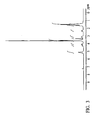
- Fig. 1 shows a 1 H NMR spectrum of biodegradable copolymer hydrogel (A) disclosed in Example 1 of the invention.
- Fig. 2 shows a 1 H NMR spectrum of biodegradable copolymer hydrogel (B) disclosed in Example 2 of the invention.
- Fig. 3 shows a 1 H NMR spectrum of biodegradable copolymer hydrogel (C) disclosed in Example 3 of the invention.
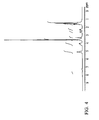
- Fig. 4 shows a 1 H NMR spectrum of biodegradable copolymer hydrogel (D) disclosed in Example 4 of the invention.
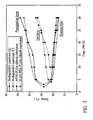
- Fig. 5 shows the phase transition diagrams of the biodegradable copolymer hydrogels (A), (C) disclosed in Examples 1, and 3 mPEG-PLGA di-block copolymer disclosed in Comparative Example 1 and PLGA-PEG-PLGA tri-block copolymer disclosed in Comparative Example 2.
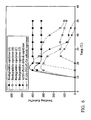
- Fig. 6 shows a graph plotting swelling ratio against temperature for the biodegradable copolymer hydrogels (A)-(D) disclosed in Examples 1-4 the mPEG-PLGA di-block copolymer disclosed in Comparative Example 1 and the PLGA-PEG-PLGA tri-block copolymer disclosed in Comparative Example 2.
- Fig. 7 shows a graph plotting degradation ratio against time for the biodegradable copolymer hydrogels (A)-(D) disclosed in Examples 1-4, the mPEG-PLGA di-block copolymer disclosed in Comparative Example 1 and the PLGA-PEG-PLGA tri-block copolymer disclosed in Comparative Example 2.
- a glass reactor 250 ml volume connecting with a condenser, a heater, and a thermostat was provided, wherein educts of the condenser wrapped with heating tape looped back and rejoined to the reactor.
- 10.04g of mPEG (methoxy poly(ethylene glycol) (with a molecular weight of 550g/mole) 20 g of lactide and 5.64 g of glycolide were added in the reactor, and the temperature was elevated slowly for complete dissolution. When the temperature reached and was sustained at 160°C, 14.0 ⁇ l of catalyst (stannous 2-ethylhexanoate) was added. After stirring for 8 hrs, the mPEG-PLGA di-block was obtained.
- biodegradable copolymer hydrogel (A) (the mPEG-PLGA di-block cross-linking by 2, 2'-Bis(2-oxazoline)).
- Preparation procedure of the biodegradable copolymer hydrogel (A) is shown as below:
- the molecule weight of the biodegradable copolymer hydrogel (A) was determined with a GPC, as shown in Table 1.
- the molecular configuration of the biodegradable copolymer hydrogel (A) was determined with an NMR, as shown in Fig. 1 .
- the biodegradable copolymer hydrogel (A) exhibited high temperature sensitivity. After measuring with a UV transmittancy test, the results showed the biodegradable copolymer hydrogel (A) was a transparent liquid under low temperature, a translucent viscous liquid at a temperature of 25 °C, and an opaque immobile gel at a temperature of 40°C.
- a glass reactor 250 ml volume connecting with a condenser, a heater, and a thermostat was provided, wherein educts of the condenser wrapped with heating tape looped back and rejoined to the reactor.
- 11.18g of mPEG (methoxy poly(ethylene glycol) (with a molecular weight of 550g/mole) 20 g of lactide and 8.57g of valerolactone were added in the reactor, and the temperature was elevated slowly for complete dissolution. When the temperature reached and was sustained at 160°C, 16.0 ⁇ l of catalyst (stannous 2-ethyl-hexanoate) was added. After stirring for 8 hrs, the mPEG-PVLA di-block was obtained.
- biodegradable copolymer hydrogel (B) (mPEG-PVLA di-block cross-linking by 2, 2'-Bis(2-oxazoline)).
- Preparation procedure of the biodegradable copolymer hydrogel (B) is shown as below:
- the molecule weight of the biodegradable copolymer hydrogel (B) was determined by a GPC, as shown in Table 1.
- the molecular configuration of the biodegradable copolymer hydrogel (B) was determined by an NMR, as shown in Fig. 2 .
- a glass reactor 250 ml volume connecting with a condenser, a heater, and a thermostat was provided, wherein educts of the condenser wrapped with heating tape looped back and rejoined to the reactor.
- 12.01g of PEG(poly(ethylene glycol)) (with a molecular weight of 1000g/mole)
- 25 g of lactide and 5.68g of glycolide were added in the reactor, and the temperature was elevated slowly for complete dissolution.
- 17.07 ⁇ l of catalyst stannous 2-ethylhexanoate
- biodegradable copolymer hydrogel (C) (the PLGA-PEG-PLGA tri-block cross-linking by 2, 2'-Bis(2-oxazoline)).
- Preparation procedure of the biodegradable copolymer hydrogel (C) is shown as below:
- the molecule weight of the biodegradable copolymer hydrogel (C) was determined by a GPC, as shown in Table 1.
- the molecular configuration of the biodegradable copolymer hydrogel (C) was determined by an NMR, as shown in Fig. 3 .
- the biodegradable copolymer hydrogel (C) exhibited high temperature sensitivity. After measuring by a UV transmittancy test, the results showed that the biodegradable copolymer hydrogel (A) was a transparent liquid under low temperature, a translucent viscous liquid at a temperature of 25 °C, and an opaque immobile gel at a temperature of 40°C.
- a glass reactor (250 ml volume) connecting with a condenser, a heater, and a thermostat was provided, wherein educts of the condenser wrapped with heating tape looped back and rejoined to the reactor.
- 25g of PEG(poly(ethylene glycol)) (with a molecular weight of 1000g/mole)
- 25 g of lactide and 10.71 g of valerolactone were added in the reactor, and the temperature was elevated slowly for complete dissolution.
- 17.53 ⁇ l of catalyst stannous 2-ethylhexanoate
- biodegradable copolymer hydrogel (D) (PVLA-PEG-PVLA tri-block cross-linking by 2, 2'-Bis(2-oxazoline)).
- D biodegradable copolymer hydrogel
- the molecule weight of the biodegradable copolymer hydrogel (D) was determined by a GPC, as shown in Table 1.
- the molecular configuration of the biodegradable copolymer hydrogel (D) was determined by an NMR, as shown in Fig. 4 .
- Table 1 Example sample Mw (g/mol) Mw/Mn 1 biodegradable copolymer hydrogel (A) 3917 1.46 2 biodegradable copolymer hydrogel (B) 4143 1.36 3 biodegradable copolymer hydrogel (C) 9401 1.23 4 biodegradable copolymer hydrogel (D) 8925 1.37
- a glass reactor 250 ml volume connecting with a condenser, a heater, and a thermostat was provided, wherein educts of the condenser wrapped with heating tape looped back and rejoined to the reactor.
- 14.24g of mPEG (methoxy poly(ethylene glycol) (with a molecular weight of 550g/mole) 25 g of lactide and 11.40g of glycolide were added in the reactor, and the temperature was elevated slowly for complete dissolution. When the temperature reached and was sustained at 160°C, 20.24 ⁇ l of catalyst (stannous 2-ethylhexanoate) was added. After stirring for 8 hrs, the mPEG-PLGA di-block was obtained.
- Preparation procedure of Comparative Example 1 is shown as below:
- biodegradable copolymer hydrogels (A)-(D) disclosed in Examples 1-4, the mPEG-PLGA di-block copolymer disclosed in Comparative Example 1 and the PLGA-PEG-PLGA tri-block copolymer disclosed in Comparative Example 2 were respectively measured by a lower critical solution temperature (LCST) test. The results are shown in Table 2.
- Example Sample LCST( ⁇ ) Example 1 biodegradable copolymer hydrogel (A) 42.56
- Example 2 biodegradable copolymer hydrogel (B) 41.25
- Example 3 biodegradable copolymer hydrogel (C) 73.32
- Example 4 biodegradable copolymer hydrogel (D) 43.79 Comparative Example 1 mPEG-PLGA di-block 25.09 Comparative Example 2 PLGA-PEG-PLGA tri-block 35.41
- the biodegradable copolymer hydrogel (A) (the mPEG-PLGA di-block cross-linking by BOX) had an LCST of over 15°C higher than that of the mPEG-PLGA di-block copolymer (as disclosed in Comparative Example 1); and the biodegradable copolymer hydrogel (C) (the PLGA-PEG-PLGA tri-block cross-linking by BOX) had an LCST of over 37°C higher than that of the PLGA-PEG-PLGA tri-block copolymer (as disclosed in Comparative Example 2).
- phase transition diagrams of the biodegradable copolymer hydrogels (A) and (C) disclosed in Examples 1 and 3, the mPEG-PLGA di-block copolymer disclosed in Comparative Example 1 and the PLGA-PEG-PLGA tri-block copolymer disclosed in Comparative Example 2 were respectively measured, as shown in Fig. 5 .
- gel form means the sample cannot instantly flow
- precipitation form means water is exhausted from the sample and liquid form and a gel form coexist in the sample (analogous precipitation).
- the biodegradable copolymer hydrogels (A)-(C) sharply undergoes a phase change from solution form to precipitation form when heated at temperature of over 30°C.
- the temperature difference between the solution form and the precipitation form was larger than 10°C, for copolymer concentrations of 5wt% and larger than 25°C for copolymer concentrations of 30wt%.
- the conventional mPEG-PLGA di-block copolymer and the PLGA-PEG-PLGA tri-block copolymer undergo a phase change from solution form to gel form when heated at a temperature of 23°C.
- the temperature difference between the solution form and the precipitation form was a mere 2-3 °C for copolymer concentrations of 5wt% and 12-14°C for copolymer concentrations of 30wt%.
- the biodegradable copolymer hydrogels (A)-(D) disclosed in Examples 1-4, the mPEG-PLGA di-block copolymer disclosed in Comparative Example 1 and the PLGA-PEG-PLGA tri-block copolymer disclosed in Comparative Example 2 were respectively measured to determine the swelling ratio thereof.
- the swelling ratio test includes: mixing the hydrogel or copolymer with deionized water to prepare a solution (concentration 15wt%), adding 3ml of the solution into a centrifuge tube (4ml volume), gradually heating the tube from a temperature of 10°C to 50°C, and measuring the height of the solution at every 5°C temperature increase increment.
- the degradation of the biodegradable copolymer hydrogels (A)-(D) disclosed in Examples 1-4, the mPEG-PLGA di-block copolymer disclosed in Comparative Example 1 and the PLGA-PEG-PLGA tri-block copolymer disclosed in Comparative Example 2 were estimated by the method as below.
- the hydrogels or copolymers were respectively mixed with a phosphate buffer saline (PBS) to fabricate a test aqueous solution with a copolymer concentration of 20 wt%.
- PBS phosphate buffer saline
- the test aqueous solution was put into an individual air-tight vial with 15ml of phosphate buffer saline (PBS).
- the vials were stirred with a speed of 50rpm at a temperature of 37°C.
- the vials were allowed to stand still, and on the 1 st, 3rd, 5th, 7th, 9th, 14th, 16th, 20th, and 28th days, the upper layer solution of the vial was poured away. The remaining solid was washed 1-2 times by deionized water. After removing excess water by a freeze-drying process (at -20°C), the remaining hydrogels or copolymers were weighed respectively.
- the degradation products of the hydrophobic polyester polymer (B) had a pH value of more than 5.0.
- the degradation products of the biodegradable copolymer hydrogels of the invention had a pH value of more than 5.0.
- the degradation products of the mPEG-PLGA di-block copolymer and the PLGA-PEG-PLGA tri-block copolymer had a pH value of less than 5.0.
- the cytotoxicities of the biodegradable copolymer hydrogels (A), and (C) disclosed in Examples 1,and 3, the mPEG-PLGA di-block copolymer disclosed in Comparative Example 1 and the PLGA-PEG-PLGA tri-block copolymer disclosed in Comparative Example 2 were estimated. Cytotoxicity was measured by the method described in ASTM F-895 "Standard Test Method for Agar Diffusion Cell Culture for Cytotoxicity". The results are shown in Table 4.
- the conventional mPEG-PLGA di-block copolymer or the PLGA-PEG-PLGA tri-block copolymer exhibited cytotoxicity after degradation.
- the biodegradable copolymer hydrogels of the invention exhibited no cytotoxicity before and after degradation.
- biodegradable copolymer hydrogel of the invention has the following advantages in comparison with conventional biohydrogels:
- the biodegradable copolymer hydrogel has a pH value of more than 5.0 after long degradation
- the biodegradable copolymer hydrogel has high moisture retention (resulting in high gel phase temperature);
- the biodegradable copolymer hydrogel has wider lower critical solution temperature (LCST) in comparison with conventional biohydrogels.
- the biodegradable copolymer hydrogel has no cytotoxicity after degradation.
Landscapes
- Chemical & Material Sciences (AREA)
- Health & Medical Sciences (AREA)
- Chemical Kinetics & Catalysis (AREA)
- Medicinal Chemistry (AREA)
- Polymers & Plastics (AREA)
- Organic Chemistry (AREA)
- General Chemical & Material Sciences (AREA)
- Polyesters Or Polycarbonates (AREA)
- Materials For Medical Uses (AREA)
- Other Resins Obtained By Reactions Not Involving Carbon-To-Carbon Unsaturated Bonds (AREA)
- Medicinal Preparation (AREA)
Claims (15)
- Hydrogel copolymère biodégradable, comprenant un copolymère représenté par la formule (I) :
A-B-BOX-B-A
dans laquelle A comprend un polymère de polyéthylèneglycol hydrophile, B comprend un polymère de polyester hydrophobe, et BOX comprend un monomère de groupe bifonctionnel de 2,2'-bis(2-oxazoline) pour coupler les di-séquences A-B. - Hydrogel copolymère biodégradable selon la revendication 1, dans lequel une extrémité du polymère de polyester hydrophobe (B) qui n'est pas liée au polymère de polyéthylèneglycol hydrophile (A) présente un groupe fonctionnel de coiffage de terminaison/couplage.
- Hydrogel copolymère biodégradable selon la revendication 2, dans lequel le polymère de polyester hydrophobe (B) est lié au BOX via le groupe fonctionnel de coiffage de terminaison/couplage.
- Hydrogel copolymère biodégradable selon la revendication 2, dans lequel le groupe fonctionnel de coiffage de terminaison/couplage est dérivé d'un agent de coiffage de terminaison/couplage et l'agent de coiffage de terminaison/couplage comprend un anhydride.
- Hydrogel copolymère biodégradable selon la revendication 1, dans lequel le polymère de polyéthylèneglycol hydrophile A présente une masse moléculaire de 300-3 000.
- Hydrogel copolymère biodégradable selon la revendication 1, dans lequel le polymère de polyester hydrophobe (B) présente une masse moléculaire de 500-5 000.
- Hydrogel copolymère biodégradable selon la revendication 1, dans lequel la di-séquence A-B réagit avec la 2,2'-bis(2-oxazoline) via une polymérisation par ouverture de cycle pour former le copolymère représenté par la formule (I).
- Hydrogel copolymère biodégradable selon la revendication 1, dans lequel l'hydrogel copolymère biodégradable ne présente pas de cytotoxicité après la dégradation.
- Hydrogel copolymère biodégradable, comprenant un copolymère représenté par la formule (II) de
B-A-B-(BOX-B-A-B)n-BOX-B-A-B
dans laquelle A comprend un polymère de polyéthylèneglycol hydrophile, B comprend un polymère de polyester hydrophobe, BOX comprend un monomère de groupe bifonctionnel de 2,2'-bis(2-oxazoline) pour le couplage des tri-séquences B-A-B, et n est nombre entier supérieur ou égal à 0. - Hydrogel copolymère biodégradable selon la revendication 9, dans lequel une terminaison du polymère de polyester hydrophobe (B) qui n'est pas liée au polymère de polyéthylèneglycol hydrophile (A) présente un groupe fonctionnel de coiffage de terminaison/couplage.
- Hydrogel copolymère biodégradable selon la revendication 10, dans lequel le polymère de polyester hydrophobe (B) est lié au BOX via le groupe fonctionnel de coiffage de terminaison/couplage.
- Hydrogel copolymère biodégradable selon la revendication 10, dans lequel le groupe fonctionnel de coiffage de terminaison/couplage est dérivé d'un agent de coiffage de terminaison/couplage, dans lequel l'agent de coiffage de terminaison/couplage comprend un anhydride.
- Hydrogel copolymère biodégradable selon la revendication 9, dans lequel le polymère de polyéthylène hydrophile (A) présente une masse moléculaire de 300-3 000.
- Hydrogel copolymère biodégradable selon la revendication 9, dans lequel le polymère de polyester hydrophobe (B) présente une masse moléculaire de 500-5 000.
- Hydrogel copolymère biodégradable selon la revendication 9, dans lequel l'hydrogel copolymère biodégradable ne présente pas de cytotoxicité après la dégradation.
Applications Claiming Priority (1)
| Application Number | Priority Date | Filing Date | Title |
|---|---|---|---|
| TW097151763A TWI374903B (en) | 2008-12-31 | 2008-12-31 | Biodegradable copolymer hydrogel materials |
Publications (3)
| Publication Number | Publication Date |
|---|---|
| EP2204397A2 EP2204397A2 (fr) | 2010-07-07 |
| EP2204397A3 EP2204397A3 (fr) | 2011-03-23 |
| EP2204397B1 true EP2204397B1 (fr) | 2013-03-20 |
Family
ID=41727490
Family Applications (1)
| Application Number | Title | Priority Date | Filing Date |
|---|---|---|---|
| EP09173765A Active EP2204397B1 (fr) | 2008-12-31 | 2009-10-22 | Hydrogels à base de copolymère biodégradable |
Country Status (3)
| Country | Link |
|---|---|
| US (1) | US8211959B2 (fr) |
| EP (1) | EP2204397B1 (fr) |
| TW (1) | TWI374903B (fr) |
Families Citing this family (14)
| Publication number | Priority date | Publication date | Assignee | Title |
|---|---|---|---|---|
| US8614190B2 (en) * | 2010-06-30 | 2013-12-24 | Industrial Technology Research Institute | Thermal responsive composition for treating bone diseases |
| US8709466B2 (en) | 2011-03-31 | 2014-04-29 | International Business Machines Corporation | Cationic polymers for antimicrobial applications and delivery of bioactive materials |
| US8642086B2 (en) | 2011-03-31 | 2014-02-04 | International Business Machines Corporation | Antimicrobial compositions, methods of preparation thereof, and uses thereof |
| TWI487542B (zh) | 2012-12-06 | 2015-06-11 | Ind Tech Res Inst | 生物可吸收多孔性薄膜 |
| TWI485189B (zh) | 2012-12-28 | 2015-05-21 | Ind Tech Res Inst | 固體製劑及其製造方法 |
| EP2842583A1 (fr) | 2013-08-29 | 2015-03-04 | Ella-CS, s.r.o. | Polyuréthanes biodégradables et bioérodables, leur procédé de préparation et d'utilisation |
| CA2945704A1 (fr) * | 2014-04-14 | 2015-10-22 | The United States Government As Represented By The Department Of Veterans Affairs | Nouveaux dilatateurs de tissus de type hydrogel |
| US10449272B2 (en) | 2015-10-16 | 2019-10-22 | Industrial Technology Research Institute | Hydrogel composition and method for using the same |
| TWI595034B (zh) * | 2015-10-16 | 2017-08-11 | 財團法人工業技術研究院 | 水膠組合物及其使用方法 |
| US20190192437A1 (en) * | 2017-12-27 | 2019-06-27 | Industrial Technology Research Institute | Powder form and use of hydrogel compositions for alleviating degenerative joint and tendon tear |
| EP3807363A4 (fr) | 2018-06-14 | 2022-05-25 | Novomer, Inc. | Stabilisation de polypropiolactone par coiffage terminal avec des agents de coiffage d'extrémité |
| AU2022313055B2 (en) * | 2021-07-21 | 2026-06-18 | Samyang Holdings Corporation | Powder formulation for tissue repair, preparation method therefor, and injectable composition for tissue repair, comprising same |
| CN114479024B (zh) * | 2022-03-01 | 2023-04-28 | 上海东庚化工技术有限公司 | 一种乳酸/戊酸共聚物、制备方法及其立构复合物 |
| CN120424867A (zh) * | 2025-07-03 | 2025-08-05 | 南京点创生物科技有限公司 | 一种人源性羊膜间充质干细胞高效扩增工艺及抗衰老应用 |
Family Cites Families (18)
| Publication number | Priority date | Publication date | Assignee | Title |
|---|---|---|---|---|
| US5410016A (en) | 1990-10-15 | 1995-04-25 | Board Of Regents, The University Of Texas System | Photopolymerizable biodegradable hydrogels as tissue contacting materials and controlled-release carriers |
| US5470944A (en) | 1992-02-13 | 1995-11-28 | Arch Development Corporation | Production of high molecular weight polylactic acid |
| DE69329594T2 (de) | 1992-02-28 | 2001-05-31 | Board Of Regents, The University Of Texas System | Photopolymerinierbare, biologisch abbaubare hydrogele als gewebekontaktmaterialien und trägerstoffe für kontrollierte freisetzung |
| KR0141431B1 (ko) | 1994-05-17 | 1998-07-01 | 김상웅 | 생분해성 하이드로겔 고분자 |
| US5936045A (en) | 1995-02-16 | 1999-08-10 | Basf Aktiengesellschaft | Biodegradable polymers, the preparation thereof, and the use thereof for producing biodegradable moldings |
| US5702717A (en) | 1995-10-25 | 1997-12-30 | Macromed, Inc. | Thermosensitive biodegradable polymers based on poly(ether-ester)block copolymers |
| US5711958A (en) | 1996-07-11 | 1998-01-27 | Life Medical Sciences, Inc. | Methods for reducing or eliminating post-surgical adhesion formation |
| US6201072B1 (en) | 1997-10-03 | 2001-03-13 | Macromed, Inc. | Biodegradable low molecular weight triblock poly(lactide-co- glycolide) polyethylene glycol copolymers having reverse thermal gelation properties |
| US6117949A (en) | 1998-10-01 | 2000-09-12 | Macromed, Inc. | Biodegradable low molecular weight triblock poly (lactide-co-glycolide) polyethylene glycol copolymers having reverse thermal gelation properties |
| US6004573A (en) | 1997-10-03 | 1999-12-21 | Macromed, Inc. | Biodegradable low molecular weight triblock poly(lactide-co-glycolide) polyethylene glycol copolymers having reverse thermal gelation properties |
| US7087244B2 (en) | 2000-09-28 | 2006-08-08 | Battelle Memorial Institute | Thermogelling oligopeptide polymers |
| US6841617B2 (en) | 2000-09-28 | 2005-01-11 | Battelle Memorial Institute | Thermogelling biodegradable aqueous polymer solution |
| US6451346B1 (en) | 1998-12-23 | 2002-09-17 | Amgen Inc | Biodegradable pH/thermosensitive hydrogels for sustained delivery of biologically active agents |
| KR100358027B1 (ko) | 2000-02-14 | 2002-10-25 | 한국과학기술연구원 | 의료용 생분해성 삼중블록 공중합체 및 그의 제조 방법 |
| KR100446101B1 (ko) | 2000-12-07 | 2004-08-30 | 주식회사 삼양사 | 수난용성 약물의 서방성 제형 조성물 |
| US7094810B2 (en) | 2001-06-08 | 2006-08-22 | Labopharm, Inc. | pH-sensitive block copolymers for pharmaceutical compositions |
| TW200410717A (en) | 2002-12-31 | 2004-07-01 | Ind Tech Res Inst | Delivery system for control release of temperature sensitive bioactive material |
| US7179867B2 (en) | 2003-11-26 | 2007-02-20 | Industrial Technology Research Institute | Thermosensitive biodegradable copolymer |
-
2008
- 2008-12-31 TW TW097151763A patent/TWI374903B/zh active
-
2009
- 2009-09-30 US US12/570,588 patent/US8211959B2/en active Active
- 2009-10-22 EP EP09173765A patent/EP2204397B1/fr active Active
Also Published As
| Publication number | Publication date |
|---|---|
| US20100166863A1 (en) | 2010-07-01 |
| EP2204397A3 (fr) | 2011-03-23 |
| TW201024338A (en) | 2010-07-01 |
| TWI374903B (en) | 2012-10-21 |
| US8211959B2 (en) | 2012-07-03 |
| EP2204397A2 (fr) | 2010-07-07 |
Similar Documents
| Publication | Publication Date | Title |
|---|---|---|
| US8211959B2 (en) | Biodegradable copolymer hydrogels | |
| TWI388591B (zh) | 溫度敏感性材料 | |
| JP3481762B2 (ja) | ポリ(アルキレンジグリコレート)、コポリマー、ブレンド、それらの製造方法及びそれらを用いた医療器具 | |
| EP0707044B1 (fr) | Mélanges de polymères absorbables | |
| JP2986509B2 (ja) | 変性ポリエステル樹脂組成物、その製造方法、およびその用途 | |
| EP0636639B1 (fr) | Copolymères d'anhydrides aromatiques et d'esters aliphatiques | |
| US6579951B1 (en) | Chain-extended or crosslinked polyethylene oxide/polypropylene oxide/polyethylene oxide block polymer with optional polyester blocks | |
| CA2205422C (fr) | Diglycolates de polyalkylene absorbables | |
| US20030105256A1 (en) | Cyanoacrylate-capped heterochain polymers and tissue adhesives and sealants therefrom | |
| US8614190B2 (en) | Thermal responsive composition for treating bone diseases | |
| AU2006242487B2 (en) | Hydrophilic/hydrophobic polymer networks based on poly(caprolactone fumarate), poly(ethylene glycol fumarate), and copolymers thereof | |
| JP5264103B2 (ja) | 温度応答性を有する生分解性グラフト共重合体 | |
| AU738400B2 (en) | Absorbable polyalkylene diglycolates | |
| MXPA97003652A (en) | Absalbib polyalykylene diglycollates |
Legal Events
| Date | Code | Title | Description |
|---|---|---|---|
| PUAI | Public reference made under article 153(3) epc to a published international application that has entered the european phase |
Free format text: ORIGINAL CODE: 0009012 |
|
| AK | Designated contracting states |
Kind code of ref document: A2 Designated state(s): AT BE BG CH CY CZ DE DK EE ES FI FR GB GR HR HU IE IS IT LI LT LU LV MC MK MT NL NO PL PT RO SE SI SK SM TR |
|
| AX | Request for extension of the european patent |
Extension state: AL BA RS |
|
| PUAL | Search report despatched |
Free format text: ORIGINAL CODE: 0009013 |
|
| AK | Designated contracting states |
Kind code of ref document: A3 Designated state(s): AT BE BG CH CY CZ DE DK EE ES FI FR GB GR HR HU IE IS IT LI LT LU LV MC MK MT NL NO PL PT RO SE SI SK SM TR |
|
| AX | Request for extension of the european patent |
Extension state: AL BA RS |
|
| 17P | Request for examination filed |
Effective date: 20110328 |
|
| 17Q | First examination report despatched |
Effective date: 20120125 |
|
| GRAP | Despatch of communication of intention to grant a patent |
Free format text: ORIGINAL CODE: EPIDOSNIGR1 |
|
| GRAS | Grant fee paid |
Free format text: ORIGINAL CODE: EPIDOSNIGR3 |
|
| GRAA | (expected) grant |
Free format text: ORIGINAL CODE: 0009210 |
|
| AK | Designated contracting states |
Kind code of ref document: B1 Designated state(s): AT BE BG CH CY CZ DE DK EE ES FI FR GB GR HR HU IE IS IT LI LT LU LV MC MK MT NL NO PL PT RO SE SI SK SM TR |
|
| REG | Reference to a national code |
Ref country code: GB Ref legal event code: FG4D |
|
| REG | Reference to a national code |
Ref country code: CH Ref legal event code: EP |
|
| REG | Reference to a national code |
Ref country code: IE Ref legal event code: FG4D |
|
| REG | Reference to a national code |
Ref country code: AT Ref legal event code: REF Ref document number: 602074 Country of ref document: AT Kind code of ref document: T Effective date: 20130415 |
|
| REG | Reference to a national code |
Ref country code: DE Ref legal event code: R096 Ref document number: 602009014102 Country of ref document: DE Effective date: 20130516 |
|
| REG | Reference to a national code |
Ref country code: NL Ref legal event code: T3 |
|
| PG25 | Lapsed in a contracting state [announced via postgrant information from national office to epo] |
Ref country code: LT Free format text: LAPSE BECAUSE OF FAILURE TO SUBMIT A TRANSLATION OF THE DESCRIPTION OR TO PAY THE FEE WITHIN THE PRESCRIBED TIME-LIMIT Effective date: 20130320 Ref country code: ES Free format text: LAPSE BECAUSE OF FAILURE TO SUBMIT A TRANSLATION OF THE DESCRIPTION OR TO PAY THE FEE WITHIN THE PRESCRIBED TIME-LIMIT Effective date: 20130701 Ref country code: SE Free format text: LAPSE BECAUSE OF FAILURE TO SUBMIT A TRANSLATION OF THE DESCRIPTION OR TO PAY THE FEE WITHIN THE PRESCRIBED TIME-LIMIT Effective date: 20130320 Ref country code: BG Free format text: LAPSE BECAUSE OF FAILURE TO SUBMIT A TRANSLATION OF THE DESCRIPTION OR TO PAY THE FEE WITHIN THE PRESCRIBED TIME-LIMIT Effective date: 20130620 Ref country code: NO Free format text: LAPSE BECAUSE OF FAILURE TO SUBMIT A TRANSLATION OF THE DESCRIPTION OR TO PAY THE FEE WITHIN THE PRESCRIBED TIME-LIMIT Effective date: 20130620 |
|
| REG | Reference to a national code |
Ref country code: AT Ref legal event code: MK05 Ref document number: 602074 Country of ref document: AT Kind code of ref document: T Effective date: 20130320 |
|
| REG | Reference to a national code |
Ref country code: LT Ref legal event code: MG4D |
|
| PG25 | Lapsed in a contracting state [announced via postgrant information from national office to epo] |
Ref country code: LV Free format text: LAPSE BECAUSE OF FAILURE TO SUBMIT A TRANSLATION OF THE DESCRIPTION OR TO PAY THE FEE WITHIN THE PRESCRIBED TIME-LIMIT Effective date: 20130320 Ref country code: GR Free format text: LAPSE BECAUSE OF FAILURE TO SUBMIT A TRANSLATION OF THE DESCRIPTION OR TO PAY THE FEE WITHIN THE PRESCRIBED TIME-LIMIT Effective date: 20130621 Ref country code: FI Free format text: LAPSE BECAUSE OF FAILURE TO SUBMIT A TRANSLATION OF THE DESCRIPTION OR TO PAY THE FEE WITHIN THE PRESCRIBED TIME-LIMIT Effective date: 20130320 Ref country code: SI Free format text: LAPSE BECAUSE OF FAILURE TO SUBMIT A TRANSLATION OF THE DESCRIPTION OR TO PAY THE FEE WITHIN THE PRESCRIBED TIME-LIMIT Effective date: 20130320 |
|
| PG25 | Lapsed in a contracting state [announced via postgrant information from national office to epo] |
Ref country code: HR Free format text: LAPSE BECAUSE OF FAILURE TO SUBMIT A TRANSLATION OF THE DESCRIPTION OR TO PAY THE FEE WITHIN THE PRESCRIBED TIME-LIMIT Effective date: 20130320 Ref country code: BE Free format text: LAPSE BECAUSE OF FAILURE TO SUBMIT A TRANSLATION OF THE DESCRIPTION OR TO PAY THE FEE WITHIN THE PRESCRIBED TIME-LIMIT Effective date: 20130320 |
|
| PG25 | Lapsed in a contracting state [announced via postgrant information from national office to epo] |
Ref country code: PT Free format text: LAPSE BECAUSE OF FAILURE TO SUBMIT A TRANSLATION OF THE DESCRIPTION OR TO PAY THE FEE WITHIN THE PRESCRIBED TIME-LIMIT Effective date: 20130722 Ref country code: RO Free format text: LAPSE BECAUSE OF FAILURE TO SUBMIT A TRANSLATION OF THE DESCRIPTION OR TO PAY THE FEE WITHIN THE PRESCRIBED TIME-LIMIT Effective date: 20130320 Ref country code: IS Free format text: LAPSE BECAUSE OF FAILURE TO SUBMIT A TRANSLATION OF THE DESCRIPTION OR TO PAY THE FEE WITHIN THE PRESCRIBED TIME-LIMIT Effective date: 20130720 Ref country code: EE Free format text: LAPSE BECAUSE OF FAILURE TO SUBMIT A TRANSLATION OF THE DESCRIPTION OR TO PAY THE FEE WITHIN THE PRESCRIBED TIME-LIMIT Effective date: 20130320 Ref country code: AT Free format text: LAPSE BECAUSE OF FAILURE TO SUBMIT A TRANSLATION OF THE DESCRIPTION OR TO PAY THE FEE WITHIN THE PRESCRIBED TIME-LIMIT Effective date: 20130320 Ref country code: SK Free format text: LAPSE BECAUSE OF FAILURE TO SUBMIT A TRANSLATION OF THE DESCRIPTION OR TO PAY THE FEE WITHIN THE PRESCRIBED TIME-LIMIT Effective date: 20130320 Ref country code: CZ Free format text: LAPSE BECAUSE OF FAILURE TO SUBMIT A TRANSLATION OF THE DESCRIPTION OR TO PAY THE FEE WITHIN THE PRESCRIBED TIME-LIMIT Effective date: 20130320 |
|
| PG25 | Lapsed in a contracting state [announced via postgrant information from national office to epo] |
Ref country code: CY Free format text: LAPSE BECAUSE OF FAILURE TO SUBMIT A TRANSLATION OF THE DESCRIPTION OR TO PAY THE FEE WITHIN THE PRESCRIBED TIME-LIMIT Effective date: 20130320 Ref country code: PL Free format text: LAPSE BECAUSE OF FAILURE TO SUBMIT A TRANSLATION OF THE DESCRIPTION OR TO PAY THE FEE WITHIN THE PRESCRIBED TIME-LIMIT Effective date: 20130320 |
|
| PLBE | No opposition filed within time limit |
Free format text: ORIGINAL CODE: 0009261 |
|
| STAA | Information on the status of an ep patent application or granted ep patent |
Free format text: STATUS: NO OPPOSITION FILED WITHIN TIME LIMIT |
|
| PG25 | Lapsed in a contracting state [announced via postgrant information from national office to epo] |
Ref country code: DK Free format text: LAPSE BECAUSE OF FAILURE TO SUBMIT A TRANSLATION OF THE DESCRIPTION OR TO PAY THE FEE WITHIN THE PRESCRIBED TIME-LIMIT Effective date: 20130320 |
|
| 26N | No opposition filed |
Effective date: 20140102 |
|
| REG | Reference to a national code |
Ref country code: DE Ref legal event code: R097 Ref document number: 602009014102 Country of ref document: DE Effective date: 20140102 |
|
| PG25 | Lapsed in a contracting state [announced via postgrant information from national office to epo] |
Ref country code: MC Free format text: LAPSE BECAUSE OF FAILURE TO SUBMIT A TRANSLATION OF THE DESCRIPTION OR TO PAY THE FEE WITHIN THE PRESCRIBED TIME-LIMIT Effective date: 20130320 |
|
| REG | Reference to a national code |
Ref country code: CH Ref legal event code: PL |
|
| REG | Reference to a national code |
Ref country code: IE Ref legal event code: MM4A |
|
| PG25 | Lapsed in a contracting state [announced via postgrant information from national office to epo] |
Ref country code: LI Free format text: LAPSE BECAUSE OF NON-PAYMENT OF DUE FEES Effective date: 20131031 Ref country code: CH Free format text: LAPSE BECAUSE OF NON-PAYMENT OF DUE FEES Effective date: 20131031 |
|
| PG25 | Lapsed in a contracting state [announced via postgrant information from national office to epo] |
Ref country code: IE Free format text: LAPSE BECAUSE OF NON-PAYMENT OF DUE FEES Effective date: 20131022 |
|
| PG25 | Lapsed in a contracting state [announced via postgrant information from national office to epo] |
Ref country code: SM Free format text: LAPSE BECAUSE OF FAILURE TO SUBMIT A TRANSLATION OF THE DESCRIPTION OR TO PAY THE FEE WITHIN THE PRESCRIBED TIME-LIMIT Effective date: 20130320 |
|
| PG25 | Lapsed in a contracting state [announced via postgrant information from national office to epo] |
Ref country code: TR Free format text: LAPSE BECAUSE OF FAILURE TO SUBMIT A TRANSLATION OF THE DESCRIPTION OR TO PAY THE FEE WITHIN THE PRESCRIBED TIME-LIMIT Effective date: 20130320 |
|
| PG25 | Lapsed in a contracting state [announced via postgrant information from national office to epo] |
Ref country code: MK Free format text: LAPSE BECAUSE OF FAILURE TO SUBMIT A TRANSLATION OF THE DESCRIPTION OR TO PAY THE FEE WITHIN THE PRESCRIBED TIME-LIMIT Effective date: 20130320 Ref country code: HU Free format text: LAPSE BECAUSE OF FAILURE TO SUBMIT A TRANSLATION OF THE DESCRIPTION OR TO PAY THE FEE WITHIN THE PRESCRIBED TIME-LIMIT; INVALID AB INITIO Effective date: 20091022 Ref country code: LU Free format text: LAPSE BECAUSE OF NON-PAYMENT OF DUE FEES Effective date: 20131022 |
|
| PG25 | Lapsed in a contracting state [announced via postgrant information from national office to epo] |
Ref country code: MT Free format text: LAPSE BECAUSE OF FAILURE TO SUBMIT A TRANSLATION OF THE DESCRIPTION OR TO PAY THE FEE WITHIN THE PRESCRIBED TIME-LIMIT Effective date: 20130320 |
|
| REG | Reference to a national code |
Ref country code: FR Ref legal event code: PLFP Year of fee payment: 7 |
|
| REG | Reference to a national code |
Ref country code: FR Ref legal event code: PLFP Year of fee payment: 8 |
|
| REG | Reference to a national code |
Ref country code: FR Ref legal event code: PLFP Year of fee payment: 9 |
|
| REG | Reference to a national code |
Ref country code: FR Ref legal event code: PLFP Year of fee payment: 10 |
|
| PGFP | Annual fee paid to national office [announced via postgrant information from national office to epo] |
Ref country code: NL Payment date: 20251026 Year of fee payment: 17 |
|
| PGFP | Annual fee paid to national office [announced via postgrant information from national office to epo] |
Ref country code: DE Payment date: 20251029 Year of fee payment: 17 |
|
| PGFP | Annual fee paid to national office [announced via postgrant information from national office to epo] |
Ref country code: GB Payment date: 20251027 Year of fee payment: 17 |
|
| PGFP | Annual fee paid to national office [announced via postgrant information from national office to epo] |
Ref country code: IT Payment date: 20251021 Year of fee payment: 17 |
|
| PGFP | Annual fee paid to national office [announced via postgrant information from national office to epo] |
Ref country code: FR Payment date: 20251027 Year of fee payment: 17 |