EP2204490A2 - Verfahren und System einer Papiermaschine und Software Produkt - Google Patents
Verfahren und System einer Papiermaschine und Software Produkt Download PDFInfo
- Publication number
- EP2204490A2 EP2204490A2 EP09175682A EP09175682A EP2204490A2 EP 2204490 A2 EP2204490 A2 EP 2204490A2 EP 09175682 A EP09175682 A EP 09175682A EP 09175682 A EP09175682 A EP 09175682A EP 2204490 A2 EP2204490 A2 EP 2204490A2
- Authority
- EP
- European Patent Office
- Prior art keywords
- heat
- dryer section
- heat recovery
- calculating
- rec
- Prior art date
- Legal status (The legal status is an assumption and is not a legal conclusion. Google has not performed a legal analysis and makes no representation as to the accuracy of the status listed.)
- Granted
Links
Images

Classifications
-
- D—TEXTILES; PAPER
- D21—PAPER-MAKING; PRODUCTION OF CELLULOSE
- D21G—CALENDERS; ACCESSORIES FOR PAPER-MAKING MACHINES
- D21G9/00—Other accessories for paper-making machines
- D21G9/0009—Paper-making control systems
- D21G9/0036—Paper-making control systems controlling the press or drying section
-
- D—TEXTILES; PAPER
- D21—PAPER-MAKING; PRODUCTION OF CELLULOSE
- D21F—PAPER-MAKING MACHINES; METHODS OF PRODUCING PAPER THEREON
- D21F5/00—Dryer section of machines for making continuous webs of paper
-
- D—TEXTILES; PAPER
- D21—PAPER-MAKING; PRODUCTION OF CELLULOSE
- D21F—PAPER-MAKING MACHINES; METHODS OF PRODUCING PAPER THEREON
- D21F5/00—Dryer section of machines for making continuous webs of paper
- D21F5/20—Waste heat recovery
-
- Y—GENERAL TAGGING OF NEW TECHNOLOGICAL DEVELOPMENTS; GENERAL TAGGING OF CROSS-SECTIONAL TECHNOLOGIES SPANNING OVER SEVERAL SECTIONS OF THE IPC; TECHNICAL SUBJECTS COVERED BY FORMER USPC CROSS-REFERENCE ART COLLECTIONS [XRACs] AND DIGESTS
- Y02—TECHNOLOGIES OR APPLICATIONS FOR MITIGATION OR ADAPTATION AGAINST CLIMATE CHANGE
- Y02P—CLIMATE CHANGE MITIGATION TECHNOLOGIES IN THE PRODUCTION OR PROCESSING OF GOODS
- Y02P70/00—Climate change mitigation technologies in the production process for final industrial or consumer products
- Y02P70/10—Greenhouse gas [GHG] capture, material saving, heat recovery or other energy efficient measures, e.g. motor control, characterised by manufacturing processes, e.g. for rolling metal or metal working
Definitions
- This invention relates to monitoring the operation of paper machines and to control of their operation.
- the invention relates especially to a new method and system for monitoring factors acting on the energy consumption in the dryer section of a paper machine and to a new method and system for measuring the dry solids content in the paper web after the press section.
- the paper raw material i.e. the pulp
- the so-called head box is located at the wet end, the pulp being brought onto the wire through the head box, forming a paper web, from which water is removed by different methods in the course of the production process.
- the web is primarily dewatered in the wire section by water absorption with the aid of vacuum pumps.
- the paper web is transferred to the press section, where dewatering takes place by pressing e.g. with the aid of felts absorbing water.
- the web is transferred to the dryer section, where final drying is performed.
- the drying in the dryer section is usually performed by means of heat generated with steam.
- the completely dried paper web can then be transferred to surface treatment or any other finishing treatment.
- the dryer section is principally surrounded by a closed hood; the moisture level of the exhaust air from the hood should be maintained on an optimal level in terms of the energy consumption of the process, typically at a ratio of 0.160 kg H 2 O/kg of dry air.
- Manufacturers typically indicate a guaranteed moisture value of the exhaust air, which the hood should resist without any risk of condensation.
- the amount of supply air conducted to the hood of the dryer section can be adjusted.
- the temperature of the supply air is generally kept constant by means of heat exchangers in a heat recovery tower and a steam battery using fresh steam.
- Both the exhaust air ducts and the supply air ducts typically comprise blowers equipped with air quantity control.
- the flow of exhaust air from the hood is typically controlled as a function of the moisture of the exhaust air.
- the exhaust air from the suction rolls in the dyer section is usually also led to the heat recovery. It is usually desirable to recover the energy contained in the humid and warm exhaust air of the suction rolls.
- the pressure differences of the suction rolls and the runnability components are measured on a one-time basis using a manual gauge.
- the present invention has the object of providing a system and a method for reducing or even totally eliminating prior art problems and drawbacks.
- One purpose of the invention is a method and a system for continuous calculation of the dry solids content of the paper web after the press section on the basis of measurement data.
- a second objective of the invention is a method and a system for monitoring the ventilation, heat recovery and other energy consumption factors in the dryer section.
- a third objective of the invention is developing tools adapted for monitoring the heat energy use of a paper machine.
- One purpose of the invention is also to provide a system and a method for more accurate and simple control of certain parts of a paper machine.
- One purpose of the invention is also to enhance the runnability and energy consumption of a paper machine and to improve the produced paper quality.
- energy use implies explicitly heat energy use. When use of electric energy is implied, this is explicitly indicated.
- a runnability component in this text denotes e.g. a blow box or the like.
- One embodiment of the present invention provides for one or more tools for indicating the paper production process state in terms of energy consumption to the operating staff of a paper machine. This allows for continuous monitoring of the state and/or energy efficiency of the paper production process and for efforts to develop the manners of driving the paper machine and its dryer section in a more favourable direction.
- the dry solids content of the press is calculated on the basis of the evaporation data of the dryer section. Consequently, the calculation may be inaccurate due to the inaccuracy in the moisture measurement and quantity measurement of the exhaust air of the hood.
- using the system of the invention usually comprises monitoring of changes in the trend of the dry solids content values rather than of absolute numerical values.
- this method reveals changes in e.g. the ash contents of the paper.
- the invention enables continuous monitoring of the dry solids content after the press section without direct measurement.
- the dry solids content after the press section can be used as an indicative measurement variable, whose variation indicates the overall operation and/or runnability of the paper machine and the function of the press.
- the dry solids content can also be used as an error indicator, e.g. by tracing runnability problems at the forward end of the dryer section and/or condensation in the hood.
- the dry solids content after the press section can also be used for expressing any malfunctions and/or required service, such as the state or the press felts or the function of the nip. This allows e.g.
- the dry solids content after the press section is used for timing a felt replacement shutdown or a wire replacement shutdown.
- the dry solids content after the press section can be used also for localising other defects in the dryer section or the wet end of the paper machine.
- the dry solids content after the press section may serve for control of the adjustment of the wet end of the paper machine. If the paper web is stated to be excessively wet when reaching the dryer section, then the amount of water contained in the paper web can be modified e.g. by changing the settings at the wet end of the paper machine. This allows for control at the wet end of e.g. underpressure in the dewatering devices, chemical feed rates and/or linear pressures in the press, and also control of the press steam box. In other words, the runnability of the dryer section can be adjusted using the dry solids content of the paper web after the press section as an evaluation variable.
- the dryer section of the paper machine is provided with a ventilation control system, such as an "XT control system" or a corresponding system, the dry solids content of the press section can be calculated on the basis of the data thus obtained. Otherwise, a necessary amount of sensors needs to be added to the process for measuring the dry solids content.
- a ventilation control system such as an "XT control system” or a corresponding system.
- the system of the invention enables the generation of clear indicators of the current state, runnability, energy use efficiency of the paper machine and/or of the current state of the ventilation and heat recovery of the dryer section.
- so-called virtual analogue gauges can be constructed for this purpose for transmitting these particular data to the operating staff via the software product of the invention. This enables operators to search new long-term means for enhanced energy use of the paper production process.
- the present invention is particularly suitable for paper machines whose dryer section implements an XT control system or the like, i.e. moisture, temperature and quantity measurements are arranged for the exhaust air from the dryer section hood. Temperature measurement of the exhaust air from the hood can also be provided after the heat recovery units. Temperature measurements and exhaust air quantity measurements are also typically arranged for the exhaust air from the suction rolls.
- a system for monitoring the operation and energy efficiency of a paper machine can be constructed by including i.a. the measurements mentioned above in the process control and data collection systems.
- the specific energy consumption (SEC) of a paper machine is one of the variables that can be calculated with the system and method of the invention.
- specific energy consumption denotes the amount of heat energy consumed per one ton of produced paper or evaporated water, i.e. MWh/(tn of paper), this unit being referred to below with the abbreviation MWh/tp, or MWh/(kg H 2 O).
- the state, runnability and/or specific energy consumption of a paper production process can thus be advantageously measured in real time in a paper machine.
- Previously heat energy consumption for instance, has usually been indicated as a long-term mean value.
- the specific energy consumption is often a direct function of the production speed of the paper machine.
- the heat energy consumption usually decreases as the production increases.
- Paper machines usually have specific basic energy consumption, which is independent of the production volume. For instance, the heat required for ventilation in the machine room depends on the outdoor temperature, and hence the amount of heat energy required for this is not dependent of the production rate of the paper machine.
- one embodiment of the invention involves determination of good realised energy use values for each production level. These values allow calculation, e.g. by the method of the smallest sum of squares, a straight line indicating the limit values under which the specific energy consumption is on an acceptable level. In addition, mean values of specific energy consumption allow calculation of a second straight line, above which the energy consumption values are too high. In such a situation, the operating staff should look for the cause of the situation and eliminate the causes as far as possible. The specific energy consumption is on an acceptable level, which yet requires monitoring in the range between these two straight lines.
- Such a method in which the values of monitored variables describing the operation of a paper machine are divided into acceptable and unacceptable values, and possible further into intermediate values requiring supervision, can be applied in accordance with the invention to the monitoring and evaluation of other variables besides those of specific energy consumption mentioned above.
- the data monitored by the method are easy to display in a simple and comprehensible form with adequate accuracy.
- one preferred embodiment of the invention comprises monitoring also of the specific energy consumption of the dryer section (SEC dry ) , i.e. of the amount of heat energy required for drying one ton of paper.
- SEC dry the specific energy consumption of the dryer section
- the specific energy consumption of the dryer section can be used for indicating the operation of the press section of the paper machine together with the dry solids content of the press, because an excessively wet web reaching the dryer section will lead to increased specific energy consumption of this section.
- the specific energy consumption may also increase as a result of malfunctions in the operation of the dryer section, such as inadequate discharge of condenser water from the dryer section cylinders.
- the use of the formula above for calculating the evaporation amount leads to certain inaccuracies due to the inexact measurements of the moisture and flow rates of the exhaust air from the hood and to the fact that the calculation does not consider that the energy input of the paper web to the dryer section is slightly higher than its energy output from the dryer section.
- monitoring the evaporation specific energy consumption provides information about the drying proper, because an increase of temperature needed for evaporation usually is a sign of problems in the dryer section, such as deteriorated condensate removal from the cylinders.
- the production volume also affects the evaporation specific energy consumption. Higher production volume results in a smaller amount of heat required for evaporating one kilogram of water. The same is true if the dry solids content after the press section decreases.
- One embodiment of the invention also uses the heat recovery heat flow as a monitoring parameter together with one or more of the parameters described above.
- the exhaust air heat flow can be calculated on a change of the enthalpy of the exhaust air from the hood.
- t is the temperature
- c ph is the specific heat capacity of water steam
- l h0 the evaporation heat of water
- x is the absolute humidity of exhaust air
- m exh d is the mass flow of dry exhaust air.
- the temperature of the water supplied to the process water heat exchangers has a significant effect on the heat recovery heat flow.
- the out door air temperature and hence the temperature of the circulated water of machine room ventilation has a high impact on the heat recovery heat flow.
- the heat flow required for heating supply air is quite constant all the year round, and very low compared to the heat flows mentioned above. If necessary, the method of the invention allows for separate calculation of the heat flows of heat recovery heat exchangers, and then the enthalpy of exhaust air is preferably also calculated between the heat exchanger units, as well as the heat flow removed by moisture condensed in the heat exchanger units.
- EFF rec heat recovery efficiency
- Q MR is the heat flow required for heating the ventilation air of the machine room ventilation
- Q sup is the heat flow required for heating the supply air in the dryer section
- m ev, dim is the dimensioned evaporation amount, i.e. the machine constant in the dryer section
- m ev is the real water evaporation quantity of the dryer section.
- the heat flow Q pw required for process water heating can be calculated by means of the difference between the temperatures of the fresh water and the hot process water.
- the dimensioned evaporation amount of the dryer section m ev, dim can be determined e.g. as in the following example: if the paper production rate of a paper machine should comprise a given number of tons per hour, then the wire section and press section techniques available will determine the dry solids content of the paper web brought to the dryer section.
- the paper quality factors which vary according to the paper grade, will determine the level of the final dry solids content. Quality factors may vary even within one paper grade. This difference between the dry solids contents should be achieved in the dryer section, in other words, a certain amount of water should be evaporated in the dryer section.
- the dryer section should hence be dimensioned such that this amount of water is discharged from the web.
- Such an amount of water is called the dimensioned evaporation amount of the dryer section m ev, dim .
- the overall evaporation amount is naturally affected by the machine speed of the paper machine, i.e. the speed of the paper web produced by the paper machine, the width of the produced paper web, and also the paper grammage. These values are dimensioning constants that may vary depending on the production conditions. However, the paper machine, its dryer section and its devices are always dimensioned in view of a given evaporation amount. Evaporation is usually performed by means of dryer cylinders, the number of cylinders and the heating steam pressure being variable parameters for achieving the desired evaporation amount.
- EFF rec Q rec / Q pw + Q MR + Q sup * 1 / m ⁇ ev in which the machine constant m ev, dim is not used.
- the numeric value may, if necessary, be ultimately multiplied by a number m ev, dim describing the appropriate dimensioned evaporation amount.
- One application of the system of the invention in a paper machine comprises means for implementing the steps of the method above.
- the measurements above are typically made by means of prior art gauges, such as temperature, moisture and mass flow sensors.
- the necessary calculations are typically carried out in a computer memory under computer software.
- the heat recovery efficiency can be used as a variable in the evaluation of the energy efficiency of the dryer section.
- the heat recovery efficiency is directly proportional to the energy efficiency of the dryer section.
- the heat recovery efficiency may also serve as an error indicator, for instance, for detecting whether the washing sprays of the heat exchangers are continuously switched on or whether there are malfunctions in the process water heating.
- the heat recovery comprises at least wash water jets on the exhaust air -side for periodic washing of the heat exchangers to keep them clean. If a heat exchanger is fouled, the pressure loss of the exhaust air will increase and the heat transfer will decrease. Decreased heat transfer results in decreased final water temperature or air temperature, requiring accordingly increased amounts of fresh steam for heating. With the washing sprays continuously switched on due to malfunction, water is wasted and the desired recovered air or water temperature is reduced, since part of the heat energy is removed along with the water.
- the heat recovery efficiency (EFF rec ) can be used as a variable that is independent of seasons and similar parameters.
- EFF rec can be used for expressing, during all seasons, inefficient heat energy use of a paper machine with higher accuracy than similar prior art variables.
- the heat recovery operation can be monitored by other variables as well, besides mere monitoring of the heat recovery efficiency.
- the heat recovery ratio indicates the percentage of the heat flow that is recovered as heat recovery heat flow from the fresh steam brought to the dryer section.
- This ratio is higher than the theoretical heat recovery efficiency, because part of the heat recovery heat flow is returned to the dryer section along with the supply air.
- the energy input of the paper web to the dryer section is higher than its output from the dryer section. In the optimal case, even nearly 90% recovery ratio can be achieved.
- the heat recovery ratio typically decreases in the spring in the northern hemisphere, when the outdoor air and any fresh water used are warmer. Then fresh water heating requires less heat transfer than in the winter.
- the ratio of secondary heat flows to primary heat flows is monitored.
- underpressure measurements of the runnability components can be set for monitoring the operation of the runnability components, such as e.g. the blow boxes.
- the measurements can be set e.g. only in part of the runnability components, preferably in those located in a single-wire run area, at the forward end of the dryer section.
- the measurement can be performed e.g. on the drive side of the runnability component by installing a thin pipe between the runnability component and the wire, with the pipe conducting from the space to be measured to an underpressure gauge, from where the measurement result is transmitted for further processing. Then the underpressure of the runnability components is compared with the surrounding air pressure, which is assumingly relatively constant.
- monitoring may relate to a change in the pressure over the blowers of the runnability component.
- the measurements may indicate an increase in the pressure difference if one or more of the runnability components are severely or totally obstructed.
- Monitoring the function of the runnability components brings about several advantages, because it allows for anticipation of malfunctions and/or the need of repair. It provides information about i.a. possible malfunctions in the controls of the runnability components, deficient balancing of the runnability component system, fouling or obstruction of the runnability component nozzles and/or blowers. The data thus collected allow for enhanced service planning of the runnability components and/or air system. It also allows the runnability of the dryer section of the paper machine to be maintained on an optimal level.
- the pressurisation of the hood ceiling space can be monitored, allowing anticipation of the service life of the ceiling and wall structures of the hood. If the hood ceiling is under overpressure, the pressure will continuously make hot and humid air penetrate into the wall structures. This, in turn, will wet the insulations. This results in a distinct increase of heat leakage of the hood and in shorter service life of the constructions.
- a sensor for temperature measurement can be installed. The sensor measures the mixing temperature of the ceiling space and the machine room air. When the temperature indicated by the sensor exceeds that of the machine room air, the flow through the hole is directed outwardly, and the ceiling space is consequently under overpressure.
- the hood air distribution i.e. the ratios of exhaust air, incoming air and/or circulating air of the hood can be adjusted, whenever necessary.
- Fouling is one of the phenomena that harm heat recovery.
- fouling occurs most frequently on the exhaust air -side, because the exhaust air entrains fibre and filler dust from the hood, which subsequently adheres to the heat transfer surfaces thereby increasing the heat transfer resistance.
- the process water heat exchangers may be fouled on the inside if merely mechanically purified natural water is used as fresh water. This would allow impurities dissolved into the water, such as humus, to reach the process and adhere to the heat transfer surfaces of the heat exchangers.
- the pressure loss of the exhaust air flow increases typically as the fouling and obstruction of the heat exchangers increase.
- a secondary condenser or final steam condenser is typically used for condensing any steam flowing from the drying groups of the dryer section, and it can also be partly used for generating the underpressure required for removing the condensate from the drying groups.
- the amount of discharged steam can be supervised by monitoring the performance of the secondary condenser. Generally speaking, the amount of discharged steam is preferably maintained at a low level. Thus the energy obtained by steam condensation is primarily used for drying the paper.
- the condensate return degree indicates the amount of the steam mass flow supplied from a power plant that is returned in the form of condensate.
- the return degree in a paper machine should usually be of the order of 80%. If the return degree drops significantly below this, there may be problems in the paper machine regarding condensate discharge and/or leakage in the steam or condensate lines. A deteriorated return degree immediately incurs expenses in the form of water purification and heating.
- the condensate return degree is used in the method and system of the invention for evaluating and/or controlling the state, runnability and/or energy economy of a paper machine and/or its dryer section.
- limit values are defined for a good, passable or poor state of each of the measured variables mentioned above.
- the determination is made by empirical means, for instance, whereby the behaviour of the variables to be measured is monitored over a given sufficiently long period and the limit values to be applied are determined empirically.
- the limits can also be determined by mathematical and/or statistical means.
- the limit values obtained are typically specific for each machine and paper grade to be produced. Whenever necessary, the limit values can be modified.
- a system comprises a system for monitoring a paper machine, which is run by means of a computer and a software product of the invention arranged to be run in the computer memory.
- a user interface of the paper machine is provided in a computer display means, or the software product is integrated in an already existing user interface of the paper machine, allowing monitoring of variables of the invention describing the operation of the paper machine and its dryer section. It is preferably possible to use the same user interface and system for controlling the operation of the paper machine and its dryer section.
- the user interface is provided with two levels.
- One or more measurable variables so-called main variables relevant for the energy use of the paper machine dryer section and the runnability systems, are selected for the main level.
- a virtual gauge is preferably created for each main variable.
- the selected main variables preferably are:
- the numerical values of the monitoring system of the paper machine only the overall specific energy consumption of the paper machine is preferably displayed on the user interface, the numerical values of the other variables bering displayed e.g. when the indicator bar is indicated with the mouse.
- the virtual gauges preferably comprise red, yellow and green areas as symbols of a good, passable and poor value of the variable to be measured. At least some of the virtual gauges may include only a red and a green area.
- supplementary variables preferably comprise:
- the heat recovery efficiency parameters and/or the return ratio of the power plant condensate can be presented as a main variable and/or supplementary variable:
- one or more measured or calculated main variables and/or supplementary variables are displayed on the user interface of the monitoring system of the paper machine by means of suitable computer program in the form of a virtual gauge.
- a virtual gauge typically has at least two areas of different colours, e.g. at least a green area and a red area, and also an indicator indicating one of the differently coloured areas of the gauge.
- the computer program for controlling the gauges can be provided e.g. such that the indicator indicates the green area of the gauge if the variable to be indicated has a good value, i.e. a value such that does not require the user of the user interface to take actions for correcting the value of this variable.
- the same indicator can be set to indicate the red area of the gauge if the variable to be indicated has a poor value, i.e. such that the user of the user interface has to take actions for correcting the value of this variable.
- the gauge may comprise more than two areas of different colours. Thus, for instance, between the green and red areas mentioned above there may be arranged a yellow area, which is selected to be indicated when the variable to be indicated by the gauge has a passable value. Then the variable may have e.g. such a value that the paper quality is acceptable, yet so close to poor that the user of the user interface has reason to prepare and shortly take actions for correcting the value of this variable.
- the present invention provides means for immediate determination of deviations occurring in the process.
- the invention also allows for more economic drive of the paper machine and/or its dryer section, because the distinct measurement variables indicate any issues to be improved in the process.
- the very process of compiling a system of the invention may be useful for finding malfunctions in the paper production process.
- the invention also allows monitoring of the state and operation of different devices in a paper machine, thus facilitating advance planning of repairs and maintenance.
- the method and system of the invention are apt to be installed both in already existing paper machines and in new paper machines. If necessary, the necessary number of sensors can be provided in an existing paper machine and/or its dryer section for performing the measurements necessary for the invention.
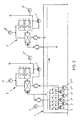
- the first graph illustrates ventilation measurements in the monitoring system of the invention; the second graph illustrates measurements that need to be set if the machine is already provided with an XT control system.
- the accompanying graphs neither illustrate the principle of XT control nor the transmission of measurement data to the process computer.
- Pressure difference sensors 3, 3', 3", 3"', 3"", 3""' for measuring the underpressure generated by the runnability components are provided in the lower part of the hood 1.
- the graph exemplifies six first runnability components equipped with pressure difference sensors.
- the air flow of the runnability components is measured by a flow sensor 4.
- the exhaust air of the rolls generating underpressure e.g. Metso VacRollTM (trademark holder: Metso Corporation, Finland)
- the exhaust air duct of the suction rolls is provided with a flow sensor 4', a temperature sensor 5 and a moisture sensor 6.
- the first heat recovery 2 comprises an air/ air heat recovery unit and an air/water heat recovery unit.
- a heat recovery unit denotes e.g. a heat exchangers or a set of several exchangers.
- a pressure difference sensor 7 measures the pressure difference over the heat recovery units of the heat recovery 2.
- the temperature sensors 5', 5" also measure the air temperature after the air/air heat recovery unit and the air/water heat recovery unit. These temperature measurements enable separate calculation of the heat recovery heat flow in air and water, without using complex moisture measurements.
- the second heat recovery 2' performs heating of the supply air of the dryer section.
- the second heat recovery 2' comprises an air/air heat recovery unit and an air/water heat recovery unit.
- the supply air system can also perform measurements, e.g. for XT control, serving to control the amount and temperature of supply air. The graph does not illustrate such measurements.
- the second heat recovery 2' performs measurements of the exhaust air from the hood 1, i.e. from the paper machine dryer section, with flow sensor 4" regarding the amount of the air, with moisture sensor 6' regarding its moisture and with temperature sensor 8 regarding its temperature.
- the second heat recovery 2' also measures the pressure difference over the heat recovery units with the pressure difference sensor 7' and the temperature by means of temperature sensors 8', 8" disposed between and after the heat recovery units.
- Graph 2 is a schematic view of measurements arranged in the dryer section if the dryer section is provided with an XT control system or similar. The measurements included in the XT control system are not illustrated in graph 2.
- Graph 2 thus shows that pressure difference sensors 3, 3', 3", 3"', 3"", 3""' have been disposed in the lower part of the dryer section hood 1 for measuring the underpressure generated by the runnability components.
- the air flow of the runnability components is measured by a flow sensor 4.
- the pressure difference sensor 7 measures the pressure difference over the heat recovery units of the heat recovery 2 and the air temperature after the air/air heat recovery unit and the air/water heat recovery unit is measured by temperature sensors 5', 5".
- the second heat recovery 2' in graph 2 measures the pressure difference over the heat recovery units by means of the pressure difference sensor 7' and the temperature by means of temperature sensors 8', 8" disposed between and after the heat recovery units.
- the remaining measurements can be performed using sensors pertaining to the XT control system.
Landscapes
- Paper (AREA)
- Diaphragms For Electromechanical Transducers (AREA)
Applications Claiming Priority (2)
| Application Number | Priority Date | Filing Date | Title |
|---|---|---|---|
| FI20041458A FI119574B (fi) | 2004-11-12 | 2004-11-12 | Menetelmä ja järjestelmä paperikoneessa sekä ohjelmistotuote |
| EP05808084A EP1836347B1 (de) | 2004-11-12 | 2005-11-11 | Verfahren und system in einer papiermaschine |
Related Parent Applications (3)
| Application Number | Title | Priority Date | Filing Date |
|---|---|---|---|
| EP05808084.7 Division | 2005-11-11 | ||
| EP05808084A Division EP1836347B1 (de) | 2004-11-12 | 2005-11-11 | Verfahren und system in einer papiermaschine |
| WOPCT/FI2005/000484 Previously-Filed-Application | 2005-11-11 |
Publications (3)
| Publication Number | Publication Date |
|---|---|
| EP2204490A2 true EP2204490A2 (de) | 2010-07-07 |
| EP2204490A3 EP2204490A3 (de) | 2010-10-27 |
| EP2204490B1 EP2204490B1 (de) | 2011-10-26 |
Family
ID=33515222
Family Applications (2)
| Application Number | Title | Priority Date | Filing Date |
|---|---|---|---|
| EP05808084A Expired - Lifetime EP1836347B1 (de) | 2004-11-12 | 2005-11-11 | Verfahren und system in einer papiermaschine |
| EP09175682A Expired - Lifetime EP2204490B1 (de) | 2004-11-12 | 2005-11-11 | Verfahren und System einer Papiermaschine und Softwareprodukt |
Family Applications Before (1)
| Application Number | Title | Priority Date | Filing Date |
|---|---|---|---|
| EP05808084A Expired - Lifetime EP1836347B1 (de) | 2004-11-12 | 2005-11-11 | Verfahren und system in einer papiermaschine |
Country Status (10)
| Country | Link |
|---|---|
| US (1) | US7811414B2 (de) |
| EP (2) | EP1836347B1 (de) |
| JP (1) | JP4629109B2 (de) |
| CN (1) | CN101048547B (de) |
| AT (2) | ATE454496T1 (de) |
| CA (1) | CA2587614C (de) |
| DE (1) | DE602005018828D1 (de) |
| ES (1) | ES2336586T3 (de) |
| FI (1) | FI119574B (de) |
| WO (1) | WO2006051157A2 (de) |
Families Citing this family (13)
| Publication number | Priority date | Publication date | Assignee | Title |
|---|---|---|---|---|
| DE102006062235A1 (de) | 2006-12-22 | 2008-06-26 | Voith Patent Gmbh | Verfahren und Vorrichtung zur Trocknung einer Faserstoffbahn |
| DE102009011217A1 (de) | 2009-03-04 | 2010-09-09 | Siemens Aktiengesellschaft | Steuerung der erweiterten Trockenpartie einer Papiermaschine |
| DE102010039093A1 (de) * | 2010-08-09 | 2012-02-09 | Voith Patent Gmbh | Verfahren und Vorrichtung zur Regelung der Feuchte einer Materialbahn |
| CN102828434B (zh) * | 2012-08-30 | 2016-01-20 | 华南理工大学 | 一种用于多烘缸造纸机干燥部的通风系统及其工作方法 |
| US9354090B2 (en) * | 2013-05-22 | 2016-05-31 | Honeywell Limited | Scanning sensor arrangement for paper machines or other systems |
| CN107478452B (zh) * | 2017-07-11 | 2020-04-10 | 新奥(中国)燃气投资有限公司 | 热电联产机组的测试方法 |
| SE542620C2 (en) * | 2018-09-25 | 2020-06-16 | Andritz Tech & Asset Man Gmbh | Method of determining the moisture content of a web of cellulose pulp |
| EP3736375B1 (de) * | 2019-05-06 | 2023-10-25 | Valmet Technologies Oy | Verfahren und anordnung zur steuerung des energieverbrauchs in einem verfahren zur herstellung einer faserstoffbahn |
| CN113512899B (zh) * | 2020-04-09 | 2022-07-19 | 南京林业大学 | 非遗印花古纸半自动化生产方法 |
| CN113758169A (zh) * | 2021-09-27 | 2021-12-07 | 浙江哲丰新材料有限公司 | 一种造纸干燥箱 |
| CN114265377B (zh) * | 2021-12-15 | 2023-11-14 | 浙江华章科技有限公司 | 纸机抄造系统的集成优化系统 |
| JP2025014642A (ja) * | 2023-07-19 | 2025-01-30 | セイコーエプソン株式会社 | シート製造装置の制御方法 |
| DE102024129430A1 (de) | 2024-10-11 | 2026-04-16 | Voith Patent Gmbh | Verfahren zur Bestimmung des Trockengehalts einer Faserstoffbahn |
Family Cites Families (11)
| Publication number | Priority date | Publication date | Assignee | Title |
|---|---|---|---|---|
| JPS5314810A (en) * | 1976-07-22 | 1978-02-09 | Ishikawajima Harima Heavy Ind | Controlling method of dehydration of paper screening machine |
| US4413427A (en) * | 1981-07-29 | 1983-11-08 | Aer Corporation | Fuel control system for dryer |
| FI71372B (fi) * | 1985-09-23 | 1986-09-09 | Valmet Oy | Ett reglersystem foer ventilationen av en pappersmaskins torkkaopa |
| FI80100C (fi) | 1986-12-18 | 1990-04-10 | Valmet Oy | Foerfarande vid styrning och/eller oevervakning av en belaeggningsprocess av en bana. |
| JP2646376B2 (ja) * | 1988-08-03 | 1997-08-27 | 住友重機械工業株式会社 | 抄紙機用ドライヤーフードにおける給・排気量制御方法及び装置 |
| JPH07100915B2 (ja) * | 1991-10-15 | 1995-11-01 | 大昭和製紙株式会社 | 紙の水分率を連続的に測定する装置 |
| AT396696B (de) * | 1992-02-13 | 1993-11-25 | Andritz Patentverwaltung | Verfahren und vorrichtung zum be- und entlüften einer mindestens eine trockengruppe umfassenden trockenpartie einer papiermaschine |
| FI107395B (fi) | 2000-02-21 | 2001-07-31 | Metso Paper Inc | Menetelmä ja laitteisto ilmanpoistojen ja -syöttöjen järjestämiseksi kuivatusosassa |
| AU2001247336B2 (en) | 2000-03-10 | 2006-02-02 | Smiths Detection, Inc. | Control for an industrial process using one or more multidimensional variables |
| JP2004027439A (ja) * | 2002-06-27 | 2004-01-29 | Yokogawa Electric Corp | 抄紙機のドライヤ予測制御方法およびその装置 |
| DE10342769A1 (de) | 2003-09-16 | 2005-04-21 | Voith Paper Patent Gmbh | System zur computergestützten Messung von Qualitäts- und/oder Prozessdaten |
-
2004
- 2004-11-12 FI FI20041458A patent/FI119574B/fi not_active IP Right Cessation
-
2005
- 2005-11-11 ES ES05808084T patent/ES2336586T3/es not_active Expired - Lifetime
- 2005-11-11 DE DE602005018828T patent/DE602005018828D1/de not_active Expired - Lifetime
- 2005-11-11 CN CN2005800369903A patent/CN101048547B/zh not_active Expired - Fee Related
- 2005-11-11 WO PCT/FI2005/000484 patent/WO2006051157A2/en not_active Ceased
- 2005-11-11 JP JP2007540664A patent/JP4629109B2/ja not_active Expired - Fee Related
- 2005-11-11 EP EP05808084A patent/EP1836347B1/de not_active Expired - Lifetime
- 2005-11-11 EP EP09175682A patent/EP2204490B1/de not_active Expired - Lifetime
- 2005-11-11 AT AT05808084T patent/ATE454496T1/de active
- 2005-11-11 AT AT09175682T patent/ATE530705T1/de not_active IP Right Cessation
- 2005-11-11 CA CA2587614A patent/CA2587614C/en not_active Expired - Lifetime
- 2005-11-11 US US11/667,519 patent/US7811414B2/en not_active Expired - Fee Related
Non-Patent Citations (1)
| Title |
|---|
| None |
Also Published As
| Publication number | Publication date |
|---|---|
| US7811414B2 (en) | 2010-10-12 |
| FI20041458L (fi) | 2006-05-13 |
| EP2204490B1 (de) | 2011-10-26 |
| FI20041458A0 (fi) | 2004-11-12 |
| WO2006051157A3 (en) | 2006-08-31 |
| CA2587614A1 (en) | 2006-05-18 |
| ATE454496T1 (de) | 2010-01-15 |
| CN101048547A (zh) | 2007-10-03 |
| EP2204490A3 (de) | 2010-10-27 |
| FI119574B (fi) | 2008-12-31 |
| JP2008519913A (ja) | 2008-06-12 |
| EP1836347B1 (de) | 2010-01-06 |
| CA2587614C (en) | 2012-01-03 |
| JP4629109B2 (ja) | 2011-02-09 |
| ES2336586T3 (es) | 2010-04-14 |
| EP1836347A2 (de) | 2007-09-26 |
| ATE530705T1 (de) | 2011-11-15 |
| WO2006051157A2 (en) | 2006-05-18 |
| US20070267160A1 (en) | 2007-11-22 |
| DE602005018828D1 (de) | 2010-02-25 |
| CN101048547B (zh) | 2011-04-20 |
Similar Documents
| Publication | Publication Date | Title |
|---|---|---|
| EP2204490B1 (de) | Verfahren und System einer Papiermaschine und Softwareprodukt | |
| Ghosh | Fundamentals of paper drying–theory and application from industrial perspective | |
| US4314878A (en) | Method of operating a papermachine drying line | |
| De Beer et al. | Long-term energy-efficiency improvements in the paper and board industry | |
| CN101792981B (zh) | 一种造纸机干燥部能量系统优化控制系统 | |
| CN102341544A (zh) | 造纸机的扩展的干燥部分的控制 | |
| US20080155851A1 (en) | Vapor hood for a paper machine and/or paperboard machine | |
| WO2000034575A1 (en) | Method and equipment for controlling properties of paper | |
| CN111926606A (zh) | 造纸机干燥部能效的一种在线监测方法 | |
| Ghodbanan et al. | Optimization for energy consumption in drying section of fluting paper machine | |
| CA2353396A1 (en) | Method of controlling the drying process in a drying section of a paper machine or the like | |
| Ghodbanan et al. | Improving energy efficiency and heat recovery performance in paper machine drying section | |
| Malton et al. | Evaluating and optimising dryer section performance | |
| Bhutani et al. | Energy assessment of paper machines | |
| Cederström | Potential of lowering steam pressure in a paper mill | |
| Ghosh et al. | Pocket ventilation-an often forgotten area of paper drying | |
| CN112595041A (zh) | 一种快速干燥窑温湿控制方法、装置及系统 | |
| DE102019123270A1 (de) | Verfahren, System und Computerprogrammprodukt für die Überwachung und/oder Steuerung von Bedingungen in dem Teilabschnitt einer Faserbahn- oder Ausrüstungsmaschine | |
| US6440270B1 (en) | Method and apparatus for controlling dryer section of paper machine | |
| Reczulski et al. | Possibilities of Reducing the Heat Energy Consumption in a Tissue Paper Machine—Case Study. Energies 2023, 16, 3738 | |
| CN204128691U (zh) | 造纸机烘缸表面温度红外检测系统 | |
| Lindberg et al. | Conservation of energy: A paper machine fingerprint cuts energy usage | |
| FI128944B (fi) | Menetelmä, järjestelmä ja tietokoneohjelmatuote olosuhteiden valvomiseksi ja/tai ohjaamiseksi kuituraina- tai jälkikäsittelykoneen osakokonaisuudella | |
| Taylor | Drying paper: More than a choice of fabric for dryer section solutions | |
| CN121383385A (zh) | 厂房室内温湿度的控制系统以及控制方法 |
Legal Events
| Date | Code | Title | Description |
|---|---|---|---|
| PUAI | Public reference made under article 153(3) epc to a published international application that has entered the european phase |
Free format text: ORIGINAL CODE: 0009012 |
|
| AC | Divisional application: reference to earlier application |
Ref document number: 1836347 Country of ref document: EP Kind code of ref document: P |
|
| AK | Designated contracting states |
Kind code of ref document: A2 Designated state(s): AT BE BG CH CY CZ DE DK EE ES FI FR GB GR HU IE IS IT LI LT LU LV MC NL PL PT RO SE SI SK TR |
|
| PUAL | Search report despatched |
Free format text: ORIGINAL CODE: 0009013 |
|
| AK | Designated contracting states |
Kind code of ref document: A3 Designated state(s): AT BE BG CH CY CZ DE DK EE ES FI FR GB GR HU IE IS IT LI LT LU LV MC NL PL PT RO SE SI SK TR |
|
| 17P | Request for examination filed |
Effective date: 20110211 |
|
| GRAP | Despatch of communication of intention to grant a patent |
Free format text: ORIGINAL CODE: EPIDOSNIGR1 |
|
| RIC1 | Information provided on ipc code assigned before grant |
Ipc: D21G 9/00 20060101ALI20110317BHEP Ipc: D21F 5/04 20060101AFI20110317BHEP Ipc: D21F 5/20 20060101ALI20110317BHEP |
|
| RTI1 | Title (correction) |
Free format text: METHOD AND SYSTEM FOR A PAPER MACHINE AND SOFTWARE PRODUCT |
|
| GRAS | Grant fee paid |
Free format text: ORIGINAL CODE: EPIDOSNIGR3 |
|
| GRAA | (expected) grant |
Free format text: ORIGINAL CODE: 0009210 |
|
| AC | Divisional application: reference to earlier application |
Ref document number: 1836347 Country of ref document: EP Kind code of ref document: P |
|
| AK | Designated contracting states |
Kind code of ref document: B1 Designated state(s): AT BE BG CH CY CZ DE DK EE ES FI FR GB GR HU IE IS IT LI LT LU LV MC NL PL PT RO SE SI SK TR |
|
| REG | Reference to a national code |
Ref country code: GB Ref legal event code: FG4D |
|
| REG | Reference to a national code |
Ref country code: CH Ref legal event code: EP |
|
| REG | Reference to a national code |
Ref country code: IE Ref legal event code: FG4D |
|
| REG | Reference to a national code |
Ref country code: DE Ref legal event code: R096 Ref document number: 602005030891 Country of ref document: DE Effective date: 20120105 |
|
| REG | Reference to a national code |
Ref country code: NL Ref legal event code: VDEP Effective date: 20111026 |
|
| LTIE | Lt: invalidation of european patent or patent extension |
Effective date: 20111026 |
|
| REG | Reference to a national code |
Ref country code: AT Ref legal event code: MK05 Ref document number: 530705 Country of ref document: AT Kind code of ref document: T Effective date: 20111026 |
|
| PG25 | Lapsed in a contracting state [announced via postgrant information from national office to epo] |
Ref country code: LT Free format text: LAPSE BECAUSE OF FAILURE TO SUBMIT A TRANSLATION OF THE DESCRIPTION OR TO PAY THE FEE WITHIN THE PRESCRIBED TIME-LIMIT Effective date: 20111026 Ref country code: BE Free format text: LAPSE BECAUSE OF FAILURE TO SUBMIT A TRANSLATION OF THE DESCRIPTION OR TO PAY THE FEE WITHIN THE PRESCRIBED TIME-LIMIT Effective date: 20111026 Ref country code: IS Free format text: LAPSE BECAUSE OF FAILURE TO SUBMIT A TRANSLATION OF THE DESCRIPTION OR TO PAY THE FEE WITHIN THE PRESCRIBED TIME-LIMIT Effective date: 20120226 |
|
| PG25 | Lapsed in a contracting state [announced via postgrant information from national office to epo] |
Ref country code: PL Free format text: LAPSE BECAUSE OF FAILURE TO SUBMIT A TRANSLATION OF THE DESCRIPTION OR TO PAY THE FEE WITHIN THE PRESCRIBED TIME-LIMIT Effective date: 20111026 Ref country code: PT Free format text: LAPSE BECAUSE OF FAILURE TO SUBMIT A TRANSLATION OF THE DESCRIPTION OR TO PAY THE FEE WITHIN THE PRESCRIBED TIME-LIMIT Effective date: 20120227 Ref country code: LV Free format text: LAPSE BECAUSE OF FAILURE TO SUBMIT A TRANSLATION OF THE DESCRIPTION OR TO PAY THE FEE WITHIN THE PRESCRIBED TIME-LIMIT Effective date: 20111026 Ref country code: SI Free format text: LAPSE BECAUSE OF FAILURE TO SUBMIT A TRANSLATION OF THE DESCRIPTION OR TO PAY THE FEE WITHIN THE PRESCRIBED TIME-LIMIT Effective date: 20111026 Ref country code: NL Free format text: LAPSE BECAUSE OF FAILURE TO SUBMIT A TRANSLATION OF THE DESCRIPTION OR TO PAY THE FEE WITHIN THE PRESCRIBED TIME-LIMIT Effective date: 20111026 Ref country code: GR Free format text: LAPSE BECAUSE OF FAILURE TO SUBMIT A TRANSLATION OF THE DESCRIPTION OR TO PAY THE FEE WITHIN THE PRESCRIBED TIME-LIMIT Effective date: 20120127 Ref country code: SE Free format text: LAPSE BECAUSE OF FAILURE TO SUBMIT A TRANSLATION OF THE DESCRIPTION OR TO PAY THE FEE WITHIN THE PRESCRIBED TIME-LIMIT Effective date: 20111026 |
|
| PG25 | Lapsed in a contracting state [announced via postgrant information from national office to epo] |
Ref country code: CY Free format text: LAPSE BECAUSE OF FAILURE TO SUBMIT A TRANSLATION OF THE DESCRIPTION OR TO PAY THE FEE WITHIN THE PRESCRIBED TIME-LIMIT Effective date: 20111026 Ref country code: MC Free format text: LAPSE BECAUSE OF NON-PAYMENT OF DUE FEES Effective date: 20111130 |
|
| REG | Reference to a national code |
Ref country code: CH Ref legal event code: PL |
|
| PG25 | Lapsed in a contracting state [announced via postgrant information from national office to epo] |
Ref country code: CZ Free format text: LAPSE BECAUSE OF FAILURE TO SUBMIT A TRANSLATION OF THE DESCRIPTION OR TO PAY THE FEE WITHIN THE PRESCRIBED TIME-LIMIT Effective date: 20111026 Ref country code: SK Free format text: LAPSE BECAUSE OF FAILURE TO SUBMIT A TRANSLATION OF THE DESCRIPTION OR TO PAY THE FEE WITHIN THE PRESCRIBED TIME-LIMIT Effective date: 20111026 Ref country code: CH Free format text: LAPSE BECAUSE OF NON-PAYMENT OF DUE FEES Effective date: 20111130 Ref country code: LI Free format text: LAPSE BECAUSE OF NON-PAYMENT OF DUE FEES Effective date: 20111130 Ref country code: DK Free format text: LAPSE BECAUSE OF FAILURE TO SUBMIT A TRANSLATION OF THE DESCRIPTION OR TO PAY THE FEE WITHIN THE PRESCRIBED TIME-LIMIT Effective date: 20111026 Ref country code: EE Free format text: LAPSE BECAUSE OF FAILURE TO SUBMIT A TRANSLATION OF THE DESCRIPTION OR TO PAY THE FEE WITHIN THE PRESCRIBED TIME-LIMIT Effective date: 20111026 Ref country code: BG Free format text: LAPSE BECAUSE OF FAILURE TO SUBMIT A TRANSLATION OF THE DESCRIPTION OR TO PAY THE FEE WITHIN THE PRESCRIBED TIME-LIMIT Effective date: 20120126 |
|
| REG | Reference to a national code |
Ref country code: IE Ref legal event code: MM4A |
|
| PG25 | Lapsed in a contracting state [announced via postgrant information from national office to epo] |
Ref country code: RO Free format text: LAPSE BECAUSE OF FAILURE TO SUBMIT A TRANSLATION OF THE DESCRIPTION OR TO PAY THE FEE WITHIN THE PRESCRIBED TIME-LIMIT Effective date: 20111026 Ref country code: IT Free format text: LAPSE BECAUSE OF FAILURE TO SUBMIT A TRANSLATION OF THE DESCRIPTION OR TO PAY THE FEE WITHIN THE PRESCRIBED TIME-LIMIT Effective date: 20111026 |
|
| PLBE | No opposition filed within time limit |
Free format text: ORIGINAL CODE: 0009261 |
|
| STAA | Information on the status of an ep patent application or granted ep patent |
Free format text: STATUS: NO OPPOSITION FILED WITHIN TIME LIMIT |
|
| REG | Reference to a national code |
Ref country code: FR Ref legal event code: ST Effective date: 20120817 |
|
| GBPC | Gb: european patent ceased through non-payment of renewal fee |
Effective date: 20120126 |
|
| 26N | No opposition filed |
Effective date: 20120727 |
|
| PG25 | Lapsed in a contracting state [announced via postgrant information from national office to epo] |
Ref country code: GB Free format text: LAPSE BECAUSE OF NON-PAYMENT OF DUE FEES Effective date: 20120126 Ref country code: IE Free format text: LAPSE BECAUSE OF NON-PAYMENT OF DUE FEES Effective date: 20111111 |
|
| REG | Reference to a national code |
Ref country code: DE Ref legal event code: R097 Ref document number: 602005030891 Country of ref document: DE Effective date: 20120727 |
|
| PG25 | Lapsed in a contracting state [announced via postgrant information from national office to epo] |
Ref country code: AT Free format text: LAPSE BECAUSE OF FAILURE TO SUBMIT A TRANSLATION OF THE DESCRIPTION OR TO PAY THE FEE WITHIN THE PRESCRIBED TIME-LIMIT Effective date: 20111026 |
|
| PG25 | Lapsed in a contracting state [announced via postgrant information from national office to epo] |
Ref country code: FR Free format text: LAPSE BECAUSE OF NON-PAYMENT OF DUE FEES Effective date: 20111226 Ref country code: ES Free format text: LAPSE BECAUSE OF FAILURE TO SUBMIT A TRANSLATION OF THE DESCRIPTION OR TO PAY THE FEE WITHIN THE PRESCRIBED TIME-LIMIT Effective date: 20120206 |
|
| PG25 | Lapsed in a contracting state [announced via postgrant information from national office to epo] |
Ref country code: LU Free format text: LAPSE BECAUSE OF NON-PAYMENT OF DUE FEES Effective date: 20111111 |
|
| PG25 | Lapsed in a contracting state [announced via postgrant information from national office to epo] |
Ref country code: FI Free format text: LAPSE BECAUSE OF FAILURE TO SUBMIT A TRANSLATION OF THE DESCRIPTION OR TO PAY THE FEE WITHIN THE PRESCRIBED TIME-LIMIT Effective date: 20111026 |
|
| PG25 | Lapsed in a contracting state [announced via postgrant information from national office to epo] |
Ref country code: TR Free format text: LAPSE BECAUSE OF FAILURE TO SUBMIT A TRANSLATION OF THE DESCRIPTION OR TO PAY THE FEE WITHIN THE PRESCRIBED TIME-LIMIT Effective date: 20111026 |
|
| PG25 | Lapsed in a contracting state [announced via postgrant information from national office to epo] |
Ref country code: HU Free format text: LAPSE BECAUSE OF FAILURE TO SUBMIT A TRANSLATION OF THE DESCRIPTION OR TO PAY THE FEE WITHIN THE PRESCRIBED TIME-LIMIT Effective date: 20111026 |
|
| PGFP | Annual fee paid to national office [announced via postgrant information from national office to epo] |
Ref country code: DE Payment date: 20231121 Year of fee payment: 19 |
|
| REG | Reference to a national code |
Ref country code: DE Ref legal event code: R119 Ref document number: 602005030891 Country of ref document: DE |
|
| PG25 | Lapsed in a contracting state [announced via postgrant information from national office to epo] |
Ref country code: DE Free format text: LAPSE BECAUSE OF NON-PAYMENT OF DUE FEES Effective date: 20250603 |