EP2205597B1 - Procédé de production de sels de (1r,5s)-anhydroecgoninester - Google Patents
Procédé de production de sels de (1r,5s)-anhydroecgoninester Download PDFInfo
- Publication number
- EP2205597B1 EP2205597B1 EP08804736A EP08804736A EP2205597B1 EP 2205597 B1 EP2205597 B1 EP 2205597B1 EP 08804736 A EP08804736 A EP 08804736A EP 08804736 A EP08804736 A EP 08804736A EP 2205597 B1 EP2205597 B1 EP 2205597B1
- Authority
- EP
- European Patent Office
- Prior art keywords
- acid
- formula
- compound
- anhydroecgonine
- ethyl ester
- Prior art date
- Legal status (The legal status is an assumption and is not a legal conclusion. Google has not performed a legal analysis and makes no representation as to the accuracy of the status listed.)
- Active
Links
- 0 COC(C(C(CC1)N(*)C1C1)C1O)=O Chemical compound COC(C(C(CC1)N(*)C1C1)C1O)=O 0.000 description 9
Classifications
-
- C—CHEMISTRY; METALLURGY
- C07—ORGANIC CHEMISTRY
- C07D—HETEROCYCLIC COMPOUNDS
- C07D451/00—Heterocyclic compounds containing 8-azabicyclo [3.2.1] octane, 9-azabicyclo [3.3.1] nonane, or 3-oxa-9-azatricyclo [3.3.1.0<2,4>] nonane ring systems, e.g. tropane or granatane alkaloids, scopolamine; Cyclic acetals thereof
-
- A—HUMAN NECESSITIES
- A61—MEDICAL OR VETERINARY SCIENCE; HYGIENE
- A61P—SPECIFIC THERAPEUTIC ACTIVITY OF CHEMICAL COMPOUNDS OR MEDICINAL PREPARATIONS
- A61P25/00—Drugs for disorders of the nervous system
- A61P25/28—Drugs for disorders of the nervous system for treating neurodegenerative disorders of the central nervous system, e.g. nootropic agents, cognition enhancers, drugs for treating Alzheimer's disease or other forms of dementia
Definitions
- the invention relates to a process for the preparation of (1R, 5S) -anhydroecgonin ester salts.
- the inventive method is particularly suitable for the large-scale production of these salts in high enantiomeric purity with respect to the (1R, 5S) -Anhydroecgoninester.
- R 1 is hydrogen, an alkyl radical, preferably methyl, ethyl, propyl or butyl, or any protecting group, preferably allyl, benzyl, methoxybenzyl, allyloxycarbonyl, benzyloxycarbonyl, tert -butyloxycarbonyl, 9-fluorenylmethyloxycarbonyl, acetyl, benzoyl or formyl;
- R 2 is alkyl, aryl, preferably phenyl or naphthyl, optionally substituted with one or more substituents selected from halo, hydroxy, amino, cyano, nitro, trifluoromethyl, trifluoromethoxy, alkoxy, cycloalkoxy, alkyl, cycloalkyl, cycloalkylalkyl, al
- the 8-azabicyclo [3.2.1] oct-2-ene system which is derived from the tropane as a backbone, represents a monounsaturated heterocyclic ring system in which the 1st and 5th C atom of a piperidine ring is replaced by a Ethylene group are interconnected.
- such systems play a role as starting or intermediates for pharmaceutically active tropane derivatives.
- Such systems gain importance in connection with potent and selective ligands of the nicotinic acetylcholine receptor (nAChR). It is hoped that such ligands a favorable influence on certain diseases, such as dementia, such as senile dementia, Alzheimer's disease, Parkinson's disease or brain disorders, such as depression and psychosis.
- a racemate resolution is bypassed here by already using the desired absolute configuration as the starting material.
- WO 2004/072071 A1 the reduction of a carbomethoxytropinone base by means of sodium borohydride and the reaction with sodium ethylate in ethyl ester to Anhydroecgoninethylester.
- WO 2004/072071 A1 nothing is said about the enantiomeric purity of the base used and the Anhydroecgoninethylesters obtained therefrom.
- a disadvantage of the described synthesis method of the prior art is that they are not designed on an industrial scale and do not take into account the special requirements for large-scale production.
- the present invention is therefore based on the object to provide an improved synthesis method, in particular for the industrial scale, which allows a synthetic access to the Anhydroecgoninestern or salts thereof. Furthermore, an economical, resource-saving and scale-up capable method with the aim of optimal depletion of the unwanted enantiomer and other impurities should be made available.
- a process suitable for industrial use is provided for the preparation of enantiomerically pure (1R, 5S) -anhydroecgonine ester salts according to the teachings of the claims.
- Salt formation and selective crystallization of (1R, 5S) -anhydro-cgonine esters with chiral acids results in a highly enantiopure form with high efficiency, depleting contained undesirable enantiomers and other impurities.
- the ester and its salts serve as starting material for the preparation of active ingredients.
- the present invention is based on a first aspect of (1R, 5S) -anhydroecgonine esters of the general chemical formula 5 : wherein R 1 is hydrogen, an alkyl radical, preferably methyl, ethyl, propyl or butyl, or any protecting group, preferably allyl, benzyl, methoxybenzyl, allyloxycarbonyl, benzyloxycarbonyl, tert -butyloxycarbonyl, 9-fluorenylmethyloxycarbonyl, acetyl, benzoyl or formyl; R 2 is alkyl, aryl, preferably phenyl or naphthyl, optionally substituted by one or more substituents selected from halogen, hydroxy, amino, cyano, nitro, trifluoromethyl, trifluoromethoxy, alkoxy, cycloalkoxy, alkyl, cycloalkyl, Cycloalkylalkyl, alkenyl and alky
- Suitable protecting groups for R 1 can be taken from the prior art, for example Theodora W. Green, Peter GM Wuts, Protective Groups in Organic Chemistry, John Wiley, 3rd Edition ,
- step (6) proceeds according to one of the following reaction equations: wherein R 1 and R 2 are as defined above and R s and R s' represent the acid residues of the chiral acids used.
- the invention also relates to salts of the compound of the formula 5 ' : with X - :
- Another aspect of the present invention is a method according to the steps (1), (2), (5) and (6), optionally with the involvement of steps (3) and (4).
- aryl or "aryl radical” means a 6- to 10-membered aromatic carbocycle and includes, for example, phenyl and naphthyl.
- Other terms which include the term “aryl” as an ingredient have the same meaning for the aryl moiety. Examples of these components are: arylalkyl, aryloxy or arylthio.
- alkyl or “alkyl groups” and alkyl groups which are part of other groups, branched and unbranched alkyl groups are denoted by 1 to 6 carbon atoms. Examples include: methyl, ethyl, propyl, butyl, pentyl, hexyl. Unless otherwise indicated, of the above designations of propyl, butyl, pentyl and hexyl all of the possible isomeric forms are included.
- propyl includes the two isomeric groups n-propyl and iso-propyl
- butyl the isomeric groups n-butyl, iso-butyl, sec. Butyl and tert-butyl.
- alkoxy or "alkoxy groups”, branched and unbranched alkyl groups having 1 to 6 carbon atoms, which are linked via an oxygen atom, are referred to. Examples include: methoxy, ethoxy, propoxy, butoxy, pentoxy, hexoxy. Unless otherwise indicated, all of the above-mentioned designations include all of the possible isomeric forms.
- Alkenyl groups mean branched and unbranched alkenyl groups having 2 to 6 carbon atoms, preferably 2 to 4 carbon atoms, having at least one double bond, such as the alkyl groups mentioned above, provided they have at least one double bond in the molecule, for example vinyl, propenyl, isopropenyl, butenyl , Pentenyl and hexenyl.
- Alkenylene groups are branched and unbranched alkenyl bridges of 2 to 6 carbon atoms, preferably 2 to 4 carbon atoms, having at least one double bond in the molecule, e.g. the above-mentioned alkylene groups, provided they have at least one double bond, such as vinylene, propenylene, isopropenylene, butenylene, pentenylene and hexenylene.
- alkenyl and alkenylene groups should be understood to include optional stereoisomers. Accordingly, for example, the definition of 2-butenyl should be understood to include 2- (Z) -butenyl and 2- (E) -butenyl, etc.
- alkynyl groups refers to alkynyl groups having 2 to 6, preferably 2 to 4, carbon atoms, provided they have at least one triple bond in the molecule, e.g. Ethynyl, propargyl, butynyl, pentynyl and hexynyl.
- Halogen is fluorine, chlorine, bromine or iodine, preferably chlorine or bromine.
- cycloalkyl radicals having 3 to 6 carbon atoms for example cyclopropyl, cyclobutyl, cyclopentyl or cyclohexyl are referred to.
- nitrogen as well as the corresponding elemental symbol, includes any oxidized form and is intended to include this as well as quaternary forms of a basic nitrogen atom.
- the term "about” means within 20%, preferably within 10%, and more preferably within 5% of a predetermined value or range.
- a specified range of values includes and discloses all values and value intervals contained therein.
- step (6) a compound of formula 5 is reacted with a chiral acid to form a salt of the compound of formula 5 ' according to the following reaction equations:
- the crystallization of compounds of the formula 5 (1R, 5S) -anhydroecgonin ester with optically active acids is not trivial. Numerous chiral acids under various conditions were examined for their crystallizability with the compound of formula 5 .
- the compound of formula 5 is initially dissolved in a solvent, preferably in concentrated form ("concentrate").
- concentration preferably in concentrated form
- the terms "in concentrated form” or “concentrate” mean at least 20% by weight, preferably at least 30% by weight, more preferably at least 40% by weight, more preferably at least 50% by weight and even more preferably understood to be at least 60% by weight solution.
- the solvents used are organic solvents having a boiling point below 150 ° C.
- Toluene and xyloL are the most preferred. Toluene is the most preferred. If the compound of formula 5 initially does not dissolve in the crystallization solvent, it may be previously dissolved in a suitable other solvent, for example an alcohol such as methanol or ethanol, so as to make the desired concentrate accessible.
- a suitable other solvent for example an alcohol such as methanol or ethanol, so as to make the desired concentrate accessible.
- the salt formation preferably takes place in toluene solution.
- the compound 5 is dissolved in toluene, if appropriate, the compound may initially be dissolved in another solvent, for example the solvent from the preceding reaction step.
- the compound 5 is preferably initially dissolved in an alcohol, for example methanol or ethanol.
- the chiral acid is initially charged in a solvent and, for this purpose, the toluene concentrate of the compound of the formula 5 , preferably with stirring, is added.
- Salt formation makes it possible to separate any enantiomer mixtures present so that the product, the (1R, 5S) -enantiomer, in an enantiomeric purity above about 95%, more preferably above about 98%, in particular above about 99%, most preferably above about 99 , 9% can be separated.
- Examples of chiral acids that can be used are: (1S, 4R) -camphor-10-sulfonic acid, (1R, 4S) -camphor-10-sulfonic acid, (2R, 3R) -di-p-toluoyltartaric acid, (2S , 3S) -Di-p-toluoyltartaric acid, (2R, 3R) tartaric acid, (2S, 3S) tartaric acid, (2R, 3R) -dibenzoyltartaric acid and (2S, 3S) -dibenzoyltartaric acid.
- the yield can be optimized accordingly, for example by deliberate slowing down the crystallization process, working at lower temperatures at the end of the crystallization process or the like.
- the chiral acid preferably in a solvent, preferably acetone, at elevated temperature, for example 35 to 60 ° C, preferably about 40 to 50 ° C, in some cases with heating to at reflux temperature of the solvent, dissolved.
- solvents it is also possible to use alcohols (C 1 to C 5 ), nitriles (C 2 to C 3 ) and ketones (C 3 to C 6 ) instead of acetone. All polar and medium polar protic or aprotic solvents with and without the addition of varying amounts of H 2 O are generally possible. This depends on the particular acid used. In individual cases, it may be useful to filter the resulting solution hot.
- the compound of the formula 5 if appropriate dissolved in one of the abovementioned solvents, is preferably added with stirring to the solution of the chiral acid.
- the starting material used may be the compound of formula 5 with variable solvent content, it being advantageous to use directly the toluene concentrate obtained in step (5), optionally with the addition of a further solvent.
- the compound of formula 5 can be used as an enantiomeric mixture containing in addition to the desired enantiomer [(1R, 5S) enantiomer] additional portions of the undesired enantiomeric [(1S, 5R) enantiomer].
- the compound of formula 5 can be used with an enantiomeric purity ⁇ 80%, preferably ⁇ 90% of the desired enantiomer [(1R, 5S) -anhydroecgoninester] and corresponding proportions of the undesired enantiomer.
- the solution of the chiral acid is still at elevated temperature, more preferably at or near the temperature at which the chiral acid was dissolved while the compound of formula 5 is added.
- the solution temperature for the chiral acid in the addition of the compound of formula 5 possibly only by about 20 ° C, preferably about 10 ° C, more preferably about 5 ° C is exceeded.
- the resulting solution may optionally be cooled after heating to reflux temperature of the solvent, after which, optionally after inoculation with a small amount of seed crystals and / or rubbing, the desired enantiomer as salt with an enantiomeric purity ⁇ 98%, preferably ⁇ 99%, more preferred ⁇ 99.9%, fails.
- the final temperature of the (1R, 5S) -enantiomer during deposition is particularly preferably between -15 and 35 ° C, in particular 5 to 35 ° C.
- the precipitation of the salt from the solvent is particularly preferably carried out in dilutions ( ⁇ m starting materials : ⁇ V solvent ) of 1:10 to 2: 1.
- the toluene concentrate can be used directly without a preparation or work-up step, for example removal of the toluene in vacuo, or else a starting material from a commercial source can also be used in the form of a mixture of enantiomers, whereby by depletion of one of the two enantiomers, the desired enantiomer is obtained as a salt having an enantiomeric purity ⁇ 98%, preferably ⁇ 99%, particularly preferably ⁇ 99.9%.
- the invention also provides the salts of the compound of formula 5 ' with a chiral acid.
- the chiral acid is preferably selected from: (1S, 4R) -camphor-10-sulfonic acid, (1R, 4S) -camphor-10-sulfonic acid, (2R, 3R) -di-p-toluoyltartaric acid, (2S, 3S) -Di-p-toluoyltartaric acid, (2R, 3R) tartaric acid, (2S, 3S) tartaric acid, (2R, 3R) -dibenzoyltartaric acid and (2S, 3S) -dibenzoyltartaric acid.
- chiral acids are of course not limited to the said chiral acids.
- the person skilled in the art is familiar with further chiral acids which can likewise be used for the preparation of salts of the compound of the formula 5 ' .
- (2R, 3R) tartaric acid with (1R, 5S) -anhydroecgonine methyl ester in the presence of water produced a readily crystallizable monohydrate. It is the first isolated monohydrate of Anhydroecgoninethylester salt.
- the content of nitrogen bases can not be set constant without major analytical or operational effort. After tests, this value varies in manufactured batches between 65 and 95 wt.%, So that the further processing of the toluene concentrate can cause difficulties.
- the toluene concentrate can not be further purified in contrast to the salt.
- the toluene concentrate can in principle be distilled in vacuo, a laboratory experiment showed that, despite generous cutting of the main fraction, only a small improvement in terms of chromatographic purity could be obtained. Only the solvent could be separated, but no significant purification could be achieved.
- the salt can be purified, for example, by recrystallization.
- the stability of the compound of formula 5 is usually lower in solution than in solid form, ie as a crystallized salt. This has an effect on the storage time, shelf life and storage, which is not possible for a longer time in solution form.
- the solid has advantages over the solution of the product.
- the toluene concentrate is obtained as an orange-brown solution
- the salts are usually isolated in the form of a white solid.
- salts of the anhydroecgonine esters per se can be characterized more accurately and easily analytically than solutions or concentrates of the anhydroecgonine esters.
- the total synthesis process according to the invention avoids the use of cocaine hydrochloride as a starting material; however, the product of very high ee value is efficiently obtained, so that the provision of even larger amounts of pure (1R, 5S) -anhydroecgonin ester and / or its salts can be provided as starting materials for the preparation of active ingredients.
- a toluene concentrated solution of the compound of formula 5 can be prepared at the end of the work-up in step (5) by adding toluene (variant 2).
- step (6) the compound of formula 5 can be dissolved in toluene as a concentrate at least 20% by weight, preferably at least 40% by weight, more preferably at least 60% by weight (variant 3).
- the chiral acid can be initially charged in a solvent in step (6) and the toluene concentrated solution of the compound of formula 5 can be added thereto (variant 4).
- the chiral acid may be selected from: (1S, 4R) -camphor-10-sulfonic acid, (1R, 4S) -camphor-10-sulfonic acid, (2R, 3R) -Di-p-toluoyltartaric acid, (2S, 3S) -di-p-toluoyltartaric acid, (2R, 3R) tartaric acid, (2S, 3S) tartaric acid, (2R, 3R) -dibenzoyltartaric acid and (2S , 3S) -dibenzoyltartaric acid (variant 5).
- the solvent in step (6) can be selected from polar or medium polar protic or aprotic solvents, preferably acetone, C 1 to C 5 alcohols, C 2 to C 3 nitriles, C 3 - to C 6 -ketones, with or without the addition of water (variant 6).
- the chiral acid may be dissolved in the solvent in step (6) by heating to a temperature in the range of from about 35 ° C to about the reflux temperature of the solvent used (variant 7).
- the concentrated toluene solution of the compound of formula 5 may be added to the solution of the chiral acid in step (6) at or near the solution temperature of the chiral acid (variant 8).
- step (6) in step (6) after addition of the toluene concentrated solution and optionally heating to reflux temperature of the solvent, cooling (variant 9).
- the compound of formula 5 ' can be precipitated at a final temperature between -15 and 35 ° C, preferably 5 to 35 ° C (variant 10).
- the precipitation can be assisted by seeding with a small amount of seed crystals and / or rubbing (variant 11).
- the compound of formula 5 ' may be in the form of an enantiomer in an enantiomeric purity of greater than about 95%, preferably greater than about 96%, more preferably greater than about 98%, especially greater than about 99%, very particularly preferably about 99.9% are precipitated (variant 12).
- a second aspect of the invention relates to a process for the preparation of salts of the compound of formula 5 : wherein the compound of formula 5 is reacted with a chiral acid to a salt of the compound of formula 5 ' : wherein R 1 and R 2 are as defined in claim 1, and X - represents the anion of a chiral acid.
- the compound of formula 5 is preferably enriched with respect to one of the possible enantiomers.
- the chiral acid may be selected from the group consisting of: (1S, 4R) -camphor-10-sulfonic acid, (1R, 4S) -camphor-10-sulfonic acid, (2R, 3R ) -Di-p-toluoyltartaric acid, (2S, 3S) -di-p-toluoyltartaric acid, (2R, 3R) tartaric acid, (2S, 3S) tartaric acid, (2R, 3R) -dibenzoyltartaric acid and (2S, 3S) - Dibenzoyltartaric acid, more preferably (1S, 4R) -camphor-10-sulphonic acid, (1R, 4S) -camphor-10-sulphonic acid, (2R, 3R) -di-p-toluoyltartaric acid, (2S, 3S) -di-p- toluoyltartaric acid, (2S, 3S) -di
- the chiral acid can be initially charged in a solvent or solvent mixture and, for this purpose, a toluene concentrated solution of the compound of the formula 5 can be added which the compound of the formula 5 is preferably present at least 60% by weight (variant 2.2).
- the solvent can be selected from polar protic or aprotic solvents, preferably acetone, C 1 - to Cs-alcohols, C 2 - to C 3 -nitriles, C 3 - to C 6 -ketones, with or without the addition of water (variant 2.3).
- the chiral acid can be dissolved in the solvent with heating to a temperature in the range from about 35 ° C to about the reflux temperature of the solvent used (variant 2.4).
- the concentrated solution of toluene of the compound of formula 5 can be added to the solution of the chiral acid at or in the vicinity of the solution temperature of the chiral acid (variant 2.5 ).
- the compound of the formula 5 ' can be precipitated at a final temperature between -15 and 35 ° C, preferably 5 to 35 ° C (variant 2.7).
- precipitation can be supported by seeding with a small amount of seed crystals and / or rubbing (variant 2.8).
- the compound of formula 5 ' in the form of an enantiomer in an enantiomeric purity of about 95%, preferably more than about 96%, more preferably about 98%, in particular over about 99%, most preferably over about 99.9% are precipitated (variant 2.9).
- a third aspect of the invention relates to an enantimerically pure salt of the compound of formula 5 with a chiral acid.
- a fourth aspect of the invention relates to a chiral, preferably enantiomerically pure, salt of the compound of formula 5 with a chiral acid which is crystalline.
- the salt of any one of aspects 3 or 4 of the invention preferably excludes (1R, 5S) -anhydroecgonine ethyl ester (2'S, 3'S) -dibenzoyl-hydrogen tartrate.
- the chiral acid is preferably selected from: (1S, 4R) -camphor-10-sulphonic acid, (1R, 4S) -camphor-10-sulphonic acid, (2R, 3R) - Di-p-toluoyltartaric acid, (2S, 3S) -di-p-toluoyltartaric acid, (2R, 3R) tartaric acid, (2S, 3S) tartaric acid, (2R, 3R) -dibenzoyltartaric acid and (2S, 3S) -dibenzoyltartaric acid.
- the chiral acid is preferably selected from: (1S, 4R) -camphor-10-sulphonic acid, (1R, 4S) -camphor-10-sulphonic acid, (2R, 3R) - Di-p-toluoyltartaric acid, (2S, 3S) -di-p-toluoyltartaric acid, (2R, 3R) tartaric acid, (2S, 3S) tartaric acid, (2R, 3R) -dibenzoyltartaric acid.
- the compound of formula 5 is preferably selected from: (1R, 5S) -anhydroecgonin ethyl ester, (1R, 5S) -anhydroecgonine methyl ester, ( 1 R, 5S) -anhydroecgoninopropyl ester and (1R, 5S) -anhydroecgonine butyl ester.
- the salt according to any of aspects 3 or 4 of the invention preferably has an enantiomeric purity of greater than about 95%, preferably greater than about 96%, more preferably greater than about 98%, especially greater than about 99% more preferably above about 99.9%.
- the salt according to any of aspects 3 or 4 of the invention may be a solvate, preferably a hydrate, more preferably a monohydrate.
- a fifth aspect of the invention relates to a solution of a (1R, 5S) -anhydroecgonine ester of the general chemical formula 5, as described in the first aspect of the invention, in toluene, xylene (all isomers), halobenzenes, aliphatic hydrocarbons (C 5 to C 8 ), halogen-containing aliphatic hydrocarbons (C 1 to C 6 ), aliphatic ethers (C 4 to C 8 ), esters of formic acid (C 2 to C 7 ), esters of acetic acid (C 3 to C 7 ) or nitriles (C 2 to C 5 ).
- Preferred solvent is toluene.
- the content of (1R, 5S) -anhydroecgonin ester is at least 20% by weight, preferably at least 40% by weight, and more preferably at least 60% by weight.
- a sixth aspect of the invention relates to a suspension consisting of a suspending agent selected from the group of toluene, xylene (all isomers), halobenzenes, aliphatic hydrocarbons (C 5 to C 8 ), halogen-containing, aliphatic hydrocarbons (C 1 to C 6 ), aliphatic ethers (C 4 to C 8 ), C 2 - C 7 alkyl esters of formic acid, esters of acetic acid (C 3 to C 7 ) or C 2 - C 5 alkyl nitriles, preferably toluene and a salt according to one of the aspects 3 or 4 of the invention, including all variants and preferences thereof.
- a suspending agent selected from the group of toluene, xylene (all isomers), halobenzenes, aliphatic hydrocarbons (C 5 to C 8 ), halogen-containing, aliphatic hydrocarbons (C 1 to C 6 ), alipha
- the Anhydroecgoninethylester succeeds, for example, by transesterification of the Anhydroecgoninmethylesters prepared according to the method described in the introduction, for example, by literature reaction according to the following reaction equation: 170 l of 2-carbomethoxytropinol concentrate (solvent: ethyl acetate, total alkaloid content calculated as 2-carbomethoxytropinol: 34.4 kg, determined by HClO 4 titration) are concentrated under reduced pressure to a volume of 60 l at 52-58 ° C. and 350 ml l given ethanol. The solution is cooled to 18 ° C and mixed at this temperature with 78.3 kg of 21% sodium ethylate.
- 2-carbomethoxytropinol concentrate solvent: ethyl acetate, total alkaloid content calculated as 2-carbomethoxytropinol: 34.4 kg, determined by HClO 4 titration
- the reaction mixture is heated with stirring for 1 h at 52 ° C and then for 1 h at 65 ° C. It is cooled to 18 ° C and then mixed with 34 l of glacial acetic acid. The reaction mixture is then concentrated at 51-58 ° C under vacuum to 70 l and added 140 l of toluene. To the resulting solution is added 410 l of condensate and adjusted at 21 ° C with 35 l of 50% sulfuric acid to a pH of 1.4. The two phases are separated and the toluene phase discarded. The aqueous phase is mixed with 340 l of toluene and adjusted with stirring to 24 ° C with 54.5 l of 50% sodium hydroxide solution to a pH of 8.5.
- the phases are separated and the aqueous phase is extracted again with 340 l of toluene.
- the combined toluene phases are mixed with 5.1 kg of sodium sulfate and added after 15 min 0.7 kg of activated carbon and 0.34 kg of diatomaceous earth. After filtration, the solvent is distilled off at 50-58 ° C in vacuo. There remain 30 l of anhydroeconomin methyl ester concentrate. Content of nitrogen bases (HClO 4 titration) 93.4%; Enantiomeric purity (chiral HPLC) 4.5% area (1S, 5R) -anhydroecgonin ethyl ester.
- the salt is separated off from acetone in dilutions ( ⁇ m starting materials : ⁇ V solvent ) from 2: 1 to 1: 1. Suitable washing liquids besides acetone are also more lipophilic solvents or solvent mixtures.
- camphor-10-sulfonate in the form of white crystals. Mp. 136 ° C; Water content (Karl Fischer titration) 0.1%; Content of nitrogen bases (HClO 4 titration, calculated on anhydrous substance) 98.8%; Chromatographic purity (GC, after base release) 98.8% Fl. Anhydroecgoninethylester; Enantiomeric purity (chiral HPLC) 99.9% Fl. (1R, 5S) -anhydroecgonin ethyl ester / 0.1% Fl. (1S, 5R) -Anhydroecgoninethylester.
- R 2 ethyl. 36.1 g of (2S, 3S) -di-p-toluoyltartaric acid are dissolved in 120 ml of acetonitrile at 50 ° C and this rapidly with stirring 22.8 g of
- the solution is cooled to room temperature with stirring within 2 h.
- a small amount of seed crystals (about 0.1 g) is added.
- the final temperature during deposition is preferably between 5 and 35 ° C.
- the salt is deposited particularly preferably from acetonitrile in dilutions ( ⁇ m Edulkte : ⁇ V solvent ) of 1: 1 to 1: 3.
- the mixture is stirred for 2 h and separates the precipitate by means of vacuum filtration.
- the washing liquid instead of acetonitrile, more lipophilic solvents or solvent mixtures are also suitable.
- Conventional devices can be used to separate precipitated solid and mother liquor, such as suction filter, centrifuge, decanter, pressure filter, etc.
- the precipitation of the salt is preferably carried out from acetone / H 2 O in dilutions ( ⁇ m starting materials : ⁇ V solvent ) of 1: 2 to 1: 8, solvent ratio of acetone / H 2 O 10: 0.1 to 10: l.
- the separation of precipitated solid and mother liquor is carried out with conventional devices, such as suction filter, centrifuge, decanter, pressure filter, etc. If required for the filtration of the starting materials filter and Absaugmassen can be used.
- Batch B 80.0 g (2R, 3R) -tartaric acid are taken up in a mixture of 600 ml of acetone and 40 ml of H 2 O at room temperature and the resulting solution is filtered. The filter is washed with 10 ml acetone and the filtrate heated to 55 ° C. 126.4 g of toluene concentrate of anhydroecgonine ethyl ester [content of nitrogen bases (HClO 4 titration) 79.1%; Chromatographic purity (GC, without toluene) 90.4% Fl. Anhydroecgoninethylester; Enantiomeric purity (chiral HPLC) 4.4% Fl.
- the precipitation of the salt is preferably carried out from acetone / H 2 O in dilutions ( ⁇ m starting materials : ⁇ V solvent ) of 1: 2 to 1: 8, solvent ratio of acetone / H 2 O 10: 0.1 to 10: 1.
- the separation of precipitated solid and mother liquor is carried out with conventional devices, such as suction filter, centrifuge, decanter, pressure filter, etc. If required for the filtration of the starting materials filter and Absaugmassen can be used.
- the suspension is stirred for a further 2 h at 20 ° C and then filtered with suction through a Buchner funnel.
- the final deposition temperature is preferably between 5 and 35 ° C.
- the precipitation of the salt from ethanol is preferably carried out in dilutions ( ⁇ m starting materials : ⁇ V solvent ) from 1: 1 to 1: 6.
- the separation of precipitated solid and mother liquor by means of conventional devices, such as a suction filter, centrifuge, a decanter, a pressure filter, etc.
Landscapes
- Chemical & Material Sciences (AREA)
- Organic Chemistry (AREA)
- Health & Medical Sciences (AREA)
- Engineering & Computer Science (AREA)
- Bioinformatics & Cheminformatics (AREA)
- Biomedical Technology (AREA)
- Neurology (AREA)
- Neurosurgery (AREA)
- Nuclear Medicine, Radiotherapy & Molecular Imaging (AREA)
- Life Sciences & Earth Sciences (AREA)
- General Chemical & Material Sciences (AREA)
- Medicinal Chemistry (AREA)
- Psychiatry (AREA)
- Hospice & Palliative Care (AREA)
- Pharmacology & Pharmacy (AREA)
- Chemical Kinetics & Catalysis (AREA)
- Animal Behavior & Ethology (AREA)
- General Health & Medical Sciences (AREA)
- Public Health (AREA)
- Veterinary Medicine (AREA)
- Organic Low-Molecular-Weight Compounds And Preparation Thereof (AREA)
- Pharmaceuticals Containing Other Organic And Inorganic Compounds (AREA)
- Nitrogen Condensed Heterocyclic Rings (AREA)
- Low-Molecular Organic Synthesis Reactions Using Catalysts (AREA)
Claims (15)
- Procédé de production de sels chiraux de (1R, 5S)-anhydroecgonine-esters de formule chimique générale 5 de préférence sous forme enrichie en énantiomères :

R1 est un atome d'hydrogène, un radical alkyle, de préférence, méthyle, éthyle, propyle ou butyle ou un groupe protecteur quelconque, de préférence allyle, benzyle, méthoxybenzyle, allyloxycarbonyle, benzyloxycarbonyle, tert-butyloxycarbonyle, 9-fluorénylméthyloxycarbonyle, acétyle, benzoyle ou formyle ;
R2 est un groupe alkyle, aryle, de préférence phényle ou naphtyle, éventuellement substitué par un ou plusieurs substituants choisis parmi un atome d'halogène, un groupe hydroxy, amino, cyano, nitro, trifluorométhyle, trifluorométhoxy, alcoxy, cycloalcoxy, alkyle, cycloalkyle, cycloalkylalkyle, alcényle et alcinyle ; de préférence R2 est un groupe méthyle, éthyle, propyle ou butyle
comprenant les étapes de(1a) conversion d'un composé de formule 1 avec du méthanol et éventuellement dans du méthanol comme solvant, en un composé de formule 1' (1b) conversion d'un composé de formule 2 avec de l'eau et un catalyseur en un composé de formule 2'
 (2) conversion d'un composé de formule 1' et d'un composé de formule 2' avec une solution de R1-amine en un composé de formule 3 :
 (3) conversion éventuelle du composé de formule 3 avec de l'acide (2R, 3R)-tartrique [acide L(+)-tartrique] avec enrichissement du sel (R)-énantiomère-hydrogénotartrate du composé de formule 3' :
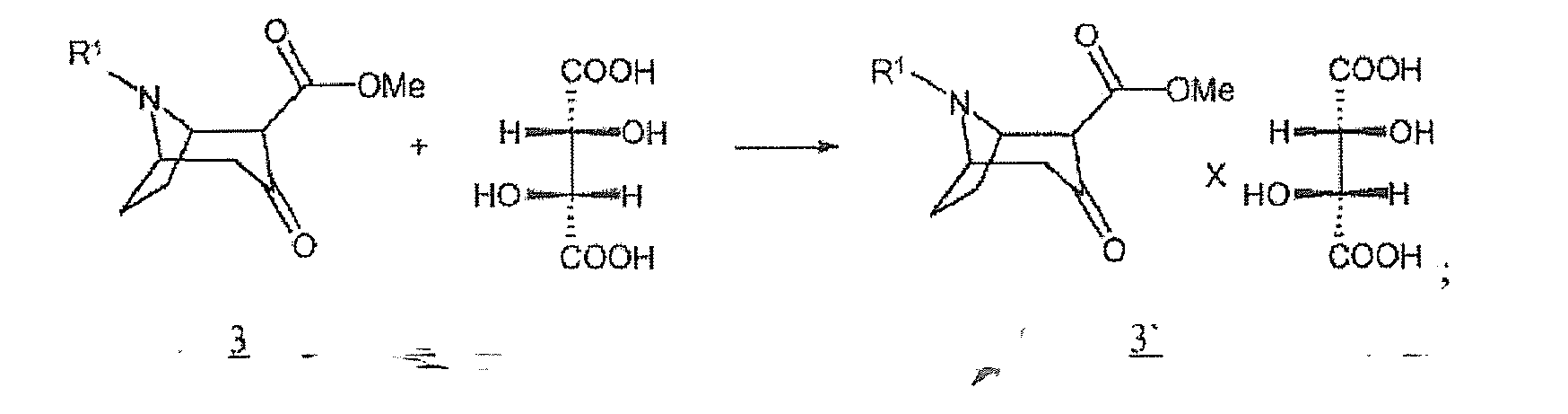 (4) libération éventuelle du composé 4 dans le composé basique
 (5) réduction du produit obtenu et éventuellement nouvelle conversion avec un alcoolat de formule MOR2 en un composé de formule 5 :
 (6) conversion du composé de formule 5 avec un acide chiral en un sel du composé de formule 5' :
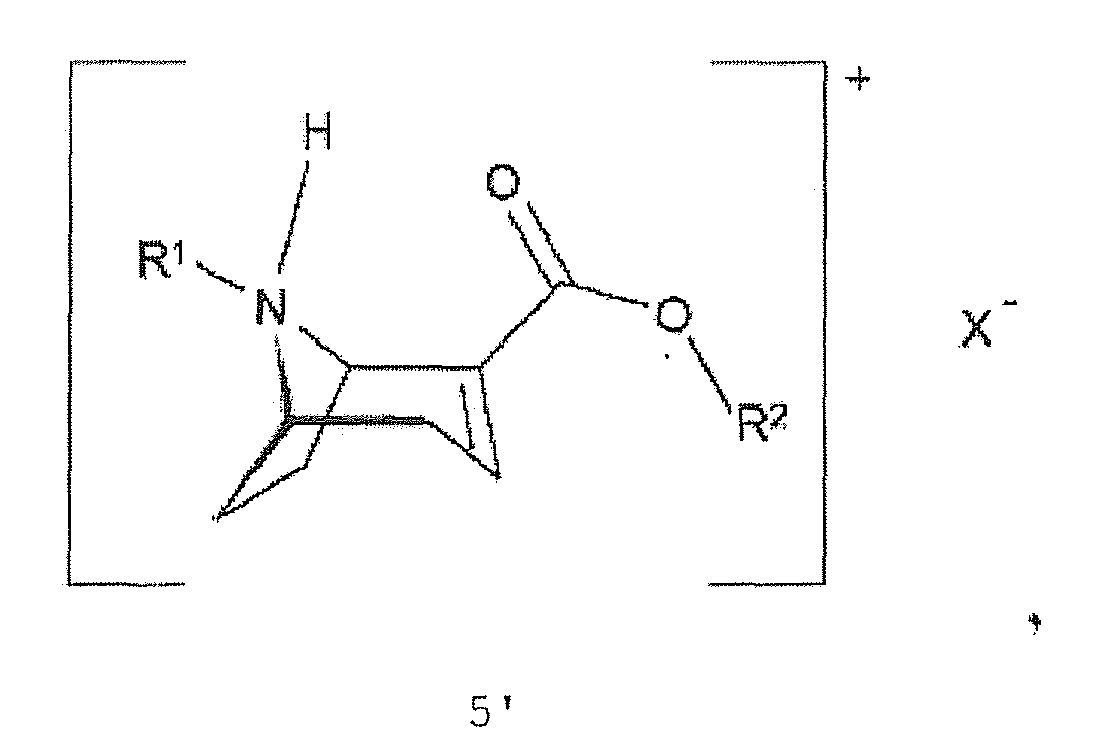 (7) éventuellement, purification du composé chiral de formule 5' et(8) éventuellement, cristallisation.
 - Procédé selon la revendication 1, caractérisé en ce que, à la fin du traitement à l'étape (5), par addition de toluène, une solution concentrée toluolique du composé de formule 5 est produite.
- Procédé selon la revendication 1, caractérisé en ce qu'à l'étape (6), le composé de formule 5 se présente sous forme de concentré dissous dans du toluène, à au moins 20 % en poids, de préférence au moins 40 % en poids, de manière particulièrement préférée au moins 60 % en poids.
- Procédé selon la revendication 1, caractérisé en ce qu'à l'étape (6), l'acide chiral est soumis à un solvant et à cette fin, la solution toluolique concentrée du composé de formule 5 est ajoutée.
- Procédé selon la revendication 1, caractérisé en ce que le solvant à l'étape (6) est choisi parmi les solvants protiques ou aprotiques, polaires ou semi-polaires, de préférence l'acétone, les alcools en C1 à C5, les nitriles en C2 à C3, les cétones en C3 à C6 avec ou sans adjonction d'eau.
- Procédé selon la revendication 1, caractérisé en ce que l'acide chiral est dissous dans le solvant de l'étape (6) par chauffage dans une plage de températures d'environ 35 °C à environ la température de reflux du solvant utilisé, le composé de formule 5 est ajouté sous la forme d'une solution ou suspension toluolique concentrée de la solution d'acide chiral à la température de dissolution ou à une température proche de celle-ci, de l'acide chiral, après addition de la solution ou suspension toluolique concentrée, et éventuellement, chauffage jusqu'à la température de reflux du solvant, le mélange est refroidi pour précipiter le composé de formule 5', de préférence jusqu`à une température finale entre -15 et 35 °C, de préférence de 5 à 35 °C et le processus de précipitation est favorisé éventuellement par inoculation d'une petite quantité de cristaux d'inoculation et/ou trituration.
- Procédé de production de sels du composé de formule 5 :

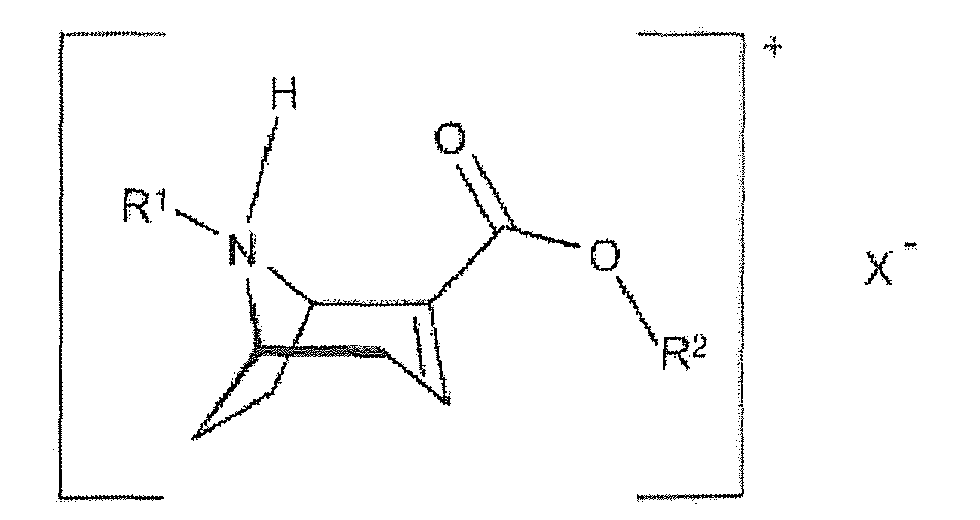
X est l'anion d'un acide chiral qui est choisi de préférence dans le groupe comprenant l'acide (1S, 4R)-camphre-10-sulfonique, l'acide (1R, 4S)-camphre-10-sulfonique, l'acide (2R, 3R)-di-p-toluoyl-tartrique, l'acide (2S, 3S)-di-p-toluyoyltartrique, l'acide (2R, 3R)-tartrique, l'acide (2S, 3S)-tartrique, l'acide (2R, 3R)-dibenzoyltartrique et l'acide (2S, 3S)-dibenzoyltartrique. - Procédé selon la revendication 7, caractérisé en ce que les conditions correspondent à celles selon l'une quelconque des revendications 2 à 6.
- Procédé selon au moins l'une quelconque des revendications précédentes 7 ou 8, caractérisé en ce que le composé de formule 5' est précipité sous la forme d'un énantiomère, en un motif énantiomère de plus d'environ 95 %, de préférence de plus d'environ 96 %, de manière particulièrement préférée de plus d'environ 98 %, en particulier de plus d'environ 99 %, de manière tout particulièrement préférée, de plus d'environ 99,9 %.
- Sel sans énantiomère du composé de formule 5

R1 est un radical alkyle, de préférence un groupe méthyle, éthyle, propyle ou butyle ou un groupe protecteur quelconque, de préférence allyle, benzyle, méthoxybenzyle, allyloxycarbonyle, benzyloxycarbonyle, tert-butyloxycarbonyle, 9-fluorénylméthyloxycarbonyle, acétyle, benzoyle ou formule ;
R2 est un groupe alkyle, aryle, de préférence phényle ou naphtyle, éventuellement substitué par un ou plusieurs substituants choisis parmi un atome d'halogène, un groupe hydroxy, amino, cyano, nitro, trifluorométhyle, trifluorométhoxy, alcoxy, cycloalcoxy, alkyle, cycloalkyle, cycloalkylalkyle, alcényle et alcinyle ; de préférence R2 est un groupe méthyle, éthyle, propyle ou butyle,
avec un acide chiral qui n'est pas le (1R, 5S)-anhydroecgonine-éthylester-(2'-S, 3'S)-dibenzoyl-hydrogénotartrate. - Sel chiral, de préférence sans énantiomère, du composé de formule 5

R1 est un radical alkyle, de préférence un groupe méthyle, éthyle, propyle ou butyle ou un groupe protecteur quelconque, de préférence allyle, benzyle, méthoxybenzyle, allyloxycarbonyle, benzyloxycarbonyle, tert-butyloxycarbonyle, 9-fluorénylméthyloxycarbonyle, acétyle, benzoyle ou formyle ;
R2 est un groupe alkyle, aryle, de préférence phényle ou naphtyle, éventuellement substitué par un ou plusieurs substituants choisis parmi un atome d'halogène, un groupe hydroxy, amino, cyano, nitro, trifluorométhyle, trifluorométhoxy, alcoxy, cycloalcoxy, alkyl, cycloalkyl, cycloalkylalkyle, alcényle et alcinyle ; de préférence R2 est un groupe méthyle, éthyle, propyle ou butyle,
avec un acide chiral qui n'est pas le (1R, 5S)-anhydroecgonine-éthylester-(2'-S, 3'S)-dibenzoyl-hydrogénotartrate. - Sel selon la revendication 10 ou 11, caractérisé en ce que l'acide chiral est choisi parmi l'acide (1S, 4R)-camphre-10-sulfonique, l'acide (1R, 4S)-camphre-10-sulfonique, l'acide (2R, 3R)-di-p-toluoyl-tartrique, l'acide (2S, 3S)-di-p-toluyoyltartrique, l'acide (2R, 3R)-tartrique, l'acide (2S, 3S)-tartrique, l'acide (2R, 3R)-dibenzoyltartrique et l'acide (2S, 3S)-dibenzoyltartrique et le composé de formule 5 est choisi parmi le (1R, 5S)-anhydroecgonine-éthylester, le (1R, 5S)-anhydroecgonineméthylester, le (1R, 5S)-anhydroecgoninpropylester et le (1R, 5S)-anhydroecgoninebutylester.
- Sel selon l'une quelconque des revendications 10 à 12, caractérisé en ce que le sel représente l'un des composés suivants :(1R, 5S)-anhydroecgonineéthylester-(1'S, 4'R)-camphre-10-sulfonate ;(1R, 5S)-anhydroecgonineéthylester-(1'R, 4'S)-camphre-10-sulfonate ;(1R, 5S)-anhydroecgonineéthylester-(2'S, 3'S)-di-p-toluoylhydrogénotartrate ;1R, 5S)-anhydroecgonineéthylester-(2'R, 3'R)-di-p-toluoylhydrogénotartrate ;(1R,5S)-anhydroecgonineéthylester-(2'R, 3'R)-hydrogénotartrate-monohydrate ;(1R, 5S)-anhydroecgonineéthylester-(2'S, 3'S)-hydrogénotartrate-monohydrate ;(1R, 5S)-anhydroecgonineéthylester-(2'R, 3'R)-hydrogénotartrate ;(1R, 5S)-anhydroecgonineéthylester-(2'S, 3'S)-hydrogénotartrate ;(1R, 5S)-anhydroecgonineéthylester-(2'R, 3'R)-dibenzoylhydrogénotartrate,(1R, 5S)-anhydroecgonineéthylester-(2'S, 3'S)-dibenzoylhydrogénotartrate, de préférence (1R, 5S)-anhydroecgonineéthylester-(1'S, 4'R)-camphre-10-sulfonate ;(1R,5S) -anhydroecgonineéthylester- (1'R, 4'S)-camphre-10-sulfonate ;(1R, 5S) -anhydroergonineéthylester- (2'S,3'S) -di-p-toluoylhydrogénotartrate ;(1R, 5S)-anhydroecgonineéthylester-(2'R, 3'R)-di-p-toluoylhydrogénotartrate ;(1R, 5S)-anhydroecgonineéthylester-(2'R, 3'R)-hydrogénotartrate-monohydrate ;(1R, 5S)-anhydroecgonineéthylester-(2'S, 3'S)-hydrogénotartrate-monohydrate ;(1R, 5S)-anhydroecgonineéthylester-(2'R, 3'R)-hydogénotartrate ;(1R, 5S)-anhydroecgonineéthylester-(2'S, 3'S)-hydrogénotartrate ;(1R, 5S)-anhydroecgonineéthylester-(2'R, 3'R)-dibenzoylhydrogénotartrate.
- Solution d'un (1R, 5S)-anhydroecgonine-ester de formule chimique générale 5 selon la revendication 1, présentant une teneur d'au moins 20 % en poids, de préférence d'au moins 40 % en poids et de manière davantage préférée d'au moins 60 % en poids dans du toluène, du xylène (tous les isomères), des halogénobenzènes, des hydrocarbures aliphatiques (en C5 à C8), des hydrocarbures aliphatiques (en C1 à C6) contenant un halogène, des éthers aliphatiques (en C4 à C8) , des esters d'acide formique (en C2 à C7), des esters d'acide acétique (en C3 à C7) ou des nitriles (en C2 à C5), de préférence, le toluène.
- Suspension consistant en un agent de mise en suspension choisi dans le groupe comprenant le toluène, le xylène (tous les isomères), des halogénobenzènes, des hydrocarbures aliphatiques (en C5 à C8) , des hydrocarbures aliphatiques (en C1 à C6) contenant un halogène, des éthers aliphatiques (en C4 à C8), des alkylesters d'acide formique (en C2 à C7), des esters d' acide acétique (en C3 à C7) ou des alkyl-nitriles (en C2 à C5), de préférence le toluène et un sel selon l'une quelconque des revendications 10 à 13.
Applications Claiming Priority (2)
| Application Number | Priority Date | Filing Date | Title |
|---|---|---|---|
| DE102007046887A DE102007046887A1 (de) | 2007-09-28 | 2007-09-28 | Verfahren zur Herstellung von (1R,5S)-Anhydroecgoninestersalzen |
| PCT/EP2008/062839 WO2009043793A1 (fr) | 2007-09-28 | 2008-09-25 | Procédé de production de sels de (1r,5s)-anhydroecgoninester |
Publications (2)
| Publication Number | Publication Date |
|---|---|
| EP2205597A1 EP2205597A1 (fr) | 2010-07-14 |
| EP2205597B1 true EP2205597B1 (fr) | 2013-03-27 |
Family
ID=40292584
Family Applications (1)
| Application Number | Title | Priority Date | Filing Date |
|---|---|---|---|
| EP08804736A Active EP2205597B1 (fr) | 2007-09-28 | 2008-09-25 | Procédé de production de sels de (1r,5s)-anhydroecgoninester |
Country Status (9)
| Country | Link |
|---|---|
| US (1) | US20100331544A1 (fr) |
| EP (1) | EP2205597B1 (fr) |
| JP (1) | JP2010540493A (fr) |
| AR (1) | AR068569A1 (fr) |
| CA (1) | CA2700932A1 (fr) |
| CL (1) | CL2008002892A1 (fr) |
| DE (1) | DE102007046887A1 (fr) |
| TW (1) | TW200920747A (fr) |
| WO (1) | WO2009043793A1 (fr) |
Families Citing this family (4)
| Publication number | Priority date | Publication date | Assignee | Title |
|---|---|---|---|---|
| DE102006039003A1 (de) * | 2006-08-19 | 2008-02-21 | Boehringer Ingelheim Pharma Gmbh & Co. Kg | Neue Verbindungen |
| EP2025675A1 (fr) | 2007-08-14 | 2009-02-18 | Boehringer Ingelheim International GmbH | Arylsulfonamides ayant activité analgésique |
| EP2188269B1 (fr) * | 2007-08-14 | 2014-05-07 | Boehringer Ingelheim International GmbH | Arylsulfonamides a effet analgesique |
| CN112480107B (zh) * | 2020-11-30 | 2022-08-16 | 上海海雁医药科技有限公司 | 取代的氮杂双环辛烷化合物及其中间体和制备方法 |
Family Cites Families (3)
| Publication number | Priority date | Publication date | Assignee | Title |
|---|---|---|---|---|
| CN1056843C (zh) | 1995-03-24 | 2000-09-27 | 纽罗研究公司 | 制备脱水芽子碱酯的方法 |
| JP4386399B2 (ja) * | 1998-09-30 | 2009-12-16 | 日本メジフィジックス株式会社 | 光学活性トロピノンモノカルボン酸エステル誘導体の製造法 |
| WO2004072071A1 (fr) | 2003-02-12 | 2004-08-26 | Neurosearch A/S | 8 nouveaux derives de 8-aza-bicyclo[3.2.1]octane et leur utilisation en tant qu'inhibiteurs du recaptage des neurotransmetteurs monoamines |
-
2007
- 2007-09-28 DE DE102007046887A patent/DE102007046887A1/de not_active Withdrawn
-
2008
- 2008-09-25 US US12/680,066 patent/US20100331544A1/en not_active Abandoned
- 2008-09-25 EP EP08804736A patent/EP2205597B1/fr active Active
- 2008-09-25 WO PCT/EP2008/062839 patent/WO2009043793A1/fr not_active Ceased
- 2008-09-25 CA CA2700932A patent/CA2700932A1/fr not_active Abandoned
- 2008-09-25 JP JP2010526287A patent/JP2010540493A/ja active Pending
- 2008-09-26 CL CL2008002892A patent/CL2008002892A1/es unknown
- 2008-09-26 AR ARP080104218A patent/AR068569A1/es unknown
- 2008-09-26 TW TW097137354A patent/TW200920747A/zh unknown
Also Published As
| Publication number | Publication date |
|---|---|
| TW200920747A (en) | 2009-05-16 |
| EP2205597A1 (fr) | 2010-07-14 |
| WO2009043793A1 (fr) | 2009-04-09 |
| AR068569A1 (es) | 2009-11-18 |
| DE102007046887A1 (de) | 2009-04-09 |
| JP2010540493A (ja) | 2010-12-24 |
| CA2700932A1 (fr) | 2009-04-09 |
| CL2008002892A1 (es) | 2009-10-16 |
| US20100331544A1 (en) | 2010-12-30 |
Similar Documents
| Publication | Publication Date | Title |
|---|---|---|
| CH621115A5 (fr) | ||
| DE69531242T2 (de) | Verfahren zur herstellung von azabicyclische derivaten | |
| DE60100321T2 (de) | Verfahren zur Herstellung von 11-Amino-3-chlor-6,11-dihydro-5,5-dioxo-6-methyl-dibenzo[c,f][1,2]-thiazepin und Anwendung zur Synthese von Thianeptin | |
| DE69623900T2 (de) | Verfahren zur Herstellung von enantiomerisch reinen Imidazol-Verbindungen | |
| EP2387556A1 (fr) | Séparation d'un mélange d'énantiomères de (r)- et de (s)-3-amino-1-butanol | |
| EP2205597B1 (fr) | Procédé de production de sels de (1r,5s)-anhydroecgoninester | |
| CH625790A5 (fr) | ||
| DE602004003037T2 (de) | Verfahren und zwischenprodukte für die herstellung von emtricitabin | |
| WO2017080770A1 (fr) | Synthèse du chlorhydrate de (z)-endoxifène | |
| EP1572641A1 (fr) | Procede de preparation de stereoisomeres de glycopyrronium a configuration r,r (ou s,s) | |
| EP0176856B1 (fr) | Procédé pour la préparation d'amines optiquement actives | |
| EP0413667A1 (fr) | Halogénoalkylphénolalcools, -cétones et leurs hydrates | |
| DE3382618T2 (de) | Verfahren zur herstellung von(d)2-(6-methoxy-2-naphthyl)propionsaeure und pharmazeutisch verwendbaren salzen davon und neue zwischenprodukte. | |
| DE602004009831T2 (de) | Verfahren zur gewinnung von tolterodin | |
| DE69108743T2 (de) | Recematspaltung von trans-2-(2-pyrimidinyl)-7-(hydroxymethyl)octahydro-2h-pyrido[1,2-a]-pyrazin. | |
| AT394717B (de) | Verfahren zur herstellung neuer naphthoxazine | |
| DE602004010929T2 (de) | Verfahren zur herstellung von n-substituierten phthalimiden | |
| EP1781612B1 (fr) | Procede raccourci pour la production de l-lobeline | |
| DE69219582T2 (de) | Neue verbindung und trennungsreagenz | |
| DE2657950A1 (de) | Trifluormethylthioderivate von cyproheptadin | |
| DE3906460C1 (fr) | ||
| EP1919888A2 (fr) | Procede de production de nebivolol | |
| DE3851942T2 (de) | Verfahren zur Herstellung von optisch aktiver alpha-Isopropyl-p-chlorophenylessigsäure. | |
| CA3034535C (fr) | Nouveau sel de (r)- (1-methylpyrrolidin-3-yl) methyl (3'-chloro -4'-fluoro- [1,1'-biphenyl]-2-yl) carbamate et forme cristalline de celui-ci | |
| DE102004004965B4 (de) | Verfahren zur Herstellung eines 2-(Ethoxymethyl)-tropanderivates |
Legal Events
| Date | Code | Title | Description |
|---|---|---|---|
| PUAI | Public reference made under article 153(3) epc to a published international application that has entered the european phase |
Free format text: ORIGINAL CODE: 0009012 |
|
| 17P | Request for examination filed |
Effective date: 20100428 |
|
| AK | Designated contracting states |
Kind code of ref document: A1 Designated state(s): AT BE BG CH CY CZ DE DK EE ES FI FR GB GR HR HU IE IS IT LI LT LU LV MC MT NL NO PL PT RO SE SI SK TR |
|
| AX | Request for extension of the european patent |
Extension state: AL BA MK RS |
|
| DAX | Request for extension of the european patent (deleted) | ||
| GRAP | Despatch of communication of intention to grant a patent |
Free format text: ORIGINAL CODE: EPIDOSNIGR1 |
|
| GRAP | Despatch of communication of intention to grant a patent |
Free format text: ORIGINAL CODE: EPIDOSNIGR1 |
|
| GRAS | Grant fee paid |
Free format text: ORIGINAL CODE: EPIDOSNIGR3 |
|
| GRAA | (expected) grant |
Free format text: ORIGINAL CODE: 0009210 |
|
| AK | Designated contracting states |
Kind code of ref document: B1 Designated state(s): AT BE BG CH CY CZ DE DK EE ES FI FR GB GR HR HU IE IS IT LI LT LU LV MC MT NL NO PL PT RO SE SI SK TR |
|
| REG | Reference to a national code |
Ref country code: GB Ref legal event code: FG4D Free format text: NOT ENGLISH |
|
| REG | Reference to a national code |
Ref country code: CH Ref legal event code: EP |
|
| REG | Reference to a national code |
Ref country code: AT Ref legal event code: REF Ref document number: 603336 Country of ref document: AT Kind code of ref document: T Effective date: 20130415 |
|
| REG | Reference to a national code |
Ref country code: IE Ref legal event code: FG4D Free format text: LANGUAGE OF EP DOCUMENT: GERMAN |
|
| REG | Reference to a national code |
Ref country code: DE Ref legal event code: R096 Ref document number: 502008009594 Country of ref document: DE Effective date: 20130523 |
|
| PG25 | Lapsed in a contracting state [announced via postgrant information from national office to epo] |
Ref country code: NO Free format text: LAPSE BECAUSE OF FAILURE TO SUBMIT A TRANSLATION OF THE DESCRIPTION OR TO PAY THE FEE WITHIN THE PRESCRIBED TIME-LIMIT Effective date: 20130627 Ref country code: SE Free format text: LAPSE BECAUSE OF FAILURE TO SUBMIT A TRANSLATION OF THE DESCRIPTION OR TO PAY THE FEE WITHIN THE PRESCRIBED TIME-LIMIT Effective date: 20130327 Ref country code: BG Free format text: LAPSE BECAUSE OF FAILURE TO SUBMIT A TRANSLATION OF THE DESCRIPTION OR TO PAY THE FEE WITHIN THE PRESCRIBED TIME-LIMIT Effective date: 20130627 Ref country code: LT Free format text: LAPSE BECAUSE OF FAILURE TO SUBMIT A TRANSLATION OF THE DESCRIPTION OR TO PAY THE FEE WITHIN THE PRESCRIBED TIME-LIMIT Effective date: 20130327 |
|
| REG | Reference to a national code |
Ref country code: LT Ref legal event code: MG4D |
|
| PG25 | Lapsed in a contracting state [announced via postgrant information from national office to epo] |
Ref country code: LV Free format text: LAPSE BECAUSE OF FAILURE TO SUBMIT A TRANSLATION OF THE DESCRIPTION OR TO PAY THE FEE WITHIN THE PRESCRIBED TIME-LIMIT Effective date: 20130327 Ref country code: FI Free format text: LAPSE BECAUSE OF FAILURE TO SUBMIT A TRANSLATION OF THE DESCRIPTION OR TO PAY THE FEE WITHIN THE PRESCRIBED TIME-LIMIT Effective date: 20130327 Ref country code: GR Free format text: LAPSE BECAUSE OF FAILURE TO SUBMIT A TRANSLATION OF THE DESCRIPTION OR TO PAY THE FEE WITHIN THE PRESCRIBED TIME-LIMIT Effective date: 20130628 Ref country code: SI Free format text: LAPSE BECAUSE OF FAILURE TO SUBMIT A TRANSLATION OF THE DESCRIPTION OR TO PAY THE FEE WITHIN THE PRESCRIBED TIME-LIMIT Effective date: 20130327 |
|
| REG | Reference to a national code |
Ref country code: NL Ref legal event code: VDEP Effective date: 20130327 |
|
| PG25 | Lapsed in a contracting state [announced via postgrant information from national office to epo] |
Ref country code: HR Free format text: LAPSE BECAUSE OF FAILURE TO SUBMIT A TRANSLATION OF THE DESCRIPTION OR TO PAY THE FEE WITHIN THE PRESCRIBED TIME-LIMIT Effective date: 20130327 |
|
| PG25 | Lapsed in a contracting state [announced via postgrant information from national office to epo] |
Ref country code: PT Free format text: LAPSE BECAUSE OF FAILURE TO SUBMIT A TRANSLATION OF THE DESCRIPTION OR TO PAY THE FEE WITHIN THE PRESCRIBED TIME-LIMIT Effective date: 20130729 Ref country code: IS Free format text: LAPSE BECAUSE OF FAILURE TO SUBMIT A TRANSLATION OF THE DESCRIPTION OR TO PAY THE FEE WITHIN THE PRESCRIBED TIME-LIMIT Effective date: 20130727 Ref country code: ES Free format text: LAPSE BECAUSE OF FAILURE TO SUBMIT A TRANSLATION OF THE DESCRIPTION OR TO PAY THE FEE WITHIN THE PRESCRIBED TIME-LIMIT Effective date: 20130708 Ref country code: EE Free format text: LAPSE BECAUSE OF FAILURE TO SUBMIT A TRANSLATION OF THE DESCRIPTION OR TO PAY THE FEE WITHIN THE PRESCRIBED TIME-LIMIT Effective date: 20130327 Ref country code: RO Free format text: LAPSE BECAUSE OF FAILURE TO SUBMIT A TRANSLATION OF THE DESCRIPTION OR TO PAY THE FEE WITHIN THE PRESCRIBED TIME-LIMIT Effective date: 20130327 Ref country code: SK Free format text: LAPSE BECAUSE OF FAILURE TO SUBMIT A TRANSLATION OF THE DESCRIPTION OR TO PAY THE FEE WITHIN THE PRESCRIBED TIME-LIMIT Effective date: 20130327 Ref country code: NL Free format text: LAPSE BECAUSE OF FAILURE TO SUBMIT A TRANSLATION OF THE DESCRIPTION OR TO PAY THE FEE WITHIN THE PRESCRIBED TIME-LIMIT Effective date: 20130327 Ref country code: CZ Free format text: LAPSE BECAUSE OF FAILURE TO SUBMIT A TRANSLATION OF THE DESCRIPTION OR TO PAY THE FEE WITHIN THE PRESCRIBED TIME-LIMIT Effective date: 20130327 |
|
| PG25 | Lapsed in a contracting state [announced via postgrant information from national office to epo] |
Ref country code: PL Free format text: LAPSE BECAUSE OF FAILURE TO SUBMIT A TRANSLATION OF THE DESCRIPTION OR TO PAY THE FEE WITHIN THE PRESCRIBED TIME-LIMIT Effective date: 20130327 Ref country code: CY Free format text: LAPSE BECAUSE OF FAILURE TO SUBMIT A TRANSLATION OF THE DESCRIPTION OR TO PAY THE FEE WITHIN THE PRESCRIBED TIME-LIMIT Effective date: 20130327 |
|
| PG25 | Lapsed in a contracting state [announced via postgrant information from national office to epo] |
Ref country code: DK Free format text: LAPSE BECAUSE OF FAILURE TO SUBMIT A TRANSLATION OF THE DESCRIPTION OR TO PAY THE FEE WITHIN THE PRESCRIBED TIME-LIMIT Effective date: 20130327 |
|
| PLBE | No opposition filed within time limit |
Free format text: ORIGINAL CODE: 0009261 |
|
| STAA | Information on the status of an ep patent application or granted ep patent |
Free format text: STATUS: NO OPPOSITION FILED WITHIN TIME LIMIT |
|
| PG25 | Lapsed in a contracting state [announced via postgrant information from national office to epo] |
Ref country code: IT Free format text: LAPSE BECAUSE OF FAILURE TO SUBMIT A TRANSLATION OF THE DESCRIPTION OR TO PAY THE FEE WITHIN THE PRESCRIBED TIME-LIMIT Effective date: 20130327 |
|
| 26N | No opposition filed |
Effective date: 20140103 |
|
| BERE | Be: lapsed |
Owner name: BOEHRINGER INGELHEIM PHARMA G.M.B.H. & CO. KG Effective date: 20130930 |
|
| REG | Reference to a national code |
Ref country code: DE Ref legal event code: R097 Ref document number: 502008009594 Country of ref document: DE Effective date: 20140103 |
|
| PG25 | Lapsed in a contracting state [announced via postgrant information from national office to epo] |
Ref country code: MC Free format text: LAPSE BECAUSE OF FAILURE TO SUBMIT A TRANSLATION OF THE DESCRIPTION OR TO PAY THE FEE WITHIN THE PRESCRIBED TIME-LIMIT Effective date: 20130327 |
|
| REG | Reference to a national code |
Ref country code: CH Ref legal event code: PL |
|
| REG | Reference to a national code |
Ref country code: IE Ref legal event code: MM4A |
|
| PG25 | Lapsed in a contracting state [announced via postgrant information from national office to epo] |
Ref country code: IE Free format text: LAPSE BECAUSE OF NON-PAYMENT OF DUE FEES Effective date: 20130925 Ref country code: LI Free format text: LAPSE BECAUSE OF NON-PAYMENT OF DUE FEES Effective date: 20130930 Ref country code: BE Free format text: LAPSE BECAUSE OF NON-PAYMENT OF DUE FEES Effective date: 20130930 Ref country code: CH Free format text: LAPSE BECAUSE OF NON-PAYMENT OF DUE FEES Effective date: 20130930 |
|
| REG | Reference to a national code |
Ref country code: AT Ref legal event code: MM01 Ref document number: 603336 Country of ref document: AT Kind code of ref document: T Effective date: 20130925 |
|
| PG25 | Lapsed in a contracting state [announced via postgrant information from national office to epo] |
Ref country code: AT Free format text: LAPSE BECAUSE OF NON-PAYMENT OF DUE FEES Effective date: 20130925 |
|
| PG25 | Lapsed in a contracting state [announced via postgrant information from national office to epo] |
Ref country code: MT Free format text: LAPSE BECAUSE OF FAILURE TO SUBMIT A TRANSLATION OF THE DESCRIPTION OR TO PAY THE FEE WITHIN THE PRESCRIBED TIME-LIMIT Effective date: 20130327 Ref country code: TR Free format text: LAPSE BECAUSE OF FAILURE TO SUBMIT A TRANSLATION OF THE DESCRIPTION OR TO PAY THE FEE WITHIN THE PRESCRIBED TIME-LIMIT Effective date: 20130327 |
|
| PG25 | Lapsed in a contracting state [announced via postgrant information from national office to epo] |
Ref country code: LU Free format text: LAPSE BECAUSE OF NON-PAYMENT OF DUE FEES Effective date: 20130925 Ref country code: HU Free format text: LAPSE BECAUSE OF FAILURE TO SUBMIT A TRANSLATION OF THE DESCRIPTION OR TO PAY THE FEE WITHIN THE PRESCRIBED TIME-LIMIT; INVALID AB INITIO Effective date: 20080925 |
|
| REG | Reference to a national code |
Ref country code: FR Ref legal event code: PLFP Year of fee payment: 9 |
|
| REG | Reference to a national code |
Ref country code: FR Ref legal event code: PLFP Year of fee payment: 10 |
|
| REG | Reference to a national code |
Ref country code: FR Ref legal event code: PLFP Year of fee payment: 11 |
|
| PGFP | Annual fee paid to national office [announced via postgrant information from national office to epo] |
Ref country code: DE Payment date: 20250919 Year of fee payment: 18 |
|
| PGFP | Annual fee paid to national office [announced via postgrant information from national office to epo] |
Ref country code: GB Payment date: 20250918 Year of fee payment: 18 |
|
| PGFP | Annual fee paid to national office [announced via postgrant information from national office to epo] |
Ref country code: FR Payment date: 20250919 Year of fee payment: 18 |