EP2206534A1 - Dibenzocycloheptanonderivate und pharmazeutische Mittel, welche diese Verbindungen enthalten - Google Patents
Dibenzocycloheptanonderivate und pharmazeutische Mittel, welche diese Verbindungen enthalten Download PDFInfo
- Publication number
- EP2206534A1 EP2206534A1 EP08166223A EP08166223A EP2206534A1 EP 2206534 A1 EP2206534 A1 EP 2206534A1 EP 08166223 A EP08166223 A EP 08166223A EP 08166223 A EP08166223 A EP 08166223A EP 2206534 A1 EP2206534 A1 EP 2206534A1
- Authority
- EP
- European Patent Office
- Prior art keywords
- dibenzo
- cyclohepten
- dihydro
- alkyl
- chloro
- Prior art date
- Legal status (The legal status is an assumption and is not a legal conclusion. Google has not performed a legal analysis and makes no representation as to the accuracy of the status listed.)
- Ceased
Links
- 150000001875 compounds Chemical class 0.000 title claims description 114
- 239000008177 pharmaceutical agent Substances 0.000 title claims description 6
- ORJNLUXHBUSOKL-UHFFFAOYSA-N 6,7-dihydrodibenzo[2,1-b:1',2'-d][7]annulen-5-one Chemical class O=C1CCC2=CC=CC=C2C2=CC=CC=C12 ORJNLUXHBUSOKL-UHFFFAOYSA-N 0.000 title abstract description 4
- 229910052739 hydrogen Inorganic materials 0.000 claims abstract description 238
- 125000003118 aryl group Chemical group 0.000 claims abstract description 134
- 229910052760 oxygen Inorganic materials 0.000 claims abstract description 19
- 125000006413 ring segment Chemical group 0.000 claims abstract description 19
- 229910052757 nitrogen Inorganic materials 0.000 claims abstract description 15
- 108060008682 Tumor Necrosis Factor Proteins 0.000 claims abstract description 12
- 102000000852 Tumor Necrosis Factor-alpha Human genes 0.000 claims abstract description 12
- MZOFCQQQCNRIBI-VMXHOPILSA-N (3s)-4-[[(2s)-1-[[(2s)-1-[[(1s)-1-carboxy-2-hydroxyethyl]amino]-4-methyl-1-oxopentan-2-yl]amino]-5-(diaminomethylideneamino)-1-oxopentan-2-yl]amino]-3-[[2-[[(2s)-2,6-diaminohexanoyl]amino]acetyl]amino]-4-oxobutanoic acid Chemical compound OC[C@@H](C(O)=O)NC(=O)[C@H](CC(C)C)NC(=O)[C@H](CCCN=C(N)N)NC(=O)[C@H](CC(O)=O)NC(=O)CNC(=O)[C@@H](N)CCCCN MZOFCQQQCNRIBI-VMXHOPILSA-N 0.000 claims abstract description 10
- 125000005842 heteroatom Chemical group 0.000 claims abstract description 10
- 229910052717 sulfur Inorganic materials 0.000 claims abstract description 10
- 150000003839 salts Chemical class 0.000 claims abstract description 8
- 229920006395 saturated elastomer Polymers 0.000 claims abstract description 8
- 125000001997 phenyl group Chemical group [H]C1=C([H])C([H])=C(*)C([H])=C1[H] 0.000 claims abstract description 7
- 125000005843 halogen group Chemical group 0.000 claims abstract description 6
- 239000012453 solvate Substances 0.000 claims abstract description 6
- 230000003287 optical effect Effects 0.000 claims abstract description 5
- 125000000623 heterocyclic group Chemical group 0.000 claims abstract description 3
- 229910052799 carbon Inorganic materials 0.000 claims description 197
- -1 2-Aminoanilino Chemical group 0.000 claims description 109
- 238000002360 preparation method Methods 0.000 claims description 27
- 125000002887 hydroxy group Chemical group [H]O* 0.000 claims description 20
- 229910052736 halogen Inorganic materials 0.000 claims description 14
- 150000002367 halogens Chemical class 0.000 claims description 14
- 125000004191 (C1-C6) alkoxy group Chemical group 0.000 claims description 13
- AEVARUDEPDZTQP-UHFFFAOYSA-N 3-chloro-7-hydroxy-5,6-dihydrodibenzo[3,1-[7]annulen-11-one Chemical compound C1CC2=CC(Cl)=CC=C2C(=O)C2=C1C(O)=CC=C2 AEVARUDEPDZTQP-UHFFFAOYSA-N 0.000 claims description 12
- HVCUUOMIISVJDB-UHFFFAOYSA-N 3-chloro-7-methoxy-5,6-dihydrodibenzo[3,1-[7]annulen-11-one Chemical compound C1CC2=CC(Cl)=CC=C2C(=O)C2=C1C(OC)=CC=C2 HVCUUOMIISVJDB-UHFFFAOYSA-N 0.000 claims description 12
- ZILNHEMLWKDFAU-UHFFFAOYSA-N 3-chloro-8-hydroxy-5,6-dihydrodibenzo[3,1-b:3',1'-f][7]annulen-11-one Chemical compound C1CC2=CC(Cl)=CC=C2C(=O)C2=CC=C(O)C=C12 ZILNHEMLWKDFAU-UHFFFAOYSA-N 0.000 claims description 10
- WBFHXTZBWNJUAA-UHFFFAOYSA-N 3-amino-8-nitro-6h-benzo[c][1]benzoxepin-11-one Chemical compound O1CC2=CC([N+]([O-])=O)=CC=C2C(=O)C2=CC=C(N)C=C12 WBFHXTZBWNJUAA-UHFFFAOYSA-N 0.000 claims description 8
- JDDUMNRTZTYOJN-KRWDZBQOSA-N 3-chloro-8-[[(4s)-2,2-dimethyl-1,3-dioxolan-4-yl]methoxy]-5,6-dihydrodibenzo[3,1-b:3',1'-f][7]annulen-11-one Chemical compound O1C(C)(C)OC[C@@H]1COC1=CC=C2C(=O)C3=CC=C(Cl)C=C3CCC2=C1 JDDUMNRTZTYOJN-KRWDZBQOSA-N 0.000 claims description 8
- JSQOYYPUZBOHBG-UHFFFAOYSA-N 8-amino-3-(2,4-difluoroanilino)-6h-benzo[c][1]benzoxepin-11-one Chemical compound C=1C(N)=CC=C(C(C2=CC=3)=O)C=1COC2=CC=3NC1=CC=C(F)C=C1F JSQOYYPUZBOHBG-UHFFFAOYSA-N 0.000 claims description 8
- AATVMRZKNFUAQQ-IBGZPJMESA-N 3-(2,4-difluoroanilino)-7-[[(4s)-2,2-dimethyl-1,3-dioxolan-4-yl]methoxy]-5,6-dihydrodibenzo[3,1-[7]annulen-11-one Chemical compound O1C(C)(C)OC[C@@H]1COC1=CC=CC2=C1CCC1=CC(NC=3C(=CC(F)=CC=3)F)=CC=C1C2=O AATVMRZKNFUAQQ-IBGZPJMESA-N 0.000 claims description 7
- IKTUMDGWQYFEMZ-UHFFFAOYSA-N 3-(2-amino-4-fluoroanilino)-8-nitro-6h-benzo[c][1]benzoxepin-11-one Chemical compound NC1=CC(F)=CC=C1NC1=CC=C2C(=O)C3=CC=C([N+]([O-])=O)C=C3COC2=C1 IKTUMDGWQYFEMZ-UHFFFAOYSA-N 0.000 claims description 7
- TXBLMZOQCSWPAG-UHFFFAOYSA-N 3-chloro-7-(oxan-4-yloxy)-5,6-dihydrodibenzo[3,1-[7]annulen-11-one Chemical compound C=1C(Cl)=CC=C(C(C2=CC=C3)=O)C=1CCC2=C3OC1CCOCC1 TXBLMZOQCSWPAG-UHFFFAOYSA-N 0.000 claims description 7
- MDFUBIZFVLKZQT-HNNXBMFYSA-N 3-chloro-7-[[(4s)-2,2-dimethyl-1,3-dioxolan-4-yl]methoxy]-5,6-dihydrodibenzo[3,1-[7]annulen-11-one Chemical compound O1C(C)(C)OC[C@@H]1COC1=CC=CC2=C1CCC1=CC(Cl)=CC=C1C2=O MDFUBIZFVLKZQT-HNNXBMFYSA-N 0.000 claims description 7
- CLFOJQLRNQUVNB-UHFFFAOYSA-N 3-(2,4-difluoroanilino)-8-nitro-6h-benzo[c][1]benzoxepin-11-one Chemical compound C=1C([N+](=O)[O-])=CC=C(C(C2=CC=3)=O)C=1COC2=CC=3NC1=CC=C(F)C=C1F CLFOJQLRNQUVNB-UHFFFAOYSA-N 0.000 claims description 6
- JLXFSAHXUYNOTA-UHFFFAOYSA-N 3-(4-fluoro-2-nitroanilino)-8-nitro-6h-benzo[c][1]benzoxepin-11-one Chemical compound C=1C([N+](=O)[O-])=CC=C(C(C2=CC=3)=O)C=1COC2=CC=3NC1=CC=C(F)C=C1[N+]([O-])=O JLXFSAHXUYNOTA-UHFFFAOYSA-N 0.000 claims description 6
- WGLXVQNGAXVEJI-UHFFFAOYSA-N 3-chloro-7-(2-morpholin-4-ylethoxy)-5,6-dihydrodibenzo[3,1-[7]annulen-11-one Chemical compound C=1C(Cl)=CC=C(C(C2=CC=C3)=O)C=1CCC2=C3OCCN1CCOCC1 WGLXVQNGAXVEJI-UHFFFAOYSA-N 0.000 claims description 6
- LBMQRLNGRGQYFD-UHFFFAOYSA-N 3-chloro-8-(2-morpholin-4-ylethoxy)-5,6-dihydrodibenzo[3,1-b:3',1'-f][7]annulen-11-one Chemical compound C=1C(Cl)=CC=C(C(C2=CC=3)=O)C=1CCC2=CC=3OCCN1CCOCC1 LBMQRLNGRGQYFD-UHFFFAOYSA-N 0.000 claims description 6
- BCLYUDXXRVZLEM-UHFFFAOYSA-N 8-nitro-3-(2-nitroanilino)-6h-benzo[c][1]benzoxepin-11-one Chemical compound C=1C([N+](=O)[O-])=CC=C(C(C2=CC=3)=O)C=1COC2=CC=3NC1=CC=CC=C1[N+]([O-])=O BCLYUDXXRVZLEM-UHFFFAOYSA-N 0.000 claims description 6
- LOONNPLXFHJQBY-UHFFFAOYSA-N 3-(2,4-difluoroanilino)-7-methoxy-5,6-dihydrodibenzo[3,1-[7]annulen-11-one Chemical compound COC1=CC=CC(C(C2=CC=3)=O)=C1CCC2=CC=3NC1=CC=C(F)C=C1F LOONNPLXFHJQBY-UHFFFAOYSA-N 0.000 claims description 5
- QAHWKXPZHLMREU-UHFFFAOYSA-N 3-(2-chloro-4-fluoroanilino)-9-hydroxy-5,6-dihydrodibenzo[3,1-[7]annulen-11-one Chemical compound C=1C=C2C(=O)C3=CC(O)=CC=C3CCC2=CC=1NC1=CC=C(F)C=C1Cl QAHWKXPZHLMREU-UHFFFAOYSA-N 0.000 claims description 5
- WQZUMIWWNZAYGR-UHFFFAOYSA-N 8-amino-3-(tetrazol-1-yl)-6h-benzo[c][1]benzoxepin-11-one Chemical compound C=1C(N)=CC=C(C(C2=CC=3)=O)C=1COC2=CC=3N1C=NN=N1 WQZUMIWWNZAYGR-UHFFFAOYSA-N 0.000 claims description 5
- MLCFRGHJTYHLTE-UHFFFAOYSA-N 8-amino-3-[2-amino-4-(trifluoromethyl)anilino]-6h-benzo[c][1]benzoxepin-11-one Chemical compound C=1C(N)=CC=C(C(C2=CC=3)=O)C=1COC2=CC=3NC1=CC=C(C(F)(F)F)C=C1N MLCFRGHJTYHLTE-UHFFFAOYSA-N 0.000 claims description 5
- VCSMWSPXBWIFSC-UHFFFAOYSA-N 8-nitro-3-(tetrazol-1-yl)-6h-benzo[c][1]benzoxepin-11-one Chemical compound C=1C([N+](=O)[O-])=CC=C(C(C2=CC=3)=O)C=1COC2=CC=3N1C=NN=N1 VCSMWSPXBWIFSC-UHFFFAOYSA-N 0.000 claims description 5
- XFYZYQHIDPVQLY-UHFFFAOYSA-N 8-nitro-3-[2-nitro-4-(trifluoromethyl)anilino]-6h-benzo[c][1]benzoxepin-11-one Chemical compound C=1C([N+](=O)[O-])=CC=C(C(C2=CC=3)=O)C=1COC2=CC=3NC1=CC=C(C(F)(F)F)C=C1[N+]([O-])=O XFYZYQHIDPVQLY-UHFFFAOYSA-N 0.000 claims description 5
- XHRNQDMNINGCES-UHFFFAOYSA-N cyclohept-4-en-1-one Chemical compound O=C1CCC=CCC1 XHRNQDMNINGCES-UHFFFAOYSA-N 0.000 claims description 5
- IWACQLNFRCERFZ-UHFFFAOYSA-N 3-(2,4-difluoroanilino)-7-(2-morpholin-4-ylethoxy)-5,6-dihydrodibenzo[3,1-[7]annulen-11-one Chemical compound FC1=CC(F)=CC=C1NC1=CC=C2C(=O)C3=CC=CC(OCCN4CCOCC4)=C3CCC2=C1 IWACQLNFRCERFZ-UHFFFAOYSA-N 0.000 claims description 4
- FDTIBVKXMCVPRW-UHFFFAOYSA-N 3-(2,4-difluoroanilino)-7-(oxan-4-yloxy)-5,6-dihydrodibenzo[3,1-[7]annulen-11-one Chemical compound FC1=CC(F)=CC=C1NC1=CC=C2C(=O)C3=CC=CC(OC4CCOCC4)=C3CCC2=C1 FDTIBVKXMCVPRW-UHFFFAOYSA-N 0.000 claims description 4
- WQUSMIJKIQMFBG-QGZVFWFLSA-N 3-(2,4-difluoroanilino)-7-[(2r)-2,3-dihydroxypropoxy]-5,6-dihydrodibenzo[3,1-[7]annulen-11-one Chemical compound OC[C@@H](O)COC1=CC=CC(C(C2=CC=3)=O)=C1CCC2=CC=3NC1=CC=C(F)C=C1F WQUSMIJKIQMFBG-QGZVFWFLSA-N 0.000 claims description 4
- TWIULMFSTMZSOH-UHFFFAOYSA-N 3-(2,4-difluoroanilino)-9-(3-hydroxypropoxy)-5,6-dihydrodibenzo[3,1-[7]annulen-11-one Chemical compound C=1C=C2C(=O)C3=CC(OCCCO)=CC=C3CCC2=CC=1NC1=CC=C(F)C=C1F TWIULMFSTMZSOH-UHFFFAOYSA-N 0.000 claims description 4
- VIDZDCYSMDTNLQ-UHFFFAOYSA-N 3-[(3-chloro-11-oxo-5,6-dihydrodibenzo[3,1-[7]annulen-9-yl)oxy]propyl acetate Chemical compound C1CC2=CC(Cl)=CC=C2C(=O)C2=CC(OCCCOC(=O)C)=CC=C21 VIDZDCYSMDTNLQ-UHFFFAOYSA-N 0.000 claims description 4
- FYYUSLSDTNKPSP-UHFFFAOYSA-N 3-anilino-9-hydroxy-5,6-dihydrodibenzo[3,1-[7]annulen-11-one Chemical compound C=1C=C2C(=O)C3=CC(O)=CC=C3CCC2=CC=1NC1=CC=CC=C1 FYYUSLSDTNKPSP-UHFFFAOYSA-N 0.000 claims description 4
- RXPFLWPGTOMJJV-UHFFFAOYSA-N 3-chloro-8-methoxy-5,6-dihydrodibenzo[3,1-b:3',1'-f][7]annulen-11-one Chemical compound C1CC2=CC(Cl)=CC=C2C(=O)C2=CC=C(OC)C=C12 RXPFLWPGTOMJJV-UHFFFAOYSA-N 0.000 claims description 4
- RNXZIMGFYJFFKG-UHFFFAOYSA-N 3-chloro-9-(2-morpholin-4-ylethoxy)-5,6-dihydrodibenzo[3,1-[7]annulen-11-one Chemical compound C=1C(Cl)=CC=C(C(C2=C3)=O)C=1CCC2=CC=C3OCCN1CCOCC1 RNXZIMGFYJFFKG-UHFFFAOYSA-N 0.000 claims description 4
- YOCYDVFBHDTJQA-UHFFFAOYSA-N 8-(2,4-difluoroanilino)-3-(2-morpholin-4-ylethoxy)-5,6-dihydrodibenzo[3,1-b:3',1'-f][7]annulen-11-one Chemical compound FC1=CC(F)=CC=C1NC1=CC=C2C(=O)C3=CC=C(OCCN4CCOCC4)C=C3CCC2=C1 YOCYDVFBHDTJQA-UHFFFAOYSA-N 0.000 claims description 4
- BSJHGNQUVPKGIL-NRFANRHFSA-N 8-(2,4-difluoroanilino)-3-[[(4s)-2,2-dimethyl-1,3-dioxolan-4-yl]methoxy]-5,6-dihydrodibenzo[3,1-b:3',1'-f][7]annulen-11-one Chemical compound O1C(C)(C)OC[C@@H]1COC1=CC=C2C(=O)C3=CC=C(NC=4C(=CC(F)=CC=4)F)C=C3CCC2=C1 BSJHGNQUVPKGIL-NRFANRHFSA-N 0.000 claims description 4
- JMLGHHJFDZQXGM-GOSISDBHSA-N 8-(2-aminoanilino)-3-[(2r)-2,3-dihydroxypropoxy]-5,6-dihydrodibenzo[3,1-b:3',1'-f][7]annulen-11-one Chemical compound NC1=CC=CC=C1NC1=CC=C2C(=O)C3=CC=C(OC[C@H](O)CO)C=C3CCC2=C1 JMLGHHJFDZQXGM-GOSISDBHSA-N 0.000 claims description 4
- BDDZMWJAWUMCBV-UHFFFAOYSA-N (3-chloro-11-oxo-5,6-dihydrodibenzo[3,1-[7]annulen-7-yl) trifluoromethanesulfonate Chemical compound C1CC2=CC(Cl)=CC=C2C(=O)C2=C1C(OS(=O)(=O)C(F)(F)F)=CC=C2 BDDZMWJAWUMCBV-UHFFFAOYSA-N 0.000 claims description 3
- XASOPRZISFGGAZ-UHFFFAOYSA-N 3-(2,4-difluoroanilino)-7-hydroxy-5,6-dihydrodibenzo[3,1-[7]annulen-11-one Chemical compound OC1=CC=CC(C(C2=CC=3)=O)=C1CCC2=CC=3NC1=CC=C(F)C=C1F XASOPRZISFGGAZ-UHFFFAOYSA-N 0.000 claims description 3
- RCHUZALXGDIWKB-UHFFFAOYSA-N 3-(2,4-difluoroanilino)-8-(tetrazol-1-yl)-6h-benzo[c][1]benzoxepin-11-one Chemical compound FC1=CC(F)=CC=C1NC1=CC=C2C(=O)C3=CC=C(N4N=NN=C4)C=C3COC2=C1 RCHUZALXGDIWKB-UHFFFAOYSA-N 0.000 claims description 3
- BEBRVWJJIIYATD-UHFFFAOYSA-N 3-(2,4-difluoroanilino)-9-(2-hydroxyethoxy)-5,6-dihydrodibenzo[3,1-[7]annulen-11-one Chemical compound C=1C=C2C(=O)C3=CC(OCCO)=CC=C3CCC2=CC=1NC1=CC=C(F)C=C1F BEBRVWJJIIYATD-UHFFFAOYSA-N 0.000 claims description 3
- VFNIKEKVRPXGNA-UHFFFAOYSA-N 3-(2,4-difluoroanilino)-9-(2-morpholin-4-ylethoxy)-5,6-dihydrodibenzo[3,1-[7]annulen-11-one Chemical compound FC1=CC(F)=CC=C1NC1=CC=C2C(=O)C3=CC(OCCN4CCOCC4)=CC=C3CCC2=C1 VFNIKEKVRPXGNA-UHFFFAOYSA-N 0.000 claims description 3
- KKQGWXPVVNVWOA-UHFFFAOYSA-N 3-(2,4-difluoroanilino)-9-hydroxy-5,6-dihydrodibenzo[3,1-[7]annulen-11-one Chemical compound C=1C=C2C(=O)C3=CC(O)=CC=C3CCC2=CC=1NC1=CC=C(F)C=C1F KKQGWXPVVNVWOA-UHFFFAOYSA-N 0.000 claims description 3
- RYBPMRFWGUEHRS-UHFFFAOYSA-N 3-(2,4-difluoroanilino)-9-hydroxydibenzo[1,3-e:1',2'-f][7]annulen-11-one Chemical compound C=1C=C2C(=O)C3=CC(O)=CC=C3C=CC2=CC=1NC1=CC=C(F)C=C1F RYBPMRFWGUEHRS-UHFFFAOYSA-N 0.000 claims description 3
- UMPBALFPJQPDCE-QGZVFWFLSA-N 3-(2-aminoanilino)-7-[(2r)-2,3-dihydroxypropoxy]-5,6-dihydrodibenzo[3,1-[7]annulen-11-one Chemical compound NC1=CC=CC=C1NC1=CC=C2C(=O)C3=CC=CC(OC[C@H](O)CO)=C3CCC2=C1 UMPBALFPJQPDCE-QGZVFWFLSA-N 0.000 claims description 3
- BYHKKYDYZBJRRB-UHFFFAOYSA-N 3-(2-aminoanilino)-7-methoxy-5,6-dihydrodibenzo[3,1-[7]annulen-11-one Chemical compound COC1=CC=CC(C(C2=CC=3)=O)=C1CCC2=CC=3NC1=CC=CC=C1N BYHKKYDYZBJRRB-UHFFFAOYSA-N 0.000 claims description 3
- YROORLNEIYSSGA-UHFFFAOYSA-N 3-(2-aminoanilino)-9-(2-morpholin-4-ylethoxy)-5,6-dihydrodibenzo[3,1-[7]annulen-11-one Chemical compound NC1=CC=CC=C1NC1=CC=C2C(=O)C3=CC(OCCN4CCOCC4)=CC=C3CCC2=C1 YROORLNEIYSSGA-UHFFFAOYSA-N 0.000 claims description 3
- SKBZKALYPRRXIL-UHFFFAOYSA-N 3-(2-chloroanilino)-9-hydroxy-5,6-dihydrodibenzo[3,1-[7]annulen-11-one Chemical compound C=1C=C2C(=O)C3=CC(O)=CC=C3CCC2=CC=1NC1=CC=CC=C1Cl SKBZKALYPRRXIL-UHFFFAOYSA-N 0.000 claims description 3
- IJZBLIFNZDSYHS-UHFFFAOYSA-N 3-(2-methoxyanilino)-8-nitro-6h-benzo[c][1]benzoxepin-11-one Chemical compound COC1=CC=CC=C1NC1=CC=C2C(=O)C3=CC=C([N+]([O-])=O)C=C3COC2=C1 IJZBLIFNZDSYHS-UHFFFAOYSA-N 0.000 claims description 3
- RFUFSAMELXKHFD-UHFFFAOYSA-N 3-(4-fluoro-2-methoxyanilino)-8-nitro-6h-benzo[c][1]benzoxepin-11-one Chemical compound COC1=CC(F)=CC=C1NC1=CC=C2C(=O)C3=CC=C([N+]([O-])=O)C=C3COC2=C1 RFUFSAMELXKHFD-UHFFFAOYSA-N 0.000 claims description 3
- LKHPMTWSQMXQEM-UHFFFAOYSA-N 8-amino-3-(2-aminoanilino)-6h-benzo[c][1]benzoxepin-11-one Chemical compound C=1C(N)=CC=C(C(C2=CC=3)=O)C=1COC2=CC=3NC1=CC=CC=C1N LKHPMTWSQMXQEM-UHFFFAOYSA-N 0.000 claims description 3
- IUVRIIONSCVHPY-UHFFFAOYSA-N n-(8-nitro-11-oxo-6h-benzo[c][1]benzoxepin-3-yl)acetamide Chemical compound O1CC2=CC([N+]([O-])=O)=CC=C2C(=O)C2=CC=C(NC(=O)C)C=C12 IUVRIIONSCVHPY-UHFFFAOYSA-N 0.000 claims description 3
- 125000004433 nitrogen atom Chemical group N* 0.000 claims description 3
- BAKRNTWSSXTYAI-UHFFFAOYSA-N N-[3-(2,4-difluoroanilino)-1-oxo-6,11-dihydro-2H-benzo[c][1]benzoxepin-8-yl]morpholine-4-carboxamide Chemical compound FC1=CC(F)=CC=C1NC(CC1=O)=CC(OCC2=C3)=C1CC2=CC=C3NC(=O)N1CCOCC1 BAKRNTWSSXTYAI-UHFFFAOYSA-N 0.000 claims description 2
- 125000002490 anilino group Chemical group [H]N(*)C1=C([H])C([H])=C([H])C([H])=C1[H] 0.000 claims description 2
- 230000002519 immonomodulatory effect Effects 0.000 claims description 2
- 239000000546 pharmaceutical excipient Substances 0.000 claims description 2
- 230000002401 inhibitory effect Effects 0.000 claims 1
- 230000000694 effects Effects 0.000 abstract description 4
- 239000003112 inhibitor Substances 0.000 abstract description 4
- LOGFVTREOLYCPF-KXNHARMFSA-N (2s,3r)-2-[[(2r)-1-[(2s)-2,6-diaminohexanoyl]pyrrolidine-2-carbonyl]amino]-3-hydroxybutanoic acid Chemical compound C[C@@H](O)[C@@H](C(O)=O)NC(=O)[C@H]1CCCN1C(=O)[C@@H](N)CCCCN LOGFVTREOLYCPF-KXNHARMFSA-N 0.000 abstract description 3
- 102000003777 Interleukin-1 beta Human genes 0.000 abstract description 3
- 108090000193 Interleukin-1 beta Proteins 0.000 abstract description 3
- 230000003110 anti-inflammatory effect Effects 0.000 abstract description 2
- VKULQTRXCPMGOH-UHFFFAOYSA-N 3-(2-aminoanilino)-9-(2,3-dihydroxypropoxy)-5,6-dihydrodibenzo[3,1-[7]annulen-11-one Chemical compound NC1=CC=CC=C1NC1=CC=C2C(=O)C3=CC(OCC(O)CO)=CC=C3CCC2=C1 VKULQTRXCPMGOH-UHFFFAOYSA-N 0.000 abstract 1
- 230000001195 anabolic effect Effects 0.000 abstract 1
- 230000000202 analgesic effect Effects 0.000 abstract 1
- 230000003266 anti-allergic effect Effects 0.000 abstract 1
- 230000002456 anti-arthritic effect Effects 0.000 abstract 1
- 230000001088 anti-asthma Effects 0.000 abstract 1
- 230000000844 anti-bacterial effect Effects 0.000 abstract 1
- 230000003178 anti-diabetic effect Effects 0.000 abstract 1
- 230000036436 anti-hiv Effects 0.000 abstract 1
- 230000002682 anti-psoriatic effect Effects 0.000 abstract 1
- 230000003356 anti-rheumatic effect Effects 0.000 abstract 1
- 230000000767 anti-ulcer Effects 0.000 abstract 1
- 239000000924 antiasthmatic agent Substances 0.000 abstract 1
- 239000003472 antidiabetic agent Substances 0.000 abstract 1
- 239000003435 antirheumatic agent Substances 0.000 abstract 1
- 150000001555 benzenes Chemical group 0.000 abstract 1
- 230000001966 cerebroprotective effect Effects 0.000 abstract 1
- 125000000753 cycloalkyl group Chemical group 0.000 abstract 1
- 125000000113 cyclohexyl group Chemical group [H]C1([H])C([H])([H])C([H])([H])C([H])(*)C([H])([H])C1([H])[H] 0.000 abstract 1
- 239000000824 cytostatic agent Substances 0.000 abstract 1
- 230000001085 cytostatic effect Effects 0.000 abstract 1
- 230000001553 hepatotropic effect Effects 0.000 abstract 1
- 239000002955 immunomodulating agent Substances 0.000 abstract 1
- 229940121354 immunomodulator Drugs 0.000 abstract 1
- 230000002584 immunomodulator Effects 0.000 abstract 1
- 230000010534 mechanism of action Effects 0.000 abstract 1
- 230000000324 neuroprotective effect Effects 0.000 abstract 1
- 230000001777 nootropic effect Effects 0.000 abstract 1
- 229940046728 tumor necrosis factor alpha inhibitor Drugs 0.000 abstract 1
- 239000002452 tumor necrosis factor alpha inhibitor Substances 0.000 abstract 1
- 239000012873 virucide Substances 0.000 abstract 1
- IAZDPXIOMUYVGZ-WFGJKAKNSA-N Dimethyl sulfoxide Chemical compound [2H]C([2H])([2H])S(=O)C([2H])([2H])[2H] IAZDPXIOMUYVGZ-WFGJKAKNSA-N 0.000 description 252
- YXFVVABEGXRONW-UHFFFAOYSA-N Toluene Chemical compound CC1=CC=CC=C1 YXFVVABEGXRONW-UHFFFAOYSA-N 0.000 description 132
- OKKJLVBELUTLKV-UHFFFAOYSA-N Methanol Chemical compound OC OKKJLVBELUTLKV-UHFFFAOYSA-N 0.000 description 117
- XEKOWRVHYACXOJ-UHFFFAOYSA-N Ethyl acetate Chemical compound CCOC(C)=O XEKOWRVHYACXOJ-UHFFFAOYSA-N 0.000 description 114
- 238000000034 method Methods 0.000 description 90
- 238000005160 1H NMR spectroscopy Methods 0.000 description 79
- 238000001644 13C nuclear magnetic resonance spectroscopy Methods 0.000 description 76
- DKGAVHZHDRPRBM-UHFFFAOYSA-N Tert-Butanol Chemical compound CC(C)(C)O DKGAVHZHDRPRBM-UHFFFAOYSA-N 0.000 description 65
- YMWUJEATGCHHMB-UHFFFAOYSA-N Dichloromethane Chemical compound ClCCl YMWUJEATGCHHMB-UHFFFAOYSA-N 0.000 description 63
- VLKZOEOYAKHREP-UHFFFAOYSA-N n-Hexane Chemical compound CCCCCC VLKZOEOYAKHREP-UHFFFAOYSA-N 0.000 description 62
- 239000000243 solution Substances 0.000 description 59
- 239000000203 mixture Substances 0.000 description 49
- LFQSCWFLJHTTHZ-UHFFFAOYSA-N Ethanol Chemical compound CCO LFQSCWFLJHTTHZ-UHFFFAOYSA-N 0.000 description 48
- XYFCBTPGUUZFHI-UHFFFAOYSA-N Phosphine Chemical compound P XYFCBTPGUUZFHI-UHFFFAOYSA-N 0.000 description 40
- 235000019439 ethyl acetate Nutrition 0.000 description 40
- 238000002844 melting Methods 0.000 description 36
- 230000008018 melting Effects 0.000 description 36
- 230000015572 biosynthetic process Effects 0.000 description 35
- YNAVUWVOSKDBBP-UHFFFAOYSA-N Morpholine Chemical compound C1COCCN1 YNAVUWVOSKDBBP-UHFFFAOYSA-N 0.000 description 34
- 238000007429 general method Methods 0.000 description 34
- 238000003786 synthesis reaction Methods 0.000 description 34
- QTBSBXVTEAMEQO-UHFFFAOYSA-N Acetic acid Chemical compound CC(O)=O QTBSBXVTEAMEQO-UHFFFAOYSA-N 0.000 description 28
- UGOMMVLRQDMAQQ-UHFFFAOYSA-N xphos Chemical group CC(C)C1=CC(C(C)C)=CC(C(C)C)=C1C1=CC=CC=C1P(C1CCCCC1)C1CCCCC1 UGOMMVLRQDMAQQ-UHFFFAOYSA-N 0.000 description 26
- 238000000746 purification Methods 0.000 description 25
- 239000012074 organic phase Substances 0.000 description 23
- XLYOFNOQVPJJNP-UHFFFAOYSA-N water Substances O XLYOFNOQVPJJNP-UHFFFAOYSA-N 0.000 description 23
- CPELXLSAUQHCOX-UHFFFAOYSA-N Hydrogen bromide Chemical compound Br CPELXLSAUQHCOX-UHFFFAOYSA-N 0.000 description 22
- LPNYRYFBWFDTMA-UHFFFAOYSA-N potassium tert-butoxide Chemical compound [K+].CC(C)(C)[O-] LPNYRYFBWFDTMA-UHFFFAOYSA-N 0.000 description 22
- 239000000047 product Substances 0.000 description 22
- WNXJIVFYUVYPPR-UHFFFAOYSA-N 1,3-dioxolane Chemical compound C1COCO1 WNXJIVFYUVYPPR-UHFFFAOYSA-N 0.000 description 21
- RTZKZFJDLAIYFH-UHFFFAOYSA-N Diethyl ether Chemical compound CCOCC RTZKZFJDLAIYFH-UHFFFAOYSA-N 0.000 description 20
- MVPPADPHJFYWMZ-UHFFFAOYSA-N chlorobenzene Chemical compound ClC1=CC=CC=C1 MVPPADPHJFYWMZ-UHFFFAOYSA-N 0.000 description 20
- 229910000073 phosphorus hydride Inorganic materials 0.000 description 20
- 239000002244 precipitate Substances 0.000 description 20
- 239000003446 ligand Substances 0.000 description 19
- WEVYAHXRMPXWCK-UHFFFAOYSA-N Acetonitrile Chemical compound CC#N WEVYAHXRMPXWCK-UHFFFAOYSA-N 0.000 description 18
- IAZDPXIOMUYVGZ-UHFFFAOYSA-N Dimethylsulphoxide Chemical compound CS(C)=O IAZDPXIOMUYVGZ-UHFFFAOYSA-N 0.000 description 18
- HEMHJVSKTPXQMS-UHFFFAOYSA-M Sodium hydroxide Chemical compound [OH-].[Na+] HEMHJVSKTPXQMS-UHFFFAOYSA-M 0.000 description 18
- 125000001309 chloro group Chemical group Cl* 0.000 description 18
- CEPCPXLLFXPZGW-UHFFFAOYSA-N 2,4-difluoroaniline Chemical compound NC1=CC=C(F)C=C1F CEPCPXLLFXPZGW-UHFFFAOYSA-N 0.000 description 16
- VEXZGXHMUGYJMC-UHFFFAOYSA-N Hydrochloric acid Chemical compound Cl VEXZGXHMUGYJMC-UHFFFAOYSA-N 0.000 description 16
- PCLIMKBDDGJMGD-UHFFFAOYSA-N N-bromosuccinimide Chemical compound BrN1C(=O)CCC1=O PCLIMKBDDGJMGD-UHFFFAOYSA-N 0.000 description 16
- 229910004298 SiO 2 Inorganic materials 0.000 description 16
- RIOQSEWOXXDEQQ-UHFFFAOYSA-N triphenylphosphine Chemical compound C1=CC=CC=C1P(C=1C=CC=CC=1)C1=CC=CC=C1 RIOQSEWOXXDEQQ-UHFFFAOYSA-N 0.000 description 16
- 239000011541 reaction mixture Substances 0.000 description 15
- XKRFYHLGVUSROY-UHFFFAOYSA-N Argon Chemical compound [Ar] XKRFYHLGVUSROY-UHFFFAOYSA-N 0.000 description 14
- WQDUMFSSJAZKTM-UHFFFAOYSA-N Sodium methoxide Chemical compound [Na+].[O-]C WQDUMFSSJAZKTM-UHFFFAOYSA-N 0.000 description 14
- WYURNTSHIVDZCO-UHFFFAOYSA-N Tetrahydrofuran Chemical compound C1CCOC1 WYURNTSHIVDZCO-UHFFFAOYSA-N 0.000 description 14
- FYSNRJHAOHDILO-UHFFFAOYSA-N thionyl chloride Chemical compound ClS(Cl)=O FYSNRJHAOHDILO-UHFFFAOYSA-N 0.000 description 14
- 229960000583 acetic acid Drugs 0.000 description 13
- 238000004440 column chromatography Methods 0.000 description 13
- 238000001816 cooling Methods 0.000 description 13
- 239000011734 sodium Substances 0.000 description 13
- HVCNXQOWACZAFN-UHFFFAOYSA-N 4-ethylmorpholine Chemical compound CCN1CCOCC1 HVCNXQOWACZAFN-UHFFFAOYSA-N 0.000 description 12
- FWPIDFUJEMBDLS-UHFFFAOYSA-L tin(II) chloride dihydrate Substances O.O.Cl[Sn]Cl FWPIDFUJEMBDLS-UHFFFAOYSA-L 0.000 description 12
- VYPSYNLAJGMNEJ-UHFFFAOYSA-N Silicium dioxide Chemical compound O=[Si]=O VYPSYNLAJGMNEJ-UHFFFAOYSA-N 0.000 description 11
- 239000012362 glacial acetic acid Substances 0.000 description 11
- 238000010438 heat treatment Methods 0.000 description 11
- 229910000042 hydrogen bromide Inorganic materials 0.000 description 11
- 239000003921 oil Substances 0.000 description 11
- 238000003756 stirring Methods 0.000 description 11
- 239000012300 argon atmosphere Substances 0.000 description 10
- 238000010992 reflux Methods 0.000 description 10
- MFRIHAYPQRLWNB-UHFFFAOYSA-N sodium tert-butoxide Chemical compound [Na+].CC(C)(C)[O-] MFRIHAYPQRLWNB-UHFFFAOYSA-N 0.000 description 10
- 239000007787 solid Substances 0.000 description 10
- KZNICNPSHKQLFF-UHFFFAOYSA-N succinimide Chemical compound O=C1CCC(=O)N1 KZNICNPSHKQLFF-UHFFFAOYSA-N 0.000 description 10
- JOXIMZWYDAKGHI-UHFFFAOYSA-N toluene-4-sulfonic acid Chemical compound CC1=CC=C(S(O)(=O)=O)C=C1 JOXIMZWYDAKGHI-UHFFFAOYSA-N 0.000 description 10
- 125000004169 (C1-C6) alkyl group Chemical group 0.000 description 9
- OZAIFHULBGXAKX-UHFFFAOYSA-N 2-(2-cyanopropan-2-yldiazenyl)-2-methylpropanenitrile Chemical compound N#CC(C)(C)N=NC(C)(C)C#N OZAIFHULBGXAKX-UHFFFAOYSA-N 0.000 description 9
- CSCPPACGZOOCGX-UHFFFAOYSA-N Acetone Chemical compound CC(C)=O CSCPPACGZOOCGX-UHFFFAOYSA-N 0.000 description 9
- 125000003178 carboxy group Chemical group [H]OC(*)=O 0.000 description 9
- 238000006243 chemical reaction Methods 0.000 description 9
- 239000012043 crude product Substances 0.000 description 9
- 238000006467 substitution reaction Methods 0.000 description 9
- GEYOCULIXLDCMW-UHFFFAOYSA-N 1,2-phenylenediamine Chemical compound NC1=CC=CC=C1N GEYOCULIXLDCMW-UHFFFAOYSA-N 0.000 description 8
- MGADZUXDNSDTHW-UHFFFAOYSA-N 2H-pyran Chemical compound C1OC=CC=C1 MGADZUXDNSDTHW-UHFFFAOYSA-N 0.000 description 8
- ISWSIDIOOBJBQZ-UHFFFAOYSA-N Phenol Chemical compound OC1=CC=CC=C1 ISWSIDIOOBJBQZ-UHFFFAOYSA-N 0.000 description 8
- KJIFKLIQANRMOU-UHFFFAOYSA-N oxidanium;4-methylbenzenesulfonate Chemical compound O.CC1=CC=C(S(O)(=O)=O)C=C1 KJIFKLIQANRMOU-UHFFFAOYSA-N 0.000 description 8
- 239000000843 powder Substances 0.000 description 8
- 238000001953 recrystallisation Methods 0.000 description 8
- 229910052786 argon Inorganic materials 0.000 description 7
- 239000012298 atmosphere Substances 0.000 description 7
- 238000004587 chromatography analysis Methods 0.000 description 7
- JJHCLPDHYBSSHC-UHFFFAOYSA-N methyl 2-methyl-4-nitrobenzoate Chemical compound COC(=O)C1=CC=C([N+]([O-])=O)C=C1C JJHCLPDHYBSSHC-UHFFFAOYSA-N 0.000 description 7
- 125000002496 methyl group Chemical group [H]C([H])([H])* 0.000 description 7
- 150000002828 nitro derivatives Chemical class 0.000 description 7
- 239000000741 silica gel Substances 0.000 description 7
- 229910002027 silica gel Inorganic materials 0.000 description 7
- 229910052708 sodium Inorganic materials 0.000 description 7
- CTQOAIXLYPGWNW-UHFFFAOYSA-N 2-[2-(3-chlorophenyl)ethenyl]-3-methoxybenzoic acid Chemical compound COC1=CC=CC(C(O)=O)=C1C=CC1=CC=CC(Cl)=C1 CTQOAIXLYPGWNW-UHFFFAOYSA-N 0.000 description 6
- JPCISVSOTKMFPG-UHFFFAOYSA-N 3-methoxy-2-methylbenzoic acid Chemical compound COC1=CC=CC(C(O)=O)=C1C JPCISVSOTKMFPG-UHFFFAOYSA-N 0.000 description 6
- OKTJSMMVPCPJKN-UHFFFAOYSA-N Carbon Chemical compound [C] OKTJSMMVPCPJKN-UHFFFAOYSA-N 0.000 description 6
- 229910020366 ClO 4 Inorganic materials 0.000 description 6
- 239000002253 acid Substances 0.000 description 6
- 239000008346 aqueous phase Substances 0.000 description 6
- 239000007789 gas Substances 0.000 description 6
- QKNXDPYLQWZVEU-UHFFFAOYSA-N methyl 2-[(3-acetamidophenoxy)methyl]-4-nitrobenzoate Chemical compound COC(=O)C1=CC=C([N+]([O-])=O)C=C1COC1=CC=CC(NC(C)=O)=C1 QKNXDPYLQWZVEU-UHFFFAOYSA-N 0.000 description 6
- 239000012071 phase Substances 0.000 description 6
- BWHMMNNQKKPAPP-UHFFFAOYSA-L potassium carbonate Chemical compound [K+].[K+].[O-]C([O-])=O BWHMMNNQKKPAPP-UHFFFAOYSA-L 0.000 description 6
- 239000002904 solvent Substances 0.000 description 6
- 150000003536 tetrazoles Chemical class 0.000 description 6
- GZNAASVAJNXPPW-UHFFFAOYSA-M tin(4+) chloride dihydrate Chemical compound O.O.[Cl-].[Sn+4] GZNAASVAJNXPPW-UHFFFAOYSA-M 0.000 description 6
- 238000011282 treatment Methods 0.000 description 6
- BJFMWMDVUVUGEY-UHFFFAOYSA-N 3-chloro-2-(3-phenylprop-2-enoxy)benzoic acid Chemical compound OC(=O)C1=CC=CC(Cl)=C1OCC=CC1=CC=CC=C1 BJFMWMDVUVUGEY-UHFFFAOYSA-N 0.000 description 5
- SRWILAKSARHZPR-UHFFFAOYSA-N 3-chlorobenzaldehyde Chemical compound ClC1=CC=CC(C=O)=C1 SRWILAKSARHZPR-UHFFFAOYSA-N 0.000 description 5
- OZAIFHULBGXAKX-VAWYXSNFSA-N AIBN Substances N#CC(C)(C)\N=N\C(C)(C)C#N OZAIFHULBGXAKX-VAWYXSNFSA-N 0.000 description 5
- 238000005863 Friedel-Crafts acylation reaction Methods 0.000 description 5
- 238000001035 drying Methods 0.000 description 5
- 125000001495 ethyl group Chemical group [H]C([H])([H])C([H])([H])* 0.000 description 5
- 239000007858 starting material Substances 0.000 description 5
- 229960002317 succinimide Drugs 0.000 description 5
- QGSOQOMVMDOEIG-UHFFFAOYSA-N 2-ethylmorpholine Chemical compound [CH2]CC1CNCCO1 QGSOQOMVMDOEIG-UHFFFAOYSA-N 0.000 description 4
- XHQZJYCNDZAGLW-UHFFFAOYSA-N 3-methoxybenzoic acid Chemical compound COC1=CC=CC(C(O)=O)=C1 XHQZJYCNDZAGLW-UHFFFAOYSA-N 0.000 description 4
- XKTYXVDYIKIYJP-UHFFFAOYSA-N 3h-dioxole Chemical compound C1OOC=C1 XKTYXVDYIKIYJP-UHFFFAOYSA-N 0.000 description 4
- KRZCOLNOCZKSDF-UHFFFAOYSA-N 4-fluoroaniline Chemical compound NC1=CC=C(F)C=C1 KRZCOLNOCZKSDF-UHFFFAOYSA-N 0.000 description 4
- MSVRGYOYISBGTH-UHFFFAOYSA-N 4-methoxy-2-methylbenzoic acid Chemical compound COC1=CC=C(C(O)=O)C(C)=C1 MSVRGYOYISBGTH-UHFFFAOYSA-N 0.000 description 4
- 238000005481 NMR spectroscopy Methods 0.000 description 4
- JUJWROOIHBZHMG-UHFFFAOYSA-N Pyridine Chemical compound C1=CC=NC=C1 JUJWROOIHBZHMG-UHFFFAOYSA-N 0.000 description 4
- PXIPVTKHYLBLMZ-UHFFFAOYSA-N Sodium azide Chemical compound [Na+].[N-]=[N+]=[N-] PXIPVTKHYLBLMZ-UHFFFAOYSA-N 0.000 description 4
- 238000007239 Wittig reaction Methods 0.000 description 4
- DHKHKXVYLBGOIT-UHFFFAOYSA-N acetaldehyde Diethyl Acetal Natural products CCOC(C)OCC DHKHKXVYLBGOIT-UHFFFAOYSA-N 0.000 description 4
- 150000001241 acetals Chemical class 0.000 description 4
- 239000003795 chemical substances by application Substances 0.000 description 4
- 229910052801 chlorine Inorganic materials 0.000 description 4
- 150000002009 diols Chemical class 0.000 description 4
- 239000000706 filtrate Substances 0.000 description 4
- 230000007062 hydrolysis Effects 0.000 description 4
- 238000006460 hydrolysis reaction Methods 0.000 description 4
- 239000005457 ice water Substances 0.000 description 4
- 125000003253 isopropoxy group Chemical group [H]C([H])([H])C([H])(O*)C([H])([H])[H] 0.000 description 4
- 125000003506 n-propoxy group Chemical group [H]C([H])([H])C([H])([H])C([H])([H])O* 0.000 description 4
- 230000020477 pH reduction Effects 0.000 description 4
- 238000006798 ring closing metathesis reaction Methods 0.000 description 4
- 238000001228 spectrum Methods 0.000 description 4
- 239000000725 suspension Substances 0.000 description 4
- VZGDMQKNWNREIO-UHFFFAOYSA-N tetrachloromethane Chemical compound ClC(Cl)(Cl)Cl VZGDMQKNWNREIO-UHFFFAOYSA-N 0.000 description 4
- PYOKUURKVVELLB-UHFFFAOYSA-N trimethyl orthoformate Chemical compound COC(OC)OC PYOKUURKVVELLB-UHFFFAOYSA-N 0.000 description 4
- 125000000391 vinyl group Chemical group [H]C([*])=C([H])[H] 0.000 description 4
- 229920002554 vinyl polymer Polymers 0.000 description 4
- 0 *C1CCOCC1 Chemical compound *C1CCOCC1 0.000 description 3
- SZBJAHPVWKIPIU-UHFFFAOYSA-N 2-(methoxymethyl)benzoic acid Chemical compound COCC1=CC=CC=C1C(O)=O SZBJAHPVWKIPIU-UHFFFAOYSA-N 0.000 description 3
- CQNZUTWPHAWQSZ-UHFFFAOYSA-N 2-[2-(3-acetamidophenyl)ethyl]-5-methoxybenzoic acid Chemical compound OC(=O)C1=CC(OC)=CC=C1CCC1=CC=CC(NC(C)=O)=C1 CQNZUTWPHAWQSZ-UHFFFAOYSA-N 0.000 description 3
- DQFVSGCBQVKYJY-UHFFFAOYSA-N 2-[2-(3-chlorophenyl)ethyl]-4-methoxybenzoic acid Chemical compound COC1=CC=C(C(O)=O)C(CCC=2C=C(Cl)C=CC=2)=C1 DQFVSGCBQVKYJY-UHFFFAOYSA-N 0.000 description 3
- LQJZMPPUQXEVIK-UHFFFAOYSA-N 2-[2-(3-chlorophenyl)ethyl]-5-methoxybenzoic acid Chemical compound OC(=O)C1=CC(OC)=CC=C1CCC1=CC=CC(Cl)=C1 LQJZMPPUQXEVIK-UHFFFAOYSA-N 0.000 description 3
- LMWSIQGMRIVDCJ-UHFFFAOYSA-N 2-formyl-5-methoxybenzoic acid Chemical compound COC1=CC=C(C=O)C(C(O)=O)=C1 LMWSIQGMRIVDCJ-UHFFFAOYSA-N 0.000 description 3
- XXXOBNJIIZQSPT-UHFFFAOYSA-N 2-methyl-4-nitrobenzoic acid Chemical compound CC1=CC([N+]([O-])=O)=CC=C1C(O)=O XXXOBNJIIZQSPT-UHFFFAOYSA-N 0.000 description 3
- AYBYAQDNXVLQHD-UHFFFAOYSA-N 3-(2-amino-4-fluoroanilino)-9-hydroxy-5,6-dihydrodibenzo[3,1-[7]annulen-11-one Chemical compound NC1=CC(F)=CC=C1NC1=CC=C2C(=O)C3=CC(O)=CC=C3CCC2=C1 AYBYAQDNXVLQHD-UHFFFAOYSA-N 0.000 description 3
- JVXNJYXGDFMWDO-UHFFFAOYSA-N 3-(bromomethyl)-2-methoxybenzoic acid Chemical compound COC1=C(CBr)C=CC=C1C(O)=O JVXNJYXGDFMWDO-UHFFFAOYSA-N 0.000 description 3
- NBJHDLKSWUDGJG-UHFFFAOYSA-N 4-(2-chloroethyl)morpholin-4-ium;chloride Chemical compound Cl.ClCCN1CCOCC1 NBJHDLKSWUDGJG-UHFFFAOYSA-N 0.000 description 3
- NJUXXDOLJQSURT-UHFFFAOYSA-N 8-amino-3-(2-amino-4-fluoroanilino)-6h-benzo[c][1]benzoxepin-11-one Chemical compound C=1C(N)=CC=C(C(C2=CC=3)=O)C=1COC2=CC=3NC1=CC=C(F)C=C1N NJUXXDOLJQSURT-UHFFFAOYSA-N 0.000 description 3
- WFDIJRYMOXRFFG-UHFFFAOYSA-N Acetic anhydride Chemical compound CC(=O)OC(C)=O WFDIJRYMOXRFFG-UHFFFAOYSA-N 0.000 description 3
- 206010001052 Acute respiratory distress syndrome Diseases 0.000 description 3
- 101100116570 Caenorhabditis elegans cup-2 gene Proteins 0.000 description 3
- 101100116572 Drosophila melanogaster Der-1 gene Proteins 0.000 description 3
- 208000022559 Inflammatory bowel disease Diseases 0.000 description 3
- 208000013616 Respiratory Distress Syndrome Diseases 0.000 description 3
- QAOWNCQODCNURD-UHFFFAOYSA-N Sulfuric acid Chemical compound OS(O)(=O)=O QAOWNCQODCNURD-UHFFFAOYSA-N 0.000 description 3
- ZMANZCXQSJIPKH-UHFFFAOYSA-N Triethylamine Chemical compound CCN(CC)CC ZMANZCXQSJIPKH-UHFFFAOYSA-N 0.000 description 3
- 150000001350 alkyl halides Chemical class 0.000 description 3
- 125000003277 amino group Chemical group 0.000 description 3
- MDFFNEOEWAXZRQ-UHFFFAOYSA-N aminyl Chemical class [NH2] MDFFNEOEWAXZRQ-UHFFFAOYSA-N 0.000 description 3
- 239000000460 chlorine Substances 0.000 description 3
- KRKNYBCHXYNGOX-UHFFFAOYSA-N citric acid Chemical compound OC(=O)CC(O)(C(O)=O)CC(O)=O KRKNYBCHXYNGOX-UHFFFAOYSA-N 0.000 description 3
- 239000003814 drug Substances 0.000 description 3
- 238000001914 filtration Methods 0.000 description 3
- 208000027866 inflammatory disease Diseases 0.000 description 3
- 229920000137 polyphosphoric acid Polymers 0.000 description 3
- 229910000027 potassium carbonate Inorganic materials 0.000 description 3
- 230000001681 protective effect Effects 0.000 description 3
- HXJUTPCZVOIRIF-UHFFFAOYSA-N sulfolane Chemical compound O=S1(=O)CCCC1 HXJUTPCZVOIRIF-UHFFFAOYSA-N 0.000 description 3
- FJMAWVQPIPVAMC-UHFFFAOYSA-N 2-(bromomethyl)-3-methoxybenzoic acid Chemical compound COC1=CC=CC(C(O)=O)=C1CBr FJMAWVQPIPVAMC-UHFFFAOYSA-N 0.000 description 2
- WXJZXFVXXJTNAA-UHFFFAOYSA-N 2-[2-(3-aminophenyl)ethyl]-5-methoxybenzoic acid Chemical compound OC(=O)C1=CC(OC)=CC=C1CCC1=CC=CC(N)=C1 WXJZXFVXXJTNAA-UHFFFAOYSA-N 0.000 description 2
- JVRBZWKPVMYEIR-UHFFFAOYSA-N 2-[2-(3-chlorophenyl)ethenyl]-4-methoxybenzoic acid Chemical compound COC1=CC=C(C(O)=O)C(C=CC=2C=C(Cl)C=CC=2)=C1 JVRBZWKPVMYEIR-UHFFFAOYSA-N 0.000 description 2
- RLWRQJLSNPOWNM-UHFFFAOYSA-N 2-[2-(3-chlorophenyl)ethyl]-3-methoxybenzoic acid Chemical compound COC1=CC=CC(C(O)=O)=C1CCC1=CC=CC(Cl)=C1 RLWRQJLSNPOWNM-UHFFFAOYSA-N 0.000 description 2
- WNZQDUSMALZDQF-UHFFFAOYSA-N 2-benzofuran-1(3H)-one Chemical compound C1=CC=C2C(=O)OCC2=C1 WNZQDUSMALZDQF-UHFFFAOYSA-N 0.000 description 2
- BXVSAYBZSGIURM-UHFFFAOYSA-N 2-phenoxy-4h-1,3,2$l^{5}-benzodioxaphosphinine 2-oxide Chemical compound O1CC2=CC=CC=C2OP1(=O)OC1=CC=CC=C1 BXVSAYBZSGIURM-UHFFFAOYSA-N 0.000 description 2
- GNSXPHIFEOSWHN-UHFFFAOYSA-N 3-(2-amino-4-fluoroanilino)-9-methoxy-5,6-dihydrodibenzo[3,1-[7]annulen-11-one Chemical compound C=1C=C2C(=O)C3=CC(OC)=CC=C3CCC2=CC=1NC1=CC=C(F)C=C1N GNSXPHIFEOSWHN-UHFFFAOYSA-N 0.000 description 2
- VYXVBYMAOYZQLU-IBGZPJMESA-N 3-(2-aminoanilino)-7-[[(4s)-2,2-dimethyl-1,3-dioxolan-4-yl]methoxy]-5,6-dihydrodibenzo[3,1-[7]annulen-11-one Chemical compound O1C(C)(C)OC[C@@H]1COC1=CC=CC2=C1CCC1=CC(NC=3C(=CC=CC=3)N)=CC=C1C2=O VYXVBYMAOYZQLU-IBGZPJMESA-N 0.000 description 2
- BTAKXKSVUMREGV-UHFFFAOYSA-N 3-chloro-9-hydroxy-5,6-dihydrodibenzo[3,1-[7]annulen-11-one Chemical compound C1CC2=CC(Cl)=CC=C2C(=O)C2=CC(O)=CC=C21 BTAKXKSVUMREGV-UHFFFAOYSA-N 0.000 description 2
- 125000004487 4-tetrahydropyranyl group Chemical group [H]C1([H])OC([H])([H])C([H])([H])C([H])(*)C1([H])[H] 0.000 description 2
- FLDSMVTWEZKONL-AWEZNQCLSA-N 5,5-dimethyl-N-[(3S)-5-methyl-4-oxo-2,3-dihydro-1,5-benzoxazepin-3-yl]-1,4,7,8-tetrahydrooxepino[4,5-c]pyrazole-3-carboxamide Chemical compound CC1(CC2=C(NN=C2C(=O)N[C@@H]2C(N(C3=C(OC2)C=CC=C3)C)=O)CCO1)C FLDSMVTWEZKONL-AWEZNQCLSA-N 0.000 description 2
- YEGQYRDJSUITQT-UHFFFAOYSA-N 6-methoxy-3h-2-benzofuran-1-one Chemical compound COC1=CC=C2COC(=O)C2=C1 YEGQYRDJSUITQT-UHFFFAOYSA-N 0.000 description 2
- JRCIIGGTYWLOSY-GOSISDBHSA-N 8-(2,4-difluoroanilino)-3-[(2r)-2,3-dihydroxypropoxy]-5,6-dihydrodibenzo[3,1-b:3',1'-f][7]annulen-11-one Chemical compound C=1C(OC[C@H](O)CO)=CC=C(C(C2=CC=3)=O)C=1CCC2=CC=3NC1=CC=C(F)C=C1F JRCIIGGTYWLOSY-GOSISDBHSA-N 0.000 description 2
- HZALJZIIPRDRDR-NRFANRHFSA-N 8-(2-aminoanilino)-3-[[(4s)-2,2-dimethyl-1,3-dioxolan-4-yl]methoxy]-5,6-dihydrodibenzo[3,1-b:3',1'-f][7]annulen-11-one Chemical compound O1C(C)(C)OC[C@@H]1COC1=CC=C2C(=O)C3=CC=C(NC=4C(=CC=CC=4)N)C=C3CCC2=C1 HZALJZIIPRDRDR-NRFANRHFSA-N 0.000 description 2
- PAYRUJLWNCNPSJ-UHFFFAOYSA-N Aniline Chemical compound NC1=CC=CC=C1 PAYRUJLWNCNPSJ-UHFFFAOYSA-N 0.000 description 2
- CIWBSHSKHKDKBQ-JLAZNSOCSA-N Ascorbic acid Chemical compound OC[C@H](O)[C@H]1OC(=O)C(O)=C1O CIWBSHSKHKDKBQ-JLAZNSOCSA-N 0.000 description 2
- 208000023275 Autoimmune disease Diseases 0.000 description 2
- FBPFZTCFMRRESA-FSIIMWSLSA-N D-Glucitol Natural products OC[C@H](O)[C@H](O)[C@@H](O)[C@H](O)CO FBPFZTCFMRRESA-FSIIMWSLSA-N 0.000 description 2
- RGHNJXZEOKUKBD-SQOUGZDYSA-N D-gluconic acid Chemical compound OC[C@@H](O)[C@@H](O)[C@H](O)[C@@H](O)C(O)=O RGHNJXZEOKUKBD-SQOUGZDYSA-N 0.000 description 2
- PXGOKWXKJXAPGV-UHFFFAOYSA-N Fluorine Chemical compound FF PXGOKWXKJXAPGV-UHFFFAOYSA-N 0.000 description 2
- WSFSSNUMVMOOMR-UHFFFAOYSA-N Formaldehyde Chemical compound O=C WSFSSNUMVMOOMR-UHFFFAOYSA-N 0.000 description 2
- VZCYOOQTPOCHFL-OWOJBTEDSA-N Fumaric acid Chemical compound OC(=O)\C=C\C(O)=O VZCYOOQTPOCHFL-OWOJBTEDSA-N 0.000 description 2
- DHMQDGOQFOQNFH-UHFFFAOYSA-N Glycine Chemical compound NCC(O)=O DHMQDGOQFOQNFH-UHFFFAOYSA-N 0.000 description 2
- 201000005569 Gout Diseases 0.000 description 2
- UFHFLCQGNIYNRP-UHFFFAOYSA-N Hydrogen Chemical compound [H][H] UFHFLCQGNIYNRP-UHFFFAOYSA-N 0.000 description 2
- 238000004566 IR spectroscopy Methods 0.000 description 2
- AFVFQIVMOAPDHO-UHFFFAOYSA-N Methanesulfonic acid Chemical compound CS(O)(=O)=O AFVFQIVMOAPDHO-UHFFFAOYSA-N 0.000 description 2
- 206010028980 Neoplasm Diseases 0.000 description 2
- NBIIXXVUZAFLBC-UHFFFAOYSA-N Phosphoric acid Chemical compound OP(O)(O)=O NBIIXXVUZAFLBC-UHFFFAOYSA-N 0.000 description 2
- 201000004681 Psoriasis Diseases 0.000 description 2
- HEDRZPFGACZZDS-MICDWDOJSA-N Trichloro(2H)methane Chemical compound [2H]C(Cl)(Cl)Cl HEDRZPFGACZZDS-MICDWDOJSA-N 0.000 description 2
- SRKDUHUULIWXFT-LLVKDONJSA-N [(4r)-2,2-dimethyl-1,3-dioxolan-4-yl]methyl 4-methylbenzenesulfonate Chemical compound C1=CC(C)=CC=C1S(=O)(=O)OC[C@@H]1OC(C)(C)OC1 SRKDUHUULIWXFT-LLVKDONJSA-N 0.000 description 2
- 208000011341 adult acute respiratory distress syndrome Diseases 0.000 description 2
- 201000000028 adult respiratory distress syndrome Diseases 0.000 description 2
- 125000000217 alkyl group Chemical group 0.000 description 2
- 150000001412 amines Chemical class 0.000 description 2
- 150000001502 aryl halides Chemical class 0.000 description 2
- ILAHWRKJUDSMFH-UHFFFAOYSA-N boron tribromide Chemical compound BrB(Br)Br ILAHWRKJUDSMFH-UHFFFAOYSA-N 0.000 description 2
- 239000012267 brine Substances 0.000 description 2
- 230000031709 bromination Effects 0.000 description 2
- 238000005893 bromination reaction Methods 0.000 description 2
- GDTBXPJZTBHREO-UHFFFAOYSA-N bromine Chemical compound BrBr GDTBXPJZTBHREO-UHFFFAOYSA-N 0.000 description 2
- 150000007942 carboxylates Chemical class 0.000 description 2
- 150000001732 carboxylic acid derivatives Chemical class 0.000 description 2
- 239000012159 carrier gas Substances 0.000 description 2
- 239000003054 catalyst Substances 0.000 description 2
- 238000003776 cleavage reaction Methods 0.000 description 2
- 238000012937 correction Methods 0.000 description 2
- 238000005661 deetherification reaction Methods 0.000 description 2
- 239000003085 diluting agent Substances 0.000 description 2
- 208000037265 diseases, disorders, signs and symptoms Diseases 0.000 description 2
- 239000003937 drug carrier Substances 0.000 description 2
- 230000032050 esterification Effects 0.000 description 2
- 238000005886 esterification reaction Methods 0.000 description 2
- 125000001301 ethoxy group Chemical group [H]C([H])([H])C([H])([H])O* 0.000 description 2
- 238000000605 extraction Methods 0.000 description 2
- 238000003818 flash chromatography Methods 0.000 description 2
- 229910052731 fluorine Inorganic materials 0.000 description 2
- 239000011737 fluorine Substances 0.000 description 2
- 238000002290 gas chromatography-mass spectrometry Methods 0.000 description 2
- 239000001307 helium Substances 0.000 description 2
- 229910052734 helium Inorganic materials 0.000 description 2
- SWQJXJOGLNCZEY-UHFFFAOYSA-N helium atom Chemical compound [He] SWQJXJOGLNCZEY-UHFFFAOYSA-N 0.000 description 2
- 239000001257 hydrogen Substances 0.000 description 2
- PQPVPZTVJLXQAS-UHFFFAOYSA-N hydroxy-methyl-phenylsilicon Chemical class C[Si](O)C1=CC=CC=C1 PQPVPZTVJLXQAS-UHFFFAOYSA-N 0.000 description 2
- 150000002576 ketones Chemical class 0.000 description 2
- 239000007788 liquid Substances 0.000 description 2
- HQKMJHAJHXVSDF-UHFFFAOYSA-L magnesium stearate Chemical compound [Mg+2].CCCCCCCCCCCCCCCCCC([O-])=O.CCCCCCCCCCCCCCCCCC([O-])=O HQKMJHAJHXVSDF-UHFFFAOYSA-L 0.000 description 2
- 238000004519 manufacturing process Methods 0.000 description 2
- IMCCZKHIPVEUEI-UHFFFAOYSA-N n,n-difluoroaniline Chemical compound FN(F)C1=CC=CC=C1 IMCCZKHIPVEUEI-UHFFFAOYSA-N 0.000 description 2
- 229910000510 noble metal Inorganic materials 0.000 description 2
- LMYJGUNNJIDROI-UHFFFAOYSA-N oxan-4-ol Chemical compound OC1CCOCC1 LMYJGUNNJIDROI-UHFFFAOYSA-N 0.000 description 2
- 150000002989 phenols Chemical class 0.000 description 2
- HXITXNWTGFUOAU-UHFFFAOYSA-N phenylboronic acid Chemical compound OB(O)C1=CC=CC=C1 HXITXNWTGFUOAU-UHFFFAOYSA-N 0.000 description 2
- 239000002243 precursor Substances 0.000 description 2
- VVWRJUBEIPHGQF-UHFFFAOYSA-N propan-2-yl n-propan-2-yloxycarbonyliminocarbamate Chemical compound CC(C)OC(=O)N=NC(=O)OC(C)C VVWRJUBEIPHGQF-UHFFFAOYSA-N 0.000 description 2
- 125000006239 protecting group Chemical group 0.000 description 2
- UMJSCPRVCHMLSP-UHFFFAOYSA-N pyridine Natural products COC1=CC=CN=C1 UMJSCPRVCHMLSP-UHFFFAOYSA-N 0.000 description 2
- 206010039073 rheumatoid arthritis Diseases 0.000 description 2
- 230000007017 scission Effects 0.000 description 2
- 239000000377 silicon dioxide Substances 0.000 description 2
- HPALAKNZSZLMCH-UHFFFAOYSA-M sodium;chloride;hydrate Chemical compound O.[Na+].[Cl-] HPALAKNZSZLMCH-UHFFFAOYSA-M 0.000 description 2
- 239000011877 solvent mixture Substances 0.000 description 2
- 239000000600 sorbitol Substances 0.000 description 2
- 235000010356 sorbitol Nutrition 0.000 description 2
- 239000012258 stirred mixture Substances 0.000 description 2
- 239000006188 syrup Substances 0.000 description 2
- 235000020357 syrup Nutrition 0.000 description 2
- 238000012360 testing method Methods 0.000 description 2
- CZDYPVPMEAXLPK-UHFFFAOYSA-N tetramethylsilane Chemical compound C[Si](C)(C)C CZDYPVPMEAXLPK-UHFFFAOYSA-N 0.000 description 2
- 229940124597 therapeutic agent Drugs 0.000 description 2
- VZCYOOQTPOCHFL-UHFFFAOYSA-N trans-butenedioic acid Natural products OC(=O)C=CC(O)=O VZCYOOQTPOCHFL-UHFFFAOYSA-N 0.000 description 2
- SZUVGFMDDVSKSI-WIFOCOSTSA-N (1s,2s,3s,5r)-1-(carboxymethyl)-3,5-bis[(4-phenoxyphenyl)methyl-propylcarbamoyl]cyclopentane-1,2-dicarboxylic acid Chemical compound O=C([C@@H]1[C@@H]([C@](CC(O)=O)([C@H](C(=O)N(CCC)CC=2C=CC(OC=3C=CC=CC=3)=CC=2)C1)C(O)=O)C(O)=O)N(CCC)CC(C=C1)=CC=C1OC1=CC=CC=C1 SZUVGFMDDVSKSI-WIFOCOSTSA-N 0.000 description 1
- SRKDUHUULIWXFT-UHFFFAOYSA-N (2,2-dimethyl-1,3-dioxolan-4-yl)methyl 4-methylbenzenesulfonate Chemical compound C1=CC(C)=CC=C1S(=O)(=O)OCC1OC(C)(C)OC1 SRKDUHUULIWXFT-UHFFFAOYSA-N 0.000 description 1
- QBYIENPQHBMVBV-HFEGYEGKSA-N (2R)-2-hydroxy-2-phenylacetic acid Chemical compound O[C@@H](C(O)=O)c1ccccc1.O[C@@H](C(O)=O)c1ccccc1 QBYIENPQHBMVBV-HFEGYEGKSA-N 0.000 description 1
- SHAHPWSYJFYMRX-GDLCADMTSA-N (2S)-2-(4-{[(1R,2S)-2-hydroxycyclopentyl]methyl}phenyl)propanoic acid Chemical compound C1=CC([C@@H](C(O)=O)C)=CC=C1C[C@@H]1[C@@H](O)CCC1 SHAHPWSYJFYMRX-GDLCADMTSA-N 0.000 description 1
- LJIOTBMDLVHTBO-CUYJMHBOSA-N (2s)-2-amino-n-[(1r,2r)-1-cyano-2-[4-[4-(4-methylpiperazin-1-yl)sulfonylphenyl]phenyl]cyclopropyl]butanamide Chemical compound CC[C@H](N)C(=O)N[C@]1(C#N)C[C@@H]1C1=CC=C(C=2C=CC(=CC=2)S(=O)(=O)N2CCN(C)CC2)C=C1 LJIOTBMDLVHTBO-CUYJMHBOSA-N 0.000 description 1
- FRJJJAKBRKABFA-TYFAACHXSA-N (4r,6s)-6-[(e)-2-[6-chloro-4-(4-fluorophenyl)-2-propan-2-ylquinolin-3-yl]ethenyl]-4-hydroxyoxan-2-one Chemical compound C(\[C@H]1OC(=O)C[C@H](O)C1)=C/C=1C(C(C)C)=NC2=CC=C(Cl)C=C2C=1C1=CC=C(F)C=C1 FRJJJAKBRKABFA-TYFAACHXSA-N 0.000 description 1
- 125000004178 (C1-C4) alkyl group Chemical group 0.000 description 1
- BJEPYKJPYRNKOW-REOHCLBHSA-N (S)-malic acid Chemical compound OC(=O)[C@@H](O)CC(O)=O BJEPYKJPYRNKOW-REOHCLBHSA-N 0.000 description 1
- APJSHECCIRQQDV-ZRDIBKRKSA-N (e)-3-[4-hydroxy-3-(5,5,8,8-tetramethyl-3-pentoxy-6,7-dihydronaphthalen-2-yl)phenyl]prop-2-enoic acid Chemical compound CCCCCOC1=CC(C(CCC2(C)C)(C)C)=C2C=C1C1=CC(\C=C\C(O)=O)=CC=C1O APJSHECCIRQQDV-ZRDIBKRKSA-N 0.000 description 1
- DPRJPRMZJGWLHY-HNGSOEQISA-N (e,3r,5s)-7-[5-(4-fluorophenyl)-3-propan-2-yl-1-pyrazin-2-ylpyrazol-4-yl]-3,5-dihydroxyhept-6-enoic acid Chemical compound OC(=O)C[C@H](O)C[C@H](O)/C=C/C=1C(C(C)C)=NN(C=2N=CC=NC=2)C=1C1=CC=C(F)C=C1 DPRJPRMZJGWLHY-HNGSOEQISA-N 0.000 description 1
- HTDQSWDEWGSAMN-UHFFFAOYSA-N 1-bromo-2-methoxybenzene Chemical compound COC1=CC=CC=C1Br HTDQSWDEWGSAMN-UHFFFAOYSA-N 0.000 description 1
- ORPVVAKYSXQCJI-UHFFFAOYSA-N 1-bromo-2-nitrobenzene Chemical compound [O-][N+](=O)C1=CC=CC=C1Br ORPVVAKYSXQCJI-UHFFFAOYSA-N 0.000 description 1
- KGYXKRGMSUHYCY-UHFFFAOYSA-N 1-bromo-4-fluoro-2-methoxybenzene Chemical compound COC1=CC(F)=CC=C1Br KGYXKRGMSUHYCY-UHFFFAOYSA-N 0.000 description 1
- XRXNWKIKQFEOGO-UHFFFAOYSA-N 1-bromo-4-fluoro-2-nitrobenzene Chemical compound [O-][N+](=O)C1=CC(F)=CC=C1Br XRXNWKIKQFEOGO-UHFFFAOYSA-N 0.000 description 1
- AJCSNHQKXUSMMY-UHFFFAOYSA-N 1-chloro-2,4-difluorobenzene Chemical compound FC1=CC=C(Cl)C(F)=C1 AJCSNHQKXUSMMY-UHFFFAOYSA-N 0.000 description 1
- TZGFQIXRVUHDLE-UHFFFAOYSA-N 1-chloro-2-nitro-4-(trifluoromethyl)benzene Chemical compound [O-][N+](=O)C1=CC(C(F)(F)F)=CC=C1Cl TZGFQIXRVUHDLE-UHFFFAOYSA-N 0.000 description 1
- QMYVWJVVVMIBMM-UHFFFAOYSA-N 2,4,5-trifluoroaniline Chemical compound NC1=CC(F)=C(F)C=C1F QMYVWJVVVMIBMM-UHFFFAOYSA-N 0.000 description 1
- UAWOCIBBELEIBQ-UHFFFAOYSA-N 2-(bromomethyl)-4-methoxybenzoic acid Chemical compound COC1=CC=C(C(O)=O)C(CBr)=C1 UAWOCIBBELEIBQ-UHFFFAOYSA-N 0.000 description 1
- LBLYYCQCTBFVLH-UHFFFAOYSA-N 2-Methylbenzenesulfonic acid Chemical compound CC1=CC=CC=C1S(O)(=O)=O LBLYYCQCTBFVLH-UHFFFAOYSA-N 0.000 description 1
- KGOQZDVXXTVZRL-UHFFFAOYSA-N 2-[(3-acetamidophenoxy)methyl]-4-nitrobenzoic acid Chemical compound CC(=O)NC1=CC=CC(OCC=2C(=CC=C(C=2)[N+]([O-])=O)C(O)=O)=C1 KGOQZDVXXTVZRL-UHFFFAOYSA-N 0.000 description 1
- NGNBDVOYPDDBFK-UHFFFAOYSA-N 2-[2,4-di(pentan-2-yl)phenoxy]acetyl chloride Chemical compound CCCC(C)C1=CC=C(OCC(Cl)=O)C(C(C)CCC)=C1 NGNBDVOYPDDBFK-UHFFFAOYSA-N 0.000 description 1
- VQNFDDMBWXCRJC-UHFFFAOYSA-N 2-[2-(2-aminophenyl)ethyl]-5-methoxybenzoic acid Chemical compound OC(=O)C1=CC(OC)=CC=C1CCC1=CC=CC=C1N VQNFDDMBWXCRJC-UHFFFAOYSA-N 0.000 description 1
- AJBCYEYWRSGIRE-UHFFFAOYSA-N 2-[2-(3-chlorophenyl)ethenyl]-5-methoxybenzoic acid Chemical compound OC(=O)C1=CC(OC)=CC=C1C=CC1=CC=CC(Cl)=C1 AJBCYEYWRSGIRE-UHFFFAOYSA-N 0.000 description 1
- UENGBOCGGKLVJJ-UHFFFAOYSA-N 2-chloro-1-(2,4-difluorophenyl)ethanone Chemical compound FC1=CC=C(C(=O)CCl)C(F)=C1 UENGBOCGGKLVJJ-UHFFFAOYSA-N 0.000 description 1
- XRAKCYJTJGTSMM-UHFFFAOYSA-N 2-chloro-4-fluoroaniline Chemical compound NC1=CC=C(F)C=C1Cl XRAKCYJTJGTSMM-UHFFFAOYSA-N 0.000 description 1
- AKCRQHGQIJBRMN-UHFFFAOYSA-N 2-chloroaniline Chemical compound NC1=CC=CC=C1Cl AKCRQHGQIJBRMN-UHFFFAOYSA-N 0.000 description 1
- ATXBGHLILIABGX-UHFFFAOYSA-N 2-nitro-4-(trifluoromethyl)aniline Chemical compound NC1=CC=C(C(F)(F)F)C=C1[N+]([O-])=O ATXBGHLILIABGX-UHFFFAOYSA-N 0.000 description 1
- CPDXPKUSKNZCQM-UHFFFAOYSA-N 3-(2,4-difluoroanilino)-9-methoxy-5,6-dihydrodibenzo[3,1-[7]annulen-11-one Chemical compound C=1C=C2C(=O)C3=CC(OC)=CC=C3CCC2=CC=1NC1=CC=C(F)C=C1F CPDXPKUSKNZCQM-UHFFFAOYSA-N 0.000 description 1
- AYSSSXHIRGLQTR-UHFFFAOYSA-N 3-(2-chloro-4-fluoroanilino)-9-methoxy-5,6-dihydrodibenzo[3,1-[7]annulen-11-one Chemical compound C=1C=C2C(=O)C3=CC(OC)=CC=C3CCC2=CC=1NC1=CC=C(F)C=C1Cl AYSSSXHIRGLQTR-UHFFFAOYSA-N 0.000 description 1
- CKMOSVVHCJYVNV-UHFFFAOYSA-N 3-(2-chloroanilino)-9-methoxy-5,6-dihydrodibenzo[3,1-[7]annulen-11-one Chemical compound C=1C=C2C(=O)C3=CC(OC)=CC=C3CCC2=CC=1NC1=CC=CC=C1Cl CKMOSVVHCJYVNV-UHFFFAOYSA-N 0.000 description 1
- WNFAQVLTRONMFD-UHFFFAOYSA-N 3-[4-carbamoyl-1-[5-(1,1,1,3,3,3-hexafluoro-2-hydroxypropan-2-yl)-1,3-thiazol-2-yl]piperidin-4-yl]benzoic acid Chemical compound C1CC(C(=O)N)(C=2C=C(C=CC=2)C(O)=O)CCN1C1=NC=C(C(O)(C(F)(F)F)C(F)(F)F)S1 WNFAQVLTRONMFD-UHFFFAOYSA-N 0.000 description 1
- ZKKJANWJOBRXAI-UHFFFAOYSA-N 3-anilino-9-methoxy-5,6-dihydrodibenzo[3,1-[7]annulen-11-one Chemical compound C=1C=C2C(=O)C3=CC(OC)=CC=C3CCC2=CC=1NC1=CC=CC=C1 ZKKJANWJOBRXAI-UHFFFAOYSA-N 0.000 description 1
- GNDDBTJBORZWKO-AWEZNQCLSA-N 3-chloro-4-[[(4s)-2,2-dimethyl-1,3-dioxolan-4-yl]methoxy]-5,6-dihydrodibenzo[2,1-b:4',3'-f][7]annulen-11-one Chemical compound O1C(C)(C)OC[C@@H]1COC1=C(Cl)C=CC2=C1CCC1=CC=CC=C1C2=O GNDDBTJBORZWKO-AWEZNQCLSA-N 0.000 description 1
- NHQDETIJWKXCTC-UHFFFAOYSA-N 3-chloroperbenzoic acid Chemical compound OOC(=O)C1=CC=CC(Cl)=C1 NHQDETIJWKXCTC-UHFFFAOYSA-N 0.000 description 1
- LSHRXKHZRVFVOU-UHFFFAOYSA-N 3-iodopropyl acetate Chemical compound CC(=O)OCCCI LSHRXKHZRVFVOU-UHFFFAOYSA-N 0.000 description 1
- 125000003349 3-pyridyl group Chemical group N1=C([H])C([*])=C([H])C([H])=C1[H] 0.000 description 1
- ZAPMTSHEXFEPSD-UHFFFAOYSA-N 4-(2-chloroethyl)morpholine Chemical compound ClCCN1CCOCC1 ZAPMTSHEXFEPSD-UHFFFAOYSA-N 0.000 description 1
- QUUIPNWIQWFQHO-UHFFFAOYSA-N 4-chloro-2-methoxy-3-(2-phenylethyl)benzoic acid Chemical compound ClC1=CC=C(C(O)=O)C(OC)=C1CCC1=CC=CC=C1 QUUIPNWIQWFQHO-UHFFFAOYSA-N 0.000 description 1
- PUGDHSSOXPHLPT-UHFFFAOYSA-N 4-fluoro-2-nitroaniline Chemical compound NC1=CC=C(F)C=C1[N+]([O-])=O PUGDHSSOXPHLPT-UHFFFAOYSA-N 0.000 description 1
- NYMDPDNETOLVBS-UHFFFAOYSA-N 4-fluoro-3-methylaniline Chemical compound CC1=CC(N)=CC=C1F NYMDPDNETOLVBS-UHFFFAOYSA-N 0.000 description 1
- 125000000339 4-pyridyl group Chemical group N1=C([H])C([H])=C([*])C([H])=C1[H] 0.000 description 1
- BMVWCPGVLSILMU-UHFFFAOYSA-N 5,6-dihydrodibenzo[2,1-b:2',1'-f][7]annulen-11-one Chemical compound C1CC2=CC=CC=C2C(=O)C2=CC=CC=C21 BMVWCPGVLSILMU-UHFFFAOYSA-N 0.000 description 1
- YKRFTVZWRSZQPQ-UHFFFAOYSA-N 5-methoxy-2-[2-(3-nitrophenyl)ethenyl]benzoic acid Chemical compound OC(=O)C1=CC(OC)=CC=C1C=CC1=CC=CC([N+]([O-])=O)=C1 YKRFTVZWRSZQPQ-UHFFFAOYSA-N 0.000 description 1
- RRELDGDKULRRDM-UHFFFAOYSA-N 6-[2-chloro-4-nitro-5-(oxan-4-yloxy)anilino]-3,4-dihydro-1H-quinolin-2-one Chemical compound [O-][N+](=O)c1cc(Cl)c(Nc2ccc3NC(=O)CCc3c2)cc1OC1CCOCC1 RRELDGDKULRRDM-UHFFFAOYSA-N 0.000 description 1
- LTUZPODERZUPRD-UHFFFAOYSA-N 6-chloro-2-(1h-indol-3-yl)-4-phenylquinoline Chemical compound C12=CC(Cl)=CC=C2N=C(C=2C3=CC=CC=C3NC=2)C=C1C1=CC=CC=C1 LTUZPODERZUPRD-UHFFFAOYSA-N 0.000 description 1
- ZCYVEMRRCGMTRW-UHFFFAOYSA-N 7553-56-2 Chemical group [I] ZCYVEMRRCGMTRW-UHFFFAOYSA-N 0.000 description 1
- HBAQYPYDRFILMT-UHFFFAOYSA-N 8-[3-(1-cyclopropylpyrazol-4-yl)-1H-pyrazolo[4,3-d]pyrimidin-5-yl]-3-methyl-3,8-diazabicyclo[3.2.1]octan-2-one Chemical class C1(CC1)N1N=CC(=C1)C1=NNC2=C1N=C(N=C2)N1C2C(N(CC1CC2)C)=O HBAQYPYDRFILMT-UHFFFAOYSA-N 0.000 description 1
- XRGHIYNMDUCPLV-UHFFFAOYSA-N 8-amino-3-(2-methoxyanilino)-6h-benzo[c][1]benzoxepin-11-one Chemical compound COC1=CC=CC=C1NC1=CC=C2C(=O)C3=CC=C(N)C=C3COC2=C1 XRGHIYNMDUCPLV-UHFFFAOYSA-N 0.000 description 1
- OJGNKCFQZAVQML-UHFFFAOYSA-N 8-amino-3-(4-fluoro-2-methoxyanilino)-6h-benzo[c][1]benzoxepin-11-one Chemical compound COC1=CC(F)=CC=C1NC1=CC=C2C(=O)C3=CC=C(N)C=C3COC2=C1 OJGNKCFQZAVQML-UHFFFAOYSA-N 0.000 description 1
- 208000030507 AIDS Diseases 0.000 description 1
- QTBSBXVTEAMEQO-UHFFFAOYSA-M Acetate Chemical compound CC([O-])=O QTBSBXVTEAMEQO-UHFFFAOYSA-M 0.000 description 1
- 201000004384 Alopecia Diseases 0.000 description 1
- 208000024827 Alzheimer disease Diseases 0.000 description 1
- 206010003210 Arteriosclerosis Diseases 0.000 description 1
- 241000416162 Astragalus gummifer Species 0.000 description 1
- 201000001320 Atherosclerosis Diseases 0.000 description 1
- CAHQGWAXKLQREW-UHFFFAOYSA-N Benzal chloride Chemical compound ClC(Cl)C1=CC=CC=C1 CAHQGWAXKLQREW-UHFFFAOYSA-N 0.000 description 1
- 238000006443 Buchwald-Hartwig cross coupling reaction Methods 0.000 description 1
- RPGDVPAENGWKAO-UHFFFAOYSA-N CNc(ccc(F)c1)c1F Chemical compound CNc(ccc(F)c1)c1F RPGDVPAENGWKAO-UHFFFAOYSA-N 0.000 description 1
- 206010006895 Cachexia Diseases 0.000 description 1
- UXVMQQNJUSDDNG-UHFFFAOYSA-L Calcium chloride Chemical compound [Cl-].[Cl-].[Ca+2] UXVMQQNJUSDDNG-UHFFFAOYSA-L 0.000 description 1
- 206010007559 Cardiac failure congestive Diseases 0.000 description 1
- KZBUYRJDOAKODT-UHFFFAOYSA-N Chlorine Chemical compound ClCl KZBUYRJDOAKODT-UHFFFAOYSA-N 0.000 description 1
- 206010009900 Colitis ulcerative Diseases 0.000 description 1
- 229920002261 Corn starch Polymers 0.000 description 1
- 208000011231 Crohn disease Diseases 0.000 description 1
- FBPFZTCFMRRESA-JGWLITMVSA-N D-glucitol Chemical compound OC[C@H](O)[C@@H](O)[C@H](O)[C@H](O)CO FBPFZTCFMRRESA-JGWLITMVSA-N 0.000 description 1
- RGHNJXZEOKUKBD-UHFFFAOYSA-N D-gluconic acid Natural products OCC(O)C(O)C(O)C(O)C(O)=O RGHNJXZEOKUKBD-UHFFFAOYSA-N 0.000 description 1
- 206010012289 Dementia Diseases 0.000 description 1
- 201000004624 Dermatitis Diseases 0.000 description 1
- 206010012438 Dermatitis atopic Diseases 0.000 description 1
- OKKJLVBELUTLKV-MZCSYVLQSA-N Deuterated methanol Chemical compound [2H]OC([2H])([2H])[2H] OKKJLVBELUTLKV-MZCSYVLQSA-N 0.000 description 1
- FEWJPZIEWOKRBE-JCYAYHJZSA-N Dextrotartaric acid Chemical compound OC(=O)[C@H](O)[C@@H](O)C(O)=O FEWJPZIEWOKRBE-JCYAYHJZSA-N 0.000 description 1
- OGDVEMNWJVYAJL-LEPYJNQMSA-N Ethyl morphine Chemical compound C([C@H]1[C@H](N(CC[C@@]112)C)C3)=C[C@H](O)[C@@H]1OC1=C2C3=CC=C1OCC OGDVEMNWJVYAJL-LEPYJNQMSA-N 0.000 description 1
- OGDVEMNWJVYAJL-UHFFFAOYSA-N Ethylmorphine Natural products C1C(N(CCC234)C)C2C=CC(O)C3OC2=C4C1=CC=C2OCC OGDVEMNWJVYAJL-UHFFFAOYSA-N 0.000 description 1
- 108010010803 Gelatin Proteins 0.000 description 1
- 239000004471 Glycine Substances 0.000 description 1
- 208000035895 Guillain-Barré syndrome Diseases 0.000 description 1
- 208000031886 HIV Infections Diseases 0.000 description 1
- 208000037357 HIV infectious disease Diseases 0.000 description 1
- 206010019280 Heart failures Diseases 0.000 description 1
- 206010020751 Hypersensitivity Diseases 0.000 description 1
- DGAQECJNVWCQMB-PUAWFVPOSA-M Ilexoside XXIX Chemical compound C[C@@H]1CC[C@@]2(CC[C@@]3(C(=CC[C@H]4[C@]3(CC[C@@H]5[C@@]4(CC[C@@H](C5(C)C)OS(=O)(=O)[O-])C)C)[C@@H]2[C@]1(C)O)C)C(=O)O[C@H]6[C@@H]([C@H]([C@@H]([C@H](O6)CO)O)O)O.[Na+] DGAQECJNVWCQMB-PUAWFVPOSA-M 0.000 description 1
- 206010023126 Jaundice Diseases 0.000 description 1
- GUBGYTABKSRVRQ-QKKXKWKRSA-N Lactose Natural products OC[C@H]1O[C@@H](O[C@H]2[C@H](O)[C@@H](O)C(O)O[C@@H]2CO)[C@H](O)[C@@H](O)[C@H]1O GUBGYTABKSRVRQ-QKKXKWKRSA-N 0.000 description 1
- 235000010643 Leucaena leucocephala Nutrition 0.000 description 1
- 240000007472 Leucaena leucocephala Species 0.000 description 1
- 239000002841 Lewis acid Substances 0.000 description 1
- 235000019759 Maize starch Nutrition 0.000 description 1
- 241000124008 Mammalia Species 0.000 description 1
- 241001465754 Metazoa Species 0.000 description 1
- 206010049567 Miller Fisher syndrome Diseases 0.000 description 1
- 238000006751 Mitsunobu reaction Methods 0.000 description 1
- TZYWCYJVHRLUCT-VABKMULXSA-N N-benzyloxycarbonyl-L-leucyl-L-leucyl-L-leucinal Chemical compound CC(C)C[C@@H](C=O)NC(=O)[C@H](CC(C)C)NC(=O)[C@H](CC(C)C)NC(=O)OCC1=CC=CC=C1 TZYWCYJVHRLUCT-VABKMULXSA-N 0.000 description 1
- FHRRDVYLCUJERS-UHFFFAOYSA-N Nc(cc1CCC(C2=CC=C3)=CC3OC3CCOCC3)ccc1C2=O Chemical compound Nc(cc1CCC(C2=CC=C3)=CC3OC3CCOCC3)ccc1C2=O FHRRDVYLCUJERS-UHFFFAOYSA-N 0.000 description 1
- 208000001132 Osteoporosis Diseases 0.000 description 1
- 206010033645 Pancreatitis Diseases 0.000 description 1
- 206010033647 Pancreatitis acute Diseases 0.000 description 1
- 206010035664 Pneumonia Diseases 0.000 description 1
- 229920002565 Polyethylene Glycol 400 Polymers 0.000 description 1
- 239000002202 Polyethylene glycol Substances 0.000 description 1
- OFOBLEOULBTSOW-UHFFFAOYSA-N Propanedioic acid Natural products OC(=O)CC(O)=O OFOBLEOULBTSOW-UHFFFAOYSA-N 0.000 description 1
- IWYDHOAUDWTVEP-UHFFFAOYSA-N R-2-phenyl-2-hydroxyacetic acid Natural products OC(=O)C(O)C1=CC=CC=C1 IWYDHOAUDWTVEP-UHFFFAOYSA-N 0.000 description 1
- 206010040070 Septic Shock Diseases 0.000 description 1
- DBMJMQXJHONAFJ-UHFFFAOYSA-M Sodium laurylsulphate Chemical compound [Na+].CCCCCCCCCCCCOS([O-])(=O)=O DBMJMQXJHONAFJ-UHFFFAOYSA-M 0.000 description 1
- 229920002472 Starch Polymers 0.000 description 1
- 208000006011 Stroke Diseases 0.000 description 1
- 210000001744 T-lymphocyte Anatomy 0.000 description 1
- FEWJPZIEWOKRBE-UHFFFAOYSA-N Tartaric acid Natural products [H+].[H+].[O-]C(=O)C(O)C(O)C([O-])=O FEWJPZIEWOKRBE-UHFFFAOYSA-N 0.000 description 1
- 229920001615 Tragacanth Polymers 0.000 description 1
- 206010067584 Type 1 diabetes mellitus Diseases 0.000 description 1
- 201000006704 Ulcerative Colitis Diseases 0.000 description 1
- BVJSGOYEEDZAGW-UHFFFAOYSA-N [chloro(nitro)methyl]benzene Chemical compound [O-][N+](=O)C(Cl)C1=CC=CC=C1 BVJSGOYEEDZAGW-UHFFFAOYSA-N 0.000 description 1
- 230000002378 acidificating effect Effects 0.000 description 1
- 239000004480 active ingredient Substances 0.000 description 1
- 201000003229 acute pancreatitis Diseases 0.000 description 1
- 239000000654 additive Substances 0.000 description 1
- 150000001298 alcohols Chemical group 0.000 description 1
- 150000001299 aldehydes Chemical class 0.000 description 1
- 125000003545 alkoxy group Chemical group 0.000 description 1
- 230000000172 allergic effect Effects 0.000 description 1
- 230000007815 allergy Effects 0.000 description 1
- 231100000360 alopecia Toxicity 0.000 description 1
- BJEPYKJPYRNKOW-UHFFFAOYSA-N alpha-hydroxysuccinic acid Natural products OC(=O)C(O)CC(O)=O BJEPYKJPYRNKOW-UHFFFAOYSA-N 0.000 description 1
- 229910052782 aluminium Inorganic materials 0.000 description 1
- 229910000147 aluminium phosphate Inorganic materials 0.000 description 1
- 239000007864 aqueous solution Substances 0.000 description 1
- 208000011775 arteriosclerosis disease Diseases 0.000 description 1
- 235000010323 ascorbic acid Nutrition 0.000 description 1
- 229960005070 ascorbic acid Drugs 0.000 description 1
- 239000011668 ascorbic acid Substances 0.000 description 1
- 208000006673 asthma Diseases 0.000 description 1
- QVGXLLKOCUKJST-UHFFFAOYSA-N atomic oxygen Chemical group [O] QVGXLLKOCUKJST-UHFFFAOYSA-N 0.000 description 1
- 201000008937 atopic dermatitis Diseases 0.000 description 1
- 208000010668 atopic eczema Diseases 0.000 description 1
- SRSXLGNVWSONIS-UHFFFAOYSA-N benzenesulfonic acid Chemical compound OS(=O)(=O)C1=CC=CC=C1 SRSXLGNVWSONIS-UHFFFAOYSA-N 0.000 description 1
- 229940092714 benzenesulfonic acid Drugs 0.000 description 1
- KCXMKQUNVWSEMD-UHFFFAOYSA-N benzyl chloride Chemical compound ClCC1=CC=CC=C1 KCXMKQUNVWSEMD-UHFFFAOYSA-N 0.000 description 1
- 229940073608 benzyl chloride Drugs 0.000 description 1
- 239000011230 binding agent Substances 0.000 description 1
- 230000037396 body weight Effects 0.000 description 1
- 238000009835 boiling Methods 0.000 description 1
- 210000000988 bone and bone Anatomy 0.000 description 1
- 229910052794 bromium Inorganic materials 0.000 description 1
- 239000001110 calcium chloride Substances 0.000 description 1
- 229910001628 calcium chloride Inorganic materials 0.000 description 1
- 239000001506 calcium phosphate Substances 0.000 description 1
- 229910000389 calcium phosphate Inorganic materials 0.000 description 1
- 235000011010 calcium phosphates Nutrition 0.000 description 1
- 201000011510 cancer Diseases 0.000 description 1
- 239000002775 capsule Substances 0.000 description 1
- 150000001721 carbon Chemical group 0.000 description 1
- 125000004432 carbon atom Chemical group C* 0.000 description 1
- 150000001733 carboxylic acid esters Chemical class 0.000 description 1
- 230000008355 cartilage degradation Effects 0.000 description 1
- 229910052681 coesite Inorganic materials 0.000 description 1
- 229940126543 compound 14 Drugs 0.000 description 1
- 239000012059 conventional drug carrier Substances 0.000 description 1
- 229910052906 cristobalite Inorganic materials 0.000 description 1
- 239000013078 crystal Substances 0.000 description 1
- DEZRYPDIMOWBDS-UHFFFAOYSA-N dcm dichloromethane Chemical compound ClCCl.ClCCl DEZRYPDIMOWBDS-UHFFFAOYSA-N 0.000 description 1
- 238000000354 decomposition reaction Methods 0.000 description 1
- UXGNZZKBCMGWAZ-UHFFFAOYSA-N dimethylformamide dmf Chemical compound CN(C)C=O.CN(C)C=O UXGNZZKBCMGWAZ-UHFFFAOYSA-N 0.000 description 1
- 125000000532 dioxanyl group Chemical group 0.000 description 1
- 125000005879 dioxolanyl group Chemical group 0.000 description 1
- 201000010099 disease Diseases 0.000 description 1
- 208000035475 disorder Diseases 0.000 description 1
- 229940079593 drug Drugs 0.000 description 1
- 238000002330 electrospray ionisation mass spectrometry Methods 0.000 description 1
- 239000003995 emulsifying agent Substances 0.000 description 1
- 239000000839 emulsion Substances 0.000 description 1
- 150000002148 esters Chemical class 0.000 description 1
- OCLXJTCGWSSVOE-UHFFFAOYSA-N ethanol etoh Chemical compound CCO.CCO OCLXJTCGWSSVOE-UHFFFAOYSA-N 0.000 description 1
- 229960004578 ethylmorphine Drugs 0.000 description 1
- 238000001704 evaporation Methods 0.000 description 1
- 230000008020 evaporation Effects 0.000 description 1
- 239000000945 filler Substances 0.000 description 1
- 239000011888 foil Substances 0.000 description 1
- 125000002485 formyl group Chemical group [H]C(*)=O 0.000 description 1
- 239000001530 fumaric acid Substances 0.000 description 1
- 125000002541 furyl group Chemical group 0.000 description 1
- 238000004817 gas chromatography Methods 0.000 description 1
- 239000008273 gelatin Substances 0.000 description 1
- 229920000159 gelatin Polymers 0.000 description 1
- 235000019322 gelatine Nutrition 0.000 description 1
- 235000011852 gelatine desserts Nutrition 0.000 description 1
- 208000005017 glioblastoma Diseases 0.000 description 1
- 239000000174 gluconic acid Substances 0.000 description 1
- 235000012208 gluconic acid Nutrition 0.000 description 1
- DBUMITZHDMTTNX-UHFFFAOYSA-N gtpl6365 Chemical compound C1=CC(OC)=CC=C1N1C(=O)C(SC=2C3=C(NC4CC4)N=CN=2)=C3N=C1 DBUMITZHDMTTNX-UHFFFAOYSA-N 0.000 description 1
- 229940093915 gynecological organic acid Drugs 0.000 description 1
- 125000001188 haloalkyl group Chemical group 0.000 description 1
- 208000006454 hepatitis Diseases 0.000 description 1
- 231100000283 hepatitis Toxicity 0.000 description 1
- 238000004128 high performance liquid chromatography Methods 0.000 description 1
- 208000033519 human immunodeficiency virus infectious disease Diseases 0.000 description 1
- 150000004677 hydrates Chemical class 0.000 description 1
- 238000005984 hydrogenation reaction Methods 0.000 description 1
- 150000002440 hydroxy compounds Chemical class 0.000 description 1
- 125000002883 imidazolyl group Chemical group 0.000 description 1
- 210000000987 immune system Anatomy 0.000 description 1
- 238000000338 in vitro Methods 0.000 description 1
- 238000001727 in vivo Methods 0.000 description 1
- 239000011261 inert gas Substances 0.000 description 1
- 239000012678 infectious agent Substances 0.000 description 1
- 229910052740 iodine Inorganic materials 0.000 description 1
- 208000028867 ischemia Diseases 0.000 description 1
- 125000000959 isobutyl group Chemical group [H]C([H])([H])C([H])(C([H])([H])[H])C([H])([H])* 0.000 description 1
- 125000001449 isopropyl group Chemical group [H]C([H])([H])C([H])(*)C([H])([H])[H] 0.000 description 1
- 125000001786 isothiazolyl group Chemical group 0.000 description 1
- 125000000842 isoxazolyl group Chemical group 0.000 description 1
- 239000008101 lactose Substances 0.000 description 1
- 150000007517 lewis acids Chemical class 0.000 description 1
- 239000000314 lubricant Substances 0.000 description 1
- 235000019359 magnesium stearate Nutrition 0.000 description 1
- VZCYOOQTPOCHFL-UPHRSURJSA-N maleic acid Chemical compound OC(=O)\C=C/C(O)=O VZCYOOQTPOCHFL-UPHRSURJSA-N 0.000 description 1
- 239000011976 maleic acid Substances 0.000 description 1
- 239000001630 malic acid Substances 0.000 description 1
- 235000011090 malic acid Nutrition 0.000 description 1
- 229960002510 mandelic acid Drugs 0.000 description 1
- 239000000463 material Substances 0.000 description 1
- COTNUBDHGSIOTA-UHFFFAOYSA-N meoh methanol Chemical compound OC.OC COTNUBDHGSIOTA-UHFFFAOYSA-N 0.000 description 1
- QLNWXBAGRTUKKI-UHFFFAOYSA-N metacetamol Chemical compound CC(=O)NC1=CC=CC(O)=C1 QLNWXBAGRTUKKI-UHFFFAOYSA-N 0.000 description 1
- 229940098779 methanesulfonic acid Drugs 0.000 description 1
- 125000000956 methoxy group Chemical group [H]C([H])([H])O* 0.000 description 1
- PGNKFDOPHHNVNF-UHFFFAOYSA-N methyl 2-(bromomethyl)-4-nitrobenzoate Chemical compound COC(=O)C1=CC=C([N+]([O-])=O)C=C1CBr PGNKFDOPHHNVNF-UHFFFAOYSA-N 0.000 description 1
- QPJVMBTYPHYUOC-UHFFFAOYSA-N methyl benzoate Chemical class COC(=O)C1=CC=CC=C1 QPJVMBTYPHYUOC-UHFFFAOYSA-N 0.000 description 1
- 150000007522 mineralic acids Chemical class 0.000 description 1
- XMWFMEYDRNJSOO-UHFFFAOYSA-N morpholine-4-carbonyl chloride Chemical compound ClC(=O)N1CCOCC1 XMWFMEYDRNJSOO-UHFFFAOYSA-N 0.000 description 1
- 125000002757 morpholinyl group Chemical group 0.000 description 1
- 201000006417 multiple sclerosis Diseases 0.000 description 1
- MUJNAWXXOJRNGK-UHFFFAOYSA-N n-[3-(6-methyl-1,2,3,4-tetrahydrocarbazol-9-yl)propyl]cyclohexanamine Chemical compound C1=2CCCCC=2C2=CC(C)=CC=C2N1CCCNC1CCCCC1 MUJNAWXXOJRNGK-UHFFFAOYSA-N 0.000 description 1
- YRCHYHRCBXNYNU-UHFFFAOYSA-N n-[[3-fluoro-4-[2-[5-[(2-methoxyethylamino)methyl]pyridin-2-yl]thieno[3,2-b]pyridin-7-yl]oxyphenyl]carbamothioyl]-2-(4-fluorophenyl)acetamide Chemical compound N1=CC(CNCCOC)=CC=C1C1=CC2=NC=CC(OC=3C(=CC(NC(=S)NC(=O)CC=4C=CC(F)=CC=4)=CC=3)F)=C2S1 YRCHYHRCBXNYNU-UHFFFAOYSA-N 0.000 description 1
- 125000001280 n-hexyl group Chemical group C(CCCCC)* 0.000 description 1
- 125000000740 n-pentyl group Chemical group [H]C([H])([H])C([H])([H])C([H])([H])C([H])([H])C([H])([H])* 0.000 description 1
- 125000004123 n-propyl group Chemical group [H]C([H])([H])C([H])([H])C([H])([H])* 0.000 description 1
- 208000004296 neuralgia Diseases 0.000 description 1
- 208000021722 neuropathic pain Diseases 0.000 description 1
- 125000000449 nitro group Chemical group [O-][N+](*)=O 0.000 description 1
- IJGRMHOSHXDMSA-UHFFFAOYSA-N nitrogen Substances N#N IJGRMHOSHXDMSA-UHFFFAOYSA-N 0.000 description 1
- VMPITZXILSNTON-UHFFFAOYSA-N o-anisidine Chemical compound COC1=CC=CC=C1N VMPITZXILSNTON-UHFFFAOYSA-N 0.000 description 1
- 239000006186 oral dosage form Substances 0.000 description 1
- 239000010502 orange oil Substances 0.000 description 1
- 150000007524 organic acids Chemical class 0.000 description 1
- 235000005985 organic acids Nutrition 0.000 description 1
- 239000003960 organic solvent Substances 0.000 description 1
- 125000002971 oxazolyl group Chemical group 0.000 description 1
- 230000003647 oxidation Effects 0.000 description 1
- 238000007254 oxidation reaction Methods 0.000 description 1
- 229910052763 palladium Inorganic materials 0.000 description 1
- 238000007911 parenteral administration Methods 0.000 description 1
- 208000028169 periodontal disease Diseases 0.000 description 1
- 239000008024 pharmaceutical diluent Substances 0.000 description 1
- 125000004193 piperazinyl group Chemical group 0.000 description 1
- 125000003386 piperidinyl group Chemical group 0.000 description 1
- 229910052697 platinum Inorganic materials 0.000 description 1
- 229920001223 polyethylene glycol Polymers 0.000 description 1
- 239000001267 polyvinylpyrrolidone Substances 0.000 description 1
- 229920000036 polyvinylpyrrolidone Polymers 0.000 description 1
- 235000013855 polyvinylpyrrolidone Nutrition 0.000 description 1
- 230000002062 proliferating effect Effects 0.000 description 1
- 238000011321 prophylaxis Methods 0.000 description 1
- 208000005069 pulmonary fibrosis Diseases 0.000 description 1
- 125000003226 pyrazolyl group Chemical group 0.000 description 1
- 125000004076 pyridyl group Chemical group 0.000 description 1
- 125000000714 pyrimidinyl group Chemical group 0.000 description 1
- 125000000719 pyrrolidinyl group Chemical group 0.000 description 1
- 125000001422 pyrrolinyl group Chemical group 0.000 description 1
- 125000000168 pyrrolyl group Chemical group 0.000 description 1
- 150000003254 radicals Chemical class 0.000 description 1
- 208000037803 restenosis Diseases 0.000 description 1
- 238000002390 rotary evaporation Methods 0.000 description 1
- 238000007127 saponification reaction Methods 0.000 description 1
- 125000002914 sec-butyl group Chemical group [H]C([H])([H])C([H])([H])C([H])(*)C([H])([H])[H] 0.000 description 1
- 230000036303 septic shock Effects 0.000 description 1
- 235000019333 sodium laurylsulphate Nutrition 0.000 description 1
- 201000005671 spondyloarthropathy Diseases 0.000 description 1
- 239000007921 spray Substances 0.000 description 1
- 239000008107 starch Substances 0.000 description 1
- 235000019698 starch Nutrition 0.000 description 1
- PJANXHGTPQOBST-UHFFFAOYSA-N stilbene Chemical compound C=1C=CC=CC=1C=CC1=CC=CC=C1 PJANXHGTPQOBST-UHFFFAOYSA-N 0.000 description 1
- 150000001629 stilbenes Chemical class 0.000 description 1
- 235000021286 stilbenes Nutrition 0.000 description 1
- 229910052682 stishovite Inorganic materials 0.000 description 1
- 239000000126 substance Substances 0.000 description 1
- 235000000346 sugar Nutrition 0.000 description 1
- 239000000375 suspending agent Substances 0.000 description 1
- 201000000596 systemic lupus erythematosus Diseases 0.000 description 1
- 239000000454 talc Substances 0.000 description 1
- 229910052623 talc Inorganic materials 0.000 description 1
- 239000011975 tartaric acid Substances 0.000 description 1
- 235000002906 tartaric acid Nutrition 0.000 description 1
- FWQHRZXEQNUCSY-UHFFFAOYSA-N tert-butyl N-[2-(ethoxycarbonylamino)-5-[(4-fluorophenyl)methyl-prop-2-ynylamino]phenyl]carbamate Chemical compound CCOC(=O)NC1=C(C=C(C=C1)N(CC#C)CC2=CC=C(C=C2)F)NC(=O)OC(C)(C)C FWQHRZXEQNUCSY-UHFFFAOYSA-N 0.000 description 1
- 125000000999 tert-butyl group Chemical group [H]C([H])([H])C(*)(C([H])([H])[H])C([H])([H])[H] 0.000 description 1
- YLQBMQCUIZJEEH-UHFFFAOYSA-N tetrahydrofuran Natural products C=1C=COC=1 YLQBMQCUIZJEEH-UHFFFAOYSA-N 0.000 description 1
- WHRNULOCNSKMGB-UHFFFAOYSA-N tetrahydrofuran thf Chemical compound C1CCOC1.C1CCOC1 WHRNULOCNSKMGB-UHFFFAOYSA-N 0.000 description 1
- 125000003718 tetrahydrofuranyl group Chemical group 0.000 description 1
- 125000001412 tetrahydropyranyl group Chemical group 0.000 description 1
- 125000004853 tetrahydropyridinyl group Chemical group N1(CCCC=C1)* 0.000 description 1
- 125000001113 thiadiazolyl group Chemical group 0.000 description 1
- 125000000335 thiazolyl group Chemical group 0.000 description 1
- 125000001544 thienyl group Chemical group 0.000 description 1
- 125000004568 thiomorpholinyl group Chemical group 0.000 description 1
- 230000000451 tissue damage Effects 0.000 description 1
- 231100000827 tissue damage Toxicity 0.000 description 1
- 239000000196 tragacanth Substances 0.000 description 1
- 235000010487 tragacanth Nutrition 0.000 description 1
- 229940116362 tragacanth Drugs 0.000 description 1
- QORWJWZARLRLPR-UHFFFAOYSA-H tricalcium bis(phosphate) Chemical compound [Ca+2].[Ca+2].[Ca+2].[O-]P([O-])([O-])=O.[O-]P([O-])([O-])=O QORWJWZARLRLPR-UHFFFAOYSA-H 0.000 description 1
- 229910052905 tridymite Inorganic materials 0.000 description 1
- ITMCEJHCFYSIIV-UHFFFAOYSA-M triflate Chemical compound [O-]S(=O)(=O)C(F)(F)F ITMCEJHCFYSIIV-UHFFFAOYSA-M 0.000 description 1
- 206010047470 viral myocarditis Diseases 0.000 description 1
- 238000010792 warming Methods 0.000 description 1
- 238000005406 washing Methods 0.000 description 1
- 239000000080 wetting agent Substances 0.000 description 1
Classifications
-
- C—CHEMISTRY; METALLURGY
- C07—ORGANIC CHEMISTRY
- C07D—HETEROCYCLIC COMPOUNDS
- C07D295/00—Heterocyclic compounds containing polymethylene-imine rings with at least five ring members, 3-azabicyclo [3.2.2] nonane, piperazine, morpholine or thiomorpholine rings, having only hydrogen atoms directly attached to the ring carbon atoms
- C07D295/04—Heterocyclic compounds containing polymethylene-imine rings with at least five ring members, 3-azabicyclo [3.2.2] nonane, piperazine, morpholine or thiomorpholine rings, having only hydrogen atoms directly attached to the ring carbon atoms with substituted hydrocarbon radicals attached to ring nitrogen atoms
- C07D295/08—Heterocyclic compounds containing polymethylene-imine rings with at least five ring members, 3-azabicyclo [3.2.2] nonane, piperazine, morpholine or thiomorpholine rings, having only hydrogen atoms directly attached to the ring carbon atoms with substituted hydrocarbon radicals attached to ring nitrogen atoms substituted by singly bound oxygen or sulfur atoms
- C07D295/084—Heterocyclic compounds containing polymethylene-imine rings with at least five ring members, 3-azabicyclo [3.2.2] nonane, piperazine, morpholine or thiomorpholine rings, having only hydrogen atoms directly attached to the ring carbon atoms with substituted hydrocarbon radicals attached to ring nitrogen atoms substituted by singly bound oxygen or sulfur atoms with the ring nitrogen atoms and the oxygen or sulfur atoms attached to the same carbon chain, which is not interrupted by carbocyclic rings
- C07D295/088—Heterocyclic compounds containing polymethylene-imine rings with at least five ring members, 3-azabicyclo [3.2.2] nonane, piperazine, morpholine or thiomorpholine rings, having only hydrogen atoms directly attached to the ring carbon atoms with substituted hydrocarbon radicals attached to ring nitrogen atoms substituted by singly bound oxygen or sulfur atoms with the ring nitrogen atoms and the oxygen or sulfur atoms attached to the same carbon chain, which is not interrupted by carbocyclic rings to an acyclic saturated chain
-
- A—HUMAN NECESSITIES
- A61—MEDICAL OR VETERINARY SCIENCE; HYGIENE
- A61P—SPECIFIC THERAPEUTIC ACTIVITY OF CHEMICAL COMPOUNDS OR MEDICINAL PREPARATIONS
- A61P29/00—Non-central analgesic, antipyretic or antiinflammatory agents, e.g. antirheumatic agents; Non-steroidal antiinflammatory drugs [NSAID]
-
- A—HUMAN NECESSITIES
- A61—MEDICAL OR VETERINARY SCIENCE; HYGIENE
- A61P—SPECIFIC THERAPEUTIC ACTIVITY OF CHEMICAL COMPOUNDS OR MEDICINAL PREPARATIONS
- A61P35/00—Antineoplastic agents
-
- A—HUMAN NECESSITIES
- A61—MEDICAL OR VETERINARY SCIENCE; HYGIENE
- A61P—SPECIFIC THERAPEUTIC ACTIVITY OF CHEMICAL COMPOUNDS OR MEDICINAL PREPARATIONS
- A61P37/00—Drugs for immunological or allergic disorders
- A61P37/02—Immunomodulators
-
- A—HUMAN NECESSITIES
- A61—MEDICAL OR VETERINARY SCIENCE; HYGIENE
- A61P—SPECIFIC THERAPEUTIC ACTIVITY OF CHEMICAL COMPOUNDS OR MEDICINAL PREPARATIONS
- A61P37/00—Drugs for immunological or allergic disorders
- A61P37/02—Immunomodulators
- A61P37/06—Immunosuppressants, e.g. drugs for graft rejection
-
- A—HUMAN NECESSITIES
- A61—MEDICAL OR VETERINARY SCIENCE; HYGIENE
- A61P—SPECIFIC THERAPEUTIC ACTIVITY OF CHEMICAL COMPOUNDS OR MEDICINAL PREPARATIONS
- A61P37/00—Drugs for immunological or allergic disorders
- A61P37/08—Antiallergic agents
-
- A—HUMAN NECESSITIES
- A61—MEDICAL OR VETERINARY SCIENCE; HYGIENE
- A61P—SPECIFIC THERAPEUTIC ACTIVITY OF CHEMICAL COMPOUNDS OR MEDICINAL PREPARATIONS
- A61P43/00—Drugs for specific purposes, not provided for in groups A61P1/00-A61P41/00
-
- A—HUMAN NECESSITIES
- A61—MEDICAL OR VETERINARY SCIENCE; HYGIENE
- A61P—SPECIFIC THERAPEUTIC ACTIVITY OF CHEMICAL COMPOUNDS OR MEDICINAL PREPARATIONS
- A61P7/00—Drugs for disorders of the blood or the extracellular fluid
-
- A—HUMAN NECESSITIES
- A61—MEDICAL OR VETERINARY SCIENCE; HYGIENE
- A61P—SPECIFIC THERAPEUTIC ACTIVITY OF CHEMICAL COMPOUNDS OR MEDICINAL PREPARATIONS
- A61P9/00—Drugs for disorders of the cardiovascular system
- A61P9/04—Inotropic agents, i.e. stimulants of cardiac contraction; Drugs for heart failure
-
- A—HUMAN NECESSITIES
- A61—MEDICAL OR VETERINARY SCIENCE; HYGIENE
- A61P—SPECIFIC THERAPEUTIC ACTIVITY OF CHEMICAL COMPOUNDS OR MEDICINAL PREPARATIONS
- A61P9/00—Drugs for disorders of the cardiovascular system
- A61P9/10—Drugs for disorders of the cardiovascular system for treating ischaemic or atherosclerotic diseases, e.g. antianginal drugs, coronary vasodilators, drugs for myocardial infarction, retinopathy, cerebrovascula insufficiency, renal arteriosclerosis
-
- C—CHEMISTRY; METALLURGY
- C07—ORGANIC CHEMISTRY
- C07C—ACYCLIC OR CARBOCYCLIC COMPOUNDS
- C07C205/00—Compounds containing nitro groups bound to a carbon skeleton
- C07C205/45—Compounds containing nitro groups bound to a carbon skeleton the carbon skeleton being further substituted by at least one doubly—bound oxygen atom, not being part of a —CHO group
-
- C—CHEMISTRY; METALLURGY
- C07—ORGANIC CHEMISTRY
- C07C—ACYCLIC OR CARBOCYCLIC COMPOUNDS
- C07C205/00—Compounds containing nitro groups bound to a carbon skeleton
- C07C205/49—Compounds containing nitro groups bound to a carbon skeleton the carbon skeleton being further substituted by carboxyl groups
- C07C205/57—Compounds containing nitro groups bound to a carbon skeleton the carbon skeleton being further substituted by carboxyl groups having nitro groups and carboxyl groups bound to carbon atoms of six-membered aromatic rings of the carbon skeleton
- C07C205/58—Compounds containing nitro groups bound to a carbon skeleton the carbon skeleton being further substituted by carboxyl groups having nitro groups and carboxyl groups bound to carbon atoms of six-membered aromatic rings of the carbon skeleton the carbon skeleton being further substituted by halogen atoms
-
- C—CHEMISTRY; METALLURGY
- C07—ORGANIC CHEMISTRY
- C07C—ACYCLIC OR CARBOCYCLIC COMPOUNDS
- C07C205/00—Compounds containing nitro groups bound to a carbon skeleton
- C07C205/49—Compounds containing nitro groups bound to a carbon skeleton the carbon skeleton being further substituted by carboxyl groups
- C07C205/57—Compounds containing nitro groups bound to a carbon skeleton the carbon skeleton being further substituted by carboxyl groups having nitro groups and carboxyl groups bound to carbon atoms of six-membered aromatic rings of the carbon skeleton
- C07C205/59—Compounds containing nitro groups bound to a carbon skeleton the carbon skeleton being further substituted by carboxyl groups having nitro groups and carboxyl groups bound to carbon atoms of six-membered aromatic rings of the carbon skeleton the carbon skeleton being further substituted by singly-bound oxygen atoms
-
- C—CHEMISTRY; METALLURGY
- C07—ORGANIC CHEMISTRY
- C07C—ACYCLIC OR CARBOCYCLIC COMPOUNDS
- C07C225/00—Compounds containing amino groups and doubly—bound oxygen atoms bound to the same carbon skeleton, at least one of the doubly—bound oxygen atoms not being part of a —CHO group, e.g. amino ketones
- C07C225/22—Compounds containing amino groups and doubly—bound oxygen atoms bound to the same carbon skeleton, at least one of the doubly—bound oxygen atoms not being part of a —CHO group, e.g. amino ketones having amino groups bound to carbon atoms of six-membered aromatic rings of the carbon skeleton
-
- C—CHEMISTRY; METALLURGY
- C07—ORGANIC CHEMISTRY
- C07C—ACYCLIC OR CARBOCYCLIC COMPOUNDS
- C07C229/00—Compounds containing amino and carboxyl groups bound to the same carbon skeleton
- C07C229/02—Compounds containing amino and carboxyl groups bound to the same carbon skeleton having amino and carboxyl groups bound to acyclic carbon atoms of the same carbon skeleton
- C07C229/04—Compounds containing amino and carboxyl groups bound to the same carbon skeleton having amino and carboxyl groups bound to acyclic carbon atoms of the same carbon skeleton the carbon skeleton being acyclic and saturated
- C07C229/06—Compounds containing amino and carboxyl groups bound to the same carbon skeleton having amino and carboxyl groups bound to acyclic carbon atoms of the same carbon skeleton the carbon skeleton being acyclic and saturated having only one amino and one carboxyl group bound to the carbon skeleton
- C07C229/10—Compounds containing amino and carboxyl groups bound to the same carbon skeleton having amino and carboxyl groups bound to acyclic carbon atoms of the same carbon skeleton the carbon skeleton being acyclic and saturated having only one amino and one carboxyl group bound to the carbon skeleton the nitrogen atom of the amino group being further bound to acyclic carbon atoms or to carbon atoms of rings other than six-membered aromatic rings
- C07C229/12—Compounds containing amino and carboxyl groups bound to the same carbon skeleton having amino and carboxyl groups bound to acyclic carbon atoms of the same carbon skeleton the carbon skeleton being acyclic and saturated having only one amino and one carboxyl group bound to the carbon skeleton the nitrogen atom of the amino group being further bound to acyclic carbon atoms or to carbon atoms of rings other than six-membered aromatic rings to carbon atoms of acyclic carbon skeletons
-
- C—CHEMISTRY; METALLURGY
- C07—ORGANIC CHEMISTRY
- C07C—ACYCLIC OR CARBOCYCLIC COMPOUNDS
- C07C229/00—Compounds containing amino and carboxyl groups bound to the same carbon skeleton
- C07C229/02—Compounds containing amino and carboxyl groups bound to the same carbon skeleton having amino and carboxyl groups bound to acyclic carbon atoms of the same carbon skeleton
- C07C229/34—Compounds containing amino and carboxyl groups bound to the same carbon skeleton having amino and carboxyl groups bound to acyclic carbon atoms of the same carbon skeleton the carbon skeleton containing six-membered aromatic rings
-
- C—CHEMISTRY; METALLURGY
- C07—ORGANIC CHEMISTRY
- C07C—ACYCLIC OR CARBOCYCLIC COMPOUNDS
- C07C271/00—Derivatives of carbamic acids, i.e. compounds containing any of the groups, the nitrogen atom not being part of nitro or nitroso groups
- C07C271/06—Esters of carbamic acids
- C07C271/40—Esters of carbamic acids having oxygen atoms of carbamate groups bound to carbon atoms of six-membered aromatic rings
- C07C271/42—Esters of carbamic acids having oxygen atoms of carbamate groups bound to carbon atoms of six-membered aromatic rings with the nitrogen atoms of the carbamate groups bound to hydrogen atoms or to acyclic carbon atoms
- C07C271/54—Esters of carbamic acids having oxygen atoms of carbamate groups bound to carbon atoms of six-membered aromatic rings with the nitrogen atoms of the carbamate groups bound to hydrogen atoms or to acyclic carbon atoms to carbon atoms of hydrocarbon radicals substituted by carboxyl groups
-
- C—CHEMISTRY; METALLURGY
- C07—ORGANIC CHEMISTRY
- C07C—ACYCLIC OR CARBOCYCLIC COMPOUNDS
- C07C309/00—Sulfonic acids; Halides, esters, or anhydrides thereof
- C07C309/63—Esters of sulfonic acids
- C07C309/64—Esters of sulfonic acids having sulfur atoms of esterified sulfo groups bound to acyclic carbon atoms
- C07C309/65—Esters of sulfonic acids having sulfur atoms of esterified sulfo groups bound to acyclic carbon atoms of a saturated carbon skeleton
-
- C—CHEMISTRY; METALLURGY
- C07—ORGANIC CHEMISTRY
- C07C—ACYCLIC OR CARBOCYCLIC COMPOUNDS
- C07C49/00—Ketones; Ketenes; Dimeric ketenes; Ketonic chelates
- C07C49/587—Unsaturated compounds containing a keto groups being part of a ring
- C07C49/703—Unsaturated compounds containing a keto groups being part of a ring containing hydroxy groups
- C07C49/747—Unsaturated compounds containing a keto groups being part of a ring containing hydroxy groups containing six-membered aromatic rings
-
- C—CHEMISTRY; METALLURGY
- C07—ORGANIC CHEMISTRY
- C07C—ACYCLIC OR CARBOCYCLIC COMPOUNDS
- C07C49/00—Ketones; Ketenes; Dimeric ketenes; Ketonic chelates
- C07C49/587—Unsaturated compounds containing a keto groups being part of a ring
- C07C49/753—Unsaturated compounds containing a keto groups being part of a ring containing ether groups, groups, groups, or groups
- C07C49/755—Unsaturated compounds containing a keto groups being part of a ring containing ether groups, groups, groups, or groups a keto group being part of a condensed ring system with two or three rings, at least one ring being a six-membered aromatic ring
-
- C—CHEMISTRY; METALLURGY
- C07—ORGANIC CHEMISTRY
- C07D—HETEROCYCLIC COMPOUNDS
- C07D309/00—Heterocyclic compounds containing six-membered rings having one oxygen atom as the only ring hetero atom, not condensed with other rings
- C07D309/02—Heterocyclic compounds containing six-membered rings having one oxygen atom as the only ring hetero atom, not condensed with other rings having no double bonds between ring members or between ring members and non-ring members
- C07D309/08—Heterocyclic compounds containing six-membered rings having one oxygen atom as the only ring hetero atom, not condensed with other rings having no double bonds between ring members or between ring members and non-ring members with hetero atoms or with carbon atoms having three bonds to hetero atoms with at the most one bond to halogen, e.g. ester or nitrile radicals, directly attached to ring carbon atoms
- C07D309/10—Oxygen atoms
- C07D309/12—Oxygen atoms only hydrogen atoms and one oxygen atom directly attached to ring carbon atoms, e.g. tetrahydropyranyl ethers
-
- C—CHEMISTRY; METALLURGY
- C07—ORGANIC CHEMISTRY
- C07D—HETEROCYCLIC COMPOUNDS
- C07D313/00—Heterocyclic compounds containing rings of more than six members having one oxygen atom as the only ring hetero atom
- C07D313/02—Seven-membered rings
- C07D313/06—Seven-membered rings condensed with carbocyclic rings or ring systems
- C07D313/10—Seven-membered rings condensed with carbocyclic rings or ring systems condensed with two six-membered rings
- C07D313/12—[b,e]-condensed
-
- C—CHEMISTRY; METALLURGY
- C07—ORGANIC CHEMISTRY
- C07D—HETEROCYCLIC COMPOUNDS
- C07D317/00—Heterocyclic compounds containing five-membered rings having two oxygen atoms as the only ring hetero atoms
- C07D317/08—Heterocyclic compounds containing five-membered rings having two oxygen atoms as the only ring hetero atoms having the hetero atoms in positions 1 and 3
- C07D317/10—Heterocyclic compounds containing five-membered rings having two oxygen atoms as the only ring hetero atoms having the hetero atoms in positions 1 and 3 not condensed with other rings
- C07D317/14—Heterocyclic compounds containing five-membered rings having two oxygen atoms as the only ring hetero atoms having the hetero atoms in positions 1 and 3 not condensed with other rings with substituted hydrocarbon radicals attached to ring carbon atoms
- C07D317/18—Radicals substituted by singly bound oxygen or sulfur atoms
- C07D317/22—Radicals substituted by singly bound oxygen or sulfur atoms etherified
-
- C—CHEMISTRY; METALLURGY
- C07—ORGANIC CHEMISTRY
- C07D—HETEROCYCLIC COMPOUNDS
- C07D405/00—Heterocyclic compounds containing both one or more hetero rings having oxygen atoms as the only ring hetero atoms, and one or more rings having nitrogen as the only ring hetero atom
- C07D405/02—Heterocyclic compounds containing both one or more hetero rings having oxygen atoms as the only ring hetero atoms, and one or more rings having nitrogen as the only ring hetero atom containing two hetero rings
- C07D405/04—Heterocyclic compounds containing both one or more hetero rings having oxygen atoms as the only ring hetero atoms, and one or more rings having nitrogen as the only ring hetero atom containing two hetero rings directly linked by a ring-member-to-ring-member bond
-
- C—CHEMISTRY; METALLURGY
- C07—ORGANIC CHEMISTRY
- C07C—ACYCLIC OR CARBOCYCLIC COMPOUNDS
- C07C2603/00—Systems containing at least three condensed rings
- C07C2603/02—Ortho- or ortho- and peri-condensed systems
- C07C2603/04—Ortho- or ortho- and peri-condensed systems containing three rings
- C07C2603/30—Ortho- or ortho- and peri-condensed systems containing three rings containing seven-membered rings
- C07C2603/32—Dibenzocycloheptenes; Hydrogenated dibenzocycloheptenes
Definitions
- the present invention relates to compounds of the formula I. in which X, Y and R 1 to R 4 have the meanings given below, and also pharmaceutical agents which contain the compounds of the formula I.
- the compounds are interleukin-1 ⁇ (IL-1 ⁇ ) and tumor necrosis factor- ⁇ (TNF- ⁇ ) inhibitors useful in the treatment of inflammatory diseases.
- IL-1 ⁇ interleukin-1 ⁇
- TNF- ⁇ tumor necrosis factor- ⁇
- IL-1 ⁇ and TNF- ⁇ protect the body from infectious agents, tumors or tissue damage.
- autoimmune diseases there is an increased production of IL-1 ⁇ and TNF- ⁇ , which may for example result in bone and cartilage degradation.
- Drugs which regulate the release of IL-1 ⁇ and TNF- ⁇ are therefore useful for the treatment of inflammatory diseases.
- a group of compounds which inhibit the release of IL-1 ⁇ and TNF- ⁇ are known from US Pat WO 98/32730 known. They correspond to the general formula and are useful for the treatment and prophylaxis of asthma, allergies, rheumatoid arthritis, spondyloarthritis, gout, atherosclerosis, inflammatory bowel disease, proliferative and inflammatory skin diseases such as psoriasis and atopic dermatitis.
- the compounds are interleukin-1 ⁇ (IL-1 ⁇ ) and tumor necrosis factor- ⁇ (TNF- ⁇ ) inhibitors which are useful for the treatment of inflammatory diseases.
- IL-1 ⁇ interleukin-1 ⁇
- TNF- ⁇ tumor necrosis factor- ⁇
- the present invention is therefore based on the object of providing anti-inflammatory compounds which have improved activity.
- alkyl (also in connection with other groups such as alkoxy, haloalkyl, etc.) includes straight and branched chain alkyl groups preferably having 1 to 6 and 1 to 4 carbon atoms, respectively, such as methyl, ethyl, n- and i-propyl, n -, i- and t-butyl, sec-butyl, n-pentyl and n-hexyl.
- halogen represents a fluorine, chlorine, bromine or iodine atom, in particular a fluorine or chlorine atom.
- C 1 -C 6 -alkoxy which is substituted by 1, 2 or 3 hydroxy or C 1 -C 6 -alkoxy groups is, in particular, 2-hydroxyethoxy, 3-hydroxypropoxy, 2-hydroxypropoxy, 1,2- Dihydroxyethoxy, 2,3-dihydroxypropoxy or 2,3-dimethoxypropoxy.
- a saturated non-aromatic heterocycle is, in particular, pyrrolidinyl, piperidinyl, hydroxypiperidinyl, piperazinyl, tetrahydropyranyl, tetrahydrofuranyl, dioxolanyl, 2,2-dimethyldioxolanyl, dioxanyl, morpholinyl or thiomorpholinyl.
- the piperidinyl radical can be replaced by 1, 2, 3 or 4 C 1 -C 4 -alkyl groups, in particular methyl groups be substituted.
- a preferred piperidinyl radical is 2,2,6,6-tetramethylpiperidinyl.
- the nitrogen heterocycles may be bonded via a nitrogen atom or a carbon atom.
- An unsaturated non-aromatic heterocycle is, in particular, pyrrolinyl, di- or tetrahydropyridinyl.
- An aromatic heterocycle is, in particular, pyridyl, preferably 3- or 4-pyridyl, pyrimidinyl, pyrrolyl, imidazolyl, pyrazolyl, oxazolyl, isoxazolyl, furyl, thienyl, thiazolyl, thiadiazolyl, isothiazolyl or the corresponding benzoderivatives thereof.
- R 1 preferably represents the abovementioned meanings a), b), c) and d).
- R1 is in position 7. According to another embodiment, R1 is in position 8. According to another embodiment, R1 is in position 9.
- R 2 is preferably H.
- R3 is preferably in position 3 (relative to Y).
- R 3 is the abovementioned meanings a), b), e), g), h), j) and k).
- R3 is according to a further embodiment of the above formula (b).
- R3 stands for wherein R8, R9, R10 and R11 have the meanings given above.
- R10 and R11 are preferably in the 3 and 5 positions.
- R3 stands for wherein R8, R9 and R10 have the meanings given above.
- R10 is preferably in the 4-position.
- R4, R5, R6, R7 and R8 are preferably H.
- R 9, R 10 and R 11 preferably have the abovementioned meanings a), b), e), f), g) and h) and in particular H, NH 2 , C 1 -C 6 -alkoxy or halogen.
- R12 is preferably H.
- R 16 preferably represents a non-aromatic heterocycle having 5 or 6 ring atoms which has 1 or 2 oxygen heteroatoms, and in particular tetrahydropyranyloxy or 2,2-dimethyldioxolanyl.
- An embodiment of the invention are the compounds of the formula Ia: wherein Y is O or S and R1, R2, R3 and R4 have the meanings given above.
- Another embodiment is the compounds of formula Iaa wherein Y is O or S and R1, R2, R9 and R10 have the meanings given above.
- Another embodiment of the invention are the compounds of formula Ib wherein X is O or S and R1, R2, R3 and R4 have the meanings given above.
- the invention also encompasses the physiologically tolerated salts of the compounds of the formula I.
- these are in particular the acid addition salts.
- inorganic acids such as hydrochloric acid, sulfuric acid or phosphoric acid or organic acids such as tartaric acid, citric acid, maleic acid, fumaric acid, malic acid, mandelic acid, ascorbic acid, gluconic acid, methanesulfonic acid, benzenesulfonic acid or toluenesulfonic acid and the like are used.
- the racemates and the individual optical isomers are likewise provided by the invention.
- the invention also provides the solvates of the compounds of the formula I or the salts thereof, in particular the hydrates.
- a formyl group is introduced via the phthalide (2).
- the unsaturated compound (5a) is obtained, which can be hydrogenated in a conventional manner, for example using a noble metal catalyst, such as Pt or Pd.
- a noble metal catalyst such as Pt or Pd.
- the amino group Prior to ring closure by Friedel-Crafts acylation, the amino group is protected by a suitable protecting group, which is removed after Friedel-Crafts acylation. After reaction with an aryl halide, compound (10) is obtained.
- Scheme II shows an alternative method for preparing (10) which avoids the use of the protecting group:
- the methoxy-substituted compounds at position 7 (10) can be converted into the hydroxy compounds (11) by ether cleavage, for example by means of aqueous HBr, see Scheme III.
- the compounds according to the invention exhibit immunomodulatory activity in vitro and in vivo and inhibit the release of TNF- ⁇ and IL-1 ⁇ .
- the compounds according to the invention are therefore suitable for the treatment of diseases which are associated with a disorder of the immune system. They are useful, for example, in the treatment of autoimmune diseases, cancer, rheumatoid arthritis, gout, septic shock, osteoporosis, neuropathic pain, HIV spread, HIV dementia, viral myocarditis, insulin-dependent diabetes, periodontal disease, restenosis, alopecia, T-cell depletion HIV infection or AIDS, psoriasis, acute pancreatitis, allograft rejection, allergic pneumonia, arteriosclerosis, multiple sclerosis, cachexia, Alzheimer's disease, stroke, jaundice, ulcerative colitis, Crohn's disease, inflammatory bowel disease (IBD), ischemia , congestive heart failure, pulmonary fibrosis, hepatitis, glioblastoma,
- the compounds of the invention can be administered either as individual therapeutic agents or as mixtures with other therapeutic agents.
- the compounds may be administered alone, but in general they are dosed and administered in the form of pharmaceutical agents, i. as mixtures of the active ingredients with suitable pharmaceutical carriers or diluents.
- the compounds or agents may be administered orally or parenterally, preferably given in oral dosage forms.
- Oral agents may, for example, be in the form of tablets or capsules and may contain conventional excipients such as binders (eg syrup, acacia, gelatin, sorbitol, tragacanth or polyvinylpyrrolidone), fillers (eg lactose, sugar, maize starch, calcium phosphate, sorbitol or glycine), lubricants (eg magnesium stearate, talc, polyethylene glycol or silica), disintegrating agent (eg starch) or wetting agent (eg sodium lauryl sulfate).
- binders eg syrup, acacia, gelatin, sorbitol, tragacanth or polyvinylpyrrolidone
- fillers eg lactose, sugar, maize starch, calcium phosphate, sorbitol or glycine
- lubricants eg magnesium stearate, talc, polyethylene glycol or silica
- Oral liquid preparations may be in the form of aqueous or oily suspensions, solutions, emulsions, syrups, elixirs or sprays, and the like. They may also be in the form of dry powder, which is prepared for reconstitution with water or other suitable carrier. Such liquid preparations may contain conventional additives, for example suspending agents, flavorings, diluents or emulsifiers. For parenteral administration, solutions or suspensions may be employed with conventional pharmaceutical carriers.
- the compounds or agents of the invention may be administered to mammals (human or animal) at a dose of from about 0.5 mg to 100 mg per kg of body weight per day. They can be given in a single dose or in multiple doses.
- the spectrum of activity of the compounds as inhibitors of TNF- ⁇ and IL-1 ⁇ release was determined by the following test systems as described by Donat C. and Laufer S. in Arch. Pharm. Pharm. Med. Chem. 333, Suppl. 1, 1-40, 2000 , examined.
- the indicated amount of acid is suspended in dichloromethane and the batch is purged with argon. After heating to reflux, a solution of thionyl chloride in 50 ml of dichloromethane is added dropwise with stirring within 1 hour and stirred for a further hour. After cooling to room temperature, a suspension of AlCl 3 in dichloromethane is added dropwise within 45 min, stirred for 30 min at room temperature and the reaction mixture is poured with stirring onto a mixture of 30 g of ice and 50 ml of water. The hydrolysis mixture is stirred for about 30 minutes, the precipitate is filtered off and the two phases of the filtrate are separated. The product is obtained by concentration of the organic phase in vacuo. The purification is carried out by recrystallization with MeOH.
- test compounds a mixture of aryl halide, amine, Pd (OAc) 2 , phosphine ligand, KOtert-Bu, toluene and tert-BuOH is heated under argon to 100 ° C and stirred for the specified time at this temperature. It is then cooled to room temperature, hydrolyzed with 150 ml of H 2 O, extracted with 3 ⁇ 200 ml of diethyl ether, the organic phase is filtered and concentrated in vacuo. The purification is carried out by flash chromatography.
- the 80 ° C hot solution is washed with 40 ml of 20% Na 2 SO 4 solution until the pH of the aqueous solution is alkaline, then washed with 40 ml of H 2 O.
- the organic phase is stirred after addition of 6 ml of morpholine for 2 h at 80 ° C, then with 50 ml of 10% H 2 SO 4 , until the aqueous phase is acidic, and washed with two times 50 ml of H 2 O.
- To crystallize the product is concentrated to 50 ml, optionally added a seed and stirred until cool to room temperature. The product is obtained by filtration in the form of white crystals.
- the filtrate is concentrated by evaporation until an oily residue is obtained, which is taken up in 10% strength NaOH solution and washed with three times 300 ml of dichloromethane. After acidification of the aqueous phase with concentrated HCl, the mixture is stirred at 0 ° C. for 1 hour.
- IR (ATR) 3327 (NH), 3074 (CH) arom , 2941-2842 (CH) aliph , 1338, 1551 (C O), 1525, 1498, 1325, 1281, 1238, 854, 832, 786.
- a yellow oil is obtained which is redissolved in ethyl acetate and 5% Na 2 HCO 3 solution (50 ml). The organic phase is separated and i. Vak. concentrated. The diol precipitates as a white solid. The solid is dissolved in hexane / ethyl acetate (1: 1) and stirred for 1 h. It is filtered off and i. Vak. concentrated.
- a yellow oil is obtained which is redissolved in ethyl acetate and 5% Na 2 HCO 3 solution (50 ml). The organic phase is separated and concentrated in vacuo. The diol precipitates as a white solid. The solid is dissolved in hexane / ethyl acetate (1: 1) and stirred for 1 h. It is filtered off and i. Vak. concentrated.
- a yellow oil is obtained which is redissolved in ethyl acetate and 5% Na 2 HCO 3 solution (50 ml). The organic phase is separated and i. Vak. concentrated. The diol precipitates as a white solid. The solid is dissolved in hexane / ethyl acetate (1: 1) and stirred for 1 h. It is filtered off and i. Vak. concentrated.
- a yellow oil is obtained which is redissolved in ethyl acetate and 5% Na 2 HCO 3 solution (50 ml). The organic phase is separated and i. Vak. concentrated. The diol precipitates as a white solid. The solid is dissolved in hexane / ethyl acetate (1: 1) and stirred for 1 h. It is filtered off and i. Vak. concentrated.
- the methoxymethylbenzoic acid and NBS are added to chlorobenzene and the reaction mixture is heated to 70 ° C.
- Triphenylphosphine is added to 150 ml of MeOH, the bromomethylmethoxybenzoic acid (dissolved in MeOH) is added dropwise with stirring and heated under reflux for 2 hours. Then the NaOMe solution (30% in MeOH) is slowly added dropwise. After completion of the dropwise addition is maintained for 15 min, then the 3-chlorobenzaldehyde is added. Followinged 6 h Reflux Schl. Thereafter, the reaction mixture is poured onto a stirred mixture of 75 g of ice and 175 ml of water. In the next step, it is washed 3 times with 200 ml of dichloromethane each time. Subsequently, the water phase with ice cooling with conc. HCl strongly acidified. Then an oily-semi-solid precipitate forms, which can be separated in a separating funnel. The residual product is extracted with dichloromethane.
- Chlorphenylvinylmethoxybenzoeklare is dissolved in methanol and treated with hydrochloric acid. Then Pd / BaSO 4 (5%) is added. After evacuation is rinsed with 4 l of H 2 . The solution is stirred under H 2 atmosphere for 2 days at room temperature. It is then filtered off from the carbon and concentrated in vacuo. The resulting oil is transferred with dichloromethane in a separating funnel and the organic phase with Washed water. After concentration, a pale yellow oil is obtained, which crystallizes on standing.
- Chlorphenylvinylmethoxybenzoeklare is dissolved in the specified solvent mixture. Subsequently, Pd / C (10%) is added. After evacuation is rinsed with 4 liters of H 2 . The solution is stirred under H 2 atmosphere (further H 2 balloon) for 4 hours at room temperature. It is then filtered off from the carbon and concentrated in vacuo.
- the chlorophenylethylmethoxybenzoic acid is suspended in dichloromethane (dry) and the reaction is purged with argon. Then the batch is heated to reflux temperature and added dropwise with stirring within one hour of the solution thionyl chloride in dichloromethane. Then it is stirred for another hour.
- reaction mixture is cooled to room temperature and within 30 min anhydrous AlCl 3 is added in.
- the mixture is then stirred for a further 45 min and the reaction mixture is then poured with stirring onto a mixture of 90 g of ice and 150 ml of water.
- the hydrolysis mixture is stirred for about 30 minutes. Subsequently, the two phases are separated. The organic phase is concentrated in vacuo
- the methoxydihydrodibenzosuberenone is dissolved in glacial acetic acid and HBr (48%, aqueous) is added. It is heated at 120-130 ° C for 3 h.
- a mixture of phenol, alkyl halide and K 2 CO 3 is heated in the specified solvent to 80 ° C, stirred for 3 h, cooled to RT and redissolved in EA and water.
- the org. Phase is washed with water and brine, dried over Na 2 SO 4 and i. Vacuum concentrated.
- Method I gives 45.6 g (0.186 mol) of 2-bromomethyl-4-methoxybenzoic acid, 48.8 g (0.186 mol) of triphenylphosphine, 26.1 g (0.186 mol) of 3-chlorobenzaldehyde and 84.0 g (0.435 mol) NaOMe (28%) in 150 ml of methanol.
- the purification is carried out by recrystallization from methanol at 4 ° C.
- Method M gives 0.50 g (1.9 mmol) of 2-chloro-8-hydroxy-10,11-dihydrodibenzo [a, d] cyclohepten-5-one, 0.75 g (2.6 mmol) of (R) -toluene-4-sulfonic acid 2,2-dimethyl- [1,3] dioxolan-4-ylmethyl ester and 0.80 g (5.8 mmol) of K 2 CO 3 in 10 ml of dry DMF.
- Mr 372.85
- Method N gives 0.10 g (0.215 mmol) of (S) -8- (2,4-difluorophenylamino) -1- (2,2-dimethyl- [1,3] dioxolan-4-ylmethoxy) -10,11-dihydrodibenzo [a, d] cyclohepten-5-one and 0.0054 g (0.0284 mmol) of p-toluenesulfonic acid monohydrate in 6 ml of methanol and 1.5 ml of water.
- Method O gives 0.91 g (0.0024 mol) of (S) -2-chloro-8- (2,2-dimethyl- [1,3] dioxolan-4-ylmethoxy) -10,11 dihydrodibenzo [a, d] cyclohepten-5-one, 1.00 g (0.0092 mol) of phenylenediamine, 2 spatula tips of Pd (OAc) 2 , 0.18 g of phosphine ligand and 1.60 g (0.0166 mol) of NaOtert -Bu reacted in 10 ml of toluene and 2 ml of tert-BuOH.
- Method N gives 0.10 g (0.225 mmol) of (S) -2- (2-amino-phenylamino) -8- (2,2-dimethyl- [1,3] dioxolan-4-ylmethoxy) -10,11-dihydrodibenzo [a, d] cyclohepten-5-ones and 0.0537 g (0.282 mmol) of p-toluenesulfonic acid monohydrate in 6 ml of methanol and 1.5 ml of water.
- Method I gives 45.6 g (0.186 mol) of 2-bromomethyl-3-methoxybenzoic acid, 48.8 g (0.186 mol) of triphenylphosphine, 26.1 g (0.186 mol) of 3-chlorobenzaldehyde and 84.0 g (0.435 mol) NaOMe (28%) in 150 ml of methanol.
- the purification is carried out by recrystallization from methanol with water.
- Method O gives 0.54 g (0.0020 mol) of 8-chloro-1-methoxy-10,11-dihydro-dibenzo [a, d] -cyclohepten-5-one, 1.08 g (0.010 mol) of phenylenediamine, 2 spatula tips of Pd (OAc) 2 , 0.14 g of phosphine ligand and 1.60 g (0.0166 mol) of NaOtert-Bu in 10 ml of toluene and 2 ml of tert-BuOH.
- the purification is carried out by column chromatography (flash; SiO 2 ; hexane 80% / ethyl acetate 20%).
- Method M gives 0.50 g (1.9 mmol) of 8-chloro-1-hydroxy-10,11-dihydrodibenzo [a, d] cyclohepten-5-one, 0.75 g (2.6 mmol) of (R) -toluene-4-sulfonic acid 2,2-dimethyl- [1,3] dioxolan-4-ylmethyl ester and 0.80 g (5.8 mmol) of K 2 CO 3 in 10 ml of dry DMF.
- Method N gives 0.10 g (0.215 mmol) of (S) -8- (2,4-difluorophenylamino) -1- (2,2-dimethyl- [1,3] dioxolan-4-ylmethoxy) -10,11-dihydrodibenzo [a, d] cyclohepten-5-one and 0.0054 g (0.0284 mmol) of p-toluenesulfonic acid monohydrate in 6 ml of methanol and 1.5 ml of water.
- Method N gives 0.10 g (0.225 mmol) of (S) -8- (2-aminophenylamino) -1- (2,2-dimethyl- [1,3] dioxolan-4-ylmethoxy) -10 , 11-dihydrodibenzo [a, d] cyclohepten-5-one and 0.0537 g (0.282 mmol) of p-toluenesulfonic acid monohydrate in 6 ml of methanol and 1.5 ml of water.
- Method O gives 0.45 g (0.0013) mol of 8-chloro-1- (tetrahydropyran-4-yloxy) -10,11-dihydrodibenzo [a, d] cyclohepten-5-one, 0, 17 g (0.0013 mol) of 2,4-difluoroaniline, 2 spatula tips of Pd (OAc) 2 , 0.14 g of phosphine ligand and 0.70 g (0.0073 mol) of NaOtert-Bu in 10 ml of toluene and 2 ml of tert-BuOH implemented.
- 0.48 g (0.0013) mol of 8-chloro-1- (2-morpholin-4-yl-ethoxy) -10,11-dihydro-dibenzo [a, d] -cyclohepten-5 are used for the synthesis of the title compound.
- Trifluoromethanesulfonic acid 8-chloro-5-oxo-10,11-dihydro-5H-dibenzo [a, d] cyclohepten-1-yl ester
- R 0.517 g (0.0020 mol) of 8-chloro-1 -hydroxy-10,11-dihydrodibenzo [a, d] cyclohepten-5-one and 0.846 g (0.0030 mol) of Tf 2 O in 5 ml of pyridine.
- the substance to be halogenated is dissolved in carbon tetrachloride at about 70 ° C and treated with the indicated amounts of N-bromosuccinimide and azobisisobutyronitrile. If necessary, the mixture is refluxed under irradiation with a 500 W spotlight for 5 hours. At the end of the reaction, N-bromosuccinimide has dissolved and has turned into succinimide, which settles to the surface. After cooling to room temperature is filtered off with suction. The filtrate is evaporated to give the product as a yellow-orange oil.
- the indicated amount of potassium carbonate in acetone is suspended in a 250 ml three-necked flask.
- the phenol to be deprotonated is added and stirred at room temperature for 15 minutes.
- the mixture is mixed with the brominated benzoic acid methyl ester and after heating to reflux at 70 ° C for 6 h.
- the acetone is removed in vacuo and the residue is shaken out several times with EtOAc.
- the combined organic phases are concentrated in vacuo after drying (Na 2 SO 4 ) and purified by recrystallization with methanol.
- the carboxylic acid ester to be saponified is dissolved in methanol at room temperature in a 100 ml one-necked flask with stirring, and then admixed with the stated amount of aqueous KOH solution. After heating the mixture to 40 ° C is refluxed for 4 h. The excess alcohol is removed in vacuo, the residue is taken up with H 2 O. It is followed by acidification of the aqueous phase with 20% HCl and subsequent stirring on ice, the precipitated crude product is filtered off with suction and dried over calcium chloride.
- the indicated amount of carboxylic acid is suspended in a dry 250 ml three-necked flask in sulfolane under argon atmosphere and heating. It is added polyphosphoric acid and the mixture is refluxed for about 2 h at 100 ° C. After cooling to room temperature, the mixture is poured into 250 ml of ice water and stirred at RT. The precipitated crude product is filtered off.
- tin (II) chloride dihydrate is dissolved in ethanol with stirring.
- the nitro compound to be reduced is added and the mixture is refluxed for 2 h at 100 ° C. After cooling to room temperature, the mixture is mixed with ice-water and alkalized with 20% sodium hydroxide solution. It is repeated extraction with ethyl acetate; the combined organic phases are concentrated in vacuo after drying (Na 2 SO 4 ).
- 0.015 g (0.042 mmol) of (8) and 0.01 g (0.15 mmol) of sodium azide are suspended in 0.05 g (0.33 mmol) of trimethyl orthoformate at 0 ° C. Then 0.03 g (0.50 mmol) of glacial acetic acid is added to the batch mixture, the mixture is heated to 100 ° C. and refluxed for 4 h. After cooling to room temperature, the mixture is concentrated in vacuo, the residue taken up with EtOAc and dissolved in the heat. The yellow product precipitates in the cold.
- Morpholine-4-carboxylic acid [3- (2,4-difluorophenylamino) -1-oxo-6,11-dihydro-dibenzo [b, e] oxepin-8-yl] -amide
Landscapes
- Organic Chemistry (AREA)
- Chemical & Material Sciences (AREA)
- Health & Medical Sciences (AREA)
- Bioinformatics & Cheminformatics (AREA)
- Engineering & Computer Science (AREA)
- Veterinary Medicine (AREA)
- Medicinal Chemistry (AREA)
- Nuclear Medicine, Radiotherapy & Molecular Imaging (AREA)
- General Chemical & Material Sciences (AREA)
- Pharmacology & Pharmacy (AREA)
- Life Sciences & Earth Sciences (AREA)
- Animal Behavior & Ethology (AREA)
- General Health & Medical Sciences (AREA)
- Public Health (AREA)
- Chemical Kinetics & Catalysis (AREA)
- Immunology (AREA)
- Cardiology (AREA)
- Heart & Thoracic Surgery (AREA)
- Transplantation (AREA)
- Vascular Medicine (AREA)
- Urology & Nephrology (AREA)
- Diabetes (AREA)
- Hematology (AREA)
- Pulmonology (AREA)
- Hospice & Palliative Care (AREA)
- Pain & Pain Management (AREA)
- Rheumatology (AREA)
- Pharmaceuticals Containing Other Organic And Inorganic Compounds (AREA)
- Acyclic And Carbocyclic Compounds In Medicinal Compositions (AREA)
Abstract
Description
- Die vorliegende Erfindung betrifft Verbindungen der Formel I

- IL-1β und TNF-α schützen den Körper vor infektiösen Agenzien, Tumoren oder Gewebeschädigung. Bei Autoimmunerkrankungen kommt es jedoch zu einer erhöhten Produktion von IL-1β und TNF-α, was beispielsweise Knochen- und Knorpelabbau zur Folge haben kann. Arzneimittel, welche die Freisetzung von IL-1β und TNF-α regulieren, sind daher zur Behandlung von inflammatorischen Erkrankungen brauchbar.
- Eine Gruppe von Verbindungen, welche die Freisetzung von IL-1β und TNF-α inhibieren, sind aus der
WO 98/32730 
- Weitere Verbindungen dieser Gruppe sind beschrieben in
WO 01/05744 WO 01/05745 WO 01/05746 WO 01/05749 WO 01/05751 WO 01/42189 WO 02/45752 WO 02/076447 WO 03/018535 - Die
WO 2006/120010 beschreibt Dibenzocycloheptanonderivate der Formel I
- Die Wirkung der Verbindungen ist jedoch nicht zufriedenstellend.
- Der vorliegenden Erfindung liegt daher die Aufgabe zugrunde, anti-inflammatorisch wirkende Verbindungen zur Verfügung zu stellen, die verbesserte Wirkung besitzen.
- Diese Aufgabe wird durch die Verbindungen der Formel I gelöst. Die Erfindung betrifft somit Verbindungen der Formel I

eines der Ringatome X und Y für CH2 und das andere für O, S, SO, SO2 oder NR5 steht; oder -X-Y- für -CH2-CH2- oder -CH=CH- steht; - R1
- ausgewählt ist unter:
- a) Hydroxy;
- b) C1-C6-Alkoxy;
- c) C1-C6-Alkoxy, das mit 1, 2 oder 3 Hydroxy- oder C1-C6-Alkoxygruppen substituiert ist;
- d) NR6R7;
- e) C1-C6-Alkoxy, das substituiert ist mit einem gesättigten oder ungesättigten, aromatischen oder nicht-aromatischen Heterocyclus mit 5 oder 6 Ringatomen, der 1, 2 oder 3 Heteroatome aufweist, die unabhängig voneinander ausgewählt sind unter O, N und S, wobei der Heterocyclus gegebenenfalls 1 oder 2 Hydroxy-, C1-C6-Alkoxy- oder C1-C6-Alkylsubstituenten aufweisen und mit einem Phenylring oder einem gesättigten oder ungesättigtenCarbocyclus mit 5 oder 6 Ringatomen kondensiert sein kann; und
- f) Tetrazolo;
- g) NR8CONR13R14;
- g) CF3SO2O-;
- h) OR16;
- i) C1-C6-Alkylcarbonyloxy-C1-C6-alkoxy; und
- j) NO2;
- R2
- für H oder C1-C6-Alkyl steht;
- R3
- ausgewählt ist unter:
- a) -NR6R7;
- b)

- c)

- d)

- e)

- f) -NH-C1-C6-Alkylen-NR6R7
- g) Tetrazolo;
- h) Halogen;
- i) OR15; und
- j) NO2; und
- k) NR8COC1-C6-Alkyl;
- R4
- für H, Halogen oder C1-C6-Alkyl steht;
- R5
- für H oder C1-C6-Alkyl, das mit 1, 2 oder 3 Hydroxy- oder C1-C6-Alkoxygruppen substituiert ist, steht;
- R6 und R7,
- die gleich oder verschieden sein können, für H oder C1-C6-Alkyl, das mit 1, 2 oder 3 Hydroxy- oder C1-C6-Alkoxygruppen substituiert ist, stehen;
- R8
- für H oder C1-C6-Alkyl steht;
- R9, R10 und R11,
- die gleich oder verschieden sein können, ausgewählt sind unter:
- a) H,
- b) NH2,
- c) mono-C1-C6-Alkylamino,
- d) di-C1-C6-Alkylamino,
- e) C1-C6-Alkyl,
- f) C1-C6-Alkoxy,
- g) Hydroxy,
- h) Halogen,
- i) C1-C6-Alkyl, das mit 1, 2 oder 3 Halogenatomen substituiert ist;
- j) CONR6R7; und
- k) NO2;
- R12
- für H oder NH2 steht;
- R15
- für H oder C1-C6-Alkyl, das mit 1, 2 oder 3 Hydroxy- oder C1-C6-Alkoxygruppen substituiert ist, steht;
- R16
- für einen nicht-aromatischen Heterocyclus mit 5 oder 6 Ringatomen, der 1 oder 2 Heteroatome aufweist, die unabhängig voneinander ausgewählt sind unter O und N;
- Der Ausdruck "Alkyl" (auch in Verbindung mit anderen Gruppen, wie Alkoxy, Halogenalkyl etc.) umfasst geradkettige und verzweigte Alkylgruppen mit vorzugsweise 1 bis 6 bzw. 1 bis 4 Kohlenstoffatomen, wie Methyl, Ethyl, n- und i-Propyl, n-, i- und t-Butyl, sec-Butyl, n-Pentyl und n-Hexyl.
- Der Ausdruck "Halogen" steht für ein Fluor-, Chlor-, Brom- oder Jodatom, insbesondere für ein Fluor- oder Chloratom.
- Bei C1-C6-Alkoxy, das mit 1, 2 oder 3 Hydroxy- oder C1-C6-Alkoxygruppen substituiert ist, handelt es sich insbesondere um 2-Hydroxyethoxy, 3-Hydroxypropoxy, 2-Hydroxypropoxy, 1,2-Dihydroxyethoxy, 2,3-Dihydroxypropoxy oder 2,3-Dimethoxypropoxy.
- Bei einem gesättigten nicht-aromatischen Heterocyclus handelt es sich insbesondere um Pyrrolidinyl, Piperidinyl, Hydroxypiperidinyl, Piperazinyl, Tetrahydropyranyl, Tetrahydrofuranyl, Dioxolanyl, 2,2-Dimethyldioxolanyl, Dioxanyl, Morpholinyl oder Thiomorpholinyl. Der Piperidinylrest kann durch 1, 2, 3 oder 4 C1-C4-Alkylgruppen, insbesondere Methylgruppen substituiert sein. Ein bevorzugter Piperidinylrest ist 2,2,6,6-Tetramethylpiperidinyl. Die Stickstoffheterocyclen können über ein Stickstoffatom oder ein Kohlenstoffatom gebunden sein.
- Bei einem ungesättigten nicht-aromatischen Heterocyclus handelt es sich insbesondere um Pyrrolinyl, Di- oder Tetrahydropyridinyl.
- Bei einem aromatischen Heterocyclus handelt es sich insbesondere um Pyridyl, bevorzugt 3- oder 4-Pyridyl, Pyrimidinyl, Pyrrolyl, Imidazolyl, Pyrazolyl, Oxazolyl, Isoxazolyl, Furyl, Thienyl, Thiazolyl, Thiadiazolyl, Isothiazolyl oder die entsprechenden Benzoderivate davon.
- R1 steht vorzugsweise für die oben genannten Bedeutungen a), b), c) und d). Gemäß einer Ausführungsform steht R1 steht in Position 7. Gemäß einer weiteren Ausführungsform steht R1 in Position 8. Gemäß einer weiteren Ausführungsform steht R1 in Position 9.
- R2 steht vorzugsweise für H.
- Der Rest R3 steht vorzugsweise in Position 3 (bezogen auf Y). Gemäß einer Ausführungsform steht R3 für die oben genannten Bedeutungen a), b), e), g), h), j) und k). R3 steht gemäß einer weiteren Ausführungsform für die oben genannte Formel (b). Gemäß einer weiteren Ausführungsform steht R3 für

- Gemäß einer weiteren Ausführungsform steht R3 für

- R4, R5, R6, R7 und R8 stehen vorzugsweise für H.
- R9, R10 und R11 stehen vorzugsweise für die oben genannten Bedeutungen a), b), e), f),g) und h) und insbesondere für H, NH2, C1-C6-Alkoxy oder Halogen.
- R12 steht vorzugsweise für H.
- R16 steht vorzugsweise für einen nicht-aromatischen Heterocyclus mit 5 oder 6 Ringatomen, der 1 oder 2 Sauerstoffheteroatome aufweist, und insbesondere für Tetrahydropyranyloxy oder 2,2-Dimethyldioxolanyl.
- Eine Ausführungsform der Erfindung sind die Verbindungen der Formel Ia:

- Eine weitere Ausführungsform sind die Verbindungen der Formel Iaa

- Eine weitere Ausführungsform der Erfindung sind die Verbindungen der Formel Ib
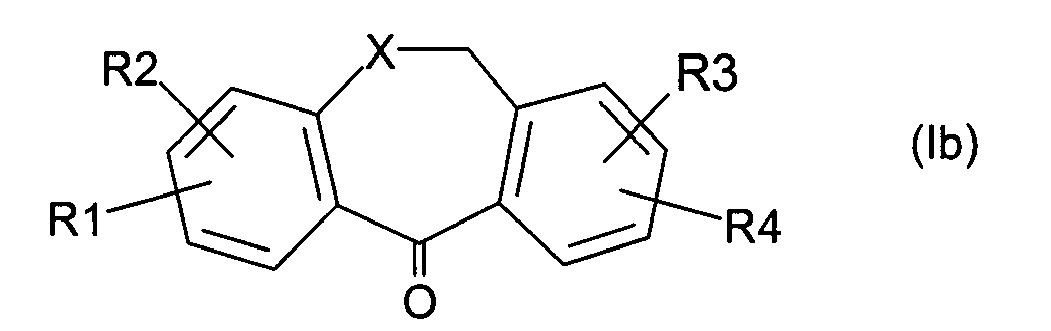
- Eine weitere Ausführungsform sind die Verbindungen der Formel Ic

- Eine weitere Ausführungsform sind die Verbindungen der Formel Ica:

- Die Erfindung umfasst auch die physiologisch verträglichen Salze der Verbindungen der Formel I. Im vorliegenden Fall handelt es sich insbesondere um die Säureadditionssalze. Zur Bildung der Säureadditionssalze werden anorganische Säuren, wie Salzsäure, Schwefelsäure oder Phosphorsäure oder organische Säuren, wie Weinsäure, Zitronensäure, Maleinsäure, Fumarsäure, Äpfelsäure, Mandelsäure, Ascorbinsäure, Gluconsäure, Methansulfonsäure, Benzolsulfonsäure oder Toluensulfonsäure und dergleichen, eingesetzt.
- Soweit die erfindungsgemäßen Verbindungen Asymmetriezentren aufweisen, sind die Racemate sowie die einzelnen optischen Isomere (Enantiomere, Diastereomere) ebenfalls Gegenstand der Erfindung.
Gegenstand der Erfindung sind auch die Solvate der Verbindungen der Formel I oder der Salze davon, insbesondere die Hydrate. - Die Herstellung der Verbindungen der Formel I , die an der Position 7 substituiert sind, wobei X-Y für CH2-CH2 oder CH = CH steht, erfolgt nach den in den Schemata I bis III beispielhaft erläuterten Verfahren.
Schema I: Synthese des Grundgerüsts mit Substitution in Position 7
- Ausgehend von 3-Methoxybenzoesäure (1) wird über das Phthalid (2) eine Formylgruppe eingeführt. Mittels einer Wittig-Reaktion erhält man die ungesättigte Verbindung (5a), die in üblicher Weise, beispielsweise unter Verwendung eines Edelmetallkatalysators, wie Pt oder Pd, hydriert werden kann. Vor dem Ringschluss durch Friedel-Crafts-Acylierung wird die Aminogruppe durch eine geeignete Schutzgruppe geschützt, die nach der Friedel-Crafts-Acylierung entfernt wird. Nach Umsetzung mit einem Arylhalogenid erhält man Verbindung (10) zu erhalten.
- Schema II zeigt ein alternatives Verfahren zu Herstellung von (10), mit dem sich die Verwendung der Schutzgruppe vermeiden lässt:


- Die an der Position 7 methoxy-substituierten Verbindungen (10) lassen sich durch Etherspaltung, etwa mittels wässriger HBr, in die Hydroxyverbindungen (11) überführen, siehe Schema III.

- Die Hydroxygruppe an Position 7 erlaubt weitere Substitutionen, etwa über die Ethersynthese nach Williams oder die Mitsunobu-Reaktion, siehe Schema IV:


- Die Herstellung der Verbindungen der Formel I , die an der Position 8 oder 9 substituiert sind, wobei X-Y für CH2-CH2 oder CH = CH steht, erfolgt nach den in den Schemata V bis X beispielhaft erläuterten Verfahren.


- Ausgehend von Methoxymethylbenzoesäure erfolgt zunächst eine Bromierung mit N-Bromsuccinimid (NBS). Die entstandene Brommethylmethoxybenzoesäure (6) wird in einer Wittig-Reaktion mit 3-Chlorbenzaldehyd zu Chlorphenylvinylmethoxybenzoesäure (7) umgesetzt. Die nachfolgende Hydrierung der Chlorphenylvinylmethoxy-benzoesäure erfolgt in üblicher Weise unter Verwendung von Edelmetalkatalysatoren, wie Pd/BaSO4 (Substitution in Position 8) bzw. Pd/C (Substitution in Position 9). Die Carbonsäure (8) wird in das Säurechlorid überführt, zum Beispiel durch Umsetzung mit Thionylchlorid. Der anschließende Ringschluss zu (9) erfolgt durch Friedel-Crafts-Acylierung mit geeigneten Lewis-Säuren, wie AlCl3. Verbindung (10) wird dann durch Etherspaltung, beispielsweise mit wässrigem Bromwasserstoff, erhalten.


- Zu einer gekühlten Lösung aus Chlorhydroxydibenzodihydrodibenzosuberon, 4-Hydroxytetrahydropyran, Triphenylphosphin und THF wird Carboxylat gegeben. Die Reaktion wird bis zur Beendigung bei Raumtemperatur fortgeführt. Das Chlor an Position 2 kann entsprechend Schema X substituiert werden.
- Auf diese Weise wurden folgende Verbindungen erhalten:

Verbindung des Beispiels Nr. R1 R3 71
(11h)

70
(15)
-Cl 

- Eine Mischung aus der phenolischen Verbindung, N-2-Chlorethylmorpholin und K2CO3 wird mehrere Stunden unter Erwärmen gerührt. Nach dem Abkühlen wird die gewünschte Verbindung in üblicher Weise gewonnen, die organische Phase abgetrennt, gewaschen und eingeengt. Das Chlor an Position 2 kann entsprechend Schema X substituiert werden.
- Auf diese Weise wurden folgende Verbindungen erhalten:
Verbindungen in Position 9 Verbindungen in Position 8 

Verbindung des Beispiels Nr. R1 R3 Verbindung des Beispiels Nr. R1 R3 73
(11j)

56
(12e)

89
(16)
-Cl 90
(17)
-Cl 
- Auf diese Weise wurden folgende Verbindungen erhalten:
Verbindungen in Position 9 Verbindungen in Position 8 

Verbindung des Beispiels Nr. R1 R3 Verbindung des Beispiels Nr. R1 R3 66
(11d)

51
(12a)
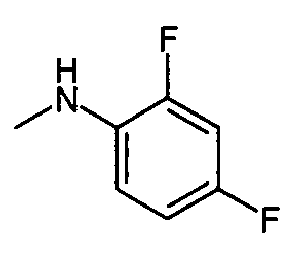
68
(11e)

53
(12b)

67
(11f)

52
(12c)

69
(11g)

54
(12d)

65
(13)
-Cl 87
(14)
-Cl 
- Die Mischung aus Chlordihydrodibenzosuberenon, Pd(OAc)2, Phosphinligand (2-(Dicyclohexylphosphino)-2',4',6'-triisopropylbiphenyl), NaOtert-Bu, Toluol, tert-BuOH und dem Amin R3NH2 wird bei erhöhten Temperaturen mehrere Stunden gerührt. Nach dem Abkühlen wird das gewünschte Produkt in üblicher Weise gewonnen.
- Auf diese Weise wurden folgende Verbindungen erhalten:

Verbindung des Beispiels Nr. R1 R3 63
(11a)-CH3 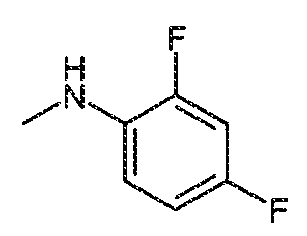
64
(11b)-CH3 
62
(11c)-OH 
- Die Herstellung der Verbindungen der Formel I , die an der Position 7 substituiert sind, wobei eines der Ringatome X oder Y für CH2 steht, erfolgt nach dem in Schema XI erläuterten Verfahren.

- Nach Veresterung der Ausgangsverbindung 2-Methyl-4-nitrobenzoesäure wird in üblicher Weise mit N-Bromsuccinimid (NBS) bromiert. Das bromierte Edukt wird in Gegenwart von Kaliumcarbonat mit dem Phenol umgesetzt. Nach Verseifung des Esters, bspw. mit KOH, erfolgt Ringschluss, beispielsweise mit Polyphosphorsäure in einem organischen Lösungsmittel, wie Sulfolan. Die Nitrogruppe wird anschließend in üblicher Weise, beispielsweise mit Sn/HCl, zur Aminogruppe reduziert. Es empfiehlt sich, bei erhöhten Temperaturen zu arbeiten, zweckmäßigerweise bei der Siedetemperatur des Lösungsmittels bzw. am Rückfluss.
- Die Herstellung der Verbindungen der Formel I, worin eines der Ringatome X oder Y für SO oder SO2 steht, erfolgt durch Oxidation der Verbindungen, worin Y für S steht, in üblicher Weise, beispielsweise mit Perverbindungen, wie m-Chlorperbenzoesäure.
- Die erfindungsgemäßen Verbindungen zeigen in vitro und in vivo immunmodulierende und die Freisetzung von TNF-α und IL-1β hemmende Wirkung. Die erfindungsgemäßen Verbindungen eignen sich daher zur Behandlung von Erkrankungen, die im Zusammenhang mit einer Störung des Immunsystems stehen. Sie eignen sich beispielsweise zur Behandlung von Autoimmunerkrankungen, Krebs, rheumatischer Arthritis, Gicht, septischem Schock, Osteoporose, neuropathischem Schmerz, HIV-Ausbreitung, HIV-Demenz, viraler Myokarditis, insulinabhängiger Diabetes, Periodontalerkrankungen, Restenose, Alopezie, T-Zell-Depletion bei HIV-Infektionen oder AIDS, Psoriasis, akuter Pankreatitis, Abstoßungsreaktionen bei allogenen Transplantaten, allergisch bedingter Lungenentzündung, Arteriosklerose, Multipler Sklerose, Kachexie, Alzheimer Erkrankung, Schlaganfall, Ikterus, Colitis ulcerosa, Morbus Crohn, Inflammatory-Bowel-Disease (IBD), Ischämie, kongestive Herzinsuffizienz, Lungen-Fibrose, Hepatitis, Glioblastom, Guillain-Barré-Syndrom, systemischer Lupus erythematodes, Adult-respiratory-distress-Syndrom (ARDS) und Atemnotsyndrom.
- Die erfindungsgemäßen Verbindungen können entweder als einzelne therapeutische Wirkstoffe oder als Mischungen mit anderen therapeutischen Wirkstoffen verabreicht werden. Die Verbindungen können alleine verabreicht werden, im Allgemeinen werden sie jedoch in Form pharmazeutischer Mittel dosiert und verabreicht, d.h. als Mischungen der Wirkstoffe mit geeigneten pharmazeutischen Trägern oder Verdünnungsmittel. Die Verbindungen oder Mittel können oral oder parenteral verabreicht werden, vorzugsweise werden sie in oralen Dosierungsformen gegeben.
- Die Art des pharmazeutischen Mittels oder Trägers bzw. des Verdünnungsmittels hängt von der gewünschten Verabreichungsform ab. Orale Mittel können bspw. als Tabletten oder Kapseln vorliegen und können übliche Exzipienten enthalten wie Bindemittel (z.B. Sirup, Akazia, Gelatine, Sorbit, Tragant oder Polyvinylpyrrolidon), Füllstoffe (z.B. Lactose, Zucker, Maisstärke, Calciumphosphat, Sorbit oder Glycin), Gleitmittel (z.B. Magnesiumstearat, Talcum, Polyethylenglycol oder Siliciumdioxid), desintegrierende Mittel (z. B. Stärke) oder Netzmittel (z. B. Natriumlaurylsulfat). Flüssige Oralpräparate können in Form wässriger oder öliger Suspensionen, Lösungen, Emulsionen, Sirupe, Elixiere oder Sprays und dergleichen sein. Sie können auch als Trockenpulver vorliegen, das zur Rekonstitution mit Wasser oder einem anderen geeigneten Träger aufbereitet wird. Derartige flüssige Präparate können übliche Additive, beispielsweise Suspendiermittel, Geschmacksstoffe, Verdünnungsmittel oder Emulgatoren enthalten. Für die parenterale Verabreichung kann man Lösungen oder Suspensionen mit üblichen pharmazeutischen Trägern einsetzen.
- Die erfindungsgemäßen Verbindungen oder Mittel können an Säuger (Mensch oder Tier) in einer Dosis von etwa 0,5 mg bis 100 mg pro kg Körpergewicht pro Tag verabreicht werden. Sie können in einer Einzeldosis oder in mehreren Dosen gegeben werden. Das Wirkungsspektrum der Verbindungen als Inhibitoren der TNF-α und IL-1β Freisetzung wurde anhand nachstehender Testsysteme wie beschrieben von Donat C. und Laufer S. in Arch. Pharm. Pharm. Med. Chem. 333, Suppl. 1, 1-40, 2000, untersucht.
- Die nachfolgenden Beispiele erläutern die Erfindung ohne sie zu begrenzen.
-
Schmelzpunkte Büchi Melting Point B-545 (thermodynamische Korrektur) NMR-Spektroskopie Bruker Avance 200 (200 MHz) IR-Spektroskopie Perkin-Elmer Spectrum One (ATR) GC-MS Hewlett Packard HP 6890 Series GC-System Hewlett Packard HP 5973 Mass Selective Detector GC-Säule: HP-5MS 5% Phenylmethylsiloxan ESI-MS: 70eV -
Temperatur [°C] Laufzeit [min] 160 1 160 → 240 10 240 5 240 → 270 10 270 35 -
MeOH Methanol NaOMe Natriummethylat KOtert-Bu Kalium-tert.-butylat Tert-BuOH tert.-Butanol EtOH Ethanol DMF Dimethylformamid THF Tetrahydrofuran DCM Dichlormethan i.Vak. im Vakuum EA Ethylacetat - Zur Synthese der Stilbene mittels Wittig-Reaktion wird die angegebene Menge Triphenylphosphin in MeOH gelöst. Unter Rühren wird das entsprechende Benzylchlorid zugetropft und 2 Stunden unter Rückfluss erhitzt. Die Reaktionsmischung wird auf 0°C abgekühlt und mit dem entsprechenden Aldehyd versetzt. Anschließend wird bei 0°C innerhalb ca. 45 min die angegebene Menge NaOMe-Lösung zugetropft. Nach beendigtem Zutropfen wird 3 h bei 0°C nachgerührt und das Reaktionsgemisch auf ein gerührtes Gemisch aus 75 g Eis und 175 ml Wasser gegossen. Es wird abgesaugt, der Filterrückstand wird mit ca. 50 ml Wasser gewaschen und die vereinigten wässrigen Phasen werden im Vakuum mehrmals mit Dichlormethan gewaschen. Das Produkt erhält man durch Ansäuern der wässrigen Phase in Form eines Niederschlags, der abfiltriert wird. Die Aufreinigung erfolgt durch Umkristallisieren aus MeOH/H2O.
- Zur Synthese der Ketone mittels Friedel-Crafts-Acylierung wird die angegebene Menge Säure in Dichlormethan suspendiert und der Ansatz mit Argon gespült. Nach Erhitzen zum Rückfluss wird unter Rühren innerhalb 1 Stunde eine Lösung aus Thionylchlorid in 50 ml Dichlormethan zugetropft und eine weitere Stunde gerührt. Nach dem Abkühlen auf Raumtemperatur wird innerhalb von 45 min eine Suspension von AlCl3 in Dichlormethan zugetropft, 30 min bei Raumtemperatur nachgerührt und das Reaktionsgemisch unter Rühren auf ein Gemisch aus 30 g Eis und 50 ml Wasser gegossen. Das Hydrolysegemisch wird ca. 30 min gerührt, der Niederschlag abfiltriert und die beiden Phasen des Filtrats werden getrennt. Das Produkt erhält man durch Einengen der organischen Phase im Vakuum. Die Aufreinigung erfolgt durch Umkristallisieren mit MeOH.
- Zur Herstellung der Testverbindungen wird eine Mischung aus Arylhalogenid, Amin, Pd(OAc)2, Phosphinligand, KOtert-Bu, Toluol und tert-BuOH unter Argon auf 100 °C erhitzt und die angegebene Zeit bei dieser Temperatur gerührt. Danach wird auf Raumtemperatur abgekühlt, mit 150 ml H2O hydrolysiert, mit je 3x 200 ml Diethylether extrahiert, die organische Phase filtriert und im Vakuum eingeengt. Die Aufreinigung erfolgt über Flash-Chromatographie.
- Zu einer Lösung der Nitroverbindung in EtOH wird SnCl2 x 5 H2O hinzugefügt. Die Mischung wird 5 h refluxiert. Dann wird abgekühlt und mit 20%iger NaOH alkalisiert. Es wird mit je 3x 200 ml Ethylacetat extrahiert und die organische Phase im Vakuum eingeengt.
- Zur Herstellung 2-Chlor-7-(S-1,2-isopropylidenglycer-3-yl)-10,11-dihydrodibenzo[a,d]cyclohepten-5-on werden 0,57 mmol 2-Chlor-7-hydroxy-10,11-dihydrodibenzo[a,d]cyclohepten-5-on in 10 ml wasserfreiem DMF gelöst, 0,82 mmol des entsprechenden α,β-isopropylideneglycerol-γ-tosylates und 1,65 mmol K2CO3 hinzugefügt. Das Reaktionsgemisch wird 24 h unter Argon-Atmosphäre bei 80°C gerührt. Die Reaktionsmischung wird auf Raumtemperatur abgekühlt in 50 ml Wasser gelöst, mit Diethylether extrahiert und die organische Phase wird im Vakuum eingeengt. Das Produkt fällt in Form eines hellgelben Öls an.
- Zur Lösung von 2 mmol Diisopropylazodicarboxylat in 20 ml THF wird eine Lösung von 2 mmol P(Ph)3 in 10 ml THF bei 0°C zugetropft und 1 h gerührt. Anschließend wird eine Lösung aus 2 mmol 2-Chlor-7-hydroxy-10,11-dihydro-dibenzo[a,d]cyclohepten-5-on und 2 ml des entsprechenden Alkohols in THF zugetropft und 2 h bei Raumtemperatur gerührt. Es wird mit Wasser hydrolysiert, mit Ethylacetat extrahiert und die organische Phase im Vakuum eingeengt. Die Aufreinigung erfolgt an SiO2 (Hexan/Ethylacetat 7+3).
- 1,7 mmol 2-Chlor-7-hydroxy-10,11-dihydro-dibenzo[a,d]cyclohepten-5-on, 1,86 mol Alkylhalogenid und 6,75 mmol K2CO3 werden entweder in DMF oder Acetonitril gelöst, für die angegebene Zeit bei 80°C gerührt, auf Raumtemperatur abgekühlt und in Diethylether und Wasser gelöst. Die organische Phase wird mit Wasser und Lauge gewaschen, über MgSO4 getrocknet und im Vakuum eingeengt.
- Die Mischung aus 20 g (131 mmol) 3-Methoxybenzoesäure, 13 ml (160 mmol) 37%ige Formalin-Lsg., 16 ml (162 mmol) 37%ige HCl und 150 ml 150 ml 100%ige Essigsäure wird unter Rühren auf 90°C erhitzt. Nachdem eine klare Lösung entstanden ist, wird der Rührer abgeschaltet und der Ansatz 14 Stunden bei dieser Temperatur belassen. Die Essigsäure wird bei 80°C im Vakuum abgezogen, der Rückstand in 150 ml Toluol aufgenommen und auf 80 ml eingeengt. Die 80°C heiße Lösung wird mit je 40 ml 20%iger Na2SO4-Lösung gewaschen, bis der pH der wässrigen Lösung alkalisch ist, dann wird mit 40 ml H2O gewaschen. Die organische Phase wird nach Zugabe von 6 ml Morpholin 2 h bei 80°C gerührt, dann mit je 50 ml 10%iger H2SO4, bis die wässrige Phase sauer ist, sowie mit je zwei mal 50 ml H2O gewaschen. Zum Kristallisieren des Produkts wird auf 50 ml eingeengt, ggf. ein Impfkristall zugefügt und bis zum Abkühlen auf Raumtemperatur gerührt. Man erhält das Produkt durch Abfiltrieren in Form von weißen Kristallen.
C9H8O3 (Mr 164,16)Ausbeute: 13,8 g (64%) Smp.: 107,6 °C GC 4,3 min MS m/z (%): 164 (56, M+), 135 (100, M+-OCH3), 107 (25) 92 (11), 77 (19), 63 (10), 51 (6). IR (ATR) 2945(C-H)aliph, 1745 (C=O), 1489, 1320, 1278, 1247, 1054, 1017, 990, 9056, 769. 1H-NMR (DMSO-d6) δ in ppm: 3.84 (s, 3 H, -OCH3), 5.33 (s, 2 H, C3-H), 7.28 (s, 1 H, C7-H), 7.31 (d, J = 8.3 Hz, C4-H), 7.56 (d, 1 H, J = 8.3 Hz, C5-H). - 10 g (61 mmol) 6-Methoxyphtalid, 11,4 g (64,0 mmol) NBS und 200 ml Chlorbenzol werden unter Rühren gemischt und die Suspension auf 85°C erhitzt und mit 2 ml der Lösung von 100 mg AIBN in 10 ml Chlorbenzol versetzt. Innerhalb weniger Minuten steigt die Temperatur auf 110°C und es entsteht eine rote Lösung. Nach dem Abflauen des Temperaturanstiegs werden die restlichen 8 ml zugegeben und 40 min bei 85 °C gerührt. Nach dem Abkühlen auf 0°C wird vom ausgefallenen Succinimid abfiltriert und mit Chlorbenzen nachgewaschen. Das Filtrat wird eingeengt, bis ein öliger Rückstand entsteht, der mit 10%iger NaOH-Lösung aufgenommen und mit je drei mal 300 ml Dichlormethan gewaschen wird. Nach dem Ansäuern der wässrigen Phase mit konzentrierter HCl wird 1 Stunde bei 0°C gerührt. Dabei fällt die Säure in Form eines weißen Niederschlags aus, von dem abfiltriert wird
C9H8O4 (Mr = 180,16)Ausbeute 9,6 g (87%) Schmelzpunkt 166,2 °C IR (ATR) 2903 (COOH), 2601 (C-H)aliph, 1703, 1586 (C=O), 1497, 1278, 1210, 1187, 1142, 1072, 1025, 897, 823, 736. H1-NMR (DMSO-d6) δ in ppm: 3.64 (s, 3 H, -OCH3), 6.59 (s, 1 H, -CHO), 7.23-7.86 (m, 3 H, C3-H, C4-H, C6-H). 10.3 (s, 1 H, -COOH). - Zur Synthese der Verbindung 5a nach Methode A werden 15,3 g (0,058 mol) Triphenylphosphin, in 100 ml MeOH, 10,0 g (0,058 mol) Nitrobenzylchlorid (gelöst in 50 ml MeOH), 9,6 g (0,058 mol) 2-Formyl-5-methoxybenzoesäure und 28,0 g (0,145 mol) 28%iger NaOMe-Lösung verwendet.
C16H13NO5 (Mr = 299,29)Ausbeute 13.5 g (78 %) Schmelzpunkt 174,7 °C IR (ATR) 2838 (COOH), 2627 (C-H)aaliph, 1687 (C=O), 1530, 1348, 1266, 1237, 810, 734, 671. H1-NMR (DMSO-d6) δ in ppm: 3.80 (s, 3 H, -OCH3), 6.67 (d, 1 H, J = 12.1 Hz, CH=CH), 6.98-7.00 (m, 2 H, C3H, C4-H, 7.12 (d, 1 H, J = 12.0 Hz, CH=CH), 7.43-7.47 (m, 3 H, C6-H, C5'-H, C6'-H), 7.88 (s, 1 H, C2'-H), 7.98 (m, 1 H, C4'-H). - Zur Synthese der Verbindung 5b nach Methode A werden 15,3 g (0,058 mol) Triphenylphosphin, in 100 ml MeOH, 9,4 g (0,058 mol) Chlorbenzylchlorid (gelöst in 50 ml MeOH), 9,6 g (0,058 mol) 2-Formyl-5-methoxybenzoesäure und 28,0 g (0,145 mol) 28%iger NaOMe-Lösung verwendet.
C16H13ClO3 (Mr = 288,73)Ausbeute 6,7 g (40 %) Schmelzpunkt 142,3 °C IR (ATR) 2835 (COOH), 2563 (C-H)aliph, 1681 (C=O), 1604, 1594, 1419, 1265, 1251, 1218,840,779,756. H1-NMR (DMSO-d6) δ in ppm: 3.79 (s, 3 H, -OCH3), 7.04 (d, 1 H, J = 16.3 Hz, CH=CH), 7.16 (dd, 1 H, J1 = 2.7 Hz, J2 = 7.9 Hz), 7.31-7.36 (m, 2 H, C2'-H, C4'-H), 7.41 (d, 1 H, J = 7.6, C4-H), 7.46-7.55 (m, 2 H, C6-H, C6'-H), 7.76 (d, 1 H, J = 8.8 Hz, C3-H), 7.86 (d, 1 H, J = 16.4 Hz, CH=CH). - 10,0 g (0,033 mol) 2-(3-Nitrophenethenyl)-5-methoxybenzoesäure werden in 150 ml EtOH suspendiert und 100 mg Pd/Kohle zugefügt. Der Ansatz wird mehrmals mit H2 gespült und 72 Stunden bei Raumtemperatur gerührt. Nach dem Abfiltrieren der Pd/Kohle wird im Vakuum eingeengt und der Rückstand mit MeOH/H2O umkristallisiert.
C16H17NO3 (Mr = 271,32)Ausbeute 8,5 g (95 %) Schmelzpunkt 108,5 °C H1-NMR (DMSO-d6) δ in ppm: 2.61 (2 H, m, -CH2-CH2-), 3.05 (m, 2 H, -CH2-CH2), 3.75 (s, 3 H, -OCH3), 6.36-6.44 (m, 3 H, C2'-H, C4'-H, C6'-H), 6.90 (t, 1 H, J1 = 7.6 Hz, J2 = 7.7 Hz, C5'-H), 7.01 (d, 1 H, J = 8.5 Hz, C4-H), 7.20 (d, 1 H, J = 8.5 Hz, C3-H), 7.3 (s, 1 H, C6-H). - 5,0 g (0,017 mol) 2-(3-Chlorphenethenyl)-5-methoxybenzoesäure werden in einem Gemisch aus 75 ml Ethylacetat und 75 m1 Acetonitril gelöst und 100 mg Pd/Kohle zugefügt. Der Ansatz wird mehrmals mit H2 gespült und 5 Stunden bei Raumtemperatur gerührt. Nach dem Abfiltrieren der Pd/Kohle wird im Vakuum eingeengt und der Rückstand mit MeOH/H2O umkristallisiert.
C16H15ClO3 (Mr = 290,75)Ausbeute 4,7 g (95 %) H1-NMR (DMSO-d6) δ in ppm: 2.73-2,81 (m, 2 H, -CH2-CH2-), 3.05-3,13 (m, 2 H, -CH2-CH2-), 3,75 (s, 3 H, OCH3), 6.99-7.35 (m, 6 H, C3-H, C4-H, C6-H, C2'-H, C4'-H, C5'-H, C6'-H). - 20 g (0,074 mol) 2-Aminophenethyl-5-methoxybenzoesäure werden in 50 ml Acetanhydrid gelöst und 15 Stunden bei Raumtemperatur gerührt. Es wird mit 200 ml Eiswasser hydrolysiert mehrmals mit je 3x 200 ml Ethylacetat extrahiert. Nach dem Einengen der organischen Phase im Vakuum erhält man ein gelbes Öl, aus dem das Produkt durch Umkristallisieren mit MeOH/H2O erhalten wird.
C17H17NO2 (Mr = 283,33)Ausbeute 16.4 g (0,058 mol) (79,0%) Schmelzpunkt 145,6 °C IR (ATR) 3265-2933, 2562 (C-H)aliph, 1622, 1693, 1593, 1567, 1437, 1420, 1289, 1235,789,747. H1-NMR (DMSO-d6) δ in ppm: 2.01 (s, 3 H, -CO-CH3), 2.74 (m, 2 H, -CH2-CH2), 3.08 (m, 2 H, -CH2-CH2), 3.74 (s, 3 H, -OCH3), 6.89 (d, 1 H, J= 7.6 Hz, C4'-H), 6.95 (d, 1 H, J = 8.5 Hz, C6'-H), 7.12-7.20 (m, 2 H, C2'-H, C6-H), 7.28 (d, 1 H, J = 2.8 Hz, C4-H), 7.44-7.46 (m, 2 H, C3-H, C6-H), 9.89 (s, 1 H, -NH-). - Zur Herstellung des 2-Nitro-7-methoxydibenzosuberenons nach Methode B werden 5,1 g (0,019 mol) 2-(3-Nitrophenylethenyl)-5-methoxybenzoesäure, 150 ml Dichlormethan, 2,42 g (0,02 mol) Thionylchlorid und 3,33 g (0,025 mol) AlCl3 verwendet.
C16H11NO4 (Mr = 281,27)Ausbeute: 58% Schmelzpunkt 163,7 °C GC 17,7 min MS m/z (%): 281 (100, M+), 266 (10, M+-CH3), 235 (10, M+-NO2), 220 (34), 192 (45), 163 (47). IR (ATR) 3093-3005 (C-H)arom, 2921-2838, 1703 (C=O), 1521, 1482, 1431, 1347, 1290, 1223, 1257, 1019, 872, 806, 730, 674. H1-NMR (DMSO-d6) δ in ppm: 3.81 (s, 3 H, -OCH3), 6.92 (dd, 1 H, J1 = 2.4 Hz, J2 = 8.0 Hz), 7.04 (d. 1 H, J = 2.5, C8-H), 7.21 (d, 1 H, J = 7.9, -CH=CH-), 7.70 (d, 1 H, J = 8.0, C3-H), 8.13-8.24 (m, 2 H, C2-H, C4-H), 8.34 (s, 1 H, C10-H), 8.67 (t, 1 H, J = 2.0 Hz, C7-H). - Zur Herstellung der Verbindung 8c nach Methode B werden 5,5 g (0,019 mol) 2-(3-Chlorphenylethenyl)-5-methoxybenzoesäure, 150 ml Dichlormethan, 2,42 g (0,02 mol) Thionylchlorid und 3,33 g ( 0,025 mol) AlCl3 verwendet.
C16H11ClO2 (Mr = 270,72)Schmelzpunkt 133,0 °C Ausbeute 4,8 g (93 %) GC 14,9 min MS m/z (%): 272/270 (52/100, M+), 244/242 (16/49), 229/227 (12/35), 201/199 ((53/100), 176 (19), 163 (78), 137 (8), 113 (9), 97 (11), 63 (10). IR (ATR) 2923-2843 (C-H)aliph, 1636, 1605, 1583 (C=O), 1556, 1503, 1298, 1245,1225, 972, 878, 863, 835, 786. H1-NMR (DMSO-d6) δ in ppm: 3.89 (s, 3 H, -OCH3), 7.06 (d, 1 H, J = 12.1 Hz, -CH=CH-), 7.25 (d, 1 H, J = 12.1 Hz, -CH=CH-), 7.37 (dd, 1 H, J1 = 2.9 Hz, J2 = 8.5 Hz, C3-H),7.35-7.40 (m, 2 H, C2-H, C10-H, 7.72 (d, 1 H, J = 8.7 Hz, C8-H), 7.85 (d, 1 H, J = 2.2 Hz, C4-H), 8.11 (d, 1 H, J = 8.6 Hz, C7-H). - Zur Herstellung der Verbindung 8a nach Methode B werden 6,0 g (0,019 mol) 2-(3-Acetamidophenethyl)-5-methoxybenzoesäure, 150 ml Dichlormethan, 2,42 g (0,02 mol) Thionylchlorid und 6,66 g ( 0,05 mol) AlCl3 verwendet.
C18H17NO3 (Mr = 295,34)Ausbeute 4,66 g (83% GC 27,0 min MS m/z (%): 295 (100, M+), 253 (60, M+-COCH3), 238 (12, 253-CH3), 224 (36, 238-NH), 210 (10), 194 (10), 180 (9), 165 (14), 152 (8). H1-NMR 2.07 (s, 3 H, -COCH3), 3.05 (s, 4 H, -CH2-CH2), 3.75 (s, 3 H, -OCH3), 7.05 (d, 1 H, J = 8.4 Hz, C8-H), 7.22 (d, 1 H, J = 8.4 Hz, C9-H), 7.38 (s, 1 H, C5-H), 7.52-7.56 (m, 2 H, C1-H, C3-H), 7.92 (d, 1 H, J = 9.3 Hz, C4-H), 10.22 (s, 1 H, -NH-). - Zur Herstellung der Verbindung 8b nach Methode B werden 5,5 g (0,019 mol) 2-(3-Chlorphenylethyl)-5-methoxybenzoesäure, 150 ml Dichlormethan, 2,42 g (0,02 mol) Thionylchlorid und 3,33 g (0,025 mol) AlCl3 verwendet.
C16H13ClO2 (Mr = 272,73)Ausbeute 58% GC 12,8 min MS m/z (%): 274/272 (35/100, M+), 259/257 ((5/17, M+-CH3), 243, 241 (19/21, M+-OCH3), 208 (29), 194 (17),178 (23, 208-CO), 165 (49). H1-NMR (DMSO-d6) δ in ppm: 3.09 (s, 4 H, -CH2-CH2), 3.77 (s, 3 H, -OCH3), 7.06 (dd, 1 H, J1 = 2.8Hz, J2 = 8.4 Hz, C3-H), 7.25 (d, 1 H, J = 8.4 Hz, C3-H), 7.38-7.45 (m, 3 H, C1-H, C6-H, C9-H), 7.85 (d, 1 H, J = 8.3, C4-H). - 4,0 g ( 0,0135 mol) 2-Acetamido-7-methoxydibenzosuberon werden in 100 ml 20%iger HCl suspendiert und das Reaktionsgemisch 5 Stunden unter Rückfluss erhitzt.
Beim Abkühlen tritt ein Niederschlag auf, von dem abfiltriert wird. Nach dem Trocknen im Vakuum erhält man ein sandfarbenes Pulver.
C16H15NO2 (Mr = 253,30)Ausbeute 1,85 g (0,0073 mol) (54,0 %) Schmelzpunkt 185,3 °C GC 18,4 min MS m/z (%): 253 (100, M+), 238 (51, M+-CH3), 224 (41, 238-NH), 210 (14), 194 (12), 180 (13), 165 (13), 152 (6). H1-NMR 2.96 (s, 4 H, -CH2-CH2), 3.75 (s, 3 H, -OCH3), 6.06 (s, 2 H, -NH2), 6.34 (s, 1 H, C1-H), 6.49 (d, 1 H, J = 8.7 Hz, C3-H), 7.00 (d, 1 H, J = 8.3 Hz, C8-H), 7.19 (d, 1 H, J = 8.3 Hz, C9-H), 7.36 (s, 1 H, C6-H), 7.87 (d, 1 H, J = 8.7 Hz, C4-H). - Zu einer Lösung von 1,0 g (2,67 mmol) 2-Chlor-7-methoxydibenzosuberon in 10 ml DCM wird unter Argon-Schutzgasatmosphäre bei Raumtemperatur 0,13 ml (1,34 mmol) Bortribromid zugetropft. Die Reaktionsmischung wird bei Raumtemperatur 6 h gerührt, anschließend mit 20 ml Wasser versetzt und die org. Phase im Vakuum eingeengt. Man erhält das Produkt in Form eines orangenen Feststoffes.
C15H11ClO2 (Mr = 258,71)Ausbeute 0,66 g (95%) Schmelzpunkt 191,6 °C IR (ATR) 2926, 1589 (C=O), 1561, 1459, 1422, 1363, 1312, 1160, 1080, 1006,837,798. H1-NMR (DMSO-d6) δ in ppm: 3.05 (dd, 4 H, J1 = 9.0, J2 = 13.5, -CH2-CH2-), 6.91 (d, 1 H, J = 8.2, C8-H), 7.13 (d, 1 H, J = 8.3, C9-H), 7.30-7.80 (m, 3 H, C1-H, C3-H, C6-H), 7.82 (d, 1 H, J = 9.1, C4-H). 13C-NMR (DMSO-d6) δ in ppm: 33.4 (C11), 34.4 (C10), 116.2 (C6), 120.7 (C8), 126.9 (C3), 129.3 (C1), 131.5 (C9), 132.5 (C4), 133.1 (C4a), 137.1 (C5a), 137.3 (C9a), 138.5 (C2), 144.7 (C11a), 156.1 (C7), 193.5 (C5). - Die Herstellung der Titelverbindung erfolgt nach Methode E.
C21H21ClO4 (Mr = 372,85)Ausbeute: 89 % GC 22,7 min MS m/z (%): 374/372 (15/43, M+), 359/357 (6/17), 299/297 (26/76), 273/271 (5/13), 260/258 (4/10), 194 (11), 178 (24), 165 (37), 145 (24), 115 (46), 101 (100), 73 (16), 59 (16). 1H-NMR (DMSO-d6) δ in ppm: 1.29 (s, 3 H, -CH3), 1.34 (s, 3 H, -CH3), 3.06 (s, 4 H, -CH2-CH2-), 3.73-3.80 (m, 1 H, -OCH2-), 4.03-4.12 (m, 3 H, -CH2O-, -OCH2-), 4.37-4.42 (m, 1 H, -CH-), 7.13 (d, 1 H, J = 8.3, C8-H), 7.27 (d, 1 H, J = 8.4, C9-H), 7.39-7.47 (m, 3 H, C1-H, C3-H, C6-H), 7.85 (d, 1 H, J = 8.3, C4-H). 13C-NMR (DMSO-d6) δ in ppm: 25.8 (-CH3), 26.9 (-CH3), 33.3 (C11), 34.4 (C10), 66.0 (-OCH2-), 69.3 (-CH2O-), 74.0 (-CH-), 115.0 (C6), 120.3 (C8), 127.0 (C3), 129.5 (C1), 131.6 (C9), 132.6 (C4), 135.1 (C4a), 136.9 (C5a), 137.5 (C9a), 138.6 (C2), 144.8 (C11a), 157.3 (C7), 193.2 (C5). - Die Herstellung der Titelverbindung erfolgt nach Methode E.
C21H21ClO4 (Mr = 372,85)Ausbeute: 91 % GC 24,6 min MS m/z (%): 374/372 (16/45, M+), 359/357 (6/17), 299/297 (26/76), 273/271 (5/13), 260/258 (4/11), 194 (12), 178 (26), 165 (39), 145 (25), 115 (46), 101 (100), 73 (14), 59 (14). 1H-NMR (DMSO-d6) δ in ppm: 1.29 (s, 3 H, -CH3), 1.34 (s, 3 H, -CH3), 3.10 (s, 4 H, -CH2-CH2-), 3.72-3.80 (m, 1 H, -CH2O-), 4.03-4.09 (m, 3 H, -CH2O-, -OCH2-), 4.31-4.46 (m, 1 H, -CH-), 7.13 (d, 1 H, J = 8.6 C8-H), 7.27 (d, 1 H, J = 8.5, C9-H), 7.39-7.49 (m, 3 H, C1-H, C3-H, C6-H), 7.85 (d, 1 H, J = 7.4, C4-H). 13C-NMR (DMSO-d6) δ in ppm: 25.7 (-CH3), 26.9 (-CH3), 33.3 (C11), 34.3 (C10), 660 (-CH2O-), 69.3 (-OCH2-), 74.0 (-CH-), 115.0 (C6), 120.2 (C8), 127.0 (C3), 129.5 (C1), 131.6 (C9), 132.6 (C4), 135.1 (C4a), 136.9 (C5a), 137.5 (C9a), 138.6 (C2), 144.7 (C11a), 157.3 (C7), 193.1 (C5). - Die Herstellung der Titelverbindung erfolgt nach Methode G unter Verwendung von 3-lodpropyl-acetat als Edukt in DMF als Solvens.
C20H19ClO4(Mr = 358,83)Ausbeute: 87 % GC 24,2 min MS m/z (%):360/358 (2/6, M+), 259/257 (2/5, M+-Acetoxypropyl), 243/241 (2/2, M+- Acetoxypropoxy), 194 (9, 243/241-Cl), 178 (6), 165 (17), 101 (100, Acetoxypropyl), 73 (11). 1H-NMR (DMSO-d6) δ in ppm: 1.96-2.08 (m, 5 H, CH3-Ac, -CH2-), 3-04-3.13 (m, 4 H, -CH2-CH2-), 4.01-4.18 (m, 4 H, -OCH2-, -CH2O-), 7.10 (d, 1 H, J = 8.3, C8-H), 7.25 (d, 1 H, J = 8.4, C9-H), 7.30-7.45 (m, 3 H, C1-H, C3-H, C6-H), 7.57 (d, 1 H, J = 8.3, C4-H). 13C-NMR (DMSO-d6) δ in ppm: 21.0 (CH3Ac-), 28.4 (-CH2-), 33.6 (C11), 34.3 (C10), 61.1 (AcO-CH 2 -), 64.8 (-OCH2), 114.9 (C6), 120.3 (C8), 127.6 (C3), 130.3 (C1), 131.6 (C9), 132.6 (C4), 135.0 (C4a), 136.9 (C5a), 137.5 (C9a), 138.5 (C2), 144.7 (C11a), 157.3 (C7), 170.7 (C=O), 193.1 (C5). - Die Herstellung der Titelverbindung erfolgt nach Methode G unter Verwendung von 3-lodethyl-acetat als Edukt und DMF als Solvens.
C19H17ClO4 (Mr = 344,80)Ausbeute: 78 % GC 21,1 min MS m/z (%): 346/344 (2/4, M+), 194 (5, 241/243-Cl), 178 (8), 165 (11), 87 (100, Acetoxyethyl). 1H-NMR (DMSO-d6) δ in ppm: 2.03 (s, 3 H, -COCH3), 3.10 (s, 4 H, -CH2-CH2-), 4.19-4.23 (m, 2 H, -OCH2-,), 4.30-4.35 (m, 2 H, -CH2-O-); 7.11-7.48 (m, 5 H, C1-H, C3-H, C6-H, C8-H, C9-H), 7.86 (d, 1 H, J = 8.3, C4-H). 13C-NMR (DMSO-d6) δ in ppm: 21.0 (CH 3 -CO-), 33.3 (C11), 34.3 (C10), 62.8 (AcO-CH 2 -), 66.4 (-CH2O-), 115.0 (C6), 120.3 (C8), 127.0 (C3), 129.5 (C1), 131.6 (C9), 132.6 (C4), 135.2 (C11a), 136.9 (C5a), 137.5 (C9a), 138.6 (C2), 144.8 (C4a), 157.1 C7), 170.7 (C=O), 193.1 (C5). - Die Herstellung der Titelverbindung erfolgt nach Methode G unter Verwendung von 2-Chlorethylmorpholin-hydrochlorid als Edukt in Acetonitril als Solvens.
C21H22ClNO3 (Mr = 371,87)Ausbeute: GC 32,7 min MS m/z (%): 373/371 (1/2, M+), 330/328 (2/6), 286/284 (2/6, M+-Morpholin-4-yl), 178 (6), 165 (4) 100 (100, Morphin-4-yl-methyl). 1H-NMR (DMSO-d6) δ in ppm: 3.11 (s, 4 H, -CH2-CH2), 3.20-3.53 (m, 6 H, -N-CH2, -CH2-N-CH2-), 3.79-4.06 (m, 4 H, -CH2-O-CH2-), 4.47-4.50 (m, 2 H, (-OCH2-), 7.19 (d, 1 H, J = 8.3, C8-H), 7.32 (d, 1 H, J = 8.4, C9-H), 7.40-7.47 (m, 3 H, C1-H, C3-H, C6-H), 7.86 (d, 1 H, J = 8.4, C4-H), 11.57 (s, 1 H, -NH-). 13C-NMR (DMSO-d6) δ in ppm: 33.3 (C11), 34.4 (C10), 57.0 (-CH 2 -O-CH 2 -), 60.1 (-N-CH2-), 65.5 (-OCH2-), 66.1 (-CH 2 -O-CH 2 ), 115.1 (C3), 120.3 (C8), 127.0 (C3), 129.5 (C1), 131.6 (C9), 132.6 (C4), 135.0 (C4a), 136.9 (C5a), 137.5 (C9a), 138.6 (C2), 144.7 (C11a), 157.2 (C7), 193.2 (C5). - Die Herstellung der Titelverbindung erfolgt nach Methode F.
C20H19ClN3 (Mr = 342,83)Ausbeute: 46 % 1H-NMR (DMSO-d6) δ in ppm: 1.54-1.61 (m, 2 H, -CH2-), 1.91-1.98 (m, 2 H, -CH2-), 3.06-3.16 (m, 4 H, -CH2-CH2-), 3.42-3.54 (m, 2 H, -CH2O-), 3.78-3.86 (m, 2 H, -CH2O-), 4.56-4.62 (m, 1 H, -CH-), 7.16 (d, 1 H, J = 8.4, C8-H), 7.27 (d, J = 8.4, C9-H), 7.38-7.48 (m, 3 H, C1-H, C3-H, C6-H), 7.86 (d, 1 H, J = 8.4 (C4-H). - Zur Herstellung der Verbindung 10a nach Methode C werden 0,5 g (1,8 mmol) 2-Chlor-7-methoxydibenzosuberon, 1,0 (9,2 mmol) g 1,2-Phenylendiamin, 0,05 g Pd(OAc)2, 0,10 g 2-(Dicyclohexylphosphino)-2'-,4'-, 6'-triisopropyl-biphenyl, 0,70 g KO-tert-Bu, 5 ml Toluol und 1 ml tert-BuOH verwendet.
C22H20N2O2 (Mr = 344,42)Ausbeute: 0,48 g (78 %) Schmp.: 106,5 °C GC 49,4 min MS m/z (%): 344 (100, M+), 329 (8), 315 (6), 301 (5), 195 (7), 165 (6), 107 (9). IR 3418-3343 (C-H)araom, 3320 (N-H), 2976-2939 (C-H)aliph, 1546 (C=O), 1516, 1494, 1323, 1284, 1147, 1026, 828, 751, 740. 1H-NMR (DMSO-d6) δ in ppm: 2.96 (s, 4 H, -CH2-CH2), 3.76 (s, 3 H, -OCH3), 4.84 (s, 2 H, -NH2), 6.46 (s, 1 H, C1-H), 6.54-6.64 (m, 2 H, C3'-H, C6'-H), 4,78 (d, 1 H, J = 7.8 Hz, C4'-H), 6.91-7.04 (m, 3 H, C3-H, C5-H, C8-H), 7.20 (d, 1 H, J = 8.3 Hz, C9-H), 7.39 (s, 1 H, C6-H), 7.92-7.97 (m, 2 H, C4-H, -NH-). 13C-NMR (DMSO-d6) δ in ppm: 33.6 (C10), 36.6 (C11), 55.5 (-OCH3), 112.1 (C6), 113.1 (C3), 114.8 (C1), 115.8 (C3'), 116.8 (C4'), 118.3 (C8), 125.2 (C5'), 126.2 (C6'), 126.3 (C1'), 126.4 (C4a), 130.4 (C9), 133.9 (C5a), 134.5 (C4), 140.3 (C9a), 144.0 (C2'), 145.7 (C11a), 151.1 (C2). 158.0 (C7), 190.3 (C5). - Zur Herstellung der Verbindung 10b nach Methode C werden 0,5 g (1,8 mmol) 2-Chlor-7-methoxydibenzosuberon, 0,3 g (1,9 mmol) 2-Nitro-4-fluoranilin, 0,05 g Pd(OAc)2, 0,10 g 2-(Dicyclohexylphosphino)-2'-,4'-, 6'-triisopropyl-biphenyl, 0,70 g KO-tert-Bu, 5 ml Toluol und 1 ml tert-BuOH verwendet. Die Aufreinigung der Nitroverbindung erfolgt durch Umkristallisieren mit MeOH. Ohne weitere Aufreinigung werden 0,5 g der Nitroverbindung, 2,9 g ZnCl2 x2 H2O in 20 ml EtOH nach Methode D reduziert.
C22H19FN2O2 (Mr = 362,41 )Ausbeute: 0,42 g (65%) Schmp.: 72.2 °C GC 54,1 min MS m/z (%): 362 (100, M+), 247 (7), 125 (14). IR (ATR) 3353 (N-H), 2941-2834 (C-H)aliph, 1622, 1567 (C=O), 1508, 1324, 1273, 1162, 839, 784. 1H-NMR (DMSO-d6) δ in ppm: 2.49 (s, 4 H, -CH2-CH2), 3.76 (s, 3 H, -OCH3), 5.25 (s, 2 H, -NH2), 6.30-6.38 (m, 2 H, C3'-H, C5'-H), 6.51-6.58 (m, 2 H, C3-H, C6'-H), 7.94-7.05 (m, 2 H, C1-H, C8-H), 7.21 (d, 1 H, J = 8.3 Hz, C9-H), 7.38 (s, 1 H, C6-H) 7.89 (s, 1 H, -NH-), 7.93 (d, 1 H, C4-H). 13C-NMR (DMSO-d6) δ in ppm: 33.6 (C10), 36.5 (C11), 55.5 (-OCH3), 101.4 (d, J = 25.5 Hz, C3'), 102.5 (d, J = 22.6 Hz, C5'), 111.9 (C6), 112.9 (C3), 114.8 (C1), 118.4 (C8), 121.3 (d, J = 2.3 Hz, C1'), 126.2 (C4a), 128.4 (d, J = 20.8 Hz, C6'), 130.4 (C9), 134.0 (C5a), 134.5 (C4), 140.3 (C9a), 145.8 (C11a), 146.5 (d, J = 12.0 Hz, C2'), 151.5 (C2), 158.0 (C7), 161.2 (d, J = 238.6 Hz, C4'), 190.2 (C5). - Zur Herstellung der Verbindung 10c nach Methode C werden 0,5 g (1,8 mmol) 2-Chlor-7-methoxydibenzosuberon, 0,25 g (1,9 mmol) 2, 4-Difluoranilin, 0,05 g (0,22 mmol) Pd(OAc)2, 0,10 g (0,21 mmol) 2-(Dicyclohexylphosphino)-2'-,4'-, 6'-triisopropyl-biphenyl, 0,70 g KO-tert-Bu, 5 ml Toluol und 1 ml tert-BuOH verwendet.
C22H17F2NO2 (Mr = 365,38)Ausbeute: 0,57 g (87%) Schmp.: 123-126 °C (Zersetzung). GC 31,4 min MS m/z (%): 365 (100, M+), 350 (7, M+-CH3), 337 (11), 322 (6), 237 (4, M+-2-NH2, 4-F-Anilin), 208 (15), 194 (5), 178 (6), 165 (15), 152 (5). IR (ATR) 3327 (N-H), 3074 (C-H)arom, 2941-2842 (C-H)aliph, 1338, 1551 (C=O), 1525, 1498, 1325, 1281, 1238, 854, 832, 786. 1H-NMR (DMSO-d6) δ in ppm: 2.99 (s, 4 H, -CH2-CH2), 3.76 8s, 3 H, -OCH3), 6.61 (s, 1 H, C1-H), 6.74 (d, 1 H, J = 8.7 Hz, C3-H), 7.00-7.47 (m, 6 H, C6-H, C8-H, C9-H, C3'-H, C5'-H, C6'-H), 7.95 (d, 1 H, J = 8.8 Hz, C4-H), 8.55 (s, 1 H, -NH-). 13C-NMR (DMSO-d6) δ in ppm: 36.2 (C10), 38.6 (C11), 55.5 (-OCH3), 105.3 (dd, J = 26.7 Hz, C3'), 112.2 (d, J = 22.1 Hz, C5'), 112.6 (C6), 113.9 (C3), 114.7 (C1), 118.6 (C8), 125.3 (d, J = 12.2 Hz, C1'), 126.4 (d, J = 9.7 Hz, C6'), 127.7 (C4a), 130.6 (C9), 133.8 (C5a), 134.6 (C4), 140.0 (C9a), 145.7 (C11a), 149.4 (C2), 154.9 (d, J = 143.5 Hz, C4'), 158.1 (C7), 159.8 (d, J = 138.2 Hz, C7'), 190.8 (C5). - C22H17ClFNO2 (Mr = 381,84)
- Zur Herstellung der Verbindung 10d nach Methode C werden 0,5 g (1,8 mmol) 2-Chlor-7-methoxydibenzosuberon, 0,27 g (1,9 mmol) 2-Chlor, 4-fluoranilin, 0,05 g (0,22 mmol) Pd(OAc)2, 0,10 g (0,21 mmol) 2-(Dicyclohexylphosphino)-2'-,4'-, 6'-triisopropyl-biphenyl, 0,70 g KO-tert-Bu, 5 ml Toluol und 1 ml tert-BuOH verwendet.
Ausbeute: 0,24 g(35%) Schmp.: 110,2 °C GC 38,4 min MS m/z (%): 385/383 (36/100, M+), 368/366 (2/6, M+-CH3), 354/352 (4/9), 340/338 (2/4), 274/272 (2/6), 237 (4, M+-2-Cl, 4-F-Anilin), 208 (14), 194 (5), 178 (6, 208-CO), 165 (13), 151 (4), 136 (6). IR (ATR) 3336 (N-H), 3070 (C-H)arom, 2939-2835 (C-H)aliph, 1602, 1554 (C=O), 1520, 1484, 1282, 1255, 1235, 863, 818, 785. 1H-NMR (DMSO-d6) δ in ppm: 3.00 (s, 4 H, -CH2-CH2-), 3.77 (s, 3 H, -OCH3), 6.60 (s, 1 H, C1-H), 6.72 (d, 1 H, J = 8.8 Hz, C3-H), 7.03 (d, 1 H, J = 5.6 Hz, C6, -H), 7.18-7.57 (m, 5 H, C6-H, C8-H, C9-H, C3'-H, C5'-H), 7.94 d, 1 H, J = 8.7 Hz, C4-H), 8.46 (s, 1 H, -NH-). 13C-NMR (DMSO-d6) δ in ppm: 33.5 (C12), 36.2 (C11), 55.5 (OCH3), 112.8 (C6), 114.1 (C3), 114.6 (C1), 115.6 (C5'), 117.7 (C3'), 118.6 (C8), 127.3 (C1'), 127.8 (C4), 129.4 (C2'), 130.6 (C9), 133.7 (C5a), 134.7 (C4), 140.0 (C9a), 145,7 (C11a), 149.5 (C2), 158.1 (C7), 158.9 (C4'), 190.8 (C5). - C22H16F3NO2 (Mr = 383,37)
- Zur Herstellung der Verbindung 10e nach Methode C werden 0,5 g (1,8 mmol) 2-Chlor-7-methoxydibenzosuberon, 0,27 g (1,8 mmol) 2-, 4-, 5-Trifluoranilin, 0,05 g (0,22 mmol) Pd(OAc)2, 0,10 g (0,21 mmol) 2-(Dicyclohexylphosphino)-2'-,4'-, 6'-triisopropyl-biphenyl, 0,70 g KO-tert-Bu, 5 ml Toluol und 1 ml tert-BuOH verwendet.
Ausbeute: 0,30 g (43%) Schmp.: 132.1 °C GC 30,0 min MS m/z (%): 383 (100, M+), 368 (8, M+-CH3), 355 (11), 340 (7), 237 (4, M+-2, 3, 4-Trifluoranilin), 208 (13),194 (5), 178 (8), 165 (13). IR (ATR) 3337 (N-H), 3298-3016 (C-H)arom. 2912-2846 (C-H)aliph, 1582, 1567, 1518 (C=O), 1286, 1273, 1221, 1161, 856, 832, 808. 1H-NMR (DMSO-d6) δ in ppm: 3.01 (s, 4 H, -CH2-CH2), 3.76 (s, 3 H, -OCH3), 6,72 (s, 1 H, C1-H), 6.82-7.05 (m, 2 H, C3'-H, C6'-H), 7.21 (d, 1 H, J = 8.3 Hz, C3-H), 7.38-7.65 (m, 2 H, C8-H, C9-H), 7.98 (d, 1 H, J = 7.98Hz, C2-H), 8.65 (s, 1 H, -NH-). 13C-NMR (DMSO-d6) δ in ppm: 33.5 (C10), 36.1 (C11), 55.5 (-OCH3), 106.4-107.4 (m, C3'), 111.9-112.3 (m, C6'), 113.3 (C6), 114.6 (C3), 114.7 (C1), 118.7 (C8), 125.6-126.2 (m, C1'), 126.2 (C4a), 128.6 (C9), 130.6 (C5a), 133.6 (C4), 134.6 (C9a), 142.6-147.9 (m, C4'), 143.6-148.9 (m, C5'), 145.5 (C11a), 148.3 (C2), 148.3-153,3 (m, C2'), 158.1 (C7), 191.1 (C5). - Zur Herstellung der Verbindung 10f nach Methode C werden 0,5 g (1,8 mmol) 2-Chlor-7-methoxydibenzosuberon,0,3 (1,9 mmol) 2-Aminotrifluorid, 0,05 g (0,22 mmol) Pd(OAc)2, 0,10 g (0,21 mmol) 2-(Dicyclohexylphosphino)-2'-,4'-, 6'-triisopropyl-biphenyl, 0,70 g KO-tert-Bu, 5 ml Toluol und 1 ml tert-BuOH verwendet.
C23H18F3NO2 (Mr = 397,40)Ausbeute: 0,23 g (32%) Schmp.: 152,5 °C GC 30,3 min MS m/z (%): 397 (100, M+), 282 (7, M+-CH3), 368 (12), 354 (6), 237 (5, M+-2-CF3-Anilin), 208 (12), 194 (5),178 (6), 165 (14). IR (ATR) 3319 (N-H), 3072-3007 (C-H)arom, 2958-2836 (C-H)aliph, 1550 (C=O), 1460, 1353, 1323, 1285, 1264, 1111, 1091, 1050, 692. 1H-NMR (DMSO-d6) δ in ppm: 3.02 (s, 4 H, -CH2-CH2-),3.76 (s, 3 H, -OCH3), 6.91 (s, 1 H, C1-H), 7.01-7.06 (m, 2 H, C3-H, C6'-H), 7.20-7.25 (m, 2 H, C2'-H, C4'-H), 7.37-7.39 (m, 2 H, C8-H, C5'-H), 7.47-7.52 (m, 2 H, C6-H, C9-H), 7.98 (d, 1 H, J = 8.7 Hz, C4-H), 9.10 (s, 1 H, -NH-). 13C-NMR (DMSO-d6) δ in ppm: 33.5 (C10), 36.1 (C11), 55.5 (-OCH3), 114.0 (C6), 114.5 (C3), 114.9-117.9 (m, C2'), 115.1 (C1), 118.7 (C4'), 121.7 (C4a), 127.1 (C11), 129.1 (C3'), 129.1-132.6 (m, -CF3), 130.7 (C9), 133.7 (C5a), 134.6 (C4), 139.9 (C9a), 142.7 (C1'), 145.7 (C11a), 147.3 (C2), 158.1 (C7), 191.2 (C5). - Zur Herstellung der Verbindung 10g nach Methode C werden 0,5 g (1,8 mmol) 2-Chlor-7-methoxydibenzosuberon, 0,2 g (2,1 mmol) Anilin, 0,05 g (0,22 mmol) Pd(OAc)2, 0,10 g (0,21 mmol) 2-(Dicyclohexylphosphino)-2'-,4'-, 6'-triisopropyl-biphenyl, 0,70g (6,2 mmol) 0,70 g KO-tert-Bu, 5 ml Toluol und 1 ml tert-BuOH verwendet.
C22H19NO2 (Mr = 329,40)Ausbeute: 0,27 g (46%) Schmp.: 123.5 °C GC 35,1 min MS m/z (%): 329 (100, M+), 314 (6, M+-CH3), 300 (11), 286 (5), 270 (3), 254 (3), 237 (2,M+-Anilin), 208 (10), 194 (4), 180 (4), 165 (11). IR (ATR) 3329 (N-H), 2992-2853 (C-H)aliph, 1560 (C=O), 1520, 1494, 1319, 1280, 1262, 1240, 1035, 817,742. 1H-NMR (DMSO-d6) δ in ppm: 2.99 (s, 4 H, -CH2-CH2), 3.75 (s, 3 H, -OCH3), 6.93-7.05 (m, 3 H, C3-H, C4'-H, C6'-H), 7.16-7.37 (m, 5 H, C6-H, C8-H, C9-H, C3'-H, C5'-H), 7.95 (d, 1H, J = 8.7 Hz, C4-H), 8.81 (s, 1H, -NH-). 13C-NMR (DMSO-d6) δ in ppm: 34.6 (C10), 36.3 (C11), 55.5 (-OCH3), 113.1 (C6), 114.5 (C3), 114.6 (C1), 118.6 (C8), 120.0 (C2'), 120.0 (C6'), 122.5 (C4'), 127.7 (C4a), 129.7 (C3'), 129.7 (C5'), 130.6 (C9), 133.9 (C5a), 134.7 (C4), 140.0 (C9a), 141.4 (C1'), 145.9 (C11a), 148.6 (C2), 158.9 (C7), 190.9 (C5). - Zur Herstellung der Verbindung 10h nach Methode C werden 0,5 g (1,8 mmol) 2-Chlor-7-methoxydibenzosuberon, 0,25 g (2,0 mmol) 2-Methoxyanilin, 0,05 g (0,22 mmol) Pd(OAc)2, 0,10 g (0,21 mmol) 2-(Dicyclohexylphosphino)-2'-,4'-, 6'-triisopropyl-biphenyl, 0,70 g KO-tert-Bu, 5 ml Toluol und 1 ml tert-BuOH verwendet.
C23H21NO3 (Mr = 359,43)Ausbeute: 0,55 g (85%) Schmp.: 145.0°C GC 49,7 min MS m/z (%): 359 (100, M+), 344 (5, M+-CH3), 326 (2), 316 (3), 208 (3), 196 (14), 183 (16), 165 (7), 152 (2), 136 (2), 121 (5), 108 (2). IR (ATR) 3323 (N-H), 3002 (C-H)arom, 1956-2829 (C-H)aliph, 1557 (C=O), 1520, 1489, 1322, 1289, 1271,1252, 1211, 1111, 1027, 866, 754. 1H-NMR (DMSO-d6) δ in ppm: 2.98 (s, 4 H, -CH2-CH2), 3.76 (s, 3 H, -OCH3), 3.79 (s, 3 H, -OCH3), 6.71 (s, 1 H, C1-H), 6.83 (d, 1 H, J = 8.9 Hz, C3-H), 6.97-7.09 (m, 3 H, C3'-H, C4'-H, C5'-H), 7.19-7.30 (m, 2 H, C8-H, C9-H), 7.38 (s, 1 H, C6-H), 7.93 (d, 1 H, J = 8.8 Hz, C4-H), 8.17 (s, 1 H, -NH-). 13C-NMR (DMSO-d6) δ in ppm: 33.6 (C10), 36.4 (C11), 55.5 (-OCH3), 55.8 (-OCH3), 112.4 (C6), 112.8 (C3), 114.1 (C3'), 114.7 (C1), 118.4 (C8), 121.0 (C4'), 122.7 (C6'), 124.6 (C5'), 127.1 (C4a), 129.6 (C1'), 130.5 (C9), 133.7 (C5a), 134.5 (C4), 140.2 (C9a), 145.6 (C11a), 149.7 (C2'), 152.3 (C2), 158.0 (C7), 190.6 (C5). - Zur Herstellung der Verbindung 10i nach Methode C werden 0,5 g (1,8 mmol) 2-Chlor-7-methoxydibenzosuberon, 0,25 g (2,0 mmol) 3-Methyl, 4-fluoranilin, 0,05 g (0,22 mmol) Pd(OAc)2, 0,10 g (0,21 mmol) 2-(Dicyclohexylphosphino)-2'-,4'-, 6'-triisopropyl-biphenyl, 0,70 g KO-tert-Bu, 5 ml Toluol und 1 ml tert-BuOH verwendet.
C23H20FNO2 (Mr = 361,42)Ausbeute: 0,51 g (78%) Schmp.: 158,9 °C GC 39,8 min MS m/z (%): 361 (100, M+), 346 (6, M+-CH3), 333 (9), 237 (2, M+-3-CH3, 4-F-Anilin), 208 (10), 178(3), 165(10). IR (ATR) 3363 (N-H), 3013 (C-H)arom, 2934-2838 (C-H)aliph, 1582, 1561 (C=O), 1501, 1286, 1270, 1210, 1048, 971, 862, 806, 768. 1H-NMR (DMSO-d6) δ in ppm: 2.21 (s, 3 H, -CH3), 3.00 (s, 4 H, -CH2-CH2), 3.77 (s, 3 H, -OCH3), 6.75 (s, 1 H, C1-H), 6.89 (d, 1 H, J = 8.8 Hz, C3-H), 7.00-7.14 (m, 4 H, C8-H, C9-H, C5'-H, C6'-H), 7.22 (d, 1 H, J = 8.3 Hz, C2'-H), 7.39 (s, 1 H, C6-H) 7.96 (d, 2 H, J = 8.8 Hz, C4-H), 8.69 (s, 1 H, -NH-). 13C-NMR (DMSO-d6) δ in ppm: 14.7 (-CH3), 33.5 (C10), 36.3 (C11), 55.7 (-OCH3), 112.6 (C6), 114.0 (C3), 114.7 (C1), 115.9 (C5'), 118.5 (C8), 119.9 (C2'), 123.8 (C6'), 125.4 (C3'), 127.4 (C4a), 130.5 (C9), 134.0 (C5a), 134.5 (C4), 137.3 (C1'), 140.1 C9a), 145.9 (C11a), 149.2 (C2), 156.8 (C4'), 158.1 (C7), 190.6 (C5). - Zur Herstellung der Verbindung 10j nach Methode C werden 0,5 g (1,8 mmol) 2-Chlor-7-methoxydibenzosuberon, 0,4 g (1,9 mmol) 2-Nitro-4-trifluormethylanilin, 0,05 g Pd(OAc)2, 0,10 g 2-(Dicyclohexylphosphino)-2'-,4'-, 6'-triisopropyl-biphenyl, 0,70 g KO-tert-Bu, 5 ml Toluol und 1 ml tert-BuOH verwendet. Die Aufreinigung der Nitroverbindung erfolgt durch Umkristallisieren mit MeOH. Ohne weitere Aufreinigung werden 0,5 g der Nitroverbindung, 2,9 g ZnCl2 x2 H2O in 20 ml EtOH nach Methode D reduziert.
C23H19F3N2O2 (Mr = 412,42)Schmp.: 78,9 °C GC 50,8 min MS m/z (%): 412 (100, M+), 397 (8, M+-CH3), 383 (4), 369 (6), 263 (6), 237 (M+-2-NH2, 4-CF3-Anilin), 208 (4), 192 (4), 175 (13). IR (ATR): 3344 (N-H), 2943 (C-H)aliph, 1567 (C=O), 1520,1496, 1333, 1283, 1260, 1213, 1162, 1147, 1112, 1036. 1H-NMR (DMSO-d6) δ in ppm: 3.00 (s, 4 H, -CH2-CH2-), 3.77 (s, 3 H, -OCH3), 5.33 (s, 2 H, -NH2), 6.62 (s, 1 H, C1-H), 6.76 (d, 1 H, J = 8.8 Hz, C3-H), 6.85 (d, 1 H, J = 8.1 Hz, C6'-H), 7.01-7.06 (m, 2 H, C3'-H, C5'-H), 7.25-7.21 (m, 2 H, C8-H, C9-H), 7.39 (s, 1 H, C6-H), 7.95 (d, 1 H, J = 8.7 Hz, C4-H), 8.09 (s, 1 H, -NH-). 13C-NMR (DMSO-d6) δ in ppm: 33.6 (C10), 36.3 (C11), 55.5 (-OCH3), 111.7 (C3'), 123.2 (C5') 113.1 (C6), 114.3 (C3), 114.7 (C1), 118.6 (C8), 125.5 (-CF3), 124.0 (C6'), 125.8 (C4'), 127.5 (C4a), 129.3 (C2'), 130.6 (C9), 133.8 (C5a), 134.6 (C4), 140.1 (C9a), 143.2 (C1'), 145.7 (C11a), 149.4 (C2), 158.1 (C7), 190.7 (C5). - Eine Mischung von 0,137 g (0,50 mmol) 2-Chlor-7-methoxydibenzosuberon, 0,092mg (0,75 mmol) Phenylboronsäure, 2,2 mg (2 mol%) Pd(OAc)2, 0,138 g (1,0 mol) K2CO3, 4,0 g PEG-400 werden bei 45°C für 5 h gerührt, bis eine vollständige Umsetzung auf der DC beobachtet wird. Zur Mischung werden 15 ml NaOH zugefügt und 4x mit je 15 ml Diethylether extrahiert. Es wir im Vakuum eingeengt. Die Aufreinigung erfolgt über Flash-Chromatographie (SiO2, Hexan/Ethylacetat 9+1).
C22H18O2 (Mr = 314,39)Ausbeute: 0,05 g (32%) Schmp.: 97,8 °C GC 24,7 min MS m/z (%): 314 (100, M+), 299 (11, M+-CH3), 285 (20), 271 (11), 255 12), 239 (11), 228 (6), 215 (5), 178 (4), 165 (10), 120 (4). IR (ATR) 3027 (C-H)arom, 2993-2834 (C-H)aliph, 1640, 1601 (C=O), 1493,1287 (C-O), 1245, 1048, 977,805, 770, 701. 1H-NMR (DMSO-d6) δ in ppm: 2.47-2.51 (m, 4 H, -CH2-CH2), 3.78 (s, 3 H, -OCH3), 7.08-7.12 (m, 1 H, C4'-H), 7.26 (d, 1 H, J = 8.4 Hz, C3-H), 7.40-7.48 (m, 4 H, C1-H, C6-H, C8-H, C9-H), 7.64 (m, 4 H, C2'-H, C3'-H, C5'-H, C6'-H), 7.97 (d, 1 H, J = 8.8 Hz, C2-H). 13C-NMR (DMSO-d6) δ in ppm: 33.6 (C10), 35.0 (C11), 55.6 (-OCH3), 114.2 (C6), 119.5 (C8), 125.0 (C3), 127.3 (C6'), 127.3 (C2'), 128.1 (C4'), 128.7 (C9), 129.4 (C5'), 129.4 (C3'), 131.4 (C1), 131.5 (C4), 134.9 (C4a), 136.9 (C5a), 139.1 (C9a), 139.1 (C1'), 143.4 (C2), 144.3 (C11a), 158.1 (C7), 193.7(C5). - Zur Herstellung der Verbindung 10I nach Methode C werden 0,5 g (1,8 mmol) 2-Chlor-7-methoxydibenzosuberenon, 0,25 g (1,9 mmol) 2, 4-Difluoranilin, 0,05 g (0,22 mmol) Pd(OAc)2, 0,10 g (0,21 mmol) 2-(Dicyclohexylphosphino)-2'-,4'-, 6'-triisopropyl-biphenyl, 0,70 g KO-tert-Bu, 5 ml Toluol und 1 ml tert-BuOH verwendet.
C22H15F2NO2 (Mr = 363,37)Ausbeute: 0,53 g (81%) Schmp.: 202,4 °C GC 36,2 min MS m/z (%): 363 (100, M+), 335 (52), 292 (48), 272 (6), 152 (13), 13), 145 (10), 136 (5). IR (ATR) 3313 (N-H), 3098-3018 (C-H)arom, 2923-2851 (C-H)aliph, 1611, 1566 (C=O), 1531, 1498, 1360, 1345, 1280, 1259, 1096, 847, 834 1H-NMR (DMSO-d6) δ in ppm: 3.87 (s, 3 H, -OCH3), 6.86-6.92 (m, 2 H, C1-H, C3-H), 6.99-7.11 (m, 3 H, C3'-H, C5'-H, C6'-H), 7.28-7.47 (m, 3 H, C8-H, C10-H, C11-H), 7.63-7.72 (m, 2 H, C6-H, C9-H), 8.11 (d, 2 H, C4-H), 8.65 (s, 1 H, -NH). 13C-NMR (DMSO-d6) δ in ppm: 55.8 (-OCH3), 105.4 (dd, J = 24.1 Hz, C3') 112.2 (d, J = 25.7 Hz, C5'), 113.1 (C6), 114.0(C1), 115.9 (C3), 119.9 (C8), 125.3 (d, J = 12.1, C1'), 126.3 (d, J = 9.7 Hz, C6'), 128.6 (C4a), 128,7 (C5a), 130,0 (C10), 131.7 (C11), 133.1 (C9), 134.2 (C4), 137.6 (C9a), 139.7 (C11a), 149.1 (C2), 155.0 (d, J = 163.7 Hz, C4') 160.0 (d, J = 163.7 Hz, C2'), 160.0 (C7), 188.1 (C5). - Zur Herstellung der Verbindung nach Methode C werden 0,67 g (1,8 mmol) 2-Chlor-7-(S-1,2-isopropylidenglycer-3-yl)-10,11-dihydrodibenzo[a,d]-cyclohepten-5-on, 0,25 g (1,9 mmol) 2, 4-Difluoranilin, 0,05 g (0,22 mmol) Pd(OAc)2, 0,10 g (0,21 mmol) 2-(Dicyclohexylphosphino)-2'-,4'-, 6'-triisopropyl-biphenyl, 0,70g (6,2 mmol) KOt-Bu, 5 ml Toluol und 1 ml t-BuOH verwendet.
C27H25F22O4 (Mr = 465,50)Ausbeute: 0,57 g(68%) Schmp.: 114,6 °C GC 76,6 min MS m/z (%): 465 (100, M+), 450 (6, M+-CH3), 390 (36), 364 (42), 351, (40), 35 (7), 323 (11), 178 (38), 165 (16), 115 (13),101 (31). IR (ATR) 3352 (N-H), 2997-2944 (C-H)aliph, 1560, 1509 (C=O), 1289,1262, 1140, 843, 814,802 1H-NMR (DMSO-d6) δ in ppm: 1.29 (s, 3 H, -CH3), 1.34 (s, 3 H, -CH3), 3.31 (s, 4 H, -CH2-CH2), 3.72-4.45 (m, 5 H, -OCH2-, -CH-, -CH2O-), 6.60 (s, 1 H, C1-H), 6.73 (d, 1 H, J = 9.3, C3-H), 7.00-7.47 (m, 6 H, C6-H, C8-H, C9-H), C3'-H, C5'-H, C6'-H), 7.94 (d, 1 H, J = 8.6, C4-H), 8.54 (s, 1 H, -NH-). 13C-NMR (DMSO-d6) δ in ppm: 25,8 (-CH3), 26.9 (-CH3), 33.5 (C11), 36.2 (C10), 66.0 (-CH2-O-), 69.2 (-O-CH2-), 74.1 (-OCH-), 105.3 (d, J = 24.3 C3'), 109.2 (-C-), 112.1 (d, J = 21.9 (C5'), 112.6 (C6), 113.9 (C3), 115.4 (C1); 119.1 (C8), 125.3 (d, J = 12.0, C1'), 126.4 (d, J = 9.8, C6'),127.7 C4a), 130.6 (C9), 133.8 (C5a), 134.9 (C4) 140.1 (C9a), 145.7 (C11a), 149.5 (C2), 154.5 (d, J = 152.8, C4'), 157.2 (C7); 160.2 (d, J = 169.5, C2') 190.7 (C5). - Zur Herstellung der Verbindung nach Methode C werden 0,67 g (1,8 mmol) 2-Chlor-7-7-(R-1,2-isopropylidenglycer-3-yl)-10,11-dihydrodibenzo[a,d]-cyclohepten-5-on, 0,25 g (1,9 mmol) 2, 4-Difluoranilin, 0,05 g (0,22 mmol) Pd(OAc)2, 0,10 g (0,21 mmol) 2-(Dicyclohexylphosphino)-2'-,4'-, 6'-triisopropyl-biphenyl, 0,70g (6,2 mmol) KOt-Bu, 5 ml Toluol und 1 ml t-BuOH verwendet.
C27H25F22O4 (Mr = 465,50)Ausbeute: 65 % - Zur Herstellung der Verbindung nach Methode C werden 0,67 g (1,8 mmol) 2-Chlor-7-7-(S-1,2-isopropylidenglycer-3-yl)-10,11-dihydrodibenzo[a,d]-cyclohepten-5-on, 1,0 (9,2 mmol) g 1, 2-Phenylendiamin, 0,05 g (0,22 mmol) Pd(OAc)2, 0,10 g (0,21 mmol) 2-(Dicyclohexylphosphino)-2'-,4'-, 6'-triisopropyl-biphenyl, 0,70g (6,2 mmol) KOt-Bu, 5 ml Toluol und 1 ml t-BuOH verwendet.
C27H28N2O4 (Mr = 444,54)1H-NMR (DMSO-d6) δ in ppm: 1.29 (s, 3 H, -CH3), 1.34 (s, 3 H, -CH3), 2.96 (s, 4 H, -CH2-CH2-), 3.72-3.79 (m, 1 H, -CH2O-), 4.01-4.31 (m, 3 H, -CH2O-, -CH2O-), 4.37-4.42 (m, 1 H, -CH-), 4.83 (s, 2 H, -NH2), 6.45 (s, 1 H, C1-H), 6.53-6.63 (m, 2 H, C3'-H, C6'-H), 6.77 (d, 1 H, J = 7.4, C4'-H), 6.90-7.05 (m, 3 H, C3-H, C8-H, C5'-H), 7.20 (d, 1 H, J = 8.4, C9-H), 7.39 (s, 1 H, C6-H), 7.91-7.96 (m, 2 H, C4-H, -NH-). 13C-NMR (DMSO-d6) δ in ppm: 25.8 (-CH3), 26.9 (-CH3), 33.6 (C10), 36.6 (C11), 66.1 (C3-Glyceryl), 69.2 (C1-Glyceryl), 74.1 (C2-Glyceryl), 112.1 (C6), 113.1 (C3), 115.5(C1), 115.8(C3'), 116.8(C4'), 118.8(C8). 125.2 (C5'); 126.2(C6'), 126.2(C1'), 126.4(C4a), 130.4(C9), 133.9 (C5a), 134.8 (C4), 140.3 (C9a), 144.0 (C2'), 145.8 (C11a), 151.1 (C2), 157.2 (C7), 190.2 (C5). - Zur Herstellung der Verbindung nach Methode C werden 0,67 g (1,8 mmol) 2-Chlor-7-(R-1,2-isopropylidenglycer-3-yl)-10,11-dihydrodibenzo[a,d]-cyclohepten-5-on, 1,0 (9,2 mmol) g 1, 2-Phenylendiamin, 0,05 g (0,22 mmol) Pd(OAc)2, 0,10 g (0,21 mmol) 2-(Dicyclohexylphosphino)-2'-,4'-, 6'-triisopropyl-biphenyl, 0,70g (6,2 mmol) KOt-Bu, 5 ml Toluol und 1 ml t-BuOH verwendet.
C27H28N2O4 (Mr = 444,54)Ausbeute: 72 % 1H-NMR (DMSO-d6) δ in ppm: 1.29 (s, 3 H, -CH3), 1.35 (s, 3 H, -CH3), 2.96 (s, 4 H, -CH2-CH2-), 3.76 (q, 1 H, J1 = 6.5, J2 = 8.1, -CH2O-), 3.99-4.12 (m, 3 H, -CH2O-, -OCH2-), 4.39 (quin, 1 H, -CH-), 4.83 (s, 2 H, -NH2), 6.46 (s, 1 H, C'-H), 6.53-6.63 (m, 2 H, C3'-H, C6'-H), 6.77 (d, 1 H, J = 6.99, C4'-H). 6.92 (d, 1 H, J = 7.0, C5'-H), 7.00-7.06 (m, 2 H, C3-H, C5-H), 7.20 (d, 1 H, J = 8.2, C9-H), 7.40 (s, 1 H, C6-H), 7.92-7.96 (m, 2 H, C4-H, -NH-). 13C-NMR (DMSO-d6) δ in ppm: 25.8 (-CH3), 26.9 (-CH3), 33.6 (C10), 36.6 (C11), 66.1 (C3-Glyceryl), 69.2 (C1-Glyceryl), 74.1 (C2-Glyceryl), 112.1 (C6), 113.1 (C3), 115.5 (C1), 115.8 (C3'), 116.6 (C4'), 118.8 (C8), 125.2 (C5'), 126.2 (C1'), 126.2 (C1'), 126.4 (C4a), 130.4 (C9), 133.9 (C5a), 134.8 (C4), 140.3 (C9a), 144.0 (C2'), 145.7 (C11a), 151.1 (C2), 157.2 (C7), 190.2 (C5). - Zu einer Lösung von 1,0 g (2,1 mmol) 2-(2, 4-Difluoranilino)-7-(S-1,2-isopropylidenglycer-3-yl)-10,11-dihydrodibenzo[a,d]-cyclohepten-5-on. in 40 ml MeOH werden 10 ml H2O und 0,25 g (1,3 mmol) p-Toluolsulfonsäure zugefügt. Die Lösung wird unter Argon-Schutzgasatmosphäre auf 50°C erhitzt. Nach 6 h wird die Lösung auf Raumtemperatur abgekühlt und im Vakuum eingeengt. Man erhält ein gelbes Öl, das in Ethylacetat und 5%iger Na2HCO3- Lösung (50 ml) wieder gelöst wird. Die organisch Phase wird abgetrennt und i. Vak. eingeengt. Das Diol fällt als weißer Feststoff aus. Der Feststoff wird in Hexan/Ethylacetat (1:1) gelöst und 1 h lang gerührt. Es wird abfiltriert und i. Vak. eingeengt.
C24H21F2NO4 (Mr = 425,44)Ausbeute: 0,85 g (95%) Schmp.: 130,3°C IR (ATR) 3305 (N-H), 2934 (C-H)aliph, 1629, 1607, 1569 (C=O), 1510, 1327, 1278, 1218, 1097,847,781. 1H-NMR (DMSO-d6) δ in ppm: 3.32 (s, 4 H, -CH2-CH2), 3.40-3.46 (m, 2 H, -CH 2 OH), 3.77-4.05 (m, 3 H, -CHOH-, -OCH2-), 4.66 (t, 1H, J = 5.7, -CH-OH), 4.94 (d, 1 H, J = 4.9, -CH2-OH, 6.60 (s, 1 H, C1-H), 6.73 (d, 1 H, J = 8.9, C3-H), 7.01-7.10 (m, 2 h, C3'-H, C6'-H), 7.22 (d, 1 H, J = 8.3, C4'-H), 7.30-7.47 (m, 3 H, C6-H, C8-H, C9-H), 7.94 (d, 1 H, J = 8.8, C4-H), 8.54 (s, 1H, -NH-). 13C-NMR (DMSO-d6) δ in ppm: 33.6 (C11), 36.3 (C10), 63.1 (-CH2-OH), 70.2 (-O-CH2-), 70.3 (-OCH-), 105.3 (d, J = 24.3, C3), 112.1 (d, J = 21.9, C5'). 112.6 (C6), 113.8 (C3), 115.4 (C1), 119.1 (C8), 125.3 (d, J = 12.0, C1'), 126.4 (d, J = 9.8, C6'), 127.7 (C4a), 130.6 (C9), 133.8 (C5a), 134.6 (C4), 139.9 (C9a), 145.7 (C11a), 149.4 (C2), 154.5 (d, J =152.8, C4'), 157.6 (C7), 160.2 (d, J = 169.5, C2'), 190.8 (C5). - Zu einer Lösung von 1,0 g (2,1 mmol) 2-(2, 4-Difluoranilino)-7-(R-1,2-isopropylidenglycer-3-yl)-10,11-dihydrodibenzo[a,d]-cyclohepten-5-on. in 40 ml MeOH werden 10 ml H2O und 0,25 g (1,3 mmol) p-Toluolsulfonsäure zugefügt. Die Lösung wird unter Argon-Schutzgasatmosphäre auf 50°C erhitzt. Nach 6 h wird die Lösung auf Raumtemperatur abgekühlt und im Vakuum eingeengt. Man erhält ein gelbes Öl, das in Ethylacetat und 5%iger Na2HCO3- Lösung (50 ml) wieder gelöst wird. Die organisch Phase wird abgetrennt und im Vakuum eingeengt. Das Diol fällt als weißer Feststoff aus. Der Feststoff wird in Hexan/ Ethylacetat (1:1) gelöst und 1 h lang gerührt. Es wird abfiltriert und i. Vak. eingeengt.
C24H21F2NO4 (Mr = 425,44)Ausbeute: 95 % 1H-NMR (DMSO-d6) δ in ppm: 2.99 (s, 4 H, -CH2-CH2-), 3.41-3.46 (m, 2 H, -CH2O-, -CH-), 3.77-4.03 (m, 3 H, -CH2O-, CH 2 OH), 4.65 (t, 1 H, J = 5.7, -OH), 4.93 (d, 1 H, J = 4.8, -OH), 6.60 (s, 1 H, C1-H), 6.73 (d, 1 H, J= 8.6, C3-H), 7.01-7.41 (m, 6 H, C6-H, C8-H, C9-H, C3'-H, C5'-H, C6'-H), 7.94 (d, 1 H, J = 8.7, C4-H), 8.53 (s, 1 H, -NH-). 13C-NMR (DMSO-d6) δ in ppm: 33.6 (C10), 36.3 (C11), 63.1 (C3-Propoxy), 70.2 (C1-Propoxy), 70.3 (C2-Propoxy), 105.3 (dd, 1 C, J1 = 24.2, J2 = 26.6, C3'), 112.2 (dd, 1 C, J1 = 3.6, J2 = 22.0, C5'), 112.6 (C6), 113.8 (C3), 115.4 (C1),119.1 (C8), 125.1-125.3 (m, 1 C, C1'),126.4-126.6 (m, 1C, C6'), 127.8 (C4a), 130.6 (C9), 133.8 (C5a), 134.6 (C4), 139.9 (C9a), 145.7 (C11a), 149.4 (C2), 153.4-156.5 (m, 1 C, C4'), 157.3 (C7), 158.3-161.3 (m, 1 C, C2'), 190.8 (C5). - Zu einer Lösung von 1,0 g (2,1 mmol) 2-(2-Aminoanilino)-7-(S-1,2-isopropylidenglycer-3-yl)-10,11-dihydrodibenzo[a,d]-cyclohepten-5-on in 40 ml MeOH werden 10 ml H2O und 0,50 g (2,6 mmol) p-Toluolsulfonsäure zugefügt. Die Lösung wird unter Argon-Schutzgasatmosphäre auf 50°C erhitzt. Nach 6 h wird die Lösung auf Raumtemperatur abgekühlt und im Vakuum eingeengt. Man erhält ein gelbes Öl, das in Ethylacetat und 5%iger Na2HCO3- Lösung (50 ml) wieder gelöst wird. Die organisch Phase wird abgetrennt und i. Vak. eingeengt. Das Diol fällt als weißer Feststoff aus. Der Feststoff wird in Hexan/Ethylacetat (1:1) gelöst und 1 h lang gerührt. Es wird abfiltriert und i. Vak. eingeengt.
C24H24N2O4 (Mr = 404,47)Ausbeute: 96 % 1H-NMR (DMSO-d6) δ in ppm: 2.96 (s, 4 H, -CH2-CH2-), 3.77-3.82 (m, 2 H, -OCH2-, -CH-), 3.86-4.02 (m, 3 H, -OCH2-, -CH2O-), 4.65 (t, 1 H, J = 5.2, -OH), 4.83 (s, 2 H, -NH2), 4.93 (d, 1 H, J = 4.5, -OH), 6.45 (s, 1 H, C1-H), 6.54-6.62 (m, 2 H, C3'-H, C6'-H), 6.77 (d, 1 H, J = 7.2, C4'-H), 6.90-7.03 (m, 3 H, C3-H, C8-H, C5'-H), 7.20 (d, 1 H, J = 8.0, C9-H), 7.40 (s, 1 H, C6-H), 7.91-7.95 (m, 2 H, C4-H, -NH-). 13C-NMR (DMSO-d6) δ in ppm: 33.6 (C10), 36.6 (C11), 63.1 (C3-Propoxy), 70.2 (C1-Propoxy), 70.3 (C2-Propoxy), 112.1 (C6), 113.1 (C3), 115.5 (C1 115.8 (C3'), 116.8 (C4'), 118.9 (C8), 125.2 (C5'), 126.2 (C6'), 126.3 (C1'), 126.4 (C4a), 130.4 (C9), 134.0 (C5a), 134.5 (C4), 140.2 (C9a), 144.0 (C2), 145.8 (C11a), 151.1 (C2), 157.6 (C7), 190.2 (C5). - Zu einer Lösung von 1,0 g (2,1 mmol) 2-(2-Aminoanilino)-7-(R-1,2-isopropylidenglycer-3-yl)-10,11-dihydrodibenzo[a,d]-cyclohepten-5-on in 40 ml MeOH werden 10 ml H2O und 0,50 g (2,6 mmol) p-Toluolsulfonsäure zugefügt. Die Lösung wird unter Argon-Schutzgasatmosphäre auf 50°C erhitzt. Nach 6 h wird die Lösung auf Raumtemperatur abgekühlt und im Vakuum eingeengt. Man erhält ein gelbes Öl, das in Ethylacetat und 5%iger Na2HCO3- Lösung (50 ml) wieder gelöst wird. Die organisch Phase wird abgetrennt und i. Vak. eingeengt. Das Diol fällt als weißer Feststoff aus. Der Feststoff wird in Hexan/Ethylacetat (1:1) gelöst und 1 h lang gerührt. Es wird abfiltriert und i. Vak. eingeengt.
C24H24N2O4 (Mr = 404,47)Ausbeute: 95 % 1H-NMR (DMSO-d6) δ in ppm: 2.96 (s, 4 H, -CH2-CH2-), 3.77-3.90 (m, 2 H, -CH2-O-, -CH-), 3.98-4.03 (m, 2 H, CH 2 OH, -CH2O-), 4.66 (s, 1 H, -OH), 4.83 (s, 2 H, -NH2), 4.93 (s, 1 H, -OH), 6.45 (s, 1 H, C1-H), 6.53-6.63 (m, 2 H, C3'-H, C6'-H), 6.77 (d, 1 H, J = 7.4, C4' -H), 6.90-7.03 (m, 3 H, C8-H, C3-H, C5'-H), 7.20 (d, 1 H, J = 8.1, C9-H), 7.40 (s, 1 H, C6-H), 7.91-7.95, (m, 2 H, C4-H, -NH-). 13C-NMR (DMSO-d6) δ in ppm: 33.6 (C10), 36.6 (C11), 65.3 (C3-Propoxy), 70.2 (C1-Propoxy), 70.3 (C2-propoxy), 112.1 (C6), 113.1 (C3), 115.5 (C1), 115.8 (C3'), 116.8 (C4'), 118.9 (C8), 125.2 (C5'), 126.2 (C6'), 126.3 (C1 ),126.4 (C4a), 130.4 (C9), 134.0 (C5a), 134.5 (C4), 140.2 (C9a), 144.0 (C2'), 145.8 (C11a), 151.1 (C2), 157.6 (C7), 190.2 (C5). - Zur Herstellung der Verbindung nach Methode C werden 0,62 g (1,8 mmol) 2-Chlor-7-(2-acetoxyethoxy)-10,11-dihydrodbenzo[a,d]-cyclohepten-5-on, 0,25 g (1,9 mmol) 2, 4-Difluoranilin, 0,05 g (0,22 mmol) Pd(OAc)2, 0,10 g (0,21 mmol) 2-(Dicyclohexylphosphino)-2'-,4'-, 6'-triisopropyl-biphenyl, 0,70g (6,2 mmol) KOt-Bu, 5 ml Toluol und 1 ml t-BuOH verwendet.
C23H19F2NO3 (Mr = 395,41)Ausbeute: 34 % 1H-NMR (DMSO-d6) δ in ppm: 2.99 (s, 4 H, -CH2-CH2-), 3.66-3.74 (m, 2 H, -CH 2 -OH), 3.97-4.02 (m, 2 H, -OCH2-), 4.85 (t, 1 H, J = 5.5, -OH), 6.60 (s, 1 H, C1-H), 6.73 (d, 1 H, J = 8.6, C3-H), 7.01-7.42 (m, 6 H, C6-H, C8-H, C9-H, C3'-H, C5'-H, C6'-H), 7.94 (d, 1 H, J = 8.8, C4-H), 8.53 (s, 1 H, -NH-). 13C-NMR (DMSO-d6) δ in ppm: 33.6 (C10), 36.2 (C11), 59.9 (C2-Ethoxy), 70.0 (C1-Ethoxy), 105.3 (t, 1 C, J = 24.2, C3'), 112-0-112.4 (m, 1 C, C5'), 112.6 (C6), 113.8 (C3), 115.4 (C1), 119.1 (C8), 125.1-125.4 (m, 1 C, C1), 126.3-126.5(m, 1 C, C6), 127.7 (C4a), 130.6 (C9), 133.8 (C5a), 134.6 (C4), 140.0 (C9a), 145.7 (C11a), 149.4 (C2), 153.4-156.5 (m, 1 C,C4), 149.4 (C7), 158.3-161.3 (m, 1 C, C2'), 190.8 (C5). - Zur Herstellung der Verbindung nach Methode C werden 0,65 g (1,8 mmol) 2-Chlor-7-(3-acetoxypropoxy)-10,11-dihydrodbenzo[a,d]-cyclohepten-5-on, 0,25 g (1,9 mmol) 2, 4-Difluoranilin, 0,05 g (0,22 mmol) Pd(OAc)2, 0,10 g (0,21 mmol) 2-(Dicyclohexylphosphino)-2'-,4'-, 6'-triisopropyl-biphenyl, 0,70g (6,2 mmol) KOt-Bu, 5 ml Toluol und 1 ml t-BuOH verwendet.
C24H21F2NO3 (Mr = 409,44)Ausbeute: 40 % 1H-NMR (DMSO-d6) δ in ppm: 1.85 (quin, 2 H, J = 6.3, -CH2-), 2.99 (s, 4 H, -CH2-CH2-), 3.55 (q, 2 H, J = 6.1, -CH 2 -OH), 4.04 (t, 2 H, J = 6.4 -OCH2-), 4.54 (t, 1 H, J = 5.1, -OH), 6.60 (s, 1 H, C1-H), 6.73 (d, 1 H, J = 8.6, C3-H), 7.00-7.42 (m, 6 H, C6-H, C8-H, C9-H, C3'-H, C5'-H, C6'-H), 7.94 (d, 1 H, J = 8.8, C4-H), 8.54 (s, 1 H, -NH-). 13C-NMR (DMSO-d6) δ in ppm: 32.5 (C2-Propoxy), 33.6 (C10), 36.2 (C11), 57.6 (C3-Propoxy), 65.1 (C1-Propoxy),105.3 (t, 1 C, J = 24.2, C3'), 11.9-112.4 (m, 1 C, C5'), 112.6 (C6), 113.8 (C3), 115.3 (C1), 119.1 (C8), 125.1-125.4 (m, 1 C, C1'), 126.3-126.6 (m, 1 C, C6'), 127.8 (C4a), 130.6 (C9), 133.8 (C5a), 134.5 (C4), 140.0 (C9a), 145.7 (C11a), 149.4(C2), 153.4-156.5 (m, 1 C, C4' ), 157.5 (C7), 158.3-161.3 (m, 1 C, C2'), 190.8 (C5). - Zur Herstellung der Verbindung nach Methode C werden 0,67 g (1,8 mmol) 2-Chlor-7-(2-morpholin-4-yl-ethoxy-10,11-dihydrodbenzo[a,d]-cyclohepten-5-on, 0,25 g (1,9 mmol) 2, 4-Difluoranilin, 0,05 g (0,22 mmol) Pd(OAc)2, 0,10 g (0,21 mmol) 2-(Dicyclohexylphosphino)-2'-,4'-, 6'-triisopropyl-biphenyl, 0,70g (6,2 mmol) KOt-Bu, 5 ml Toluol und 1 ml t-BuOH verwendet.
C24H21F2NO4 (Mr = 425,44)Ausbeute: 76 % 1H-NMR (DMSO-d6) δ in ppm: 2.42-2.50 (m, 4 H, -CH2-N-CH2-), 2.67 (t, 2 H, -CH2N-), 2.99 (s, 4 H, -CH2-CH2-), 3.56 (t, 4 H, J = 4.6, -CH2-O-CH2-), 4.09 (t, 2 H, J = 5.7, -CH2O-), 6.61 (s, 1 H, C6-H), 6.73 (d, 1 H, J = 8.9, C3-H), 7.01-7.43 (m, 6 H, C1-H, C8-H, C9-H, C3'-H, C5'-H, C6'-H), 7.94 (d, 1 H, J = 8.8, C4-H); 8.52 (s, 1 H, -NH-). 13C-NMR (DMSO-d6) δ in ppm: 33.5 (C10), 36.2, 54.0 (2 C, C2/C6-Morpholinyl), 57.3 (C2-Ethoxy), 65.9 (C1-Ethoxy), 66.5 (2 C, C3/C5-Morpholinyl), 105,3 (dd, 1 C, J1 = 24.1, J2 = 26.7, C3), 111.9-112.4 (m, 1 C, C5'), 112.6 (C6), 113.9 (C3), 115.5 (C1), 119.1 (C8), 125.2-125.4 (m, 1 C, C1), 126.3-126.5 (m, 1 C, C6), 127.8 (C4a), 130.6 (C9), 133.8 (C5a), 134.6 (C4), 140.0 (C9a), 145.7 (C11a), 149.4 (C2), 154.9 (dd, 1 C, J1 = 12.6, J2 = 142.3, C4), 157.3 (C7), 159.8 (dd, 1 C, J1 = 11.5, J2 = 138.1, C2'), 190.8 (C5). - Zur Herstellung der Verbindung nach Methode C werden 0,67 g (1,8 mmol) 2-Chlor-7-(2-morpholin-4-yl-ethoxy)-10,11-dihydrodbenzo[a,d]-cyclohepten-5-on, 1,0 (9,2 mmol) g 1, 2-Phenylendiamin, 0,05 g (0,22 mmol) Pd(OAc)2, 0,10 g (0,21 mmol) 2-(Dicyclohexylphosphino)-2'-,4'-, 6'-triisopropyl-biphenyl, 0,70g (6,2 mmol) KOt-Bu, 5 ml Toluol und 1 ml t-BuOH verwendet.
C27H29N3O3 (Mr = 443,55))Ausbeute: 74 % 1H-NMR (DMSO-d6) δ in ppm: 2.30-2.50 (m, 4 H, -CH2-N-CH2-), 2.67 (t, 2 H, J = 5.5, -CH2-N-), 2.96 (s, 4 H, -CH2-CH2-), 3.56 (t, 4 H, J = 4.3, -CH2-O-CH2-), 4.09 (t, 2 H, J = 5.4, -CH2O-), 4.83 (s, 2 H, -NH2), 6.45 (s, 1 H, C1-H), 6.54-6.63 (m, 2 H, C3'-H, C6'-H), 6.77 (d, 1 H, J = 7.6, C4'-H), 6.92 (d, 1 H, J = 7.6, C5'-H), 6.99-7.03 (m, 2 H, C3-H, C8-H), 7.19 (d, 1 H, J = 8.3, C9-H), 7.38 (s, 1 H, C6-H), 7.91-7.95 (m, 2 H, C4-H, -NH-). 13C-NMR (DMSO-d6) δ in ppm: 33.6 (C10), 36.6 (C11), 54.0 (2 C, C2/C6-Morpholinyl), 57.3 (C2-Ethoxy), 65.9 (C1-Ethoxy), 66.5 (2 C, C3/C5-Morpholinyl), 112.2 (C6), 113.1 (C3), 115.6 (C1), 115.8 (C3'), 116.8 (C4'), 118.8 (C8), 125.2 (C5'), 126.1 (C6'), 126.2 (C1'), 126.4 (C4a), 130.4 (C9), 133.9 (C5a), 134.6 (C4), 140.3 (C9a), 144.0 (C2'), 145.7 (C11a), 151.1 (C2), 157.2 (C7), 190.2 (C5). - Zur Herstellung der Verbindung nach Methode C werden 0,62 g (1,8 mmol) 2-Chlor-7-(2-tetrahydropyran-4-yl-oxy)-10,11-dihydrodbenzo[a,d]-cyclohepten-5-on, 0,25 g (1,9 mmol) 2, 4-Difluoranilin, 0,05 g (0,22 mmol) Pd(OAc)2, 0,10 g (0,21 mmol) 2-(Dicyclohexylphosphino)-2'-,4'-, 6'-triisopropyl-biphenyl, 0,70g (6,2 mmol) KOt-Bu, 5 ml Toluol und 1 ml t-BuOH verwendet.
C26H23F2NO3 (Mr = 435,47)Ausbeute: 56 % 1H-NMR (DMSO-d6) δ in ppm: 1.52-1.61 (m, 2 H, C3/C5-Tetrahydropyranyl), 1.92-1.98 (m, 2 H, C3/C5-Tetrahydropyranyl), 1.99 (s, 4 H, -CH2-CH2), 3.41-3.53 (m, 2 H, C2/C6-Tetrahydropyranyl), 3.78-3.88 (m, 2 H, C2/C6-Tetrahydropyranyl), 4.51-4.67 (m, 1 H, C4-Tetrahydropyranyl), 6.60 (s, 1 H, C6-H), 6.73 (d, 1 H, J = 8.8, C3-H), 7.04-7.41 (C1-H, C8-H, C9-H, C3'-H, C5'-H, C6'-H), 7.94 (d, 1 H, C4-H), 8.53 (s, 1 H, -NH-). 13C-NMR (DMSO-d6) δ in ppm: 32.1 (2 C, C3/C5-Tetrahydropyranyl), 33.5 (C10), 36.2 (C11), 64.8 (2 C, C2/C6-Tetrahydropyranyl), 171.9 (C4-Tetrahyropyranl), 105.3 (dd, 1 C, J1 = 24.2, J2 = 26.7, C3') 112.2 (dd, 1 C, J1 = 3.7, J2 = 22.1, C5'), 112.6 (C6), 113.9 (C3), 117.1 (C1), 120.4 (C8), 125.2-125.4 (m, 1 C, C1'), 126.4 (dd, 1 C, J1 = 3.2, J2 = 9.7, C6') 127.7 (C4a), 130.6 (C9), 133.8 (C5a), 134.7 (C4), 140.2 (C9a, 145.7 (C11a), 149.5 (C2), 154.9 (dd, 1 C, J1 = 11.8, J2 = 143.5, C4') 158.7 (C7), 159.8 (dd, 1 C, J1 = 11.9, J2 = 137.6, C2'), 190.8 (C5). - Die Methoxymethylbenzoesäure und NBS werden in Chlorbenzol gegeben und die Reaktionsmischung auf 70°C erhitzt.
- Nach Zutropfen von AIBN/Chlorbenzol wird weitere 2 h 45 min bei 100°C gerührt. Dann wird die Lösung abgekühlt und das Chlorbenzol entfernt. Das Produkt wird ohne weitere Aufreinigung weiter verwendet. Das Succinimid wird in der folgenden Stufe entfernt.
- Nach Zutropfen von AIBN/Chlorbenzol wird weitere 1 h 30 min bei 70-75°C gerührt. Dann wird die Lösung abgekühlt und das Chlorbenzol entfernt. Das Produkt wird ohne weitere Aufreinigung weiter verwendet. Das Succinimid wird in der folgenden Stufe entfernt.
- Triphenylphosphin wird in 150 ml MeOH gegeben, unter Rühren die Brommethylmethoxybenzoesäure (gelöst in MeOH) zugetropft und 2 Stunden unter Rückfluss erhitzt. Anschließend tropft man langsam die NaOMe-Lösung (30% in MeOH) zu. Nach beendigtem Zutropfen wird noch 15 min gewartet, dann wird der 3-Chlorbenzaldehyd zugegeben. Es folgen 6 h Refluxieren. Danach wird der Reaktionsansatz auf ein gerührtes Gemisch aus 75 g Eis und 175 ml Wasser gegossen. Im nächsten Schritt wird 3x mit je 200 ml Dichlormethan gewaschen. Anschließend wird die Wasserphase unter Eiskühlung mit konz. HCl stark angesäuert. Daraufhin bildet sich ein ölig-halbfester Niederschlag, der im Scheidetrichter abgetrennt werden kann. Das restliche Produkt wird mit Dichlormethan extrahiert.
- Die Chlorphenylvinylmethoxybenzoesäure wird in Methanol gelöst und mit Salzsäure versetzt. Anschließend wird Pd / BaSO4 (5 %) zugefügt. Nach Evakuieren wird mit 4 l H2 gespült. Die Lösung wird unter H2-Atmosphäre 2 Tage bei Raumtemperatur gerührt. Anschließend wird von der Kohle abfiltriert und im Vakuum eingeengt. Das entstehende Öl wird mit Dichlormethan in einen Scheidetrichter überführt und die organische Phase mit Wasser gewaschen. Nach Einengen erhält man ein hell-gelbes Öl erhält, das beim Stehen lassen kristallisiert.
- Die Chlorphenylvinylmethoxybenzoesäure wird im angegebenen Lösungsmittelgemisch gelöst. Anschließend wird Pd / C (10 %) zugefügt. Nach Evakuieren wird mit 4 Liter H2 gespült. Die Lösung wird unter H2-Atmosphäre (weiterer H2-Ballon) 4 Stunden bei Raumtemperatur gerührt. Anschließend wird von der Kohle abfiltriert und im Vakuum eingeengt.
- Die Chlorphenylethylmethoxybenzoesäure wird in Dichlormethan (trocken) suspendiert und der Ansatz mit Argon gespült. Dann wird der Ansatz auf Rückflusstemperatur erhitzt und unter Rühren innerhalb einer Stunde der Lösung Thionylchlorid in Dichlormethan zugetropft. Anschließend wird noch eine weiter Stunde gerührt.
- Der Reaktionsansatz wird auf Raumtemperatur abgekühlt und innerhalb von 30 min wird wasserfreies AlCl3 in zugegeben. Danach wird noch weitere 45 min gerührt und das Reaktionsgemisch dann unter Rühren auf eine Mischung aus 90 g Eis und 150 ml Wasser gegossen. Das Hydrolysegemisch wird ca. 30 min gerührt. Anschließend werden die beiden Phasen getrennt. Die organische Phase wird im Vakuum eingeengt
- Das Methoxydihydrodibenzosuberenon wird in Eisessig gelöst und HBr (48 %, wässrig) zugefügt. Es wird 3 h bei 120-130°C erhitzt.
- Nach Hydrolyse mit ca. 150 g Eis wird vom Niederschlag abfiltriert.
- Nach Hydrolyse mit ca. 150 g Eis wird vom Niederschlag abfiltriert und nach Waschen mit Wasser der Filterrückstand wieder in Dichlormethan gelöst. Anschließend wird eingeengt.
- Zu der Lösung des Dihydrodibenzosuberenons in DMF wird zuerst der Toluen-4-sulfonsäure-2,2-dimethyl-[1,3]dioxolan-4-ylmethylester und anschließend K2CO3 hinzugefügt. Die Reaktionsmischung wird unter Argon auf 80°C erwärmt und nach 24 h wieder auf Raumtemperatur abgekühlt. Anschließend wird der Ansatz in 50 ml Wasser aufgenommen und mit Ethylacetat extrahiert, die vereinigten organischen Phasen werden mit NaOH gewaschen und über Na2SO4 getrocknet. Dann wird i.Vak. eingeengt, wobei man ein braunes Öl erhält, das über Flash (SiO2, Hexan/Ethylacetat) gereinigt wird. Man erhält das reine Acetal.
- Zu einer Lösung des Acetals in MeOH wird H2O und p-Toluensulfonsäure zugefügt. Die Lösung wird unter Schutzgas auf 50°C erhitzt. Nach 6 h wird die Lösung auf Raumtemperatur abgekühlt und i. Vak. eingeengt. Man erhält ein gelbes Öl, das in Ethylacetat und 5%iger Na2HCO3- Lösung (50 ml) wieder gelöst wird. Die organisch Phase wird abgetrennt und i. Vak. eingeengt.
- Die Mischung aus Chlordihydrodibenzosuberenon, Pd(OAc)2, Phosphinligand (2-(Dicyclohexylphosphino)-2',4',6'-triisopropylbiphenyl), NaOtert-Bu, Aminosubstituent, Toluen und tert-BuOH wird bei 100°C 3-5 h gerührt. Danach wird abgekühlt, die Mischung in 150 ml Wasser aufgenommen und mit Diethylether extrahiert. Die vereinigten org. Phasen werden i. Vak. eingeengt und säulenchromatographisch (Flash; SiO2; Hexan/Ethylacetat) gereinigt.
- Unter Schutzgas wird eine Lösung aus Chlorhydroxydibenzodihydrodibenzosuberenon, Alkohol, Triphenylphosphin und THF hergestellt. Nach Zutropfen des Carboxylats wird 1h bei 0°C gerührt. Die Reaktion wird bis zur Beendigung bei Raumtemperatur fortgeführt. Danach wird i. Vak. eingeengt.
- Eine Mischung aus Phenol, Alkylhalogenid und K2CO3 wird im angegebenen Lösungsmittel auf 80°C erhitzt, 3 h gerührt, auf RT abgekühlt und wieder in EA und Wasser gelöst. Die org. Phase wird mit Wasser und Lauge gewaschen, über Na2SO4 getrocknet und i. Vakuum eingeengt.
- Zu einer gerührten Lösung des Phenols in Pyridin wird bei 0 °C (Eisbad) unter Argon langsam Tf2O über 0,5 h hinzugefügt. Die Reaktionsmischung wird bei Raumtemperatur über Nacht gerührt, mit EA extrahiert und die organische Phase mit 10%iger HCl und 5%iger NaHCO3-Lösung gewaschen, über Na2SO4 getrocknet, abfiltriert und eingeengt.
- Zur Synthese der Titelverbindung werden nach Methode H (Variante 2) 6,64 g (0,040 mol) 4-Methoxy-2-methylbenzoesäure, 7,1 g (0,040 mol) NBS und 0,25g AIBN in 150 ml Chlorbenzol umgesetzt.
C9H10O3 (Mr = 166,18)
1H-NMR (DMSO-d6) δ in ppm:
13C-NMR (DMSO-d6) δ in ppm:
- Zur Synthese der Titelverbindung werden nach Methode I 45,6 g ( 0,186 mol) 2-Bromomethyl-4-methoxybenzoesäure, 48,8 g (0,186 mol) Triphenylphosphin, 26,1 g (0,186 mol) 3-Chlorbenzaldehyd und 84,0 g (0,435 mol) NaOMe (28%) in 150 ml Methanol umgesetzt.
Die Aufreinigung erfolgt durch Umkristallisation aus Methanol bei 4°C.
C16H13ClO3 (Mr = 288,73)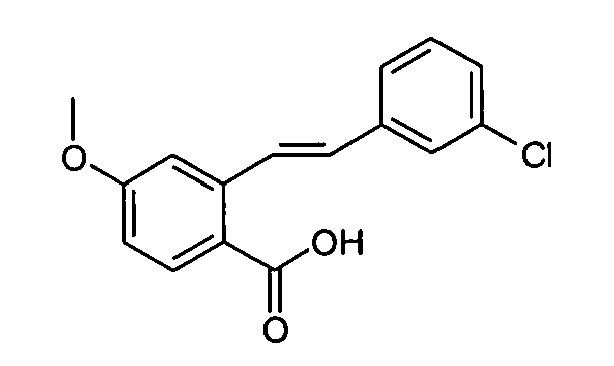
1H-NMR (DMSO-d6) δ in ppm: 3,86 (s, 3H, -OCH3), 6,96 (d, 1H, J=8,78 Hz, C5-H), 7,12-7,59 (m, 6H, C3-H und C4'-/C5'-/C6'-H und C1-/C2-H Vinyl), 7,89 (d, 1H, J=8,72 Hz, C2'), 8,01-8,09 (m, 1H, C6). 13C-NMR (DMSO-d6) δ in ppm: 55,9 (-OCH3), 112,1 (C3), 113,9 (C5), 122,0 (C1), 125,5 (C6'), 126,7 (C2'), 127,9 (C4'), 129,6 (C1 Vinyl), 129,6 (C2 Vinyl), 131,0 (C5'), 133,3 (C6), 133,9 (C3'), 139,9 (C1'), 140,7 (C1), 162,3 (C4), 168,2 (-COOH). - Zur Synthese der Titelverbindung werden nach Methode J (Variante 2) 6,0 g 2-[2-(3-Chlorphenyl)-vinyl]-4-methoxybenzoesäure, 0,6 g Pd / C (10 %) und 4I Wasserstoff eingesetzt. Das Lösungsmittelgemisch besteht aus 75 ml Acetonitril, 75 ml Ethylacetat und 20 ml Methanol.
C16H15ClO3 (Mr = 290,75)
- Zur Synthese der Titelverbindung werden nach Methode K 16,6 g (0,057 mol) [2-(3-Chlorphenyl)-ethyl]-4-methoxybenzoesäure, 7,25 g (0,06 mol) SOCl2, 250 ml Dichlormethan, und 10 g AlCl3 (0,075 mol) eingesetzt.
Die Aufreinigung erfolgt säulenchromatographisch (Flash; SiO2; Hexan 90% / Ethylacetat 10%).
C16H13ClO2 (Mr = 272,73)
MS m/z (%): 274/272 (34/100, M+), 259/257 (2/5, M+-CH3), 246/244 (9/26, M+-CO), 237 (19, M+-Cl), 231/229 (5/17, 259/257-CO), 208 (17, 244-Cl), 194 (10, 231/229-Cl), 178 (14, 194-O), 165 (43, 4-Methoxy-2-methylbenzoesäure). IR (ATR) 2921, 2852, 1595, 1266, 1203, 1185, 1110, 1031, 942, 912, 874, 839, 814, 769, 722, 596, 537 cm-1. 1H-NMR (DMSO-d6) ö in ppm: 3,11 (s, 4H, -CH2-CH2-), 3,82 (s, 3H, -OCH3), 6,87-6,96 (m, 2H, C7-/C9-H), 7,37-7,46 (m, 2H, C1-/C3-H), 7,87 (d, 1H, J=8,37 Hz, C6-H), 7,99 (d, 1H, 8,70 J=8,70 Hz, C4-H). 13C-NMR (DMSO-d6) δ in ppm: 34,0 (C11), 35,1 (C10), 55,8 (-OCH3), 113,1 (C7), 114,6 (C9), 126,9 (C3), 129,0 (C1), 130,0 (C5a), 132,7 (C6), 133,7 (C4), 137,1 (C4a), 137,5 (C2), 144,5 (C9a), 145,7 (C11a), 163,1 (C8), 191, (C5). - Zur Synthese der Titelverbindung werden nach Methode L 1,0 g (4,87 mmol) 2-Chlor-8-methoxy-10,11-dihydrodibenzo[a,d]cyclohepten-5-on, 10 ml HBr (48%, wässrig) und 10 ml Eisessig eingesetzt.
C15H11ClO2 (Mr = 258,71)
- Zur Darstellung der Titelverbindung werden nach Methode M 0,50 g (1,9 mmol) 2-Chlor-8-hydroxy-10,11-dihydrodibenzo[a,d]cyclohepten-5-on, 0,75 g (2,6 mmol) (R)-Toluen-4-sulfonsäure-2,2-dimethyl-[1,3]dioxolan-4-ylmethylester und 0,80 g (5,8 mmol) K2CO3 in 10 ml trockenem DMF umgesetzt.
C21H21ClO4 (Mr = 372,85)
- Zur Synthese der Titelverbindung werden nach Methode O 0,81 g (0,0022 mol) (S)-2-Chlor-1-(2,2-dimethyl-[1,3]dioxolan-4-ylmethoxy)-10,11-dihydrodibenzo[a,d]cyclohepten-5-on, 0,25 g (0,0019 mol) 2,4-Difluoranilin, 2 Spatelspitzen Pd(OAc)2, 0,14 g Phosphinligand und 0,70g (0,0073 mol) NaOtert-Bu in 10 ml Toluen und 2 ml tert-BuOH umgesetzt.
Die Aufreinigung erfolgt säulenchromatographisch (Flash; SiO2; Hexan 80% / Ethylacetat 20%).
C27H25F2NO4 (Mr= 465,50)
- Zur Synthese der Titelverbindung werden nach Methode N 0,10 g (0,215 mmol) (S)-8-(2,4-Difluorophenylamino)-1-(2,2-dimethyl-[1,3]dioxolan-4-ylmethoxy)-10,11-dihydrodibenzo[a,d]cyclohepten-5-on und 0,0054 g (0,0284 mmol) p-Toluensulfonsäure-Monohydrat in 6 ml Methanol und 1,5 ml Wasser umgesetzt.
C24H21F2NO4 (Mr = 425,44)
1H-NMR (DMSO-d6) δ in ppm: 2,95-3,09 (m, 4H, -CH2-CH2-),
- Zur Synthese der Titelverbindung werden nach Methode O 0,91 g (0,0024 mol) (S)-2-Chlor-8-(2,2-dimethyl-[1,3]dioxolan-4-ylmethoxy)-10,11-dihydrodibenzo[a,d]cyclohepten-5-on, 1,00 g (0,0092 mol) Phenylendiamin, 2 Spatelspitzen Pd(OAc)2, 0,18 g Phosphinligand und 1,60 g (0,0166 mol) NaOtert-Bu in 10 ml Toluen und 2 ml tert-BuOH umgesetzt.
Die Aufreinigung erfolgt säulenchromatographisch (Flash; SiO2; Hexan 70% / Ethylacetat 30%).
C27H28N2O4 (Mr = 444,54)
13C-NMR (DMSO-d6) δ in ppm: 25,7 (-CH3), 27,0 (-CH3), 35,1 (C11), 36,1 (C10), 66,0 (C3 Dioxolan), 69,2 (C1 Dioxolan), 73,9 (C2 Dioxolan), 109,3 (-C-(CH3)2-), 112,0 (C7), 112,9 (C9), 113,0 (C3), 114,3 (C1), 115,8 (C3'), 116,8 (C4'), 125,3 (C4a), 126,1 (C5'), 126,3 (C6'), 126,7 (C5a) 131,8 (C1'), 133,6 (C6), 133,9 (C4), 144,0 (C2'), 145,0 (C9a), 145,4 (C2), 150,8 (C11a), 161,3 (C8), 188,7 (C5). - Zur Synthese der Titelverbindung werden nach Methode N 0,10 g (0,225 mmol) (S)-2-(2-Amino-phenylamino)-8-(2,2-dimethyl-[1,3]dioxolan-4-ylmethoxy)-10,11-dihydrodibenzo[a,d]cyclohepten-5-one und 0,0537 g (0,282 mmol) p-Toluensulfonsäure-Monohydrat in 6 ml Methanol und 1,5 ml Wasser umgesetzt.
C24H24N2O4 (Mr = 404,47)
13C-NMR (DMSO-d6) δ in ppm: 35,2 (C11), 36,1 (C10), 63,0 (C3 Dihydroxypropoxy), 70,1 (C1 Dihydroxypropoxy), 70,2 (C2 Dihydroxypropoxy), 112,0 (C9), 112,8 (C7), 113,0 (C3), 114,3 (C1), 115,8 (C3'), 116,8 (C4'), 125,4 (C4a), 126,1 (C6'), 126,3 (C5'), 126,7 (C5a), 131,5 (C1'), 133,9 (C4), 144,0 (C2'), 145,0 (C9a), 145,4 (C2), 150,8 (C11a), 161,8 (C8), 188,7 (C5) - Zur Synthese der Titelverbindung werden nach Methode Q 0,44 g (1,69 mmol) 2-Chlor-8-hydroxy-10,11-dihydrodibenzo[a,d]cyclohepten-5-on, 0,345 g (1,86 mmol) 4-(2-Chlorethyl)morpholinhydrochlorid und 0,93 g (6,75 mmol) K2CO3 in 15 ml Acetonitril umgesetzt.
C21H22ClNO3 (Mr = 371,87)
1H-NMR (DMSO-d6) δ in ppm: 2,47 (unter DMSO, 4H, C2-/C6-H Morpholin), 2,68 (t, 2H, J=5,73 Hz, C2-H Ethylmorphin), 3,10 (s, 4H, -CH2-CH2-Cyclohexan), 3,53-3,58 (m, 4H, C3-/C5-H Morpholin), 4,15 (t, 2H, J=5,69 Hz, C1-H Ethylmorpholin), 6,88-6,96 (m, 2H, C7-/C9-H), 7,36-7,44 (m, 2H, C1-/C3-H), 7,87 (d, 1H, J=8,37 Hz, C6-H), 7,98 (d, 1H, J=8,64 Hz, C4-H). 13C-NMR (DMSO-d6) δ in ppm: 34,0 (C11), 35,1 (C10), 54,0 (2C, C2/C6 Morpholin), 57,2 (C2 Ethylmorpholin), 66,0 (C1 Ethylmorpholin), 66,5 (2C, C3/C5 Morpholin), 113,5 (C7), 115,2 (C9), 126,9 (C3), 129,0 (C1), 130,0 (C5a), 132,7 (C6), 133,7 (C4), 137,1 (C4a), 137,5 (C2), 144,5 (C9a), 145,7 (C11a), 162,3 (C8), 191,0 (C5). - Zur Synthese der Titelverbindung werden nach Methode O 0,45 g (0,0013) mol 8-Chlor-1-(2-morpholin-4-yl-ethoxy)-10,11-dihydrodibenzo[a,d]cyclohepten-5-on, 0,20 g (0,0015 mol) 2,4-Difluoranilin, 2 Spatelspitzen Pd(OAc)2, 0,14 g Phosphinligand und 0,70g (0,0073 mol) NaOtert-Bu in 10 ml Toluen und 2 ml tert-BuOH umgesetzt.
Die Aufreinigung erfolgt säulenchromatographisch (Flash; SiO2; Hexan 80% / Ethylacetat 20%).
C27H26F2N2O2 (Mr = 464,52)
1H-NMR (DMSO-d6) δ in ppm: 2,49 (unter DMSO, 4H, C2-/C6-H Morpholin), 2,69 (t, 2H, J=5,51 Hz, C2-H Ethylmorpholin), 2,96-3,07 (m, 4H, -CH2-CH2-Cycloheptan), 3,56 (t, 4H, J=4,50 Hz, C3-/C5-H Morpholin), 4,15 (t, 2H, J=5,44 Hz, C1-H Ethylmorpholin), 6,61 (s, 1H, C1-H), 6,73 (d, 1H, J=8,43 Hz, C3-H), 6,86-6,91 (m, 2H, C3'-/C6'-H), 7,05-7,13 (m, 1H, C5'-H), 7,30-7,47 (m, 2H, C7-/C9-H), 7,95 (d, 2H, J=8,66 Hz, C4-/C6-H), 8,49 (s, 1H, -NH-). 13C-NMR (DMSO-d6) δ in ppm: 35,1 (s, C11), 35,8 (s, C10), 53,9 (s, 2C, C2/C6 Morpholin), 57,3 (s, C2 Ethylmorpholin), 65,9 (s, C1, Ethylmorpholin), 66,5 (s, 2C, C3/C5 Morpholin), 105,3 (dd, J1=25,5 Hz, J2=24,2 Hz, C3'), 112,2 (dd, J1=21,9 Hz, J2=3,8 Hz, C5'), 112,5 (s, C7), 113,1 (s, C9), 113,6 (s, C9), 114,5 (s, C1), 125,5 (dd, J1=12,0 Hz, J2=3,4 Hz, C1'), 126,3 (dd, J1=9,5 Hz, J2=3,1 Hz, C6'), 128,2 (s, C4a), 131,3 (s, C5a), 133,6 (s, C6), 133,8 (s, C4), 145,1 (s, C2), 145,3 (s, C11a), 149,1 (s, C9a), 154,9 (dd, J1=141,3 Hz, J2=11,0, C4'), 159,7 (dd, J1=129,7 Hz, J2=12,0 Hz, C2'), 161,6 (s, C8), 189,1 (s, C5). - Zur Synthese der Titelverbindung werden nach Methode H (Variante 1) 6,64 g (0,040 mol) 3-Methoxy-2-methylbenzoesäure, 7,1 g (0,040 mol) NBS und 0,25g AIBN in 150 ml Chlorbenzol umgesetzt.
C9H9BrO3 (Mr = 245,07)Ausbeute: 55% 
1H-NMR (DMSO-d6) δ in ppm: 3,89 (s, 3H, -OCH3), 5,03 (s, 2H, -CH2-Br), 7,23-7,28 (m, 1H, C5-H), 7,41-7,46 (m, 2H, C4-/C5-H), 13,25 (s, 1H, -COOH). 13C-NMR (DMSO-d6) δ in ppm: 56,1 (-OCH3), 68,4 (-CH2Br), 116,3 (C4), 116,8 (C6), 126,9 (C2), 131,4 (C5), 135,3 (C1), 154,3 (C3), 170,9 (-COOH). - Zur Synthese der Titelverbindung werden nach Methode I 45,6 g ( 0,186 mol) 2-Bromomethyl-3-methoxybenzoesäure, 48,8 g (0,186 mol) Triphenylphosphin, 26,1 g (0,186 mol) 3-Chlorbenzaldehyd und 84,0 g (0,435 mol) NaOMe (28%) in 150 ml Methanol umgesetzt.
Die Aufreinigung erfolgt durch Umkristallisation aus Methanol mit Wasser.
C16H13ClO3 (Mr = 288,73)Ausbeute: 51 % Schmp.: 119 °C 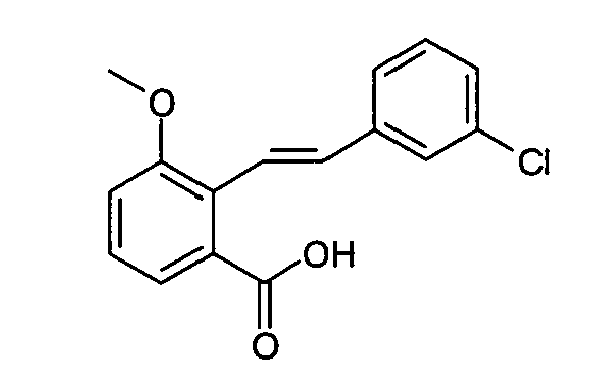
IR (ATR) 2923, 2360, 2342, 1685, 1587, 1451, 1300, 1275, 1260, 1220, 1197, 1178, 1049, 973, 964, 914, 889, 872, 810, 783, 761, 749, 729, 705, 684, 667, 621, 530, 457, 432 cm-1. 1H-NMR (DMSO-d6) δ in ppm: 3,86 (s, 3H, -OCH3), 7,04-7,55 (m, 9H, Diphenylethen), 13,03 (s, 1H, -COOH). 13C-NMR (DMSO-d6) δ in ppm: 56,3 (O-CH3), 114,2 (C4), 121,4 (C6), 124,8 (C2), 125,2 (C1/C2 Vinyl), 126,2 (C6'), 127,6 (C2'), 128,8 (C4'), 130,9 (C5), 132,0 (C5'), 133,9 (C1), 134,0 (C3'), 140,4 (C1'), 157,9 (C3), 169,9 (-COOH). - Zur Synthese der Titelverbindung werden nach Methode J (Variante 1) 6,0 g 2-[2-(3-Chlorphenyl)-vinyl]-3-methoxybenzoesäure, 0,6 g Pd / BaSO4 (5 %), 4 l Wasserstoff und 150 ml Methanol eingesetzt.
C16H15ClO3 (Mr = 290,75)
Ausbeute: 87 % Schmp.: 91 °C IR (ATR) 2947, 2359, 2342, 1691, 1461, 1436, 1276, 1250, 1214, 1089, 1058, 1000, 782, 753, 696, 681 cm-1. 1H-NMR (DMSO-d6) δ in ppm: 2,74 (t, 2H, J=8,07 Hz, C1 Ethyl), 3,11 (t, 2H, J=8,08, C2 Ethyl), 3,79 (s, 3H, -OCH3), 7,15 (d, 2H, C4-H und C6'-H), 7,22-7,25 (m, 2H, C5-H und C5'-H), 7,27 (s, 1H, C2'-H), 7,30- 7,37 (m, 2H, C6-H und C4'-H). 13C-NMR (DMSO-d6) δ in ppm: 28,7 (C1 Ethyl), 35,7 (C2 Ethyl), 56,3 (-OCH3), 114,2 (C4), 122,0 (C6), 126,1 (C6'), 127,2 (C4'), 128,3 (C2'), 130,3 (C5'), 130,4 (C1), 132,6 (C2), 133,2 (C3'), 145,0 (C1'), 157,8 (C3), 169,4 (-COOH). - Zur Synthese der Titelverbindung werden nach Methode K 16,6 g (0,057 mol) [2-(3-Chlorphenyl)-ethyl]-3-methoxybenzoesäure, 7,25 g (0,06 mol) SOCl2, 250 ml Dichlormethan, und 10 g AlCl3 eingesetzt.
Die Aufreinigung erfolgt säulenchromatographisch (Flash; SiO2; Hexan 90% / Ethylacetat 10%).
C16H13ClO2 (Mr = 272,73)
Ausbeute: 47 % Schmp.: 75 °C GC 13,5 min MS m/z (%): 274/272 (35/100, M+), 259/257 (6/18, M+-CH3), 245/243 (5/15, M+-CO), 231/229 (3/11, 259/257-CO), 208 (17, 243-Cl), 194 (20, 231/229-Cl), 178 (23, 194-O), 165 (44, 3-Methoxy-2-methylbenzoesäure). IR (ATR) 2946, 2901, 2359, 1659, 1589, 1575, 1312, 1284, 1254, 1228, 1184, 1087, 1062, 960, 862, 795, 754, 722, 706 cm-1. 1H-NMR (DMSO-d6) δ in ppm: 3,08 (s, 4H, -CH2-CH2-) 3,82 (s, 3H, -OCH3), 7,18-7,42 (m, 5H, C2-/C3-/C4-/C7-/C9-H), 7,68 (d, 1H, J=8,28 Hz, C6-H). 13C-NMR (DMSO-d6) δ in ppm: 26,2 (C11), 32,9 (C10), 56,4 (-OCH3), 114,9 (C2), 121,7 (C4), 127,0 (C7), 127,6 (C3), 129,0 (C9), 130,3 (C5a), 131,3 (C6), 137,1 (C4a), 138,1 (C11a), 139,4 (C8), 143,7 (C9a), 156,7 (C1), 195,2 (C5). - Zur Synthese der Titelverbindung werden nach Methode L 1,0 (4,87 mmol) g 8-Chlor-1-methoxy-10,11-dihydrodibenzo[a,d]cyclohepten-5-on, 10 ml HBr (48%, wässrig) und 10 ml Eisessig eingesetzt.
C15H11ClO2 (Mr = 258,71)Ausbeute: 95 % Schmp.: 185 °C GC 15,2 min 
MS m/z (%): 260/258 (34/100, M+), 243/241 (2/7, M+-OH ), 232/230 (9/27, M+-CO), 223 (21, M+-Cl), 217/215 (2/7), 207/205 (2/6), 195 (28, 223-CO), 177 (12), 165 (39). IR (ATR) 3251, 2360, 1637, 1573, 1307, 1282, 1241, 1221, 1176, 1159, 886, 759 cm-1. 1H-NMR (DMSO-d6) δ in ppm: 3,07 (s, 4H, -CH2-CH2-), 7,04 (d, 1H, J=7,84 Hz, C2-H), 7,15 (t, 1H, J=7,78 Hz, C3-H), 7,28 (d, 1H, J=7,69 Hz, C7-H), 7,38 (d, 1H, J=8,31 Hz, C4-H), 7,45 (s, 1H, C9-H), 7,67 (d, 1H, J=8,32, C6-H), 9,84 (s, 1H, -OH). 13C-NMR (DMSO-d6) δ in ppm: 26,5 (C11), 33,0 (C10), 119,1 (C2), 120,6 (C4), 126,9 (C7), 127,2 (C3), 128,7 (C9), 129,0 (C5a), 131,3 (C6), 136,9 (C4a), 138,4 (C11a), 139,5 (C8), 143,8 (C9a), 155,0 (C1), 195,4 (C5). - Zur Synthese der Titelverbindung werden nach Methode O 0,52 g (0,0020 mol) 8-Chlor-1-hydroxy-10,11-dihydro-dibenzo[a,d]cyclohepten-5-on, 0,26 g (0,0020 mol) 2,4-Difluoranilin, 2 Spatelspitzen Pd(OAc)2, 0,14 g Phosphinligand und 0,90g (0,0094 mol) NaOtert-Bu in 10 ml Toluen und 2 ml tert-BuOH umgesetzt.
Die Aufreinigung erfolgt Säulenchromatographisch (Flash; Kieselgel, 90% Hexan + 10% Ethylacetat).
C21H15F2NO2 (Mr=351,36)
GC 35,3 min MS m/z (%): 351 (100, M+), 336 (4, M+-O), 323 (10, M+-CO), 308 (3, 323-O), 223 (2, 336-Difluorbenzen), 194 (12, 223-CO), 165 (13, 3-Methoxy-2-methylbenzoesäure), 129 (1, Difluoranilin), 115 (1, Difluoranilin). IR (ATR) (cm-1) 1H-NMR (DMSO-d6) δ in ppm: 2,93-3,06 (m, 4H, -CH2-CH2-), 6,61 (s, 1H, C9-H), 6,71 (d, 1H, J=8,04 Hz, C6'-H), 6,98 (d, 1H, J=7,84 Hz, C7-H), 7,05-7,13 (m, 2H, C3'-/C5'-H), 7,24 (d, 1H, J=7,62 Hz, C2-H), 7,34-7,39 (m, 2H, C3-/C4-H), 7,41-7,78 (m, 1H, C6-H), 8,46 (s, 1H, -NH-), 9,69 (s, 1H, -OH). 13C-NMR (DMSO-d6) δ in ppm: - Zur Synthese der Titelverbindung werden nach Methode O 0,54 g (0,0020 mol) 8-Chlor-1-methoxy-10,11-dihydro-dibenzo[a,d]cyclohepten-5-on, 0,26 g (0,0020 mol) 2,4-Difluoranilin, 2 Spatelspitzen Pd(OAc)2, 0,14 g Phosphinligand und 0,70g (0,0073 mol) NaOtert-Bu in 10 ml Toluen und 2 ml tert-BuOH umgesetzt.
Die Aufreinigung erfolgt säulenchromatographisch (Flash; SiO2; Hexan 90% / Ethylacetat 10%).
C22H17F2NO2 (Mr = 365,38)Ausbeute: g (%) Schmp.: 216 °C 
GC 31,6 min MS m/z (%): 365 (100, M+), 350 (6, M+-CH3), 336(8), 322 (5, 350-CO), 306 (3, 322-O), 208 (11, M+-CO -NH-Phe), 194 (8, 208-CH3), 178 (9, 194-O), 165 (17). IR (ATR) 3276, 1299, 1286, 1269, 1255, 1193, 1073, 966, 863, 828, 764, 727, 603, 534, 496, 460, 446 cm-1. 1H-NMR (DMSO-d6) δ in ppm: 2,94-3,08 (m, 4H, -CH2-CH2-), 3,82 (s, 3H, -OCH3), 6,61 (s, 1H, C9-H), 6,72 (d, 1H, J=8,72 Hz, C7-H), 7,03-7,17- (m, 2H, C3'-/C6'-H), 7,23-7,45- (m, 4H, C2-/C3-/C4-H und C5'-H), 7,83 (d, 1H, J=8,69, C6-H), 8,49 (s, 1H, NH). 13C-NMR (DMSO-d6) δ in ppm: 25,0 (s, C11), 35,1 (s, C10), 56,4 (s, -OCH3), 105,5 (d, J=26,6 Hz, C3'), 112,2 (d, J=25,6 Hz, C5'), 112,6 (s, C7), 113,8 (s, C9), 114,3 (s, C2), 121,9 (s, C4), 125,4 (d, J=12,1 Hz, C1'), 126,3(d, J=9,6 Hz, C6'), 127,3 (s, C3), 128,4 (s, C5a), 130,1 (s, C4a), 132,9 (s, C6), 141,2 (s, C11a), 145,2 (s, C8), 149,3 (s, C9a), 154,9 (d, J=141,2 Hz, C4'), 155,8 (s, C1), 159,8 (d, J=137,1 Hz, C2'), 192,6 (s, C5). - Zur Synthese der Titelverbindung werden nach Methode O 0,54 g (0,0020 mol) 8-Chlor-1-methoxy-10,11-dihydro-dibenzo[a,d]cyclohepten-5-on, 1,08 g (0,010 mol) Phenylendiamin, 2 Spatelspitzen Pd(OAc)2, 0,14 g Phosphinligand und 1,60g (0,0166 mol) NaOtert-Bu in 10 ml Toluen und 2 ml tert-BuOH umgesetzt.
Die Aufreinigung erfolgt säulenchromatographisch (Flash; SiO2; Hexan 80% / Ethylacetat 20%).
C22H20N2O2 (Mr = 344,42)
Ausbeute: 46 (%) Schmp.: 132 °C GC 54,5 min MS m/z (%): 344 (100, M+), 329 (13, M+-CH3), 315 (6, M+-CO), 301 (5, 315-CH2), 285 (5, 301-O), 195 (9, 301-1,2-Diaminobenzen), 182 (6), 165 (8, 3-Methoxy-2-methylbenzoesäure), 107 (13, 1,2-Diaminobenzen), 80 (7). IR (ATR) 3356, 3282, 2852, 1616, 1587, 1563, 1553, 1497, 1335, 1293, 1272, 1255, 1222, 1192, 1075, 826, 759, 749, 706, 540, 505, 438 cm-1. 1H-NMR (DMSO-d6) δ in ppm: 2,93-3,02 (m, 4H, -CH2-CH2-), 3,81 (s, 3H, -OCH3), 4,82 (s, 2H, -NH2), 6,45 (s, 1H, C9-H), 6,59 (d, 2H, J=8,22 Hz, C3'-/C6'-H), 6,76 (d, 1H, J=7,66 Hz, C7-H), 6,89-7,02 (m, 2H, C4'-/C5'-H), 7,13 (d, 1H, J=7,47 Hz, C2-H), 7,21-7,37 (m, 2H, C3-/C4-H), 7,80-8,01 (m, 2H, -NH, C6-H). 13C-NMR (DMSO-d6) δ in ppm: 24,8 (C11), 35,5 (C10), 56,4 (-OCH3), 112,0 (C7), 113,0 (C3'), 114,1 (C9), 115,8 (C2), 116,8 (C4'), 122,0 (C5'), 125,3 (C5a), 126,1 (C6'), 126,3 (C4), 126,8 (C4a), 127,2 (C3), 130,0 (C11a), 133,2 (C6), 141,5 (C1'), 144,0 (C2'), 145,4 (C9a), 151,0 (C8), 155,6 (C1), 191,9 (C5). - Zur Darstellung der Titelverbindung werden nach Methode M 0,50 g (1,9 mmol) 8-Chlor-1-hydroxy-10,11-dihydrodibenzo[a,d]cyclohepten-5-on, 0,75 g (2,6 mmol) (R)-Toluen-4-sulfonsäure-2,2-dimethyl-[1,3]dioxolan-4-ylmethylester und 0,80 g (5,8 mmol) K2CO3 in 10 ml trockenem DMF umgesetzt.
C21H21ClO4 (Mr = 372,85)
Ausbeute: 53 % Schmp.: °C GC 22,8 min MS m/z (%): 374/372 (35/100, M+), 359/357 (6/17, M+-CH3), 337 (2, M+-Cl), 316/314 (10/26, 359/357-CH3), 299/297 (16/39, 316/314-OH), 285/283 (3/8, 299/297-CH2), 269 (283), 258/256 (15/6 M+-Dioxolan), 194 (12, 258/256-Cl-CO), 178 (23, 194-CO), 165 (51, 3-Methoxy-2-methylbenzoesäure). IR (ATR) 2962, 2359, 1650, 1586, 1449, 1370, 1310, 1284, 1257, 1213, 1177, 1156, 1057, 974, 873, 790, 761, 694, 665, 555 cm-1. 1H-NMR (DMSO-d6) δ in ppm: 1,31 (s, 3H, -CH3), 1,36 (s, 3H, -CH3), 3,11 (s, 4H, -CH2-CH2), 3,78-3,86 (m, 1H, Dioxolan), 4,00-4,11 (m, 3H, Dioxolan), 4,41-4,46 (m, 1H, Dioxolan), 7,25-7,44 (m, 4H, C2-/C3-/C4-/C7-H), 7,47 (s, 1H, C9-H), 7,69 (d, 1H, J=8,34 Hz, C6-H). 13C-NMR (DMSO-d6) δ in ppm: 25,7 (-CH3), 26,3 (-CH3), 26,9 (C11), 32,8 (C10), 66,0 (C3 Dioxolan), 69,8 (C1 Dioxolan), 74,1 (C2 Dioxolan), 109,2 (-C(CH3)2), 116,3 (C2), 122,1 (C4), 127,0 (C7), 127,6 (C3), 129,1 (C9), 130,7 (C5a), 131,3 (C6), 137,1 (C4a), 138,2 (C11a), 139,5 (C8), 143,7 (C9a), 155,9 (C1), 195,2 (C5). - Zur Synthese der Titelverbindung werden nach Methode O 0,50 g (0,0013 mol (S)-8-Chlor-1-(2,2-dimethyl-[1,3]dioxolan-4-ylmethoxy)-10,11-dihydrodibenzo[a,d]cyclohepten-5-on, 0,17 g (0,0013 mol) 2,4-Difluoranilin, 2 Spatelspitzen Pd(OAc)2, 0,14 g Phosphinligand und 0,70 g (0,0073 mol) NaOtert-Bu in 10 ml Toluen und 2 ml tert-BuOH umgesetzt.
Die Aufreinigung erfolgt säulenchromatographisch (Flash; SiO2; Hexan 80% / Ethylacetat 20%).
C27H25F2NO4 (Mr = 465,50)Ausbeute: 37 % Schmp.: 127 °C GC min MS m/z (%): 
IR (ATR) 3307, 2981, 1503, 1287, 1257, 1207, 1139, 1062, 1041, 864, 843, 832, 810, 757, 541, 515 cm-1. 1H-NMR (DMSO-d6) δ in ppm: 1,31 (s, 3H, -CH3), 1,36 (s, 3H, -CH3), 2,96-3,11 (m, 4H, -CH2-CH2-), 3,78-3,85 (m, 1H, Dioxolan), 4,04-4,14 (m, 3H, Dioxolan), 4,38-4,46 (m, 1H, Dioxolan), 6,62-6,73 (m, 2H, C7-/C9-H), 7,08-7,43 (m, 6H, C2-/C3-/C4-H und C3'-/C5'-/C6'-H), 7,81 (d, 1H, J=8,72 Hz, C6), 8,49 (s, 1H, -NH-). 13C-NMR (DMSO-d6) δ in ppm: 25,1 (s, C10), 25,7 (s, -CH3), 26,9 (s, -CH3), 35,0 (s, C11), 66,0 (s, C3 Dioxolan), 69,9 (s, C1 Dioxolan), 74,1 (s, C2 Dioxolan), 105,0 (d, J=26,4 Hz, C3'), 109,2 (s, -C(CH3)2), 112,2 (d, J=21,8 Hz, C5'), 112,6 (s, C7), 113,9 (s, C9), 115,7 (s, C2), 122,3 (s, C4), 125,4 (d, J=15,8 Hz, C1'), 126,2 (d, J=6,7 Hz, C6'), 127,2 (s, C3), 128,5 (s, C5a), 130,4 (s, C4a), 132,9 (s, C6), 141,3 (s, C11a), 145,1 (s, C8), 149,3 (s, C9a), 154,9 (d, J=138,5 Hz, C4'), 155,0 (s, C1), 159,7 (d, J=148,2 Hz, C2'), 192,6 (s, C5). - Zur Synthese der Titelverbindung werden nach Methode N 0,10 g (0,215 mmol) (S)-8-(2,4-Difluorophenylamino)-1-(2,2-dimethyl-[1,3]dioxolan-4-ylmethoxy)-10,11-dihydrodibenzo[a,d]cyclohepten-5-on und 0,0054 g (0,0284 mmol) p-Toluensulfonsäure-Monohydrat in 6 ml Methanol und 1,5 ml Wasser umgesetzt.
C24H21F2NO4 (Mr = 425,44)
Ausbeute: 88 % Schmp.: 125°C GC min MS m/z (%): IR (ATR) 3307, 1541, 1305, 1257, 1217, 1138, 1116, 1098, 1061, 967, 847, 833, 812, 758, 601, 570, 539, 458 cm-1. 1H-NMR (DMSO-d6) δ in ppm: 3,00-3,08 (m, 4H, -CH2-CH2-), 3,46-3,49 (m, 2H, Dihydroxypropoxy), 3,78-4,03 (m, 3H, Dihydroxypropoxy), 6,63-6,73 (m, 2H, C7-/C9-H), 7,04-7,41 (m, 6H, C2-/C3-/C4-H und C3'-/C5'-/C6'-H), 7,80 (d, 1H, J=8,73 Hz, C6), 8,48 (s, 1H, -NH). 13C-NMR (DMSO-d6) δ in ppm: 25,2 (s, C11), 35,0 (s, C10), 63,1 (s, C3 Dihydroxypropoxy), 70,4 (s, C2 Dihydroxypropoxy), 70,9 (s, C1 Dihydroxypropoxy), 105,3 (t, J=25,3 Hz, C3'), 112,1 (d, J=25,9 Hz, C5'), 112,5 (s, C7), 113,9 (s, C9), 115,5 (s, C2), 121,9 (s, C4), 125,4 (d, J=15,6 Hz, C1'), 126,1 (d, J=9,6 Hz, C6'), 127,2 (s, C3), 128,6 (s, C5a), 130,5 (s, C4a), 132,8(s, C6), 141,2 (s, C11a), 145,1 (s, C8), 149,2 (s, C9a), 154,8 (d, J=141,5 Hz, C4'), 155,5 (s, C1), 159,7 (d, J=136,2 Hz, C2'), 192,7 (s, C5). - Zur Synthese der Titelverbindung werden nach Methode O 0,50 g (0,0013 mol) (S)-2-Chlor-8-(2,2-dimethyl-[1,3]dioxolan-4-ylmethoxy)-10,11-dihydrodibenzo[a,d]cyclohepten-5-on, 0,70 g (0,0065 mol) Phenylendiamin, 2 Spatelspitzen Pd(OAc)2, 0,14 g Phosphinligand und 1,04 g (0,0108 mol) NaOtert-Bu in 10 ml Toluen und 2 ml tert-BuOH umgesetzt.
Die Aufreinigung erfolgt säulenchromatographisch (Flash; SiO2; Hexan 70% / Ethylacetat 30%).
C27H28N2O4 (Mr = 444,54)
Ausbeute: 23 % Schmp.: <35°C GC min MS m/z (%): IR (ATR) 3347, 2927, 1566, 1499, 1450, 1254, 1212, 1155, 1069, 969, 908, 832, 745, 703, 599, 512, 448 cm-1. 1H-NMR (DMSO-d6) δ in ppm: 1,31 (s, 3H, -CH3), 1,36 (s, 3H, -CH3), 2,91-3,10 (m, 4H, -CH2-CH2-), 3,78-3,85 (m, 1H, Dioxolan), 4,00-4,03 (m, 3H Dioxolan), 4,40-4,43 (m, 1H, Dioxolan), 4,82 (s, 2H, -NH2), 6,47- 6,62 (m, 3H, C9-H und C5'-/C6'-H), 6,78 (d, 1H, J=7,29 Hz, C3'-H), 6,92 (d, 1H, J=7,17 Hz, C7-H), 7,01 (d, 1H, J=7,76 Hz, C2-H), 7,16-7,24 (m, 2H, C3-H und C4'-H), 7,38 (d, 1H, J=7,55 Hz, C4-H), 7,82 (d, 1H, J=8,74, C6-H), 7,91 (s, 1H, -NH-). 13C-NMR (DMSO-d6) δ in ppm: 24,9 (C11), 25,7 (-CH3), 26,9 (-CH3), 35,4 (C10), 66,0 (C3 Dioxolan), 69,9 (C1 Dioxolan), 74,1 (C2 Dioxolan), 109,2 (-C(CH3)2), 112,0 (C7), 113,1 (C9), 115,5 (C3'), 115,8 (C2), 116,8 (C4'), 122,4 (C5'), 125,3 (C5a), 126,0 (C6'), 126,3 (C4), 126,9 (C3), 127,2 (C4a), 130,4 (C11a), 133,1 (C6), 141,6 (C1'), 193,9 (C2'), 145,3 (C8), 150,9 (C9a), 154,9 (C1), 191,9 (C5). - Zur Synthese der Titelverbindung werden nach Methode N 0,10 g (0,225 mmol) (S)-8-(2-Aminophenylamino)-1-(2,2-dimethyl-[1,3]dioxolan-4-ylmethoxy)-10,11-dihydrodibenzo[a,d]cyclohepten-5-on und 0,0537 g (0,282 mmol) p-Toluensulfonsäure-Monohydrat in 6 ml Methanol und 1,5 ml Wasser umgesetzt.
C24H24N2O4 (Mr = 404,47)Ausbeute: 40 % 
IR (ATR) 3305, 2919, 1566, 1498, 1449, 1255, 1216, 1189, 1155, 1111, 1043, 967, 908, 831, 749, 703, 448, 405 cm-1. 1H-NMR (DMSO-d6) δ in ppm: 2,93-3,11 (m, 4H, -CH2-CH2-), 3,47 (d, 2H, J=5,48 Hz, C3-H Dihydroxypropoxy), 3,83 (q, 1H, J=5,60 Hz, C2-H Dihydroxypropoxy), 3,85-4,06 (m, 2H, C1-H Dihydroxypropoxy), 4,82 (s, 2H, -NH2), 6,48 (s, 1H, C9-H), 6,59 (d, 2H, J=7,39 Hz, C3'-/C6'-H), 6,76 (d, 1H, J=7,41 Hz, C7-H), 6,90-7,02 (m, 2H, C4-H und C5'-H), 7,12 (d, 1H, J=7,37 Hz, C2-H), 7,23 (t, 1H, J=7,80 Hz, C3-H), 7,34 (d, 1H, J=7,09 Hz, C4-H), 7,80 (d, 1H, J=8,74 Hz, C6-H), 7,91 (s, 1H, -NH-). 13C-NMR (DMSO-d6) δ in ppm: 25,0 (C11), 35,4 (C10), 63,1 (C3 Dihydroxypropoxy), 70,4 (C2 Dihydroxypropoxy), 70,9 (C1 Dihydroxypropoxy), 112,0 (C7), 113,2 (C9), 115,4 (C3'), 115,8 (C2), 116,8 (C4'), 122,0 (C6'), 125,4 (C5a), 126,0 (C5'), 126,3 (C4), 127,0 (C3), 127,1 (C4a), 130,5 (C11a), 133,1 (C6), 141,5 (C1), 143,9 (C2'), 145,3 (C7), 150,9 (C9a), 155,3 (C1), 192,1 (C5). - Zur Synthese der Titelverbindung werden nach Methode P 0,45 g (1,7 mmol) 8-Chlor-1-hydroxy-10,11-dihydrodibenzo[a,d]cyclohepten-5-on, 0,28 g (0,0027 mol) Tetrahydropyran-4-ol, 0,77 g (2,9 mmol) P(Ph)3 und 0,41 g (2,0 mmol) Diisopropylazodicarboxylat in 2 ml THF umgesetzt.
C20H19ClO3 (Mr = 342,83)
Ausbeute: 45 % 1H-NMR (DMSO-d6) δ in ppm: 1,63 (s, 2H, C2-H Pyran), 1,91 (s, 2H, C6-H Pyran), 3,10 (s, 4H, -CH2-CH2-), 3,48 (s, 2H, C3-H Pyran), 3,79 (s, 2H, C5-H Pyran), 4,61 (s, 1H, C1-H Pyran), 7,05-7,42 (m, 5H, C2-/C3-/C4-/C6/C7-H), 7,67 (s, 1H, C9-H). 13C-NMR (DMSO-d6) δ in ppm: 26,4 (C11), 31,9 (2C, C2/C6 Pyran), 32,9 (C10), 64,6 (2C, C3/C5 Pyran), 72,4 (C1 Pyran), 118,1 (C2), 122,1 (C4). 127,0 (C7), 127,4 (C3), 129,1 (C9), 131,4 (C6), 137,1 (C4a), 138,0 (C5a), 139,9 (C11a), 143,8 (C8), 154,3 (C9a), 156,5 (C1), 195,2 (C5). - Zur Synthese der Titelverbindung werden nach Methode O 0,45 g (0,0013) mol 8-Chlor-1-(tetrahydropyran-4-yloxy)-10,11-dihydrodibenzo[a,d]cyclohepten-5-on, 0,17 g (0,0013 mol) 2,4-Difluoranilin, 2 Spatelspitzen Pd(OAc)2, 0,14 g Phosphinligand und 0,70g (0,0073 mol) NaOtert-Bu in 10 ml Toluen und 2 ml tert-BuOH umgesetzt.
Die Aufreinigung erfolgt säulenchromatographisch (Flash; SiO2; Hexan 70% / Ethylacetat 30%).
C26H23F2NO3 (Mr = 435,47)Ausbeute: 52 % Schmp.: 134 °C 
IR (ATR) 3327, 2961, 2857, 1564, 1496, 1300, 1277, 1257, 1243, 1187, 1150, 1131, 1099, 1088, 1005, 957, 858, 833, 813, 769, 630, 577, 550, 508 cm-1. 1H-NMR (DMSO-d6) δ in ppm: 1,54-1,71 (m, 2H, C2-H Pyran), 1,91-2,00 (m, 2H, C6-H Pyran), 2,96-3,12 (m, 4H, -CH2-CH2-), 3,43-3,54 (m, 2H, C3-H Pyran), 3,78-3,88 (m, 2H, C4-H Pyran), 4,59 (q, 1H, J=3,68 Hz, C1-H Pyran), 6,62 (s, 1H, C9-H), 6,71 (d, 1H, J=8,68 Hz, C7-H), 7,03-7,13 (m, 1H, C6'-H), 7,22-7,25 (m, 2H, C3'-/C5'-H), 7,29-7,42 (m, 3H, C2/C3-/C4-H), 7,82 (d, 1H, J=8,66 Hz, C6-H), 8,48 (s, 1H, -NH-). 13C-NMR (DMSO-d6) δ in ppm: 25,3 (s, C11), 32,0 (s, 2C, C2/C6 Pyran), 35,1 (s, C10), 64,7 (s, 2C, C3/C5 Pyran), 72,8 (s, C1 Pyran), 105,3 (t, J=25,5 Hz, C3'), 112,2 (d, J=22,1 Hz, C5'), 112,7 (s, C7), 113,9 (s, C9), 117,9 (s, C2), 122,4 (s, C4), 125,4 (d, J=15,7 Hz, C1'), 126,2 (d, J=9,5 Hz, C6'), 127,1 (s, C3), 128,4(s, C5a), 131,5(s, C4a), 132,9 (s, C6), 141,7 (s, C11a), 145,2 (s, C8), 149,2 (s, C9a), 155,0 (d, J=141,0 Hz, C4'), 153,4 (s, C1), 159,6 (d, J=137,2 Hz, C2'), 192,6 (s, C5). - Zur Synthese der Titelverbindung werden nach Methode Q 0,44 g (1,69 mmol) 8-Chlor-1-hydroxy-10,11-dihydrodibenzo[a,d]cyclohepten-5-on, 0,345 g (1,86 mmol) 4-(2-Chlorethyl)morpholinhydrochlorid und 0,93 g (6,75 mmol) K2CO3 in 15 ml Acetonitril umgesetzt.
C21H21ClNO3 (Mr = 371,87)
Ausbeute: g (%) Schmp.: <35°C GC 29,7min MS m/z (%): 373/371 (1/4, M+), 165 (4, 3-Methoxy-2-methyl-benzoesäure), 114 (1, Ethylmorpholin), 100 (100, 114-CH2), 87 (1, 100-CH2). IR (ATR) 2854, 1585, 1451, 1282, 1252, 1115, 1090, 1062, 909, 860, 757 cm-1 1H-NMR (DMSO-d6) δ in ppm: 2,50 (unter DMSO, 4H, C2-/C6-H Morpholin), 2,71 (t, 2H, J=5,61 Hz, C2-H Ethylmorpholin), 3,09 (s, 4H, -CH2-CH2-Cycloheptan), 3,47-3,58 (m, 4H, C3-/C5-H Morpholin), 4,12 (t, 2H, J=5,59 Hz, C1-H Ethylmorpholin), 7,23-7,70 (m, 6H, C2-/C3-/C4-/C6-/C7-/C9-H). 13C-NMR (DMSO-d6) δ in ppm: 26,4 (C11), 32,9 (C10), 53,9 (C2/C6 Morpholin), 57,3 (C2 Ethylmorpholin), 66,6 (C3/C5 Morpholin), 67,0 (C1 Ethylmorpholin), 116,3 (C2), 121,9 (C4), 127,0 (C7), 127,5 (C3), 129,1 (C9), 130,7 (C6), 131,3 (C5a), 137,1 (C4a), 138,1 (C11a), 139,5 (C8), 143,7 (C9a), 156,0 (C1), 195,2 (C5). - Zur Synthese der Titelverbindung werden nach Methode O 0,48 g (0,0013) mol 8-Chlor-1-(2-morpholin-4-yl-ethoxy)-10,11-dihydrodibenzo[a,d]cyclohepten-5-on, 0,17 g (0,0013 mol) 2,4-Difluoranilin, 2 Spatelspitzen Pd(OAc)2, 0,14 g Phosphinligand und 0,70g (0,0073 mol) NaOtert-Bu in 10 ml Toluen und 2 ml tert-BuOH umgesetzt.
Die Aufreinigung erfolgt säulenchromatographisch (Flash; SiO2; Hexan 60% / Ethylacetat 40%).
C27H26F2N2O3 (Mr = 464,52)
1H-NMR (DMSO-d6) δ in ppm: 2,49 (unter DMSO, 4H C2-/C6-H Morpholin), 2,72 (t, 2H, J=5,62 Hz, C2-H Ethylmorpholin), 2,99-3,10 (m, 4H, -CH2-CH2-Cycloheptan), 3,56 (t, 4H, J=4,58 Hz, C3-/C5-H Morpholin), 4,12 (t, 2H, J=5,62 Hz, C1-H Ethylmorpholin), 6,62 (s, 1H, C9-H), 6,71 (d, 1H, J=8,68 Hz, C7-H), 7,08-7,41 (m, 6H, C2-/C3-/C4-H und C3'-/C5'-/C6'-H), 7,82 (d, 1H, J=8,67 Hz, C6-H), 8,48 (s, 1H, -NH-). 13C-NMR (DMSO-d6) δ in ppm: 25,2 (s, C11), 35,1 (s, C10), 53,9 (s, 2C, C2/C6 Morpholin), 57,4 (s, C2 Ethylmorpholin), 66,6 (s, 2C, C3/C5 Morpholin), 67,1 (s, C1 Ethylmorpholin), 105,3 (dd, J1=26,6 Hz, J2= 24,1 Hz, C3'), 112,1 (dd, J1=21,8 Hz, J2=3,7 Hz, C5'), 112,6 (s, C7), 113,9 (s, C9), 115,8 (s, C2), 122,1 (s, C4), 125,4 (dd, J1=12,1 Hz, J2=3,6 Hz, C1'), 126,2 (dd, J1=9,6 Hz, J2=3,2 Hz, C6'), 127,2 (s, C5a), 128,5 (s, C3), 130,5 (s, C4a), 132,9 (s, C6), 141,3 (s, C11a), 145,1 (s, C8), 149,2 (s, C9a), 154,8 (dd, J1=140,7 Hz, J2=12,6 Hz, C4'), 155,1 (s, C1 159,7 (dd, J1=136,5 Hz, J2=11,8 Hz, C2'), 196,6 (s, C5). - Trifluormethansulfonsäure-8-chlor-5-oxo-10,11-dihydro-5H-dibenzo[a,d]cyclohepten-1-ylester Zur Herstellung der Titelverbindung werden nach Methode R 0,517 g (0,0020 mol) 8-Chlor-1-hydroxy-10,11-dihydrodibenzo[a,d]cyclohepten-5-on und 0,846 g (0,0030 mol) Tf2O in 5 ml Pyridin umgesetzt.
C16H10CIF3O4S (Mr = 390,77)
Ausbeute: g (%) GC 11,9 min MS m/z (%): 392/390 (39/100, M+), 364/362 (9/24, M+-CO), 259/257 (17/50, M+-SO2CF3), 231/229 (10/31, 259/257-CO), 194 (54, 231/229-CI). -
- Schmelzpunkte: Büchi Melting Point B-545 (thermodynamische Korrektur)
- NMR-Spektroskopie: Bruker Advance 200 (200 MHz)
- Interner Standard: Tetramethylsilan (TMS), δ [ppm]=0
- IR-Spektroskopie: Perkin Elmer Spectrum One (ATR Technik)
- DC: SiO2 60 F254- Alufolien, Familie Merck
- GC/MS: Hewlett Packard HP 6890 Series GC-System (Säule: HP-5MS: 5% Phenyl-Methyl-Siloxan; Länge: 30,0 m, Durchmesser: 250 µm, Filmdicke: 0,25 µm; oder ähnliche Säule anderer Hersteller
- Trägergas: Helium 6.0
- Flussrate: 1,2 ml/min
- Einlasstemperatur: 250°C
Heizrate [K/min] Endtemperatur [ºC] Haltezeit [min] 100 1 10 160 10 15 200 15 - Einlasstemperatur: 250°C
Heizrate [K/min] Endtemperatur [ºC] Haltezeit [min] 100 1 10 160 10 15 200 15 10 270 20 - Einlasstemperatur: 250°C
Heizrate [K/min] Endtemperatur [°C] Haltezeit [min] 160 1 10 240 5 10 270 15 - Einlasstemperatur: 250°C
Heizrate [K/min] Endtemperatur [°C] Haltezeit [min] 160 1 10 240 5 10 270 30
TSQ Quantum
Surveyor HPLC (Thermo Finnigan, CA, San Jose) binary pump/autosampler/PDA detector
gekuppelt an Thermo Finnigan TSQ Quantum triple quadrupole MS - Zur Veresterung der Säuregruppe der Ausgangsverbindung 2-Methyl-4-nitro-benzoesäure wird die angegebene Menge in einem 100 ml Einhalskolben in Methanol bei Raumtemperatur gelöst und mit konzentrierter H2SO4 versetzt und bei ca.60°C für 6h refluxiert. Der überschüssige Alkohol wird im Vakuum entfernt, der Rückstand wird mit EtOAc aufgenommen und wiederholt mit 20%iger Natronlauge entsäuert. Die vereinigten organischen Phasen werden nach Trocknen (Na2SO4) im Vakuum eingeengt.
- In einem 250 ml-Dreihalskolben mit Rückflusskühler und Trockenrohr wird die zu halogenierende Substanz in Tetrachlorkohlenstoff bei ca.70°C gelöst und mit den angegebene Mengen von N-Bromsuccinimid und Azobisisobutyronitril versetzt. Die Mischung wird 5 h ggf. unter Bestrahlung mit einem 500 W Scheinwerfer refluxiert. Am Ende der Reaktion hat sich N-Bromsuccinimid aufgelöst und ist in Succinimid übergegangen, das sich an der Oberfläche absetzt. Nach dem Abkühlen auf Raumtemperatur wird abgesaugt. Das Filtrat wird einrotiert, um das Produkt als gelb-oranges Öl zu erhalten.
- Zur weiteren Umsetzung des bromierten Eduktes mit substituierten Phenolen wird in einem 250 ml-Dreihalskolben die angegebene Menge Kaliumcarbonat in Aceton suspendiert. Das zu deprotonierende Phenol wird zugegeben und bei Raumtemperatur 15 min gerührt. Dann wird die Mischung mit dem bromierten Benzoesäuremethylester versetzt und nach Erhitzen auf 70°C 6 h refluxiert. Das Aceton wird im Vakuum entfernt und der Rückstand wird mehrfach mit EtOAc ausgeschüttelt. Nach Ansäuern der wässrigen Phase mit 20%iger HCI werden die vereinigten organischen Phasen im Vakuum nach Trocknen (Na2SO4) eingeengt und durch Umkristallisation mit Methanol aufgereinigt.
- Der zu verseifende Carbonsäureester wird bei Raumtemperatur in einem 100 ml-Einhalskolben in Methanol unter Rühren gelöst und anschließend mit der angegebenen Menge wässriger KOH-Lösung versetzt. Nach Erwärmen der Mischung auf 40°C wird 4 h refluxiert. Der überschüssige Alkohol wird im Vakuum entfernt, der Rückstand wird mit H2O aufgenommen. Es folgt Ansäuern der wässrigen Phase mit 20%iger HCI und anschließendes Rühren auf Eis, das dabei ausfallende Rohprodukt wird abgesaugt und über Calciumchlorid getrocknet.
- Zur Synthese der Ketone wird die angegebene Menge Carbonsäure in einem trockenen 250 ml Dreihalskolben in Sulfolan unter Argon-Atmosphäre und Erwärmen suspendiert. Es wird Polyphosphorsäure zugegeben und der Ansatz für ca. 2 h bei 100°C refluxiert. Nach Abkühlen auf Raumtemperatur wird die Mischung in 250 ml Eiswasser gegossen und bei RT nachgerührt. Das ausgefallene Rohprodukt wird abfiltriert.
- In einem 100 ml Einhalskolben mit Rückflusskühler wird das acetylierte Ringgerüst in Methanol durch Erwärmen gelöst und anschließend mit der angegeben Menge konzentrierter Salzsäure versetzt. Die Reaktionsmischung wird für 4h unter Rückfluss gerührt. Anschließend engt man den Ansatz im Vakuum ein. Den Rückstand versetzt man mit Salzsäure (10%) und rührt ihn auf, stellt ihn anschließend auf Eis und wartet bis das Produkt vollständig auskristallisiert ist und filtriert es ab.
- Zur Reduktion der Nitroverbindung wird die angegebene Menge Zinn(II)chlorid-Dihydrat in Ethanol unter Rühren gelöst. Die zu reduzierende Nitroverbindung wird hinzugegeben und die Mischung wird für 2 h bei 100 °C refluxiert. Nach Abkühlen auf Raumtemperatur wird der Ansatz mit Eiswasser versetzt und mit 20%iger Natronlauge alkalisiert. Es erfolgt wiederholte Extraktion mit Ethylacetat; die vereinigten organischen Phasen werden nach Trocknen (Na2SO4) im Vakuum eingeengt.
- In einen trockenen 100 ml-Dreihalskolben mit Rückflusskühler, Blasenzähler und Thermometer werden die angegebenen Mengen von 3-Amino-8-nitro-6H-dibenzo[b,e]oxepin-11-on, Phosphinligand, KOt-Bu, tert-Butanol, Halogenaromat, Pd(OAc)2 eingewogen. Die Mischung wird unter Argon-Atmosphäre in Toluol (wasserfrei) suspendiert und auf 110°C erhitzt und für 2 h refluxiert. Es erfolgt Hydrolyse mit Eiswasser und wiederholte Extraktion mit EtOAc. Die vereinigten organischen Phasen werden filtriert und anschließend im Vakuum eingeengt. Der Rückstand wird chromatographisch aufgereinigt.
- Nach der Allgemeinen Methode S werden 5,00 g (27,60 mmol) 2-Methyl-4-nitro-benzoesäure in 20 ml Methanol unter Erwärmen gelöst und mit 6 ml konzentrierter Schwefelsäure versetzt. Die Ansatzmischung wird für 5h refluxiert.
C9H9NO3(Mr= 195,18)Ausbeute 4,90 g (90,9%) Schmelzpunkt 73,6°C 1H-NMR (CDCl3) δ in ppm: 8.19-8.09 (m, 2H, aryl H), 7.99 (d, 1H, J= 8.52 Hz, aryl H), 3.87 (s, 3H, -OCH3), 2.59 (s, 3H, -CH3) 13C-NMR (CDCl3) in ppm: 166.35 (-C=O), 159.29 (C4), 141.79 (C2), 135.14 (C1), 131.43 (C6), 126.06 (C3), 120.48 (C5), 52.37 (-OCH3), 21.50 (-CH3) IR (ATR) (cm-1): 1722, 1523, 1432, 1348, 1260, 1081, 896, 821, 786, 730 GC (Methode 1) 9,55 min MS m/z (%): 195 (70), 164 (100), 134 (21), 118 (29), 63 (15) - Nach der Allgemeinen Methode T werden 4,70 g (24,00 mmol) (1) in 30 ml Tetrachlorkohlenstoff unter Erwärmen gelöst und anschließend mit 5,00 g (28,00 mmol) N-Bromsuccinimid und 2 Spatelspitzen Azobisisobutyronitril versetzt. Die Ansatzmischung wird für 6h unter Bestrahlung mit einem 500 W Scheinwerfer refluxiert. Beim Abkühlen auf Raumtemperatur scheidet sich Succinimid ab, das abfiltriert wird. Das Filtrat wird einrotiert, um das Produkt als gelbes Öl zu erhalten.
C9H8BrNO4 (Mr = 274,07)Ausbeute 5,85 g (88,8%) 1H-NMR (CDCl3) δ in ppm: 4.96 (s, 2H, -CH2-Br), 2.71 (s, 3H, -CH3) GC (Methode 3) 7,98 min MS m/z (%): 274 (100), 193 (38), 178 (46), 147 (12), 132 (18), 88 (9) - Nach der Allgemeinen Methode U werden 1,50 g (10,86 mmol) Kaliumcarbonat in 15 ml Aceton suspendiert und anschließend mit 1,80 g (11,90 mmol) 3-Acetamidophenol versetzt, die Ansatzmischung wird für 15 min gerührt. 2,44 g (8,91 mmol) (2) werden der Ansatzmischung zugegeben.
C17H16N2O6 (Mr = 344,33)Ausbeute 1,33 g (43,3%) Schmelzpunkt 139,2°C
13C-NMR (DMSO-d6) δ in ppm: 168.75 (-NH-C=O-), 166.00 (-C=O), 158.41 (C1), 149.75 (C4), 141.00 (C2), 140.77 (C3'), 134.48 (C1), 132.10 (C6), 130.02 (C5'), 123.08 (C3), 122.64 (C5), 112.37 (C4'), 109.49 (C6'), 105.94 (C2'), 65.01 (-CH2-O), 52.16 (-O-CH3), 24.41 (-NH=O-CH3)IR (ATR) (cm-1): 1729, 1719, 1606, 1349, 1289, 1253, 1158, 1057, 771, 727 GC (Methode 3) 23,07 min MS m/z (%): 344 (10), 327 (10), 271 (3), 194 (100), 148 (44) - Nach der Allgemeinen Methode V werden 1,30 g (3,78 mmol) (3) in 20 ml Methanol gelöst und mit 0,70 g (12,50 mmol) KOH versetzt.
C167H14N2O6 (Mr = 330,30)Ausbeute 1,20 g (96,1%) Schmelzpunkt 225,0°C
13C-NMR (DMSO-d6) δ in ppm: 168.74 (-COOH), 167.14(-NH-C=O), 158.46 (C1'), 149.58 (C4), 141.00 (C2), 140.81 (C3'), 135.63 (C1), 132.27 (C6), 130.02 (C5'), 122.89 (C3), 122.28 (C5), 112.30 (C4'), 109.55 (C6'), 105.90 (C2'), 67.10 (-CH2-O-), 24.40 (-NH-C=O-CH3)IR (ATR) (cm-1): 1732, 1603, 1520, 1487, 1343, 1284, 1159, 1053, 767, 733 - Nach der Allgemeinen Methode W werden 0,80 g (2,42 mmol) (4) in 10 ml Sulfolan bei 100°C angelöst. Anschließend werden 15 ml (30,0 g) Polyphosphorsäure dem Reaktionsgemisch hinzugegeben.
C16H12N2O5 (Mr = 312,28)Ausbeute 0,50 g (66,2%) Schmelzpunkt 171,4°C IR (ATR) (cm1): 1670, 1580, 1526, 1406, 1344, 1294, 1247, 905, 740, 708 LC 18,62 min MS (ESI) 312.9 [M+H]+ - Nach der Allgemeinen Methode X werden 0,70 g (2,24 mmol) (5) in 25 ml Methanol gelöst und mit 8,0 ml konzentrierter Salsäure versetzt.
C14H10N2O4 (Mr = 270,25)Ausbeute 0,40 g (66,1%) Schmelzpunkt 59,0°C
13C-NMR (DMSO-d6) δ in ppm: 185.21 (C11), 163.65 (C4a), 162.24 (C3), 157.01 (C8), 154.81 (C6a), 137.84 (C10a), 134.01 (C1), 131.02 (C10), 123.91 (C7), 123.38 (C9), 114.37 (C11a), 110.98 (C2), 100.98 (C4), 71.90 (C6)IR (ATR) (cm-1): 2790, 2565, 1644, 1608, 1531, 1297, 1250, 1150, 1085, 907, 819, 708 GC (Methode 3) 20,74 min MS m/z (%): 270 (100), 241 (13), 224 (14), 195 (22), 167 (19), 139 (10), 83 (9), 63 (9) - Nach der Allgemeinen Methode Z werden 0,50 g (1,85 mmol) (6), 0,28 g (1,89 mmol) 1-Chlor-2,4-difluorbenzen, 2 Spatelspitzen Pd(OAc)2, 0,09 g 2-(Dicyclohexylphosphino)-2',4',6'-triisopropylbiphenyl (Phosphinligand), 0,50 g KOt-Bu, 1,5 ml t-BuOH eingewogen und in 10 ml Toluol (wasserfrei) gelöst. Die Ansatzmischung wird unter Argon-Atmosphäre für 4h bei 100°C refluxiert. Das Rohprodukt wird über Kieselgel mit DCM/EtOH (98/2) chromatographisch aufgereinigt.
C20H12F2N2O4 (Mr = 382,33)Ausbeute 0,05 g (7,0%) Schmelzpunkt 210-214°C
13C-NMR (DMSO-d6) δ in ppm: 186.11 (C11), 163.30 (C4a), nicht detektiert (C4', C2'), 152.89 (C8), 149.52 (C3), 145.34 (C6a), 137.76 (C10a), 133.85 (C1), 131.01 (C10), 127.38 (C1', J= 9.85 Hz), 124.23 (C6', J= 14.23 Hz), 116.52 (C7), 112.57 (C5', J= 3.52 Hz), 110.35 (C2), 105.45 (C3', J= 24.29 Hz), 101.93 (C4), 72.03 (C6)IR (ATR) (cm-1): 2849, 1643, 1608, 1531, 1297, 1249, 1150, 740 LC 8,97 min MS (ESI) 381.1 [M-H]- - Nach der Allgemeinen Methode Y werden 0,10 g (0,44 mmol) Zinn(II)-Chlorid-Dihydrat in 7 ml Ethanol gelöst und mit 0,45 g (0,11 mmol) (7) versetzt.
C20H14F2N2O2 (Mr = 282,30)Ausbeute 0,035 g (90,3%) Schmelzpunkt 184-193°C
13C-NMR (DMSO-d6) δ in ppm: 184.59 (C11), 162.65 (C4a), nicht detektiert (C4', C2')153.51 (C8), 151.07 (C3), 139.19 (C6a), 133.86 (C1), 132.47 (C10), 127.02 (C9), 126.99 (C1'), 125.55 (C6), 118.32 (C10a), 113.50 (C7), 111.67 (C5'), 109.85 (C2), 105.32 (C3'), 102.56 (C4), 74.41 (C6)IR (ATR) (cm-1): 1613, 1586, 1557, 1523, 1402, 1324, 1312, 1281, 1258, 1115, 816 LC 7,76 min MS (ESI) 353.2 [M+H]+ - Nach der Allgemeinen Methode Z werden 1,00 g (3,70 mmol) (6), 0,80 g (3,96 mmol) 1-Brom-2-nitrobenzen, 2 Spatelspitzen Pd(OAc)2, 0,10 g 2-(Dicyclohexylphosphino)-2',4',6'-triisopropylbiphenyl (Phosphinligand), 0,70 g KOt-Bu, 2,0 ml t-BuOH eingewogen und in 10 ml Toluol (wasserfrei) gelöst. Die Ansatzmischung wird unter Argon-Atmosphäre für 4h bei
100°C refluxiert. Das Rohprodukt wird über Kieselgel mit DCM/EtOH (98/2) chromatographisch aufgereinigt.
C20H13N3O6 (Mr = 391,34)Ausbeute 0,35 g (24,2%) Schmelzpunkt 212,5°C
13C-NMR (DMSO-d6) δ in ppm: 184.34 (C11), 162.90 (C4a), 149.93 (C8), 149.69 (C3), 145.19 (C6a), 137.69 (C10a), 136.34 (C1'), 135.45 (C5'),134.08 (C2'), 133.68 (C1), 130.99 (C10), 128.40 (C3' und C7),126.40 (C6'), 123.66 (C9),123.33 (C4'), 118.55 (C11a), 112.45 (C2), 106.36 (C4), 72.34 (C6)IR (ATR) (cm-1): 1642, 1595, 1582, 1500, 1356, 1340, 1269, 1248, 1226, 1152, 1131, 1034,736 LC 9,18 min MS (ESI) 390.3 [M-H]- - Nach der Allgemeinen Methode Y werden 2,40 g (10,66 mmol) Zinn(II)-Chlorid-Dihydrat in 15 ml Ethanol gelöst und mit 0,35 g (0,89 mmol) (9) versetzt.
C20H17N3O2 (Mr = 331,38)Ausbeute 0,20 g (67,9%) Schmelzpunkt 203,9°C
13C-NMR (MeOH-d4) δ in ppm: 186.65 (C11), 163.58 (C4a), 153.31 (C8), 153.12 (C3), 143.31 (C6a), 139.37 (C1'), 133.34 (C1), 131.97 (C10), 127.65 (C6'), 126.51 (C2'), 125.66(C10a), 117.775 (C5'), 116.89 (C11a), 115.96 (C4'), 113.34 (C9), 111.46 (C3'), 109.27 (C2), 101.14 (C4), 73.99 (C6)IR (ATR) (cm-1): 1601, 1579, 1550, 1497, 1291, 1267, 1228, 1112, 828, 757, 747 LC 7,05 min MS (ESI) 332.9 [M+H]+ - Nach der Allgemeinen Methode Z werden 0,85 g (3,14mmol) (6), 0,70 g (3,19 mmol) 1-Brom-4-fluor-2-nitrobenzen, 2 Spatelspitzen Pd(OAc)2, 0,10 g 2-(Dicyclohexylphosphino)-2',4',6'-triisopropylbiphenyl (Phosphinligand), 0,70 g KOt-Bu, 2,0 ml t-BuOH eingewogen und in 10 ml Toluol (wasserfrei) gelöst. Die Ansatzmischung wird unter Argon-Atmosphäre für 4h bei 100°C refluxiert. Das Rohprodukt wird über Kieselgel mit DCM/EtOH (98/2) chromatographisch aufgereinigt.
C20H12FN2O4 (Mr = 409,33)Ausbeute 0,10 g (7,8%) Schmelzpunkt 210,7°C
13C-NMR (DMSO-d6) δ in ppm: 186.67 (C11), 163.01 (C4a), 161.01 (C4', J= 251.75 Hz), 150.73 (C8), 149.67 (C3), 145.22 (C6a), 141.37 (C2' J= 7.30 Hz), 137.71 (C10a), 133.77 (C1), 132.56 (C1'), 131.00 (C10), 124.19 (C5'), 123.66 (C7), 123.15 (C6'), 122.70 (C9), 118.18 (C11a), 113.03 (C3', J= 23.44 Hz), 112.23 (C2), 105.28 (C4), 72.03 (C6)IR (ATR) (cm-1): 1585, 1531, 1516, 1308, 1264, 1246, 1138, 1036, 890, 872, 815 LC 9,15 min MS (ESI) 408.3 [M-H]- - Nach der Allgemeinen Methode Y werden 0,60 g (2,66 mmol) Zinn(II)-Chlorid-Dihydrat in 10 ml Ethanol gelöst und mit 0,10 g (0,89 mmol) (11) versetzt.
C20H16FN3O2 (Mr = 349,37)Ausbeute 0,01 g (11,9%) Schmelzpunkt 194,5°C
13C-NMR (MeOH-d4) δ in ppm: 186.68 (C11), 163.57 (C4a), 155.84 (C4', J= 217.20 Hz), 153.68 (C8), 149.21 (C3), 139.15 (C6a), 133.41 (C1), 131.81 (C10), 130.23 (C1), 128.66 (C6', J= 11.6 Hz), 116.88 (C11a), 115.34 (C9), 113.61 (C7), 109.27 (C2), 105.34 (C5',J= 24.45 Hz), 103.03 (C3', J= 23.18 Hz), 101.15 (C4), 73.67 (C6)IR (ATR) (cm-1): 1602, 1579, 1551, 1505, 1293, 1265, 1233, 1161,1113, 831, 759 LC 7,34 min MS (ESI) 350.5 [M+H]+ - Nach der Allgemeinen Methode Z werden 0,80 g (2,96 mmol) (6), 0,70 g (3,80 mmol) 2-Bromanisol, 2 Spatelspitzen Pd(OAc)2, 0,10 g 2- (Dicyclohexylphosphino)-2',4',6'-triisopropylbiphenyl (Phosphinligand), 0,50 g KOt-Bu, 2,0 ml t-BuOH eingewogen und in 10 ml Toluol (wasserfrei) gelöst. Die Ansatzmischung wird unter Argon-Atmosphäre für 4h bei 100°C refluxiert. Das Rohprodukt wird über Kieselgel mit DCM/EtOH (98/2) chromatographisch aufgereinigt.
C21H16NzO5 (Mr= 376,37) Ausbeute 0,025g (2,2%) Schmelzpunkt 200,3°C
13C-NMR (DMSO-d6) δ in ppm: 185.73 (C11), 163.30 (C4a), 153.28 (C8),152.84 (C2'), 149.43 (C3), 145.46 (C6a), 137.82 (C10a), 133.60 (C1), 131.02 (C10), 128.68 (C1'), 125.78 (C9), 124.06 (C7), 123.51 (C5'), 121.00 (C4'), 115.96 (C11a), 112.60 (C3'), 110.67 (C4), 71.98 (-O-CH2), 55.84 (-O-CH3)IR (ATR) (cm-1): 3410, 1622, 1593, 1520, 1343, 1296, 1235, 1027, 768, 761, 742 LC 9,03 min MS (ESI) 377.4 [M+H]+ - Nach der Allgemeinen Methode Y werden 0,10 g (0,44 mmol) Zinn(II)- Chlorid- Dihydrat in 15 ml Ethanol gelöst und mit 0,04 g (0,10 mmol) (14) versetzt.
C21H18N2O3 (Mr = 346,39) Ausbeute 0,0046 g (13,3%) Schmelzpunkt 68,4°C
13C-NMR (DMSO-d6) δ in ppm: 184.50 (C11), 162.65 (C4a), 153.38 (C8), 152.30 (C2'), 151.29 (C3), 139.20 (C6a), 133.61 (C1), 132.44 (C10), 129.51 (C1'), 127.17 (C10a), 124.77 (C5), 122.91 (C6'), 120.93 (C4'), 117.81 (C11a), 113.47 (C3'), 112.43 (C9), 111.66 (C7), 10.19 (C2), 102.65 (C4), 74.34 (C6), 55.81 (-OCH3)LC 18,55 min MS (ESI) 347.3 [M+H]+ - Nach der Allgemeinen Methode Z werden 0,70 g (2,60 mmol) (6), 0,55 g (2,68 mmol) 2-Brom-5-fluoranisol, 2 Spatelspitzen Pd(OAc)2, 0,10 g 2- (Dicyclohexylphosphino)-2',4',6'-triisopropylbiphenyl (Phosphinligand), 0,50 g KOt-Bu, 2,0 ml t-BuOH eingewogen und in 10 ml Toluol (wasserfrei) gelöst. Die Ansatzmischung wird unter Argon-Atmosphäre für 4h bei 100°C refluxiert. Das Rohprodukt wird über Kieselgel mit DCM/EtOH (98/2) chromatographisch aufgereinigt.
C21H15FN2O5 (Mr = 394,36)Ausbeute 0,07 g (0,01%) Schmelzpunkt 222,3°C
13C-NMR (DMSO-d6) δ in ppm: 185.72 (C11), 163.34 (C4a), 160.42 (C4', J= 241.23 Hz), 154.77 (C2', J= 10.51 Hz), 153.84 (C8), 149.40 (C3), 145.45 (C6a), 137.80 (C10a), 133.66 (C1), 131.01 (C10), 126.29 (C6' J= 10.16 Hz), 124.81 (C1', J= 30.68 Hz), 124.01 (C7), 123.49 (C9), 115.80 (C11a), 110.29 (C2), 106.96 (C5', J= 22.03 Hz), 101.05 (C3', J= 26.81 Hz), nicht detektiert (C4), 71.98 (C6), 56.34 (-OCH3)IR (ATR) (cm-1): 3314, 1613, 1552, 1510, 1307, 1279, 1235, 1151, 1189, 957, 829, 816 LC 8,90 min MS (ESI) 395.3 [M+H]+ - Nach der Allgemeinen Methode Y werden 0,30 g (1,32 mmol) Zinn(II)-Chlorid-Dihydrat in 15 ml Ethanol gelöst und mit 0,07 g (0,19 mmol) (16) versetzt.
C21H17FN2O3 (Mr = 364,38)Ausbeute 0,042 g (60,6%) Schmelzpunkt 38,9°C
13C-NMR (DMSO-d6) δ in ppm: 184.49 (C11), 162.70 (C4a), 159.92 (C4', J= 240.08 Hz), 154.35 (C2', J= 10.41 Hz), 153.37 (C8), 151.98 (C3), 139.18 (C6a), 133.67 (C1), 132.43 (C10), 127.15 (C10a), 125.59 (C6', J= 3.07 Hz), 125.28 (C1'), 117.58 (C11a), 113.46 (C9), 111.65 (C7), 109.72 (C2), 106.81 (C5', J= 21.98 Hz), 101.99 (C4), 100.92 (C3',J= 26.96 Hz), 74.33 (C6), 56.29 (-OCH3)IR (ATR) (cm-1): 3329, 2923, 1599, 1584, 1520, 1268, 1229, 1110, 1028, 949, 832 LC 18,82 min MS (ESI) 365.2 [M+H]+ - Nach der Allgemeinen Methode Z werden 0,70 g (2,60mmol) (6), 0,55 g (3,05 mmol) 4-Chlor-3-nitro-benzotrifluorid, 2 Spatelspitzen Pd(OAc)2, 0,10 g 2- (Dicyclohexylphosphino)-2',4',6'-triisopropylbiphenyl (Phosphinligand), 0,50 g KOt-Bu, 2,0 ml t-BuOH eingewogen und in 10 ml Toluol (wasserfrei) gelöst. Die Ansatzmischung wird unter Argon-Atmosphäre für 4h bei 100°C refluxiert. Das Rohprodukt wird über Kieselgel mit n-Hexan/Ethylacetat (5/2) chromatographisch aufgereinigt.
C21H12F3N3O6 (Mr = 459,34)Ausbeute 0,047 g (3,9%) Schmelzpunkt 196,3°C
13C-NMR (DMSO-d6) δ in ppm: 187.42 (C11), 162.55 (C4a), 149.84 (C8), 147.66 (C3), 145.08 (C1'), 141.09 (C6a), 137.64 (C2'), 136.89 (C10a), 133.52 (C5'), 131.72 (C10), 130.98 (C1), 124.32 (C9), 123.77 (C7), 121.73(CF3), 121.33 (C3'), 120.65 (C4'), 120.32 (C6'), 120.00 (C11a), 115.32 (C2), 110.32 (C4), 72.04 (C6)IR (ATR) (cm-1): 3324, 1636, 1603, 1574, 1531, 1324, 1150, 1112, 1083, 914, 819, 709 LC 9,67 min MS (ESI) 458.6 [M-H]- - Nach der Allgemeinen Methode Y werden 0,30 g (1,32 mmol) Zinn(II)-Chlorid-Dihydrat in 15 ml Ethanol gelöst und mit 0,095 g (0,20 mmol) (18) versetzt.
C21H16F3N3O2 (Mr = 399,38)Ausbeute 0,061 g (76,4%) Schmelzpunkt 93,9°C
13C-NMR (DMSO-d6) δ in ppm: 184.61 (C11), 162.66 (C4a), 153.44 (C8), 151.07 (C3), 143.35 (C1'), nicht detektiert (C6a) 139.20 (C2'), 133.79 (C1), 132.47 (C10), 129.17 (CF3), 127.06 (C4'), 125.45 (C5'), 124.47 (C6'), 118.09 (C11a), 113.50 (C9), 113.01 (C3'), 111.70 (C7), 110.33 (C2), 102.90 (C4), 74.39 (C6)IR (ATR) (cm-1): 3352, 1599, 1521, 1334, 1293, 1231, 1160, 1116, 917, 815 LC 19,06 min MS 400.3 [M+H]+ - 0,50 g (1,85 mmol) (6) und 0,35 g (5,38 mmol) Natriumazid werden in 2,20 g (14,84 mmol) Trimethylorthoformat bei 0°C suspendiert. Dann wird der Ansatzmischung 1,20 g (20,00 mmol) Eisessig hinzugefügt, die Mischung wird auf 100°C erhitzt und für 4h refluxiert. Nach Abkühlen auf Raumtemperatur wird der Ansatz im Vakuum eingeengt, der Rückstand mit EtOAc aufgenommen und in der Wärme gelöst. Das weiß-graue Produkt fällt in der Kälte aus.
C15H9NsO4 (Mr = 323,27)Ausbeute 0,50 g (83,6 %) Schmelzpunkt 123-126°C
13C-NMR (DMSO) δ in ppm: 188.40 (C11), 161.95 (C4a), 150.21 (C8), 144.68 (Tetrazol), 137.54 (C10a), 133.19 (C10), 131.19 (C1), 125.02 (C7), 124.55 (C2), 124.00 (C11a), 114.81 (C9), 112.81 (C4), 70.01 (C6) - Nach der Allgemeinen Methode Y werden 1,50 g (6,66 mmol) Zinn(II)-Chlorid-Dihydrat in 10 ml Ethanol gelöst und mit 0,50 g (1,54 mmol) (20) versetzt.
C15H11N5O2 (Mr = 293,29)Ausbeute 0,027 g (6,1%) Schmelzpunkt 277,0°C IR (ATR) (cm-1 1608, 1588, 1553, 1501, 1374, 1300, 1196, 1002,842,762,700 - 0,015 g (0,042 mmol) (8) und 0,01 g (0,15 mmol) Natriumazid werden in 0,05 g (0,33 mmol) Trimethylorthoformiat bei 0°C suspendiert. Dann wird der Ansatzmischung 0,03 g (0,50 mmol) Eisessig hinzugefügt, die Mischung wird auf 100°C erhitzt und für 4h refluxiert. Nach Abkühlen auf Raumtemperatur wird der Ansatz im Vakuum eingeengt, der Rückstand mit EtOAc aufgenommen und in der Wärme gelöst. Das gelbe Produkt fällt in der Kälte aus.
C21H13F2N5O2 (Mr = 405,37) Ausbeute 0,26 g (88,1%) Schmelzpunkt 59,0°C
13C-NMR (DMSO-d6) δ in ppm: 174.70 (C11), 163.21 (C4a), icht detektiert (C4'), 155.34 (C2', J= 267.55 Hz), 142.79 (C3), 140.74 (Tetrazol), 138.38 (C6a), 136.36 (C1), 133.85 (C8), 131.53 (C10+10a), nicht detektiert (C9), 121.42 (C6'), 120.00 (C1'), 116.75 (C5'), 110.28 (C2), 102.02 (C4) , 72.60 (C6)IR (ATR) (cm-1): 2790, 2565, 1644, 1608, 1531, 1297, 1250, 1150, 1085, 907, 819, 708 LC 8,15 min MS (ESI) 404.1 [M-H]- - Zur Herstellung der Verbindung 10m werden 0,5 g (1,8 mmol) 2-Chlor-7-methoxydibenzosuberon, 0,25 g (2,0 mmol) 3-Methyl-4-fluoranilin, 0,05 g (0,22 mmol) Pd(OAc)2, 0,10 g (0,21 mmol) 2-(Dicyclohexylphosphino)-2',4',6'-triisopropyl-biphenyl, 0,70g (6,2 mmol) KOt-Bu, 5 ml Toluol und 1 ml t-BuOH verwendet und nach Methode C umgesetzt.
H1-NMR (DMSO-d6) δ in ppm: 2.96 (s, 4 H, -CH2-CH2-), 3.76 (s, 3 H, -OCH3), 6.46 (s, 1 H, C1-H), 6.61 (d, 1 H, J = 8.8, C3-H), 6.99-7.26 (m, 5 H, C8-H, C9-H, C2-H, C4-H, C5-H), 7.38 (s, 1 H, C6-H), 7.94 (s, d, 1 H, J = 8.7, C4-H), 8.22 (s, 1 H, -NH-).
13C-NMR (DMSO-d6) δ in ppm: 33.5 (C12), 36.4 (C11), 55.5 (-OCH3), 111.9 (C6), 113.1 (C3), 113.7 (d, 1 C, J = 22.2, C5), 114.7 (C1), 117.7 (d, 1 C, J = 22.0, C3), 118.4 (C3), 126.7 (C8), 127.0 (C1'), 130.4 (C9), 134.0 (C5a), 134.5 (C4), 135.4 (d, 1 C, J = 2.6, C2), 136.2 (d, 1 C, J = 8.3, C1'-H), 140.2 (C9a), 145.9 (C11a), 150.9 (C2), 158.0 (C7), 159.6 (d, 1 C, J = 241.0, C4'), 190.5 (C5). - Zur Herstellung der Verbindung 10n werden 0,5 g (1,8 mmol) 2-Chlor-7-methoxydibenzosuberon, 0,27 g (2,1 mmol) 2-Chloranilin, 0,05 g (0,22 mmol) Pd(OAc)2, 0,10 g (0,21 mmol) 2-(Dicyclohexylphosphino)-2'-,4'-, 6'-triisopropyl-biphenyl, 0,70g (6,2 mmol) KOt-Bu, 5 ml Toluol und 1 ml t-BuOH verwendet und nach Methode C umgesetzt.
H1-NMR (DMSO-d6) δ in ppm: 3.00 (s, 4 H, -CH2-CH2-), 3.77 (s, 3 H, -OCH3), 6.73 (s, 1 H, C1-H), 6.84 (d, 1 H, C3-H), 7.02-7.54 (m, 7H, C6-H, C7-H, C8-H, C2-H, C3-H, C4-H, C5), 7.95 (d, 1 H, J = 8.7, C4-H), 8.45 (s, 1 H, -NH-).
13C-NMR (DMSO-d6) δ in ppm: 33.5 (C12), 36.2 (C11), 55.5 (-OCH3), 113.4 (C6), 114.6 (C3), 114.9 (C1), 118.6 (C8), 124.5 (C4'), 125.4 (C6), 127.3 (C5'), 128.1 (C4a), 128.4 (C2') 130.6 (C9), 130.7 (C3'), 133.7 (C4), 134.5 (C5a), 138.1 (C1') 140.0 (C9a), 145.6 (C11a), 148.9 (C2), 158.1 (C7), 190.9 (C5). - 0,2 g (0,55 mmol) 2-(2, 4-Difluoranilino)-7-methoxy-10,11-dihydro-dibenzo[a,d]-cyclohepten-5-on werden in 2 ml Eisessig gelöst, 2 ml HBr (45%) hinzu gefügt und 6 h refluxiert. Die Lösung wird mit 200 g Eis hydrolisiert und es wird vom Niederschlag abfiltriert. Man erhält das Produkt in Form eines weißen Pulvers.
C21H15F2NO2 (Mr = 351,35) - 0,2 g (0,55 mmol) 2-(2-Amino-4-fluoranilino)-7-methoxy-10,11-dihydro-dibenzo[a,d]-cyclohepten-5-on werden in 2 ml Eisessig gelöst, 2 ml HBr (45%) hinzu gefügt und 6 h refluxiert. Die Lösung wird mit 200 g Eis hydrolysiert und es wird vom Niederschlag abfiltriert. Man erhält das Produkt in Form eines weißen Pulvers.
C21H17FN2O2 (Mr= 348,38) - 0,2 g (0,52 mmol) 2-(2-Chlor-4-fluoranilino)-7-methoxy-10,11-dihydro-dibenzo[a,d]-cyclohepten-5-on werden in 2 ml Eisessig gelöst, 2 ml HBr (45%) hinzu gefügt und 6 h refluxiert. Die Lösung wird mit 200 g Eis hydrolysiert und es wird vom Niederschlag abfiltriert. Man erhält das Produkt in Form eines weißen Pulvers.
- 0,2 g (0,55 mmol) 2-(2-Chloranilino)-7-methoxy-10,11-dihydro-dibenzo[a,d]-cyclohepten-5-on werden in 2 ml Eisessig gelöst, 2 ml HBr (45%) hinzu gefügt und 6 h refluxiert. Die Lösung wird mit 200 g Eis hydrolysiert und es wird vom Niederschlag abfiltriert. Man erhält das Produkt in Form eines weißen Pulvers.
- 0,2 g (0,61 mmol) 2-Anilino-7-methoxy-10,11-dihydro-dibenzo[a,d]-cyclohepten-5-on werden in 2 ml Eisessig gelöst, 2 ml HBr (45%) hinzu gefügt und 6 h refluxiert. Die Lösung wird mit 200 g Eis hydrolysiert und es wird vom Niederschlag abfiltriert. Man erhält das Produkt in Form eines weißen Pulvers.
C21H17NO2 (Mr = 315,380) - 0,2 g (0,55 mmol) 2-(2-Amino-4-fluoranilino)-7-methoxy-10,11-dihydro-dibenzo[a,d]-cyclohepten-5-on werden in 2 ml Eisessig gelöst, 2 ml HBr (45%) hinzu gefügt und 6 h refluxiert. Die Lösung wird mit 200 g Eis hydrolysiert und es wird vom Niederschlag abfiltriert. Man erhält das Produkt in Form eines weißen Pulvers.
- Zur Herstellung der Verbindung 14 werden 0,72 g (1,8 mmol) 2-Chlor-7-[3-(4-Hydroxypiperidin-4-yl-propoxy)]--10,11-dihydrodbenzo[a,d]-cyclohepten-5-one, 0,25 g (1,9 mmol) 2, 4-Difluoranilin, 0,05 g (0,22 mmol) Pd(OAc)2, 0,10 g (0,21 mmol) 2-(Dicyclohexylphosphino)-2'-,4'-, 6'-triisopropyl-biphenyl, 0,70g (6,2 mmol) KOt-Bu, 5 ml Toluol und 1 ml t-BuOH verwendet.
-

- 0,60 g (2,66 mmol) Zinn(II)chlorid-Dihydrat werden in 10 ml EtOH gelöst und mit 0,10 g (0,89 mmol) der 8-Nitroverbindung versetzt und gemäß Methode D umgesetzt.
C20H16FN3O2 (Mr = 349.37)Ausbeute 0,01 g (11,9 %) Schmelzpunkt 194,5°C
13C-NMR (MeOH-d4) δ in ppm: 186.68 (C11), 163.57 (C4a), 155.84 (C4'), J = 217.20 Hz), 153.68 (C8), 149.21 (C3), 139.15 (C6a), 133.41 (C1), 131.81 (C10), 130.23 (C1'), 128.66 (C6', J = 11.6 Hz), 116.88 (C11a), 115.34 (C9), 113.61 (C7), 109.27 (C2), 105.34 (C5',J = 24.45 Hz), 103.03 (C3', J= 23.18 Hz), 101.15 (C4), 73.67 (C6)IR (ATR) (cm-1): 1602, 1579, 1551, 1505, 1293, 1265, 1233, 1161,1113, 831, 759 LC 7,34 min MS (ESI) 350.3 [M+H]+ -

- Zu einer Lösung aus 0,05 g (0,14 mmol) 3-(2,4-difluorphenylamino)-8-amino-6H-dibenzo[b,e]oxepin-11-on und 0,03 g (0,30 mmol) Triethylamin (frisch destilliert) in 3 ml Tetrahydrofuran wird tropfenweise 0,025 g (0,16 mmol) Morpholin-4-carbonsäurechlorid unter Eiskühlung langsam hinzugegeben. Nach beendeter Zugabe wird die Ansatzmischung bei RT 2 h unter Argon-Atmosphäre gerührt. Am Ende der Reaktion wird überschüssiges Lösungsmittel einrotiert, der Rückstand in EtOAc aufgenommen und gegen 5%-ige NaHCO3-Lösung ausgeschüttelt. Die organische Phase wird einrotiert, das Rohprodukt wird in MeOH/H2O umkristallisiert und anschließend mit Diethylether gewaschen und getrocknet.
C25H21F2NsO4 (Mr = 465.46)Ausbeute 0,03 g (46,0 %) Schmelzpunkt 244,3 °C IR (ATR) (cm-1): 1556,1512,1309,1229,1097,911,872,833,694 LC 7,76 min MS (ESI) 464.1 [M-H]- -


-
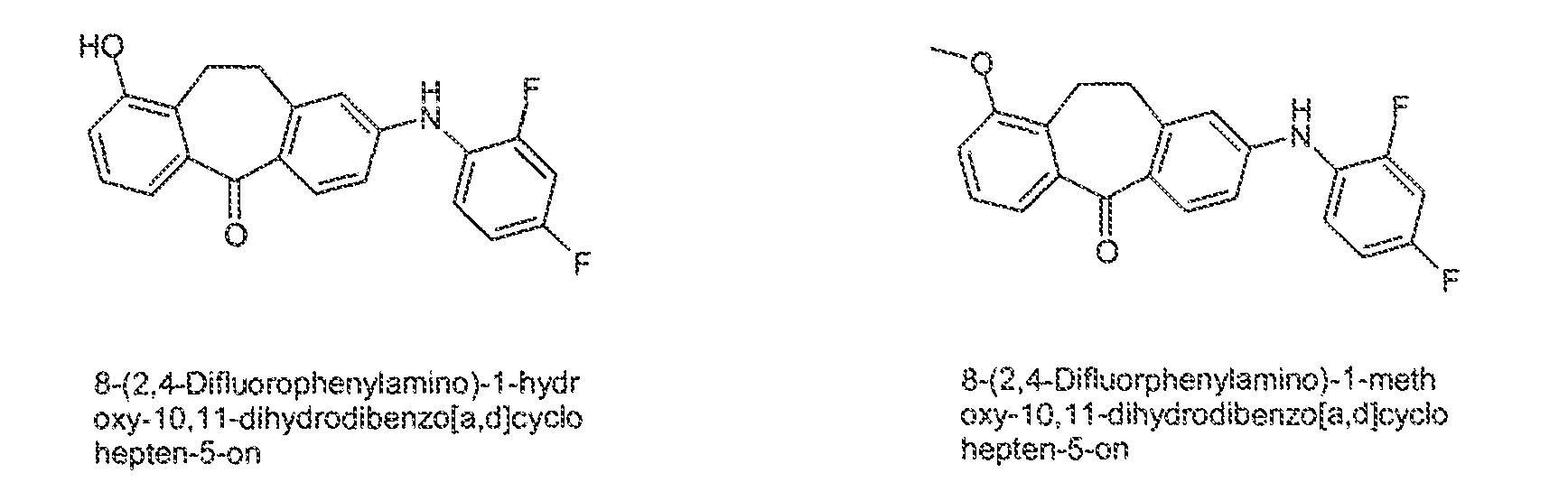


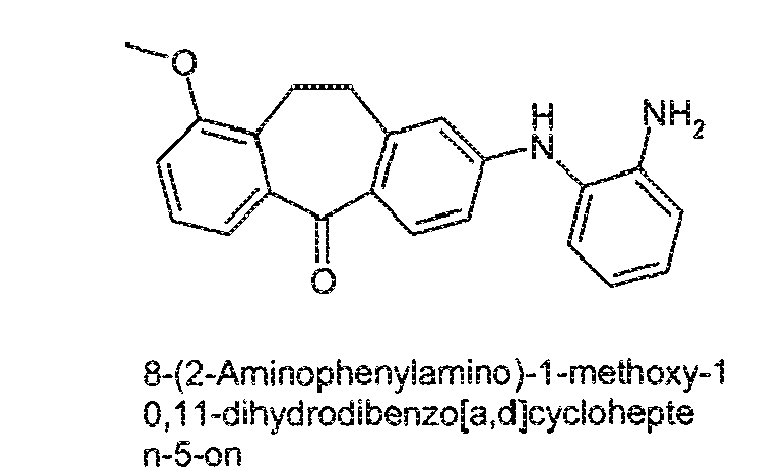

Claims (16)
- Verbindungen der Formel 1

eines der Ringatome X und Y für CH2 und das andere für O, S, SO, SO2 oder NR5 steht; oder -X-Y- für -CH2-CH2- oder -CH=CH- steht;R1 ausgewählt ist unter:a) Hydroxy;b) C1-C6-Alkoxy;c) C1-C6-Alkoxy, das mit 1, 2 oder 3 Hydroxy- oder C1-C6-Alkoxygruppen substituiert ist;d) NR6R7;e) C1-C6-Alkoxy, das substituiert ist mit einem gesättigten oder ungesättigten, aromatischen oder nicht-aromatischen Heterocyclus mit 5 oder 6 Ringatomen, der 1, 2 oder 3 Heteroatome aufweist, die unabhängig voneinander ausgewählt sind unter O, N und S, wobei der Heterocyclus gegebenenfalls 1 oder 2 Hydroxy-, C1-C6-Alkoxy- oder C1-C6-Alkylsubstituenten aufweisen und mit einem Phenylring oder einem gesättigten oder ungesättigtenCarbocyclus mit 5 oder 6 Ringatomen kondensiert sein kann; undf) Tetrazolo;g) NR8CONR13R14;g) CF3SO2O-;h) OR16;i) C1-C6-Alkylcarbonyloxy-C1-C6-alkoxy;j) NO2;R2 für H oder C1-C6-Alkyl steht;R3 ausgewählt ist unter:a) -NR6R7;b) c)
c) d)
d) e)
e) f) -NH-C1-C6-Alkylen-NR6R7g) Tetrazolo;h) Halogen;i) OR15; undj) NO2; undk) NR8COC1-C6-Alkyl;R4 für H, Halogen oder C1-C6-Alkyl steht;R5 für H oder C1-C6-Alkyl, das mit 1, 2 oder 3 Hydroxy- oder C1-C6-Alkoxygruppen substituiert ist, steht;R6 und R7, die gleich oder verschieden sein können, für H oder C1-C6-Alkyl, das mit 1, 2 oder 3 Hydroxy- oder C1-C6-Alkoxygruppen substituiert ist, stehen;R8 für H oder C1-C6-Alkyl steht;R9, R10 und R11, die gleich oder verschieden sein können, ausgewählt sind unter:j) H,k) NH2,l) mono-C1-C6-Alkylamino,m) di-C1-C6-Alkylamino,n) C1-C6-Alkyl,o) C1-C6-Alkoxy,p) Hydroxy,q) Halogen,r) C1-C6-Alkyl, das mit 1, 2 oder 3 Halogenatomen substituiert ist;j) CONR6R7; undk) NO2;R12 für H oder NH2 steht;R13 und R14, die gleich oder verschieden sein können, für H oder C1-C6-Alkyl stehen oder zusammen mit dem Stickstoffatom an das sie gebunden sind, für einen nicht-aromatischen Heterocyclus mit 5 oder 6 Ringatomen, der 1 oder 2 Heteroatome aufweist, die unabhängig voneinander ausgewählt sind unter O und N;R15 für H oder C1-C6-Alkyl, das mit 1, 2 oder 3 Hydroxy- oder C1-C6-Alkoxygruppen substituiert ist, steht;R16 für einen nicht-aromatischen Heterocyclus mit 5 oder 6 Ringatomen, der 1 oder 2 Heteroatome aufweist, die unabhängig voneinander ausgewählt sind unter O und N;und die optischen Isomeren, physiologisch verträglichen Salze und Solvate davon.
 - Verbindungen nach Anspruch 1 der Formel la

- Verbindungen nach Anspruch 1 der Formel Ib:

- Verbindungen nach Anspruch 1 der Formel Ic:

- Verbindungen nach einem der vorhergehenden Ansprüche, wobei R1 ausgewählt ist unter NR6R7, Hydroxy, C1-C6-Alkoxy, C1-C6-Alkyl, das mit 1, 2 oder 3 Hydroxygruppen substituiert ist, und einem gesättigten nicht-aromatischen Heterocyclus mit 5 oder 6 Ringatomen, der 1 oder 2 Heteroatome aufweist, die unabhängig voneinander ausgewählt sind unter O und N, und der gegebenenfalls 1 oder 2 C1-C6-Alkylsubstituenten aufweisen kann.
- Verbindungen nach einem der vorhergehenden Ansprüche, wobei R3 ausgewählt ist unterb)
 e) Phenyl undg) Tetrazolo.
 - Verbindungen nach Anspruch 6, wobei R9 und R10 unabhängig voneinander ausgewählt sind unter H, NH2, mono-C1-C6-Alkylamino, di-C1-C6-Alkylamino, Halogen, CF3, C1-C6-Alkyl und C1-C6-Alkoxy und R11 für H oder Halogen steht.
- Verbindungen nach Anspruch 6 oder 7, wobei R3 für einen Rest der Formel

- Verbindungen nach einem der vorhergehenden Ansprüche, wobei R4 für H steht.
- Verbindungen nach einem der vorhergehenden Ansprüche, wobei R6 und R7 für H stehen.
- Verbindungen nach einem der vorhergehenden Ansprüche der Formel

- Verbindungen nach Anspruch 2 der Formel laa

- Verbindungen nach Anspruch 4 der Formel lca:
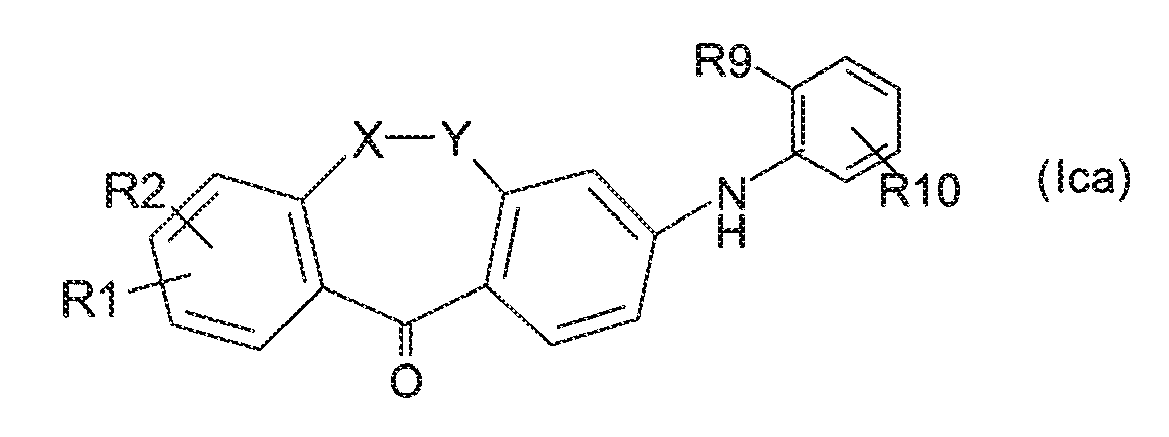
-X-Y- für -CH2-CH2- oder -CH=CH- steht und R1, R2, R9 und R10 die in Anspruch 1 oder 7 angegebenen Bedeutungen besitzen. - Verbindungen nach Anspruch 1:(1) 2-Nitro-7-methoxydibenzosuberenon(2) 2-Chlor-7-methoxysuberenon(3) 2-Acetamido-7-methoxydibenzosuberon(4) 2-Chlor-7-methoxydibenzodibenzosuberon(5) 2-Amino-7-methoxydibenzosuberon(6) 2-Chlor-7-hydroxydibenzosuberon(7) 2-Chlor-7-(S-1,2-isopropylidenglycer-3-yl)-10,11-dihydro-dibenzo[a,d]cyclohepten-5-on(8) 2-Chlor-7-(R-1,2-isopropylidenglycer-3-yl)-10,11-dihydro-dibenzo[a,d]cyclohepten-5-on(9) 2-Chlor-7-(3-acetoxypropoxy)-10,11-dihydro-dibenzo[a,d]-cyclohepten-5-on(10) 2-Chlor-7-(3-acetoxyethoxy)-10,11-dihydro-dibenzo[a,d]cyclohepten-5-on(11) 2-Chloro-7-(2-morpholin-4-yl-ethoxy)-10,11-dihydro-dibenzo[a,d]-cyclohepten-5-on(12) 2-Chloro-7-(2-tetrahydropyran-4-yl-oxy)-10,11-dihydro-dibenzo[a,d]-cyclohepten-5-on(13) 2-(2-Aminoanilino)-7-methoxydibenzosuberon(14) 2-(2-Amino-4-fluoranilino)-7-methoxydibenzosuberon(15) 2-(2,4-Difluoranilino)-7-methoxydibenzosuberon(16) 2-(2-Chlor-4-fluoranilino)-7-methoxydibenzosuberon(17) 2-(2,4,5-Trifluoranilino)-7-methoxydibenzosuberon(18) 2-(2-Trifluormethylanilino)-7-methoxydibenzosuberon(19) 2-(Anilino)-7-methoxydibenzosuberon(20) 2-(2-Methoxyanilino)-7-methoxydibenzosuberon(21) 2-(3-Methyl-4-fluoranilino)-7-methoxydibenzosuberon(22) 2-(2-Amino-4-trifluormethylanilino)-7-methoxydibenzosuberon(23) 2-(Phenyl)-7-methoxydibenzosuberon(24) 2-(2,4-Difluoranilino)-7-methoxydibenzosuberenon(25) 2-(2,4-Difluoranilino)-7-(S-1,2-isopropylidenglycer-3-yl)-10,11-dihydro-dibenzo[a,d]-cyclohepten-5-on(26) 2-(2,4-Difluoranilino)-7-(R-1,2-isopropylidenglycer-3-yl)-10,11-dihydro-dibenzo[a,d]-cyclohepten-5-on(27) 2-(2-Aminoanilino)-7-(S-1,2-isopropylidenglycer-3-yl)-10,11-dihydro-dibenzo[a,d]-cyclohepten-5-on(28) 2-(2-Aminoanilino)-7-(R-1,2-isopropylidenglycer-3-yl)-10,11-dihydro-dibenzo[a,d]-cyclohepten-5-on(29) 2-(2,4-Difluoranilino)-7-[2R-,3-dihydroxypropoxy]-10,11-dihydro-dibenzo[a,d]-cyclohepten-5-on(30) 2-(2,4-Difluoranilino)-7-[2S-,3-dihydroxypropoxy]-10,11-dihydro-dibenzo[a,d]-cyclohepten-5-on(31) 2-(2-Aminoanilino-7-[2R-,3-dihydroxypropoxy]-10,11-dihydro-dibenzo[a,d]-cyclohepten-5-on(32) 2-(2-Aminoanilino-7-[2S-,3-dihydroxypropoxy]-10,11-dihydro-dibenzo[a,d]-cyclohepten-5-on(33) 2-(2,4-Difluoranilino)-7-(2-hydroxy-ethoxy)-10,11-dihydro-dibenzo[a,d]-cyclohepten-5-on(34) 2-(2,4-Difluoranilino)-7-(3-hydroxy-propoxy)-10,11-dihydro-dibenzo[a,d]-cyclohepten-5-on(35) 2-(2,4-Difluoranilino)-7-(2-morpholin-4-yl-ethoxy)-10,11-dihydro-dibenzo[a,d]-cyclohepten-5-on(36) 2-(2-Aminoanilino)-7-(2-morpholin-4-yl-ethoxy)-10,11-dihydro-dibenzo[a,d]-cyclohepten-5-on(37) 2-(2,4-Difluoranilino)-7-(2-tetrahydropyran-4-yl-oxy)-10,11-dihydro-dibenzo[a,d]-cyclohepten-5-on(38) 2-Chlor-8-methoxy-10,11-dihydrodibenzo[a,d]cyclohepten-5-on(39) 2-Chlor-8-hydroxy-10,11-dihydrodibenzo[a,d]cyclohepten-5-on(40) (S)-2-Chlor-8-(2,2-dimethyl-[1,3]dioxolan-4-ylmethoxy)-10,11-dihydrodibenzo[a,d]cyclohepten-5-on(41) (S)-2-(2,4-Difluorophenylamino)-8-(2,2-dimethyl-[1,3]dioxolan-4-ylmethoxy)-10,11-dihydro-dibenzo[a,d]cyclohepten-5-on(42) (R)-2-(2,4-Difluorophenylamino)-8-(2,3-dihydroxypropoxy)-10,11-dihydrodibenzo[a,d]cyclohepten-5-on(43) (S)-2-(2-Aminophenylamino)-8-(2,2-dimethyl-[1,3]dioxolan-4-ylmethoxy)-10,11-dihydrodibenzo[a,d]cyclohepten-5-on(44) (R)-2-(2-Aminophenylamino)-8-(2,3-dihydroxypropoxy)-10,11-dihydrodibenzo[a,d]cyclohepten-5-on(45) 2-Chlor-8-(2-morpholin-4-ylethoxy)-10,11-dihydrodibenzo[a,d]cyclohepten-5-on(46) 2-(2,4-Difluorphenylamino)-8-(2-morpholin-4-yl-ethoxy)-10,11-dihydrodibenzo[a,d]cyclohepten-5-on(47) 8-Chlor-1-methoxy-10,11-dihydrodibenzo[a,d]cyclohepten-5-on(48) 8-Chlor-1-hydroxy-10,11-dihydrodibenzo[a,d]cyclohepten-5-on(49) 8-(2,4-Difluorphenylamino)-1-hydroxy-10,11-dihydro-dibenzo[a,d]cyclohepten-5-on(50) 8-(2,4-Difluorphenylamino)-1-methoxy-10,11-dihydrodibenzo[a,d]cyclohepten-5-on(51) 8-(2-Aminophenylamino)-1-methoxy-10,11-dihydrodibenzo[a,d]cyclohepten-5-on(52) (S)-8-Chlor-1-(2,2-dimethyl-[1,3]dioxolan-4-ylmethoxy)-10,11-dihydrodibenzo-[a,d]cyclohepten-5-on(53) (S)-8-(2,4-Difluorphenylamino)-1-(2,2-dimethyl-[1,3]dioxolan-4-ylmethoxy)-10,11-dihydrodibenzo[a,d]cyclohepten-5-on(54) (R)-8-(2,4-Difluorphenylamino)-1-(2,3-dihydroxypropoxy)-10,11-dihydrodibenzo-[a,d]cyclohepten-5-on(55) (S)-8-(2-Aminophenylamino)-1-(2,2-dimethyl-[1,3]dioxolan-4-ylmethoxy)-10,11-dihydrodibenzo[a,d]cyclohepten-5-on(56) (R)-8-(2-Aminophenylamino)-1-(2,3-dihydroxypropoxy)-10,11-dihydrodibenzo-[a,d]cyclo-hepten-5-on(57) 8-Chlor-1-(tetrahydropyran-4-yloxy)-10,11-dihydrodibenzo[a,d]cyclohepten-5-on(58) 8-(2,4-Difluorphenylamino)-1-(tetrahydropyran-4-yloxy)-10,11-dihydrodibenzo[a,d]cyclohepten-5-on(59) 8-Chlor-1-(2-morpholin-4-yl-ethoxy)-10,11-dihydrodibenzo[a,d]cyclohepten-5-on(60) 8-(2,4-Difluorphenylamino)-1-(2-morpholin-4-yl-ethoxy)-10,11-dihydrodibenzo-[a,d]cyclo-hepten-5-on(61) Trifluormethansulfonsäure-8-chlor-5-oxo-10,11-dihydro-5H-dibenzo[a,d]cyclohepten-1-ylester(62) 3-Acetamido-8-nitro-6H-dibenzo[b,e]oxepin-11-on(63) 3-Amino-8-nitro-6H-dibenzo[b,e]oxepin-11-on(64) 3-(2,4-Difluorphenylamino)-8-nitro-6H-dibenzo[b,e]oxepin-11-on(65) 3-(2,4-Difluorphenylamino)-8-amino-6H-dibenzo[b,e]oxepin-11-on(66) 3-(2-Nitrophenylamino)-8-nitro-6H-dibenzo[b,e]oxepin-11-on(67) 3-(2-Aminophenylamino)-8-amino-6H-dibenzo[b,e]oxepin-11-on(68) 3-(4-Fluor-2-nitrophenylamino)-8-nitro-6H-dibenzo[b,e]oxepin-11-on(69) 3-(2-Amino-4-fluorphenylamino)-8-nitro-6H-dibenzo[b,e]oxepin-11-on(70) 3-(2-Methoxyphenylamino)-8-nitro-6H-dibenzo[b,e]oxepin-11-on(71) 8-Amino-3-(2-methoxyphenylamino)-6H-dibenzo□b,e□oxepin-11-on(72) 8-Nitro-3-(4-fluor-2-methoxyphenylamino)-6H-dibenzo[b,e]oxepin-11-on(73) 8-Amino-3-(4-fluor-2-methoxyphenylamino)-6H-dibenzo□b,e□-oxepin-11-on(74) 8-Nitro-3-(2-nitro-4-trifluormethylphenylamino)-6H-dibenzo[b,e]oxepin-11-on(75) 8-Amino-3-(2-amino-4-trifluormethylphenylamino)-6H-dibenzo[b,e]oxepin-11-on(76) 3-(Tetrazol-1-yl)-8-nitro-6H-dibenzo[b,e]oxepin-11-on(77) 8-Amino-3-(tetrazol-1-yl)-6H-dibenzo[b,e]oxepin-11-on(78) 3-(2,4-Difluorphenylamino)-8-tetrazol-1-yl-6H-dibenzo[b,e]oxepin-11-on(79) 2-(2-Methyl-4-Fluoranilino)-7-methoxydibenzosuberon(80) 2-(2-Chloranilino)-7-methoxydibenzosuberon(81) 2-(2-Amino-4-fluoranilino)-7-hydroxy-10,11-dihydro-dibenzo[a,d]-cyclohepten-5-on(82) 2-(2, 4-Difluoranilino)-7-hydroxy-10,11-dihydro-dibenzo[a,d]-cyclohepten-5-on(83) 2-(2-Chlor-4-fluoranilino)-7-hydroxy-10,11-dihydro-dibenzo[a,d]-cyclohepten-5-on(84) 2-(2-Chloranilino)-7-hydroxy-10,11-dihydro-dibenzo[a,d]-cyclohepten-5-on(85) 2-(Anilino)-7-hydroxy-10,11-dihydro-dibenzo[a,d]-cyclohepten-5-on(86) 2-(2,4-Difluoranilino)-7-hydroxy-dibenzo[a,d]-cyclohepten-5-on(87) 2-(2,4-Difluoranilino)-7-[3-(4-Hydroxypiperidin-4-yl-propoxy)]-10,11-dihydro-dibenzo[a,d]-cyclohepten-5-on(88) 3-(2-Amino-4-fluorphenylamino)-8-nitro-6H-dibenzo[b,e]oxepin-11-on(89) Morpholin-4-carbonsäure[3-(2,4-difluorphenylamino)-1-oxo-6,11-dihydro-dibenzo[b,e]oxepin-8-yl]amid.
- Pharmazeutisches Mittel, enthaltend wenigstens eine Verbindung der Formel I gemäß einem der Ansprüche 1 bis 13, gegebenenfalls zusammen mit physiologisch verträglichen Exzipienten.
- Verwendung wenigstens einer Verbindung der Formel I nach einem der Ansprüche 1 bis 14, zur Herstellung eines pharmazeutischen Mittels zur Immunmodulierung und/oder zur Inhibierung der Freisetzung von IL-1β und/oder TNF-α.
Priority Applications (5)
| Application Number | Priority Date | Filing Date | Title |
|---|---|---|---|
| EP08166223A EP2206534A1 (de) | 2008-10-09 | 2008-10-09 | Dibenzocycloheptanonderivate und pharmazeutische Mittel, welche diese Verbindungen enthalten |
| EP09783915.3A EP2349964B1 (de) | 2008-10-09 | 2009-10-09 | Dibenzocycloheptanonderivate und pharmazeutische mittel, welche diese verbindungen enthalten |
| ES09783915.3T ES2553757T3 (es) | 2008-10-09 | 2009-10-09 | Derivados de dibenzocicloheptanona y agentes farmacéuticos que contienen estos compuestos |
| PCT/EP2009/063215 WO2010040843A2 (de) | 2008-10-09 | 2009-10-09 | Dibenzocycloheptanonderivate und pharmazeutische mittel, welche diese verbindungen enthalten |
| US13/122,883 US8633312B2 (en) | 2008-10-09 | 2009-10-09 | Dibenzocycloheptatone derivatives and pharmaceutical agents containing said compounds |
Applications Claiming Priority (1)
| Application Number | Priority Date | Filing Date | Title |
|---|---|---|---|
| EP08166223A EP2206534A1 (de) | 2008-10-09 | 2008-10-09 | Dibenzocycloheptanonderivate und pharmazeutische Mittel, welche diese Verbindungen enthalten |
Publications (1)
| Publication Number | Publication Date |
|---|---|
| EP2206534A1 true EP2206534A1 (de) | 2010-07-14 |
Family
ID=40374923
Family Applications (2)
| Application Number | Title | Priority Date | Filing Date |
|---|---|---|---|
| EP08166223A Ceased EP2206534A1 (de) | 2008-10-09 | 2008-10-09 | Dibenzocycloheptanonderivate und pharmazeutische Mittel, welche diese Verbindungen enthalten |
| EP09783915.3A Active EP2349964B1 (de) | 2008-10-09 | 2009-10-09 | Dibenzocycloheptanonderivate und pharmazeutische mittel, welche diese verbindungen enthalten |
Family Applications After (1)
| Application Number | Title | Priority Date | Filing Date |
|---|---|---|---|
| EP09783915.3A Active EP2349964B1 (de) | 2008-10-09 | 2009-10-09 | Dibenzocycloheptanonderivate und pharmazeutische mittel, welche diese verbindungen enthalten |
Country Status (4)
| Country | Link |
|---|---|
| US (1) | US8633312B2 (de) |
| EP (2) | EP2206534A1 (de) |
| ES (1) | ES2553757T3 (de) |
| WO (1) | WO2010040843A2 (de) |
Cited By (2)
| Publication number | Priority date | Publication date | Assignee | Title |
|---|---|---|---|---|
| CN101786942A (zh) * | 2009-01-23 | 2010-07-28 | 常州亚邦制药有限公司 | 2,4-二氯-10,11-二氢-5H-二苯并[a,d]环庚烯-5-醇的制备方法 |
| CN115385887A (zh) * | 2022-06-08 | 2022-11-25 | 北京联本医药化学技术有限公司 | 一种铵盐离子液体催化环合反应制备伊索克酸的方法 |
Families Citing this family (8)
| Publication number | Priority date | Publication date | Assignee | Title |
|---|---|---|---|---|
| WO2012079017A1 (en) * | 2010-12-10 | 2012-06-14 | Nektar Therapeutics | Hydroxylated tricyclic compounds |
| EP3111937B1 (de) * | 2011-07-08 | 2020-06-17 | Helmholtz-Zentrum für Infektionsforschung GmbH | Arzneimittel zur behandlung von leberkrebs |
| WO2016116522A1 (de) * | 2015-01-20 | 2016-07-28 | Cynora Gmbh | Organische moleküle zur verwendung in optoelektronischen bauelementen |
| CN105017041B (zh) * | 2015-06-12 | 2017-09-29 | 北京科技大学 | 二苯并环庚烯酮衍生物及其制备和应用 |
| US10342786B2 (en) | 2017-10-05 | 2019-07-09 | Fulcrum Therapeutics, Inc. | P38 kinase inhibitors reduce DUX4 and downstream gene expression for the treatment of FSHD |
| WO2019071144A1 (en) | 2017-10-05 | 2019-04-11 | Fulcrum Therapeutics, Inc. | USE OF P38 INHIBITORS TO REDUCE DUX4 EXPRESSION |
| US20230017312A1 (en) * | 2019-08-27 | 2023-01-19 | Synovo Gmbh | Centrally active p38alpha inhibiting compounds |
| WO2023186881A1 (en) | 2022-03-29 | 2023-10-05 | Baden-Württemberg Stiftung Ggmbh | P38 map kinase inhibitors for use in the treatment of colorectal cancer |
Citations (20)
| Publication number | Priority date | Publication date | Assignee | Title |
|---|---|---|---|---|
| DE2224655A1 (de) * | 1971-05-21 | 1972-12-07 | Roussel-Uclaf, Paris | Tricyclische Verbindungen und Verfahren zu deren Herstellung |
| US4235820A (en) * | 1976-08-10 | 1980-11-25 | Merck & Co., Inc. | Process for dibenzocycloheptene compounds |
| US4576960A (en) * | 1981-12-23 | 1986-03-18 | Hoechst Roussel Pharmaceuticals Incorporated | 6,11-Dihydro-11-oxo-dibenz[b,e]oxepin derivatives |
| JPH0646560A (ja) * | 1992-04-20 | 1994-02-18 | Nec Corp | スイッチング電源の電圧検出回路 |
| EP0685478A1 (de) * | 1993-02-16 | 1995-12-06 | Ube Industries, Ltd. | Quinolin-derivate |
| CA2175287A1 (en) * | 1996-04-29 | 1997-10-30 | Pauline C. Ting | Tricyclic derivatives, compositions and methods of use |
| WO1998032730A1 (en) | 1997-01-24 | 1998-07-30 | Leo Pharmaceutical Products Ltd. A/S (Løvens Kemiske Fabrik Produktionsaktieselskab) | Aminobenzophenones as inhibitors of interleukin and tnf |
| JPH11130713A (ja) * | 1997-10-23 | 1999-05-18 | Senju Pharmaceut Co Ltd | ジベンゾシクロヘプテノン誘導体及びその塩 |
| EP0979821A1 (de) * | 1997-04-15 | 2000-02-16 | Kyowa Hakko Kogyo Co., Ltd. | Trizyklische verbindungen |
| WO2001005746A1 (en) | 1999-07-16 | 2001-01-25 | Leo Pharmaceutical Products Ltd. A/S (Løvens Kemiske Fabrik Produktionsaktieselskab) | AMINOBENZOPHENONES AS INHIBITORS OF IL-1β AND TNF-$g(a) |
| WO2001005745A1 (en) | 1999-07-16 | 2001-01-25 | Leo Pharmaceutical Products Ltd. A/S (Løvens Kemiske Fabrik Produktionsaktieselskab) | AMINOBENZOPHENONES AS INHIBITORS OF IL-1β AND TNF-$g(a) |
| WO2001005744A1 (en) | 1999-07-16 | 2001-01-25 | Leo Pharmaceutical Products Ltd. A/S (Løvens Kemiske Fabrik Produktionsaktieselskab) | Novel aminobenzophenones |
| WO2001005751A1 (en) | 1999-07-16 | 2001-01-25 | Leo Pharmaceutical Products Ltd. A/S (Løvens Kemiske Fabrik Produktionsaktieselskab) | AMINOBENZOPHENONES AS INHIBITORS OF IL-1β AND TNF-$g(a) |
| WO2001005749A1 (en) | 1999-07-16 | 2001-01-25 | Leo Pharmaceutical Products Ltd. A/S (Løvens Kemiske Fabrik Produktionsaktieselskab) | AMINOBENZOPHENONES AS INHIBITORS OF IL-1β AND TNF-$g(a) |
| WO2001042189A1 (en) | 1999-12-06 | 2001-06-14 | Leo Pharma A/S | AMINOBENZOPHENONES AS INHIBITORS OF IL-1β AND TNF-$g(a) |
| WO2002045752A2 (en) | 2000-12-08 | 2002-06-13 | Leo Pharma A/S | Dermal anti-inflammatory composition |
| WO2002076447A1 (en) | 2001-03-23 | 2002-10-03 | Novartis Ag | Hallogenated aminobenzophenones and aminobenzoylpyridines as inhibitors of il-1 and tnf |
| WO2003018535A2 (en) | 2001-08-28 | 2003-03-06 | Leo Pharma A/S | Novel aminobenzoephenones |
| US20050256165A1 (en) * | 2003-12-10 | 2005-11-17 | Edgar Dale M | Doxepin analogs and methods of use thereof |
| WO2006120010A2 (de) | 2005-05-12 | 2006-11-16 | Merckle Gmbh | Dibenzocycloheptanverbindungen und pharmazeutische mittel, welche diese verbindungen enthalten |
-
2008
- 2008-10-09 EP EP08166223A patent/EP2206534A1/de not_active Ceased
-
2009
- 2009-10-09 WO PCT/EP2009/063215 patent/WO2010040843A2/de not_active Ceased
- 2009-10-09 EP EP09783915.3A patent/EP2349964B1/de active Active
- 2009-10-09 US US13/122,883 patent/US8633312B2/en active Active
- 2009-10-09 ES ES09783915.3T patent/ES2553757T3/es active Active
Patent Citations (20)
| Publication number | Priority date | Publication date | Assignee | Title |
|---|---|---|---|---|
| DE2224655A1 (de) * | 1971-05-21 | 1972-12-07 | Roussel-Uclaf, Paris | Tricyclische Verbindungen und Verfahren zu deren Herstellung |
| US4235820A (en) * | 1976-08-10 | 1980-11-25 | Merck & Co., Inc. | Process for dibenzocycloheptene compounds |
| US4576960A (en) * | 1981-12-23 | 1986-03-18 | Hoechst Roussel Pharmaceuticals Incorporated | 6,11-Dihydro-11-oxo-dibenz[b,e]oxepin derivatives |
| JPH0646560A (ja) * | 1992-04-20 | 1994-02-18 | Nec Corp | スイッチング電源の電圧検出回路 |
| EP0685478A1 (de) * | 1993-02-16 | 1995-12-06 | Ube Industries, Ltd. | Quinolin-derivate |
| CA2175287A1 (en) * | 1996-04-29 | 1997-10-30 | Pauline C. Ting | Tricyclic derivatives, compositions and methods of use |
| WO1998032730A1 (en) | 1997-01-24 | 1998-07-30 | Leo Pharmaceutical Products Ltd. A/S (Løvens Kemiske Fabrik Produktionsaktieselskab) | Aminobenzophenones as inhibitors of interleukin and tnf |
| EP0979821A1 (de) * | 1997-04-15 | 2000-02-16 | Kyowa Hakko Kogyo Co., Ltd. | Trizyklische verbindungen |
| JPH11130713A (ja) * | 1997-10-23 | 1999-05-18 | Senju Pharmaceut Co Ltd | ジベンゾシクロヘプテノン誘導体及びその塩 |
| WO2001005745A1 (en) | 1999-07-16 | 2001-01-25 | Leo Pharmaceutical Products Ltd. A/S (Løvens Kemiske Fabrik Produktionsaktieselskab) | AMINOBENZOPHENONES AS INHIBITORS OF IL-1β AND TNF-$g(a) |
| WO2001005746A1 (en) | 1999-07-16 | 2001-01-25 | Leo Pharmaceutical Products Ltd. A/S (Løvens Kemiske Fabrik Produktionsaktieselskab) | AMINOBENZOPHENONES AS INHIBITORS OF IL-1β AND TNF-$g(a) |
| WO2001005744A1 (en) | 1999-07-16 | 2001-01-25 | Leo Pharmaceutical Products Ltd. A/S (Løvens Kemiske Fabrik Produktionsaktieselskab) | Novel aminobenzophenones |
| WO2001005751A1 (en) | 1999-07-16 | 2001-01-25 | Leo Pharmaceutical Products Ltd. A/S (Løvens Kemiske Fabrik Produktionsaktieselskab) | AMINOBENZOPHENONES AS INHIBITORS OF IL-1β AND TNF-$g(a) |
| WO2001005749A1 (en) | 1999-07-16 | 2001-01-25 | Leo Pharmaceutical Products Ltd. A/S (Løvens Kemiske Fabrik Produktionsaktieselskab) | AMINOBENZOPHENONES AS INHIBITORS OF IL-1β AND TNF-$g(a) |
| WO2001042189A1 (en) | 1999-12-06 | 2001-06-14 | Leo Pharma A/S | AMINOBENZOPHENONES AS INHIBITORS OF IL-1β AND TNF-$g(a) |
| WO2002045752A2 (en) | 2000-12-08 | 2002-06-13 | Leo Pharma A/S | Dermal anti-inflammatory composition |
| WO2002076447A1 (en) | 2001-03-23 | 2002-10-03 | Novartis Ag | Hallogenated aminobenzophenones and aminobenzoylpyridines as inhibitors of il-1 and tnf |
| WO2003018535A2 (en) | 2001-08-28 | 2003-03-06 | Leo Pharma A/S | Novel aminobenzoephenones |
| US20050256165A1 (en) * | 2003-12-10 | 2005-11-17 | Edgar Dale M | Doxepin analogs and methods of use thereof |
| WO2006120010A2 (de) | 2005-05-12 | 2006-11-16 | Merckle Gmbh | Dibenzocycloheptanverbindungen und pharmazeutische mittel, welche diese verbindungen enthalten |
Non-Patent Citations (12)
| Title |
|---|
| BIOORGANIC & MEDICINAL CHEMISTRY LETTERS, vol. 14, 2004, pages 3601 - 3605 |
| GILBERTO A ROMEIRO ET AL: "Synthesis of a new Benzocycleheptaquinoline System", HETEROCYCLIC COMMUNICATIONS, FREUND PUBLISHING HOUSE, TEL AVIV, vol. 9, no. 5, 1 January 2003 (2003-01-01), pages 493 - 498, XP009113024, ISSN: 0793-0283 * |
| INOUE J ET AL: "Synthesis and aldose reductase inhibitory activities of novel dibenzocycloheptenone derivatives", EUROPEAN JOURNAL OF MEDICINAL CHEMISTRY, EDITIONS SCIENTIFIQUE ELSEVIER, PARIS, FR, vol. 34, no. 5, 1 May 1999 (1999-05-01), pages 399 - 404, XP004180347, ISSN: 0223-5234 * |
| J. MED. CHEM., vol. 46, 2003, pages 5651 - 5662 |
| JOHNS AND K R MARKHAM R B: "The synthesis of dibenzo(c,f)(1,2)diazepin-11-one", JOURNAL OF THE CHEMICAL SOCIETY, CHEMICAL SOCIETY, LETCHWORTH., GB, 1 January 1962 (1962-01-01), pages 3712 - 3717, XP009113042, ISSN: 0368-1769 * |
| KLUGE A F ET AL, JOURNAL OF MEDICINAL CHEMISTRY, AMERICAN CHEMICAL SOCIETY, WASHINGTON, US, vol. 21, no. 6, 1 January 1978 (1978-01-01), pages 529 - 536, XP002090592, ISSN: 0022-2623 * |
| LENNON M ET AL: "Azabenzocycloheptenones. PART XVII. SOME SUBSTITUTION REACTIONS IN TETRAHYDRO-1-BENZAZEPIN-5-ONES", JOURNAL OF THE CHEMICAL SOCIETY, PERKIN TRANSACTIONS 1, CHEMICAL SOCIETY. LETCHWORTH, GB, no. 15, 1 January 1974 (1974-01-01), pages 1828 - 1833, XP002303553, ISSN: 0300-922X * |
| M. SLUSARCZYK ET AL: "Synthesis and biological evaluation of methylene-bridged analogs of the potent cannabinoid receptor antagonist Rimonabant", EUR.J.ORG.CHEM., 22 January 2008 (2008-01-22), pages 1350 - 1357, XP002526500 * |
| MACDONALD I ET AL: "AZABENZOCYCLOHEPTENONES. PART IV. A NEW SYNTHESIS AND SOME REACTIONS OF THE 5,6-DIHYDRODIBENZ[b,e]AZEPIN-11-ONE SYSTEM", JOURNAL OF THE CHEMICAL SOCIETY, SECTION C: ORGANIC CHEMISTRY, CHEMICAL SOCIETY. LETCHWORTH, GB, 1 January 1969 (1969-01-01), pages 1321 - 1325, XP001109099, ISSN: 0022-4952 * |
| RYTTER OTTOSEN E ET AL: "Synthesis and Structure-Activity Relationship of Aminobenzophenones. A Novel Class of p38 MAP Kinase Inhibitors with High Antiinflammatory Activity", JOURNAL OF MEDICINAL CHEMISTRY, AMERICAN CHEMICAL SOCIETY. WASHINGTON.; US, vol. 46, 1 January 2003 (2003-01-01), pages 5651 - 5662, XP002282566, ISSN: 0022-2623 * |
| T. W. CAMPBELL ET AL: "186. Synthese des 2'-Acetamino-2,3;6,7-dibenzo-tropilidens und des 2-Acetamino-9,9-dimethyl-fluorens", HELV. CHIM. ACTA, vol. XXXVI, no. VI, 1953, pages 1489 - 1499, XP002526499 * |
| VON DONAT C.; LAUFER S., ARCH. PHARM. PHARM. MED. CHEM., vol. 333, no. 1, 2000, pages 1 - 40 |
Cited By (4)
| Publication number | Priority date | Publication date | Assignee | Title |
|---|---|---|---|---|
| CN101786942A (zh) * | 2009-01-23 | 2010-07-28 | 常州亚邦制药有限公司 | 2,4-二氯-10,11-二氢-5H-二苯并[a,d]环庚烯-5-醇的制备方法 |
| CN101786942B (zh) * | 2009-01-23 | 2014-01-08 | 常州亚邦制药有限公司 | 2,4-二氯-10,11-二氢-5H-二苯并[a,d]环庚烯-5-醇的制备方法 |
| CN115385887A (zh) * | 2022-06-08 | 2022-11-25 | 北京联本医药化学技术有限公司 | 一种铵盐离子液体催化环合反应制备伊索克酸的方法 |
| CN115385887B (zh) * | 2022-06-08 | 2024-01-23 | 北京联本医药化学技术有限公司 | 一种铵盐离子液体催化环合反应制备伊索克酸的方法 |
Also Published As
| Publication number | Publication date |
|---|---|
| WO2010040843A2 (de) | 2010-04-15 |
| ES2553757T3 (es) | 2015-12-11 |
| WO2010040843A3 (de) | 2010-08-05 |
| EP2349964A2 (de) | 2011-08-03 |
| US20120115862A1 (en) | 2012-05-10 |
| US8633312B2 (en) | 2014-01-21 |
| EP2349964B1 (de) | 2015-09-09 |
Similar Documents
| Publication | Publication Date | Title |
|---|---|---|
| EP2349964B1 (de) | Dibenzocycloheptanonderivate und pharmazeutische mittel, welche diese verbindungen enthalten | |
| RU2419621C2 (ru) | Гетероциклические соединения, пригодные для использования в качестве анаболических агентов скота | |
| EP0986545B1 (de) | Nichtsteroidale (hetero)zyklisch-substituierte acylanilide mit gemischter gestagener und androgener wirksamkeit | |
| CN103342633B (zh) | 用于制备苯并呋喃类化合物的方法 | |
| JP5208239B2 (ja) | アルキンカップリングによる抗がん活性三環式化合物の新規製法 | |
| WO2008090193A2 (de) | Verfahren zur herstellung von betamimetika | |
| WO2007020227A1 (de) | Verfahren zur herstellung von betamimetika | |
| CN102503788B (zh) | 4-(2-甲基烯丙基)-1,2-苯二酚作为制备香料的应用 | |
| FR2669029A1 (fr) | Nouveaux derives de la n-benzoyl proline, leur procede de preparation et les compositions pharmaceutiques qui les contiennent. | |
| EP0410834A1 (de) | 4,1,2-Benzoxadiazin-Derivate enthaltende Arzneimittel, Derivate und Verfahren zu deren Herstellung | |
| HU209293B (en) | Process for producing cyclic substituted (quinolin-2-yl-methoxy)-phenyl acetic acid derivatives and pharmaceutical compositions containing them | |
| EP2722322B1 (de) | 1,3-di-oxo-inden-derivat, pharmazeutisch zulässiges salz und optisches isomer davon, herstellungsverfahren dafür und pharmazeutische zusammensetzung mit diesem derivat als antiviralem wirkstoff | |
| EP0412899A2 (de) | Oxazolopyridinderivate, Verfahren zu ihrer Herstellung und diese enthaltende pharmazeutische Zubereitungen | |
| DK159435B (da) | Analogifremgangsmaade til fremstilling af 2-hydroxy-5-(1-hydroxy-2-piperazinylethyl)benzoesyrederivater eller et farmaceutisk acceptabelt syreadditionssalt deraf | |
| EP1881968A2 (de) | Dibenzocycloheptanverbindungen und pharmazeutische mittel, welche diese verbindungen enthalten | |
| ZA200302971B (en) | Efficient process for the preparation of a factor Xa inhibitor. | |
| DE2402705A1 (de) | Tetrahydrofluorensaeuren | |
| HUT70041A (en) | 2-substituted quinolylmethoxy-phenylacetic acid derivatives, pharmaceutical compositions comprising them and the process for preparing thereof | |
| US20090281146A1 (en) | Process for the preparation of n-(3,5-dichloropyrid-4-yl)-4-difluoromethoxy-8-methanesulfonamido-dibenzo[b,d]furan-1-carboxamide | |
| JPH10508014A (ja) | 6−ポリフルオロアルコキシ−及び6−ポリフルオロアルキル−2−アミノベンゾチアゾール誘導体 | |
| DE60311284T2 (de) | 4-(3,5-dicyanophenoxy)pyrazol-derivate zur verwendung als reverse transkriptase modulatoren zur behandlung von u.a. hiv | |
| EP0384350B1 (de) | Dihydroxynaphthalin-Derivate | |
| JP3227616B2 (ja) | ヘキサヒドロインデノ〔1,2−b〕ピロール誘導体 | |
| KR840000033B1 (ko) | 이소퀴놀린 유도체의 제조방법 | |
| BE897358A (fr) | Derives amines de benzylidene-pyrrolo [2,1-b] quinazolines et de benzylidene-pyrido [2,1-b] quinazolines |
Legal Events
| Date | Code | Title | Description |
|---|---|---|---|
| PUAI | Public reference made under article 153(3) epc to a published international application that has entered the european phase |
Free format text: ORIGINAL CODE: 0009012 |
|
| AK | Designated contracting states |
Kind code of ref document: A1 Designated state(s): AT BE BG CH CY CZ DE DK EE ES FI FR GB GR HR HU IE IS IT LI LT LU LV MC MT NL NO PL PT RO SE SI SK TR |
|
| AX | Request for extension of the european patent |
Extension state: AL BA MK RS |
|
| STAA | Information on the status of an ep patent application or granted ep patent |
Free format text: STATUS: THE APPLICATION HAS BEEN REFUSED |
|
| AKY | No designation fees paid | ||
| 18R | Application refused |
Effective date: 20100814 |
|
| REG | Reference to a national code |
Ref country code: DE Ref legal event code: R108 Effective date: 20110301 Ref country code: DE Ref legal event code: 8566 |