EP2207234A1 - Électrolyte non aqueux - Google Patents
Électrolyte non aqueux Download PDFInfo
- Publication number
- EP2207234A1 EP2207234A1 EP09180129A EP09180129A EP2207234A1 EP 2207234 A1 EP2207234 A1 EP 2207234A1 EP 09180129 A EP09180129 A EP 09180129A EP 09180129 A EP09180129 A EP 09180129A EP 2207234 A1 EP2207234 A1 EP 2207234A1
- Authority
- EP
- European Patent Office
- Prior art keywords
- additive
- lithium
- nonaqueous electrolyte
- lithium secondary
- secondary cell
- Prior art date
- Legal status (The legal status is an assumption and is not a legal conclusion. Google has not performed a legal analysis and makes no representation as to the accuracy of the status listed.)
- Granted
Links
Images


Classifications
-
- H—ELECTRICITY
- H01—ELECTRIC ELEMENTS
- H01M—PROCESSES OR MEANS, e.g. BATTERIES, FOR THE DIRECT CONVERSION OF CHEMICAL ENERGY INTO ELECTRICAL ENERGY
- H01M10/00—Secondary cells; Manufacture thereof
- H01M10/05—Accumulators with non-aqueous electrolyte
- H01M10/056—Accumulators with non-aqueous electrolyte characterised by the materials used as electrolytes, e.g. mixed inorganic/organic electrolytes
- H01M10/0564—Accumulators with non-aqueous electrolyte characterised by the materials used as electrolytes, e.g. mixed inorganic/organic electrolytes the electrolyte being constituted of organic materials only
- H01M10/0566—Liquid materials
- H01M10/0567—Liquid materials characterised by the additives
-
- C—CHEMISTRY; METALLURGY
- C01—INORGANIC CHEMISTRY
- C01B—NON-METALLIC ELEMENTS; COMPOUNDS THEREOF; METALLOIDS OR COMPOUNDS THEREOF NOT COVERED BY SUBCLASS C01C
- C01B35/00—Boron; Compounds thereof
- C01B35/08—Compounds containing boron and nitrogen, phosphorus, oxygen, sulfur, selenium or tellurium
- C01B35/10—Compounds containing boron and oxygen
- C01B35/12—Borates
-
- C—CHEMISTRY; METALLURGY
- C01—INORGANIC CHEMISTRY
- C01B—NON-METALLIC ELEMENTS; COMPOUNDS THEREOF; METALLOIDS OR COMPOUNDS THEREOF NOT COVERED BY SUBCLASS C01C
- C01B35/00—Boron; Compounds thereof
- C01B35/08—Compounds containing boron and nitrogen, phosphorus, oxygen, sulfur, selenium or tellurium
- C01B35/10—Compounds containing boron and oxygen
- C01B35/12—Borates
- C01B35/121—Borates of alkali metal
-
- C—CHEMISTRY; METALLURGY
- C04—CEMENTS; CONCRETE; ARTIFICIAL STONE; CERAMICS; REFRACTORIES
- C04B—LIME, MAGNESIA; SLAG; CEMENTS; COMPOSITIONS THEREOF, e.g. MORTARS, CONCRETE OR LIKE BUILDING MATERIALS; ARTIFICIAL STONE; CERAMICS; REFRACTORIES; TREATMENT OF NATURAL STONE
- C04B35/00—Shaped ceramic products characterised by their composition; Ceramics compositions; Processing powders of inorganic compounds preparatory to the manufacturing of ceramic products
- C04B35/515—Shaped ceramic products characterised by their composition; Ceramics compositions; Processing powders of inorganic compounds preparatory to the manufacturing of ceramic products based on non-oxide ceramics
- C04B35/553—Shaped ceramic products characterised by their composition; Ceramics compositions; Processing powders of inorganic compounds preparatory to the manufacturing of ceramic products based on non-oxide ceramics based on fluorides
-
- H—ELECTRICITY
- H01—ELECTRIC ELEMENTS
- H01M—PROCESSES OR MEANS, e.g. BATTERIES, FOR THE DIRECT CONVERSION OF CHEMICAL ENERGY INTO ELECTRICAL ENERGY
- H01M10/00—Secondary cells; Manufacture thereof
- H01M10/05—Accumulators with non-aqueous electrolyte
- H01M10/052—Li-accumulators
- H01M10/0525—Rocking-chair batteries, i.e. batteries with lithium insertion or intercalation in both electrodes; Lithium-ion batteries
-
- H—ELECTRICITY
- H01—ELECTRIC ELEMENTS
- H01M—PROCESSES OR MEANS, e.g. BATTERIES, FOR THE DIRECT CONVERSION OF CHEMICAL ENERGY INTO ELECTRICAL ENERGY
- H01M10/00—Secondary cells; Manufacture thereof
- H01M10/05—Accumulators with non-aqueous electrolyte
- H01M10/056—Accumulators with non-aqueous electrolyte characterised by the materials used as electrolytes, e.g. mixed inorganic/organic electrolytes
- H01M10/0564—Accumulators with non-aqueous electrolyte characterised by the materials used as electrolytes, e.g. mixed inorganic/organic electrolytes the electrolyte being constituted of organic materials only
- H01M10/0566—Liquid materials
- H01M10/0568—Liquid materials characterised by the solutes
-
- H—ELECTRICITY
- H01—ELECTRIC ELEMENTS
- H01M—PROCESSES OR MEANS, e.g. BATTERIES, FOR THE DIRECT CONVERSION OF CHEMICAL ENERGY INTO ELECTRICAL ENERGY
- H01M4/00—Electrodes
- H01M4/02—Electrodes composed of, or comprising, active material
- H01M4/36—Selection of substances as active materials, active masses, active liquids
- H01M4/48—Selection of substances as active materials, active masses, active liquids of inorganic oxides or hydroxides
- H01M4/485—Selection of substances as active materials, active masses, active liquids of inorganic oxides or hydroxides of mixed oxides or hydroxides for inserting or intercalating light metals, e.g. LiTi2O4 or LiTi2OxFy
-
- H—ELECTRICITY
- H01—ELECTRIC ELEMENTS
- H01M—PROCESSES OR MEANS, e.g. BATTERIES, FOR THE DIRECT CONVERSION OF CHEMICAL ENERGY INTO ELECTRICAL ENERGY
- H01M4/00—Electrodes
- H01M4/02—Electrodes composed of, or comprising, active material
- H01M4/36—Selection of substances as active materials, active masses, active liquids
- H01M4/48—Selection of substances as active materials, active masses, active liquids of inorganic oxides or hydroxides
- H01M4/50—Selection of substances as active materials, active masses, active liquids of inorganic oxides or hydroxides of manganese
- H01M4/505—Selection of substances as active materials, active masses, active liquids of inorganic oxides or hydroxides of manganese of mixed oxides or hydroxides containing manganese for inserting or intercalating light metals, e.g. LiMn2O4 or LiMn2OxFy
-
- H—ELECTRICITY
- H01—ELECTRIC ELEMENTS
- H01M—PROCESSES OR MEANS, e.g. BATTERIES, FOR THE DIRECT CONVERSION OF CHEMICAL ENERGY INTO ELECTRICAL ENERGY
- H01M4/00—Electrodes
- H01M4/02—Electrodes composed of, or comprising, active material
- H01M4/36—Selection of substances as active materials, active masses, active liquids
- H01M4/58—Selection of substances as active materials, active masses, active liquids of inorganic compounds other than oxides or hydroxides, e.g. sulfides, selenides, tellurides, halogenides or LiCoFy; of polyanionic structures, e.g. phosphates, silicates or borates
- H01M4/5825—Oxygenated metallic salts or polyanionic structures, e.g. borates, phosphates, silicates, olivines
-
- H—ELECTRICITY
- H01—ELECTRIC ELEMENTS
- H01M—PROCESSES OR MEANS, e.g. BATTERIES, FOR THE DIRECT CONVERSION OF CHEMICAL ENERGY INTO ELECTRICAL ENERGY
- H01M4/00—Electrodes
- H01M4/02—Electrodes composed of, or comprising, active material
- H01M4/36—Selection of substances as active materials, active masses, active liquids
- H01M4/58—Selection of substances as active materials, active masses, active liquids of inorganic compounds other than oxides or hydroxides, e.g. sulfides, selenides, tellurides, halogenides or LiCoFy; of polyanionic structures, e.g. phosphates, silicates or borates
- H01M4/583—Carbonaceous material, e.g. graphite-intercalation compounds or CFx
-
- H—ELECTRICITY
- H01—ELECTRIC ELEMENTS
- H01M—PROCESSES OR MEANS, e.g. BATTERIES, FOR THE DIRECT CONVERSION OF CHEMICAL ENERGY INTO ELECTRICAL ENERGY
- H01M4/00—Electrodes
- H01M4/02—Electrodes composed of, or comprising, active material
- H01M4/36—Selection of substances as active materials, active masses, active liquids
- H01M4/58—Selection of substances as active materials, active masses, active liquids of inorganic compounds other than oxides or hydroxides, e.g. sulfides, selenides, tellurides, halogenides or LiCoFy; of polyanionic structures, e.g. phosphates, silicates or borates
- H01M4/583—Carbonaceous material, e.g. graphite-intercalation compounds or CFx
- H01M4/587—Carbonaceous material, e.g. graphite-intercalation compounds or CFx for inserting or intercalating light metals
-
- C—CHEMISTRY; METALLURGY
- C04—CEMENTS; CONCRETE; ARTIFICIAL STONE; CERAMICS; REFRACTORIES
- C04B—LIME, MAGNESIA; SLAG; CEMENTS; COMPOSITIONS THEREOF, e.g. MORTARS, CONCRETE OR LIKE BUILDING MATERIALS; ARTIFICIAL STONE; CERAMICS; REFRACTORIES; TREATMENT OF NATURAL STONE
- C04B2235/00—Aspects relating to ceramic starting mixtures or sintered ceramic products
- C04B2235/02—Composition of constituents of the starting material or of secondary phases of the final product
- C04B2235/30—Constituents and secondary phases not being of a fibrous nature
- C04B2235/32—Metal oxides, mixed metal oxides, or oxide-forming salts thereof, e.g. carbonates, nitrates, (oxy)hydroxides, chlorides
- C04B2235/3201—Alkali metal oxides or oxide-forming salts thereof
-
- C—CHEMISTRY; METALLURGY
- C04—CEMENTS; CONCRETE; ARTIFICIAL STONE; CERAMICS; REFRACTORIES
- C04B—LIME, MAGNESIA; SLAG; CEMENTS; COMPOSITIONS THEREOF, e.g. MORTARS, CONCRETE OR LIKE BUILDING MATERIALS; ARTIFICIAL STONE; CERAMICS; REFRACTORIES; TREATMENT OF NATURAL STONE
- C04B2235/00—Aspects relating to ceramic starting mixtures or sintered ceramic products
- C04B2235/02—Composition of constituents of the starting material or of secondary phases of the final product
- C04B2235/30—Constituents and secondary phases not being of a fibrous nature
- C04B2235/32—Metal oxides, mixed metal oxides, or oxide-forming salts thereof, e.g. carbonates, nitrates, (oxy)hydroxides, chlorides
- C04B2235/3201—Alkali metal oxides or oxide-forming salts thereof
- C04B2235/3203—Lithium oxide or oxide-forming salts thereof
-
- C—CHEMISTRY; METALLURGY
- C04—CEMENTS; CONCRETE; ARTIFICIAL STONE; CERAMICS; REFRACTORIES
- C04B—LIME, MAGNESIA; SLAG; CEMENTS; COMPOSITIONS THEREOF, e.g. MORTARS, CONCRETE OR LIKE BUILDING MATERIALS; ARTIFICIAL STONE; CERAMICS; REFRACTORIES; TREATMENT OF NATURAL STONE
- C04B2235/00—Aspects relating to ceramic starting mixtures or sintered ceramic products
- C04B2235/02—Composition of constituents of the starting material or of secondary phases of the final product
- C04B2235/30—Constituents and secondary phases not being of a fibrous nature
- C04B2235/42—Non metallic elements added as constituents or additives, e.g. sulfur, phosphor, selenium or tellurium
- C04B2235/421—Boron
-
- H—ELECTRICITY
- H01—ELECTRIC ELEMENTS
- H01M—PROCESSES OR MEANS, e.g. BATTERIES, FOR THE DIRECT CONVERSION OF CHEMICAL ENERGY INTO ELECTRICAL ENERGY
- H01M2300/00—Electrolytes
- H01M2300/0017—Non-aqueous electrolytes
- H01M2300/0025—Organic electrolyte
-
- H—ELECTRICITY
- H01—ELECTRIC ELEMENTS
- H01M—PROCESSES OR MEANS, e.g. BATTERIES, FOR THE DIRECT CONVERSION OF CHEMICAL ENERGY INTO ELECTRICAL ENERGY
- H01M2300/00—Electrolytes
- H01M2300/0017—Non-aqueous electrolytes
- H01M2300/0025—Organic electrolyte
- H01M2300/0028—Organic electrolyte characterised by the solvent
- H01M2300/0037—Mixture of solvents
- H01M2300/004—Three solvents
-
- H—ELECTRICITY
- H01—ELECTRIC ELEMENTS
- H01M—PROCESSES OR MEANS, e.g. BATTERIES, FOR THE DIRECT CONVERSION OF CHEMICAL ENERGY INTO ELECTRICAL ENERGY
- H01M4/00—Electrodes
- H01M4/02—Electrodes composed of, or comprising, active material
- H01M4/13—Electrodes for accumulators with non-aqueous electrolyte, e.g. for lithium-accumulators; Processes of manufacture thereof
- H01M4/131—Electrodes based on mixed oxides or hydroxides, or on mixtures of oxides or hydroxides, e.g. LiCoOx
-
- H—ELECTRICITY
- H01—ELECTRIC ELEMENTS
- H01M—PROCESSES OR MEANS, e.g. BATTERIES, FOR THE DIRECT CONVERSION OF CHEMICAL ENERGY INTO ELECTRICAL ENERGY
- H01M4/00—Electrodes
- H01M4/02—Electrodes composed of, or comprising, active material
- H01M4/64—Carriers or collectors
- H01M4/66—Selection of materials
- H01M4/661—Metal or alloys, e.g. alloy coatings
-
- Y—GENERAL TAGGING OF NEW TECHNOLOGICAL DEVELOPMENTS; GENERAL TAGGING OF CROSS-SECTIONAL TECHNOLOGIES SPANNING OVER SEVERAL SECTIONS OF THE IPC; TECHNICAL SUBJECTS COVERED BY FORMER USPC CROSS-REFERENCE ART COLLECTIONS [XRACs] AND DIGESTS
- Y02—TECHNOLOGIES OR APPLICATIONS FOR MITIGATION OR ADAPTATION AGAINST CLIMATE CHANGE
- Y02E—REDUCTION OF GREENHOUSE GAS [GHG] EMISSIONS, RELATED TO ENERGY GENERATION, TRANSMISSION OR DISTRIBUTION
- Y02E60/00—Enabling technologies; Technologies with a potential or indirect contribution to GHG emissions mitigation
- Y02E60/10—Energy storage using batteries
-
- Y—GENERAL TAGGING OF NEW TECHNOLOGICAL DEVELOPMENTS; GENERAL TAGGING OF CROSS-SECTIONAL TECHNOLOGIES SPANNING OVER SEVERAL SECTIONS OF THE IPC; TECHNICAL SUBJECTS COVERED BY FORMER USPC CROSS-REFERENCE ART COLLECTIONS [XRACs] AND DIGESTS
- Y02—TECHNOLOGIES OR APPLICATIONS FOR MITIGATION OR ADAPTATION AGAINST CLIMATE CHANGE
- Y02P—CLIMATE CHANGE MITIGATION TECHNOLOGIES IN THE PRODUCTION OR PROCESSING OF GOODS
- Y02P70/00—Climate change mitigation technologies in the production process for final industrial or consumer products
- Y02P70/50—Manufacturing or production processes characterised by the final manufactured product
Definitions
- the present invention relates to a nonaqueous electrolyte.
- the nonaqueous electrolyte of the present invention can be used most appropriately in a lithium secondary cell.
- Primary cells and secondary cells contain one or multiple electrochemical cells. Many cells contain lithium because of the high reduction potential of lithium, low molecular weight of elemental lithium, and high output density. The small size and high mobility of lithium cations make possible rapid recharging in secondary cells. These advantages make lithium secondary cells ideal for portable telephones, laptop computers, and other such portable electronic devices. Larger lithium cells are also being developed recently for use in the hybrid electric automobile market.
- Lithium secondary cells are superior to existing primary and secondary cell technology because of the high reduction potential and low molecular weight of elemental lithium and dramatically improve the output density.
- a lithium secondary cell is a cell that contains metallic lithium as the cathode.
- a secondary cell is a cell intended to undergo multiple cycles of charging and discharging. The small size and high mobility of the lithium cation enables rapid recharging. These advantages make lithium secondary cells ideal for portable telephones, laptop computers, and other such portable electronic devices. Larger lithium ion cells are also recently being developed and are intended for use in the hybrid car market.
- the object of the present invention is to resolve the above-mentioned drawbacks of the prior art and to provide a nonaqueous electrolyte that makes it possible to lengthen the life of a lithium ion cell when used in a lithium ion cell even when subjected to repeated charging/discharging cycles.
- Another object of the present invention is to provide a lithium ion cell that can achieve a longer life even when subjected to repeated charging/discharging cycles.
- the nonaqueous electrolyte of the present invention is based on the above knowledge. More specifically, it is characterized by containing a nonaqueous solvent, a lithium salt shown by the following formula (1) Li 2 B 12 H x F 12-x (1) (where, x is an integer of from 0 to 3), at least one first additive among compounds shown by the following formula (2) (where, X and Y are independently H, CH 3 , a vinyl group, or F), (where, X and Y are independently H, CH 3 , a vinyl group, or F), and at least one second additive among compounds shown by the following formula (3) (where, Y is O, X is H or OH, and n is an integer of 0-5).
- a lithium salt shown by the following formula (1) Li 2 B 12 H x F 12-x (1) (where, x is an integer of from 0 to 3)
- at least one first additive among compounds shown by the following formula (2) where, X and Y are independently H, CH 3 , a vinyl group, or F
- the present invention provides a nonaqueous electrolyte that makes it possible to lengthen the life of a lithium ion cell when used in a lithium ion cell even when subjected to repeated charging/discharging cycles.
- the present invention also provides a lithium ion cell that makes it possible to actualize longer life even when subjected to repeated charging/discharging cycles.
- the present invention also provides a lithium ion cell capable of maintaining higher discharge capacity even when subjected to repeated charging/discharging cycles.
- Figure 1 is a schematic oblique view showing an example of the construction of a lithium ion cell of the present invention.
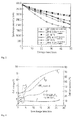
- Figure 2 is a graph showing the measurement results obtained in the working example.
- Figure 3 is a graph showing the measurement results obtained in the working example.
- Figure 4 is a graph showing the measurement results obtained in the working example.
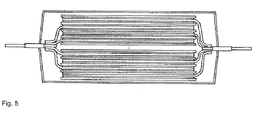
- Figure 5 is a schematic cross-sectional view showing an example of the construction of a lithium ion cell of the present invention.
- Figure 6 is a graph showing the IR profile obtained in Production Example 5.
- the electrolyte of the present invention contains at least a nonaqueous solvent, a lithium salt having a specific structure, and two types of additives having specific structures.
- lithium salts that can be used in the present invention examples of the lithium salt that constitutes the electrolyte salt of the present invention are lithium fluoroborates shown by the following formula (1) Li 2 B 12 H x F 12-x (1) (where, x is an integer of from 0 to 3)
- the first additive in the present invention is at least one additive among compounds shown by the following formula (2):
- the following compounds among the above-mentioned first additives are especially suitable for use from the standpoint of cell performance.
- At least one additive selected from vinylene carbonate (VC), vinyl ethylene carbonate (VEC), dimethyl vinylene carbonate (DMVC), and fluorinated ethylene carbonate (FEC).
- VC vinylene carbonate
- VEC vinyl ethylene carbonate
- DMVC dimethyl vinylene carbonate
- FEC fluorinated ethylene carbonate
- VC among these is especially preferred from the standpoint of not raising the internal resistance.
- the second additive in the present invention is at least one additive among compounds shown by the following formula (3): (where, Y is O, X is H or OH, and n is an integer of 0-5).
- the following compounds among the above-mentioned second additives are especially suitable for use from the standpoint of their stability at high temperature.
- At least one additive selected from propane sultone (PS) and hydroxypropane sultone (HOPS).
- PS propane sultone
- HOPS hydroxypropane sultone
- PS among them is especially preferred for its good ability to suppress gas production.
- first and second additives in the present invention from the standpoint of the balance of cell performance and life.
- First additive ⁇ Second additive> Vinylene carbonate (VC) Propane sultone (PS) Fluorinated ethylene carbonate (FEC) PS (VC + vinyl ethylene carbonate (VEC)) PS
- the nonaqueous solvent also sometimes referred to as the "carrier" that can be used in the present invention is not particularly restricted.
- the solvent or carrier may contain at least one type of ionic liquid.
- ionic liquid also refers to any type of room-temperature molten salt [sic].
- suitable ionic liquids include in particular at least one member selected from asymmetrical tetraalkyl ammonium salts of weakly coordinated anions that do not contain active hydrogen or reducible hydrogen in the liquid cation, for example, butyl trimethylammonium tetrafluoroborate, hexyl trimethylammonium trifluoromethanesulfonimide, and the like, and N-alkyl piperidium [sic; piperidinium] salts of weakly coordinated anions, for example, N-methylpiperidinium tetrafluoroborate, N-ethylpiperidinium trifluoromethanesulfonate, and N-butylpiperidinium trifluoromethanesulfonimide.
- composition ratios are volume ratios (parts)
- This ratio R (Cap) is more preferably [blank space] or more (ideally [blank space] or more).
- Cap (100) and/or Cap (200) can be determined by "interpolation" by the following formula from the capacity after the before and after charge/discharge cycles (for example, the capacity of (100 - a) times and (100 + b) times; (200 - c) times and (200 + d) times [translator's note: no closing parenthesis].
- Cap (100) and Cap (200) can be measured appropriately by using the conditions discussed below in Working Example 1.
- the electrolyte of the present invention may include an aprotic gel polymer carrier/solvent.
- a suitable gel polymer carrier/solvent may include at least one member selected from the group consisting in particular of polyethers, polyethylene oxides, polyimides, polyphosphazines, polyacrylonitriles, polysiloxanes, polyether grafted polysiloxanes, derivatives of the above, copolymers of the above, crosslinked and network structures of the above, and blends of the above.
- a suitable ionic electrolyte salt is added.
- gel polymer carriers/solvents may include those prepared from a polymer matrix derived from at least one member selected from the group consisting of polypropylene oxides, polysiloxanes, sulfonated polyimides, perfluorinated membranes (NafionTM resins), divinyl polyethylene glycols, polyethylene glycol-bis(methylacrylates), polyethylene glycol-bis(methyl methacrylates), derivatives of the above, copolymers of the above, and crosslinked and network structures of the above.
- the aprotic gel polymer carrier may contain any of the aprotic liquid carriers listed above.
- the salt concentration is typically from about 0.05 to about 2 mol, or from about 0.1 to about 1.2 mol or from about 0.2 to about 0.5 mol.
- the viscosity tends to become overly high when the concentration is raised, and the bulk conductivity characteristics of the cell that utilizes the electrolyte are sometimes negatively affected.
- the cell of the present invention contains a cathode, anode, and the electrolyte of the present invention.
- the anode and cathode of the cell may be any type of lithium-containing substance being utilized or a substance such as lithium and the like that can "host” an ion in reduced form or oxidized form.
- the term "host” means a substance capable of reversibly segregating an ion, for example, a lithium ion.
- the cathode of the cell of the present invention may include at least one member selected from the group consisting of metallic lithium, a carbonaceous substance, for example, amorphous carbon or graphite (natural or manmade), tin and alloys thereof, silicon and alloys thereof, germanium and alloys thereof, metal oxides, and derivatives of these substances (for example, lithium titanate).
- a carbonaceous substance for example, amorphous carbon or graphite (natural or manmade)
- tin and alloys thereof silicon and alloys thereof, germanium and alloys thereof, metal oxides, and derivatives of these substances (for example, lithium titanate).
- the anode used in the cell of the present invention in particular may be based on a lithium composite oxide that combines cobalt, nickel, manganese, a mixture of these, or other such transition metals or a lithium composite oxide in which some of the lithium sites or transition metal sites are substituted by at least one member selected from the group consisting of cobalt, nickel, manganese, aluminum boron, magnesium, iron, copper, and the like.
- lithium composite used as the anode examples include lithium iron phosphates, LiFePO 4 , LiNi 1-x CO x O 2 , and lithium manganese spinel, LiMn 2 O 4 .
- the separator of the lithium cell in the present invention may include a microporous polymer film.
- the polymer that forms the film in particular include at least one member selected from the group consisting of nylon, cellulose, nitrocellulose, polysulfone, polyacrylonitrile, polyvinylidene fluoride, polypropylene, polyethylene, polybutene, and mixtures thereof.
- a ceramic separator, particularly one based on a silicate, aluminosilicate, and derivatives of these, can also be used.
- the electrolyte wetting of the separator can be improved by adding a surfactant to the separator or electrolyte.
- Other components or compounds known to be used in electrolytes or cells may also be added.
- the cell is constructed from a carbonaceous lithium ion-hosting cathode, anode, separator, and a lithium-based electrolyte salt carried in an aprotic solvent, gel polymer, or polymer matrix.
- a carbonaceous lithium ion-hosting cathode examples include graphite and hard carbon.
- This crude product was analyzed by 19 F NMR and was found to be mainly B 12 F 10 H 2 2- (60%), B 12 F 11 H 2- (35%), and B 12 F 12 2- (5%).
- the crude product was dissolved in water, and the pH of the solution was adjusted to 4-6 using triethylamine and triethylamine hydrochloride.
- the precipitated product was filtered out, dried, and again suspended in water.
- Two equivalents of lithium hydroxide monohydrate was added to this slurry, and the resulting triethylamine was evacuated. After distilling off all of the triethylamine, more lithium hydroxide was added, and the pH of the final solution was brought to 9-10.
- the water was removed by distillation, and the final product was vacuum dried for 4-8 hours at 200°C.
- This crude product was analyzed by 19 F NMR and was found to be mainly B 12 F 10 H 2 2- (60%), B 12 F 11 H 2- (35%), and B 12 F 12 2- (5%).
- the crude product was dissolved in water, and the pH of the solution adjusted to 4-6 using triethylamine and triethylamine hydrochloride.
- the precipitated product was filtered, dried, and again suspended in water.
- Two equivalents of lithium hydroxide monohydrate was added to this slurry, and the resulting triethylamine was evacuated. After distilling off all of the triethylamine, more lithium hydroxide was added, and the pH of the final solution was brought to 9-10.
- the water was removed by distillation, and the final product was vacuum dried for 4-8 hours at 200°C.
- Li 2 B 12 F 12 An aqueous solution of Li 2 B 12 F 12 containing approximately 200 ppm of sodium was eluted through column having an Li + form cation exchange resin DOWEX 50WX8-200. The water was distilled off from the eluate, and the residue was vacuum dried at 150°C. The refined salt Li 2 B 12 F 12 contained about 60 ppm of sodium when measured by ICP.
- TGA/IR analysis was performed by ramping the sample in TA 2960 SDT and heating from room temperature to 800°C at 10°C/min in 100 cc/min of N 2 , H 2 O, saturated N 2 , or air.
- the gas released was passed through a 10 cm IR gas cell.
- the IR spectrum was collected at a resolution of 4 cm -1 and a gain of 1 by AVATAR IR.
- the spectrum was collected as a series of spectra at 1-minute intervals.
- the profile of the released gas was created by measuring the absorbance related to various compounds at the band maximum in the IR spectrum. Quantitative information was derived by multiplying the area under the profile curve by the calibration factor and dividing by the sample weight.
- the IR profile shown in Figure 6 shows that the majority of the water is removed from the sample by N 2 purging at about 190°C and more is removed at 225°C. The final removal of water at 180°C or lower appears to progress relatively slowly.
- Li 2 B 12 F 12 salt prepared according to Production Example 2 was ground and dried for 8 hours at 250°C under a 3.999 Pa (30 mTorr) dynamic vacuum. The sample was transferred to a drying box having an argon-filled inert atmosphere. Moisture analysis of this salt was carried out by an Orion AF7 coulometric Karl Fischer titrator. Hydranal TM Karl Fischer reagent and standards made by Riedel-deHaen were used. Approximately 0.60 g of Li 2 B 12 F 12 was dissolved in 3 mL of acetonitrile, and from 3 to 1 mL was taken for water analysis. After this drying procedure, a water value of about 100 ppm was obtained on a salt weight basis. Vacuum drying in this method typically gave water readings of 100-500 ppm.
- Li 2 B 12 F 12 salt prepared according to Production Example 2 was ground and dried for four hours at 150-200°C under a 13.332 Pa (100 mTorr) dynamic vacuum.
- the sample was further ground and loaded onto a quartz frit in a vertical glass tube. This tube was externally heated to 260°C, and dry nitrogen was purged through the salt at a rate sufficient to fluidize the salt bed.
- the sample was cooled and transferred to a box having an argon-filled inert atmosphere for analysis of the water content.
- Karl Fischer analysis performed in the same way as in Example 7, showed the salt to contain 10-20 ppm of water on a salt weight basis.
- Li 2 B 12 F 12 (purity 99.5% or more), a lithium salt, was stored in an argon glove box kept at a dew point of -80°C or lower and supplied for preparation of the electrolyte after fluorinating the raw material according to Production Example 2, removing the impurities, and drying.
- the purity of the Li 2 B 12 F 12 obtained assessed by liquid chromatography (LC) was 99.5%.
- the water content assessed by the Karl Fischer (KF) method was 20 ppm.
- the solvent used in the electrolyte was refined to a water content of 10 ppm or less.
- PC propylene carbonate
- EC ethylene carbonate
- DEC diethyl carbonate
- PS propane sultone
- a laminated cell was prepared by the following procedure to assess the cell characteristics.
- NMP N-mertipyrrolidone
- the paste was applied to an anode current collector 1 made of aluminum foil, dried, and pressed to prepare an anode electrode having a anode layer 2 formed on both surfaces of the anode current collector 1.
- the paste was applied to a cathode current collector 3 made of copper foil, dried, and pressed to prepare a cathode electrode having a cathode layer 4 formed on both surfaces of the cathode current collector 3.
- the cell 1 prepared was allowed to stand for 8 hours after filling until the electrolyte had conditioned the electrode. It was then charged to 3.2 V at 0.1 C (400 mA), and allowed to stand for another 8 hours. Next, it was charged to 4.2 V at 0.2 C (800 mA) and charged at a constant voltage until the current value reached 40 mA by 4.2 V. After standing for another 8 hours in this state, it was discharged at a constant current to 2.7 V at 0.2 C. After measuring the discharge capacity, the top seal was cut away, the gas was removed, and the top was again sealed by heat sealing. The starting discharge capacity of the laminated cell 1 was 3.97 Ah.
- the cell 1 was charged for 3.5 h by a constant current-constant voltage of 4.2 V at 0.5 C and stored in this state in a 60°C constant temperature tank. After a certain period of time, the stored cell was removed from the constant temperature tank and the residual capacity at 0.2 C and, after charging at 0.5 C, the recovered discharge capacity at 0.2 C were assessed at 25°C. Such testing was conducted by varying the voltage during storage between 3.95 V and 4.1 V, and the graph of the changes in capacity shown in Figure 2 was obtained by a 60°C cycle test.
- the graph of Figure 3 was also obtained by a 60°C storage test.
- the cell was not overcharged up to a set voltage of 5.5 volt and a flat plateau was observed at about 4.6 volt due to oxidation of the overcharge protection salt when 0.2 M Li 2 B 12 F 12 in an LiPF 6 electrolyte was used.
- the use of Li 2 B 12 F 12 salt in a lithium secondary cell having LiPF 6 salt gives overcharge protection, and a sufficient amount was present to create a redox shuttle during overcharge conditions.
- curve 1 shows the voltage of Working Example 1.
- Curve 1' shows the surface temperature of Working Example 1.
- Curve 2 shows the voltage of the comparative example.
- Curve 2' shows the surface temperature of the comparative example.
- the invention also relates to the following numbered items:
Landscapes
- Chemical & Material Sciences (AREA)
- Engineering & Computer Science (AREA)
- Inorganic Chemistry (AREA)
- Chemical Kinetics & Catalysis (AREA)
- Electrochemistry (AREA)
- General Chemical & Material Sciences (AREA)
- Organic Chemistry (AREA)
- Manufacturing & Machinery (AREA)
- Condensed Matter Physics & Semiconductors (AREA)
- General Physics & Mathematics (AREA)
- Physics & Mathematics (AREA)
- Materials Engineering (AREA)
- Ceramic Engineering (AREA)
- Structural Engineering (AREA)
- Crystallography & Structural Chemistry (AREA)
- Secondary Cells (AREA)
- Battery Electrode And Active Subsutance (AREA)
Applications Claiming Priority (1)
| Application Number | Priority Date | Filing Date | Title |
|---|---|---|---|
| JP2008335160A JP5300468B2 (ja) | 2008-12-26 | 2008-12-26 | 非水電解液 |
Publications (2)
| Publication Number | Publication Date |
|---|---|
| EP2207234A1 true EP2207234A1 (fr) | 2010-07-14 |
| EP2207234B1 EP2207234B1 (fr) | 2012-04-18 |
Family
ID=41682892
Family Applications (1)
| Application Number | Title | Priority Date | Filing Date |
|---|---|---|---|
| EP09180129A Not-in-force EP2207234B1 (fr) | 2008-12-26 | 2009-12-21 | Électrolyte non-aqueux |
Country Status (8)
| Country | Link |
|---|---|
| US (1) | US20100167121A1 (fr) |
| EP (1) | EP2207234B1 (fr) |
| JP (1) | JP5300468B2 (fr) |
| KR (1) | KR101157722B1 (fr) |
| CN (1) | CN101789527A (fr) |
| AT (1) | ATE554511T1 (fr) |
| CA (1) | CA2688952C (fr) |
| TW (1) | TWI449231B (fr) |
Families Citing this family (20)
| Publication number | Priority date | Publication date | Assignee | Title |
|---|---|---|---|---|
| CN101640288B (zh) * | 2008-07-30 | 2012-03-07 | 比亚迪股份有限公司 | 一种锂离子电池电解液及含有该电解液的锂离子电池 |
| JP5300468B2 (ja) * | 2008-12-26 | 2013-09-25 | 昭和電工株式会社 | 非水電解液 |
| US8993177B2 (en) | 2009-12-04 | 2015-03-31 | Envia Systems, Inc. | Lithium ion battery with high voltage electrolytes and additives |
| WO2013054676A1 (fr) * | 2011-10-12 | 2013-04-18 | 昭和電工株式会社 | Batterie secondaire à solution non aqueuse |
| US20140017558A1 (en) * | 2012-07-16 | 2014-01-16 | Nthdegree Technologies Worldwide Inc. | Diatomaceous Ionic Gel Separation Layer for Energy Storage Devices and Printable Composition Therefor |
| CN103811812B (zh) * | 2012-11-06 | 2016-12-21 | 万向电动汽车有限公司 | 一种锂离子动力电池防过充电解液及采用其制备的锂离子动力电池 |
| US10411299B2 (en) | 2013-08-02 | 2019-09-10 | Zenlabs Energy, Inc. | Electrolytes for stable cycling of high capacity lithium based batteries |
| KR101749186B1 (ko) | 2013-09-11 | 2017-07-03 | 삼성에스디아이 주식회사 | 리튬 전지용 전해질, 이를 포함하는 리튬 전지, 및 리튬 전지용 전해질의 제조방법 |
| FR3011683A1 (fr) * | 2013-10-03 | 2015-04-10 | Arkema France | Sel d'anion pentacyclique : composition pour batteries |
| CN104752770A (zh) * | 2013-12-30 | 2015-07-01 | 天津金牛电源材料有限责任公司 | 一种用于锂离子电池的高电压电解液的制备方法 |
| CN103794817A (zh) * | 2014-02-20 | 2014-05-14 | 福建创鑫科技开发有限公司 | 乙烯基碳酸乙烯酯在锂离子电池中的应用 |
| JP6517069B2 (ja) * | 2014-06-30 | 2019-05-22 | パナソニック株式会社 | 非水電解質二次電池 |
| EP3353844B1 (fr) | 2015-03-27 | 2022-05-11 | Mason K. Harrup | Solvants entièrement inorganiques pour électrolytes |
| US10707531B1 (en) | 2016-09-27 | 2020-07-07 | New Dominion Enterprises Inc. | All-inorganic solvents for electrolytes |
| US10801990B2 (en) * | 2018-04-17 | 2020-10-13 | Hach Company | Alkalinity measurement of an aqueous sample |
| US10847839B2 (en) * | 2018-08-01 | 2020-11-24 | Uchicago Argonne, Llc | Non-aqueous electrolytes for lithium batteries |
| WO2020111633A1 (fr) * | 2018-11-26 | 2020-06-04 | 동우 화인켐 주식회사 | Composition de solution électrolytique et batterie secondaire l'utilisant |
| KR102138128B1 (ko) | 2018-11-26 | 2020-07-27 | 동우 화인켐 주식회사 | 전해액 조성물 및 이를 이용한 이차전지 |
| CN115232100B (zh) * | 2022-09-21 | 2022-12-09 | 湖南省正源储能材料与器件研究所 | 一种碳酸亚乙烯酯精馏过程中溶剂回收的方法 |
| US20240339662A1 (en) * | 2023-04-04 | 2024-10-10 | NOHMs Technologies, Inc. | Functionalized cyclic ethers for lithium-ion batteries |
Citations (6)
| Publication number | Priority date | Publication date | Assignee | Title |
|---|---|---|---|---|
| EP1304758A1 (fr) * | 2000-06-26 | 2003-04-23 | Matsushita Electric Industrial Co., Ltd. | Electrolyte non aqueux et cellule secondaire de celui-ci |
| EP1513215A2 (fr) * | 2003-09-04 | 2005-03-09 | Air Products And Chemicals, Inc. | Agrégats anioniques polyfluorinés de bore pour electrolytes au lithium |
| US6927001B1 (en) * | 1999-05-24 | 2005-08-09 | Ube Industries, Ltd. | Non-aqueous electrolytic solution and lithium secondary battery |
| EP1679760A1 (fr) * | 2005-01-11 | 2006-07-12 | Air Products and Chemicals, Inc. | Electrolytes, cellules et méthod de fabrication d'une couche de passivation |
| EP1763099A2 (fr) * | 2005-08-23 | 2007-03-14 | Air Products And Chemicals, Inc. | Contre-anions d'électrolyte stable pour des dispositifs électrochimiques |
| US20070072086A1 (en) * | 2003-05-15 | 2007-03-29 | Yuasa Corporation | Nonaqueous electrolyte cell |
Family Cites Families (13)
| Publication number | Priority date | Publication date | Assignee | Title |
|---|---|---|---|---|
| JP3493873B2 (ja) * | 1995-04-28 | 2004-02-03 | ソニー株式会社 | 非水電解液二次電池 |
| JP2002033120A (ja) * | 2000-07-17 | 2002-01-31 | Matsushita Electric Ind Co Ltd | 非水電解質二次電池 |
| JP4544408B2 (ja) * | 2004-06-18 | 2010-09-15 | 日本電気株式会社 | 二次電池用電解液およびそれを用いた二次電池 |
| US20080026297A1 (en) * | 2005-01-11 | 2008-01-31 | Air Products And Chemicals, Inc. | Electrolytes, cells and methods of forming passivaton layers |
| US20070072085A1 (en) * | 2005-09-26 | 2007-03-29 | Zonghai Chen | Overcharge protection for electrochemical cells |
| TWI341603B (en) * | 2006-02-15 | 2011-05-01 | Lg Chemical Ltd | Non-aqueous electrolyte and electrochemical device with an improved safety |
| KR100706654B1 (ko) | 2006-02-17 | 2007-04-12 | 제일모직주식회사 | 비수성 전해액 및 이를 포함하는 리튬 2차 전지 |
| US7638243B2 (en) * | 2006-03-22 | 2009-12-29 | Novolyte Technologies Inc. | Stabilized nonaqueous electrolytes for rechargeable batteries |
| JP5034287B2 (ja) * | 2006-03-24 | 2012-09-26 | ソニー株式会社 | 電池 |
| JP5392449B2 (ja) * | 2006-09-05 | 2014-01-22 | 株式会社Gsユアサ | 非水電解質電池及びその製造方法 |
| KR101115028B1 (ko) * | 2007-05-15 | 2012-03-09 | 주식회사 엘지화학 | 비수전해액 첨가제 및 이를 이용하는 이차 전지 |
| JP2008311211A (ja) * | 2007-05-16 | 2008-12-25 | Sanyo Electric Co Ltd | 非水電解質二次電池 |
| JP5300468B2 (ja) * | 2008-12-26 | 2013-09-25 | 昭和電工株式会社 | 非水電解液 |
-
2008
- 2008-12-26 JP JP2008335160A patent/JP5300468B2/ja not_active Expired - Fee Related
-
2009
- 2009-02-13 US US12/370,843 patent/US20100167121A1/en not_active Abandoned
- 2009-12-21 TW TW098144001A patent/TWI449231B/zh active
- 2009-12-21 AT AT09180129T patent/ATE554511T1/de active
- 2009-12-21 CA CA2688952A patent/CA2688952C/fr active Active
- 2009-12-21 EP EP09180129A patent/EP2207234B1/fr not_active Not-in-force
- 2009-12-24 KR KR1020090131078A patent/KR101157722B1/ko not_active Expired - Fee Related
- 2009-12-25 CN CN200911000061A patent/CN101789527A/zh active Pending
Patent Citations (6)
| Publication number | Priority date | Publication date | Assignee | Title |
|---|---|---|---|---|
| US6927001B1 (en) * | 1999-05-24 | 2005-08-09 | Ube Industries, Ltd. | Non-aqueous electrolytic solution and lithium secondary battery |
| EP1304758A1 (fr) * | 2000-06-26 | 2003-04-23 | Matsushita Electric Industrial Co., Ltd. | Electrolyte non aqueux et cellule secondaire de celui-ci |
| US20070072086A1 (en) * | 2003-05-15 | 2007-03-29 | Yuasa Corporation | Nonaqueous electrolyte cell |
| EP1513215A2 (fr) * | 2003-09-04 | 2005-03-09 | Air Products And Chemicals, Inc. | Agrégats anioniques polyfluorinés de bore pour electrolytes au lithium |
| EP1679760A1 (fr) * | 2005-01-11 | 2006-07-12 | Air Products and Chemicals, Inc. | Electrolytes, cellules et méthod de fabrication d'une couche de passivation |
| EP1763099A2 (fr) * | 2005-08-23 | 2007-03-14 | Air Products And Chemicals, Inc. | Contre-anions d'électrolyte stable pour des dispositifs électrochimiques |
Also Published As
| Publication number | Publication date |
|---|---|
| CA2688952C (fr) | 2014-07-22 |
| TWI449231B (zh) | 2014-08-11 |
| EP2207234B1 (fr) | 2012-04-18 |
| JP2010157437A (ja) | 2010-07-15 |
| KR101157722B1 (ko) | 2012-06-20 |
| TW201027822A (en) | 2010-07-16 |
| ATE554511T1 (de) | 2012-05-15 |
| CA2688952A1 (fr) | 2010-06-26 |
| CN101789527A (zh) | 2010-07-28 |
| US20100167121A1 (en) | 2010-07-01 |
| KR20100076911A (ko) | 2010-07-06 |
| JP5300468B2 (ja) | 2013-09-25 |
Similar Documents
| Publication | Publication Date | Title |
|---|---|---|
| EP2207234B1 (fr) | Électrolyte non-aqueux | |
| EP2693558B1 (fr) | Batterie rechargeable à lithium-ion et électrolyte non aqueux pour batterie rechargeable à lithium-ion | |
| US7348103B2 (en) | Polyfluorinated boron cluster anions for lithium electrolytes | |
| EP4087005A1 (fr) | Électrolytes contenant du phosphore | |
| US7465517B2 (en) | High purity lithium polyhalogenated boron cluster salts useful in lithium batteries | |
| EP3979383B1 (fr) | Composition d'électrolyte, composition de solvant, électrolyte non aqueux et leur utilisation | |
| US20080063945A1 (en) | Polyfluorinated Boron Cluster Anions for Lithium Electrolytes | |
| EP2907183B1 (fr) | Cellules électrochimiques | |
| EP1837333A1 (fr) | Sel d'ammonium quaternaire, electrolyte, solution electrolytique et dispositif electrochimique | |
| US20120276445A1 (en) | Pure forms of lithium borate salts and the process producing such forms | |
| KR102023678B1 (ko) | 이차전지용 전해액 및 이를 포함하는 이차전지 | |
| KR20190092879A (ko) | 이차전지용 전해액 및 이를 포함하는 이차전지 | |
| EP2903075A1 (fr) | Solution d'électrolyte non aqueux, dispositif électrochimique, cellule secondaire au lithium-ion, et module | |
| KR20180025917A (ko) | 이소시아나이드를 포함하는 리튬-이온 전지용 비수성 전해질 | |
| KR20180050780A (ko) | 비수전해액 및 리튬 이차전지 | |
| EP3896772A1 (fr) | Électrolyte non aqueux pour batterie et batterie secondaire au lithium | |
| EP3656009B1 (fr) | Liquides ioniques modifiés contenant de la triazine | |
| EP1689016B1 (fr) | Solution electrolytique et accumulateur au lithium a electrolyte non-aqueux contenant cette derniere | |
| EP4273992B1 (fr) | Batterie secondaire au lithium à sécurité élevée à haute température | |
| US20060204843A1 (en) | Polyfluorinated boron cluster anions for lithium electrolytes | |
| KR102431260B1 (ko) | 리튬이온전지용 기능성 전해액 및 이를 포함하는 리튬이온전지 | |
| EP4379890A1 (fr) | Batterie secondaire au lithium | |
| KR102630824B1 (ko) | 리튬 디플루오로(옥살라토)보레이트의 제조방법, 이로부터 제조된 리튬 디플루오로(옥살라토)보레이트, 리튬이온전지용 전해액 및 이를 포함하는 리튬이온전지 |
Legal Events
| Date | Code | Title | Description |
|---|---|---|---|
| PUAI | Public reference made under article 153(3) epc to a published international application that has entered the european phase |
Free format text: ORIGINAL CODE: 0009012 |
|
| AK | Designated contracting states |
Kind code of ref document: A1 Designated state(s): AT BE BG CH CY CZ DE DK EE ES FI FR GB GR HR HU IE IS IT LI LT LU LV MC MK MT NL NO PL PT RO SE SI SK SM TR |
|
| AX | Request for extension of the european patent |
Extension state: AL BA RS |
|
| 17P | Request for examination filed |
Effective date: 20101023 |
|
| GRAP | Despatch of communication of intention to grant a patent |
Free format text: ORIGINAL CODE: EPIDOSNIGR1 |
|
| RIC1 | Information provided on ipc code assigned before grant |
Ipc: C04B 35/553 20060101ALI20111102BHEP Ipc: C01B 35/12 20060101ALI20111102BHEP Ipc: H01M 10/0525 20100101ALI20111102BHEP Ipc: H01M 10/0568 20100101ALI20111102BHEP Ipc: H01M 10/0567 20100101AFI20111102BHEP |
|
| RTI1 | Title (correction) |
Free format text: NON-AQUEOUS ELECTROLYTE |
|
| GRAS | Grant fee paid |
Free format text: ORIGINAL CODE: EPIDOSNIGR3 |
|
| GRAA | (expected) grant |
Free format text: ORIGINAL CODE: 0009210 |
|
| AK | Designated contracting states |
Kind code of ref document: B1 Designated state(s): AT BE BG CH CY CZ DE DK EE ES FI FR GB GR HR HU IE IS IT LI LT LU LV MC MK MT NL NO PL PT RO SE SI SK SM TR |
|
| REG | Reference to a national code |
Ref country code: GB Ref legal event code: FG4D |
|
| REG | Reference to a national code |
Ref country code: CH Ref legal event code: EP |
|
| REG | Reference to a national code |
Ref country code: IE Ref legal event code: FG4D |
|
| REG | Reference to a national code |
Ref country code: AT Ref legal event code: REF Ref document number: 554511 Country of ref document: AT Kind code of ref document: T Effective date: 20120515 |
|
| REG | Reference to a national code |
Ref country code: DE Ref legal event code: R096 Ref document number: 602009006416 Country of ref document: DE Effective date: 20120614 |
|
| REG | Reference to a national code |
Ref country code: NL Ref legal event code: VDEP Effective date: 20120418 |
|
| REG | Reference to a national code |
Ref country code: AT Ref legal event code: MK05 Ref document number: 554511 Country of ref document: AT Kind code of ref document: T Effective date: 20120418 |
|
| LTIE | Lt: invalidation of european patent or patent extension |
Effective date: 20120418 |
|
| PG25 | Lapsed in a contracting state [announced via postgrant information from national office to epo] |
Ref country code: IS Free format text: LAPSE BECAUSE OF FAILURE TO SUBMIT A TRANSLATION OF THE DESCRIPTION OR TO PAY THE FEE WITHIN THE PRESCRIBED TIME-LIMIT Effective date: 20120818 Ref country code: CY Free format text: LAPSE BECAUSE OF FAILURE TO SUBMIT A TRANSLATION OF THE DESCRIPTION OR TO PAY THE FEE WITHIN THE PRESCRIBED TIME-LIMIT Effective date: 20120418 Ref country code: FI Free format text: LAPSE BECAUSE OF FAILURE TO SUBMIT A TRANSLATION OF THE DESCRIPTION OR TO PAY THE FEE WITHIN THE PRESCRIBED TIME-LIMIT Effective date: 20120418 Ref country code: SE Free format text: LAPSE BECAUSE OF FAILURE TO SUBMIT A TRANSLATION OF THE DESCRIPTION OR TO PAY THE FEE WITHIN THE PRESCRIBED TIME-LIMIT Effective date: 20120418 Ref country code: NO Free format text: LAPSE BECAUSE OF FAILURE TO SUBMIT A TRANSLATION OF THE DESCRIPTION OR TO PAY THE FEE WITHIN THE PRESCRIBED TIME-LIMIT Effective date: 20120718 Ref country code: PL Free format text: LAPSE BECAUSE OF FAILURE TO SUBMIT A TRANSLATION OF THE DESCRIPTION OR TO PAY THE FEE WITHIN THE PRESCRIBED TIME-LIMIT Effective date: 20120418 Ref country code: LT Free format text: LAPSE BECAUSE OF FAILURE TO SUBMIT A TRANSLATION OF THE DESCRIPTION OR TO PAY THE FEE WITHIN THE PRESCRIBED TIME-LIMIT Effective date: 20120418 |
|
| PG25 | Lapsed in a contracting state [announced via postgrant information from national office to epo] |
Ref country code: SI Free format text: LAPSE BECAUSE OF FAILURE TO SUBMIT A TRANSLATION OF THE DESCRIPTION OR TO PAY THE FEE WITHIN THE PRESCRIBED TIME-LIMIT Effective date: 20120418 Ref country code: HR Free format text: LAPSE BECAUSE OF FAILURE TO SUBMIT A TRANSLATION OF THE DESCRIPTION OR TO PAY THE FEE WITHIN THE PRESCRIBED TIME-LIMIT Effective date: 20120418 Ref country code: PT Free format text: LAPSE BECAUSE OF FAILURE TO SUBMIT A TRANSLATION OF THE DESCRIPTION OR TO PAY THE FEE WITHIN THE PRESCRIBED TIME-LIMIT Effective date: 20120820 Ref country code: GR Free format text: LAPSE BECAUSE OF FAILURE TO SUBMIT A TRANSLATION OF THE DESCRIPTION OR TO PAY THE FEE WITHIN THE PRESCRIBED TIME-LIMIT Effective date: 20120719 Ref country code: LV Free format text: LAPSE BECAUSE OF FAILURE TO SUBMIT A TRANSLATION OF THE DESCRIPTION OR TO PAY THE FEE WITHIN THE PRESCRIBED TIME-LIMIT Effective date: 20120418 |
|
| PG25 | Lapsed in a contracting state [announced via postgrant information from national office to epo] |
Ref country code: BE Free format text: LAPSE BECAUSE OF FAILURE TO SUBMIT A TRANSLATION OF THE DESCRIPTION OR TO PAY THE FEE WITHIN THE PRESCRIBED TIME-LIMIT Effective date: 20120418 |
|
| PG25 | Lapsed in a contracting state [announced via postgrant information from national office to epo] |
Ref country code: RO Free format text: LAPSE BECAUSE OF FAILURE TO SUBMIT A TRANSLATION OF THE DESCRIPTION OR TO PAY THE FEE WITHIN THE PRESCRIBED TIME-LIMIT Effective date: 20120418 Ref country code: SK Free format text: LAPSE BECAUSE OF FAILURE TO SUBMIT A TRANSLATION OF THE DESCRIPTION OR TO PAY THE FEE WITHIN THE PRESCRIBED TIME-LIMIT Effective date: 20120418 Ref country code: EE Free format text: LAPSE BECAUSE OF FAILURE TO SUBMIT A TRANSLATION OF THE DESCRIPTION OR TO PAY THE FEE WITHIN THE PRESCRIBED TIME-LIMIT Effective date: 20120418 Ref country code: NL Free format text: LAPSE BECAUSE OF FAILURE TO SUBMIT A TRANSLATION OF THE DESCRIPTION OR TO PAY THE FEE WITHIN THE PRESCRIBED TIME-LIMIT Effective date: 20120418 Ref country code: AT Free format text: LAPSE BECAUSE OF FAILURE TO SUBMIT A TRANSLATION OF THE DESCRIPTION OR TO PAY THE FEE WITHIN THE PRESCRIBED TIME-LIMIT Effective date: 20120418 Ref country code: CZ Free format text: LAPSE BECAUSE OF FAILURE TO SUBMIT A TRANSLATION OF THE DESCRIPTION OR TO PAY THE FEE WITHIN THE PRESCRIBED TIME-LIMIT Effective date: 20120418 Ref country code: DK Free format text: LAPSE BECAUSE OF FAILURE TO SUBMIT A TRANSLATION OF THE DESCRIPTION OR TO PAY THE FEE WITHIN THE PRESCRIBED TIME-LIMIT Effective date: 20120418 |
|
| PLBE | No opposition filed within time limit |
Free format text: ORIGINAL CODE: 0009261 |
|
| STAA | Information on the status of an ep patent application or granted ep patent |
Free format text: STATUS: NO OPPOSITION FILED WITHIN TIME LIMIT |
|
| PG25 | Lapsed in a contracting state [announced via postgrant information from national office to epo] |
Ref country code: IT Free format text: LAPSE BECAUSE OF FAILURE TO SUBMIT A TRANSLATION OF THE DESCRIPTION OR TO PAY THE FEE WITHIN THE PRESCRIBED TIME-LIMIT Effective date: 20120418 |
|
| 26N | No opposition filed |
Effective date: 20130121 |
|
| PG25 | Lapsed in a contracting state [announced via postgrant information from national office to epo] |
Ref country code: ES Free format text: LAPSE BECAUSE OF FAILURE TO SUBMIT A TRANSLATION OF THE DESCRIPTION OR TO PAY THE FEE WITHIN THE PRESCRIBED TIME-LIMIT Effective date: 20120729 |
|
| REG | Reference to a national code |
Ref country code: DE Ref legal event code: R097 Ref document number: 602009006416 Country of ref document: DE Effective date: 20130121 |
|
| PG25 | Lapsed in a contracting state [announced via postgrant information from national office to epo] |
Ref country code: BG Free format text: LAPSE BECAUSE OF FAILURE TO SUBMIT A TRANSLATION OF THE DESCRIPTION OR TO PAY THE FEE WITHIN THE PRESCRIBED TIME-LIMIT Effective date: 20120718 Ref country code: MC Free format text: LAPSE BECAUSE OF NON-PAYMENT OF DUE FEES Effective date: 20121231 |
|
| REG | Reference to a national code |
Ref country code: IE Ref legal event code: MM4A |
|
| PG25 | Lapsed in a contracting state [announced via postgrant information from national office to epo] |
Ref country code: IE Free format text: LAPSE BECAUSE OF NON-PAYMENT OF DUE FEES Effective date: 20121221 |
|
| PG25 | Lapsed in a contracting state [announced via postgrant information from national office to epo] |
Ref country code: MT Free format text: LAPSE BECAUSE OF FAILURE TO SUBMIT A TRANSLATION OF THE DESCRIPTION OR TO PAY THE FEE WITHIN THE PRESCRIBED TIME-LIMIT Effective date: 20120418 |
|
| PG25 | Lapsed in a contracting state [announced via postgrant information from national office to epo] |
Ref country code: TR Free format text: LAPSE BECAUSE OF FAILURE TO SUBMIT A TRANSLATION OF THE DESCRIPTION OR TO PAY THE FEE WITHIN THE PRESCRIBED TIME-LIMIT Effective date: 20120418 |
|
| PG25 | Lapsed in a contracting state [announced via postgrant information from national office to epo] |
Ref country code: SM Free format text: LAPSE BECAUSE OF FAILURE TO SUBMIT A TRANSLATION OF THE DESCRIPTION OR TO PAY THE FEE WITHIN THE PRESCRIBED TIME-LIMIT Effective date: 20120418 Ref country code: LU Free format text: LAPSE BECAUSE OF NON-PAYMENT OF DUE FEES Effective date: 20121221 |
|
| PG25 | Lapsed in a contracting state [announced via postgrant information from national office to epo] |
Ref country code: HU Free format text: LAPSE BECAUSE OF FAILURE TO SUBMIT A TRANSLATION OF THE DESCRIPTION OR TO PAY THE FEE WITHIN THE PRESCRIBED TIME-LIMIT Effective date: 20091221 |
|
| REG | Reference to a national code |
Ref country code: CH Ref legal event code: PL |
|
| PG25 | Lapsed in a contracting state [announced via postgrant information from national office to epo] |
Ref country code: CH Free format text: LAPSE BECAUSE OF NON-PAYMENT OF DUE FEES Effective date: 20131231 Ref country code: LI Free format text: LAPSE BECAUSE OF NON-PAYMENT OF DUE FEES Effective date: 20131231 |
|
| PG25 | Lapsed in a contracting state [announced via postgrant information from national office to epo] |
Ref country code: MK Free format text: LAPSE BECAUSE OF FAILURE TO SUBMIT A TRANSLATION OF THE DESCRIPTION OR TO PAY THE FEE WITHIN THE PRESCRIBED TIME-LIMIT Effective date: 20120418 |
|
| REG | Reference to a national code |
Ref country code: FR Ref legal event code: PLFP Year of fee payment: 7 |
|
| REG | Reference to a national code |
Ref country code: FR Ref legal event code: PLFP Year of fee payment: 8 |
|
| REG | Reference to a national code |
Ref country code: FR Ref legal event code: PLFP Year of fee payment: 9 |
|
| REG | Reference to a national code |
Ref country code: DE Ref legal event code: R082 Ref document number: 602009006416 Country of ref document: DE Representative=s name: ANDREA SOMMER PATENTANWAELTE PARTNERSCHAFT MBB, DE Ref country code: DE Ref legal event code: R082 Ref document number: 602009006416 Country of ref document: DE |
|
| REG | Reference to a national code |
Ref country code: DE Ref legal event code: R082 Ref document number: 602009006416 Country of ref document: DE Representative=s name: ANDREA SOMMER PATENTANWAELTE PARTNERSCHAFT MBB, DE |
|
| P01 | Opt-out of the competence of the unified patent court (upc) registered |
Effective date: 20230523 |
|
| PGFP | Annual fee paid to national office [announced via postgrant information from national office to epo] |
Ref country code: GB Payment date: 20231102 Year of fee payment: 15 |
|
| PGFP | Annual fee paid to national office [announced via postgrant information from national office to epo] |
Ref country code: FR Payment date: 20231108 Year of fee payment: 15 Ref country code: DE Payment date: 20231024 Year of fee payment: 15 |
|
| REG | Reference to a national code |
Ref country code: DE Ref legal event code: R119 Ref document number: 602009006416 Country of ref document: DE |
|
| GBPC | Gb: european patent ceased through non-payment of renewal fee |
Effective date: 20241221 |
|
| PG25 | Lapsed in a contracting state [announced via postgrant information from national office to epo] |
Ref country code: DE Free format text: LAPSE BECAUSE OF NON-PAYMENT OF DUE FEES Effective date: 20250701 |
|
| PG25 | Lapsed in a contracting state [announced via postgrant information from national office to epo] |
Ref country code: GB Free format text: LAPSE BECAUSE OF NON-PAYMENT OF DUE FEES Effective date: 20241221 |
|
| PG25 | Lapsed in a contracting state [announced via postgrant information from national office to epo] |
Ref country code: FR Free format text: LAPSE BECAUSE OF NON-PAYMENT OF DUE FEES Effective date: 20241231 |