EP2207323B1 - Sécurité adaptative de dispositifs d'information portables - Google Patents
Sécurité adaptative de dispositifs d'information portables Download PDFInfo
- Publication number
- EP2207323B1 EP2207323B1 EP09151535.3A EP09151535A EP2207323B1 EP 2207323 B1 EP2207323 B1 EP 2207323B1 EP 09151535 A EP09151535 A EP 09151535A EP 2207323 B1 EP2207323 B1 EP 2207323B1
- Authority
- EP
- European Patent Office
- Prior art keywords
- security
- module
- portable information
- information device
- configuration
- Prior art date
- Legal status (The legal status is an assumption and is not a legal conclusion. Google has not performed a legal analysis and makes no representation as to the accuracy of the status listed.)
- Active
Links
Images






Classifications
-
- H—ELECTRICITY
- H04—ELECTRIC COMMUNICATION TECHNIQUE
- H04L—TRANSMISSION OF DIGITAL INFORMATION, e.g. TELEGRAPHIC COMMUNICATION
- H04L63/00—Network architectures or network communication protocols for network security
- H04L63/02—Network architectures or network communication protocols for network security for separating internal from external traffic, e.g. firewalls
- H04L63/0227—Filtering policies
- H04L63/0263—Rule management
-
- H—ELECTRICITY
- H04—ELECTRIC COMMUNICATION TECHNIQUE
- H04W—WIRELESS COMMUNICATION NETWORKS
- H04W12/00—Security arrangements; Authentication; Protecting privacy or anonymity
- H04W12/30—Security of mobile devices; Security of mobile applications
-
- G—PHYSICS
- G06—COMPUTING OR CALCULATING; COUNTING
- G06F—ELECTRIC DIGITAL DATA PROCESSING
- G06F21/00—Security arrangements for protecting computers, components thereof, programs or data against unauthorised activity
- G06F21/50—Monitoring users, programs or devices to maintain the integrity of platforms, e.g. of processors, firmware or operating systems
-
- G—PHYSICS
- G06—COMPUTING OR CALCULATING; COUNTING
- G06F—ELECTRIC DIGITAL DATA PROCESSING
- G06F21/00—Security arrangements for protecting computers, components thereof, programs or data against unauthorised activity
- G06F21/50—Monitoring users, programs or devices to maintain the integrity of platforms, e.g. of processors, firmware or operating systems
- G06F21/57—Certifying or maintaining trusted computer platforms, e.g. secure boots or power-downs, version controls, system software checks, secure updates or assessing vulnerabilities
- G06F21/577—Assessing vulnerabilities and evaluating computer system security
-
- H—ELECTRICITY
- H04—ELECTRIC COMMUNICATION TECHNIQUE
- H04L—TRANSMISSION OF DIGITAL INFORMATION, e.g. TELEGRAPHIC COMMUNICATION
- H04L63/00—Network architectures or network communication protocols for network security
- H04L63/10—Network architectures or network communication protocols for network security for controlling access to devices or network resources
- H04L63/105—Multiple levels of security
-
- H—ELECTRICITY
- H04—ELECTRIC COMMUNICATION TECHNIQUE
- H04L—TRANSMISSION OF DIGITAL INFORMATION, e.g. TELEGRAPHIC COMMUNICATION
- H04L63/00—Network architectures or network communication protocols for network security
- H04L63/10—Network architectures or network communication protocols for network security for controlling access to devices or network resources
- H04L63/107—Network architectures or network communication protocols for network security for controlling access to devices or network resources wherein the security policies are location-dependent, e.g. entities privileges depend on current location or allowing specific operations only from locally connected terminals
-
- H—ELECTRICITY
- H04—ELECTRIC COMMUNICATION TECHNIQUE
- H04W—WIRELESS COMMUNICATION NETWORKS
- H04W12/00—Security arrangements; Authentication; Protecting privacy or anonymity
- H04W12/12—Detection or prevention of fraud
-
- G—PHYSICS
- G06—COMPUTING OR CALCULATING; COUNTING
- G06F—ELECTRIC DIGITAL DATA PROCESSING
- G06F2221/00—Indexing scheme relating to security arrangements for protecting computers, components thereof, programs or data against unauthorised activity
- G06F2221/21—Indexing scheme relating to G06F21/00 and subgroups addressing additional information or applications relating to security arrangements for protecting computers, components thereof, programs or data against unauthorised activity
- G06F2221/2111—Location-sensitive, e.g. geographical location, GPS
-
- G—PHYSICS
- G06—COMPUTING OR CALCULATING; COUNTING
- G06F—ELECTRIC DIGITAL DATA PROCESSING
- G06F2221/00—Indexing scheme relating to security arrangements for protecting computers, components thereof, programs or data against unauthorised activity
- G06F2221/21—Indexing scheme relating to G06F21/00 and subgroups addressing additional information or applications relating to security arrangements for protecting computers, components thereof, programs or data against unauthorised activity
- G06F2221/2113—Multi-level security, e.g. mandatory access control
-
- H—ELECTRICITY
- H04—ELECTRIC COMMUNICATION TECHNIQUE
- H04L—TRANSMISSION OF DIGITAL INFORMATION, e.g. TELEGRAPHIC COMMUNICATION
- H04L63/00—Network architectures or network communication protocols for network security
- H04L63/14—Network architectures or network communication protocols for network security for detecting or protecting against malicious traffic
- H04L63/1433—Vulnerability analysis
-
- H—ELECTRICITY
- H04—ELECTRIC COMMUNICATION TECHNIQUE
- H04L—TRANSMISSION OF DIGITAL INFORMATION, e.g. TELEGRAPHIC COMMUNICATION
- H04L63/00—Network architectures or network communication protocols for network security
- H04L63/14—Network architectures or network communication protocols for network security for detecting or protecting against malicious traffic
- H04L63/1441—Countermeasures against malicious traffic
-
- H—ELECTRICITY
- H04—ELECTRIC COMMUNICATION TECHNIQUE
- H04L—TRANSMISSION OF DIGITAL INFORMATION, e.g. TELEGRAPHIC COMMUNICATION
- H04L63/00—Network architectures or network communication protocols for network security
- H04L63/20—Network architectures or network communication protocols for network security for managing network security; network security policies in general
-
- H—ELECTRICITY
- H04—ELECTRIC COMMUNICATION TECHNIQUE
- H04W—WIRELESS COMMUNICATION NETWORKS
- H04W12/00—Security arrangements; Authentication; Protecting privacy or anonymity
- H04W12/60—Context-dependent security
- H04W12/63—Location-dependent; Proximity-dependent
-
- H—ELECTRICITY
- H04—ELECTRIC COMMUNICATION TECHNIQUE
- H04W—WIRELESS COMMUNICATION NETWORKS
- H04W12/00—Security arrangements; Authentication; Protecting privacy or anonymity
- H04W12/60—Context-dependent security
- H04W12/67—Risk-dependent, e.g. selecting a security level depending on risk profiles
Definitions
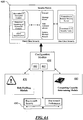
- FIG. 1C illustrates a system architecture that includes security provisions that protect client device 150 from various threats.
- Server 100 controls traffic that travels to network 140 from outside network 110, such as the Internet.
- Client device 150 represents any of a variety of PIDs.
- Client device 150 runs various applications 160.
- Server 100 runs various applications 130, which support or facilitate the operation of client applications 160.
- One example of an application 130 is a Web server application.
- the server has applications for security.
- Management console 120 provides administrator access for controlling server applications 160, and for changing different application settings.
- Management console 120 has its own graphical user interface (GUI), which allows for the administrator of the server to make adjustments to the server applications 160 in real time. With the provision of console 120, the administrator can control both, the applications for security, and other various applications, which operate on the server.
- GUI graphical user interface
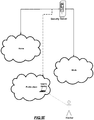
- FIG. 1E is a diagram illustrating a scenario in which the user of the client device cannot be confident in the overall protection of its data. While the user may be confident that the home and work networks have the benefit of a security server, such as a firewall at the host network, a the user cannot have the same confidence in other places, where the user's device can be subjected hacker attacks or unknown programs that might defeat any non-robust local firewall or other security measures on the user's device.
- a security server such as a firewall at the host network
- FIG. 2A is a diagram of a local security module 300 that runs on a portable information device according to one aspect of the invention.
- module means a real-world device or component implemented using hardware, such as by an application specific integrated circuit (ASIC) of field-programmable gate array (FPGA), for example, or as a combination of hardware and software, such as by a microprocessor system and a set of instructions to implement the security module functionality.
- a module can also be implemented as a combination of the two, with certain functions facilitated by hardware, and other functions facilitated by a combination of hardware and software.
- security module 300 can be realized in a variety of configurations, and should not be limited to any particular implementation exemplified herein.
- Security module 300 performs any combination of one or more security-related functions, such as prevention of unwanted content 302, detection/scrubbing of unwanted content 304, and threat neutralization 306. These security-related functions are described below only generally, by way of illustration, and are not intended to be a required or exhaustive list of security functions within the invention as it applies to security module 300. A variety of other security-related functions can be present in addition to, or in place of, any of the functions exemplified herein.
- Prevention of unwanted content 302 includes blocking unwanted content, such as viruses, worms, and other malware, adware, spyware, spam, and the like, as well as undesired data traffic, such as hacker attacks, before any of these threats or programs can be placed on the local device.
- this function involves blocking or diverting of content or data traffic at a firewall.
- Detection/scrubbing of unwanted content 304 would apply to content that may have penetrated the prevention function, and now resides in some form on the local device.
- a typical example of this functionality would include scanning for viruses based on a database of virus definitions, and removing or quarantining those program instructions or associated data.
- Threat neutralization 306 applies to detected unwanted content or detected attacks or threats in progress, and involves taking action to terminate any suspect programs or processes, stop network traffic, and restore the system to a previous known safe state.
- Security module 300 includes a variety of components, such as, for example, firewall 308, message filters 310, anti-malware/adware blocking/removal tool 312, and system backup/restore utility 314. These components can work in different combinations to achieve the various functions of security module 300.
- security module 300 facilitates configurability of its functions. For example, one type of configurability is the ability to selectively turn individual components or functions on or off. Another type of configurability is the ability to dynamically adjust the operation of individual functions or components. For example, operational settings of firewall 308 can be adjusted in one embodiment to set a level of protection to be more or less aggressive, based on the needs of the operator or of the system.
- FIGs. 2C and 2D illustrate another type of configurability of security arrangements according to embodiments of the invention.
- the thin client and thick client configurations shown respectively in FIG. 2C and FIG. 2D can be dynamically configured based on a variety of factors related to the configuration or operating state of PID 10, as will be described in more detail below.
- the dynamic configurability provided by these embodiments enables an adequate level of security to be maintained while permitting better computing performance, or better mobility, or both, of the user's device. Accordingly, the user can remain confident that a suitable security configuration will exist notwithstanding where the user may be connecting to the network. If the user's device is located in a particular local area network known to be secure, the configuration of FIG.
- a hybrid thin client/thick client security arrangement can be configured, in which certain security functions are off-loaded to the server, while other security functions are executed locally on the user's portable information device.
- PID 10 runs a reduced-function firewall that controls network traffic to of outbound data and blocks all unauthorized inbound traffic, but does not take on the burden of scanning authorized inbound traffic for potentially harmful data payloads.
- a security server takes on the computing-intensive remaining firewall functionality of scanning data communications for potential threats, and responding to those threats.
- Configuration can be set locally, such as by a configuring process running on PID 10.
- configuration can be set remotely, such as by a remote security server.
- a security configuration module running locally on PID 10 is tasked with determining when to configure or re-configure the security module, and what operational settings to establish.
- the security configuration module can receive, monitor, or otherwise obtain information about the system configuration, the operating state of PID 10, relevant history of PID 10, global security situational information, user preferences, or any combination of these. In turn, this information would be used in the automatic configuring of the security module.
- System configuration data can include, device type, processor speed, memory size, processor bus speed, battery capacity, a list of installed applications, and a list of frequently-used applications.
- Operating state data can include items such as the physical location of PID 10, network traffic speed, network traffic volume, remaining battery capacity, amount of memory allocated, a list of applications currently running, or processor idling time. Relevant history of PID 10 includes items such as recent history of detected attacks, higher-than-normal frequency of pings or attempted connections from unknown sources, and the like. Such items can be correlated to location information.
- Global security situational information can include items such as a current overall state of threats that exists. For instance, a prevalence of a particular worm, patterns of server outages attributable to denial-of-service attacks, and the like, would tend to increase the overall threat level. This type of information is constantly monitored by security firms, and can be provided to PID 10 during a security update, for example.
- User preferences can include items such as a risk tolerance input provided by a user, or performance requirements.
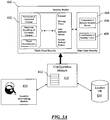
- FIG. 3A illustrates a security arrangement according to one embodiment in which configurable security module 400 existing on PID 10 can be automatically configured based on a present location of PID 10.
- Security module 400 includes a thick client security portion 402, and a thin client security portion 404.
- Thick client security portion 402 is similar to security module 300 described above in that it can include a variety of security functions and components, each of which can be individually configured or adjusted.
- Thin client security portion 404 includes a provision 406 facilitating a connection to a remote security server, which includes a module configured with network addresses of various available security servers that implements logic for connecting to, and utilizing, any one of the remote security servers.
- One type of embodiment utilizes an encrypted tunnel connection such as the one described above with reference to FIG. 2E .
- Thin client security portion 404 also includes a task coordinating provision 408 that facilitates the exchange of information between thick client security portion 402 and the remote security server.
- the role of task coordinating portion 408 also includes ensuring proper overall operation when a hybrid security arrangement is in place in which portions of thick client security portion 402 operate in conjunction with the remote security server via thin client security portion 404.
- location determining module 414 utilizes a network topology analyzer that analyzes data packets in order to deduce the location or network identity of the local network through which PID 10 may be communicating.
- the nature of location information provided by either method is different, so the two methods may be used in conjunction with one another to produce a better estimation of the location or network being used.
- location determining module 414 includes a user interface component that permits a user of the device to enter his or her location. The user interface input may be used in conjunction with either the GPS location or the network topology determination in order to fine-tune the location or network identity. For instance, the user may be presented with two or three possible choices from which to select the network being used, those choices having been automatically generated based on information deduced by the other location determining methods.
- the position of the client device can be ascertained in various ways within the scope of aspects of the invention.
- a number of other techniques for determining the geographic position of a networked device are generally known, and any suitable technique can be utilized.
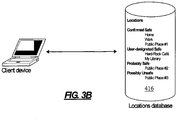
- Security configuration module 410 uses the location identification to ascertain a security risk profile for the present location. Based on the security risk profile, configuration module 410 uses decision criteria 412 to set a suitable configuration for security module 400. Security configuration module accesses location profile database 416 to look up the present location from among a list of local networks at different geographic locations.
- Places stored in the database can be categorized as shown in the embodiment of FIG. 3B : confirmed safe; user-designated safe; probably safe; and possibly unsafe.
- combinations of different techniques for determining location of PID 10 may be utilized to confirm a "safe" status and counter attempts at location spoofing and the like.
- Various other categorizations or designations of safety level may be utilized.
- Security configuration module 450 includes configuration determining module 460 and configuration setting module 465.
- Configuration determining module 460 includes decision criteria that read and process input from at least one of risk profiling module 470, computing capacity determining module 480, and user input module 490, to determine which configuration or operational settings are suitable to be set for security module 400.
- Configuration setting module 465 sets the determined configuration or operational settings in security module 400.
- configuration determining module 460 and configuration setting module 465 of security configuration module 450 configure the operational settings of security module 400 with a goal of reducing computational load on the computer circuitry presented by operation of configurable security module 400, while maintaining a level of security to protect against present security risks, as determined by the security configuration module based on the input from risk profiling module 470.
- configuration determining module 460 maintains a hierarchy of security-related functionality available in security module 400.
- the hierarchy of security-related functionality is ordered according to a current set of security risks, as determined by risk profiling module 470.
- the hierarchical arrangement is dynamic; whereas in more basic embodiments, static hierarchical arrangements of security-related functionality can be used.
- the hierarchy is ordered in terms of essentiality of functionality needed to protect against the current set of security risks. For example, for PID 10 running a web browser program but not an email client program, firewall and anti-malware/adware functions are more essential to maintaining protection from likely security threats than, for example, message filtering functions.
- essentiality of functionality is ranked in terms of finer granularity, where operational settings for each class of security-related functionality can be varied.
- the anti-malware/adware function can be tuned to protect against particular threats associated with applications that are currently being executed in PID 10, to the exclusion of providing a broader spectrum of protection against all known threats.
- configuration determining module 460 derives or selects the hierarchical order of security-related functionality in response to the current set of security risks from risk profiling module 470, and further selects, from among the hierarchy, a subset of more essential functionality based on the current computing capacity, as determined by computing capacity module 480.
- more security functionality is generally provided; however, under conditions of reduced computing capacity, security is limited to only essential features.
- configuration setting module 465 setting the configuration of operational settings for security module 400, such that a computational load on the computer circuitry attributable to operation of security module 400 is reduced while the subset of more essential security-related functionality is provided, thereby facilitating usability of PID 10 while providing security protection for PID 10 corresponding to the current set of security risks.
- configuration setting module 465 progressively disables security-related functionality in order of less essential functionality to more essential functionality to preserve computing capacity for non-security functions of PID 10.
- Risk profiling module 470 obtains information from which it ascertains a present risk profile.
- FIG. 4B illustrates an example in which risk profiling module 470 interfaces with several different sources of risk-related information.
- risk profiling module 470 communicates with location determining module 414 and location database 416 (both of which have been described above) to obtain information about the present location and determine the corresponding level of security associated with the present location.
- Risk profiling module 470 in this example also interfaces with security server connection module 500, which enables risk profiling module 470 to obtain security-related information over the network. Examples of such information include information about the general threat level and, when used in conjunction with location determining module 414, the threat level specific to the present location.
- Risk profiling module 470 assesses, and re-assesses a current set of security risks to which PID 10 is exposed.
- risk profiling module 470 performs re-assessment periodically, such as on a certain predetermined time interval.
- the re-assessment is performed in response to occurrence of certain events relevant to risk profiling, such as upon the opening of a new application instance, for example.
- re-assessment is performed both, periodically, and in response to events.
- certain indicia of risk are re-assessed periodically, such as a present threat level indication, which does not tend to change frequently; while other indicia of security risk, such as network traffic volume, for instance, tends to change abruptly based on changes in operating modes or applications running on PID 10.
- Application analysis module 510 examines the registry of the operating system of PID 10 to determine which applications are installed on the device. From this information, risk profiling module 470, in conjunction with application analysis module 510, can determine specific vulnerabilities of PID 10. An application such as a Web browser would have a different vulnerability profile than an email application, or a spreadsheet, for example. In a related embodiment, application analysis module 510 examines applications that are presently active, which is a narrower subset than all of the installed applications. Accordingly, in one embodiment, the risk profile indication can vary as a function of time, depending on which applications are in use at the present instant.
- Security history module 520 provides information about recent security-related occurrences that may deflect a present threat level. For example, if the firewall has been detecting a higher-than-normal frequency of attempts to access PID 10 by unknown devices, this may be an indicator of an increased risk of intrusion. Event history can also be associated with location information, such that different locations may have different relevant histories. Accordingly, if the user carries PID 10 to a new location, the relevant history for that location would be examined.
- computing capacity determining module 480 provides information about the system performance of PID 10 for use by security configuration module 450. This type of information enables security configuration module 450 to select an appropriate configuration for configurable security module 400 so that system performance is not unduly burdened by operation of the security system. In one type of embodiment, computing capacity information provided by computing capacity determining module 480 is considered in conjunction with the risk profile information by security configuration module 450 to achieve a proper balance between performance needs and security needs for PID 10.
- Computing capacity determining module 480 assesses, and re-assesses a current state of computing capacity availability of PID 10. In one arrangement, computing capacity determining module 480 performs re-assessment periodically, such as on a certain predetermined time interval. In another arrangement, the re-assessment is performed in response to occurrence of certain events relevant to computing capacity, such as upon the opening of a new application instance, for example. In a related embodiment, re-assessment is performed both, periodically, and in response to events.
- certain indicia of computing capacity are re-assessed periodically, such as battery capacity, which does not tend to change abruptly; while other indicia of computing capacity, such as available memory, for instance, tends to change abruptly based on changes in operating modes or applications running on PID 10.
- FIG. 4C illustrates several examples of the types of inputs received by computing capacity determining module 480 in one example embodiment.
- Input 540 is an indicator of the type of device that is PID 10.
- Computing capacity determining module 480 can also access device information database 545, which may reside locally or remotely from PID 10, and which contains performance measures of classifications of various types of devices. Since the device type can be a static item of information in many cases, this information may be determined during installation of the security arrangement onto PID 10.
- FIG. 4D is a table illustrating an example set of data contained in device information database 545. The display size, processor type, data store type and size, battery capacity, and communications provisions facilitate estimation of each device's performance characteristics, including the rate of battery drain. Another example of data in device information database is information that is produced by the Systeminfo utility for Windows XP by Microsoft Corporation.
- FIG. 4E is another embodiment of a set of data contained in device information database 545, in which a predetermined performance score or rating is given to each type of device. Based on the performance rating, a particular configuration type may be determined, as illustrated in FIG. 4F .
- the configuration types shown in FIG. 4F can be established during installation of the security arrangement, during an update of the installation, or dynamically, according to various embodiments.
- a dynamically-configurable embodiment may be suitable in cases where upgradeability or expansion is possible, such as in devices facilitation expansion memory card slots (micro SD, for instance), or for devices for which higher-capacity batteries can be installed by the user.
- processor monitor 550 provides indicia of the load on the processor of PID 10, and provides a corresponding input to security configuration module 450.
- processor monitor 550 measures the ratio of time in which the processor is in an idling state.
- some processors utilize a reduced clock speed mode such as the Speedstep ® feature by Intel Corporation or the Cool 'n Quiet TM feature by AMD Inc. during their idling state. Operation in these modes can be monitored and utilized in embodiments of the invention as a measure of processor load.
- Processor load is one type of indicator of the intensity of use that PID 10 is experiencing.
- memory monitor 560 monitors memory allocation, which is another measure of system load and capacity for running security module 400, and provides a corresponding input to security configuration module 450.
- configuration module may temporarily configure security module 400 with a reduced functionality (if doing so is not inconsistent with the security needs in view of the current risk profile and user-specified tolerances).
- Network traffic volume monitor 570 provides an input to security configuration module 450 indicating the present status of network traffic into, and out of, PID 10. Incoming and outgoing network traffic are informative as to the nature of the current use of PID 10. As a direct measure, the network traffic volume indicates available communications bandwidth that may be needed for certain types of configurations of security module 400. As an indirect measure, the network traffic volume, and the predominant direction of data flow, and the ratio of incoming to outgoing data volumes, collectively, are indicative of the user's intensity of use and corresponding needs for device performance. Security configuration module 450, in one embodiment, considers the input from network traffic volume monitor 570 as part of determining whether to configure security module 400 to operate in thin or thick client modes, the former requiring more communication bandwidth than the latter.
- Battery capacity indication 580 provides battery status information to security configuration module 450.
- Battery status is informative of computing capacity limitations because, even though the processor, memory and communications bandwidth may be sufficient to support a robust security configuration, the computing load of the security module in that configuration would be more power-intensive. A situation in which there are limited energy reserves in PID 10 may dictate configuring security module 400 in a reduced load operating mode.
- security configuration module 450 can further receive an input from user input module 490, which enables the user of PID 10 to provide his or her preferences to be taken into consideration in configuring security module 400.
- user input module 490 provides, via the user interface, a slider or other intuitive control operable by the user, with which the user can select a bias towards security, or a bias towards performance. For instance, in a situation where a user needs to browse the Web with particular urgency at a given moment, or run a graphics-intensive application smoothly, the user can set the slider control with a bias towards performance.
- user input module 490 provides a user control to facilitate selectively shutting down other background programs in addition to the security components that may be shut down to favor performance. In another situation, where the user intends to access personal or financial information, the user could set the slider control indicating a bias towards security.
- security configuration module can be programmed with any suitable decision logic for determining configuration settings for security module 400 based on the variety of inputs that it receives.
- the decision logic may be selected or formulaically derived based on the device type. For example, a smartphone device with fewer computing resources and less communication bandwidth could have a decision profile that favors more aggressive responsiveness biased toward preserving performance, than a netbook-type device that has a more capable processor and more memory.
- Device A may preferentially migrate from a thick client configuration to a thin client configuration, as an initial response to the situation; whereas Device B may preferentially reduce functionality of security module 400 while security module 400 remains in a thick client mode.
- security configuration module 450 is programmed to balance the needs of preserving performance PID 10 while providing an adequate level of protection from security risks by computing a performance-risk vector from multi-variable inputs representing the security risk profile, as well as the computing capacity, and user input settings.
- Each variable of the multi-variable inputs can have a different weight assigned to it such that the corresponding input is given greater emphasis in the formula.
- some of the variables are weighted in the following order (from greatest to least weight):
- FIG. 5 illustrates a decision process for determining the type of security threats database update that is to be performed according to one embodiment.
- application analysis module 510 detects the installed applications present on PID 10. Based on this list, at 610, application analysis module 510 selects from among three update options: option 620 would configure the threats database with updated threat descriptions for only the installed applications.
- option 630 would configure the database to include descriptions of threats associated with the installed applications, plus additional threats that are associated with application programs having similar characteristics. For instance, in the case of Mozilla Firefox being an installed application, Option 630 would update the threat descriptions database with threats associated with Web browser programs in general.
- Option 640 would achieve a full configuration with all known threat definitions, as in a conventional security arrangement that does not include provisions for reducing its overall functionality.
- selection from among the three options is based on the computing capacity as determined by computing capacity determining module 480, based on processor and memory capability and, optionally, as well as on current load conditions.
- the present battery life can be a factor in what type of updating is performed.
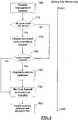
- FIG. 6 is a flow diagram illustrating a simple example of how various security configurations can be selected as a function of battery life remaining. As the remaining battery life decreases from high to low with use of PID 10, the illustrated process is followed in sequence. In general, non-essential security functions are disabled first, and more essential security functions are disabled last. In the example of FIG. 6 , a management console of the security system running on PID 10 is disabled first at 700. Since the management console is simply a user interface and does not itself perform security functions, it constitutes a load on system resources that is simply overhead.
- the system determines whether there is any active communications with a remote security server. If there are active communications, that indicates the security module is operating in a configuration that relies on security server to some extent. In this case, disabling the encrypted communications channel that facilitates the connection to the server at 720 is skipped. If, on the other hand, the security module is not actively communicating with the security server, then the encryption modules can be disabled at 720.
- the system checks whether or not the location determining function is operational. If it is operational (i.e. not disabled), the related functionality of management of the locations database is left operational to support the location-based configurability functionality. If the location determining function is unused, the location database and any other related functionality is disabled at 740.
- the firewall and antivirus functions are progressively minimized.
- progressive minimization is described above with reference to FIG. 5 , where the threat descriptions database is reduced to spend fewer system resources on addressing security risks that are less likely. Focusing on only those risks that are most pertinent to the present types of applications, or on only those particular applications installed on PID 10, provides a more efficient utilization of system resources spent on security.
- the location determining and responding functions, and the communications functions are disabled at 760 to preserve system resources for only the most essential firewall and malware functions.
- a judgment would need to be exercised as to whether to disable security functions altogether so as to preserve system resources for only the applications being run, or whether the risk of operating the applications on PID 10 without any security is unacceptable.
- the device when the battery reaches a critically low level, say, 10%, for example, the device prompts the user to authorize unsecured operation.
- user notifications are given at different stages of security system disablement, thereby giving the user the ability to adjust the behavior of resource management of PID 10.
Landscapes
- Engineering & Computer Science (AREA)
- Computer Security & Cryptography (AREA)
- Computer Hardware Design (AREA)
- General Engineering & Computer Science (AREA)
- Signal Processing (AREA)
- Computer Networks & Wireless Communication (AREA)
- Computing Systems (AREA)
- Software Systems (AREA)
- Theoretical Computer Science (AREA)
- Physics & Mathematics (AREA)
- General Physics & Mathematics (AREA)
- Business, Economics & Management (AREA)
- General Business, Economics & Management (AREA)
- Computer And Data Communications (AREA)
Claims (20)
- Un dispositif informatique portable (10) comportant un dispositif de sécurité configurable de façon dynamique, le dispositif comprenant :un circuit d'ordinateur, comprenant un processeur (20) couplé de manière opérationnelle à un magasin de données ;une interface utilisateur, y compris des périphériques d'affichage (14) et d'entrée par l'utilisateur ;un circuit de communication sans fil (24) ; etune alimentation en énergie (28) configurée pour fournir de l'énergie au circuit d'ordinateur, à l'interface utilisateur et au circuit de communication sans fil, l'alimentation en énergie comprenant une source d'énergie embarquée (30) ;dans lequel le circuit informatique comprend un dispositif de sécurité comprenant :un module de sécurité configurable (400) qui effectue de manière sélective les services de sécurité dans le dispositif informatique portable (10) ;un module de détermination de localisation (414) configuré afin de déterminer et fournir une indication d'un emplacement actuel du dispositif informatique portable (10) ;une base de données de profil de localisation (416) contenant des informations de profil de risque de sécurité pour une pluralité de réseaux locaux à une pluralité d'emplacements géographiques ;et un module de configuration de sécurité (410) disposé pour utiliser l'indication de l'emplacement actuel pour évaluer un risque de sécurité actuel auquel le dispositif informatique portable (10) est exposé en fonction des informations de profil de risque contenues dans la base de données de profil localisation (416) correspondant à l'emplacement actuel, et disposé de façon dynamique afin de configurer le module de sécurité (400) pour s'assurer que certains des services de sécurité soient effectués sélectivement soit par un serveur de sécurité (352) qui se trouve à distance du dispositif informatique portable (10); soit par le module de sécurité (400).
- Un dispositif informatique portable (10) conforme à la revendication 1, dans lequel le module de configuration de sécurité (410) est adapté afin de configurer de façon dynamique le module de sécurité (400) pour fonctionner dans soit:une configuration de client légère dans laquelle une majorité des services de sécurité sont fournis par un serveur de sécurité (352) situé à distance du dispositif informatique portable (10) ; soitune configuration de client épaisse dans laquelle une majorité des services de sécurité sont fournis par le module de sécurité configurable (400).
- Un dispositif informatique portable (10) conforme à la revendication 2, dans lequel le module de configuration de sécurité (410) est agencé afin de configurer le module de sécurité (400) pour fonctionner dans la configuration de client légère en réponse à une évaluation, par le module de configuration de sécurité (410), du risque actuel associé à l'emplacement actuel étant un risque de sécurité relativement élevé; et
dans lequel le module de configuration de sécurité (410) est agencé afin de configurer le module de sécurité (400) pour fonctionner dans la configuration de client épaisse en réponse à une évaluation, par le module de configuration de sécurité (410), du risque actuel associé à l'emplacement actuel étant un risque de sécurité relativement faible. - Un dispositif informatique portable (10) conforme à l'une quelconque des revendications précédentes, dans lequel le module de configuration de sécurité (410) est adapté afin de configurer de façon dynamique le module de sécurité (400) pour fonctionner dans une configuration hybride dans laquelle certains services de sécurité sont fournis sélectivement par le serveur de sécurité (352) situé à distance du dispositif informatique portable (10) et d'autres services de sécurité sont fournis par le module de sécurité (400) du dispositif informatique portable (10).
- Un dispositif informatique portable (10) conforme à l'une quelconque des revendications précédentes, dans lequel le module de détermination de localisation (414) comprend au moins l'un de :un récepteur de système de positionnement global ; etun analyseur de topologie de réseau.
- Un dispositif informatique portable (10) conforme à l'une quelconque des revendications précédentes, comprenant en outre :un module de détermination de capacité de calcul (480) qui réévalue un état actuel de la disponibilité de la capacité de calcul du dispositif informatique portable (10) ; etdans lequel le module de configuration de sécurité (450) configure de manière dynamique le module de sécurité (400) en réponse à l'état actuel de la disponibilité de la capacité de calcul à partir du module de détermination de la capacité de calcul (480).
- Un dispositif d'information portable (10) conforme à l'une quelconque des revendications précédentes, dans lequel le module de sécurité configurable (400) stocke une pluralité de définitions de menaces et analyse au moins l'un du magasin de données et du trafic de réseau à l'égard de toute présence de menaces de sécurité en fonction de la pluralité de définitions de menaces.
- Un dispositif d'information portable (10) conforme à l'une quelconque des revendications précédentes, dans lequel le module de sécurité configurable (400) est configuré afin de fournir un canal de communication sécurisé entre le dispositif informatique portable (10) et le serveur de sécurité (352).
- Un dispositif informatique portable (10) conforme à l'une quelconque des revendications précédentes, dans lequel le module de configuration de sécurité (410) est agencé afin de configurer de façon dynamique le module de sécurité (400) en fonction de la bande passante disponible des communications du réseau du dispositif informatique portable (10).
- Un dispositif d'information portable (10) conforme à l'une quelconque des revendications précédentes, dans lequel le module de configuration de sécurité (450) est agencé afin de configurer de façon dynamique le module de sécurité (400) en fonction de la capacité de calcul disponible dans le dispositif informatique portable (10).
- Dispositif d'information portable (10) conforme à l'une quelconque des revendications précédentes, comprenant en outre :un module de préférences d'utilisateur configuré pour obtenir au moins un paramètre de l'utilisateur choisi dans le groupe consistant en : informations de tolérance au risque de sécurité, exigences d'expérience de l'utilisateur ou toute combinaison de celles-ci ;dans lequel le module de configuration de sécurité (450) est configuré afin de configurer de façon dynamique le module de sécurité (400) en fonction de ce au moins un paramètre.
- Un procédé pour configurer automatiquement un module de sécurité (400) sur un dispositif informatique portable (10), le procédé comprenant :la détermination automatique, par le dispositif informatique portable (10), d'un emplacement actuel du dispositif informatique portable (10) ;le maintien automatiquement, par le dispositif informatique portable (10), d'une base de données de profil de localisation (416) contenant des informations de profil de risque de sécurité pour une pluralité de réseaux locaux à une pluralité d'emplacements géographiques ;la réévaluation automatique, par le dispositif informatique portable (10), d'un risque de sécurité actuel auquel le dispositif informatique portable est exposé en fonction des informations de profil de risque contenues dans la base de données de profil de localisation (416) correspondant à l'emplacement actuel ;et la reconfiguration automatique du module de sécurité (400) en fonction du risque de sécurité actuel, de telle sorte que le module de sécurité (400) effectue de manière sélective des services de sécurité soit par un serveur de sécurité (352) qui est situé à distance du dispositif informatique portable (10) ; soit par le module de sécurité (400).
- Un procédé conforme à la revendication 12, comprenant en outre la configuration dynamique du module de sécurité (400) pour fonctionner dans soit:une configuration de client légère dans laquelle une majorité des services de sécurité sont fournis par le serveur de sécurité (352) situé à distance à partir du dispositif informatique portable (10) ; soitune configuration de client épaisse dans laquelle une majorité des services de sécurité sont fournis par le module de sécurité configurable (410).
- Un procédé conforme à la revendication 13, dans lequel le module de sécurité (400) est configuré afin de fonctionner dans la configuration du client légère en réponse à une évaluation du risque actuel associé à l'emplacement actuel étant un risque de sécurité relativement élevé ; et
dans lequel le module de sécurité (400) est configuré afin de fonctionner dans la configuration du client épaisse en réponse à une évaluation du risque actuel associé à l'emplacement actuel étant un risque de sécurité relativement faible. - Un procédé conforme à la revendication 12, 13 ou 14, dans lequel la reconfiguration automatique du module de sécurité (400) comprend la configuration du module de sécurité (400) afin de fonctionner dans une configuration hybride dans laquelle certains services de sécurité sont fournis sélectivement par le serveur de sécurité (352) situé à distance à partir du dispositif informatique portable (10), et d'autres services de sécurité sont fournis par le module de sécurité (400) du dispositif informatique portable (10).
- Un procédé conforme à l'une quelconque des revendications 12 à 15, comprenant en outre :la réévaluation d'un état actuel de la disponibilité de capacité de calcul du dispositif informatique portable (10) ; etla reconfiguration du module de sécurité (400) en réponse à l'état actuel de la disponibilité de la capacité de calcul.
- Un procédé conforme à l'une quelconque des revendications 12 à 16, comprenant en outre :le stockage d'une pluralité de définitions de menace et le balayage des données stockées dans, ou en communication avec, le dispositif informatique portable (10) à l'égard de toute présence de menaces de sécurité en fonction de la pluralité de définitions de menaces.
- Un procédé conforme à l'une quelconque des revendications 12 à 17, dans lequel la reconfiguration automatique du module de sécurité (400) comprend la configuration du module de sécurité (400) sur la base de la bande passante disponible des communications du réseau du dispositif informatique portable (10).
- Un procédé conforme à l'une quelconque des revendications 12 à 18, dans lequel la reconfiguration automatique du module de sécurité (400) comprend la configuration du module de sécurité (400) en fonction de la capacité de calcul disponible du dispositif informatique portable (10).
- Un procédé conforme à l'une quelconque des revendications 12 à 19, comprenant en outre :l'obtention d'au moins un paramètre de l'utilisateur choisi dans le groupe consistant en : informations de tolérance au risque de sécurité, exigences d'expérience de l'utilisateur ou toute combinaison de celles-ci ; etla configuration du module de sécurité (400) en fonction de cet au moins un paramètre.
Applications Claiming Priority (2)
| Application Number | Priority Date | Filing Date | Title |
|---|---|---|---|
| US11923708P | 2008-12-02 | 2008-12-02 | |
| US14209208P | 2008-12-31 | 2008-12-31 |
Publications (2)
| Publication Number | Publication Date |
|---|---|
| EP2207323A1 EP2207323A1 (fr) | 2010-07-14 |
| EP2207323B1 true EP2207323B1 (fr) | 2017-08-02 |
Family
ID=42153707
Family Applications (1)
| Application Number | Title | Priority Date | Filing Date |
|---|---|---|---|
| EP09151535.3A Active EP2207323B1 (fr) | 2008-12-02 | 2009-01-28 | Sécurité adaptative de dispositifs d'information portables |
Country Status (1)
| Country | Link |
|---|---|
| EP (1) | EP2207323B1 (fr) |
Families Citing this family (2)
| Publication number | Priority date | Publication date | Assignee | Title |
|---|---|---|---|---|
| RU2453917C1 (ru) * | 2010-12-30 | 2012-06-20 | Закрытое акционерное общество "Лаборатория Касперского" | Система и способ для оптимизации выполнения антивирусных задач в локальной сети |
| US9330262B2 (en) | 2012-09-21 | 2016-05-03 | University Of Limerick | Systems and methods for runtime adaptive security to protect variable assets |
Family Cites Families (3)
| Publication number | Priority date | Publication date | Assignee | Title |
|---|---|---|---|---|
| WO2003081932A1 (fr) * | 2002-03-27 | 2003-10-02 | Nokia Corporation | Dispositif, systeme et procede de telecommunications mobiles a plusieurs niveaux de securite |
| US7526800B2 (en) | 2003-02-28 | 2009-04-28 | Novell, Inc. | Administration of protection of data accessible by a mobile device |
| US7908660B2 (en) * | 2007-02-06 | 2011-03-15 | Microsoft Corporation | Dynamic risk management |
-
2009
- 2009-01-28 EP EP09151535.3A patent/EP2207323B1/fr active Active
Non-Patent Citations (1)
| Title |
|---|
| None * |
Also Published As
| Publication number | Publication date |
|---|---|
| EP2207323A1 (fr) | 2010-07-14 |
Similar Documents
| Publication | Publication Date | Title |
|---|---|---|
| US7607174B1 (en) | Adaptive security for portable information devices | |
| US7584508B1 (en) | Adaptive security for information devices | |
| US9552478B2 (en) | Team security for portable information devices | |
| US10979391B2 (en) | Cyber threat attenuation using multi-source threat data analysis | |
| US10863358B2 (en) | Threat index based WLAN security and quality of service | |
| EP2599026B1 (fr) | Système et procédé de protection locale contre logiciel malveillant | |
| US7308703B2 (en) | Protection of data accessible by a mobile device | |
| US7827607B2 (en) | Enhanced client compliancy using database of security sensor data | |
| EP1677484B1 (fr) | Méthode et système pour distribuer des politiques de sécurité | |
| US7478420B2 (en) | Administration of protection of data accessible by a mobile device | |
| WO2004057834A2 (fr) | Administration de la protection de donnees accessibles a un dispositif mobile | |
| WO2018206965A1 (fr) | Détection d'attaques de sécurité iot à l'aide de caractéristiques de couche de communication physique | |
| EP2207322B1 (fr) | Sécurité adaptative pour dispositifs d'information | |
| JP4684802B2 (ja) | セキュリティの脅威に起因してネットワークの通信が制限されている間に仮想ネットワーク内のネットワークデバイスが通信することを可能にすること | |
| EP1917757A2 (fr) | Procedes et systemes permettant de controler intelligemment l'acces a des ressources informatiques | |
| RU101231U1 (ru) | Система управления безопасностью мобильного вычислительного устройства | |
| RU108896U1 (ru) | Система для обеспечения общей безопасности мобильных устройств | |
| EP2207323A1 (fr) | Sécurité adaptative de dispositifs d'information portables | |
| Antrosiom et al. | Malware defense using network security authentication | |
| Buennemeyer et al. | Battery-sensing intrusion protection system | |
| HK1143474B (en) | An information device having a dynamically configurable security protection and a method for automatically configuring an information device | |
| HK1143474A1 (en) | An information device having a dynamically configurable security protection and a method for automatically configuring an information device | |
| CN101820438B (zh) | 一种局域网中的计算机启动方法和一种局域网 | |
| KR101007357B1 (ko) | 모바일 통신 단말을 위한 보안 서비스 재구성 방법 및 그 장치 |
Legal Events
| Date | Code | Title | Description |
|---|---|---|---|
| PUAI | Public reference made under article 153(3) epc to a published international application that has entered the european phase |
Free format text: ORIGINAL CODE: 0009012 |
|
| AK | Designated contracting states |
Kind code of ref document: A1 Designated state(s): AT BE BG CH CY CZ DE DK EE ES FI FR GB GR HR HU IE IS IT LI LT LU LV MC MK MT NL NO PL PT RO SE SI SK TR |
|
| AX | Request for extension of the european patent |
Extension state: AL BA RS |
|
| 17P | Request for examination filed |
Effective date: 20110111 |
|
| AKX | Designation fees paid |
Designated state(s): AT BE BG CH CY CZ DE DK EE ES FI FR GB GR HR HU IE IS IT LI LT LU LV MC MK MT NL NO PL PT RO SE SI SK TR |
|
| RAP1 | Party data changed (applicant data changed or rights of an application transferred) |
Owner name: AO KASPERSKY LAB |
|
| GRAP | Despatch of communication of intention to grant a patent |
Free format text: ORIGINAL CODE: EPIDOSNIGR1 |
|
| RIC1 | Information provided on ipc code assigned before grant |
Ipc: G06F 21/50 20130101ALI20170120BHEP Ipc: H04W 12/12 20090101ALI20170120BHEP Ipc: H04L 29/06 20060101AFI20170120BHEP Ipc: G06F 21/57 20130101ALI20170120BHEP |
|
| INTG | Intention to grant announced |
Effective date: 20170210 |
|
| GRAS | Grant fee paid |
Free format text: ORIGINAL CODE: EPIDOSNIGR3 |
|
| GRAA | (expected) grant |
Free format text: ORIGINAL CODE: 0009210 |
|
| AK | Designated contracting states |
Kind code of ref document: B1 Designated state(s): AT BE BG CH CY CZ DE DK EE ES FI FR GB GR HR HU IE IS IT LI LT LU LV MC MK MT NL NO PL PT RO SE SI SK TR |
|
| REG | Reference to a national code |
Ref country code: GB Ref legal event code: FG4D |
|
| REG | Reference to a national code |
Ref country code: CH Ref legal event code: EP Ref country code: AT Ref legal event code: REF Ref document number: 915587 Country of ref document: AT Kind code of ref document: T Effective date: 20170815 |
|
| REG | Reference to a national code |
Ref country code: IE Ref legal event code: FG4D |
|
| REG | Reference to a national code |
Ref country code: DE Ref legal event code: R096 Ref document number: 602009047447 Country of ref document: DE |
|
| REG | Reference to a national code |
Ref country code: NL Ref legal event code: MP Effective date: 20170802 |
|
| REG | Reference to a national code |
Ref country code: FR Ref legal event code: PLFP Year of fee payment: 10 |
|
| REG | Reference to a national code |
Ref country code: AT Ref legal event code: MK05 Ref document number: 915587 Country of ref document: AT Kind code of ref document: T Effective date: 20170802 |
|
| REG | Reference to a national code |
Ref country code: LT Ref legal event code: MG4D |
|
| PG25 | Lapsed in a contracting state [announced via postgrant information from national office to epo] |
Ref country code: SE Free format text: LAPSE BECAUSE OF FAILURE TO SUBMIT A TRANSLATION OF THE DESCRIPTION OR TO PAY THE FEE WITHIN THE PRESCRIBED TIME-LIMIT Effective date: 20170802 Ref country code: NO Free format text: LAPSE BECAUSE OF FAILURE TO SUBMIT A TRANSLATION OF THE DESCRIPTION OR TO PAY THE FEE WITHIN THE PRESCRIBED TIME-LIMIT Effective date: 20171102 Ref country code: AT Free format text: LAPSE BECAUSE OF FAILURE TO SUBMIT A TRANSLATION OF THE DESCRIPTION OR TO PAY THE FEE WITHIN THE PRESCRIBED TIME-LIMIT Effective date: 20170802 Ref country code: NL Free format text: LAPSE BECAUSE OF FAILURE TO SUBMIT A TRANSLATION OF THE DESCRIPTION OR TO PAY THE FEE WITHIN THE PRESCRIBED TIME-LIMIT Effective date: 20170802 Ref country code: FI Free format text: LAPSE BECAUSE OF FAILURE TO SUBMIT A TRANSLATION OF THE DESCRIPTION OR TO PAY THE FEE WITHIN THE PRESCRIBED TIME-LIMIT Effective date: 20170802 Ref country code: LT Free format text: LAPSE BECAUSE OF FAILURE TO SUBMIT A TRANSLATION OF THE DESCRIPTION OR TO PAY THE FEE WITHIN THE PRESCRIBED TIME-LIMIT Effective date: 20170802 Ref country code: HR Free format text: LAPSE BECAUSE OF FAILURE TO SUBMIT A TRANSLATION OF THE DESCRIPTION OR TO PAY THE FEE WITHIN THE PRESCRIBED TIME-LIMIT Effective date: 20170802 |
|
| PG25 | Lapsed in a contracting state [announced via postgrant information from national office to epo] |
Ref country code: LV Free format text: LAPSE BECAUSE OF FAILURE TO SUBMIT A TRANSLATION OF THE DESCRIPTION OR TO PAY THE FEE WITHIN THE PRESCRIBED TIME-LIMIT Effective date: 20170802 Ref country code: PL Free format text: LAPSE BECAUSE OF FAILURE TO SUBMIT A TRANSLATION OF THE DESCRIPTION OR TO PAY THE FEE WITHIN THE PRESCRIBED TIME-LIMIT Effective date: 20170802 Ref country code: GR Free format text: LAPSE BECAUSE OF FAILURE TO SUBMIT A TRANSLATION OF THE DESCRIPTION OR TO PAY THE FEE WITHIN THE PRESCRIBED TIME-LIMIT Effective date: 20171103 Ref country code: BG Free format text: LAPSE BECAUSE OF FAILURE TO SUBMIT A TRANSLATION OF THE DESCRIPTION OR TO PAY THE FEE WITHIN THE PRESCRIBED TIME-LIMIT Effective date: 20171102 Ref country code: IS Free format text: LAPSE BECAUSE OF FAILURE TO SUBMIT A TRANSLATION OF THE DESCRIPTION OR TO PAY THE FEE WITHIN THE PRESCRIBED TIME-LIMIT Effective date: 20171202 Ref country code: ES Free format text: LAPSE BECAUSE OF FAILURE TO SUBMIT A TRANSLATION OF THE DESCRIPTION OR TO PAY THE FEE WITHIN THE PRESCRIBED TIME-LIMIT Effective date: 20170802 |
|
| PG25 | Lapsed in a contracting state [announced via postgrant information from national office to epo] |
Ref country code: RO Free format text: LAPSE BECAUSE OF FAILURE TO SUBMIT A TRANSLATION OF THE DESCRIPTION OR TO PAY THE FEE WITHIN THE PRESCRIBED TIME-LIMIT Effective date: 20170802 Ref country code: DK Free format text: LAPSE BECAUSE OF FAILURE TO SUBMIT A TRANSLATION OF THE DESCRIPTION OR TO PAY THE FEE WITHIN THE PRESCRIBED TIME-LIMIT Effective date: 20170802 Ref country code: CZ Free format text: LAPSE BECAUSE OF FAILURE TO SUBMIT A TRANSLATION OF THE DESCRIPTION OR TO PAY THE FEE WITHIN THE PRESCRIBED TIME-LIMIT Effective date: 20170802 |
|
| REG | Reference to a national code |
Ref country code: DE Ref legal event code: R097 Ref document number: 602009047447 Country of ref document: DE |
|
| PG25 | Lapsed in a contracting state [announced via postgrant information from national office to epo] |
Ref country code: EE Free format text: LAPSE BECAUSE OF FAILURE TO SUBMIT A TRANSLATION OF THE DESCRIPTION OR TO PAY THE FEE WITHIN THE PRESCRIBED TIME-LIMIT Effective date: 20170802 Ref country code: IT Free format text: LAPSE BECAUSE OF FAILURE TO SUBMIT A TRANSLATION OF THE DESCRIPTION OR TO PAY THE FEE WITHIN THE PRESCRIBED TIME-LIMIT Effective date: 20170802 Ref country code: SK Free format text: LAPSE BECAUSE OF FAILURE TO SUBMIT A TRANSLATION OF THE DESCRIPTION OR TO PAY THE FEE WITHIN THE PRESCRIBED TIME-LIMIT Effective date: 20170802 |
|
| PLBE | No opposition filed within time limit |
Free format text: ORIGINAL CODE: 0009261 |
|
| STAA | Information on the status of an ep patent application or granted ep patent |
Free format text: STATUS: NO OPPOSITION FILED WITHIN TIME LIMIT |
|
| 26N | No opposition filed |
Effective date: 20180503 |
|
| PG25 | Lapsed in a contracting state [announced via postgrant information from national office to epo] |
Ref country code: SI Free format text: LAPSE BECAUSE OF FAILURE TO SUBMIT A TRANSLATION OF THE DESCRIPTION OR TO PAY THE FEE WITHIN THE PRESCRIBED TIME-LIMIT Effective date: 20170802 |
|
| REG | Reference to a national code |
Ref country code: CH Ref legal event code: PL |
|
| PG25 | Lapsed in a contracting state [announced via postgrant information from national office to epo] |
Ref country code: LU Free format text: LAPSE BECAUSE OF NON-PAYMENT OF DUE FEES Effective date: 20180128 |
|
| REG | Reference to a national code |
Ref country code: IE Ref legal event code: MM4A |
|
| REG | Reference to a national code |
Ref country code: BE Ref legal event code: MM Effective date: 20180131 |
|
| PG25 | Lapsed in a contracting state [announced via postgrant information from national office to epo] |
Ref country code: BE Free format text: LAPSE BECAUSE OF NON-PAYMENT OF DUE FEES Effective date: 20180131 Ref country code: CH Free format text: LAPSE BECAUSE OF NON-PAYMENT OF DUE FEES Effective date: 20180131 Ref country code: LI Free format text: LAPSE BECAUSE OF NON-PAYMENT OF DUE FEES Effective date: 20180131 |
|
| PG25 | Lapsed in a contracting state [announced via postgrant information from national office to epo] |
Ref country code: IE Free format text: LAPSE BECAUSE OF NON-PAYMENT OF DUE FEES Effective date: 20180128 |
|
| PG25 | Lapsed in a contracting state [announced via postgrant information from national office to epo] |
Ref country code: MC Free format text: LAPSE BECAUSE OF FAILURE TO SUBMIT A TRANSLATION OF THE DESCRIPTION OR TO PAY THE FEE WITHIN THE PRESCRIBED TIME-LIMIT Effective date: 20170802 |
|
| PG25 | Lapsed in a contracting state [announced via postgrant information from national office to epo] |
Ref country code: MT Free format text: LAPSE BECAUSE OF NON-PAYMENT OF DUE FEES Effective date: 20180128 |
|
| PG25 | Lapsed in a contracting state [announced via postgrant information from national office to epo] |
Ref country code: TR Free format text: LAPSE BECAUSE OF FAILURE TO SUBMIT A TRANSLATION OF THE DESCRIPTION OR TO PAY THE FEE WITHIN THE PRESCRIBED TIME-LIMIT Effective date: 20170802 |
|
| PG25 | Lapsed in a contracting state [announced via postgrant information from national office to epo] |
Ref country code: HU Free format text: LAPSE BECAUSE OF FAILURE TO SUBMIT A TRANSLATION OF THE DESCRIPTION OR TO PAY THE FEE WITHIN THE PRESCRIBED TIME-LIMIT; INVALID AB INITIO Effective date: 20090128 Ref country code: PT Free format text: LAPSE BECAUSE OF FAILURE TO SUBMIT A TRANSLATION OF THE DESCRIPTION OR TO PAY THE FEE WITHIN THE PRESCRIBED TIME-LIMIT Effective date: 20170802 |
|
| PG25 | Lapsed in a contracting state [announced via postgrant information from national office to epo] |
Ref country code: MK Free format text: LAPSE BECAUSE OF NON-PAYMENT OF DUE FEES Effective date: 20170802 Ref country code: CY Free format text: LAPSE BECAUSE OF FAILURE TO SUBMIT A TRANSLATION OF THE DESCRIPTION OR TO PAY THE FEE WITHIN THE PRESCRIBED TIME-LIMIT Effective date: 20170802 |
|
| REG | Reference to a national code |
Ref country code: DE Ref legal event code: R079 Ref document number: 602009047447 Country of ref document: DE Free format text: PREVIOUS MAIN CLASS: H04L0029060000 Ipc: H04L0065000000 |
|
| PGFP | Annual fee paid to national office [announced via postgrant information from national office to epo] |
Ref country code: GB Payment date: 20241227 Year of fee payment: 17 |
|
| PGFP | Annual fee paid to national office [announced via postgrant information from national office to epo] |
Ref country code: FR Payment date: 20241223 Year of fee payment: 17 |
|
| PGFP | Annual fee paid to national office [announced via postgrant information from national office to epo] |
Ref country code: DE Payment date: 20241224 Year of fee payment: 17 |