EP2207334A1 - Procédé destiné à la synchronisation de carnets d'adresses - Google Patents
Procédé destiné à la synchronisation de carnets d'adresses Download PDFInfo
- Publication number
- EP2207334A1 EP2207334A1 EP09013996A EP09013996A EP2207334A1 EP 2207334 A1 EP2207334 A1 EP 2207334A1 EP 09013996 A EP09013996 A EP 09013996A EP 09013996 A EP09013996 A EP 09013996A EP 2207334 A1 EP2207334 A1 EP 2207334A1
- Authority
- EP
- European Patent Office
- Prior art keywords
- address book
- data
- protocol
- synchronization
- server
- Prior art date
- Legal status (The legal status is an assumption and is not a legal conclusion. Google has not performed a legal analysis and makes no representation as to the accuracy of the status listed.)
- Withdrawn
Links
- 238000000034 method Methods 0.000 title claims abstract description 27
- 230000005540 biological transmission Effects 0.000 claims description 22
- 230000008569 process Effects 0.000 claims description 8
- 238000012546 transfer Methods 0.000 claims description 4
- 238000013507 mapping Methods 0.000 claims 1
- 230000007246 mechanism Effects 0.000 description 8
- 230000008859 change Effects 0.000 description 7
- 230000001360 synchronised effect Effects 0.000 description 3
- 230000006870 function Effects 0.000 description 2
- 230000000977 initiatory effect Effects 0.000 description 2
- 238000004519 manufacturing process Methods 0.000 description 2
- 230000011664 signaling Effects 0.000 description 2
- 230000002159 abnormal effect Effects 0.000 description 1
- 230000008901 benefit Effects 0.000 description 1
- 238000004891 communication Methods 0.000 description 1
- 238000011161 development Methods 0.000 description 1
- 230000018109 developmental process Effects 0.000 description 1
- 238000010295 mobile communication Methods 0.000 description 1
- 238000012545 processing Methods 0.000 description 1
- 230000000717 retained effect Effects 0.000 description 1
Images

Classifications
-
- H—ELECTRICITY
- H04—ELECTRIC COMMUNICATION TECHNIQUE
- H04M—TELEPHONIC COMMUNICATION
- H04M3/00—Automatic or semi-automatic exchanges
- H04M3/42—Systems providing special services or facilities to subscribers
- H04M3/487—Arrangements for providing information services, e.g. recorded voice services or time announcements
- H04M3/493—Interactive information services, e.g. directory enquiries ; Arrangements therefor, e.g. interactive voice response [IVR] systems or voice portals
- H04M3/4931—Directory assistance systems
-
- H—ELECTRICITY
- H04—ELECTRIC COMMUNICATION TECHNIQUE
- H04M—TELEPHONIC COMMUNICATION
- H04M1/00—Substation equipment, e.g. for use by subscribers
- H04M1/26—Devices for calling a subscriber
- H04M1/27—Devices whereby a plurality of signals may be stored simultaneously
- H04M1/274—Devices whereby a plurality of signals may be stored simultaneously with provision for storing more than one subscriber number at a time, e.g. using toothed disc
- H04M1/2745—Devices whereby a plurality of signals may be stored simultaneously with provision for storing more than one subscriber number at a time, e.g. using toothed disc using static electronic memories, e.g. chips
- H04M1/2753—Devices whereby a plurality of signals may be stored simultaneously with provision for storing more than one subscriber number at a time, e.g. using toothed disc using static electronic memories, e.g. chips providing data content
- H04M1/2757—Devices whereby a plurality of signals may be stored simultaneously with provision for storing more than one subscriber number at a time, e.g. using toothed disc using static electronic memories, e.g. chips providing data content by data transmission, e.g. downloading
-
- H—ELECTRICITY
- H04—ELECTRIC COMMUNICATION TECHNIQUE
- H04M—TELEPHONIC COMMUNICATION
- H04M3/00—Automatic or semi-automatic exchanges
- H04M3/42—Systems providing special services or facilities to subscribers
- H04M3/42136—Administration or customisation of services
-
- H—ELECTRICITY
- H04—ELECTRIC COMMUNICATION TECHNIQUE
- H04Q—SELECTING
- H04Q11/00—Selecting arrangements for multiplex systems
- H04Q11/04—Selecting arrangements for multiplex systems for time-division multiplexing
- H04Q11/0428—Integrated services digital network, i.e. systems for transmission of different types of digitised signals, e.g. speech, data, telecentral, television signals
- H04Q11/0435—Details
- H04Q11/0457—Connection protocols
-
- H—ELECTRICITY
- H04—ELECTRIC COMMUNICATION TECHNIQUE
- H04M—TELEPHONIC COMMUNICATION
- H04M2203/00—Aspects of automatic or semi-automatic exchanges
- H04M2203/55—Aspects of automatic or semi-automatic exchanges related to network data storage and management
- H04M2203/554—Data synchronization
-
- H—ELECTRICITY
- H04—ELECTRIC COMMUNICATION TECHNIQUE
- H04M—TELEPHONIC COMMUNICATION
- H04M2207/00—Type of exchange or network, i.e. telephonic medium, in which the telephonic communication takes place
- H04M2207/08—ISDN systems
-
- H—ELECTRICITY
- H04—ELECTRIC COMMUNICATION TECHNIQUE
- H04Q—SELECTING
- H04Q2213/00—Indexing scheme relating to selecting arrangements in general and for multiplex systems
- H04Q2213/13096—Digital apparatus individually associated with a subscriber line, digital line circuits
-
- H—ELECTRICITY
- H04—ELECTRIC COMMUNICATION TECHNIQUE
- H04Q—SELECTING
- H04Q2213/00—Indexing scheme relating to selecting arrangements in general and for multiplex systems
- H04Q2213/13097—Numbering, addressing
-
- H—ELECTRICITY
- H04—ELECTRIC COMMUNICATION TECHNIQUE
- H04Q—SELECTING
- H04Q2213/00—Indexing scheme relating to selecting arrangements in general and for multiplex systems
- H04Q2213/13106—Microprocessor, CPU
-
- H—ELECTRICITY
- H04—ELECTRIC COMMUNICATION TECHNIQUE
- H04Q—SELECTING
- H04Q2213/00—Indexing scheme relating to selecting arrangements in general and for multiplex systems
- H04Q2213/13209—ISDN
-
- H—ELECTRICITY
- H04—ELECTRIC COMMUNICATION TECHNIQUE
- H04Q—SELECTING
- H04Q2213/00—Indexing scheme relating to selecting arrangements in general and for multiplex systems
- H04Q2213/1336—Synchronisation
Definitions
- the present invention relates to a method for synchronizing a local address book, which is held in a terminal for telecommunications via a digital landline, in particular an ISDN telephone, with a central address book held on a server of a network operator.
- Telecommunication subscribers have different terminals for telecommunications, in each of which address books are kept.
- a subscriber has at least a mobile telephone and a landline telephone connected to the public fixed cable network in the private rooms.
- Each contact that is to be newly added, deleted or changed in the address book must therefore be manually entered or changed or deleted in both the address book of the mobile phone and the landline phone. This is extremely user-unfriendly.
- Central address books are known, hereafter also referred to as network address books, which are held on a central storage device of a server and which can be used to synchronize all the contacts of the local address books of different devices with each other, by always changing one entry in a local address book corresponding update, ie synchronizes with the central address book.
- the changed address book content can in turn be compared with the other devices, so that ultimately all devices with address books are always up to date.
- a mechanism for matching an address book held in a digital landline telephone with a central address book is not known. There is therefore a need to always manually transfer the stored in a mobile phone contacts on a landline phone.
- the present invention is therefore based on the object to provide a method that allows automatic synchronization of an address book of a landline phone with a central address book in a simple manner.
- a method for synchronizing a local address book, which is held in a terminal for telecommunications via a digital landline connection, in particular an ISDN telephone, with a central address book, which is held on a server of a network operator proposed in which the Synchronization by means of a synchronization protocol via a control channel of the fixed network connection, via which a data connection between the terminal and server is made, wherein the synchronization protocol is mapped to a transmitted over the control channel control protocol from a linking device.
- the transmission of synchronization data by means of a synchronization protocol via the control channel of the digital terminal of the terminal makes it possible to carry out a comparison of the address book held in this terminal with a central address book via the digital subscriber line to which the terminal is connected.
- the idea underlying the invention is to provide a centralized address book which is held in a central storage device and managed, for example, by a network operator, and which can be used to synchronize all the address books of different communication terminals. If a user creates a new contact in his mobile-phone-side address book, he can see through an automatic synchronization process between his mobile phone and the network address book on the one hand and between the network address book and his landline phone on the other hand, the same contact in the local address book of his landline terminal. There is no need to manually insert this new contact into the landline telephone.
- the contact is created in the landline phone, it can be transmitted to the mobile phone through a synchronization with the network address book and subsequent synchronization with the local address book, so that here also a manual Setting up the contact is no longer necessary. This offers the user an enormous added value of his landline connection and high ease of use.
- the synchronization of the local with the central address book can be achieved by linking a suitable for data synchronization protocol with a protocol for data transmission.
- a linking device can be implemented both on the central address book-managing server and on the terminal for landline telephony.
- the landline telephone is an ISDN telephone, the landline in a similar manner an ISDN connection and the control channel of the so-called D-channel of the ISDN connection, wherein for the transmission of control data over the D-channel expediently the so-called LAP-D Protocol can be used.
- ISDN stands for "Integrated Services Digital Network” and can be translated analogously to "integrated services digital network”.
- services such as telex (Telex), Teletex, Datex-L (circuit-switched data transmission) and Datex-P (packet-switched data transmission) are transmitted via ISDN.
- ISDN offers a digital transmission to the end device. This makes it possible to transmit several channels simultaneously via one connection.
- B-channels In the case of ISDN basic access, two user channels, so-called B-channels, are available for the telecommunications. They can be used independently for telephone calls, faxes or data transmissions via modem. Several terminals can be connected to one connection and several numbers (MSN, Multiple Subscriber Number) can be assigned, which can then be assigned to the endbands as desired.
- MSN Multiple Subscriber Number
- ISDN also provides a separate control channel for call processing features, also called a data channel or D-channel.
- the D-channel transmits control information and the signaling for establishing and reducing the connections.
- the user channels have a data transmission rate of 64 kbits / s
- the control channel has a data transmission rate of 16 kbits / s.
- the transmission of control and signaling data via the D channel by means of the so-called LAP-D protocol.
- This LAP-D protocol (Link Access Procedure for the D-Channel) is a protocol of the data link layer in ISDN, ie the second protocol layer in the sense of the OSI layer model (OSI, Open Systems Interconnection).
- the data link layer is responsible for the exchange of data packets over the first layer, the so-called physical layer, which corresponds to the physical trunk.
- the data link layer divides the data to be sent into packets, detects and eliminates transmission errors, and controls the transmission order of the packets. These tasks are performed in the control channel of the ISDN according to the LAP-D protocol.
- control channel available for the synchronization of the address books.
- This can be done by setting up a synchronization protocol to the LAP-D protocol, which can be set up by means of the linking device which connects the synchronization protocol data with the control protocol data for transmission via the control channel and, after receiving linked data, the synchronization protocol data from the Control log data separates.
- SyncML Synchronization Markup Language
- SyncML is a platform-independent standard that is used to synchronize data between computers and was developed by the Open Mobile Alliance (OMA) for device synchronization (DS) between the device and the server.
- OMA Open Mobile Alliance
- SyncML currently supports the exchange of data objects (OBEX, Object Exchange) via infrared or Bluetooth®, as well as WAP (Wireless Application Protocol) and HTTP (Hypertext Transfer Protocol).
- OMA Open Mobile Alliance
- WAP Wireless Application Protocol
- HTTP Hypertext Transfer Protocol
- the data can be any information.
- SyncML combines the properties of a description language with protocol agreements and has syntax based on Extensible Markup Language (XML).
- SyncML An advantage of SyncML is that it recognizes which terminal has which data, and also checks whether the respective other terminal wants to have this data in addition to its own. In the event that both terminals have the same data content, only in different versions, ie if z. B. If a single entry of a contact has been changed, it can be defined which change will be retained.
- the synchronization process preferably takes place automatically after an entry has been created, changed or deleted in the local or central address book. The user does not have to start the synchronization process explicitly so that it is ensured that the address data in the local and central address book are always synchronized.
- a linking device may be provided which combines the synchronization protocol data for sending them with the control protocol data in order to transmit them via the control channel.
- the linking devices are also adapted to disconnect synchronization protocol data associated with control protocol data when received by the server or the terminal.
- the synchronization protocol data are transmitted in compressed form. As a result, the required bandwidth can be reduced and a faster data synchronization can be achieved.
- the central address book can be associated with an identifier that is mapped to the addressing of the same from the linking device of the terminal to a phone number of the server. This makes it possible to address the central address book from the terminal.
- the illustration of the telephone number can have, for example, the form ⁇ LocURI> http: // telephone number / identifier / ⁇ / LocURI>.
- the local address book can be assigned an identifier, wherein the linking device of the server for addressing the local address book can map the identifier of the local address book to the phone number of the terminal.
- the identifier shown in this way can have, for example, the form ⁇ LocURI> ISDN: telephone number ⁇ / LocURI>.
- the linking devices transmit an acknowledgment of receipt to the corresponding sender when a data packet has been received. In this way transmission errors can be detected become. If a data packet is not received so that no acknowledgment of receipt takes place, the data sent can be sent again.
- Fig. 1 shows the connection-oriented relationship between local address books 3, 21, 31 and a central address book 2, hereafter called network address book.
- the network address book 2 contains address data 4, which are stored in a central database.
- the local address book 31 of a mobile telephone 30 can be synchronized with the address data 4 of the network address book 2 via a GSM (Global System for Mobile Communications), GPRS (General Packet Radio Service) or UMTS (Universal Mobile Telecommunications System) network 25 of a mobile radio network operator 24.
- GSM Global System for Mobile Communications
- GPRS General Packet Radio Service
- UMTS Universal Mobile Telecommunications System
- the network address book 2 can be operated from the mobile phone 30.
- the user can create, change or delete an address book entry of the local address book 31 of the mobile phone 30.
- the change is then transmitted to the network address book 2 either by explicit manual initiation, but preferably automatically after the change of the address book contents.
- the mobile phone-side address book 31 may also be made to synchronize with the network address book 2 by the user. Alternatively, it may receive a synchronization request from the network address book 2 so that a synchronization process is started.
- the synchronization data is transmitted by means of SyncML (OMA DS) via the GSM, GPRS or a UMTS network 25 which is operated by the mobile radio network operator 24.
- OMA DS SyncML
- the network address book 2 can receive synchronization requests from a mobile telephone 30, a PC 20 or a landline telephone 1 and store them in the central memory. Furthermore, the network address book 2 is capable of sending synchronization requests to the mobile telephone 30, the PC 20 or the landline telephone 1 when there is a change in the contact list, i. his address book content 4 recognizes.
- the network address book 2 can also be operated from the landline telephone 1, in particular an ISDN telephone 1.
- the user can create, modify or delete an address book entry of the local address book 3 of the landline telephone 1.
- the change is then transmitted to the network address book 2 either by explicit manual initiation, but preferably automatically after the change of the address book contents.
- the landline phone-side address book 3 can also be made to synchronize with the network address book 2 by the user. Alternatively, it may receive a synchronization request from the network address book 2 so that a synchronization process is started.
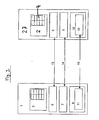
- FIG. 12 shows a schematic representation of the protocol stacks implemented according to the proposal of the invention in the landline telephone 1 and the server 27 on which the network address book 2 is operated in order to synchronize the local address book 3 with the network address book 2.
- a linking device 7, 8 implemented both on the part of the landline phone 1 as well as on the server side 27, each of which execute a link mechanism that allows the use of the SyncML protocol over the LAP-D protocol of an ISDN connection.
- the linking mechanism is in FIG. 2 illustrates and is based on a set of protocol stacks implemented in the landline telephone 1 and the server 27.
- LAP-D (11, 12) refers to that of the standard ITU-T Q.921 defined protocol and is used to establish a transmission channel over the D-channel.
- the linking devices 7, 8 execute the linking mechanism according to the invention.
- SyncML refers to either the SyncML client, ie the landline telephone 1, or the SyncML server 27, and refers to the protocol as specified by the Open Mobile Association (OMA).
- Reference numerals 3 and 4 indicate the address book data in which names and telephone numbers stored in either the landline telephone 1 or in a database associated with the server 27 are included.
- the linking mechanism makes use of the following functions to map the functionality provided by the SyncML protocol stack 5, 6 to the functionality provided by the LAP-D link 11, 12. These functions are implemented as parts of the linking devices 7, 8 in this.
- the linking device 7 maps the SyncML identifier (URI, Uniform Resource Identifier) of the network address book 2 to the ISDN number of the network address book 2 managing server 27, which is used by the LAP-D protocol 12.
- the SyncML identifier (URI) of the network address book 2 may be in the form of this ISDN telephone number followed by a database identifier, for example in the form ⁇ LocURI> http: // 495005005000 / joesmith / ⁇ / LocURI>.
- the phone number 495005005000 used by the LAP-D protocol and the database ID of the address data 4 are joesmith.
- the linking device 7 uses this telephone number and the database identifier for addressing the network address book 2 in the XML-based command of the SyncML protocol ⁇ LocURI> ⁇ / LocURI>, which specifies the destination address of the synchronization data.
- the linking device 8 maps the SyncML identifier (URI) of the local address book 3 of the telephone 1 to the ISDN telephone number of the telephone 1 used by the LAP-D protocol 11.
- the SyncML identifier in this case is the identifier of the telephone 1, which may be in the form of an ISDN telephone number.
- the identifier shown can have the following form, for example: ⁇ LocURI> ISDN: 4921144556677 ⁇ / LocURI>.
- the linking devices 7, 8 ensure that the data packets are transmitted in the correct order by assigning sequence numbers to the data packets, which indicate data loss during the transmission 14.
- the linking devices 7, 8 transmit data only after the establishment of a connection 15 between the telephone 1 and the network address book 2 or the server 27.
- the linking devices 7, 8 use internal acknowledgments to inform each other that transmitted data packets have been received on the other side of the link 14.
Landscapes
- Engineering & Computer Science (AREA)
- Signal Processing (AREA)
- Computer Networks & Wireless Communication (AREA)
- Telephonic Communication Services (AREA)
Applications Claiming Priority (1)
| Application Number | Priority Date | Filing Date | Title |
|---|---|---|---|
| DE102009004510A DE102009004510A1 (de) | 2009-01-09 | 2009-01-09 | Verfahren zur Synchronisation von Adressbüchern |
Publications (1)
| Publication Number | Publication Date |
|---|---|
| EP2207334A1 true EP2207334A1 (fr) | 2010-07-14 |
Family
ID=42097187
Family Applications (1)
| Application Number | Title | Priority Date | Filing Date |
|---|---|---|---|
| EP09013996A Withdrawn EP2207334A1 (fr) | 2009-01-09 | 2009-11-09 | Procédé destiné à la synchronisation de carnets d'adresses |
Country Status (2)
| Country | Link |
|---|---|
| EP (1) | EP2207334A1 (fr) |
| DE (1) | DE102009004510A1 (fr) |
Citations (3)
| Publication number | Priority date | Publication date | Assignee | Title |
|---|---|---|---|---|
| EP1001645A2 (fr) * | 1998-11-12 | 2000-05-17 | Robert Bosch Gmbh | Méthode, terminal de télécommunication et commutateur de télécommunication pour la transmission bidirectionelle de données sur une ligne de transmission |
| US20040052356A1 (en) * | 2002-09-18 | 2004-03-18 | Sbc Properties, L.P., Of Reno, Nv | Multi-modal address book |
| WO2008128555A1 (fr) * | 2007-04-20 | 2008-10-30 | Gigaset Communications Gmbh | Procédé et terminal de création et/ou de modification d'une entrée dans un répertoire de communication |
Family Cites Families (8)
| Publication number | Priority date | Publication date | Assignee | Title |
|---|---|---|---|---|
| DE3912078A1 (de) * | 1989-04-13 | 1990-10-18 | Telefonbau & Normalzeit Gmbh | Digitale fernmeldevermittlungsanlage |
| DE19809803A1 (de) * | 1998-03-09 | 1999-09-16 | Bosch Gmbh Robert | Endgerätekombination für eine Vermittlungsanlage |
| US6434147B1 (en) * | 1999-01-08 | 2002-08-13 | Nortel Netwoks Limited | Method and system for sequential ordering of missing sequence numbers in SREJ frames in a telecommunication system |
| US7155483B1 (en) * | 2001-08-07 | 2006-12-26 | Good Technology, Inc. | Apparatus and method for conserving bandwidth by batch processing data transactions |
| US20030073432A1 (en) * | 2001-10-16 | 2003-04-17 | Meade, William K. | Mobile computing device with method and system for interrupting content performance among appliances |
| DE102004014588A1 (de) * | 2004-03-23 | 2005-10-13 | Orga Kartensysteme Gmbh | Chipkarte zur Identifikation eines Mobilfunkteilnehmers in einem Mobilfunknetz |
| DE102006040719A1 (de) * | 2006-08-30 | 2008-03-06 | Axalto Gmbh | Verfahren, Server und Vorrichtung zum Angeben des Dienstanbieters, zu dem die Telefonnummer eines Telefonbucheintrags gehört, auf der Vorrichtung |
| DE102006055501A1 (de) * | 2006-11-24 | 2008-05-29 | Bayerische Motoren Werke Ag | Verfahren zur Übertragung von Telefonbuchdaten von einem Mobiltelefon zu einem externen Gerät und externes Gerät |
-
2009
- 2009-01-09 DE DE102009004510A patent/DE102009004510A1/de not_active Withdrawn
- 2009-11-09 EP EP09013996A patent/EP2207334A1/fr not_active Withdrawn
Patent Citations (3)
| Publication number | Priority date | Publication date | Assignee | Title |
|---|---|---|---|---|
| EP1001645A2 (fr) * | 1998-11-12 | 2000-05-17 | Robert Bosch Gmbh | Méthode, terminal de télécommunication et commutateur de télécommunication pour la transmission bidirectionelle de données sur une ligne de transmission |
| US20040052356A1 (en) * | 2002-09-18 | 2004-03-18 | Sbc Properties, L.P., Of Reno, Nv | Multi-modal address book |
| WO2008128555A1 (fr) * | 2007-04-20 | 2008-10-30 | Gigaset Communications Gmbh | Procédé et terminal de création et/ou de modification d'une entrée dans un répertoire de communication |
Also Published As
| Publication number | Publication date |
|---|---|
| DE102009004510A1 (de) | 2010-07-15 |
Similar Documents
| Publication | Publication Date | Title |
|---|---|---|
| DE69727253T2 (de) | Verfahren und vorrichtung zur sychronisierten durchführung von konfigurationinformation in einem kommunikationssystem | |
| DE10123068A1 (de) | Geräteregistrierungsserver zur automatischen Verbindung und zum Datenaustausch zwischen allgemein verwendeten Geräten und Backend-Systemen | |
| EP1632065B1 (fr) | Procede pour transmettre des messages dans un systeme de communication base sur mms | |
| EP2204039B1 (fr) | Procédé et terminal de communication pour l'échange de données pendant ou après une communication | |
| DE60213171T2 (de) | Verfahren zur Übertragung von Kurznachrichten mit Hilfe von Internet Fernsprechgeräten und entsprechendes System | |
| EP2324620A1 (fr) | Procédé de transmission et de traitement de données de fonction commandées par réseau entre un client et un serveur | |
| DE69936813T2 (de) | Dynamische Selektion von Zusammenwirkungsfunktionen in einem Kommunikationssystem | |
| EP0998078A1 (fr) | Méthode pour la configuration d'une liaison de communication pour transmission de données | |
| DE10085359B3 (de) | Kommunikationssystem und darin verwendetes Verfahren | |
| DE602005004370T2 (de) | Synchronisation von Server- und Geräte-Daten unter Benutzung von Geräte-Daten-Schemata | |
| WO2005041535A1 (fr) | Procede d'etablissement d'une liaison de communication dans un reseau de communication directe | |
| DE19801769A1 (de) | System und Verfahren im Zusammenhang mit der Telekommunikation | |
| EP1512270B1 (fr) | Procede pour identifier un abonne d'un systeme de telecommunication | |
| EP1738568A1 (fr) | Liaison de telecommunications entre deux appareils de telecommunications a transmission d'instructions de controle d'affichage dans un canal de donnees separe | |
| EP1139644A2 (fr) | Commutateur controlé par ordinateur | |
| DE602004005445T2 (de) | Verfahren zur aktualisierung von sitzungseinleitungsinformationen in verbindung mit einer fernsprechverbindung und endgeräteeinrichtung mit dem verfahren | |
| DE102006001503A1 (de) | Verfahren und System zum Übermitteln von Zusatzdaten und Kommunikationsendgerät | |
| DE102007057986B4 (de) | Verfahren zum Betreiben von zumindest einer gemäß einem Schnurlostelekommunikationsstandard funktionierenden mobilen Funksende-/Funkempfangseinrichtung an einer gemäß dem Schnurlostelekommunikationsstandard funktionierenden stationären Funksende-/Funkempfangseinrichtung sowie stationäre Funksende-/Funkempfangseinrichtung und mobile Funksende-/Funkempfangseinrichtung zur Durchführung des Verfahrens | |
| DE102009004510A1 (de) | Verfahren zur Synchronisation von Adressbüchern | |
| WO2008003404A1 (fr) | Procédé et système de communication destinés à commander le flux de données par des noeuds réseau | |
| DE60207056T2 (de) | System und Verfahren zur Datenteilung von einem WAP-Endgerät | |
| DE102004047352B4 (de) | Kommunikationssystem, Nachrichtenverarbeitungsrechner und Verfahren zum Verarbeiten einer Nachricht | |
| DE102007020373B4 (de) | Verfahren und Kommunikationsknoten zum Aufbau einer Echtzeit-Kommunikationsverbindung | |
| WO2006105773A2 (fr) | Procede de deviation d'au moins un message multimedia dans un reseau de communication de telephonie mobile, dispositifs de relais de messages multimedia, unite de serveur de telephonie mobile centrale et element de memoire de terminal de communication de telephonie mobile | |
| WO2008095987A2 (fr) | Recherche sur le web dans un répertoire de communication et établissement d'une liaison de communication avec un autre abonné dans un réseau de communication à commutation de circuits et/ou de paquets d'après un résultat de recherche |
Legal Events
| Date | Code | Title | Description |
|---|---|---|---|
| PUAI | Public reference made under article 153(3) epc to a published international application that has entered the european phase |
Free format text: ORIGINAL CODE: 0009012 |
|
| AK | Designated contracting states |
Kind code of ref document: A1 Designated state(s): AT BE BG CH CY CZ DE DK EE ES FI FR GB GR HR HU IE IS IT LI LT LU LV MC MK MT NL NO PL PT RO SE SI SK SM TR |
|
| AX | Request for extension of the european patent |
Extension state: AL BA RS |
|
| 17P | Request for examination filed |
Effective date: 20110112 |
|
| 17Q | First examination report despatched |
Effective date: 20160315 |
|
| STAA | Information on the status of an ep patent application or granted ep patent |
Free format text: STATUS: THE APPLICATION IS DEEMED TO BE WITHDRAWN |
|
| 18D | Application deemed to be withdrawn |
Effective date: 20160726 |