EP2208212B1 - Colorant comprenant un groupe d'ancrage dans sa structure moleculaire - Google Patents
Colorant comprenant un groupe d'ancrage dans sa structure moleculaire Download PDFInfo
- Publication number
- EP2208212B1 EP2208212B1 EP08840975.0A EP08840975A EP2208212B1 EP 2208212 B1 EP2208212 B1 EP 2208212B1 EP 08840975 A EP08840975 A EP 08840975A EP 2208212 B1 EP2208212 B1 EP 2208212B1
- Authority
- EP
- European Patent Office
- Prior art keywords
- dye
- chromophore
- represented
- conjugated system
- group
- Prior art date
- Legal status (The legal status is an assumption and is not a legal conclusion. Google has not performed a legal analysis and makes no representation as to the accuracy of the status listed.)
- Not-in-force
Links
- 0 *c1ccc(C=O)[s]1 Chemical compound *c1ccc(C=O)[s]1 0.000 description 8
- NIXRKCUQMUVQMK-UHFFFAOYSA-N CC[n]1(=C)c(/C=C2/C(O)=C(C3N(CC(O)=O)c4ccccc4C3(C)C)C2=O)ccc2c1cccc2 Chemical compound CC[n]1(=C)c(/C=C2/C(O)=C(C3N(CC(O)=O)c4ccccc4C3(C)C)C2=O)ccc2c1cccc2 NIXRKCUQMUVQMK-UHFFFAOYSA-N 0.000 description 1
Images


Classifications
-
- H—ELECTRICITY
- H01—ELECTRIC ELEMENTS
- H01G—CAPACITORS; CAPACITORS, RECTIFIERS, DETECTORS, SWITCHING DEVICES, LIGHT-SENSITIVE OR TEMPERATURE-SENSITIVE DEVICES OF THE ELECTROLYTIC TYPE
- H01G9/00—Electrolytic capacitors, rectifiers, detectors, switching devices, light-sensitive or temperature-sensitive devices; Processes of their manufacture
- H01G9/20—Light-sensitive devices
- H01G9/2059—Light-sensitive devices comprising an organic dye as the active light absorbing material, e.g. adsorbed on an electrode or dissolved in solution
-
- C—CHEMISTRY; METALLURGY
- C09—DYES; PAINTS; POLISHES; NATURAL RESINS; ADHESIVES; COMPOSITIONS NOT OTHERWISE PROVIDED FOR; APPLICATIONS OF MATERIALS NOT OTHERWISE PROVIDED FOR
- C09B—ORGANIC DYES OR CLOSELY-RELATED COMPOUNDS FOR PRODUCING DYES, e.g. PIGMENTS; MORDANTS; LAKES
- C09B57/00—Other synthetic dyes of known constitution
- C09B57/007—Squaraine dyes
-
- H—ELECTRICITY
- H01—ELECTRIC ELEMENTS
- H01G—CAPACITORS; CAPACITORS, RECTIFIERS, DETECTORS, SWITCHING DEVICES, LIGHT-SENSITIVE OR TEMPERATURE-SENSITIVE DEVICES OF THE ELECTROLYTIC TYPE
- H01G9/00—Electrolytic capacitors, rectifiers, detectors, switching devices, light-sensitive or temperature-sensitive devices; Processes of their manufacture
- H01G9/20—Light-sensitive devices
- H01G9/2059—Light-sensitive devices comprising an organic dye as the active light absorbing material, e.g. adsorbed on an electrode or dissolved in solution
- H01G9/2063—Light-sensitive devices comprising an organic dye as the active light absorbing material, e.g. adsorbed on an electrode or dissolved in solution comprising a mixture of two or more dyes
-
- H—ELECTRICITY
- H10—SEMICONDUCTOR DEVICES; ELECTRIC SOLID-STATE DEVICES NOT OTHERWISE PROVIDED FOR
- H10K—ORGANIC ELECTRIC SOLID-STATE DEVICES
- H10K85/00—Organic materials used in the body or electrodes of devices covered by this subclass
- H10K85/60—Organic compounds having low molecular weight
- H10K85/649—Aromatic compounds comprising a hetero atom
- H10K85/652—Cyanine dyes
-
- H—ELECTRICITY
- H01—ELECTRIC ELEMENTS
- H01G—CAPACITORS; CAPACITORS, RECTIFIERS, DETECTORS, SWITCHING DEVICES, LIGHT-SENSITIVE OR TEMPERATURE-SENSITIVE DEVICES OF THE ELECTROLYTIC TYPE
- H01G9/00—Electrolytic capacitors, rectifiers, detectors, switching devices, light-sensitive or temperature-sensitive devices; Processes of their manufacture
- H01G9/20—Light-sensitive devices
- H01G9/2027—Light-sensitive devices comprising an oxide semiconductor electrode
- H01G9/2031—Light-sensitive devices comprising an oxide semiconductor electrode comprising titanium oxide, e.g. TiO2
-
- H—ELECTRICITY
- H10—SEMICONDUCTOR DEVICES; ELECTRIC SOLID-STATE DEVICES NOT OTHERWISE PROVIDED FOR
- H10K—ORGANIC ELECTRIC SOLID-STATE DEVICES
- H10K85/00—Organic materials used in the body or electrodes of devices covered by this subclass
- H10K85/30—Coordination compounds
- H10K85/341—Transition metal complexes, e.g. Ru(II)polypyridine complexes
- H10K85/344—Transition metal complexes, e.g. Ru(II)polypyridine complexes comprising ruthenium
-
- H—ELECTRICITY
- H10—SEMICONDUCTOR DEVICES; ELECTRIC SOLID-STATE DEVICES NOT OTHERWISE PROVIDED FOR
- H10K—ORGANIC ELECTRIC SOLID-STATE DEVICES
- H10K85/00—Organic materials used in the body or electrodes of devices covered by this subclass
- H10K85/60—Organic compounds having low molecular weight
- H10K85/649—Aromatic compounds comprising a hetero atom
- H10K85/655—Aromatic compounds comprising a hetero atom comprising only sulfur as heteroatom
-
- Y—GENERAL TAGGING OF NEW TECHNOLOGICAL DEVELOPMENTS; GENERAL TAGGING OF CROSS-SECTIONAL TECHNOLOGIES SPANNING OVER SEVERAL SECTIONS OF THE IPC; TECHNICAL SUBJECTS COVERED BY FORMER USPC CROSS-REFERENCE ART COLLECTIONS [XRACs] AND DIGESTS
- Y02—TECHNOLOGIES OR APPLICATIONS FOR MITIGATION OR ADAPTATION AGAINST CLIMATE CHANGE
- Y02E—REDUCTION OF GREENHOUSE GAS [GHG] EMISSIONS, RELATED TO ENERGY GENERATION, TRANSMISSION OR DISTRIBUTION
- Y02E10/00—Energy generation through renewable energy sources
- Y02E10/50—Photovoltaic [PV] energy
- Y02E10/542—Dye sensitized solar cells
-
- Y—GENERAL TAGGING OF NEW TECHNOLOGICAL DEVELOPMENTS; GENERAL TAGGING OF CROSS-SECTIONAL TECHNOLOGIES SPANNING OVER SEVERAL SECTIONS OF THE IPC; TECHNICAL SUBJECTS COVERED BY FORMER USPC CROSS-REFERENCE ART COLLECTIONS [XRACs] AND DIGESTS
- Y02—TECHNOLOGIES OR APPLICATIONS FOR MITIGATION OR ADAPTATION AGAINST CLIMATE CHANGE
- Y02E—REDUCTION OF GREENHOUSE GAS [GHG] EMISSIONS, RELATED TO ENERGY GENERATION, TRANSMISSION OR DISTRIBUTION
- Y02E10/00—Energy generation through renewable energy sources
- Y02E10/50—Photovoltaic [PV] energy
- Y02E10/549—Organic PV cells
Definitions
- the present invention relates to a dye including an anchoring group in its structure, to a method of synthesis of such dye, to an electronic device comprising such dye, and to uses of such dye.
- the dye-sensitised solar cell ( B. O'Regan and M. Grätzel, Nature 353 (1991) 737 ; WO 91/16719 [A ]) is a photovoltaic device that offers high energy-conversion efficiencies at low cost.
- DSSC dye-sensitised solar cell
- these functions are separated.
- Light is absorbed by a sensitizer dye which is anchored to the surface of a semiconductor such as nanocrystalline TiO 2 .
- the charge separation takes place at the interface via photo-induced electron injection from the dye into the conduction band of the semiconductor.
- the dye molecule is regenerated from a counter electrode via a redox couple in the electrolyte.
- the redox couple is regenerated in turn at the counter-electrode the circuit being completed by electron transport through the external load.
- the efficiency of a DSSC is determined by the number of collected and injected photons, and thus by the light absorbed by the dye sensitizer. For high efficiencies, the ideal sensitizer should absorb efficiently over a broad range of solar spectrum. In addition, for efficient electron injection it must be able to adsorb (by chemisorption) onto the semiconductor surface. Upon photo-excitation it should inject electrons into the conduction band of the semiconductor with a quantum yield of unity. To minimize energy losses during electron transfer, the energy level of its excited state should be well matched with the lower bound of the conduction band of the semiconductor. Its redox potential should be well matched with that of the redox couple so that the dye regeneration via electron donation is possible.
- the slow recombination is considered to be a result of the large separation between semiconductor and the Ru 3+ by the bipyridyl ligands.
- the molecular design of these Ru-complexes is successful in an efficient charge separation and thus, high energy conversion efficiency.
- the energy conversion efficiency of the DSSC is limited by the light-harvesting capacity of these Ru-dyes to absorb the sunlight.
- the photo-active region of the photovoltaic device is reduced to the visible part of the solar spectrum, and within that, to the shorter wavelength region. The photons of the longer wavelength region are not harvested and cannot be converted to electrical energy.
- Hara et al., 2003, New J. Chem. 27, 783-785 discloses coumarin dyes having thiophene moieties for use in organic-dye-sensitized solar cells .
- N, N-dimethylaniline (DMA) moieties and a cyanoacetic acid moiety for use in dye-sensitized solar cells . Accordingly, it was an object of the present invention to provide for new dyes to be used in dye-sensitized solar cells. Moreover, it was an object of the present invention to provide for easy accessible, stable and soluble functional materials with intense absorption in the visible and long wavelength region of the solar spectrum.
- DMA N, N-dimethylaniline
- a dye including an anchoring group in its molecular structure, said anchoring group allowing a covalent coupling of said dye to a surface, for example a surface of a nanoporous semiconductor layer, said anchoring group being represented by formula 1 wherein attachment of said anchoring group within said molecular structure of said dye is at the terminal carbon marked with an asterisk in above formula, wherein
- said conjugated system is represented by a moiety shown in formula 3 or a combination of any of the moieties represented by formula 3,
- the dye according to the present invention is represented by formula 16 A, G and R 3 being as defined in claim 1, and said conjugated system being as defined in claim 2.
- the dye according to the present invention is represented by formula 17 i.e. wherein said conjugated system is a thiophene, G is a -COOH-group and A is a-CN-group.
- the objects of the present invention are also solved by a method of synthesis of a chromophore as defined in claim 1, said chromophore having Ar 1 and Ar 2 as aromatic systems in its structure, wherein Ar 1 and Ar 2 are different and are as defined in claim 1, said method at least comprising:
- an electronic device comprising a dye as defined above, wherein, preferably said device is a solar cell, more preferably a dye-sensitized solar cell.
- electronic devices comprising a dye in accordance with the present invention include energy supply devices for portable electronic devices and displays, such as solar cell panels for or incorporated in mobile phones, notebooks, laptops, portable audio-tape players, MP3-players, remote controls, e-cards, e-books, e-readers, portable CD players, portable DVD players, cameras, digicams, GPS devices, portable sensors, displays integrated in electronic devices.
- Examples of electronic devices in accordance with the present invention also include portable solar chargers for batteries of any of the aforementioned devices.
- electronic devices in accordance with the present invention include smart windows, on-roof applications, especially in areas where a grid connection is not possible, e.g. camping cars, boats.
- the energy supply device is a solar cell panel
- such panel is preferably a dye sensitized solar cell panel (DSSC panel) (see also figure 11 ).
- said dye is chemisorbed to a photoactive semiconductor layer.
- the device according to the present invention further comprises at least one other dye, wherein, preferably, said at least one other dye is a dye as defined above, wherein, more preferably said at least one other dye is cis -bis(isothiocyanato)bis(2,2'-bipyridyl-4,4'-dicarboxylato)-ruthenium(II) bis-tetrabutylammonium (red dye) or tris(isothiocyanato)-ruthenium(II)-2,2':6',2"-terpyridine-4,4',4"-tricarboxylic acid tris-tetrabutylammonium salt (black dye) or a combination of the two.
- said at least one other dye is a dye as defined above, wherein, more preferably said at least one other dye is cis -bis(isothiocyanato)bis(2,2'-bipyridyl-4,4'-dicarboxylato)-rut
- the electronic device according to the present invention is a chromogenic sensor, wherein preferably, said dye is present in solution or wherein said dye is present in a film.
- the objects of the present invention are also solved by the use of a dye as defined above as sensitizer in a dye-sensitized solar cell, preferably together with at least one other dye, wherein, more preferably, said at least one other dye is a dye as defined in any of claims 1-3, even more preferably red-dye or black-dye or a combination of the two.
- a dye as defined above as a sensor, wherein the spectral properties of said dye depend on the presence, absence or quantity of analyte present and change in accordance therewith, wherein, preferably, said sensor is for detecting the presence, absence or quantity of solvents, such as ethanol, methanol and acetonitrile.
- anchoring group is meant to refer to any functional group that allows a covalent coupling (chemisorption) of the entity to which such anchoring group belongs, to a surface, for example the surface of a nanoporous semiconductor layer within a solar cell.
- a "chromophore” is an entity within a molecular structure that is responsible for the light absorption, in the present case squarylium and croconium dyes, semi-squarylium or semi-croconium dyes, aromatic and heteroaromatic systems bridged by (poly-)enes, styrene, or other aromatic or heteroaromatic rings, secondary or tertiary amines with aromatic or heteroaromatic systems attached, (poly-)phenylenes mono-endcapped with an aromatic system or metal organic complexes, such as polypyridyl ruthenium, osmium, iridium complexes or palladium, platinum, nickel porphyrine and phtalocyanine derivatives.
- conjugated system is a molecule having alternating double bonds and single bonds between its atom centers.
- the simplest example of a conjugated system is butadiene wherein there are two double bonds separated by a single bond.
- molecular structure refers to the structure of a molecule.
- molecular structure of a dye is the structure of the molecule of said dye.
- An “anchoring group” that is included in the molecular structure of a dye forms part of said molecular structure.
- a dye is referred to as being "chemisorbed" to a layer or surface, if the dye is covalently coupled thereto.
- red-dye and black-dye refers to commonly used dyes for dye-sensitized solar cells which are cis -bis(isothiocyanato)bis(2,2'-bipyridyl-4,4'-dicarboxylato)-ruthenium(II) bis-tetrabutylammonium (in literature also known as Ruthenium 535-bisTBA, N719 or B2) and tris(isothiocyanato)-ruthenium(II)-2,2':6',2"-terpyridine-4,4',4"- tricarboxylic acid, tris-tetrabutylammonium salt (also known as Ruthenium 620-1H3TBA, Ruthenium 620 or N-749).
- a dye including an anchoring group in its molecular structure is meant to refer both to a scenario where only one anchoring group is present within the structure and a scenario wherein several anchoring groups are present.
- G refers to a group which preferably is an acidic group in the sense that such group has a proton that can be dissociated from such group.
- G is selected from COOH, SO 3 H, PO 3 H 2 , BO 2 H 2 , SH, OH, NH 2 .
- a molecule that is able to absorb in the wavelength range of visible and/or IR light is meant to refer to a molecule that is able to absorb light in only one or several parts of the entire range indicated or over the total range. For example a molecule may only absorb in the range of from 500 - 700 nm, whereas another molecule may absorb in the range of from 750 - 1000 nm, whereas a third molecule may absorb over the range of from 300 - 1200 nm. All these scenarios are meant to be encompassed by such wording.
- a “functionalized conjugated system”, as used herein, is meant to refer to a conjugated system which has been endowed with a chemical functionality that allows such conjugated system to react with other molecules.
- Examples for such functionalized conjugated system are a metallated conjugated system having an aldehyde group into which functionalized conjugated system an anchoring group may be introduced.
- a conjugated system and an anchoring group are attached to a chromophore. Such attachment may occur at any position within the chromophore, and it may be via a C-atom or an N-atom within said chromophore.
- the term "protected dye”, as used herein, is a dye wherein the anchoring group is protected by an appropriate protecting group. In preferred embodiments, such term refers to the dye represented by formula 2 but in which the anchoring groups are protected by appropriate protecting groups. In a further reaction the anchoring groups may be activated by deprotecting them. Appropriate protecting groups are known to a person skilled in the art and may be identified by him without undue experimentation.
- Ar 1 and Ar 2 represent aromatic and hetero-aromatic systems.
- Ar 1 and Ar 2 are, according to the present invention, indeed exemplified by the systems shown below, it is clear to someone skilled in the art that, once these systems are attached to a squaric acid derivative, as shown in formula 5 or aromatic systems, they might gain or lose a positive charge which is delocalized over the entire molecule. This is due to the zwitter-ionic character of the dye molecules and the possible mesomeric structures of such conjugated systems. An example of this is shown below:
- a “chromogenic sensor” as used herein refers to a composition or compound the spectral-characteristics of which are dependent on the environment or the presence or absence or quantity present of an analyte. Accordingly, the spectral characteristics, such as the color will change, if an analyte is present or absent, as the case may be.
- substituted phenyl/biphenyl is meant to refer to any phenyl/biphenyl wherein a hydrogen has been replaced by a substituent, such as a halogen, NO 2 , NH 2 , OH or other suitable functional groups.
- substituents have for example been defined above as Z or R 1 , which substituents may also be substitutents at a phenyl or biphenyl.
- the present inventors have surprisingly found that if one endows organic dyes, such as squarylium dyes, with an anchoring group(s), these dyes are very well suited to be used in dye sensitized solar cells and sensor devices.
- the inventors have devised methods of synthesis for producing such dyes, and these dyes effectively adsorb on nanoporous semiconductor layers, such as TiO 2 , they are active sensitizers in the visible, but also in the red/IR region of the solar spectrum which is a region where the standard red- and black-dye are not active.
- the dyes according to the present invention show high quantum efficiency at an absorption maximum similar to that of the standard red-dye.
- a dye sensitized solar cell comprising a dye according to the present invention, and, in addition thereto, one or more further dyes, is herein also referred to as a multiple-dyes sensitized solar cell (M-DSSC).
- M-DSSC multiple-dyes sensitized solar cell
- said one or more further dyes is also a dye according to the present invention.
- organic dyes have high absorption coefficients. This means it needs less amount of dye to absorb the same amount of light. Less amount of one dye on a surface enables the use of more dyes with different absorption properties, ideally being a mixture of dyes absorbing the whole range of the sun spectrum.
- the anchoring group consists of a group represented by the general formula which is directly or optionally bridged by a conjugated system to the main core of the dye, also herein being referred to as the chromophore.
- the present invention also encompasses dyes wherein the chromophore (or main core of the dye) has more than one anchoring group attached, and, optionally, also more than one conjugated system.
- Such structures are also meant to be encompassed by the formulae given in the claims, more specifically claims 1-3. Without wishing to be bound by any theory, the present inventors believe that this kind of anchoring group influences the electron density distribution in such way that after photo-excitation a fast electron injection occurs.
- the dye is directly attached to the semiconductor surface, such as the TiO 2 surface via the group G of the anchoring group.
- the A-group of the anchoring group shown above, having an electron acceptor character is believed to have a positive effect on electron injection from the dye to the semiconductor.
- the present inventors believe, and molecular orbital calculations support their assumption. that in the ground state, the electron density is localized on the chromophore or dye moiety, far away from the semiconductor surface. After photo-excitation, effective charge separation and electron fast migration from the dye-moiety next to the anchoring group via the conjugated system if present, otherwise directly, takes place. This process is promoted by the acceptor character of the A-group of the anchoring group.
- the electron distribution changes in such a way that the electron density becomes highest in the proximity of anchor group.
- the electron transfer from here to the conduction band of the semiconductor is therefore fast.
- This hypothesized intramolecular electron density relocation induced by photo-excitation is similar to the intra-molecular metal-ligand-charge-transfer in standard red dye.
- the anchoring group is carboxylic acid group which is attached to the bipyridine ligand. Instead, by attaching to a ligand the anchoring group being defined in claim 1, the inventors believe that the electron injection from the photo-excited dye into the conduction band of the semiconductor is even faster.
- the chromophore can be an organic dye, such as a squarylium acid derivative, and is responsible for the light absorption abilities of the entire dye molecule.
- the energy levels (HOMO/LUMO) of an organic dye can systematically be tuned by chemical structure modification in such a manner that they match with the other components of the DSSC: The energy level of the excited state of the dye (LUMO) with the conduction band of the semiconductor and the ground state energy level of the dye (HOMO) with the redox potential of the redox pair. If a conjugated system is present, its role is to allow the fast electron flow through the system and thus, the distribution relocation after photo-excitation. Further, an extended ⁇ -conjugation results in an additional red-shift of the absorption.
- the structure of the dyes should include the following anchor group
- the dyes may have the following structure
- Preferred examples of the conjugated system are R 1 , n 1 and n 2 being as defined above.
- the chromophore is a squarylium dye represented by formula 5 X, Y, Ar 1 and Ar 2 being as defined above.
- the dye includes a chromophore which is a indole-based squarylium dye and wherein Ar1 and Ar2 being an indole aromatic system attached to a squaric acid.
- the anchoring group being attached to the chromophore via a conjugated system.
- A, G being as defined in claim 1
- the dye has following structure With the conjugated system being a thiophene, G being carboxylic acid -COOH and A being a cyano group -CN
- the chromophores based on squarylium dye can be synthesized as follows:
- the chromophores based on squarylium dye can be synthesized as follows:
- the dyes expressed by general formula 2 can be synthesized by following routes:
- Example 1 Synthesis scheme of dye being described in claim 1-3 having acrylic acid moiety attached to squarylium dye via a thiophene as conjugated system
- Step b) Under inert atmosphere, compound 3 is dissolved in anhydrous DMF. 1 equivalent of POCl3 is slowly added and the mixture stirred at 70°C for 4 hours. The mixture is allowed to cool down to room temperature, ice and water are added and aquesous NaOH for neutralisation. The mixture is extracted with dichloromethane and the solvent removed under reduced pressure. The crude product is purified by column chromatography on silica gel with (2/8) acetone/ ethylacetate to give the pure compound 4.
- Step c) A mixture of compound 4 and acrylic acid in acetonitrile are heated in the presence of small amount of piperidine to 80°C for 12 hours. After cooling, the solvent is removed under reduced pressure and the crude product is purified by column chromatography on silica gel with (5/5) acetone/ ethylacetate to give the dye 5 as a bluish green powder.
- Halogenated chromophore 1 which represents a general structure 5 can be prepared by two different routes.
- Substituted semisquaric acid derivative 1c was reacted with 1 equivalent of 1d in a 1:1 mixture of 1-butanol/toluene in the presence of pyridine. Under reflux (130°C), the reaction generated water that was removed by azeotropic distillation. After 1 h reaction time, formation of squarylium dye was indicated by the appearance of a blue-green colour. After 12 h at 130 °C, the reaction mixture was allowed to cool to room temperature and the solvent removed under reduced pressure. The crude product was purified by column chromatography on silica gel with dichloromethane/ethylacetate as eluent. The pure product 1 was isolated as green solid.
- step a) a brominated semisquaric acid derivative is produced.
- Substituted semisquaric acid derivative 1c was reacted with 1 equivalent of 1a in a 1:1 mixture of 1-butanol/toluene in the presence of pyridine. Under reflux (130°C), the reaction generated water that was removed by azeotropic distillation. Already after 20 minutes reaction time, formation of squarylium dye was indicated by the appearance of a blue-green colour. After 12 h at 130 °C, the reaction mixture was allowed to cool to room temperature and the solvent removed under reduced pressure. The crude product was purified by column chromatography on silica gel with dichloromethane/ethylacetate as eluent. The pure product 1 was isolated as green solid.
- Example 2 Synthesis of a dye being described in claim 1-3, having a cyano acrylic acid moiety directly attached via a vinylthiophene moiety. to a bis(bipyridine) Ru chromophore
- Example 3 Molecular modelling - theoretical calculations of dye 5 having acrylic acid moiety attached to squarylium dye via a thiophene as conjugated system
- Figure 7 shows energy levels of DSSC including for comparison the energy levels of different squarylium dyes.
- the structure of the dyes is given in figure 8 .
- Squarylium dye 11 and 14 have an absorption at 630 nm and 660 nm, respectively and efficiency of the DSSC of 1.76 % and 4.21 %.Based on the calculations we expect better performance of the DSSC prepared with 5 as sensitizer. The calculations predict for the sensitizer dye 5
- Figure 9 shows the electron distribution of the sensitizer dye 5 in ground and excited state.
- the nature of the anchor group allows an intramolecular relocation of the electron density by photoexcitation.
- the molecule in ground state shows the electron density is highest on the chromophor, far away from the semiconductor surface.
- the LUMO of the molecule is depicted. This is correlated with the electron distribution of the molecule after photoexcitation. After photoexcitation, the electron density is very high in the vicinity of the anchoring group that allows the direct coupling with the nanoporous semiconductor. The present inventors believe that this situation enables a very fast electron injection.
- dyes which are stable and are characterized by a strong absorption and emission in the visible and IR region of the solar spectrum, and they are useful as sensitizers in DSSCs for these regions.
- they are able to collect the solar light over a broad range of the solar spectrum.
- the present inventors describe a molecular design of these dyes for improved performance in dye-sensitized solar cells.
- the anchoring group is believed to be responsible for the efficient adsorption of the dye-sensitizer onto the nanoporous semiconductor surface and consist of an acrylic acid moiety which is optionally bridged by a conjugated system to the main core of the dye. This kind of anchoring group is believed to enable a photo-excitation induced intramolecular electron density relocation in organic dyes resulting in better performance of the sensitizer in a photovoltaic device.
- Indole derivative 10a was reacted with 0.5 equivalent of squaric acid in a 1:1 mixture of 1-butanol/toluene in the presence of pyridine. Under reflux, the reaction generates water that was removed by azeotropic distillation by using a Dean-Stark trap. After 1 h reaction time, the appearance of a green-blue colour could be observed evidencing the formation of the squarylium dye. The reaction was monitored by TLC and after 12 h no further change in conversion was observed. After cooling at room temperature, dichloromethane was added and the reaction mixture filtered off. The solvent was removed under reduced pressure.
- Brominated indoline 12a was reacted with 0.5 equivalent of squaric acid in a 1:1 mixture of 1-butanol/toluene in the presence of pyridine. Under reflux, the reaction generated water that was removed by azeotropic distillation by using a Dean-Stark trap. After 1 h reaction time, formation of squarylium dye was indicated by the appearance of a bluish colour. After 16 h at 120 °C, the reaction mixture was allowed to cool to room temperature and the solvent removed under reduced pressure. The crude product was purified by column chromatography on silica gel with (4/6) dichloromethane/ethylacetate. Product 12 was isolated as green solid.
- Substituted semisquaric acid derivative 1c was reacted with 1 equivalent of 10a in a 1:1 mixture of 1-butanol/toluene in the presence of pyridine. Under reflux (130°C), the reaction generated water which was removed by azeotropic distillation by using a Dean-Stark trap. After 1 h reaction time, formation of squarylium dye was indicated by the appearance of a blue-green colour. After 12 h at 120 °C, the reaction mixture was allowed to cool to room temperature and the solvent removed under reduced pressure. The crude product was purified by column chromatography on silica gel with (1:1) dichloromethane/ethylacetate as eluent. The pure product 16 was isolated as green solid.
- UV-Vis of a ethanol solution of sensitizer dye 5 and for comparison standard black dye 23 and standard red dye 24 see figure 12a .
- the DSSCs are assembled as follows: A 30-nm-thick bulk TiO 2 blocking layer is formed on FTO (approx. 100 nm on glass or flexible substrate). A 10-30 ⁇ m-thick porous layer of semiconductor particles is screen printed on the blocking layer and sintered at 450 °C for half an hour. Dye molecules are adsorbed to the nanoporos particles via self-assembling out of a dye-solution.
- the dye-solution consists of a single dye or single dye and an additive, such as deoxycholic acid or a mixture of dye in different ratio or a mixture of dye in different ratio and an additive.
- the porous layer is filled with a) liquid electrolyte b) polymer gel electrolyte containing I - /I 3 - as redox couple (15 mM) by drop casting.
- a reflective platinum back electrode is attached with a distance of 6 ⁇ m from the porous layer.
- the quality of the cells is evaluated by means of current density (J) and voltage (V) characteristics under illumination with light from a sulphur lamp (IKL Celsius, Light Drive 1000) with an intensity of 100 mW cm -2 . If not otherwise stated, the results are averages over three cells, each of 0.24 cm 2 active area.
- a cell containing the commercial standard red dye (so called bisTBA-Ru535 or N719) or black dye (so called Ru620-1H3TBA or N749) is prepared under same conditions.
- Sensitizer J SC [mA/cm 2 ] V OC [mV] FF [%] ⁇ [%] 5 [1] 8.3 650 75 4.05 17 [1] 3.0 710 78 1.67 [1] TiO 2 dye-coating from 0.1 mM dye solution + with additive deoxycholic acid 20 mM. [2] TiO 2 dye-coating from 0.3 mM dye solution + with additive deoxycholic acid 20 mM.
- the efficiency of the DSSC prepared with sensitizer dye 5 shows has much higher efficiency as the dye 17 from the same class of organic dyes but without the anchoring group.
- sensitizer 5 The photo-activity of sensitizer 5 is higher than of sensitizer 17 and extended in the longer wavelength region of the solar spectrum with the maximum at 690-700 nm (see figure 12b ).
- sensitizer dyne 5 with the anchoring group according claim 1 over other organic dyes is reflected by the fact that this sensitizer dye can be used in mixture with other sensitizer dye resulting in higher efficiency of the solar cell than using a single sensitizer dye.
- the inventors name this type of solar cell device in which more than one dye are used as sensitizer for harvesting the light Multiple-dyes sensitized solar cell (M-DSSC). Beside sensitizer dye 5 , the mixture can contain one or more other dyes.
- Examples are given for mixture of sensitizer dye 5 with standard black dye 23 (Example 15), with one other organic dye such as 21 or 22 (Example 16 and 17), with two other dyes, such as 21 and 23 (Example 18), or 22 and 23 (Example 19).
- standard black dye 23 is preferably used instead standard red dye 24 when high photo-activity in the long wavelength region of solar spectrum is needed.
- dye 5 is photo-active in the range of 550-750 nm where standard dyes 23 and 24 and organic dye 21 doesn't have any photo-activity (see figure 12d ).
- IPCE curve of the dye mixture is a mirror of the added IPCE curve of the single dyes. This is the reason why the dye mixture performs better than the single dyes.
- Both dyes show high efficiencies.
- the efficiency of the DSSC devise increases. This is due to the additive behavior of the individual short current density.
- dye 5 is photo-active in the range of 550-750 nm where standard dyes 23 and 24 and organic dye 21 doesn't have any photo-activity (see figure 12e ).
- the IPCE curve of the dye 22 is extended to the red when using the dyes mixture.
- the three dyes have similar efficiency as single sensitizer. By mixing the dyes higher efficiency of DSSC is achieved. By using a solution in which the dyes are mixed in 1:1 ratio the efficiency of the DSSC devise increases.
- the dyes are photo-active in different regions of solar spectrum.
- the IPCE curve of the mixture is extended to the red region due to effect of black dye, and is more intense in the range of 580-780 nm due to dye 5 (see figure 12f ).
Landscapes
- Engineering & Computer Science (AREA)
- Chemical & Material Sciences (AREA)
- Power Engineering (AREA)
- Materials Engineering (AREA)
- Microelectronics & Electronic Packaging (AREA)
- Organic Chemistry (AREA)
- Physics & Mathematics (AREA)
- Spectroscopy & Molecular Physics (AREA)
- Hybrid Cells (AREA)
- Plural Heterocyclic Compounds (AREA)
- Photovoltaic Devices (AREA)
- Indole Compounds (AREA)
Claims (11)
- Colorant comportant un groupe d'ancrage dans sa structure moléculaire, ledit groupe d'ancrage permettant un couplage covalent dudit colorant à une surface, par exemple une surface d'une couche semi-conductrice nanoporeuse, ledit groupe d'ancrage étant représenté par la formule 1
 dans laquelle G est choisi parmi -COOH, -SO3H, -PO3H2, -BO2H2, -SH, -OH et -NH2, de préférence -COOH, etdans laquelle A est choisi dans le groupe comprenant-CN, -NO2, -COOR, -COSR, -COR, -CSR, -NCS, -CF3, -CONR2, -OCF3 et C6H5-mFm, où m = 1-5,R représentant H, n'importe quelle chaîne alkyle linéaire ou ramifiée de formule générale -CnH2n+1, n = 0-12, de préférence 0-4, ou n'importe quel groupe phényle ou biphényle substitué ou non substitué,ledit colorant étant représenté par
ledit chromophore étant représenté par la formule 5
 dans laquelle R1 et R2 sont identiques ou différents et sont, à chaque occurrence, indépendamment choisis parmi H, n'importe quelle chaîne alkyle linéaire ou ramifiée de formule générale -CnH2n+1, avec n = 0-12, de préférence 0-4, et n'importe quel groupe phényle ou biphényle substitué ou non substitué,dans laquelle R3 est choisi parmi H, -(CH2)nCH3, -(CH2)n-COOR, -(CH2)n-OR, -(CH2)n-SR, -(CH2)n-NR2 et -((CH2)p-O)n-CH3, avec p = 1-4 et n = 0-12, etdans laquelle Z représente une ou plusieurs fractions qui, à chaque occurrence, sont indépendamment choisies parmi H, un halogène tel que Cl, Br, F, I, ou NO2, NH2, CN, SO3H, OH, H, -(CH2)nCH3, -(CH2)n-COOR, -(CH2)n-OR,-(CH2)n-SR, -(CH2)n-NR2 et -((CH2)p-O)n-CH3,ou n'importe quel système aromatique ou hétéroaromatique représenté par les formules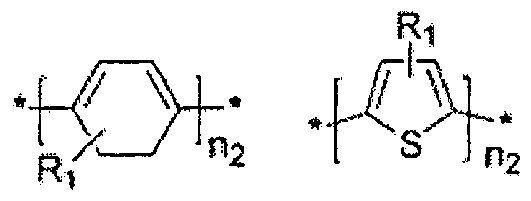
- Colorant selon la revendication 1, dans lequel ledit système conjugué est représenté par une fraction représentée dans la formule 3
 dans laquelle n1 et n2 = 0-12, de préférence n1 = 0-3 et n2 = 1-7,dans laquelle R3 est choisi parmi H, -(CH2)nCH3, -(CH2)n-COOR, -(CH2)n-OR, -(CH2)n-SR, -(CH2)n-NR2 et -((CH2)p-O)n-CH3, p = 1-4, n = 0-12,dans laquelle R1 est choisi parmi un halogène tel que Cl, Br, F, I, ou NO2, NH2, CN, SO3H, OH, H, -(CH2)nCH3, -(CH2)n-COOR, -(CH2)n-OR, -(CH2)n-SR, -(CH2)n-NR2 et -((CH2)p-O)n-CH3, p = 1-4, n = 0-12,R représentant H, n'importe quelle chaîne alkyle linéaire ou ramifiée de formule générale -CnH2n+1, n = 0-12, de préférence 0-4, ou n'importe quel groupe phényle ou biphényle substitué ou non substitué, etdans laquelle X1 et Y1, à chaque occurrence, sont indépendamment choisis parmi 0, S et NR.
 - Colorant selon la revendication 1 ou 2, représenté par la formule 16


- Procédé de synthèse d'un chromophore tel que défini dans la revendication 1, dans lequel Ar1 et Ar2 sont identiques et sont tels que définis dans la revendication 1, ledit procédé comprenant :la réactionde 2 équivalents de [Ar1-CH3]+Hal-, où Hal- = I-, Br-, Cl-, NCS- ou SCN-,ou de 2 équivalents de [Ar1=CH2],avec 1 équivalent d'un dérivé d'acide squarique selon le schéma 1 ou 2


 X et Y étant tels que définis dans la revendication 1, pour obtenir un colorant squarylium répondant à la formule 22, comme défini dans le schéma 1 ou 2.
 - Procédé de synthèse d'un chromophore tel que défini dans la revendication 1, ledit chromophore ayant Ar1 et Ar2 comme systèmes aromatiques dans sa structure, Ar1 et Ar2 étant différents et étant tels que définis dans la revendication 1, ledit procédé comprenant au moins :a) la formation d'un chloro- ou alkylester d'un dérivé d'acide squarique substitué par un système aromatique Ar1, Ar1 étant tel que défini dans la revendication 1, comme représenté par le schéma 5 ou 6

 X, Y, Ar1 et Ar2 étant tels que définis dans la revendication 1, Hal- étant I-, Cl-, Br-, NCS- ou SCN-, etE représentant Cl ou un groupe alcoxy, de préférence un groupe éthoxy, propoxy, isopropoxy ou butoxy ;b) la condensation du produit de l'étape a) avec [Ar2-CH3]+Hal-, où Hal- = I-, Br-, Cl-, CN-, NCS- ou SCN-,
ou avec [Ar2=CH2],
selon le schéma 9 ou 10


- Procédé de synthèse d'un colorant selon l'une quelconque des revendications 1 à 3, comprenant les étapes suivantes :a) couplage d'un chromophore tel que défini dans l'une quelconque des revendications 1 et 3 et d'un système conjugué tel que défini dans l'une quelconque des revendications 1 et 2, de préférence sous catalyse par métal de transition,b) introduction d'une fraction carboxyaldéhyde dans ledit système conjugué,c) transformation de ladite fraction carboxyaldéhyde en un groupe d'ancrage par réaction du produit de l'étape b) avec A-CH2-G, où A et G sont tels que définis dans la revendication 1,
ledit chromophore étant tel que défini dans l'une quelconque des revendications 1 et 3, ledit système conjugué étant tel que défini dans l'une quelconque des revendications 1 et 2 et ledit groupe d'ancrage étant tel que défini dans la revendication 1,
dans lequel, de préférence, l'étape a)
est le couplage d'un chromophore halogéné et d'un système conjugué métallé, comme représenté par le schéma
est le couplage d'un chromophore métallé et d'un système conjugué halogéné, comme représenté par le schéma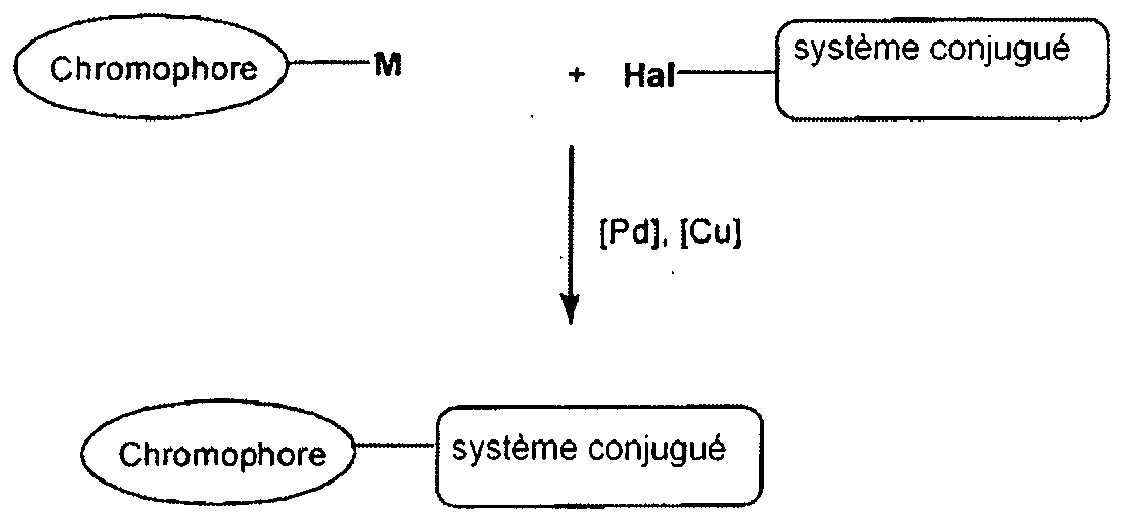 Hal = Br, I, Cl, tosyle,M = Sn(alkyle)3, B(OR)2, MgHal, ou ZnR2, R étant dans ce cas un groupe alkyle, de préférence un alkyle en C1-C12, et b) est l'introduction d'une fraction carboxyaldéhyde dans ledit système conjuguéet c) est la réaction de condensation du produit de l'étape b) avec un réactif de formule générale A-CH2-G, comme représenté par le schéma
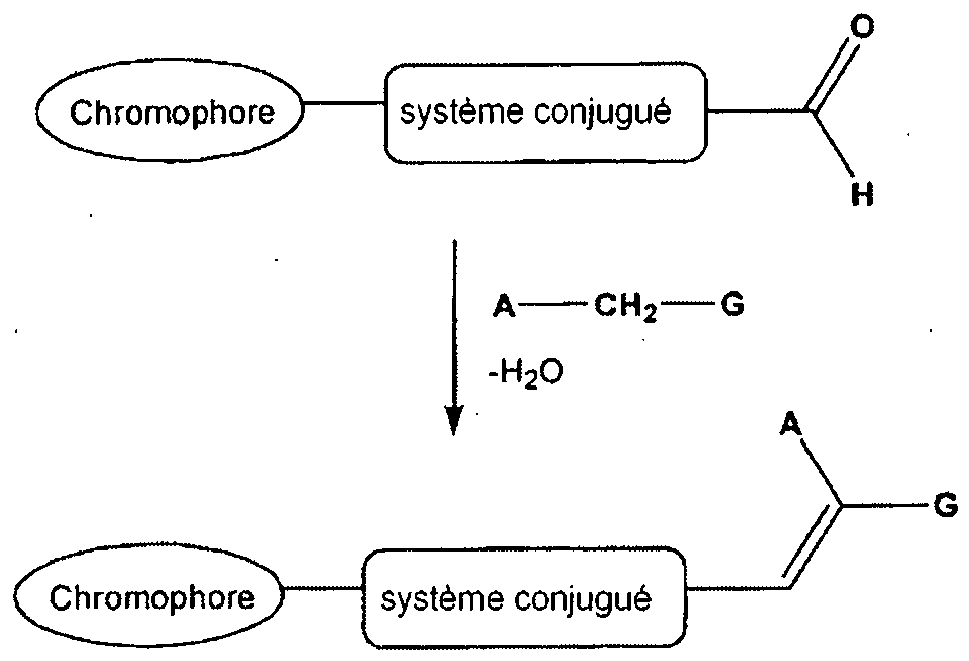
- Procédé de synthèse d'un colorant selon l'une quelconque des revendications 1 à 3, comprenant les étapes suivantes :a) introduction d'un groupe d'ancrage tel que défini dans la revendication 1, dans lequel G = Gp, Gp étant choisi parmi -COOR, -SO3R, -PO3R2, -BO2R2, -SR, -OR et -NR2, R étant n'importe quelle chaîne alkyle linéaire ou ramifiée de formule générale -CnH2n+1, n = 1-12, dans un système conjugué fonctionnalisé,b) couplage d'un chromophore et du produit de l'étape a), de préférence sous catalyse par métal de transition,
ledit chromophore étant tel que défini dans l'une quelconque des revendications 1 et 3, ledit système conjugué étant tel que défini dans la revendication 2 et ledit groupe d'ancrage étant tel que défini dans la revendication 1,c) déprotection de Gp en G, G étant tel que défini dans la revendication 1,
dans lequel, de préférence, ledit système conjugué fonctionnalisé est un système conjugué métallé, et l'étape a) est l'introduction dudit groupe d'ancrage dans ledit système conjugué fonctionnalisé, b) est le couplage d'un chromophore halogéné et du produit de l'étape a), et les étapes a) et b) sont représentées par le schéma
ledit système conjugué est un système conjugué halogéné, l'étape b) est le couplage d'un chromophore métallé et du produit de l'étape a), et les étapes a) et b) sont représentées par le schéma

- Procédé de synthèse d'un colorant selon l'une quelconque des revendications 1 à 3, comprenant les étapes suivantes :a) introduction d'une fraction carboxyaldéhyde dans un chromophore,b) transformation de ladite fraction carboxyaldéhyde en un groupe d'ancrage par réaction du produit de l'étape a) avec A-CH2-G, où A et G sont tels que définis dans la revendication 1,
ledit chromophore étant tel que défini dans l'une quelconque des revendications 1 et 3, et ledit groupe d'ancrage étant tel que défini dans la revendication 1, dans lequel, de préférence, l'étape a) est l'introduction d'une fraction carboxyaldéhyde dans un chromophore, comme représenté par le schéma
et b) est la réaction de condensation du produit de l'étape a) avec un réactif de formule générale A-CH2-G, comme représenté par le schéma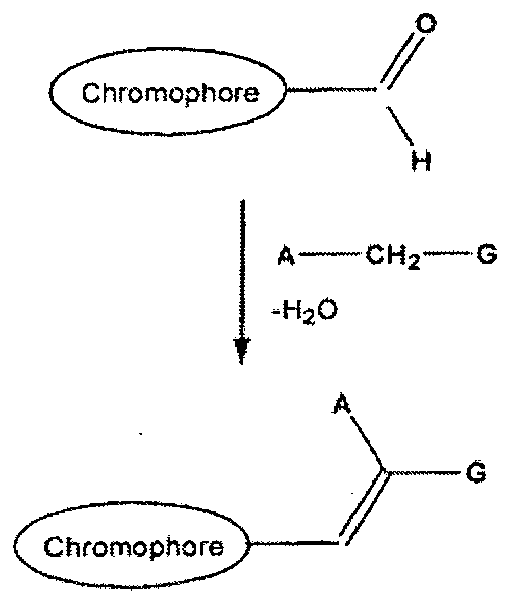
- Dispositif électronique comprenant un colorant tel que défini dans l'une quelconque des revendications 1 à 3 qui, de préférence, est une cellule solaire, mieux une cellule solaire à colorant, dans lequel, mieux encore, dans la cellule solaire à colorant, ledit colorant est chimisorbé sur une couche semi-conductrice photoactive.
- Dispositif selon la revendication 9, comprenant en outre au moins un autre colorant, dans lequel, de préférence, ledit au moins un autre colorant est un colorant tel que défini dans l'une quelconque des revendications 1 à 3, dans lequel, mieux encore, ledit au moins un autre colorant est un sel de bis-tétrabutylammonium de cis-bis(isothiocyanato)bis(2,2'-bipyridyl-4,4'-dicarboxylato)-ruthénium(II) ou de tris-tétrabutylammonium d'acide tris(isothiocyanato)-ruthénium(II)-2,2':6',2"-terpyridine-4,4',4"-tricarboxylique ou une combinaison des deux.
- Utilisation d'un colorant tel que défini dans l'une quelconque des revendications 1 à 3 comme sensibilisant dans une cellule solaire à colorant, de préférence conjointement avec au moins un autre colorant, mieux ledit au moins un autre colorant étant un colorant tel que défini dans l'une quelconque des revendications 1 à 3, mieux encore ledit au moins un autre colorant étant un sel de bis-tétrabutylammonium de cis-bis(isothiocyanato)bis(2,2'-bipyridyl-4,4'-dicarboxylato)-ruthénium(II) ou de tris-tétrabutylammonium d'acide tris(isothiocyanato)-ruthénium(II)-2,2':6',2"-terpyridine-4,4',4"-tricarboxylique ou une combinaison des deux.
Priority Applications (1)
| Application Number | Priority Date | Filing Date | Title |
|---|---|---|---|
| EP08840975.0A EP2208212B1 (fr) | 2007-10-25 | 2008-10-27 | Colorant comprenant un groupe d'ancrage dans sa structure moleculaire |
Applications Claiming Priority (4)
| Application Number | Priority Date | Filing Date | Title |
|---|---|---|---|
| EP07020925A EP2053618A1 (fr) | 2007-10-25 | 2007-10-25 | Teinture comprenant un groupe d'ancrage dans sa structure moléculaire |
| EP08007856A EP2112671A1 (fr) | 2008-04-23 | 2008-04-23 | Teinture comprenant un groupe d'ancrage dans sa structure moléculaire |
| PCT/EP2008/009075 WO2009053108A1 (fr) | 2007-10-25 | 2008-10-27 | Colorant comprenant un groupe d'ancrage dans sa structure moléculaire |
| EP08840975.0A EP2208212B1 (fr) | 2007-10-25 | 2008-10-27 | Colorant comprenant un groupe d'ancrage dans sa structure moleculaire |
Publications (2)
| Publication Number | Publication Date |
|---|---|
| EP2208212A1 EP2208212A1 (fr) | 2010-07-21 |
| EP2208212B1 true EP2208212B1 (fr) | 2015-12-09 |
Family
ID=40265968
Family Applications (2)
| Application Number | Title | Priority Date | Filing Date |
|---|---|---|---|
| EP08840975.0A Not-in-force EP2208212B1 (fr) | 2007-10-25 | 2008-10-27 | Colorant comprenant un groupe d'ancrage dans sa structure moleculaire |
| EP08842861A Ceased EP2212895A1 (fr) | 2007-10-25 | 2008-10-27 | Colorants à base de squarylium comprenant un groupe d'ancrage |
Family Applications After (1)
| Application Number | Title | Priority Date | Filing Date |
|---|---|---|---|
| EP08842861A Ceased EP2212895A1 (fr) | 2007-10-25 | 2008-10-27 | Colorants à base de squarylium comprenant un groupe d'ancrage |
Country Status (7)
| Country | Link |
|---|---|
| US (2) | US8440840B2 (fr) |
| EP (2) | EP2208212B1 (fr) |
| JP (2) | JP5584127B2 (fr) |
| CN (2) | CN101836274B (fr) |
| BR (1) | BRPI0818449A2 (fr) |
| RU (1) | RU2490746C2 (fr) |
| WO (2) | WO2009053108A1 (fr) |
Families Citing this family (32)
| Publication number | Priority date | Publication date | Assignee | Title |
|---|---|---|---|---|
| US8440840B2 (en) * | 2007-10-25 | 2013-05-14 | Sony Corporation | Dye including an anchoring group in its molecular structure |
| CN102197097A (zh) * | 2008-10-27 | 2011-09-21 | 索尼公司 | 包含连接有偶姻基团的发色团的染料 |
| WO2010088723A1 (fr) * | 2009-02-03 | 2010-08-12 | University Of Wollongong | Composition de colorant pour un usage dans un matériau photoélectrique |
| KR101107069B1 (ko) * | 2009-07-10 | 2012-01-20 | 삼성에스디아이 주식회사 | 염료 감응 태양 전지용 염료 및 이를 이용하여 제조된 염료 감응 태양 전지 |
| JP5590552B2 (ja) * | 2010-04-13 | 2014-09-17 | 国立大学法人広島大学 | 色素増感型光電変換素子 |
| GB2481035A (en) * | 2010-06-09 | 2011-12-14 | Univ Bangor | Preparing dye sensitised solar cells (DSSC) with multiple dyes |
| JP2012072228A (ja) * | 2010-09-28 | 2012-04-12 | Yamamoto Chem Inc | アクリル酸系化合物、該化合物を用いた色素増感太陽電池 |
| US20160225534A1 (en) * | 2010-12-16 | 2016-08-04 | National Yunlin University Of Science And Technology | Composite dye-sensitized solar cell |
| US20130327401A1 (en) * | 2010-12-16 | 2013-12-12 | National Yunlin University Of Science And Technology | Composite dye-sensitized solar cell |
| JP2012131906A (ja) * | 2010-12-22 | 2012-07-12 | Toyo Ink Sc Holdings Co Ltd | 色素および色素増感太陽電池 |
| WO2012114552A1 (fr) * | 2011-02-23 | 2012-08-30 | ソニー株式会社 | Film électroconducteur transparent, dispositif de saisie d'informations et appareil électronique |
| ITRM20110184A1 (it) * | 2011-04-12 | 2012-10-13 | Dyepower | Procedimento di sinterizzazione di formulazioni a base di ossidi metallici. |
| US20140202537A1 (en) * | 2011-08-25 | 2014-07-24 | Liyuan Han | Dye-sensitized solar cell and sensitizing dye |
| JP5901983B2 (ja) * | 2012-01-31 | 2016-04-13 | 株式会社フジクラ | 色素増感太陽電池 |
| WO2013142595A1 (fr) * | 2012-03-21 | 2013-09-26 | The University Of North Carolina At Chapel Hill | Ensembles moléculaires et films multicouches pour photocourant et catalyse |
| JP5846579B2 (ja) * | 2012-03-23 | 2016-01-20 | 新日鉄住金化学株式会社 | ポリメチン色素前駆体、その前駆体の骨格を含むスクアリリウム色素、それを用いた色素増感太陽電池、光電変換素子 |
| TWI434895B (zh) | 2012-03-28 | 2014-04-21 | Ind Tech Res Inst | 染料與光電轉換裝置 |
| US9755155B2 (en) * | 2012-05-07 | 2017-09-05 | Sony Corporation | Organic compounds containing squaric acid or croconic acid moieties for application in electronic devices |
| JP5992389B2 (ja) | 2012-11-16 | 2016-09-14 | 富士フイルム株式会社 | 光電変換素子、色素増感太陽電池、金属錯体色素、色素溶液、色素吸着電極および色素増感太陽電池の製造方法 |
| US20150294796A1 (en) * | 2012-11-21 | 2015-10-15 | North Carolina State University | Assemblies and methods of stabilization |
| WO2014103831A1 (fr) * | 2012-12-28 | 2014-07-03 | 株式会社Adeka | Corps chargé et élément de conversion photoélectrique |
| US20140216553A1 (en) * | 2013-02-04 | 2014-08-07 | Sean Vail | Dye-Sensitized Solar Cell via Co-Sensitization with Cooperative Dyes |
| JP6104199B2 (ja) * | 2014-03-12 | 2017-03-29 | 富士フイルム株式会社 | 感熱性発色組成物、及び、赤外線感光性発色組成物 |
| WO2015190398A1 (fr) * | 2014-06-13 | 2015-12-17 | 富士フイルム株式会社 | Élément de conversion photoélectrique, cellule solaire à colorant, colorant complexe à base de ruthénium, solution de colorant, et composé de bipyridine |
| US11352500B2 (en) * | 2015-01-27 | 2022-06-07 | Sony Corporation | Squaraine-based molecules as material for organic photoelectric conversion layers in organic photodiodes |
| KR102013538B1 (ko) * | 2015-09-17 | 2019-08-22 | 후지필름 가부시키가이샤 | 광전 변환 소자, 색소 증감 태양 전지, 색소 조성물 및 산화물 반도체 전극 |
| US11377562B2 (en) | 2016-07-28 | 2022-07-05 | Council Of Scientific & Industrial Research | Squaraine dyes and applications thereof |
| KR102214877B1 (ko) * | 2016-12-07 | 2021-02-09 | 후지필름 가부시키가이샤 | 광전 변환 소자, 광 센서 및 촬상 소자 |
| CN109928894B (zh) * | 2018-10-09 | 2022-05-03 | 宁波卢米蓝新材料有限公司 | 一种含有多元环的化合物、应用及有机电致发光器件 |
| CN115696934B (zh) * | 2022-10-27 | 2026-04-17 | 浙江大学杭州国际科创中心 | 基于超分子弱相互作用的分子器件及其制备、使用与应用 |
| KR102850837B1 (ko) * | 2022-11-30 | 2025-08-27 | 주식회사 엘엠에스 | 흡수제 |
| KR102745217B1 (ko) * | 2022-12-07 | 2024-12-23 | 주식회사 엘엠에스 | 흡수제 조성물 |
Family Cites Families (10)
| Publication number | Priority date | Publication date | Assignee | Title |
|---|---|---|---|---|
| DE69939147D1 (de) | 1998-09-30 | 2008-09-04 | Fujifilm Corp | Mit einem Methinfarbstoff sensibilisierte Halbleiterteilchen |
| US6403807B1 (en) * | 1999-07-06 | 2002-06-11 | Surromed, Inc. | Bridged fluorescent dyes, their preparation and their use in assays |
| JP2002105346A (ja) * | 2000-07-25 | 2002-04-10 | Fuji Photo Film Co Ltd | 金属錯体色素、光電変換素子および光電池 |
| US7141735B2 (en) * | 2000-07-27 | 2006-11-28 | Nippon Kayaku Kabushiki Kaisha | Dye-sensitized photoelectric conversion device |
| JP5142307B2 (ja) * | 2000-11-28 | 2013-02-13 | 独立行政法人産業技術総合研究所 | 有機色素を光増感剤とする半導体薄膜電極、光電変換素子 |
| WO2004082061A1 (fr) * | 2003-03-14 | 2004-09-23 | Nippon Kayaku Kabushiki Kaisha | Dispositif de conversion photoelectrique sensibilise par colorant |
| RU2264407C1 (ru) * | 2004-07-30 | 2005-11-20 | Государственное образовательное учреждение высшего профессионального образования "Ивановский государственный химико-технологический университет" (ГОУВПО "ИГХТУ") | Металлокомплексы тетра-(три-5,6,8- карбокси)антрахинонопорфиразина |
| JP2006111783A (ja) * | 2004-10-15 | 2006-04-27 | Seimi Chem Co Ltd | 新規アミノ基含有複素環誘導体および該複素環誘導体を含有する光電変換用増感色素 |
| US8044219B2 (en) * | 2005-05-13 | 2011-10-25 | Agc Seimi Chemical., Ltd. | Amino group-containing heterocyclic derivatives and sensitizing dyes for photoelectric conversion containing the heterocyclic derivatives |
| US8440840B2 (en) * | 2007-10-25 | 2013-05-14 | Sony Corporation | Dye including an anchoring group in its molecular structure |
-
2008
- 2008-10-27 US US12/738,703 patent/US8440840B2/en not_active Expired - Fee Related
- 2008-10-27 CN CN200880112883.8A patent/CN101836274B/zh not_active Expired - Fee Related
- 2008-10-27 WO PCT/EP2008/009075 patent/WO2009053108A1/fr not_active Ceased
- 2008-10-27 BR BRPI0818449 patent/BRPI0818449A2/pt not_active IP Right Cessation
- 2008-10-27 US US12/739,573 patent/US8445697B2/en not_active Expired - Fee Related
- 2008-10-27 JP JP2010530353A patent/JP5584127B2/ja not_active Expired - Fee Related
- 2008-10-27 CN CN2008801128842A patent/CN101836275B/zh not_active Expired - Fee Related
- 2008-10-27 EP EP08840975.0A patent/EP2208212B1/fr not_active Not-in-force
- 2008-10-27 JP JP2010530352A patent/JP5501239B2/ja not_active Expired - Fee Related
- 2008-10-27 RU RU2010120881/04A patent/RU2490746C2/ru not_active IP Right Cessation
- 2008-10-27 EP EP08842861A patent/EP2212895A1/fr not_active Ceased
- 2008-10-27 WO PCT/EP2008/009074 patent/WO2009053107A1/fr not_active Ceased
Non-Patent Citations (1)
| Title |
|---|
| KOHJIRO HARA ET AL: "Molecular Design of Coumarin Dyes for Efficient Dye-Sensitized Solar Cells", JOURNAL OF PHYSICAL CHEMISTRY. B (ONLINE), AMERICAN CHEMICAL SOCIETY, COLUMBUS, OH, US, vol. 107, no. 2, 16 January 2003 (2003-01-16), pages 597 - 606, XP002668245, ISSN: 1520-5207, DOI: 10.1021/JP026963X * |
Also Published As
| Publication number | Publication date |
|---|---|
| WO2009053107A1 (fr) | 2009-04-30 |
| WO2009053108A1 (fr) | 2009-04-30 |
| JP5584127B2 (ja) | 2014-09-03 |
| US8445697B2 (en) | 2013-05-21 |
| CN101836275B (zh) | 2013-11-06 |
| RU2490746C2 (ru) | 2013-08-20 |
| JP5501239B2 (ja) | 2014-05-21 |
| EP2212895A1 (fr) | 2010-08-04 |
| BRPI0818449A2 (pt) | 2015-05-12 |
| JP2011502187A (ja) | 2011-01-20 |
| US20100300521A1 (en) | 2010-12-02 |
| CN101836274A (zh) | 2010-09-15 |
| CN101836274B (zh) | 2014-03-26 |
| RU2010120881A (ru) | 2011-11-27 |
| US8440840B2 (en) | 2013-05-14 |
| JP2011504190A (ja) | 2011-02-03 |
| US20100212737A1 (en) | 2010-08-26 |
| CN101836275A (zh) | 2010-09-15 |
| EP2208212A1 (fr) | 2010-07-21 |
Similar Documents
| Publication | Publication Date | Title |
|---|---|---|
| EP2208212B1 (fr) | Colorant comprenant un groupe d'ancrage dans sa structure moleculaire | |
| Hagberg et al. | Symmetric and unsymmetric donor functionalization. comparing structural and spectral benefits of chromophores for dye-sensitized solar cells | |
| Tang et al. | Starburst triphenylamine-based cyanine dye for efficient quasi-solid-state dye-sensitized solar cells | |
| KR101043264B1 (ko) | 색소증감 광전 변환 소자 | |
| EP1798804A1 (fr) | Dispositifs de conversion photoélectriques sensibilisés par teinture | |
| US9679702B2 (en) | Dye comprising a chromophore to which an acyloin group is attached | |
| Qian et al. | Indeno [1, 2-b] indole-based organic dyes with different acceptor groups for dye-sensitized solar cells | |
| Liao et al. | Novel BODIPY dyes with electron donor variety for dye-sensitized solar cells | |
| Cogal et al. | Asymmetric phthalocyanine derivatives containing 4-carboxyphenyl substituents for dye-sensitized solar cells | |
| KR20080077765A (ko) | 신규한 루테늄계 염료 및 이의 제조방법 | |
| JP4230228B2 (ja) | 色素増感光電変換素子 | |
| JP5794589B2 (ja) | 色素増感太陽電池及び増感色素 | |
| EP2053618A1 (fr) | Teinture comprenant un groupe d'ancrage dans sa structure moléculaire | |
| Siu et al. | Optimizing the photovoltaic performance of thiocyanate-free ruthenium photosensitizers by structural modification of C^ N cyclometalating ligand in dye-sensitized solar cells | |
| EP2112671A1 (fr) | Teinture comprenant un groupe d'ancrage dans sa structure moléculaire | |
| Houarner-Rassin et al. | Improved efficiency of a thiophene linked ruthenium polypyridine complex for dry dye-sensitized solar cells | |
| KR20080103683A (ko) | 신규한 줄로리딘계 염료 및 이의 제조방법 | |
| KR20100128258A (ko) | 신규한 루테늄계 염료 및 이의 제조방법 | |
| Arcos et al. | Structural effects on the photoelectrochemical properties of new push-pull dyes based on vinazene acceptor triphenylamine donor | |
| KR20100128255A (ko) | 신규한 스파이로바이플루오렌계 염료 및 이의 제조방법 | |
| Ooyama et al. | Dye-sensitized solar cells based on D–π–A fluorescent dyes with pyridine ring forming strong interaction with nanocrystalline TiO2 | |
| CN104479391B (zh) | 一种双咔唑D-D-π-A型染料、制备方法及应用 | |
| Cao et al. | N‐Aryl Arenedicarboximides as Tunable Panchromatic Dyes for Molecular Solar Cells | |
| Nakao | Study on Highly Efficient Organic Sensitizers for Dye-Sensitized Solar Cells Using Novel Squarylium Dyes |
Legal Events
| Date | Code | Title | Description |
|---|---|---|---|
| PUAI | Public reference made under article 153(3) epc to a published international application that has entered the european phase |
Free format text: ORIGINAL CODE: 0009012 |
|
| 17P | Request for examination filed |
Effective date: 20100521 |
|
| AK | Designated contracting states |
Kind code of ref document: A1 Designated state(s): AT BE BG CH CY CZ DE DK EE ES FI FR GB GR HR HU IE IS IT LI LT LU LV MC MT NL NO PL PT RO SE SI SK TR |
|
| AX | Request for extension of the european patent |
Extension state: AL BA MK RS |
|
| 17Q | First examination report despatched |
Effective date: 20101124 |
|
| DAX | Request for extension of the european patent (deleted) | ||
| GRAP | Despatch of communication of intention to grant a patent |
Free format text: ORIGINAL CODE: EPIDOSNIGR1 |
|
| RIC1 | Information provided on ipc code assigned before grant |
Ipc: C09B 57/00 20060101ALI20150217BHEP Ipc: H01L 51/30 20060101ALI20150217BHEP Ipc: H01G 9/20 20060101AFI20150217BHEP |
|
| INTG | Intention to grant announced |
Effective date: 20150302 |
|
| GRAP | Despatch of communication of intention to grant a patent |
Free format text: ORIGINAL CODE: EPIDOSNIGR1 |
|
| GRAJ | Information related to disapproval of communication of intention to grant by the applicant or resumption of examination proceedings by the epo deleted |
Free format text: ORIGINAL CODE: EPIDOSDIGR1 |
|
| INTG | Intention to grant announced |
Effective date: 20150527 |
|
| GRAP | Despatch of communication of intention to grant a patent |
Free format text: ORIGINAL CODE: EPIDOSNIGR1 |
|
| INTC | Intention to grant announced (deleted) | ||
| INTG | Intention to grant announced |
Effective date: 20150709 |
|
| GRAS | Grant fee paid |
Free format text: ORIGINAL CODE: EPIDOSNIGR3 |
|
| GRAA | (expected) grant |
Free format text: ORIGINAL CODE: 0009210 |
|
| AK | Designated contracting states |
Kind code of ref document: B1 Designated state(s): AT BE BG CH CY CZ DE DK EE ES FI FR GB GR HR HU IE IS IT LI LT LU LV MC MT NL NO PL PT RO SE SI SK TR |
|
| REG | Reference to a national code |
Ref country code: GB Ref legal event code: FG4D |
|
| REG | Reference to a national code |
Ref country code: AT Ref legal event code: REF Ref document number: 764885 Country of ref document: AT Kind code of ref document: T Effective date: 20151215 Ref country code: CH Ref legal event code: EP |
|
| REG | Reference to a national code |
Ref country code: IE Ref legal event code: FG4D |
|
| REG | Reference to a national code |
Ref country code: DE Ref legal event code: R096 Ref document number: 602008041593 Country of ref document: DE |
|
| REG | Reference to a national code |
Ref country code: LT Ref legal event code: MG4D |
|
| REG | Reference to a national code |
Ref country code: NL Ref legal event code: MP Effective date: 20151209 |
|
| PG25 | Lapsed in a contracting state [announced via postgrant information from national office to epo] |
Ref country code: NO Free format text: LAPSE BECAUSE OF FAILURE TO SUBMIT A TRANSLATION OF THE DESCRIPTION OR TO PAY THE FEE WITHIN THE PRESCRIBED TIME-LIMIT Effective date: 20160309 Ref country code: LT Free format text: LAPSE BECAUSE OF FAILURE TO SUBMIT A TRANSLATION OF THE DESCRIPTION OR TO PAY THE FEE WITHIN THE PRESCRIBED TIME-LIMIT Effective date: 20151209 Ref country code: ES Free format text: LAPSE BECAUSE OF FAILURE TO SUBMIT A TRANSLATION OF THE DESCRIPTION OR TO PAY THE FEE WITHIN THE PRESCRIBED TIME-LIMIT Effective date: 20151209 |
|
| REG | Reference to a national code |
Ref country code: AT Ref legal event code: MK05 Ref document number: 764885 Country of ref document: AT Kind code of ref document: T Effective date: 20151209 |
|
| PG25 | Lapsed in a contracting state [announced via postgrant information from national office to epo] |
Ref country code: NL Free format text: LAPSE BECAUSE OF FAILURE TO SUBMIT A TRANSLATION OF THE DESCRIPTION OR TO PAY THE FEE WITHIN THE PRESCRIBED TIME-LIMIT Effective date: 20151209 Ref country code: LV Free format text: LAPSE BECAUSE OF FAILURE TO SUBMIT A TRANSLATION OF THE DESCRIPTION OR TO PAY THE FEE WITHIN THE PRESCRIBED TIME-LIMIT Effective date: 20151209 Ref country code: SE Free format text: LAPSE BECAUSE OF FAILURE TO SUBMIT A TRANSLATION OF THE DESCRIPTION OR TO PAY THE FEE WITHIN THE PRESCRIBED TIME-LIMIT Effective date: 20151209 Ref country code: GR Free format text: LAPSE BECAUSE OF FAILURE TO SUBMIT A TRANSLATION OF THE DESCRIPTION OR TO PAY THE FEE WITHIN THE PRESCRIBED TIME-LIMIT Effective date: 20160310 Ref country code: FI Free format text: LAPSE BECAUSE OF FAILURE TO SUBMIT A TRANSLATION OF THE DESCRIPTION OR TO PAY THE FEE WITHIN THE PRESCRIBED TIME-LIMIT Effective date: 20151209 |
|
| PG25 | Lapsed in a contracting state [announced via postgrant information from national office to epo] |
Ref country code: IS Free format text: LAPSE BECAUSE OF FAILURE TO SUBMIT A TRANSLATION OF THE DESCRIPTION OR TO PAY THE FEE WITHIN THE PRESCRIBED TIME-LIMIT Effective date: 20151209 |
|
| PG25 | Lapsed in a contracting state [announced via postgrant information from national office to epo] |
Ref country code: CZ Free format text: LAPSE BECAUSE OF FAILURE TO SUBMIT A TRANSLATION OF THE DESCRIPTION OR TO PAY THE FEE WITHIN THE PRESCRIBED TIME-LIMIT Effective date: 20151209 Ref country code: IT Free format text: LAPSE BECAUSE OF FAILURE TO SUBMIT A TRANSLATION OF THE DESCRIPTION OR TO PAY THE FEE WITHIN THE PRESCRIBED TIME-LIMIT Effective date: 20151209 |
|
| PG25 | Lapsed in a contracting state [announced via postgrant information from national office to epo] |
Ref country code: RO Free format text: LAPSE BECAUSE OF FAILURE TO SUBMIT A TRANSLATION OF THE DESCRIPTION OR TO PAY THE FEE WITHIN THE PRESCRIBED TIME-LIMIT Effective date: 20151209 Ref country code: IS Free format text: LAPSE BECAUSE OF FAILURE TO SUBMIT A TRANSLATION OF THE DESCRIPTION OR TO PAY THE FEE WITHIN THE PRESCRIBED TIME-LIMIT Effective date: 20160409 Ref country code: AT Free format text: LAPSE BECAUSE OF FAILURE TO SUBMIT A TRANSLATION OF THE DESCRIPTION OR TO PAY THE FEE WITHIN THE PRESCRIBED TIME-LIMIT Effective date: 20151209 Ref country code: EE Free format text: LAPSE BECAUSE OF FAILURE TO SUBMIT A TRANSLATION OF THE DESCRIPTION OR TO PAY THE FEE WITHIN THE PRESCRIBED TIME-LIMIT Effective date: 20151209 Ref country code: SK Free format text: LAPSE BECAUSE OF FAILURE TO SUBMIT A TRANSLATION OF THE DESCRIPTION OR TO PAY THE FEE WITHIN THE PRESCRIBED TIME-LIMIT Effective date: 20151209 Ref country code: PT Free format text: LAPSE BECAUSE OF FAILURE TO SUBMIT A TRANSLATION OF THE DESCRIPTION OR TO PAY THE FEE WITHIN THE PRESCRIBED TIME-LIMIT Effective date: 20160411 |
|
| REG | Reference to a national code |
Ref country code: DE Ref legal event code: R097 Ref document number: 602008041593 Country of ref document: DE |
|
| PLBE | No opposition filed within time limit |
Free format text: ORIGINAL CODE: 0009261 |
|
| STAA | Information on the status of an ep patent application or granted ep patent |
Free format text: STATUS: NO OPPOSITION FILED WITHIN TIME LIMIT |
|
| REG | Reference to a national code |
Ref country code: FR Ref legal event code: PLFP Year of fee payment: 9 |
|
| PG25 | Lapsed in a contracting state [announced via postgrant information from national office to epo] |
Ref country code: DK Free format text: LAPSE BECAUSE OF FAILURE TO SUBMIT A TRANSLATION OF THE DESCRIPTION OR TO PAY THE FEE WITHIN THE PRESCRIBED TIME-LIMIT Effective date: 20151209 Ref country code: PL Free format text: LAPSE BECAUSE OF FAILURE TO SUBMIT A TRANSLATION OF THE DESCRIPTION OR TO PAY THE FEE WITHIN THE PRESCRIBED TIME-LIMIT Effective date: 20151209 |
|
| 26N | No opposition filed |
Effective date: 20160912 |
|
| PG25 | Lapsed in a contracting state [announced via postgrant information from national office to epo] |
Ref country code: SI Free format text: LAPSE BECAUSE OF FAILURE TO SUBMIT A TRANSLATION OF THE DESCRIPTION OR TO PAY THE FEE WITHIN THE PRESCRIBED TIME-LIMIT Effective date: 20151209 |
|
| PG25 | Lapsed in a contracting state [announced via postgrant information from national office to epo] |
Ref country code: BE Free format text: LAPSE BECAUSE OF FAILURE TO SUBMIT A TRANSLATION OF THE DESCRIPTION OR TO PAY THE FEE WITHIN THE PRESCRIBED TIME-LIMIT Effective date: 20151209 |
|
| REG | Reference to a national code |
Ref country code: CH Ref legal event code: PL |
|
| REG | Reference to a national code |
Ref country code: IE Ref legal event code: MM4A |
|
| PG25 | Lapsed in a contracting state [announced via postgrant information from national office to epo] |
Ref country code: LI Free format text: LAPSE BECAUSE OF NON-PAYMENT OF DUE FEES Effective date: 20161031 Ref country code: CH Free format text: LAPSE BECAUSE OF NON-PAYMENT OF DUE FEES Effective date: 20161031 |
|
| PG25 | Lapsed in a contracting state [announced via postgrant information from national office to epo] |
Ref country code: LU Free format text: LAPSE BECAUSE OF NON-PAYMENT OF DUE FEES Effective date: 20161027 |
|
| REG | Reference to a national code |
Ref country code: FR Ref legal event code: PLFP Year of fee payment: 10 |
|
| PG25 | Lapsed in a contracting state [announced via postgrant information from national office to epo] |
Ref country code: IE Free format text: LAPSE BECAUSE OF NON-PAYMENT OF DUE FEES Effective date: 20161027 |
|
| PG25 | Lapsed in a contracting state [announced via postgrant information from national office to epo] |
Ref country code: CY Free format text: LAPSE BECAUSE OF FAILURE TO SUBMIT A TRANSLATION OF THE DESCRIPTION OR TO PAY THE FEE WITHIN THE PRESCRIBED TIME-LIMIT Effective date: 20151209 Ref country code: HU Free format text: LAPSE BECAUSE OF FAILURE TO SUBMIT A TRANSLATION OF THE DESCRIPTION OR TO PAY THE FEE WITHIN THE PRESCRIBED TIME-LIMIT; INVALID AB INITIO Effective date: 20081027 |
|
| PG25 | Lapsed in a contracting state [announced via postgrant information from national office to epo] |
Ref country code: TR Free format text: LAPSE BECAUSE OF FAILURE TO SUBMIT A TRANSLATION OF THE DESCRIPTION OR TO PAY THE FEE WITHIN THE PRESCRIBED TIME-LIMIT Effective date: 20151209 Ref country code: MC Free format text: LAPSE BECAUSE OF FAILURE TO SUBMIT A TRANSLATION OF THE DESCRIPTION OR TO PAY THE FEE WITHIN THE PRESCRIBED TIME-LIMIT Effective date: 20151209 Ref country code: HR Free format text: LAPSE BECAUSE OF FAILURE TO SUBMIT A TRANSLATION OF THE DESCRIPTION OR TO PAY THE FEE WITHIN THE PRESCRIBED TIME-LIMIT Effective date: 20151209 Ref country code: MT Free format text: LAPSE BECAUSE OF NON-PAYMENT OF DUE FEES Effective date: 20161031 |
|
| PG25 | Lapsed in a contracting state [announced via postgrant information from national office to epo] |
Ref country code: BG Free format text: LAPSE BECAUSE OF FAILURE TO SUBMIT A TRANSLATION OF THE DESCRIPTION OR TO PAY THE FEE WITHIN THE PRESCRIBED TIME-LIMIT Effective date: 20151209 |
|
| REG | Reference to a national code |
Ref country code: FR Ref legal event code: PLFP Year of fee payment: 11 |
|
| REG | Reference to a national code |
Ref country code: GB Ref legal event code: 746 Effective date: 20210920 |
|
| PGFP | Annual fee paid to national office [announced via postgrant information from national office to epo] |
Ref country code: FR Payment date: 20210922 Year of fee payment: 14 |
|
| PGFP | Annual fee paid to national office [announced via postgrant information from national office to epo] |
Ref country code: GB Payment date: 20210922 Year of fee payment: 14 |
|
| PGFP | Annual fee paid to national office [announced via postgrant information from national office to epo] |
Ref country code: DE Payment date: 20210921 Year of fee payment: 14 |
|
| REG | Reference to a national code |
Ref country code: DE Ref legal event code: R119 Ref document number: 602008041593 Country of ref document: DE |
|
| GBPC | Gb: european patent ceased through non-payment of renewal fee |
Effective date: 20221027 |
|
| PG25 | Lapsed in a contracting state [announced via postgrant information from national office to epo] |
Ref country code: FR Free format text: LAPSE BECAUSE OF NON-PAYMENT OF DUE FEES Effective date: 20221031 Ref country code: DE Free format text: LAPSE BECAUSE OF NON-PAYMENT OF DUE FEES Effective date: 20230503 |
|
| PG25 | Lapsed in a contracting state [announced via postgrant information from national office to epo] |
Ref country code: GB Free format text: LAPSE BECAUSE OF NON-PAYMENT OF DUE FEES Effective date: 20221027 |