EP2208758B1 - Polypropylenharzzusammensetzung für kfz-material - Google Patents
Polypropylenharzzusammensetzung für kfz-material Download PDFInfo
- Publication number
- EP2208758B1 EP2208758B1 EP08847504.1A EP08847504A EP2208758B1 EP 2208758 B1 EP2208758 B1 EP 2208758B1 EP 08847504 A EP08847504 A EP 08847504A EP 2208758 B1 EP2208758 B1 EP 2208758B1
- Authority
- EP
- European Patent Office
- Prior art keywords
- propylene
- polypropylene resin
- resin composition
- ethylene
- sol
- Prior art date
- Legal status (The legal status is an assumption and is not a legal conclusion. Google has not performed a legal analysis and makes no representation as to the accuracy of the status listed.)
- Active
Links
Images
Classifications
-
- C—CHEMISTRY; METALLURGY
- C08—ORGANIC MACROMOLECULAR COMPOUNDS; THEIR PREPARATION OR CHEMICAL WORKING-UP; COMPOSITIONS BASED THEREON
- C08L—COMPOSITIONS OF MACROMOLECULAR COMPOUNDS
- C08L53/00—Compositions of block copolymers containing at least one sequence of a polymer obtained by reactions only involving carbon-to-carbon unsaturated bonds; Compositions of derivatives of such polymers
-
- C—CHEMISTRY; METALLURGY
- C08—ORGANIC MACROMOLECULAR COMPOUNDS; THEIR PREPARATION OR CHEMICAL WORKING-UP; COMPOSITIONS BASED THEREON
- C08F—MACROMOLECULAR COMPOUNDS OBTAINED BY REACTIONS ONLY INVOLVING CARBON-TO-CARBON UNSATURATED BONDS
- C08F297/00—Macromolecular compounds obtained by successively polymerising different monomer systems using a catalyst of the ionic or coordination type without deactivating the intermediate polymer
- C08F297/06—Macromolecular compounds obtained by successively polymerising different monomer systems using a catalyst of the ionic or coordination type without deactivating the intermediate polymer using a catalyst of the coordination type
- C08F297/08—Macromolecular compounds obtained by successively polymerising different monomer systems using a catalyst of the ionic or coordination type without deactivating the intermediate polymer using a catalyst of the coordination type polymerising mono-olefins
- C08F297/083—Macromolecular compounds obtained by successively polymerising different monomer systems using a catalyst of the ionic or coordination type without deactivating the intermediate polymer using a catalyst of the coordination type polymerising mono-olefins the monomers being ethylene or propylene
-
- C—CHEMISTRY; METALLURGY
- C08—ORGANIC MACROMOLECULAR COMPOUNDS; THEIR PREPARATION OR CHEMICAL WORKING-UP; COMPOSITIONS BASED THEREON
- C08L—COMPOSITIONS OF MACROMOLECULAR COMPOUNDS
- C08L23/00—Compositions of homopolymers or copolymers of unsaturated aliphatic hydrocarbons having only one carbon-to-carbon double bond; Compositions of derivatives of such polymers
- C08L23/02—Compositions of homopolymers or copolymers of unsaturated aliphatic hydrocarbons having only one carbon-to-carbon double bond; Compositions of derivatives of such polymers not modified by chemical after-treatment
- C08L23/04—Homopolymers or copolymers of ethene
- C08L23/08—Copolymers of ethene
- C08L23/0807—Copolymers of ethene with unsaturated hydrocarbons only containing four or more carbon atoms
- C08L23/0815—Copolymers of ethene with unsaturated hydrocarbons only containing four or more carbon atoms with aliphatic 1-olefins containing one carbon-to-carbon double bond
-
- C—CHEMISTRY; METALLURGY
- C08—ORGANIC MACROMOLECULAR COMPOUNDS; THEIR PREPARATION OR CHEMICAL WORKING-UP; COMPOSITIONS BASED THEREON
- C08L—COMPOSITIONS OF MACROMOLECULAR COMPOUNDS
- C08L23/00—Compositions of homopolymers or copolymers of unsaturated aliphatic hydrocarbons having only one carbon-to-carbon double bond; Compositions of derivatives of such polymers
- C08L23/02—Compositions of homopolymers or copolymers of unsaturated aliphatic hydrocarbons having only one carbon-to-carbon double bond; Compositions of derivatives of such polymers not modified by chemical after-treatment
- C08L23/10—Homopolymers or copolymers of propene
- C08L23/12—Polypropene
Definitions
- the present invention relates to specific polypropylene resin compositions for automobile parts.
- the present invention relates to polypropylene resin compositions that can produce injection molded articles having excellent rigidity and impact resistance, less weld lines and flow marks and good appearance and are suitable for producing injection molded automobile parts.
- Polypropylene resin compositions have a wide range of uses as rigid and heat resistant materials. For example, they are widely used as materials for automobile parts such as bumpers, instrumental panels (dashboards), door trims and pillars.
- the use as automobile parts requires excellent general properties such as rigidity, heat resistance and light resistance, and also high impact resistance.
- an ethylene/propylene random copolymer part is formed during the polymer production process to be a block copolymer, or an ethylene/ ⁇ -olefin copolymer rubber is added after the polymer production.
- molded articles used as automobile parts are relatively large and frequently have complicated shapes.
- JP-A-2003-041088 Patent Document 1 discloses a material designed for large molded articles having excellent appearance with less weld lines or flow marks. However, the document does not explicitly describe the appearance balance between weld lines and flow marks, and does not ensure sufficient appearance balance.
- Patent Document 1 JP-A-2003-041088
- the polypropylene resin composition further comprises:
- An injection molded article according to the present invention is obtained by injection molding the polypropylene resin composition and is suitably used as an automobile part.
- the injection molded article is an automobile part.
- the polypropylene resin compositions of the present invention can give injection molded articles having excellent mechanical properties and good appearance with less weld lines and flow marks.
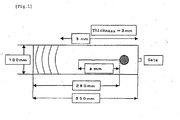
- Fig. 1 is a schematic view that explains how a weld length and a flow mark-free length are measured.
- the propylene block copolymer (A-1) according to the present invention comprises a propylene homopolymer part and an ethylene/propylene random copolymer part and has a melt flow rate (MFR) (230°C, 2.16 kg load) of 50 to 200 g/10 min, preferably 50 to 150 g/10 min, more preferably 50 to 140 g/10 min, and still more preferably 70 to 120 g/10 min.
- MFR melt flow rate
- the propylene block copolymer (A-1) according to the present invention is fractionated into a room temperature n-decane insoluble part (D insol (1)) composed mainly of the propylene homopolymer part and a room temperature n-decane soluble part (D sol (1)) composed mainly of the ethylene/propylene random copolymer part.
- the content of the D insol (1) is 70 to 95 wt%, preferably 75 to 95 wt%, and more preferably 82 to 92 wt%.
- the content of the D sol (1) is 5 to 30 wt%, preferably 5 to 25 wt%, and more preferably 8 to 18 wt%.
- the D insol (1) has an isotactic pentad fraction (mmmm) of not less than 97% according to 13 C-NMR.
- the isotactic pentad fraction represents a proportion of isotactic pentad sequences relative to the pentad sequences in a propylene homopolymer molecular chain measured by 13 C-NMR.
- the isotactic pentad fraction is a ratio of the 13 C-NMR spectrum absorption intensity of the methyl groups in the central propylene monomer unit of five consecutively meso-linked propylene monomer units, relative to the total absorption intensity of the methyl carbon region.
- the D insol (1) preferably has a melt flow rate (MFR) (230°C, 2.16 kg load) of 2 to 1000 g/10 min, more preferably 20 to 400 g/10 min, still more preferably 50 to 300 g/10 min, and particularly preferably 80 to 250 g/10 min.
- MFR melt flow rate
- the D sol (1) has an intrinsic viscosity [ ⁇ ] of 4 to 10 dl/g, and preferably 5 to 9 dl/g as determined at 135°C in decalin.
- the D sol (1) has a content of ethylene-derived structural units of 20 to 60 mol%, and preferably 30 to 50 mol% according to 13 C-NMR.
- the D sol (1) may contain structural units derived from known olefins such as butene and hexene, dienes such as 1,7-octadiene, and vinyl compounds such as styrene while still achieving the object of the present invention. Of these, butene-derived structural units are preferable.
- the content of these optional structural units derived from the compounds such as olefins is 0 to 5 mol%, and preferably 0 to 2 mol%.
- the D insol (1) may contain structural units derived from ethylene or the above compounds. The content of these structural units is preferably 0 to 2 mol%, and more preferably 0 to 1 mol%.
- the block copolymer has a melt flow rate or an intrinsic viscosity below the above range, the obtainable resin compositions tend to give molded articles having flow marks and weld lines.
- the propylene block copolymer (A-2) according to the present invention comprises a propylene homopolymer part and an ethylene/propylene random copolymer part and has a melt flow rate (MFR) (230°C, 2.16 kg load) of 1 to 200 g/10 min, preferably 20 to 140 g/10 min, and more preferably 30 to 140 g/10 min.
- MFR melt flow rate
- the propylene block copolymer (A-2) according to the present invention is fractionated into a room temperature n-decane insoluble part (D insol (2)) composed mainly of the propylene homopolymer part and a room temperature n-decane soluble part (D sol (2)) composed mainly of the ethylene/propylene random copolymer part.
- the content of the D insol (2) is 70 to 95 wt%, and preferably 75 to 90 wt%.
- the content of the D sol (2) is 5 to 30 wt%, and preferably 10 to 25 wt%.
- the D insol (2) preferably has a melt flow rate (MFR) (230°C, 2.16 kg load) of 1 to 600 g/10 min, more preferably 10 to 300 g/10 min, still more preferably 20 to 130 g/10 min, and particularly preferably 30 to 100 g/10 min.
- MFR melt flow rate
- the D insol (2) has an isotactic pentad fraction (mmmm) of not less than 97% according to 13 C-NMR
- the D sol (2) has an intrinsic viscosity [ ⁇ ] of 1.5 to 3.5 dl/g, and preferably 2 to 3.5 dl/g as determined at 135°C in decalin.
- the D sol (2) has an ethylene content of 20 to 60 mol%, and preferably 30 to 50 mol% according to 13 C-NMR.
- the D sol (2) of the present invention may contain structural units derived from known olefins such as butene and hexene, dienes such as 1,7-octadiene, and vinyl compounds such as styrene while still achieving the object of the present invention. Of these, butene-derived structural units are preferable.
- the content of these optional structural units derived from the compounds such as olefins is 0 to 5 mol%, and preferably 0 to 2 mol%.
- the D insol (2) may contain structural units derived from ethylene or the above compounds. The content of these structural units is preferably 0 to 2 mol%, and more preferably 0 to 1 mol%.
- the block copolymer has MFR or an intrinsic viscosity below the above range, the obtainable resin compositions tend to give molded articles having flow marks and weld lines.
- the propylene homopolymer (A-3) according to the present invention has an isotactic pentad fraction (mmmm) of not less than 97% according to 13 C-NMR and a melt flow rate (MFR) (230°C, 2.16 kg load) of 5 to 500 g/10 min, preferably 15 to 300 g/10 min, and more preferably 30 to 200 g/10 min.
- MFR melt flow rate
- Each of the components (A-1) to (A-3) according to the present invention may be produced using a known titanium catalyst.
- Preferred examples of the titanium catalysts include solid polymerization catalysts wherein main components are a solid titanium catalyst component containing titanium, magnesium and halogen, and an aluminum compound.
- the propylene block copolymers (A-1) and (A-2) of the present invention may be produced by multistage polymerization in the presence of a highly stereospecific polypropylene production catalyst according to a method described in Japanese Patent Application No. H11-107975 or JP-A-2004-262993 .
- the propylene block copolymer may be produced by multistage polymerization that has two or more stages including: a first stage wherein propylene is polymerized in the substantial presence or absence of hydrogen to afford a propylene homopolymer part in an amount that will account for 75 to 95 wt% of the final propylene block copolymer; and a later stage wherein ethylene and propylene are copolymerized to give an ethylene/propylene random copolymer part in an amount that will account for 5 to 25 wt% of the final propylene block copolymer, these stages being performed in the presence of a highly stereospecific polypropylene production catalyst that includes (i) a solid titanium catalyst component containing magnesium, titanium, a halogen and an electron donor, (ii) an organometallic compound catalyst component, and (iii) a donor component.
- MFR and intrinsic viscosity [ ⁇ ] of the propylene block copolymers (A-1) and (A-2) may be controlled appropriately by for example
- the multistage polymerization may be carried out continuously, batchwise, or semi-continuously, and is preferably carried out continuously.
- the polymerization may be performed by known methods including gas-phase polymerization and liquid-phase polymerization such as solution polymerization, slurry polymerization or bulk polymerization. Polymerization in the second and later stages is preferably carried out continuously from the previous stage. In the case of batch polymerization, the multistage polymerization may be performed in one polymerization reactor.
- Inert hydrocarbons may be used as polymerization media, or liquid propylene may be used as a polymerization medium.
- Polymerization conditions in each stage are appropriately selected while the polymerization temperature is about -50 to +200°C, preferably about 20 to 100°C, and the polymerization pressure is atmospheric pressure to 9.8 MPa (gauge pressure), preferably about 0.2 to 4.9 MPa (gauge pressure).
- the propylene homopolymer (A-3) of the present invention may be produced by single-stage or multistage, i.e., two or more stages, polymerization of propylene alone according to the method for producing the copolymers (A-1) and (A-2).
- Examples of the ethylene/ ⁇ -olefin copolymer rubbers (B) according to the present invention include ethylene/ ⁇ -olefin copolymers and ethylene/ ⁇ -olefin/non-conjugated diene copolymers.
- the ⁇ -olefins include ⁇ -olefins having 3 to 10 carbon atoms, with propylene, 1-butene, 1-hexene and 1-octene being concretely preferred.
- the non-conjugated dienes include cyclic non-conjugated dienes such as 5-ethylidene-2-norbornene, 5-propylidene-2-norbornene, dicyclopentadiene, 5-vinyl-2-norbornene, 5-methylene-2-norbornene, 5-isopropylidene-2-norbornene and norbornadiene; and linear non-conjugated dienes such as 1,4-hexadiene, 4-methyl-1,4-hexadiene, 5-methyl-1,4-hexadiene, 5-methyl-1,4-hexadiene, 5-methyl-1,5-heptadiene, 6-methyl-1,5-heptadiene, 6-methyl-1,7-octadiene and
- ethylene/ ⁇ -olefin copolymer rubbers (B) ethylene/propylene copolymer and ethylene/butene copolymer are preferable.
- the content of propylene or butene in the copolymer is in the range of 5 to 80 wt%, preferably 10 to 60 wt%, and more preferably 15 to 50 wt%.
- the ethylene/ ⁇ -olefin copolymer rubbers (B) may be produced by known methods or may be commercially obtained. Commercially available products include TAFMER A series and H series manufactured by Mitsui Chemicals, Inc., ENGAGE series manufactured by The Dow Chemical Company, and EXACT series manufactured by Exxon.
- the inorganic fillers include talc, clay, calcium carbonate, mica, silicates, carbonates and glass fibers, with talc being preferred.
- Preferable talc has an average particle diameter of 1 to 10 ⁇ m, and preferably 2 to 6 ⁇ m as measured by laser analysis.
- the polypropylene resin compositions of the present invention comprise the components (A-1), (A-2), (B) and (C), and optionally the component (A-3) as required.
- the components constituting the polypropylene resin composition are selected from materials that satisfy the above-described composition and properties. Two or more kinds of the identical components may be used in combination. For example, two or more propylene block copolymers (A-1) satisfying the aforementioned conditions may be used in combination.
- the proportions of each components in the polypropylene resin composition relative to 100 wt% of the components (A-1), (A-2), (B) and (C) are: 14 to 39 wt%, preferably 20 to 35 wt% for the propylene block copolymer (A-1); 20 to 60 wt%, preferably 30 to 50 wt% for the propylene block copolymer (A-2) ; 5 to 30 wt%, preferably 10 to 20 wt for the ethylene/ ⁇ -olefin copolymer rubber (B); and 10 to 30 wt%, preferably 15 to 25 wt% for the inorganic filler (C).
- the polypropylene resin composition further comprises the propylene homopolymer (A-3)
- the contents of the components (A-1), (A-2), (B) and (C) are as described above and the content of the propylene homopolymer (A-3) is 0.1 to 20 wt%, and preferably 0.1 to 10 wt%, relative to 100 wt% of (A-1), (A-2), (A-3), (B) and (C).
- the resin part except the inorganic filler (C) has a melt flow rate (MFR) (230°C, 2.16 kg load) of 1 to 200 g/10 min, preferably 20 to 140 g/10 min, and more preferably 40 to 130 g/10 min.
- MFR melt flow rate
- the inorganic filler (C) may be separated from the polypropylene resin composition as follows.
- the polypropylene resin composition containing the inorganic filler (C) is wrapped in filter paper and placed in cylindrical filter paper.
- the composition is then subjected to Soxhlet extraction with a paraxylene solvent for 6 hours to remove the component (C) that is insoluble in the paraxylene solvent.
- the resultant resin solution is separated to give the resin part by removing the paraxylene solvent.
- the polypropylene resin composition is injection molded to a plate 350 mm in length, 100 mm in width and 3 mm in thickness using an injection mold ( Fig. 1 ) that has a gate at a central position in the width direction (50 mm) and a weir that blocks the flow of the composition and has a center located 50 mm below the gate in the flowing direction, the weir having a diameter of 40 mm and a thickness of 3 mm.
- the molded plate is visually inspected, and a weld length (a) of a weld line that occurs past the weir and a flow mark-free length (b) from an end on the gate side to a starting point of a flow mark are measured.
- Injection molding is performed with injection molding machine M200 (MEIKI CO., LTD.) under the following conditions. Cylinder temperature: 210°C Mold clamping force: 200 ton Mold temperature: 20°C Injection pressure: 8.2 MPa Cooling time: 20 sec
- Equation (III) Equation (III), in which case the molded articles will have an excellent appearance with less weld lines and flow marks.
- polypropylene resin compositions having the aforementioned components in the specified amounts of the present invention satisfy the ⁇ x ⁇ condition and thereby can give molded articles having excellent balance between weld lines and flow marks.
- the aforementioned ⁇ and ⁇ values may be controlled by adjusting the properties and amounts of each components constituting the polypropylene resin composition.
- the most influential factor is the intrinsic viscosity [ ⁇ ] of the room temperature n-decane soluble parts (D sol ) composed essentially of an ethylene/propylene random copolymer part of the propylene block copolymers (A-1) and (A-2). That is, both ⁇ and ⁇ tend to be large when [ ⁇ ] of the room temperature n-decane soluble parts (D sol ) composed essentially of an ethylene/propylene random copolymer part of the propylene block copolymers is small. In contrast, ⁇ and ⁇ tend to be small if the room temperature n-decane soluble parts (D sol ) composed essentially of an ethylene/propylene random copolymer part of the propylene block copolymers have large [ ⁇ ].
- the hitherto impossible improvement in balance between weld lines and flow marks is achieved by using the above specific ratio of the propylene block copolymer (A-1) that contains a room temperature n-decane soluble part (D sol (1)) with large [ ⁇ ] to the propylene block copolymer (A-2) that contains a room temperature n-decane soluble part (D sol (2)) with small [ ⁇ ].
- well-balanced mechanical strength properties may be provided by using the ethylene/ ⁇ -olefin copolymer rubber (B) and the inorganic filler (C) in the aforementioned amounts.
- the polypropylene resin compositions of the present invention may be produced by mixing or melt kneading the components (A-1), (A-2), (B) and (C) and optionally the component (A-3) by means of a mixing apparatus such as a Banbury mixer, a single-screw extruder, a twin-screw extruder or a high-speed twin-screw extruder. Additives may be added together with the components (A-1) to (A-3), (B) and (C) as required while still achieving the object of the present invention.
- a mixing apparatus such as a Banbury mixer, a single-screw extruder, a twin-screw extruder or a high-speed twin-screw extruder.
- Additives may be added together with the components (A-1) to (A-3), (B) and (C) as required while still achieving the object of the present invention.
- Exemplary additives include heat stabilizers, antistatic agents, weathering stabilizers, light stabilizers, anti-aging agents, antioxidants, fatty acid metal salts, softeners, dispersing agents, fillers, coloring agents, lubricants and dyes.
- the mixing sequence for the additives and the like may be determined appropriately. They may be mixed at once, or in multistage such that some of the components are mixed and others are thereafter mixed.
- the injection molded article according to the present invention is obtained by injection molding the polypropylene resin composition.
- the injection molded articles may be obtained in various shapes using known injection molding machines and molding conditions.
- the resin temperature is generally 200 to 250°C
- the injection pressure that depends on the shape of the injection molded articles is generally 800 to 1400 kg/cm 2 .
- the polypropylene resin compositions of the present invention show excellent molding properties such as flowability in injection molding and can give injection molded articles having good appearance with less noticeable flow marks and weld lines.
- the injection molded articles of the present invention are particularly suited as automobile parts such as bumpers, instrumental panels (dashboards), side decks, console boxes, side moldings, door trims, pillar trims and steering column covers.
- Molding and properties measurements of the present invention were carried out by the following methods.
- MFR was measured in accordance with ASTM D 1238 (230°C, 2.16 kg load).
- a sample weighing 5 g was mixed with 200 ml of n-decane and was dissolved by heating at 145°C for 30 minutes. The solution was cooled to 20°C in about 3 hours and was allowed to stand for 30 minutes. The resultant precipitate (hereinafter, the n-decane insoluble part (D insol )) was filtered. The filtrate was added to an approximately 3-fold excess of acetone to precipitate the components that had been dissolved in n-decane (precipitate (A)). The precipitate (A) was filtered from acetone and was dried. Concentrating the filtrate to dryness did not give any residues.
- Equation (Eq-3) Pmmmm is an absorption intensity of the methyl groups in the third unit of five consecutively meso-linked propylene monomer units, and Pw is an absorption intensity assigned to all the methyl groups in propylene units.
- the peak assignment was carried out in accordance with Polymer, 1993, Vol. 34, No. 14, 3129-3131 .
- NMR analysis in (4) and (5) was performed with nuclear magnetic resonance spectrometer ECA 500 (manufactured by JEOL Ltd.) and Fourier transform at a measurement temperature of 120°C, with 45° pulse application, 5.5 sec interval and 5000 to 10000 scans.
- the flexural modulus was determined in accordance with ASTM D 790.
- the tensile yield strength was determined in accordance with ASTM D 638.
- the Izod impact strength was determined in accordance with ASTM D 256. A test piece was collected from the injection molded article and was notched.
- Propylene block copolymers (1) to (4) and propylene homopolymers (5) and (6) were prepared by methods described in Japanese Patent Application No. H11-107975 and JP-A-2004-262993 .
- the components (A-1) to (C) in amounts shown in Table 1 were dry blended with a Henschel mixer and melt kneaded with a twin-screw kneader at 200°C. The kneaded product was pelletized. The pellets of the composition were molded into predetermined test pieces and plates.
- Comparative Examples 1 to 4 in which the compositions were outside the scope of the present invention resulted in resin compositions that had a high weld disappearance rate ( ⁇ ) but a high flow mark development rate ( ⁇ ), or a low weld disappearance rate ( ⁇ ) but a low flow mark development rate ( ⁇ ). Consequently, the ⁇ x ⁇ values were outside the above range and the balance of appearance properties was bad.
- Table 1 Ex. 1 Ex. 2 Ex. 3 Ex. 4 Comp. Ex. 1 Comp. Ex. 2 Comp. Ex. 3 Comp. Ex.
Landscapes
- Chemical & Material Sciences (AREA)
- Inorganic Chemistry (AREA)
- Health & Medical Sciences (AREA)
- Chemical Kinetics & Catalysis (AREA)
- Medicinal Chemistry (AREA)
- Polymers & Plastics (AREA)
- Organic Chemistry (AREA)
- Compositions Of Macromolecular Compounds (AREA)
- Injection Moulding Of Plastics Or The Like (AREA)
Claims (6)
- Polypropylen-Harz-Zusammensetzung umfassend:14 bis 39 Gew.-% eines Propylen-Block-Copopymers (A-1) mit einer Schmelzflussrate (melt flow rate, MFR) (230°C, 2,16 kg Ladung) von 50 bis 200 g/10 min, wobei das Propylen-Block-Copolymer 70 bis 95 Gew.-% eines bei Raumtemperatur in n-Decan unlöslichen Teils (Dinsol (1)), der hauptsächlich zusammengesetzt ist aus einem Propylen-Homopolymer-Teil, und 5 bis 30 Gew.-% eines bei Raumtemperatur in n-Decan löslichen Teils Dsol (1)), der hauptsächlich zusammengesetzt ist aus einem statistischen Ethylen/Propylen-Copolymer-Teil, umfasst,wobei Dinsol (1) eine isotaktische Pentad-Fraktion (mmmm) von nicht weniger als 97% gemäß 13C-NMR aufweist, und Dsol (1) eine intrinsische Viskosität [η] von 4 bis 10 dl/g wie bestimmt bei 135°C in Decalin aufweist;20 bis 60 Gew.-% eines Propylen-Block-Copolymers (A-2) mit einer Schmelzflussrate (MFR) (230°C, 2,16 kg Ladung) von 1 bis 200 g/10 min, wobei das Propylen-Block-Copolymer 70 bis 95 Gew.-% eines bei Raumtemperatur in n-Decan unlöslichen Teils (Dinsol (2)), der hauptsächlich zusammengesetzt ist aus einem Propylen-Homopolymer-Teil und 5 bis 30 Gew.-% eines bei Raumtemperatur in n-Decan löslichen Teils (Dsol (2)) der hauptsächlich zusammengesetzt ist aus einem statistischen Ethylen/Propylen-Copolymer-Teil, umfasst,wobei Dinsol (2) eine isotaktische Pentad-Fraktion (mmmm) von nicht weniger als 97% gemäß 13C-NMR aufweist, und Dsol (2) eine intrinsische Viskosität [η] von 1,5 bis 3,5 dl/g wie bestimmt bei 135°C in Decalin auweist;5 bis 30 Gew.-% eines Ethylen/α-Olefin-Copolymer-Kautschuks (B); und10 bis 30 Gew.% eines anorganischen Füllstoffs (C)
(wobei die Summe von (A-1), (A-2), (B) und (C) 100 Gew.-% beträgt). - Popypropylen-Harz-Zusammensetzung nach Anspruch 1, des Weiteren umfassend:0,1 bis 20 Gew.% eines Propylen-Homopolymers (A-3) mit einer isotaktischen Pentad-Fraktion (mmmm) von nicht weniger als 97% gemäß 13C-NMR und einer Schmelzflussrate (MFR) (230°C, 2,16 kg Ladung) von 5 bis 500 g/10 min (wobei die Summe von (A-1), (A-2), (A-3), (B) und (C) 100 Gew.-% beträgt.
- Polypropylen-Harz-Zusammensetzung nach Anspruch 1 oder 2, wobei der bei Raumtemperatur in n-Decan unlösliche Teil (Dinsol (1)), der hauptsächlich aus einem Propylen-Homopolymer-Teil des Propylen-Block-Copolymers (A-1) zusammengesetzt ist, eine Schmelzflussrat (MFR) (230°C, 2,16 kg Ladung) von 2 bis 1000 g/10 min aufweist.
- Polypropylen-Harz-Zusammensetzung nach einem beliebigen der Ansprüche 1 bis 3, wobei, wenn die Polypropylen-Harz-Zusammensetzung zu einer Platte von 350 mm Länge, 100 mm Breite und 3 mm Dicke unter Verwendung einer Spritzgussform, die ein Tor (gate) an einer zentralen Position in der Breitenrichtung und ein Wehr (weir), welches den Fluss der Zusammensetzung blockiert und ein 50 mm unterhalb des Tors in Flussrichtung angeordnetes Zentrum aufweist, wobei das Wehr einen Durchmesser von 40 mm und eine Dicke von 3 mm aufweist, spritzgegossen ist, die gegossene Platte die Beziehung gemäß Gleichung (III) erfüllt:

wobei α eine Naht-Verschwindens-Geschwindigkeit (weld disappearance rate) ist, erhalten durch Gleichung (I) aus einer Nahtlänge (a) einer Nahtlinie, die nach dem Wehr auftritt, und β eine Flussmarken-Entwicklungsgeschwindigkeit (flow mark development rate) ist, erhalten durch Gleichung (II) aus einer Flussmarken-freien-Länge (b) gemessen von einem Ende auf der Torseite zu einem Anfangspunkt auf einer Flussmarke:

- Spritzgussartikel erhalten durch Spritzgießen der Polypropylen-Harz-Zusammensetzung gemäß einem beliebigen der Ansprüche 1 bis 4.
- Spritzgussartikel nach Anspruch 5, der ein Automobilteil ist.
Applications Claiming Priority (2)
| Application Number | Priority Date | Filing Date | Title |
|---|---|---|---|
| JP2007291908 | 2007-11-09 | ||
| PCT/JP2008/069414 WO2009060738A1 (ja) | 2007-11-09 | 2008-10-27 | 自動車材用ポリプロピレン系樹脂組成物 |
Publications (3)
| Publication Number | Publication Date |
|---|---|
| EP2208758A1 EP2208758A1 (de) | 2010-07-21 |
| EP2208758A4 EP2208758A4 (de) | 2011-06-22 |
| EP2208758B1 true EP2208758B1 (de) | 2015-11-25 |
Family
ID=40625634
Family Applications (1)
| Application Number | Title | Priority Date | Filing Date |
|---|---|---|---|
| EP08847504.1A Active EP2208758B1 (de) | 2007-11-09 | 2008-10-27 | Polypropylenharzzusammensetzung für kfz-material |
Country Status (7)
| Country | Link |
|---|---|
| US (1) | US20100311894A1 (de) |
| EP (1) | EP2208758B1 (de) |
| JP (1) | JP5495788B2 (de) |
| CN (1) | CN101855293B (de) |
| AR (1) | AR069183A1 (de) |
| BR (1) | BRPI0820496B1 (de) |
| WO (1) | WO2009060738A1 (de) |
Families Citing this family (17)
| Publication number | Priority date | Publication date | Assignee | Title |
|---|---|---|---|---|
| SG172306A1 (en) * | 2008-12-22 | 2011-07-28 | Prime Polymer Co Ltd | Propylene-based resin composition, moldings, and container |
| JP5159733B2 (ja) * | 2009-09-08 | 2013-03-13 | 三井化学株式会社 | ポリプロピレン系樹脂組成物およびその製造方法 |
| JP5613032B2 (ja) * | 2010-12-03 | 2014-10-22 | 株式会社プライムポリマー | ポリプロピレン系樹脂組成物 |
| JP5828845B2 (ja) * | 2011-01-27 | 2015-12-09 | 株式会社プライムポリマー | ポリプロピレン系樹脂組成物 |
| JP5636320B2 (ja) * | 2011-03-29 | 2014-12-03 | 日本ポリプロ株式会社 | 自動車部材用ポリプロピレン系樹脂組成物及び自動車用外装部材 |
| JP5736337B2 (ja) * | 2012-03-28 | 2015-06-17 | 日本ポリプロ株式会社 | ポリプロピレン系樹脂組成物およびその成形体 |
| JP5688389B2 (ja) * | 2012-03-30 | 2015-03-25 | 日本ポリプロ株式会社 | ポリプロピレン系樹脂組成物及びその成形体 |
| EP2669329A1 (de) | 2012-06-01 | 2013-12-04 | Basell Poliolefine Italia S.r.l. | Mineralgefüllte Polypropylen-Zusammensetzung zum Schäumen |
| JP6229384B2 (ja) * | 2012-09-13 | 2017-11-15 | 住友化学株式会社 | ポリプロピレン系樹脂組成物およびそれからなる成形体 |
| JP2014074102A (ja) * | 2012-10-03 | 2014-04-24 | Prime Polymer Co Ltd | ポリプロピレン系樹脂組成物 |
| ES2542435T3 (es) * | 2012-11-29 | 2015-08-05 | Borealis Ag | Modificador del defecto de rayas de tigre |
| JP6566842B2 (ja) | 2015-11-11 | 2019-08-28 | 株式会社プライムポリマー | ポリプロピレン系樹脂組成物 |
| JP6916713B2 (ja) * | 2017-11-06 | 2021-08-11 | サンアロマー株式会社 | ポリプロピレン系樹脂組成物及び成形品 |
| WO2019208601A1 (ja) * | 2018-04-24 | 2019-10-31 | 株式会社プライムポリマー | プロピレン系樹脂組成物 |
| EP4029912A4 (de) * | 2019-09-13 | 2023-08-16 | Prime Polymer Co., Ltd. | Polypropylenharzzusammensetzung und formartikel damit |
| JP7638678B2 (ja) * | 2020-11-24 | 2025-03-04 | 三井化学株式会社 | ペレット |
| JP7638677B2 (ja) * | 2020-11-24 | 2025-03-04 | 三井化学株式会社 | エチレン・1-オクテン共重合体 |
Family Cites Families (22)
| Publication number | Priority date | Publication date | Assignee | Title |
|---|---|---|---|---|
| CA2128920C (en) * | 1993-07-28 | 1999-06-01 | Akihiko Yamamoto | Propylene polymer compositions |
| JP2802023B2 (ja) * | 1993-08-10 | 1998-09-21 | 宇部興産株式会社 | 強化ポリプロピレン樹脂組成物 |
| JP3213481B2 (ja) * | 1994-07-07 | 2001-10-02 | トヨタ自動車株式会社 | 自動車内装用ポリプロピレン樹脂組成物 |
| EP0751160B1 (de) * | 1995-06-26 | 1998-12-09 | Japan Polyolefins Co., Ltd. | Propylenblockcopolymer, Verfahren zu seiner Herstellung und Propylenharzzusammensetzung diese enthaltend |
| US5880198A (en) * | 1996-03-04 | 1999-03-09 | Tonen Chemical Corporation | Thermoplastic resin composition comprising propylene elastomer, and talc components |
| JPH11147975A (ja) | 1997-02-05 | 1999-06-02 | Mitsui Chem Inc | 樹脂バインダー組成物 |
| US6214934B1 (en) * | 1997-05-28 | 2001-04-10 | Mitsui Chemicals Inc | Polypropylene resin composition for use in automotive inner and outer trims |
| JP3683409B2 (ja) * | 1997-05-28 | 2005-08-17 | 三井化学株式会社 | 自動車内外装用ポリプロピレン樹脂組成物 |
| US6838510B2 (en) * | 2001-05-24 | 2005-01-04 | Mitsui Chemicals, Inc. | Resin composition for automotive exterior parts |
| JP4083467B2 (ja) * | 2001-05-24 | 2008-04-30 | 株式会社プライムポリマー | 自動車外装用樹脂組成物 |
| JP4881522B2 (ja) * | 2001-09-28 | 2012-02-22 | 日本ポリプロ株式会社 | ポリプロピレン系樹脂組成物 |
| JP4041705B2 (ja) * | 2002-07-19 | 2008-01-30 | 日産自動車株式会社 | 自動車内装成形品 |
| JP4039961B2 (ja) | 2003-02-28 | 2008-01-30 | 三井化学株式会社 | ポリプロピレン共重合体の製造方法 |
| JP4294381B2 (ja) * | 2003-06-06 | 2009-07-08 | 株式会社プライムポリマー | プロピレン系樹脂組成物 |
| WO2005030867A2 (en) * | 2003-09-29 | 2005-04-07 | Sumitomo Chemical Company, Limited | Thermoplastic resin composition and injection molded articles comprising the same |
| JP2005105037A (ja) * | 2003-09-29 | 2005-04-21 | Sumitomo Chemical Co Ltd | 熱可塑性樹脂組成物および射出成形体 |
| JP2005126697A (ja) * | 2003-09-29 | 2005-05-19 | Sumitomo Chemical Co Ltd | 熱可塑性樹脂組成物および射出成形体 |
| JP4543648B2 (ja) * | 2003-09-29 | 2010-09-15 | 住友化学株式会社 | 熱可塑性樹脂組成物および射出成形体 |
| JP3953466B2 (ja) * | 2004-02-23 | 2007-08-08 | 日本ポリプロ株式会社 | ポリプロピレン系樹脂組成物及びその成形体 |
| EP2261277B1 (de) * | 2003-12-26 | 2016-07-13 | Japan Polypropylene Corporation | Polypropylen-Harzzusammensetzung und daraus hergestellter Formkörper |
| JP2005264017A (ja) * | 2004-03-19 | 2005-09-29 | Mitsui Chemicals Inc | ポリプロピレン系樹脂組成物 |
| US7166677B2 (en) * | 2004-03-19 | 2007-01-23 | Mitsui Chemicals, Inc. | Polypropylene resin compositions |
-
2008
- 2008-10-27 JP JP2009540014A patent/JP5495788B2/ja active Active
- 2008-10-27 EP EP08847504.1A patent/EP2208758B1/de active Active
- 2008-10-27 US US12/741,480 patent/US20100311894A1/en not_active Abandoned
- 2008-10-27 BR BRPI0820496-9A patent/BRPI0820496B1/pt active IP Right Grant
- 2008-10-27 WO PCT/JP2008/069414 patent/WO2009060738A1/ja not_active Ceased
- 2008-10-27 CN CN2008801151849A patent/CN101855293B/zh active Active
- 2008-11-04 AR ARP080104825A patent/AR069183A1/es not_active Application Discontinuation
Also Published As
| Publication number | Publication date |
|---|---|
| EP2208758A1 (de) | 2010-07-21 |
| CN101855293A (zh) | 2010-10-06 |
| AR069183A1 (es) | 2010-01-06 |
| US20100311894A1 (en) | 2010-12-09 |
| JP5495788B2 (ja) | 2014-05-21 |
| CN101855293B (zh) | 2012-12-05 |
| BRPI0820496B1 (pt) | 2019-02-12 |
| JPWO2009060738A1 (ja) | 2011-03-24 |
| EP2208758A4 (de) | 2011-06-22 |
| BRPI0820496A2 (pt) | 2015-06-16 |
| WO2009060738A1 (ja) | 2009-05-14 |
Similar Documents
| Publication | Publication Date | Title |
|---|---|---|
| EP2208758A1 (de) | Polypropylenharzzusammensetzung für kfz-material | |
| US6441081B1 (en) | Polypropylene-base resin composition and products of injection molding thereof | |
| DE102008011287B4 (de) | Polypropylenharzzusammensetzung und spritzgeformter Gegenstand, umfassend die Polypropylenharzzusammensetzung | |
| EP2294129B1 (de) | Thermoplastische polyolefine mit hohem strömungsgrad und ausgezeichneter oberflächenqualität hergestellt durch mehrstufigen verfahren | |
| DE112008003455B4 (de) | Polyprophylenharzzusammensetzung und daraus hergestellter Formgegenstand | |
| DE19821937B4 (de) | Harzmasse auf Polypropylenbasis, spritzgeformter Gegenstand daraus und Verwendung einer Harzmasse auf Polypropylenbasis zur Herstellung von Formkörpern | |
| EP2031018B1 (de) | Polypropylenharzzusammensetzung und daraus hergestellte spritzgussautomobilteile | |
| DE102006001127A1 (de) | Polypropylenharzzusammensetzung | |
| EP1130055B1 (de) | Thermoplastische harzzusammensetzung und spritzgussteil davon | |
| EP0593221A2 (de) | Polypropylen Zusammensetzungen | |
| EP0739943A1 (de) | Thermoplastische Harzzusammensetzung und Spritzgussformteil daraus | |
| EP0739940A2 (de) | Thermoplastische Harzmasse und daraus hergestellter Spritzgussartikel | |
| EP1112323B1 (de) | Mischungen aus teilkristallinen polymeren | |
| DE102006001682A1 (de) | Polypropylenharzzusammensetzung | |
| EP3487927B1 (de) | Steife propylenzusammensetzung mit guter dimensionsstabilität und hervorragender oberflächenbeschaffenheit | |
| US20060058434A1 (en) | Polypropylene resin composition and injection molded article made from the same | |
| EP1477525B1 (de) | Polyolefin-Zusammensetzung | |
| DE102004045928B4 (de) | Thermoplastische Harzmasse und spritzgeformter Gegenstand | |
| DE112007003153B4 (de) | Polypropylenharzzusammensetzung, daraus hergestelltes Formteil und Verwendung der Zusammensetzung | |
| DE69800202T2 (de) | Propylen Harzmischung | |
| US20030176555A1 (en) | Polypropylene-based resin composition and its injection molded article | |
| EP3645626B1 (de) | Polypropylenzusammensetzung mit ausgezeichnetem oberflächenerscheinungsbild | |
| US20040242773A1 (en) | Polypropylene resin composition, method for its production, and injection molded article | |
| JP2002012718A (ja) | 熱可塑性樹脂組成物及びその射出成形体 | |
| DE102005038865B4 (de) | Verfahren zur Herstellung einer Harzzusammensetzung auf Propylenbasis, Harzzusammensetzung auf Propylenbasis und spritzgegossener Gegenstand |
Legal Events
| Date | Code | Title | Description |
|---|---|---|---|
| PUAI | Public reference made under article 153(3) epc to a published international application that has entered the european phase |
Free format text: ORIGINAL CODE: 0009012 |
|
| 17P | Request for examination filed |
Effective date: 20100512 |
|
| AK | Designated contracting states |
Kind code of ref document: A1 Designated state(s): AT BE BG CH CY CZ DE DK EE ES FI FR GB GR HR HU IE IS IT LI LT LU LV MC MT NL NO PL PT RO SE SI SK TR |
|
| AX | Request for extension of the european patent |
Extension state: AL BA MK RS |
|
| DAX | Request for extension of the european patent (deleted) | ||
| A4 | Supplementary search report drawn up and despatched |
Effective date: 20110519 |
|
| GRAP | Despatch of communication of intention to grant a patent |
Free format text: ORIGINAL CODE: EPIDOSNIGR1 |
|
| GRAJ | Information related to disapproval of communication of intention to grant by the applicant or resumption of examination proceedings by the epo deleted |
Free format text: ORIGINAL CODE: EPIDOSDIGR1 |
|
| GRAP | Despatch of communication of intention to grant a patent |
Free format text: ORIGINAL CODE: EPIDOSNIGR1 |
|
| INTG | Intention to grant announced |
Effective date: 20150518 |
|
| INTC | Intention to grant announced (deleted) | ||
| INTG | Intention to grant announced |
Effective date: 20150609 |
|
| GRAS | Grant fee paid |
Free format text: ORIGINAL CODE: EPIDOSNIGR3 |
|
| GRAA | (expected) grant |
Free format text: ORIGINAL CODE: 0009210 |
|
| AK | Designated contracting states |
Kind code of ref document: B1 Designated state(s): AT BE BG CH CY CZ DE DK EE ES FI FR GB GR HR HU IE IS IT LI LT LU LV MC MT NL NO PL PT RO SE SI SK TR |
|
| REG | Reference to a national code |
Ref country code: GB Ref legal event code: FG4D |
|
| REG | Reference to a national code |
Ref country code: CH Ref legal event code: EP |
|
| REG | Reference to a national code |
Ref country code: AT Ref legal event code: REF Ref document number: 762581 Country of ref document: AT Kind code of ref document: T Effective date: 20151215 |
|
| REG | Reference to a national code |
Ref country code: IE Ref legal event code: FG4D |
|
| REG | Reference to a national code |
Ref country code: DE Ref legal event code: R096 Ref document number: 602008041320 Country of ref document: DE |
|
| REG | Reference to a national code |
Ref country code: NL Ref legal event code: FP |
|
| REG | Reference to a national code |
Ref country code: LT Ref legal event code: MG4D |
|
| REG | Reference to a national code |
Ref country code: AT Ref legal event code: MK05 Ref document number: 762581 Country of ref document: AT Kind code of ref document: T Effective date: 20151125 |
|
| PG25 | Lapsed in a contracting state [announced via postgrant information from national office to epo] |
Ref country code: IS Free format text: LAPSE BECAUSE OF FAILURE TO SUBMIT A TRANSLATION OF THE DESCRIPTION OR TO PAY THE FEE WITHIN THE PRESCRIBED TIME-LIMIT Effective date: 20160325 Ref country code: NO Free format text: LAPSE BECAUSE OF FAILURE TO SUBMIT A TRANSLATION OF THE DESCRIPTION OR TO PAY THE FEE WITHIN THE PRESCRIBED TIME-LIMIT Effective date: 20160225 Ref country code: HR Free format text: LAPSE BECAUSE OF FAILURE TO SUBMIT A TRANSLATION OF THE DESCRIPTION OR TO PAY THE FEE WITHIN THE PRESCRIBED TIME-LIMIT Effective date: 20151125 Ref country code: ES Free format text: LAPSE BECAUSE OF FAILURE TO SUBMIT A TRANSLATION OF THE DESCRIPTION OR TO PAY THE FEE WITHIN THE PRESCRIBED TIME-LIMIT Effective date: 20151125 Ref country code: LT Free format text: LAPSE BECAUSE OF FAILURE TO SUBMIT A TRANSLATION OF THE DESCRIPTION OR TO PAY THE FEE WITHIN THE PRESCRIBED TIME-LIMIT Effective date: 20151125 |
|
| PG25 | Lapsed in a contracting state [announced via postgrant information from national office to epo] |
Ref country code: SE Free format text: LAPSE BECAUSE OF FAILURE TO SUBMIT A TRANSLATION OF THE DESCRIPTION OR TO PAY THE FEE WITHIN THE PRESCRIBED TIME-LIMIT Effective date: 20151125 Ref country code: PT Free format text: LAPSE BECAUSE OF FAILURE TO SUBMIT A TRANSLATION OF THE DESCRIPTION OR TO PAY THE FEE WITHIN THE PRESCRIBED TIME-LIMIT Effective date: 20160325 Ref country code: PL Free format text: LAPSE BECAUSE OF FAILURE TO SUBMIT A TRANSLATION OF THE DESCRIPTION OR TO PAY THE FEE WITHIN THE PRESCRIBED TIME-LIMIT Effective date: 20151125 Ref country code: GR Free format text: LAPSE BECAUSE OF FAILURE TO SUBMIT A TRANSLATION OF THE DESCRIPTION OR TO PAY THE FEE WITHIN THE PRESCRIBED TIME-LIMIT Effective date: 20160226 Ref country code: LV Free format text: LAPSE BECAUSE OF FAILURE TO SUBMIT A TRANSLATION OF THE DESCRIPTION OR TO PAY THE FEE WITHIN THE PRESCRIBED TIME-LIMIT Effective date: 20151125 Ref country code: AT Free format text: LAPSE BECAUSE OF FAILURE TO SUBMIT A TRANSLATION OF THE DESCRIPTION OR TO PAY THE FEE WITHIN THE PRESCRIBED TIME-LIMIT Effective date: 20151125 Ref country code: FI Free format text: LAPSE BECAUSE OF FAILURE TO SUBMIT A TRANSLATION OF THE DESCRIPTION OR TO PAY THE FEE WITHIN THE PRESCRIBED TIME-LIMIT Effective date: 20151125 |
|
| PG25 | Lapsed in a contracting state [announced via postgrant information from national office to epo] |
Ref country code: IT Free format text: LAPSE BECAUSE OF FAILURE TO SUBMIT A TRANSLATION OF THE DESCRIPTION OR TO PAY THE FEE WITHIN THE PRESCRIBED TIME-LIMIT Effective date: 20151125 |
|
| REG | Reference to a national code |
Ref country code: DE Ref legal event code: R097 Ref document number: 602008041320 Country of ref document: DE |
|
| PG25 | Lapsed in a contracting state [announced via postgrant information from national office to epo] |
Ref country code: SK Free format text: LAPSE BECAUSE OF FAILURE TO SUBMIT A TRANSLATION OF THE DESCRIPTION OR TO PAY THE FEE WITHIN THE PRESCRIBED TIME-LIMIT Effective date: 20151125 Ref country code: DK Free format text: LAPSE BECAUSE OF FAILURE TO SUBMIT A TRANSLATION OF THE DESCRIPTION OR TO PAY THE FEE WITHIN THE PRESCRIBED TIME-LIMIT Effective date: 20151125 Ref country code: RO Free format text: LAPSE BECAUSE OF FAILURE TO SUBMIT A TRANSLATION OF THE DESCRIPTION OR TO PAY THE FEE WITHIN THE PRESCRIBED TIME-LIMIT Effective date: 20151125 Ref country code: EE Free format text: LAPSE BECAUSE OF FAILURE TO SUBMIT A TRANSLATION OF THE DESCRIPTION OR TO PAY THE FEE WITHIN THE PRESCRIBED TIME-LIMIT Effective date: 20151125 |
|
| PLBE | No opposition filed within time limit |
Free format text: ORIGINAL CODE: 0009261 |
|
| STAA | Information on the status of an ep patent application or granted ep patent |
Free format text: STATUS: NO OPPOSITION FILED WITHIN TIME LIMIT |
|
| REG | Reference to a national code |
Ref country code: FR Ref legal event code: PLFP Year of fee payment: 9 |
|
| 26N | No opposition filed |
Effective date: 20160826 |
|
| PG25 | Lapsed in a contracting state [announced via postgrant information from national office to epo] |
Ref country code: SI Free format text: LAPSE BECAUSE OF FAILURE TO SUBMIT A TRANSLATION OF THE DESCRIPTION OR TO PAY THE FEE WITHIN THE PRESCRIBED TIME-LIMIT Effective date: 20151125 |
|
| REG | Reference to a national code |
Ref country code: CH Ref legal event code: PL |
|
| PG25 | Lapsed in a contracting state [announced via postgrant information from national office to epo] |
Ref country code: MC Free format text: LAPSE BECAUSE OF FAILURE TO SUBMIT A TRANSLATION OF THE DESCRIPTION OR TO PAY THE FEE WITHIN THE PRESCRIBED TIME-LIMIT Effective date: 20151125 |
|
| REG | Reference to a national code |
Ref country code: IE Ref legal event code: MM4A |
|
| PG25 | Lapsed in a contracting state [announced via postgrant information from national office to epo] |
Ref country code: LI Free format text: LAPSE BECAUSE OF NON-PAYMENT OF DUE FEES Effective date: 20161031 Ref country code: CH Free format text: LAPSE BECAUSE OF NON-PAYMENT OF DUE FEES Effective date: 20161031 |
|
| PG25 | Lapsed in a contracting state [announced via postgrant information from national office to epo] |
Ref country code: LU Free format text: LAPSE BECAUSE OF NON-PAYMENT OF DUE FEES Effective date: 20161027 |
|
| REG | Reference to a national code |
Ref country code: FR Ref legal event code: PLFP Year of fee payment: 10 |
|
| PG25 | Lapsed in a contracting state [announced via postgrant information from national office to epo] |
Ref country code: IE Free format text: LAPSE BECAUSE OF NON-PAYMENT OF DUE FEES Effective date: 20161027 |
|
| PG25 | Lapsed in a contracting state [announced via postgrant information from national office to epo] |
Ref country code: HU Free format text: LAPSE BECAUSE OF FAILURE TO SUBMIT A TRANSLATION OF THE DESCRIPTION OR TO PAY THE FEE WITHIN THE PRESCRIBED TIME-LIMIT; INVALID AB INITIO Effective date: 20081027 Ref country code: CY Free format text: LAPSE BECAUSE OF FAILURE TO SUBMIT A TRANSLATION OF THE DESCRIPTION OR TO PAY THE FEE WITHIN THE PRESCRIBED TIME-LIMIT Effective date: 20151125 |
|
| PG25 | Lapsed in a contracting state [announced via postgrant information from national office to epo] |
Ref country code: MT Free format text: LAPSE BECAUSE OF NON-PAYMENT OF DUE FEES Effective date: 20161031 |
|
| PG25 | Lapsed in a contracting state [announced via postgrant information from national office to epo] |
Ref country code: BG Free format text: LAPSE BECAUSE OF FAILURE TO SUBMIT A TRANSLATION OF THE DESCRIPTION OR TO PAY THE FEE WITHIN THE PRESCRIBED TIME-LIMIT Effective date: 20151125 |
|
| REG | Reference to a national code |
Ref country code: FR Ref legal event code: PLFP Year of fee payment: 11 |
|
| PGFP | Annual fee paid to national office [announced via postgrant information from national office to epo] |
Ref country code: NL Payment date: 20251021 Year of fee payment: 18 |
|
| PGFP | Annual fee paid to national office [announced via postgrant information from national office to epo] |
Ref country code: DE Payment date: 20251021 Year of fee payment: 18 |
|
| PGFP | Annual fee paid to national office [announced via postgrant information from national office to epo] |
Ref country code: GB Payment date: 20251022 Year of fee payment: 18 |
|
| PGFP | Annual fee paid to national office [announced via postgrant information from national office to epo] |
Ref country code: FR Payment date: 20251029 Year of fee payment: 18 |
|
| PGFP | Annual fee paid to national office [announced via postgrant information from national office to epo] |
Ref country code: BE Payment date: 20251021 Year of fee payment: 18 Ref country code: TR Payment date: 20251020 Year of fee payment: 18 |
|
| PGFP | Annual fee paid to national office [announced via postgrant information from national office to epo] |
Ref country code: CZ Payment date: 20251021 Year of fee payment: 18 |