EP2209741B1 - Composés en poudre niambox(oh)y, procédé pour leur production et leur utilisation dans des batteries - Google Patents
Composés en poudre niambox(oh)y, procédé pour leur production et leur utilisation dans des batteries Download PDFInfo
- Publication number
- EP2209741B1 EP2209741B1 EP08803505A EP08803505A EP2209741B1 EP 2209741 B1 EP2209741 B1 EP 2209741B1 EP 08803505 A EP08803505 A EP 08803505A EP 08803505 A EP08803505 A EP 08803505A EP 2209741 B1 EP2209741 B1 EP 2209741B1
- Authority
- EP
- European Patent Office
- Prior art keywords
- compound according
- pulverulent
- particle size
- pulverulent compound
- size distribution
- Prior art date
- Legal status (The legal status is an assumption and is not a legal conclusion. Google has not performed a legal analysis and makes no representation as to the accuracy of the status listed.)
- Active
Links
Images
Classifications
-
- C—CHEMISTRY; METALLURGY
- C01—INORGANIC CHEMISTRY
- C01G—COMPOUNDS CONTAINING METALS NOT COVERED BY SUBCLASSES C01D OR C01F
- C01G53/00—Compounds of nickel
-
- C—CHEMISTRY; METALLURGY
- C01—INORGANIC CHEMISTRY
- C01G—COMPOUNDS CONTAINING METALS NOT COVERED BY SUBCLASSES C01D OR C01F
- C01G53/00—Compounds of nickel
- C01G53/80—Compounds containing nickel, with or without oxygen or hydrogen, and containing one or more other elements
- C01G53/82—Compounds containing nickel, with or without oxygen or hydrogen, and containing two or more other elements
-
- H—ELECTRICITY
- H01—ELECTRIC ELEMENTS
- H01M—PROCESSES OR MEANS, e.g. BATTERIES, FOR THE DIRECT CONVERSION OF CHEMICAL ENERGY INTO ELECTRICAL ENERGY
- H01M4/00—Electrodes
- H01M4/02—Electrodes composed of, or comprising, active material
- H01M4/36—Selection of substances as active materials, active masses, active liquids
- H01M4/48—Selection of substances as active materials, active masses, active liquids of inorganic oxides or hydroxides
- H01M4/52—Selection of substances as active materials, active masses, active liquids of inorganic oxides or hydroxides of nickel, cobalt or iron
-
- C—CHEMISTRY; METALLURGY
- C01—INORGANIC CHEMISTRY
- C01P—INDEXING SCHEME RELATING TO STRUCTURAL AND PHYSICAL ASPECTS OF SOLID INORGANIC COMPOUNDS
- C01P2002/00—Crystal-structural characteristics
- C01P2002/50—Solid solutions
- C01P2002/52—Solid solutions containing elements as dopants
-
- C—CHEMISTRY; METALLURGY
- C01—INORGANIC CHEMISTRY
- C01P—INDEXING SCHEME RELATING TO STRUCTURAL AND PHYSICAL ASPECTS OF SOLID INORGANIC COMPOUNDS
- C01P2002/00—Crystal-structural characteristics
- C01P2002/50—Solid solutions
- C01P2002/52—Solid solutions containing elements as dopants
- C01P2002/54—Solid solutions containing elements as dopants one element only
-
- C—CHEMISTRY; METALLURGY
- C01—INORGANIC CHEMISTRY
- C01P—INDEXING SCHEME RELATING TO STRUCTURAL AND PHYSICAL ASPECTS OF SOLID INORGANIC COMPOUNDS
- C01P2004/00—Particle morphology
- C01P2004/01—Particle morphology depicted by an image
- C01P2004/02—Particle morphology depicted by an image obtained by optical microscopy
-
- C—CHEMISTRY; METALLURGY
- C01—INORGANIC CHEMISTRY
- C01P—INDEXING SCHEME RELATING TO STRUCTURAL AND PHYSICAL ASPECTS OF SOLID INORGANIC COMPOUNDS
- C01P2004/00—Particle morphology
- C01P2004/51—Particles with a specific particle size distribution
-
- C—CHEMISTRY; METALLURGY
- C01—INORGANIC CHEMISTRY
- C01P—INDEXING SCHEME RELATING TO STRUCTURAL AND PHYSICAL ASPECTS OF SOLID INORGANIC COMPOUNDS
- C01P2004/00—Particle morphology
- C01P2004/54—Particles characterised by their aspect ratio, i.e. the ratio of sizes in the longest to the shortest dimension
-
- C—CHEMISTRY; METALLURGY
- C01—INORGANIC CHEMISTRY
- C01P—INDEXING SCHEME RELATING TO STRUCTURAL AND PHYSICAL ASPECTS OF SOLID INORGANIC COMPOUNDS
- C01P2006/00—Physical properties of inorganic compounds
- C01P2006/11—Powder tap density
-
- C—CHEMISTRY; METALLURGY
- C01—INORGANIC CHEMISTRY
- C01P—INDEXING SCHEME RELATING TO STRUCTURAL AND PHYSICAL ASPECTS OF SOLID INORGANIC COMPOUNDS
- C01P2006/00—Physical properties of inorganic compounds
- C01P2006/12—Surface area
-
- C—CHEMISTRY; METALLURGY
- C01—INORGANIC CHEMISTRY
- C01P—INDEXING SCHEME RELATING TO STRUCTURAL AND PHYSICAL ASPECTS OF SOLID INORGANIC COMPOUNDS
- C01P2006/00—Physical properties of inorganic compounds
- C01P2006/40—Electric properties
-
- H—ELECTRICITY
- H01—ELECTRIC ELEMENTS
- H01M—PROCESSES OR MEANS, e.g. BATTERIES, FOR THE DIRECT CONVERSION OF CHEMICAL ENERGY INTO ELECTRICAL ENERGY
- H01M10/00—Secondary cells; Manufacture thereof
- H01M10/34—Gastight accumulators
- H01M10/345—Gastight metal hydride accumulators
-
- Y—GENERAL TAGGING OF NEW TECHNOLOGICAL DEVELOPMENTS; GENERAL TAGGING OF CROSS-SECTIONAL TECHNOLOGIES SPANNING OVER SEVERAL SECTIONS OF THE IPC; TECHNICAL SUBJECTS COVERED BY FORMER USPC CROSS-REFERENCE ART COLLECTIONS [XRACs] AND DIGESTS
- Y02—TECHNOLOGIES OR APPLICATIONS FOR MITIGATION OR ADAPTATION AGAINST CLIMATE CHANGE
- Y02E—REDUCTION OF GREENHOUSE GAS [GHG] EMISSIONS, RELATED TO ENERGY GENERATION, TRANSMISSION OR DISTRIBUTION
- Y02E60/00—Enabling technologies; Technologies with a potential or indirect contribution to GHG emissions mitigation
- Y02E60/10—Energy storage using batteries
-
- Y—GENERAL TAGGING OF NEW TECHNOLOGICAL DEVELOPMENTS; GENERAL TAGGING OF CROSS-SECTIONAL TECHNOLOGIES SPANNING OVER SEVERAL SECTIONS OF THE IPC; TECHNICAL SUBJECTS COVERED BY FORMER USPC CROSS-REFERENCE ART COLLECTIONS [XRACs] AND DIGESTS
- Y10—TECHNICAL SUBJECTS COVERED BY FORMER USPC
- Y10T—TECHNICAL SUBJECTS COVERED BY FORMER US CLASSIFICATION
- Y10T428/00—Stock material or miscellaneous articles
- Y10T428/29—Coated or structually defined flake, particle, cell, strand, strand portion, rod, filament, macroscopic fiber or mass thereof
- Y10T428/2982—Particulate matter [e.g., sphere, flake, etc.]
Definitions
- the present invention relates to powdery compounds of the formula Ni a M b O x (OH) y , a process for their preparation, and their use as active material for nickel metal hydride and / or as a precursor for the preparation of lithium compounds for use in lithium secondary batteries.
- JP10027611A discloses the synthesis of a co-precipitated mixed hydroxide which includes, but is not limited to, at least the two metals nickel and cobalt.
- the co-precipitated mixed hydroxide is further processed to lithium mixed metal oxides as an active composition for lithium secondary batteries.
- the co-precipitation of the elements at the precursor stage makes it possible to produce a lithium mixed metal oxide which, when used in lithium secondary batteries, leads to an improvement in the electrochemical cycling behavior.
- the molar nickel content in the lithium mixed metal oxides, based on the metallic elements with the exception of lithium amounts to at least 70%.
- a coprecipitated nickel-cobalt-manganese hydroxide which has a tap density of at least 1.5 g / cm 3 .
- the co-precipitated mixed hydroxide serves as a precursor for the synthesis of lithium-nickel-cobalt-manganese oxides (LNCMO).
- LNCMO lithium-nickel-cobalt-manganese oxides
- Powders whose tapped densities have values between 1.71 and 1.91 g / cm 3 are disclosed in the examples.
- the average particle size of the powder is 5-20 microns.
- Mixed hydroxides with a high tapped density could be found in US 2002/0053663 A 1 were achieved by performing the precipitation either under inert or even under reducing conditions.
- US 2003/0054251 A1 describes an optimized process route for the synthesis of nickel- and manganese-containing mixed oxides or mixed hydroxides as precursors for the cathodic active composition in lithium secondary batteries.
- the main idea of this invention is to pretreat the co-precipitated mixed hydroxides already mentioned in the literature (eg the metals Ni, Co, Mn) thermally before the actual furnace process at 300-500 ° C in order to obtain a so-called 'dry precursor'.
- This 'dry precursor' is then mixed with a lithium component offset and implemented by an annealing to LNCMO.
- a final product is obtained, which is characterized by a higher product consistency than materials in which the undried mixed hydroxide is used.
- the product consistency of the materials was determined by making twenty batteries each with each material and evaluating the variation in capacity decrease between the third and three hundredth electrochemical cycles for these twenty batteries.
- NiMH nickel metal hydride batteries
- the importance of the tap density of nickel hydroxide to achieve high energy densities in NiMH batteries is also in WO003004418 described.
- a correlation between tap density and particle size is also described here.
- the font JP-10-097856 Its purpose is to produce as dense nickel hydroxides as possible which are to be used as active material of the positive electrode of NiMH batteries.
- the nickel hydroxide should also have a high degree of utilization and good cycle stability at high temperatures.
- the dense nickel hydroxide with tapped densities of at least 2.0 g / cc (g / cm 3 ) was achieved inter alia by setting an average particle size of 5 to 20 microns.
- the nickel mixed metal hydroxides prepared according to the cited prior art are used both as starting materials for the production of cathode materials for lithium secondary batteries and directly as active material for NiMH batteries.
- Such secondary batteries are only partially suitable for use in hybrid and electric vehicles. Both types of vehicles require rapid discharge and charging of the batteries in order to achieve high accelerations and, when the vehicle is decelerated, to convert its kinetic energy back into electrical energy with as little heat loss as possible.
- For fixed energy for a particular acceleration or braking operation is the required discharge / charge rate, expressed in ⁇ ⁇ total capacity / ⁇ t, the lower the higher the total capacity of the battery. So it is not only out of space and cost reasons but also for electrical reasons sought to have the highest possible volume capacity of the battery. Moreover, in the case of a purely electric vehicle, this is absolutely necessary because the capacity naturally determines the radius of action and is absolutely crucial for the marketability of these vehicles.
- the object of the present invention is therefore the provision of materials which make it possible to produce secondary batteries with a high volumetric energy density and at the same time a high volumetric power density.
- a further object is to provide for the very significant sector of hybrid and electric vehicles (electric vehicles, EVs, hybrid cars, trucks, locomotives, bicycles, mopeds, scooters) materials that allow batteries to build, which allow these vehicles despite high acceleration values long ranges.
- the object of the present invention is also to provide a method for the production of materials for batteries and in particular for secondary batteries.
- the object is achieved by a pulverulent compound of the formula Ni a M b O x (OH) y .
- NMOOH nickel mixed metal hydroxide or nickel mixed metal oxyhydroxide
- M is at least one element selected from the group consisting of Fe, Co, Zn, Mn, Al, Mg, Ca, Sr, La, Ce, Y, Yb and / or mixtures thereof means 0.6 ⁇ a ⁇ 1.0, 0 ⁇ b ⁇ 0.4, 0 ⁇ x ⁇ 0.6 and 1.4 ⁇ y ⁇ 2.0, characterized in that the D 50 value of the particle size distribution, measured according to ASTM B 822, ⁇ 5 ⁇ m, and the ratio of tap density, measured according to ASTM B 527, to D 50 value of the particle size distribution is at least 0.4 g / cm 3 .mu.m.
- Advantageous pulverulent compounds according to the invention are nickel mixed metal hydroxides in which the D 50 value of the particle size distribution is ⁇ 3 ⁇ m.
- the pulverulent compounds according to the invention preferably have a ratio of the tap density to D 50 value of the particle size distribution of at least 0.6 g / cm 3 .mu.m, preferably at least 0.7 g / cm 3 .mu.m, particularly preferably at least 0.8 g / cm 3 .mu.m.
- Table 1 No. a M b x y 001 Ni 0.984 Co 0.016 Zn 0,000 Mg 0,000 0.016 0.01 1.99 002 Ni 0.851 Co 0.149 Zn 0,000 Mg 0,000 0,149 0.05 1.95 003 Ni 0.800 Co 0.200 Zn 0,000 Mg 0,000 0,200 0.08 1.92 004 Ni 0.927 Co 0.016 Zn 0.057 Mg 0,000 0.073 0.01 1.99 005 Ni 0.925 Co 0.016 Zn 0.057 Mg 0.002 0,075 0.01 1.99 006 Ni 0.925 Co 0.016 Zn 0.057 Ca 0.002 0,075 0.01 1.99 007 Ni 0.919 Co 0.024 Zn 0.057 Mg 0,000 0.081 0.01 1.99 008 Ni 0.918 Co 0.024 Zn 0.057 Mg 0.002 0.082 0.01 1.99 009 Ni 0.917 Co 0.024 Z
- the powdered nickel mixed metal hydroxides according to the invention are particularly distinguished by their BET surface areas.
- the BET surface area of the powders measured according to ASTM D 3663, is at least 5 m 2 / g, preferably at least 7 m 2 / g, particularly preferably at least 10 m 2 / g.
- the tapped density of the pulverulent compounds according to the invention reaches very high values despite low D 50 values.
- the tapped density of the pulverulent compounds according to the invention measured according to ASTM B 527, is ⁇ 2.0 g / cm 3 , preferably ⁇ 2.1 g / cm 3 , more preferably ⁇ 2.2 g / cm 3 and particularly preferably ⁇ 2.3 g / cm 3 , especially preferred powdered compounds are characterized by an even higher tap density of ⁇ 2.4 g / cm 3 .
- the mixed metal hydroxides according to the invention are distinguished by a particularly broad particle size distribution.
- the ratio of D 90 / D 50 wherein D means diameter of the powder particles, is at least 1.8, preferably at least 1.9, more preferably at least 2.0.
- Particular mixed metal hydroxides according to the invention have a ratio D 90 / D 50 of at least 2.15.
- the preferred pulverulent compounds according to the invention are distinguished by the spheroidal shape of the particles whose form factor has a value of ⁇ 0.8, preferably 0.9, particularly preferably ⁇ 0.95.
- the form factor of the particles can be determined according to the in US 5476530 , Columns 7 and 8 and Figure 5 be determined method. This method determines a shape factor of the particles, which is a measure of the spheroidicity of the particles.
- the form factor of the particles can also be determined from the SEM images of the materials.
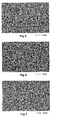
- FIGS. 5 and 6 show, by way of example, a picture of the nickel mixed metal hydroxides prepared according to Examples 1 and 2 using a scanning electron microscope (SEM).
- SEM scanning electron microscope
- the form factors of the powdery compounds according to the invention are remarkably high with values of ⁇ 0.8, in view of the fact that the materials have particle size distributions with D 50 values of ⁇ 5.0 ⁇ m.
- the high solids concentration in the suspension increases the spheroidicity of the particles and, on the other hand, reduces their porosity. Both lead to an increase in the tapped density of the powders.
- the powdery compounds according to the invention have comparatively high BET values despite low porosities. Usually, the BET surface decreases sharply with decreasing porosity.
- the mixed metal hydroxides according to the invention have a relatively high inner pore surface despite the small pore volume. This means that the pore radii are significantly smaller and the number of pores is significantly larger than in the case of the prior art powders.
- the high solids contents in the suspension allow the production of very fine spheroidal powders with high form factors.
- the process according to the invention is preferably carried out with solids contents in the suspension of at least 225 g / l, more preferably of at least 250 g / l, particularly preferably at least 300 g / l.
- the D 50 value of the particles depends on the primary and secondary nucleation. While the primary nucleation is promoted by high supersaturations, for example, high excesses of alkali, the mechanical effect of particle-particle collisions or particle-stirrer impacts is decisive for the secondary nucleation. Particularly fine and spheroidal particles are obtained when the excess of alkali metal hydroxide is preferably at least 0.12 mol / l, more preferably at least 0.25 mol / l. Of particular importance for the secondary nucleation and the formation of spheroidal particles is the mechanical power input of the stirrer in the suspension. The mechanical power input, later also called specific power input, is defined as the energy transferred by the stirrer to the suspension per unit time and volume.
- the specific energy input into the reactor is defined as the energy transferred to the suspension by the stirrer per unit volume.
- the process according to the invention is preferably carried out at a specific power input of at least 2.5 W / liter (W / l), more preferably at least 3 W / l.
- mixed nickel metal hydroxides can be prepared from the group of the metals Fe, Co, Zn, Mn, Al, Mg, Ca, Sr, La, Ce, Y, Yb. It is based on educt solutions of water-soluble salts of mineral acids, e.g. Sulfuric acid, hydrochloric acid or nitric acid of the aforementioned metals.
- mineral acids e.g. Sulfuric acid, hydrochloric acid or nitric acid of the aforementioned metals.
- the educt solutions can be prepared by dissolving the respective metal chlorides, metal sulfates or metal nitrates in water or dissolving the metals in the corresponding mineral acids (first starting material solution).
- the alkali solutions are provided in the desired concentration as an aqueous solution (second educt solution).
- the process is preferably suitable for the production of nickel mixed metal hydroxides according to the invention.
- water-soluble metal salts e.g. Nickel sulfate, nickel nitrate, nickel chloride and / or mixtures thereof are used.
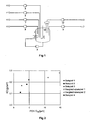
- the preparation of the powdery compound according to the invention is preferably in a in FIG. 1 reactor (1) by precipitation crystallization from aqueous nickel salt solutions at an alkali hydroxide concentration of at least 0.12 mol / l, by the supply of alkali metal hydroxide solutions and optionally ammonia, in gaseous or aqueous solution.
- the alkali metal hydroxide solutions used are preferably sodium hydroxide and potassium hydroxide.
- the precipitation crystallization can be carried out batchwise or semi-continuously, this is preferably carried out continuously. In a continuous process, a simultaneous supply of metal salt solution, alkali hydroxide solution and ammonia solution into the reactor and a continuous withdrawal of the product suspension via a free overflow or a pump.
- the temperature in the reaction zone of the reactor is 20 to 90 ° C, preferably 40 to 70 ° C, particularly preferably 45 to 60 ° C.
- the nickel mixed metal hydroxides according to the invention can preferably be used in the, in FIG. 1 shown plant, are produced.
- the method according to the invention will be explained in more detail.
- a reactor (1) equipped with stirrer (2), thermostat (3) and circulation pump (4) is first filled with mother liquor, which already has the salt concentration, NaOH concentration and NH 3 concentration of the later stationary state. After start-up of stirrer, heat tracing and circulation pump, metal sulfate solution, sodium hydroxide solution, ammonia and optionally water are fed via the metering pumps (5), (6), (7) and (8). The resulting product suspension is level controlled via the pump (9) removed from the reactor.
- the reactor is further equipped with a dip tube (10) which has a filter plate (11) at the end of a conical widening. With the pump (12) can be removed from the reactor via this filter element mother liquor.
- the solids content of the product suspension regardless of the Eduktkonzentrationen and the Salt concentration can be adjusted in the mother liquor.
- the mother liquor can also be separated from the reactor via hydrocyclones, oblique clarifiers or cross-flow filtration.
- the material is collected in the stationary state after 5 residence times over a period of 24 hours, filtered on a filter chute and washed with 5 liters of water per kg and then dried in a drying oven at temperatures up to 90 ° C to constant weight.
- stirrers can be used. Particularly good results are achieved with propeller stirrers or disc stirrers.
- the pulverulent compounds according to the invention are suitable as precursors for the production of secondary batteries.
- the powdery compounds according to the invention are used as a precursor for the preparation of lithium compounds for lithium secondary.
- the pulverulent compounds are used in lithium ion cells or lithium polymer cells.
- the nickel mixed metal hydroxides according to the invention can be used particularly advantageously as active material in nickel metal hydride batteries.
- the secondary batteries containing the powders according to the invention are particularly suitable for use in hybrid vehicles, electric vehicles, solar vehicles and in vehicles powered by fuel cells.
- the reactor (1) is first filled with mother liquor, which has the Na 2 SO 4 , NaOH and NH 3 concentration of the respective stationary reactor state. Then, stirrer (2); Thermostat heating (3) and circulation pump (4) put into operation. After the respective reaction temperature is reached, the gravimetrically controlled pumps (5) to (8) are put into operation. Pump (5) conveys metal salt solution, pump (6) sodium hydroxide solution, pump (7) ammonia solution and pump (8) fully desalted (VE) water into the reactor. Subsequently, pump (9) is started, which conveys the resulting product suspension level-controlled from the Raktor.
- the gravimetrically controlled, self-priming pump (12) is put into operation, via a dip tube (10), in the upper part of a filter plate (11) is arranged to remove the required amount of mother liquor from the reactor system and the desired solids content adjust the suspension.
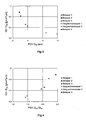
- Fig. 2 the tapped density of the materials prepared according to Table 2 is plotted against the D 50 value of the particle size distribution. It can be seen that the tap density also decreases with decreasing D 50 value, but nevertheless remains at a high level of> 2.1 g / cm 3 . One reason for this is the high spheroidicity, which is also high for these small particles, as well as the REM images in Fig. 5 for example 1, Fig. 6 for example 2 and Fig. 7 for example 3 show.
- Fig. 3 the ratio of tap density to D is plotted against the D 50 value 50. It increases extremely strongly with falling D 50 value, since the tapping density of the pulverulent compounds according to the invention decreases only weakly with the D 50 value.
- Fig. 3 the ratio of tap density to D is plotted against the D 50 value 50. It increases extremely strongly with falling D 50 value, since the tapping density of the pulverulent compounds according to the invention decreases only weakly with the D 50 value.
- the ratio of tap density and D 50 value is plotted against the ratio of D 90 value and D 50 value of the particle size distribution. It shows a nearly linear behavior with a strong positive slope. This means that the width of the particle size distribution, which reflects the ratio D 90 / D 50 , has such an effect on the packing density of the materials that broad particle size distributions lead to higher packing densities. However, high packing densities alone are not sufficient for high tapping densities. The particles themselves must also be sufficiently dense, ie their internal porosity must not be too large. From Table 2 it can be seen that the BET surface area of the powders according to the invention can be more than 10 m 2 / g and the porosity obviously does not increase so much that a negative effect on the tap density results.
- the powders according to the invention have very fine pores with a small diameter and a high surface area, but the pore volume itself is relatively small. In order to achieve the high specific surface area with these fine pores, their length and number must be particularly high.
- the powders of the invention are particularly advantageous for use in Nickelmetallhydridbatterien, where it depends on high volumetric capacity and at the same time on fast charge and discharge. This is especially the case with the use of nickel metal hydride batteries in electric vehicles and hybrid vehicles.
- the characteristic properties of the pulverulent compounds according to the invention such as small particle size, very broad particle size distribution, high ratio of tapped density / D 50 value and despite high BET values high tapping densities, result from the combination of large surplus alkali (> 0.12 mol / l) , high solids concentration and high mechanical power input.
- pulverulent compounds according to the invention are produced with tap densities of> 2.3 g / cm 3 or even> 2.4 g / cm 3 for particle sizes of ⁇ 3 ⁇ m with D 50 values.
- the ratio of tap density to D 50 value even reaches values greater than 1.0.
Landscapes
- Chemical & Material Sciences (AREA)
- Organic Chemistry (AREA)
- Inorganic Chemistry (AREA)
- Chemical Kinetics & Catalysis (AREA)
- Electrochemistry (AREA)
- General Chemical & Material Sciences (AREA)
- Inorganic Compounds Of Heavy Metals (AREA)
- Battery Electrode And Active Subsutance (AREA)
Claims (20)
- Composé sous forme de poudre de formule NiaMbOx(OH)y, M signifiant un élément choisi dans le groupe constitué par Fe, Co, Zn, Mn, Al, Mg, Ca, Sr, La, Ce, Y, Yb et/ou leurs mélanges, 0,6 ≤ a < 1, 0 < b ≤ 0,4, 0 < x ≤ 0,60 et 1,4 ≤ y < 2, caractérisé en ce que la valeur D50 de la répartition des tailles des particules, mesurée selon la norme ASTM B 822, est < 5 µm, et le rapport de la densité tassée, mesurée selon la norme ASTM B 527, à la valeur D50 de la répartition des tailles des particules vaut au moins 0,4 g/cm3.µm.
- Composé sous forme de poudre selon la revendication 1, caractérisé en ce que la valeur D50 de la répartition des tailles des particules est < 3 µm.
- Composés sous forme de poudre selon la revendication 1 ou 2, caractérisés en ce que le rapport de la densité tassée à la valeur D50 de la répartition des tailles des particules vaut au moins 0,6 g/cm3.µm.
- Composés sous forme de poudre selon la revendication 1 ou 2, caractérisés en ce que le rapport de la densité tassée à la valeur D50 de la répartition des tailles des particules vaut au moins 0,8 g/cm3.µm.
- Composé sous forme de poudre selon au moins l'une quelconque des revendications 1 à 4, caractérisé en ce que la surface BET, mesurée selon la norme ASTM D 3663, vaut au moins 5 m2/g.
- Composé sous forme de poudre selon au moins l'une quelconque des revendications 1 à 4, caractérisé en ce que la surface BET, mesurée selon la norme ASTM D 3663, vaut au moins 10 m2/g.
- Composé sous forme de poudre selon au moins l'une quelconque des revendications 1 à 6, caractérisé en ce que la largeur normalisée de la répartition de la taille des grains, définie par le rapport D90/D50, D signifiant le diamètre des particules de poudre, vaut au moins 1,8.
- Composé sous forme de poudre selon au moins l'une quelconque des revendications 1 à 6, caractérisé en ce que la largeur normalisée de la répartition des tailles des particules, définie par le rapport D90/D50, D signifiant le diamètre des particules de poudre, vaut au moins 2,0.
- Composé sous forme de poudre selon au moins l'une quelconque des revendications 1 à 8, caractérisé en ce que les particules présentent une forme sphéroïde.
- Composé sous forme de poudre selon au moins l'une quelconque des revendications 1 à 9, caractérisé en ce que les particules présentent un facteur de forme ≥ 0,8.
- Composé sous forme de poudre selon au moins l'une quelconque des revendications 1 à 9, caractérisé en ce que les particules présentent un facteur de forme ≥ 0,9.
- Procédé pour la préparation du composé sous forme de poudre selon au moins l'une quelconque des revendications 1 à 11, constitué par les étapes suivantes :a) mise à disposition d'au moins une première et d'une deuxième solution de départ,b) réunion de ladite au moins une première et de la deuxième solution de départ dans un réacteur et génération d'une zone de réaction mélangée de manière homogène par une introduction de puissance mécanique spécifique d'au moins 2 Watts/litre et génération d'une suspension de produit, constituée par un produit insoluble et une lessive-mère sursaturée par réglage d'un excès de lessive, présentant un excès de lessive d'au moins 0,12 mole/l,c) séparation partielle de la lessive-mère du produit précipité pour le réglage de teneurs en solides d'au moins 150 g/l dans la suspension par des éléments de clarification ou de filtration.
- Procédé selon la revendication 12, caractérisé en ce que la teneur en solides dans la suspension est d'au moins 225 g/l.
- Procédé selon la revendication 12, caractérisé en ce que la teneur en solides dans la suspension est d'au moins 300 g/l.
- Procédé selon la revendication 12, caractérisé en ce que la concentration de la lessive alcaline est d'au moins 0,25 mole/l.
- Procédé selon la revendication 12, caractérisé en ce que l'introduction de puissance mécanique spécifique est d'au moins 2,5 W/l.
- Utilisation du composé sous forme de poudre selon au moins l'une quelconque des revendications 1 à 11 comme matériau actif pour des batteries nickel-hydrure métallique.
- Batteries nickel-hydrure métallique, contenant un composé sous forme de poudre selon au moins l'une quelconque des revendications 1 à 11.
- Utilisation de batteries nickel-hydrure métallique selon la revendication 17 pour une utilisation pour des véhicules hybrides et électriques, les téléphones mobiles solaires et dans les véhicules entraînés par des piles à combustible.
- Utilisation du composé sous forme de poudre selon au moins l'une quelconque des revendications 1 à 11 comme précurseur pour la préparation de composés à base de lithium pour des batteries secondaires à lithium.
Applications Claiming Priority (2)
| Application Number | Priority Date | Filing Date | Title |
|---|---|---|---|
| DE102007049108A DE102007049108A1 (de) | 2007-10-12 | 2007-10-12 | Pulverförmige Verbindungen, Verfahren zu deren Herstellung sowie deren Verwendung in Batterien |
| PCT/EP2008/061530 WO2009049955A1 (fr) | 2007-10-12 | 2008-09-02 | Composés en poudre niambox(oh)y, procédé pour leur production et leur utilisation dans des batteries |
Publications (2)
| Publication Number | Publication Date |
|---|---|
| EP2209741A1 EP2209741A1 (fr) | 2010-07-28 |
| EP2209741B1 true EP2209741B1 (fr) | 2013-01-16 |
Family
ID=40210420
Family Applications (1)
| Application Number | Title | Priority Date | Filing Date |
|---|---|---|---|
| EP08803505A Active EP2209741B1 (fr) | 2007-10-12 | 2008-09-02 | Composés en poudre niambox(oh)y, procédé pour leur production et leur utilisation dans des batteries |
Country Status (10)
| Country | Link |
|---|---|
| US (1) | US8545794B2 (fr) |
| EP (1) | EP2209741B1 (fr) |
| JP (1) | JP5553761B2 (fr) |
| KR (1) | KR101526628B1 (fr) |
| CN (1) | CN101903292B (fr) |
| CA (1) | CA2695763A1 (fr) |
| DE (1) | DE102007049108A1 (fr) |
| RU (1) | RU2010118409A (fr) |
| TW (1) | TWI419839B (fr) |
| WO (1) | WO2009049955A1 (fr) |
Cited By (1)
| Publication number | Priority date | Publication date | Assignee | Title |
|---|---|---|---|---|
| CN104884390A (zh) * | 2013-02-13 | 2015-09-02 | 株式会社Lg化学 | 具有低振实密度的过渡金属前体和具有高粒子强度的锂过渡金属氧化物 |
Families Citing this family (11)
| Publication number | Priority date | Publication date | Assignee | Title |
|---|---|---|---|---|
| JP5655218B2 (ja) * | 2008-04-03 | 2015-01-21 | エルジー・ケム・リミテッド | リチウム複合遷移金属酸化物製造用の新規な前駆物質、リチウム−遷移金属複合酸化物及びリチウム二次バッテリ− |
| JP2012099470A (ja) * | 2010-10-08 | 2012-05-24 | Sumitomo Chemical Co Ltd | リチウム二次電池用正極材料前駆体の製造方法およびリチウム二次電池用正極材料の製造方法 |
| US20120177921A1 (en) * | 2011-01-10 | 2012-07-12 | Basf Se | Process for preparing transition metal carbonates |
| CN103553152B (zh) * | 2013-10-22 | 2015-09-23 | 金天能源材料有限公司 | 高密度球形镍钴铝前驱体材料及其制备方法 |
| TWI633062B (zh) | 2014-06-12 | 2018-08-21 | 烏明克公司 | 用於可充電電池的鋰過渡金屬氧化物陰極材料之先質 |
| CN105983383A (zh) * | 2015-02-15 | 2016-10-05 | 江苏海四达电源股份有限公司 | 一种制备锂离子电池正极材料镍钴锰酸锂前躯体的装置 |
| CN106450287B (zh) * | 2016-10-31 | 2019-05-28 | 湘潭大学 | 一种氟氧化铋/氢氧化镍二次碱性电池及其制备方法 |
| KR102123541B1 (ko) * | 2017-06-29 | 2020-06-16 | 주식회사 엘지화학 | 리튬 이차전지용 양극 활물질 전구체의 제조 방법 |
| CN110739447A (zh) * | 2018-07-20 | 2020-01-31 | 河南科隆新能源股份有限公司 | 一种锂离子电池前躯体粒径分布可控的制备方法 |
| JP7262230B2 (ja) * | 2019-01-22 | 2023-04-21 | 株式会社田中化学研究所 | 非水電解質二次電池用複合水酸化物小粒子 |
| FI4229008T3 (fi) | 2020-10-13 | 2024-10-25 | Basf Se | Prosessi hiukkas(oksi)hydroksidin valmistamista varten sekä hiukkas(oksi)hydroksidi ja sen käyttö |
Family Cites Families (18)
| Publication number | Priority date | Publication date | Assignee | Title |
|---|---|---|---|---|
| ATE168357T1 (de) | 1992-05-04 | 1998-08-15 | Starck H C Gmbh Co Kg | Submicrone carbonitrid-pulver, verfahren zu ihrer herstellung sowie deren verwendung |
| JP3290355B2 (ja) | 1996-07-12 | 2002-06-10 | 株式会社田中化学研究所 | リチウムイオン二次電池用のリチウム含有複合酸化物及びその製造法 |
| JP3579545B2 (ja) | 1996-09-20 | 2004-10-20 | 株式会社田中化学研究所 | アルカリ蓄電池用水酸化ニッケル及びその製造法 |
| DE19939025A1 (de) * | 1998-12-24 | 2000-06-29 | Starck H C Gmbh Co Kg | Nickel-Mischydroxid, Verfahren zu dessen Herstellung und dessen Verwendung als Kathodenmaterial in alkalischen Batterien |
| US6569567B1 (en) * | 1999-09-13 | 2003-05-27 | Ovonic Battery Company, Inc. | Method of activating metal hydride material and electrode |
| FR2803104B1 (fr) * | 1999-12-23 | 2002-03-15 | Cit Alcatel | Electrode au nickel non frittee pour generateur electrochimique secondaire a electrolyte alcalin |
| US20020053663A1 (en) | 2000-11-06 | 2002-05-09 | Tanaka Chemical Corporation | High density cobalt-manganese coprecipitated nickel hydroxide and process for its production |
| DE10132895A1 (de) * | 2001-07-06 | 2003-01-16 | Starck H C Gmbh | Nickelhydroxid und Verfahren zu dessen Herstellung |
| JP3827545B2 (ja) | 2001-09-13 | 2006-09-27 | 松下電器産業株式会社 | 正極活物質、その製造方法および非水電解質二次電池 |
| JP2003323890A (ja) * | 2002-04-30 | 2003-11-14 | Sumitomo Metal Mining Co Ltd | アルカリ蓄電池用水酸化ニッケル及びその製造方法 |
| DE10245467A1 (de) * | 2002-09-28 | 2004-04-08 | Varta Automotive Systems Gmbh | Aktives Nickelmischhydroxid-Kathodenmaterial für alkalische Akkumulatoren und Verfahren zu seiner Herstellung |
| US20050221179A1 (en) * | 2002-09-28 | 2005-10-06 | Varta Automotive Systems Gmbh | Active mixed nickel hydroxide cathode material for alkaline storage batteries and process for its production |
| NZ538480A (en) * | 2003-04-17 | 2007-12-21 | Seimi Chem Kk | Lithium-nickel-cobalt-manganese containing composite oxide, material for positive electrode active material for lithium secondary battery, and methods for producing these |
| CN100431206C (zh) * | 2004-06-24 | 2008-11-05 | 松下电器产业株式会社 | 碱性电池 |
| DE102004044557B3 (de) * | 2004-09-15 | 2006-06-14 | Bayer Inc., Sarnia | Mischmetallhydroxide, deren Herstellung und Verwendung |
| WO2007000075A1 (fr) * | 2005-06-27 | 2007-01-04 | Shenzhen Bak Battery Co., Ltd | Procédé de préparation d’hydroxyde nickeleux sphérique qui est dopé et d’oxydes métalliques multiples, et pile secondaire au lithium |
| KR101306532B1 (ko) * | 2005-08-12 | 2013-09-09 | 토다 고교 유럽 게엠베하 | 무기 화합물 |
| DE102006015538A1 (de) | 2006-03-31 | 2007-10-11 | H. C. Starck Gmbh & Co. Kg | Vorrichtung und Verfahren zur Herstellung von Verbindungen durch Fällung |
-
2007
- 2007-10-12 DE DE102007049108A patent/DE102007049108A1/de not_active Ceased
-
2008
- 2008-09-02 RU RU2010118409/05A patent/RU2010118409A/ru not_active Application Discontinuation
- 2008-09-02 WO PCT/EP2008/061530 patent/WO2009049955A1/fr not_active Ceased
- 2008-09-02 CA CA2695763A patent/CA2695763A1/fr not_active Abandoned
- 2008-09-02 KR KR1020107006338A patent/KR101526628B1/ko active Active
- 2008-09-02 CN CN200880111354.6A patent/CN101903292B/zh active Active
- 2008-09-02 US US12/682,707 patent/US8545794B2/en active Active
- 2008-09-02 EP EP08803505A patent/EP2209741B1/fr active Active
- 2008-09-29 JP JP2010528335A patent/JP5553761B2/ja active Active
- 2008-10-09 TW TW097138805A patent/TWI419839B/zh active
Cited By (1)
| Publication number | Priority date | Publication date | Assignee | Title |
|---|---|---|---|---|
| CN104884390A (zh) * | 2013-02-13 | 2015-09-02 | 株式会社Lg化学 | 具有低振实密度的过渡金属前体和具有高粒子强度的锂过渡金属氧化物 |
Also Published As
| Publication number | Publication date |
|---|---|
| TW200936507A (en) | 2009-09-01 |
| JP2011501727A (ja) | 2011-01-13 |
| DE102007049108A1 (de) | 2009-04-16 |
| KR20100067086A (ko) | 2010-06-18 |
| JP5553761B2 (ja) | 2014-07-16 |
| RU2010118409A (ru) | 2011-11-27 |
| US20100310869A1 (en) | 2010-12-09 |
| US8545794B2 (en) | 2013-10-01 |
| CA2695763A1 (fr) | 2009-04-23 |
| TWI419839B (zh) | 2013-12-21 |
| WO2009049955A1 (fr) | 2009-04-23 |
| KR101526628B1 (ko) | 2015-06-05 |
| CN101903292A (zh) | 2010-12-01 |
| CN101903292B (zh) | 2015-11-25 |
| EP2209741A1 (fr) | 2010-07-28 |
Similar Documents
| Publication | Publication Date | Title |
|---|---|---|
| EP2209741B1 (fr) | Composés en poudre niambox(oh)y, procédé pour leur production et leur utilisation dans des batteries | |
| EP2190786B1 (fr) | Composés pulvérulents. procédé pour les produire et leur utilisation dans des batteries secondaires au lithium | |
| EP2386339B1 (fr) | Procédé de fabrication d'hydroxydes mixtes de Ni et Co poudreux | |
| DE69737435T2 (de) | Positives aktives Material für nichtwässrige Sekundärzellen und Verfahren zur Herstellung von diesem activen Material | |
| WO2002083555A2 (fr) | Phosphates de lithium binaires, ternaires et quaternaires, leur procede de production et leur utilisation | |
| DE112021006151T5 (de) | Verfahren zum recycling von eisenphosphatabfall und anwendung davon | |
| DE102005012640A1 (de) | Kreisprozess zur nasschemischen Herstellung von Lithiummetallphosphaten | |
| DE112021005630T5 (de) | Regenerationsverfahren für abfallmaterial von ternären kathoden und anwendung davon | |
| EP1145346B1 (fr) | Hydroxyde mixte de nickel, son procede de fabrication et son utilisation comme materiau cathode dans les piles alcalines | |
| EP1406839B1 (fr) | Hydroxyde de nickel et procede permettant de le produire | |
| EP2169086B1 (fr) | Poudre de métal réfractaire | |
| EP1543573A2 (fr) | Materiau de cathode actif a base d'hydroxyde mixte de nickel pour des accumulateurs alcalins et son procede de production | |
| DE102006049107A1 (de) | Pulverförmige Verbindungen, Verfahren zu deren Herstellung sowie deren Verwendung in elektrochemischen Anwendungen | |
| DE102018205398A1 (de) | Verfahren zur Herstellung von Mischoxid-Pulvern sowie ein Mischoxid-Pulver | |
| DE19823129A1 (de) | Verfahren zur Herstellung einer hochdichten Formiermasse aus Nickelhydroxid | |
| JP7219756B2 (ja) | 固体材料へのチタンの均一導入 | |
| DE102022002314A1 (de) | Kathodenaktivmaterial für Sekundärzellbatterien mit nichtwässrigem Elektrolyten und sein Herstellungsverfahren | |
| AT522061B1 (de) | Herstellungsverfahren für Lithiumvanadiumphosphat | |
| WO2014180821A1 (fr) | Procédé de préparation de suspensions | |
| EP2590897A1 (fr) | Carbone poreux de haute pureté pour condensateurs à double couche | |
| HK1146265A (en) | Powdered compounds, method for the production thereof, and use thereof in lithium secondary batteries |
Legal Events
| Date | Code | Title | Description |
|---|---|---|---|
| PUAI | Public reference made under article 153(3) epc to a published international application that has entered the european phase |
Free format text: ORIGINAL CODE: 0009012 |
|
| 17P | Request for examination filed |
Effective date: 20100512 |
|
| AK | Designated contracting states |
Kind code of ref document: A1 Designated state(s): AT BE BG CH CY CZ DE DK EE ES FI FR GB GR HR HU IE IS IT LI LT LU LV MC MT NL NO PL PT RO SE SI SK TR |
|
| AX | Request for extension of the european patent |
Extension state: AL BA MK RS |
|
| DAX | Request for extension of the european patent (deleted) | ||
| 17Q | First examination report despatched |
Effective date: 20120229 |
|
| GRAP | Despatch of communication of intention to grant a patent |
Free format text: ORIGINAL CODE: EPIDOSNIGR1 |
|
| GRAS | Grant fee paid |
Free format text: ORIGINAL CODE: EPIDOSNIGR3 |
|
| GRAA | (expected) grant |
Free format text: ORIGINAL CODE: 0009210 |
|
| AK | Designated contracting states |
Kind code of ref document: B1 Designated state(s): AT BE BG CH CY CZ DE DK EE ES FI FR GB GR HR HU IE IS IT LI LT LU LV MC MT NL NO PL PT RO SE SI SK TR |
|
| REG | Reference to a national code |
Ref country code: GB Ref legal event code: FG4D Free format text: NOT ENGLISH |
|
| REG | Reference to a national code |
Ref country code: CH Ref legal event code: EP |
|
| REG | Reference to a national code |
Ref country code: IE Ref legal event code: FG4D Free format text: LANGUAGE OF EP DOCUMENT: GERMAN |
|
| REG | Reference to a national code |
Ref country code: AT Ref legal event code: REF Ref document number: 593805 Country of ref document: AT Kind code of ref document: T Effective date: 20130215 Ref country code: CH Ref legal event code: EP |
|
| REG | Reference to a national code |
Ref country code: DE Ref legal event code: R096 Ref document number: 502008009141 Country of ref document: DE Effective date: 20130314 |
|
| REG | Reference to a national code |
Ref country code: NL Ref legal event code: VDEP Effective date: 20130116 |
|
| REG | Reference to a national code |
Ref country code: LT Ref legal event code: MG4D |
|
| PG25 | Lapsed in a contracting state [announced via postgrant information from national office to epo] |
Ref country code: NO Free format text: LAPSE BECAUSE OF FAILURE TO SUBMIT A TRANSLATION OF THE DESCRIPTION OR TO PAY THE FEE WITHIN THE PRESCRIBED TIME-LIMIT Effective date: 20130416 Ref country code: IS Free format text: LAPSE BECAUSE OF FAILURE TO SUBMIT A TRANSLATION OF THE DESCRIPTION OR TO PAY THE FEE WITHIN THE PRESCRIBED TIME-LIMIT Effective date: 20130516 Ref country code: ES Free format text: LAPSE BECAUSE OF FAILURE TO SUBMIT A TRANSLATION OF THE DESCRIPTION OR TO PAY THE FEE WITHIN THE PRESCRIBED TIME-LIMIT Effective date: 20130427 Ref country code: SE Free format text: LAPSE BECAUSE OF FAILURE TO SUBMIT A TRANSLATION OF THE DESCRIPTION OR TO PAY THE FEE WITHIN THE PRESCRIBED TIME-LIMIT Effective date: 20130116 Ref country code: BG Free format text: LAPSE BECAUSE OF FAILURE TO SUBMIT A TRANSLATION OF THE DESCRIPTION OR TO PAY THE FEE WITHIN THE PRESCRIBED TIME-LIMIT Effective date: 20130416 Ref country code: LT Free format text: LAPSE BECAUSE OF FAILURE TO SUBMIT A TRANSLATION OF THE DESCRIPTION OR TO PAY THE FEE WITHIN THE PRESCRIBED TIME-LIMIT Effective date: 20130116 |
|
| PG25 | Lapsed in a contracting state [announced via postgrant information from national office to epo] |
Ref country code: SI Free format text: LAPSE BECAUSE OF FAILURE TO SUBMIT A TRANSLATION OF THE DESCRIPTION OR TO PAY THE FEE WITHIN THE PRESCRIBED TIME-LIMIT Effective date: 20130116 Ref country code: GR Free format text: LAPSE BECAUSE OF FAILURE TO SUBMIT A TRANSLATION OF THE DESCRIPTION OR TO PAY THE FEE WITHIN THE PRESCRIBED TIME-LIMIT Effective date: 20130417 Ref country code: LV Free format text: LAPSE BECAUSE OF FAILURE TO SUBMIT A TRANSLATION OF THE DESCRIPTION OR TO PAY THE FEE WITHIN THE PRESCRIBED TIME-LIMIT Effective date: 20130116 Ref country code: PT Free format text: LAPSE BECAUSE OF FAILURE TO SUBMIT A TRANSLATION OF THE DESCRIPTION OR TO PAY THE FEE WITHIN THE PRESCRIBED TIME-LIMIT Effective date: 20130516 Ref country code: NL Free format text: LAPSE BECAUSE OF FAILURE TO SUBMIT A TRANSLATION OF THE DESCRIPTION OR TO PAY THE FEE WITHIN THE PRESCRIBED TIME-LIMIT Effective date: 20130116 Ref country code: PL Free format text: LAPSE BECAUSE OF FAILURE TO SUBMIT A TRANSLATION OF THE DESCRIPTION OR TO PAY THE FEE WITHIN THE PRESCRIBED TIME-LIMIT Effective date: 20130116 |
|
| PG25 | Lapsed in a contracting state [announced via postgrant information from national office to epo] |
Ref country code: HR Free format text: LAPSE BECAUSE OF FAILURE TO SUBMIT A TRANSLATION OF THE DESCRIPTION OR TO PAY THE FEE WITHIN THE PRESCRIBED TIME-LIMIT Effective date: 20130116 |
|
| PG25 | Lapsed in a contracting state [announced via postgrant information from national office to epo] |
Ref country code: SK Free format text: LAPSE BECAUSE OF FAILURE TO SUBMIT A TRANSLATION OF THE DESCRIPTION OR TO PAY THE FEE WITHIN THE PRESCRIBED TIME-LIMIT Effective date: 20130116 Ref country code: CZ Free format text: LAPSE BECAUSE OF FAILURE TO SUBMIT A TRANSLATION OF THE DESCRIPTION OR TO PAY THE FEE WITHIN THE PRESCRIBED TIME-LIMIT Effective date: 20130116 Ref country code: EE Free format text: LAPSE BECAUSE OF FAILURE TO SUBMIT A TRANSLATION OF THE DESCRIPTION OR TO PAY THE FEE WITHIN THE PRESCRIBED TIME-LIMIT Effective date: 20130116 Ref country code: RO Free format text: LAPSE BECAUSE OF FAILURE TO SUBMIT A TRANSLATION OF THE DESCRIPTION OR TO PAY THE FEE WITHIN THE PRESCRIBED TIME-LIMIT Effective date: 20130116 Ref country code: DK Free format text: LAPSE BECAUSE OF FAILURE TO SUBMIT A TRANSLATION OF THE DESCRIPTION OR TO PAY THE FEE WITHIN THE PRESCRIBED TIME-LIMIT Effective date: 20130116 |
|
| PLBE | No opposition filed within time limit |
Free format text: ORIGINAL CODE: 0009261 |
|
| STAA | Information on the status of an ep patent application or granted ep patent |
Free format text: STATUS: NO OPPOSITION FILED WITHIN TIME LIMIT |
|
| PG25 | Lapsed in a contracting state [announced via postgrant information from national office to epo] |
Ref country code: CY Free format text: LAPSE BECAUSE OF FAILURE TO SUBMIT A TRANSLATION OF THE DESCRIPTION OR TO PAY THE FEE WITHIN THE PRESCRIBED TIME-LIMIT Effective date: 20130116 |
|
| 26N | No opposition filed |
Effective date: 20131017 |
|
| PG25 | Lapsed in a contracting state [announced via postgrant information from national office to epo] |
Ref country code: IT Free format text: LAPSE BECAUSE OF FAILURE TO SUBMIT A TRANSLATION OF THE DESCRIPTION OR TO PAY THE FEE WITHIN THE PRESCRIBED TIME-LIMIT Effective date: 20130116 |
|
| REG | Reference to a national code |
Ref country code: DE Ref legal event code: R097 Ref document number: 502008009141 Country of ref document: DE Effective date: 20131017 |
|
| BERE | Be: lapsed |
Owner name: H.C. STARCK G.M.B.H. Effective date: 20130930 |
|
| PG25 | Lapsed in a contracting state [announced via postgrant information from national office to epo] |
Ref country code: MC Free format text: LAPSE BECAUSE OF FAILURE TO SUBMIT A TRANSLATION OF THE DESCRIPTION OR TO PAY THE FEE WITHIN THE PRESCRIBED TIME-LIMIT Effective date: 20130116 |
|
| REG | Reference to a national code |
Ref country code: CH Ref legal event code: PL |
|
| GBPC | Gb: european patent ceased through non-payment of renewal fee |
Effective date: 20130902 |
|
| REG | Reference to a national code |
Ref country code: IE Ref legal event code: MM4A |
|
| PG25 | Lapsed in a contracting state [announced via postgrant information from national office to epo] |
Ref country code: LI Free format text: LAPSE BECAUSE OF NON-PAYMENT OF DUE FEES Effective date: 20130930 Ref country code: CH Free format text: LAPSE BECAUSE OF NON-PAYMENT OF DUE FEES Effective date: 20130930 Ref country code: BE Free format text: LAPSE BECAUSE OF NON-PAYMENT OF DUE FEES Effective date: 20130930 Ref country code: GB Free format text: LAPSE BECAUSE OF NON-PAYMENT OF DUE FEES Effective date: 20130902 Ref country code: IE Free format text: LAPSE BECAUSE OF NON-PAYMENT OF DUE FEES Effective date: 20130902 |
|
| REG | Reference to a national code |
Ref country code: AT Ref legal event code: MM01 Ref document number: 593805 Country of ref document: AT Kind code of ref document: T Effective date: 20130902 |
|
| PG25 | Lapsed in a contracting state [announced via postgrant information from national office to epo] |
Ref country code: AT Free format text: LAPSE BECAUSE OF NON-PAYMENT OF DUE FEES Effective date: 20130902 |
|
| REG | Reference to a national code |
Ref country code: FR Ref legal event code: PLFP Year of fee payment: 8 |
|
| PG25 | Lapsed in a contracting state [announced via postgrant information from national office to epo] |
Ref country code: MT Free format text: LAPSE BECAUSE OF FAILURE TO SUBMIT A TRANSLATION OF THE DESCRIPTION OR TO PAY THE FEE WITHIN THE PRESCRIBED TIME-LIMIT Effective date: 20130116 Ref country code: TR Free format text: LAPSE BECAUSE OF FAILURE TO SUBMIT A TRANSLATION OF THE DESCRIPTION OR TO PAY THE FEE WITHIN THE PRESCRIBED TIME-LIMIT Effective date: 20130116 |
|
| PG25 | Lapsed in a contracting state [announced via postgrant information from national office to epo] |
Ref country code: LU Free format text: LAPSE BECAUSE OF NON-PAYMENT OF DUE FEES Effective date: 20130902 Ref country code: HU Free format text: LAPSE BECAUSE OF FAILURE TO SUBMIT A TRANSLATION OF THE DESCRIPTION OR TO PAY THE FEE WITHIN THE PRESCRIBED TIME-LIMIT; INVALID AB INITIO Effective date: 20080902 |
|
| REG | Reference to a national code |
Ref country code: FR Ref legal event code: PLFP Year of fee payment: 9 |
|
| REG | Reference to a national code |
Ref country code: FR Ref legal event code: PLFP Year of fee payment: 10 |
|
| REG | Reference to a national code |
Ref country code: DE Ref legal event code: R081 Ref document number: 502008009141 Country of ref document: DE Owner name: UMICORE, BE Free format text: FORMER OWNER: H.C. STARCK GMBH, 38642 GOSLAR, DE |
|
| REG | Reference to a national code |
Ref country code: FR Ref legal event code: TP Owner name: CS ENERGY MATERIALS LTD., JP Effective date: 20170627 |
|
| REG | Reference to a national code |
Ref country code: DE Ref legal event code: R082 Ref document number: 502008009141 Country of ref document: DE Ref country code: DE Ref legal event code: R082 Ref document number: 502008009141 Country of ref document: DE Representative=s name: FDST PATENTANWAELTE FREIER DOERR STAMMLER TSCH, DE |
|
| REG | Reference to a national code |
Ref country code: DE Ref legal event code: R082 Ref document number: 502008009141 Country of ref document: DE |
|
| REG | Reference to a national code |
Ref country code: FR Ref legal event code: TP Owner name: UMICORE, BE Effective date: 20170913 |
|
| REG | Reference to a national code |
Ref country code: FR Ref legal event code: PLFP Year of fee payment: 11 |
|
| P01 | Opt-out of the competence of the unified patent court (upc) registered |
Effective date: 20230602 |
|
| PGFP | Annual fee paid to national office [announced via postgrant information from national office to epo] |
Ref country code: FI Payment date: 20250912 Year of fee payment: 18 |
|
| PGFP | Annual fee paid to national office [announced via postgrant information from national office to epo] |
Ref country code: DE Payment date: 20250702 Year of fee payment: 18 |
|
| PGFP | Annual fee paid to national office [announced via postgrant information from national office to epo] |
Ref country code: FR Payment date: 20250703 Year of fee payment: 18 |