EP2211552A1 - Verfahren und Vorrichtung zur Videokodierung unter Verwendung von Makroblockgruppen - Google Patents
Verfahren und Vorrichtung zur Videokodierung unter Verwendung von Makroblockgruppen Download PDFInfo
- Publication number
- EP2211552A1 EP2211552A1 EP09305060A EP09305060A EP2211552A1 EP 2211552 A1 EP2211552 A1 EP 2211552A1 EP 09305060 A EP09305060 A EP 09305060A EP 09305060 A EP09305060 A EP 09305060A EP 2211552 A1 EP2211552 A1 EP 2211552A1
- Authority
- EP
- European Patent Office
- Prior art keywords
- group
- macroblock
- raster scan
- macroblocks
- video
- Prior art date
- Legal status (The legal status is an assumption and is not a legal conclusion. Google has not performed a legal analysis and makes no representation as to the accuracy of the status listed.)
- Withdrawn
Links
- 238000000034 method Methods 0.000 title claims abstract description 39
- 239000000872 buffer Substances 0.000 description 2
- 244000050403 Iris x germanica Species 0.000 description 1
- 230000003044 adaptive effect Effects 0.000 description 1
- 230000009286 beneficial effect Effects 0.000 description 1
- 230000015572 biosynthetic process Effects 0.000 description 1
- 230000003139 buffering effect Effects 0.000 description 1
- 230000001427 coherent effect Effects 0.000 description 1
- 238000013144 data compression Methods 0.000 description 1
- 238000013075 data extraction Methods 0.000 description 1
- 230000001419 dependent effect Effects 0.000 description 1
- 230000000670 limiting effect Effects 0.000 description 1
- 238000012986 modification Methods 0.000 description 1
- 230000004048 modification Effects 0.000 description 1
- 238000005457 optimization Methods 0.000 description 1
Images





Classifications
-
- H—ELECTRICITY
- H04—ELECTRIC COMMUNICATION TECHNIQUE
- H04N—PICTORIAL COMMUNICATION, e.g. TELEVISION
- H04N19/00—Methods or arrangements for coding, decoding, compressing or decompressing digital video signals
- H04N19/10—Methods or arrangements for coding, decoding, compressing or decompressing digital video signals using adaptive coding
- H04N19/169—Methods or arrangements for coding, decoding, compressing or decompressing digital video signals using adaptive coding characterised by the coding unit, i.e. the structural portion or semantic portion of the video signal being the object or the subject of the adaptive coding
- H04N19/17—Methods or arrangements for coding, decoding, compressing or decompressing digital video signals using adaptive coding characterised by the coding unit, i.e. the structural portion or semantic portion of the video signal being the object or the subject of the adaptive coding the unit being an image region, e.g. an object
-
- H—ELECTRICITY
- H04—ELECTRIC COMMUNICATION TECHNIQUE
- H04N—PICTORIAL COMMUNICATION, e.g. TELEVISION
- H04N19/00—Methods or arrangements for coding, decoding, compressing or decompressing digital video signals
- H04N19/10—Methods or arrangements for coding, decoding, compressing or decompressing digital video signals using adaptive coding
- H04N19/102—Methods or arrangements for coding, decoding, compressing or decompressing digital video signals using adaptive coding characterised by the element, parameter or selection affected or controlled by the adaptive coding
- H04N19/103—Selection of coding mode or of prediction mode
- H04N19/105—Selection of the reference unit for prediction within a chosen coding or prediction mode, e.g. adaptive choice of position and number of pixels used for prediction
-
- H—ELECTRICITY
- H04—ELECTRIC COMMUNICATION TECHNIQUE
- H04N—PICTORIAL COMMUNICATION, e.g. TELEVISION
- H04N19/00—Methods or arrangements for coding, decoding, compressing or decompressing digital video signals
- H04N19/10—Methods or arrangements for coding, decoding, compressing or decompressing digital video signals using adaptive coding
- H04N19/102—Methods or arrangements for coding, decoding, compressing or decompressing digital video signals using adaptive coding characterised by the element, parameter or selection affected or controlled by the adaptive coding
- H04N19/103—Selection of coding mode or of prediction mode
- H04N19/11—Selection of coding mode or of prediction mode among a plurality of spatial predictive coding modes
-
- H—ELECTRICITY
- H04—ELECTRIC COMMUNICATION TECHNIQUE
- H04N—PICTORIAL COMMUNICATION, e.g. TELEVISION
- H04N19/00—Methods or arrangements for coding, decoding, compressing or decompressing digital video signals
- H04N19/10—Methods or arrangements for coding, decoding, compressing or decompressing digital video signals using adaptive coding
- H04N19/134—Methods or arrangements for coding, decoding, compressing or decompressing digital video signals using adaptive coding characterised by the element, parameter or criterion affecting or controlling the adaptive coding
- H04N19/146—Data rate or code amount at the encoder output
- H04N19/147—Data rate or code amount at the encoder output according to rate distortion criteria
-
- H—ELECTRICITY
- H04—ELECTRIC COMMUNICATION TECHNIQUE
- H04N—PICTORIAL COMMUNICATION, e.g. TELEVISION
- H04N19/00—Methods or arrangements for coding, decoding, compressing or decompressing digital video signals
- H04N19/10—Methods or arrangements for coding, decoding, compressing or decompressing digital video signals using adaptive coding
- H04N19/169—Methods or arrangements for coding, decoding, compressing or decompressing digital video signals using adaptive coding characterised by the coding unit, i.e. the structural portion or semantic portion of the video signal being the object or the subject of the adaptive coding
- H04N19/17—Methods or arrangements for coding, decoding, compressing or decompressing digital video signals using adaptive coding characterised by the coding unit, i.e. the structural portion or semantic portion of the video signal being the object or the subject of the adaptive coding the unit being an image region, e.g. an object
- H04N19/176—Methods or arrangements for coding, decoding, compressing or decompressing digital video signals using adaptive coding characterised by the coding unit, i.e. the structural portion or semantic portion of the video signal being the object or the subject of the adaptive coding the unit being an image region, e.g. an object the region being a block, e.g. a macroblock
-
- H—ELECTRICITY
- H04—ELECTRIC COMMUNICATION TECHNIQUE
- H04N—PICTORIAL COMMUNICATION, e.g. TELEVISION
- H04N19/00—Methods or arrangements for coding, decoding, compressing or decompressing digital video signals
- H04N19/46—Embedding additional information in the video signal during the compression process
-
- H—ELECTRICITY
- H04—ELECTRIC COMMUNICATION TECHNIQUE
- H04N—PICTORIAL COMMUNICATION, e.g. TELEVISION
- H04N19/00—Methods or arrangements for coding, decoding, compressing or decompressing digital video signals
- H04N19/50—Methods or arrangements for coding, decoding, compressing or decompressing digital video signals using predictive coding
- H04N19/593—Methods or arrangements for coding, decoding, compressing or decompressing digital video signals using predictive coding involving spatial prediction techniques
Definitions
- This invention relates to a method and a device for video coding, and a method and a device for video decoding.
- Intra prediction is based on using previously reconstructed data.
- intra prediction is performed in units of single macroblocks (MB).
- the macroblocks in a frame are coded in raster scan order.
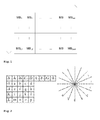
- Fig.1 shows the raster scan order that H.264/AVC uses to implement intra prediction: first all MBs in a row MB 1 ,MB 2 ,...,MB eol are encoded, then the next row of MBs follows and so on, until the last MB in the last row MB L1 ,MB L2 ,...,MB Leol is encoded.
- Each MB contains a plurality of blocks, typically 4x4 or 8x8 blocks. Within each MB, different raster scan orders for the blocks are allowed. Limited by the linear MB raster scan order, a MB can use data from the left and/or upper reconstructed MB to perform intra prediction. It is the same with 4x4 blocks inside the MB: the predictors of various modes of all variable-size blocks are limited to the left and upper neighbors. Taking 4x4 block intra prediction as an example, the predictors and the prediction directions are shown in Fig.2 . In one mode, indicated by predictor 1, horizontal prediction from left to right is used. E.g. blocks a,b,c,d are successively predicted from block I of the neighboring MB. All available prediction modes predict either left-to-right or up-down, except mode 2 which predicts based on an average DC value (not shown in Fig.2 ).
- the present invention improves intra-prediction in various aspects.
- multiple MBs are grouped for being encoded.
- Each group of MBs is intra-coded as a separate encoding unit, wherein different raster scan orders within a group are possible.
- the employed raster scan order is indicated by an indication, e.g. flag.
- a group comprises MBs that belong to at least two lines and at least two columns of MBs.
- a MB group covers a rectangular area of MxN MBs (N > 1 or M > 1).
- the invention is particularly useful for embodiments where both, N > 1 and M > 1, because more different raster scan orders are possible to be used.
- a MB group based intra prediction method wherein reconstructed MBs right and/or below a current MB are available for prediction, besides the left and upper reconstructed MBs, depending on the employed raster scan type.
- New raster scan types may be used, including bi-directional prediction, right-to-left prediction and/or down-up prediction.
- an enhanced encoding syntax for MB group encoded video comprises encoding units, each comprising a MB group with a plurality of MBs and a MB group raster scan indication.
- the order of the MBs within the MB group and within the encoding unit is variable.
- the encoding/decoding order of MBs is indicated by a MB group raster scan indication.
- the encoded MBs are put into the encoding unit in the order of their encoding, and can be retrieved from the encoding unit in the order of their encoding/decoding.
- a video encoder comprises means for dividing a video image into a plurality of MB groups, means for determining an individual raster scan type within a MB group, means for encoding the MBs of the MB group using intra prediction according to the determined raster scan type, and means for forming or generating an encoded video stream, wherein a MB group header with a raster scan type indication is inserted into the video stream.
- the encoded MBs of the MB group are inserted into the video stream in the order of their encoding.
- a new context generation scheme comprises analyzing a current MB group raster scan type and a current MB position, and depending on both determining for the current MB a prediction mode, wherein for the determining additionally a predictor indication may be used.
- the predictor indication may be similar to the conventional direction predictors of Fig.2 .
- a conventional predictor needs to be unique with respect to all existing prediction directions (nine in Fig.2 )
- the enhanced predictor indication needs to be unique only with respect to the current MB position and the already reconstructed neighboring MBs of the current MB group.
- the present invention may improve intra prediction design, e.g. of the current H.264/AVC standard, at least in the following aspects:
- a MB group based intra prediction framework and method is proposed, e.g. for H.264/AVC.
- Advantages of the proposed method are that it achieves much better coding efficiency and also allows parallel execution, which makes parallel implementations possible.
- the coding order of MBs inside a group is selected by choosing the lowest R-D cost of all possible coding orders (i.e. rate-distortion optimization (RDO) is used), while the bit-stream structure is re-organized corresponding to the selected coding order.
- RDO rate-distortion optimization
- An input frame is divided into several different groups of MBs. Each group is coded as one unit. The different groups are coded in a raster scan order. Different coding orders of MBs in one group are tested in order to find the best coding order with the lowest R-D cost of the group. The chosen coding order of the MB group is indicated in the bit-stream to ensure correct decoding.
- a group of MBs is used as a unit for intra prediction. Many different kinds of coding orders of MBs in one group can be performed to get the lowest R-D cost in intra prediction.
- a frame is divided into 16x16 MBs which are coded in raster scan order.
- an input frame is divided into groups of MBs with e.g. MxN MBs per group.
- the different groups can be encoded/decoded in raster scan order, i.e. linear.
- one advantage of the invention is that different MB groups can be encoded/decoded in parallel, as long as for the processed MB groups the required neighboring MB groups are available for prediction. Further, parallel processing of some MBs within a MB group may be possible, depending on the prediction mode.
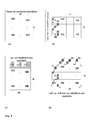
- MB groups An exemplary proposed formation of MB groups in a frame is shown in Fig.3 a) , where the frame width is W MBs and the frame height H MBs.
- the MB group size chosen here is MxN MBs. It is to be noted here that although in this example all MB groups have same size, the MB group size may in principle vary within a frame. In that case, the required processing and buffering capacity is higher and another indication is used for indicating the current MB group size. However, the MBs of a MB group are always adjacent to each other, so that a MB group is a coherent area of the picture. MB groups are easily coded in raster scan order line-by-line (in terms of lines of MB groups).
- each MB group has its own internal MB raster scan order for scanning its MxN MBs.
- One exemplary MB groups is shown in Fig.3 b) .
- the encoded MBs that belong to the MB group are still separate from each other (e.g. the MB structure is maintained in the encoded signal), but new intra prediction modes may be employed within a MB group, as will be explained in the following.
- Each MB group may use intra prediction also from left or upper neighbor groups, like it was conventionally done for single MBs.
- Different possibilities of coding orders for MBs in a group can be chosen to perform intra prediction, according to different neighborhood circumstances of the MB group.
- R-D costs of a MB group in different coding orders are compared to get the best coding order, i.e. the coding order with the lowest R-D cost.
- the coding order is written into the resulting bit-stream to ensure correct decoding. Detailed syntax examples are listed below.
- a 2x2 MB group is taken as an example.
- the neighborhood status and four sample coding orders of the 2x2 MB group are shown in Fig.5 .
- the coding orders can be designed flexibly, using in principle any sequential or parallel combination of the MBs in order to reach optimal coding performance.
- coding orders are useful, particularly for MB groups larger than 2x2 MBs. These MB groups can use specific sets of MB coding order options similar to the 2x2 MB group case.
- the design of the coding order can be customized to guarantee maximum coding efficiency. In one embodiment of the invention only some pre-defined coding orders are allowed for MB groups, depending on the current neighborhood situation. This has at least two advantages:
- one MB may use also right or down reconstructed MBs to perform intra prediction.
- the neighborhood circumstances for one MB increase from four (none, left, up, left-up) in H.264/AVC to sixteen (none, left, up, right, down, right-down, etc.).
- New prediction modes for intra16x16 are proposed in chapter 3.1 to deal with new neighborhood circumstances.
- New prediction modes for intra4x4 are proposed in chapter 3.2 for the same reason with intra16x16.
- intra prediction usually comprises predicting a current MB from a reconstructed MB, determining the difference which is known as residual, and entropy coding the residual
- decoding usually comprises entropy decoding received video data, wherein residuals are obtained, performing prediction using previously reconstructed MBs and adding the prediction result and the residual.
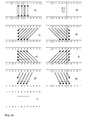
- Exemplary Intra 16x16 prediction modes are shown in figures 6-9 . However, in principle the prediction modes for different circumstances can be designed flexibly, using all available neighbors, in order to get an optimal prediction.
- Fig.6 shows four sample prediction modes in a case where left and up neighbors are available. Similar prediction modes can be constructed in neighboring MB availability circumstances of up-right, right-down and down-left.
- Fig.6 a) it is optimal to use pure vertical intra prediction downwards.
- Fig.6 b) a horizontal intra prediction left-to-right is optimal.
- Fig.6 c) intra prediction is done using an average DC value of upper and left neighbor.
- Fig.6 d) is a case where diagonal intra prediction is optimal.
- the cases a)-c) mainly correspond to conventional intra prediction encoding modes, as shown in Fig.2 .
- Fig.7 a shows a case where bi-linear vertical intra prediction is optimal.
- Fig.7 b) shows vertical downwards intra prediction, Fig.7 c) vertical upwards intra prediction and Fig.7 d) intra prediction base on DC average of upper and lower neighbor.
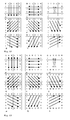
- Fig.8 When three neighbors are available, as it may happen for MBs within a MB group, sample prediction modes are as shown in Fig.8 which takes left-up-right as an example.
- Fig.8a it is optimal (in terms of RDO) to use vertical intra prediction downwards, although left and right neighbors are also available.
- Fig.8 b bi-linear intra prediction is shown between neighbors opposite to each other, i.e. left and right MBs.
- Fig. 8d shows an intra prediction mode that combines both, e.g. by superposition
- Fig.8 c) shows intra prediction based on DC average of the available neighbor MBs.
- Fig.9 a shows a case where, in this neighborhood circumstance, bi-linear vertical intra prediction between upper and lower neighbor gives optimal encoding results.
- Fig.9 b) bi-linear intra prediction between neighbors opposite to each other is optimal, in this case left and right MBs.
- Fig. 9 d) shows an intra prediction mode using a combination of vertical and horizontal bi-linear intra prediction
- Fig.9 c) shows intra prediction based on DC average of the available neighbor MBs.
- Figs.6-9 provide a good set of allowed choices for intra predicting 16x16 MBs. That is, for each 16x16 MB within a MB group it may be determined which of the neighborhood circumstances apply, and which of the prediction modes shown is optimal. Further, in one embodiment it is sufficient to use a 2-bit intra prediction type indication per MB, since depending on the neighborhood circumstances always four MB prediction modes are allowed. E.g. if a MB intra prediction indication indicates "Mode 1", it may mean vertical intra prediction downwards if for the current MB left and up neighbors are available, as in Fig.6 a) .
- the same indication may mean bi-directional vertical prediction if for the current MB up and down neighbors are available, as in Fig.7 a) .
- the indication requires fewer bits, since its meaning depends on the available neighbor MBs. This is pre-determined due to the raster scan order of the MB group, which defines the sequential order of encoding and decoding the MBs within the MB group.
- Intra4x4 prediction modes in the proposed method are shown in Figs.10-13 . It is to be noted that the prediction modes for different circumstances can be designed flexibly using all available neighbors in order to get optimal prediction.
- Fig.10 a)-i) When left and up neighbors are available, sample prediction modes as shown in Fig.10 a)-i) can be used. There are similar prediction modes in the other neighboring 4x4 block availability circumstances: up-right, right-down and down-left. As an example, Fig.10 k) shows a case where up and right neighbors are available. All the new modes disclosed herein allow enhanced video coding and data compression.
- Fig.11 When up and down neighbors are available, sample prediction modes as shown in Fig.11 may be used. There are similar prediction modes in neighboring 4x4 block availability circumstance of left-right.
- Fig.11 a) shows a bi-linear intra prediction between up and down neighbors.
- Fig.12 When there are three neighbor MBs available, sample prediction modes are exemplarily shown in Fig.12 , which takes left-up-right as an example.
- Fig.12 b shows a bi-linear intra prediction between left and right neighbors.
- Fig.13 When all four neighbor MBs of a 4x4 MB are all available, sample prediction modes are shown in Fig.13 .
- Fig.13 a) and b) show bi-linear intra prediction (that is: intra prediction using bi-linear interpolation).
- the proposed modes are much more delicate than the conventional modes, since they cover more texture prediction direction possibilities.
- the conventional DIAG mode for 16x16 is only a 45 degree prediction. As shown in the above-mentioned figures, we have as an additional mode 26.6 degree prediction in different directions.
- a context model of entropy coding methods namely CAVLC and CABAC, is limited to left and upper neighbors.
- changes oriented to the right or down neighbors are made to the context model of entropy coding methods.
- Fig.15 Four different coding orders towards four different starting blocks are shown in Fig.15 .
- the block with the emphasized number is the starting block in the corresponding coding order.
- coding orders of 4x4 blocks in MB can be according to Fig.15 , or according to the intra prediction order in intra4x4 prediction.
- CAVLC Content-adaptive Variable Length Coding
- luma4x4BlkIdx is set equal to 0.
- nA and nB are the number of non-zero transform coefficient levels in the block of transform coefficient levels blkA located to the left of the current block and the block of transform coefficient levels blkB located above the current block, respectively.
- nC is derived as follows.
- nC is set equal to ( nA + nB + 1 ) >> 1.
- nC is set equal to nA + nB.
- currBlkAddrA, currBlkAddrB, currBlkAddrE, currBlkAddrF be the availability of left, up, right, down block of current 4x4 blocks.
- nE and nF be the number of non-zero transform coefficient levels in the block of transform coefficient levels located to the right of the current block and the block of transform coefficient levels located below the current block, respectively.
- nC is derived as follows.
- nC is set equal to (nA+nB+nE+nF+2) >> 2.
- nC is set equal to (nA+nB+nE+1.5)/3.
- Other circumstances with three neighbors available can be derived similarly from above formula.
- nC is set equal to (nA+nB+1)>>1.
- Other circumstances with two neighbors available can be derived similarly from above formula.
- nC is set equal to nA.
- Other circumstances with one neighbor available can be derived similarly.
- CABAC Content-based Adaptive Binary Arithmetic Coding
- variable ctxIdxInc condTermFlagA + condTermFlagB .
- CondTermFlagA and condTermFlagB are availability of left and upper MBs.
- CondTermFlagE and condTermFlagF are variables standing for the availability of right and down MBs.
- Syntax element mb_order_in_group is proposed to add into macroblock_layer syntax table in order to notify the decoder of the decoding order of MBs in one group.
- Syntax element block_in_mb added to mb_pred syntax table in order to notify the decoding order of the 4x4 blocks within a MB.
- the syntax for the proposed macroblock_layer() is shown in Tab.1. It is noted here that this kind of syntax is known to define actually the structure of a bit-stream fraction. In the example of Tab.1, the defined bit-stream fraction is on MB layer, and if a previously read flag IndexInMBGroup been set to zero, the first two bits of the bit-stream indicate mb_order_in_group, and the next two bits as mb_type. Otherwise, the first two bits of the bit-stream are interpreted as mb_type, and so on.
- variable IndexInMBGroup stands for the order of the MB in its group according to the coding path.
- the new element mb_order_in_group indicates the decoding order of MBs in one group. While in this example it has two bits, it may have more bits if more intra prediction modes are defined as being allowed. The remaining parameters are defined as the standard.
- the variable IndexInMB stands for the order of 4x4 blocks in MB in the coding path.
- the element block_order_in_mb indicates the decoding order of 4x4 blocks in one MB.
- the remaining parameters are defined as in the standard.
- Fig.16 shows an exemplary bit-stream with encoded video according to the invention.
- the stream S comprises at least one (though usually many) MB group encoding units MBGU, where each unit comprises two portions: one portion GH1 for structural information, such as a header, and one portion MBG1 for the actual image data.
- the image data are MB data (mostly residual data) of the MBs that belong to the MB group, and the structural information comprises decoding information, namely the order of encoding. The same order is to be used for decoding the MBs of the group.
- Fig.17 shows an example of intra-prediction within a MB group, and how the single MBs will be ordered within the stream. It is in principle as Fig.5b ), second case, but with a larger MB group (4x4 instead of 2x2). Some MBs MB31,MB41,MB32,MB42 can be bi-directionally predicted in this case.
- Fig.17 b) shows a corresponding fraction of the encoded bit-stream. In this embodiment the order of MBs within the stream depends on the decided prediction order.
- Fig.18 shows the structure of an exemplary encoder in the upper portion and an exemplary decoder in the lower portion. Conventional parts are omitted. Buffers B are used when the MBs of a MB group are ordered or re-ordered.
- the encoder comprises at least the following units: a section generating unit eb1 with means for dividing a video image into a plurality of MB groups, a raster scan type determining unit eb2 with means for determining a raster scan type RST from a plurality of raster scan types within a MB group, an encoding unit eb3 with means for encoding the MBs of the MB group according to the determined raster scan type, and a stream generating unit eb4 with means for generating an encoded video stream, wherein the MB group is inserted as a data block into the video stream.
- the data block comprises the encoded MBs and a MB group header with an indication indicating the determined raster scan type, so as to enable decoding.
- the encoding unit eb3 uses intra prediction.
- the encoded video data Venc are then transmitted, including possible storage.
- a decoder On the receiver side RX, a decoder comprises a data extraction unit db1 with means for extracting from received video data an encoding unit that comprises a group of MBs and a MB group header, as shown in Fig.16 , wherein the MB group header comprises a raster scan type indication.
- the decoder further comprises a decoding unit db2 with means for decoding the group of MBs, wherein intra prediction is used and wherein the order of the MBs within said group of MBs is determined by said raster scan type indication.
- a buffer B is available in the decoding unit db2, for re-ordering the MBs of an image so that subsequent conventional steps can be performed.
- a video encoder comprises means for dividing a video image into a plurality of MB groups, means for determining one of a plurality of raster scan types within a MB group, means for encoding the MBs of the MB group according to the determined raster scan type, wherein intra prediction is used, and means for generating an encoded video stream, wherein the MB group is inserted as a data block into the video stream, the data block comprising the encoded MBs and a MB group header with an indication indicating said determined raster scan type.
- said means for determining a raster scan type within a MB group further comprises means for comparing the encoding results of different raster scan types, wherein RDO is used, and means for selecting the raster scan type with minimum RDO.
- a video decoder comprises means for extracting from received video data at least one encoding unit that comprises a group of MBs and a MB group header, wherein the MB group header comprises a raster scan type indication, and means for decoding the group of MBs, wherein intra prediction is used and wherein the order of the MBs within said group of MBs is determined by said raster scan type indication.
- intra prediction is performed within the MB group across MB boundaries.
- a method for video encoding comprises steps of dividing a video image into a plurality of MB groups, determining one of a plurality of raster scan type within a MB group, encoding the MBs of the MB group according to the determined raster scan type, wherein intra prediction is used, and generating an encoded video stream, wherein the encoded MB group is inserted as a data block into the video stream, the data block comprising the encoded MBs and a MB group header with an indication indicating said determined raster scan type.
- said step of determining a raster scan type within a MB group further comprises steps of comparing the encoding results of different raster scan types, wherein RDO is used for the comparing, and selecting the raster scan type with minimum RDO.
- a method for video decoding comprises steps of extracting from received video data at least one encoding unit that comprises a group of MBs and a MB group header, wherein the MB group header comprises a raster scan type indication, and decoding the group of MBs, wherein intra prediction is used and wherein decoding order of the MBs within said group of MBs is determined by said raster scan type indication.
- bi-directional intra prediction is performed between two MBs opposite to each other for at least one MB.
- a group of MBs comprises NxM MBs, with N being at least two MB lines or M being at least two MB columns. In an embodiment, both N and M are more than 1.
- said MB header further comprises a start position indicating the position of the first MB.
- At least one of said MBs comprises a MB intra prediction indication that is unique only within the context of said MB, the method further comprising steps of determining for said at least one MB which neighbor MBs have already been reconstructed, depending on the available reconstructed neighbor blocks, determining from said MB intra prediction indication an intra prediction mode, and encoding or decoding the MB according to said determined intra prediction indication.
- an encoded video signal comprises at least one encoding unit, wherein the encoding unit comprises a header comprising a raster scan type indication that refers to a MB group, and a MB group that comprises a plurality of encoded MBs, wherein the MBs are intra predicted and wherein the encoding order and/or decoding order of the MBs within said MB group is indicated by said raster scan type indication.
- the encoded video signal comprises at least two encoding units and further comprises a higher order header that comprises a default raster scan type indication for said plurality of encoding units, wherein the default raster scan type indication may be overruled by each encoding units' MB group header.
Landscapes
- Engineering & Computer Science (AREA)
- Multimedia (AREA)
- Signal Processing (AREA)
- Compression Or Coding Systems Of Tv Signals (AREA)
Priority Applications (2)
| Application Number | Priority Date | Filing Date | Title |
|---|---|---|---|
| EP09305060A EP2211552A1 (de) | 2009-01-22 | 2009-01-22 | Verfahren und Vorrichtung zur Videokodierung unter Verwendung von Makroblockgruppen |
| PCT/EP2010/050131 WO2010084037A1 (en) | 2009-01-22 | 2010-01-08 | Method and device for video coding using macroblock groups |
Applications Claiming Priority (1)
| Application Number | Priority Date | Filing Date | Title |
|---|---|---|---|
| EP09305060A EP2211552A1 (de) | 2009-01-22 | 2009-01-22 | Verfahren und Vorrichtung zur Videokodierung unter Verwendung von Makroblockgruppen |
Publications (1)
| Publication Number | Publication Date |
|---|---|
| EP2211552A1 true EP2211552A1 (de) | 2010-07-28 |
Family
ID=40886730
Family Applications (1)
| Application Number | Title | Priority Date | Filing Date |
|---|---|---|---|
| EP09305060A Withdrawn EP2211552A1 (de) | 2009-01-22 | 2009-01-22 | Verfahren und Vorrichtung zur Videokodierung unter Verwendung von Makroblockgruppen |
Country Status (2)
| Country | Link |
|---|---|
| EP (1) | EP2211552A1 (de) |
| WO (1) | WO2010084037A1 (de) |
Cited By (6)
| Publication number | Priority date | Publication date | Assignee | Title |
|---|---|---|---|---|
| JP2012089987A (ja) * | 2010-10-18 | 2012-05-10 | Mitsubishi Electric Corp | 動画像符号化装置 |
| US9036702B2 (en) | 2009-09-10 | 2015-05-19 | Thomson Licensing | Method and apparatus for image encoding using hold-MBs, and method and apparatus for image decoding using hold-MBs |
| CN104853196A (zh) * | 2014-02-18 | 2015-08-19 | 华为技术有限公司 | 编解码方法和装置 |
| EP3185553A1 (de) * | 2015-12-21 | 2017-06-28 | Thomson Licensing | Vorrichtung, system und verfahren zur videokompression mittels intelligenter abtastung von codierungsbaumeinheit und zugehöriges computerprogramm und medium |
| CN108989825A (zh) * | 2018-07-18 | 2018-12-11 | 北京奇艺世纪科技有限公司 | 一种算术编码方法、装置及电子设备 |
| US20220295092A1 (en) * | 2017-09-20 | 2022-09-15 | Panasonic Intellectual Property Corporation Of America | Encoder, decoder, encoding method, and decoding method |
Families Citing this family (1)
| Publication number | Priority date | Publication date | Assignee | Title |
|---|---|---|---|---|
| US20140219361A1 (en) * | 2013-02-01 | 2014-08-07 | Samplify Systems, Inc. | Image data encoding for access by raster and by macroblock |
Citations (3)
| Publication number | Priority date | Publication date | Assignee | Title |
|---|---|---|---|---|
| JP2004253826A (ja) * | 2002-10-03 | 2004-09-09 | Matsushita Electric Ind Co Ltd | ビデオ及び画像圧縮のための適応マクロブロックスキャン方法 |
| WO2008024345A1 (en) * | 2006-08-24 | 2008-02-28 | Thomson Licensing | Adaptive region-based flipping video coding |
| EP1956847A1 (de) * | 2005-11-08 | 2008-08-13 | Matsushita Electric Industrial Co., Ltd. | Verfahren zur codierung beweglicher bilder, verfahren zur decodierung beweglicher bilder und vorrichtungen dafür |
-
2009
- 2009-01-22 EP EP09305060A patent/EP2211552A1/de not_active Withdrawn
-
2010
- 2010-01-08 WO PCT/EP2010/050131 patent/WO2010084037A1/en not_active Ceased
Patent Citations (3)
| Publication number | Priority date | Publication date | Assignee | Title |
|---|---|---|---|---|
| JP2004253826A (ja) * | 2002-10-03 | 2004-09-09 | Matsushita Electric Ind Co Ltd | ビデオ及び画像圧縮のための適応マクロブロックスキャン方法 |
| EP1956847A1 (de) * | 2005-11-08 | 2008-08-13 | Matsushita Electric Industrial Co., Ltd. | Verfahren zur codierung beweglicher bilder, verfahren zur decodierung beweglicher bilder und vorrichtungen dafür |
| WO2008024345A1 (en) * | 2006-08-24 | 2008-02-28 | Thomson Licensing | Adaptive region-based flipping video coding |
Non-Patent Citations (4)
| Title |
|---|
| JVT: "Draft ITU-T Recommendation and Final Draft International Standard of Joint Video Specification (ITU-T Rec. H.264 ISO/IEC 14496-10 AVC)", JOINT VIDEO TEAM (JVT) OF ISO/IEC MPEG & ITU-T VCEG(ISO/IEC JTC1/SC29/WG11 AND ITU-T SG16 Q6), XX, XX, no. JVT-G050r1, 14 March 2003 (2003-03-14), XP030005712 * |
| MURAKAMI T ET AL: "Adaptive Picture Flipping Coding for enhancing H.264/AVC", PROCEEDINGS OF THE PICTURE CODING SYMPOSIUM, XX, XX, 7 November 2007 (2007-11-07), pages 1 - 4, XP002461400 * |
| TAICHIRO SHIODERA ET AL: "Block Based Extra/Inter-Polating Prediction for Intra Coding", IMAGE PROCESSING, 2007. ICIP 2007. IEEE INTERNATIONAL CONFERENCE ON, IEEE, PI, 1 September 2007 (2007-09-01), pages VI - 445, XP031158358, ISBN: 978-1-4244-1436-9 * |
| XIONG L: "Adaptive intra slice coding", JOINT VIDEO TEAM (JVT) OF ISO/IEC MPEG & ITU-T VCEG(ISO/IEC JTC1/SC29/WG11 AND ITU-T SG16 Q6), XX, XX, no. JVT-Q052, 11 October 2005 (2005-10-11), XP030006213 * |
Cited By (18)
| Publication number | Priority date | Publication date | Assignee | Title |
|---|---|---|---|---|
| US9036702B2 (en) | 2009-09-10 | 2015-05-19 | Thomson Licensing | Method and apparatus for image encoding using hold-MBs, and method and apparatus for image decoding using hold-MBs |
| JP2012089987A (ja) * | 2010-10-18 | 2012-05-10 | Mitsubishi Electric Corp | 動画像符号化装置 |
| CN104853196A (zh) * | 2014-02-18 | 2015-08-19 | 华为技术有限公司 | 编解码方法和装置 |
| KR20160114166A (ko) * | 2014-02-18 | 2016-10-04 | 후아웨이 테크놀러지 컴퍼니 리미티드 | 인코딩 및 디코딩 방법과 장치 |
| EP3094091A4 (de) * | 2014-02-18 | 2016-11-16 | Huawei Tech Co Ltd | Codierungs- und decodierungsverfahren und vorrichtung |
| JP2017506463A (ja) * | 2014-02-18 | 2017-03-02 | 華為技術有限公司Huawei Technologies Co.,Ltd. | エンコーディング方法及び装置並びにデコーディング方法及び装置 |
| CN104853196B (zh) * | 2014-02-18 | 2018-10-19 | 华为技术有限公司 | 编解码方法和装置 |
| CN108464004A (zh) * | 2015-12-21 | 2018-08-28 | 汤姆逊许可公司 | 使用智能编码树单元扫描的视频压缩的装置、系统和方法以及对应计算机程序和介质 |
| WO2017108638A1 (en) * | 2015-12-21 | 2017-06-29 | Thomson Licensing | Apparatus, system and method of video compression using smart coding tree unit scanning and corresponding computer program and medium |
| EP3185553A1 (de) * | 2015-12-21 | 2017-06-28 | Thomson Licensing | Vorrichtung, system und verfahren zur videokompression mittels intelligenter abtastung von codierungsbaumeinheit und zugehöriges computerprogramm und medium |
| US10659785B2 (en) | 2015-12-21 | 2020-05-19 | Interdigital Vc Holdings, Inc. | Apparatus, system and method of video compression using smart coding tree unit scanning and corresponding computer program and medium |
| US20220295092A1 (en) * | 2017-09-20 | 2022-09-15 | Panasonic Intellectual Property Corporation Of America | Encoder, decoder, encoding method, and decoding method |
| US11671617B2 (en) * | 2017-09-20 | 2023-06-06 | Panasonic Intellectual Property Corporation Of America | Encoder, decoder, encoding method, and decoding method |
| US20230262254A1 (en) * | 2017-09-20 | 2023-08-17 | Panasonic Intellectual Property Corporation Of America | Encoder, decoder, encoding method, and decoding method |
| US20230269390A1 (en) * | 2017-09-20 | 2023-08-24 | Panasonic Intellectual Property Corporation Of America | Encoder, decoder, encoding method, and decoding method |
| US12167021B2 (en) | 2017-09-20 | 2024-12-10 | Panasonic Intellectual Property Corporation Of America | Encoder, decoder, encoding method, and decoding method |
| US12184884B2 (en) | 2017-09-20 | 2024-12-31 | Panasonic Intellectual Property Corporation Of America | Encoder, decoder, encoding method, and decoding method |
| CN108989825A (zh) * | 2018-07-18 | 2018-12-11 | 北京奇艺世纪科技有限公司 | 一种算术编码方法、装置及电子设备 |
Also Published As
| Publication number | Publication date |
|---|---|
| WO2010084037A1 (en) | 2010-07-29 |
Similar Documents
| Publication | Publication Date | Title |
|---|---|---|
| JP4542107B2 (ja) | 画像復号装置及び画像復号方法 | |
| KR101379087B1 (ko) | 화상 부호화 장치 및 방법, 그리고 화상 복호 장치 및 방법 | |
| US8488889B2 (en) | Image encoder and image decoder, image encoding method and image decoding method, image encoding program and image decoding program, and computer readable recording medium recorded with image encoding program and computer readable recording medium recorded with image decoding program | |
| CN102484698B (zh) | 用于对图像进行编码和解码方法、编码装置和解码装置 | |
| US8509551B2 (en) | Image encoder and image decoder, image encoding method and image decoding method, image encoding program and image decoding program, and computer readable recording medium recording with image encoding program and computer readable recording medium recorded with image decoding program | |
| US20090034857A1 (en) | Image encoder and image decoder, image encoding method and image decoding method, image encoding program and image decoding program, and computer readable recording medium recorded with image encoding program and computer readable recording medium recorded with image decoding program | |
| US20090123066A1 (en) | Image encoding device, image decoding device, image encoding method, image decoding method, image encoding program, image decoding program, computer readable recording medium having image encoding program recorded therein, | |
| US20080123947A1 (en) | Image encoding device, image decoding device, image encoding method, image decoding method, image encoding program, image decoding program, computer readable recording medium having image encoding program recorded therein | |
| US20080123977A1 (en) | Image encoder and image decoder, image encoding method and image decoding method, image encoding program and image decoding program, and computer readable recording medium recorded with image encoding program and computer readable recording medium recorded with image decoding program | |
| US20080165849A1 (en) | Image encoder and image decoder, image encoding method and image decoding method, image encoding program and image decoding program, and computer readable recording medium recorded with image encoding program and computer readable recording medium recorded with image decoding program | |
| US20080137744A1 (en) | Image encoder and image decoder, image encoding method and image decoding method, image encoding program and image decoding program, and computer readable recording medium recorded with image encoding program and computer readable recording medium recorded with image decoding program | |
| US20080130989A1 (en) | Image encoder and image decoder, image encoding method and image decoding method, image encoding program and image decoding program, and computer readable recording medium recorded with image encoding program and computer readable recording medium recorded with image decoding program | |
| US20080130990A1 (en) | Image encoder and image decoder, image encoding method and image decoding method, image encoding program and image decoding program, and computer readable recording medium recorded with image encoding program and computer readable recording medium recorded with image decoding program | |
| US20080130988A1 (en) | Image encoder and image decoder, image encoding method and image decoding method, image encoding program and image decoding program, and computer readable recording medium recorded with image encoding program and computer readable recording medium recorded with image decoding program | |
| EP2211552A1 (de) | Verfahren und Vorrichtung zur Videokodierung unter Verwendung von Makroblockgruppen | |
| KR101468078B1 (ko) | 화면 내 예측 방법 및 장치 | |
| US11290709B2 (en) | Image data encoding and decoding | |
| KR20210111901A (ko) | 화면 내 예측 방법 및 이러한 방법을 사용하는 장치 | |
| KR20120058384A (ko) | 인트라 프리딕션 방법 |
Legal Events
| Date | Code | Title | Description |
|---|---|---|---|
| PUAI | Public reference made under article 153(3) epc to a published international application that has entered the european phase |
Free format text: ORIGINAL CODE: 0009012 |
|
| AK | Designated contracting states |
Kind code of ref document: A1 Designated state(s): AT BE BG CH CY CZ DE DK EE ES FI FR GB GR HR HU IE IS IT LI LT LU LV MC MK MT NL NO PL PT RO SE SI SK TR |
|
| AX | Request for extension of the european patent |
Extension state: AL BA RS |
|
| AKY | No designation fees paid | ||
| STAA | Information on the status of an ep patent application or granted ep patent |
Free format text: STATUS: THE APPLICATION IS DEEMED TO BE WITHDRAWN |
|
| 18D | Application deemed to be withdrawn |
Effective date: 20110129 |