EP2212751B1 - Verfahren und mittel zur steuerung einer elektrolysezelle - Google Patents
Verfahren und mittel zur steuerung einer elektrolysezelle Download PDFInfo
- Publication number
- EP2212751B1 EP2212751B1 EP08852151.3A EP08852151A EP2212751B1 EP 2212751 B1 EP2212751 B1 EP 2212751B1 EP 08852151 A EP08852151 A EP 08852151A EP 2212751 B1 EP2212751 B1 EP 2212751B1
- Authority
- EP
- European Patent Office
- Prior art keywords
- future
- accordance
- process variable
- control
- prediction
- Prior art date
- Legal status (The legal status is an assumption and is not a legal conclusion. Google has not performed a legal analysis and makes no representation as to the accuracy of the status listed.)
- Active
Links
Images


Classifications
-
- C—CHEMISTRY; METALLURGY
- C25—ELECTROLYTIC OR ELECTROPHORETIC PROCESSES; APPARATUS THEREFOR
- C25C—PROCESSES FOR THE ELECTROLYTIC PRODUCTION, RECOVERY OR REFINING OF METALS; APPARATUS THEREFOR
- C25C3/00—Electrolytic production, recovery or refining of metals by electrolysis of melts
- C25C3/06—Electrolytic production, recovery or refining of metals by electrolysis of melts of aluminium
- C25C3/20—Automatic control or regulation of cells
Definitions
- the present invention relates to a method and means for controlling an electrolysis cell for production of aluminium.
- the invention applies a non-linear model predictive control system (NMPC), where a model of the process is applied to predict the future behaviour of the process. Further, an estimator function is applied to produce estimates of process data in present time, based upon historical data.
- NMPC non-linear model predictive control system
- the benefits of the presented invention are that one is able to control the electrolysis cell such that the process variations are reduced. By that on is able to operate the electrolysis cell closer to operational targets and process limits, and to achieve lower emission to the surroundings combined with stable and more efficient production.
- NMPC for controlling industrial processes is for instance known from the oil refinery industry, where this type of control has been widely applied.
- EP 0211 924 discloses a method of controlling the alumina feed to reduction cells for producing aluminium. There is employed an adaptive control with parameter estimation and controller calculation based upon the separation theorem. As a process model there is used a linear model having two inputs and one output.
- US patent 4,814;050 is representative for the state of the art linear controller that includes the use of an estimator that employs two sets of equations, namely, a time update algorithm that contains a dynamic model of the alumina mass balance of the cell and provides estimates of alumina concentration, and a measurement algorithm that uses a process feedback variable from the cell to modify the alumina estimate.
- US 6 609 119 B1 relates to a neural control logic scheme based on prediction and pattern recognition techniques to control electrochemical processes such as aluminium electrolytic cells.
- the predictive capacity of feedforward neural networks is used to predict the future values of decision variables to be used by the cell's control logic, enabling the control logic to apply anticipated actions to cells in different conditions, thus avoiding anode effects and improving cell stability.
- the pattern recognition capacity of LVQ-type neural networks is used to provide a closed-loop control structure to the feeding of the cell as a function of cell resistance, alumina concentration and cell condition.
- Controlling the alumina reducing process is challenging due to non-linear process characteristics, coupled mass and energy balance and few measurements.
- bath temperature-acidity correlation It is well known in the aluminium community that both AlF 3 additions and the bath temperature have an influence on the acidity due to variation in side ledge thickness.
- the relationship between the bath temperature and the acidity is referred to as bath temperature-acidity correlation, or simply the correlation line.
- one (mathematical) model represents a theoretical representation of the Aluminium Electrolysis Cell.
- the modeling methodology in the present invention is based on First Principle. This means that the model describing the process is based on fundamental understanding of the physics that describe heat and mass transfer relations and basic physical property relations. Modeling by First Principle usually takes the form of non-linear differential equations, and hence results in a non-linear model.
- First Principle the mass and energy balance of the cell is described in such a manner that the time behavior of a chosen set of process variables and the relationship between them can be determined (or estimated).
- the chosen set of process variable modeled is typical the side ledge thickness, mass of liquid bath and metal, concentration and mass of AlF 3 , concentration and mass of Al 2 O 3 , mass of sludge, bath temperature, cathode temperature, various heat flows, bath and metal height and pseudo resistance, to mention the most important ones.
- the model represents an idealized framework, and will to a certain degree deviate from the physical process due to model uncertainty.
- estimation techniques known as Kalmanfiltering is used.
- Kalman filter state estimation is as such known from instance US patent 6757579 .
- Kalman filter state estimation for the aluminium reduction cells is known from " Estimation of states in aluminium reduction cells applying extended kalman filtering algorithms together with a nonlinear dynamic model and discrete measurements" T.Saksvikronning, K.Vee, E.Gran (Light Metals 1976, pp. 275-286 )
- the model uncertainty is adjusted for based on the information available in the measurements of process variables (a sub-set of all the process variables) and the process inputs.
- the measurements are typically the pseudo resistance, bath temperature, cathode temperature, liquid bath and metal height and the concentration of AlF 3 .
- the process inputs are typically the line current, added masses, anode movements and events (anode effect, metal tap, liquid bath tap/addition, anode change).
- the outcome of the model adjustment is a more accurate estimation of the chosen set of process variables at the given time instance.
- the Hall-Heroult process for aluminium production is the most used method by which aluminium is produced industrially today.
- Liquid aluminium is produced by the electrolytic reduction of alumina ( Al 2 O 3 ) dissolved in an electrolyte, referred to as bath, which mainly consists of cryolite ( Na 3 AlF 6 ) .
- bath which mainly consists of cryolite ( Na 3 AlF 6 ) .
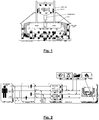
- a sketch of the alumina reduction cell is shown in Figure 1 .
- alumina reduction cell hereafter referred to as the cell, one (S ⁇ derberg) or several (Prebake) carbon anodes are dipped into the bath. The alumina is consumed electrochemically at the anode.
- the carbon anode is consumed during the process (theoretically 333 kg C/t Al).
- the lower part of the cell, the cathode consists of a steel shell lined with refractory and thermal insulation. A pool of liquid aluminium is formed on top of the carbon bottom.
- the cathode in the electrochemically sense, is the interface between the liquid aluminium and the bath, described by AlF 3 + 3 Na + + 3 e ⁇ Al + 3 NaF (2) and the total cell reaction becomes
- Pure bath Na 3 AlF 6
- the bath composition in a cell may typically be 6-13 [wt%] AlF 3 , 4-6 [wt%] CaF 2 , and 2-4 [wt%] Al 2 O 3 .
- Lowering the liquidus temperature makes it possible to operate the cell at a lower bath temperature, but at the expense of reduced solubility of Al 2 O 3 in the bath, demanding good Al 2 O 3 control. It should be mentioned that if the concentration of Al 2 O 3 gets too low (less than approx.
- anode effect the cell enters a state called anode effect.
- anode effect the cell voltage increases from the normal 4-4.5V up to 20-50V.
- Anode effect is a highly unwanted state, not only because it represents a waste of energy and a disturbance of the energy balance, but also because greenhouse gases ( CF 4 and C 2 F 6 ) are produced at the anode. Very often the anode effect requires a manual intervention of an operator.
- the bath temperature during normal cell operation is between 940 °C and 970 °C.
- the bath is not consumed during the electrolytic process, but some is lost, mainly during vaporization.
- the vapour mainly consists of NaAlF 4 .
- some bath is lost by entrainment of small droplets, and water present in the alumina feed reacts to form HF.
- the gas is collected and cleaned in a gas scrubbing system. More than 98% of the AlF 3 is recovered in the scrubbing system and recycled back to the cells.
- the content of sodium oxide ( Na 2 O ) and calcium fluoride ( Ca 2 F ) in the fed Al 2 O 3 neutralize AlF 3 .
- the neutralized amount is also a function of the penetration of sodium into the cathode, and hence the cell age.
- a 170 kA cell emits about 60 equivalent kg AlF 3 pr. 24 hours, and uses approximately 2500 kg Al 2 O 3 pr. 24 hours.
- the amount of AlF 3 due to neutralization for a 170 kA cell is between 0 and 20 kg per 24 hour (dependent of cell age). However, since most of the AlF 3 is recycled, the real consumption of AlF 3 is very small compared to the consumption of Al 2 O 3 .
- the composition of the side ledge is mainly pure Na 3 AlF 6 with some CaF 2 .
- the thickness of the side ledge is a function of the heat flow through the sides, which is a function of the difference in bath temperature and liquidus temperature. Since it is assumed that the side ledge composition is mainly Na 3 AlF 6 , this means that the total mass of cryolite in the bath varies, while the masses of AlF 3 and Al 2 O 3 do not vary with the side ledge thickness. Further, since the concentration of an additive is the mass of the additive divided by the total mass of bath, the variation in the side ledge thickness introduces variation in the concentrations. Hence, the changes in the concentrations introduce changes in the liquidus temperature, which introduces changes in the superheat, affecting the side ledge thickness.
- the challenge is thereby to ensure stable cell operations resulting in a stable protective side ledge, while minimizing energy input and maximizing production.
- centralized or decentralised architectures To control the electrolysis cells there are two main hardware architectures, namely centralized or decentralised architectures.
- the process control input is calculated by a centralized computer and distributed to local controlling devices on each aluminium electrolysis cell.
- decentralized architectures a decentralized computer, usually located close to the aluminium electrolysis cell, calculates the process control input.
- the dynamics in the mass of Al 2 O 3 is fast, and the control of the concentration of Al 2 O 3 has to deal with quick responses.
- the control of the concentration of Al 2 O 3 is usually considered as an isolated problem.
- the bath temperature is usually measured manually once a day or at least once a week. In some technologies, the bath temperature is possible to measure automatically.
- the concentration of AlF 3 (acidity) is typically measured manually once or twice a week, while the concentration of Al 2 O 3 is not normally measured at all, only in conjunction with experiments.
- R b is used as an input for the anode beam adjustment, and acts as a control variable in conjunction with the energy input to the cell.
- control problem is a non-linear multivariable control problem, it is commonly solved as if it should be a linear non-multivariable problem. I.e. using linear, single loop controllers (i.e. one controller controls one process variable), typically one controller for alumina control, one for AlF 3 control and one for energy/bath temperature control.
- linear, single loop controllers i.e. one controller controls one process variable
- typically one controller for alumina control, one for AlF 3 control and one for energy/bath temperature control typically one controller for alumina control, one for AlF 3 control and one for energy/bath temperature control.
- the measurements act as input to the controllers; the alumina controller typically uses the pseudo resistance measurement; the AlF 3 -controller uses a combination of AlF 3 and bath temperature measurements.
- the output from an AlF 3 -controller could typically be c1(Tb-TbRef) + c2(AlF 3 - AlF 3 ref) , where c1 and c2 is technology specific constants.
- Some technologies also use the bath temperature measurement to adjust the energy input (voltage) applied to the cell.
- linear single loop controllers do not "co-operate" (not a multivariable control scheme), although some technologies do use a slight coupling between AlF 3 control and energy/bath temperature control. Also these linear controllers are bounded by a lot of heuristic and rules.
- the present invention process control of Aluminium Electrolysis Cell:
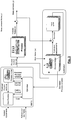
- Non-linear Model Predictive Control we understand the use of a non-linear dynamical model, state estimation (process variable estimation) and the solution of an online constrained non-linear optimisation problem to calculate the control inputs to the physical process. See also Fig. 3 .
- FIG. 3 illustrates the building blocks in the invention.
- the block labelled “Process” is meant to illustrate the physical process - one instance of the aluminium electrolysis cell. To the “Process” one is able to apply process control inputs (mass and energy) and measure some process outputs. The measurement could only be done up to a certain level of accuracy. The level of inaccuracy is described as "Measurement Noise”.
- the block labelled “Estimator” contains a mathematical model of the "Process”. The “Process” is described by using “First Principle” modelling techniques, and results in several process parameters and process variables that are used in the estimation of the current value of the said variables. Also the model contains partial differential equations (PDE), which capture the time derivative of a selected sub-set of the process variables. This sub-set is called process states.
- PDE partial differential equations
- the discrepancy could be seen as uncertainty - here labelled "State Noise”.
- the value of the process control inputs and the value of the measurements is also led as inputs to the "Estimator”.
- the purpose of the "Estimator” is to calculate an estimate of the current process variables (process states, estimated parameters and measurements). Further, the estimated measurements are compared to the physical measurements, and the deviation is used to adjust the model such that the deviation is minimized. This technique is referred to as a Kalmanfilter estimation technique.
- the estimated measurements, states and parameters are the output form the "Estimator”, and serves as an input to the non-linear model predictive control (NMPC) block.
- the "NMPC” block uses a sub set of the estimated process variables (CV), usually in conjunction with some reference values and constraints, to calculate the optimal future process control input senario (MV) in order to move the process from the current working point (given by the estimate), to the working point given by the reference values.
- the optimal future process control input senario would typically be within a finite future time frame. Since the strategy is operating in the discrete time frame, the optimal future process control input senario would be calculated each time step (say each 5 th minute), based up on updated process variable estimates, which also are available each time step.
- the optimal control input scenario is found by solving an optimisation criterion by minimizing it with respect to predicted process variables, among others.
- the predictions stem from using the non-linear dynamic model to predict the future values of the process variables.
- the optimiser used is an optimiser that is able to solve non-linear constrained problems (typically SQP).
- SQP non-linear constrained problems
- the non-linear process model in the "NMPC" block is in this embodiment of the invention the same as the non-linear model in the "Estimator” block.
- NMPC non-linear model of the aluminium electrolysis process is introduced.
- the (non-linear) model has two important purposes - one is to estimate the current value of important process variables and measurements of the process, the second is to be used to predict the future values of the process variables and measurements (see figure 7 , to be further explained later).
- a dynamic mathematical model of the electrolysis process is used to estimate important process variables.
- the process variables could be variables that are not measured at all (side ledge thickness, mass of bath and metal, mass of AlF 3 , mass of Al 2 O 3 , concentration of Al 2 O 3 ) and process variables that are infrequently measured (concentration of AlF 3 , bath height, metal height and bath temperature).
- process variables modelled is that estimates of the process variables are available almost continuously (for example each 5 th minute).
- the NMPC uses the estimate from the estimator described above as a starting point (where we are). By comparing the estimate with selected set points (where we want to go) on a given set of process variables, the NMPC controller calculates the future control path in an optimal manner by the use of the model. The 'future' could be the next 24 hours. The first optimal control is then applied to the physical process. This scheme is then repeated each n th minute (n to be determined) (see Fig. 7 ).
- the input to the controller is entirely based on estimated values, and not measured values directly. Further the controller utilizes the nonlinearity of the process, the coupling between the process variables, and the process dynamics together with process and controller constraints, and finds an optimal process control input, which is put onto the physical process. Also, in this embodiment of the invention the use of the NMPC is to directly calculate the process control inputs, and not some set points to secondary control loops or systems
- the model used has 9 estimated process states, 7 measurements, 3 main and 10 additional process control inputs and some estimated process parameters. Further there is defined some calculated process variables.
- the estimated process states are the side ledge thickness, bath temperature, mass of dissolved alumina in the bath, mass of dissolved aluminium fluoride in the bath, metal mass, the distance between the lower anode surface and the cathode, cathode temperature, mass of alumina sludge and mass of cryolite in the cell.
- the measurements are the pseudo resistance, line current, bath temperature, concentration of aluminium fluoride, metal height, bath height and cathode rod temperature.
- the main 3 process control inputs are the addition of alumina and aluminium fluoride and the anode movement.
- the additional 10 process control inputs are information about the discrete events anode change, tap of metal, addition/removal of bath, crust covering, covering crust by alumina, addition of soda, crust brake, anode effect and anode problems.
- the parameter estimated could be any, one or several, of the parameters needed to describe an aluminium electrolysis cell, but in present embodiment of the invention only the heat loss through the is estimated.
- the other parameters are considered known and constant.
- the most important calculated variables are mass of bath, alumina concentration, acidity, pseudo resistance, liquidus temperature, super-heat and anode-cathode distance.
- the uncertainty related to the estimated process states and measurements is assumed Gaussian and additive.
- the uncertainty in the control inputs is assumed Gaussian and relative.
- the NMPC controller is used to control the Aluminium Electrolysis Cell and the aim is to control the energy and mass balance. Since there are three process inputs available (addition of alumina, addition of aluminium fluoride and anode movement) one can only expect to control three process variables to a desired value (set point). In the NMPC framework the process input is termed manipulated variables (MV).
- MV manipulated variables
- One of the challenges is then to select those three process variables that allow one to best control the mass and energy balance.
- the following three process variables are chosen: alumina concentration, bath temperature and side ledge thickness.
- These process variables are referred to as controlled variables or CVs, and is a sub set of all the process variables. Further the three process variables referred is associated with a reference (or a desired) value.
- the mass of fluoride in the bath is also included in the CV, but without reference values. They are however assumed having a value between some determined minimum and maximum limits (see Table 3). Also it is important to note that the pseudo resistance has no dedicated reference value in this embodiment of the invention.
- the NMPC is allowed to use the resistance value necessary to maintain the energy balance.
- CVs The idea behind the selection of these process variables as CVs is that once the alumina concentration, the bath temperature and the side ledge thickness are determined the superheat is determined. When the superheat is determined, the liquidus temperature is determined and by that the mass of fluoride. Further the ACD is included in the CV in order to have the possibility to constrain the ACD because of safety related issues. For example it is considered as a serious safety concern if the anodes should leave the bath (high ACD).
- the output from the Kalmanfilter as previously described is the best estimate of the current state of the process variables, and is used by the NMPC to define a starting point for the calculations to come.
- the NMPC calculates an optimal future process input scenario U (t k ), U (t k+1 ), ..., U (t k+Nu ) in order to achieve the set point for the CVs within a chosen future discrete time of length N (prediction horizon).
- t k is the present time (now)
- t k +1 , ..., t k + Nu is the forward discrete time in the control horizon.
- the interval t k to t k + N forms the prediction window.
- only the first calculated process input U(t k ) from the optimal future process input scenario is put into effect on the physical process itself. This scheme is then repeated for example each 5 th minute.
- the prediction model used in this invention is the same model as the model used in the estimator previously described, but now without the possibility to update the state estimates from measurements.
- a criterion to be minimized is defined.
- Constraints it should be understood methods for constraint handling if some constraints are violated.
- T means the transpose.
- the vector Z is composed of the future prediction of the controlled variables (CV).
- Z - Z ref means the deviation.
- the vector U is the future input scenario of all manipulated variables (MV), while ⁇ U is the difference between the present and the previous input scenario.
- Equation (6) are all positive semi-definite and diagonal matrices, i.e. contains only positive or zero weights.
- Q and S can bee seen as incorporated in W.
- the purpose of the weight matrix Q is to control the behavior of the NMPC controller. Obviously increasing the weights in Q will increase the importance of controlling the CV to its set point and therefore reduce the set point deviation. By choosing different weights for the different CVs, one controls the priority between them. In this process the most important one is to achieve the desired alumina concentration, then the bath temperature and finally the side ledge thickness. This is reflected in the Q matrix with a large value in Q related to the alumina concentration, lower on the bath temperature and lowest on the side ledge thickness (see Table 3).
- Equation (6) controls the cost of the use of the process inputs. Increasing the weights in S will suppress the use of the MV and relax the use of it. For example, with reference to Table 2 below, it is cheap to use alumina, a bit more costly to use anode movement and very expensive to use aluminium fluoride to achieve the desired set points.
- Table 1 Input blocking - selected samples No Input Type Selected samples (sample numbers of 143) 1 Alumina feed Feedback 0, 4, 10, 24, 48, 96 2 Aluminium fluoride feed Feedback 0, 72 3 Anode movement for MPC Feedback 0, 12, 24, 48, 96
- the points where the CV is evaluated against the reference are freely selected (see Table 4).
- the parameterization of the input scenario may be selected individually for each MV (see Figure 7 ).
- the algorithm is also illustrated in figure 4 to 7 .
- Figure 4 illustrates that in the time t k (now) a new updated estimate of the CV's is available.
- the updated estimate of the CV's is a subset of the estimate of the process variables.
- the estimate of the process variables is the output available from the estimator (Kalmanfilter).
- Z ref illustrates the set point for the CV.
- MV illustrates the manipulated variables as defined earlier.
- Figure 7 illustrates that in the time t k (now) the future optimal process control input scenario is calculated for the prediction window defined. Only U(t k ), the first process input combination for the optimal process control input scenario, is put onto the physical process. The current estimate of the process variables forms the starting point used in the prediction of the future time behavior of the process. The predicted CV is an extracted subset of the predicted time behavior of the process variables as given by the prediction model. Also the figure illustrates the control horizon and the prediction horizon. The control horizon could be smaller or equal to the prediction horizon. The control horizon stems from the cases when using input blocking. In such a case when the control horizon is smaller than the prediction horizon, it is assumed that the future optimal process control input value in the interval t k+Nu+1 to t k+N is equal to U(t k+Nu ).
- Figure 6 illustrates that in the time t k (now) a new updated and corrected estimate of the CV's is available based on new measurements and inputs.
- Figure 7 illustrates that in the time t k (now) a new future optimal input sequence is calculated for the prediction window defined based on the new updated CV. Only U(t k ), the first process input combination for the optimal future input sequence, is put onto the physical process.
- the updated predicted CV is an extracted subset of the predicted time behavior of the process variables as given by the prediction model.
- the dotted lines are the one from the last sample. Then repeat from Fig. 6 .
- Table 2 Parametertuning related to the MV's No Input Type UMin uMax duMax S 1 Alumina feed Feedback 0 12 1.5 0.1 2 Aluminium fluoride feed Feedback 0 1.36 1.36 1800 3 Anode movement for MPC Feedback -20 20 8 20
- Table 3 Parametertuning related to the CV's No Variable name Z min Z max Q Setpoint 1 Alumina concentration 2.3 4.5 250 3.0 2 Bath temperature 952 970 10 958.0 3 Side ledge thickness 20 160 0.4 100.0 4 Mass of fluoride 500 1600 0 N/A 5 Anode-cathode distance 0.02 0.04 0 N/A 6 Super heat 3.0 15.0 0 N/A
- the chosen prediction horizon is typically 12 hours long. This has proven to give good results both on simulator and during online tests. This horizon is long enough that most variables have settled at the end of it.
- the different controlled variables have different settling times, and are thus tuned differently in the prediction horizon.
- the controller is tuned such that the added alumina mainly controls alumina concentration, anode movement mainly controls the temperature and the addition of aluminium fluoride mainly controls the side ledge thickness.
- interactions and coupling between the variables are taken into account despite this tuning
- Table 4 Parameterizing of the CV's No Variable name Active samples 1 Alumina concentration, 3:6:144 2 Bath temperature 24:6:144 3 Side ledge thickness 48:6:144 4 Mass of fluoride 12:6:144 5 Anode-cathode distance, 12:6:144 6 Super heat 12:6:144
- 3:6:144 means that the 1 th value selected is sample nr 3, then each 6 th up till sample nr 144 (12 hours).
- the idea behind the parameterization is that the CV is not changing faster than that the process dynamics is captured within the parameterization. By this, a selection of the sampling times is used and hence reduces the application's memory usage.
- controller can be integrated in both decentralized and centralized control system architectures where said computer will have a software program dedicated to each pot or electrolysis cell due to the individual character of said cells.
- the NMPC could be used to control the complete plant when dynamic current load is an issue.
- the set point could be optimized such that the whole plant (all cells) could be operated in an optimum manner to lower the power consumption in defined periods during the day.
Landscapes
- Chemical & Material Sciences (AREA)
- Engineering & Computer Science (AREA)
- Chemical Kinetics & Catalysis (AREA)
- Electrochemistry (AREA)
- Materials Engineering (AREA)
- Metallurgy (AREA)
- Organic Chemistry (AREA)
- Electrolytic Production Of Metals (AREA)
- Feedback Control In General (AREA)
Claims (10)
- Verfahren zur Steuerung einer Elektrolysezelle vom Hall-Heroult-Typ zur Aluminiumproduktion durch Prozesssteuerungseingaben von Energie und Masse, welches die Messung einer oder mehrerer Prozessvariabler zur Erstellung eines Satzes von historischen Daten zur Modellierung eines Satzes von Prozessvariablen, welche über die Zeit variieren, umfasst, darunter wenigstens eines von Aluminiumoxidkonzentration, Badtemperatur oder Seitenwanddicke, wobei die gemessene(n) Variable(n) einem Schätzer zur Schätzung des aktuellen Wertes der einen oder mehreren Prozessvariablen zugeführt wird (werden), gefolgt von der Vorhersage des Wertes derselben Prozessvariablen und/oder einer anderen Prozessvariablen (anderer Prozessvariabler) in der Zukunft, wobei der (die) vorhergesagte(n) Wert(e) bei der Berechnung zukünftiger Steuerungseingabeszenarien verwendet wird (werden),
wobei
die Vorhersage der Prozessvariablen gemäß einem nichtlinearen dynamischen Modell des Aluminiumelektrolyseprozesses durchgeführt wird, basierend auf dem Ersten Prinzip, um ein optimales zukünftiges Prozesseingabeszenario U(tk), U(tk+1), ... ,U(tk+Nu) zu erzielen, um den Sollwert für die gesteuerten Variablen (Controlled Variables, CVs) für wenigstens eines von Aluminiumoxidkonzentration, Badtemperatur oder Seitenwanddicke innerhalb eines gewählten Vorhersagehorizonts zu erreichen, und wobei die Schätzung des aktuellen Wertes einer oder mehrerer Prozessvariabler durch Kalman-Filtertechniken oder Prinzipien des bewegten Horizonts durchgeführt wird. - Verfahren nach Anspruch 1,
wobei
eine Prozesssteuerungseingabe der Zelle in zeitlichen Abständen zugeführt wird,
wobei die Periode T ungefähr 5 Minuten beträgt. - Verfahren nach Anspruch 1,
wobei
die Berechnung zukünftiger Steuerungseingabeszenarien in zeitlichen Abständen zugeführt wird, wobei die Periode T ungefähr 5 Minuten beträgt. - Verfahren nach Anspruch 1,
wobei
die Berechnung zukünftiger Steuerungseingabeszenarien gemäß der folgenden Kostenfunktionsgleichung J durchgeführt wird: Z die Zukunftsvorhersage der gesteuerten Variablen (CV) ist,Zref die gewünschten Werte oder Referenzwerte von Z sind Z,U das zukünftige Prozesseingabeszenario ist,ΔU die Differenz zwischen dem gegenwärtigen und dem vorhergehenden Prozesseingabeszenario ist,W gewisse Gewichtsmatrizen oder -funktionen sind, die verwendet werden, um Kombinationen von Z, Zref , U und/oder ΔU mit Strafen zu versehen,und der Begriff Nebenbedingungen sich auf Verfahren zur Handhabung von Nebenbedingungen, falls gewisse Nebenbedingungen verletzt werden, bezieht.
 - Verfahren nach Anspruch 1,
wobei
die Berechnung zukünftiger Steuerungseingabeszenarien gemäß der folgenden Kostenfunktionsgleichung J' durchgeführt wird: wobei: T die Transponierte ist,Z ein Vektor ist, der aus der Zukunftsvorhersage der gesteuerten Variablen (CV) besteht,Z-Zref die Abweichung bedeutet,U ein Vektor ist, der sich auf das zukünftige Eingabeszenario aller manipulierten Variablen (MV) bezieht,ΔU die Differenz zwischen dem gegenwärtigen und dem vorhergehenden Eingabeszenario ist,Q und S alle positiv semidefinite Matrizen und Diagonalmatrizen sind, d. h. nur positive oder Nullgewichte enthalten.
 - Verfahren nach Anspruch 1,
wobei das Modell den (die) geschätzten aktuellen Wert(e) einer/von Prozessvariablen mit ausgewählten Sollwerten auf einem gegebenen Satz von Prozessvariablen vergleicht. - Mittel zur Steuerung einer Elektrolysezelle vom Hall-Heroult-Typ zur Aluminiumproduktion durch Prozesssteuerungseingaben von Energie und Masse, welche Mittel zur Messung einer oder mehrerer Prozessvariabler zur Erstellung eines Satzes von historischen Daten zur Modellierung eines Satzes von Prozessvariablen, welche über die Zeit variieren, umfasst, darunter wenigstens eines von Aluminiumoxidkonzentration, Badtemperatur oder Seitenwanddicke, wobei die gemessene(n) Variable(n) einem Schätzer zur Schätzung des aktuellen Wertes der einen oder mehreren Prozessvariablen zugeführt wird (werden), gefolgt von der Vorhersage des Wertes derselben Prozessvariablen und/oder einer anderen Prozessvariablen (anderer Prozessvariabler) in der Zukunft, wobei der (die) vorhergesagte(n) Wert(e) verwendet wird (werden), um ein zukünftiges Eingabesteuerungsszenario mittels eines Rechners zu berechnen,
wobei
die Vorhersage der Prozessvariablen gemäß einem nichtlinearen dynamischen Modell der Aluminiumelektrolysezelle durchgeführt wird, basierend auf dem Ersten Prinzip, um ein optimales zukünftiges Prozesseingabeszenario U(tk), U(tk+1), ...,U(tk+Nu) zu erzielen, um den Sollwert für die gesteuerten Variablen (Controlled Variables, CVs) für wenigstens eines von Aluminiumoxidkonzentration, Badtemperatur oder Seitenwanddicke innerhalb eines gewählten Vorhersagehorizonts zu erreichen, und wobei der aktuelle Wert einer oder mehrerer Prozessvariabler geschätzt wird, wobei der Schätzer ein Kalman-Filter oder ein Schätzer zur Schätzung auf bewegtem Horizont ist. - Mittel nach Anspruch 7,
wobei
das Prozesssteuerungsmittel ein integrierter Bestandteil einer lokalen Zellensteuereinheit ist. - Mittel nach Anspruch 7,
wobei
das Prozesssteuerungsmittel ein integrierter Bestandteil einer zentralen Steuereinheit ist. - Mittel nach Anspruch 9,
wobei
das Prozesssteuerungsmittel für jede einzelne Zelle zugeordnete Software enthält.
Applications Claiming Priority (2)
| Application Number | Priority Date | Filing Date | Title |
|---|---|---|---|
| NO20075933A NO328080B1 (no) | 2007-11-19 | 2007-11-19 | Fremgangsmate og anordning for styring av en elektrolysecelle |
| PCT/NO2008/000402 WO2009067019A1 (en) | 2007-11-19 | 2008-11-12 | Method and means for controlling an electrolysis cell |
Publications (3)
| Publication Number | Publication Date |
|---|---|
| EP2212751A1 EP2212751A1 (de) | 2010-08-04 |
| EP2212751A4 EP2212751A4 (de) | 2013-01-23 |
| EP2212751B1 true EP2212751B1 (de) | 2018-07-04 |
Family
ID=40667707
Family Applications (1)
| Application Number | Title | Priority Date | Filing Date |
|---|---|---|---|
| EP08852151.3A Active EP2212751B1 (de) | 2007-11-19 | 2008-11-12 | Verfahren und mittel zur steuerung einer elektrolysezelle |
Country Status (11)
| Country | Link |
|---|---|
| EP (1) | EP2212751B1 (de) |
| CN (1) | CN101868765B (de) |
| AR (1) | AR069355A1 (de) |
| AU (1) | AU2008326931B2 (de) |
| BR (1) | BRPI0820426A2 (de) |
| CA (1) | CA2704551C (de) |
| EA (1) | EA018248B1 (de) |
| NO (1) | NO328080B1 (de) |
| NZ (1) | NZ585470A (de) |
| WO (1) | WO2009067019A1 (de) |
| ZA (1) | ZA201003134B (de) |
Cited By (1)
| Publication number | Priority date | Publication date | Assignee | Title |
|---|---|---|---|---|
| EP4198655A1 (de) * | 2021-12-16 | 2023-06-21 | Abb Schweiz Ag | Erstellung oder verbesserung eines simulationsmodells einer elektrolyseuranlage |
Families Citing this family (12)
| Publication number | Priority date | Publication date | Assignee | Title |
|---|---|---|---|---|
| IT1401233B1 (it) * | 2010-07-14 | 2013-07-12 | Danieli Automation Spa | Dispositivo per la rilevazione di livello in una attrezzatura di colata e relativo procedimento di rilevazione. |
| US9121104B2 (en) * | 2011-01-31 | 2015-09-01 | Alcoa Inc. | Systems and methods for determining alumina properties |
| US20130024179A1 (en) * | 2011-07-22 | 2013-01-24 | General Electric Company | Model-based approach for personalized equipment degradation forecasting |
| GB201602613D0 (en) * | 2016-02-15 | 2016-03-30 | Dubai Aluminium Pjsc And Newsouth Innovations Pty Ltd | Method for estimating dynamic state variables in an electrolytic cell suitable for the Hall-Héroult electrolysis process |
| KR102492794B1 (ko) * | 2016-08-12 | 2023-01-27 | 보스톤 일렉트로메탈러지칼 코포레이션 | 야금 용기의 무-누설 전류 수집기 어셈블리지 및 제조 방법 |
| US9996074B2 (en) | 2016-09-21 | 2018-06-12 | International Business Machines Corporation | System and predictive modeling method for smelting process control based on multi-source information with heterogeneous relatedness |
| NO20181482A1 (en) | 2018-11-20 | 2020-05-21 | Norsk Hydro As | Method and system for controlling suction of off-gases from electrolysis cells |
| WO2020190271A1 (en) * | 2019-03-16 | 2020-09-24 | General Electric Company | System and method for controlling of smelting pot line |
| CN112239873B (zh) * | 2019-07-19 | 2021-10-01 | 郑州轻冶科技股份有限公司 | 一种铝电解工艺参数优化方法以及铝电解槽组 |
| CN114123238B (zh) * | 2021-11-12 | 2023-09-22 | 国网江苏省电力有限公司营销服务中心 | 一种电解铝负荷参与电力系统调频的卡尔曼滤波控制方法 |
| CN115558961B (zh) * | 2022-10-13 | 2026-03-17 | 中国科学院深圳先进技术研究院 | 一种控制氟化铝添加量的方法及装置 |
| DE102024114720A1 (de) | 2024-05-24 | 2025-11-27 | Rolls-Royce Solutions GmbH | Verfahren zum Betreiben einer Leistungsvorrichtung, Computerprogramm sowie Steuervorrichtung zur Durchführung eines solchen Verfahrens und Leistungsanordnung mit einer solchen Steuervorrichtung |
Family Cites Families (8)
| Publication number | Priority date | Publication date | Assignee | Title |
|---|---|---|---|---|
| NO166821C (no) | 1985-02-21 | 1991-09-04 | Aardal & Sunndal Verk As | Fremgangsmaate for styring av aluminiumoksyd-tilfoerselen til elektrolyseovner for fremstilling av aluminium. |
| US4814050A (en) | 1986-10-06 | 1989-03-21 | Aluminum Company Of America | Estimation and control of alumina concentration in hall cells |
| CA2230564A1 (en) * | 1995-09-01 | 1997-03-13 | Auckland Uniservices Limited | Measurement of alumina in reduction pots |
| FR2749858B1 (fr) * | 1996-06-17 | 1998-07-24 | Pechiney Aluminium | Procede de regulation de la teneur en alumine du bain des cuves d'electrolyse pour la production d'aluminium |
| CA2230882C (en) | 1997-03-14 | 2004-08-17 | Dubai Aluminium Company Limited | Intelligent control of aluminium reduction cells using predictive and pattern recognition techniques |
| US6757579B1 (en) | 2001-09-13 | 2004-06-29 | Advanced Micro Devices, Inc. | Kalman filter state estimation for a manufacturing system |
| US7272454B2 (en) * | 2003-06-05 | 2007-09-18 | Fisher-Rosemount Systems, Inc. | Multiple-input/multiple-output control blocks with non-linear predictive capabilities |
| US20070225835A1 (en) * | 2006-03-23 | 2007-09-27 | Yucai Zhu | Computer method and apparatus for adaptive model predictive control |
-
2007
- 2007-11-19 NO NO20075933A patent/NO328080B1/no unknown
-
2008
- 2008-11-12 AU AU2008326931A patent/AU2008326931B2/en active Active
- 2008-11-12 BR BRPI0820426-8A patent/BRPI0820426A2/pt not_active Application Discontinuation
- 2008-11-12 EA EA201000833A patent/EA018248B1/ru not_active IP Right Cessation
- 2008-11-12 CN CN200880116702.9A patent/CN101868765B/zh active Active
- 2008-11-12 NZ NZ585470A patent/NZ585470A/en unknown
- 2008-11-12 CA CA2704551A patent/CA2704551C/en active Active
- 2008-11-12 WO PCT/NO2008/000402 patent/WO2009067019A1/en not_active Ceased
- 2008-11-12 EP EP08852151.3A patent/EP2212751B1/de active Active
- 2008-11-18 AR ARP080105014 patent/AR069355A1/es active IP Right Grant
-
2010
- 2010-05-04 ZA ZA2010/03134A patent/ZA201003134B/en unknown
Non-Patent Citations (1)
| Title |
|---|
| None * |
Cited By (1)
| Publication number | Priority date | Publication date | Assignee | Title |
|---|---|---|---|---|
| EP4198655A1 (de) * | 2021-12-16 | 2023-06-21 | Abb Schweiz Ag | Erstellung oder verbesserung eines simulationsmodells einer elektrolyseuranlage |
Also Published As
| Publication number | Publication date |
|---|---|
| EA018248B1 (ru) | 2013-06-28 |
| NO328080B1 (no) | 2009-11-30 |
| AU2008326931B2 (en) | 2013-01-10 |
| AU2008326931A1 (en) | 2009-05-28 |
| CN101868765B (zh) | 2014-07-09 |
| WO2009067019A1 (en) | 2009-05-28 |
| EP2212751A1 (de) | 2010-08-04 |
| CN101868765A (zh) | 2010-10-20 |
| NZ585470A (en) | 2012-05-25 |
| NO20075933L (no) | 2009-05-20 |
| CA2704551C (en) | 2016-08-23 |
| BRPI0820426A2 (pt) | 2015-05-19 |
| EA201000833A1 (ru) | 2010-12-30 |
| AR069355A1 (es) | 2010-01-13 |
| CA2704551A1 (en) | 2009-05-28 |
| EP2212751A4 (de) | 2013-01-23 |
| ZA201003134B (en) | 2011-04-28 |
Similar Documents
| Publication | Publication Date | Title |
|---|---|---|
| EP2212751B1 (de) | Verfahren und mittel zur steuerung einer elektrolysezelle | |
| Würth et al. | Neighboring-extremal updates for nonlinear model-predictive control and dynamic real-time optimization | |
| CA2230882C (en) | Intelligent control of aluminium reduction cells using predictive and pattern recognition techniques | |
| Shi et al. | Advanced model-based estimation and control of alumina concentration in an aluminum reduction cell | |
| CN114047722A (zh) | 基于mpc的自适应位姿修正的路径跟踪控制方法 | |
| Minzu et al. | Systematic Procedure for Optimal Controller Implementation Using Metaheuristic Algorithms. | |
| US7378009B2 (en) | Method of controlling an aluminum cell with variable alumina dissolution rate | |
| Ross et al. | Sensor data fusion in electrochemical applications: An overview and its application to electrochlorination monitoring | |
| Jia et al. | Application of robust model predictive control using principal component analysis to an industrial thickener | |
| Meghlaoui et al. | Predictive control of aluminum electrolytic cells using neural networks | |
| Kolås et al. | A nonlinear model based control strategy for the aluminium electrolysis process | |
| Shi et al. | Advanced monitoring and control of alumina concentration in aluminum smelting cells | |
| CN120506267A (zh) | 一种基于强化学习的多变量分层自适应充填调控方法 | |
| Drengstig et al. | On the AlF/sub 3/and temperature control of an aluminum electrolysis cell | |
| Antille et al. | Hall‐Heroult Cell Simulator: A Tool for the Operation and Process Control | |
| Gran | A multivariable control in aluminum reduction cells | |
| CN111462830B (zh) | 一种基于电解铝工艺模型的状态观测方法 | |
| Wang et al. | Dynamic modelling and predictive control for the sequential collaborative reactors of cobalt removal process under time‐varying conditions | |
| Wu et al. | Output feedback Lyapunov‐based model predictive control with extended Kalman filter for nonlinear systems subject to random measurement delays and noises | |
| Kolås | Defining and verifying the “correlation line” in aluminum electrolysis | |
| Sadighi et al. | Artificial neural network modeling and optimization of Hall-Héroult process for aluminum production | |
| WO2020190271A1 (en) | System and method for controlling of smelting pot line | |
| CN118588207A (zh) | 铝电解的出铝数据预测方法、装置及存储介质 | |
| Rajput | Interpretable Dynamic Modeling and Optimization for Zinc Leaching Process | |
| Yan et al. | Optimal Control of Alumina Concentration in Aluminum Reduction Cell Based on Two-Layer Model Predictive Control |
Legal Events
| Date | Code | Title | Description |
|---|---|---|---|
| PUAI | Public reference made under article 153(3) epc to a published international application that has entered the european phase |
Free format text: ORIGINAL CODE: 0009012 |
|
| 17P | Request for examination filed |
Effective date: 20100621 |
|
| AK | Designated contracting states |
Kind code of ref document: A1 Designated state(s): AT BE BG CH CY CZ DE DK EE ES FI FR GB GR HR HU IE IS IT LI LT LU LV MC MT NL NO PL PT RO SE SI SK TR |
|
| AX | Request for extension of the european patent |
Extension state: AL BA MK RS |
|
| RIN1 | Information on inventor provided before grant (corrected) |
Inventor name: KOLAS, STEINAR |
|
| DAX | Request for extension of the european patent (deleted) | ||
| A4 | Supplementary search report drawn up and despatched |
Effective date: 20121220 |
|
| RIC1 | Information provided on ipc code assigned before grant |
Ipc: G05B 13/04 20060101AFI20121214BHEP Ipc: C25C 3/20 20060101ALI20121214BHEP |
|
| 17Q | First examination report despatched |
Effective date: 20130807 |
|
| STAA | Information on the status of an ep patent application or granted ep patent |
Free format text: STATUS: EXAMINATION IS IN PROGRESS |
|
| GRAP | Despatch of communication of intention to grant a patent |
Free format text: ORIGINAL CODE: EPIDOSNIGR1 |
|
| STAA | Information on the status of an ep patent application or granted ep patent |
Free format text: STATUS: GRANT OF PATENT IS INTENDED |
|
| INTG | Intention to grant announced |
Effective date: 20180206 |
|
| GRAS | Grant fee paid |
Free format text: ORIGINAL CODE: EPIDOSNIGR3 |
|
| GRAA | (expected) grant |
Free format text: ORIGINAL CODE: 0009210 |
|
| STAA | Information on the status of an ep patent application or granted ep patent |
Free format text: STATUS: THE PATENT HAS BEEN GRANTED |
|
| AK | Designated contracting states |
Kind code of ref document: B1 Designated state(s): AT BE BG CH CY CZ DE DK EE ES FI FR GB GR HR HU IE IS IT LI LT LU LV MC MT NL NO PL PT RO SE SI SK TR |
|
| REG | Reference to a national code |
Ref country code: GB Ref legal event code: FG4D |
|
| REG | Reference to a national code |
Ref country code: CH Ref legal event code: EP |
|
| REG | Reference to a national code |
Ref country code: AT Ref legal event code: REF Ref document number: 1015157 Country of ref document: AT Kind code of ref document: T Effective date: 20180715 |
|
| REG | Reference to a national code |
Ref country code: IE Ref legal event code: FG4D |
|
| REG | Reference to a national code |
Ref country code: DE Ref legal event code: R096 Ref document number: 602008055881 Country of ref document: DE |
|
| REG | Reference to a national code |
Ref country code: NL Ref legal event code: MP Effective date: 20180704 |
|
| REG | Reference to a national code |
Ref country code: LT Ref legal event code: MG4D |
|
| REG | Reference to a national code |
Ref country code: AT Ref legal event code: MK05 Ref document number: 1015157 Country of ref document: AT Kind code of ref document: T Effective date: 20180704 |
|
| PG25 | Lapsed in a contracting state [announced via postgrant information from national office to epo] |
Ref country code: NL Free format text: LAPSE BECAUSE OF FAILURE TO SUBMIT A TRANSLATION OF THE DESCRIPTION OR TO PAY THE FEE WITHIN THE PRESCRIBED TIME-LIMIT Effective date: 20180704 |
|
| REG | Reference to a national code |
Ref country code: SK Ref legal event code: T3 Ref document number: E 28443 Country of ref document: SK |
|
| PG25 | Lapsed in a contracting state [announced via postgrant information from national office to epo] |
Ref country code: NO Free format text: LAPSE BECAUSE OF FAILURE TO SUBMIT A TRANSLATION OF THE DESCRIPTION OR TO PAY THE FEE WITHIN THE PRESCRIBED TIME-LIMIT Effective date: 20181004 Ref country code: BG Free format text: LAPSE BECAUSE OF FAILURE TO SUBMIT A TRANSLATION OF THE DESCRIPTION OR TO PAY THE FEE WITHIN THE PRESCRIBED TIME-LIMIT Effective date: 20181004 Ref country code: GR Free format text: LAPSE BECAUSE OF FAILURE TO SUBMIT A TRANSLATION OF THE DESCRIPTION OR TO PAY THE FEE WITHIN THE PRESCRIBED TIME-LIMIT Effective date: 20181005 Ref country code: SE Free format text: LAPSE BECAUSE OF FAILURE TO SUBMIT A TRANSLATION OF THE DESCRIPTION OR TO PAY THE FEE WITHIN THE PRESCRIBED TIME-LIMIT Effective date: 20180704 Ref country code: AT Free format text: LAPSE BECAUSE OF FAILURE TO SUBMIT A TRANSLATION OF THE DESCRIPTION OR TO PAY THE FEE WITHIN THE PRESCRIBED TIME-LIMIT Effective date: 20180704 Ref country code: CZ Free format text: LAPSE BECAUSE OF FAILURE TO SUBMIT A TRANSLATION OF THE DESCRIPTION OR TO PAY THE FEE WITHIN THE PRESCRIBED TIME-LIMIT Effective date: 20180704 Ref country code: FI Free format text: LAPSE BECAUSE OF FAILURE TO SUBMIT A TRANSLATION OF THE DESCRIPTION OR TO PAY THE FEE WITHIN THE PRESCRIBED TIME-LIMIT Effective date: 20180704 Ref country code: LT Free format text: LAPSE BECAUSE OF FAILURE TO SUBMIT A TRANSLATION OF THE DESCRIPTION OR TO PAY THE FEE WITHIN THE PRESCRIBED TIME-LIMIT Effective date: 20180704 Ref country code: PL Free format text: LAPSE BECAUSE OF FAILURE TO SUBMIT A TRANSLATION OF THE DESCRIPTION OR TO PAY THE FEE WITHIN THE PRESCRIBED TIME-LIMIT Effective date: 20180704 |
|
| PG25 | Lapsed in a contracting state [announced via postgrant information from national office to epo] |
Ref country code: LV Free format text: LAPSE BECAUSE OF FAILURE TO SUBMIT A TRANSLATION OF THE DESCRIPTION OR TO PAY THE FEE WITHIN THE PRESCRIBED TIME-LIMIT Effective date: 20180704 Ref country code: HR Free format text: LAPSE BECAUSE OF FAILURE TO SUBMIT A TRANSLATION OF THE DESCRIPTION OR TO PAY THE FEE WITHIN THE PRESCRIBED TIME-LIMIT Effective date: 20180704 Ref country code: ES Free format text: LAPSE BECAUSE OF FAILURE TO SUBMIT A TRANSLATION OF THE DESCRIPTION OR TO PAY THE FEE WITHIN THE PRESCRIBED TIME-LIMIT Effective date: 20180704 |
|
| REG | Reference to a national code |
Ref country code: DE Ref legal event code: R097 Ref document number: 602008055881 Country of ref document: DE |
|
| PG25 | Lapsed in a contracting state [announced via postgrant information from national office to epo] |
Ref country code: RO Free format text: LAPSE BECAUSE OF FAILURE TO SUBMIT A TRANSLATION OF THE DESCRIPTION OR TO PAY THE FEE WITHIN THE PRESCRIBED TIME-LIMIT Effective date: 20180704 Ref country code: IT Free format text: LAPSE BECAUSE OF FAILURE TO SUBMIT A TRANSLATION OF THE DESCRIPTION OR TO PAY THE FEE WITHIN THE PRESCRIBED TIME-LIMIT Effective date: 20180704 Ref country code: EE Free format text: LAPSE BECAUSE OF FAILURE TO SUBMIT A TRANSLATION OF THE DESCRIPTION OR TO PAY THE FEE WITHIN THE PRESCRIBED TIME-LIMIT Effective date: 20180704 |
|
| PLBE | No opposition filed within time limit |
Free format text: ORIGINAL CODE: 0009261 |
|
| STAA | Information on the status of an ep patent application or granted ep patent |
Free format text: STATUS: NO OPPOSITION FILED WITHIN TIME LIMIT |
|
| PG25 | Lapsed in a contracting state [announced via postgrant information from national office to epo] |
Ref country code: DK Free format text: LAPSE BECAUSE OF FAILURE TO SUBMIT A TRANSLATION OF THE DESCRIPTION OR TO PAY THE FEE WITHIN THE PRESCRIBED TIME-LIMIT Effective date: 20180704 |
|
| 26N | No opposition filed |
Effective date: 20190405 |
|
| REG | Reference to a national code |
Ref country code: CH Ref legal event code: PL |
|
| GBPC | Gb: european patent ceased through non-payment of renewal fee |
Effective date: 20181112 |
|
| PG25 | Lapsed in a contracting state [announced via postgrant information from national office to epo] |
Ref country code: LU Free format text: LAPSE BECAUSE OF NON-PAYMENT OF DUE FEES Effective date: 20181112 Ref country code: MC Free format text: LAPSE BECAUSE OF FAILURE TO SUBMIT A TRANSLATION OF THE DESCRIPTION OR TO PAY THE FEE WITHIN THE PRESCRIBED TIME-LIMIT Effective date: 20180704 |
|
| REG | Reference to a national code |
Ref country code: BE Ref legal event code: MM Effective date: 20181130 |
|
| REG | Reference to a national code |
Ref country code: IE Ref legal event code: MM4A |
|
| PG25 | Lapsed in a contracting state [announced via postgrant information from national office to epo] |
Ref country code: CH Free format text: LAPSE BECAUSE OF NON-PAYMENT OF DUE FEES Effective date: 20181130 Ref country code: SI Free format text: LAPSE BECAUSE OF FAILURE TO SUBMIT A TRANSLATION OF THE DESCRIPTION OR TO PAY THE FEE WITHIN THE PRESCRIBED TIME-LIMIT Effective date: 20180704 Ref country code: LI Free format text: LAPSE BECAUSE OF NON-PAYMENT OF DUE FEES Effective date: 20181130 |
|
| PG25 | Lapsed in a contracting state [announced via postgrant information from national office to epo] |
Ref country code: IE Free format text: LAPSE BECAUSE OF NON-PAYMENT OF DUE FEES Effective date: 20181112 |
|
| PG25 | Lapsed in a contracting state [announced via postgrant information from national office to epo] |
Ref country code: BE Free format text: LAPSE BECAUSE OF NON-PAYMENT OF DUE FEES Effective date: 20181130 |
|
| PG25 | Lapsed in a contracting state [announced via postgrant information from national office to epo] |
Ref country code: GB Free format text: LAPSE BECAUSE OF NON-PAYMENT OF DUE FEES Effective date: 20181112 |
|
| PG25 | Lapsed in a contracting state [announced via postgrant information from national office to epo] |
Ref country code: MT Free format text: LAPSE BECAUSE OF NON-PAYMENT OF DUE FEES Effective date: 20181112 |
|
| PG25 | Lapsed in a contracting state [announced via postgrant information from national office to epo] |
Ref country code: TR Free format text: LAPSE BECAUSE OF FAILURE TO SUBMIT A TRANSLATION OF THE DESCRIPTION OR TO PAY THE FEE WITHIN THE PRESCRIBED TIME-LIMIT Effective date: 20180704 |
|
| PG25 | Lapsed in a contracting state [announced via postgrant information from national office to epo] |
Ref country code: PT Free format text: LAPSE BECAUSE OF FAILURE TO SUBMIT A TRANSLATION OF THE DESCRIPTION OR TO PAY THE FEE WITHIN THE PRESCRIBED TIME-LIMIT Effective date: 20180704 |
|
| PG25 | Lapsed in a contracting state [announced via postgrant information from national office to epo] |
Ref country code: HU Free format text: LAPSE BECAUSE OF FAILURE TO SUBMIT A TRANSLATION OF THE DESCRIPTION OR TO PAY THE FEE WITHIN THE PRESCRIBED TIME-LIMIT; INVALID AB INITIO Effective date: 20081112 Ref country code: CY Free format text: LAPSE BECAUSE OF FAILURE TO SUBMIT A TRANSLATION OF THE DESCRIPTION OR TO PAY THE FEE WITHIN THE PRESCRIBED TIME-LIMIT Effective date: 20180704 |
|
| P01 | Opt-out of the competence of the unified patent court (upc) registered |
Effective date: 20230607 |
|
| PGFP | Annual fee paid to national office [announced via postgrant information from national office to epo] |
Ref country code: IS Payment date: 20251111 Year of fee payment: 18 Ref country code: DE Payment date: 20251119 Year of fee payment: 18 |
|
| PGFP | Annual fee paid to national office [announced via postgrant information from national office to epo] |
Ref country code: FR Payment date: 20251121 Year of fee payment: 18 |
|
| PGFP | Annual fee paid to national office [announced via postgrant information from national office to epo] |
Ref country code: SK Payment date: 20251104 Year of fee payment: 18 |