EP2213468A1 - Kontrolle einer kombinierten falz-/fadenheft-buchbindemaschine - Google Patents
Kontrolle einer kombinierten falz-/fadenheft-buchbindemaschine Download PDFInfo
- Publication number
- EP2213468A1 EP2213468A1 EP10152112A EP10152112A EP2213468A1 EP 2213468 A1 EP2213468 A1 EP 2213468A1 EP 10152112 A EP10152112 A EP 10152112A EP 10152112 A EP10152112 A EP 10152112A EP 2213468 A1 EP2213468 A1 EP 2213468A1
- Authority
- EP
- European Patent Office
- Prior art keywords
- sheet
- current
- signature
- sheets
- signatures
- Prior art date
- Legal status (The legal status is an assumption and is not a legal conclusion. Google has not performed a legal analysis and makes no representation as to the accuracy of the status listed.)
- Granted
Links
Images




Classifications
-
- B—PERFORMING OPERATIONS; TRANSPORTING
- B42—BOOKBINDING; ALBUMS; FILES; SPECIAL PRINTED MATTER
- B42C—BOOKBINDING
- B42C1/00—Collating or gathering sheets combined with processes for permanently attaching together sheets or signatures or for interposing inserts
- B42C1/12—Machines for both collating or gathering and permanently attaching together the sheets or signatures
-
- B—PERFORMING OPERATIONS; TRANSPORTING
- B42—BOOKBINDING; ALBUMS; FILES; SPECIAL PRINTED MATTER
- B42C—BOOKBINDING
- B42C19/00—Multi-step processes for making books
- B42C19/02—Multi-step processes for making books starting with single sheets
-
- B—PERFORMING OPERATIONS; TRANSPORTING
- B42—BOOKBINDING; ALBUMS; FILES; SPECIAL PRINTED MATTER
- B42B—PERMANENTLY ATTACHING TOGETHER SHEETS, QUIRES OR SIGNATURES OR PERMANENTLY ATTACHING OBJECTS THERETO
- B42B2/00—Permanently attaching together sheets, quires or signatures by stitching with filamentary material, e.g. textile threads
- B42B2/02—Machines for stitching with thread
Definitions
- the solution according to one or more embodiments of the present invention relates to the bookbinding field. More specifically, this solution relates to the production of books through bookbinding combined machines.
- the books are generally formed by signatures, each one of them consisting of a printed sheet that is folded one or more times; the signatures are grouped into blocks, and then bound together (for example, sewn).
- a classic bookbinding system includes folding machines (which fold the sheets for obtaining corresponding signatures), gathering machines (which gather the signatures into groups corresponding to the books by extracting them from different hoppers each one being loaded with signatures of the same type), stacking machines (which arrange the groups of signatures on top of each other for obtaining corresponding stacks of signatures), and sewing machines (which sew the groups of signatures of the stacks through continuous threads for obtaining corresponding book blocks).
- bookbinding machines of the combined type which combined machines perform the operations of gathering, folding and binding in a single passage.
- Such combined machines receive a stack of sheets being ordered according to the books to be produced.
- the sheets are gathered in succession from the stack to form groups of sheets corresponding to the signatures; the groups of sheets are folded to obtain the signatures, which are then sewn together to obtain the book blocks.
- the combined machines allow producing books on demand in a very simple way. Therefore, they lend themselves to be used particularly for the production of limited-edition books (even of small units).
- KRISTEC is a registered trademark of Meccanotecnica S.p.A.
- a drawback of the known combined machines is that such programming requires a series of manual operations to insert the information being necessary (for example, through a control panel).
- the programming operations are slow and tiresome.
- such operations are prone to human errors; when this happens, all the book blocks being made are unusable, so that the corresponding entire stack of sheets is wasted. This is particularly perceived in the typical applications of the combined machines, wherein very short jobs (comprising the production of a few books) are often executed; in such case, the frequent programming operations for every job heavily affect the yield of the combined machine.
- control systems of a processing sequence of the sheets being possibly used in the known combined machines are very limited. Indeed, such control systems are simply based on the use of a notch, which is printed on a first sheet of every signature. In this way, whenever the combined machine should start processing the sheets of a new signature (according to the information being input during its programming), if the current sheet does not include such notch it is possible to detect an error condition (for example, being caused by the lack of a sheet or by the repetition of equal sheets). However, this does not allow detecting other types of error (for example, when two sheets are exchanged between them); in any case, the control system requires the prior programming of the combined machine (with the drawbacks being pointed out above).
- control systems commonly used in the standard sewing machines cannot be applied to the combined machines. Indeed, such control systems would require a starting learning phase, wherein the sheets that form a book need to be preliminarily processed for defining an expected processing sequence (to be used later on to compare every sheet to be processed with a sheet of the sequence that is expected at that moment - for example, through image recognition techniques).
- learning phase would have to be repeated for every job to be executed; moreover, the typically limited number of books to be produced in each job would make the time being necessary for the corresponding learning phase untenable in practice (since too high with respect to the execution time of the entire job).
- a different type of combined machine is instead described in US-A-2004/0214707 .
- the sheets are folded individually (one or more times); the folded sheets are then gathered (by stacking them one on top of the other) for their binding.
- a barcode is printed on every sheet, which barcode includes several pieces of configuration information, among them a consecutive number of the sheet in the corresponding book and a number of pages in the book.
- a barcode reader reads this configuration information from every sheet. The information thus obtained is used to verify whether every book is complete and whether the order of its sheets is correct, and to adapt a folding station of the combined machine automatically.
- the solution according to an embodiment of the present invention is based on the idea of controlling the folding of the sheets and the sewing of the signatures automatically.
- an aspect of the solution according to an embodiment of the invention provides a method for controlling a bookbinding folding/sewing combined machine.
- the method provides for gathering printed sheets in succession from a stack of sheets being supplied to the combined machine for obtaining groups of sheets.
- the groups of sheets are folded for obtaining corresponding signatures.
- groups of signatures are sewn through continuous threads for obtaining corresponding book blocks.
- the solution according to an embodiment of the invention there is further provided for reading configuration information from at least part of the sheets (for example, reading a progressive number of sheet representing a position of the sheet in the corresponding signature, a total number of sheets of this signature, a progressive number of signature representing a position of the signature in the corresponding book block, and a total number of signatures of this book block from a barcode that is printed on every sheet).
- configuration information for example, reading a progressive number of sheet representing a position of the sheet in the corresponding signature, a total number of sheets of this signature, a progressive number of signature representing a position of the signature in the corresponding book block, and a total number of signatures of this book block from a barcode that is printed on every sheet.
- the same configuration information may also be used to detect sequence errors of the sheets (for example, when the progressive number of sheet does not match the one of the expected sheet in the signature or the progressive number of signature does not match the one of the expected signature in the book block).
- a different aspect of the solution according to an embodiment of the invention provides a corresponding computer program.
- Another aspect of the solution according to an embodiment of the invention provides a control system for implementing the method (with the same advantageous features being recited in the dependent claims for the method that apply mutatis mutandis to the control system).
- a further aspect of the solution according to an embodiment of the invention provides a bookbinding folding/sewing combined machine, which includes this control system.
- a different aspect of the solution according to an embodiment of the invention provides a bookbinding plant including one or more of these combined machines.
- the machine 100 is a combined machine of the folding/sewing type, which is capable of performing operations of gathering, folding and sewing (flat) printed sheets for producing books in a single passage.
- the combined machine 100 is used in a printing centre, wherein the sheets are supplied from digital printers (not shown in the figure).
- the combined machine 100 includes a hopper 105 wherein a stack of sheets 110 is loaded manually.
- the sheets are arranged in the stack 110 according to their expected processing sequence.
- the expected sequence is defined by the signatures that form the corresponding book block in the correct order; in turn, each signature is defined by the sheets that form it in the correct order.
- a control system 115 controls the processing of the sheets, according to a barcode that is read from a current sheet 110c at the top of the stack 110 (as described in detail in the following).
- the hopper 105 pushes the stack of sheets 110 upwards, so that the sheet 110c is always aligned with a suction and extraction system 120.
- Such system 120 extracts the sheets in succession from the stack 110, and places them into a gathering station 125; particularly, the sheets extracted from the stack 110 are arranged one on top of the other so as to add to a current group of sheets 130 in the making.
- the group of sheets 130 is conveyed to a folding station 135 that folds it so as to obtain such signature (denoted with the reference 140).
- the group of sheets 130 is placed onto a chute, which is provided with a slit arranged parallel to a feeding direction of the group of sheets 130; the group of sheets 130 is stopped on the chute by an adjustable register, so that the slit is substantially at a half thereof.
- a blade is extracted through the slit of the chute until it abuts against a corresponding abutment; consequently, the group of sheets 130 is folded in a central portion thereof that is brought inside a pair of jaws above the chute (while a lateral portion remains resting on the chute). The blade is then retracted under the chute and the jaws are tightened so as to form a back of the signature 140.
- the jaws are opened and the signature 140 thus obtained is supplied to a sewing station 145.
- the signature 140 (already opened in its lateral portion) is placed astride a fixed saddle, which conveys it to a movable saddle (in an open position being aligned with the fixed saddle); the movable saddle is then closed (by raising it), and the signature 140 is sewn through continuous threads to a current group of signatures 150 in the making (by joining it to a preceding signature of the group of signatures 150 if different from the first one).
- the threads are cut to separate it from the next signatures so as to obtain such book block (denoted with the reference 155).
- the book block 155 is placed onto a holder 160, which outputs it (for further operations that complete the production of the corresponding book).
- the operation of the combined machine 100 is managed by a programmable logic controller 165.
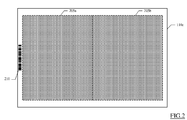
- FIG.2 An exemplary printed sheet that may be used to apply the solution according to an embodiment of the invention is illustrated in FIG.2 .
- Two different pages 205a and 205b of the corresponding book are printed on each side of the sheet 110c (of which only the front one is shown in the figure).
- the front side of the sheet 110c also includes a barcode 210 (for example, being printed in an external scrap area - to be cut after the sewing in order to allow the opening of the pages of the book - at the beginning of the sheet 110c along an extraction direction thereof from the hopper of the combined machine); the barcode 210 consists of a series of parallel lines having variable width and spacing, which represents a corresponding code according to a predefined coding (in the following, the term barcode will be used to indicate both its representation and its content for the sake of exposition simplicity).
- the barcode 210 includes configuration information of the sheet, which is used to control its processing.
- the barcode 210 indicates a progressive number of sheet that represents a position of the sheet 110c in the corresponding signature (first, second, third, and so on), together with a total number of sheets of such signature; moreover, the barcode 210 indicates a progressive number of signature that represents a position of the signature of the sheet 110c in the corresponding book block (first, second, third, and so on), together with a total number of signatures of such book block.
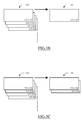
- FIG.3A-3G there are shown the various phases of a process that implement the solution according to an embodiment of the invention.
- the sheets to be processed in the stack 110 are identified through the control information represented by the corresponding barcodes.
- the books of a generic job are each one formed by 10 signatures.
- the first sheet in a first signature being formed by 3 sheets will be identified by 1/3-1/10 (to indicate the sheet 1 out of 3 in the signature 1 out of 10)
- its second sheet will be identified by 2/3-1/10
- its third sheet will be identified by 3/3-1/10.
- the stack 110 then includes the first sheet of the second signature - for example, being formed by 3 sheets (identified by 1/3-2/10), and so on up to the last sheet of the last signature - being formed by 2 sheets (identified by 2/2-10/10).
- each book begins in FIG.3B when the sheet 1/3-1/10 is at the top of the stack 110.
- the sheet 1/3-1/10 is extracted from the stack 110 to begin a new group of sheets 130 for the corresponding signature (in the gathering station).
- the sheet 2/3-1/10 is now at the top of the stack 110.
- the sheet 2/3-1/10 is likewise extracted from the stack 110 and added to the group of sheets 130 in the making (above the sheet 1/3-1/10).
- the group of sheets 130 is folded (in the folding station), so as to obtain the corresponding signature (identified with 1/10).
- the signature 1/10 is then supplied to the sewing station to begin a new group of signatures 150.
- another group of sheets 130 is obtained (by adding the sheets 1/3-2/10, 2/3-2/10, and 3/3-2/10 in succession).
- the group of sheets 130 is likewise folded so as to obtain the corresponding signature (identified with 2/10), which is added to the group of signatures 150 in the making (by sewing it to the preceding signature 1/10).
- the barcode being read from the current sheet allows determining in an automatic way when the current group of sheets is complete (i.e., the progressive number of sheet is equal to the total number of sheets) and when the current group of signatures is complete (i.e., the progressive number of signature is equal to the total number of signatures).
- the proposed solution remarkably simplifies the use of the combined machine.
- the removal of the human intervention substantially reduces the risk of errors. Such advantages are particularly evident in the typical applications of the combined machine (wherein very short jobs comprising the production of a few books are often executed), with a remarkable increase of its yield.
- This also allows producing different books that use sheets of the same size continuously, by putting the corresponding sheets together in a single stack - since the sheets of each book include all the information being necessary for their processing. In this way, it is possible to group more jobs into a continuous execution stream (without the need of providing any additional information to indicate the number of books of each job).
- a sequence error of the sheets in the stack may be detected when the progressive number of sheet does not follow the preceding one in the same signature before the completion of the corresponding group of sheets (for example, 2/3-3/10 after 1/3-3-10), or when the progressive number of sheet is not the first in a next signature after the completion of the preceding one (for example, 1/3-5/10 after 3/3-4/10). Consequently, it is possible to detect any sequence error of the sheets in the stack (for example, being caused by the lack of a sheet, the repetition of equal sheets, the exchange of two sheets, and the like) in an automatic way.
- the main software components that may be used to implement the solution according to an embodiment of the invention are illustrated in FIG.4 . These software components are denoted as a whole with the reference 400.
- the information is typically stored on a mass memory of the control system and loaded (at least partially) into its working memory when the programs are running.
- a reading module 405 drives a barcode reader (not shown in the figure), which is used to read the barcodes from the front side of every current sheet at the top of the stack in the hopper of the combined machine.
- a barcode reader (not shown in the figure)
- Each barcode being read is supplied to a management module 410.
- the management module 410 extracts the configuration information from the barcode (i.e., the progressive number of sheet, the total number of sheets, the progressive number of signature, and the total number of signatures).
- the management module 410 passes such configuration information to an updating module 415.
- the module 415 accordingly updates a sheet register (indicative of the total number of sheets of the current signature) and a signature register (indicative of the total number of signatures of the current book block), which are stored into corresponding variables 420; moreover, the module 415 accordingly updates a sheet index (indicative of an expected position of the current sheet in the current signature) and a signature index (indicative of an expected position of the current signature in the current book block), which are stored into corresponding variables 425.
- the management module 410 also interfaces with a verification module 430, which accesses the variables 420,425 to verify whether the current sheet (identified by the corresponding configuration information being passed by the management module 410) corresponds to the sheet being expected at the moment.
- the verification module 430 returns the outcome of the operation to the management module 410, which accordingly commands the programmable logic controller of the combined machine (not shown in the figure).
- the method begins at the black start circle 503, and then passes to block 506 wherein the combined machine is started (after loading the stack of sheets to be processed into the hopper).
- the sheet index (INDf), the signature index (INDs), the sheet register (REGf) and the signature register (REGs) are initialised to 0.
- a loop is then executed continuously for each current sheet to be processed; the loop begins at block 509, wherein a barcode is searched on the front face of the current sheet at the top to the stack (for example, in a predefined search area wherein is should be printed). Passing to block 512, if no barcode has been found within a predetermined time-out (for example, 10-30ms), the combined machine enters an error condition at block 515, since the sheet cannot be recognized (for example, because it is turned in the wrong way round in the stack); in such case, the combined machine is stopped, and a corresponding alarm signal is output. The method then ends at the concentric white/black stop circles 518.
- the method passes from block 512 to block 521, wherein the configuration information is extracted from the barcode - i.e., progressive number of sheet (PRGf), progressive number of signature (PRGs), total number of sheets (TOTf) and total number of signatures (TOTs).
- PRGf progressive number of sheet
- PRGs progressive number of signature
- TOTf total number of sheets
- TOTs total number of signatures
- the sheet index is incremented continuously during the formation of the current group of sheets (to point to the next sheet of the current signature), and it is set to 1 after the completion of the current group of sheets (to point to the first sheet of the next signature).
- the signature index is incremented continuously during the formation of the current group of signatures (to point to the next signature of the current book block), and it is set to 1 after the completion of the current group of signatures (to point to the first signature of the next book block).
- the method passes to block 542, wherein the total number of signatures is compared with the signature register. If the method determines that the two values are different (TOTs ⁇ >REGs), the combined machine enters an error condition at block 545, since the current sheet does not belong to the current book block.
- the combined machine is stopped, and a corresponding alarm signal is output; preferably, in such case there is also output (for example, on a display of the combined machine, in textual and/or graphical form) an indication of the current sheet (identified by the progressive number of sheet, the total number of sheets, the progressive number of signature and the total number of signatures) and an indication of the expected sheet (identified by the sheet index, the sheet register, the signature index and the signature register), so as to facilitate the solution of the problem.
- the method then ends to the stop circles 518.
- the method passes to block 548, wherein the total number of sheets is compared with the sheet register. If the method determines that the two values are different (TOTf ⁇ >REGf), the combined machine again enters an error condition at block 551, since the current sheet does not belong to the current signature. As above, the combined machine is stopped (with a corresponding alarm signal), and the indications of the current sheet and of the expected sheet are output (to facilitate the solution of the problem). The method then ends to the stop circles 518.
- the flow of activity merges again at block 554 from the block 539 (first signature of the book block), from the block 542 (first sheet of a signature different from the first one) or from the block 548 (sheet different from the first one of a signature different from the first one); in such phase, the progressive number of sheet is compared with the sheet index. If the method determines that the two values are different (PRGfI ⁇ >INDf), the combined machine again enters an error condition at block 557, since the current sheet is not the expected one in the current signature (for example, because of lacking, repeated, or exchanged sheets). As above, the combined machine is stopped (with a corresponding alarm signal), and the indications of the current sheet and of the expected sheet are output.
- the method then ends to the stop circles 518.
- the method passes from the block 560 to block 566; at this point, the current sheet (whose configuration information indicates is correct) is extracted from the stack and added to the current group of sheets in the making (in the gathering station).
- a test is then made at block 569 to verify whether the configuration information being extracted from the barcode indicates that the current sheet is the last one of the current group of sheets; such condition occurs when the progressive number of sheet is equal to the total number of sheets (PRGf TOTf).
- the method continues to block 572, wherein the (complete) current group of sheets is conveyed to the folding station, where it is folded to obtain the corresponding current signature.
- the current signature is conveyed to the sewing station to be sewn to the current group of signatures in the making (by joining it to a preceding signature thereof if different from the first one).
- the flow of activity then passes from the block 581 to block 584.
- the same point is also reached directly from the block 569 if the current sheet is not the last one of the current group of sheets (PRGf ⁇ >TOTf), and from the block 578 if the current signature is not the last one of the current group of signatures (PRGs ⁇ >TOTs).
- a test is performed to verify whether the combined machine is to be stopped (for example, when the stack of sheets in the hopper is finished or a corresponding command is input manually through a control panel of the combined machine).
- the method returns to the block 509 to repeat the same operations on a new current sheet at the top to the stack. On the contrary, the method ends to the stop circles 518.
- the proposed solution lends itself to be implemented with an equivalent method (by using similar steps, removing some steps being non-essential, or adding further optional steps); moreover, the steps may be performed in a different order, concurrently or in an interleaved way (at least in part).
- equivalent techniques may be used to sew the groups of signatures, or more generally to bind them (for example, by gluing the signatures together); particularly, the completion of each book block may involve the execution of different and/or additional operations (for example, a blind stitch).
- the same solution lends itself to control the gathering, the folding and the binding (or any combination of such operations); for example, it is possible to include, in the barcodes, configuration information for regulating the position of the register that stops the groups of sheets on the chute of the folding station, configuration information that regulates the folding of the groups of sheets, and the like.
- the control of the position of the sheets in the corresponding signatures may be performed in an equivalent way (for example, by only verifying whether the progressive number of sheet is equal to the sheet index); moreover, for this purpose different configuration information may be provided on each sheet (for example, its progressive number of sheet and the one of the next sheet).
- control of the belonging of the sheets to the corresponding signatures as well may be performed in an equivalent way and/or by using different configuration information (for example, a signature code).
- Different operations may be executed in response to the detection of every sequence error (even without stopping the combined machine immediately); in any case, the control of the position of the sheets in the corresponding signatures, the control of the position of the signatures in the corresponding book blocks, the control of the belonging of the sheets to the corresponding signatures and/or the control of the belonging of the signatures to the corresponding book blocks are not strictly necessary, and they may be omitted (in whole or in part) in a simplified implementation.
- the same configuration information is printed on every sheet; in such case, the barcodes are read from each sheet to allow identifying the beginning of a new job in a stream of jobs in the same stack of sheets (when the configuration information just read are different from the one of the current job).
- the proposed solution may be implemented as a stand-alone module, as a plug-in for a control program already installed, or directly in the control program itself. Similar considerations apply if the program (which may be used to implement each embodiment of the invention) is structured in a different way, or if additional modules or functions are provided; likewise, the memory structures may be of other types, or may be replaced with equivalent entities (not necessarily consisting of physical storage media).
- the program may take any form suitable to be used by any data processing system or in connection therewith (for example, within a virtual machine); particularly, the program may be in the form of external or resident software, firmware, or microcode (either in object code or in source code - for example, to be compiled or interpreted).
- the medium can be any element suitable to contain, store, communicate, propagate, or transfer the program.
- the medium may be of the electronic, magnetic, optical, electromagnetic, infrared, or semiconductor type; examples of such medium are fixed disks (where the program can be pre-loaded), removable disks, tapes, cards, wires, fibres, wireless connections, networks, broadcast waves, and the like.
- the solution according to an embodiment of the present invention lends itself to be implemented even with a hardware structure (for example, integrated in a chip of semiconductor material), or with a combination of software and hardware.
- control system lends itself to be implemented and put on the market even as a stand-alone product, in order to be used in standard combined machines already existing. Particularly, it is possible to provide a simple modification kit for applying such control system to the standard combined machines.
- the combined machine may have a different structure or it may include equivalent components. More generally, the same solution may be applied to a folding/binding combined machine, which performs the operations of gathering, folding and binding in a single passage with any other technique (for example, for producing glued books).
- one or more of these combined machines may be used in any other bookbinding plant (for example, in a photocopy shop centre wherein the sheets to be bound are supplied from photocopying machines).
Landscapes
- Engineering & Computer Science (AREA)
- Mechanical Engineering (AREA)
- Folding Of Thin Sheet-Like Materials, Special Discharging Devices, And Others (AREA)
- Sheets, Magazines, And Separation Thereof (AREA)
Applications Claiming Priority (1)
| Application Number | Priority Date | Filing Date | Title |
|---|---|---|---|
| IT000114A ITMI20090114A1 (it) | 2009-01-30 | 2009-01-30 | Macchina cucitrice a fogli piani con separazione automatica fogli |
Publications (2)
| Publication Number | Publication Date |
|---|---|
| EP2213468A1 true EP2213468A1 (de) | 2010-08-04 |
| EP2213468B1 EP2213468B1 (de) | 2011-05-25 |
Family
ID=41136642
Family Applications (1)
| Application Number | Title | Priority Date | Filing Date |
|---|---|---|---|
| EP10152112A Active EP2213468B1 (de) | 2009-01-30 | 2010-01-29 | Kontrolle einer kombinierten falz-/fadenheft-buchbindemaschine |
Country Status (3)
| Country | Link |
|---|---|
| EP (1) | EP2213468B1 (de) |
| AT (1) | ATE510704T1 (de) |
| IT (1) | ITMI20090114A1 (de) |
Cited By (4)
| Publication number | Priority date | Publication date | Assignee | Title |
|---|---|---|---|---|
| EP2325122A1 (de) | 2009-11-24 | 2011-05-25 | Smyth S.r.l. | Verfahren und Vorrichtung zur Herstellung und Zuführung digital gedruckter Signaturen zu einer Maschine |
| EP2527158A2 (de) | 2011-05-24 | 2012-11-28 | Meccanotecnica S.p.A. | Kombinierte Buchblockbindemaschine mit automatischem Zusammentragen von Bogenlagen |
| CN102971153A (zh) * | 2010-09-03 | 2013-03-13 | 麦克诺技术股份有限公司 | 多功能装订机 |
| WO2025243340A1 (en) * | 2024-05-24 | 2025-11-27 | Meccanotecnica S.P.A. | Interfacing between a continuous process and a discrete process in a bookbinding system |
Citations (4)
| Publication number | Priority date | Publication date | Assignee | Title |
|---|---|---|---|---|
| EP0846573A1 (de) | 1996-11-19 | 1998-06-10 | Gianattilio Meratti | Verfahren zum Herstellen von Bogen und Faltmaschine dafür |
| EP0895872A1 (de) * | 1997-08-04 | 1999-02-10 | Horizon International Inc. | Buchbindevorrichtung |
| EP1136283A2 (de) * | 2000-03-17 | 2001-09-26 | Hewlett-Packard Company, A Delaware Corporation | Integrierte Dokumentenerstellung und -weiterverarbeitung auf selbstständigen Weiterverarbeitungseinheiten |
| US20040214707A1 (en) | 2003-05-08 | 2004-10-28 | Maschinenbau Oppenweiler Binder Gmbh & Co. Kg | Method for further processing printed sheets |
-
2009
- 2009-01-30 IT IT000114A patent/ITMI20090114A1/it unknown
-
2010
- 2010-01-29 AT AT10152112T patent/ATE510704T1/de not_active IP Right Cessation
- 2010-01-29 EP EP10152112A patent/EP2213468B1/de active Active
Patent Citations (4)
| Publication number | Priority date | Publication date | Assignee | Title |
|---|---|---|---|---|
| EP0846573A1 (de) | 1996-11-19 | 1998-06-10 | Gianattilio Meratti | Verfahren zum Herstellen von Bogen und Faltmaschine dafür |
| EP0895872A1 (de) * | 1997-08-04 | 1999-02-10 | Horizon International Inc. | Buchbindevorrichtung |
| EP1136283A2 (de) * | 2000-03-17 | 2001-09-26 | Hewlett-Packard Company, A Delaware Corporation | Integrierte Dokumentenerstellung und -weiterverarbeitung auf selbstständigen Weiterverarbeitungseinheiten |
| US20040214707A1 (en) | 2003-05-08 | 2004-10-28 | Maschinenbau Oppenweiler Binder Gmbh & Co. Kg | Method for further processing printed sheets |
Cited By (7)
| Publication number | Priority date | Publication date | Assignee | Title |
|---|---|---|---|---|
| EP2325122A1 (de) | 2009-11-24 | 2011-05-25 | Smyth S.r.l. | Verfahren und Vorrichtung zur Herstellung und Zuführung digital gedruckter Signaturen zu einer Maschine |
| CN102971153A (zh) * | 2010-09-03 | 2013-03-13 | 麦克诺技术股份有限公司 | 多功能装订机 |
| US9033329B2 (en) | 2010-09-03 | 2015-05-19 | Meccanotecnica S.P.A. | Multi-function binding machine |
| CN102971153B (zh) * | 2010-09-03 | 2016-01-06 | 麦克诺技术股份有限公司 | 多功能装订机 |
| EP2527158A2 (de) | 2011-05-24 | 2012-11-28 | Meccanotecnica S.p.A. | Kombinierte Buchblockbindemaschine mit automatischem Zusammentragen von Bogenlagen |
| EP2527158A3 (de) * | 2011-05-24 | 2013-02-06 | Meccanotecnica S.p.A. | Kombinierte Buchblockbindemaschine mit automatischem Zusammentragen von Bogenlagen |
| WO2025243340A1 (en) * | 2024-05-24 | 2025-11-27 | Meccanotecnica S.P.A. | Interfacing between a continuous process and a discrete process in a bookbinding system |
Also Published As
| Publication number | Publication date |
|---|---|
| ATE510704T1 (de) | 2011-06-15 |
| ITMI20090114A1 (it) | 2010-07-31 |
| EP2213468B1 (de) | 2011-05-25 |
Similar Documents
| Publication | Publication Date | Title |
|---|---|---|
| EP2213468B1 (de) | Kontrolle einer kombinierten falz-/fadenheft-buchbindemaschine | |
| DE60025869T2 (de) | Integrierte Dokumentenerstellung und -weiterverarbeitung auf selbstständigen Weiterverarbeitungseinheiten | |
| JP4300984B2 (ja) | 綴じ処理装置 | |
| US7573387B2 (en) | Continuous paper processing system | |
| CN102968843A (zh) | 纸片类处理装置 | |
| JP4948369B2 (ja) | 情報処理装置及び印刷制御方法 | |
| AU2015376066B2 (en) | Sheet processing machine and method of manufacturing thereof | |
| EP1907924B1 (de) | Verfahren und gerät zum öffnen eines buches auf einer bestimmten seite | |
| JP5824990B2 (ja) | 後処理装置及び画像形成装置 | |
| US20160152050A1 (en) | Sheet processing apparatus and image forming system | |
| EP2790098A1 (de) | Bilderzeugungsvorrichtung, Bilderzeugungssystem und Verfahren zur Steuerung einer Bilderzeugungsvorrichtung | |
| US20040214707A1 (en) | Method for further processing printed sheets | |
| JP5346562B2 (ja) | 印刷製品を製造する方法およびこの方法を実施する装置 | |
| JPS60240497A (ja) | 製本針金綴不良検査装置 | |
| JP2013152314A (ja) | 画像形成システム | |
| EP2527158B1 (de) | Kombinierte Buchblockbindemaschine mit automatischem Zusammentragen von Bogenlagen | |
| JP2009137224A (ja) | 冊子製本装置における丁合い部材角折れ検出方法 | |
| JP4549814B2 (ja) | 丁合検査システム | |
| JP2010208097A (ja) | 製本装置 | |
| EP2199950A2 (de) | Erkennung von Artikeln auf der Basis einer Kombination aus Codes und Bildern | |
| EP4335653A1 (de) | Verfahren zur überwachung des herstellprozesses eines buchförmigen ausweis-, wert- oder sicherheitsdokuments | |
| EP1216947A1 (de) | Verfahren für die weitestgehend fehlerfreie Verarbeitung von Druckbogen auf dem Weg des Zusammentragens dieser Druckbogen | |
| EP2439076B1 (de) | Produktionsüberwachung von buchbindeartikeln mittels bilderkennung von druckdateien | |
| CN203033535U (zh) | 一种装订机错帖在线检验系统 | |
| JP2007058574A (ja) | 紙葉類処理システム |
Legal Events
| Date | Code | Title | Description |
|---|---|---|---|
| PUAI | Public reference made under article 153(3) epc to a published international application that has entered the european phase |
Free format text: ORIGINAL CODE: 0009012 |
|
| AK | Designated contracting states |
Kind code of ref document: A1 Designated state(s): AT BE BG CH CY CZ DE DK EE ES FI FR GB GR HR HU IE IS IT LI LT LU LV MC MK MT NL NO PL PT RO SE SI SK SM TR |
|
| AX | Request for extension of the european patent |
Extension state: AL BA RS |
|
| 17P | Request for examination filed |
Effective date: 20101008 |
|
| GRAP | Despatch of communication of intention to grant a patent |
Free format text: ORIGINAL CODE: EPIDOSNIGR1 |
|
| RIC1 | Information provided on ipc code assigned before grant |
Ipc: B42C 19/02 20060101ALI20101103BHEP Ipc: B42C 1/12 20060101AFI20101103BHEP |
|
| GRAS | Grant fee paid |
Free format text: ORIGINAL CODE: EPIDOSNIGR3 |
|
| GRAA | (expected) grant |
Free format text: ORIGINAL CODE: 0009210 |
|
| AK | Designated contracting states |
Kind code of ref document: B1 Designated state(s): AT BE BG CH CY CZ DE DK EE ES FI FR GB GR HR HU IE IS IT LI LT LU LV MC MK MT NL NO PL PT RO SE SI SK SM TR |
|
| REG | Reference to a national code |
Ref country code: GB Ref legal event code: FG4D |
|
| REG | Reference to a national code |
Ref country code: CH Ref legal event code: EP |
|
| REG | Reference to a national code |
Ref country code: IE Ref legal event code: FG4D |
|
| REG | Reference to a national code |
Ref country code: DE Ref legal event code: R096 Ref document number: 602010000038 Country of ref document: DE Effective date: 20110707 |
|
| REG | Reference to a national code |
Ref country code: NL Ref legal event code: VDEP Effective date: 20110525 |
|
| PG25 | Lapsed in a contracting state [announced via postgrant information from national office to epo] |
Ref country code: NO Free format text: LAPSE BECAUSE OF FAILURE TO SUBMIT A TRANSLATION OF THE DESCRIPTION OR TO PAY THE FEE WITHIN THE PRESCRIBED TIME-LIMIT Effective date: 20110825 Ref country code: SE Free format text: LAPSE BECAUSE OF FAILURE TO SUBMIT A TRANSLATION OF THE DESCRIPTION OR TO PAY THE FEE WITHIN THE PRESCRIBED TIME-LIMIT Effective date: 20110525 Ref country code: HR Free format text: LAPSE BECAUSE OF FAILURE TO SUBMIT A TRANSLATION OF THE DESCRIPTION OR TO PAY THE FEE WITHIN THE PRESCRIBED TIME-LIMIT Effective date: 20110525 Ref country code: PT Free format text: LAPSE BECAUSE OF FAILURE TO SUBMIT A TRANSLATION OF THE DESCRIPTION OR TO PAY THE FEE WITHIN THE PRESCRIBED TIME-LIMIT Effective date: 20110926 Ref country code: LT Free format text: LAPSE BECAUSE OF FAILURE TO SUBMIT A TRANSLATION OF THE DESCRIPTION OR TO PAY THE FEE WITHIN THE PRESCRIBED TIME-LIMIT Effective date: 20110525 |
|
| PG25 | Lapsed in a contracting state [announced via postgrant information from national office to epo] |
Ref country code: LV Free format text: LAPSE BECAUSE OF FAILURE TO SUBMIT A TRANSLATION OF THE DESCRIPTION OR TO PAY THE FEE WITHIN THE PRESCRIBED TIME-LIMIT Effective date: 20110525 Ref country code: FI Free format text: LAPSE BECAUSE OF FAILURE TO SUBMIT A TRANSLATION OF THE DESCRIPTION OR TO PAY THE FEE WITHIN THE PRESCRIBED TIME-LIMIT Effective date: 20110525 Ref country code: GR Free format text: LAPSE BECAUSE OF FAILURE TO SUBMIT A TRANSLATION OF THE DESCRIPTION OR TO PAY THE FEE WITHIN THE PRESCRIBED TIME-LIMIT Effective date: 20110826 Ref country code: IS Free format text: LAPSE BECAUSE OF FAILURE TO SUBMIT A TRANSLATION OF THE DESCRIPTION OR TO PAY THE FEE WITHIN THE PRESCRIBED TIME-LIMIT Effective date: 20110925 Ref country code: BE Free format text: LAPSE BECAUSE OF FAILURE TO SUBMIT A TRANSLATION OF THE DESCRIPTION OR TO PAY THE FEE WITHIN THE PRESCRIBED TIME-LIMIT Effective date: 20110525 Ref country code: CY Free format text: LAPSE BECAUSE OF FAILURE TO SUBMIT A TRANSLATION OF THE DESCRIPTION OR TO PAY THE FEE WITHIN THE PRESCRIBED TIME-LIMIT Effective date: 20110525 Ref country code: SI Free format text: LAPSE BECAUSE OF FAILURE TO SUBMIT A TRANSLATION OF THE DESCRIPTION OR TO PAY THE FEE WITHIN THE PRESCRIBED TIME-LIMIT Effective date: 20110525 Ref country code: ES Free format text: LAPSE BECAUSE OF FAILURE TO SUBMIT A TRANSLATION OF THE DESCRIPTION OR TO PAY THE FEE WITHIN THE PRESCRIBED TIME-LIMIT Effective date: 20110905 Ref country code: AT Free format text: LAPSE BECAUSE OF FAILURE TO SUBMIT A TRANSLATION OF THE DESCRIPTION OR TO PAY THE FEE WITHIN THE PRESCRIBED TIME-LIMIT Effective date: 20110525 |
|
| PG25 | Lapsed in a contracting state [announced via postgrant information from national office to epo] |
Ref country code: NL Free format text: LAPSE BECAUSE OF FAILURE TO SUBMIT A TRANSLATION OF THE DESCRIPTION OR TO PAY THE FEE WITHIN THE PRESCRIBED TIME-LIMIT Effective date: 20110525 |
|
| PG25 | Lapsed in a contracting state [announced via postgrant information from national office to epo] |
Ref country code: CZ Free format text: LAPSE BECAUSE OF FAILURE TO SUBMIT A TRANSLATION OF THE DESCRIPTION OR TO PAY THE FEE WITHIN THE PRESCRIBED TIME-LIMIT Effective date: 20110525 Ref country code: EE Free format text: LAPSE BECAUSE OF FAILURE TO SUBMIT A TRANSLATION OF THE DESCRIPTION OR TO PAY THE FEE WITHIN THE PRESCRIBED TIME-LIMIT Effective date: 20110525 |
|
| PG25 | Lapsed in a contracting state [announced via postgrant information from national office to epo] |
Ref country code: SK Free format text: LAPSE BECAUSE OF FAILURE TO SUBMIT A TRANSLATION OF THE DESCRIPTION OR TO PAY THE FEE WITHIN THE PRESCRIBED TIME-LIMIT Effective date: 20110525 Ref country code: PL Free format text: LAPSE BECAUSE OF FAILURE TO SUBMIT A TRANSLATION OF THE DESCRIPTION OR TO PAY THE FEE WITHIN THE PRESCRIBED TIME-LIMIT Effective date: 20110525 |
|
| PLBE | No opposition filed within time limit |
Free format text: ORIGINAL CODE: 0009261 |
|
| STAA | Information on the status of an ep patent application or granted ep patent |
Free format text: STATUS: NO OPPOSITION FILED WITHIN TIME LIMIT |
|
| 26N | No opposition filed |
Effective date: 20120228 |
|
| REG | Reference to a national code |
Ref country code: DE Ref legal event code: R097 Ref document number: 602010000038 Country of ref document: DE Effective date: 20120228 |
|
| PG25 | Lapsed in a contracting state [announced via postgrant information from national office to epo] |
Ref country code: MC Free format text: LAPSE BECAUSE OF NON-PAYMENT OF DUE FEES Effective date: 20120131 |
|
| REG | Reference to a national code |
Ref country code: FR Ref legal event code: ST Effective date: 20120928 |
|
| REG | Reference to a national code |
Ref country code: IE Ref legal event code: MM4A |
|
| PG25 | Lapsed in a contracting state [announced via postgrant information from national office to epo] |
Ref country code: FR Free format text: LAPSE BECAUSE OF NON-PAYMENT OF DUE FEES Effective date: 20120131 |
|
| PG25 | Lapsed in a contracting state [announced via postgrant information from national office to epo] |
Ref country code: IE Free format text: LAPSE BECAUSE OF NON-PAYMENT OF DUE FEES Effective date: 20120129 |
|
| PG25 | Lapsed in a contracting state [announced via postgrant information from national office to epo] |
Ref country code: MK Free format text: LAPSE BECAUSE OF FAILURE TO SUBMIT A TRANSLATION OF THE DESCRIPTION OR TO PAY THE FEE WITHIN THE PRESCRIBED TIME-LIMIT Effective date: 20110525 |
|
| PG25 | Lapsed in a contracting state [announced via postgrant information from national office to epo] |
Ref country code: BG Free format text: LAPSE BECAUSE OF FAILURE TO SUBMIT A TRANSLATION OF THE DESCRIPTION OR TO PAY THE FEE WITHIN THE PRESCRIBED TIME-LIMIT Effective date: 20110825 |
|
| PG25 | Lapsed in a contracting state [announced via postgrant information from national office to epo] |
Ref country code: MT Free format text: LAPSE BECAUSE OF FAILURE TO SUBMIT A TRANSLATION OF THE DESCRIPTION OR TO PAY THE FEE WITHIN THE PRESCRIBED TIME-LIMIT Effective date: 20110525 |
|
| PG25 | Lapsed in a contracting state [announced via postgrant information from national office to epo] |
Ref country code: TR Free format text: LAPSE BECAUSE OF FAILURE TO SUBMIT A TRANSLATION OF THE DESCRIPTION OR TO PAY THE FEE WITHIN THE PRESCRIBED TIME-LIMIT Effective date: 20110525 |
|
| PG25 | Lapsed in a contracting state [announced via postgrant information from national office to epo] |
Ref country code: SM Free format text: LAPSE BECAUSE OF FAILURE TO SUBMIT A TRANSLATION OF THE DESCRIPTION OR TO PAY THE FEE WITHIN THE PRESCRIBED TIME-LIMIT Effective date: 20110525 Ref country code: LU Free format text: LAPSE BECAUSE OF NON-PAYMENT OF DUE FEES Effective date: 20120129 |
|
| PG25 | Lapsed in a contracting state [announced via postgrant information from national office to epo] |
Ref country code: HU Free format text: LAPSE BECAUSE OF FAILURE TO SUBMIT A TRANSLATION OF THE DESCRIPTION OR TO PAY THE FEE WITHIN THE PRESCRIBED TIME-LIMIT Effective date: 20100129 |
|
| GBPC | Gb: european patent ceased through non-payment of renewal fee |
Effective date: 20140129 |
|
| PG25 | Lapsed in a contracting state [announced via postgrant information from national office to epo] |
Ref country code: GB Free format text: LAPSE BECAUSE OF NON-PAYMENT OF DUE FEES Effective date: 20140129 |
|
| P01 | Opt-out of the competence of the unified patent court (upc) registered |
Effective date: 20230513 |
|
| PGFP | Annual fee paid to national office [announced via postgrant information from national office to epo] |
Ref country code: CH Payment date: 20250201 Year of fee payment: 16 |
|
| REG | Reference to a national code |
Ref country code: CH Ref legal event code: U11 Free format text: ST27 STATUS EVENT CODE: U-0-0-U10-U11 (AS PROVIDED BY THE NATIONAL OFFICE) Effective date: 20260201 |
|
| PGFP | Annual fee paid to national office [announced via postgrant information from national office to epo] |
Ref country code: DE Payment date: 20260325 Year of fee payment: 17 |
|
| PGFP | Annual fee paid to national office [announced via postgrant information from national office to epo] |
Ref country code: IT Payment date: 20260122 Year of fee payment: 17 |