EP2214007B1 - Instrument d'analyse - Google Patents
Instrument d'analyse Download PDFInfo
- Publication number
- EP2214007B1 EP2214007B1 EP08844630.7A EP08844630A EP2214007B1 EP 2214007 B1 EP2214007 B1 EP 2214007B1 EP 08844630 A EP08844630 A EP 08844630A EP 2214007 B1 EP2214007 B1 EP 2214007B1
- Authority
- EP
- European Patent Office
- Prior art keywords
- sheet
- electrode
- sheets
- biosensor
- electrode sheet
- Prior art date
- Legal status (The legal status is an assumption and is not a legal conclusion. Google has not performed a legal analysis and makes no representation as to the accuracy of the status listed.)
- Active
Links
- 239000003153 chemical reaction reagent Substances 0.000 claims description 65
- 238000004458 analytical method Methods 0.000 claims description 18
- 239000000835 fiber Substances 0.000 claims description 14
- 239000004744 fabric Substances 0.000 claims description 12
- 238000000576 coating method Methods 0.000 claims description 6
- 230000002209 hydrophobic effect Effects 0.000 claims description 6
- 239000011248 coating agent Substances 0.000 claims description 5
- 238000000034 method Methods 0.000 description 23
- 239000007788 liquid Substances 0.000 description 17
- 239000000463 material Substances 0.000 description 17
- 238000004519 manufacturing process Methods 0.000 description 11
- 238000010586 diagram Methods 0.000 description 6
- 239000012530 fluid Substances 0.000 description 6
- KDLHZDBZIXYQEI-UHFFFAOYSA-N Palladium Chemical compound [Pd] KDLHZDBZIXYQEI-UHFFFAOYSA-N 0.000 description 5
- 239000008280 blood Substances 0.000 description 5
- 210000004369 blood Anatomy 0.000 description 5
- 238000005259 measurement Methods 0.000 description 5
- 229910052751 metal Inorganic materials 0.000 description 5
- 239000002184 metal Substances 0.000 description 5
- BASFCYQUMIYNBI-UHFFFAOYSA-N platinum Chemical compound [Pt] BASFCYQUMIYNBI-UHFFFAOYSA-N 0.000 description 5
- 230000035945 sensitivity Effects 0.000 description 5
- 239000000758 substrate Substances 0.000 description 5
- WQZGKKKJIJFFOK-GASJEMHNSA-N Glucose Natural products OC[C@H]1OC(O)[C@H](O)[C@@H](O)[C@@H]1O WQZGKKKJIJFFOK-GASJEMHNSA-N 0.000 description 4
- 239000004020 conductor Substances 0.000 description 4
- 239000008103 glucose Substances 0.000 description 4
- 239000011148 porous material Substances 0.000 description 4
- 238000004080 punching Methods 0.000 description 4
- 108091006149 Electron carriers Proteins 0.000 description 3
- PXHVJJICTQNCMI-UHFFFAOYSA-N Nickel Chemical compound [Ni] PXHVJJICTQNCMI-UHFFFAOYSA-N 0.000 description 3
- 108090000854 Oxidoreductases Proteins 0.000 description 3
- 102000004316 Oxidoreductases Human genes 0.000 description 3
- 239000012876 carrier material Substances 0.000 description 3
- 238000001035 drying Methods 0.000 description 3
- 239000010931 gold Substances 0.000 description 3
- 230000000149 penetrating effect Effects 0.000 description 3
- 238000004804 winding Methods 0.000 description 3
- OKTJSMMVPCPJKN-UHFFFAOYSA-N Carbon Chemical compound [C] OKTJSMMVPCPJKN-UHFFFAOYSA-N 0.000 description 2
- YCKRFDGAMUMZLT-UHFFFAOYSA-N Fluorine atom Chemical compound [F] YCKRFDGAMUMZLT-UHFFFAOYSA-N 0.000 description 2
- 108010050375 Glucose 1-Dehydrogenase Proteins 0.000 description 2
- 108010015776 Glucose oxidase Proteins 0.000 description 2
- 239000004366 Glucose oxidase Substances 0.000 description 2
- 229910052799 carbon Inorganic materials 0.000 description 2
- HVYWMOMLDIMFJA-DPAQBDIFSA-N cholesterol Chemical compound C1C=C2C[C@@H](O)CC[C@]2(C)[C@@H]2[C@@H]1[C@@H]1CC[C@H]([C@H](C)CCCC(C)C)[C@@]1(C)CC2 HVYWMOMLDIMFJA-DPAQBDIFSA-N 0.000 description 2
- 230000006835 compression Effects 0.000 description 2
- 238000007906 compression Methods 0.000 description 2
- 238000005520 cutting process Methods 0.000 description 2
- 239000011737 fluorine Substances 0.000 description 2
- 229910052731 fluorine Inorganic materials 0.000 description 2
- 235000019420 glucose oxidase Nutrition 0.000 description 2
- 229940116332 glucose oxidase Drugs 0.000 description 2
- PCHJSUWPFVWCPO-UHFFFAOYSA-N gold Chemical compound [Au] PCHJSUWPFVWCPO-UHFFFAOYSA-N 0.000 description 2
- 229910052737 gold Inorganic materials 0.000 description 2
- 238000009413 insulation Methods 0.000 description 2
- 230000001678 irradiating effect Effects 0.000 description 2
- JVTAAEKCZFNVCJ-UHFFFAOYSA-N lactic acid Chemical compound CC(O)C(O)=O JVTAAEKCZFNVCJ-UHFFFAOYSA-N 0.000 description 2
- 229910052763 palladium Inorganic materials 0.000 description 2
- 229910052697 platinum Inorganic materials 0.000 description 2
- 230000003252 repetitive effect Effects 0.000 description 2
- 239000011347 resin Substances 0.000 description 2
- 229920005989 resin Polymers 0.000 description 2
- 229910052709 silver Inorganic materials 0.000 description 2
- 239000004332 silver Substances 0.000 description 2
- 238000004544 sputter deposition Methods 0.000 description 2
- 239000004094 surface-active agent Substances 0.000 description 2
- IIZPXYDJLKNOIY-JXPKJXOSSA-N 1-palmitoyl-2-arachidonoyl-sn-glycero-3-phosphocholine Chemical compound CCCCCCCCCCCCCCCC(=O)OC[C@H](COP([O-])(=O)OCC[N+](C)(C)C)OC(=O)CCC\C=C/C\C=C/C\C=C/C\C=C/CCCCC IIZPXYDJLKNOIY-JXPKJXOSSA-N 0.000 description 1
- 0 CC1C(*2)C2CC1 Chemical compound CC1C(*2)C2CC1 0.000 description 1
- RYGMFSIKBFXOCR-UHFFFAOYSA-N Copper Chemical compound [Cu] RYGMFSIKBFXOCR-UHFFFAOYSA-N 0.000 description 1
- 239000004677 Nylon Substances 0.000 description 1
- 239000004698 Polyethylene Substances 0.000 description 1
- KJTLSVCANCCWHF-UHFFFAOYSA-N Ruthenium Chemical compound [Ru] KJTLSVCANCCWHF-UHFFFAOYSA-N 0.000 description 1
- 239000012327 Ruthenium complex Substances 0.000 description 1
- BQCADISMDOOEFD-UHFFFAOYSA-N Silver Chemical compound [Ag] BQCADISMDOOEFD-UHFFFAOYSA-N 0.000 description 1
- 229910021607 Silver chloride Inorganic materials 0.000 description 1
- 239000002390 adhesive tape Substances 0.000 description 1
- WQZGKKKJIJFFOK-VFUOTHLCSA-N beta-D-glucose Chemical compound OC[C@H]1O[C@@H](O)[C@H](O)[C@@H](O)[C@@H]1O WQZGKKKJIJFFOK-VFUOTHLCSA-N 0.000 description 1
- 235000012000 cholesterol Nutrition 0.000 description 1
- 229910052802 copper Inorganic materials 0.000 description 1
- 239000010949 copper Substances 0.000 description 1
- 238000000151 deposition Methods 0.000 description 1
- 230000008021 deposition Effects 0.000 description 1
- 230000007613 environmental effect Effects 0.000 description 1
- 239000006260 foam Substances 0.000 description 1
- 235000001727 glucose Nutrition 0.000 description 1
- 238000005534 hematocrit Methods 0.000 description 1
- 239000012943 hotmelt Substances 0.000 description 1
- 239000012774 insulation material Substances 0.000 description 1
- 229910052741 iridium Inorganic materials 0.000 description 1
- GKOZUEZYRPOHIO-UHFFFAOYSA-N iridium atom Chemical compound [Ir] GKOZUEZYRPOHIO-UHFFFAOYSA-N 0.000 description 1
- XEEYBQQBJWHFJM-UHFFFAOYSA-N iron Substances [Fe] XEEYBQQBJWHFJM-UHFFFAOYSA-N 0.000 description 1
- 150000004698 iron complex Chemical class 0.000 description 1
- 235000014655 lactic acid Nutrition 0.000 description 1
- 239000004310 lactic acid Substances 0.000 description 1
- 239000000787 lecithin Substances 0.000 description 1
- 229940067606 lecithin Drugs 0.000 description 1
- 235000010445 lecithin Nutrition 0.000 description 1
- 239000007769 metal material Substances 0.000 description 1
- 239000012982 microporous membrane Substances 0.000 description 1
- 239000000203 mixture Substances 0.000 description 1
- 229910052759 nickel Inorganic materials 0.000 description 1
- 239000004745 nonwoven fabric Substances 0.000 description 1
- 229920001778 nylon Polymers 0.000 description 1
- 229910052762 osmium Inorganic materials 0.000 description 1
- SYQBFIAQOQZEGI-UHFFFAOYSA-N osmium atom Chemical compound [Os] SYQBFIAQOQZEGI-UHFFFAOYSA-N 0.000 description 1
- 239000002245 particle Substances 0.000 description 1
- 238000007747 plating Methods 0.000 description 1
- -1 polyethylene Polymers 0.000 description 1
- 229920000573 polyethylene Polymers 0.000 description 1
- 229910052703 rhodium Inorganic materials 0.000 description 1
- 239000010948 rhodium Substances 0.000 description 1
- MHOVAHRLVXNVSD-UHFFFAOYSA-N rhodium atom Chemical compound [Rh] MHOVAHRLVXNVSD-UHFFFAOYSA-N 0.000 description 1
- 229910052707 ruthenium Inorganic materials 0.000 description 1
- 238000007650 screen-printing Methods 0.000 description 1
- HKZLPVFGJNLROG-UHFFFAOYSA-M silver monochloride Chemical compound [Cl-].[Ag+] HKZLPVFGJNLROG-UHFFFAOYSA-M 0.000 description 1
- 238000009751 slip forming Methods 0.000 description 1
- 210000002700 urine Anatomy 0.000 description 1
- 238000009941 weaving Methods 0.000 description 1
- 239000002759 woven fabric Substances 0.000 description 1
Images




Classifications
-
- G—PHYSICS
- G01—MEASURING; TESTING
- G01N—INVESTIGATING OR ANALYSING MATERIALS BY DETERMINING THEIR CHEMICAL OR PHYSICAL PROPERTIES
- G01N27/00—Investigating or analysing materials by the use of electric, electrochemical, or magnetic means
- G01N27/26—Investigating or analysing materials by the use of electric, electrochemical, or magnetic means by investigating electrochemical variables; by using electrolysis or electrophoresis
- G01N27/28—Electrolytic cell components
- G01N27/30—Electrodes, e.g. test electrodes; Half-cells
- G01N27/327—Biochemical electrodes, e.g. electrical or mechanical details for in vitro measurements
- G01N27/3271—Amperometric enzyme electrodes for analytes in body fluids, e.g. glucose in blood
- G01N27/3272—Test elements therefor, i.e. disposable laminated substrates with electrodes, reagent and channels
-
- C—CHEMISTRY; METALLURGY
- C12—BIOCHEMISTRY; BEER; SPIRITS; WINE; VINEGAR; MICROBIOLOGY; ENZYMOLOGY; MUTATION OR GENETIC ENGINEERING
- C12Q—MEASURING OR TESTING PROCESSES INVOLVING ENZYMES, NUCLEIC ACIDS OR MICROORGANISMS; COMPOSITIONS OR TEST PAPERS THEREFOR; PROCESSES OF PREPARING SUCH COMPOSITIONS; CONDITION-RESPONSIVE CONTROL IN MICROBIOLOGICAL OR ENZYMOLOGICAL PROCESSES
- C12Q1/00—Measuring or testing processes involving enzymes, nucleic acids or microorganisms; Compositions therefor; Processes of preparing such compositions
- C12Q1/001—Enzyme electrodes
- C12Q1/005—Enzyme electrodes involving specific analytes or enzymes
- C12Q1/006—Enzyme electrodes involving specific analytes or enzymes for glucose
Definitions
- the present invention relates to an analysis tool having a reagent portion and electrodes.
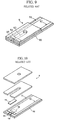
- Analysis tools include, for example, an electrode-type biosensor 9 shown in Figs. 9 and 10 (for example, refer to Japanese Patent Application Laid-Open ( JP-A) No. 6-109688 ).
- This biosensor 9 has electrodes 91 and 92 provided in a substrate 90 and a fluid path 93 for moving a sample such as blood.
- the electrode 91 has a reactive electrode 94 for performing transfer of electrons to/from a certain component of blood.
- the electrode 92 has a counter electrode 95 for generating an electric potential difference from the reactive electrode 94.
- the reactive electrode 94 and the counter electrode 95 are exposed in the fluid path 93 and also make contact with the reagent portion 96.
- the electrodes 91 and 92 of the biosensor 9 is formed by screen printing using ink containing conductive components such as carbon or silver, metal sputtering, or burying metal pieces in the substrate 90. Therefore, the electrodes 91 and 92 have little or substantially no thickness, and the area of the reactive electrode 94 substantially affect the sensor sensitivity of the biosensor 9. Meanwhile, the biosensor 9 tends to be made to have a smaller size of the fluid path 93 to reduce the necessary amount of the sample and also reduce the areas of the electrodes 91 and 92 and, further, the areas of the reactive electrode 94 and the counter electrode 95.
- the output of the biosensor 9 is also reduced, and the sensor sensitivity may be easily dispersed.
- the reagent portion 96 is formed by, for example, attaching a reagent liquid to cover the reactive electrode 94 and/or the counter electrode 95 and drying the reagent liquid.
- the circumferential portion of the attaching spot is more rapidly dried in comparison with the center portion of the attaching spot of the reagent liquid. Therefore, the circumference of the attaching spot is crystallized first, and the circumference of the reagent portion 96 has a higher concentration of the reagent in comparison with the center portion.
- the electrodes 91 and 92 are formed by burying metal pieces in the substrate 90, it is necessary to increase the thickness of the entire substrate. Therefore, when the biosensor 9 is manufactured, it may be impossible to perform a manufacturing process by extracting materials such as the substrate 90 from a roll. In other words, since it is difficult to perform a roll-to-roll manufacturing process, the manufacturing method is limited, and it is difficult to improve the manufacturing efficiency.
- Patent Document 1 Japanese Patent Application Laid-Open ( JP-A) No. 6-109688 WO 02/097416 A1 discloses a biosensor having a first electrode system, a microporous membrane support and a second electrode system.
- the electrode systems are made of an electrically conductive material selected from the group consisting of gold, platinum, silver, silver chloride, rhodium, iridium, ruthenium, palladium, osmium, carbon, copper, and mixtures thereof.
- the present invention has been made to provide an analysis tool such as a biosensor, capable of increasing the electrode area for making contact with the sample, with excellent efficiency and low cost to facilitate miniaturization of the analysis tool.
- the porous conductive potion is obtained by coating a conductive film on at least part of a surface and an inner surface of a porous body.
- the porous body is, for example, an insulating fiber mesh cloth.
- the biosensor 1 shown in Figs. 1 to 3 is configured as a disposable type and installed in an analyzer such as a concentration measurement apparatus to analyze a certain component (for example, glucose, cholesterol, or lactic acid) within a sample (for example, a biochemical sample such as blood or urine).
- the biosensor 1 has a stack structure including a cover sheet 2, an electrode sheet 3, a separator 4, an electrode sheet 5, and a cover sheet 6 and is formed as a sheet shape as a whole.
- the biosensor 1 also has a reagent portion 7 to allow the analysis of the sample by attaching the sample to the reagent portion 7.
- the cover sheets 2 and 6 are provided to protect the electrode sheets 3 and 5 and define an attaching area or a movement area of the sample and have through-holes 20, 21, 60, and 61.
- the through-holes 20 and 60 are provided to allow the connectors 80 and 81 of the analyzer to make contact with the electrode sheets 3 and 5 and expose a part of the electrode sheets 3 and 5.
- the through-holes 21 and 61 function as an attaching hole for the sample supplied to the biosensor 1 and an air vent port.
- the cover sheets 2 and 6 are formed of, for example, an insulating resin material such as PET and have a thickness of 150 to 300 ⁇ m.
- the electrode sheets 3 and 5 receive voltages by the connectors 80 and 81 of the analyzer and may be formed as a sheet shape having a thickness of, for example, 10 to 50 ⁇ m.
- the electrode sheets 3 and 5 are entirely porous and have conductivity at least on the surface(s). Porosity of the electrode sheets 3 and 5 is set to, for example, 10 to 300 ⁇ m with respect to a mesh diameter or a porous diameter such that a capillary force sufficient to move the sample can be acted without generating clogging when the sample is supplied.
- Such electrode sheets 3 and 5 may be formed by providing a conductive film on the surface of the porous body having low conductivity.
- the porous body may include, for example, an insulating fiber cloth.
- the insulating fiber cloth may be obtained, for example, by plain-weaving an insulating fiber.
- the insulating fiber may have a fiber length of 5 to 100 ⁇ m using, for example, polyethylene or nylon. Needless to say, the insulating fiber cloth may also include other fabrics such as twill or sateen woven fabrics or nonwoven fabrics.
- the porous body may include foam or a porous material obtained by integrating plural particles in addition to the fiber cloth.
- the conductive film may be formed on the porous body by, for example, a method of forming a film known in the art using a conductive material such as metal.
- the metal material may include, for example, platinum (Pt), gold (Au), palladium (Pd), or nickel (Ni).
- the film-forming method may include, for example, sputtering, deposition, or plating.
- the electrode sheets 3 and 5 be entirely formed using a porous body as a base material. Instead, at least a portion where the reagent portion 8 is provided (where the sample is moved) may be porous or the entire body may be porous due to the conductor.
- the separator 4 is provided to maintain an insulation state between the electrode sheets 3 and 5, and may be formed as a sheet shape having a thickness of, for example, 10 to 50 ⁇ m and entirely porous due to the insulation material.
- the separator 4 may include a material capable of acting a capillary force sufficient to move the sample without generating clogging when the sample is supplied, and may include, for example, a porous body having a mesh diameter or a porous diameter of 10 to 300 ⁇ m.
- the porous body may include the same porous material as those that can be employed in the electrode sheets 3 and 5.
- the electrode sheets 3 and 5 and the separators 4 are hydrophilically processed in the area where the reagent portion 7 is provided and also hydrophobically processed in the area surrounding at least the circumference of the reagent portion 7.
- the hydrophilic process may be performed by coating a surfactant such as lecithin or irradiating ultraviolet or vacuum ultraviolet rays.
- the hydrophobic process may be performed by coating fluorine or the like.
- the reagent portion 7 When the reagent portion 7 is formed by performing the hydrophilic process for the area where the reagent portion 7 is formed, it is possible to impregnate a reagent liquid for selectively forming the reagent portion 7 for the hydrophilically processed portion. As a result, it is possible to appropriately define the reagent portion 7.
- the reagent portion 7 When the reagent portion 7 is supplied with the sample, the sample is actively moved to the hydrophilically processed portion, and it is possible to suppress the sample from penetrating into areas other than the reagent portion 7. Therefore, it is possible to selectively and efficiently supply the sample to the reagent portion 7.
- the electrode sheets 3 and 5 and the separator 4 it is possible to suppress the sample from penetrating into the circumference of the reagent portion 7 by performing the hydrophobic process to surround the reagent portion 7 when the reagent portion 7 is supplied with the sample. As a result, it is possible to selectively and efficiently supply the sample to the reagent portion 7.
- the reagent portion 7 is provided for reaction of the sample and continuously formed along the electrode sheet 3, the separator 4, and the electrode sheet 5 between the cover sheets 2 and 6 and the through-holes 21 and 61.
- a reagent portion 7 contains a reagent such as an oxidoreductase and an electron carrier material and is formed by supporting such a sample within a predetermined area in the electrode sheet 3, the separator 4, and the electrode sheet 5.
- the oxidoreductase is selected depending on the type of a certain component within the sample. For example, when glucose is analyzed, glucose oxidase (GOD) or glucose dehydrogenase (GDH) may be used, and typically, PQQGDH is used.
- the electron carrier material may include, for example, a ruthenium complex or an iron complex, and typically [Ru(NH 3 ) 6 ]Cl 3 or K 3 [Fe(CN) 6 ].
- the biosensor 1 described above has the reagent portion 7 in the electrode sheets 3 and 5 and the separator 4 formed as a porous material, it is possible to enlarge the contact area between the reagent portion 7 and the sample and the electrode sheet 3 and 5 and the separator 4. As a result, it is possible to improve an output of the biosensor 1 and further sensor sensitivity.
- the reagent portion 7 is formed by supporting the reagent in the porous body, it is possible to increase a solubility of the reagent portion 7 and uniformize the concentration of the sample when the sample is supplied in comparison with a case where the reagent portion is formed in a flat shape as in the related art. Therefore, in the biosensor 1, it is possible to appropriately achieve minimization of the biosensor 1 while appropriately obtaining the measurement accuracy.
- the material rolls 2A and 6A become the cover sheets 2 and 6 of the biosensor 1, and have plural through-holes corresponding to the through-holes 20, 21, 60, and 61 of the cover sheets 2 and 6.
- Such material rolls 2A and 6A are formed by winding long sheets 2B and 6B, for example, having plural through-holes that have been previously formed, around cores 2C and 6C.
- the long sheets 2B and 6B may be formed of, for example, an insulating resin material such as PET having a thickness of 150 to 300 ⁇ m, and the through-holes may be formed by, for example, a punching process.
- the punching process for forming plural through-holes may be performed in the same manufacturing line as that of a process of stacking material sheets 2A to 6A or a process of attaching a reagent liquid immediately before the process of stacking the material sheets 2A to 6A.
- the material rolls 3A and 5A become the electrode sheets 3 and 5 of the biosensor 1 and have a porous shape having conductivity in at least a part of the surface and the inner surface.
- Such material sheets 3A and 5A are formed by winding the long sheets 3B and 5B of an insulating fiber cloth having a conductive film having a thickness of, for example, 10 to 50 ⁇ m around the cores 3C and 5C.
- the conductive film may be formed by a film-forming method known in the art using a conductive material such as metal.
- the material roll 4A becomes the separator 4 of the biosensor 1 and has a porous shape.
- the material roll 4A is formed by winding the long sheet 4B of an insulating fiber cloth having a thickness of, for example, 10 to 50 ⁇ m around the core 4C.
- a hydrophilic process is performed for the area where the reagent portion 7 is previously provided (the area corresponding to predetermined through-holes of the long sheets 2B and 6B), and a hydrophobic process is entirely or partially performed so as to enclose the hydrophilically processed portion.
- the hydrophilic process is performed by, for example, a surfactant process or irradiating ultraviolet rays, and the hydrophobic process is performed by, for example, a fluorine coating process.
- the material rolls 2A to 6A are set, and the long sheets 2B to 6B are stacked to each other by pulling out the long sheets 2B to 6B from the material rolls 2A to 6A.
- bonding layers are formed between the neighboring long sheets to provide a stack sheet 8.
- the bonding layers may be formed by interposing bonding sheets such as a double-sided adhesive tape or a hot-melt bonding sheet between the long sheets 2A to 6A.
- the long sheets 2B to 6B are bonded to each other through a compression bonding or a thermal compression bonding.
- a reagent liquid is attached on predetermined through-holes of the long sheet 2B.
- the reagent liquid contains an oxidoreductase and an electron carrier material and is attached by a dispenser 82 known in the art.
- the long sheets 3B to 5B are formed of a porous material, the reagent liquid attached through the through-holes is penetrated into the long sheets 3B to 5B. Therefore, since the reagent liquid is uniformly dried in comparison with a case where the reagent liquid is attached on a flat surface, it is possible to uniformize the reagent concentration when the sample is supplied to the reagent portion 7 and the reagent portion 7 is dissolved.
- the stack sheet 8 is wound around the core 84.
- the biosensor 1 shown in Figs. 1 to 3 can be obtained by performing a punching process or a cutting process for the stack sheet 8.
- the punching or cutting of the stack sheet 8 may be performed in the same manufacturing line as that of the process of coating the reagent liquid before the stack sheet 8 is wound around the core 83.
- the biosensor 1 can be formed using plural material rolls 2A to 6A, it is possible to perform, a so-called roll-to-roll manufacturing. Therefore, it is possible to manufacture the biosensor 1 in an efficient and inexpensive manner with few limitations.
- Figs. 5 and 6 like reference numerals denote like elements as in the first embodiment of the present invention described above, and repetitive descriptions thereof are omitted hereinafter.
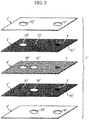
- the biosensor 1' shown in Figs. 5 and 6 is formed as a sheet shape obtained by stacking a cover sheet 2', an electrode sheet 3', a separator 4', an electrode sheet 5', and a cover sheet 6'.
- the cover sheet 2', the electrode sheet 3', and the separator 4' have through-holes 22', 30', and 40', respectively, communicating with one another.
- the through-holes 22', 30', and 40' are provided to expose the electrode sheet 5' and allow the connector 80 to make contact with the electrode sheet 5'.
- the separator 4', the electrode sheet 5', and the cover sheet 6' have through-holes 41', 50', and 62', respectively, communicating to one another.
- the through-holes 41', 50', and 62' are provided to expose the electrode sheet 3' and allow the connector 81 to make contact with the electrode sheet 3'.
- Electrodes 3' and 5' surfaces 31' and 51', where the separator 4' is bonded to, selectively have conductivity.
- Such electrode sheets 3' and 5' may be provided by forming a conductive film on only a single surface of the porous body such as an insulating fiber cloth.
- the electrode sheets 3' and 5' may be obtained by forming a conductive film on all of the surfaces 31' and 51' and the surfaces 32' and 52'.
- the electrode sheets 3' and 5' may be obtained by forming a conductive film on predetermined portions including an area where the reagent portion 7 is formed and an area making contact with the connectors 80 and 81.
- the area where the reagent portion 7 is formed is also porous in the biosensor 1', it is possible to increase the contact area between the reagent portion 7 or the sample and the electrode sheets 2' and 4' or the separator 3'. As a result, it is possible to improve the output of the biosensor 1' and further the sensor sensitivity. It is possible to appropriately prepare miniaturization of the biosensor 1' while appropriately obtaining the measurement accuracy.
- Figs. 7 and 8 like or substantially identical elements are denoted by like reference numerals as in the first embodiment described above, and repetitive descriptions thereof are omitted hereinafter.
- the biosensor 1" shown in Figs. 7 and 8 has a sheet shape obtained by stacking a cover sheet 2", an electrode sheet 3", a separator 4", an electrode sheet 5", and a cover sheet 6".
- the cover sheet 2", the electrode sheets 3", and the separator 4" have through-holes 22", 30", and 40", respectively, communicating with one another.
- the through-holes 22", 30", and 40" are provided to expose the electrode sheet 5" and allow the connector 81 to make contact with the electrode sheet 5".
- the connector 80 is allowed to make contact with the electrode sheet 3". That is, the electrode sheets 3" and 5" are exposed through the cover sheet 2". Therefore, in the analyzer, the connectors 80 and 81 are arranged side by side in the cover sheet 2" side.
- the electrode sheet 3" is arranged such that the surface 32" opposite to the surface 31", where the separator 4" is bonded, selectively has conductivity.
- the electrode sheet 5" is arranged such that the surface 51", where the separator 4" is bonded, selectively has conductivity. That is, since the electrode sheets 3" and 5" make contact with the connectors 80 and 81 on the surfaces 32" and 51", respectively, it is not necessary to actively conduct the surfaces 31" and 52".
- Such electrode sheets 3" and 5" are formed to have porosity by forming a conductive film on only a single surface of a porous body such as an insulating fiber cloth.
- the separator 4" may be omitted when the conductivity is selectively provided to the surfaces 32" and 51", and a sufficient insulation can be obtained in the surfaces 31" and 52".
- a conductive film may be formed on all of the surfaces 31" and 51" and the surfaces 32" and 52".
- the conductive film may be formed on predetermined portions including the area where the reagent portion 7 is formed or the area making contact with the connectors 80 and 81.
- the present invention may be variously modified without limitation to the aforementioned embodiments.
- the through-holes formed on the cover sheet may be formed as a hole continuously extending to the edge of the cover sheet.
- the number of electrode sheets in the biosensor is not necessarily two, but may include a correction electrode sheet for measuring the influence quantity of the hematocrit in the biosensor, for example, using whole blood as the sample.
- the electrode is not necessarily formed as a sheet shape, but may be appropriately designed.
Landscapes
- Chemical & Material Sciences (AREA)
- Health & Medical Sciences (AREA)
- Life Sciences & Earth Sciences (AREA)
- Organic Chemistry (AREA)
- Wood Science & Technology (AREA)
- Molecular Biology (AREA)
- Proteomics, Peptides & Aminoacids (AREA)
- Zoology (AREA)
- Physics & Mathematics (AREA)
- Analytical Chemistry (AREA)
- Biochemistry (AREA)
- General Health & Medical Sciences (AREA)
- Biophysics (AREA)
- Immunology (AREA)
- Engineering & Computer Science (AREA)
- Electrochemistry (AREA)
- Emergency Medicine (AREA)
- Pathology (AREA)
- Biotechnology (AREA)
- Microbiology (AREA)
- General Physics & Mathematics (AREA)
- Chemical Kinetics & Catalysis (AREA)
- Hematology (AREA)
- Bioinformatics & Cheminformatics (AREA)
- General Engineering & Computer Science (AREA)
- Genetics & Genomics (AREA)
- Investigating Or Analysing Biological Materials (AREA)
- Apparatus Associated With Microorganisms And Enzymes (AREA)
Claims (8)
- Outil d'analyse (1 ; 1' ; 1") comprenant :une portion de réactif (7) ; etune première feuille d'électrode (3, 3' ; 3") et une seconde feuille d'électrode (5 ; 5' ; 5"), etl'outil d'analyse comprend en outre une feuille isolante (4 ; 4' ; 4") interposée entre les première et seconde feuilles d'électrode,dans lequel la première feuille d'électrode et la seconde feuille d'électrode incluent une portion conductrice poreuse où la portion de réactif est formée,comprenant en outre une première (2 ; 2' ; 2") et une seconde feuille de couverture (6 ; 6', 6") entre lesquelles les première et seconde feuilles d'électrode sont interposées,dans lequel la première feuille de couverture, la première feuille d'électrode, la feuille isolante, la seconde feuille d'électrode et la seconde feuille de couverture sont empilées dans cet ordre, etau moins une des première et seconde feuilles de couverture a un trou (20, 21 ; 21, 22' ; 20, 21, 22" ; 60, 61 ; 61, 62' ; 61) pour exposer les première et seconde feuilles d'électrode,caractérisé en ce queune zone hydrophobe est formée dans une région entourant une circonférence de la portion de réactif, etdans lequel une zone hydrophile est formée dans une région où la portion de réactif est prévue.
- Outil d'analyse (1 ; 1' ; 1") selon la revendication 1,
dans lequel la portion conductrice poreuse peut être obtenue par revêtement d'un film conducteur sur au moins une partie d'une surface et d'une surface intérieure d'un corps poreux. - Outil d'analyse (1 ; 1' ; 1") selon la revendication 2, dans lequel le corps poreux est un tissu maillé à fibres isolantes.
- Outil d'analyse (1 ; 1' ; 1") selon la revendication 1, dans lequel la feuille isolante est un tissu maillé à fibres isolantes.
- Outil d'analyse (1 ; 1' ; 1") selon la revendication 1, dans lequel
un trou (20, 21 ; 22', 21 ; 20, 21, 22") pour exposer la première feuille d'électrode est formé dans la première feuille de couverture, et
un trou (60, 61 ; 61, 62' ; 61) pour exposer la seconde feuille d'électrode est formé dans la seconde feuille de couverture. - Outil d'analyse (1 ; 1' ; 1") selon la revendication 1, dans lequel
un trou (21 ; 22', 21 ; 21, 22" ; 30', 40' ; 30", 40") pour exposer la seconde feuille d'électrode est formé dans la première feuille de couverture, la première feuille d'électrode et la feuille isolante, et
un trou (61 ; 61, 62' ; 61 ; 41', 50') pour exposer la première feuille d'électrode est formé dans la seconde feuille de couverture, la seconde feuille d'électrode et la feuille isolante. - Outil d'analyse (1 ; 1' ; 1") selon la revendication 6, dans lequel
la première feuille d'électrode peut être obtenue en formant de manière sélective le film conducteur sur un côté seconde feuille de couverture du corps poreux, et
la seconde feuille d'électrode peut être obtenue en formant de manière sélective le film conducteur sur un côté première feuille de couverture du corps poreux. - Outil d'analyse (1 ; 1' ; 1") selon la revendication 1, dans lequel
un trou (21, 22', 30', 40' ; 21, 22" ; 30" ; 40") pour exposer la seconde feuille d'électrode est formé dans la première feuille de couverture, la première feuille d'électrode et la feuille isolante, et
un trou (20, 21 ; 21, 22' ; 20, 21, 22") pour exposer la première feuille d'électrode est en outre formé dans la première feuille de couverture.
Applications Claiming Priority (2)
| Application Number | Priority Date | Filing Date | Title |
|---|---|---|---|
| JP2007282782 | 2007-10-31 | ||
| PCT/JP2008/069982 WO2009057792A1 (fr) | 2007-10-31 | 2008-10-31 | Instrument d'analyse |
Publications (3)
| Publication Number | Publication Date |
|---|---|
| EP2214007A1 EP2214007A1 (fr) | 2010-08-04 |
| EP2214007A4 EP2214007A4 (fr) | 2014-11-26 |
| EP2214007B1 true EP2214007B1 (fr) | 2019-05-01 |
Family
ID=40591171
Family Applications (1)
| Application Number | Title | Priority Date | Filing Date |
|---|---|---|---|
| EP08844630.7A Active EP2214007B1 (fr) | 2007-10-31 | 2008-10-31 | Instrument d'analyse |
Country Status (7)
| Country | Link |
|---|---|
| US (1) | US8384402B2 (fr) |
| EP (1) | EP2214007B1 (fr) |
| JP (1) | JP5081249B2 (fr) |
| KR (1) | KR101460837B1 (fr) |
| CN (1) | CN101842698B (fr) |
| TW (1) | TWI435076B (fr) |
| WO (1) | WO2009057792A1 (fr) |
Families Citing this family (7)
| Publication number | Priority date | Publication date | Assignee | Title |
|---|---|---|---|---|
| JP5839986B2 (ja) * | 2011-12-26 | 2016-01-06 | 日産自動車株式会社 | 検査方法および検査システム |
| JP6286835B2 (ja) * | 2013-02-26 | 2018-03-07 | 大日本印刷株式会社 | 濃度測定センサ用シートの製造方法 |
| JP2015200570A (ja) * | 2014-04-08 | 2015-11-12 | 株式会社村田製作所 | バイオセンサおよびバイオセンサの製造方法 |
| CN104792845A (zh) * | 2014-08-07 | 2015-07-22 | 中国科学院微电子研究所 | 传感装置 |
| WO2016121952A1 (fr) * | 2015-01-29 | 2016-08-04 | アラム株式会社 | Capteur de liquide |
| KR102094837B1 (ko) * | 2018-09-27 | 2020-03-30 | 주식회사 아이센스 | 연속 혈당 측정용 센서 부재 |
| CN112294326B (zh) * | 2020-12-01 | 2025-09-23 | 天津九安医疗电子股份有限公司 | 一种柔性血糖电化学测试探针及其组装方法 |
Citations (1)
| Publication number | Priority date | Publication date | Assignee | Title |
|---|---|---|---|---|
| KR20020091473A (ko) * | 2001-05-30 | 2002-12-06 | 주식회사 아이센스 | 대면형 다공성 전극을 포함하는 자가 시료채취 흐름계형바이오 센서 |
Family Cites Families (19)
| Publication number | Priority date | Publication date | Assignee | Title |
|---|---|---|---|---|
| US4229490A (en) * | 1978-09-01 | 1980-10-21 | Texas Instruments Incorporated | Novel method for catalyst application to a substrate for fuel cell electrodes |
| US4293396A (en) * | 1979-09-27 | 1981-10-06 | Prototech Company | Thin carbon-cloth-based electrocatalytic gas diffusion electrodes, and electrochemical cells comprising the same |
| JP3189416B2 (ja) | 1992-09-25 | 2001-07-16 | 松下電器産業株式会社 | 液体の成分測定装置 |
| AT397513B (de) * | 1992-12-15 | 1994-04-25 | Avl Verbrennungskraft Messtech | Amperometrische enzymelektrode |
| AUPM506894A0 (en) * | 1994-04-14 | 1994-05-05 | Memtec Limited | Novel electrochemical cells |
| US5981203A (en) * | 1994-04-26 | 1999-11-09 | The Regents Of The University Of Michigan | Unitary sandwich enzyme immunoassay cassette, device and method of use |
| EP0821726B1 (fr) * | 1995-03-10 | 2014-05-07 | Meso Scale Technologies, LLC. | Essai par électrochimioluminescence multispécifique et multirangée |
| US6207369B1 (en) * | 1995-03-10 | 2001-03-27 | Meso Scale Technologies, Llc | Multi-array, multi-specific electrochemiluminescence testing |
| EP0771867A3 (fr) * | 1995-10-30 | 1998-09-02 | Ciba-Geigy Japan Limited | Electrode enzymatique |
| JP3393361B2 (ja) | 1997-03-24 | 2003-04-07 | 国立身体障害者リハビリテーションセンター総長 | バイオセンサ |
| JP3299211B2 (ja) * | 1999-02-23 | 2002-07-08 | 名古屋市 | 固体電解質を利用した酵素センサー |
| US6562210B1 (en) * | 1999-12-30 | 2003-05-13 | Roche Diagnostics Corporation | Cell for electrochemical anaylsis of a sample |
| EP1336839B1 (fr) * | 2000-10-27 | 2012-01-25 | ARKRAY, Inc. | Biocapteur |
| CN1205474C (zh) * | 2001-05-29 | 2005-06-08 | 松下电器产业株式会社 | 生物传感器 |
| DE60236429D1 (en) * | 2001-05-30 | 2010-07-01 | I Sens Inc | Biosensor |
| EP1573846A2 (fr) * | 2002-09-23 | 2005-09-14 | Protonex Technology Corporation | Empilements de piles electrochimiques a liquide et leur procedes de production |
| JP4069171B2 (ja) | 2003-09-25 | 2008-04-02 | 富山県 | マイクロウェルアレイチップ及びその製造方法 |
| DE10356752A1 (de) * | 2003-12-04 | 2005-06-30 | Roche Diagnostics Gmbh | Beschichtete Testelemente |
| KR100902081B1 (ko) * | 2007-05-15 | 2009-06-09 | 삼성전자주식회사 | 탄소 나노튜브의 전극 사이 배치 방법, 탄소나노튜브-탐식자 복합체를 이용한 생체분자 검출 장치와 그방법 |
-
2008
- 2008-10-31 EP EP08844630.7A patent/EP2214007B1/fr active Active
- 2008-10-31 CN CN200880114182.8A patent/CN101842698B/zh active Active
- 2008-10-31 US US12/740,850 patent/US8384402B2/en active Active
- 2008-10-31 WO PCT/JP2008/069982 patent/WO2009057792A1/fr not_active Ceased
- 2008-10-31 TW TW097142313A patent/TWI435076B/zh active
- 2008-10-31 JP JP2009539151A patent/JP5081249B2/ja active Active
- 2008-10-31 KR KR1020107011820A patent/KR101460837B1/ko active Active
Patent Citations (1)
| Publication number | Priority date | Publication date | Assignee | Title |
|---|---|---|---|---|
| KR20020091473A (ko) * | 2001-05-30 | 2002-12-06 | 주식회사 아이센스 | 대면형 다공성 전극을 포함하는 자가 시료채취 흐름계형바이오 센서 |
Also Published As
| Publication number | Publication date |
|---|---|
| US20100244862A1 (en) | 2010-09-30 |
| KR20100101590A (ko) | 2010-09-17 |
| EP2214007A4 (fr) | 2014-11-26 |
| KR101460837B1 (ko) | 2014-11-11 |
| EP2214007A1 (fr) | 2010-08-04 |
| JP5081249B2 (ja) | 2012-11-28 |
| TWI435076B (zh) | 2014-04-21 |
| CN101842698A (zh) | 2010-09-22 |
| US8384402B2 (en) | 2013-02-26 |
| WO2009057792A1 (fr) | 2009-05-07 |
| CN101842698B (zh) | 2016-06-15 |
| JPWO2009057792A1 (ja) | 2011-03-10 |
| TW200938837A (en) | 2009-09-16 |
Similar Documents
| Publication | Publication Date | Title |
|---|---|---|
| EP2214007B1 (fr) | Instrument d'analyse | |
| US6863801B2 (en) | Electrochemical cell | |
| KR100655357B1 (ko) | 전기화학셀 | |
| US6174420B1 (en) | Electrochemical cell | |
| US6767440B1 (en) | Biosensor | |
| US6521110B1 (en) | Electrochemical cell | |
| EP1472527B1 (fr) | Electrode sous forme de microbande | |
| KR100767204B1 (ko) | 일회용 전기화학적 센서의 연속 제조 방법 | |
| JP3821685B2 (ja) | バイオセンサ | |
| CA2197385C (fr) | Capteurs electrochimiques a selectivite amelioree et a sensibilite accrue | |
| WO2005122296A2 (fr) | Dispositif d'electrode, procede de fabrication d'un dispositif d'electrode et procede de detection electrochimique utilisant un dispositif d'electrode | |
| US20060008581A1 (en) | Method of manufacturing an electrochemical sensor | |
| AU4454799A (en) | Electrochemical cell | |
| HK1060597B (en) | Electrochemical sensor | |
| HK1057609B (en) | Electrochemical cells |
Legal Events
| Date | Code | Title | Description |
|---|---|---|---|
| PUAI | Public reference made under article 153(3) epc to a published international application that has entered the european phase |
Free format text: ORIGINAL CODE: 0009012 |
|
| 17P | Request for examination filed |
Effective date: 20100519 |
|
| AK | Designated contracting states |
Kind code of ref document: A1 Designated state(s): AT BE BG CH CY CZ DE DK EE ES FI FR GB GR HR HU IE IS IT LI LT LU LV MC MT NL NO PL PT RO SE SI SK TR |
|
| AX | Request for extension of the european patent |
Extension state: AL BA MK RS |
|
| DAX | Request for extension of the european patent (deleted) | ||
| A4 | Supplementary search report drawn up and despatched |
Effective date: 20141028 |
|
| RIC1 | Information provided on ipc code assigned before grant |
Ipc: G01N 27/327 20060101AFI20141022BHEP Ipc: G01N 27/30 20060101ALI20141022BHEP Ipc: G01N 27/416 20060101ALI20141022BHEP Ipc: G01N 27/28 20060101ALI20141022BHEP Ipc: C12Q 1/00 20060101ALI20141022BHEP Ipc: G01N 27/333 20060101ALI20141022BHEP |
|
| STAA | Information on the status of an ep patent application or granted ep patent |
Free format text: STATUS: EXAMINATION IS IN PROGRESS |
|
| 17Q | First examination report despatched |
Effective date: 20180411 |
|
| GRAP | Despatch of communication of intention to grant a patent |
Free format text: ORIGINAL CODE: EPIDOSNIGR1 |
|
| STAA | Information on the status of an ep patent application or granted ep patent |
Free format text: STATUS: GRANT OF PATENT IS INTENDED |
|
| INTG | Intention to grant announced |
Effective date: 20181207 |
|
| GRAS | Grant fee paid |
Free format text: ORIGINAL CODE: EPIDOSNIGR3 |
|
| GRAA | (expected) grant |
Free format text: ORIGINAL CODE: 0009210 |
|
| STAA | Information on the status of an ep patent application or granted ep patent |
Free format text: STATUS: THE PATENT HAS BEEN GRANTED |
|
| AK | Designated contracting states |
Kind code of ref document: B1 Designated state(s): AT BE BG CH CY CZ DE DK EE ES FI FR GB GR HR HU IE IS IT LI LT LU LV MC MT NL NO PL PT RO SE SI SK TR |
|
| REG | Reference to a national code |
Ref country code: GB Ref legal event code: FG4D |
|
| REG | Reference to a national code |
Ref country code: CH Ref legal event code: EP Ref country code: AT Ref legal event code: REF Ref document number: 1127613 Country of ref document: AT Kind code of ref document: T Effective date: 20190515 |
|
| REG | Reference to a national code |
Ref country code: DE Ref legal event code: R096 Ref document number: 602008059946 Country of ref document: DE |
|
| REG | Reference to a national code |
Ref country code: IE Ref legal event code: FG4D |
|
| REG | Reference to a national code |
Ref country code: NL Ref legal event code: MP Effective date: 20190501 |
|
| REG | Reference to a national code |
Ref country code: LT Ref legal event code: MG4D |
|
| PG25 | Lapsed in a contracting state [announced via postgrant information from national office to epo] |
Ref country code: NO Free format text: LAPSE BECAUSE OF FAILURE TO SUBMIT A TRANSLATION OF THE DESCRIPTION OR TO PAY THE FEE WITHIN THE PRESCRIBED TIME-LIMIT Effective date: 20190801 Ref country code: FI Free format text: LAPSE BECAUSE OF FAILURE TO SUBMIT A TRANSLATION OF THE DESCRIPTION OR TO PAY THE FEE WITHIN THE PRESCRIBED TIME-LIMIT Effective date: 20190501 Ref country code: LT Free format text: LAPSE BECAUSE OF FAILURE TO SUBMIT A TRANSLATION OF THE DESCRIPTION OR TO PAY THE FEE WITHIN THE PRESCRIBED TIME-LIMIT Effective date: 20190501 Ref country code: NL Free format text: LAPSE BECAUSE OF FAILURE TO SUBMIT A TRANSLATION OF THE DESCRIPTION OR TO PAY THE FEE WITHIN THE PRESCRIBED TIME-LIMIT Effective date: 20190501 Ref country code: PT Free format text: LAPSE BECAUSE OF FAILURE TO SUBMIT A TRANSLATION OF THE DESCRIPTION OR TO PAY THE FEE WITHIN THE PRESCRIBED TIME-LIMIT Effective date: 20190901 Ref country code: ES Free format text: LAPSE BECAUSE OF FAILURE TO SUBMIT A TRANSLATION OF THE DESCRIPTION OR TO PAY THE FEE WITHIN THE PRESCRIBED TIME-LIMIT Effective date: 20190501 Ref country code: HR Free format text: LAPSE BECAUSE OF FAILURE TO SUBMIT A TRANSLATION OF THE DESCRIPTION OR TO PAY THE FEE WITHIN THE PRESCRIBED TIME-LIMIT Effective date: 20190501 Ref country code: SE Free format text: LAPSE BECAUSE OF FAILURE TO SUBMIT A TRANSLATION OF THE DESCRIPTION OR TO PAY THE FEE WITHIN THE PRESCRIBED TIME-LIMIT Effective date: 20190501 |
|
| PG25 | Lapsed in a contracting state [announced via postgrant information from national office to epo] |
Ref country code: GR Free format text: LAPSE BECAUSE OF FAILURE TO SUBMIT A TRANSLATION OF THE DESCRIPTION OR TO PAY THE FEE WITHIN THE PRESCRIBED TIME-LIMIT Effective date: 20190802 Ref country code: LV Free format text: LAPSE BECAUSE OF FAILURE TO SUBMIT A TRANSLATION OF THE DESCRIPTION OR TO PAY THE FEE WITHIN THE PRESCRIBED TIME-LIMIT Effective date: 20190501 Ref country code: BG Free format text: LAPSE BECAUSE OF FAILURE TO SUBMIT A TRANSLATION OF THE DESCRIPTION OR TO PAY THE FEE WITHIN THE PRESCRIBED TIME-LIMIT Effective date: 20190801 |
|
| REG | Reference to a national code |
Ref country code: AT Ref legal event code: MK05 Ref document number: 1127613 Country of ref document: AT Kind code of ref document: T Effective date: 20190501 |
|
| PG25 | Lapsed in a contracting state [announced via postgrant information from national office to epo] |
Ref country code: IS Free format text: LAPSE BECAUSE OF FAILURE TO SUBMIT A TRANSLATION OF THE DESCRIPTION OR TO PAY THE FEE WITHIN THE PRESCRIBED TIME-LIMIT Effective date: 20190901 |
|
| PG25 | Lapsed in a contracting state [announced via postgrant information from national office to epo] |
Ref country code: SK Free format text: LAPSE BECAUSE OF FAILURE TO SUBMIT A TRANSLATION OF THE DESCRIPTION OR TO PAY THE FEE WITHIN THE PRESCRIBED TIME-LIMIT Effective date: 20190501 Ref country code: RO Free format text: LAPSE BECAUSE OF FAILURE TO SUBMIT A TRANSLATION OF THE DESCRIPTION OR TO PAY THE FEE WITHIN THE PRESCRIBED TIME-LIMIT Effective date: 20190501 Ref country code: EE Free format text: LAPSE BECAUSE OF FAILURE TO SUBMIT A TRANSLATION OF THE DESCRIPTION OR TO PAY THE FEE WITHIN THE PRESCRIBED TIME-LIMIT Effective date: 20190501 Ref country code: CZ Free format text: LAPSE BECAUSE OF FAILURE TO SUBMIT A TRANSLATION OF THE DESCRIPTION OR TO PAY THE FEE WITHIN THE PRESCRIBED TIME-LIMIT Effective date: 20190501 Ref country code: AT Free format text: LAPSE BECAUSE OF FAILURE TO SUBMIT A TRANSLATION OF THE DESCRIPTION OR TO PAY THE FEE WITHIN THE PRESCRIBED TIME-LIMIT Effective date: 20190501 Ref country code: DK Free format text: LAPSE BECAUSE OF FAILURE TO SUBMIT A TRANSLATION OF THE DESCRIPTION OR TO PAY THE FEE WITHIN THE PRESCRIBED TIME-LIMIT Effective date: 20190501 |
|
| REG | Reference to a national code |
Ref country code: DE Ref legal event code: R097 Ref document number: 602008059946 Country of ref document: DE |
|
| PLBE | No opposition filed within time limit |
Free format text: ORIGINAL CODE: 0009261 |
|
| STAA | Information on the status of an ep patent application or granted ep patent |
Free format text: STATUS: NO OPPOSITION FILED WITHIN TIME LIMIT |
|
| PG25 | Lapsed in a contracting state [announced via postgrant information from national office to epo] |
Ref country code: TR Free format text: LAPSE BECAUSE OF FAILURE TO SUBMIT A TRANSLATION OF THE DESCRIPTION OR TO PAY THE FEE WITHIN THE PRESCRIBED TIME-LIMIT Effective date: 20190501 |
|
| 26N | No opposition filed |
Effective date: 20200204 |
|
| PG25 | Lapsed in a contracting state [announced via postgrant information from national office to epo] |
Ref country code: PL Free format text: LAPSE BECAUSE OF FAILURE TO SUBMIT A TRANSLATION OF THE DESCRIPTION OR TO PAY THE FEE WITHIN THE PRESCRIBED TIME-LIMIT Effective date: 20190501 |
|
| PG25 | Lapsed in a contracting state [announced via postgrant information from national office to epo] |
Ref country code: SI Free format text: LAPSE BECAUSE OF FAILURE TO SUBMIT A TRANSLATION OF THE DESCRIPTION OR TO PAY THE FEE WITHIN THE PRESCRIBED TIME-LIMIT Effective date: 20190501 Ref country code: MC Free format text: LAPSE BECAUSE OF FAILURE TO SUBMIT A TRANSLATION OF THE DESCRIPTION OR TO PAY THE FEE WITHIN THE PRESCRIBED TIME-LIMIT Effective date: 20190501 |
|
| REG | Reference to a national code |
Ref country code: CH Ref legal event code: PL |
|
| PG25 | Lapsed in a contracting state [announced via postgrant information from national office to epo] |
Ref country code: LU Free format text: LAPSE BECAUSE OF NON-PAYMENT OF DUE FEES Effective date: 20191031 Ref country code: LI Free format text: LAPSE BECAUSE OF NON-PAYMENT OF DUE FEES Effective date: 20191031 Ref country code: CH Free format text: LAPSE BECAUSE OF NON-PAYMENT OF DUE FEES Effective date: 20191031 |
|
| REG | Reference to a national code |
Ref country code: BE Ref legal event code: MM Effective date: 20191031 |
|
| PG25 | Lapsed in a contracting state [announced via postgrant information from national office to epo] |
Ref country code: BE Free format text: LAPSE BECAUSE OF NON-PAYMENT OF DUE FEES Effective date: 20191031 |
|
| PG25 | Lapsed in a contracting state [announced via postgrant information from national office to epo] |
Ref country code: IE Free format text: LAPSE BECAUSE OF NON-PAYMENT OF DUE FEES Effective date: 20191031 |
|
| PG25 | Lapsed in a contracting state [announced via postgrant information from national office to epo] |
Ref country code: CY Free format text: LAPSE BECAUSE OF FAILURE TO SUBMIT A TRANSLATION OF THE DESCRIPTION OR TO PAY THE FEE WITHIN THE PRESCRIBED TIME-LIMIT Effective date: 20190501 |
|
| PG25 | Lapsed in a contracting state [announced via postgrant information from national office to epo] |
Ref country code: HU Free format text: LAPSE BECAUSE OF FAILURE TO SUBMIT A TRANSLATION OF THE DESCRIPTION OR TO PAY THE FEE WITHIN THE PRESCRIBED TIME-LIMIT; INVALID AB INITIO Effective date: 20081031 Ref country code: MT Free format text: LAPSE BECAUSE OF FAILURE TO SUBMIT A TRANSLATION OF THE DESCRIPTION OR TO PAY THE FEE WITHIN THE PRESCRIBED TIME-LIMIT Effective date: 20190501 |
|
| PGFP | Annual fee paid to national office [announced via postgrant information from national office to epo] |
Ref country code: DE Payment date: 20241021 Year of fee payment: 17 |
|
| PGFP | Annual fee paid to national office [announced via postgrant information from national office to epo] |
Ref country code: GB Payment date: 20241022 Year of fee payment: 17 |
|
| PGFP | Annual fee paid to national office [announced via postgrant information from national office to epo] |
Ref country code: FR Payment date: 20241021 Year of fee payment: 17 |
|
| PGFP | Annual fee paid to national office [announced via postgrant information from national office to epo] |
Ref country code: IT Payment date: 20241025 Year of fee payment: 17 |