EP2214128A1 - Procédé et système de modelage de processus de fabrication - Google Patents
Procédé et système de modelage de processus de fabrication Download PDFInfo
- Publication number
- EP2214128A1 EP2214128A1 EP09100085A EP09100085A EP2214128A1 EP 2214128 A1 EP2214128 A1 EP 2214128A1 EP 09100085 A EP09100085 A EP 09100085A EP 09100085 A EP09100085 A EP 09100085A EP 2214128 A1 EP2214128 A1 EP 2214128A1
- Authority
- EP
- European Patent Office
- Prior art keywords
- model
- real
- virtual equipment
- machine
- level
- Prior art date
- Legal status (The legal status is an assumption and is not a legal conclusion. Google has not performed a legal analysis and makes no representation as to the accuracy of the status listed.)
- Withdrawn
Links
Images


Classifications
-
- G—PHYSICS
- G06—COMPUTING OR CALCULATING; COUNTING
- G06Q—INFORMATION AND COMMUNICATION TECHNOLOGY [ICT] SPECIALLY ADAPTED FOR ADMINISTRATIVE, COMMERCIAL, FINANCIAL, MANAGERIAL OR SUPERVISORY PURPOSES; SYSTEMS OR METHODS SPECIALLY ADAPTED FOR ADMINISTRATIVE, COMMERCIAL, FINANCIAL, MANAGERIAL OR SUPERVISORY PURPOSES, NOT OTHERWISE PROVIDED FOR
- G06Q10/00—Administration; Management
- G06Q10/06—Resources, workflows, human or project management; Enterprise or organisation planning; Enterprise or organisation modelling
-
- G—PHYSICS
- G05—CONTROLLING; REGULATING
- G05B—CONTROL OR REGULATING SYSTEMS IN GENERAL; FUNCTIONAL ELEMENTS OF SUCH SYSTEMS; MONITORING OR TESTING ARRANGEMENTS FOR SUCH SYSTEMS OR ELEMENTS
- G05B19/00—Program-control systems
- G05B19/02—Program-control systems electric
- G05B19/418—Total factory control, i.e. centrally controlling a plurality of machines, e.g. direct or distributed numerical control [DNC], flexible manufacturing systems [FMS], integrated manufacturing systems [IMS] or computer integrated manufacturing [CIM]
- G05B19/41885—Total factory control, i.e. centrally controlling a plurality of machines, e.g. direct or distributed numerical control [DNC], flexible manufacturing systems [FMS], integrated manufacturing systems [IMS] or computer integrated manufacturing [CIM] characterised by modeling, simulation of the manufacturing system
-
- G—PHYSICS
- G05—CONTROLLING; REGULATING
- G05B—CONTROL OR REGULATING SYSTEMS IN GENERAL; FUNCTIONAL ELEMENTS OF SUCH SYSTEMS; MONITORING OR TESTING ARRANGEMENTS FOR SUCH SYSTEMS OR ELEMENTS
- G05B2219/00—Program-control systems
- G05B2219/30—Nc systems
- G05B2219/31—From computer integrated manufacturing till monitoring
- G05B2219/31372—Mes manufacturing execution system
Definitions
- the present invention relates to a method and a system for modeling a manufacturing process planned by an Enterprise Resource Planning (ERP) and produced by a shop floor, wherein a Manufacturing Executing System (MES) implements a modeled manufacturing process and plans and/or controls the corresponding manufacturing at shop floor.
- ERP Enterprise Resource Planning
- MES Manufacturing Executing System
- a method for managing and controlling manufacturing processes planned by an Enterprise Resource Planning (ERP) and produced by a shop floor provides a Manufacturing Executing System (MES) for implementing the planned manufacturing processes and controlling the corresponding production steps at plant floor.
- ERP Enterprise Resource Planning
- MES Manufacturing Executing System
- the Enterprise Resource Planning is a system including hardware devices and corresponding software applications for planning the business resources of an enterprise, i.e. material provisions, human resource managements, purchasing, orders, profits, finance, inventory controls, customer managements, etceteras, while the term "plant floor” has been used to indicate a system supporting the control of single machines involved in the manufacturing processes, for example by measuring the number of pieces produced per hour by each machine or the functioning parameters thereof, the quality of the pieces produced and so on.
- MES is an intermediate layer providing computing machines and software tools 1-n between the ERP upper layer and the plant floor lower layer, including a software tool for production order management 1, which receives requests of production from the ERP, and a software tool for production modeling 2, which supports the phases of selecting and managing the resources to be involved in the manufacturing processes, i.e. employees, machines and materials, in order to realize a planned manufacturing process within required time constrains.
- manufacturing execution systems require modeling plant equipment for both controlling and planning activities.
- controlling and planning activities have different goals and can require different model approach.
- two separate models for the same set of machines can not be used in the MES application because this separation will lead to a modeling gap.
- each nozzle machine which means the painter equipment of this example to comprise four machines.
- This model can easily manage a set of machine variables and actions that are used by the MES application for controlling the machine execution, e.g. each nozzle machine requires modeling a set of machine attributes that describe for example the level of ink, the cleanness of the nozzle, the execution of a periodic nozzle cleaning procedure, etc.
- the controlling activities desire to achieve a high granularity with respect to the machines to be controlled.
- the MES model will benefit of a single model for the entire painting equipment.
- This model can easily manage the set of equipment attributes (different from the machine attributes) that describe the action performed by the painter equipment, e.g. the composed color which is not a basic color of one of the four nozzle machines and the required portions of the basic colors for each nozzle machine, the intensity used for painting, etc.
- both models focus only on specific aspects of the MES application with offering advantages for the primary aspect but incurring disadvantages for the secondary aspect and vice versa.
- the painter equipment by means of four separate machines, it is straightforward to control the availability of ink in each nozzle; however, it is not clear how to model the concept of equipment that paints a composed color (i.e. green).
- the painter equipment By modeling the painter equipment by means of single machine, it is straightforward to represent the high level concept of an advanced programmable painter; however, in order to model all the technical requirements of each nozzle machine, a large set of machine attributes must be included within the high level model with absolutely no guarantee of coherence among the various data (e.g. the modeling gap may apply a model asserting that Black is set to 100; Cyan, Magenta and Yellow nozzles are set to 0 whilst the painter equipment is configured to paint the Green color.
- the four nozzle machines can be used altogether for performing a single painting phase with a composed color (e.g. Green) and they can be used separately and simultaneously for performing two or more painting phases with basic color (e.g. Yellow and Black).
- a composed color e.g. Green
- basic color e.g. Yellow and Black
- MES software applications provide modeling features that allow the user to represent the plant machines by means of describing machine attributes and functions. The user is in charge of selecting the best model for fitting his own plant requirements. None of the available MES software applications allow to model a set of machines by means of different aspects that cover both the desired control and planning activites. When the model requires highlighting different aspects for the same equipment, the user is in charge to the problem with partially fitting models and custom application which implies tremendous efforts in observing a possible modeling gap which fatal production errors or deadlock situations.
- ERP Enterprise Resource Planning
- MES Manufacturing Executing System
- the objective is achieved according to the present invention by a method for modeling a manufacturing process planned by an Enterprise Resource Planning (ERP) and produced by a shop floor, wherein a Manufacturing Executing System (MES) implements the modeled manufacturing process and plans and/or controls the corresponding manufacturing at shop floor, the method comprising the steps of:
- ERP Enterprise Resource Planning
- MES Manufacturing Executing System
- the new modeling approach describes both the planning and the controlling aspect with a strong relationship among these two representations.
- the data within the planning level is based on a hierarchical production structure that allows the composition of the virtual equipment by using existing machine modules of existing real and/or virtual machines.
- the data within the control level describes the virtual equipment with a real hardware oriented approach allowing the user to define the machine attributes as it is exactly required for controlling the machine execution.
- the creation of the virtual equipment with its composition from already existing real machines and/or other virtual machines and the description of the virtual machine comprising specific modeling level and specific controlling level therefore allows to satisfy both the demand for the production modeling and the production controlling.
- the method may comprise the steps of:
- This approach allows to combine both the controlling approach using as much as possible control parameter and the planning approach using as less as possible planning models of the equipment.
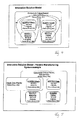
- FIG. 2 now represents a diagram of the state-of-the-art control oriented model.
- Each nozzle machine 10 to 16 can be controlled individually with respect to its significant real machine attributes, such as ink level, intensity, status, nozzle cleanness. Therefore, by modeling the painter equipment by means of the four separate nozzle machines 10 to 16, these real machine attributes can be easily controlled separately. Currently, this model does not allow to model the concept of equipment that paint a composed color.
- the innovative idea is now to provide a new modeling approach to a manufacturing plant that allows to describe both the control and the planning aspects with a strong relationship between the two representations.
- the modeling approach is based on a hierarchical structure that allows composing equipment models for the painter by using other equipment model modules, i.e. for the single nozzles or for every possible combination among these nozzle machines 10 to 16.
- the control level model describes the equipment with a real hardware oriented approach. This means that the user is able to define the machine attributes as it is exactly required for controlling the machine execution. In other words, the planning does not need to observe any of the real machine attributes except for possible constraints when using the same nozzle machine in two planning activities simultaneously. In the example given above, the user can model the four different nozzle machines (10 to 16) with their attributes only focusing on the control aspect (e.g. the level of ink, the cleanness status of the nozzle).
- the user can now model an virtual equipment that represents the high-level painter equipment.
- the user inserts the high-level attributes (e.g. color configuration of the painter).
- the high-level attributes e.g. color configuration of the painter.
- the user is able to model the constraints among the virtual equipment variables and the real machine variable (e.g. the painter equipment color is set to GREEN value only if the four nozzle machines are properly configured to mix up their basic colors in order to compose the GREEN color).
- the applied composition pattern allows the system to detect that a machine is used and configured by a planning activity that reserves and sets values for the high-level equipment model. For instance, the planning activities of the MES application state that the painter equipment is reserved by a painting phase starting at time t s , ending at a time t e and requiring the configuration of the color GREEN.
- the system is also aware that two nozzle machines are busy from time t s to time t e and they are individually configured by their low-level machine attributes for composing the color GREEN (e.g. CYAN and YELLOW are busy and set to 100; MAGENTA and BLACK nozzles are idle.
- CYAN and YELLOW are busy and set to 100; MAGENTA and BLACK nozzles are idle.
- this approach now also allows modeling multiple different ways of using the nozzle machines as depicted in the state-of-the-art example according to the Figures 2 and 3 .
- the machine can be used jointly for painting composed colors or individually for painting basic colors
- the user can model a number of virtual equipment (e.g. one for each individual color and one for the composed colors as shown in Figure 5 ).
- the system can easily detect if unfeasibility situations arise due to the constraints given in the planning level model. For instance, it is not possible to plan simultaneous usage of the composite color painter with the BLACK painter, because both rely on the real machine BLACK nozzle 10. However, it is possible to plan simultaneous usage of the BLACK painter machine and the CYAN painter machine because they rely on different machines.
- This solution therefore allows to develop an advanced plant modeling capability of the MES with an outstanding degree of adaptability to various industrial scenarios and flexible manufacturing systems. This ability significantly reduces efforts in the plant modeling phase for every MES application deployment. Moreover, it allows developing rich features of MES software that close the information management gaps between the different ISA95 modeling levels.
Landscapes
- Engineering & Computer Science (AREA)
- Business, Economics & Management (AREA)
- Manufacturing & Machinery (AREA)
- Strategic Management (AREA)
- Quality & Reliability (AREA)
- Physics & Mathematics (AREA)
- General Physics & Mathematics (AREA)
- Human Resources & Organizations (AREA)
- Entrepreneurship & Innovation (AREA)
- Economics (AREA)
- Educational Administration (AREA)
- Development Economics (AREA)
- Game Theory and Decision Science (AREA)
- Automation & Control Theory (AREA)
- General Engineering & Computer Science (AREA)
- Marketing (AREA)
- Operations Research (AREA)
- Tourism & Hospitality (AREA)
- General Business, Economics & Management (AREA)
- Theoretical Computer Science (AREA)
- General Factory Administration (AREA)
- Management, Administration, Business Operations System, And Electronic Commerce (AREA)
Priority Applications (3)
| Application Number | Priority Date | Filing Date | Title |
|---|---|---|---|
| EP09100085A EP2214128A1 (fr) | 2009-01-29 | 2009-01-29 | Procédé et système de modelage de processus de fabrication |
| US12/693,578 US8306644B2 (en) | 2009-01-29 | 2010-01-26 | Method and system for modeling a manufacturing process |
| CN201010108226.5A CN101794145B (zh) | 2009-01-29 | 2010-01-28 | 用于对制造过程进行建模的方法和系统 |
Applications Claiming Priority (1)
| Application Number | Priority Date | Filing Date | Title |
|---|---|---|---|
| EP09100085A EP2214128A1 (fr) | 2009-01-29 | 2009-01-29 | Procédé et système de modelage de processus de fabrication |
Publications (1)
| Publication Number | Publication Date |
|---|---|
| EP2214128A1 true EP2214128A1 (fr) | 2010-08-04 |
Family
ID=41119831
Family Applications (1)
| Application Number | Title | Priority Date | Filing Date |
|---|---|---|---|
| EP09100085A Withdrawn EP2214128A1 (fr) | 2009-01-29 | 2009-01-29 | Procédé et système de modelage de processus de fabrication |
Country Status (3)
| Country | Link |
|---|---|
| US (1) | US8306644B2 (fr) |
| EP (1) | EP2214128A1 (fr) |
| CN (1) | CN101794145B (fr) |
Cited By (1)
| Publication number | Priority date | Publication date | Assignee | Title |
|---|---|---|---|---|
| EP2963599A1 (fr) * | 2014-06-30 | 2016-01-06 | Siemens Aktiengesellschaft | Gestion de l'exécution d'un ordre de fabrication |
Families Citing this family (4)
| Publication number | Priority date | Publication date | Assignee | Title |
|---|---|---|---|---|
| CN102436236B (zh) * | 2011-10-26 | 2013-10-16 | 奇瑞汽车股份有限公司 | 一种用于规划生产线的方法和装置 |
| US10559043B1 (en) * | 2016-10-25 | 2020-02-11 | Flextronics Ap, Llc. | Visualization tool for displaying and configuring routing paths and related attributes for tasks performed in manufacturing processes |
| CN107390647A (zh) * | 2017-05-27 | 2017-11-24 | 四川用联信息技术有限公司 | 一种混合的衡量制造过程多元质量能力的算法 |
| CN112486128B (zh) * | 2020-12-07 | 2021-12-03 | 东莞市琅菱机械有限公司 | 一种基于mes系统的粉体原料制造控制方法及系统 |
Citations (3)
| Publication number | Priority date | Publication date | Assignee | Title |
|---|---|---|---|---|
| US6871113B1 (en) * | 2002-11-26 | 2005-03-22 | Advanced Micro Devices, Inc. | Real time dispatcher application program interface |
| US20060149406A1 (en) * | 2004-12-31 | 2006-07-06 | Inventec Corporation | Production procedure planning system and method |
| US20080154660A1 (en) * | 2006-12-21 | 2008-06-26 | Jochen Steinbach | Generating Planning-Level Time and Capacity Requirement Formulas for Manufacturing Processes |
Family Cites Families (14)
| Publication number | Priority date | Publication date | Assignee | Title |
|---|---|---|---|---|
| US6993456B2 (en) * | 1999-09-30 | 2006-01-31 | Rockwell Automation Technologies, Inc. | Mechanical-electrical template based method and apparatus |
| US20020128810A1 (en) * | 2000-12-29 | 2002-09-12 | Adept Technology, Inc. | Systems and methods for simulation, analysis and design of automated assembly systems |
| US7072731B1 (en) * | 2001-04-03 | 2006-07-04 | Advanced Micro Devices | Starvation avoidance lot start agent (SALSA) |
| US20020193972A1 (en) * | 2001-06-14 | 2002-12-19 | Ntn Corporation | Workshop facility design and operation support system enabling verification of the entire workshop to be performed easily |
| US20040034555A1 (en) * | 2002-03-18 | 2004-02-19 | Dismukes John P. | Hierarchical methodology for productivity measurement and improvement of complex production systems |
| US7949501B1 (en) * | 2002-05-17 | 2011-05-24 | Northwestern University | Systems and methods for a real time machine simulator to explore the effects of rules used in a modular manufacturing or assembly system |
| DE10224650A1 (de) * | 2002-06-03 | 2003-12-18 | Schneider Automation Gmbh | Verfahren zur Entwicklung eines agentenbasierten Steuerungssystems für ein industrielles flexibles Produktionssystem |
| DE10354146A1 (de) * | 2003-11-19 | 2005-06-30 | Schneider Electric Gmbh | Verfahren zur Entwicklung und Implementierung eines Modells zur formalen Beschreibung von mehrere verteilte Komponenten aufweisenden kollaborativen Systemen, insbesondere von intelligenten flexiblen Produktionsautomatisierungssystemen |
| DE102004003167A1 (de) * | 2004-01-21 | 2005-08-18 | Siemens Ag | Verfahren zum Entwickeln einer Maschine |
| US7177714B2 (en) * | 2004-09-28 | 2007-02-13 | Siemens Technology-To-Business Center, Llc | Method and apparatus for determining and representing continuous resource loading profiles and overload probability functions for complex discrete manufacturing |
| US7693585B2 (en) * | 2004-09-30 | 2010-04-06 | Rockwell Automation Technologies, Inc. | Enabling object oriented capabilities in automation systems |
| DE102006058282A1 (de) * | 2006-12-08 | 2008-06-12 | Schneider Electric Gmbh | Engineering-Verfahren zur Entwicklung einer Service orientierten Software-Komponente sowie Software-Komponenten als Bestandteile einer Service orientierten Architektur |
| DE602007011265D1 (de) * | 2007-09-12 | 2011-01-27 | Siemens Ag | Verfahren zur Implementierung eines Produktionsausführungssystems |
| US8126840B2 (en) * | 2007-10-22 | 2012-02-28 | Noria Corporation | Lubrication program management system and methods |
-
2009
- 2009-01-29 EP EP09100085A patent/EP2214128A1/fr not_active Withdrawn
-
2010
- 2010-01-26 US US12/693,578 patent/US8306644B2/en not_active Expired - Fee Related
- 2010-01-28 CN CN201010108226.5A patent/CN101794145B/zh not_active Expired - Fee Related
Patent Citations (3)
| Publication number | Priority date | Publication date | Assignee | Title |
|---|---|---|---|---|
| US6871113B1 (en) * | 2002-11-26 | 2005-03-22 | Advanced Micro Devices, Inc. | Real time dispatcher application program interface |
| US20060149406A1 (en) * | 2004-12-31 | 2006-07-06 | Inventec Corporation | Production procedure planning system and method |
| US20080154660A1 (en) * | 2006-12-21 | 2008-06-26 | Jochen Steinbach | Generating Planning-Level Time and Capacity Requirement Formulas for Manufacturing Processes |
Cited By (2)
| Publication number | Priority date | Publication date | Assignee | Title |
|---|---|---|---|---|
| EP2963599A1 (fr) * | 2014-06-30 | 2016-01-06 | Siemens Aktiengesellschaft | Gestion de l'exécution d'un ordre de fabrication |
| CN105225024A (zh) * | 2014-06-30 | 2016-01-06 | 西门子公司 | 管理制造订单的执行 |
Also Published As
| Publication number | Publication date |
|---|---|
| CN101794145A (zh) | 2010-08-04 |
| US20100191358A1 (en) | 2010-07-29 |
| US8306644B2 (en) | 2012-11-06 |
| CN101794145B (zh) | 2014-12-17 |
Similar Documents
| Publication | Publication Date | Title |
|---|---|---|
| Gudala et al. | Adaptive project execution: balancing iterative development and milestone planning | |
| García-Reyes et al. | A model to become a supply chain 4.0 based on a digital maturity perspective | |
| US8306644B2 (en) | Method and system for modeling a manufacturing process | |
| Dlouhy et al. | Three-level method of Takt planning and Takt control–A new approach for designing production systems in construction | |
| De Boer | Resource-constrained multi-project management | |
| Bratukhin et al. | Functional analysis of manufacturing execution system distribution | |
| LARSEN et al. | Dynamic planning enriches concurrent process and production planning | |
| Timm et al. | Flexible mass customisation: managing its information logistics using adaptive cooperative multi-agent systems | |
| Haroun et al. | Maintenance organization | |
| Vajna | Workflow for design | |
| EP2169495A1 (fr) | Procédé de modelage d'un processus de fabrication | |
| Martin | Extending UAF for model‐based capability planning and enterprise portfolio management | |
| Tripathi et al. | Changing Roles and Responsibilities from Traditional project management to Agile project management | |
| Bernus et al. | Modeling dynamic management features of virtual enterprises | |
| Turner et al. | Improving systems engineering effectiveness in rapid response development environments | |
| Dombkins | Realizing Complex Policy: Using a Systems-of-Systems Approach to Develop and Implement Policy. | |
| Giebels et al. | Building holarchies for concurrent manufacturing planning and control in EtoPlan | |
| Mikler et al. | Towards profitable persistent manufacturing. Human factors in overcoming disturbances in production systems | |
| Prieto | Systems Nature of Large Complex Programs | |
| Ang | Planning and implementing CIM | |
| Kage et al. | Positioning in technology-induced Business Ecosystems like Additive Manufacturing | |
| Masood et al. | Productivity Improvement through Computer Integrated Manufacturing in Post WTO Scenario | |
| Knofius | Towards a digital spare parts supply chain | |
| Picot et al. | Characteristics of virtual networks | |
| Okubo et al. | Optimal Shipbuilding Production Planning through Modeling and Simulation of Complex Rules and Space Constraints |
Legal Events
| Date | Code | Title | Description |
|---|---|---|---|
| PUAI | Public reference made under article 153(3) epc to a published international application that has entered the european phase |
Free format text: ORIGINAL CODE: 0009012 |
|
| AK | Designated contracting states |
Kind code of ref document: A1 Designated state(s): AT BE BG CH CY CZ DE DK EE ES FI FR GB GR HR HU IE IS IT LI LT LU LV MC MK MT NL NO PL PT RO SE SI SK TR |
|
| AX | Request for extension of the european patent |
Extension state: AL BA RS |
|
| 17P | Request for examination filed |
Effective date: 20100906 |
|
| 17Q | First examination report despatched |
Effective date: 20100929 |
|
| AKX | Designation fees paid |
Designated state(s): AT BE BG CH CY CZ DE DK EE ES FI FR GB GR HR HU IE IS IT LI LT LU LV MC MK MT NL NO PL PT RO SE SI SK TR |
|
| RAP1 | Party data changed (applicant data changed or rights of an application transferred) |
Owner name: SIEMENS AKTIENGESELLSCHAFT |
|
| APBK | Appeal reference recorded |
Free format text: ORIGINAL CODE: EPIDOSNREFNE |
|
| APBN | Date of receipt of notice of appeal recorded |
Free format text: ORIGINAL CODE: EPIDOSNNOA2E |
|
| RAP1 | Party data changed (applicant data changed or rights of an application transferred) |
Owner name: SIEMENS AKTIENGESELLSCHAFT |
|
| APBR | Date of receipt of statement of grounds of appeal recorded |
Free format text: ORIGINAL CODE: EPIDOSNNOA3E |
|
| APAF | Appeal reference modified |
Free format text: ORIGINAL CODE: EPIDOSCREFNE |
|
| STAA | Information on the status of an ep patent application or granted ep patent |
Free format text: STATUS: EXAMINATION IS IN PROGRESS |
|
| APBT | Appeal procedure closed |
Free format text: ORIGINAL CODE: EPIDOSNNOA9E |
|
| STAA | Information on the status of an ep patent application or granted ep patent |
Free format text: STATUS: THE APPLICATION IS DEEMED TO BE WITHDRAWN |
|
| 18D | Application deemed to be withdrawn |
Effective date: 20190801 |